Article

Nitrogen Forms Alter the Competitive Advantage of the Invasive Plant Amaranthus retroflexus over the Local Species


1
College of Grassland Science, Qingdao Agricultural University, Qingdao 266109, China
2
Shandong Key Laboratory for Germplasm Innovation of Saline-Alkaline Tolerant Grasses and Trees, Qingdao 266109, China
*
Author to whom correspondence should be addressed.
Nitrogen 2026, 7(2), 57; https://doi.org/10.3390/nitrogen7020057
Submission received: 19 April 2026 / Revised: 14 May 2026 / Accepted: 19 May 2026 / Published: 26 May 2026
(This article belongs to the Special Issue Nitrogen Management in Plant Cultivation)

Abstract

Nitrogen forms and native plant traits jointly regulate the competitive ability of invasive plants. This study investigated the invasive species Amaranthus retroflexus and the native species Portulaca oleracea and Medicago sativa. Using a pot experiment, we analyzed their competitive effects under NO3-N, NH4+-N, CO(NH2)2-N and mixed nitrogen (Mix-N) treatments. The results showed that nitrogen addition had no significant effect on the relative yield of A. retroflexus but significantly increased the relative yield of P. oleracea, thereby weakening the competitive advantage of A. retroflexus. In contrast, nitrogen addition had no significant effect on the relative yield of M. sativa but significantly increased the relative yield of A. retroflexus, thereby enhancing the competitive advantage of A. retroflexus. The effect of NO3-N treatment varied markedly between the two mixed-culture systems: it strengthened the advantage of A. retroflexus when grown with M. sativa yet weakened the advantage when grown with P. oleracea. Further analysis revealed that the competitive advantage of A. retroflexus was associated with the optimization of its photosynthetic traits and nitrogen absorption efficiency. Specifically, it included greater leaf number, leaf area, SPAD value, and leaf biomass. In summary, the competitive performance of invasive plants is not a fixed attribute but rather a dynamic outcome jointly regulated by the interplay between native plant traits and soil nitrogen forms. This provides new insight into the invasion mechanism of alien plants and aids in formulating targeted control strategies.

1. Introduction

Global climate change and human activities have significantly altered the nitrogen cycling patterns in terrestrial ecosystems, representing one of the key environmental drivers facilitating the spread and invasion of alien plants [1,2]. Increased nitrogen input can disrupt the long-term nutrient-limited state of native communities, favoring species with rapid growth rates and high resource-use efficiency, thereby enhancing the establishment and spread of alien species in farmland and other anthropogenic ecosystems [3,4]. In addition, plant invasions can alter ecosystem greenhouse gas dynamics: in wetlands, invasive plants can increase CH4 emissions through enhanced methanogenesis driven by increased plant biomass and soil organic carbon inputs, while in terrestrial ecosystems, they can elevate N2O emissions via altered nitrogen-cycling processes [2].
Previous studies have shown that the key factors influencing plant invasion success are not simply the total soil nitrogen content, but rather the supply patterns of different nitrogen forms (e.g., nitrate, ammonium, and dissolved organic nitrogen) and the preference of invasive plants for specific nitrogen forms [5]. Plants can achieve niche differentiation and resource complementarity through plasticity in nitrogen uptake across various ecosystems. This plasticity helps maintain community diversity [6]. However, some invasive species may possess more advantageous nitrogen-use strategies. In the context of nitrogen deposition, certain invasive plants exhibit a strong preference for specific nitrogen sources, flexibly utilize various nitrogen forms, and optimize the spatial distribution of nitrogen acquisition and absorption efficiency to gain a competitive advantage [5,7]. When utilizing similar inorganic nitrogen forms, invasive species exhibit higher nitrogen-use efficiency and biomass accumulation than their native congeners and can more fully utilize organic nitrogen sources such as amino acids [8,9]. Some invasive plants demonstrate more efficient uptake of specific nitrogen forms. Interestingly, the preferred nitrogen form can differ among invasive species depending on their evolutionary history and the dominant N form in their native or invaded habitats. Yet each preference represents an advantageous strategy when it enables the invader to exploit the most readily available N source more efficiently than co-occurring species. For instance, Flaveria bidentis exhibits a stronger absorption preference and competitive advantage for ammonium nitrogen, which can be assimilated directly into amino acids at a lower energy cost than nitrate [10]. In contrast, Xanthium strumarium achieves a marked preference for and efficient uptake of nitrate nitrogen by up-regulating the expression of nitrate transporter genes, thereby enhancing its competitiveness in disturbed habitats where nitrate is typically the dominant N form [11]. Furthermore, some invasive plants have demonstrated greater plasticity in their nitrogen absorption capabilities compared to co-occurring native species, although this trait is not universal across all invasive taxa [5,12]. For example, Solidago canadensis can flexibly adapt its N-form preference to match the predominant nitrogen form in the soil (whether NO3-N or NH4+-N), whereas the co-occurring native Artemisia lavandulaefolia consistently prefers NO3 in all habitats [5]. Similarly, X. strumarium exhibits stronger plastic responses to nitrate than its native congener [11]. Collectively, these findings suggest that divergent strategies in utilizing nitrogen forms represent a key mechanism through which certain invasive species gain a competitive advantage under changing nitrogen environments [12,13].
Amaranthus retroflexus (Amaranthaceae), a widespread and noxious alien weed in farmland ecosystems, has become one of the typical invasive species threatening forage yield and native plant diversity [14,15]. Studies have shown that A. retroflexus is highly responsive to the timing and frequency of nitrogen supply: nitrogen pulses can rapidly activate its nitrogen metabolism (e.g., increasing nitrate reductase activity), allowing it to exploit nutrient flushes more efficiently than co-occurring species [14,15]. This rapid nitrogen acquisition capacity can translate into a competitive advantage, particularly against local leguminous plants, by enabling A. retroflexus to preempt resources during the critical early-growth stage [14,15,16]. However, existing studies have focused primarily on nitrogen pulses or total nitrogen levels, whereas the effects of different nitrogen forms (e.g., nitrate vs. ammonium vs. urea) on the competitive performance of A. retroflexus under interspecific competition remain largely unexplored. It has been demonstrated that planting patterns significantly modulate the responses of invasive and native species to nitrogen forms and levels, with mixed-culture experiments providing deeper insights into the invasiveness of alien species [17]. Moreover, native legumes may increase their dependence on biological nitrogen fixation when competing with invasive plants, a compensatory response driven by the invader’s suppression of soil nitrogen availability [18]. Whether this mechanism can offset the competitive advantage of A. retroflexus under different nitrogen forms remains unknown. Considering the interaction between nitrogen forms and interspecific competition, this study focuses on the invasive species A. retroflexus and native species of different functional types (including leguminous and non-leguminous plants). By manipulating nitrogen forms and native species combinations, the study aims to address the following questions: (1) How do nitrogen forms affect the competitive ability of A. retroflexus against native species? (2) Does the presence of leguminous native species alter the invasion advantage of A. retroflexus under nitrogen addition?

2. Materials and Methods

2.1. Experimental Materials

The experimental plants included the invasive species Amaranthus retroflexus, an annual C4 weed native to North America but now widely naturalized in farmland ecosystems of China. Portulaca oleracea (Portulacaceae, named species A), a co-occurring native C4 weed in the same habitat and also a traditional edible and medicinal plant in China [19]. As a weed, it shares similar growth and resource-use strategies with A. retroflexus in farmland, making it an appropriate representative of native C4 species. Medicago sativa (Fabaceae, named species B) is a perennial C3 legume widely cultivated as forage in northern China. Moreover, legume fodder plants have been shown to competitively suppress invasive weeds when intercropped, making them suitable for testing whether nitrogen-fixing plants attenuate the competitive advantage of A. retroflexus [20]. All seeds were collected from at least 30 randomly selected individuals per species at the Jiaozhou Experimental Base of Qingdao Agricultural University (36°26′ N, 120°03′ E) to capture local genetic diversity and minimize maternal effects. Seeds from all individuals of a given species were pooled to form a single seed lot. A preliminary germination test was conducted before the formal experiment, and healthy seeds with uniform morphology were selected for subsequent trials.

2.2. Experimental Design

The experiment comprised two factors: nitrogen form and planting pattern. Nitrogen form treatments included five levels: CK (no addition), NH4+-N, NO3-N, CO(NH2)2-N (AM), and Mix-N. NH4+-N and NO3-N represent the dominant nitrogen forms in atmospheric deposition, while CO(NH2)2-N was included because it is the most widely used nitrogen fertilizer in agriculture. Monoculture treatments involved A. retroflexus, P. oleracea, and M. sativa (4 plants per pot). Mixed-culture treatments consisted of A. retroflexus grown with P. oleracea (named MA) and A. retroflexus grown with M. sativa (named MB) (4 plants per pot, planted at a 1:1 ratio). The two factors were fully crossed, resulting in 25 treatment combinations (5 nitrogen forms × 5 planting patterns), with four replicates each. Pots were arranged in the greenhouse using a randomized block design and rotated weekly within each block to minimize positional effects of light, temperature, and humidity gradients. Because the levels of planting pattern were not fully applicable across species—A. retroflexus appeared in monoculture and both mixture types, whereas P. oleracea and M. sativa each appeared only in monoculture and one mixture—the statistical analyses were performed separately for each species using two-way ANOVAs (nitrogen form × planting pattern at the species-specific levels). This approach avoids pseudo-replication and correctly reflects the nested structure of species identity within planting patterns.
The nitrogen forms were applied in the following ways: ① NH4+-N (NH4Cl, GR ≥ 99.8%; Chemical Reagents Co., Ltd., Shanghai, China); ② NO3-N (KNO3, AR, ≥99%; Aladdin®, Shanghai, China); ③ CO(NH2)2-N (AR, ≥99%; Aladdin®, Shanghai, China); ④ mixed nitrogen in three forms (Mix-N, 1:1:1). The nitrogen addition concentration was set at 5 g·N·m−2·yr−1, corresponding to 0.012 g N per pot per application, applied every 15 days. The control was distilled water treatment (CK, 0 g·L−1).
The experiment was conducted in a greenhouse at Qingdao Agricultural University (conditions during the trial: temperature 16–30 °C; relative humidity 60–65%; light intensity 8000–19,000 lux). The experiment lasted for 90 days, during which P. oleracea and A. retroflexus reached the flowering stage while M. sativa remained vegetative. Harvest at this time allowed assessment of competitive effects on reproductive allocation for the two flowering species and ensured that the vegetative biomass of M. sativa had stabilized, thereby guaranteeing that competitive interactions were fully expressed. This approach prioritizes an equivalent duration of interaction over an equivalent phenological stage. Seeds of A. retroflexus and M. sativa were soaked in distilled water for 24 h and then germinated in seedling trays. Seeds were sown at a depth of 1 cm, with sufficient moisture maintained. Uniformly growing seedlings were selected and transplanted into plastic pots when they had developed two true leaves. The plastic flowerpot, filled with the mixed substrate, had dimensions of 26.7 cm (diameter) × 30 cm (height), providing sufficient space for four plants to grow without crowding. A plastic tray was placed under each pot to prevent loss of nutrients and water. To reduce the interference of soil nitrogen on the experimental treatments, a mixture of sandy loam soil and vermiculite (V:V = 3:1) was selected as the potting substrate. The substrate was sterilized at 105 °C for 1 h before the experiment. We ensured that each pot was filled with the same mass of substrate. Representative samples were taken to determine the basic physical and chemical properties of the mixed substrate prior to planting, as shown in Table 1. The measured values confirm that the substrate provided a uniform, well-drained, and moderately fertile background across all pots. Although the substrate contained measurable background nitrogen (Table 1), it was prepared as a single batch, ensuring uniformity across all pots. Therefore, any treatment effects are attributable solely to the added nitrogen forms and species identity rather than to substrate heterogeneity. During the experiment, the soil moisture content was controlled at 60% to 65% of the field capacity by the weighing method. Watering was performed once every 48 h to maintain consistent soil moisture. No chemical herbicides or pesticides were applied during the entire growth process. We used manual or physical methods to control pests and diseases.

2.3. Measurements

SPAD values were measured using a portable chlorophyll meter (SPAD-502 Plus, Konica Minolta, Inc., Tokyo, Japan). Measurements were taken at the midpoint of the upper portion of the second fully expanded, disease-free functional leaf from the top of each plant. SPAD measurements were conducted between 09:00 and 11:00 to minimize diurnal variation. Because SPAD–chlorophyll relationships are species-specific and no species-specific calibration curves were established in this study, SPAD values were used solely for relative comparisons among treatments within each species rather than for absolute comparisons across species. The same leaf was then scanned with a color image scanner (Epson Perfection V700 Photo, Seiko Epson Corporation, Suwa, Nagano, Japan) to determine leaf area.
Before harvesting, the number of leaves per plant was counted, including all leaves that remained fully or partially green and retained photosynthetic function. Plants were then cut off at the substrate surface and separated into four parts: leaves, stems, spikelet, and roots. The roots were rinsed gently with tap water to remove the adhering substrate and then blotted dry with absorbent paper. After weighing the fresh weight of each organ separately, the samples were placed in an oven at 105 °C for 30 min to deactivate enzymatic activity and were then transferred to a drying oven at 70 °C until a constant dry weight was achieved. The dry weights of leaves, stems, spikelet, and roots were recorded separately. Subsequently, aboveground biomass, total biomass, root-to-shoot ratio, and reproductive allocation (inflorescence dry weight/total biomass) were calculated. Further, through Formulas (1)–(4), the indicators such as relative yield (RY), total relative yield (RYT), competitive balance index (CB), and relative interaction index (RII) are calculated [21,22].
R Y i = Y i , m i x Y i , m o n o
In Formula (1), RYi is defined as the relative yield of species i under a given nitrogen form and planting pattern; Yi,mix represents the average biomass of species i when grown in mixed culture with another species; and Yi,momo denotes its average biomass when grown in monoculture under the same nitrogen form.
R Y T = p R Y 1 + q R Y 2
In Formula (2), p and q represent the proportional abundances of the two species in the mixture, respectively. RYT < 1 indicates that two species primarily utilize identical resources, whereas RYT > 1 indicates the presence of resource complementarity or spatiotemporal niche differentiation.
C B = ln ( Y 1 , m i x / Y 1 , m o n o Y 2 , m i x / Y 2 , m o n o )
In Formula (3), CB > 0 indicates that species 1 has a stronger competitive advantage than species 2; CB < 0 suggests that species 2 is relatively more dominant conversely.
R I I = B w i t h B w i t h o u t B w i t h + B w i t h o u t
In Formula (4), Bwith represents the biomass of the species when grown with neighbors (in mixed culture), while Bwithout denotes its biomass without neighbors (in monoculture). RII < 0 indicates that net competition predominates, RII > 0 suggests that the presence of neighbors has a net positive effect on biomass compared to growing alone, which may reflect either reduced competitive suppression or net facilitation.
In this study, “competitive advantage” of A. retroflexus was operationally defined as a higher relative yield (RY > 1), a positive competitive balance index (CB > 0) when compared to the native species and a relative interaction index (RII > 0) indicating reduced competitive suppression or net facilitation.
Total carbon and nitrogen were determined using an elemental analyzer (Vario EL cube, Elementar, Langenselbold, Germany). Total phosphorus in plant tissues was measured via hydrogen peroxide digestion followed by analysis with a continuous flow analyzer (SEAL, Norderstedt, Germany). Total phosphorus in soil was determined by perchloric acid digestion and subsequent measurement with a continuous flow analyzer [23].

2.4. Statistical Analyses

Separate two-way analyses of variance (ANOVAs) were conducted for each species because the levels of the planting pattern were not fully applicable across species. For A. retroflexus, the model included five nitrogen forms and three planting patterns (monoculture, MA and MB) as fixed factors. For P. oleracea and M. sativa, the model included five nitrogen forms and two planting patterns (monoculture and mixed planting). All analyses were performed in SPSS 20.0 (SPSS Inc., Chicago, IL, USA).
Prior to each ANOVA, normality of residuals was tested using the Shapiro–Wilk test, and homogeneity of variances was assessed using Levene’s test. All measured variables satisfied both assumptions (p > 0.05). When significant main effects or interactions were detected, post hoc multiple comparisons were performed using Tukey’s HSD test (α = 0.05).
For competitive indices (RY, RYT, CB, and RII), differences among nitrogen forms within each mixture system were assessed using one-way ANOVA followed by Tukey’s HSD test. Detailed ANOVA results are provided in Supplementary Tables S1–S4. Figures were plotted using Prism 8.0 (GraphPad Software, San Diego, CA, USA).

3. Results

3.1. Plant Height, Biomass and Allocation

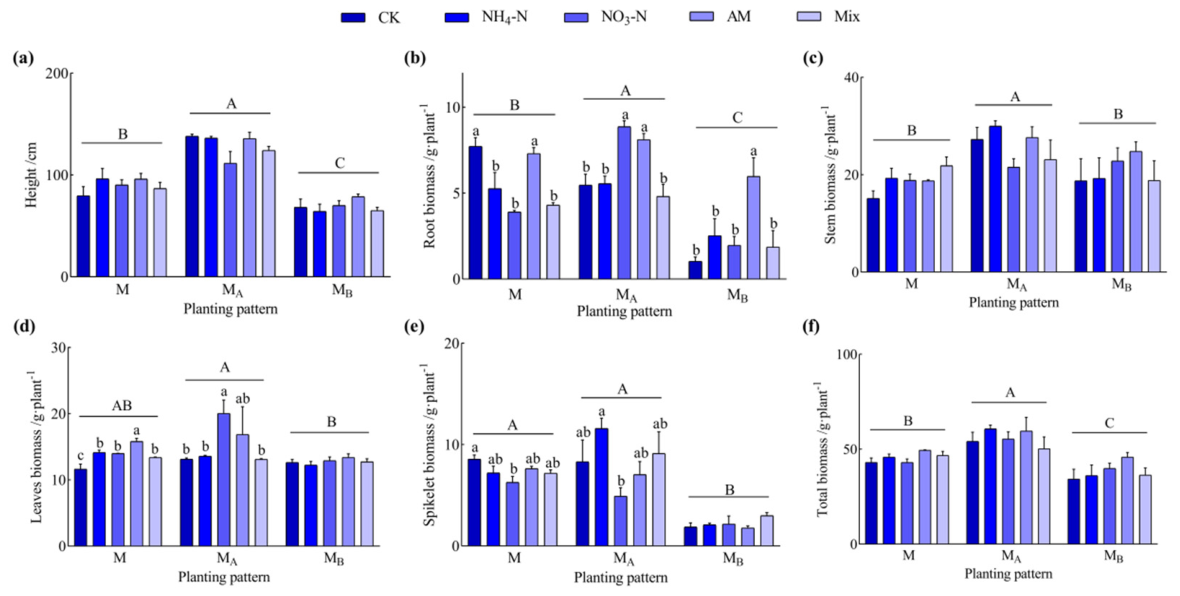
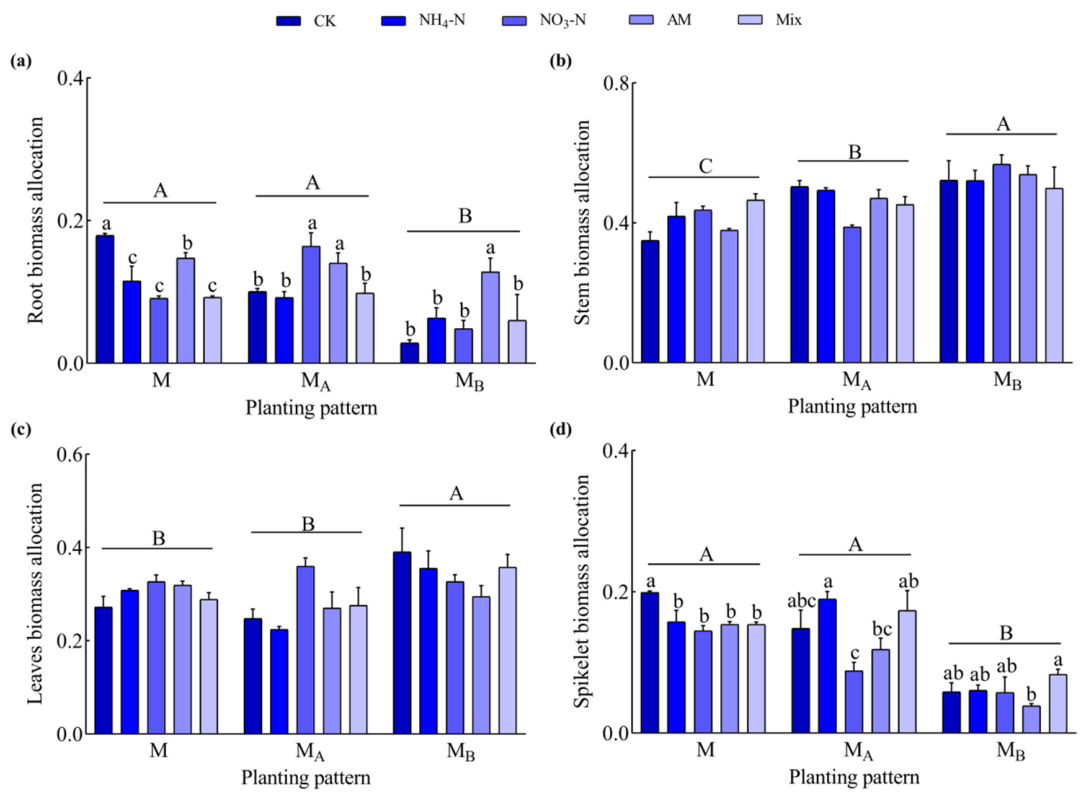
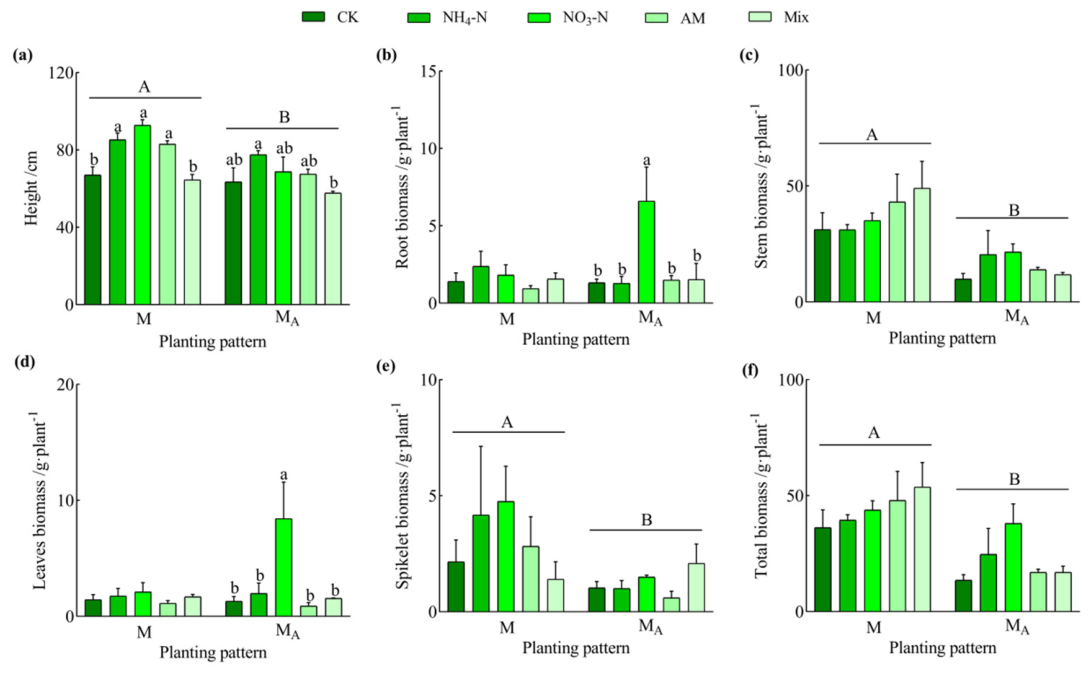
Planting pattern significantly affected the plant height of A. retroflexus (p < 0.001, Figure 1a, Table S1). Compared to monoculture (89.8 ± 6.25 cm), height increased by 43.8% in MA (129.1 ± 10.1 cm) and decreased by 22.8% in MB (69.3 ± 5.2 cm). Nitrogen form had no significant effect on plant height (p = 0.113). Planting pattern significantly affected root, stem, leaves, spikelet, and total biomass of A. retroflexus (p < 0.001, Figure 1b–f). Overall, these biomass variables showed either no significant difference or a promotional effect in MA and either no significant difference or inhibition in MB. In MA, NO3-N significantly increased root and leaf biomass of A. retroflexus, while reducing spikelet biomass. In MB, the effect of nitrogen form was relatively limited. Planting pattern significantly affected biomass allocation of A. retroflexus (p < 0.05, Figure 2). In MA, stem biomass proportion increased by 12.6% compared to monoculture (from 41.0 ± 4.1% to 46.2 ± 4.1%). In MB, root and spikelet biomass proportions decreased, while stem and leaf biomass proportions increased. In MA, NO3-N significantly increased root biomass proportion and reduced spikelet biomass proportion. In MB, neither NO3-N nor NH4+-N significantly affected biomass allocation of M. sativa (p > 0.05).
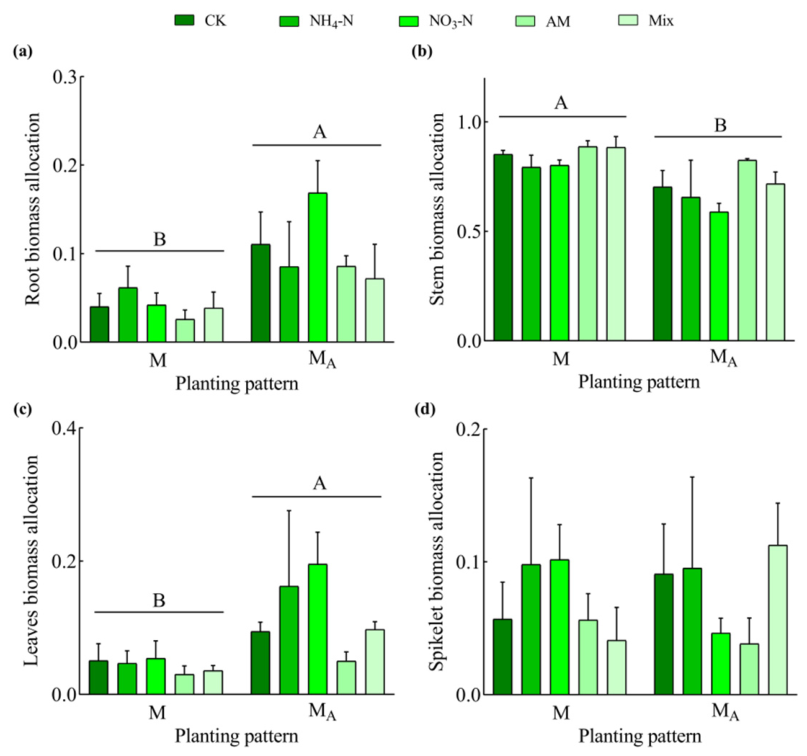
Planting pattern significantly affected plant height, stem, spikelet, and total biomass of P. oleracea (p < 0.05, Table S2), all of which were significantly inhibited in MA (p < 0.05; Figure 3a,c,e,f). Nitrogen form significantly affected root and leaf biomass in MA, with NO3-N treatment significantly higher than other nitrogen forms (p < 0.05; Figure 3b,d). Planting pattern significantly affected root, stem, and leaf biomass proportions (p < 0.05; Figure 4a–c). Compared to monoculture, MA increased root biomass proportion (from 4.2 ± 1.1% to 10.5 ± 3.4%) and leaf biomass proportion (from 4.4 ± 0.9% to 12.0 ± 5.2%) while reducing stem biomass proportion (from 84.4 ± 4.0% to 69.9 ± 7.8%). Spikelet biomass proportion was not significantly affected by planting pattern (p > 0.05; Figure 4d).
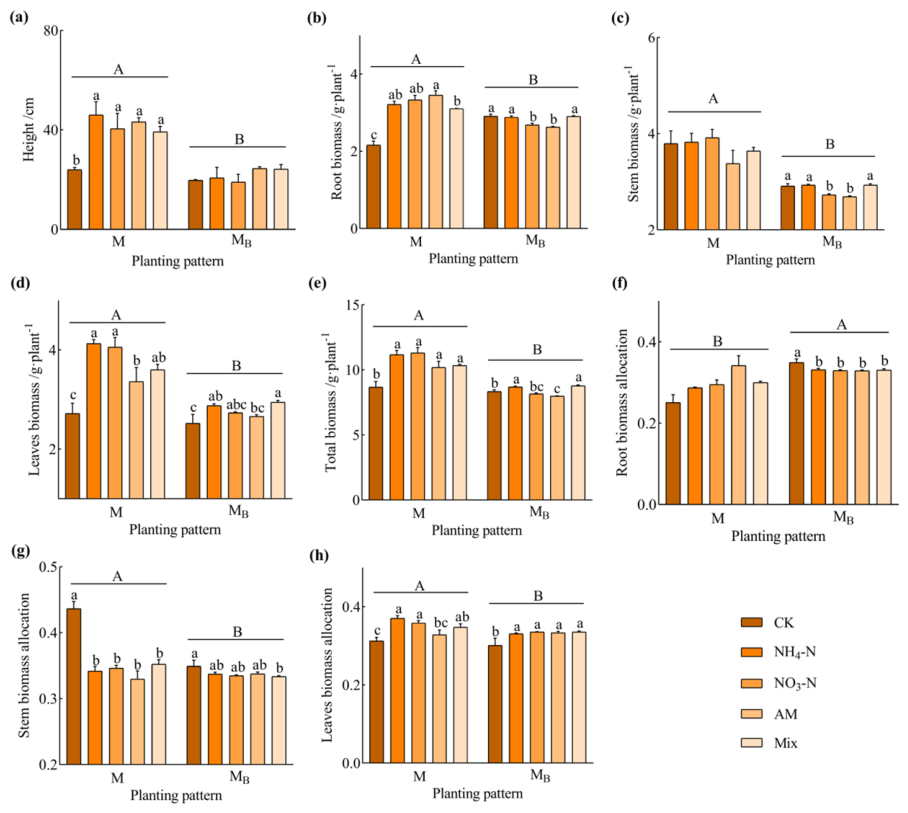
Planting pattern significantly affected plant height, biomass, and biomass allocation of M. sativa (p < 0.05; Figure 5, Table S3). All measured variables were inhibited in MB, except root biomass proportion, which increased compared to monoculture. In MB, stem, leaf, and total biomass were lower under NO3-N and CO(NH2)2-N treatments than under NH4+-N and Mix-N treatments. Similarly, nitrogen form significantly affected biomass allocation in MB (p < 0.05; Figure 5f–h).

3.2. Leaf Characteristics

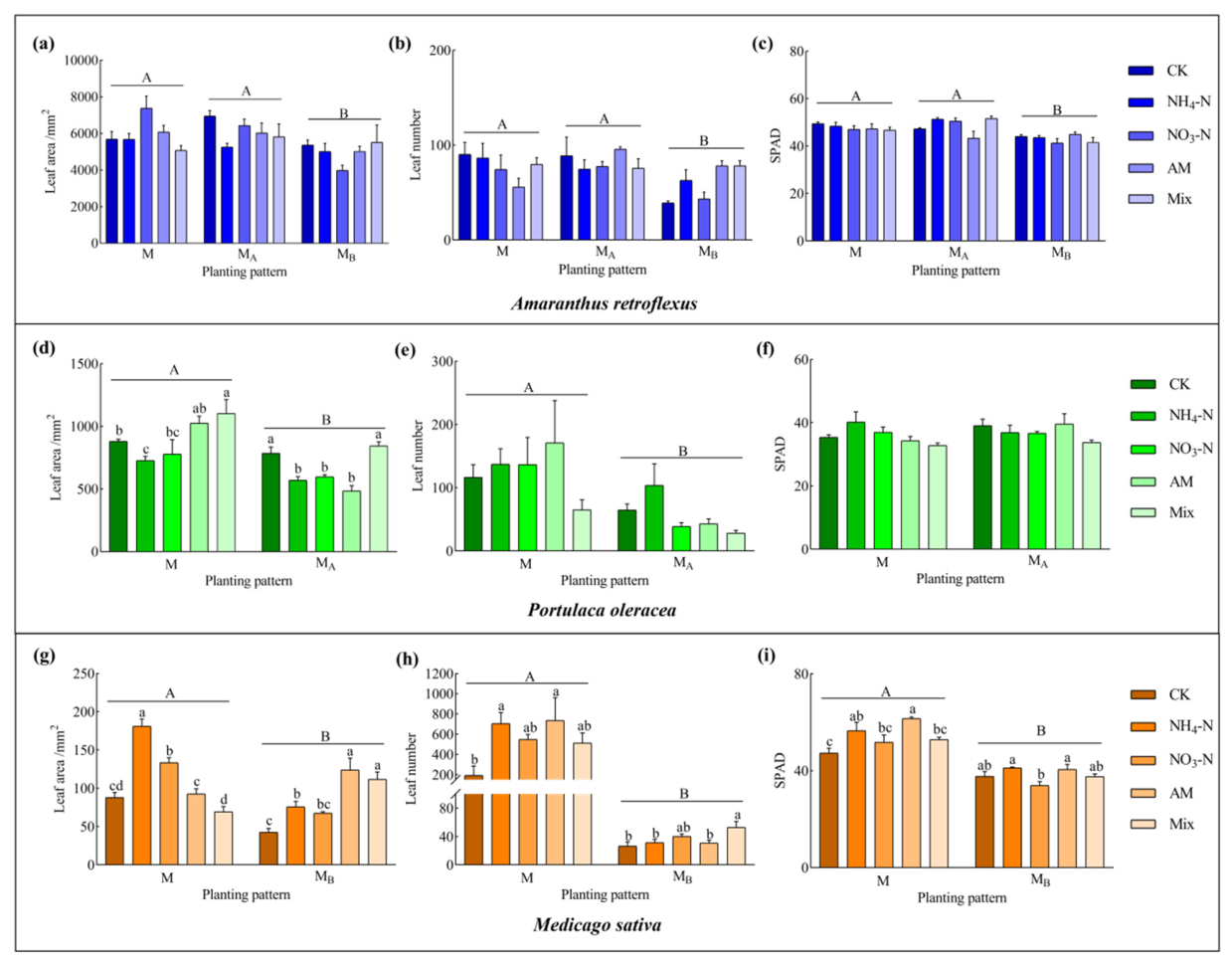
Leaf area, leaf number, and SPAD value of A. retroflexus (Figure 6a–c) showed no significant differences between monoculture and MA (p > 0.05) but were significantly lower in MB than in monoculture (p < 0.05). For P. oleracea, leaf area and leaf number were significantly lower in MA than in monoculture (decreased by over 55%), whereas SPAD value was not significantly affected. In MA, leaf area of P. oleracea was significantly lower under NH4+-N, NO3-N and CO(NH2)2-N treatments than CK and Mix-N. Both planting pattern and nitrogen form significantly affected leaf area, leaf number, and SPAD value of M. sativa. Leaf number in MB (36 ± 9) decreased by over 93% compared to monoculture (538 ± 193). In MB, nitrogen form significantly affected leaf traits of M. sativa, with Mix-N generally performing better across all indicators (Figure 6g–i).

3.3. Plant Nutrients

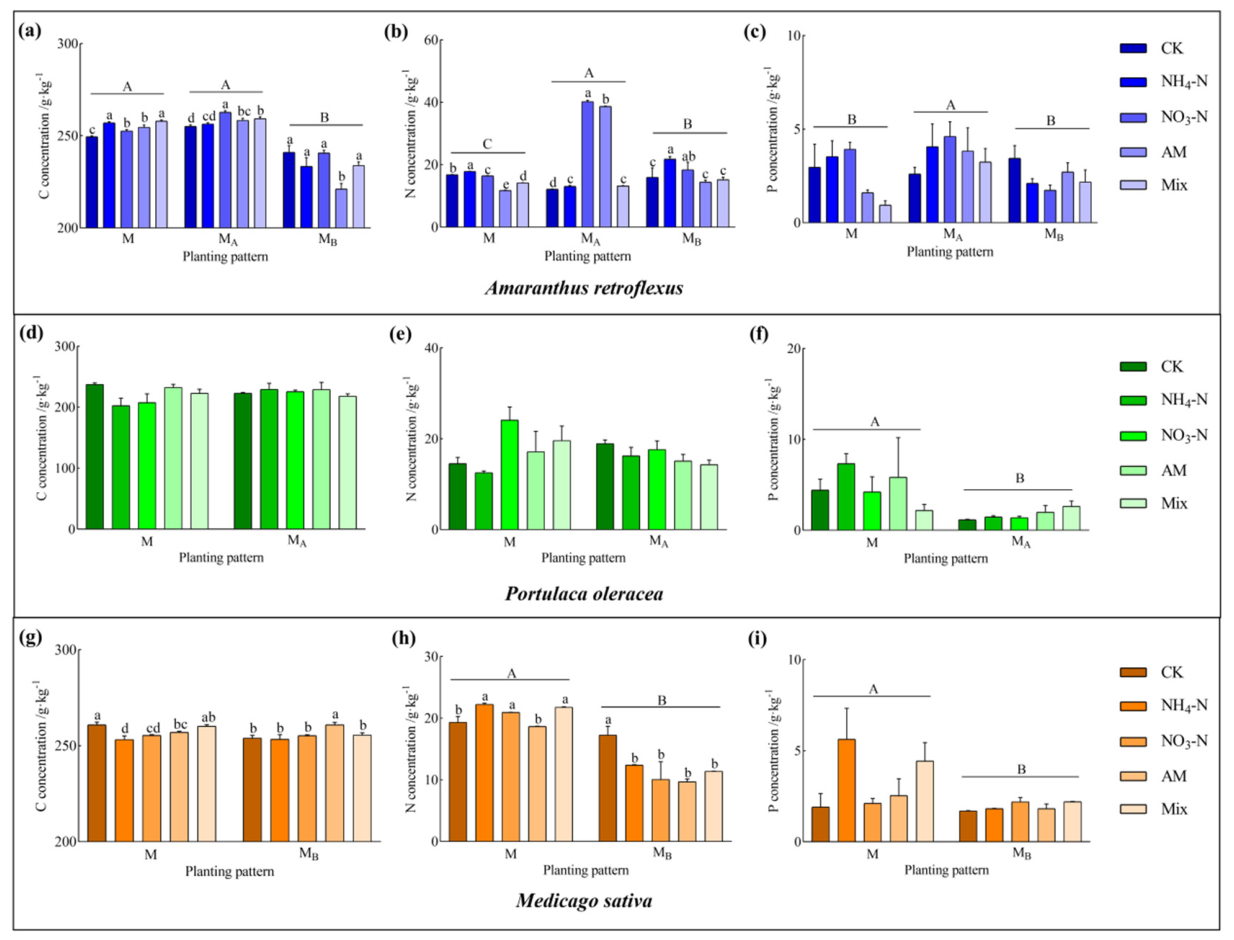
Planting pattern significantly affected plant carbon, nitrogen and phosphorus concentrations of A. retroflexus (p < 0.05; Figure 7a–c). Under the MA pattern, N and P concentrations were significantly increased compared with monoculture. Under the MB pattern, C concentration decreased, while N concentration increased. Nitrogen form also exerted a significant effect on the N content of A. retroflexus. Specifically, under the MA pattern, the highest N concentrations were observed with NO3-N (40.22 ± 0.40 g·kg−1) and CO(NH2)2-N (38.65 ± 0.16 g·kg−1), which were significantly higher than those under other treatments (12.18–13.24 g·kg−1). For P. oleracea, planting pattern and nitrogen form had no significant effect on C and N concentrations. However, planting pattern significantly influenced P concentration, with intercropping leading to a notable reduction in P concentration (p < 0.05; Figure 7f). In Medicago sativa, planting pattern significantly affected N and P concentrations (p < 0.05; Figure 7h–i), both of which decreased considerably under intercropping (MB). Under the MB pattern, the addition of exogenous nitrogen reduced the N concentration of M. sativa (Figure 7h).

3.4. Soil Nutrients

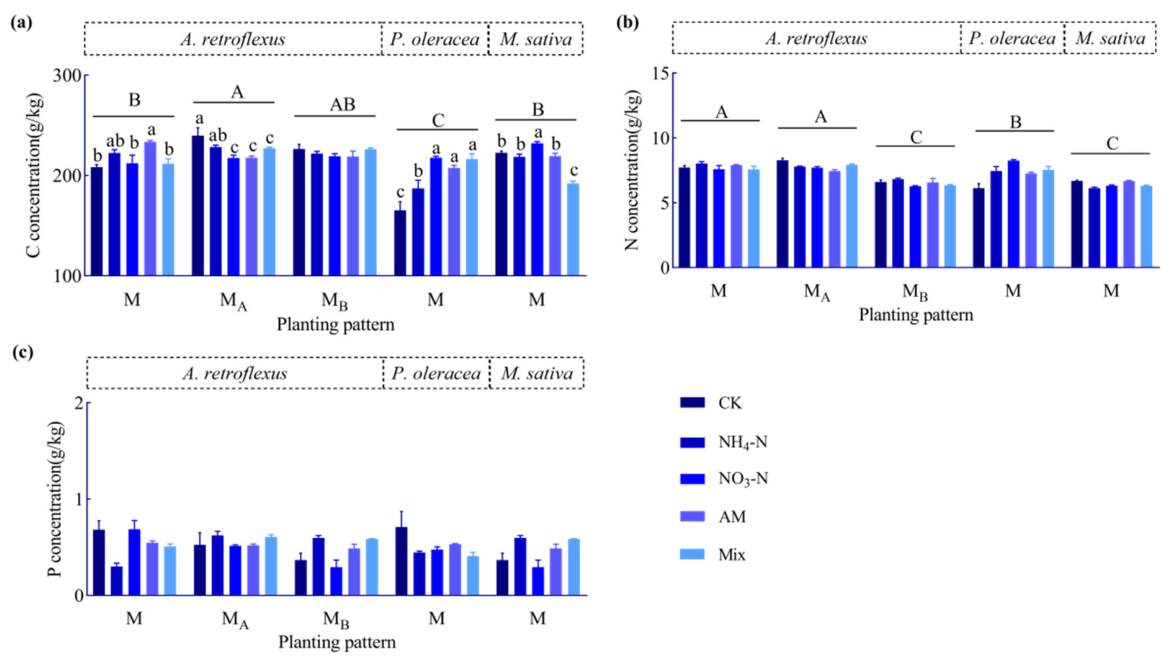
When A. retroflexus was grown in mixture with P. oleracea, soil carbon concentration was significantly higher than in their respective monocultures (p < 0.001), whereas no significant difference was observed when grown with M. sativa (Figure 8a). In the mixture of A. retroflexus and P. oleracea, soil nitrogen concentration showed little difference from A. retroflexus monoculture but was higher than P. oleracea monoculture. In the mixture with M. sativa, soil nitrogen content did not differ significantly from M. sativa monoculture but was lower than A. retroflexus monoculture (Figure 8b). Planting pattern and nitrogen form had no significant effect on the soil’s phosphorus concentration (Figure 8c).
Competitive indices further quantified these competitive differences (Table S4). Mixed planting of A. retroflexus with P. oleracea increased the relative yield of A. retroflexus but suppressed that of P. oleracea. The weakest inhibitory effect was observed under NO3-N treatment (Table 2). Under this nitrogen form, the total relative yield of both species was the highest (1.0780), and the competitive balance index was the lowest (0.3932), indicating that differences in nitrogen utilization mitigated interspecific competition. All indices indicated that mixed planting of A. retroflexus with M. sativa suppressed both species. Among nitrogen forms, CO(NH2)2-N and NO3-N imposed the least suppression on the relative yield of A. retroflexus, whereas the relative yield of M. sativa was not significantly affected by nitrogen form. The competitive balance index further demonstrated that nitrogen addition generally enhanced the competitive advantage of A. retroflexus, most notably under NO3-N and CO(NH2)2-N treatments.

4. Discussion

4.1. Effects of Planting Pattern and Nitrogen Forms on Biomass and Morphological Characteristics

This study further support the “hypothesis of the evolution of nitrogen allocation” [24], which posits that invasive plants can gain a growth advantage in competition by adjusting the allocation ratio of nitrogen between photosynthetic tissues and defensive structures [11,14,25]. When grown in mixture with P. oleracea, A. retroflexus exhibited stronger competitive ability by significantly increasing its own plant height and total biomass (particularly in roots and stems) while suppressing the height and total biomass of P. oleracea [26,27]. This competitive asymmetry may be partly explained by the inherent size disparity between the two species: A. retroflexus is a tall annual (60–150 cm, Figure S1) with an erect habit, whereas P. oleracea is a prostrate herb (typically 10–30 cm tall). The taller stature enables A. retroflexus to preempt light resources and dominate the vertical canopy, leading to size-asymmetric competition—a phenomenon where larger individuals acquire a disproportionate share of contested resources [28]. Such growth advantage aligns with the majority of successful invasion cases [29,30]. As a C4 plant, A. retroflexus exhibits strong leaf plasticity. Its leaves are less affected during competition, allowing it to maintain well-developed photosynthetic structures (e.g., high leaf number and area) throughout the competitive process [26]. In contrast, both leaf area and leaf number in P. oleracea were significantly suppressed. The limited influence of nitrogen form on the competitive outcome between the two C4 species may reflect their shared photosynthetic pathway and potentially similar nitrogen utilization patterns, although direct measurements of nitrogen uptake kinetics or transporter expression would be needed to verify this inference [31].
The invasive advantage can vary depending on the identity of the native species [1,30]. For instance, both A. retroflexus and M. sativa exhibited reductions in plant height and biomass when competing with each other, and the decline of M. sativa was greater, indicating that the invasive plant still holds a relative growth advantage [32]. Notably, when competing with M. sativa (MB), the root biomass of A. retroflexus decreased by 53.2% compared to monoculture, which was substantially higher than the reduction in its aboveground parts (stem: 11.2%; leaf: 7.3%). This contrasts with studies reporting increased root biomass in invasive plants under mixed planting, such as in Solidago canadensis [33], Lonicera japonica [34], as well as the response of A. retroflexus when competing with P. oleracea in this study, where root biomass increased relative to monoculture. This suggests that the nitrogen-fixing capacity of M. sativa may have partially suppressed the invasive advantage of A. retroflexus, providing support for the potential use of leguminous plants in biological control strategies. Leaf traits of A. retroflexus were less inhibited or maintained under competition (e.g., leaf biomass), whereas the corresponding indices in M. sativa were significantly reduced [3,35]. The difference was most pronounced in leaf number. Concurrently, the decline in leaf SPAD value was also smaller in A. retroflexus than in M. sativa [30]. These results are consistent with a pattern of preferential resource allocation to aboveground organs under competition, which may help A. retroflexus sustain photosynthetic capacity. This pattern aligns with the nitrogen allocation hypothesis, which predicts that invasive plants will increase the allocation of nutrients to photosynthetic organs. Furthermore, nitrogen forms (e.g., CO(NH2)2-N) were found to modulate the biomass allocation pattern of A. retroflexus (such as increasing root biomass proportion and reducing inflorescence biomass proportion) and influence its competitive outcome with M. sativa, indicating that differences in nitrogen forms can reshape interspecific competitive relationships [3,36].
Both A. retroflexus and P. oleracea share the C4 photosynthetic pathway, which may explain why nitrogen forms had a relatively limited effect on their competitive outcome. When competing with M. sativa (which reaches 60–100 cm in height), the height advantage of A. retroflexus is less pronounced than when facing P. oleracea, allowing nitrogen forms to exert a stronger modulating role on the competitive outcome [37]. In contrast, M. sativa is a C3 legume, and the differential competitive responses observed between the two mixed-culture systems may partly reflect differences in photosynthetic efficiency and nitrogen metabolism between C3 and C4 plants. Future studies should directly compare C3 and C4 natives to disentangle pathway effects from other functional traits.

4.2. Effects of Planting Pattern and Nitrogen Forms on Plant and Soil Nutrients

According to the “fluctuating-resources hypothesis”, invasive plants are generally more proficient at exploiting nutrient-rich environments. They demonstrate enhanced nutrient utilization and invasion capacity under nitrogen addition [37,38]. Previous studies have shown that invasive plants achieve rapid expansion by enhancing their utilization of NH4+-N resources [35,39]. In this study, the competitive advantage of A. retroflexus was largely due to its efficient utilization of NO3-N and CO(NH2)2-N [40], a phenomenon also corroborated in its competition with soybean [41]. The response of invasive plants to nitrogen is further modulated by the traits of native species [42]. For example, when grown with M. sativa, the advantage of A. retroflexus was primarily due to higher utilization efficiencies of NH4+-N and NO3-N, concurrently suppressing the nitrogen use efficiency of M. sativa. These findings suggest that nitrogen uptake patterns of invasive plants may be flexible and responsive to the identity of competing species and available soil nitrogen forms [7,43,44], although the present study did not directly quantify N-form uptake rates or preferences.
The nitrogen uptake preference of invasive plants could also influence soil nitrogen-cycling patterns. For instance, species that prefer NH4+-N may lead to the accumulation of ammonium ions in the soil [45], while those favoring NO3-N may promote higher nitrate ion content [46]. In this study, there were significant differences in soil carbon content and carbon-to-nitrogen ratio among different planting patterns. In the mixed-planting treatments, both soil carbon content and carbon-to-nitrogen ratio showed an upward trend. This could be related to the increased nitrogen demand resulting from the rapid growth of invasive plants and a relative increase in carbon retention in the soil [47,48,49].

4.3. Effects of Planting Pattern and Nitrogen Forms on Competitiveness

A. retroflexus achieved population expansion by competing with P. oleracea for the same nitrogen resources. This competitive interaction resulted in a net facilitative effect on A. retroflexus and a net inhibitory effect on P. oleracea (Table 2), which aligns with most invasive processes [25,41]. The competitive effect is modulated by nitrogen forms. NH4+-N exerts the strongest facilitative effect on A. retroflexus, whereas NO3-N weakens this effect. Its nitrogen optimization strategy is similar to that of species such as Spartina alterniflora [40]. However, the competitive advantage of invasive plants is not constant and regulated by species traits and environmental conditions [50,51]. For example, nitrogen addition improved the competitive advantage of A. retroflexus to some extent in this study, but a net competitive interaction between the two species was still maintained. This may stem from the nitrogen-fixing capacity of M. sativa, although we did not directly measure nodulation or nitrogenase activity in this study. Previous studies have shown that alfalfa can fix atmospheric N2 under similar conditions [16], which could partially offset the competitive effect of A. retroflexus. Similar conclusions have been validated in competitive studies involving Oenothera biennis, Chenopodium album, and Artemisia argyi [42]. Under NO3-N treatment, A. retroflexus exhibited the greatest competitive advantage likely because nitrate suppresses nitrogenase activity, which reduced nitrogen uptake by M. sativa [52]. Therefore, when evaluating the competitive mechanisms of invasive plants, it is necessary to integrate both native plant traits and nitrogen forms to account for the confounding effects of nitrogen fixation and differences in nitrogen uptake preferences. It should also be noted that the positive RII values observed in this study more likely reflect reduced competitive suppression rather than true facilitation. This is because resource-driven facilitation is biologically implausible in short-term pot experiments between invasive and native species.
These findings may inform integrated weed management. In China, A. retroflexus is primarily controlled by acetochlor and atrazine in maize and soybean fields, but populations resistant to atrazine and other herbicides have been widely documented, which has motivated interest in alternative cultural strategies [53]. Chinese farmers predominantly apply urea as the main nitrogen source, while nitrate- and ammonium-based fertilizers are also used in specific regions and cropping systems. Our results suggest that nitrogen form management—such as reducing nitrate-based fertilization in legume-containing systems—could serve as a complementary cultural practice to suppress invasive weed vigor. Field-scale studies are needed to validate these findings under agronomic conditions.

5. Conclusions

The competitive advantage of A. retroflexus is jointly determined by the type of native plant and the form of nitrogen. Its competitive performance is regulated by different nitrogen forms, with NO3-N playing a dominant role. Even under the same NO3-N condition, its competitive performance varies depending on the native species. NO3-N weakens the advantage of A. retroflexus by increasing the relative yield of P. oleracea when the two species compete. In contrast, NO3-N enhances the advantage of A. retroflexus by boosting its own relative yield when competing with M. sativa. The competitive advantage of A. retroflexus was associated with greater resource allocation to photosynthetic traits, consistent with the hypothesis that invasive plants prioritize investment in photosynthetic structures under competition. This finding reveals the competitive mechanisms in heterogeneous nitrogen environments. These results support the adaptive strategy in which invasive plants tend to allocate more resources to photosynthetic structures, contributing to a better understanding of trait-based competitive responses in heterogeneous nitrogen environments.

Supplementary Materials

The following supporting information can be downloaded at: https://www.mdpi.com/article/10.3390/nitrogen7020057/s1, Figure S1: Photographs of Amaranthus retroflexus: (a) pot-grown plants at 60 days after transplanting under greenhouse conditions, and (b) plants in the field at the Jiaozhou Experimental Base; Table S1: Analysis of variance (ANOVA) for plant height, biomass and allocation, leaf traits, and nutrients under different nitrogen forms and planting patterns of Amaranthus retroflexus with descriptive analysis; Table S2: Analysis of variance (ANOVA) for plant height, biomass and allocation, leaf traits, and nutrients under different nitrogen forms and planting patterns of Portulaca oleracea with descriptive analysis; Table S3: Analysis of Variance (ANOVA) for plant height, biomass and allocation, leaf traits, and nutrients under different nitrogen forms and planting patterns of Medicago sativa with descriptive analysis; Table S4: Analysis of variance (ANOVA) for soil nutrients under different nitrogen forms and planting patterns with descriptive analysis.

Author Contributions

Conceptualization, F.Y. and J.C.; Methodology, F.Y., Y.Z., W.W., L.X., J.Z. and J.C.; Software, F.Y., Y.Z., W.W. and L.X.; Validation, F.Y., Y.Z., W.W. and J.C.; Formal analysis, F.Y., W.W., L.X., J.Z. and J.C.; Investigation, F.Y., Y.Z., W.W., L.X., J.Z. and J.C.; Resources, J.C.; Data curation, F.Y., Y.Z., W.W., L.X., J.Z. and J.C.; Writing—original draft, F.Y., Y.Z. and J.C.; Writing—review & editing, F.Y. and J.C.; Supervision, J.C.; Project administration, J.C.; Funding acquisition, J.C. All authors have read and agreed to the published version of the manuscript.

Funding

This work was supported by the Key R&D Program of Shandong Province, China (2025CXPT149), the Natural Science Foundation of Shandong Province (Grant number: ZR2025QC246), and China Agriculture Research System (CARS-34).

Data Availability Statement

The raw data supporting the conclusions of this article will be made available by the authors on request.

Conflicts of Interest

The authors declare no conflicts of interest.

References

  1. Xiang, C.; Wang, X.; Chen, Y.; Liu, L.; Li, M.; Wang, T.; Sun, Y.; Li, H.; Guo, X. Nitrogen deposition enhances the competitive advantage of invasive plant species over common native species through improved resource acquisition and absorption. Ecol. Process. 2024, 13, 61. [Google Scholar] [CrossRef]
  2. Bezabih Beyene, B.; Li, J.; Yuan, J.; Dong, Y.; Liu, D.; Chen, Z.; Kim, J.; Kang, H.; Freeman, C.; Ding, W. Non-native plant invasion can accelerate global climate change by increasing wetland methane and terrestrial nitrous oxide emissions. Glob. Change Biol. 2022, 28, 5453–5468. [Google Scholar] [CrossRef]
  3. Sun, J.K.; Liu, M.C.; Chen, J.X.; Qu, B.; Gao, Y.; Geng, L.; Zheng, L.; Feng, Y.L. Higher Nitrogen Uptakes Contribute to Growth Advantage of Invasive Solanum rostratum over Two Co-Occurring Natives Under Different Soil Nitrogen Forms and Concentrations. Plants 2025, 14, 640. [Google Scholar] [CrossRef]
  4. Sun, Y.; Liu, M.; Song, M.; Tian, Y.; Xu, X. Interactions between neighboring native and alien species are modulated by nitrogen availability. Rhizosphere 2020, 16, 100242. [Google Scholar] [CrossRef]
  5. Guan, M.; Pan, X.-C.; Sun, J.-K.; Chen, J.-X.; Kong, D.-L.; Feng, Y.-L. Nitrogen acquisition strategy and its effects on invasiveness of a subtropical invasive plant. Front. Plant Sci. 2023, 14, 1243849. [Google Scholar] [CrossRef]
  6. Ashton, I.W.; Miller, A.E.; Bowman, W.D.; Suding, K.N. Niche complementarity due to plasticity in resource use: Plant partitioning of chemical N forms. Ecology 2010, 91, 3252–3260. [Google Scholar] [CrossRef]
  7. Chang, X.; Wang, W.; Zhou, H. Nitrogen Acquisition by Invasive Plants: Species Preferential N Uptake Matching with Soil N Dynamics Contribute to Its Fitness and Domination. Plants 2025, 14, 748. [Google Scholar] [CrossRef] [PubMed]
  8. Yu, H.; He, W. Plant invaders outperform congeneric natives on amino acids. Basic Appl. Ecol. 2021, 54, 75–84. [Google Scholar] [CrossRef]
  9. Yu, H.; He, W.; Osborne, B. Congeneric invasive versus native plants utilize similar inorganic nitrogen forms but have disparate use efficiencies. J. Plant Ecol. 2021, 14, 180–190. [Google Scholar] [CrossRef]
  10. Huangfu, C.; Li, H.; Chen, X.; Liu, H.; Wang, H.; Yang, D. Response of an invasive plant, Flaveria bidentis, to nitrogen addition: A test of form-preference uptake. Biol. Invasions 2016, 18, 3365–3380. [Google Scholar] [CrossRef]
  11. Luo, J.; Gao, Y.; Feng, W.; Liu, M.; Qu, B.; Zhang, C.; Feng, Y. Stronger ability to absorb nitrate and associated transporters in the invasive plant Xanthium strumarium compared with its native congener. Environ. Exp. Bot. 2022, 198, 104851. [Google Scholar] [CrossRef]
  12. Zhang, Z.; Zhang, C.; Zhang, C.; Wang, W.; Feng, Y. Differences and related physiological mechanisms in effects of ammonium on the invasive plant Xanthium strumarium and its native congener X. sibiricum. Front. Plant Sci. 2022, 13, 999748. [Google Scholar] [CrossRef] [PubMed]
  13. Kama, R.; Javed, Q.; Bo, Y.; Imran, M.A.; Filimban, F.Z.; Li, Z.; Nong, X.; Diatta, S.; Ren, G.; Eldin, S.M.; et al. Identity and Diversity of Invasive Plant Affecting the Growth of Native Lactuca indica. ACS Omega 2023, 8, 17983–17991. [Google Scholar] [CrossRef]
  14. Jiang, B.; Zhou, X.; Lu, P.; Li, Q.; Yang, H.; Feike, T.; Zhang, L.; Guan, J.; Zhao, W.; Liu, H. Nitrogen Pulse and Competition Affects Nitrogen Metabolism in Invasive Weed (Amaranthus retroflexus) and Native Crop (Glycine max). Sustainability 2020, 12, 772. [Google Scholar] [CrossRef]
  15. Roiloa, S.R.; Lu, P.; Li, J.; Jin, C.; Jiang, B.; Bai, Y. Different Growth Responses of an Invasive Weed and a Native Crop to Nitrogen Pulse and Competition. PLoS ONE 2016, 11, e0156285. [Google Scholar] [CrossRef]
  16. Shao, Z.; Zheng, C.; Postma, J.A.; Lu, W.; Gao, Q.; Gao, Y.; Zhang, J. Nitrogen acquisition, fixation and transfer in maize/alfalfa intercrops are increased through root contact and morphological responses to interspecies competition. J. Integr. Agric. 2021, 20, 2240–2254. [Google Scholar] [CrossRef]
  17. Feng, W.; Huang, K.; Sun, S.; Sun, J.; Guan, M.; Qi, F.; Liu, M.; Qu, B.; Feng, Y. Planting patterns affect the differences in growth and its responses to nitrogen forms and levels between three invasive and their respective related native species. Plants 2025, 14, 1768. [Google Scholar] [CrossRef]
  18. Han, M.; Zhang, H.; Liu, M.; Tang, J.; Guo, X.; Ren, W.; Zhao, Y.; Yang, Q.; Guo, B.; Han, Q.; et al. Increased dependence on nitrogen-fixation of a native legume in competition with an invasive plant. Plant Divers. 2024, 46, 510–518. [Google Scholar] [CrossRef]
  19. César, O.; Rosario, G.; Elvia, B.; Rocío, T.; Víctor, H.; Jesús, M. Bioactive compounds of purslane (Portulaca oleracea L.) according to the production system: A review. Sci. Hortic. 2023, 308, 111584. [Google Scholar] [CrossRef]
  20. Ojija, F.; Ngimba, C. Suppressive abilities of legume fodder plants against the invasive weed Parthenium hysterophorus (Asteraceae). Environ. Sustain. Indic. 2021, 10, 100111. [Google Scholar] [CrossRef]
  21. Weigelt, A.; Jolliffe, P. Indices of plant competition. J. Ecol. 2003, 91, 707–720. [Google Scholar] [CrossRef]
  22. Armas, C.; Ordiales, R.; Pugnaire, F. Measuring plant interactions: A new comparative index. Ecology 2004, 85, 2682–2686. [Google Scholar] [CrossRef]
  23. Ma, G.; Du, X.R. Research on the Application of Continuous Flow Analyzer in the Determination of Total Phosphorus, Total Nitrogen and Ammonia Nitrogen. In The 40th Anniversary Academic Exchange Conference of “Water Resources Protection” and the 2025 (13th) Water Ecology Conference; Hohai University: Nanjing, China, 2025. [Google Scholar]
  24. Feng, Y.; Lei, Y.; Wang, R.; Callaway, R.M.; Valiente-Banuet, A.; Inderjit; Li, Y.; Zheng, Y. Evolutionary tradeoffs for nitrogen allocation to photosynthesis versus cell walls in an invasive plant. Proc. Natl. Acad. Sci. USA 2009, 106, 1853–1856. [Google Scholar] [CrossRef] [PubMed]
  25. Shan, L.; Oduor, A.M.O.; Huang, W.; Liu, Y. Nutrient enrichment promotes invasion success of alien plants via increased growth and suppression of chemical defenses. Ecol. Appl. 2023, 34, e2791. [Google Scholar] [CrossRef]
  26. Hamidzadeh Moghadam, S.; Alebrahim, M.T.; Mohebodini, M.; MacGregor, D.R. Genetic variation of Amaranthus retroflexus L. and Chenopodium album L. (Amaranthaceae) suggests multiple independent introductions into Iran. Front. Plant Sci. 2023, 13, 1024555. [Google Scholar] [CrossRef]
  27. Matos, C.; Ward, D.; Schöb, C. Invasive grass species do not have priority effects. J. Plant Ecol. 2025, 18, rtaf053. [Google Scholar] [CrossRef]
  28. Schwinning, S.; Weiner, J. Mechanisms determining the degree of size asymmetry in competition among plants. Oecologia 1998, 113, 447–455. [Google Scholar] [CrossRef]
  29. Van Kleunen, M.; Weber, E.; Fischer, M. A meta-analysis of trait differences between invasive and non-invasive plant species. Ecol. Lett. 2010, 13, 235–245. [Google Scholar] [CrossRef]
  30. Sun, J.K.; Liu, M.C.; Tang, K.Q.; Tang, E.X.; Cong, J.M.; Lu, X.R.; Liu, Z.X.; Feng, Y.L. Advantages of growth and competitive ability of the invasive plant Solanum rostratum over two co-occurring natives and the effects of nitrogen levels and forms. Front. Plant Sci. 2023, 14, 1169317. [Google Scholar] [CrossRef] [PubMed]
  31. Yuan, Y.; Guo, W.; Ding, W.; Du, N.; Luo, Y.; Liu, J.; Xu, F.; Wang, R. Competitive interaction between the exotic plant Rhus typhina L. and the native tree Quercus acutissima Carr. in Northern China under different soil N:P ratios. Plant Soil 2013, 372, 389–400. [Google Scholar] [CrossRef]
  32. Catford, J.A.; Jansson, R.; Nilsson, C. Reducing redundancy in invasion ecology by integrating hypotheses into a single theoretical framework. Divers. Distrib. 2008, 15, 22–40. [Google Scholar] [CrossRef]
  33. Ren, G.; Li, Q.; Li, Y.; Li, J.; Opoku Adomako, M.; Dai, Z.; Li, G.; Wan, L.; Zhang, B.; Zou, C.B.; et al. The enhancement of root biomass increases the competitiveness of an invasive plant against a co-occurring native plant under elevated nitrogen deposition. Flora 2019, 261, 151486. [Google Scholar] [CrossRef]
  34. Jo, I.; Fridley, J.D.; Frank, D.A. Linking above- and belowground resource use strategies for native and invasive species of temperate deciduous forests. Biol. Invasions 2014, 17, 1545–1554. [Google Scholar] [CrossRef]
  35. Huang, F.; Zhou, G.; Liao, H.; Fan, Z.; Chen, B. Simulated nitrogen deposition induces shifts in growth and resource-use strategies during range expansion of an invasive plant. Biol. Invasions 2022, 24, 621–633. [Google Scholar] [CrossRef]
  36. Liu, Y.; van Kleunen, M. Nitrogen acquisition of Central European herbaceous plants that differ in their global naturalization success. Funct. Ecol. 2019, 33, 566–575. [Google Scholar] [CrossRef]
  37. Jacob, W. Asymmetric competition in plant populations. Trends Ecol. Evol. 1990, 5, 360–364. [Google Scholar] [CrossRef]
  38. Seabloom, E.W.; Borer, E.T.; Buckley, Y.M.; Cleland, E.E.; Davies, K.F.; Firn, J.; Harpole, W.S.; Hautier, Y.; Lind, E.M.; MacDougall, A.S.; et al. Plant species’ origin predicts dominance and response to nutrient enrichment and herbivores in global grasslands. Nat. Commun. 2015, 6, 7710. [Google Scholar] [CrossRef]
  39. Li, W.; Wang, L.; Qian, S.; He, M.; Cai, X.; Ding, J. Root characteristics explain greater water use efficiency and drought tolerance in invasive Compositae plants. Plant Soil 2022, 483, 209–223. [Google Scholar] [CrossRef]
  40. Li, Q.; Zhang, X.; Liang, J.; Gao, J.; Xu, X.; Yu, F. High nitrogen uptake and utilization contribute to the dominance of invasive Spartina alterniflora over native Phragmites australis. Biol. Fertil. Soils 2021, 57, 1007–1013. [Google Scholar] [CrossRef]
  41. Etminani, A.; Mohammadi, K.; Saberali, S.F. Effects of fertilizer on growth and yield of red beans under competition conditions with Amaranthus retroflexus. J. Plant Nutr. 2021, 45, 426–438. [Google Scholar] [CrossRef]
  42. Guo, X.; Hu, Y.; Ma, J.Y.; Wang, H.; Wang, K.L.; Wang, T.; Jiang, S.Y.; Jiao, J.B.; Sun, Y.K.; Jiang, X.L.; et al. Nitrogen Deposition Effects on Invasive and Native Plant Competition: Implications for Future Invasions. Ecotoxicol. Environ. Saf. 2023, 259, 115029. [Google Scholar] [CrossRef]
  43. Li, J.; He, J.Z.; Liu, M.; Yan, Z.Q.; Xu, X.L.; Kuzyakov, Y. Invasive plant competitivity is mediated by nitrogen use strategies and rhizosphere microbiome. Soil Biol. Biochem. 2024, 192, 109361. [Google Scholar] [CrossRef]
  44. Yu, H.; Le Roux, J.J.; Jiang, Z.; Sun, F.; Peng, C.; Li, W. Soil nitrogen dynamics and competition during plant invasion: Insights from Mikania micrantha invasions in China. New Phytol. 2020, 229, 3440–3452. [Google Scholar] [CrossRef]
  45. Chen, W.; Chen, B.; Bohren, C. Considering the preferences for nitrogen forms by invasive plants: A case study from a hydroponic culture experiment. Weed Res. 2018, 59, 49–57. [Google Scholar] [CrossRef]
  46. Liao, C.; Peng, R.; Luo, Y.; Zhou, X.; Wu, X.; Fang, C.; Chen, J.; Li, B. Altered ecosystem carbon and nitrogen cycles by plant invasion: A meta-analysis. New Phytol. 2007, 177, 706–714. [Google Scholar] [CrossRef]
  47. Zhang, Y.; Ding, W.; Luo, J.; Donnison, A. Changes in soil organic carbon dynamics in an Eastern Chinese coastal wetland following invasion by a C4 plant Spartina alterniflora. Soil Biol. Biochem. 2010, 42, 1712–1720. [Google Scholar] [CrossRef]
  48. Ren, G.; Zou, C.; Wan, L.; Johnson, J.H.; Li, J.; Zhu, L.; Qi, S.; Dai, Z.; Zhang, H.; Du, D.; et al. Interactive effect of climate warming and nitrogen deposition may shift the dynamics of native and invasive species. J. Plant Ecol. 2021, 14, 84–95. [Google Scholar] [CrossRef]
  49. Yin, L.; Zhang, G.; Zhao, H.; Zhang, Y.; Wangchen, J.; Wan, F.; Liu, B.; Qian, W. Inhibition of the invasive plant Ambrosia trifida by Sigesbeckia glabrescens extracts. Ecotoxicol. Environ. Saf. 2025, 289, 117716. [Google Scholar] [CrossRef] [PubMed]
  50. Wang, Y.; Chen, D.; Yan, R.; Yu, F.; van Kleunen, M. Invasive alien clonal plants are competitively superior over co-occurring native clonal plants. Perspect. Plant Ecol. Evol. Syst. 2019, 40, 125484. [Google Scholar] [CrossRef]
  51. Pyšek, P.; Čuda, J.; Šmilauer, P.; Skálová, H.; Chumová, Z.; Lambertini, C.; Lučanová, M.; Ryšavá, H.; Trávníček, P.; Šemberová, K.; et al. Competition among native and invasive Phragmites australis populations: An experimental test of the effects of invasion status, genome size, and ploidy level. Ecol. Evol. 2020, 10, 1106–1118. [Google Scholar] [CrossRef]
  52. Wang, Q.; Huang, Y.; Ren, Z.; Zhang, X.; Ren, J.; Su, J.; Zhang, C.; Tian, J.; Yu, Y.; Gao, G.F.; et al. Transfer cells mediate nitrate uptake to control root nodule symbiosis. Nat. Plants 2020, 6, 800–808. [Google Scholar] [CrossRef]
  53. Guo, Y.; Wang, Y.; Zang, X.; Luo, C.; Huang, C.; Cong, K.; Guo, X. Transcriptomic analysis of amaranthus retroflex resistant to ppo-inhibitory herbicides. PLoS ONE 2023, 18, e0288775. [Google Scholar] [CrossRef]
Figure 1. Plant height (a), root biomass (b), stem biomass (c), leaf biomass (d), spikelet biomass (e), and total biomass (f) of A. retroflexus under different nitrogen forms and planting patterns. Abbreviations: M, monoculture; MA, mixed culture of A. retroflexus with P. oleracea; MB, mixed culture of A. retroflexus with M. sativa. Uppercase and lowercase letters represent significant differences among planting patterns and nitrogen forms, respectively. The same conventions apply hereafter.
Nitrogen 07 00057 g001
Figure 2. Biomass allocation patterns of A. retroflexus under different nitrogen forms and planting patterns. (ad) represent the proportion of root, stem, leaf, and spikelet biomass, respectively.
Nitrogen 07 00057 g002
Figure 3. Plant height (a), root biomass (b), stem biomass (c), leaf biomass (d), spikelet biomass (e), and total biomass (f) of P. oleracea under different nitrogen forms and planting patterns.
Nitrogen 07 00057 g003
Figure 4. Biomass allocation patterns of P. oleracea under different nitrogen forms and planting patterns. (ad) represent the proportion of root, stem, leaf, and spikelet biomass, respectively.
Nitrogen 07 00057 g004
Figure 5. Plant height (a), root biomass (b), stem biomass (c), leaf biomass (d), total biomass (e), root biomass allocation (f), stem biomass allocation (g), and leaf biomass allocation (h) of M. sativa under different nitrogen forms and planting patterns.
Nitrogen 07 00057 g005
Figure 6. Leaf area (a,d,g), leaf number (b,e,h) and SPAD value (c,f,i) of A. retroflexus, P. oleracea and M. sativa under different nitrogen forms and planting patterns.
Nitrogen 07 00057 g006
Figure 7. C concentration (a,d,g), N concentration (b,e,h) and P concentration (c,f,i) of A. retroflexus, P. oleracea and M. sativa under different nitrogen forms and planting patterns.
Nitrogen 07 00057 g007
Figure 8. Soil nutrients under different nitrogen forms and planting patterns. (ac) represent soil carbon, nitrogen, and phosphorus concentration, respectively.
Nitrogen 07 00057 g008
Table 1. Physicochemical properties of the culture medium.
Available NAvailable PAvailable KTotal NTotal P
322.5 mg·kg−1213.2 mg·kg−1816.5 mg·kg−11526 mg·kg−11233 mg·kg−1
pHECBulk DensityAir-filled PorosityWater-holding PorosityTotal Porosity
6.190.72 mS·cm−10.135 g·cm−340.22%22.44%62.65%
Table 2. Relative yield (RY), relative yield total (RYT), competitive balance index (CB), and relative interaction index (RII) under different cultivation patterns and nitrogen forms.
CKNH4+-NNO3-NCO(NH2)2-NMIX
A. retroflexusP. oleraceaA. retroflexusP. oleraceaA. retroflexusP. oleraceaA. retroflexusP. oleraceaA. retroflexusP. oleracea
RY1.25800.3750 b1.32270.6263 a1.28730.8688 a1.20550.3533 b1.07390.3155 b
RYT0.8165 ab0.9745 ab1.0780 a0.7794 b0.6947 b
CB1.2105 a0.7475 b0.3932 c1.2275 a1.2248 a
RII0.1143−0.4546 c0.1389−0.2298 b0.1256−0.0702 a0.0932−0.4779 c0.0356−0.5203 c
A. retroflexusM. sativaA. retroflexusM. sativaA. retroflexusM. sativaA. retroflexusM. sativaA. retroflexusM. sativa
RY0.7962 b0.96140.7863 b0.77780.9265 a0.72090.9275 a0.78230.7794 b0.8490
RYT0.87880.78200.82370.85490.8142
CB−0.1885 c0.0110 b0.2509 a0.1702 a−0.0855 b
RII−0.1134−0.0197 a−0.01196−0.1250 bc−0.0381−0.1622 c−0.0376−0.1221 bc−0.1240−0.0817 b
Note: Different lowercase letters denote statistically significant differences between nitrogen forms at the 0.05 level.
Disclaimer/Publisher’s Note: The statements, opinions and data contained in all publications are solely those of the individual author(s) and contributor(s) and not of MDPI and/or the editor(s). MDPI and/or the editor(s) disclaim responsibility for any injury to people or property resulting from any ideas, methods, instructions or products referred to in the content.