Review

Every Pixel You Take: Unlocking Urban Vegetation Insights Through High- and Very-High-Resolution Remote Sensing


by
Germán Catalán
1,2,3,
Carlos Di Bella
4,5,
Paula Meli
6,
Francisco de la Barrera
7,8,
Rodrigo Vargas-Gaete
9,10,
Rosa Reyes-Riveros
3,11,
Sonia Reyes-Packe
8,12 and
Adison Altamirano
2,3,*
1
Programa de Doctorado en Ciencias Agroalimentarias y Medioambiente, Universidad de La Frontera, Francisco Salazar 01145, Temuco 4811230, Chile
2
Departamento de Ciencias Forestales, Universidad de La Frontera, Francisco Salazar 01145, Temuco 4811230, Chile
3
Laboratorio de Ecología del Paisaje y Conservación, Universidad de La Frontera, Francisco Salazar 01145, Temuco 4811230, Chile
4
Instituto de Investigaciones Fisiológicas y Ecológicas Vinculadas a la Agricultura (IFEVA), Facultad de Agronomía, Universidad de Buenos Aires, Consejo Nacional de Investigaciones Científicas y Técnicas (CONICET), Buenos Aires C1417DSE, Argentina
5
Departamento de Métodos Cuantitativos y Sistemas de Información, Facultad de Agronomía, Universidad de Buenos Aires, Av. San Martín 4453, Buenos Aires C1417DSE, Argentina
6
Laboratorio de Estudios del Antropoceno, Departamento de Manejo de Bosques y Medio Ambiente, Universidad de Concepción, Concepción 3349001, Chile
7
Facultad de Ciencias Ambientales, Universidad de Concepción, Concepción 3349001, Chile
8
Centro de Desarrollo Urbano Sostenible (CEDEUS), Universidad de Concepción, Concepción 3349001, Chile
9
Laboratorio de Ecosistemas y Bosques (EcoBos), Universidad de La Frontera, Casilla 54-D, Francisco Salazar 01145, Temuco 4811230, Chile
10
Centro Nacional de Excelencia para la Industria de la Madera (CENAMAD), Pontificia Universidad Católica de Chile, Santiago 8320000, Chile
11
Departamento de Ciencias Ambientales, Facultad de Recursos Naturales, Universidad Católica de Temuco, Rudecindo Ortega 2950, Temuco 4811230, Chile
12
Facultad de Agronomía e Ingeniería Forestal, Pontificia Universidad Católica de Chile, Vicuña Mackenna 4680, Santiago 6904411, Chile
*
Author to whom correspondence should be addressed.
Urban Sci. 2025, 9(9), 385; https://doi.org/10.3390/urbansci9090385
Submission received: 23 July 2025 / Revised: 3 September 2025 / Accepted: 12 September 2025 / Published: 22 September 2025

Abstract

Urban vegetation plays a vital role in mitigating the impacts of urbanization, improving biodiversity, and providing key ecosystem services. However, the spatial distribution, ecological dynamics, and social implications of urban vegetation remain insufficiently understood, particularly in underrepresented regions. This systematic review aims to synthesize global research trends in very-high-resolution (VHR) remote sensing of urban vegetation between 2000 and 2024. A total of 123 peer-reviewed empirical studies were analyzed using bibliometric and thematic approaches, focusing on the spatial resolution (<10 m), sensor type, research objectives, and geographic distribution. The findings reveal a predominance of biophysical studies (72%) over social-focused studies (28%), with major thematic clusters related to urban climate, vegetation structure, and technological applications such as UAVs and machine learning. The research is heavily concentrated in the Global North, particularly China and the United States, while regions like Latin America and Africa remain underrepresented. This review identifies three critical gaps: (1) limited research in the Global South, (2) insufficient integration of ecological and social dimensions, and (3) underuse of advanced technologies such as hyperspectral imaging and AI-driven analysis. Addressing these gaps is essential for promoting equitable, technology-informed urban planning. This review provides a comprehensive overview of the state of the field and offers directions for future interdisciplinary research in urban remote sensing.

1. Introduction

Urban landscapes concentrate key economic assets and constitute the primary sites for economic and institutional activities worldwide [1]. Presently, over half of the global population resides in urban areas, and projections indicate that this figure will surpass 75% by 2050 [2]. This unprecedented urban expansion brings forth complex challenges, necessitating the development of robust land management frameworks to mitigate adverse environmental, social, and economic impacts, while promoting more inclusive, resilient, and sustainable cities [3]. Accordingly, the future sustainability of cities, particularly in developing nations, depends on the implementation of informed strategies to guide urban growth and address its multifaceted repercussions [4,5].
Urban vegetation scholarship remains geographically imbalanced, with Latin American, African, and South Asian cities comparatively underrepresented in multi-city analyses [6]. These matter because rapid urban expansion in many of these regions overlaps with biodiversity hotspots and climate vulnerability, elevating the need for fine-grained, policy-relevant evidence [7,8]. At the same time, inequities in access to cooling canopies and proximate green space carry measurable public health and microclimate implications, including heat exposure and air quality burdens [9,10,11]. To address these gaps, very-high-resolution (≤1 m) and high-resolution (<10 m) remote sensing can supply the block-scale indicators required for equitable planning, crown-resolved canopies, proximity metrics, and microclimate exposure, while enabling species- or functional-type inference when paired with appropriate features and classifiers [12,13,14,15]. Nevertheless, practical constraints, including uneven access to commercial VHR archives, computing resources, and technical capacity, continue to limit locally led analyses; targeted capacity building, cloud-based workflows, and multisource frameworks have been proposed to lower these barriers and improve reproducibility [6,16,17]. Framing underrepresentation as both a knowledge gap and a social justice concern therefore motivates our analysis of geographic and thematic patterns and our emphasis on HR/VHR solutions for equity-oriented climate adaptation in urban settings.
We define high resolution as >1–<10 m and very high resolution as ≤1 m, because these scales resolve crown-level structure and within-neighborhood heterogeneity that are not reliably captured at coarser resolutions [18]. Very-high-resolution imagery, including WorldView-2/3 and UAV acquisitions, supports crown-scale mapping and, when paired with spectral–textural features and modern classifiers, species- or functional-type discrimination [12,19,20]. These capabilities matter directly for the three themes developed below: for urban heat, VHR enables neighborhood-scale canopy metrics linked to cooling thresholds; for vegetation equity, it quantifies access to proximate and cooling canopies with policy-relevant precision; and for biodiversity (see Table 1), it supports fine-grained assessments of species or trait patterns in fragmented urban habitats [10,11,13,21,22]. By integrating ecological and socio-environmental analyses, HR and VHR data contribute to a comprehensive understanding of the benefits and inequities associated with green spaces, thus supporting more equitable and sustainable urban planning [23].
To orient the reader before the technical overview, this review proceeds in three steps: we first quantify geographic and temporal patterns in HR/VHR urban vegetation studies, then synthesize thematic clusters and gaps with attention to equity and the Global South, and finally map platforms, resolutions, and methods to urban use cases and policy applications, with details specified in the research questions.
The evolution of remote sensing applications in urban environments has a strong legacy, tracing back to conceptual models such as Ridd’s V–I–S model (vegetation–impervious surface–soil) introduced in 1995, which became foundational for distinguishing urban elements in satellite imagery [25]. This framework enabled detailed thematic analyses of urban matrices and laid the groundwork for increasingly sophisticated assessments based on high-resolution data. Subsequent studies, such as those by Jensen and Cowen (1999), highlighted the value of remote sensing for characterizing both socioeconomic and infrastructural features, significantly broadening its utility in urban research [26]. The advent of advanced sensors like IKONOS and QuickBird, with sub-meter spatial resolutions, enabled pioneering studies in species-level vegetation detection, canopy analysis, and urban morphology, as illustrated in works by Weng et al. (2004) and Gillespie et al. (2008) [27,28]. On the other hand, since the mid-2010s, three developments have reshaped urban vegetation remote sensing. First, high-revisit HR constellations such as PlanetScope provide near-daily 3–5 m imagery, supporting city-to-regional monitoring and time-sensitive analyses. Second, very-high-resolution satellites such as WorldView-3 offer sub-meter panchromatic and multispectral imaging with additional spectral capability, enabling crown-scale mapping and, with appropriate features/classifiers, species- or functional-type discrimination in heterogeneous streetscapes [12]. Third, cloud-based platforms such as Google Earth Engine have standardized access to large archives and scalable computation, improving transparency, versioning, and reproducibility for multi-city studies [29].
Urban environmental sustainability increasingly depends on the integration of vegetation into urban planning frameworks, a priority intensified by accelerating urbanization. Urban vegetated areas range from intensively managed spaces such as parks and community gardens to unmanaged, spontaneously vegetated sites including vacant lots and marginal lands, each characterized by varying degrees of resource input and ecological structure [30,31,32,33]. This structural heterogeneity often aligns with patterns of socio-spatial inequality, underscoring the need for inclusive planning strategies that encompass both managed and unmanaged green spaces to ensure equitable urban greening [34,35].
These vegetated environments collectively support critical ecological functions that contribute to urban resilience, including stormwater regulation, air pollutant removal, carbon sequestration, noise mitigation, and microclimate stabilization [36,37,38,39,40]. In turn, these functions are associated with multiple dimensions of human well-being, influencing physical and mental health outcomes, social cohesion, public safety, and environmental justice [41,42,43]. Strategically embedding vegetation into urban systems therefore advances both ecological objectives and social equity imperatives.
Recent research has shifted towards understanding how the environmental and social effects of urban vegetation depend on its composition, structure, and spatial configuration, including the tree cover percentage, patch size, connectivity, and degree of naturalness. For example, the connectivity of green spaces enhances urban biodiversity [44], tree canopy cover mitigates urban heat [9], and vegetation structure influences mental health benefits [45]. However, the intricate relationships between these characteristics and human well-being are still not fully elucidated. This highlights the ongoing need for studies employing advanced technologies, such as very-high-resolution remote sensing, thermal imaging, and hyperspectral imaging, to clarify these interactions [46,47]. Empirical studies confirm the influence of vegetation density and canopy structure on urban heat mitigation and thermal comfort [10,48]. Positive associations between urban greenspace, reduced psychological distress, and increased opportunities for physical activity are also emerging [49,50]. Nonetheless, further research is needed to disentangle the causal pathways and to explore how factors like spatial connectivity and naturalness contribute to psychological restoration and social integration [41,51]. Advanced spatial analytics and machine learning approaches are increasingly deployed to address these questions, enabling the integration of urban vegetation planning with human-centered urban design [8,14].
Although global and regional datasets address some scientific needs, they often lack the fine spatial resolution necessary to detect detailed urban vegetation patterns. Early satellite imagery such as Landsat TM and SPOT, with spatial resolutions of 20–30 m, has shown limited capacity for analyzing small-scale urban greenery. These sensors struggle to distinguish fine urban features due to their coarse resolution, which hinders accurate classification and vegetation estimation in complex urban landscapes [52]. While such datasets provide wide coverage and long-term continuity, they lack the precision required for mapping fine-scale vegetation variations, often necessitating fusion with higher-resolution imagery or advanced sub-pixel analysis techniques [50,53,54,55]
By contrast, high- and very-high-resolution (HR/VHR) remote sensing has become central to urban vegetation studies because it resolves patterns obscured at medium resolutions. In heterogeneous urban mosaics, HR/VHR data enhance the detection of the tree canopy structure, species composition, and vegetation condition, enabling mapping at the object or crown scale and capturing within-neighborhood heterogeneity [13,18]. These fine-grain metrics are directly relevant to ecosystem services and urban climate; for example, block-scale canopy cover is strongly associated with daytime heat mitigation, with threshold effects ~40% canopy [10]. Moreover, VHR satellite sensors (e.g., WorldView-2/3) and modern classification pipelines allow for species-level or functional-type discrimination [12,22,56], expanding beyond greenness indices toward trait-relevant indicators. UAV platforms further contribute centimeter-level photogrammetry, thermal, and hyperspectral acquisitions, facilitating micro-site diagnostics while also introducing regulatory and reproducibility challenges that must be addressed [13].
Such advances are particularly pertinent for addressing the social dimensions of urban greenery. Frameworks such as the 3–30–300 rule recommend that individuals should see at least three trees from their home, neighborhoods should sustain 30% canopy cover, and accessible green space should be within 300 m [11]. Implementing these guidelines requires sub-meter resolution data to accurately map individual trees, assess canopy coverage at the local scale, and evaluate accessibility. Studies demonstrate that vegetation at these scales not only mitigates heat islands but also strengthens social bonds and improves air quality, benefits that disproportionately support vulnerable populations [9,11,21,41]. Finally, methodological innovations such as object-based and multi-scale analytical approaches now enable the precise extraction of complex urban classes from VHR datasets [57], facilitating diverse applications ranging from land-use planning, biodiversity conservation, and invasive species monitoring to public health research [58,59,60]. Together, these developments frame the necessity of HR/VHR remote sensing for integrating ecological function, climate adaptation, and environmental justice into urban vegetation research. While thematic classification using remote sensing imagery remains an entry point for urban ecological investigations [48], its applications have expanded to encompass biomass estimation, carbon stock assessment, vegetation inventories, ecosystem service valuation, change detection, sociodemographic analysis, informal settlement mapping, and well-being evaluation [10,49,50]. Nevertheless, there remains a paucity of research addressing these topics at fine scales in urban areas [51].
The progression of Earth observation technologies has been pivotal in transitioning from broad land cover assessments to highly detailed urban investigations. Herold et al. (2003) [61] demonstrated that adequate spectral and spatial resolution is vital for discriminating between built structures and vegetation in dense cities [61]. Similarly, Lu and Weng (2009) confirmed the efficacy of IKONOS imagery for extracting impervious surfaces, reinforcing the role of VHR data in urban research [62]. These technological advances have catalyzed the adoption of quantitative methods, notably object-based classifiers and spatial metrics, as well as the integration of emerging technologies such as UAVs, hyperspectral sensors, and machine learning algorithms [19].
Recent applications demonstrate how HR/VHR remote sensing underpins actionable urban green space management and climate regulation. At neighborhood scales, crown-resolved canopy metrics derived from very-high-resolution imagery have been linked to meaningful reductions in daytime heat, with threshold-like effects ~40% canopy cover that inform local cooling strategies [10]. At city scale, 1 m land-cover/land-use products such as UrbanWatch enable consistent baseline mapping across entire metropolitan areas to guide greening targets and cross-city benchmarking [13]. At the asset scale, WorldView-2/3 imagery combined with modern classifiers has achieved species-level discrimination of urban trees, supporting street tree inventories, risk assessment, and targeted planting or maintenance [12]. Together, these empirical cases illustrate how HR/VHR data translate directly into planning-relevant diagnostics spanning parcel, neighborhood, and citywide decisions, and they motivate the integration of remote sensing outputs with health and equity indicators in urban policy [11].
Given the notable methodological advancements and the persistent gaps in geographic research coverage, a comprehensive and critical review of high-resolution (HR) and very-high-resolution (VHR) remote sensing applications for urban vegetation is both necessary and timely. This systematic review aims to synthesize current knowledge on the use of HR and VHR imagery in urban vegetation studies, emphasizing recent progress, unresolved challenges, and emerging opportunities for interdisciplinary collaboration.
To this end, this review addresses the following research questions:
(1)
What are the spatial and temporal trends in the application of HR and VHR sensors in urban vegetation research?
(2)
What are the main research themes and outstanding knowledge gaps?
(3)
Which platforms, sensors, and spatial resolutions are most commonly used, and how can technological advancements support sustainable urban planning and environmental justice in different socio-ecological contexts?
To align the analytical framework with our objectives, we classify studies according to their dominant emphasis into biophysical and social lenses, while explicitly identifying hybrids, following a pragmatic scheme adopted in prior syntheses of urban green and remote sensing research. Through this classification, the study not only structures the analysis but also seeks to inform future research directions and contribute to evidence-based decision making in urban environmental governance and the development of green infrastructure.

2. Materials and Methods

2.1. Literature Search Strategy

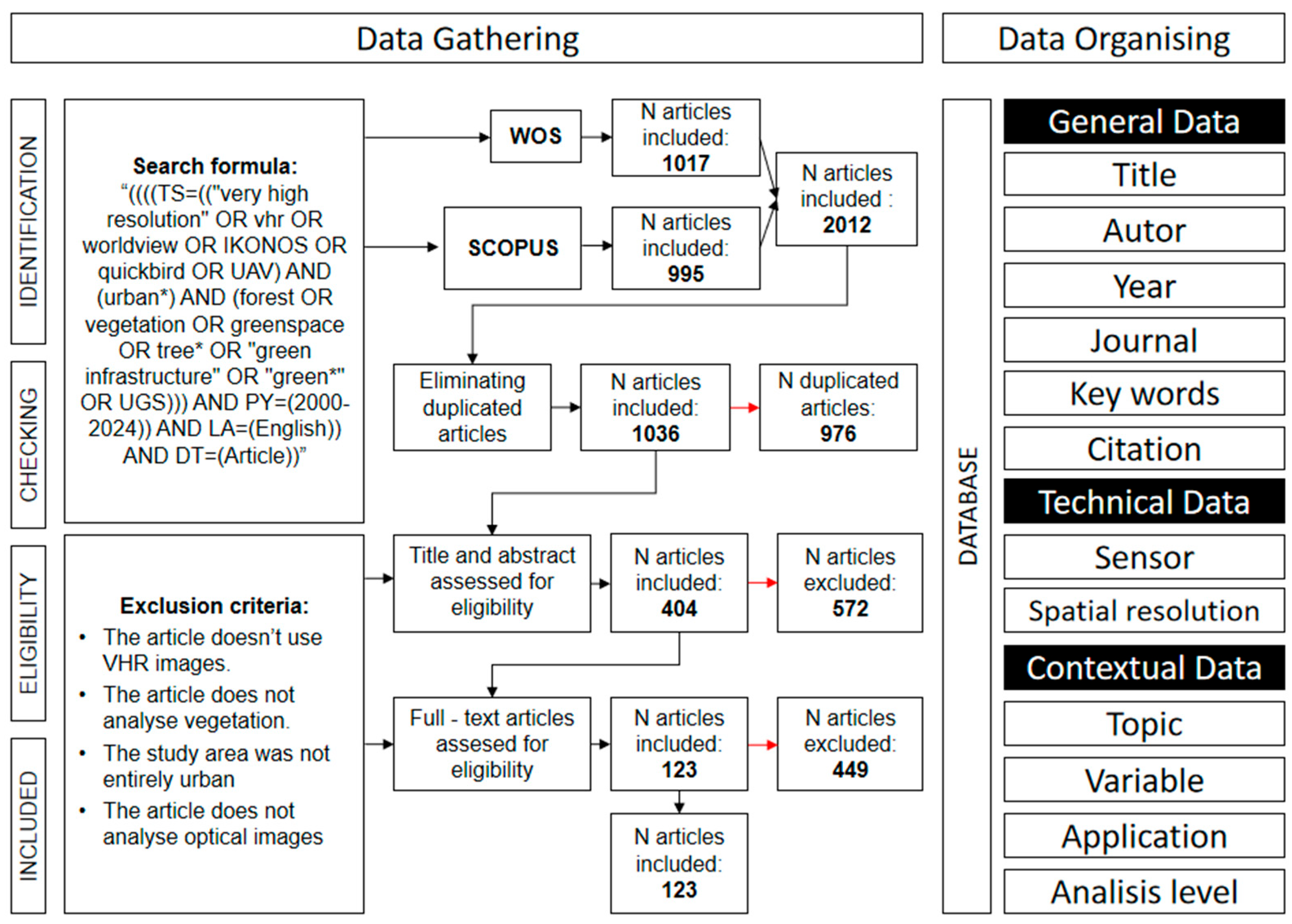
A comprehensive literature review was conducted using “Web of Science” and “Scopus” databases, known for their broad coverage across various scientific disciplines [63]. Our search strategy was designed to capture studies relevant to very-high-resolution (VHR) remote sensing in urban vegetation contexts. The search query was formulated using a combination of key terms, including “very high resolution,” “VHR,” “WorldView,” “IKONOS,” “QuickBird,” “UAV,” and terms related to urban environments such as “urban,” “forest,” “vegetation,” “greenspace,” “tree,” “green infrastructure,” and “UGS.” The final search syntax implemented was “TOPIC = ((“very high resolution” OR VHR OR WorldView OR IKONOS OR QuickBird OR UAV) AND (urban*) AND (forest OR vegetation OR greenspace OR tree* OR “green infrastructure” OR green* OR UGS))”.

2.2. Inclusion and Exclusion Criteria

The literature search was limited to peer-reviewed articles (2000–2024, in English) to ensure methodological transparency and global accessibility. Only empirical studies using optical or thermal HR/VHR imagery were included. Study selection followed PRISMA 2020 reporting guidance and our a priori eligibility criteria [64,65].
The inclusion criteria were
(i)
The use of HR or VHR imagery;
(ii)
Explicit focus on urban vegetation within urban settings;
(iii)
Empirical application of remote sensing imagery (not reviews/theory).
We restrict scope to optical/thermal high-resolution and very-high-resolution imagery (as defined in the Introduction and Table 1) because these spatial grains and spectral domains resolve crown-level structure and within-neighborhood heterogeneity that are central to urban vegetation mapping; they also support, with appropriate spectral–textural features and classifiers, species- or functional-type discrimination in complex streetscapes [12,18]. Studies that use only moderate resolution (e.g., ≥10–30 m), or rely exclusively on SAR or LiDAR, are excluded to maintain comparability in spectral content, spatial detail, and algorithmic pipelines across the review [14,24]. Where SAR or LiDAR add clear value, we treat them as complementary modalities and discuss fusion-based exemplars in the Discussion section, but a full treatment of radar- or LiDAR-only workflows is outside of our objectives.

2.3. Data Extraction and Organization

First, duplicates were removed, reducing 2012 initial records to 1036 (Figure 1). Second, titles and abstracts were screened against the eligibility criteria, yielding 404 candidate studies. Third, full texts were assessed, resulting in 123 included articles. Title and abstract screening and full-text assessment were conducted independently by two reviewers, with discrepancies resolved by consensus. The overall process is summarized in a PRISMA 2020 flow diagram [64].
The final sample (n = 123) comprises empirical studies that employ optical or thermal high-resolution and very-high-resolution imagery (HR/VHR). For each study, we extracted bibliographic variables (authors, year, journal, research area, keywords, and citations), technical variables (platforms and sensors, spatial resolution, spectral domain, and preprocessing and classification approaches), and thematic variables (objectives, applications, and level of analysis: urban, regional, or global). All variables were recorded in a structured spreadsheet to ensure traceability.

2.4. Analytical Approach and Bibliometric Analysis

We performed keyword co-occurrence mapping in VOSviewer (v. 1.6.20) [66] to identify prevalent topics and thematic clusters across the 123 studies, focusing on frequency of occurrence and network structure. To enhance reproducibility, we report the following key settings: full counting, association strength normalization, and a minimum keyword occurrence threshold of 5, with clusters derived using the software’s default community detection algorithm [66]. We also compiled descriptive statistics on platform/sensor frequencies and methodological techniques used across studies.
Following prior syntheses that organize urban green and remote sensing literatures along biophysical and social lenses, we coded each study by its dominant emphasis, with an additional secondary tag for hybrid designs when both domains were substantively addressed. Two reviewers independently applied the labels using the stated aims, outcome variables, and evaluation metrics as anchors, and disagreements were resolved by consensus. This scheme provides continuity with the review’s goals while preserving comparability; hybrid tags are retained for sensitivity descriptions reported in the Results section. The biophysical group includes studies on vegetation structure, species mapping, thermal dynamics, carbon metrics, and related ecosystem functions (e.g., [67,68]). The social group encompasses research on urban planning, public health, social equity, and community well-being linked to vegetation. This binary framework balances analytical clarity with the field’s dual emphasis on ecological performance and human outcomes, consistent with recent syntheses on green infrastructure contributions to climate regulation, biodiversity, and social benefits [69,70].
Within each category, we conducted keyword analysis to track shifts in research priorities and emerging trends (e.g., “canopy structure,” “species diversity,” and “thermal performance” in biophysical; “green infrastructure,” “urban planning,” and “public health” in social). Integrating this thematic classification with bibliometrics provides a coherent lens on how HR/VHR technologies are being deployed to address both ecological and socio-environmental questions in cities.

3. Results

3.1. Geographic and Temporal Trends

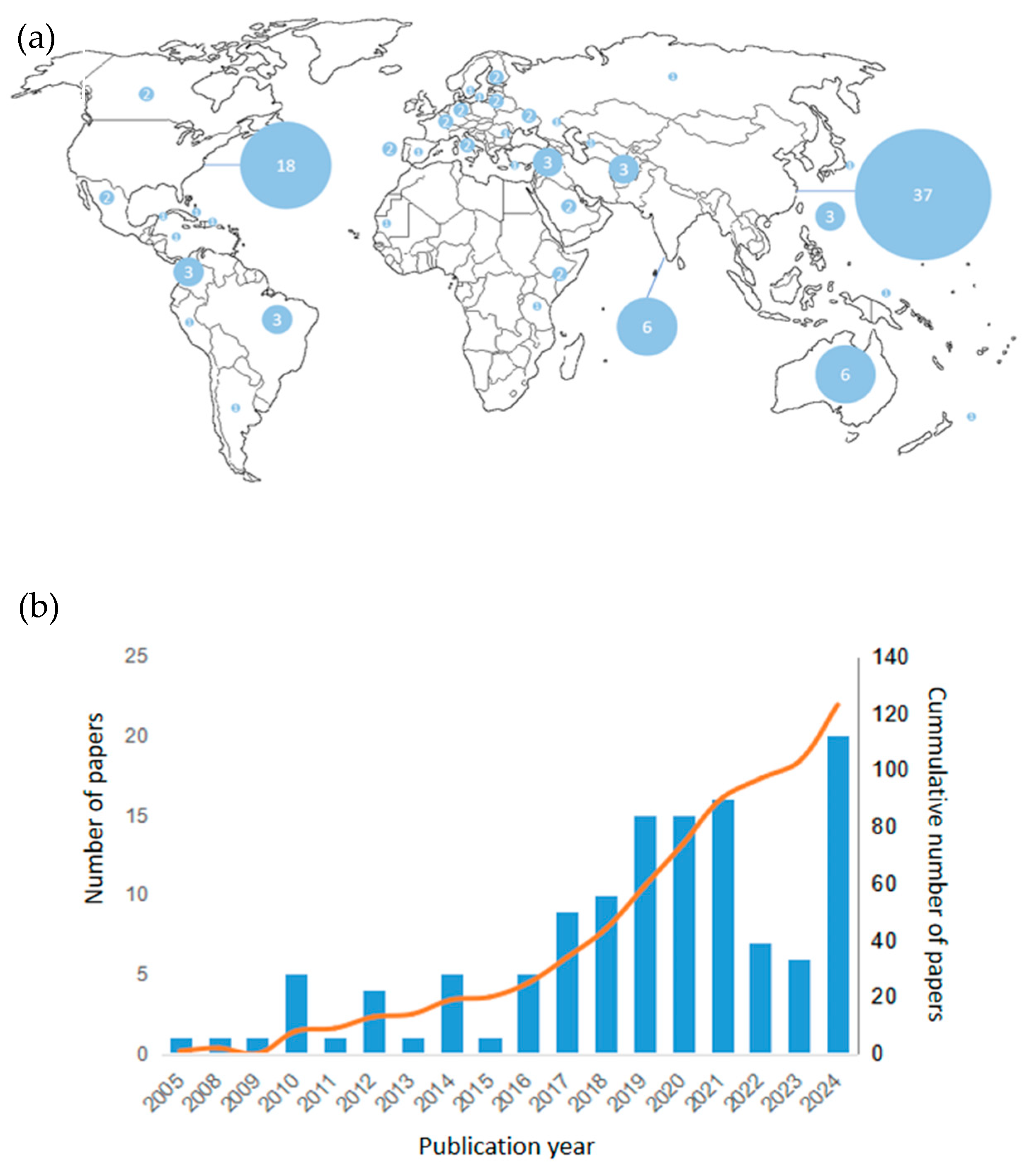
Nearly half of the research articles (48%) were published across six leading scientific journals, with Remote Sensing and Landscape and Urban Planning collectively contributing 27% of these publications. Contributions to this field come from 41 countries, showcasing a diverse international effort. Among these, China leads with 37 studies (29%), followed by the United States with 18 studies (14%). India and Australia also make notable contributions, each with six studies each (4.8%). Collectively, these four nations account for over half of the total research output (Figure 2a).
The geographic distribution of contributions reveals a predominant focus on the northern hemisphere, while regions such as South America and Africa remain underrepresented, contributing only nine and four studies, respectively. A temporal analysis of the reviewed literature reveals a sharp increase in research publications over the past eight years, with 64% of the studies published in the last five years (Figure 2b). This recent surge is consistent with global agendas that prioritize fine-scale urban greening for climate adaptation, biodiversity conservation, and public health, as reflected in IPCC AR6, the Kunming–Montreal Global Biodiversity Framework, and the World Cities Report, which collectively call for neighborhood-scale evidence and actionable indicators.
The scientific production is concentrated in a subset of countries with high absolute publication volumes, whereas many others show lower density and temporal discontinuities. The pattern is consistent across databases and years, with a clear acceleration after approximately 2018. At the regional scale, Europe, North America, and China lead the publication counts, while Latin America, Africa, and South Asia are underrepresented. This heterogeneity should be considered when interpreting global trends and regional comparisons.

3.2. Main Topics and Gaps in Urban Vegetation Research

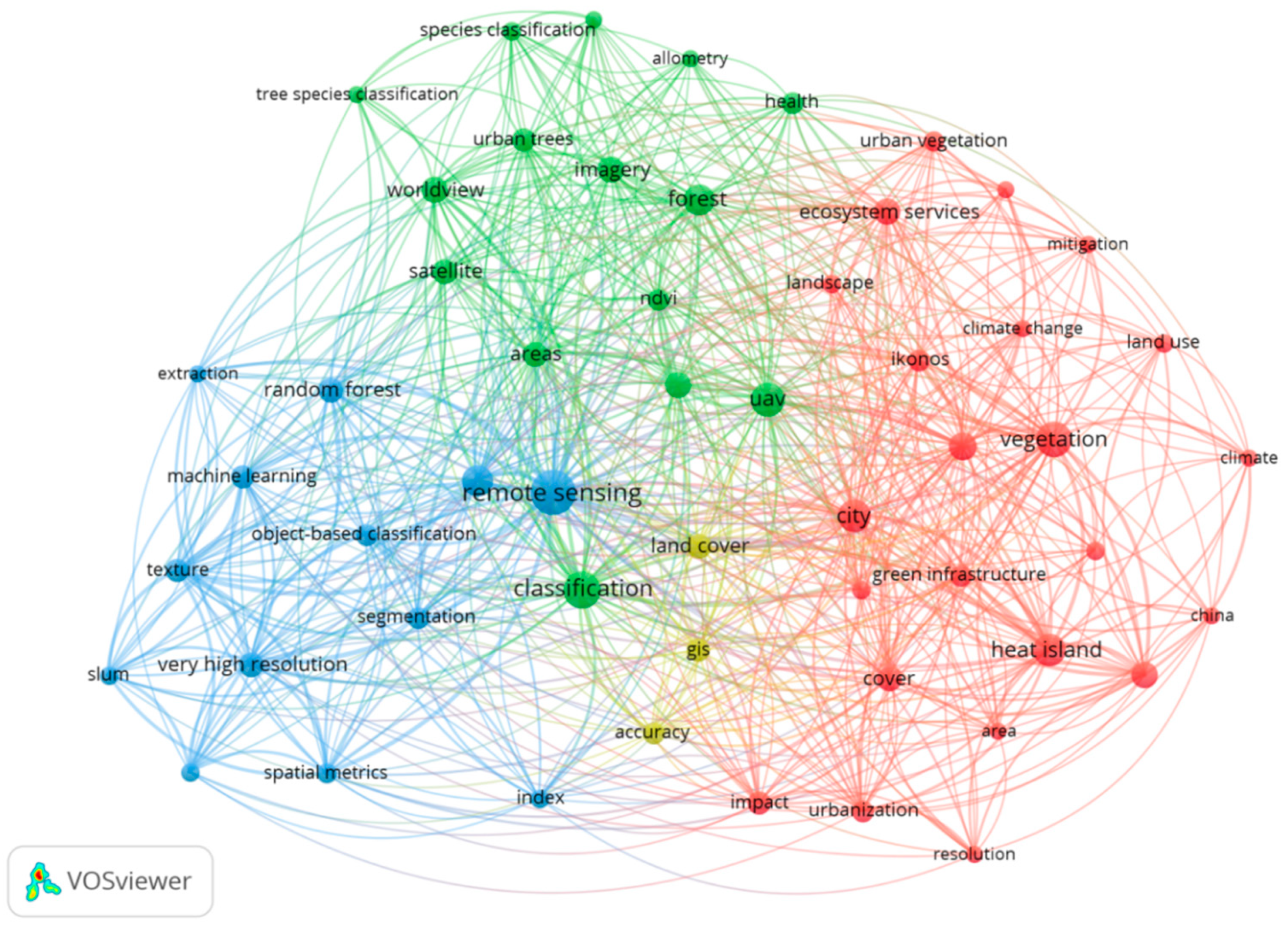
The co-occurrence network analysis for the 743 keywords in 123 documents identified three different thematic clusters (Figure 3). Categorically, the thematic clusters were as follows: the Red Cluster, with association for urbanization and urban climate, includes keywords like city, vegetation, heat island, and land use. These keywords are generally attributed to research for urban vegetation dynamics, climate phenomena, and measures for mitigating the heat island effect and land surface temperature. In the second category, the Blue Cluster, with a relation for advanced remote sensing methods and space analysis, includes keywords like very high resolution, object-based classification, learning, and spatial metrics. This thematic group signifies the application of advanced methods and technologies in remote sensing with a focus in remote sensing data for informal settlement examination, texture identification, texture characterization, and high-accuracy urban research. Finally, the Green Cluster, with a thematic area in ecology and vegetation, includes keywords like forest, vegetation, ecosystem service, and imagery. This thematic group is attributed to research with the application of vegetation indices (e.g., NDVI) and technologies like a UAV for vegetation condition examination, ecosystem service, and biodiversity examination in cities. In total, the results portray that co-occurrence in keywords indicates three significant research themes: the role played in climate due to urbanization, the development in remote sensing methods, as well as examination in ecological processes for cities. Such thematic clusters provide an orderly summary for the dominant thematic fields identified within the literature analyzed.
The thematic analysis of the reviewed studies revealed two primary groups: the biophysical group, (72%) and the social group, (28%). The biophysical group focuses on ecological and environmental aspects of urban vegetation, addressing topics such as biomass and carbon estimation, species mapping, and ecosystem services. In contrast, the social group examines the relationships between vegetation characteristics and the socioeconomic and demographic factors of urban populations, emphasizing the human dimension of urban ecosystems.
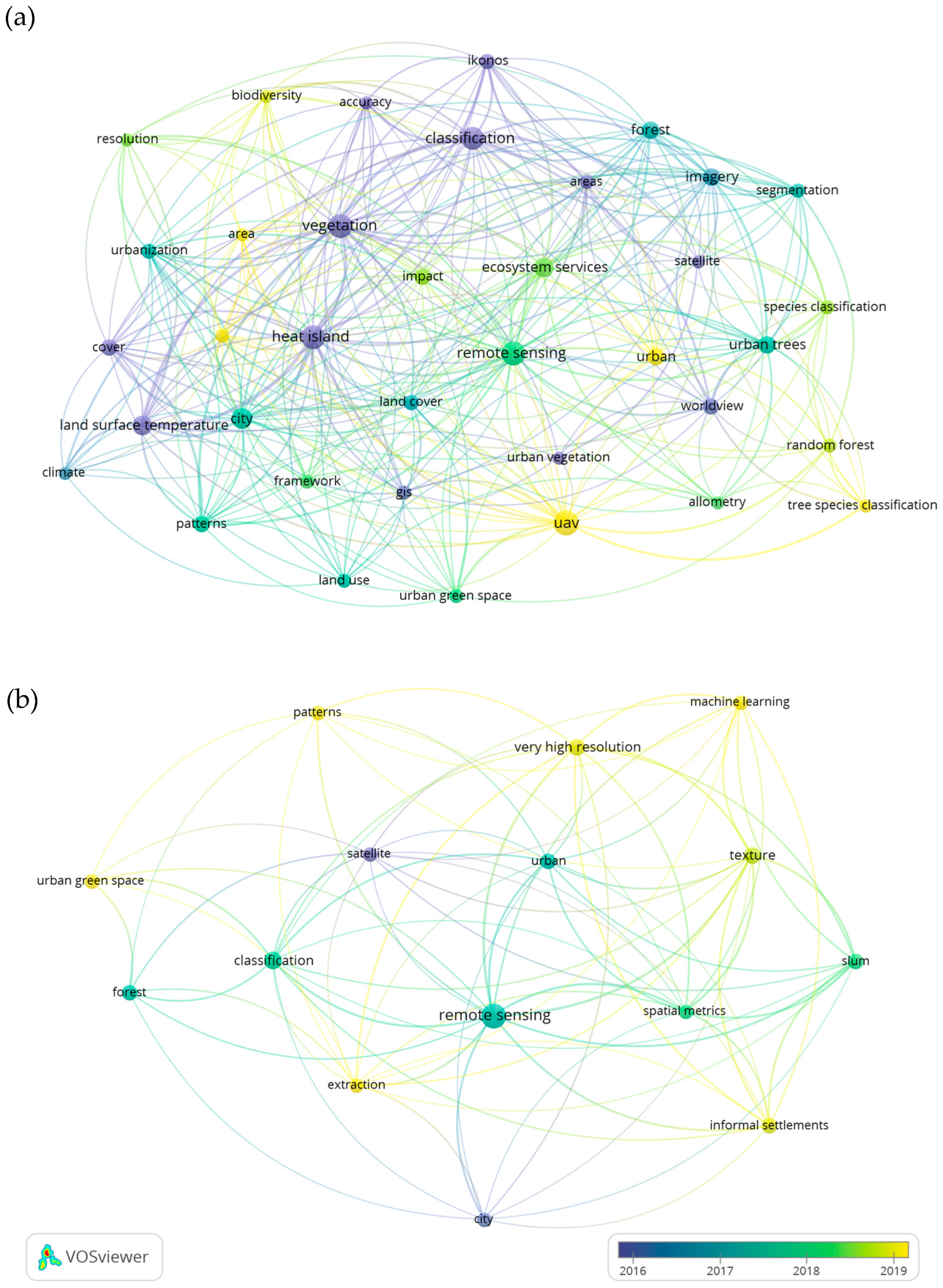
Within the biophysical group, 561 keywords were extracted from 88 papers, of which 37 keywords appeared in at least five papers (Figure 4a). The most frequently occurring keywords include UAV (18 instances), vegetation (17 instances), remote sensing (17 instances), heat island (17 instances), classification (15 instances), city (12 instances), land surface temperature (11 instances), and ecosystem services (11 instances). The temporal evolution of these keywords highlights a clear shift in research priorities within remote sensing. Early studies were dominated by foundational terms such as classification, climate, IKONOS, environment, and landscape. More recent contributions focus on keywords like ecosystem services, UAV, urban greenery, and species classification. This shift signifies an increasing integration of cutting-edge tools and a growing emphasis on ecological functions and urban sustainability. The adoption of terms like UAV and species classification highlights the application of advanced methodologies for fine-scale analysis, enabling researchers to capture spatial and temporal dynamics more effectively in urban and natural ecosystems.
In the social group, 269 keywords were collected from 35 papers, with 15 keywords appearing in at least five papers (Figure 4b). The most prominent keywords include remote sensing (15 instances), classification (8 instances), texture (7 instances), very high resolution (VHR) (7 instances), slum (6 instances), informal settlements (6 instances), urban (6 instances), and forest (6 instances). Earlier studies were characterized by foundational terms such as remote sensing, satellite, and city, which showed a primary focus on traditional methodologies for mapping and analyzing urban areas. In contrast, recent trends highlight the emergence of advanced concepts and tools, as evidenced by keywords like machine learning, UGS, extraction, and VHR.
The co-occurrence map separates ecological terms (e.g., canopy cover, species diversity, NDVI, and fragmentation) from social terms (e.g., urban heat, equity, accessibility, and public health), with several bridging keywords, notably ecosystem services, heat island, and environmental justice, connecting clusters under the association strength normalization used here. This structure mirrors current practice, where high-/very-high-resolution indicators of vegetation structure (crown-scale canopy and heterogeneity) are increasingly mobilized to evaluate cooling benefits and distributional equity at neighborhood scales. In practical terms, combined social and ecological lenses move analyses beyond greenness enumeration toward policy-relevant diagnostics (e.g., canopy thresholds for heat mitigation; 3–30–300 proximity benchmarks), aligning remote sensing outputs with planning and health applications.
Advances in sensor technologies, particularly the adoption of VHR imagery, have catalyzed a transformative shift toward more detailed and precise monitoring, enabling researchers to study urban vegetation across scales, from landscape-level patterns to fine-scale dynamics. This shift illustrates the commitment of remote sensing researchers to harness technological advancements for understanding and mitigating the intricate interplay between urbanization and ecological sustainability. By embracing these innovations, the field continues to expand its capacity to deliver actionable insights that support more equitable, resilient, and environmentally sound urban planning and management.

3.3. Technological Advancements in Remote Sensing Platforms

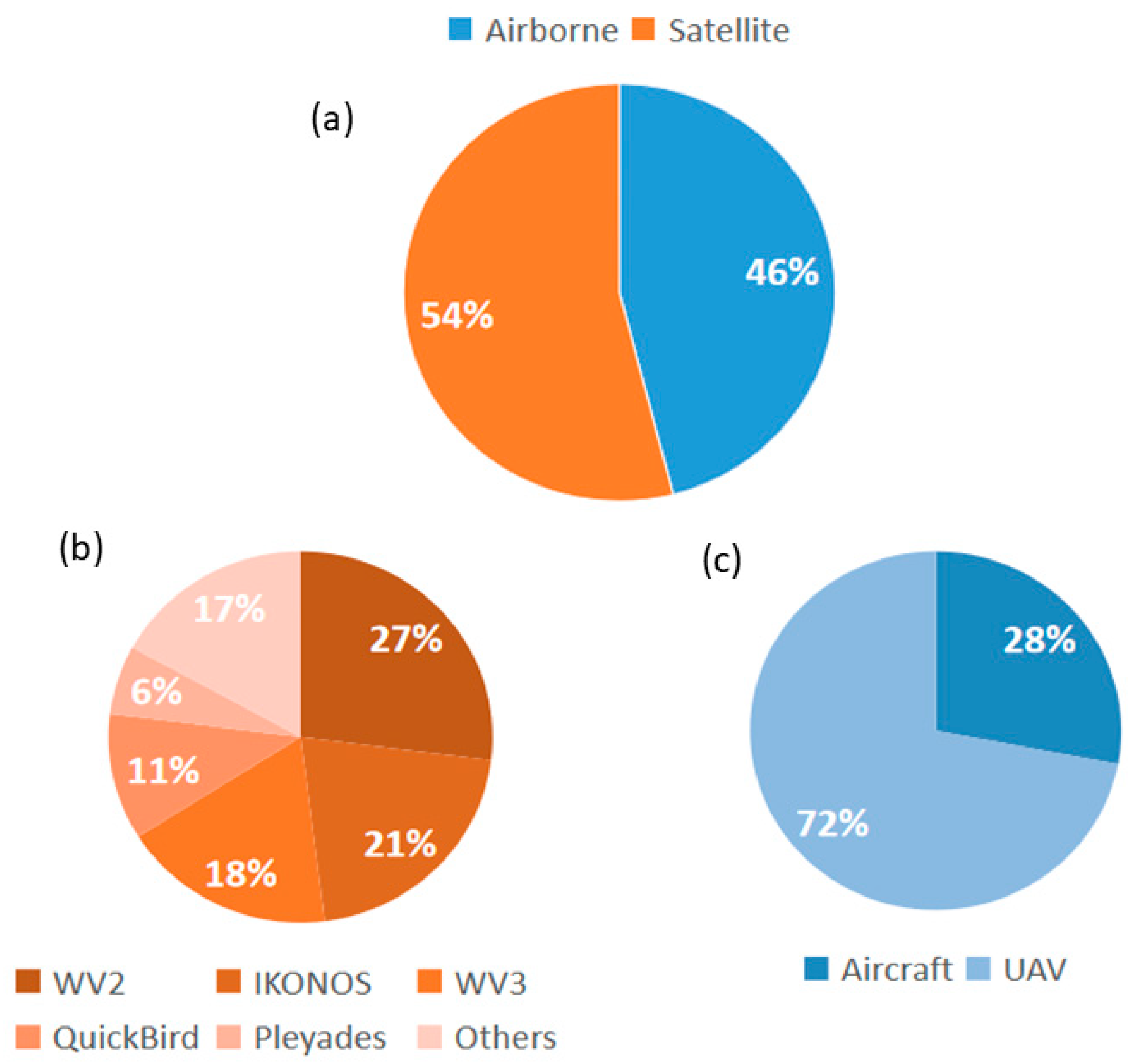
We found two primary approaches in the scale of analysis for urban vegetation studies, highlighting a distinct focus on different elements of urban vegetation dynamics (Figure 5). A majority, 66%, of the research papers adopted a gross approach, focused on elements like green structures or clusters of vegetation patches. In contrast, the remaining 34% of studies took a more detailed perspective, meticulously analyzing individual elements, while collective studies provide insights into large-scale spatial and ecological patterns, though detailed studies offer precise analyses of the health and growth of individual elements.
In examining the technological platforms employed in these studies, there emerged a clear preference for satellite platforms, which were utilized in 54% of the cases. Within this category, the most prevalently used very-high-resolution (VHR) satellite sensors included WorldView 2 (27%), IKONOS (21%), WorldView 3 (18%), QuickBird (11%), and Pleiades (6%) (Figure 5).
On the other hand, airborne/aircraft platforms were employed in 46% of the studies, further subdivided into piloted aircraft sensors and unmanned aircraft systems (UAVs). Piloted aircraft sensors comprised 28% of this category, including advanced technology like the frontal scanning infrared (FLIR) and multispectral sensors from renowned companies like Leica and ULTRACAM. These sensors are notable for their sub-meter spatial resolutions, allowing for highly detailed imaging of urban vegetation. UAVs constituted 72% of the airborne category.

4. Discussion

4.1. Geographical and Temporal Trends

While the Global South remains underrepresented, emerging contributions from countries like Brazil and Colombia demonstrate the potential for significant advancements when support and collaboration are provided. Recent disruptions, such as those caused by the COVID-19 pandemic, further underscore the vulnerability of research systems in these regions, with delays in peer review, reduced funding, and limited fieldwork access contributing to a decline in publications during 2022 and 2023 [71,72,73]. These disruptions emphasize the importance of fostering international collaborations, promoting equitable access to technology, and establishing regional research hubs equipped with advanced remote sensing tools to bridge the geographic gap [74].
The underrepresentation of Africa and Latin America has substantive implications for inference and policy transfer because research agendas, metrics, and trained models developed in well-studied regions may not generalize to cities with different urban morphologies, vegetation assemblages, aerosol regimes, and exposure profiles. Rapid urban growth in many southern regions intersects biodiversity priority areas and climate vulnerability, which raises the stakes for locally calibrated evidence [7]. At the same time, the geographic concentration of publications reflects structural drivers, including higher national R&D intensity, robust innovation systems, and mature Earth observation infrastructures that provide stable archives and user support, as seen in coordinated programs such as Copernicus and long-running Landsat missions, along with cloud platforms that enable scalable, transparent analysis [6,24,29,75,76,77]. Without targeted data and validation in underrepresented settings, domain shift can bias crown-scale mapping, heat diagnostics, and equity indicators, leading to the misestimation of needs and suboptimal interventions [78]. Addressing these disparities requires open datasets and benchmarks that include southern cities, targeted capacity building for HR/VHR processing, cloud-enabled workflows, and co-produced analyses with local institutions so that indicators reflect on-the-ground priorities and planning constraints [6,79].

4.2. Main Topics and Gaps in Research of Urban Vegetation

Thematic keyword analysis reveals a dichotomy between biophysical and social dimensions in urban vegetation research. The biophysical cluster, which dominates the literature, focuses on topics such as biomass estimation, species mapping, and ecosystem services [80]. These studies highlight the critical role of urban vegetation in climate regulation, carbon sequestration, and biodiversity support. However, the underrepresentation of social dimensions reflects a significant gap in the literature, particularly regarding public health, social equity, and access to green spaces.
Integrating ecological metrics with sociodemographic data offers a path forward. For instance, machine learning algorithms applied to VHR imagery can correlate vegetation cover with social vulnerability indicators, enabling targeted interventions to address disparities in green space access [80]. This interdisciplinary approach is essential for developing sustainable and equitable urban designs that address both ecological and societal priorities [81,82].
Recent studies emphasize the interconnectedness of these themes, cautioning that simplistic interpretations of green space data may overlook the complexity of social and ecological interactions [83,84]. Future research should prioritize nuanced, context-specific analyses that consider the multifaceted nature of urban ecosystems, promoting a holistic understanding of how urban vegetation contributes to both environmental resilience and well-being [85].

4.3. Conceptual Framework and Methodological Implications

The rapid expansion of very-high-resolution (VHR) remote sensing and unmanned aerial vehicle (UAV) applications in urban vegetation studies requires a conceptual framework that moves beyond descriptive inventories. Fine-scale vegetation metrics are not only technical achievements but also provide a mechanistic understanding of how urban greenery contributes to ecosystem resilience, biodiversity, and human well-being.
At the ecological scale, tree canopy structure, crown architecture, and vertical complexity are increasingly recognized as critical determinants of microclimate regulation and biodiversity support. Recent studies demonstrate that canopy structural metrics derived from UAV imagery and deep learning approaches outperform area-based measures in predicting ecosystem functions such as thermal mitigation and species diversity [10,86]. This structural focus aligns with ecological theories of resilience, which emphasize redundancy and diversity in maintaining ecosystem stability.
At the socio-ecological scale, high-resolution vegetation data reveal stark inequalities in the spatial distribution of green infrastructure. Emerging global syntheses show that vulnerable populations are systematically exposed to hotter urban environments with less vegetation, reinforcing the need to integrate environmental justice into remote sensing frameworks [21,49]. By combining VHR imagery with sociodemographic indicators, researchers can operationalize vegetation mapping within governance frameworks aimed at equitable access to green benefits [21,84].
From a methodological perspective, VHR/UAV approaches provide several strengths: (i) object-level mapping of individual trees and small patches, (ii) improved structural inference such as tree height and canopy volume, and (iii) actionable diagnostics for urban planners at neighborhood scales. However, significant weaknesses remain. First, longitudinal datasets derived from UAVs or VHR satellites are scarce, limiting the ability to capture temporal dynamics and phenological processes [87]. Second, reproducibility and harmonization issues persist due to inconsistent reporting of calibration protocols, preprocessing workflows, and ground truth data. Third, UAV applications face regulatory and ethical challenges, particularly regarding airspace restrictions, privacy in residential areas, and data ownership [88,89]. Addressing these weaknesses is essential to strengthen the scientific robustness and societal relevance of urban vegetation monitoring.

4.4. Comparative Suitability of Remote Sensing Technologies Across Urban Contexts

To systematically evaluate how different platforms contribute to urban vegetation research, we summarize the comparative strengths, limitations, and recommended applications of very-high-resolution (VHR) satellites, UAV RGB/multispectral systems, UAV/airborne hyperspectral sensors, and thermal infrared (TIR) products. This synthesis provides a decision-oriented overview, highlighting the conditions under which each technology is most effective and the methodological considerations that constrain their use. Table 2 distills these aspects into a comparative framework that facilitates linking sensor capabilities with specific urban contexts and research objectives.

4.5. Technological Advances in Remote Sensing for Studying Urban Vegetation

The technological trajectory of remote sensing in urban vegetation research reflects a clear transition from coarse, generalized approaches toward fine-scale, multi-platform frameworks. Pioneering studies such as Tucker (1979) [94], who established the NDVI vegetation index, and Carlson and Arthur (2000) [90], who linked satellite imagery with urban land-use and microclimatic dynamics, laid the foundation for subsequent urban ecological applications. These early contributions demonstrate how incremental advances in spatial and spectral resolution enabled the current generation of sensors to move from broad land cover mapping to detailed assessments of vegetation structure, function, and ecosystem services.
Recent innovations in very-high-resolution (VHR) satellites (≤1–2 m) and UAV-based sensors have been transformative. Panchromatic sharpening and VNIR bandsets in platforms such as WorldView-2/3 allow species- or functional-type discrimination within heterogeneous urban streetscapes, while UAVs offer centimeter-scale flexibility for site-specific diagnostics [12,13,86,91]. UAV photogrammetry supports crown-scale mapping, tree gap detection, and canopy continuity analysis, with applications ranging from equity audits to climate adaptation studies [42,86,87]. Beyond these uses, UAV-based hyperspectral acquisitions extend analytical capacity to species-level trait mapping and early stress detection, albeit at higher operational cost and with payload/illumination challenges [92,93,95]. Thermal infrared (TIR) has emerged as a complementary data source, particularly in quantifying land surface temperature (LST) gradients and evaluating canopy cooling thresholds across neighborhoods [44,96].
Empirical studies illustrate these advances. Wu et al. [86] applied UAV imagery with computer vision algorithms to detect treetops and estimate tree height in complex urban environments, while Isibue and Pingel [97] demonstrated UAV potential for ecological inventories and long-term urban forestry management. These examples reinforce the versatility of UAVs in bridging fine-scale structural data with urban ecological applications. Meanwhile, large-scale VHR satellite products such as UrbanWatch have demonstrated 1 m LCLU mapping across 22 U.S. cities with high accuracy, underscoring operational feasibility for city-scale baselines [13].
Despite their promise, several critical gaps remain. First, regulatory and ethical constraints, particularly related to privacy and airspace permissions, limit UAV scalability in dense cities [88,98,99]. Second, data harmonization across sensors, resolutions, and acquisition conditions remains inconsistent, reducing the comparability of studies [8,16,17]. Third, reproducibility is often undermined by the insufficient reporting of calibration, flight protocols, and ground truth data [92,93,100]. Finally, the scarcity of longitudinal UAV datasets restricts the ability to monitor canopy growth, phenological changes, or long-term greening interventions [54,93]. Addressing these challenges requires community standards, open-access UAV archives, and collaborative monitoring networks that ensure data transparency and comparability across time and urban typologies.
An important distinction when analyzing sensor suitability lies in resolution. Medium-resolution sensors (e.g., Landsat at 30 m, Sentinel-2 at 10 m) remain valuable for longitudinal monitoring and regional coverage but are inherently limited in urban contexts, where mixed pixels and coarse grain obscure fine-scale heterogeneity, such as street trees, courtyard canopies, or narrow green corridors [24,77]. By contrast, high-resolution (HR, >1–<10 m) and very-high-resolution (VHR, ≤1 m) data overcome these constraints by resolving individual crowns, canopy gaps, and structural variation within neighborhoods, enabling analyses directly tied to ecosystem services, equity metrics, and resilience theory. This comparative advantage explains the predominance of VHR sensors such as WorldView-2/3 and QuickBird in urban vegetation studies, as they offer operational capacity for crown-scale mapping and trait inference that low-resolution platforms cannot provide [12,22]. UAV platforms extend this further with centimeter-scale diagnostics, thus bridging critical gaps between local ecological structure and planning-relevant applications [86,93,97].

4.6. Bridging Research Gaps and Enhancing Inclusivity

Addressing the geographic and thematic disparities identified in this review requires an inclusive and collaborative approach. The underrepresentation of regions such as South America and Africa in urban vegetation research reveals a geographic bias that limits the global understanding of ecological and socioeconomic dynamics in urban areas. Advanced technologies like UAVs and hyperspectral imaging have transformed the study of urban vegetation, but their adoption in these regions remains uneven due to access restrictions, high costs, and weak institutional frameworks [101]. To mitigate these barriers, establishing regional research hubs equipped with state-of-the-art remote sensing tools could empower local researchers to undertake impactful studies. These hubs, coupled with subsidized access to VHR imagery and capacity-building initiatives, would help address critical ecological and social challenges unique to these regions [102,103].
This review also highlights the need for the better integration of biophysical and social dimensions in urban vegetation studies. While most research focuses on biophysical parameters, such as biomass and vegetation cover, there is a pressing need to address social issues, including equitable access to green spaces and their impact on public health.
While most research focuses on biophysical parameters, such as biomass and vegetation cover, there is a pressing need to address social issues, including equitable access to green spaces and their impact on public health. At this level, very-high-resolution data offer unique opportunities to operationalize environmental justice frameworks and embed resilience theory into urban governance. For instance, the recently proposed 3–30–300 rule, which recommends that every resident should see at least three trees from their home, live in a neighborhood with 30% canopy cover, and have access to a park within 300 m, can only be reliably monitored through sub-meter resolution data [11]. By coupling these indicators with sociodemographic data, urban planners can identify neighborhoods with higher vulnerability and prioritize interventions to reduce environmental inequities [21]. Furthermore, integrating canopy structural diversity and connectivity measures derived from UAV and VHR imagery with socio-ecological theory strengthens our understanding of resilience, biodiversity conservation, and social cohesion in cities [51]. These approaches emphasize that vegetation mapping is not merely a technical task but also a foundation for equitable governance and improved human well-being, highlighting the potential of remote sensing to support inclusive and justice-oriented urban greening policies [69].
Combining ecological metrics with sociodemographic indicators can provide actionable insights for urban planning. For example, machine learning techniques applied to VHR imagery can model the relationship between vegetation distribution and social well-being, enabling targeted interventions to reduce disparities [104,105,106]. These interdisciplinary approaches ensure that research outcomes are both scientifically robust and socially relevant, contributing to sustainable and equitable urban development.
Technological advancements in remote sensing, particularly UAVs and hyperspectral imaging, have significantly enhanced the capacity to study urban vegetation at fine scales. These tools offer ultra-high-resolution datasets that support detailed analyses of vegetation structure and function. For instance, UAV-mounted sensors provide multispectral, 3D, and thermal imaging data with resolutions below 50 cm, enabling precise monitoring of urban microclimates and vegetation health [91,95,107]. However, widespread adoption of these technologies is often constrained by high costs, regulatory challenges, and the technical expertise required for data processing [92,108,109]. Addressing these limitations through international collaborations, innovative funding mechanisms, and technology transfer programs would enable researchers in resource-constrained regions to harness these tools effectively.
Technical and operational hurdles can be mitigated through standardized calibration and reporting (e.g., reference networks and BRDF-aware workflows) to improve comparability and reproducibility [100,110,111]. Costs of algorithm development fall when communities adopt open, annotated benchmarks for urban segmentation and classification (e.g., SpaceNet; LoveDA), which facilitate method transfer across cities [78,112]. For urban UAV operations, risk-based rules and traffic management frameworks provide clear, scalable pathways for compliant flights in built-up areas [98,99]. Finally, interdisciplinary co-production and capacity building with municipal and public health partners help align sensing campaigns with equity and climate adaptation needs while building local analytical capability [79].
The thematic analysis conducted in this review underscores the dynamic and multidisciplinary evolution of remote sensing research in urban vegetation. The distinction between biophysical and social themes reflects the integration of ecological, technological, and societal dimensions, offering a comprehensive perspective on urban ecosystems. Moreover, the temporal progression of keywords such as UAV, ecosystem services, machine learning, and UGS demonstrates the adaptability of the field to emerging technologies and societal priorities. Future research should build on this adaptability by promoting interdisciplinary collaborations that address ecological resilience and social equity. Linking vegetation metrics with outcomes such as neighborhood satisfaction or public health could provide actionable insights for urban planners and policymakers, ensuring that urban vegetation research contributes to more sustainable and inclusive cities [113,114,115,116,117].

4.7. Future Research Directions and Critical Gaps

Despite rapid growth in very-high-resolution applications, several methodological and thematic gaps constrain progress and policy relevance. Many studies still rely primarily on pixel-based classifiers rather than taking fuller advantage of object-based image analysis and modern machine and deep learning approaches, which improve contextual discrimination in heterogeneous urban fabrics [12,118,119,120]. Accuracy assessment and validation are often limited or underreported, despite well-established guidance for rigorous sampling and error reporting, which is essential for reproducibility and comparison across cities [121,122]. Longitudinal analyses remain scarce; yet, UAV time series and cloud-based platforms now enable scalable, versioned processing for temporally explicit models of canopy dynamics and heat exposure [29,93]. Ethical, legal, and privacy considerations for UAV sensing in residential settings also require clearer treatment and adherence to risk-based rules to safeguard communities while permitting research operations [98]. Finally, limited integration of ecological and sociodemographic data hinders equity-oriented diagnostics that link crown-scale indicators to access and health outcomes [11,21,123]. To convert advances into reproducible, policy-relevant practice, we recommend the following: standardized calibration and reporting, including BRDF-aware workflows [93]; evaluation on open benchmarks with geographically disjoint splits to manage domain shift [78,112]; compliant urban UAV operations coupled with cloud workflows for transparent, scalable analysis [29]; and institutionalized co-production with municipal and public health partners so that HR/VHR indicators align with equity and adaptation priorities, including uncertainty disclosures for decision support [79,124].

5. Conclusions

Our findings indicate that the field is shaped by two interlocking gaps. A geographic concentration of studies in high-investment research systems and a thematic emphasis on biophysical indicators relative to social outcomes operate as mutually reinforcing structural inequalities, limiting both empirical diversity and the conceptual richness of urban vegetation research. These constraints heighten the risk that models and metrics calibrated in well-studied contexts will not transfer to rapidly urbanizing regions, where neighborhood-scale heat exposure, access to cooling canopies, and local planning constraints differ markedly [7,10,11]. Addressing this structure requires coupling crown-resolved HR/VHR indicators with equity-aware evaluation and co-production, while also investing in the enabling conditions that drive scientific capacity: sustained national R&D and innovation ecosystems, open datasets and benchmarks, and longitudinal city-scale baselines that make results comparable across places. This synthesis motivates the actionable directions that follow and clarify how technical, institutional, and social choices can align the next generation of urban vegetation sensing with inclusive climate adaptation and public health goals.
To enhance practical utility and reproducibility across cities, we recommend the following priorities: (1) adopt standardized calibration and reporting (e.g., panel workflows, illumination/BRDF control, and uncertainty disclosure) to improve comparability across cities and campaigns; (2) build open, labeled benchmarks for crown delineation, species/functional types, and change detection, leveraging existing VHR datasets and challenge series to accelerate; (3) establish longitudinal HR/VHR observatories (multi-season and multi-year) to capture dynamics relevant to climate adaptation and management; (4) address domain shifts explicitly (differences in GSD, sun–sensor geometry, and phenology) via external validation and typology-stratified error reporting; and (5) institutionalize interdisciplinary co-production with municipalities and public health partners, linking vegetation indicators to equity and heat-exposure metrics (e.g., neighborhood canopy thresholds and accessibility within 300 m) for decision support.
To address the gaps identified in this review, future research should focus on promoting inclusivity, fostering interdisciplinary collaborations, and ensuring equitable access to advanced remote sensing technologies. Expanding studies to underrepresented regions will provide critical insights into diverse urban ecological and socioeconomic contexts, enhancing the relevance of research to global sustainability goals.
We identify five priorities to close technical and theoretical gaps in HR/VHR urban vegetation remote sensing. First, develop and evaluate self- and weakly supervised representation learning on large geospatial datasets to reduce label dependence and enhance cross-city generalization. Second, formalize domain shift protocols and use open benchmarks with geographically disjoint train–test splits and typology-stratified reporting, building on SpaceNet, LoveDA, and city-scale 1 m products for reproducible comparisons. Third, pursue multimodal fusion of VHR optical with UAV hyperspectral and thermal and with elevation products (photogrammetric DSM/LiDAR) to couple structures, traits, and heat exposure within a single product. Fourth, integrate uncertainty quantification and equity-aware evaluation, linking outputs to cooling thresholds and access metrics relevant for planning and health. Fifth, pilot foundation models and promptable segmentation for rapid label generation and transfer, while documenting biases and failure modes and leveraging emerging geospatial tooling. Moreover, integrating biophysical and social dimensions will enable the development of holistic urban vegetation strategies that support both environmental resilience and social well-being.

Supplementary Materials

The following supporting information can be downloaded at: https://www.mdpi.com/article/10.3390/urbansci9090385/s1, S1: Extraction spreadsheet in CSV format with all bibliographic, technical, and thematic variables; S2: VOSviewer files (.txt), along with the exact parameter settings used (full counting, association strength normalization, and minimum occurrence threshold).

Author Contributions

Conceptualization, G.C., A.A., and C.D.B.; Methodology, R.R.-R., G.C., and P.M.; Writing—original draft, G.C., A.A., C.D.B., P.M., F.d.l.B., R.V.-G., R.R.-R., and S.R.-P.; Writing—review and editing, G.C., A.A., C.D.B., P.M., F.d.l.B., R.V.-G., R.R.-R., and S.R.-P.; Funding acquisition, G.C. and A.A. All authors have read and agreed to the published version of the manuscript.

Funding

This research was funded by the National Doctoral Scholarship (ANID). The APC was funded by Universidad de La Frontera.

Acknowledgments

We acknowledge additional support provided through the Internationalization Scholarship between Universidad de La Frontera and Universidad de Buenos Aires. We thank Universidad de La Frontera and Universidad de Buenos Aires for their invaluable support. A.A. gives thanks to Fondecyt grant 1211051. Partially funded by Universidad de La Frontera, PF24-0009. G.C. warmly acknowledges Martin, Alex, and Fernanda for their constant support and encouragement.

Conflicts of Interest

The authors declare no conflicts of interest.

References

  1. Revi, A. Re-Imagining the United Nations’ Response to a Twenty-First-Century Urban World. Urbanisation 2017, 2, ix–xv. [Google Scholar] [CrossRef]
  2. Kundu, D.; Pandey, A.K. World Urbanisation: Trends and Patterns. In Developing National Urban Policies; Springer Nature Singapore: Singapore, 2020; pp. 13–49. ISBN 978-981-15-3737-0. [Google Scholar]
  3. Artmann, M.; Inostroza, L.; Fan, P. Urban Sprawl, Compact Urban Development and Green Cities. How Much Do We Know, How Much Do We Agree? Ecol. Indic. 2019, 96, 3–9. [Google Scholar] [CrossRef]
  4. Almulhim, A.I.; Yigitcanlar, T. Understanding Smart Governance of Sustainable Cities: A Review and Multidimensional Framework. Smart Cities 2025, 8, 113. [Google Scholar] [CrossRef]
  5. Mishra, V. Rethinking Urban Future: Towards Sustainable Cities and Communities. Anthr. Sci. 2025, 3, 1–8. [Google Scholar] [CrossRef]
  6. United Nations Educational, Scientific and Cultural Organization. UNESCO Science Report 2021: The Race Against Time for Smarter Development; World Science Report; United Nations: New York, NY, USA, 2021; ISBN 978-92-1-005857-5. [Google Scholar]
  7. Simkin, R.D.; Seto, K.C.; McDonald, R.I.; Jetz, W. Biodiversity Impacts and Conservation Implications of Urban Land Expansion Projected to 2050. Proc. Natl. Acad. Sci. USA 2022, 119, e2117297119. [Google Scholar] [CrossRef] [PubMed]
  8. Shahtahmassebi, A.R.; Li, C.; Fan, Y.; Wu, Y.; Lin, Y.; Gan, M.; Wang, K.; Malik, A.; Blackburn, G.A. Remote Sensing of Urban Green Spaces: A Review. Urban For. Urban Green. 2021, 57, 126946. [Google Scholar] [CrossRef]
  9. Piracha, A.; Chaudhary, M.T. Urban Air Pollution, Urban Heat Island and Human Health: A Review of the Literature. Sustainability 2022, 14, 9234. [Google Scholar] [CrossRef]
  10. Ziter, C.D.; Pedersen, E.J.; Kucharik, C.J.; Turner, M.G. Scale-Dependent Interactions between Tree Canopy Cover and Impervious Surfaces Reduce Daytime Urban Heat during Summer. Proc. Natl. Acad. Sci. USA 2019, 116, 7575–7580. [Google Scholar] [CrossRef] [PubMed]
  11. Browning, M.H.E.M.; Locke, D.H.; Konijnendijk, C.; Labib, S.M.; Rigolon, A.; Yeager, R.; Bardhan, M.; Berland, A.; Dadvand, P.; Helbich, M.; et al. Measuring the 3-30-300 Rule to Help Cities Meet Nature Access Thresholds. Sci. Total Environ. 2024, 907, 167739. [Google Scholar] [CrossRef] [PubMed]
  12. Hartling, S.; Sagan, V.; Sidike, P.; Maimaitijiang, M.; Carron, J. Urban Tree Species Classification Using a WorldView-2/3 and LiDAR Data Fusion Approach and Deep Learning. Sensors 2019, 19, 1284. [Google Scholar] [CrossRef]
  13. Zhang, Y.; Chen, G.; Myint, S.W.; Zhou, Y.; Hay, G.J.; Vukomanovic, J.; Meentemeyer, R.K. UrbanWatch: A 1-Meter Resolution Land Cover and Land Use Database for 22 Major Cities in the United States. Remote Sens. Environ. 2022, 278, 113106. [Google Scholar] [CrossRef]
  14. Zhou, G. Urban High-Resolution Remote Sensing: Algorithms and Modeling, 1st ed.; CRC Press: Boca Raton, FL, USA, 2020; ISBN 978-1-003-08243-9. [Google Scholar]
  15. Doughty, C.L.; Cavanaugh, K.C.; Chapman, S.; Fatoyinbo, L. Uncovering Mangrove Range Limits Using Very High Resolution Satellite Imagery to Detect Fine-scale Mangrove and Saltmarsh Habitats in Dynamic Coastal Ecotones. Remote Sens. Ecol. Conserv. 2024, 10, 686–701. [Google Scholar] [CrossRef]
  16. García-Pardo, K.A.; Moreno-Rangel, D.; Domínguez-Amarillo, S.; García-Chávez, J.R. Remote Sensing for the Assessment of Ecosystem Services Provided by Urban Vegetation: A Review of the Methods Applied. Urban For. Urban Green. 2022, 74, 127636. [Google Scholar] [CrossRef]
  17. García-Pardo, K.A.; Moreno-Rangel, D.; Domínguez-Amarillo, S.; García-Chávez, J.R. Urban Classification of the Built-up and Seasonal Variations in Vegetation: A Framework Integrating Multisource Datasets. Urban For. Urban Green. 2023, 89, 128114. [Google Scholar] [CrossRef]
  18. Neyns, R.; Canters, F. Mapping of Urban Vegetation with High-Resolution Remote Sensing: A Review. Remote Sens. 2022, 14, 1031. [Google Scholar] [CrossRef]
  19. Weng, Q. Remote Sensing of Impervious Surfaces in the Urban Areas: Requirements, Methods, and Trends. Remote Sens. Environ. 2012, 117, 34–49. [Google Scholar] [CrossRef]
  20. Myint, S.W.; Gober, P.; Brazel, A.; Grossman-Clarke, S.; Weng, Q. Per-Pixel vs. Object-Based Classification of Urban Land Cover Extraction Using High Spatial Resolution Imagery. Remote Sens. Environ. 2011, 115, 1145–1161. [Google Scholar] [CrossRef]
  21. Nesbitt, L.; Meitner, M.J.; Girling, C.; Sheppard, S.R.J.; Lu, Y. Who Has Access to Urban Vegetation? A Spatial Analysis of Distributional Green Equity in 10 US Cities. Landsc. Urban Plan. 2019, 181, 51–79. [Google Scholar] [CrossRef]
  22. Yel, S.G.; Tunc Gormus, E. Exploiting Hyperspectral and Multispectral Images in the Detection of Tree Species: A Review. Front. Remote Sens. 2023, 4, 1136289. [Google Scholar] [CrossRef]
  23. Sheng, Q.; Zhang, Y.; Zhu, Z.; Li, W.; Xu, J.; Tang, R. An Experimental Study to Quantify Road Greenbelts and Their Association with PM2.5 Concentration along City Main Roads in Nanjing, China. Sci. Total Environ. 2019, 667, 710–717. [Google Scholar] [CrossRef]
  24. Wulder, M.A.; Loveland, T.R.; Roy, D.P.; Crawford, C.J.; Masek, J.G.; Woodcock, C.E.; Allen, R.G.; Anderson, M.C.; Belward, A.S.; Cohen, W.B.; et al. Current Status of Landsat Program, Science, and Applications. Remote Sens. Environ. 2019, 225, 127–147. [Google Scholar] [CrossRef]
  25. Ridd, M.K. Exploring a V-I-S (Vegetation-Impervious Surface-Soil) Model for Urban Ecosystem Analysis through Remote Sensing: Comparative Anatomy for Cities†. Int. J. Remote Sens. 1995, 16, 2165–2185. [Google Scholar] [CrossRef]
  26. Beyrouthy, N.E.; Al Sayah, M.; Sarkissian, R.D.; Nedjai, R. Enhancing Urban Temperature Monitoring through High-Resolution Remote Sensing and Advanced Data Processing Techniques. Theor. Appl. Clim. 2025, 156. [Google Scholar] [CrossRef]
  27. Weng, Q.; Lu, D.; Schubring, J. Estimation of Land Surface Temperature–Vegetation Abundance Relationship for Urban Heat Island Studies. Remote Sens. Environ. 2004, 89, 467–483. [Google Scholar] [CrossRef]
  28. Gillespie, T.W.; Foody, G.M.; Rocchini, D.; Giorgi, A.P.; Saatchi, S. Measuring and Modelling Biodiversity from Space. Prog. Phys. Geogr. Earth Environ. 2008, 32, 203–221. [Google Scholar] [CrossRef]
  29. Gorelick, N.; Hancher, M.; Dixon, M.; Ilyushchenko, S.; Thau, D.; Moore, R. Google Earth Engine: Planetary-Scale Geospatial Analysis for Everyone. Remote Sens. Environ. 2017, 202, 18–27. [Google Scholar] [CrossRef]
  30. Cornelis, J.; Hermy, M. Biodiversity Relationships in Urban and Suburban Parks in Flanders. Landsc. Urban Plan. 2004, 69, 385–401. [Google Scholar] [CrossRef]
  31. Sandström, U.G.; Angelstam, P.; Mikusiński, G. Ecological Diversity of Birds in Relation to the Structure of Urban Green Space. Landsc. Urban Plan. 2006, 77, 39–53. [Google Scholar] [CrossRef]
  32. Tzoulas, K.; Korpela, K.; Venn, S.; Yli-Pelkonen, V.; Kaźmierczak, A.; Niemela, J.; James, P. Promoting Ecosystem and Human Health in Urban Areas Using Green Infrastructure: A Literature Review. Landsc. Urban Plan. 2007, 81, 167–178. [Google Scholar] [CrossRef]
  33. Lepczyk, C.A.; Aronson, M.F.J.; Evans, K.L.; Goddard, M.A.; Lerman, S.B.; MacIvor, J.S. Biodiversity in the City: Fundamental Questions for Understanding the Ecology of Urban Green Spaces for Biodiversity Conservation. BioScience 2017, 67, 799–807. [Google Scholar] [CrossRef]
  34. Reynolds, C.; Howes, C.G. Contrasting Relationships between Socio-Economic Status and Avian Ecosystem Service Provision in a Developing World City. Landsc. Urban Plan. 2023, 240, 104900. [Google Scholar] [CrossRef]
  35. Jakstis, K.; Dubovik, M.; Laikari, A.; Mustajärvi, K.; Wendling, L.; Fischer, L.K. Informing the Design of Urban Green and Blue Spaces through an Understanding of Europeans’ Usage and Preferences. People Nat. 2023, 5, 162–182. [Google Scholar] [CrossRef]
  36. Bolund, P.; Hunhammar, S. Ecosystem Services in Urban Areas. Ecol. Econ. 1999, 29, 293–301. [Google Scholar] [CrossRef]
  37. Jim, C.Y.; Chen, W.Y. Assessing the Ecosystem Service of Air Pollutant Removal by Urban Trees in Guangzhou (China). J. Environ. Manag. 2008, 88, 665–676. [Google Scholar] [CrossRef]
  38. Strohbach, M.W.; Haase, D. Above-Ground Carbon Storage by Urban Trees in Leipzig, Germany: Analysis of Patterns in a European City. Landsc. Urban Plan. 2012, 104, 95–104. [Google Scholar] [CrossRef]
  39. Dobbs, C.; Escobedo, F.J.; Zipperer, W.C. A Framework for Developing Urban Forest Ecosystem Services and Goods Indicators. Landsc. Urban Plan. 2011, 99, 196–206. [Google Scholar] [CrossRef]
  40. Gómez-Baggethun, E.; Barton, D.N. Classifying and Valuing Ecosystem Services for Urban Planning. Ecol. Econ. 2013, 86, 235–245. [Google Scholar] [CrossRef]
  41. Reyes-Riveros, R.; Altamirano, A.; De La Barrera, F.; Rozas-Vásquez, D.; Vieli, L.; Meli, P. Linking Public Urban Green Spaces and Human Well-Being: A Systematic Review. Urban For. Urban Green. 2021, 61, 127105. [Google Scholar] [CrossRef]
  42. Clauzel, C.; Louis-Lucas, T.; Bortolamiol, S.; Blanc, N.; Grésillon, E.; Bouteau, F.; Laurenti, P.; Clavel, J. Schoolyard Greening to Improve Functional Connectivity in the City and Support Biodiversity. Urban For. Urban Green. 2025, 112, 128937. [Google Scholar] [CrossRef]
  43. Gallez, E.; Canters, F.; Gadeyne, S.; Baró, F. A Multi-Indicator Distributive Justice Approach to Assess School-Related Green Infrastructure Benefits in Brussels. Ecosyst. Serv. 2024, 70, 101677. [Google Scholar] [CrossRef]
  44. Coutts, A.M.; Harris, R.J.; Phan, T.; Livesley, S.J.; Williams, N.S.G.; Tapper, N.J. Thermal Infrared Remote Sensing of Urban Heat: Hotspots, Vegetation, and an Assessment of Techniques for Use in Urban Planning. Remote Sens. Environ. 2016, 186, 637–651. [Google Scholar] [CrossRef]
  45. Annerstedt Van Den Bosch, M.; Mudu, P.; Uscila, V.; Barrdahl, M.; Kulinkina, A.; Staatsen, B.; Swart, W.; Kruize, H.; Zurlyte, I.; Egorov, A.I. Development of an Urban Green Space Indicator and the Public Health Rationale. Scand. J. Public Health 2016, 44, 159–167. [Google Scholar] [CrossRef] [PubMed]
  46. Chen, W.; Zhi, X.; Huang, Y.; Wang, Z.; Lu, Z.; Zhang, W. Physically Plausible Spectral Reconstruction in Remote Sensing Using Multispectral Image. In Proceedings of the 2024 IEEE International Conference on Signal, Information and Data Processing (ICSIDP), Zhuhai, China, 22–24 November 2024; IEEE: Piscataway, NJ, USA, 2024; pp. 1–7. [Google Scholar]
  47. Rodriguez-Gomez, C.; Kereszturi, G.; Jeyakumar, P.; Pullanagari, R.; Reeves, R.; Rae, A.; Procter, J.N. Remote Exploration and Monitoring of Geothermal Sources: A Novel Method for Foliar Element Mapping Using Hyperspectral (VNIR-SWIR) Remote Sensing. Geothermics 2023, 111, 102716. [Google Scholar] [CrossRef]
  48. Bowler, D.E.; Buyung-Ali, L.; Knight, T.M.; Pullin, A.S. Urban Greening to Cool Towns and Cities: A Systematic Review of the Empirical Evidence. Landsc. Urban Plan. 2010, 97, 147–155. [Google Scholar] [CrossRef]
  49. Gascon, M.; Triguero-Mas, M.; Martínez, D.; Dadvand, P.; Rojas-Rueda, D.; Plasència, A.; Nieuwenhuijsen, M.J. Residential Green Spaces and Mortality: A Systematic Review. Environ. Int. 2016, 86, 60–67. [Google Scholar] [CrossRef]
  50. Nieuwenhuijsen, M.J.; Khreis, H.; Triguero-Mas, M.; Gascon, M.; Dadvand, P. Fifty Shades of Green: Pathway to Healthy Urban Living. Epidemiology 2017, 28, 63–71. [Google Scholar] [CrossRef]
  51. Rummell, A.J.; Borland, H.P.; Hazell, J.J.; Mosman, J.D.; Leon, J.X.; Henderson, C.J.; Gilby, B.L.; Olds, A.D. Connectivity Shapes Delivery of Multiple Ecological Benefits from Restoration. Biol. Conserv. 2023, 288, 110358. [Google Scholar] [CrossRef]
  52. Mosime, M.T.; Tesfamichael, S.G. COMPARISON OF SPOT AND LANDSAT DATA IN CLASSIFYING WETLAND VEGETATION TYPES. Int. Arch. Photogramm. Remote Sens. Spat. Inf. Sci. 2017, XLII-3/W2, 131–135. [Google Scholar] [CrossRef]
  53. Bai, D.; Wang, Y.; Ma, Y.; Li, H.; Guan, X. Fine-Scale Variations and Driving Factors of GPP Derived from Multi-Source Data Fusion in the Mountainous Region of Northwestern Hubei. Remote Sens. 2025, 17, 2186. [Google Scholar] [CrossRef]
  54. Platel, A.; Sandino, J.; Shaw, J.; Bollard, B.; Gonzalez, F. Advancing Sparse Vegetation Monitoring in the Arctic and Antarctic: A Review of Satellite and UAV Remote Sensing, Machine Learning, and Sensor Fusion. Remote Sens. 2025, 17, 1513. [Google Scholar] [CrossRef]
  55. Mathieu, R.; Aryal, J.; Chong, A.K. Object-Based Classification of Ikonos Imagery for Mapping Large-Scale Vegetation Communities in Urban Areas. Sensors 2007, 7, 2860–2880. [Google Scholar] [CrossRef]
  56. Liu, X.; Huang, Y.; Xu, X.; Li, X.; Li, X.; Ciais, P.; Lin, P.; Gong, K.; Ziegler, A.D.; Chen, A.; et al. High-Spatiotemporal-Resolution Mapping of Global Urban Change from 1985 to 2015. Nat. Sustain. 2020, 3, 564–570. [Google Scholar] [CrossRef]
  57. Chen, Y.; Lv, Z.; Huang, B.; Jia, Y. Delineation of Built-Up Areas from Very High-Resolution Satellite Imagery Using Multi-Scale Textures and Spatial Dependence. Remote Sens. 2018, 10, 1596. [Google Scholar] [CrossRef]
  58. Chance, C.M.; Coops, N.C.; Crosby, K.; Aven, N. Spectral Wavelength Selection and Detection of Two Invasive Plant Species in an Urban Area. Can. J. Remote Sens. 2016, 42, 27–40. [Google Scholar] [CrossRef]
  59. Ordóñez, C.; Kendal, D.; Davern, M.; Conway, T. Having a Tree in Front of One’s Home Is Associated with GREATER Subjective Wellbeing in Adult Residents in Melbourne, Australia, and Toronto, Canada. Environ. Res. 2024, 250, 118445. [Google Scholar] [CrossRef]
  60. Peng, L.; Cao, S.; Chen, Y.; Zeng, B.; Lin, D.; Xie, C.; Li, X.; Ma, J. The Restorative Effect of Urban Forest Vegetation Types and Slope Positions on Human Physical and Mental Health. Forests 2025, 16, 653. [Google Scholar] [CrossRef]
  61. Herold, M.; Gardner, M.E.; Roberts, D.A. Spectral Resolution Requirements for Mapping Urban Areas. IEEE Trans. Geosci. Remote Sens. 2003, 41, 1907–1919. [Google Scholar] [CrossRef]
  62. Lu, D.; Weng, Q. Extraction of Urban Impervious Surfaces from an IKONOS Image. Int. J. Remote Sens. 2009, 30, 1297–1311. [Google Scholar] [CrossRef]
  63. Zhu, J.; Liu, W. A Tale of Two Databases: The Use of Web of Science and Scopus in Academic Papers. Scientometrics 2020, 123, 321–335. [Google Scholar] [CrossRef]
  64. Page, M.J.; McKenzie, J.E.; Bossuyt, P.M.; Boutron, I.; Hoffmann, T.C.; Mulrow, C.D.; Shamseer, L.; Tetzlaff, J.M.; Akl, E.A.; Brennan, S.E.; et al. The PRISMA 2020 Statement: An Updated Guideline for Reporting Systematic Reviews. BMJ 2021, n71. [Google Scholar] [CrossRef] [PubMed]
  65. Adem Esmail, B.; Cortinovis, C.; Suleiman, L.; Albert, C.; Geneletti, D.; Mörtberg, U. Greening Cities through Urban Planning: A Literature Review on the Uptake of Concepts and Methods in Stockholm. Urban For. Urban Green. 2022, 72, 127584. [Google Scholar] [CrossRef]
  66. Van Eck, N.J.; Waltman, L. Software Survey: VOSviewer, a Computer Program for Bibliometric Mapping. Scientometrics 2010, 84, 523–538. [Google Scholar] [CrossRef] [PubMed]
  67. Nichol, J.; Wong, M.S. Remote Sensing of Urban Vegetation Life Form by Spectral Mixture Analysis of High-resolution IKONOS Satellite Images. Int. J. Remote Sens. 2007, 28, 985–1000. [Google Scholar] [CrossRef]
  68. Yao, H.; Qin, R.; Chen, X. Unmanned Aerial Vehicle for Remote Sensing Applications—A Review. Remote Sens. 2019, 11, 1443. [Google Scholar] [CrossRef]
  69. Jennings, V.; Rigolon, A.; Thompson, J.; Murray, A.; Henderson, A.; Gragg, R.S. The Dynamic Relationship between Social Cohesion and Urban Green Space in Diverse Communities: Opportunities and Challenges to Public Health. IJERPH 2024, 21, 800. [Google Scholar] [CrossRef]
  70. Semeraro, T.; Scarano, A.; Buccolieri, R.; Santino, A.; Aarrevaara, E. Planning of Urban Green Spaces: An Ecological Perspective on Human Benefits. Land 2021, 10, 105. [Google Scholar] [CrossRef]
  71. Else, H. How a Torrent of COVID Science Changed Research Publishing—in Seven Charts. Nature 2020, 588, 553. [Google Scholar] [CrossRef]
  72. Fry, C.V.; Cai, X.; Zhang, Y.; Wagner, C.S. Consolidation in a Crisis: Patterns of International Collaboration in Early COVID-19 Research. PLoS ONE 2020, 15, e0236307. [Google Scholar] [CrossRef]
  73. Sarkis, J.; Cohen, M.J.; Dewick, P.; Schröder, P. A Brave New World: Lessons from the COVID-19 Pandemic for Transitioning to Sustainable Supply and Production. Resour. Conserv. Recycl. 2020, 159, 104894. [Google Scholar] [CrossRef] [PubMed]
  74. Bartesaghi-Koc, C.; Osmond, P.; Peters, A. Mapping and Classifying Green Infrastructure Typologies for Climate-Related Studies Based on Remote Sensing Data. Urban For. Urban Green. 2019, 37, 154–167. [Google Scholar] [CrossRef]
  75. Fortunato, S.; Bergstrom, C.T.; Börner, K.; Evans, J.A.; Helbing, D.; Milojević, S.; Petersen, A.M.; Radicchi, F.; Sinatra, R.; Uzzi, B.; et al. Science of Science. Science 2018, 359, eaao0185. [Google Scholar] [CrossRef]
  76. World Intellectual Property Organization; Dutta, S.; Lanvin, B.; Rivera León, L.; Wunsch-Vincent, S. Global Innovation Index 2024: Innovation in the Face of Uncertainty; World Intellectual Property Organization: Geneva, Switzerland, 2024. [Google Scholar]
  77. Drusch, M.; Del Bello, U.; Carlier, S.; Colin, O.; Fernandez, V.; Gascon, F.; Hoersch, B.; Isola, C.; Laberinti, P.; Martimort, P.; et al. Sentinel-2: ESA’s Optical High-Resolution Mission for GMES Operational Services. Remote Sens. Environ. 2012, 120, 25–36. [Google Scholar] [CrossRef]
  78. Wang, J.; Zheng, Z.; Ma, A.; Lu, X.; Zhong, Y. LoveDA: A Remote Sensing Land-Cover Dataset for Domain Adaptive Semantic Segmentation. In Proceedings of the NIPS’21: Proceedings of the 35th International Conference on Neural Information Processing Systems, Red Hook, NY, USA, 6–14 December 2021. [Google Scholar] [CrossRef]
  79. Norström, A.V.; Cvitanovic, C.; Löf, M.F.; West, S.; Wyborn, C.; Balvanera, P.; Bednarek, A.T.; Bennett, E.M.; Biggs, R.; De Bremond, A.; et al. Principles for Knowledge Co-Production in Sustainability Research. Nat. Sustain. 2020, 3, 182–190. [Google Scholar] [CrossRef]
  80. Darabi, D.; Kluge, U.; Penka, S.; Mundt, A.P.; Schouler-Ocak, M.; Butler, J.; Liu, S.; Heinz, A.; Rapp, M.A. Environmental Stress, Minority Status, and Local Poverty: Risk Factors for Mental Health in Berlin’s Inner City. Eur. Arch. Psychiatry Clin. Neurosci. 2023, 273, 1201–1206. [Google Scholar] [CrossRef] [PubMed]
  81. Cervelli, E.; Scotto Di Perta, E.; Pindozzi, S. Identification of Marginal Landscapes as Support for Sustainable Development: GIS-Based Analysis and Landscape Metrics Assessment in Southern Italy Areas. Sustainability 2020, 12, 5400. [Google Scholar] [CrossRef]
  82. Menon, J.S.; Sharma, R. Nature-Based Solutions for Co-Mitigation of Air Pollution and Urban Heat in Indian Cities. Front. Sustain. Cities 2021, 3. [Google Scholar] [CrossRef]
  83. Martinuzzi, A.; Blok, V.; Brem, A.; Stahl, B.; Schönherr, N. Responsible Research and Innovation in Industry—Challenges, Insights and Perspectives. Sustainability 2018, 10, 702. [Google Scholar] [CrossRef]
  84. Sathyakumar, V.; Ramsankaran, R.; Bardhan, R. Linking Remotely Sensed Urban Green Space (UGS) Distribution Patterns and Socio-Economic Status (SES) - A Multi-Scale Probabilistic Analysis Based in Mumbai, India. GIScience Remote Sens. 2019, 56, 645–669. [Google Scholar] [CrossRef]
  85. Pham, T.-T.-H.; Apparicio, P.; Séguin, A.-M.; Landry, S.; Gagnon, M. Spatial Distribution of Vegetation in Montreal: An Uneven Distribution or Environmental Inequity? Landsc. Urban Plan. 2012, 107, 214–224. [Google Scholar] [CrossRef]
  86. Wu, H.; Zhuang, M.; Chen, Y.; Meng, C.; Wu, C.; Ouyang, L.; Liu, Y.; Shu, Y.; Tao, Y.; Qiu, T.; et al. Urban Treetop Detection and Tree-Height Estimation from Unmanned-Aerial-Vehicle Images. Remote Sens. 2023, 15, 3779. [Google Scholar] [CrossRef]
  87. Fang, F. Crown-Level Mapping of Tree Species and Health from Remote Sensing of Rural and Urban Forests. Ph.D. Thesis, West Virginia University Libraries, Morgantown, WV, USA, 2019. [Google Scholar]
  88. Vidović, A.; Štimac, I.; Mihetec, T.; Patrlj, S. Application of Drones in Urban Areas. Transp. Res. Procedia 2024, 81, 84–97. [Google Scholar] [CrossRef]
  89. Singh, K.K.; Surasinghe, T.D.; Frazier, A.E. Systematic Review and Best Practices for Drone Remote Sensing of Invasive Plants. Methods Ecol. Evol. 2024, 15, 998–1015. [Google Scholar] [CrossRef]
  90. Carlson, T.N.; Traci Arthur, S. The Impact of Land Use — Land Cover Changes Due to Urbanization on Surface Microclimate and Hydrology: A Satellite Perspective. Glob. Planet. Change 2000, 25, 49–65. [Google Scholar] [CrossRef]
  91. Lee, G.; Hwang, J.; Cho, S. A Novel Index to Detect Vegetation in Urban Areas Using UAV-Based Multispectral Images. Appl. Sci. 2021, 11, 3472. [Google Scholar] [CrossRef]
  92. Ecke, S.; Dempewolf, J.; Frey, J.; Schwaller, A.; Endres, E.; Klemmt, H.-J.; Tiede, D.; Seifert, T. UAV-Based Forest Health Monitoring: A Systematic Review. Remote Sens. 2022, 14, 3205. [Google Scholar] [CrossRef]
  93. Aasen, H.; Honkavaara, E.; Lucieer, A.; Zarco-Tejada, P.J. Quantitative Remote Sensing at Ultra-High Resolution with UAV Spectroscopy: A Review of Sensor Technology, Measurement Procedures, and Data Correction Workflows. Remote Sens. 2018, 10, 1091. [Google Scholar] [CrossRef]
  94. Tucker, C.J. Red and Photographic Infrared Linear Combinations for Monitoring Vegetation. Remote Sens. Environ. 1979, 8, 127–150. [Google Scholar] [CrossRef]
  95. Wang, T.; Guan, T.; Qiu, F.; Liu, L.; Zhang, X.; Zeng, H.; Zhang, Q. Evaluation of Scale Effects on UAV-Based Hyperspectral Imaging for Remote Sensing of Vegetation. Remote Sens. 2025, 17, 1080. [Google Scholar] [CrossRef]
  96. Neinavaz, E.; Schlerf, M.; Darvishzadeh, R.; Gerhards, M.; Skidmore, A.K. Thermal Infrared Remote Sensing of Vegetation: Current Status and Perspectives. Int. J. Appl. Earth Obs. Geoinf. 2021, 102, 102415. [Google Scholar] [CrossRef]
  97. Isibue, E.W.; Pingel, T.J. Unmanned Aerial Vehicle Based Measurement of Urban Forests. Urban For. Urban Green. 2020, 48, 126574. [Google Scholar] [CrossRef]
  98. Szira, Z.; Varga, E.; Csegődi, T.L.; Milics, G. The Development of Drone Techology and Its Regulation in the European Union. EU Agrar. Law 2023, 12, 35–41. [Google Scholar] [CrossRef]
  99. International Civil Aviation Organization. Manual on Remotely Piloted Aircraft Systems (RPAS), 1st ed.; International Civil Aviation Organization: Montréal, QC, Canada, 2015; ISBN 978-92-9249-718-7. [Google Scholar]
  100. Schunke, S.; Leroy, V.; Govaerts, Y. Retrieving BRDFs from UAV-Based Radiometers for Fiducial Reference Measurements: Caveats and Recommendations. Front. Remote Sens. 2023, 4, 1285800. [Google Scholar] [CrossRef]
  101. Li, X.; Ou, X.; Sun, X.; Li, H.; Li, Y.; Zheng, X. Urban Biodiversity Conservation: A Framework for Ecological Network Construction and Priority Areas Identification Considering Habit Differences within Species. J. Environ. Manag. 2024, 365, 121512. [Google Scholar] [CrossRef]
  102. Wegmann, M. Remote Sensing Training in Ecology and Conservation – Challenges and Potential. Remote Sens. Ecol. Conserv. 2017, 3, 5–6. [Google Scholar] [CrossRef]
  103. Duque, J.; Patino, J.; Betancourt, A. Exploring the Potential of Machine Learning for Automatic Slum Identification from VHR Imagery. Remote Sens. 2017, 9, 895. [Google Scholar] [CrossRef]
  104. Xia, Z.; Huang, J.; Huang, Y.; Liu, K.; Zhu, R.; Shen, Z.; Yuan, C.; Liu, L. A Social–Ecological Approach for Identifying and Mapping Ecosystem Service Trade-Offs and Conservation Priorities in Peri-Urban Areas. Ambio 2024, 53, 1522–1540. [Google Scholar] [CrossRef]
  105. Rademacher, A.; Cadenasso, M.L.; Pickett, S.T.A. From Feedbacks to Coproduction: Toward an Integrated Conceptual Framework for Urban Ecosystems. Urban Ecosyst. 2019, 22, 65–76. [Google Scholar] [CrossRef]
  106. Barbierato, E.; Bernetti, I.; Capecchi, I.; Saragosa, C. Integrating Remote Sensing and Street View Images to Quantify Urban Forest Ecosystem Services. Remote Sens. 2020, 12, 329. [Google Scholar] [CrossRef]
  107. Hernández-Clemente, R.; Hornero, A.; Mottus, M.; Penuelas, J.; González-Dugo, V.; Jiménez, J.C.; Suárez, L.; Alonso, L.; Zarco-Tejada, P.J. Early Diagnosis of Vegetation Health from High-Resolution Hyperspectral and Thermal Imagery: Lessons Learned from Empirical Relationships and Radiative Transfer Modelling. Curr. For. Rep. 2019, 5, 169–183. [Google Scholar] [CrossRef]
  108. Lu, B.; Dao, P.; Liu, J.; He, Y.; Shang, J. Recent Advances of Hyperspectral Imaging Technology and Applications in Agriculture. Remote Sens. 2020, 12, 2659. [Google Scholar] [CrossRef]
  109. Torresan, C.; Berton, A.; Carotenuto, F.; Di Gennaro, S.F.; Gioli, B.; Matese, A.; Miglietta, F.; Vagnoli, C.; Zaldei, A.; Wallace, L. Forestry Applications of UAVs in Europe: A Review. Int. J. Remote Sens. 2017, 38, 2427–2447. [Google Scholar] [CrossRef]
  110. Swaminathan, V.; Thomasson, J.A.; Hardin, R.G.; Rajan, N.; Raman, R. Radiometric Calibration of UAV Multispectral Images under Changing Illumination Conditions with a Downwelling Light Sensor. Plant Phenome J. 2024, 7, e70005. [Google Scholar] [CrossRef]
  111. Bouvet, M.; Thome, K.; Berthelot, B.; Bialek, A.; Czapla-Myers, J.; Fox, N.; Goryl, P.; Henry, P.; Ma, L.; Marcq, S.; et al. RadCalNet: A Radiometric Calibration Network for Earth Observing Imagers Operating in the Visible to Shortwave Infrared Spectral Range. Remote Sens. 2019, 11, 2401. [Google Scholar] [CrossRef]
  112. Van Etten, A.; Lindenbaum, D.; Bacastow, T.M. SpaceNet: A Remote Sensing Dataset and Challenge Series. arXiv 2018, arXiv:1807.01232. [Google Scholar] [CrossRef]
  113. Sanders, R.A. Estimating Satisfaction Levels for a City’s Vegetation. Urban Ecol. 1984, 8, 269–283. [Google Scholar] [CrossRef]
  114. Orban, E.; Sutcliffe, R.; Dragano, N.; Jöckel, K.-H.; Moebus, S. Residential Surrounding Greenness, Self-Rated Health and Interrelations with Aspects of Neighborhood Environment and Social Relations. J. Urban Health 2017, 94, 158–169. [Google Scholar] [CrossRef]
  115. Mouratidis, K. Commute Satisfaction, Neighborhood Satisfaction, and Housing Satisfaction as Predictors of Subjective Well-Being and Indicators of Urban Livability. Travel. Behav. Soc. 2020, 21, 265–278. [Google Scholar] [CrossRef]
  116. Madrid-Solorza, S.; Marquet, O.; Fuentes, L.; Miralles-Guasch, C. Urban Vitality Conditions and Neighborhood Satisfaction in a Latin American City: The Case of Santiago de Chile. J. Urban Plann. Dev. 2023, 149, 3. [Google Scholar] [CrossRef]
  117. Gintoli, I.; Bellisario, V.; Squillacioti, G.; Caputo, M.; Borraccino, A.; Dalmasso, P.; Bono, R.; Lemma, P. Urbanization and Greenness in HBSC Survey: Association with Life Satisfaction and Health Complaints. Eur. J. Public Health 2020, 30. [Google Scholar] [CrossRef]
  118. Blaschke, T. Object Based Image Analysis for Remote Sensing. ISPRS J. Photogramm. Remote Sens. 2010, 65, 2–16. [Google Scholar] [CrossRef]
  119. Blaschke, T.; Hay, G.J.; Kelly, M.; Lang, S.; Hofmann, P.; Addink, E.; Queiroz Feitosa, R.; Van Der Meer, F.; Van Der Werff, H.; Van Coillie, F.; et al. Geographic Object-Based Image Analysis – Towards a New Paradigm. ISPRS J. Photogramm. Remote Sens. 2014, 87, 180–191. [Google Scholar] [CrossRef] [PubMed]
  120. Maxwell, A.E.; Warner, T.A.; Fang, F. Implementation of Machine-Learning Classification in Remote Sensing: An Applied Review. Int. J. Remote Sens. 2018, 39, 2784–2817. [Google Scholar] [CrossRef]
  121. Foody, G.M. Status of Land Cover Classification Accuracy Assessment. Remote Sens. Environ. 2002, 80, 185–201. [Google Scholar] [CrossRef]
  122. Olofsson, P.; Foody, G.M.; Herold, M.; Stehman, S.V.; Woodcock, C.E.; Wulder, M.A. Good Practices for Estimating Area and Assessing Accuracy of Land Change. Remote Sens. Environ. 2014, 148, 42–57. [Google Scholar] [CrossRef]
  123. Rigolon, A.; Browning, M.H.E.M.; McAnirlin, O.; Yoon, H. (Violet) Green Space and Health Equity: A Systematic Review on the Potential of Green Space to Reduce Health Disparities. IJERPH 2021, 18, 2563. [Google Scholar] [CrossRef] [PubMed]
  124. Intergovernmental Panel on Climate Change (IPCC). Climate Change 2022—Impacts, Adaptation and Vulnerability: Working Group II Contribution to the Sixth Assessment Report of the Intergovernmental Panel on Climate Change, 1st ed.; Cambridge University Press: Cambridge, UK, 2023; ISBN 978-1-009-32584-4. [Google Scholar]
Figure 1. Flow chart of the methodological procedure used to select papers and organize the database. Arrows indicate the sequential flow of the article selection process. See Supplementary Materials S1 and S2 for the extraction spreadsheet and keyword co-occurrence files.
Urbansci 09 00385 g001
Figure 2. (a) Number of study sites analyzed per country. (b) Number of papers analyzed per year and cumulative number papers.
Urbansci 09 00385 g002
Figure 3. Keyword co-occurrence analysis based on the reviewed articles. Colors represent distinct thematic clusters identified: red (urbanization and urban climate), blue (advanced remote sensing techniques and spatial analysis), and green (ecology and vegetation). The size of the circles indicates the frequency of keyword usage, while the strength of the connections (lines) reflects the relevance and co-occurrence of terms.
Urbansci 09 00385 g003
Figure 4. The most used terms in urban vegetation studies, divided into two thematic groups: (a) environmental thematic group and (b) social thematic group. The environmental group (a) includes terms related to ecosystem services such as biomass, NDVI, and land surface temperature, while the social group (b) includes terms associated with environmental inequality and access to green infrastructure, such as informal settlements and very high resolution. Temporal differences in the colors reflect the evolving importance of these keywords over time.
Urbansci 09 00385 g004
Figure 5. (a) Percentage of studies using satellite or airborne platforms. (b) Percentage of studies by sensor on satellite platforms. (c) Percentage of studies by type of airborne platform.
Urbansci 09 00385 g005
Table 1. HR vs. VHR in urban vegetation applications.
ClassSpatial Resolution (GSD)Representative Sensors/PlatformsUnique Contributions to Themes
HR>1–<10 mPlanetScope (3–5 m), SPOT-6/7Citywide greenness and trends; regional comparability; insufficient for crown-scale separation in narrow streetscapes [18,24].
VHR≤1 m (satellite ≤0.5–1 m; UAV cm levelWorldView-2/3, Pleiades, UAV RGB/multispectralCrown-scale canopy and within-neighborhood heterogeneity; species- or functional-type inference with appropriate features/classifiers; diagnostics for heat mitigation and equity at block scale [10,11,12,13,22].
Table 2. Comparative overview of remote sensing technologies applied to urban vegetation research. The table summarizes key strengths, limitations, and best use cases of very-high-resolution (VHR) satellites, UAV RGB/multispectral, UAV/airborne hyperspectral, and thermal infrared (TIR) products, providing guidance for selecting appropriate platforms across heterogeneous urban contexts.
TechnologyStrengthsLimitationsBest Use Cases
VHR satellites Citywide coverage with ≤1–2 m GSD; consistent geolocation; repeat availability; SWIR/VNIR options [12]High cost; spectral constraints compared to airborne hyperspectral products; shadowing/occlusion in dense urban coresMulti-neighborhood assessments; cross-city comparability; baseline mapping where UAV access is restricted [12]
UAV RGB/multispectralCentimeter-level detail; crown-scale mapping; gap detection; flexible timing for heat/phenology studies [90,91]Limited coverage (battery/area trade-offs); radiometric calibration challenges; strict regulations and privacy constraintsSite-specific diagnostics in parks/streetscapes; post-intervention monitoring; equity audits at neighborhood scale [90,91]
UAV/airborne hyperspectralRich spectral detail; species/trait inference; early stress detection [18,92]High payload and processing demand; BRDF/illumination corrections requiredTargeted campaigns for species discrimination, trait mapping, or stress detection in critical corridors and biodiversity hotspots [18,92]
Thermal infrared (TIR)Supports mapping of land surface temperature (LST); canopy cooling assessment; integration with HR/VHR vegetation products [78,93]Sensitive to emissivity, atmospheric conditions, and time-of-day; requires careful correctionsDesign and evaluation of heat-mitigation strategies across neighborhoods [78,93]
Disclaimer/Publisher’s Note: The statements, opinions and data contained in all publications are solely those of the individual author(s) and contributor(s) and not of MDPI and/or the editor(s). MDPI and/or the editor(s) disclaim responsibility for any injury to people or property resulting from any ideas, methods, instructions or products referred to in the content.