


Abstract
Sustainable urban development depends not only on efficient design and construction but also on the long-term governance of built assets during their operational phase. However, Building Information Modeling (BIM) is still predominantly applied to design and delivery processes, with limited integration into structured maintenance and renewal planning. This study develops a BIM-enabled lifecycle governance methodology that integrates lifecycle cost modeling, service-life estimation, and time-based renewal scheduling into a unified digital asset environment. Rather than proposing a new theoretical model, the study focuses on the systematic integration and operationalization of these components into a reproducible and auditable workflow. The methodology is validated through an anonymized multi-asset industrial portfolio comprising buildings, technical infrastructure, and external works, modeled over a 30-year planning horizon using structured maintenance and renewal data. Comparative scenario analysis between reactive and planned lifecycle strategies evaluates expenditure distribution, capital concentration, and intervention synchronization. The results demonstrate that embedding structured lifecycle parameters within BIM improves the predictability of annual expenditures, reduces cost concentration in peak renewal years, and enhances transparency of long-term asset planning without significantly altering cumulative lifecycle costs. These outcomes support more structured financial planning and coordination of maintenance and renewal activities at the portfolio level. The study does not quantify environmental or social sustainability impacts; its contribution lies in providing a governance-oriented methodology that transforms BIM-based asset data into decision-support outputs for long-term lifecycle planning.
1. Introduction
Sustainable urban development requires more than energy-efficient design and low-carbon construction; it depends fundamentally on how built assets are governed throughout their operational life. Buildings and infrastructure account for a significant share of global resource consumption and environmental impact, much of which is determined during decades of use rather than at the point of completion [1,2]. Deferred maintenance, irregular renewal cycles, and fragmented asset information frequently result in cost volatility, premature replacement, and systemic risk in urban infrastructure portfolios [3]. Consequently, the operational phase has emerged as a critical yet under-integrated dimension of sustainability-oriented urban management.
Building information modeling (BIM) has become a central digital technology in architecture, engineering, and construction, enabling coordination, visualization, and data integration across project phases [4,5]. While BIM has matured in design and construction management, its role in facility management and long-term asset governance remains comparatively limited [6]. Existing studies emphasize BIM-enabled facility management systems and digital twins for monitoring and real-time data exchange [7,8]. However, many implementations focus primarily on reactive maintenance tracking rather than structured lifecycle planning supported by lifecycle costing (LCC) and service-life modeling [9].
Lifecycle costing is widely recognized as a decision-support method for evaluating total cost of ownership and informing sustainable investment strategies [10,11]. The integration of LCC within BIM environments has been proposed as a pathway toward more transparent and data-driven decision-making [12]. Nevertheless, methodological gaps persist regarding the systematic embedding of maintenance intervals, renewal cycles, and long-term expenditure forecasting directly into BIM-based asset information models. A central debate in the field concerns whether real-time digital twin monitoring will supersede forecast-based lifecycle planning [13], or whether structured predictive modeling remains essential for strategic capital governance and long-term budgeting [14]. The latter perspective argues that even with advanced sensing technologies, urban asset portfolios require forecast-based renewal planning to ensure fiscal stability and infrastructure resilience.
In response to these challenges, this study introduces a BIM-enabled lifecycle governance framework that integrates lifecycle cost modeling, service-life estimation, and time-based renewal scheduling within a unified digital asset environment. The framework is validated through an anonymized multi-asset industrial portfolio modeled over a 30-year planning horizon. The main aim of the study is to demonstrate how embedding structured lifecycle parameters within BIM improves expenditure predictability, reduces capital concentration peaks, and enhances transparency in operational-phase decision-making. The results indicate that BIM-enabled lifecycle governance can transform digital models into strategic instruments for sustainable urban asset management, supporting financial stability and long-term infrastructure resilience.
Accordingly, the main research question of this study is: how can BIM-based asset information be structured and operationalized to support long-term maintenance and renewal governance across a multi-asset portfolio? A related question is whether embedding lifecycle parameters, service-life assumptions, and expenditure scheduling into a BIM-enabled environment improves the transparency and predictability of long-term asset planning.
Rather than proposing a new theoretical model, this study develops a reproducible implementation methodology that integrates existing concepts into a unified and auditable lifecycle governance workflow. In this study, sustainability is addressed primarily through improved lifecycle governance and resource planning, rather than through direct quantification of environmental or social indicators.
2. State of the Art
Building information modeling has become a mainstream digital approach for coordinating design and construction information, yet the operational phase—where most costs, risks, and environmental impacts accumulate—still suffers from fragmented data and weak continuity from delivery to long-term management. Early BIM–facility management (FM) research clarified that FM is inherently information-intensive and that BIM can support FM only when models contain the operational attributes needed for maintenance work processes (e.g., asset identifiers, locations, specifications, and maintainability data), rather than relying on geometric detail alone [15].
2.1. BIM for Operations and Maintenance: From Models to Information Requirements
Subsequent research has repeatedly shown that the key bottleneck is not producing a BIM model, but ensuring that asset information is structured, reliable, and maintainable over time so that it remains usable for inspection, maintenance planning, and renewal decisions. Knowledge-based approaches illustrate this shift by capturing maintenance reasoning and feedback from interventions to support preventive and corrective decision-making [16].
Systematic reviews of BIM in FM and operation and maintenance (O&M) describe a persistent gap between research prototypes and repeatable operational practice, with interoperability and information requirements recurring as limiting factors [17,18]. These reviews also note that many studies target individual tasks (e.g., maintenance work orders, emergency response, energy) rather than integrated, long-horizon governance of maintenance and renewal decisions across multiple systems and assets [19].
2.2. Existing Assets and Urban Portfolios: The As-Is Challenge
The governance challenge becomes more pronounced for existing assets and portfolio-scale contexts, which are central to sustainable urban development. Information is frequently incomplete or uncertain due to undocumented changes, varying data quality, and limited traceability of prior interventions. The literature on BIM for existing buildings highlights high effort for generating and updating “as-is” semantic models and difficulties in handling uncertain objects and relationships—factors that directly undermine reliable maintenance and renewal planning [20].
Urban-scale management introduces additional complexity because decision-making must span multiple facilities and surrounding urban elements. Ontology-based BIM–GIS integration has therefore been proposed to reduce heterogeneity between building and geographic representations and to enable multi-facility, context-aware facility/asset management platforms [21]. While this improves multi-scale information integration, it does not by itself specify how long-term renewal cycles, intervention timing, and budget distribution should be governed and optimized.
2.3. Lifecycle Costing and Renewal Decision Support in BIM
Lifecycle costing is widely used to evaluate long-term economic implications of asset decisions, and BIM has been explored as a container for LCC data and calculations. BIM-enabled LCC studies demonstrate the feasibility of embedding cost logic within BIM toolchains and using model-based data to compare alternatives or assess investment implications [22]. However, much of the BIM–LCC literature remains design-stage oriented or limited to specific subsystems, and fewer studies explicitly structure multi-system maintenance and renewal schedules across a long planning horizon and then evaluate the governance value in terms of capital peak smoothing and reduced expenditure concentration. Recent studies also emphasize the importance of optimization and strategic lifecycle planning in asset management, particularly in the context of infrastructure systems and long-term maintenance decision-making [23,24,25].
2.4. Digital Twins and Predictive Maintenance: Complement or Replacement?
A fast-growing research stream positions digital twins, IoT, and machine learning as pathways to predictive maintenance. Data-driven predictive maintenance frameworks linking BIM and IoT demonstrate how condition prediction can inform maintenance planning, particularly for MEP components [26]. Reviews on digital twin technologies identify enabling technologies, architectures, and persistent integration barriers, especially around data heterogeneity and interoperability [27]. These advances strengthen responsiveness and condition-based decisions, but they do not eliminate the need for forecast-based renewal governance because asset owners still must commit to multi-year renewal budgets and coordinate interventions even when sensing is partial, uneven, or absent across asset portfolios.
2.5. Portfolio Governance, Data Quality, and Controlled Information Environments
Recent work increasingly treats asset governance as an information quality problem. Portfolio-based studies show that strategic asset management depends on consistent non-geometric data structures, traceable information flows, and integration of heterogeneous sources across assets [28]. Owner-oriented research similarly emphasizes formalizing and evolving information requirements to ensure that BIM deliverables remain relevant for asset management outcomes across the operational lifecycle [29,30]. Asset management practices are also guided by international standards such as the ISO 55000 series, which emphasize lifecycle thinking, value-based decision-making, and structured information management [31,32].
In parallel, frameworks proposing controlled data environments for FM emphasize validation, versioning, and information control as prerequisites for reliable O&M use cases [33,34]. Methodological contributions that extract BIM data into databases for integration with asset management systems also reinforce that operational value depends on well-defined model requirements and reliable data pipelines rather than model possession alone [35,36,37].
2.6. Research Gap
The literature provides strong building blocks in BIM–FM integration, BIM for existing assets, BIM–LCC workflows, and digital twin/predictive maintenance. However, it offers limited consolidation around a governance-oriented, long-horizon renewal planning model that embeds service-life assumptions, maintenance intervals, renewal cycles, and cost attributes as structured object-level data, supports scenario comparison between reactive and planned lifecycle strategies, and evaluates performance using governance-relevant indicators such as expenditure concentration, intervention synchronization, and transparency of assumptions at the portfolio scale. This study addresses that gap by proposing and validating a BIM-enabled lifecycle governance framework designed explicitly to support maintenance and renewal decision-making for sustainable urban assets.
2.7. Positioning of the Proposed Approach
Existing BIM–FM studies primarily focus on supporting individual operational tasks such as maintenance work orders, inspection processes, or real-time monitoring. BIM–LCC research typically addresses cost estimation at the design stage or evaluates specific investment scenarios. Digital twin approaches emphasize condition monitoring and predictive maintenance based on sensor data.
In contrast, the approach presented in this study integrates structured asset data, lifecycle cost parameters, and deterministic scheduling logic into a unified governance framework. The primary contribution lies in transforming BIM from an information repository into an executable and auditable system for long-term maintenance and renewal planning at the portfolio level.
3. Materials and Methods
3.1. Research Design
This study applies a design-science research approach combined with a structured case study validation. The objective is to develop and test a BIM-enabled lifecycle governance framework that integrates maintenance planning, renewal scheduling, and lifecycle cost modeling within a unified digital asset environment. The research process consisted of three stages:
- Development of a lifecycle parameter schema;
- Integration of lifecycle attributes into a BIM-based asset information model;
- Comparative scenario analysis between reactive and planned lifecycle strategies.
The methodological foundation for lifecycle cost modeling follows established service-life planning and lifecycle costing principles [38,39] and aligns with asset management principles defined in the ISO 55000 series [31,32], while BIM information management aligns with widely recognized BIM standards and interoperability practices [40,41].
3.2. Case Study Description
The framework was validated on an anonymized industrial asset portfolio, representing a 2025 expansion of a heavy-industrial manufacturing complex. The portfolio includes six primary assets: internal roads, a production hall, a transformer station, a canopy with an overhead crane, an open warehouse, and a waste disposal storage area.
The system boundary includes the following:
- Preventive maintenance activities;
- Minor repair interventions;
- Scheduled renewals of structural and technical systems;
- Associated labor and material costs.
Operational energy consumption, user behavior effects, demolition costs, and residual asset values were excluded to maintain focus on maintenance and renewal governance. The planning horizon was 30 years, divided into annual time steps.
The selected case study represents a heterogeneous multi-asset portfolio that includes buildings, technical systems, and external infrastructure elements. This diversity allows the proposed methodology to be tested across different asset categories, intervention types, and lifecycle behaviors within a single controlled environment.
While the case study is limited to an industrial context, it captures key characteristics common to urban asset portfolios, including mixed asset types, varying service-life cycles, and interdependent maintenance activities. Therefore, the case is considered sufficiently representative for validating the methodological framework, although not for generalizing specific cost values or intervention parameters.
3.3. Data Sources and Preparation
Cost inputs were derived from structured mini-budget estimates based on 2025 regional market prices and standard unit cost databases. These costs were cross-referenced with bill-of-quantities data and typical contractor pricing structures to ensure consistency. The values represent planning-level cost assumptions intended for lifecycle modeling rather than exact tender prices. Unit cost data were compiled from standardized regional cost databases and processed using Microsoft Excel 365 (Microsoft Corporation, Redmond, WA, USA).
The cost structure distinguishes between operational expenditure (maintenance and minor repairs) and capital expenditure (renewals), enabling separate aggregation and analysis within the lifecycle model.
Input data were derived from the following:
- As-built project documentation and bills of quantities;
- Structured maintenance and renewal plans;
- Unit cost databases based on 2025 regional market prices;
- Service-life assumptions from standards and manufacturer documentation.
Each maintainable element was assigned the following attributes:
- Unique element identifier;
- Quantity (m2, m, pcs, or lump sum);
- Maintenance interval (years);
- Minor cycle repair (years);
- Renewal cycle (years);
- Unit maintenance cost;
- Unit renewal cost;
- Cost classification (operational expenditure or capital expenditure).
3.4. BIM Integration Framework
Lifecycle attributes were embedded within BIM objects as structured property sets. Each asset element included service-life parameters, maintenance intervals, renewal cycles, and cost attributes. Time (4D) and cost (5D) dimensions were linked to enable visualization of intervention schedules and expenditure distribution.
Interoperability was ensured through open data structures compatible with Industry Foundation Classes (IFC). The BIM model functioned as the following:
- A persistent asset registry;
- A parameter container for lifecycle governance;
- A visualization interface for scenario comparison.
No proprietary automation scripts were required; the method can be replicated using standard BIM authoring tools and cost-modeling spreadsheets.
The BIM model was developed using Autodesk Revit 2024 (Autodesk Inc., San Francisco, CA, USA). Data extraction, parameter structuring, and lifecycle cost calculations were performed using Microsoft Excel 365 (Microsoft Corporation, Redmond, WA, USA). Open data exchange was implemented via Industry Foundation Classes (IFC) schemas to ensure interoperability across platforms.
3.5. Data Availability
All calculation procedures, parameter structures, and lifecycle modeling logic are documented within the study. The structured dataset (anonymized building parameters, cost matrices, and intervention schedules) and calculation templates are available from the corresponding author upon reasonable request. No restrictions apply other than anonymization of commercially sensitive cost information.
3.6. Sensitivity Analysis
To evaluate the robustness of the lifecycle model, a simplified sensitivity analysis was conducted by varying unit cost inputs by ±20%. The analysis examined the impact of cost variability on annual expenditure profiles, cumulative lifecycle costs, and the timing of peak renewal years.
The results indicate that while absolute cost levels vary proportionally with input changes, the overall structure of the lifecycle schedule—particularly the timing and concentration of major renewal events—remains stable. This suggests that the governance value of the model lies primarily in its scheduling logic and structural transparency rather than in precise cost prediction.
The sensitivity analysis confirms that the proposed methodology is robust for strategic planning purposes, even under moderate uncertainty in cost inputs.
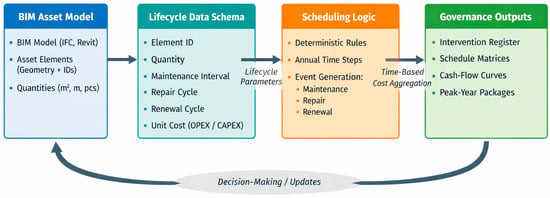
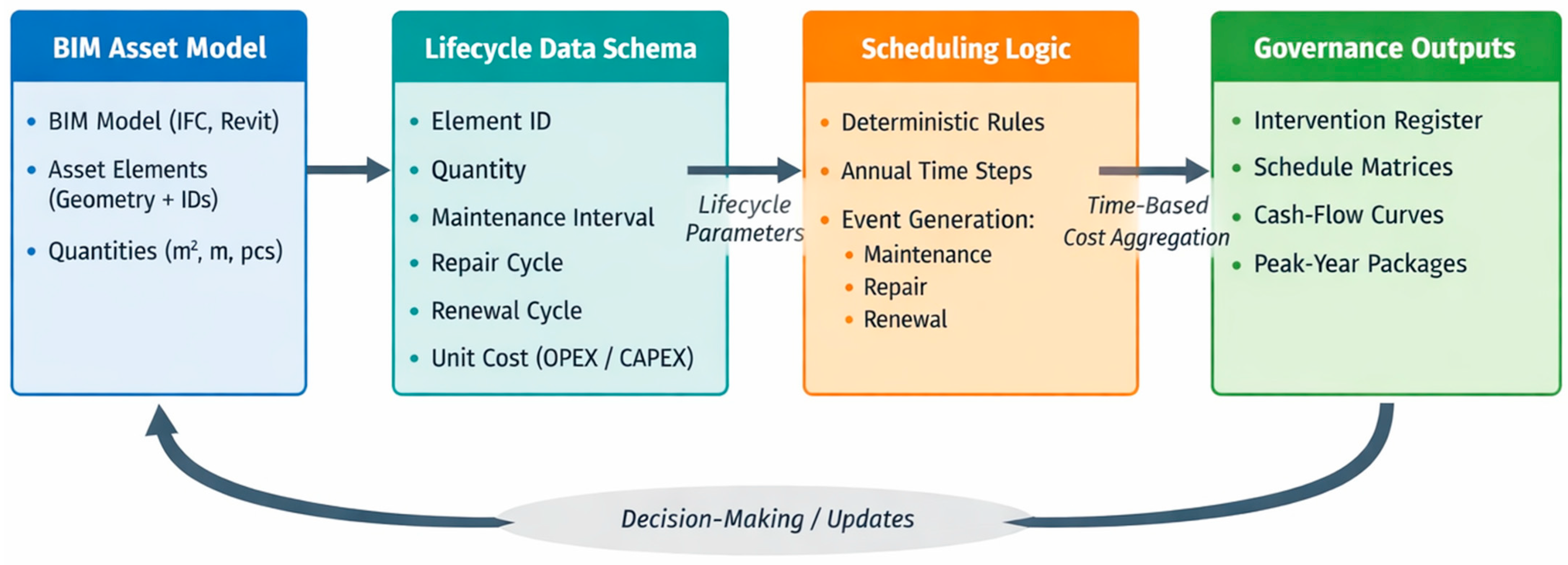
Figure 1 BIM-enabled lifecycle governance workflow. The diagram illustrates the transformation of BIM-based asset data into structured lifecycle information, deterministic scheduling, and governance-oriented outputs including intervention registers, schedule matrices, and cost projections.
Figure 1.
BIM-enabled lifecycle governance workflow.
4. Data Standardization Implemented in the Study
This study begins by establishing a project data standard that makes the BIM environment executable for lifecycle governance rather than a static repository. The standard was defined before any lifecycle simulation to prevent the most common failure mode reported in BIM-enabled operations: missing or inconsistent operational attributes that cannot support maintenance planning, renewal scheduling, or cost aggregation. The definition also follows evidence that owner-led information requirements and portfolio data quality management are decisive for achieving asset-management value from BIM over the operational life of assets.
4.1. Portfolio Scope, Anonymization, and Granularity
The validation context is an anonymized multi-asset portfolio (Industrial Asset Portfolio A, IAPA) consisting of six objects (O1–O6) representing buildings, technical facilities, and external works. All organization- and site-specific identifiers were removed and replaced by neutral codes. The data standard preserves technical structure needed for replication (element types, quantities, intervention cycles, and cost structure) while eliminating identifying metadata.
The standard operates at the maintainable element level. A maintainable element is defined as a unit that can be inspected, serviced, repaired, or renewed without ambiguity (e.g., roof membrane system, heat pump unit, luminaire set, drainage separator, asphalt wearing course). This granularity is consistent with BIM–FM studies that emphasize actionable element-level information as the basis for maintenance decision support.
4.2. Asset Breakdown Structure and the Coding System
A portfolio-wide Asset Breakdown Structure (ABS) was implemented to ensure stable aggregation across time and across heterogeneous assets. The ABS is optimized for lifecycle governance and scenario analysis rather than construction work packaging.
Hierarchy used in this study:
- Portfolio: IAPA.
- Object: O1–O6.
- System group: STR (structure), ENV (envelope), MEP (mechanical), ELE (electrical), SAF (safety), EXT (external works).
- Element: maintainable unit.
- Intervention type: INS (inspection), MNT (maintenance), REP (repair), RENEW (renewal).
Element identifier rule (primary key):
<object>-<system>-<elementtype>-<sequence>.
Example: O2-ENV-ROOF-001.
This rule enables every dataset record to be traced to a single BIM object and to a single set of lifecycle parameters. Stable identifiers and structured information requirements are repeatedly identified as prerequisites for reliable O&M use.
4.3. Lifecycle Governance Data Dictionary (Minimum Schema)
A data dictionary was defined as the authoritative source of field meanings, units, allowed values, and data types. The minimum schema in Table 1 was implemented for every maintainable element. The schema is intentionally compact: it contains the smallest set of fields necessary to reproduce scheduling and lifecycle cost aggregation while remaining realistic for asset owners to maintain over time.
Table 1.
Minimum lifecycle governance schema implemented in study (element level).
4.4. Scheduling Logic Encoded by the Data Standard
The dataset produces intervention schedules deterministically using annual time steps. For each element i and year t in the planning horizon, events are generated according to the element’s interval parameters:
- A maintenance event occurs when t mod maint_interval_y = 0.
- A repair event occurs when repair_interval_y is defined and t mod repair_interval_y = 0.
- A renewal event occurs when t mod renew_interval_y = 0.
Each event inherits element_id, object_id, system_group, and cost_class, enabling portfolio-level aggregation and governance indicators (e.g., expenditure concentration, synchronization of major renewals). This explicit encoding addresses a common gap identified in reviews: many BIM–FM studies support operational task execution but do not formalize long-horizon renewal scheduling as a computable, auditable layer.
4.5. BIM Linkage Implemented in the Study
In this study, the BIM model functions as an asset registry and a visualization interface. Each BIM object represents a maintainable element store: at minimum, element_id, object_id, system_group, and location_code. The lifecycle governance attributes in Table 1 are stored as structured properties within the BIM environment and exported as a synchronized dataset for simulation and scenario comparison. This approach is consistent with evidence that BIM-enabled O&M benefits from controlled information environments and traceable data pipelines rather than ad hoc handover files.
4.6. Validation Rules and Data Quality Controls
A validation protocol was executed before scenario modeling and repeated after each revision. This was necessary because portfolio studies show that data quality issues scale nonlinearly when interventions and costs are aggregated over time and across assets.
Acceptance criteria applied:
- Completeness: 100% of elements contain all mandatory fields in Table 1.
- Unit consistency: qty_unit must match the controlled vocabulary and the unit-cost basis.
- Interval validity: interval fields must be integers ≥ 1 (or null where allowed).
- Referential integrity: every element_id maps to exactly one object and one system group.
- Outlier checks: interval and unit-cost outliers are flagged and reviewed against source assumptions.
- Change control: every edit increments revision_id and records data_source plus a reason note.
These controls implement portfolio-level data governance practices emphasized in strategic asset data quality research and support the owner-information requirement logic identified as critical for operational BIM success.
5. BIM-Enabled Generation of the Maintenance and Renewal Plan (Case-Study Implementation)
This study operationalizes lifecycle governance by converting an anonymized portfolio BIM into a time-phased maintenance and renewal program with auditable quantities, intervention cycles, and costs. The case-study portfolio consists of six urban-industrial assets that represent typical municipal-scale “urban supporting infrastructure” (mobility surfaces, production/utility buildings, and logistics/waste areas): internal roads (3972 m2), a high-load production hall (1885 m2), a transformer station (225 m2), an overhead crane canopy (860 m2), an open warehouse platform (2000 m2), and a waste disposal storage area (607 m2).
All cost inputs are expressed as current, non-indexed values in EUR (excluding VAT), derived from market mini-budgets for the local 2025 context and intended to be replaced by tendered or in-house rates when available.
5.1. BIM-to-Asset Register: Making the Model “Schedule-Ready”
The BIM model is first transformed into an asset register that is stable over time and suitable for lifecycle scheduling. In practical terms, this means that each maintainable item is represented as a uniquely identified asset record linked to its BIM element (or BIM proxy for non-geometric assets). For the case study, the minimum schedule-ready record includes:
- Asset identifier (object + system + element);
- BIM link (e.g., IFC GUID or model element ID);
- Measurable quantity (m2, m, unit count, or lump sum);
- Intervention type (maintenance vs. renewal);
- Intervention cycle (years);
- Unit cost and computed cycle cost.
The BIM-to-asset mapping follows the logic of “maintainable scope,” not only geometry. For example, the transformer station includes civil/architectural elements (masonry facade, roof membrane, raised technical floor) and critical electrical systems (MV/LV switchgear, busbars, breakers, sensors, and inspection access provisions). The same principle is applied to external assets: the road system is modeled as surfaces (area-based) but lifecycle scope also includes drainage points and lighting/electrical zones (count-based).
5.2. Intervention Library: Encoding Maintain/Renew Logic as Reusable Templates
Once the register exists, the plan is generated from a library of intervention templates. Each template is parameterized by quantity and unit cost, and it carries a cycle that reflects expected degradation and service life. The study uses explicit, element-level interventions (not generic “allowances”), such as the following:
Roads: annual surface inspection, annual inlet cleaning, crack sealing every 5 years, resurfacing every 15 years, lighting replacement every 25 years.
Production hall: annual floor maintenance, roof membrane cleaning every 2 years, floor resurfacing every 15 years, roof membrane replacement at year 25, HVAC overhauls at year 20 and 25.
Transformer station: thermography and cabinet tightening at 2-year cycles, breaker tests at 3 years, roof membrane renewal at year 25, partial protection module upgrades at year 30.
Canopy: crane inspections annually, control pendant renewal at year 15, drivetrain refurbishment at year 20, lighting renewal at year 25, structural recoating at year 30.
Open warehouse and waste area: annual inspections and drain cleaning, expansion-joint resealing at year 15, separator overhaul at year 25, surface sealing and partial slab resurfacing at year 30.
This explicit encoding is the core “governance” mechanism: each planned activity can be traced back to an asset record and justified through a quantity, a cost, and an interval.
5.3. Schedule Generation Rules and Outputs (30-Year Horizon)
The lifecycle schedule is generated deterministically from the intervention library. In this study, preventive maintenance cycles are initialized from year 1 (because inspections and routine servicing begin immediately after commissioning), while renewals are placed at their first expected end-of-life year (e.g., 15, 20, 25, or 30). The resulting plan is also presented as two 15-year phases to support budgeting and operational planning.
5.4. Why This Is a Concrete BIM-Enabled Solution (Not Just a Schedule)
This chapter’s contribution is the executable linkage from BIM to lifecycle governance: the BIM model supplies stable quantities (areas, lengths, counts) and a navigable asset structure; the intervention library encodes maintain/renew logic with explicit cycles and costs; and the generated work packages provide an auditable basis for annual planning, procurement packaging, and long-term renewal strategy. The “governance” aspect is that every euro in the plan is traceable to a maintainable asset and a transparent rule (quantity × unit cost × scheduled year), enabling portfolio-level trade-offs (e.g., deferring a resurfacing cycle versus increasing preventive sealing frequency) while keeping operational risk visible.
6. Case Study Outputs: BIM-Linked Maintenance and Renewal Plan
The study produced a set of concrete, BIM-ready outputs that translate an asset information model into an actionable maintenance and renewal program for an anonymized industrial asset portfolio. The portfolio comprises six sub-objects (O1–O6): internal roads (3972 m2), a production hall (1885 m2), a transformer station (225 m2), a canopy with an overhead crane (860 m2), an open warehouse platform (2000 m2), and a waste disposal storage area (607 m2).
All cost outputs are expressed in EUR (excluding VAT) using 2025 market unit rates, enabling direct OPEX forecasting and long-term budgeting.
6.1. Output A: Portfolio Intervention Register (BIM-Linked Task List)
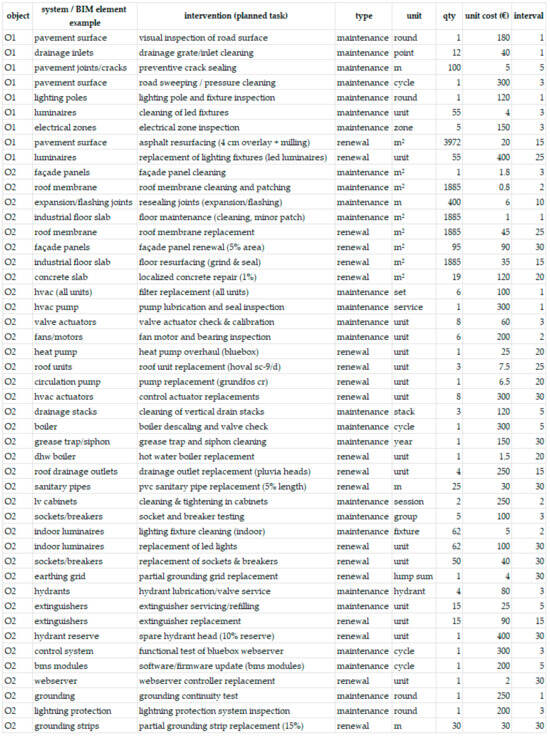
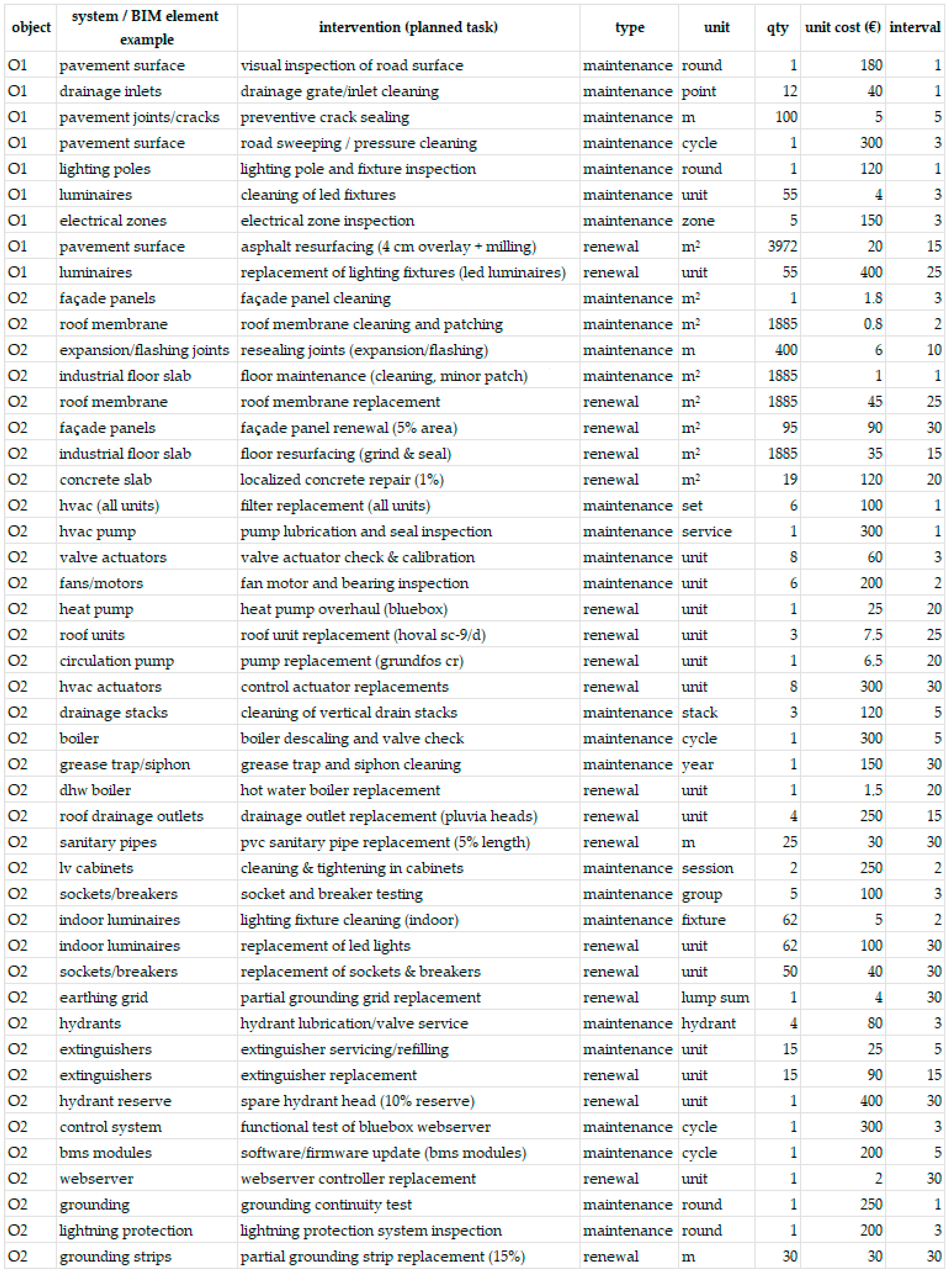
For each object, the study generated a structured intervention register that can be mapped to BIM elements (e.g., slabs, roofs, luminaires, HVAC units, crane components) as planned tasks with attributes: task type (maintenance/renewal), quantity, unit cost, interval, and planned execution year. Examples of task definitions include asphalt resurfacing for O1 (3972 m2 at EUR 20/m2 every 15 years) and LED luminaire replacement for O1 (55 units at EUR 400 every 25 years).
The same structure is applied across building systems in O2 (envelope, HVAC, plumbing, electrical, fire safety, automation, grounding). A sample of the output is shown in Figure 2.
Figure 2.
Portfolio intervention register (BIM-linked task list).
6.2. Output B: Consolidated Schedule Matrices (Workload Planning)
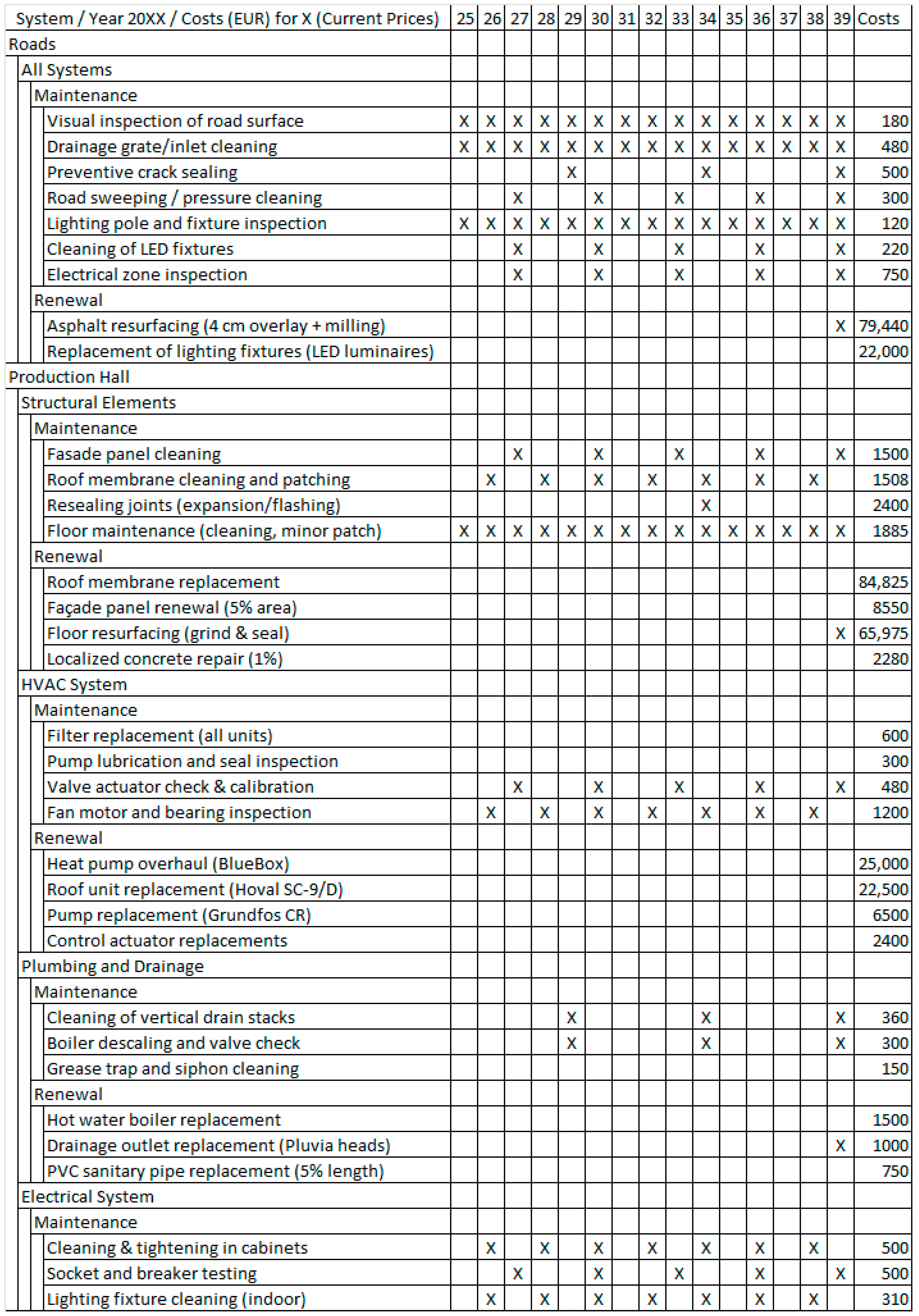
The plan also produced consolidated schedule matrices where each maintenance or renewal activity is marked by year (“X”), allowing facility teams to visualize concurrent interventions across objects and systems and to coordinate shutdown windows and contractor packaging. An example is shown in Figure 3.
Figure 3.
Consolidated schedule matrices (workload planning).
6.3. Output C: Portfolio Cash-Flow Curve (Annual and Cumulative Costs)
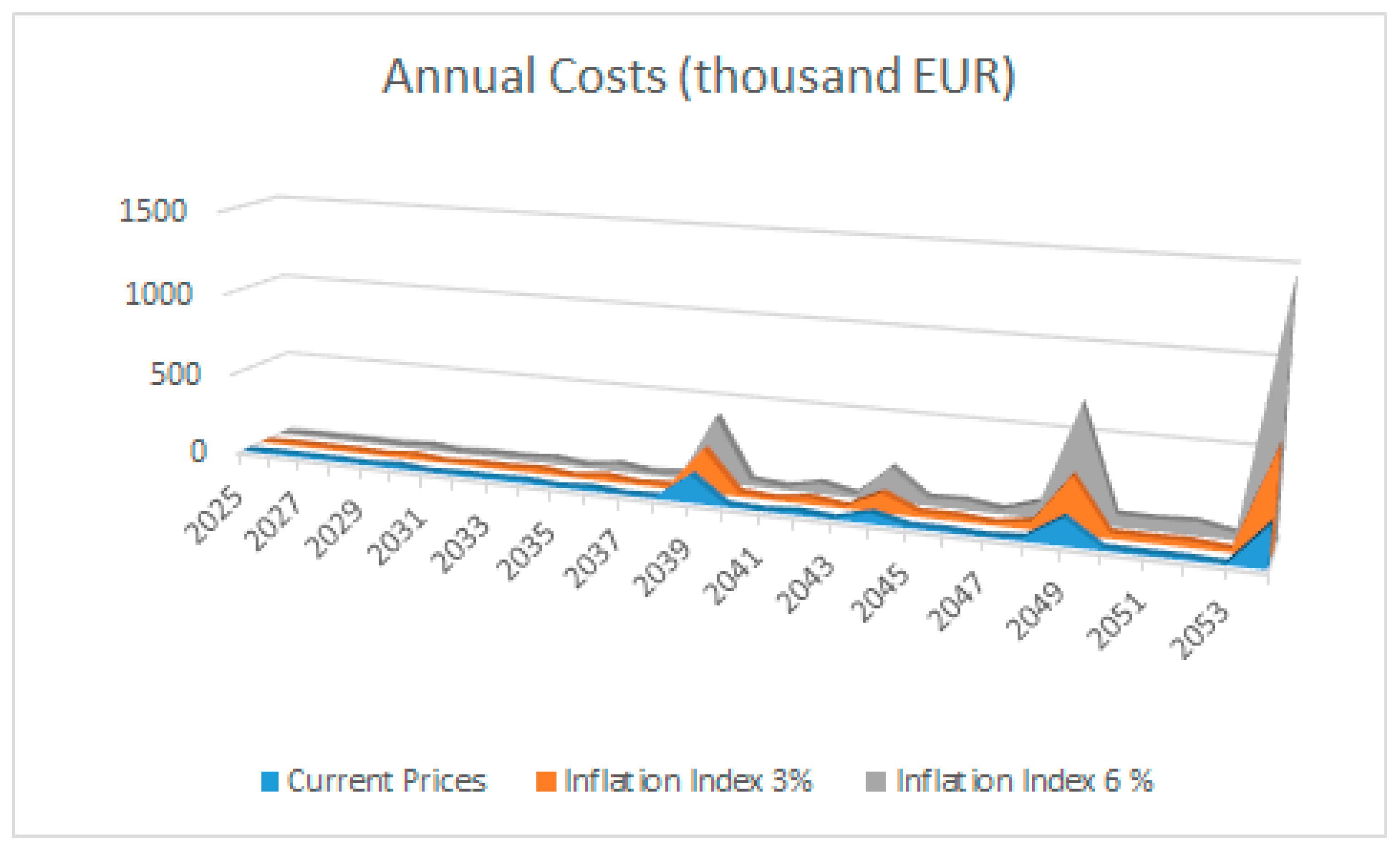
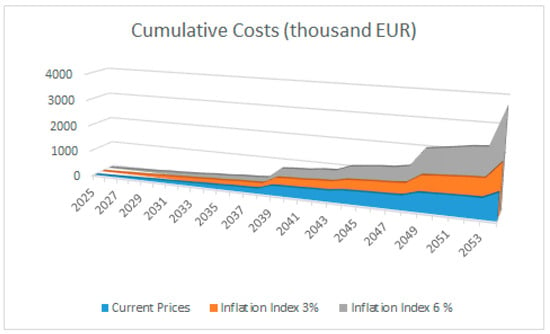
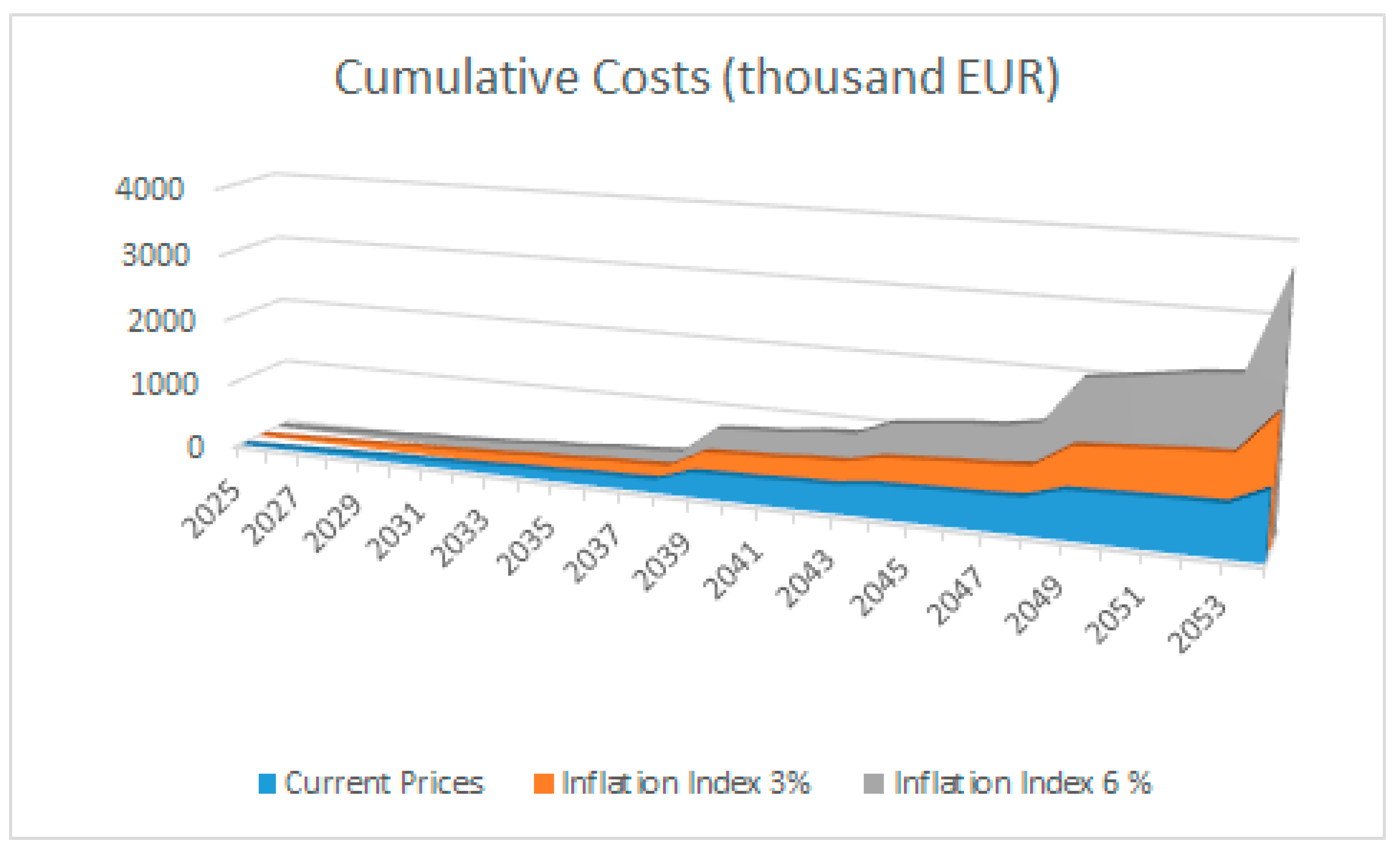
A key deliverable is the portfolio-level annual and cumulative cash-flow output, reported in current prices and as inflation-adjusted scenarios (3% and 6%). The annual costs are shown in Figure 4 and the cumulative costs in Figure 5.
Figure 4.
Annual maintenance and renewal costs.
Figure 5.
Cumulative maintenance and renewal costs.
6.4. Output D: Peak-Year Renewal Work Packages (What Drives the Spikes)
The BIM-enabled schedule makes cost concentrations explainable and “packageable” into renewal bundles. The largest peaks align with major renewal intervals (15, 20, 25, and 30 years from the baseline year 2025), dominated by high-load surfaces, roof systems, and critical equipment.
6.4.1. Package 1: Year 15 Peak (2039, Annual Total EUR 166,945)
Main renewal drivers generated by the plan include:
- O1 roads: asphalt resurfacing 3972 m2 × EUR 20/m2 = EUR 79,440 (15-year cycle).
- O2 production hall: floor resurfacing 1885 m2 × EUR 35/m2 = EUR 65,975 (15-year cycle).
- O2 production hall: roof drainage outlet replacement 4 × EUR 250 = EUR 1000 (15-year cycle).
- O4 canopy crane: control pendant replacement 1 × EUR 800 = EUR 800 (15-year cycle).
These renewals are complemented by the recurring preventive tasks scheduled for the same year (inspections, cleaning, tests) across all objects.
6.4.2. Package 2: Year 20 Peak (2044, Annual Total EUR 63,756)
Key drivers include:
- O2 production hall HVAC: heat pump overhaul 1 × EUR 25,000 and pump replacement 1 × EUR 6500 (20-year cycle).
- O4 canopy crane: travel motors/gearbox refurbishment 2 × EUR 2500 = EUR 5000 (20-year cycle).
- O6 waste area: surface repairs (5% spalling) 30 m2 × EUR 50/m2 = EUR 1500 (20-year cycle).
6.4.3. Package 3: Year 25 Peak (2049, Annual Total EUR 158,820)
This peak is dominated by roof and lighting renewals plus selective equipment overhauls:
- O2 production hall: roof membrane replacement 1885 m2 × EUR 45/m2 = EUR 84,825.
- O2 production hall HVAC: roof unit replacement 3 × EUR 7500 = EUR 22,500.
- O1 roads: replacement of LED luminaires 55 × EUR 400 = EUR 22,000.
- O3 transformer station: roof membrane renewal 225 m2 × EUR 45/m2 = EUR 10,125, plus lighting fixture renewal 20 × EUR 100 = EUR 2000.
- O4 canopy crane: safety sensor replacement 1 × EUR 600 and luminaire replacement 9 × EUR 180 = EUR 1620.
- O5 open warehouse: luminaire replacement 12 × EUR 180 = EUR 2160.
- O6 waste area: wastewater separator overhaul 1 × EUR 1200 and luminaire replacement 6 × EUR 180 = EUR 1080.
6.4.4. Package 4: Year 30 Peak (2054, Annual Total EUR 251,695)
The year-30 package is a multi-object “restoration wave” combining large surface renewals with broad electrical and structural refresh actions:
- O1 roads: asphalt resurfacing again EUR 79,440 (15-year cycle repeated).
- O2 production hall: floor resurfacing again EUR 65,975 and façade renewal (5%) 95 m2 × EUR 90/m2 = EUR 8550.
- O2 production hall: electrical partial refresh (LED lighting 62 × EUR 100, sockets/breakers 50 × EUR 40, grounding grid EUR 4000) and automation controller renewal (EUR 2000).
- O4 canopy: roof sheet replacement (25%) 215 m2 × EUR 40/m2 = EUR 8600, steel recoating 150 m2 × EUR 25/m2 = EUR 3750, and crane rail partial replacement 10 m × EUR 120/m = 1200 EUR.
- O5 open warehouse: slab resurfacing (10%) 200 m2 × EUR 45/m2 = EUR 9000 and expansion joint resealing (15-year cycle repeated) 100 m × EUR 8/m = EUR 800.
- O6 waste area: surface sealant renewal 607 m2 × EUR 12/m2 = EUR 7284 and fence panel renewal (25%) 45 m2 × EUR 90/m2 = EUR 4050.
As with earlier peaks, the remaining portion of the year-30 annual total is attributed to coincident preventive maintenance tasks (annual/biannual inspections, cleaning, grounding continuity tests) that remain scheduled alongside renewals to protect performance during and after restoration works.
Practical implication for BIM-enabled lifecycle governance. These outputs demonstrate how the BIM-linked intervention register and schedule matrices can be elevated into a portfolio cash-flow forecast that is both auditable (traceable to element quantities and unit costs) and operationally actionable (convertible into annual work packages). The result is a governance-ready maintenance and renewal plan that supports budget stability through resource leveling while preserving the reliability and serviceability of high-criticality assets such as heavy-duty surfaces, roofs, HVAC equipment, and lifting technology.
7. Discussion
Interpreted against prior BIM–FM studies, the contribution is the conversion of “information availability” into “decision usability.” Previous research has shown that BIM adoption in FM is limited by inconsistent asset data, unclear information requirements, and weak data validation, which often reduces BIM to documentation rather than operational decision support. The case study demonstrates that a minimal, enforced lifecycle schema (element ID, quantity, interval, unit cost, and cost class) is sufficient to generate auditable outputs: schedule matrices, annual and cumulative cost curves, and peak-year renewal work packages.
This directly aligns with earlier findings that operational benefit depends on structured information requirements and controlled information environments rather than additional geometric detail.
From a broader urban sustainability perspective, the plan outputs demonstrate three implications that extend beyond a single industrial site. First, peak visibility enables resource leveling and coordinated renewal packaging, reducing repeated mobilization and limiting operational disruption. In practice, this means that envelope access cycles (e.g., roof membrane renewal) can be aligned with rooftop HVAC replacement and drainage interventions to avoid multiple scaffoldings or shutdown windows. Second, the plan makes “low-cost but high-criticality” maintenance visible, such as grounding continuity testing and periodic electrical inspections, which are commonly underfunded when budgets focus only on capital renewals. Third, the portfolio cash flow output provides a governance-ready argument for proactive planning: inflation scenarios show that the same renewal structure can impose substantially different long-term financial burdens under macroeconomic uncertainty, reinforcing the value of early, structured renewal scheduling.
However, the results also highlight limitations that are consistent with open challenges in the literature. The lifecycle schedule is deterministic and interval-based; it does not model for stochastic failures, uncertain degradation, or changing operational intensity. Unit costs are derived from a market-based baseline and therefore remain sensitive to regional procurement conditions and future supply-chain volatility. Environmental impacts are addressed indirectly through the logic that preventive maintenance reduces premature replacements, but the study does not yet quantify embodied carbon or material flows per renewal event. Finally, although the portfolio contains multiple asset types, transfer to broader urban portfolios (schools, hospitals, civic buildings, roads) requires calibration of intervention libraries and cost structures to different typologies.
Future research should extend the presented governance framework in four directions. First, inspection results and defect logs should be integrated to adjust intervals dynamically, enabling a hybrid approach where BIM-based planning is updated by condition feedback. Second, renewal events should be coupled with environmental impact factors so that the same event table yields both LCC and LCA indicators, supporting sustainability trade-offs. Third, portfolio optimization methods should be applied to smooth renewal peaks under annual budget caps while respecting criticality constraints and operational downtime classes. Fourth, interoperability studies should test how reliably the lifecycle parameter set can be exchanged and maintained across heterogeneous BIM, FM, and asset management platforms over long operational periods.
The transferability of the framework to other asset types requires adaptation of input parameters and intervention logic. While the underlying structure—comprising the lifecycle data schema, BIM linkage, and deterministic scheduling model—is generic and transferable, key inputs such as unit costs, service-life assumptions, and intervention libraries are context-specific.
For example, application to public infrastructure such as schools, hospitals, or transportation systems would require calibration to different regulatory environments, usage patterns, and criticality classifications. Therefore, the framework should be understood as a transferable methodology rather than a directly transferable dataset.
In this study, financial stability is not interpreted as a macroeconomic or organizational performance indicator, but as a property of lifecycle expenditure distribution. Specifically, it refers to the predictability and temporal distribution of maintenance and renewal costs, including the reduction of cost concentration in peak years and improved transparency of long-term financial commitments. These aspects are directly observable in the generated cash-flow curves and peak-year renewal packages.
Applying the framework to other asset categories would require the development of asset-specific intervention libraries, recalibration of service-life assumptions, and alignment with sector-specific regulatory and operational constraints. These adaptations represent a non-trivial effort and highlight that the framework provides a transferable structure, but not a universally applicable parameter set.
The contribution of this study is therefore best understood as a methodology blueprint that translates conceptual BIM–FM approaches into an executable governance model. Environmental and social dimensions of sustainability are not explicitly modeled or quantified within the current framework.
8. Conclusions
This study proposed and validated a BIM-enabled lifecycle governance methodology that generates auditable maintenance and renewal plan from structured asset data. The results demonstrate that embedding lifecycle parameters within a BIM environment improves the predictability of annual expenditures, enables identification and structuring of renewal peaks, and increases the transparency of long-term cost distribution. These effects contribute to improved financial planning at the portfolio level.
The findings support the central hypothesis that BIM can serve sustainable urban asset management only when complemented by early data standardization, validation routines, and a computable scheduling model that transforms asset information into lifecycle governance outputs. While the current implementation is deterministic and cost-focused, it provides a robust baseline for future extensions that incorporate condition-based updating, environmental indicators, and portfolio-scale optimization.
The study does not demonstrate environmental performance improvements, stochastic modeling of asset degradation, or optimization of maintenance strategies under budget constraints. It also does not validate predictive maintenance approaches based on real-time data. These aspects remain outside the scope of the current work and represent directions for future research.
Funding
This research was funded by Czech Technical University in Prague, Faculty of Civil Engineering research project SGS26/013/OHK1/1T/11.
Institutional Review Board Statement
Not applicable.
Informed Consent Statement
Not applicable.
Data Availability Statement
The data supporting the findings of this study are available from the author upon reasonable request. The dataset includes anonymized asset parameters, lifecycle cost structures, and intervention schedules. Access is restricted due to the anonymization of commercially sensitive cost information.
Acknowledgments
The author gratefully acknowledges the support of the Department of Construction Management and Economics, Faculty of Civil Engineering, Czech Technical University in Prague.
Conflicts of Interest
The authors declare no conflicts of interest.
Abbreviations
The following abbreviations are used in this manuscript:
| 4D | four-dimensional (time/scheduling integration in BIM) |
| 5D | five-dimensional (cost integration in BIM) |
| ABS | asset breakdown structure |
| BIM | building information modeling |
| ELE | electrical (system group code) |
| ENV | envelope (system group code) |
| EUR | euro |
| EXT | external works (system group code) |
| FM | facilities management |
| GIS | geographic information system |
| GUID | globally unique identifier |
| HVAC | heating, ventilation, and air conditioning |
| IAPA | industrial asset portfolio a (anonymized portfolio identifier) |
| ID | identifier |
| IFC | industry foundation classes |
| INS | inspection (intervention type) |
| IOT | internet of things |
| LCA | life cycle assessment |
| LCC | life cycle costing |
| LED | light-emitting diode |
| LV | low voltage |
| MEP | mechanical, electrical, and plumbing |
| MNT | maintenance (intervention type) |
| MV | medium voltage |
| O&M | operation and maintenance |
| O1–O6 | anonymized object identifiers within the portfolio |
| OPEX | operational expenditure |
| RENEW | renewal (intervention type) |
| REP | repair (intervention type) |
| SAF | safety (system group code) |
| STR | structure (system group code) |
| VAT | value-added tax |
References
- Sartori, I.; Hestnes, A.G. Energy use in the life cycle of conventional and low-energy buildings: A review article. Energy Build. 2007, 39, 249–257. [Google Scholar] [CrossRef] [Scilit]
- Cabeza, L.F.; Rincón, L.; Vilariño, V.; Pérez, G.; Castell, A. Life cycle assessment (LCA) and life cycle energy analysis (LCEA) of buildings and the building sector: A review. Renew. Sustain. Energy Rev. 2014, 29, 394–416. [Google Scholar] [CrossRef] [Scilit]
- Kadeřábková, B.; Čermáková, K.; Hromada, E.; Pavelka, T. Does Increased Construction Activity Transmit into Housing Prices and Rents? Evidence from the V4 Countries and Austria. Front. Sustain. Cities 2023, 5, 1267964. [Google Scholar] [CrossRef] [Scilit]
- Succar, B. Building information modelling framework: A research and delivery foundation for industry stakeholders. Autom. Constr. 2009, 18, 357–375. [Google Scholar] [CrossRef] [Scilit]
- Karásek, J.; Pojar, J.; Kaločai, L.; Schneiderová Heralová, R. Cost Optimum Calculation of Energy Efficiency Measures in the Czech Republic. Energy Policy 2018, 123, 155–166. [Google Scholar] [CrossRef] [Scilit]
- Kim, K.; Kim, H.; Kim, W.; Kim, C.; Kim, J.; Yu, J. Integration of ifc objects and facility management work information using Semantic Web. Autom. Constr. 2018, 87, 173–187. [Google Scholar] [CrossRef] [Scilit]
- Patacas, J.; Dawood, N.; Kassem, M. BIM for facilities management: A framework and a common data environment using open standards. Autom. Constr. 2020, 120, 103366. [Google Scholar] [CrossRef] [Scilit]
- Opoku, D.G.J.; Perera, S.; Osei-Kyei, R.; Rashidi, M. Digital twin application in the construction industry: A literature review. J. Build. Eng. 2021, 40, 102726. [Google Scholar] [CrossRef] [Scilit]
- Vitkova, A.; Vitasek, S. A Case Study on Sustainable Technologies in Residential Buildings from a Life Cycle Cost Analysis (LCC) Perspective. Sustainability 2024, 16, 10892. [Google Scholar] [CrossRef] [Scilit]
- Cole, R.J.; Sterner, E. Reconciling theory and practice of life-cycle costing. Build. Res. Inf. 2000, 28, 368–375. [Google Scholar] [CrossRef] [Scilit]
- Gluch, P.; Baumann, H. The life cycle costing (LCC) approach: A conceptual discussion of its usefulness for environmental decision-making. Build. Environ. 2004, 39, 571–580. [Google Scholar] [CrossRef] [Scilit]
- Santos, R.; Costa, A.A.; Silvestre, J.D.; Pyl, L. Integration of LCA and LCC analysis within a BIM-based environment. Autom. Constr. 2019, 103, 127–149. [Google Scholar] [CrossRef] [Scilit]
- Tuhaise, V.V.; Tah, J.H.M.; Abanda, F.H. Technologies for digital twin applications in construction. Autom. Constr. 2023, 152, 104931. [Google Scholar] [CrossRef] [Scilit]
- Kumar, D.; Setunge, S.; Patnaikuni, I. Prediction of life-cycle expenditure for different categories of council buildings. J. Perform. Constr. Facil. 2010, 24, 556–561. [Google Scholar] [CrossRef] [Scilit]
- Becerik-Gerber, B.; Jazizadeh, F.; Li, N.; Calis, G. Application areas and data requirements for BIM-enabled facilities management. J. Constr. Eng. Manag. 2012, 138, 431–442. [Google Scholar] [CrossRef] [Scilit]
- Motawa, I.; Almarshad, A.K. A knowledge-based BIM system for building maintenance. Autom. Constr. 2013, 29, 173–182. [Google Scholar] [CrossRef] [Scilit]
- Volk, R.; Stengel, J.; Schultmann, F. Building information modeling (BIM) for existing buildings—Literature review and future needs. Autom. Constr. 2014, 38, 109–127. [Google Scholar] [CrossRef] [Scilit]
- Mignard, C.; Nicolle, C. Merging BIM and GIS using ontologies application to urban facility management in ACTIVe3D. Comput. Ind. 2014, 65, 1276–1290. [Google Scholar] [CrossRef] [Scilit]
- Pärn, E.A.; Edwards, D.J.; Sing, C.P. The building information modelling trajectory in facilities management: A review. Autom. Constr. 2017, 75, 45–55. [Google Scholar] [CrossRef] [Scilit]
- Cavka, H.B.; Staub-French, S.; Poirier, E.A. Developing owner information requirements for BIM-enabled project delivery and asset management. Autom. Constr. 2017, 83, 169–183. [Google Scholar] [CrossRef] [Scilit]
- Zadeh, P.A.; Wang, G.; Cavka, H.B.; Staub-French, S.; Pottinger, R. Information Quality Assessment for Facility Management. Adv. Eng. Inform. 2017, 33, 181–205. [Google Scholar] [CrossRef] [Scilit]
- Wang, H.; Pan, Y.; Luo, X. Integration of BIM and GIS in sustainable built environment: A review and bibliometric analysis. Autom. Constr. 2019, 103, 41–52. [Google Scholar] [CrossRef] [Scilit]
- Utami, R. State-of-the-Art Review on BIM for Infrastructure Management. ITcon—Electronic J. Inf. Technol. Constr. 2024, 29, 810–825. [Google Scholar] [CrossRef] [Scilit]
- Chalhoub, J.; Ayer, S.K. Exploring the Performance of an Augmented Reality Application for Construction Layout Tasks. Multimed. Tools Appl. 2019, 78, 35075–35098. [Google Scholar] [CrossRef] [Scilit]
- Kaur, R.; Mwambegele, B.J.; Abraham, A.G.; Basheer, S.A.; Garia, S. A Comprehensive Review on Building Information Modelling (BIM), Its Implementations and Applications. Discov. Civ. Eng. 2025, 2, 177. [Google Scholar] [CrossRef] [Scilit]
- Cheng, J.C.P.; Chen, W.; Tan, Y.; Wang, M. Data-driven predictive maintenance planning framework for MEP components based on BIM and IoT using machine learning algorithms. Autom. Constr. 2020, 112, 103087. [Google Scholar] [CrossRef] [Scilit]
- Hamedi Rad, M.A.; Jalaei, F.; Golpour, A.; Hosseini Varzandeh, S.S.; Guest, G. BIM-based approach to conduct life cycle cost analysis of resilient buildings at the conceptual stage. Autom. Constr. 2021, 123, 103480. [Google Scholar] [CrossRef] [Scilit]
- Kamal, Z.; Taghaddos, H.; Metvaei, S. BIM-based maintenance management system for healthcare facilities. J. Perform. Constr. Facil. 2021, 35, 04021036. [Google Scholar] [CrossRef] [Scilit]
- Kamal, Z.; Taghaddos, H.; Metvaei, S. BIM-based repair and maintenance for hospital work order management. Autom. Constr. 2022, 143, 104546. [Google Scholar] [CrossRef] [Scilit]
- Fang, Z.; Liu, Y.; Lu, Q.; Pitt, M.; Hanna, S.; Tian, Z. BIM-integrated portfolio-based strategic asset data quality management. Autom. Constr. 2022, 134, 104070. [Google Scholar] [CrossRef] [Scilit]
- ISO 55000:2014; Asset Management—Overview, Principles and Terminology. International Organization for Standardization: Geneva, Switzerland, 2014.
- ISO 55001:2014; Asset Management—Management Systems—Requirements. International Organization for Standardization: Geneva, Switzerland, 2014.
- Quinn, C.; Zargar Shabestari, A.; Misic, T.; Gilani, S.; Litoiu, M.; McArthur, J.J. Building automation system—BIM integration using a linked data structure. Autom. Constr. 2020, 118, 103257. [Google Scholar] [CrossRef] [Scilit]
- Lu, K.; Jiang, X.; Yu, J.; Tam, V.W.Y.; Skitmore, M. Integration of life cycle assessment and life cycle cost using building information modeling: A critical review. J. Clean. Prod. 2021, 285, 125438. [Google Scholar] [CrossRef] [Scilit]
- Heaton, J.; Parlikad, A.K.; Schooling, J. Design and development of BIM models to support operations and maintenance. Comput. Ind. 2019, 111, 172–186. [Google Scholar] [CrossRef] [Scilit]
- Condotta, M.; Scanagatta, C. BIM-based method to inform operation and maintenance phases through a simplified procedure. J. Build. Eng. 2023, 65, 105730. [Google Scholar] [CrossRef] [Scilit]
- Hagedorn, P.; Liu, L.; König, M.; Hajdin, R.; Blumenfeld, T.; Stöckner, M.; Billmaier, M.; Grossauer, K.; Gavin, K. BIM-Enabled Infrastructure Asset Management Using Information Containers and Semantic Web. J. Comput. Civ. Eng. 2023, 37, 04022041. [Google Scholar] [CrossRef] [Scilit]
- Gao, X.; Pishdad-Bozorgi, P. BIM-enabled facilities operation and maintenance: A review. Adv. Eng. Inform. 2019, 39, 227–247. [Google Scholar] [CrossRef] [Scilit]
- Kim, Y. The cost of deferred maintenance: Effects of politics on highway maintenance spending. Public Work. Manag. Policy 2021, 27, 10–12. [Google Scholar] [CrossRef] [Scilit]
- Věrný, L.; Žák, J. A Cost–Benefit Analysis of BIM Methodology Implementation in the Preparation and Construction Phase of Public Sector Projects. Buildings 2025, 15, 3837. [Google Scholar] [CrossRef] [Scilit]
- Azhar, S. Building information modeling (BIM): Trends, benefits, risks, and challenges for the AEC industry. Leadersh. Manag. Eng. 2011, 11, 241–252. [Google Scholar] [CrossRef] [Scilit]

Disclaimer/Publisher’s Note: The statements, opinions and data contained in all publications are solely those of the individual author(s) and contributor(s) and not of MDPI and/or the editor(s). MDPI and/or the editor(s) disclaim responsibility for any injury to people or property resulting from any ideas, methods, instructions or products referred to in the content. |
© 2026 by the author. Licensee MDPI, Basel, Switzerland. This article is an open access article distributed under the terms and conditions of the Creative Commons Attribution (CC BY) license.