


Abstract
Suburban residential streets have long been criticised for their multiple short-comings, including traffic-related injury, increased stormwater runoff, and lack of aesthetic values. Research suggests that Integrated Green-Grey Infrastructure (IGGI) is likely to play a role in mitigating these problems. IGGI refers to infrastructure that consists of both natural materials (such as plants, soil) and human-made structures (such as concrete, pipes). However, IGGI’s definition remains vague, and little is known about its implementation in suburban street retrofitting, and how effective it is. Using a systematic literature review method, this paper analyses peer-reviewed journal articles published over a period of ten years between 2014 and 2023. The objective was to understand IGGI’s definition, integration, and effectiveness in implemented residential street retrofitting projects. Through a rigorous screening process, 15 papers were selected for qualitative analysis. Clusters developed in analysing the results consist of IGGI’s concepts, components, integration and effectiveness. The most notable subject area is system-scale integration, shared by 14 papers. Findings regarding the effectiveness of IGGI suggest strong empirical evidence related to stormwater management and road user behavioural change; however, there were mixed perceptions toward the aesthetic values of rain gardens.
1. Introduction
1.1. The Problem and Its Characteristics
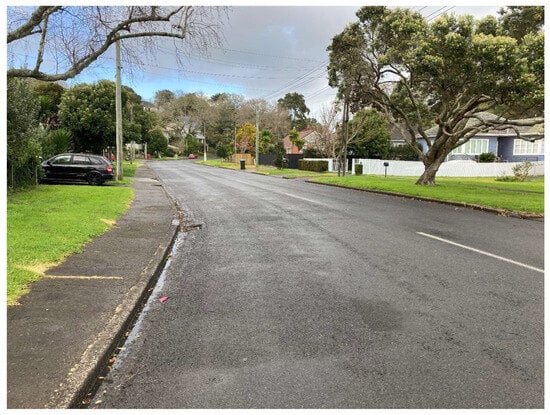
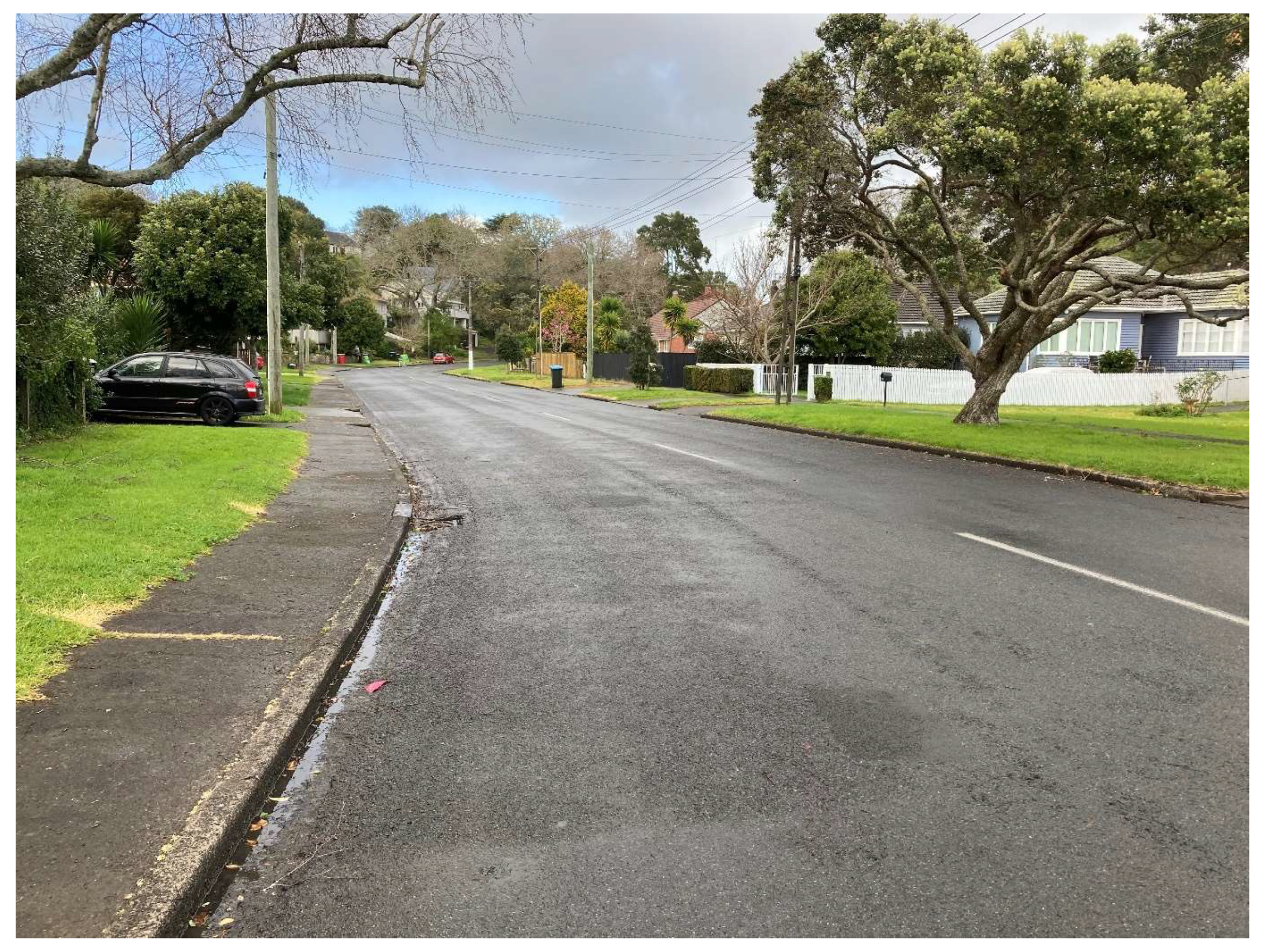
Suburban residential streets in many developed countries were designed as motor vehicle-dominated, wide, paved surfaces. These streets share three common characteristics: Their primary function is to accommodate vehicular speed and movement; their prominent geometric features are wide paved surfaces with a high proportion for motor vehicles and narrow strips for utilities, sidewalks and planting; and the network of these streets occupies up to 30% of total suburban land, providing the necessary access to individual houses and domestic carports [1,2,3]. Figure 1 shows a typical suburban residential street.
Figure 1.
A typical suburban residential street in Auckland, New Zealand (photo taken by author).
Recently, these conventionally designed residential streets have been increasingly associated with environmental and social problems. The wide paved surfaces of these streets can lead to increased stormwater runoff [4], which then often results in water contamination [5] and urban flooding [6]. Their car-dominated travel mode is associated with high accident rates and increased injury risks for cyclists and pedestrians [7]. Moreover, roads characterised by wide carriageways and insufficient street canopy coverage contribute to urban heat; therefore, they are frequently thermally uncomfortable for pedestrians in hot summer conditions [8]. The narrow footpaths of these streets discourage many residents from using the streets for walking, playing, and social interaction [9], which may contribute to physical and mental health decline [10].
1.2. Current Solutions and Gaps
Research suggests that integrated green-grey infrastructure may play a role in mitigating these challenges [11,12,13]. Green infrastructure refers to natural features and systems, including vegetation, soils, and water [14]. Grey infrastructure refers to human-made features and systems, including utility networks such as roads, electricity, water supply and sewage systems [15]. Integrated green-grey infrastructure (IGGI) refers to infrastructure consisting of both “green” (natural, living) and “grey” (human-made, anthropogenic) infrastructure [12]. Research indicates that IGGI has the potential to combine the benefits of both green and grey infrastructures, thereby mitigating multiple issues [16,17]. An example of a street IGGI could be a stormwater rain garden, which is typically composed of green infrastructure (such as plants and soil) and grey infrastructure (such as concrete surround and drainage pipes) [18]. A well-designed rain garden can provide multiple environmental and social benefits, including reducing flood risk, decreasing stormwater pollution, increasing biodiversity, and adding aesthetic value [19].
However, a narrative review of the global literature reveals three significant research gaps. First, there seems to be a lack of explicit definitions for “Integrated Green-Grey Infrastructure” in the context of suburban street retrofits. Novel street infrastructure has been promoted and studied, but many different concepts have been used, such as Nature-based Solutions (NbS) [20], green-infrastructure [21], Complete Street [22], Green Street [23], stormwater street [24]. However, these definitions are often vague and inconsistent. For example, NbS covers a range of green infrastructure strategies that address environmental and societal issues. It is an umbrella term without a clear definition [25]. Its taxonomies, such as nature-based infrastructure, green or green/grey infrastructure, and hybrid infrastructure, each have overlapping definitions of what is considered green, grey or green/grey [25]. This inconsistency poses significant challenges for research and creates a considerable barrier for cross-disciplinary collaboration. Although one definition of IGGI has been developed regarding IGGI’s types, scales, and functions [12], it is a general one. There is a need for a more specific definition of IGGI in the context of residential street retrofitting.
Second, several knowledge gaps regarding the integration of IGGI in street spaces are apparent. Despite the significant potential of integrated systems, there is a limited understanding of how to incorporate green and grey infrastructure effectively. In particular, there is a lack of holistic understanding of how green and grey components work within the street space and whether their performance complement or conflict with one another. These gaps were echoed by several authors. For example, Rogers et al. [26] noted the lack of physical integration between surface infrastructure and buried utilities within street spaces. Page et al. [27] pointed out the lack of peer-reviewed literature on integrating multiple stormwater infrastructures at the street catchment scale. Without careful integration, there is a risk that fragmented new infrastructure elements may exacerbate the vulnerability of urban environments [28].
Third, there seems to be a significant knowledge gap regarding the effectiveness of street IGGI. The potential benefits of IGGI have been explored by several authors [27,29], but the number of peer-reviewed literature on their effectiveness is limited. For example, little is known about the assessment of the quality performance of integrated stormwater infrastructure at the catchment scale [27]. Moreover, methods for evaluating IGGI effectiveness also need to be tested. For instance, despite the general success of improved walking and cycling activities, the effectiveness evaluation of IGGI needs to consider street hierarchy, functions, and visual features [29].
1.3. Research Aim
In response, this research aims to advance scholarly understanding of Integrated Green-Grey Infrastructure (IGGI) in residential street retrofitting. Using a systematic review of the global literature published between 1 January 2014 and 31 December 2023, this paper reports on the research status of implemented IGGI in residential street retrofits. It discusses the concepts, integration, and impact of IGGI in residential street retrofitting around three distinct questions. First, how has IGGI been defined in the context of residential street retrofits? Second, how has IGGI been integrated in residential street retrofits? Third, how has IGGI effectiveness been evaluated in the context of residential street retrofits?
2. Theoretical Background
2.1. Diverse Concepts of Suburban Street Retrofits
Historically, streets were the centres of public spaces in many communities. Their layout were mostly narrow and irregular, with distinctive characteristics. They were designed to meet the needs of foot traffic and sometimes very limited use by vehicles. As transportation advanced, these streets, where possible, were adjusted to prioritise new forms of transport. Over the years, streets also became corridors for access, parking, drainage, and utilities [30,31]. Since the 1930s, driven by rapid suburban sprawl and the advance of transport technology, residential streets in American suburbs were standardised as wide-paved transport corridors dominated by motor vehicles [32]. Such street patterns spread to cities across North America, Europe, Australia, and New Zealand as they enabled large-scale suburban development while meeting the needs for fast vehicle movement [13].
The retrofitting of suburban residential streets was first driven by traffic safety, then shifted to stormwater management, and environmental and social well-being. Researchers and practitioners promoted various concepts, such as Green Infrastructure [21], Complete Street [22], Green Street [23], Stormwater Street [24], and Nature-based Solutions (NbS) [20]. The scale of street retrofitting also ranges significantly, from stormwater catchment to neighbourhood scale, and street network scale to individual infrastructure components [13].
Several concepts are similar to IGGI, such as Green Infrastructure (GI), Nature-based Solutions (NbS), Sustainable Drainage Systems (SuDS), Blue-Green Infrastructure (BGI). In the street retrofitting context, they all emphasise adding natural components (green infrastructure) to existing engineering systems (grey infrastructure). However, in developed urban or suburban areas, especially within strictly defined street spaces, any add-on “natural” components inevitably contain human-made materials (grey infrastructure). For example: a tree pit added to an existing street may consist of the tree itself (nature-based), constructed soil (nature/human-based), and tree pit border (human-based) [18]. The term IGGI acknowledges the mutual relationships between nature-based (green) and human-made (grey) components, rather than prioritising one over another. In this paper, we will use IGGI to refer to infrastructures that contains green, blue, and grey components rather than separated terms.
2.2. Definitions and Development of IGGI
The IGGI concept was first proposed in 2006 and has been developed by several scholars over the last two decades. The early understanding of IGGI was defined by Davies et al. [11] as a green-grey continuum, with green and grey at either end, and various combinations of green and grey in the middle. This generic definition was later refined by Aleksandrova et al. [13] as a framework of grey, green, and green-grey infrastructure in the context of street retrofitting. According to Wesener and McWilliam [12], “integrated green-grey infrastructure” (IGGI) consists of three spatial scales: “Intracomponent scale” refers to one infrastructure component consisting of both green and grey constituents; “intercomponent scale” refers to two components, one green and one grey, that work together; and “system scale” refers to a system consisting of multiple green, grey and/or green-grey components, often at a larger spatial scale.
In the street context, examples at the intracomponent scale IGGI include rain gardens, which consist of plants (green elements) and drainage pipes (grey elements). At the intercomponent scale, an example could be a bioswale (a green component) enclosed by a chicane (a grey component). An example of system scale IGGI is an entire street integrated with multiple green and grey components, including rain gardens, planters, and raised pedestrian crossings, which work together to slow down the traffic speed [12,13].
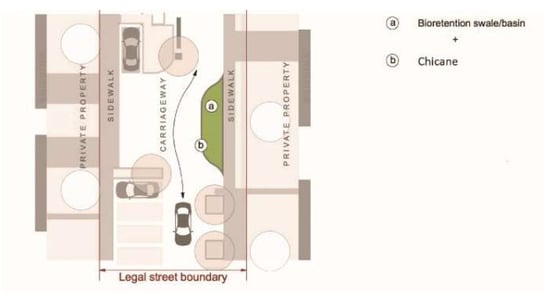
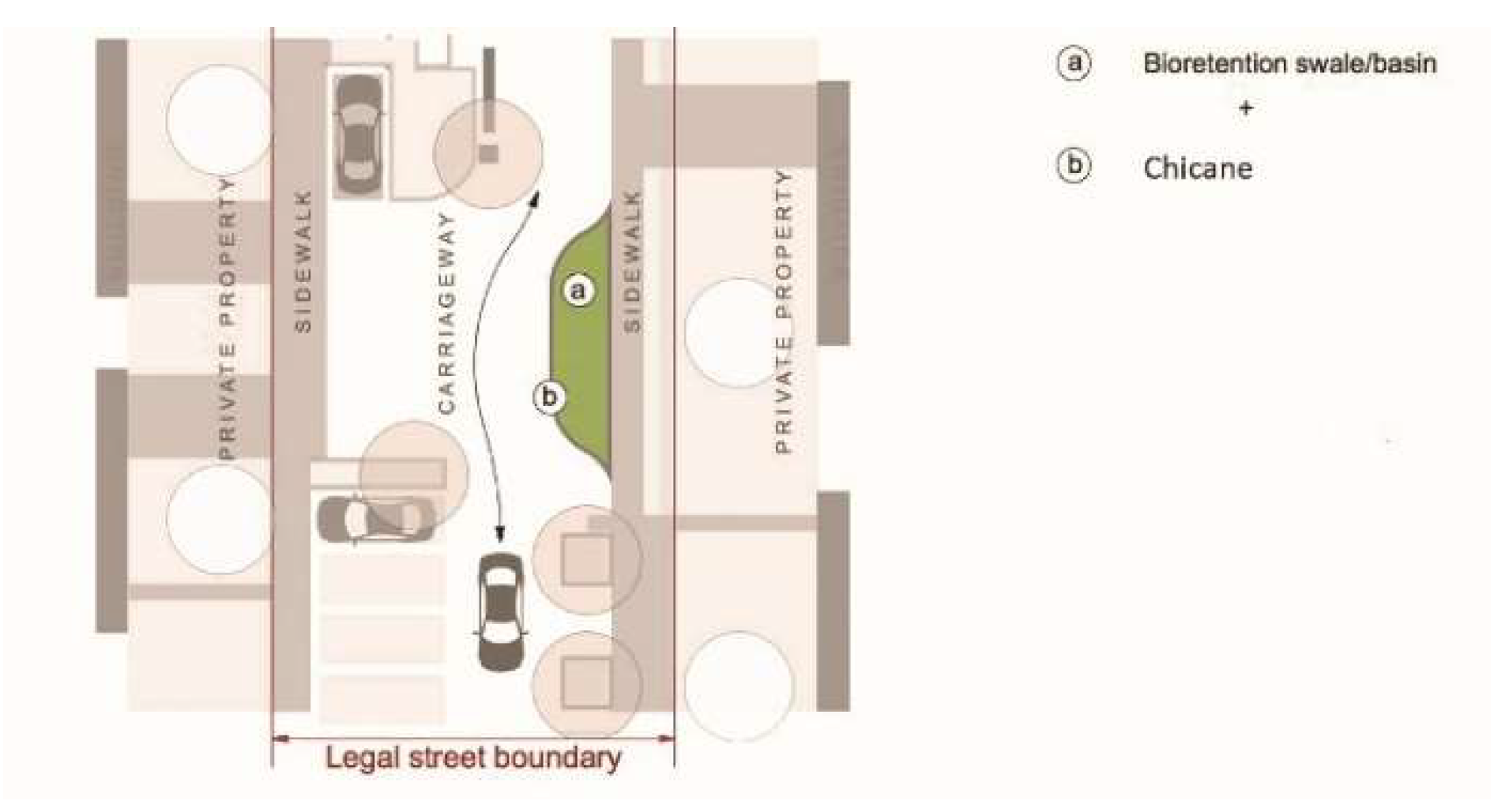
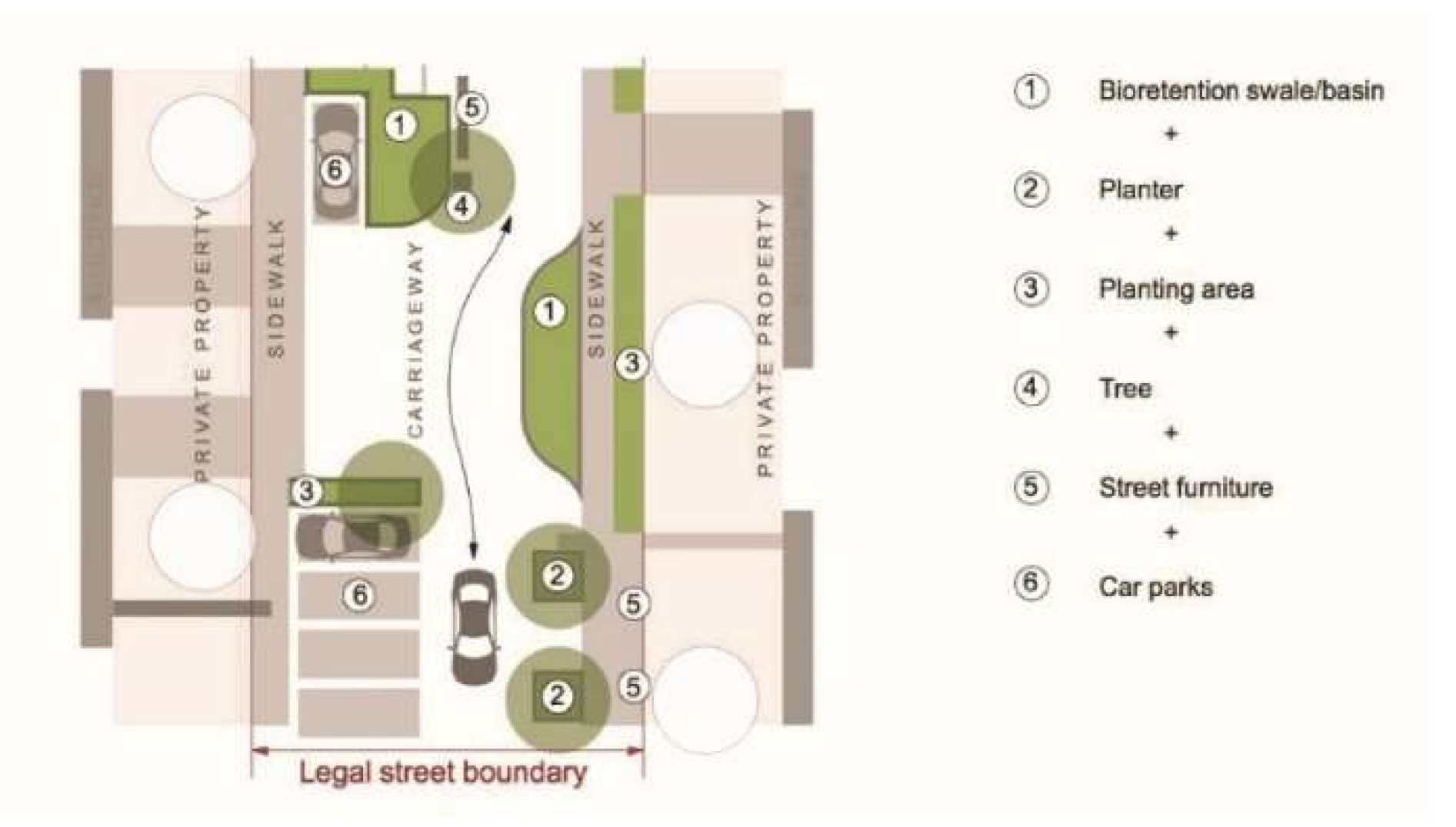
In their definition of IGGI, Wesener and McWilliam [12] also suggest that the types of integration (ways in which infrastructure constituents connect with one another) can be either “physical integration” or “functional integration”. Physical integration refers to the positions of green and grey infrastructures that are close or linked. Functional integration means green and grey infrastructures work towards a common function without necessarily being physically connected. Figure 2 illustrates an example of physical integration in the street context, where a green infrastructure (a. bioretention swale) was physically enclosed by a grey infrastructure (b. traffic calming chicane) to slow down the speed of cars. Figure 3 shows an example of functionally integrated green-grey street infrastructure, where several green (1. Bioretention swales; 2. Planters; 3. Planting areas; 4. Trees) and grey (5. Street furniture; 6. Car parks) components work together to serve a traffic calming function–slowing down the travel speed of cars from both directions.
Figure 2.
An example of physically integrated street infrastructure (plan view; not to scale) [13].
Figure 3.
An example of functionally integrated green-grey street infrastructure (plan view; not to scale) [13].
Compared to solely green or grey approaches, integrated green-grey infrastructure is considered more resilient to changes, as it combines services of both approaches [33,34]. Research shows that grey infrastructure is more effective in regulating services but less adaptable when extreme events exceed its capacity. While green infrastructure is more adaptive to the fluctuation of natural dynamics, it is less reliable in coping with frequent daily events [34]. For example, underground stormwater pipes, as grey infrastructure, work well in draining small, frequent rainfall, but are less adaptable to flood events that exceed the pipes’ capacity. On the contrary, a green infrastructure, such as a grass swale, adapts well to extreme dry or wet conditions, but is less suitable for daily drainage. Integrating these green and grey infrastructures could optimise their advantages and offer multiple services [33].
2.3. Theoretical Framework of IGGI
Aleksandrova et al. [13] proposed a “street infrastructure landscape services framework” based on two landscape research frameworks: ecosystem services and landscape services. Ecosystem Services is widely used for the study of large-scale nature-based ecological systems [35,36,37]. Landscape Services associates human factors with ecosystems and recognises human-made landscape elements in smaller scale urban settings [38,39]. However, these concepts are insufficient for the study of integrated systems. To acknowledge “nature/human-based services” provided by integrated green-grey infrastructure, Aleksandrova [40] developed a “street infrastructure landscape services framework” [40]. The framework classifies street landscape services into three categories: nature-based, human-based and nature/human-based services. It offers a platform to associate street landscape elements (green, grey, and green-grey) and their providing services (cultural services, provisioning services, regulating services, and supporting services). However, due to a limited number of case studies, this newly established framework needs testing, refinement and further development.
3. Materials and Methods
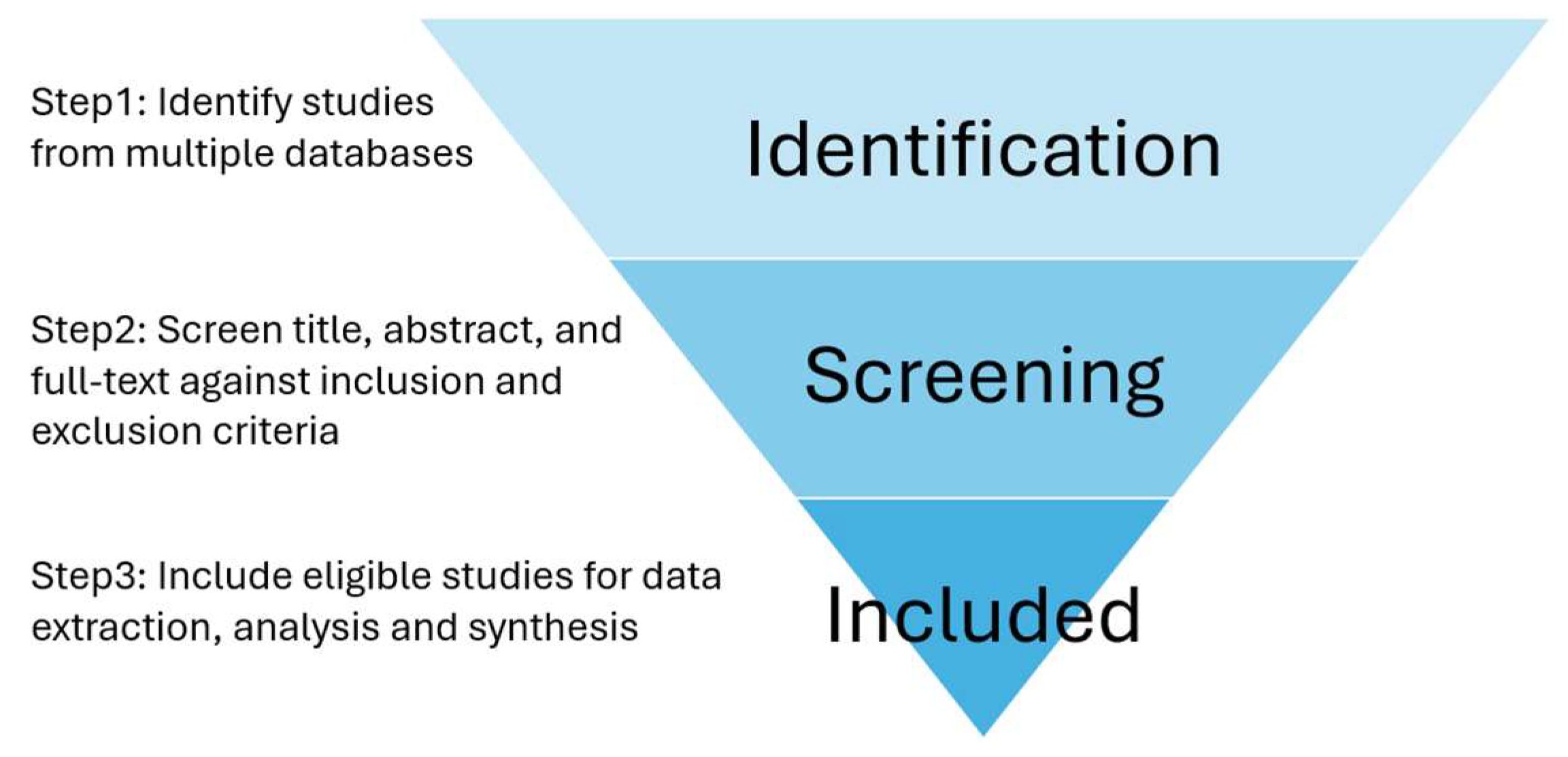
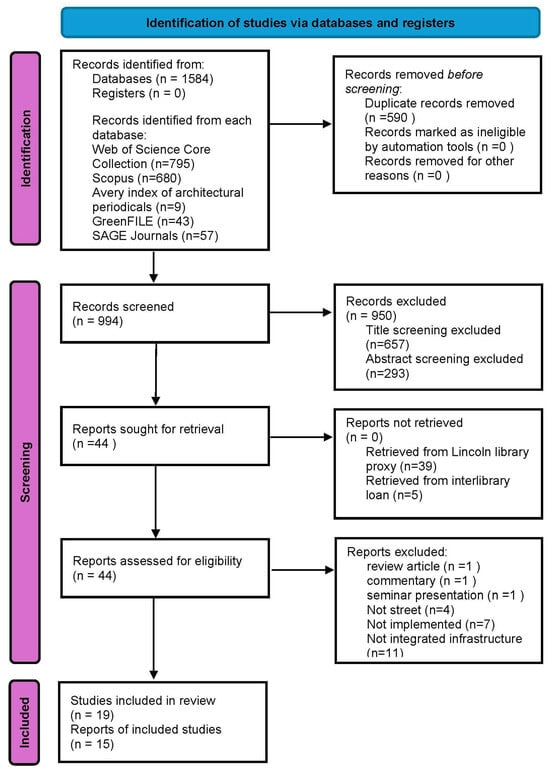
This study applied a Systematic Review Methodology following the PRISMA 2020 guidelines [41]. The completed PRISMA checklist is provided in the Supplementary Materials. The operational steps of PRISMA consist of three phases: identification, screening, and included, illustrated by Figure 4 below:
Figure 4.
Operational steps of the PRISMA process.
Compared with a narrative literature review, a systematic review is more transparent, repeatable, and rigorous when selecting data [42,43]. Through an initial scoping test across a wide range of databases, two groups of sources were selected: mainstream academic platforms (Web of Science and Scopus), and sources frequently used in the landscape architecture field (Avery index of architectural periodicals, GreenFILE, and SAGE Journals). To determine the most suitable search strings, several combinations of keywords and Boolean operators across various databases were tested.
3.1. Identification of Studies from Database Search
The database search took place on 15 February 2024, following the search string and identification criteria set up below:
3.1.1. Search String
(residential OR neighbourhood OR neighborhood OR suburb* OR communit*) AND (street* OR road* OR “right-of-way” OR carriageway OR lane OR laneway OR boulevard OR avenue OR throughway OR way) AND (retrofit* OR upgrad*)
3.1.2. Identification Criteria
- Types of publication: peer-reviewed journal articles or review articles.
- Publication date: studies published between 1 January 2014 and 31 December 2023 (10 years).
- Language: English language
After identifying studies from selected resources, search results were uploaded to the reference management software Zotero 8. Errors were manually corrected and duplicates removed, assisted by Zotero.
3.2. Screening Process
A three-step screening process was implemented based on the review of title, abstract and full-text. To determine eligible studies, inclusion and exclusion criteria were developed to reflect the characteristics of study streets.
3.2.1. Inclusion Criteria
- Country or region of the project: North America (USA, Canada); Europe (27 EU countries, and UK); Australia and New Zealand.
- Study focus: focus on implemented street retrofitting project.
- Land-use context: suburban; residential.
- Types of infrastructure contain both green and grey infrastructure.
3.2.2. Exclusion Criteria
- Country or region of the project: countries and regions other than North America, Europe, Australia, and New Zealand.
- Study focus: focus on planning, design, land use, policy, building or material, other than streets.
- Land-use context: rural, industrial, commercial, park or conservation sites.
- Types of infrastructure: single infrastructure, e.g., reconfiguration of the road surface.
The screening process was colour-coded in the Zotero library to ensure clarity and transparency. Only studies that met all inclusion criteria were included for further coding and thematic analysis.
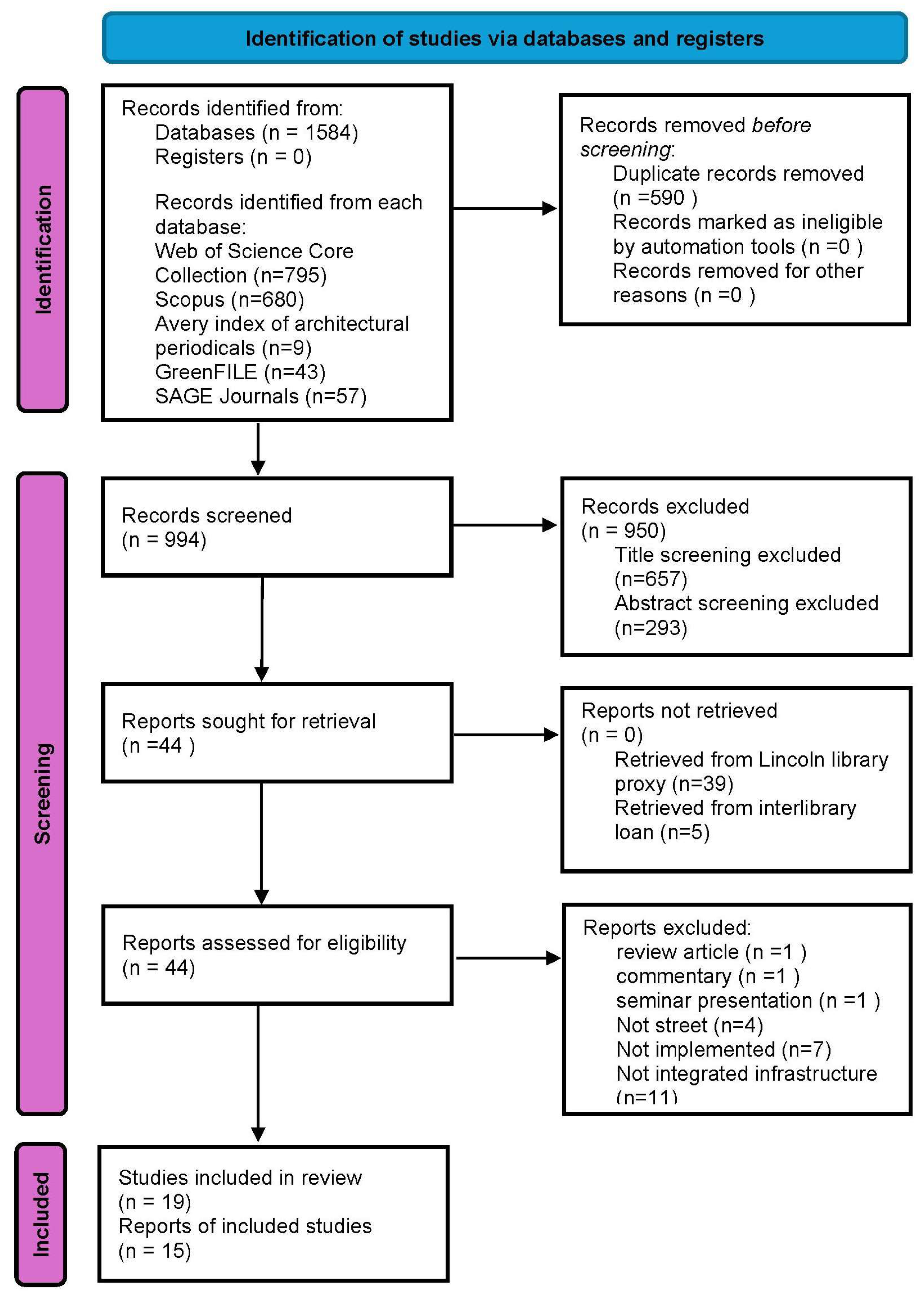
In addition, Wesener and MacWilliam’s definition of integrated green-grey infrastructure [12] was used to analyse various concepts raised in the studies. We used the “street integrated green-grey infrastructure framework” [13] to categorise infrastructure components and systems identified. Studies that did not fit Wesener and MacWilliam’s definition of integration were excluded. The PRISMA flow diagram in Figure 5 illustrates the article selection process.
Figure 5.
PRISMA flow diagram illustrates the data selection process.
3.3. Coding and Theme Identification
We manually extracted codes from included articles and recorded all codes using NVivo 14 analysis software. We developed a two-tier coding system, consisting of parent codes and child codes. The parent codes were deductive, driven by the three sub-questions: First, who has studied IGGI, when and where were they studied? Second, what IGGI have been studied, what are their characteristics? Third, how has IGGI been studied, what are their characteristics? The child codes were developed inductively; they were identified from various ideas in individual studies. Table 1 below illustrates the relationships of parent–child codes. The coding process was conducted by the first author. After all codes were identified and organised, we actively engaged with the codes, and identified relationships, themes, and patterns.
Table 1.
Overview of qualitative content analysis codes.
4. Results
The initial search results from selected databases are 1584 publications (see Appendix A; search strategies and search results). Through a rigorous screening process highlighted in the methods section and Figure 5, we identified a final selection of 15 papers. This section provides an overview of the 15 papers, and the results of our analysis regarding IGGI definitions, integration, and impacts.
4.1. Overview of Findings
The final selection of 15 papers (Table 2) were published in 14 journals across life science, social science, physical science, and technological sectors. Based on the project’s location, the fifteen papers are from four different countries: nine papers are from the USA, three from New Zealand, two from the UK, and one from Australia.
Based on the number of authors and disciplines, there is evidence of multi-disciplinary collaboration, particularly regarding research at street- and community-wide scales. In terms of authorship, three papers were written by single authors and twelve papers were written by two or more authors. Nearly half of the papers have more than four authors. The maximum number of authors in one paper is nine [29], followed by eight authors in two papers [44,45]. Seven papers involve authors from more than three disciplines. The maximum number of disciplines in one study is six [29], including human factors, medicine, health and wellbeing, transport engineering, nursing, and population health.
The author’s affiliations suggest that university-based scholars play leading roles in conducting street infrastructure retrofitting research, with only one exception [46] where the authors were industry professionals. Eight papers were written by a team of university scholars and industry professionals indicating strong industry–university partnerships in this line of research. There was limited involvement of landscape architecture scholars with only one co-author in a US-based project [45].
The most concerning problem was the evaluation of IGGI performance, including the lack of empirical study at the catchment scale [27,47,48] and lack of evidence on the effectiveness of street infrastructure [49,50,51]. The second most concerning issue was residents’ perception of street IGGI, including lack of social [52], ecological [53], aesthetic value [54] and road safety [44]. Other concerns studied were the lack of research on suburban street retrofits [29], the methodological gap [45] and procedural justice [55].
Table 2.
Overview of the 15 included papers.
4.2. Concepts of IGGI
Research results suggest that a wide range of concepts were used to describe integrated green-grey infrastructure (Table 3). Across all 15 papers, nine different concepts were identified. The most frequently used term was “SCMs” (Stormwater Control Measures; four papers). The second frequently used term was “Te Ara Mau-Future Streets”, referring to a New Zealand-based suburban-wide street retrofitting programme (three papers). “Green Street” was used in two papers by the same author. “Green Infrastructure” (GI) was used in two papers; one refers to a “Catchment-scale GI” and another calls “GI best Management Practices”. “SuDS”, “Street Ahead”, and “Raingarden” were used in one paper, respectively.
Table 3.
Names of the studied IGGI.
Overall, the naming approaches of these nine terms fall into three categories: function-based, programme-based and context-based. Function-based definitions focus on specific water functions including “SCM retrofits”, “SuDS”, “GI BMPs” and “Raingarden”. Programme-based definitions refer to specific retrofitting programmes, including “Te Ara Mau-Future Street” (a community-wide retrofitting programme in Central Mangere, a suburb in south Auckland, New Zealand), “Green Streets” (a widespread program across European countries), and “Street Ahead” (a city-wide retrofitting initiative by Sheffield Council, UK). Context-based definitions relate to the spatial context, including “catchment-scale green infrastructure retrofits” and “street-related upgrades”. The variation in names reflects the multi-disciplinary and multi-scale nature of residential street retrofitting. None of the concepts used the term “integrated green-grey infrastructure” or specified “integration”.
Components of the Studied IGGI
Based on Wesener and McWilliam’s definition [12], we coded infrastructure components as green, grey or integrated green-grey in each study (Table 4). All analysed papers looked at a combination of two or more components. A total of 13 papers studied green-grey infrastructure along with other components (green or grey), two papers studied green and grey components within a system (community or city). Among the 13 studies on green-grey infrastructure, seven papers focussed on bioretention devices such as bioswales and rain gardens.
Table 4.
Components of street infrastructure.
The majority of studies involved replacing grey components by adding new green components, except one study discussed the removal of green components before adding new grey components [55].
4.3. Integration of IGGI
Based on Wesener and McWilliam’s definition of integration [12], we coded integration related to three aspects: the scale of integration, types of integration, and the function of integration.
4.3.1. Scales of Integration
According to Wesener and McWilliam [12], the scales of integration were classified as intracomponent, intercomponent, and system scale [12] (Table 5).
Table 5.
Scale of integration.
Intracomponent integration was present in ten papers, including bioretention devices, tree filters, plant islands that consist of both human-made components (concrete edges or layers) and natural components (soils, vegetation or microbes).
Intercomponent integration was found in three studies, where two or more infrastructure components were connected. For example, Casares et al. [46] shows the integration of a rain garden with permeable paving on both sides.
Overall, a strong pattern of system integration was found across all studies, with only one exception [56]. Among the fourteen studies on system integration, five were at stormwater catchment scales, four at sewershed systems scale, four at community/neighbourhood scale, and one at city scale. However, the size of these systems varied dramatically, from a 0.35 ha size street catchment [27,48] to a large river catchment covering six suburban neighbourhoods [52,53]. Another kind of system integration was the infrastructure response in relation to a river catchment location. For example, Jarden et al. [47] investigated the effectiveness of rain gardens concerning headwater hydrographical characteristics.
4.3.2. Types of Integration
Types of integration have been identified as functional and physical integration [12]. All fifteen papers involved functional integration (see following section “functions of IGGI”), and four involved physical integration.
The four that discussed physical integrations were bioretention devices consisting of above- and below-ground integration [46,49,54,56]. Unlike previous research that focused on the physical connections at the road surface level [57], the four studies focused on the interactions between the surface overland flow and subsurface layers from a hydrological perspective.
In addition to the physical or functional integration within the main street corridor (public right-of-way), the studies also discussed other ways of integration. For example, the integration of green-grey infrastructures across both public land and private properties [49,53]. Such integration was necessary, as stormwater or sewer water systems rely on natural hydrological catchment boundaries, regardless of public or private landownership.
4.3.3. Functions of Integration
The functions of IGGI are related to four ecosystem services: cultural, provisioning, regulating, and supporting services [35]. As shown in Table 6, half of the articles discussed multiple services. The most popular services were regulating services, with twelve papers relating to these, including nine on stormwater, and three on walking and cycling. Among the nine studies related to stormwater, four focused on water quality and the mitigation of stormwater pollution [27,48,50,56], one focused on water quantity [46], and two focused on hydrological characteristics of both quality and quantity [47,49].
Table 6.
Ecosystem services associated with IGGI.
Seven papers discussed cultural services, including physical activity, amenity and aesthetic values, wayfinding, indigenous cultural values, recreational values, and procedural environmental justice values. Supporting services were identified in five papers. Provisioning services were not discussed in any of the papers.
Several authors evaluated residents’ perception towards stormwater management devices. For example, three studies [52,53,54] investigated residents’ perceptions of amenities and aesthetic values of rain gardens that were initially designed as stormwater components. Heydon [55] questioned environmental justice aspects with regard to felling trees to make room for IGGI implementation.
Different functions of the same project were discussed from various perspectives. For example, the three NZ studies examined the same project with regard to three functions: user behaviour [29], sense of security [51], and health impacts [44]. Despite their differences, the three articles shared the same cultural elements and indigenous values.
4.4. Effectiveness and Impact of Implemented IGGI
The 15 articles evaluated the effectiveness of implemented IGGI from several perspectives, indicating positive impacts on the natural environment, social behaviour, and cultural amenity while also revealing limitations in implementing IGGI.
4.4.1. Applied Methods for Evaluating Implemented IGGI
The 15 studies employed a variety of qualitative and quantitative methods to evaluate implemented IGGI (Table 7). Eight studies used quantitative methods, seven used qualitative methods. Nearly half of the articles applied mixed methods, for example, a monitoring study mixed with a before–after impact design [47]; or a survey mixed with a best–worst scaling design [54].
Table 7.
Applied methods identified from the 15 papers.
Quantitative methods were used to evaluate the effectiveness of stormwater control measures or traffic calming devices. Seven papers used quantitative methods for monitoring and evaluating changes in water quality. One study measured the changes in speed and volume of road traffic [51].
Qualitative methods were used to explore behavioural changes, e.g., physical activities related to walking and cycling facilities [45], and perceptions of aesthetics values, e.g., the natural beauty of rain gardens [54]. Semi-structured interviews, questionnaire surveys, and case studies were the most popular methods, followed by co-design and focus groups.
4.4.2. Impact of IGGI on Stormwater Management Functions
Five articles focused on evaluating the performance and impacts of IGGI on stormwater. Three of them investigated the effectiveness of catchment-scale GI retrofits [27,47,48]; two examined the performance of small interventions [50,56].
IGGI performed well in reducing stormwater runoff and improving water quality, particularly when IGGI were functionally connected at the hydrological catchment scale. Jarden et al. [47] found street-based IGGIs compelling when they were functionally connected and linked with household IGGIs. Compared with an adjacent street without IGGI installation, the IGGIs in the study catchment reduced 33% of peak flow and 40% of total storm volumes [47].
The results from small IGGI interventions also indicated positive impacts on water quality performance. Through monitoring IGGI interventions, Abdollahian et al. [50] found they both significant contributed to removing E. coli bacteria. Through monitoring sediment and metal removals of two small IGGI for two years, Houle [56] found both interventions exceeded the median effectiveness of conventional-sized IGGI. By monitoring two residential catchments over 14 months, Page et al. [27] found significant hydrological mitigation for removing most heavy metal particles.
4.4.3. Impacts of IGGI on Residents’ Perceptions
Four articles focused on residents’ perceptions. Church [52,53] found that residents generally acknowledged a rain garden’s role in improving stormwater functions, increasing street aesthetics and calming traffic. However, residents’ feelings toward rain gardens as elements of nature were not as strong. This finding was echoed by Dobbie et al. [54] who argued that residents generally had a stronger preference for street trees over rain gardens. They recommended colourful and flowering plants in rain gardens to improve their aesthetic appearance. Witten et al.’s [44] study on residents’ feelings about traffic safety showed inconsistent results. While some focus groups indicated improvement in traffic safety, others showed increased concerns.
4.4.4. Impacts of IGGI on Road Users’ Behaviour
Two articles investigated the association between IGGI and road users’ behaviours [45,51]. Hosking et al. [51] found that neighbourhood-scale street retrofitting was effective in reducing traffic speed and volume on local roads. They observed 8 km/h mean speed reduction and 17–24% volume reduction in controlled areas, compared with no retrofitting roads. Acciai et al. [45] found strong associations between street upgrades and an increase in children’s physical activity, especially within a mile’s proximity to children’s homes.
5. Discussion
Our systematic review evaluated 15 international studies on IGGI’s implementation in residential street retrofitting, revealing several significant findings. First, we identified nine different concepts similar to IGGI. These names were defined by IGGI’s primary function, local initiatives/programmes, or spatial scales, respectively, reflecting the multi-disciplinary and multi-functional needs of IGGI. Second, through analysing IGGI integration, we found that system-scale integration was most commonly discussed across all 15 studies. This finding is significant because it started to fill a major gap identified by prior studies. We also identified an emerging topic discussing the interaction between surface and subsurface layers, which offers explicit insights for above- and below-ground integration. Third, we examined ways of post-construction evaluation of street IGGI and found that both technical and social methods are critical. Findings from these evaluations suggest strong empirical evidence related to stormwater management and road user behavioural change; however, there was mixed perceptions towards the aesthetic values of rain gardens.
Before interpreting our findings further, we must acknowledge several significant limitations. First, the current review only included projects in North America (the USA and Canada), Europe (27 EU countries and the UK), Australia, and New Zealand. Although the reason was that these countries share similar suburban forms and street typologies, this may limit the identification of innovative IGGI that occurred in other countries. Second, the review only included studies published in the English language and relied heavily on studies in the USA. This selection criterion may limit the generalisation of studies in countries with a smaller number of publications. Third, although the search process included peer-reviewed journal articles across multiple databases, it did not include grey literature. This process could have excluded valuable empirical evidence that was not published. Fourth, the review only included a post-construction evaluation of implemented projects, and excluded studies on the planning and design of IGGI. The result of this inclusion criterion was effective in identifying IGGI’s effectiveness but may have limited the identification of IGGI concepts and design components. In addition, as the search strategy focused on “residential street retrofitting”, papers that did not acknowledge these terms or their synonyms were not identified during the database search. It is also possible that green-grey integration happened at the intracomponent or intercomponent level but was not identified in the database search because the author(s) did not acknowledge the project’s street context.
Limitations also occurred due to the lack of a standard definition of IGGI. On the one hand, the presence of too many similar terms weakened the ability to identify relevant studies specifically. Despite the authors’ best effort to manually include similar concepts, it was possible that some relevant studies were left out. On the other hand, some studies claim the use of “green infrastructure” but actually refer to grey infrastructure. For example, one excluded study discussed a “non-vegetative green infrastructure”, referring to city-wide cycleways rather than plas and vegetation [58]. Similarly, the word grey also has different meanings for different professions. For instance, grey in water engineering refers to reusable household wastewater from sinks, showers, baths, washing machines, and dishwashers [59]. These variations in terminology may have limited the effectiveness of database search and study identification.
Notwithstanding these limitations, this review provides valuable insights into the research status of implemented IGGI in residential street retrofitting. Findings from the review suggest three emerging topics:
5.1. Environmental Impact
In mitigating water-related environmental issues, it seems IGGI performs better when integrated at the catchment scale. Several pieces of evidence suggest that attachment-scale integrated IGGI has been effective in managing stormwater functions, including reducing peak flows and storm volumes, as well as removing heavy metal particles [27,47,48]. These findings contrasted with individual IGGI interventions, which were positive overall in terms of sediment and bacteria removal, but inconsistent across studies [50,56]. Similar findings were also discussed in the management of river catchment [52,53], stormwater sub-catchment [27,47,48], and sewer catchment [46,49,50].
5.2. Social and Cultural Impact
The impact of certain IGGIs on residents’ perceptions, feelings, and behavioural changes was inconsistent. Compared to the previous review on IGGI [13], the occurrence of cultural services was critical, revealing a more balanced incorporation of cultural and environmental values. Several social studies enriched the scope of IGGI by adding amenity, aesthetic, wayfinding, indigenous, and recreational values to the ‘main’ design functions [52,53,54]. For example, two papers assessed residents’ perception of aesthetic values towards stormwater rain gardens—a side benefit in addition to their primary stormwater function [52,53]. These social and cultural impact indicates the need for comprehensive approaches in response to personal preferences, age groups, and proximity to users’ homes or road hierarchy. Hence, there is a need for research that evaluates the multiple functions of IGGI, including their social and cultural impact on surrounding communities.
5.3. Multiscale Integration of IGGI:
The literature reviewed in this study found IGGI integration from individual streets to multi-scalar integration into broader environmental and built systems. System-scale integration can be categorised into four spatial scales: city-wide, water-catchment, neighbourhood and street scales. The most important finding about IGGI integration types was the integration between above- and below-ground components, which differs from prior studies that focused mainly on the street surface level. Another important finding was the integration between street space and adjacent properties, as water systems are inseparable by public/private boundaries. Despite an emerging attempt to optimise the integration of surface and subsurface components, little information was found about the physical connections between various components. More research is needed to understand the complex spatial and temporal dynamics of the hydrological context (e.g., the project’s catchment location, changing overland flow paths, and changing groundwater levels).
Our research points to several important directions for future research and practice.
One research direction is to define the concept of IGGI better. The review identified nine very different concepts of street IGGI, characterised by the IGGI’s primary function, local initiatives/programmes, or spatial scales. Although they reflect the multiple benefits that IGGI provides in mitigating environmental and social issues associated with residential streets, they also cause insistence in database search and cross-disciplinary communication. To advance the study of IGGI, a consistent definition is needed that spans disciplinary boundaries and is shared by researchers and practitioners. More research may be required to better understand the functions, programmes, and scales of street IGGI integration before an interdisciplinary definition can be reached.
Another direction is the need for further development of the “street infrastructure landscape service framework”. The framework provided a suitable platform for associating IGGI components with their corresponding ecological services. It was also helpful in de-coding various green and grey components. However, it is insufficient for mapping multiple services offered by a single device. Further study is needed to test and refine the framework.
IGGI’s physical integration could also be a future direction. Compared with studies on functional integration, the number of studies dealing with physical integration is very limited. Despite an emerging attempt to optimise the integration of surface and subsurface components, little information was found about the physical connections between various components. More research is needed to understand the complex spatial and temporal dynamics of the hydrological context (e.g., the project’s catchment location, changing overland flow paths, and changing groundwater levels). Future research should also investigate the relationships between three-dimensional spatial configurations and the performance of IGGI.
Additionally, there is a strong need for more empirical data. As confirmed by several studies, the post-construction evaluation of street IGGI remains a considerable gap. Further research is needed to assess the environmental, social, and cultural impact of IGGI. More evidence is also required to draw a complete picture of the various functions offered by street IGGI. Potential study directions include reviewing grey literature, such as project reports and conference papers, and conducting interviews with practitioners who have experience with IGGI. More research is also needed to understand the enablers of barriers to IGGI implementation and evaluation.
6. Conclusions
This paper examined key issues faced by residential street retrofitting and reviewed implemented mitigation solutions in the form of Integrated Green-Grey Infrastructure (IGGI). Through a rigorous systematic review method, we identified 15 peer-reviewed journal articles across Australasia, Europe, and North America. The number of studies identified from 2014 to 2023 is relatively small, suggesting that research on the post-construction evaluation of IGGI remains a much-needed study area in the context of residential street retrofits.
The findings from this study helped broaden the current understanding of IGGI’s definition, integration, and effectiveness in a residential street retrofitting context. First, the review identified various concepts of implemented IGGI internationally. The differences between these concepts enrich the current definition of IGGI and reflect the diverse roles that IGGIs play. Second, the review reveals a wide range of green-grey integration at system scales that extend beyond individual streets, notably at neighbourhood-wide and water catchment-wide scales. This finding started to address a research gap regarding IGGI’s system-scale integration. Furthermore, the review provides empirical evidence of the effectiveness and limitations of IGGI, especially regarding its environmental impact, social and cultural impact, and multiscale integration.
Despite its contribution, the review also has its limitations in the data selection process and publication bias. One limitation is that the data selection criteria defined by the project’s geographical location, language, publication year, and implementation, which may have excluded some relevant studies that were outside of this scope. Another limitation is potential publication bias. Grey literature, such as project reports and conference papers, was excluded from the review, as the focus of this study was on scholarly publications.
Nonetheless, the review lays the essential groundwork for future research into IGGI’s integration and implementation across various spatial scales. To advance the scholarship of IGGI integration and evaluation, further study is needed, for example, by including “grey literature” and by investigating the viewpoints of IGGI designers, implementers and users. Furthermore, additional work is required in order to understand the enablers of and barriers to IGGI implementation and evaluation.
Supplementary Materials
The following supporting information can be downloaded at: https://www.mdpi.com/article/10.3390/urbansci10020092/s1, File S1: PRISMA checklist.
Author Contributions
This paper is based on a PhD research conducted by X.W. and supervised by A.W. and W.M. Conceptualization, X.W., A.W. and W.M.; methodology, X.W., A.W. and W.M.; software, X.W.; validation, A.W. and W.M.; formal analysis, X.W.; investigation, X.W.; resources, X.W.; data curation, X.W.; writing—original draft preparation, X.W.; writing—review and editing, A.W. and W.M.; visualisation, X.W.; supervision, A.W. and W.M.; project administration, A.W.; funding acquisition, A.W. All authors have read and agreed to the published version of the manuscript.
Funding
This research received no external funding.
Institutional Review Board Statement
Not applicable.
Informed Consent Statement
Not applicable.
Data Availability Statement
The original contributions presented in this study are included in the article/Supplementary Materials. Further inquiries can be directed to the corresponding author.
Acknowledgments
Xinxin Wang acknowledges academic workshops and database resources from Lincoln University. X.W. also acknowledges research time allocation and technical support from Unitec.
Conflicts of Interest
The authors declare no conflicts of interest.
Appendix A. Search Strategies and Search Results
| Types of Database | Database/ Platform | Search Term | Search Field | Time Range (Publication Date) | Refine Results/Filters | Search Date | Search Results |
|---|---|---|---|---|---|---|---|
| Technical | Web of Science Core Collection | TERM1: Residential OR neighbourhood OR neighborhood OR suburb* OR Communit* TERM2: Street* OR Road* OR “right-of-way” OR carriageway OR Lane OR Laneway OR Boulevard OR Avenue OR Throughway OR Way TERM3: retrofit* OR upgrad* | Topic (Searches title, abstract and indexing) | 1 January 2014 to 31 December 2023 | Document types: article, or review article Languages: English | 15 February 2024 | 796 (only 795 have abstracts, exported to Zotero) |
| Scopus | TERM1: Residential OR neighbourhood OR neighborhood OR suburb* OR Communit* TERM2: Street* OR Road* OR “right-of-way” OR carriageway OR Lane OR Laneway OR Boulevard OR Avenue OR Throughway OR Way TERM3: retrofit* OR upgrad* | Article title, Abstract, Keywords | 2014–2023 | Document type: Article, or Review. Language: English | 15 February 2024 | 680 | |
| Social | Avery index of architectural periodicals | TERM1: Residential OR neighbourhood OR neighborhood OR suburb* OR Communit* TERM2: Street* OR Road* OR “right-of-way” OR carriageway OR Lane OR Laneway OR Boulevard OR Avenue OR Throughway OR Way TERM3: retrofit* OR upgrad* | AB Abstract | January 2014 to December 2023 | Limit your results: Peer-reviewed; English Language; Abstract Available | 15 February 2024 | 9 |
| GreenFILE | TERM1: Residential OR neighbourhood OR neighborhood OR suburb* OR Communit* TERM2: Street* OR Road* OR “right-of-way” OR carriageway OR Lane OR Laneway OR Boulevard OR Avenue OR Throughway OR Way TERM3: retrofit* OR upgrad* | AB Abstract or Author-supplied Abstract | January 2014 to December 2023 | Limit your results: Peer-reviewed | 15 February 2024 | 43 | |
| SAGE Journals | TERM1: Residential OR neighbourhood OR neighborhood OR suburb* OR Communit* TERM2: Street* OR Road* OR “right-of-way” OR carriageway OR Lane OR Laneway OR Boulevard OR Avenue OR Throughway OR Way TERM3: retrofit* OR upgrad* | Abstract | January 2014 to December 2023 | Article type: research article, or Review article. | 15 February 2024 | 57 |
References
- Southworth, M.; Ben-Joseph, E. Streets and the Shaping of Towns and Cities; Island Press: Washington, DC, USA, 2003; ISBN 9781610911092. [Google Scholar]
- Dover, V.; Massengale, J. Street Design: The Secret to Great Cities and Towns; John Wiley & Sons: New York, NY, USA, 2013; ISBN 9781118418598. [Google Scholar]
- Silva, C. PAuckland’s Urban Sprawl, Policy Ambiguities and the Peri-Urbanisation to Pukekohe. Urban Sci. 2019, 3, 1. [Google Scholar] [CrossRef] [Scilit]
- Gavric, S.; Leonhardt, G.; Marsalek, J.; Viklander, M. Processes Improving Urban Stormwater Quality in Grass Swales and Filter Strips: A Review of Research Findings. Sci. Total Environ. 2019, 669, 431–447. [Google Scholar] [CrossRef] [Scilit]
- Leroy, M.C.; Portet-Koltalo, F.; Legras, M.; Lederf, F.; Moncond’huy, V.; Polaert, I.; Marcotte, S. Performance of Vegetated Swales for Improving Road Runoff Quality in a Moderate Traffic Urban Area. Sci. Total Environ. 2016, 566–567, 113–121. [Google Scholar] [CrossRef] [Scilit]
- Zellner, M.; Massey, D.; Minor, E.; Gonzalez-Meler, M. Exploring the Effects of Green Infrastructure Placement on Neighborhood-Level Flooding via Spatially Explicit Simulations. Comput. Environ. Urban Syst. 2016, 59, 116–128. [Google Scholar] [CrossRef] [Scilit]
- Karndacharuk, A.; Wilson, D.J.; Dunn, R.C.M. Qualitative Evaluation Study of Urban Shared Spaces in New Zealand. Transp. Res. D Transp. Environ. 2016, 42, 119–134. [Google Scholar] [CrossRef] [Scilit]
- Marando, F.; Salvatori, E.; Sebastiani, A.; Fusaro, L.; Manes, F. Regulating Ecosystem Services and Green Infrastructure: Assessment of Urban Heat Island Effect Mitigation in the Municipality of Rome, Italy. Ecol. Model. 2019, 392, 92–102. [Google Scholar] [CrossRef] [Scilit]
- Salmond, J.A.; Tadaki, M.; Arbuthnott, S.V.K.; Coutts, A.; Demuzere, M.; Dirks, K.N.; Heaviside, C.; Lim, S.; Macintyre, H.; McInnes, R.N.; et al. Health and Climate Related Ecosystem Services Provided by Street Trees in the Urban Environment. Environ. Health 2016, 15, 95–111. [Google Scholar] [CrossRef] [Scilit]
- Mwipiko, R. An Exploration of the Effects of the Built Environment on Depression in the Wellington Region, New Zealand; Massey University Wellington: Wellington, New Zealand, 2019. [Google Scholar]
- Davies, C.; MacFarlane, R.; McGloin, C.; Roe, M. Green Infrastructure Planning Guide Project; Final Report; Lund Humphries Publishers Ltd.: London, UK, 2006. [Google Scholar]
- Wesener, A.; McWilliam, W. Integrated Urban Green and Grey Infrastructure. In The Palgrave Encyclopedia of Urban and Regional Futures; Brears, R.C., Ed.; Palgrave Macmillan: London, UK, 2021; ISBN 9783030518127. [Google Scholar]
- Aleksandrova, K.I.; McWilliam, W.J.; Wesener, A. Status and Future Directions for Residential Street Infrastructure Retrofit Research. Urban Sci. 2019, 3, 49. [Google Scholar] [CrossRef] [Scilit]
- Tzoulas, K.; Korpela, K.; Venn, S.; Yli-Pelkonen, V.; Kaźmierczak, A.; Niemela, J.; James, P. Promoting Ecosystem and Human Health in Urban Areas Using Green Infrastructure: A Literature Review. Landsc. Urban Plan. 2007, 81, 167–178. [Google Scholar] [CrossRef] [Scilit]
- Hao, T.; Rogers, C.D.F.; Metje, N.; Chapman, D.N.; Muggleton, J.M.; Foo, K.Y.; Wang, P.; Pennock, S.R.; Atkins, P.R.; Swingler, S.G.; et al. Condition Assessment of the Buried Utility Service Infrastructure. Tunn. Undergr. Space Technol. 2012, 28, 331–344. [Google Scholar] [CrossRef] [Scilit]
- Brockbank, T.; Jonathan, K. When Grey Meets Green-A Hybrid Treatment Story. In Proceedings of the Water New Zealand Stormwater Conference, Auckland, New Zealand, 3–5 May 2017; pp. 1–22. [Google Scholar]
- Masseroni, D.; Ercolani, G.; Chiaradia, E.A.; Maglionico, M.; Toscano, A.; Gandolfi, C.; Bischetti, G.B. Exploring the Performances of a New Integrated Approach of Grey, Green and Blue Infrastructures for Combined Sewer Overflows Remediation in High-Density Urban Areas. J. Agric. Eng. 2018, 49, 233–241. [Google Scholar] [CrossRef] [Scilit]
- Christchurch City Council. Rain Garden Design, Construction and Maintenance Manual; Christchurch City Council: Christchurch, New Zealand, 2016; 66p. [Google Scholar]
- Dunnett, N.; Clayden, A. Rain Gardens: Managing Water Sustainably in the Garden and Designed Landscape; Timber Press: Portland, OR, USA, 2007; ISBN 9780881928266. [Google Scholar]
- Phillips, A.; da Schio, N.; Canters, F.; Khan, A.Z. “A Living Street and Not Just Green”: Exploring Public Preferences and Concerns Regarding Nature-Based Solution Implementation in Urban Streetscapes. Urban For. Urban Green. 2023, 86, 128034. [Google Scholar] [CrossRef] [Scilit]
- Nickel, D.; Schoenfelder, W.; Medearis, D.; Dolowitz, D.P.; Keeley, M.; Shuster, W. German Experience in Managing Stormwater with Green Infrastructure. J. Environ. Plan. Manag. 2014, 57, 403–423. [Google Scholar] [CrossRef] [Scilit]
- Gregg, K.; Hess, P. Complete Streets at the Municipal Level: A Review of American Municipal Complete Street Policy. Int. J. Sustain. Transp. 2019, 13, 407–418. [Google Scholar] [CrossRef] [Scilit]
- Ferrell, C.E.; Eells, J.M.; Lee, R.W.; Hosseinzade, R. Analysis of the Benefits of Green Streets; Mineta Transportation Institute: San Jose, CA, USA, 2020. [Google Scholar]
- Alley, G. Stormwater Streets. In Urban Street Stormwater Guide; Island Press: Washington, DC, USA, 2017; pp. 26–73. [Google Scholar]
- PPIAF. What Are Nature-Based Solutions for Infrastructure? Available online: https://www.gihub.org/articles/what-are-nature-based-solutions-for-infrastructure/ (accessed on 10 November 2024).
- Rogers, C.D.F.; Hao, T.; Costello, S.B.; Burrow, M.P.N.; Metje, N.; Chapman, D.N.; Parker, J.; Armitage, R.J.; Anspach, J.H.; Muggleton, J.M.; et al. Condition Assessment of the Surface and Buried Infrastructure—A Proposal for Integration. Tunn. Undergr. Space Technol. 2012, 28, 202–211. [Google Scholar] [CrossRef] [Scilit]
- Page, J.L.; Winston, R.J.; Mayes, D.B.; Perrin, C.A.; Hunt, W.F. Retrofitting Residential Streets with Stormwater Control Measures over Sandy Soils for Water Quality Improvement at the Catchment Scale. J. Environ. Eng. 2015, 141, 1–11. [Google Scholar] [CrossRef] [Scilit]
- Ramísio, P.J.; Brito, R.S.; Beceiro, P. Accessing Synergies and Opportunities between Nature-Based Solutions and Urban Drainage Systems. Sustainability 2022, 14, 16906. [Google Scholar] [CrossRef] [Scilit]
- Mackie, H.; Macmillan, A.; Witten, K.; Baas, P.; Field, A.; Smith, M.; Hosking, J.; King, K.; Sosene, L.; Woodward, A. Te Ara Mua—Future Streets Suburban Street Retrofit: A Researcher-Community-Government Co-Design Process and Intervention Outcomes. J. Transp. Health 2018, 11, 209–220. [Google Scholar] [CrossRef] [Scilit]
- Gehl, J. Life Between Buildings: Using Public Space, 5th ed.; Arkitektens Forlag: Copenhagen, Denmark; The Danish Architectural Press: Copenhagen, Denmark, 2001; ISBN 8774072838. [Google Scholar]
- Department for Transport. Manual for Streets; Thomas Telford: London, UK, 2007. [Google Scholar]
- Southworth, M.; Ben-Joseph, E. Street Standards and the Shaping of Suburbia. J. Am. Plan. Assoc. 1995, 61, 65–81. [Google Scholar] [CrossRef] [Scilit]
- Alves, A.; Gersonius, B.; Sanchez, A.; Vojinovic, Z.; Kapelan, Z. Multi-Criteria Approach for Selection of Green and Grey Infrastructure to Reduce Flood Risk and Increase Co-Benefits. Water Resour. Manag. 2018, 32, 2505–2522. [Google Scholar] [CrossRef] [Scilit]
- Chen, W.; Wang, W.; Huang, G.; Wang, Z.; Lai, C.; Yang, Z. The Capacity of Grey Infrastructure in Urban Flood Management: A Comprehensive Analysis of Grey Infrastructure and the Green-Grey Approach. Int. J. Disaster Risk Reduct. 2021, 54, 102045. [Google Scholar] [CrossRef] [Scilit]
- TEEB—The Economics of Ecosystems and Biodiversity. TEEB Manual for Cities: Ecosystem Services in Urban Management; TEEB: Potsdam, Germany, 2011. [Google Scholar]
- Lennon, M.; Scott, M. Delivering Ecosystems Services via Spatial Planning: Reviewing the Possibilities and Implications of a Green Infrastructure Approach. TPR Town Plan. Rev. 2014, 85, 563–587. [Google Scholar] [CrossRef] [Scilit]
- Schröter, M.; van der Zanden, E.H.; van Oudenhoven, A.P.E.; Remme, R.P.; Serna-Chavez, H.M.; de Groot, R.S.; Opdam, P. Ecosystem Services as a Contested Concept: A Synthesis of Critique and Counter-Arguments. Conserv. Lett. 2014, 7, 514–523. [Google Scholar] [CrossRef] [Scilit]
- Vallés-Planells, M.; Galiana, F.; Van Eetvelde, V. A Classification of Landscape Services to Support Local Landscape Planning. Ecol. Soc. 2014, 19, 44. [Google Scholar] [CrossRef] [Scilit]
- Termorshuizen, J.W.; Opdam, P. Landscape Services as a Bridge between Landscape Ecology and Sustainable Development. Landsc. Ecol. 2009, 24, 1037–1052. [Google Scholar] [CrossRef] [Scilit]
- Aleksandrova, K.I. Green, Grey or Green-Grey? Decoding Infrastructure Integration and Implementation for Residential Street Retrofits; Lincoln University: Lincoln, New Zealand, 2016. [Google Scholar]
- Page, M.J.; McKenzie, J.E.; Bossuyt, P.M.; Boutron, I.; Hoffmann, T.C.; Mulrow, C.D.; Shamseer, L.; Tetzlaff, J.M.; Akl, E.A.; Brennan, S.E.; et al. The PRISMA 2020 Statement: An Updated Guideline for Reporting Systematic Reviews. BMJ 2021, 372, 71. [Google Scholar] [CrossRef] [Scilit]
- Jesson, J. Doing Your Literature Review: Traditional and Systematic Techniques; Matheson, L., Lacey, F.M., Eds.; SAGE Publications: London, UK, 2011. [Google Scholar]
- Dixon-Woods, M.; Sutton, A. Systematic Review. In The SAGE Encyclopedia of Social Science Research Methods; Lewis-Beck, M.S., Bryman, A., Liao, T.F., Eds.; SAGE Publications: Thousand Oaks, CA, USA, 2011; ISBN 9780761923633. [Google Scholar]
- Witten, K.; Macmillan, A.; Mackie, H.; van der Werf, B.; Smith, M.; Field, A.; Woodward, A.; Hosking, J. Te Ara Mua—Future Streets: Can a Streetscape Upgrade Designed to Increase Active Travel Change Residents’ Perceptions of Neighbourhood Safety? Wellbeing Space Soc. 2022, 3, 100079. [Google Scholar] [CrossRef] [Scilit]
- Acciai, F.; DeWeese, R.S.; Lloyd, K.; Yedidia, M.J.; Kennedy, M.; DiSantis, K.I.; Tulloch, D.; Ohri-Vachaspati, P. The Relationship between Changes in Neighborhood Physical Environment and Changes in Physical Activity among Children: A Prospective Cohort Study. Int. J. Behav. Nutr. Phys. Act. 2023, 20, 82. [Google Scholar] [CrossRef] [Scilit]
- Casares, P.S.; Benton, L.; Bull, J. Sustainable Drainage Retrofit Case Study: Counters Creek Flood Alleviation Scheme, UK. J. Environ. Eng. Sci. 2021, 16, 166–173. [Google Scholar] [CrossRef] [Scilit]
- Jarden, K.M.; Jefferson, A.J.; Grieser, J.M. Assessing the Effects of Catchment-Scale Urban Green Infrastructure Retrofits on Hydrograph Characteristics. Hydrol. Process. 2016, 30, 1536–1550. [Google Scholar] [CrossRef] [Scilit]
- Page, J.L.; Winston, R.J.; Mayes, D.B.; Perrin, C.; Hunt, W.F. Retrofitting with Innovative Stormwater Control Measures: Hydrologic Mitigation of Impervious Cover in the Municipal Right-of-Way. J. Hydrol. 2015, 527, 923–932. [Google Scholar] [CrossRef] [Scilit]
- Lim, T.C.; Welty, C. Assessing Variability and Uncertainty in Green Infrastructure Planning Using a High-Resolution Surface-Subsurface Hydrological Model and Site-Monitored Flow Data. Front. Built Environ. 2018, 4, 71. [Google Scholar] [CrossRef] [Scilit]
- Abdollahian, S.; Kazemi, H.; Rockaway, T.; Gullapalli, V. Stormwater Quality Benefits of Permeable Pavement Systems with Deep Aggregate Layers. Environments 2018, 5, 68. [Google Scholar] [CrossRef] [Scilit]
- Hosking, J.; Mackie, H.; Macmillan, A.; van der Werf, B.; Smith, M.; Witten, K.; Woodward, A. Effects of Te Ara Mua—Future Streets Suburban Street Retrofit on Traffic Speed and Volume: Controlled before-after Study. J. Transp. Health 2023, 30, 101601. [Google Scholar] [CrossRef] [Scilit]
- Church, S.P. From Street Trees to Natural Areas: Retrofitting Cities for Human Connectedness to Nature. J. Environ. Plan. Manag. 2018, 61, 878–903. [Google Scholar] [CrossRef] [Scilit]
- Church, S.P. Exploring Green Streets and Rain Gardens as Instances of Small Scale Nature and Environmental Learning Tools. Landsc. Urban Plan. 2015, 134, 229–240. [Google Scholar] [CrossRef] [Scilit]
- Dobbie, M.F.; Farrelly, M.A. Using Best-Worst Scaling to Reveal Preferences for Retrofitting Raingardens in Suburban Streets. Urban For. Urban Green 2022, 74, 127619. [Google Scholar] [CrossRef] [Scilit]
- Heydon, J. Procedural Environmental Injustice in “Europe’s Greenest City”: A Case Study into the Felling of Sheffield’s Street Trees. Soc. Sci. 2020, 9, 100. [Google Scholar] [CrossRef] [Scilit]
- Houle, J.J.; Ballestero, T.P.; Puls, T.A. The Performance Analysis of Two Relatively Small Capacity Urban Retrofit Stormwater Controls. J. Water Manag. Model. 2017, 25, C417. [Google Scholar] [CrossRef] [Scilit]
- Joseph, E. Ben Changing the Residential Street Scene- Adapting the Shared Street (Woonerf) Concept to the Suburban Environment. J. Am. Plan. Assoc. 1995, 61, 504–515. [Google Scholar] [CrossRef] [Scilit]
- Quinton, J.; Nesbitt, L.; Connolly, J.J.T.; Wyly, E. How Common Is Greening in Gentrifying Areas? Urban Geogr. 2023, 45, 1029–1051. [Google Scholar] [CrossRef] [Scilit]
- Surendran, S.; Wheatley, A.D. Grey-water Reclamation for Non-potable Re-use. Water Environ. J. 1998, 12, 406–413. [Google Scholar] [CrossRef] [Scilit]

Disclaimer/Publisher’s Note: The statements, opinions and data contained in all publications are solely those of the individual author(s) and contributor(s) and not of MDPI and/or the editor(s). MDPI and/or the editor(s) disclaim responsibility for any injury to people or property resulting from any ideas, methods, instructions or products referred to in the content. |
© 2026 by the authors. Licensee MDPI, Basel, Switzerland. This article is an open access article distributed under the terms and conditions of the Creative Commons Attribution (CC BY) license.