3.1. Application of the ASIF Methodology in a Managerial Capacity in Low Emission Zones and Zero Emission Zones
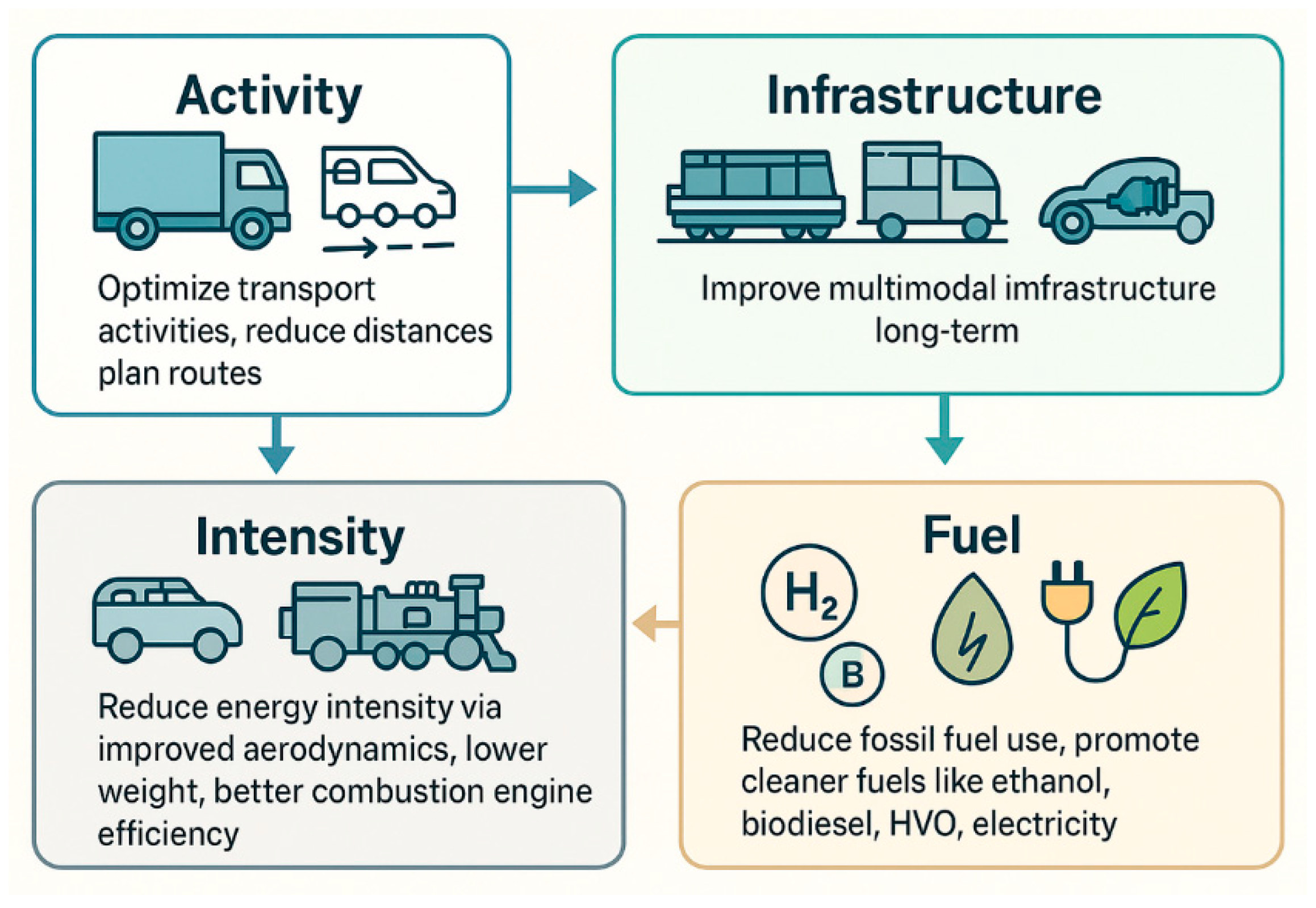
The use of the ASIF methodology in management aims to assess urban mobility management actions for the implementation of LEZ/ZEZ. The methodology considers four lines of action, segmented into (1) Reduction in activity, (2) Provision of infrastructure (Structure), (3) Reduction in energy intensity (Intensity), and (4) Choice of low-carbon energy sources (Fuel) [
12].
This study aims to develop a phased implementation procedure for a LEZ/ZEZ that can be adapted to any city with diverse socioeconomic conditions. It is used as a basis for studies conducted in several cities, although most are in European cities, as the first zone was developed in Sweden.
The case studies presented in
Table 2 focus on international cities with established Low and Zero Emission Zone policies. The inclusion criteria were based on three qualitative factors: (i) the maturity of implementation, favoring cities where measures have been in place long enough to generate observable effects; (ii) the availability of documented outcomes in scientific literature or official government reports; and (iii) the relevance of the measures to the specific dimensions of the ASIF framework (Activity, Structure, Intensity, Fuel). This qualitative synthesis aims to identify regulatory precedents and operational strategies that can serve as a benchmark for the Rio de Janeiro roadmap.
The change in the propulsion system in public transport, similar to that carried out in the LEZ in the Greek city of Athens, which had an autonomy range of 127 to 293 km, was needed to cool the cabin due to summer weather conditions. The battery needs to be charged every 3 days, given a daily route of 100 to 180 km. However, the need for constant cooling by the air conditioning system, along with the vehicle’s functional passenger capacity, reduces its range [
19]. When analyzing flexibility and capacity, there is a negative impact: it will restrict access and require structured logistical planning to ensure the viability of deliveries in the region. However, GHG and atmospheric pollutant levels will decrease in the LEZ region and surrounding areas.
The Total Cost of Ownership (TCO) for electric and diesel-powered buses will reach parity in 15 years, as the initial investment and infrastructure acquisition costs in Brazil remain high. Therefore, tax incentives could be provided so that the cost of the energy transition is not passed on to passengers [
35]. This could lead to an increase in bus fares by transferring the initial cost to the fare.
The electrification of light vehicles, given the growth of the global market, would facilitate the adoption of ride-hailing services and the electrification of taxi fleets, despite the high initial investment [
20]. The energy transition of vehicle propulsion systems at a global level is a reality for certain social classes. Countries that do not have a developed economy or are developing may find it challenging to adopt this climate adaptation strategy, thereby hampering urban resilience.
According to [
10], the reduction in urban bus lines in the metropolitan region of Rio de Janeiro between 2013 and 2017 resulted in an 8% reduction in energy consumption, up to a 25% reduction in GHG emissions, and a decrease in local pollutants ranging from 14% to 45%, as the region experiences traffic congestion during peak hours between 6:30 p.m. and 8:30 p.m. due to the volume of vehicles.
As a result, following studies carried out in the cities of Madrid and Milan, which implemented speed limits in the LEZ/ZEZ area, as well as access restrictions at certain times of the day, led to less congestion and lower GHG emissions, reducing the population’s exposure to air pollution [
21].
Designating specific parking areas for executive buses in tourist areas, such as Amsterdam, aims to restrict access to LEZs by these vehicles, encouraging the use of public transport [
22]. This practice has a low implementation cost and improves traffic flow, increasing confidence and safety. However, it can increase travel time for bus passengers, while light vehicle users can benefit from reduced traffic. Effectiveness depends on appropriate infrastructure dimensioning, especially for electric vehicles, whose charging requires specific support.
The implementation and development of bike lanes with greater provision for pedestrians encourage the adoption of more sustainable modes of transport, thereby reducing dependence on private vehicles in the region, promoting ecological thinking, and improving health [
23,
36]. Municipalities could then implement bike lane projects and bike collection points, as well as develop mobile applications to guide potential users to bike locations and the number of bikes available.
This good practice could impact the initial investment and cost negatively, as it will require engineering works in the region. However, it will increase reliability for users who frequent the area and may reduce travel time. In any case, in the presence of delays in the implementation work, the time attribute is expected to be affected. The flexibility and accessibility of bicycle pick-up/drop-off points, distributed in a structured manner, will have a positive impact.
According to [
24], Light Rail Vehicles (LRVs) use existing road infrastructure, promote the revitalization of historic areas, and are a non-polluting mode of transportation because they use electricity for traction. However, it requires a high initial investment and maintenance costs. It will have a positive impact, as there will be no congestion delays during travel, and it will be possible to identify the distance to the next train on the platforms. However, it offers no flexibility and will have a negative impact, as it is not possible to deviate from the designated route. The capacity will be limited to 300 people per train.
According to [
25], replacing the propulsion systems of fossil-fuel-powered garbage trucks with natural gas and diesel-powered buses with electric buses were good practice adopted by the city of Haifa, Israel. Similar to the measure used in the city of London, changes to the propulsion systems of public road transport and garbage trucks can be implemented by retrofitting or replacing conventional tires with more modern ones that reduce rolling resistance [
18].
Restricting the use of a vehicle based on the last digit of the license plate and the day on which it cannot be used is considered a good practice in implementing rules to determine a LEZ, as the Brazilian city of São Paulo has been using since 1997 [
26]. Its implementation will require stricter enforcement by public authorities and a more extended period for the population to adapt, as it will be necessary to adjust delivery routes and the use of light vehicles. Restricting access to cargo transport vehicles by gross weight or access times is a good practice used by the city of Haifa, Israel, which employs these mechanisms to reduce emissions of polluting gases in the region [
25].
The staggered labeling of vehicles by their propulsion technology and pollution level, as mandated by government regulations, will enable the government to create an access schedule that limits the year of manufacture/propulsion system of the vehicle, a good practice used in the city of Paris, France [
27]. This measure may be structured by the local government with extended deadlines, as it should be accompanied by a socioeconomic study of the population in the area where the LEZ is implemented, due to the fact that new vehicles, whether light, medium, or heavy, but with latest technologies, require a high initial investment [
16].
The implementation of short-term parking areas, supported by appropriate signage, can enhance compliance and improve the organization of last-mile delivery operations [
28]. In parallel, the deployment of electric vehicle charging infrastructure in parking facilities and strategic tourist locations, both within and adjacent to the LEZ, may increase public acceptance and facilitate the transition to low-emission mobility [
30]. These measures can be introduced through a phased implementation strategy, combined with vehicle labeling schemes and differentiated charging mechanisms based on vehicles’ emission levels, thereby supporting regulatory enforcement and incentivizing cleaner transport choices [
23].
The government could conduct logistical studies for the phased implementation of the rules, with the same deadlines as for vehicle labeling, as well as the location of peripheral parking lots for vehicles that do not meet the requirements of the LEZ, in addition to increasing the energy supply to the area, as it will be necessary to install electric vehicle charging stations.
As for freight transport, logistical studies of commercial points should be carried out, and loading/unloading locations may be established in the surrounding area, as well as within it, defining them as logistics proximity zones, similar to what has been done in the French city of Bordeaux, which delimits a specific area for the delivery of goods within a limited radius and with the aid of electric tricycles or small electric carts [
29].
From an economic perspective, the proposed measures are expected to generate positive impacts, despite the high initial investment required for implementation and system development, as structured parking systems can enhance user safety and operational efficiency. However, their effectiveness and social acceptability depend on being informed by comprehensive logistical and socioeconomic assessments of the local population, given that inadequately designed interventions may produce uneven or unintended distributional effects.
Travel time will increase for users subject to the vehicle labeling rules and, consequently, will adversely affect users who, due to poorly formulated rules, must travel longer distances because of imposed access restrictions. Therefore, there should be greater flexibility in the implementation schedule.
Temporarily restricting vehicle access during periods of elevated air pollution, combined with targeted communication to drivers, represents an effective regulatory measure to address episodic increases in CO
2 concentrations under adverse meteorological conditions, such as high temperatures, low dispersion, and prolonged congestion, which can intensify urban heat island effects [
31]. This approach can be implemented through coordination with vehicle registration authorities to enable digital notifications and access control for fossil-fuel-powered vehicles, supported by up-to-date registries and artificial intelligence–based systems for monitoring and enforcement.
The city of Nanchang in China has implemented an electronic license plate recognition system in conjunction with the vehicle control department and, with this, has installed an identification system in traffic control cameras to identify vehicles with outdated labels or those that violate the established labeling schedule, providing alerts to drivers or issuing fines [
32].
The government may coordinate with the vehicle control department to implement and enforce the LEZ scheme as established in the phased access schedule based on the fuel used or the vehicle’s year of manufacture. With this, they can use artificial intelligence to identify the year of manufacture and/or label determined for that vehicle model through the license plate and send messages to drivers’ mobile devices informing them of the violation and specifying a period of time for them to leave the area, in addition to applying fines and penalties.
The development of this control system, along with the use of artificial intelligence, will require an increase in initial investment and operating costs. However, it will provide public authorities with a greater sense of security and control and enhance reliability. Nevertheless, it may be negatively affected if there is poor communication with the population and if deadlines are unattainable due to the region’s socioeconomic situation. Due to greater control and restrictions, it will reduce flexibility and environmental impacts, enable reductions in GHG and atmospheric pollutants, and increase local energy use due to the increase in electric vehicles in the region.
Restricting access based on the year of manufacture and fuel used is considered one of the first steps in initiating the transition from LEZ to ZEZ. Still, it is necessary to complement this with alternative non-polluting transportation, such as electric bicycles, tricycles, electric buses, light rail, or subways [
33]. The government could implement structured urban planning that integrates different modes of transportation, and merchants should analyze their vehicle fleet and the technology used in their last-mile delivery logistics.
The economic aspects of initial investment and the cost to the government may be structured and, at this stage, complemented by improved frequency for the various modes of transportation. Businesses should have renewed their fleets and technology. They should have a last-mile delivery logistics plan with best practices for the surrounding area and complementary transportation, such as bicycles, tricycles, or electric vans. At the operational level, there should be a significant impact from changes in technology of light vehicles. Safety and reliability will be positively affected by the government’s sense of structured commitment. Still, flexibility at this stage will already be negatively affected by the greater restrictions required.
Restricting access to motorcycles by year of manufacture and fuel used is considered a good practice used by the city of Dar Es Salaam in Tanzania, which has completely restricted access, not only because of air pollution or GHG emissions, but also because of concerns about road safety, causing accidents or alleged links to crime [
34]. The next step in implementing the ZEZ is to ban fossil-fuel-powered trucks and buses. With this, it would be necessary for parking lot implementation in peripheral areas to be underway already.
Best practices implemented in European cities offer valuable references for the development of low-emission urban logistics strategies. Initiatives such as bicycle and electric scooter sharing in Stuttgart, along with shared electric vans and cargo bicycles in La Rochelle, demonstrate the feasibility of reducing emissions in last-mile delivery operations. These approaches can be effectively integrated with proximity-based logistics zones, as evidenced by the experience of Bordeaux, thereby enhancing the sustainability and efficiency of urban freight systems [
33].
The government may provide financial and tax assistance to small businesses, enabling them to acquire complementary modes for last-mile logistics [
33]. Structure parking lots in the peripheral areas of the LEZ/ZEZ area, as well as structure parking lots in the proximity zones within it, aiming to reduce irregular parking on the roads and provide an increase in vehicle flow.
From an economic standpoint, the initial investment and costs will be negatively affected by the high cost of purchasing electric vehicles. As such, government fiscal and financial assistance is essential. Reliability may be negatively impacted if proximity zones, peripheral parking lots, and government financial and budgetary assistance are not structured. Still, if all activities are carried out, it will be positively affected.
The ban on access by light vehicles powered by internal combustion engines using fossil fuels is the last good practice to be implemented in the phasing of the LEZ until the full implementation of the ZEZ, because, even though electric vehicle sales are growing globally, the initial investment cost remains high. Therefore, the socioeconomic factors of the location where it will be implemented and the prolonged phasing-in period for vehicle labeling should be analyzed [
16]. The implementation of this phase should already include a structured logistics plan for the region, with parking spots equipped with charging infrastructure for electric vehicles and the provision of transportation modes.
The sequence of best practices aimed at the proper implementation of the LEZ/ZEZ should be accompanied by structured public transportation accompanied by complementary modes such as electric bicycles, scooters, and others, tax and economic subsidies for the purchase of electric vehicles and for small businesses in the region, extended deadlines for the implementation of stages and vehicle labeling, clear communication with the population at each stage and schedule, as well as studies before, during, and after the implementation of GHG and air pollutant emission levels.
These measures demonstrate how this model can be replicated in other cities, as they improve urban resilience through the energy transition in the transport sector. This makes it possible to develop climate adaptation strategies in line with the implementation of these zones, aiming to reduce the formation and intensity of heat islands.
However, implementation must be well structured and include clear, detailed steps for the population, while respecting the region’s socioeconomic limitations, as it could lead to social injustice due to the high initial cost of light electric vehicles or increased public transportation fares resulting from the change in propulsion system. Such measures must provide equitable, sustainable, and fair access to urban mobility.
3.2. Implementation of the Low Emission Zone in the Southern Countries of Latin America
In Latin American countries within the Global South, CO
2 emissions are closely linked to structural drivers such as economic expansion, accelerated urbanization, industrial growth, and the intensification of international tourism. These dynamics increase energy and transport demand, reinforce fossil fuel dependence, and exacerbate environmental pressures on rapidly transforming urban systems, particularly through population concentration, infrastructure expansion, and rising mobility needs. Emissions mitigation in this context is further constrained by political, fiscal, and institutional limitations that hinder the adoption of integrated long-term strategies and the effective internalization of environmental costs. Although the expansion of lower-carbon energy sources and the conservation of natural areas represent key mitigation pathways, their implementation remains challenged by budgetary constraints, regulatory fragmentation, and limited coordination across energy, transport, urban, and land-use sectors. Addressing these structural and governance barriers is therefore essential to align urban and economic development trajectories in Latin America with climate change mitigation objectives [
37].
In Bogotá, Colombia, the assessed decarbonisation pathways emphasise systemic transformations in the urban transport sector, primarily driven by technological change, modal shifts, and improvements in vehicle efficiency rather than by explicitly defined spatial restriction policies. The scenarios indicate that emission reductions rely heavily on the gradual replacement of conventional vehicle fleets and the strengthening of public and collective transport systems within a context of high motorisation and persistent social inequalities. Implementation challenges emerge from the scale of informal and older vehicle fleets, institutional capacity constraints, and the difficulty of ensuring equitable access to cleaner mobility options. As a result, Bogotá can be characterised as being in an early stage of transition, where future outcomes depend on aligning technological decarbonisation strategies with demand management and governance mechanisms capable of delivering emissions reductions without exacerbating accessibility constraints [
38].
In the Argentine city of Buenos Aires, the scenarios analyzed reflect a more consolidated political environment in which transport decarbonization is integrated into broader urban mobility and land-use strategies. Emissions-reduction trajectories are associated with improvements in fleet performance, greater public transport efficiency, and measures to manage traffic intensity in central urban areas, rather than the explicit adoption of low-emission zoning instruments. However, structural limitations related to the continued relevance of private vehicles, political sensitivity to access regulation, and uneven implementation capacity stand out. These factors place Buenos Aires at an intermediate stage of development, where future decarbonization gains depend on strengthening institutional coordination and ensuring that regulatory and technological measures evolve coherently to support long-term climate mitigation goals while maintaining urban accessibility. The city intends to begin implementing two low-emission zones, starting with restricting vehicle access to the city center [
38].
In Ecuador, transport-related emission mitigation is primarily anchored in strategic planning and the progressive alignment of mobility policies with national climate objectives. The transition pathway emphasises improvements in energy efficiency, the gradual introduction of low-emission technologies, and the strengthening of public transport systems as central mechanisms for reducing both greenhouse gas emissions and local air pollutants. These practices reflect an intermediate stage of implementation, in which challenges in institutional coordination and financial feasibility constrain regulatory ambition. Mitigation efforts are therefore characterised by a long-term orientation, prioritising structural readiness and policy coherence over the immediate deployment of restrictive or spatially targeted urban measures [
39].
Bolivia’s approach to mitigating transport-related pollution is shaped by an early-stage transition framework, which focuses on preparatory and enabling actions rather than direct regulatory interventions. Emission-reduction efforts are oriented toward improving energy efficiency and gradually reducing emissions intensity through planning, institutional strengthening, and integrating cleaner energy considerations into transport policy. The absence of mature operational instruments reflects structural constraints related to governance capacity and resource availability, positioning mitigation outcomes as incremental and highly dependent on the consolidation of long-term energy transition strategies [
39].
In Paraguay, mitigating emissions from the transport sector is framed as an emerging policy domain, with practices primarily focused on efficiency gains and the exploration of low-emission pathways rather than on concrete implementation mechanisms. The prevailing emphasis is on establishing the foundational conditions necessary for future action, including policy alignment, institutional development, and strategic recognition of transport as a contributor to national emissions. As a result, mitigation remains conceptual and prospective, with limited short-term impact on urban transport systems and a strong dependence on future regulatory and financial mobilisation [
39].
Chile exhibits a more advanced configuration of transport emission mitigation practices, characterised by the systematic integration of low-emission technologies and a clear strategic orientation toward energy transition within the transport sector. The prioritisation of fleet transformation, particularly in public transport, reflects a mature policy environment capable of translating climate objectives into tangible mitigation outcomes. While challenges related to scale and long-term sustainability persist, the country demonstrates a higher degree of institutional readiness and policy coherence, enabling more effective reductions in both greenhouse gas emissions and local air pollutants within urban transport systems [
39].
The study [
40] developed for the city of Cuenca integrates atmospheric dispersion modeling with analysis of historical observational data, providing a robust technical and scientific basis for air quality management in an urban context. Although it does not address the formal implementation of a low-emission zone, the study accurately identifies the contribution of mobile sources to atmospheric pollutant concentrations and their spatial and temporal variability, providing direct input for traffic control and vehicle restriction policies.
The objectives focus on understanding the processes of pollution formation and dispersion, supporting evidence-based decision-making, and reducing the health risks associated with chronic exposure to urban pollutants. The methodological assumptions include the reliability of monitoring records, the adequacy of models applied to local conditions, and the integration of scientific analysis with urban planning. From the perspective of the public policy cycle, Cuenca is at an advanced stage of diagnosis and evaluation, still before the implementation of regulatory instruments such as LEZ, and faces barriers to converting technical knowledge into normative and operational measures. Prospective scenarios indicate that the systematic incorporation of these results may enable progressive strategies for traffic management and emission control [
40].
Medellín’s LEZ is a public policy instrument designed to mitigate atmospheric emissions from mobile sources. It is structured around a territorial delimitation of the urban center and a gradual implementation strategy that integrates awareness-raising, mobility management, and environmental monitoring actions. The prioritization of this area is supported by technical evidence from a detailed characterization of vehicular traffic, with an emphasis on variables such as road occupancy, intensity, and speed, which allow for the identification of spatial and temporal patterns relevant to emissions control [
41,
42].
The articulation between interinstitutional governance, the promotion of sustainable modes of transport, and the systematic use of data constitutes an integrated approach between urban mobility and air quality. In this context, the LEZ is in a phase of progressive implementation supported by a solid analytical foundation, still conditioned by challenges related to impact assessment and the induction of structural changes in urban mobility patterns, but with significant potential to contribute to the improvement of public health and local climate change mitigation strategies [
41,
42].
Implementation of the Low Emission Zone in Brazil
In Brazil, in a manner comparable to a LEZ, the City of São Paulo implemented, in 1997 and in subsequent regulatory updates, a legally established vehicle-rotation system based on the final digit of private vehicle license plates [
26]. In contrast, Rio de Janeiro is the only city to have formally established ND implementation through legislation [
9]. Although the adoption of light electric vehicles has been actively encouraged and sales have grown exponentially, a significant national-level barrier persists due to their high purchase cost [
43].
Particulate matter (PM) and ozone (O
3), two of the six criteria pollutants commonly used in air-quality assessment, are of particular relevance from a public health perspective due to the well-documented association of PM with respiratory and cardiovascular morbidity and the adverse health effects of O
3 at both moderate and high concentrations. At elevated levels, both pollutants can impair physical performance and reduce overall well-being. In Rio de Janeiro, road-based transport constitutes the predominant source of urban air pollution, especially in the city’s central area. Accordingly, traffic management and mobility regulation strategies play a critical role in reducing emissions, improving traffic conditions, and mitigating the release of local and global pollutants, underscoring the importance of systematic greenhouse gas emissions assessment as a foundation for evidence-based urban policy [
44].
According to the GHG Emissions Monitoring Report for the City of Rio de Janeiro covering the period from 2012 to 2019, the transportation and energy-generation sectors are the dominant contributors to municipal emissions, jointly accounting for approximately 70% of the total. Nevertheless, other sectors also make relevant contributions, including waste generation and disposal, industrial processes and product use (IPPU), and agriculture, forestry, and other land uses (AFOLU) [
45].
The Climate Action Plan (CAP), which provides strategic guidance for municipal government actions, incorporates, in addition to the United Nations mitigation framework, a target of reducing GHG emissions by 20% by 2030. The measures proposed include replacing 20% of the Public Passenger Transport Service bus fleet with non-emitting vehicles and establishing the ND, within which only electric vehicles will be permitted. Complementary actions include implementing water features and green infrastructure, expanding tree planting, adopting photovoltaic energy, and using permeable paving in the city center [
9].
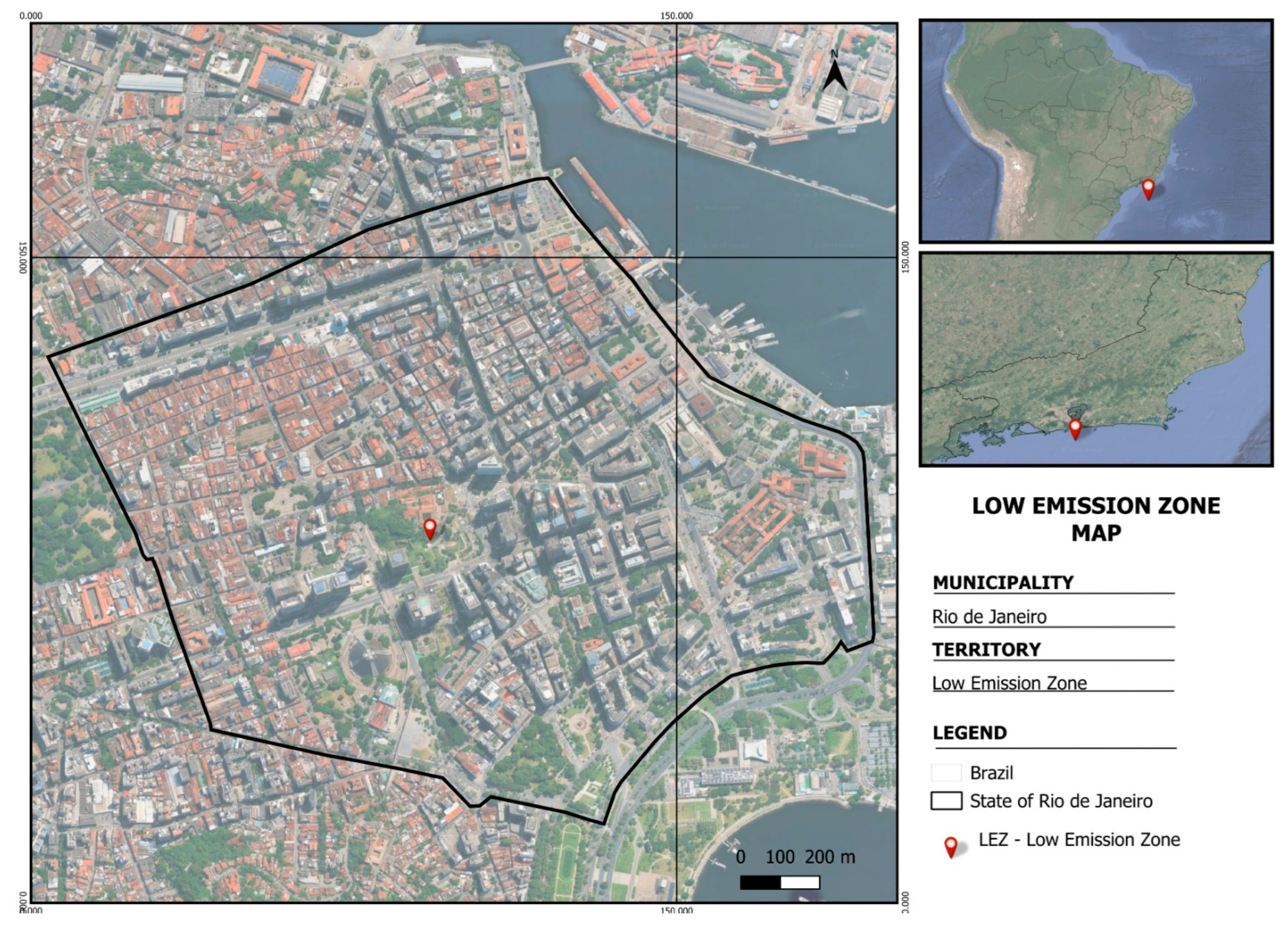
Beyond the CAP, the Executive Branch of the Municipality of Rio de Janeiro instituted the Reviver Centro Program, which establishes urban and environmental redevelopment guidelines for the Centro and Lapa neighborhoods and defines the pilot design for the ND or LEZ, as illustrated in
Figure 3. The Complementary Law (LC) determines that conservation initiatives and the construction of new residential units should be undertaken in the area, alongside incentives for the adoption of technologies and solutions aimed at improving building energy efficiency, strengthening green public transport over individual transport—particularly fossil-fuel-based modes—and promoting the implementation of green areas and social equity [
9].
In terms of transportation, the LEZ is well-connected, with Santos Dumont Airport and ferry access located in this region. In terms of rail transport, there is access to the Santa Tereza tram, the four LRV lines, and the two subway lines via four stations.
In terms of road transport, the region has several lines, both as the start and end of the line and as a point of embarkation and disembarkation. 165 bus lines run through the city center, specifically the ND, including 23 premium or express services (frescão) and 142 regular, totaling approximately 330 travel routes [
46].
The division of modes of transport by passenger use, based on 2023 data, found that 76% of public transport users use road transport, specifically buses. The second most used mode of transportation is rail, analyzing only the subway, given that the region has access to two lines, the result is 22.38%, followed by ferries at 1.57% and light rail at only 0.06% [
47].
The municipal government may promote energy transition by electrifying buses or adopting biofuels on routes serving the region, and by setting initial targets and operational guidelines for the development of the LEZ. At the same time, efforts should be made to modernize the official vehicle fleets of the public sector in the region through the introduction of light hybrid or fully electric vehicles, thus contributing to the expansion of local energy supply which is necessary to recharge the vehicles, since one of the main barriers to the implementation of electric buses may be the supply of energy by the local utility company.
The application of best practices identified in the ASIF methodology is feasible across different scenarios, as its effectiveness depends on coordinated actions by government authorities, local businesses, and the population directly affected by the designation of the LEZ/ZEZ area. Conducting an emissions inventory before implementation, throughout the implementation phases, and after full deployment is considered an essential procedure, as it accurately captures the actual magnitude of mitigation.
The government plays a central role in implementing the proposed stages. It should, therefore, structure actions and timelines that align with the city’s socioeconomic conditions, while also undertaking early measures that visibly demonstrate institutional commitment to raising awareness of the program’s relevance and benefits.
The development of the stages for changing the propulsion systems of municipal buses can proceed in parallel with the implementation and expansion of bike lanes and light rail, as this would reduce the number of vehicles and encourage the use of public transport. However, the frequency of services and tax incentives for companies that make this change should be planned, as should subsidies for tickets for these modes of transport, to encourage their use.
The use of private vehicle rotation, similar to the city of São Paulo [
23], which restricts access to the region based on the last digit of the vehicle’s license plate number. However, for this to be done efficiently, it will be necessary to implement a camera system with artificial intelligence, linked to a database, to identify the registered model and driver through the vehicle license plates and, with this, apply sanctions to drivers who do not respect the vehicle rotation system or, in more advanced stages, do not respect access with the defined technology or the use of public agents carrying out control.
A possible second step is to restrict access to vehicles with a gross weight exceeding 3.5 tons, as in the city of Haifa, or to adopt current technologies, such as more sustainable propellants and electrification for light and semi-light commercial trucks. Public–private partnerships can be established to use parking spaces in peripheral and internal areas, as downtown has several parking facilities. For example, the Menezes Cortes Terminal could be used in the internal area, or the Cinelândia parking lot in the peripheral region, which would provide an ideal location for loading/unloading in the vicinity.
Given Brazil’s low average income and the high costs of cleaner vehicle technologies, restrictions on private vehicles should be introduced gradually. Limiting access for motorcycles will be the most challenging step, given their widespread use for deliveries and quick trips, their lower cost, and the scarcity of electric models. In addition, their mobility in congested areas makes them more useful. Thus, this restriction will require more extended deadlines and should be among the last measures implemented.
The parallel development of LEZs/ZEZs in green areas of the city favors greater mitigation of GHGs and atmospheric pollutants, as trees act as natural filters, regulate the microclimate, indirectly reducing vehicle emissions, such as PM
2.5 and NO
x, promoting active mobility and physical activity in these areas, as well as being a source of noise pollution absorption [
48].
Given that studies show improvements in health quality through reductions in GHGs and atmospheric pollutants in the peripheral areas of these zones, the conservation of peri-urban green regions smaller than 1 square kilometer can help mitigate air pollution from anthropogenic sources [
49].
Although LEZs are primarily justified by their environmental and climate-mitigation benefits, the findings indicate that such measures may also impose significant mobility- and accessibility-related burdens. In car-dependent urban contexts, access restrictions can reduce temporal flexibility, complicate daily travel routines, and limit access to essential activities, particularly for households with constrained adaptive capacity. The impacts extend beyond the regulated area, affecting social interactions and participation by increasing dependence on informal mobility arrangements and discouraging visits. These outcomes reveal a persistent tension between environmental effectiveness and social sustainability, suggesting that the assessment of LEZs should move beyond environmental performance alone to incorporate their distributive and accessibility implications within urban mobility systems [
50].
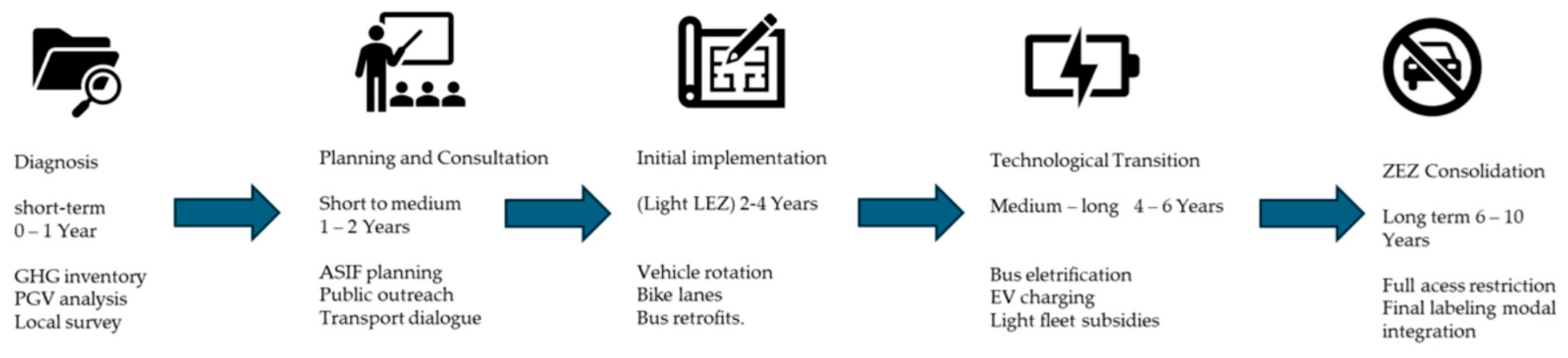
The development of a roadmap as a decision-making tool, identifying stages and deadlines, aims to ensure consistency between emissions mitigation targets and local implementation capacity. Illustrating the need for gradual institutional strengthening and socioeconomic adaptation to ensure policy sustainability and public acceptance.
Based on the literature, empirical results, and governance analysis, the roadmap in
Figure 4 describes five progressive stages over a 10-year horizon, highlighting coordinated governance, energy transition, and stakeholder involvement.
In addition to socioeconomic barriers to the implementation of LEZ/ZEZ in the city, there will be political and institutional barriers. The absence of a national legal framework governing LEZ areas limits municipalities’ ability to enforce traffic restrictions or environmental penalties. In the case of Rio de Janeiro, despite local initiatives, there is weak vertical coordination with federal and state policies.
Changes in municipal leadership often result in the discontinuation of environmental programs and urban mobility plans, weakening the institution and compromising long-term goals. Another critical problem is the silo structure of public administration, such as the lack of interaction between transportation, environment, urban development, and energy agencies, hindering the planning necessary for the effective implementation of the LEZ/ZEZ, as shown in
Table 3.
Institutional passivity, insufficient technical staff, and limited fiscal capacity further constrain the government’s ability to enforce new regulatory frameworks. Pressure from trade associations, transport unions, and logistics operators, who may view ZEZ rules as economically punitive, results in political resistance and delays in approval. These factors suggest that, in addition to technological and financial planning, implementing LEZs in Latin American cities requires robust governance mechanisms, legal clarity, and robust stakeholder engagement strategies to ensure continued implementation and public acceptance.



 ,
,