

Strategic Management of Urban Sustainability and Resilience: Navigating the BANI Environment in Ukrainian Context

 ,
,  ,
,
Abstract
1. Introduction
- To frame post-invasion urban recovery through a BANI lens by characterising how brittleness, anxiety, non-linearity, and incomprehensibility manifest in Ukrainian cities and what this implies for planning under uncertainty.
- To synthesise an integrated recovery approach that links governance, infrastructure resilience, digital capacity, and circular-economy principles into a coherent set of policy and implementation pathways.
- To demonstrate applicability through an anchored case by using Kyiv to illustrate how the framework can be operationalized to support prioritisation, sequencing, and accountability in recovery decisions.
- A BANI-to-policy translation artefact. We provide a structured mapping from BANI conditions to concrete policy design requirements (e.g., redundancy and modularity for brittleness, trust and risk communication for anxiety, adaptive sequencing for non-linearity, and transparent metrics for incomprehensibility).
- An integrative recovery framework. We offer a modular structure that connects institutional coordination, critical infrastructure, digital services, and sustainability objectives, making cross-sector dependencies explicit.
- An operationalization toolkit for decision-makers. We outline practical levers and evaluation hooks (principles, criteria/indicators, and governance checks) that enable monitoring, adjustment, and learning during implementation rather than only ex post assessment.
- A case-grounded demonstration for Ukraine’s context. We apply the framework to Kyiv to show how the proposed structure supports actionable choices (priorities, sequencing, and trade-offs) under disruption and resource constraints.
2. Understanding the BANI Environment in the Ukrainian Urban Context
2.1. Literature Review
2.2. Defining the BANI Framework
- Brittleness (B). This term refers to systems that, despite appearing robust, possess an inherent fragility and potential to collapse under stress. This fragility often arises from global interconnectedness and an overemphasis on efficiency at the expense of redundancy and resilience. In urban systems, this translates to critical infrastructure, such as power grids and transportation networks, being vulnerable to cascading failures from minor disruptions. For Kyiv, this is acutely manifested in the direct impact of military actions on its infrastructure, where seemingly stable systems can be instantly shattered, leading to widespread disruptions.
- Anxiety (A). This describes a pervasive emotional and psychological toll stemming from constant uncertainty, rapid change, and information overload. The spread of misinformation can exacerbate this anxiety, leading to risk aversion, feelings of helplessness, and potentially inaction among individuals and organisations. In urban contexts, this manifests as heightened stress among residents due to unpredictable changes and a general sense of uncertainty about the future of their city. Kyiv’s residents experience profound anxiety due to ongoing air raids, displacement, and the constant threat of conflict, which deeply impacts their daily lives and decision-making.
- Non-linearity (N). This characterises situations where cause-and-effect relationships are not predictable. Small inputs can lead to disproportionately large, unexpected, and complex outcomes. This complicates traditional forecasting and planning, as processes can spin out of control with slight disruptions. Climate change, with its far-reaching and often surprising impacts, serves as a prime example of non-linearity in environmental systems. In Kyiv, the non-linear impacts of conflict are evident in unpredictable population displacements, disruptions to supply chains, and the cascading failures of interconnected urban systems due to targeted attacks.
- Incomprehensibility (I). This denotes problems so complex and fast-moving that they defy easy understanding or clear solutions, even when abundant data is available. The sheer volume of information can lead to cognitive overload and a feeling of being overwhelmed, making rational decision-making challenging. This is particularly relevant when dealing with AI technologies whose decision-making processes can be difficult to rationalise or fully explain. For Kyiv, the scale and speed of wartime destruction, coupled with the complexities of humanitarian aid, internal displacement, and future reconstruction, create an environment where traditional planning models struggle to grasp the full scope of challenges and solutions.
2.3. Manifestations and Implications for Ukrainian Urban Systems
2.4. The Human Dimension: How Urban Design and BANI Characteristics Impact Mental Well-Being and Social Equity in Ukraine
3. Foundational Principles for Sustainable Urban Development in a BANI World: Ukrainian Path to Resilience
3.1. Adaptive Governance and Planning
3.2. Building Urban Resilience
3.3. Circular Economy Principles
4. Leveraging Technology for Urban Sustainability and Resilience in Ukraine
4.1. The Transformative Role of AI, IoT, and Digital Twins
- AI: AI can support urban decision-making in BANI conditions by enhancing triage, forecasting, and logistics under uncertain conditions. For Kyiv, realistic near-term applications include rapid damage assessment, prioritisation of repair queues, forecasting localised humanitarian needs, and anomaly detection across energy, health, and environmental signals. These benefits are conditional on data governance, model transparency, and integration with human-led crisis protocols. Without such safeguards, AI may increase institutional complexity and perceived opacity rather than reduce the incomprehensibility that BANI highlights.
- IoT: IoT enables near-real-time visibility across transport, energy, water, and public safety systems, creating the data foundation for faster repairs and more targeted resource allocation. For Kyiv, this could include monitoring the status of critical infrastructure, neighbourhood-level air quality, and energy demand variability during crisis periods. However, IoT expansion must be designed with cyber and physical redundancy in mind, especially where sensors and control systems interface with power and water networks. In wartime-degraded conditions, we assume partial observability and design for graceful degradation: satellite and drone assessment, utility continuity logs, and field reporting can substitute when local sensors or networks fail, and any digital monitoring should be deployable on low-power, low-bandwidth links with backup power at critical nodes.
- Digital Twins: Urban digital twins can serve as controlled test environments for reconstruction choices, helping planners compare design options under multiple threat and budget assumptions. In Kyiv, a phased approach could begin with district-level energy and mobility models that integrate outage histories, repair backlogs, and new distributed generation scenarios. The primary value is not perfect prediction, but rather improved coordination and earlier detection of trade-offs across infrastructure, climate goals, and service equity.
4.2. Closed-Loop Integration Model: Digital Twins, Mental Health Service Distribution, and Urban Resilience Indicators
4.3. Smart Energy Management
4.4. Data-Driven Urban Planning
4.5. Cybersecurity as a Critical Enabler
5. Cultivating Well-Being in the “Anxious” City: Kyiv’s Human-Centred Recovery
5.1. The Socio-Economic Burden of Mental Health in Urban Populations
5.2. Impact of Urban Design on Psychological Strain
5.3. Digital Mental Health Interventions
5.4. Integrating Mental Health into Urban Policy
- Stakeholder identification matrix. Kyiv should establish a matrix that identifies youth subgroups affected by war and reconstruction (e.g., displaced/returning youth, youth with disabilities, youth in heavily affected districts, and school-attending vs. out-of-school youth), and maps them to institutional stakeholders (schools, municipal health and social services, NGOs, community hubs, and digital platform operators). The matrix specifies each group’s expected role (user, co-designer, evaluator), accessibility needs (language, disability supports), and safe engagement channels.
- Participation levels and decision rights. Participation should be explicitly classified by level of influence to prevent tokenism:Information sharing (transparent communication of options and constraints); consultation (structured feedback on needs and usability); co-design (joint development of programme components such as referral pathways, platform features, or school-based delivery); and co-decision-making (youth representatives hold defined voting/approval rights on selected elements such as prioritisation of interventions, service standards, and evaluation indicators). Each programme component should declare its participation level and what decisions youth input can change.
- Conflict resolution, safeguarding, and accountability. Because youth participation occurs in a high-stress context, Kyiv should implement a simple dispute-resolution and safeguarding mechanism: facilitated sessions with documented agendas and outputs; an escalation pathway to a small cross-sector steering group (municipality-school-service providers-youth reps); and a grievance channel (including anonymous reporting) for concerns related to privacy, stigma, or harmful content. Participation outputs (decisions made, items deferred, and rationale) should be published in a concise “you said—we did” log to maintain trust and ensure the process informs iterative planning updates.
6. Implementation Strategies and Best Practices: Ukrainian Adaptive Recovery Model
6.1. Multi-Stakeholder Collaboration and Co-Creation
6.2. Continuous Monitoring, Evaluation, and Learning
6.3. Policy Frameworks and Funding Mechanisms
- District-level energy resilience packages that combine solar-plus-storage for critical facilities (hospitals, shelters, water pumping) with grid-hardening and islanding protocols, evaluated through outage reduction and recovery-time metrics.
- An AI-enabled reconstruction monitoring and prioritisation platform that fuses satellite or drone damage assessment, municipal asset registries, and transparent progress dashboards to support adaptive sequencing and anti-corruption accountability.
- Cyber-secure digital public services for recovery delivery, including interoperable registries (housing, benefits, permits) and incident-response-ready architectures that protect critical municipal and utility operations.
- Community-scaled digital mental health and psychosocial support for displaced and war-affected populations, integrated with primary care referral pathways and privacy-preserving analytics to guide resource allocation.
7. Case Studies and Examples of Adaptive Urban Development in BANI-like Contexts
7.1. Core Mathematical Model Framework
- Sustainability sub model
- 2.
- Resilience sub model
- 3.
- BANI dynamics is presented in Table 4. For each BANI factor, the table gives the mathematical representation used to encode its effect in the modelling framework (e.g., thresholds, variance-linked risk, tipping dynamics, entropy-driven delays).
- Strategic decision variables
- -
- Budget
- -
- War-driven
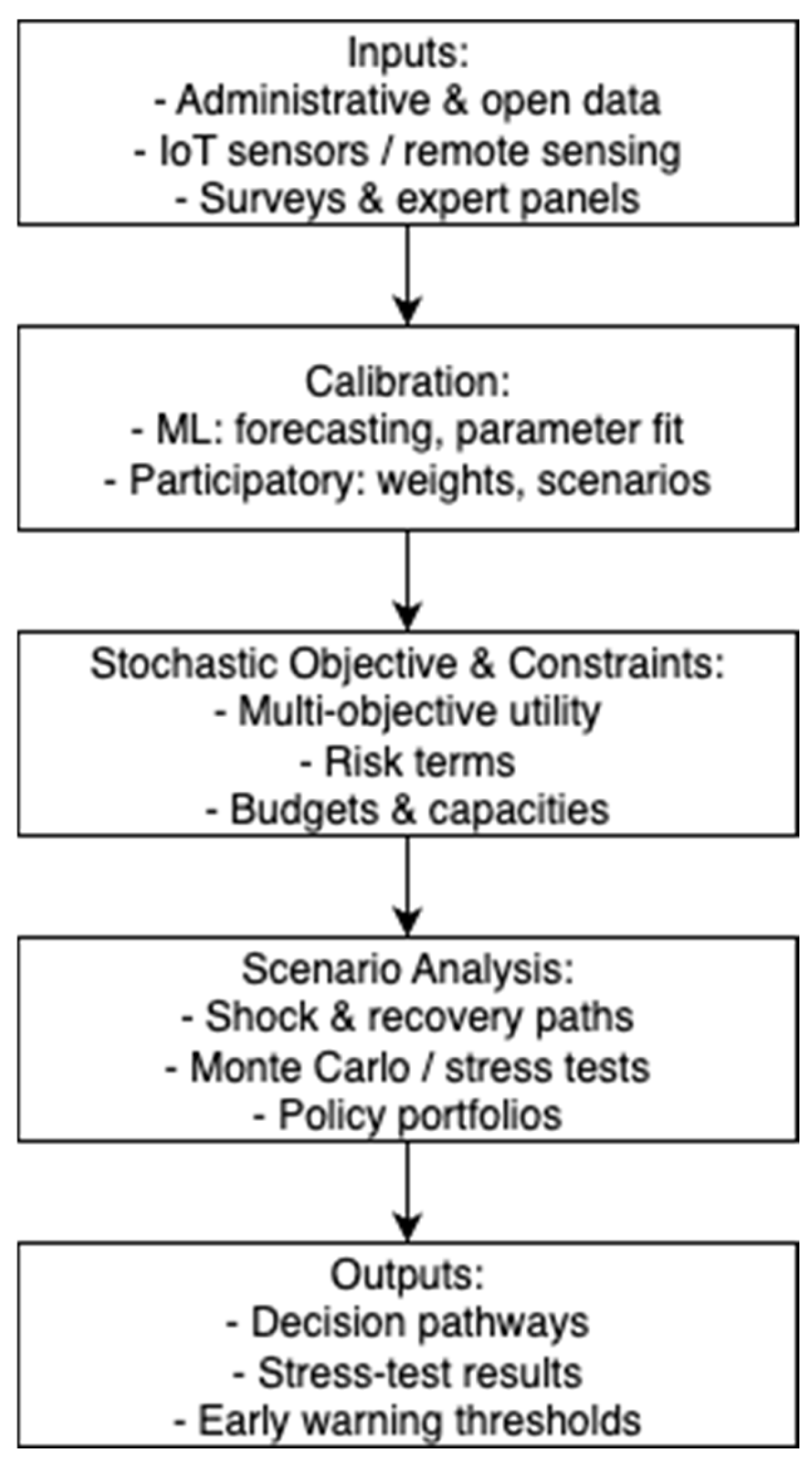
7.2. Implementation Protocol
- Data inputs
- Satellite imagery (damage assessment)
- UNDP resilience indicators
- Energy grid vulnerability maps
- Calibration
- Machine learning for λ, θi
- Participatory modelling with local communities
- Outputs
- Adaptive investment pathways
- Stress-test reports for cities
- Early-warning thresholds for BANI shocks
- War Effects. Explicit shock terms γk in the resilience submodel.
- Decentralisation. SG(t) depends on local governance capacity.
- EU Integration. S(t) increases with alignment to EU Green Deal.
- Energy. SE(t) penalises fossil fuel dependence (post-strike recovery).
- (a)
- Spatial/service-access layer: district-level population and vulnerability profiles; geolocated critical facilities (hospitals, shelters, water pumping, schools); service catchments and travel-time-to-access metrics (e.g., share of residents within X minutes of shelter/primary care); green/blue space accessibility indicators and exposure proxies (noise/heat where available).
- (b)
- Energy and critical-infrastructure layer: utility continuity logs and restoration records (e.g., outage minutes and restoration times for electricity/heating/water), redundancy coverage for critical facilities (backup power, islanding readiness), distributed generation and storage capacity additions over time, and energy/emissions accounting for reconstructed assets.
- (c)
- Social and governance layer: displacement/return dynamics, housing availability and repair throughput, service utilisation metrics (healthcare, social support), and transparency/accountability indicators (procurement cycle time, completion rates, grievance reporting).
- Scenario A. “Baseline Recovery” (No Major Shocks)
- u1. 20% to renewables (solar microgrids)
- u2. 30% to infrastructure (water pipes, roads)
- u3. 25% to social housing
- u4. 15% to AI monitoring (e.g., air quality sensors)
- Scenario B. “BANI Crisis” (Shocks + Anxiety)
- Year 2 (2027). Major flood (γ2 = 0.3) damages 30% of the infrastructure.
- Year 4 (2029). Energy grid cyberattack (γ4 = 0.2).
- Anxiety Effect (illustrative). Decision and implementation delays reduce Radaptive by 15% (placeholder for a moderate delay regime; calibrated in practice from procurement/coordination latency proxies as described in Section 7.1).
- Renewables + Redundancy. High u1 and u4 mitigate energy shocks (critical after Russian strikes).
- Adaptive Budgeting. Dynamic reallocation (e.g., reduce u3 during crises) improves outcomes.
- Anxiety Tax. BANI effects reduce resilience by ~15%—Invest in transparent governance (SG).
8. Discussion
9. Conclusions
Author Contributions
Funding
Institutional Review Board Statement
Informed Consent Statement
Data Availability Statement
Conflicts of Interest
References
- Bushuyev, S.; Bushuyeva, N.; Nekrasov, I.; Chumachenko, I. Successful Management of Public Health Projects Driven by AI in a BANI Environment. Computation 2025, 13, 160. [Google Scholar] [CrossRef]
- Haque, U.; Bukhari, M.H.; Fiedler, N.; Wang, S.; Korzh, O.; Espinoza, J.; Ahmad, M.; Holovanova, I.; Chumachenko, T.; Marchak, O.; et al. A Comparison of Ukrainian Hospital Services and Functions before and during the Russia-Ukraine War. JAMA Health Forum 2024, 5, e240901. [Google Scholar] [CrossRef]
- Dotsenko, N.; Chumachenko, D.; Chumachenko, I. Modeling of the Process of Critical Competencies Management in the Multi-Project Environment. In Proceedings of the 2019 IEEE 14th International Conference on Computer Sciences and Information Technologies (CSIT), Lviv, Ukraine, 17–20 September 2019; pp. 89–93. [Google Scholar] [CrossRef]
- Cascio, J. Facing the Age of Chaos—Jamais Cascio—Medium. Available online: https://medium.com/%40cascio/facing-the-age-of-chaos-b00687b1f51d (accessed on 29 September 2025).
- Padalko, H.; Chomko, V. Dmytro Chumachenko A Novel Approach to Fake News Classification Using LSTM-Based Deep Learning Models. Front. Big Data 2024, 6, 1320800. [Google Scholar] [CrossRef]
- Dobrovolska, V.; Bilushchak, T.; Syerov, Y. Intelligence Web Analysis of Internet Resources of Intangible Digital Cultural Heritage Collections. In Proceedings of the CEUR Workshop Proceedings, Łódź, Poland, 2–4 December 2022; pp. 1–18. [Google Scholar]
- Dotsenko, N.; Chumachenko, I.; Kraivskyi, B.; Railian, M.; Litvinov, A. Methodological Support for Managing of Critical Competences in Agile Transformation Projects within a Multi-Project Medical Environment. Adv. Inf. Syst. 2024, 8, 26–33. [Google Scholar] [CrossRef]
- Huang, J.; Lu, H.; Du, M. Coordinated Development of Digital Economy and Ecological Resilience in China: Spatial–Temporal Evolution and Convergence. In Environment, Development and Sustainability; Springer: Berlin/Heidelberg, Germany, 2025. [Google Scholar] [CrossRef]
- World Bank Group. Updated Ukraine Recovery and Reconstruction Needs Assessment Released. Available online: https://www.worldbank.org/en/news/press-release/2025/02/25/updated-ukraine-recovery-and-reconstruction-needs-assessment-released (accessed on 22 August 2025).
- United Nations. Efforts to Reconstruct Human Settlements in Ukraine Affected by War; United Nations: New York, NY, USA, 2024. [Google Scholar]
- Kapucu, N.; Ge, Y.; Rott, E.; Isgandar, H. Urban Resilience: Multidimensional Perspectives, Challenges and Prospects for Future Research. Urban Gov. 2024, 4, 162–179. [Google Scholar] [CrossRef]
- Dotsenko, N.; Chumachenko, I.; Skachkov, O.; Husieva, Y. Development and Implementation of Intelligent Programming Tool for Agile Transformation of Human Resource Management Processes. In Proceedings of the CEUR Workshop Proceedings, Cambridge, MA, USA, 27 September 2024; pp. 361–368. [Google Scholar]
- Weil, C.; Bibri, S.E.; Longchamp, R.; Golay, F.; Alahi, A. Urban Digital Twin Challenges: A Systematic Review and Perspectives for Sustainable Smart Cities. Sustain. Cities Soc. 2023, 99, 104862. [Google Scholar] [CrossRef]
- Peldon, D.; Banihashemi, S.; LeNguyen, K.; Derrible, S. Navigating Urban Complexity: The Transformative Role of Digital Twins in Smart City Development. Sustain. Cities Soc. 2024, 111, 105583. [Google Scholar] [CrossRef]
- Hassine, L.; Quadar, N.; Ledmaoui, Y.; Chaibi, H.; Saadane, R.; Chehri, A.; Jakimi, A. Enhancing Smart Grid Security in Smart Cities: A Review of Traditional Approaches and Emerging Technologies. Appl. Energy 2025, 398, 126430. [Google Scholar] [CrossRef]
- Xu, Z.; Marini, S.; Mauro, M.; Latessa, P.M.; Grigoletto, A.; Toselli, S. Associations between Urban Green Space Quality and Mental Wellbeing: Systematic Review. Land 2025, 14, 381. [Google Scholar] [CrossRef]
- Çetin, S.; Kirchherr, J. The Build Back Circular Framework: Circular Economy Strategies for Post-Disaster Reconstruction and Recovery. Circ. Econ. Sustain. 2025, 5, 1689–1726. [Google Scholar] [CrossRef]
- Musa, M.; Rahman, T.; Deb, N.; Rahman, P. Harnessing Artificial Intelligence for Sustainable Urban Development: Advancing the Three Zeros Method through Innovation and Infrastructure. Sci. Rep. 2025, 15, 23673. [Google Scholar] [CrossRef]
- Bushuyev, S.; Chumachenko, I.; Galkin, A.; Bushuiev, D.; Dotsenko, N. Sustainable Development Projects Implementing in BANI Environment Based on AI Tools. Sustainability 2025, 17, 2607. [Google Scholar] [CrossRef]
- Piletskiy, P.; Chumachenko, D.; Meniailov, I. Development and Analysis of Intelligent Recommendation System Using Machine Learning Approach. Adv. Intell. Syst. Comput. 2020, 1113, 186–197. [Google Scholar] [CrossRef]
- Zeng, X.; Yu, Y.; Yang, S.; Lv, Y.; Sarker, M.N.I. Urban Resilience for Urban Sustainability: Concepts, Dimensions, and Perspectives. Sustainability 2022, 14, 2481. [Google Scholar] [CrossRef]
- Elmqvist, T.; Andersson, E.; Frantzeskaki, N.; McPhearson, T.; Olsson, P.; Gaffney, O.; Takeuchi, K.; Folke, C. Sustainability and Resilience for Transformation in the Urban Century. Nat. Sustain. 2019, 2, 267–273. [Google Scholar] [CrossRef]
- OECD. Enhancing Resilience by Boosting Digital Business Transformation in Ukraine; OECD: Paris, France, 2024. [Google Scholar]
- Ingram, G.; Vora, P. Ukraine: Digital Government Is Central to Resilience. Available online: https://www.brookings.edu/articles/ukraine-digital-government-is-central-to-resilience/ (accessed on 29 September 2025).
- UNDP. United Nations Development Programme in Ukraine. Available online: https://www.undp.org/sites/g/files/zskgke326/files/2023-09/undp-ua-recovery-framework.pdf (accessed on 29 September 2025).
- Klymak, M.; Vlandas, T. Governance in Times of War: Public Procurement in Ukraine. PLoS ONE 2024, 19, e0305344. [Google Scholar] [CrossRef]
- Rezende, D.A.; Almeida, F.; André, L. Strategic Digital City: Multiple Projects for Sustainable Urban Management. Sustainability 2024, 16, 5450. [Google Scholar] [CrossRef]
- Romero-Lankao, P.; Gnatz, D.; Wilhelmi, O.; Hayden, M. Urban Sustainability and Resilience: From Theory to Practice. Sustainability 2016, 8, 1224. [Google Scholar] [CrossRef]
- Acuti, D.; Bellucci, M.; Manetti, G. Company Disclosures Concerning the Resilience of Cities from the Sustainable Development Goals (SDGs) Perspective. Cities 2020, 99, 102608. [Google Scholar] [CrossRef]
- Grum, B.; Kobal Grum, D. Urban Resilience and Sustainability in the Perspective of Global Consequences of COVID-19 Pandemic and War in Ukraine: A Systematic Review. Sustainability 2023, 15, 1459. [Google Scholar] [CrossRef]
- Conti, M.E.; Battaglia, M.; Calabrese, M.; Simone, C. Fostering Sustainable Cities through Resilience Thinking: The Role of Nature-Based Solutions (NBSs): Lessons Learned from Two Italian Case Studies. Sustainability 2021, 13, 12875. [Google Scholar] [CrossRef]
- Jamal, S.; Atahar, M.; Ahmad, W.S. Resilience in Urban Ecosystems: Interdisciplinary Perspective, Strategic Blueprint, and Innovative Pathways for the Cities of Tomorrow. GeoJournal 2025, 90, 18. [Google Scholar] [CrossRef]
- Mrak, I.; Ambruš, D.; Marović, I. A Holistic Approach to Strategic Sustainable Development of Urban Voids as Historic Urban Landscapes from the Perspective of Urban Resilience. Buildings 2022, 12, 1852. [Google Scholar] [CrossRef]
- Koshiw, I.; O’Carroll, L. Kyiv Transport App Is Transformed into Life-Saving War Information Tool. Available online: https://www.theguardian.com/world/2022/mar/15/kyiv-transport-app-is-transformed-into-life-saving-war-information-tool (accessed on 29 September 2025).
- Carey, C. Kyiv Reinvents Its Transport App to Aid War Effort—Cities Today. Available online: https://cities-today.com/kyiv-reinvents-its-transport-app-to-aid-war-effort (accessed on 29 September 2025).
- Chow, T.C.; Zailani, S.; Rahman, M.K.; Qiannan, Z.; Bhuiyan, M.A.; Patwary, A.K. Impact of Sustainable Project Management on Project Plan and Project Success of the Manufacturing Firm: Structural Model Assessment. PLoS ONE 2021, 16, e0259819. [Google Scholar] [CrossRef]
- Kovacic, S.F. Managing and Engineering in Complex Situations; Springer: Dordrecht, The Netherlands, 2013. [Google Scholar]
- Yu, M.; Zhu, F.; Yang, X.; Wang, L.; Sun, X. Integrating Sustainability into Construction Engineering Projects: Perspective of Sustainable Project Planning. Sustainability 2018, 10, 784. [Google Scholar] [CrossRef]
- Manning, S.; von Hagen, O. Linking Local Experiments to Global Standards: How Project Networks Promote Global Institution-Building. Scand. J. Manag. 2010, 26, 398–416. [Google Scholar] [CrossRef]
- Nasir, B.A. Design Considerations of Micro-Hydro-Electric Power Plant. Energy Procedia 2014, 50, 19–29. [Google Scholar] [CrossRef]
- Situm, M. Editorial: Strategic Pathways for the Future—Sustainability, Resilience, and Innovation in Corporate Governance and Business Strategy. Corp. Bus. Strategy Rev. 2024, 5, 4–5. [Google Scholar] [CrossRef]
- Bisoyi, B.; Nayak, B.; Das, B.; Pasumarti, S.S. Urban Resilience and Inclusion of Smart Cities in the Transformation Process for Sustainable Development: Critical Deflections on the Smart City of Bhubaneswar in India. In Lecture Notes in Electrical Engineering; Springer: Singapore, 2021; pp. 149–160. [Google Scholar] [CrossRef]
- Kuyken, W.; Ball, S.; Crane, C.; Ganguli, P.; Jones, B.; Montero-Marin, J.; Nuthall, E.; Raja, A.; Taylor, L.; Tudor, K.; et al. Effectiveness and Cost-Effectiveness of Universal School-Based Mindfulness Training Compared with Normal School Provision in Reducing Risk of Mental Health Problems and Promoting Well-Being in Adolescence: The MYRIAD Cluster Randomised Controlled Trial. Evid. Based Ment. Health 2022, 25, 99–109. [Google Scholar] [CrossRef]
- Foulkes, L.; Guzman Holst, C.; Andrews, J.L. Potential Harm from Universal School-Based Mental Health Interventions: Candidate Mechanisms and Future Directions. Curr. Opin. Psychol. 2025, 67, 102196. [Google Scholar] [CrossRef]
- Hayes, D.; Deniz, E.; Nisbet, K.; Thompson, A.; March, A.; Mason, C.; Santos, J.; Mansfield, R.; Ashworth, E.; Moltrect, B.; et al. Universal, School-Based, Interventions to Improve Emotional Outcomes in Children and Young People: A Systematic Review and Meta-Analysis. Front. Child Adolesc. Psychiatry 2025, 4, 1526840. [Google Scholar] [CrossRef] [PubMed]
- World Health Organization. Guidelines on Mental Health Promotive and Preventive Interventions for Adolescents; World Health Organization: Geneva, Switzerland, 2020. [Google Scholar]
- Guzman-Holst, C.; Davis, R.S.; Andrews, J.L.; Foulkes, L. Scoping Review: Potential Harm from School-Based Group Mental Health Interventions. Child Adolesc. Ment. Health 2025, 30, 208–222. [Google Scholar] [CrossRef] [PubMed]
- Gustafsson, M.; Matveieva, O.; Wihlborg, E.; Borodin, Y.; Mamatova, T.; Kvitka, S. Adaptive Governance amidst the War: Overcoming Challenges and Strengthening Collaborative Digital Service Provision in Ukraine. Gov. Inf. Q. 2025, 42, 102056. [Google Scholar] [CrossRef]
- Oliychenko, I.; Ditkovska, M.; Klochko, A. Digital Transformation of Public Authorities in Wartime: The Case of Ukraine. J. Inf. Policy 2024, 14, 686–746. [Google Scholar] [CrossRef]
- Melnykovska, I.; Sokhey, S.W. The Local and Regional Dimension of Ukraine’s Resilience during Russia’s Full-Scale Invasion: An Introduction. Post-Sov. Aff. 2025, 41, 401–410. [Google Scholar] [CrossRef]
- Kushnir, O. Ukraine’s Cities during and after the War: Formal and Informal Institutions in Regional Governance. J. Contemp. Eur. Stud. 2025, 1–26. [Google Scholar] [CrossRef]
- Zhang, Y.; Wu, T.; Yu, H.; Fu, J.; Xu, J.; Liu, L.; Tang, C.; Li, Z. Green Spaces Exposure and the Risk of Common Psychiatric Disorders: A Meta-Analysis. SSM-Popul. Health 2024, 25, 101630. [Google Scholar] [CrossRef]
- Patwary, M.M.; Bardhan, M.; İnan, H.E.; Browning, M.H.E.M.; Disha, A.S.; Haque, M.Z.; Helmy, M.; Ashraf, S.; Dzhambov, A.M.; Shuvo, F.K.; et al. Exposure to Urban Green Spaces and Mental Health during the COVID-19 Pandemic: Evidence from Two Low and Lower-Middle-Income Countries. Front. Public Health 2024, 12, 1334425. [Google Scholar] [CrossRef]
- Mazzetto, S. A Review of Urban Digital Twins Integration, Challenges, and Future Directions in Smart City Development. Sustainability 2024, 16, 8337. [Google Scholar] [CrossRef]
- Luo, J.; Liu, P.; Kong, X.; Shen, J.; Wu, Q.; Xu, D. Urban Digital Twins for Citizen-Centric Planning: A Systematic Review of Built Environment Perception and Public Participation. Int. J. Appl. Earth Obs. Geoinf. 2025, 143, 104746. [Google Scholar] [CrossRef]
- Zaman, D.; Mazinani, M. Cybersecurity in Smart Grids: Protecting Critical Infrastructure from Cyber Attacks. SHIFRA 2023, 2023, 86–94. [Google Scholar] [CrossRef]
- UNDP. Creative Recycling of Rubble in Ukraine Puts Reconstruction in the Spotlight with New Government, UNDP Campaign. Available online: https://www.undp.org/ukraine/press-releases/creative-recycling-rubble-ukraine-puts-reconstruction-spotlight-new-government-undp-campaign (accessed on 22 August 2025).


| BANI Characteristic | Definition | Urban Manifestation/Implication in Ukraine | Key Urban Challenge in Ukraine |
|---|---|---|---|
| Brittle | Systems that appear robust but can collapse under stress. | Direct targeting and destruction of critical infrastructure (energy grids, transportation, housing) leading to cascading failures. | Maintaining essential services and ensuring rapid recovery amidst ongoing attacks and widespread damage. |
| Anxious | Pervasive emotional and psychological toll from constant uncertainty, rapid change, and information overload. | Heightened stress, trauma, and psychological strain among residents due to air raids, displacement, and misinformation. | Mitigating chronic psychological distress, fostering mental well-being, and rebuilding social trust. |
| Non-linear | Cause-and-effect relationships are not predictable; small inputs lead to disproportionately large, unexpected outcomes. | Unpredictable population displacement, disruptions to supply chains, and unforeseen consequences of infrastructure damage on urban systems. | Forecasting future needs, adapting to rapid demographic shifts, and managing complex interdependencies in reconstruction. |
| Incomprehensible | Problems so complex and fast-moving that they defy easy understanding or clear solutions, even with abundant data. | Overwhelming scale of destruction, complexity of humanitarian needs, and challenges in coordinating massive reconstruction efforts amidst uncertainty. | Developing holistic, adaptive planning strategies that can make sense of chaos and guide long-term recovery. |
| Technology/Tool | Specific Application in Urban Development | BANI Characteristic Addressed | Key Benefit for Sustainability/Resilience in Kyiv |
|---|---|---|---|
| AI | Predictive analytics for damage assessment, reconstruction logistics, humanitarian needs; dynamic simulations for urban planning; misinformation countering; mental health support. | Incomprehensibility, Non-linearity, Anxiety. | Enhanced decision-making for rapid recovery, proactive risk mitigation in conflict zones, optimised resource allocation for reconstruction, and psychological support for residents. |
| IoT | Real-time monitoring of damaged infrastructure, energy distribution, public safety, resource consumption. | Brittleness, Anxiety, Incomprehensibility. | Immediate situational awareness during attacks, efficient resource management for emergency response, and data-driven insights for rebuilding efforts. |
| Digital Twins | Immersive virtual environments for reconstruction planning, simulating resilience of new designs against threats, optimising material/energy flows in rebuild. | Incomprehensibility, Non-linearity. | Risk-free testing of urban regeneration plans, optimised infrastructure design for resilience, and identification of bottlenecks in post-war recovery. |
| Smart Grids | Decentralised energy distribution, integration of renewables, dynamic optimisation of energy consumption. | Brittleness, Non-linearity. | Enhanced energy security against attacks, improved energy efficiency during reconstruction, and increased urban resilience to power disruptions. |
| Predictive Analytics | Forecasting housing demand for displaced populations, anticipating resource needs for reconstruction, early risk detection (e.g., disease spread, panic). | Non-linearity, Anxiety. | Proactive urban planning for demographic shifts, reduced uncertainty in resource allocation, and timely interventions for public health and social stability. |
| Cybersecurity Solutions | Secure-by-design principles for urban infrastructure, encryption, network segmentation, and continuous monitoring against cyberattacks. | Brittleness, Anxiety. | Safeguarding critical urban services from cyber warfare, maintaining public trust in digital systems, and ensuring operational continuity during conflict. |
| Strategy Category | Specific Action/Intervention | Key Benefit for Mental Well-Being | BANI Characteristic Addressed (Primary) | Kyiv-Specific Application |
|---|---|---|---|---|
| Urban Design & Green Infrastructure | Equitable access to green and blue spaces. | Reduced stress, improved emotional regulation, lower risk of mental disorders. | Anxiety | Prioritising the rapid restoration and creation of parks, public gardens, and accessible green corridors in war-affected districts for psychological recovery. |
| Noise reduction zoning and acoustic sensitivity in urban design. | Reduced sleep disruption, anxiety, and depression. | Anxiety | Implementing noise mitigation strategies during reconstruction and designing quiet zones for respite from conflict-related stressors. | |
| Design of mixed-use developments and walkable urban areas. | Reduced psychological strain from commutes, increased physical activity, and enhanced social connection. | Anxiety | Rebuilding neighbourhoods with integrated services and pedestrian-friendly layouts to reduce reliance on fragmented transport and foster local community bonds. | |
| Digital Mental Health Solutions | AI-powered chatbots and virtual therapists. | Immediate, on-demand support; reduced stigma; increased accessibility. | Anxiety | Deploying AI-driven mental health chatbots accessible via Kyiv Digital or other platforms to provide immediate, low-stigma support for trauma and stress. |
| VR therapy for exposure and social skills training. | Safe practice environments, personalised therapeutic experiences, and improved social interaction. | Anxiety | Developing VR modules to help residents process trauma in a safe, controlled environment and practice social reintegration skills. | |
| Personalised therapy programmes (AI-driven). | Tailored interventions, enhanced engagement, better outcomes. | Incomprehensibility | Utilising AI to tailor mental health interventions based on individual needs and trauma responses, adapting to the unique experiences of Kyiv’s population. | |
| Blended care models (digital + human support). | Improved adherence, increased effectiveness, enhanced trust. | Anxiety | Integrating digital mental health tools with human support networks (psychologists, social workers, community volunteers) for comprehensive care. | |
| Policy & Community Engagement | Comprehensive school mental health systems (MTSS, CSMHS). | Increased mental health literacy, reduced stigma, improved help-seeking, and better academic outcomes. | Anxiety | Implementing trauma-informed mental health programmes in schools to support children and youth affected by conflict. |
| Youth-centred policy design and co-creation. | Increased relevance and impact of interventions, enhanced autonomy, reduced unintended negative effects. | Anxiety, Incomprehensibility | Actively involving Kyiv’s youth in designing mental health and urban reconstruction initiatives to ensure relevance and foster ownership. | |
| Investment in digital literacy programmes. | Bridged the digital divide, ensured equitable access to DMHIs, and increased engagement. | Anxiety | Providing digital literacy training to ensure all residents, especially vulnerable groups, can access digital mental health and urban services. | |
| Community-led urban sustainability initiatives. | Enhanced social cohesion, community pride, local resilience. | Brittleness, Anxiety | Supporting and empowering local community groups in Kyiv to lead reconstruction and greening projects, building on wartime self-organisation efforts. |
| BANI Factors | Mathematical Representation |
|---|---|
| Brittle | Infrastructure failure is Stress > Thresholdmaterial |
| Anxious | Risk perception ∝σ2 (Shock Frequency) |
| non-linear | |
| Incomprehensible | Information entropy H(t) ≥ H0 ⇒ decision delays |
| Parameter | Value | Source/Assumption |
|---|---|---|
| Initial Sustainability S(0) | 0.45 | Post-war assessment (low due to infrastructure damage) |
| Initial Resilience R(0) | 0.30 | High vulnerability to energy/water disruptions |
| Shock Severity γk | 0.15 (annual attack), 0.3 (major flood) | Based on 2020–2023 event frequency in Northern Ukraine |
| Discount rate ρ | 0.10 | High urgency of recovery |
| Policy weights α, β | 0.6 (sustainability), 0.4 (resilience) | Prioritising green reconstruction (EU alignment) |
| Budget τ(t)⋅GDP | $100 M/year | Estimated post-war GDP for Chernihiv Oblast + international aid |
| Investment | Baseline (%) | Adjusted for BANI (%) | Rationale |
|---|---|---|---|
| Renewables (u1) | 20 | 30 | Reduce energy brittleness |
| Infrastructure (u2) | 30 | 25 | Shift funds to redundancy |
| Social (u3) | 25 | 20 | Temporary reduction |
| AI Monitoring (u4) | 15 | 25 | Early warning for shocks |
Disclaimer/Publisher’s Note: The statements, opinions and data contained in all publications are solely those of the individual author(s) and contributor(s) and not of MDPI and/or the editor(s). MDPI and/or the editor(s) disclaim responsibility for any injury to people or property resulting from any ideas, methods, instructions or products referred to in the content. |
© 2026 by the authors. Licensee MDPI, Basel, Switzerland. This article is an open access article distributed under the terms and conditions of the Creative Commons Attribution (CC BY) license.
Share and Cite
Bushuyev, S.; Wolff, C.; Biletskyi, I.; Chumachenko, I.; Bushuieva, V. Strategic Management of Urban Sustainability and Resilience: Navigating the BANI Environment in Ukrainian Context. Urban Sci. 2026, 10, 91. https://doi.org/10.3390/urbansci10020091
Bushuyev S, Wolff C, Biletskyi I, Chumachenko I, Bushuieva V. Strategic Management of Urban Sustainability and Resilience: Navigating the BANI Environment in Ukrainian Context. Urban Science. 2026; 10(2):91. https://doi.org/10.3390/urbansci10020091
Chicago/Turabian StyleBushuyev, Sergiy, Carsten Wolff, Ihor Biletskyi, Igor Chumachenko, and Victoria Bushuieva. 2026. "Strategic Management of Urban Sustainability and Resilience: Navigating the BANI Environment in Ukrainian Context" Urban Science 10, no. 2: 91. https://doi.org/10.3390/urbansci10020091
APA StyleBushuyev, S., Wolff, C., Biletskyi, I., Chumachenko, I., & Bushuieva, V. (2026). Strategic Management of Urban Sustainability and Resilience: Navigating the BANI Environment in Ukrainian Context. Urban Science, 10(2), 91. https://doi.org/10.3390/urbansci10020091