


Abstract
Fibromyalgia is a chronic pain condition associated with reduced quality of life, psychological symptoms, cognitive impairment, and low adherence to exercise-based interventions. Immersive virtual reality (IVR) has gained attention as a rehabilitation approach; however, the relationship between user experience, adherence, and clinical outcomes remains unclear. This post hoc exploratory secondary analysis was derived from a randomized controlled clinical trial (NCT07605143) and included 16 women with fibromyalgia who completed a six-week IVR-based rehabilitation program. Associations between user experience, adherence, and clinical outcomes were explored among participants exposed to IVR. Quality of life was assessed using the Fibromyalgia Impact Questionnaire-Revised (FIQ-R), psychological symptoms using the Depression Anxiety Stress Scales (DASS-21), and user experience using the Player Experience of Need Satisfaction (PENS) questionnaire. Within-group changes were observed in FIQ-R scores (p = 0.001; d = 1.08) and DASS-21 stress levels (p = 0.025). Participants demonstrated favorable adherence and positive user experience. A significant correlation was identified between intuitive control and changes in depression scores (ρ = 0.63, p = 0.008). This exploratory analysis identified favorable user experience and adherence among women participating in an IVR-based rehabilitation program. However, due to the absence of a concurrent control group, no conclusions regarding treatment efficacy can be drawn. These findings should be considered hypothesis-generating.
1. Introduction
Fibromyalgia is a chronic pain condition characterized by widespread musculoskeletal pain, fatigue, sleep disturbances, and cognitive impairment, affecting approximately 2–4% of the population, predominantly women [1]. Its pathophysiology involves mechanisms of central sensitization, altered nociceptive processing, and dysfunction in descending pain inhibitory pathways, along with alterations in brain networks associated with emotional and cognitive regulation [2,3]. In addition to physical symptoms, fibromyalgia is strongly associated with psychological disturbances such as anxiety, depression, and stress, which contribute to symptom amplification and reduced quality of life [4,5].
Exercise-based interventions are widely recommended as first-line non-pharmacological treatments, demonstrating beneficial effects on pain, function, and psychological outcomes [6,7,8]. However, their effectiveness in real-world settings is often limited by poor adherence [9], which remains one of the main barriers to long-term therapeutic success. In chronic pain populations, adherence is influenced not only by symptom burden but also by motivational and experiential factors, including perceived enjoyment, engagement, and self-efficacy [10,11,12]. Therefore, interventions that enhance the patient’s experience may play a critical role in improving adherence and clinical outcomes.
Immersive virtual reality (IVR) has emerged as a promising tool in rehabilitation, providing interactive environments that integrate multisensory stimulation, real-time feedback, and task-oriented activities [13,14,15]. Previous studies have demonstrated that this approach can improve clinical and psychological outcomes in patients with fibromyalgia, supporting its feasibility and therapeutic potential [16,17,18]. In particular, previous work conducted by our research group demonstrated improvements in quality of life and psychological symptoms following IVR-based exercise interventions in women with fibromyalgia [19,20]. However, despite these promising findings, the behavioral mechanisms underlying these effects remain insufficiently understood.
Beyond its direct physiological and neurocognitive effects, IVR may exert its influence through behavioral pathways. Specifically, the immersive and interactive nature of virtual environments may enhance user experience, which in turn could promote adherence to treatment [21,22]. From the perspective of Self-Determination Theory, motivation is sustained when psychological needs such as competence, autonomy, and enjoyment are satisfied [23,24]. These constructs can be assessed using tools such as the Player Experience of Need Satisfaction (PENS), which captures key dimensions of user interaction within virtual environments [25,26]. In this context, user experience may function as a critical mediator linking the intervention to behavioral engagement [27,28,29].
Adherence can therefore be conceptualized as a behavioral bridge between the experience of the intervention and its clinical outcomes [30]. Interventions that enhance immersion and enjoyment may increase participation, which in turn may lead to greater improvements in clinical variables such as quality of life and psychological symptoms [31]. Despite this theoretical framework, few studies have empirically examined the relationship between user experience, adherence, and clinical outcomes in fibromyalgia, particularly within immersive virtual reality interventions.
Therefore, the aim of this exploratory secondary analysis was to examine the relationship between immersive experience, treatment adherence, and clinical improvement in women with fibromyalgia participating in an immersive virtual reality-based rehabilitation program.
2. Materials and Methods
2.1. Design and Subjects
The present study corresponds to a post hoc exploratory secondary analysis derived from a randomized controlled clinical trial registered at ClinicalTrials.gov (NCT07605143). The original trial was designed to investigate the effects of an immersive virtual reality (IVR)-based rehabilitation program in individuals with fibromyalgia. The study was conducted at the Kinesiology Center of Universidad San Sebastián, Concepción, Chile, within the framework of a community engagement initiative (Project ID 4404). Ethical approval was granted by the Scientific Ethics Committee of Universidad San Sebastián (Approval No. 171-25), and all procedures were performed in accordance with the principles of the Declaration of Helsinki [32]. Written informed consent was obtained from all participants prior to enrollment and data collection.
In the original randomized controlled trial, participants were allocated to either an immersive virtual reality exercise group or a conventional exercise control group. The purpose of the present secondary analysis was not to compare treatment groups, but rather to explore potential associations between user experience, adherence, and changes in clinical outcomes among participants exposed to IVR. To address this objective, only participants allocated to the IVR group were included in the present analyses.
User experience was assessed using the Player Experience of Need Satisfaction (PENS) questionnaire, which was specifically designed to evaluate motivational and experiential aspects associated with interaction in virtual environments. Because the instrument was administered exclusively to participants receiving IVR, equivalent user-experience data were not available for the control group. Consequently, the control group was not included in the present analyses. Given the exploratory nature of this post hoc investigation and the absence of a concurrent comparison group, the findings should be interpreted as hypothesis-generating and should not be considered evidence of treatment efficacy. The sample size for the present study was determined by the number of participants allocated to the IVR arm of the original clinical trial.
Eligible participants were adults aged 18 years or older with a medical diagnosis of fibromyalgia established according to the American College of Rheumatology criteria [33]. Recruitment was conducted through patient associations, social media announcements, and referrals from healthcare professionals. Individuals were screened for eligibility prior to enrollment.
Inclusion criteria were (i) age ≥ 18 years; (ii) confirmed diagnosis of fibromyalgia; and (iii) ability to understand and comply with study procedures. Exclusion criteria included (i) pregnancy or breastfeeding; (ii) oncological pain conditions; (iii) uncontrolled metabolic disorders; and (iv) vestibular dysfunctions or other conditions that could potentially be aggravated by exposure to immersive virtual reality environments.
The present investigation builds upon a broader research program conducted by our group examining the role of immersive virtual reality in fibromyalgia rehabilitation. Previous studies from the same research line include a quasi-experimental investigation reporting improvements in clinical and psychological outcomes [19], as well as a pilot study supporting the feasibility and applicability of IVR-based exercise interventions in this population [20].
2.2. Intervention
The intervention consisted of a supervised physiotherapy-based exercise program delivered over six consecutive weeks, with two sessions per week, resulting in a total of 12 treatment sessions. Each session lasted approximately 30 min and combined conventional aerobic exercise with immersive virtual reality (IVR)-based activities. The IVR component was delivered using an Oculus Quest 2™ head-mounted display (Meta Platforms Inc., Menlo Park, CA, USA) and the FitXR platform (FITAR LIMITED, London, UK).
Each treatment session began with a 10 min warm-up performed on a TFB cycle ergometer (BH Fitness, Vitoria-Gasteiz, Spain). The purpose of this phase was to prepare participants for the subsequent virtual reality activities through gradual cardiovascular activation and increased body temperature. Exercise intensity during the warm-up was monitored using the modified Borg Rating of Perceived Exertion scale, and participants were encouraged to maintain a moderate intensity corresponding to approximately 3–5 points on the scale.
Participants were familiarized with the virtual reality equipment before the first intervention session, including headset placement, controller handling, and navigation within the virtual environment. This familiarization process was intended to improve comfort, facilitate interaction with the virtual environment, and minimize potential difficulties during subsequent sessions.
Following the warm-up, participants completed approximately 20 min of immersive virtual reality exercise using the FitXR platform. Prior to each session, participants selected their preferred virtual environment and difficulty level (beginner, intermediate, or advanced). Difficulty levels differed according to movement complexity, exercise intensity, execution speed, and coordination demands. Selection was individualized according to participant preferences and perceived tolerance to exercise, allowing participants to choose the level that they considered most appropriate for each session.
The immersive exercise program was organized into three sequential phases. The first phase consisted of approximately five minutes of mobility and activation exercises involving the upper limbs, lower limbs, and trunk. These activities were guided by virtual avatars and accompanied by real-time visual and auditory feedback designed to facilitate movement execution and participant engagement.
The second phase comprised approximately ten minutes of interactive motor tasks and coordination exercises performed within gamified virtual environments. Activities included boxing-style movements, target-directed reaching tasks, multidirectional upper-limb actions, and eye–hand coordination exercises synchronized with visual stimuli presented within the virtual environment. These exercises were intended to promote active participation, motor engagement, and sustained interaction with the virtual platform.
The final phase lasted approximately five minutes and focused on recovery and relaxation. Participants performed low-intensity movements, stretching exercises, and guided breathing activities designed to facilitate a gradual reduction in physical effort and promote post-exercise recovery.
All intervention sessions were conducted under the supervision of a physiotherapist, who was responsible for ensuring participant safety, assisting with equipment setup, monitoring exercise performance, and providing support whenever necessary. Participants assigned to the control group completed the same physiotherapy program and exercise dosage under therapist supervision but without exposure to immersive virtual reality, thereby maintaining equivalence in treatment duration, exercise volume, and therapist supervision between groups.
2.3. Assessment of Outcomes
Adherence to the intervention was defined as the percentage of completed sessions relative to the total number of scheduled sessions during the six-week intervention period. Adherence was selected as a behavioral indicator of engagement with the rehabilitation program, reflecting the extent to which participants completed the prescribed intervention dose. Attendance was recorded individually for each participant at every treatment session by the supervising physiotherapist. In addition to overall adherence, participant retention was calculated as the proportion of individuals who completed the intervention relative to those initially allocated to the IVR group.
User experience was assessed using the complete Player Experience of Need Satisfaction (PENS) questionnaire. The instrument comprises 20 items distributed across five dimensions: competence, autonomy, enjoyment/intrinsic motivation, intuitive control, and immersion/presence. Responses are rated on a 7-point Likert scale ranging from 1 (“strongly disagree”) to 7 (“strongly agree”). Scores for each dimension were calculated as the mean of the corresponding items, with higher values indicating a more favorable user experience. The questionnaire was administered after completion of the intervention to capture participants’ perceptions of their interaction with the immersive virtual environment. PENS has been widely used in virtual reality and exergaming research to assess motivational, experiential, and engagement-related aspects associated with technology use and user interaction [25,34]. Because the instrument specifically evaluates experiences occurring within virtual environments, it was administered exclusively to participants allocated to the IVR group.
The Fibromyalgia Impact Questionnaire-Revised (FIQ-R) is one of the most widely used disease-specific outcome measures in fibromyalgia research and provides a comprehensive assessment of physical functioning, overall disease impact, and symptom severity associated with the condition [35,36]. The FIQ-R is one of the most frequently used outcome measures in fibromyalgia research and provides a comprehensive assessment of the perceived burden associated with the condition [37]. Higher scores indicate greater disease impact and poorer health-related quality of life.
Psychological symptoms were evaluated using the Depression Anxiety Stress Scales (DASS-21), a validated self-report questionnaire designed to assess emotional distress across three domains: depression, anxiety, and stress [38]. Each subscale provides an independent measure of symptom severity, with higher scores indicating greater psychological distress. The DASS-21 has been extensively used in clinical and chronic pain populations due to its adequate psychometric properties and sensitivity to changes in emotional symptoms. Given the high prevalence of psychological symptoms in fibromyalgia, assessment of depression, anxiety, and stress was considered relevant for exploring potential associations between user experience and emotional outcomes.
Adverse events were monitored throughout the intervention period. Participants were instructed to report any discomfort, dizziness, cybersickness symptoms, visual disturbances, or other events potentially associated with virtual reality exposure [39]. All reported events were documented and managed according to established safety procedures. The occurrence, severity, and potential relationship to the intervention were reviewed throughout the study to ensure participant safety and intervention tolerability.
2.4. Statistical Analysis
Statistical analyses were performed using JASP software (version 0.18.3; JASP Team, Amsterdam, The Netherlands). Descriptive statistics were calculated for all study variables and are presented as mean ± standard deviation for continuous variables and frequencies with percentages for categorical variables, as appropriate.
Data distribution was evaluated using the Shapiro–Wilk test. Within-group changes in clinical outcomes between baseline and post-intervention assessments were analyzed using paired-samples t-tests when normality assumptions were met or Wilcoxon signed-rank tests when data were not normally distributed. Effect sizes were calculated to facilitate interpretation of the magnitude of observed changes and were reported as Cohen’s d for parametric analyses and rank-biserial correlation (rrb) for non-parametric analyses.
Associations between adherence, user experience (PENS dimensions), and changes in clinical outcomes were explored using correlation analyses. Pearson’s correlation coefficient was used for normally distributed variables, whereas Spearman’s rank correlation coefficient was used when normality assumptions were not satisfied. Correlation analyses focused on relationships between adherence, PENS dimensions, and changes in FIQ-R and DASS-21 scores within participants exposed to immersive virtual reality.
Given the exploratory nature of the study, no correction for multiple comparisons was applied. Therefore, correlation findings should be interpreted cautiously and considered hypothesis-generating. Statistical significance was established at p < 0.05. Where appropriate, 95% confidence intervals were calculated to provide additional information regarding the precision of the observed effects.
3. Results
3.1. Participant Characteristics
The study included 16 women with fibromyalgia allocated to the immersive virtual reality (IVR) group. Participants presented a clinically representative profile characterized by middle age, high prevalence of overweight/obesity, low levels of physical activity, and frequent use of pharmacological treatment. Additionally, most participants reported comorbid conditions commonly associated with fibromyalgia, supporting the clinical complexity of the sample. The baseline sociodemographic and clinical characteristics of the participants are summarized in Table 1.
Table 1.
Baseline sociodemographic and clinical characteristics of participants.
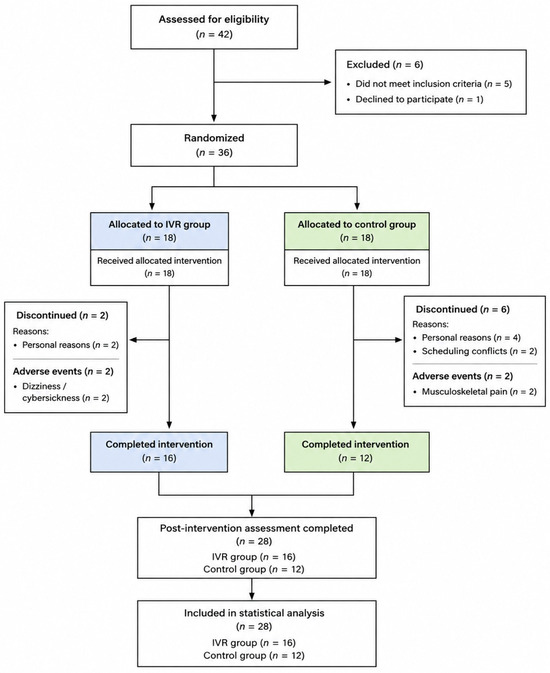
Figure 1 presents the participant flow throughout the study. A total of 42 individuals were assessed for eligibility, of whom 36 were randomized into either the IVR group or the control group. Six participants discontinued the intervention during follow-up, resulting in a final analytical sample of 16 participants in the IVR group and 12 in the control group.
Figure 1.
Flow diagram of participants throughout the study. Assessed for eligibility (n = 42); excluded (n = 6: did not meet inclusion criteria (n = 5), declined to participate (n = 1)); randomized (n = 36); allocated to immersive virtual reality (IVR) group (n = 18) or control group (n = 18); discontinued intervention (IVR group: n = 2; control group: n = 6); adverse events (IVR group: n = 2; control group: n = 2); completed intervention (IVR group: n = 16; control group: n = 12); included in statistical analysis (IVR group: n = 16; control group: n = 12). Arrows indicate participant flow between study stages.
Adverse events were mild and transient, consisting primarily of dizziness and cybersickness symptoms reported during IVR exposure. No serious adverse events or intervention discontinuations related to safety concerns were observed.
3.2. Clinical Outcomes Following IVR Intervention
Participants in the IVR group demonstrated significant improvements in quality of life following the intervention, evidenced by a reduction in FIQ-R scores with a large effect size. Regarding psychological symptoms, significant reductions were observed in stress levels, whereas depression and anxiety scores did not show statistically significant changes. Depression outcomes demonstrated greater interindividual variability compared with the remaining psychological domains. Changes in clinical outcomes following the IVR intervention are presented in Table 2.
Table 2.
Exploratory clinical outcomes following the IVR intervention.
3.3. User Experience and Adherence
Retention in the IVR group was 88.9% (16/18 participants). Adherence metrics were calculated among participants who completed the intervention (n = 16), whereas retention was calculated for all participants originally allocated to the IVR group (n = 18). The two discontinuations were due to personal reasons unrelated to the intervention. Among completers, 75% of participants attended at least 75% of the scheduled sessions, indicating high engagement with the immersive rehabilitation program. No participant discontinued the intervention due to adverse events associated with immersive virtual reality exposure. User experience and adherence metrics are presented in Table 3.
Table 3.
User experience and adherence metrics in the IVR group.
3.4. Correlations Between User Experience, Adherence, and Clinical Outcomes
Correlation analyses revealed generally low-to-moderate associations between PENS dimensions, adherence, and clinical outcomes. The strongest association was observed between intuitive control and improvement in depression symptoms (ρ = 0.63, p = 0.008), indicating that participants who perceived greater ease and control during interaction with the virtual environment tended to demonstrate greater reductions in depressive symptoms. The distribution of individual responses and the observed association are illustrated in Supplementary Figure S1. However, given the exploratory nature of the analyses and the small sample size, these findings should be interpreted cautiously. Exact p-values and bootstrap-derived 95% confidence intervals for all correlations are presented in Supplementary Table S1. No significant correlations were observed between the remaining PENS dimensions and adherence or clinical outcomes. Correlations between PENS dimensions, adherence, and clinical outcomes are presented in Table 4.
Table 4.
Correlations between PENS dimensions, adherence, and clinical outcomes in the IVR group.
4. Discussion
The present exploratory secondary analysis examined the relationship between immersive experience, adherence, and clinical improvement in women with fibromyalgia participating in an immersive virtual reality (IVR)-based rehabilitation program. Importantly, because this post hoc analysis focused exclusively on participants exposed to IVR and did not include a concurrent control group, the observed clinical changes cannot be attributed to the intervention itself and should not be interpreted as evidence of treatment efficacy. The main findings were (i) changes in quality of life and stress levels observed among participants exposed to the intervention; (ii) moderate-to-high adherence and positive user experience across PENS domains; and (iii) an association between intuitive control and improvement in depressive symptoms. However, most dimensions of immersive experience were not significantly associated with adherence or clinical outcomes, suggesting that engagement in IVR-based rehabilitation may depend on multiple behavioral and contextual factors beyond immersion alone.
The reduction in FIQ-R scores observed among participants exposed to IVR is consistent with findings reported in previous studies evaluating IVR-based exercise interventions in fibromyalgia [40,41]. Importantly, the observed reduction in FIQ-R scores (12.5 points) falls within or exceeds commonly reported minimal clinically important difference thresholds for fibromyalgia, which have been estimated at approximately 8–14 points. This suggests that the observed improvement may be clinically meaningful despite the exploratory nature of the present analysis. Beyond conventional exercise effects, immersive environments may facilitate participation through attentional distraction, multisensory stimulation, and increased motivational engagement [42,43]. In chronic pain populations, these mechanisms may reduce the salience of nociceptive input and temporarily shift attention away from pain-related cognitions, potentially improving exercise tolerance and perceived functionality [44,45].
Stress levels also improved significantly following the intervention, whereas anxiety and depression did not demonstrate statistically significant changes [46,47]. This pattern is clinically plausible, as stress-related symptoms may respond more rapidly to short-term behavioral interventions than broader affective disturbances [48,49]. Immersive environments may transiently reduce hypervigilance and emotional overload through enjoyable and interactive experiences [50,51]. Nevertheless, the absence of significant changes in anxiety and depression suggests that longer interventions or psychologically targeted approaches may be necessary to modify more stable affective symptoms in fibromyalgia [52].
An exploratory association was observed between intuitive control and changes in depressive symptoms, although depression did not significantly improve at the group level. Therefore, this finding should be interpreted cautiously and considered hypothesis-generating. The individual variability underlying this association is illustrated in Supplementary Figure S1. Participants who perceived greater ease and control while interacting with the virtual environment demonstrated greater reductions in depression scores. This finding highlights the potential importance of usability-related dimensions in digital rehabilitation. While immersion is often considered the defining feature of virtual reality interventions, the present results suggest that the perceived ability to interact comfortably with the system may represent an important usability-related factor worthy of further investigation, particularly in populations characterized by cognitive fatigue and emotional distress [53,54,55]. From a behavioral perspective, intuitive interaction may reduce frustration and cognitive burden, thereby facilitating a more positive therapeutic experience.
Despite high levels of enjoyment, autonomy, and immersion, most PENS dimensions showed weak or non-significant associations with adherence and clinical outcomes. This finding contrasts with theoretical assumptions proposing that immersive experience directly drives engagement and therapeutic response [26,55]. Adherence in fibromyalgia rehabilitation is likely influenced by multiple factors, including fatigue severity, symptom fluctuations, transportation barriers, social support, and treatment expectations [56,57].
Nevertheless, adherence levels observed in the present study were clinically relevant, with most participants completing at least 75% of the prescribed sessions. These adherence levels are particularly relevant considering the persistent barriers to exercise participation commonly reported in fibromyalgia populations [56,58,59]. This finding supports previous reports suggesting that IVR may increase treatment acceptability and engagement in chronic pain populations [53,54]. The gamified and interactive nature of immersive environments may transform exercise into a more motivating and less aversive therapeutic experience, potentially reducing avoidance behaviors commonly observed in fibromyalgia [60,61,62]. Stress-related symptoms may be more sensitive to short-term changes in attentional engagement and emotional regulation than broader affective domains such as anxiety or depression [63].
Several methodological limitations should be considered when interpreting these exploratory findings. The small sample size may have limited statistical power, particularly for correlation analyses and psychological outcomes. In addition, this study represents a post hoc exploratory analysis derived from a randomized controlled trial. Although the original study included random allocation to experimental and control groups, the present analysis focused exclusively on participants exposed to IVR because user experience was assessed using the Player Experience of Need Satisfaction (PENS) questionnaire, which was only applicable to this intervention. Consequently, causal inferences regarding treatment efficacy cannot be made, and the findings should be interpreted as hypothesis-generating. The intervention duration was relatively short, and adherence was assessed primarily through session attendance, which may not fully capture behavioral engagement. User experience was assessed only in the IVR group and through self-reported measures, which may be influenced by social desirability, response bias, novelty effects, and placebo-related effects commonly observed in exercise and behavioral interventions. In addition, multiple correlation analyses were performed without correction for multiple comparisons, increasing the possibility of type I error. Furthermore, objective behavioral metrics derived directly from the virtual reality system and objective physical performance measures were not available. Future studies should incorporate objective indicators of engagement and functional performance, such as system-derived metrics and maximal or submaximal cardiorespiratory fitness assessments (e.g., VO2max, six-minute walk test, or other physical performance tests). Finally, the absence of long-term follow-up prevents conclusions regarding the sustainability of the observed effects.
Despite these limitations, this study provides exploratory insights regarding the behavioral dimensions of immersive rehabilitation in fibromyalgia. The findings suggest that user engagement during IVR-based rehabilitation may not depend exclusively on immersion or enjoyment but also on how participants interact with and perceive control over the virtual environment. Future studies should incorporate larger randomized samples, longitudinal follow-up, and objective engagement metrics to better understand the mechanisms linking immersive experience, adherence, and clinical outcomes in chronic pain rehabilitation.
5. Conclusions
This post hoc exploratory analysis suggests that immersive virtual reality (IVR)-based rehabilitation may be associated with favorable user experience and adherence among women with fibromyalgia. The findings indicate that dimensions related to intuitive interaction and perceived control may play a role in behavioral engagement during rehabilitation. Changes in subjective clinical outcomes were observed among participants exposed to IVR; however, due to the absence of a concurrent control group in the present analysis, the small sample size, and the reliance on self-reported measures, no conclusions regarding treatment efficacy can be drawn. These findings should be considered hypothesis-generating and warrant confirmation in adequately powered randomized controlled trials incorporating objective outcome measures and longitudinal follow-up.
Supplementary Materials
The following supporting information can be downloaded at: https://www.mdpi.com/article/10.3390/sci8070143/s1, Table S1: Spearman correlations between PENS dimensions, adherence, and clinical outcomes in the IVR group, including exact p-values and bootstrap-derived 95% confidence intervals; Figure S1: Scatterplot illustrating the association between PENS intuitive control and changes in depressive symptoms.
Author Contributions
Conceptualization, G.A.-Á.; methodology, G.A.-Á.; validation, R.C.-L., J.M.G.-P., F.G.-R. and A.B.-O.; formal analysis, G.A.-Á.; investigation, W.O.-T. and B.P.-N.; data curation, G.A.-Á.; writing—original draft preparation, G.A.-Á.; writing—review and editing, G.A.-Á. and C.C.-P.; visualization, G.A.-Á. All authors have read and agreed to the published version of the manuscript.
Funding
This study was funded by the Collaborative Project (ID4404) of the Vice-Rector’s Office for University Outreach (VCM) at the Universidad San Sebastián, Concepción, Chile.
Institutional Review Board Statement
The study was conducted in accordance with the Declaration of Helsinki and approved by the Scientific Ethics Committee of Universidad San Sebastián (Approval No. 171-25, 12 December 2025). The original randomized controlled trial from which this exploratory analysis was derived was registered at ClinicalTrials.gov (NCT07605143).
Informed Consent Statement
Informed consent was obtained from all subjects involved in the study.
Data Availability Statement
The data presented in this study are available on request from the corresponding author. The data are not publicly available due to privacy and ethical restrictions related to participant confidentiality.
Acknowledgments
The research team extends their gratitude to the Fibromyalgia Association of Concepción.
Conflicts of Interest
The authors declare no conflicts of interest.
Abbreviations
The following abbreviations are used in this manuscript:
| IVR | Immersive Virtual Reality |
| FIQ-R | Fibromyalgia Impact Questionnaire-Revised |
| DASS-21 | Depression Anxiety Stress Scales-21 |
| PENS | Player Experience of Need Satisfaction |
| BMI | Body Mass Index |
References
- Filipovic, T.; Filipović, A.; Nikolic, D.; Gimigliano, F.; Stevanov, J.; Hrkovic, M.; Bosanac, I. Fibromyalgia: Understanding, Diagnosis and Modern Approaches to Treatment. J. Clin. Med. 2025, 14, 955. [Google Scholar] [CrossRef] [Scilit] [PubMed]
- Kravitz, H.M.; Katz, R.S. Fibrofog and Fibromyalgia: A Narrative Review and Implications for Clinical Practice. Rheumatol. Int. 2015, 35, 1115–1125. [Google Scholar] [CrossRef] [Scilit] [PubMed]
- Nicholls, T.; Kelly, K. Assessing Working Memory Function in Individuals with Fibromyalgia: A Systematic Review and Meta-Analysis. Appl. Neuropsychol. Adult 2025, 1–17. [Google Scholar] [CrossRef] [Scilit] [PubMed]
- Sarihan, K.; İnaltekin, A.; Yilmaz, O.A. Kinesiophobia Level in Fibromyalgia Patients and Its Relationship with Cognitive Functions, Anxiety, Depression, Disease Activity and Pain Level. Healthcare 2026, 14, 1137. [Google Scholar] [CrossRef] [Scilit] [PubMed]
- Cabero-Pérez, J.A.; Susperregui, J.; Diez, M.J.; Solera-Ruiz, I.; Alonso-Cardaño, A.; Batuecas-Asensio, S.; Serrano-García, A. Persistent Physical Symptoms and Psychosomatic Profiling in Fibromyalgia: A Cross-Sectional Study in a Pain Management Unit. J. Clin. Med. 2026, 15, 1964. [Google Scholar] [CrossRef] [Scilit] [PubMed]
- Pérez-Romero, N.; Rubilar-Barrera, A.; Salinas-Parada, C.C.; Navarrete-Valenzuela, K.; Vera-Espinoza, V.P.; Núñez, O.; Cerda-Vega, E. Effects of Physical Exercise on Anxiety and Depression of People with Fibromyalgia: Umbrella Review of Systematic Reviews and Meta-Analyses. J. Funct. Morphol. Kinesiol. 2026, 11, 193. [Google Scholar] [CrossRef] [Scilit] [PubMed]
- Stavrou, V.T.; Zis, P. Exercise as Medicine: Quantifying the Effects of Physical Activity on Fibromyalgia Pain—A Systematic Review and Meta-Analysis. Brain Sci. 2026, 16, 365. [Google Scholar] [CrossRef] [Scilit] [PubMed]
- Casale, R.; Capodaglio, P.; Petrikonis, K.; Paladini, A.; Sarzi-Puttini, P.; Bernatoniene, J. Fibromyalgia, Eating Disorders and Rehabilitation: The Nrf2 Link. Antioxidants 2026, 15, 364. [Google Scholar] [CrossRef] [Scilit] [PubMed]
- Parpa, K. Barriers to Exercise Participation in Individuals with Fibromyalgia in a Workplace Setting. Medicina 2026, 62, 354. [Google Scholar] [CrossRef] [Scilit] [PubMed]
- Day, M.A.; Ehde, D.M.; Bindicsova, I.; Jensen, M.P. Understanding the Role of Therapist Quality in Accounting for Heterogeneity of Patient Outcomes in Psychosocial Chronic Pain Treatments. J. Pain 2024, 25, 843–856. [Google Scholar] [CrossRef] [Scilit] [PubMed]
- Shahidi, B.; Padwal, J.; Lee, E.; Xu, R.; Northway, S.; Taitano, L.; Wu, T.; Raiszadeh, K. Factors Impacting Adherence to an Exercise-Based Physical Therapy Program for Individuals with Low Back Pain. PLoS ONE 2022, 17, e0276326. [Google Scholar] [CrossRef] [Scilit] [PubMed]
- Ye, L.; Li, Y.; Deng, Q.; Zhao, X.; Zhong, L.; Yang, L. Acceptance and Commitment Therapy for Patients with Chronic Pain: A Systematic Review and Meta-Analysis on Psychological Outcomes and Quality of Life. PLoS ONE 2024, 19, e0301226. [Google Scholar] [CrossRef] [Scilit] [PubMed]
- Rah, A.; Chen, Y. Stroke Rehabilitation in Virtual Reality Through Enhanced Plantar Pressure Detection Using Sensor Resolution and Adaptive Thresholding. Algorithms 2026, 19, 368. [Google Scholar] [CrossRef] [Scilit]
- Kabisch, N.; Brandes, J.; Lehmann, A.; Claus, M.; Jacobs, S.; Böhmer, M.; Kehrle, F.; Jahn, P.; Fink, F. Developing a Novel Augmented Reality-Based Sports Therapy System (STAR): A User-Centered Design Study Focusing on Usability and User Acceptance. Digit. Health Innov. 2026, 1, 2. [Google Scholar] [CrossRef] [Scilit]
- Curzio, L.D.; Paolucci, T.; Miccinilli, S.; Bravi, M.; Santacaterina, F.; Giorgi, L.; Sterzi, S.; Zollo, L.; Bernetti, A.; Bressi, F. The Role of Virtual Reality, Exergames, and Digital Technologies in Knee Osteoarthritis Rehabilitation Before or After Total Knee Arthroplasty: A Systematic Review of the Interventions in Elderly Patients. Medicina 2025, 61, 1587. [Google Scholar] [CrossRef] [Scilit] [PubMed]
- Bravo-Aparicio, J.; Trillo-Charlín, I.; Aceituno-Gómez, J.; Beltrán-Alacreu, H.; Arroyo-Fernández, R. Effectiveness of Virtual Reality-Based Active Exercise Interventions for Fibromyalgia: A Systematic Review and Meta-Analysis of Randomized Controlled Trials. Appl. Sci. 2026, 16, 1687. [Google Scholar] [CrossRef] [Scilit]
- Gulsen, C.; Soke, F.; Eldemir, K.; Apaydin, Y.; Ozkul, C.; Guclu-Gunduz, A.; Akcali, D.T. Effect of Fully Immersive Virtual Reality Treatment Combined with Exercise in Fibromyalgia Patients: A Randomized Controlled Trial. Assist. Technol. 2022, 34, 256–263. [Google Scholar] [PubMed]
- Brea-Gomez, B.; Perez-Gisbert, L.; Fernandez-Castro, I.; Valenza, M.C.; Torres-Sanchez, I. Effects of Virtual Reality-Based Rehabilitation in the Treatment of Patients with Fibromyalgia Syndrome: A Systematic Review and Meta-Analysis of Randomized Clinical Trials. Games Health J. 2025, 14, 79–102. [Google Scholar] [CrossRef] [Scilit] [PubMed]
- Arias-Álvarez, G.; Santamera-Lastras, M.; Guzmán-Oyarzo, D.; Osorio-Torres, W.; Parada-Norambuena, B.; Pecos-Martín, D.; González, J.G.P.; Gómez-Pulido, J.; Carvajal-Parodi, C. Immersive Virtual Reality Exercise: Effects on Cortisol, Quality of Life, Cognitive Function, and Psychological Symptoms in Fibromyalgia. Medicina 2026, 62, 446. [Google Scholar] [CrossRef] [Scilit] [PubMed]
- Arias-Álvarez, G.; Guzmán-Pincheira, C.; González-González, D.; Osorio-Torres, W.; Pecos-Martín, D.; Gómez-Pulido, J.; Carvajal-Parodi, C. Effects of Immersive Virtual Reality-Based Exercise on Quality of Life, Stress, Anxiety, Depression, and Handgrip Strength in Fibromyalgia: A Pilot Study. Virtual Real. Intell. Hardw. 2025, 7, 267–278. [Google Scholar] [CrossRef] [Scilit]
- Aderinto, N.; Olatunji, G.; Abdulbasit, M.O.; Edun, M.; Aboderin, G.; Egbunu, E. Exploring the Efficacy of Virtual Reality-Based Rehabilitation in Stroke: A Narrative Review of Current Evidence. Ann. Med. 2023, 55, 2285907. [Google Scholar] [CrossRef] [Scilit] [PubMed]
- Rubio-Arias, J.Á.; Verdejo-Herrero, A.; Andreu-Caravaca, L.; Ramos-Campo, D.J. Impact of Immersive Virtual Reality Games or Traditional Physical Exercise on Cardiovascular and Autonomic Responses, Enjoyment and Sleep Quality: A Randomized Crossover Study. Virtual Real. 2024, 28, 64. [Google Scholar] [CrossRef] [Scilit]
- Wu, R.; Feng, S.; Quan, H.; Zhang, Y.; Fu, R.; Li, H. Effect of Self-Determination Theory on Knowledge, Treatment Adherence, and Self-Management of Patients With Maintenance Hemodialysis. Contrast Media Mol. Imaging 2022, 2022, 1416404. [Google Scholar] [CrossRef] [Scilit] [PubMed]
- Chen, K.; Yang, L.; Tu, J. Self-Determination Theory in Return to Work Interventions: A Scoping Review. J. Multidiscip. Healthc. 2025, 18, 7539–7550. [Google Scholar] [CrossRef] [Scilit] [PubMed]
- Alrizki, Z.M.; Kurniawan, D. GEQ and PENS Applications for Analyzing Levels of Player Experience and Satisfaction in Mobile Video Games. Indones. J. Comput. Sci. 2024, 13, 3824. [Google Scholar] [CrossRef] [Scilit]
- Johnson, D.; Gardner, M.J.; Perry, R. Validation of Two Game Experience Scales: The Player Experience of Need Satisfaction (PENS) and Game Experience Questionnaire (GEQ). Int. J. Hum.-Comput. Stud. 2018, 118, 38–46. [Google Scholar] [CrossRef] [Scilit]
- Bellos, C.; Stefanou, K.; Tzallas, A.; Stergios, G.; Tsipouras, M. Methods and Approaches for User Engagement and User Experience Analysis Based on Electroencephalography Recordings: A Systematic Review. Electronics 2025, 14, 251. [Google Scholar] [CrossRef] [Scilit]
- Zhang, Y.; Wang, H.; Shi, B.E. User Engagement Correlates Better with Behavioral than Physiological Measures in a Virtual Reality Robotic Rehabilitation System. In Proceedings of the 2024 IEEE International Conference on Systems, Man, and Cybernetics (SMC); IEEE: Piscataway, NJ, USA, 2024; pp. 5189–5194. [Google Scholar]
- Teo, J.L.; Zheng, Z.; Bird, S.R. Identifying the Factors Affecting ‘Patient Engagement’in Exercise Rehabilitation. BMC Sports Sci. Med. Rehabil. 2022, 14, 18. [Google Scholar] [CrossRef] [Scilit] [PubMed]
- Religioni, U.; Barrios-Rodríguez, R.; Requena, P.; Borowska, M.; Ostrowski, J. Enhancing Therapy Adherence: Impact on Clinical Outcomes, Healthcare Costs, and Patient Quality of Life. Medicina 2025, 61, 153. [Google Scholar] [CrossRef] [Scilit] [PubMed]
- Burke, C.A.; Seidler, K.J.; Rethorn, Z.D.; Hoenig, H.; Allen, K.; Tabriz, A.A.; Norman, K.; Murphy-McMillan, L.K.; Sharpe, J.; Joseph, L.M. Interventions to Improve Long-Term Adherence to Physical Rehabilitation: A Systematic Review. J. Geriatr. Phys. Ther. 2024, 47, E124–E136. [Google Scholar] [CrossRef] [Scilit]
- World Medical Association. World Medical Association Declaration of Helsinki: Ethical Principles for Medical Research Involving Human Subjects. JAMA 2013, 310, 2191–2194. [Google Scholar] [CrossRef] [Scilit] [PubMed]
- Wolfe, F.; Clauw, D.J.; Fitzcharles, M.-A.; Goldenberg, D.L.; Häuser, W.; Katz, R.L.; Mease, P.J.; Russell, A.S.; Russell, I.J.; Walitt, B. 2016 Revisions to the 2010/2011 Fibromyalgia Diagnostic Criteria. Semin. Arthritis. Rheum. 2016, 46, 319–329. [Google Scholar] [CrossRef] [Scilit] [PubMed]
- Ijaz, K.; Ahmadpour, N.; Wang, Y.; Calvo, R.A. Player Experience of Needs Satisfaction (PENS) in an Immersive Virtual Reality Exercise Platform Describes Motivation and Enjoyment. Int. J. Hum. Comput. Interact. 2020, 36, 1195–1204. [Google Scholar] [CrossRef] [Scilit]
- Bennett, R.M.; Friend, R.; Jones, K.D.; Ward, R.; Han, B.K.; Ross, R.L. The Revised Fibromyalgia Impact Questionnaire (FIQR): Validation and Psychometric Properties. Arthritis Res. Ther. 2009, 11, R120. [Google Scholar] [CrossRef] [PubMed]
- Salgueiro, M.; García-Leiva, J.M.; Ballesteros, J.; Hidalgo, J.; Molina, R.; Calandre, E.P. Validation of a Spanish Version of the Revised Fibromyalgia Impact Questionnaire (FIQR). Health Qual. Life Outcomes 2013, 11, 132. [Google Scholar] [CrossRef] [Scilit] [PubMed]
- Collado-Mateo, D.; Chen, G.; Garcia-Gordillo, M.A.; Iezzi, A.; Adsuar, J.C.; Olivares, P.R.; Gusi, N. Fibromyalgia and Quality of Life: Mapping the Revised Fibromyalgia Impact Questionnaire to the Preference-Based Instruments. Health Qual. Life Outcomes 2017, 15, 114. [Google Scholar] [CrossRef] [Scilit] [PubMed]
- Medvedev, O.N. Depression Anxiety Stress Scales (DASS-21) in International Contexts. In International Handbook of Behavioral Health Assessment; Krägeloh, C.U., Alyami, M., Medvedev, O.N., Eds.; Springer International Publishing: Cham, Switzerland, 2023; pp. 1–15. ISBN 978-3-030-89738-3. [Google Scholar]
- Simón-Vicente, L.; Rodríguez-Cano, S.; Delgado-Benito, V.; Ausín-Villaverde, V.; Delgado, E.C. Cybersickness. A Systematic Literature Review of Adverse Effects Related to Virtual Reality. Neurología 2024, 39, 701–709. [Google Scholar] [CrossRef] [Scilit] [PubMed]
- Chittaro, L.; Longhino, S.; Serafini, M.; Cacioppo, S.; Quartuccio, L. Efficacy of Immersive Virtual Reality Combined With Multisensor Biofeedback on Chronic Pain in Fibromyalgia: A Pilot Randomized Controlled Trial. ACR Open Rheumatol. 2025, 7, e70048. [Google Scholar] [CrossRef] [Scilit] [PubMed]
- Cortés-Pérez, I.; Zagalaz-Anula, N.; Ibancos-Losada, M.D.R.; Nieto-Escamez, F.A.; Obrero-Gaitan, E.; Osuna-Perez, M.C. Virtual Reality-Based Therapy Reduces the Disabling Impact of Fibromyalgia Syndrome in Women: Systematic Review with Meta-Analysis of Randomized Controlled Trials. J. Pers. Med. 2021, 11, 1167. [Google Scholar] [CrossRef] [Scilit] [PubMed]
- Brown, P.; Powell, W.; Dansey, N.; Al-Abbadey, M.; Stevens, B.; Powell, V. Virtual Reality as a Pain Distraction Modality for Experimentally Induced Pain in a Chronic Pain Population: An Exploratory Study. Cyberpsychol. Behav. Soc. Netw. 2022, 25, 66–71. [Google Scholar] [CrossRef] [Scilit] [PubMed]
- Ibrahim, F.E.; Zayed, H.H.; Koura, M.H.; ElSayed, N. Efficacy of Virtual Reality Distraction for Reducing Chronic Pain. In Proceedings of the 2024 IEEE International Symposium on Mixed and Augmented Reality (ISMAR); IEEE: Piscataway, NJ, USA, 2024; pp. 1029–1037. [Google Scholar]
- Menekli, T.; Yaprak, B.; Doğan, R. The Effect of Virtual Reality Distraction Intervention on Pain, Anxiety, and Vital Signs of Oncology Patients Undergoing Port Catheter Implantation: A Randomized Controlled Study. Pain Manag. Nurs. 2022, 23, 585–590. [Google Scholar] [CrossRef] [Scilit] [PubMed]
- Alhusamiah, B.K.; Zeilani, R.S.; Haddad, R.H. Using Immersive and Non-Immersive Virtual Reality as an Innovative and Novel Technology for Managing Depression, Anxiety and Psychological Distress among Patients with Cancer. J. Enabling Technol. 2025, 19, 42–62. [Google Scholar] [CrossRef] [Scilit]
- Cuñado-Pradales, R.; Soto-Ruiz, N.; Escalada-Hernández, P.; San Martín-Rodríguez, L.; García-Vivar, C. Virtual Reality to Reduce Pain, Fatigue, and Emotional Distress in People with Cancer: A Scoping Review. Cancer Nurs. 2024, 49, E224–E243. [Google Scholar] [CrossRef] [Scilit] [PubMed]
- Magalhães, M.; Coelho, A.; Melo, M.; Bessa, M. Measuring Users’ Emotional Responses in Multisensory Virtual Reality: A Systematic Literature Review. Multimed. Tools Appl. 2024, 83, 43377–43417. [Google Scholar]
- Mancuso, V.; Bruni, F.; Stramba-Badiale, C.; Riva, G.; Cipresso, P.; Pedroli, E. How Do Emotions Elicited in Virtual Reality Affect Our Memory? A Systematic Review. Comput. Hum. Behav. 2023, 146, 107812. [Google Scholar] [CrossRef] [Scilit]
- Davies, S. Immersive and User-Adaptive Gamification in Cognitive Behavioural Therapy for Hypervigilance. In Authorea Preprints; John Wiley & Sons: Hoboken, NJ, USA, 2024. [Google Scholar]
- Sakuma, S.; Kimpara, K.; Kawai, Y.; Yanagita, Y.; Tanaka, N.; Tawara, Y.; Matsui, G.; Terada, K.; Arizono, S. Integrating Physical Therapy and Virtual Reality to Manage Pain-Related Fear of Movement in Patients With Chronic Pain: A Randomized Controlled Trial. Cureus 2025, 17, e79551. [Google Scholar] [CrossRef] [Scilit] [PubMed]
- Sari, F.; Sudan Aran, A.; Alp, G. The Psychological and Physiological Effects of a Virtual Reality-Based Treatment Program in Female Patients with Fibromyalgia Syndrome: A Randomized Controlled Trial. Assist. Technol. 2025, 37, 220–228. [Google Scholar] [CrossRef] [Scilit] [PubMed]
- Tuena, C.; Pedroli, E.; Trimarchi, P.D.; Gallucci, A.; Chiappini, M.; Goulene, K.; Gaggioli, A.; Riva, G.; Lattanzio, F.; Giunco, F.; et al. Usability Issues of Clinical and Research Applications of Virtual Reality in Older People: A Systematic Review. Front. Hum. Neurosci. 2020, 14, 93. [Google Scholar] [CrossRef] [Scilit] [PubMed]
- Tieri, G.; Costa, A.; Zabberoni, S.; Tenaglia, E.; De Simone, M.S. User Experience, System Usability, and Feasibility of Two Novel Immersive Virtual Reality Memory Tasks for Cognitive Training: A Pilot Study. Brain Sci. 2025, 15, 1289. [Google Scholar] [CrossRef] [Scilit] [PubMed]
- Wenk, N.; Penalver-Andres, J.; Buetler, K.A.; Nef, T.; Müri, R.M.; Marchal-Crespo, L. Effect of Immersive Visualization Technologies on Cognitive Load, Motivation, Usability, and Embodiment. Virtual Real. 2023, 27, 307–331. [Google Scholar] [PubMed]
- Sarmento, C.V.; Liu, Z.; Smirnova, I.V.; Liu, W. Exploring Adherence to Moderate to High-Intensity Exercises in Patients with Fibromyalgia: The Role of Physiological and Psychological Factors—A Narrative Literature Review. Physiologia 2023, 3, 472–483. [Google Scholar] [CrossRef] [Scilit]
- Häuser, W.; Fitzcharles, M.-A. Adherence to Clinical Guidelines for Fibromyalgia: Help or Hindrance? Can. J. Pain 2023, 7, 2255070. [Google Scholar] [CrossRef] [Scilit] [PubMed]
- Vancampfort, D.; Van Damme, T.; Brunner, E.; McGrath, R.L.; Hemmings, L.; Guimaraes, M.E.; Schuch, F. Dropout from Exercise Interventions in Adults with Fibromyalgia: A Systematic Review and Meta-Analysis. Arch. Phys. Med. Rehabil. 2024, 105, 571–579. [Google Scholar] [CrossRef] [Scilit] [PubMed]
- Ivorra López, S.; Nardi-Rodríguez, A.; López-Roig, S.; Peñacoba, C.; Pamies-Aubalat, L.; Pastor-Mira, M.-Á. How Can We Increase Walking Exercise Adherence in Women with Fibromyalgia? Aten. Primaria 2025, 57, 103333. [Google Scholar] [CrossRef] [Scilit] [PubMed]
- Zuki, F.S.M.; Sulaiman, S.; Merienne, F.; Ricca, A.; Guillet, C.; Saad, M.N.M. Assessing the Impact of Enriched Virtual Reality on Motivation and Engagement in Stroke Rehabilitation. IEEE Access 2024, 12, 143585–143598. [Google Scholar] [CrossRef] [Scilit]
- Goudman, L.; Jansen, J.; Billot, M.; Vets, N.; De Smedt, A.; Roulaud, M.; Rigoard, P.; Moens, M. Virtual Reality Applications in Chronic Pain Management: Systematic Review and Meta-Analysis. JMIR Serious Games 2022, 10, e34402. [Google Scholar] [CrossRef] [Scilit] [PubMed]
- Guerra-Armas, J.; Flores-Cortes, M.; Pineda-Galan, C.; Luque-Suarez, A.; La Touche, R. Role of Immersive Virtual Reality in Motor Behaviour Decision-Making in Chronic Pain Patients. Brain Sci. 2023, 13, 617. [Google Scholar] [CrossRef] [Scilit] [PubMed]
- Brelet, L.; Gaffary, Y. Stress Reduction Interventions: A Scoping Review to Explore Progress toward Use of Haptic Feedback in Virtual Reality. Front. Virtual Real. 2022, 3, 900970. [Google Scholar] [CrossRef] [Scilit]
- Tan, P.; Wu, Y.; Chen, X.; Chen, J.; Guo, Z.; Lu, X.; Chen, J.; Zhang, H. A Systematic Review on Mindfulness-Based Immersive Interventions in Depressive Disorders. npj Ment. Health Res. 2026, 5, 22. [Google Scholar] [CrossRef] [Scilit] [PubMed]

Disclaimer/Publisher’s Note: The statements, opinions and data contained in all publications are solely those of the individual author(s) and contributor(s) and not of MDPI and/or the editor(s). MDPI and/or the editor(s) disclaim responsibility for any injury to people or property resulting from any ideas, methods, instructions or products referred to in the content. |
© 2026 by the authors. Licensee MDPI, Basel, Switzerland. This article is an open access article distributed under the terms and conditions of the Creative Commons Attribution (CC BY) license.