


Abstract
Previous studies have consistently demonstrated associations between time perspective and chronotype, but the mechanisms underlying these associations remain poorly understood. Drawing on the view that time perspective manifests in behaviours that can shape bedtime routines, which in turn affect the state component of chronotype, the present study examined whether sleep hygiene mediates the relationship between time perspective and chronotype. Among 455 adults who self-reported time perspective, sleep hygiene, and chronotype, eveningness was associated with poorer sleep hygiene, lower future and past-positive orientations, higher past-negative orientation, and greater deviation from a balanced time perspective. Furthermore, poor sleep hygiene was associated with lower future and lower past-positive orientations, higher present-fatalistic orientation, and greater deviation from a balanced time perspective. Mediation analyses demonstrated that the associations of lower future and past-positive orientations, higher past-negative, and greater deviation from a balanced time perspective with chronotype were partly mediated by poor sleep hygiene. These findings suggest that the indirect associations between time perspective and chronotype through sleep hygiene are consistent with the proposed theoretical mechanism. The results align with the view that chronotype incorporates a state component that represents a potential target of sleep hygiene interventions aimed at shifting this component toward morningness for some individuals.
1. Introduction
Chronotype, also termed morningness–eveningness or circadian preference, describes an individual’s preferred and actual times of day for sleep, as well as mental and physical activity [1]. Evening chronotypes, regardless of culture, maintain later sleep and activity schedules than morning chronotypes [2]. Given that the majority of societies follow daily schedules requiring early morning starts, eveningness can lead to a clash for individuals obligated to adhere to these schedules—a phenomenon called social jetlag [3]—as well as to chronic partial sleep loss on workdays [4]. These consequences of chronotype–society mismatch are suggested to further lead to adverse outcomes in some people, manifesting as costs of the mismatch itself or unhealthy coping strategies [5]. Due to the adverse outcomes associated with chronotype–society mismatch, factors influencing chronotype are of increasing interest to researchers.
1.1. Modifying the State Component of Chronotype
Chronotype is considered a phenotype comprising both trait and state components and therefore exhibits variability in response to environmental and behavioural influences [5,6,7]. These influences can be exerted by acting on circadian and homeostatic processes as described by the two-process model of sleep regulation [8]. State chronotype can be modified through the circadian process by exposure to Zeitgebers, particularly light—morning exposure advances the circadian rhythm, while evening exposure delays it [9]. Indeed, even under naturalistic conditions, individuals living in the eastern parts of a time zone exhibit earlier chronotypes than those living in western regions because sunrise and sunset occur earlier, resulting in earlier entrainment to solar time [10,11].
State chronotype may also be influenced through the homeostatic process. Because sleep pressure accumulates during wakefulness, the type and intensity of daily activities can affect the rate at which sleep pressure builds and consequently influence sleep timing. The homeostatic process is also reflected in the dissipation of sleep pressure during sleep, which can be affected by the sleep environment. More favourable (pre)sleep conditions may facilitate recovery and promote earlier spontaneous awakening [12]. Research supports the notion that lower physical activity and more time in sedentary activities are observed in evening chronotypes than morning ones [13].
1.2. Time Perspective and Chronotype
Time perspective describes individuals’ ways of relating to the past, present, and future. Zimbardo and Boyd [14] distinguished five dimensions of time perspective: past-negative (PN), reflecting a tendency to focus on unpleasant memories associated with negative emotions; past-positive (PP), characterised by a warm and nostalgic view of the past; present-hedonistic (PH), associated with impulsivity and the pursuit of immediate pleasure; present-fatalistic (PF), involving feelings of helplessness and beliefs that life outcomes are determined by fate; and future (F), characterised by an orientation toward long-term goals and behavioural planning aimed at their attainment. Research has additionally emphasised the role of deviation from a balanced time perspective (DBTP or DBTP-r) [15], which is claimed to reflect a lack of adaptive balance among temporal orientations [16] but computationally reflects a composite score, with high values representing high PN and PF, low PP and F, and extreme poles of PH [15].
A number of studies have examined the association between time perspective and chronotype. Díaz-Morales et al. [17] showed that eveningness was most strongly associated with lower F and higher PF. Stolarski et al. [18] found that eveningness was related to lower F and higher PN, PH, and DBTP. Similarly, Meng et al. [19] reported that eveningness was associated with lower F and higher PF, PN, and DBTP. Beracci et al. [20] found that evening chronotypes have low levels of F and high levels of PH. Jankowski [6] found that eveningness was associated with lower F and PP and higher DBTP-r. Warowny and Stolarski [21] found that morningness was related to higher F and lower PN. Overall, these findings indicate that eveningness is linked to lower F and PP and higher PN, PF, PH, and DBTP(-r), with some discrepancies between studies.
1.3. Hypothesised Effects of Time Perspective on Chronotype
Time perspective manifests in behaviours that can provide inputs to circadian and homeostatic processes underlying the modifiable aspects of state chronotype. F has long been recognised as a cognitive–motivational construct related to self-regulation [22]. Individuals high in F are more likely to regulate their sleep and rise times because achieving long-term goals is facilitated by alignment with the predominantly morning-oriented organisation of academic and occupational activities. Earlier wake times may increase morning light exposure, which advances the circadian phase while simultaneously initiating the earlier accumulation of sleep pressure, which promotes earlier sleep onset and greater morningness [23].
PF is characterised by a subjective lack of control that may extend over sleep-related behaviour. Without controlling the sleep schedule, sleep times tend to drift toward later hours because, in most individuals, the intrinsic circadian period exceeds 24 h [24]. PH and PN orientations may contribute to eveningness through heightened pre-sleep arousal. Individuals high in PH may prioritise rewarding evening activities, such as informal social interactions or media entertainment, over sleep initiation [25]. Individuals high in PN may experience increased rumination and negative affect at bedtime, making it more difficult to fall asleep and delaying sleep onset. Both pathways may contribute to later sleep timing.
PP, in contrast, may be associated with lower pre-sleep arousal. Positive recollections before sleep can facilitate relaxation, reducing pre-sleep arousal and facilitating sleep onset [26]. Falling asleep more quickly and in a relaxed state may lead to quality sleep and earlier wake-up times, thereby promoting morningness through the same mechanisms described above (earlier light exposure and onset of sleep pressure build-up). DBTP(-r) may be expected to show associations because it reflects a configuration characterised by low F and PP together with elevated PN and PF [15]. Consequently, the mechanisms linking these dimensions to chronotype may collectively contribute to the established association between higher DBTP(-r) and eveningness.
1.4. Sleep Hygiene
Sleep hygiene describes behaviours, typically performed in a habitual manner, that promote or impair sleep quality. Inadequate sleep hygiene includes behaviours such as daytime napping, maintaining an irregular sleep–wake schedule, consuming sleep-disruptive substances (e.g., caffeine) before bedtime, engaging in arousing activities before bedtime, using the bed or bedroom for activities other than sleep, and maintaining a sleep environment that is unfavourable for sleep [27]. Research consistently shows that eveningness is related to inadequate sleep hygiene in adults [28]. For example, Lin and Chung [29] identified four components of sleep hygiene and found that eveningness was related primarily to poorer pre-sleep stress management and lower regularity of sleep timing, whereas no associations were observed with physical exercise, the consumption of sleep-disruptive substances before bedtime, or maintenance of the physical sleep environment. Importantly, these associations do not appear to stem from differences in knowledge about healthy sleep practices, as chronotypes do not differ in sleep hygiene awareness [30]. This suggests that behavioural implementation rather than knowledge itself may account for chronotype differences in sleep hygiene.
To date, studies directly examining associations between time perspective and sleep hygiene have not been published. However, several findings suggest that such relationships may exist. F and P orientations have been linked to better sleep quality, whereas PN, PF, and DBTP(-r) have been associated with poorer sleep quality [31,32,33]. Given that many of the behavioural tendencies implied by these time perspectives are directly relevant to sleep regulation, it is plausible that sleep hygiene may constitute one pathway linking time perspective to chronotype.
1.5. Current Study
The present study examines whether sleep hygiene mediates the association between time perspective and chronotype. Recently, I proposed that time perspective may manifest in motivations and behaviours that shape bedtime habits capable of acting on the state component of chronotype [6]. Many of these habits can be conceptualised as elements of sleep hygiene. In particular, future orientation may foster the planning and regulation of sleep habits, whereas present-fatalistic and present-hedonistic orientations may be associated with the poorer regulation of sleep-related behaviour. Similarly, past-positive and past-negative orientations may influence sleep through their associations with positive and negative pre-sleep emotional states, respectively. Consequently, I hypothesise that the previously observed associations of lower F and PP and higher PF, PH, PN, and DBTP-r with eveningness [6,17] will be reproduced and that these associations will be mediated, at least partially, by poorer sleep hygiene. Because the primary objective is to explain the underlying nature of these macro-level relationships, sleep hygiene is expected to account for, rather than counteract, the overarching association between time perspective and chronotype. Additionally, this study provides the first examination of the associations between time perspective dimensions and sleep hygiene.
2. Materials and Methods
2.1. Procedure
Participants were recruited via the university’s Sona Systems (Ltd., Tallinn, Estonia) subject pool, comprising primarily students and a smaller subset of general-population volunteers. Invitations were distributed through the Sona dashboard and via email. In exchange for their time, students earned course credits for an optional academic requirement. The survey, hosted on Google Forms (LLC, Mountain View, CA, USA), included 90 mandatory items across six screens; participants were permitted to navigate back to previous questions and screens. To control for duplicate entries, unique Sona identifiers were recorded for each respondent.
2.2. Questionnaires
At the start of the questionnaire, participants self-reported demographics, work status, time zone changes, and the use of sleep medications. Two questions controlling for attentive responding were positioned after one-third and two-thirds of the questions (e.g., “This is a control question to check if you are answering carefully. Select the fourth column (rarely)”).
Morningness–eveningness was evaluated using the Polish version of the Reduced Morningness–Eveningness Questionnaire (rMEQ) [34]. This 4-item scale utilises 4- or 5-point response formats, yielding a composite score between 4 and 18, where lower values signify eveningness and higher values indicate morningness. The scale exhibited adequate internal consistency within the current sample, as reflected by a Cronbach’s α coefficient of 0.76.
Chronotype was measured via the Micro Munich ChronoType Questionnaire (μMCTQ) [35]. Chronotype was defined as the midpoint of sleep on work-free days, corrected for sleep debt accumulated during the work week (MSFsc). In short, MSFsc = sleep onset on free days plus half of the average sleep duration throughout a week. MSFsc is expressed in local time, where later values denote greater eveningness. Internal consistency is typically not computed because MSFsc is a single indicator of chronotype in μMCTQ.
Sleep hygiene was evaluated using the Sleep Hygiene Index (SHI) [36], a 13-item self-report measure designed to identify behavioural patterns that comprise sleep hygiene practices. Participants rated each item according to the frequency of the behaviour on a 5-point Likert scale, ranging from 1 (never) to 5 (always). A global sleep hygiene score was derived by summing these items, with total scores spanning from 13 to 65; low values show good sleep hygiene and higher values reflect more inadequate sleep hygiene. In the present study, the scale demonstrated low internal consistency (Cronbach’s α = 0.67).
Time perspective was assessed using the Zimbardo Time Perspective Inventory [14], a 56-item instrument measuring the five dimensions previously described: past-negative (PN), past-positive (PP), present-hedonistic (PH), present-fatalistic (PF), and future (F). Respondents rated items on a 5-point Likert-type scale, with subscale scores calculated as item means ranging from 1 to 5. Furthermore, the Deviation from the Balanced Time Perspective (DBTP-r) was determined according to the formula provided by Jankowski et al. [15]. Internal consistency, as indicated by Cronbach’s α for the subscales in the current study, was generally high for PP (0.84), PN (0.85), PH (0.75), and F (0.81), with the PF dimension proving to be an exception (0.65).
2.3. Participants
An a priori power analysis [37] assuming α (two-tailed) = 0.05, β = 0.20, and r = 0.13 (the weakest statistically significant association between time perspective and morningness–eveningness) [6] returned a sample size of 462 individuals. This power analysis was based on the zero-order association because the study aimed to elucidate established relationships. A total of 481 participants completed the study, but 26 were excluded from the analyses due to inattentive responding (marking an incorrect response in any of the two control questions), leaving 455 individuals for further analyses. They were mainly women (79.1%), followed by men (18.2%) and other genders (2.7%), aged between 18 and 60 years (Table 1). They were mostly university students (93.0%), and some among students and non-students were working (41.1% of the total sample). The majority of the participants had not worked between 22:00 and 6:00 in the past two weeks (90.3%), had not crossed at least two time zones within the past two weeks (97.6%), and had not taken prescribed medicines for sleep within the past month (89.0%). Among the non-student participants, the majority were postgraduates (78.8%), followed by graduates (22.2%).
Table 1.
Descriptive statistics, Cronbach alphas (diagonal), and zero-order (below diagonal) and partial (controlling for age and gender; above diagonal) correlations of main study variables.
2.4. Statistical Analyses
Given that the primary study variables were approximately continuous, a parametric approach was planned for the analyses. All analyses were conducted on the final analytic sample of 455 participants, with no missing observations. Initially, descriptive statistics were computed, including means to represent central tendencies and standard deviations to capture variability across study variables. For the preliminary analyses, differences between genders were examined using Welch’s ANOVA test preceded by an assumptions check of distributional characteristics in each gender group and homogeneity of variances. Next, the main study variables were screened for linearity, influential observations, and distributional characteristics to verify the adequacy of parametric correlation and mediation models. Associations among variables were first examined with Pearson zero-order correlations, followed by partial correlations controlling for age and gender. These analyses were used to examine the hypothesised associations among time perspective, chronotype, and sleep hygiene. Mediation models were applied to elucidate only established associations between time perspective and chronotype identified in correlational analyses. The established associations were operationalised as associations that were statistically significant, explained at least 1% of the variance in the chronotype indicator, and were directionally consistent with past findings. These correlational analyses of time perspective dimensions with chronotype indicators, and the subsequent mediation analyses, constituted the primary analyses of the study. Mediation analyses were conducted using the PROCESS 5.0 macro for SPSS 29 (IBM Corp., Armonk, NY, USA), employing Model 4 [38]. These analyses were repeated with age and gender included as covariates to assess the robustness of the findings. The significance of indirect effects was determined using 95% confidence intervals based on 5000 bootstrap samples. A two-tailed significance level of p < 0.05 was applied throughout. To quantify the effect size of the mediation, variance decomposition was performed, following the method proposed by Fairchild et al. [39]. This approach partitions the total explained variance (R2 for the association between time perspective and chronotype) into two components: the direct effect (the unique contribution of time perspective to chronotype) and the indirect effect (the shared contribution of time perspective and sleep hygiene). The indirect effect R2 is computed as the difference between the total effect R2 and the direct effect R2.
3. Results
3.1. Gender Differences
Prior to conducting the group comparisons, distributional assumptions were verified within each of the three gender groups. Kurtosis values were <|2.0| and skewness values were <|1.5| across all gender groups for nearly all study variables, indicating an approximately normal distribution. The only exception was for SHI in the other gender group, where skewness reached −1.56. Furthermore, Levene’s test did not detect significant heterogeneity of variances. These outcomes, combined with the severe discrepancies in the sample sizes, supported the choice of Welch’s ANOVA.
Welch’s ANOVA showed that men (M = 3.33, SD = 0.62), women (M = 3.66, SD = 0.60), and other genders (M = 3.23, SD = 0.46) differed only in F (Fw(2, 29.08) = 12.86, p < 0.001, ω2 = 0.09). Post hoc comparisons with the LSD pairwise test showed that women were higher in F than men (p < 0.001) and other genders (p < 0.05), while men and other genders did not differ one from another (p = 0.47). No gender differences appeared in other variables, i.e., PN (Fw(2, 29.60) = 0.47, p = 0.63, ω2 = 0.01), PP (Fw(2, 29.12) = 1.39, p = 0.27, ω2 = 0.02), PH (Fw(2, 29.02) = 1.66, p = 0.21, ω2 = 0.02), PF (Fw(2, 28.42) = 2.35, p = 0.11, ω2 = 0.03), DBTP-r (Fw(2, 29.01) = 1.24, p = 0.30, ω2 = 0.02), MSFsc (Fw(2, 28.98) = 0.14, p = 0.87, ω2 = 0.00), rMEQ (Fw(2, 27.84) = 1.18, p = 0.32, ω2 = 0.02), SHI (Fw(2, 27.72) = 1.95, p = 0.16, ω2 = 0.03).
3.2. Data Screening for Correlations and Mediations
Prior to conducting the correlational and mediational analyses, an examination of linearity, influential observations, and distributional characteristics was performed. Visual inspection of bivariate scatterplots did not reveal any apparent non-linearity between any set of variables, supporting the adequacy of employing linear models. An assessment of influential observations was conducted using Cook’s distance metrics derived from two multivariate models—with the MSFsc and rMEQ total scores as the respective dependent variables and with the time perspective dimensions, sleep hygiene, sex, and age as predictors. This screening did not indicate the presence of any influential observations, as all values fell safely below the conventional threshold of 1.0 (with maximum Cook’s distances of 0.041 and 0.058 for the respective models). Furthermore, the unstandardised residuals from both models demonstrated approximately normal distributions, with kurtosis values well below |2.0| (maximum 1.31) and skewness values well below |1.5| (maximum 0.48). At the univariate level, the continuous variables also displayed approximately normal distributions, with maximum kurtosis of 1.25 and maximum skewness of 0.52 (both observed for the MSFsc variable).
3.3. Correlations
Pearson correlations indicated that older individuals exhibited more morning chronotypes, as indicated by MSFsc, and less inadequate sleep hygiene; however, age was unrelated to rMEQ, all time perspective dimensions, and DBTP-r (Table 1). Eveningness indicated by μMCTQ was related to eveningness measured with rMEQ, as well as to inadequate sleep hygiene, greater PN, lower F, and higher DBTP-r. Eveningness measured with rMEQ displayed the same pattern of associations, but, in addition, it was related to lower PP. More inadequate sleep hygiene was associated with lower PP and F and with higher PN, PF, and DBTP-R but was unrelated to PF. Higher DBTP-r values reflected greater PN and PF and lower PP and F, but it was uncorrelated with DBTP-r. Partial correlations controlling for gender (dichotomous: women versus men and other genders) and age confirmed the above pattern of correlations (Table 1).
3.4. Mediations
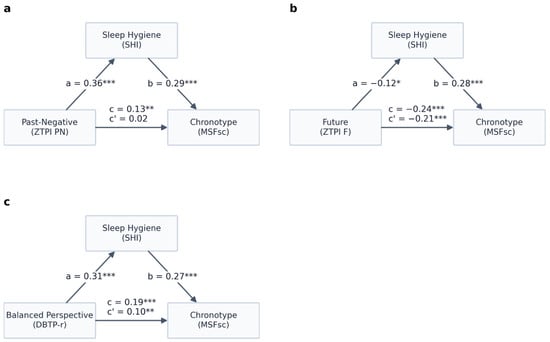
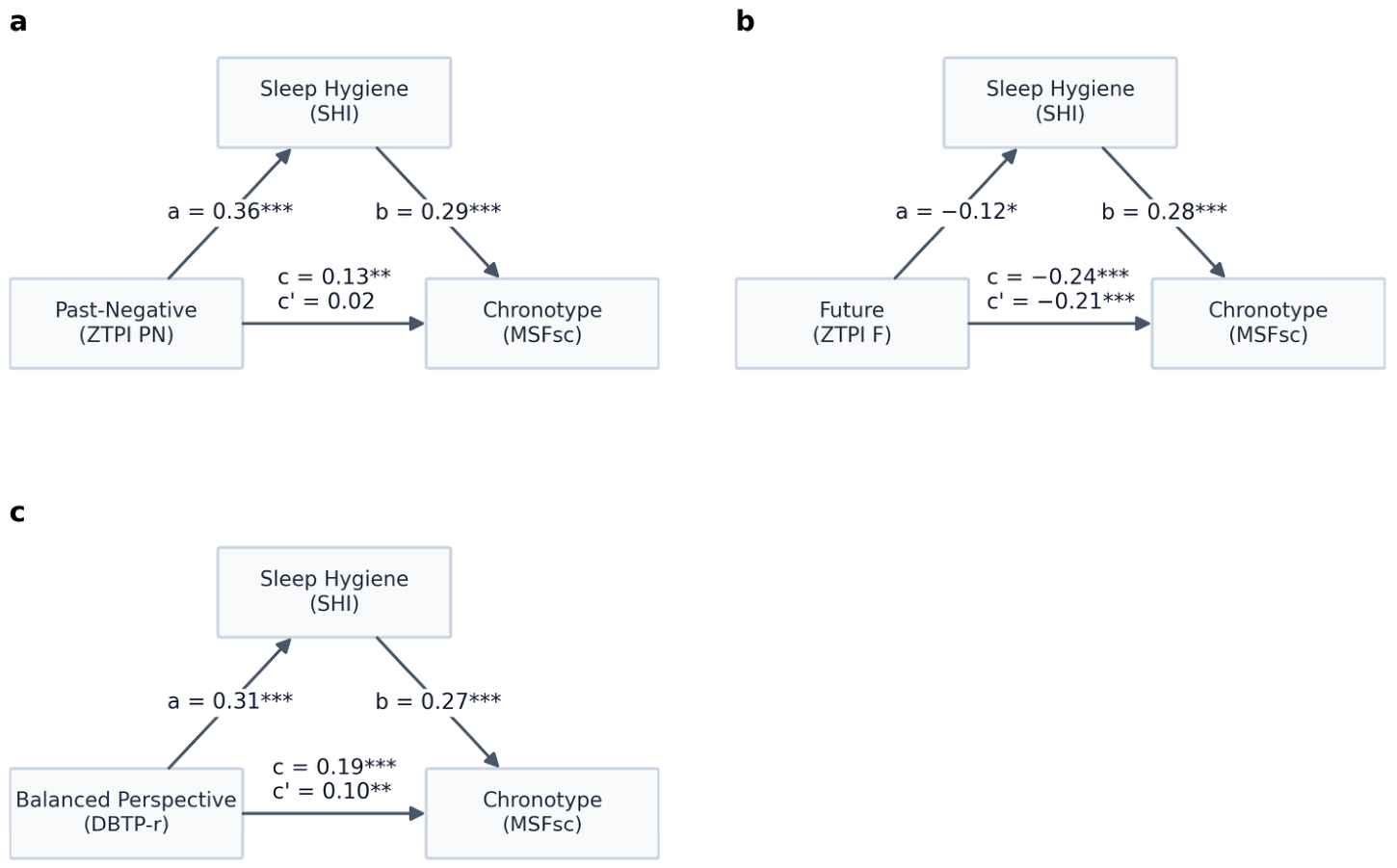
Three total effects of the time perspective dimensions (PN, F, DBTP-r) on MSFsc, identified in the correlation analyses (Table 1), could potentially be mediated by sleep hygiene. The mediation analysis showed that the indirect effect of PN on MSFsc via sleep hygiene was statistically significant and fully mediated the association between PN and MSFsc (Figure 1a). The indirect effect of F on MSFsc via sleep hygiene was statistically significant and partly mediated the association between F and MSFsc (Figure 1b). The indirect effect of DBTP-r on MSFsc via sleep hygiene was also statistically significant and partly mediated the association (Figure 1c). These effects show that the associations of higher PN and DBTP-r and lower F with eveningness can be fully (PN) or partly (DBTP-r and F) explained by inadequate sleep hygiene. The percentages of variance explained by these effects can be found in Table 2.
Figure 1.
The mediating effects of sleep hygiene in the associations between the time perspective dimensions and chronotype measured with midsleep on free days sleep-corrected. The mediated effect amounted to 0.10 [0.06; 0.15] for PN (a), −0.03 [−0.06; −0.01] for F (b), and 0.08 [0.05; 0.13] for DBTP-r (c). Presented coefficients are standardised, * p < 0.05; ** p < 0.01; *** p < 0.001.
Table 2.
Percentage of variance explained by total, direct, and indirect effects of time perspective dimensions on chronotype via sleep hygiene.
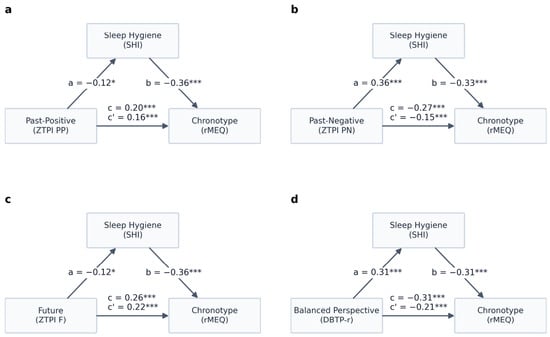
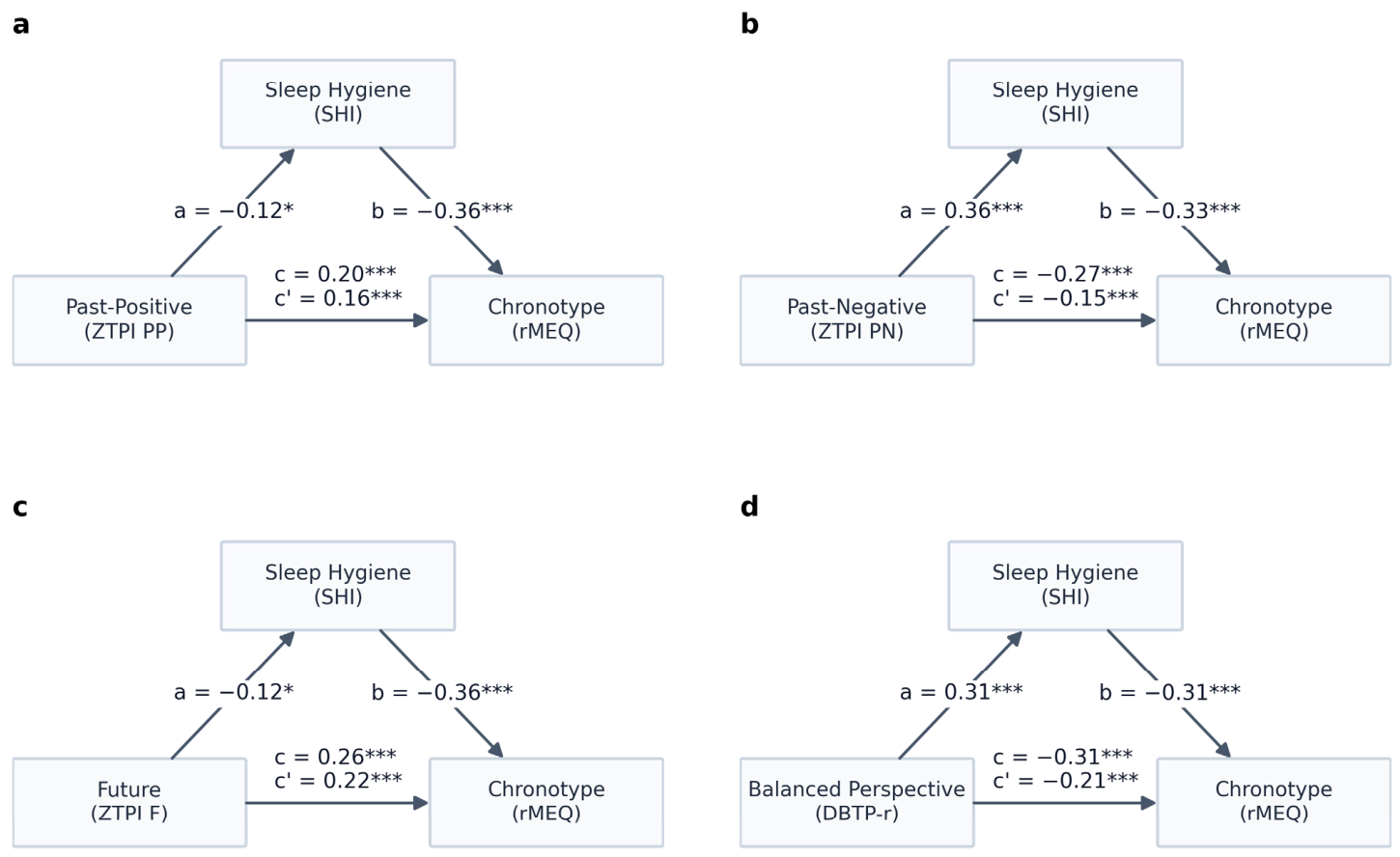
Four total effects of the time perspective dimensions (PP, PN, F, DBTP-r) on rMEQ, identified in the correlation analyses (Table 1), could potentially be mediated by sleep hygiene. The mediation analysis showed that all four effects were partly mediated by sleep hygiene (Table 2). Specifically, statistically significant indirect effects through sleep hygiene were observed in the associations of PP (95% CI [0.01; 0.08]), PN (95% CI [−0.16; −0.08]), F (95% CI [0.01; 0.08]), and DBTP-r (95% CI [−0.14; −0.06]) with rMEQ (Figure 2a–d). These effects indicate that higher PN and DBTP-r and lower F and PP are related to eveningness indirectly through inadequate sleep hygiene, which partly explains these associations (see Table 2 for effect sizes).
Figure 2.
The mediating effects of sleep hygiene in the associations between the time perspective dimensions and chronotype measured with the Reduced Morningness–Eveningness Questionnaire. The mediated effect amounted to 0.04 [0.01; 0.08] for PP (a), −0.12 [−0.16; −0.08] for PN (b), 0.04 [0.01; 0.08] for F (c), and −0.10 [−0.14; −0.06] for DBTP-r (d). Presented coefficients are standardised, * p < 0.05; *** p < 0.001.
4. Discussion
This study aimed to analyse the mediating role of sleep hygiene in the association of time perspective with chronotype. The results revealed significant indirect associations of F, PP, PN, and DBTP-r with chronotype through sleep hygiene, consistent with the proposed theoretical mechanism wherein sleep hygiene links time perspective and chronotype. These main findings are discussed below, followed by the brief consideration of several secondary outcomes.
Eveningness, as indicated by the rMEQ scores, was associated with lower levels of PP and F, higher PN, and a less balanced time perspective in the present study. MSFsc showed the same pattern of associations, with the exception of PP, which showed a statistically non-significant association, although the direction of this negligible correlation was the same as for the rMEQ scores. Collectively, the observed pattern of associations reflected the pattern reported in past studies [6,18]. It is also worth noting that the associations of the time perspective dimensions with chronotype measured using rMEQ were stronger than for MSFsc, so that dimensions that are more weakly related to chronotype (i.e., PP) did not appear for the MSFsc indicator. Such lower sensitivity of MSFsc compared to the rMEQ scores was also observed in some previous studies analysing other variables (e.g., sleep quality) [40], and the current results suggest that the weaker relationship between time perspective and MSFsc compared to rMEQ may reflect the generally lower sensitivity of sleep timing indicators to psychological factors compared with measures of morningness–eveningness preference. This may be partly attributable to the fact that rMEQ assesses subjective preferences and self-perceived morningness–eveningness, whereas time perspective is itself a psychological self-report construct. Contrary to expectations based on some previous reports [17,18], PH and PF were not associated with chronotype in the present sample. This may indicate that the associations of these dimensions as observed in some previous studies are weaker and less consistent than those involving other time perspective dimensions.
Inadequate sleep hygiene was related to eveningness, in line with past reports [28,29]. It is likely that inadequate sleep habits delay sleep onset, thereby contributing to greater eveningness via modulation of state chronotype. Engagement in sleep-disruptive behaviours, such as using screen media before sleep, which has been related to eveningness [41], can act both on circadian and homeostatic processes. Specifically, evening exposure to blue light emitted from screens can not only delay circadian rhythms but can also override homeostatic sleep pressure if media use produces emotionally arousing responses [42]. Other sleep-disruptive behaviours covered by sleep hygiene are, among others, working until late hours or the use of sleep-disruptive substances. These behaviours are also likely to explain the links between sleep hygiene and eveningness observed in the current study, as past research indicates that procrastination and psychostimulant use are related to eveningness [43,44]. Late-evening work not only acts on the circadian process by exposure to light but also can evoke arousal that overrides the homeostatic sleep drive. The use of psychostimulants, such as cigarettes, is also known to negatively impact sleep [45].
These sleep-disruptive behaviours that contribute to eveningness may also stem from an individual’s time perspective profile. The mediation analyses provided support for the central hypothesis of this study, suggesting that sleep hygiene may partly account for the associations between time perspective and chronotype. For both chronotype indicators, indirect effects through sleep hygiene were observed for F, PN, and DBTP-r. Additionally, sleep hygiene mediated the association between PP and chronotype measured with the rMEQ. These findings are consistent with the proposition that sleep behaviours and habits, as behavioural expressions of trait time perspective, may be related to the modifiable state component of chronotype [6]. Although these indirect effects were modest in magnitude, explaining 1.6–5.5% of the variance in chronotype, they nevertheless provide potentially useful theoretical insight into the mechanisms underlying the associations between time perspective and chronotype, which were themselves small to moderate in magnitude.
The present findings make it more plausible that individuals high in F, owing to the self-regulatory capacities encompassed by this time perspective dimension [22], are able to better adhere to sleep habits that promote earlier bedtimes in order to achieve their future goals in a morning-oriented society, which in turn act on state chronotype. As a result, they may exhibit a more morning-oriented chronotype. Individuals high in PN are likely to ruminate about negative past events before sleep—a behaviour that constitutes one aspect of inadequate sleep hygiene and may delay sleep onset—thereby promoting a later state chronotype. Besides the present mediational outcome supporting this proposed mechanism, other studies have observed that eveningness is related to greater pre-sleep rumination [46].
A more tentative explanation applies to PP orientation. Individuals high in PP may be more likely to experience positive recollections and reduced pre-sleep arousal. Positive emotional states before sleep may facilitate relaxation and sleep initiation [26], thereby indirectly promoting earlier sleep timing. The weaker and less consistent associations involving PP suggest, however, that this pattern of associations may be less pronounced than those involving F and PN orientations.
Finally, DBTP-r likely reflects the cumulative contribution of several sleep-relevant tendencies. Because DBTP-r is characterised by lower F and PP together with elevated maladaptive temporal orientations, like PN [15], its indirect association with chronotype may represent the combined effects of poorer self-regulation, greater negative affect, and fewer adaptive bedtime coping strategies. Consequently, individuals with a less balanced time perspective may be more prone to engaging in behaviours that delay sleep and contribute to greater eveningness.
Gender differences appeared only in F in the present research, with women exhibiting higher levels than men. This outcome replicates some of the previous reports, but these reports also showed that women scored higher on PP and lower on PN [47]. On the other hand, other studies have shown no gender difference in any of the TP dimensions [6], suggesting that overall gender differences may be small; therefore, sampling fluctuations around a small true effect may result in statistically significant findings in some studies but not others. There were also no gender differences in chronotype indicated by either the rMEQ scores or MSFsc. The lack of gender differences in the rMEQ scores is consistent with past results for Polish participants [34]. In many studies, MSFsc tends to be later in men than in women, especially during reproductive age [48], but, in some studies, these effects are very small, i.e., explaining less than 1% of the variance [49], or absent when MSFsc is derived from μMCTQ [50]. In any case, gender differences were not the primary focus of this study and were controlled for in the analyses.
Age was related to sleep hygiene in that older participants exhibited lower levels of inadequate sleep hygiene. This is a well-recognised association in past research, as younger individuals typically engage more frequently in sleep-adverse lifestyle behaviours like excessive screen time, irregular schedules, and energy drink consumption, whereas older people typically adopt more stable and structured routines [51]. Older participants in the present research had also earlier chronotypes as indicated by the MSFsc sleep timing indicator—a phenomenon that was also shown in previous studies [48]. This study did not show an association between age and chronotype as measured by rMEQ. This outcome is consistent with other studies with morningness–eveningness preference scales, like rMEQ, in samples of a similar age to this study. For example, there were no differences in rMEQ scores in German adults aged 21–30 years [52], corroborating the notion that preference scales of morningness–eveningness are less sensitive to age differences than sleep timing indicators of chronotype. Age was unrelated to all time perspective dimensions, possibly due to the concentrated age distribution, as some previous studies have indicated that older individuals score lower on PH, PP, and PN [6,53].
Limitations
Several limitations should be considered when interpreting the findings. Firstly, it should be highlighted that all considerations concerning causality remain speculative, because they cannot be confirmed in an observational, single-measurement, cross-sectional study. The proposed causal mechanisms were inferred on theoretical grounds, while the observed results provide support rather than proof. Future studies should apply more sophisticated paradigms that allow for firmer conclusions regarding causality, such as sleep lab interventional experiments or longitudinal ecological momentary assessment [54].
Second, this study has the typical limitations resulting from the use of self-report scales; thus, the findings should be interpreted with caution, as self-report measures are inherently susceptible to bias [55]. For instance, the Sleep Hygiene Index and the chronotype measures used in this study assess related aspects of sleep, even though their items address different aspects of sleep-related behaviours. Furthermore, using self-report measures may introduce shared-method variance and reporting biases. Future studies could benefit from incorporating objective measures of sleep timing, such as actigraphy, as well as objectively measured behavioural indicators of sleep hygiene.
Third, the sample consisted predominantly of young adults, limiting its generalisability to other age groups like adolescents or older adults. Because both chronotype [48] and time perspective [53] vary across the lifespan, replication in more diverse populations is warranted. Future replications should also include participants from different geographical regions and cultural backgrounds given that both chronotype and time perspective are susceptible to these factors [10,55].
Fourth, it is worth noting that the internal consistency coefficients of the psychometric instruments used in this study varied across scales. Scales with lower reliability are inherently subject to greater measurement error, which typically attenuates the observed statistical associations. Therefore, some of the relationships documented here may represent conservative estimates, and caution should be exercised when comparing effect sizes across variables with differing reliability profiles. The differences in the results obtained with MSFsc versus rMEQ may also partly stem from the different reliability profiles of the measures, as the former may be more prone to systematic measurement error than the latter [5,56].
Fifth, the number of statistical tests conducted across the study necessitates the cautious interpretation of individual p-values. Although the analyses served distinct purposes and the mediation models were selected according to predefined criteria, multiple tests were conducted across the different analytical stages. Therefore, an increased risk of Type I errors cannot be excluded, and individual statistically significant findings should be interpreted in the context of the overall pattern of the results.
5. Conclusions
Despite its limitations, this study provides a meaningful input to the knowledge of the associations between time perspective and chronotype by identifying sleep hygiene as a potential factor accounting for part of the association between the two constructs. These findings support the view that chronotype is not solely a reflection of stable biological predispositions but also incorporates a modifiable state component that may be related to behavioural factors. Sleep hygiene may similarly be involved in the associations between chronotype and other psychological phenomena, such as personality, providing a potential avenue for future research [57].
Beyond their theoretical implications, these findings lead to the hypothesis—requiring further validation—that sleep hygiene may represent a potentially modifiable target that could complement interventions addressing chronotype-related difficulties. For individuals experiencing such difficulties, typically those with pronounced eveningness, a more comprehensive assessment could also consider habitual sleep-related behaviours and, potentially, time perspective. Such an assessment could help to identify whether sleep behaviours may partly account for the association between time perspective and excessively delayed sleep patterns, thereby informing more tailored intervention strategies. Depending on the individual profile, interventions could complement traditional chronobiological approaches, such as appropriately timed light exposure or melatonin administration [58], with strategies addressing maladaptive sleep behaviours [59] or, where relevant, a more adaptive time perspective profile [60].
Funding
This work was supported by the University of Warsaw through funds awarded by the Ministry of Science and Higher Education in the form of a subsidy for the maintenance and development of research potential (501-D125-01-1250000).
Institutional Review Board Statement
The study was conducted in accordance with the Declaration of Helsinki. Ethical approval was obtained from the Ethics Committee at the Faculty of Psychology, University of Warsaw (No. 20/1301/2026, date of approval 13 January 2026).
Informed Consent Statement
Informed consent was obtained from all subjects involved in the study.
Data Availability Statement
The original data presented in the study are openly available via the Open Science Framework at osf.io/6jmkd.
Acknowledgments
Conflicts of Interest
The author declares no conflicts of interest.
Abbreviations
The following abbreviations are used in this manuscript:
| DBTP | Deviation from a Balanced Time Perspective |
| DBTP-r | Deviation from a Balanced Time Perspective—Revised |
| F | Future |
| μMCTQ | Micro Munich ChronoType Questionnaire |
| MSFsc | Midsleep on free days sleep-corrected |
| PF | Present-fatalistic |
| PH | Present-hedonistic |
| PN | Past-negative |
| PP | Past-positive |
| rMEQ | Reduced Morningness–Eveningness Questionnaire |
| SHI | Sleep Hygiene Index |
| ZTPI | Zimbardo Time Perspective Inventory |
References
- Randler, C.; Jankowski, K.S.; Rahafar, A.; Díaz-Morales, J.F. Sociosexuality, morningness–eveningness, and sleep duration. Sage Open 2016, 6, 2158244015621958. [Google Scholar] [CrossRef] [Scilit]
- Randler, C.; Jankowski, K.S. Evidence for the validity of the composite scale of morningness based on students from Germany and Poland–relationship with sleep–wake and social schedules. Biol. Rhythm Res. 2014, 45, 653–659. [Google Scholar] [CrossRef] [Scilit]
- Wittmann, M.; Dinich, J.; Merrow, M.; Roenneberg, T. Social jetlag: Misalignment of biological and social time. Chronobiol. Int. 2006, 23, 497–509. [Google Scholar] [CrossRef] [Scilit] [PubMed]
- Jankowski, K.S. Social jet lag: Sleep-corrected formula. Chronobiol. Int. 2017, 34, 531–535. [Google Scholar] [CrossRef] [Scilit] [PubMed]
- Roenneberg, T.; Pilz, L.K.; Zerbini, G.; Winnebeck, E.C. Chronotype and social jetlag: A (self-) critical review. Biology 2019, 8, 54. [Google Scholar] [CrossRef] [Scilit] [PubMed]
- Jankowski, K.S. Time perspective and depressive symptoms: Mediating role of chronotype. Pers. Individ. Dif. 2026, 248, 113481. [Google Scholar] [CrossRef] [Scilit]
- Putilov, A.A. State-and trait-like variation in morning and evening components of morningness–eveningness in winter depression. Nord. J. Psychiatry 2017, 71, 561–569. [Google Scholar] [CrossRef] [Scilit] [PubMed]
- Borbély, A.A.; Daan, S.; Wirz-Justice, A.; Deboer, T. The two-process model of sleep regulation: A reappraisal. J. Sleep Res. 2016, 25, 131–143. [Google Scholar] [CrossRef] [Scilit] [PubMed]
- Minors, D.S.; Waterhouse, J.M.; Wirz-Justice, A. A human phase-response curve to light. Neurosci. Lett. 1991, 133, 36–40. [Google Scholar] [CrossRef] [Scilit] [PubMed]
- Jankowski, K.S.; Vollmer, C.; Linke, M.; Randler, C. Differences in sun time within the same time zone affect sleep–wake and social rhythms, but not morningness preference: Findings from a Polish–German comparison study. Time Soc. 2014, 23, 258–276. [Google Scholar] [CrossRef] [Scilit]
- Roenneberg, T.; Kumar, C.J.; Merrow, M. The human circadian clock entrains to sun time. Curr. Biol. 2007, 17, R44–R45. [Google Scholar] [CrossRef] [Scilit] [PubMed]
- Troynikov, O.; Watson, C.G.; Nawaz, N. Sleep environments and sleep physiology: A review. J. Therm. Biol. 2018, 78, 192–203. [Google Scholar] [CrossRef] [Scilit] [PubMed]
- Sempere-Rubio, N.; Aguas, M.; Faubel, R. Association between chronotype, physical activity and sedentary behaviour: A systematic review. Int. J. Environ. Res. Public Health 2022, 19, 9646. [Google Scholar] [CrossRef] [Scilit] [PubMed]
- Zimbardo, P.G.; Boyd, J.N. Putting time in perspective: A valid, reliable individual-differences metric. J. Pers. Soc. Psychol. 1999, 77, 1271–1288. [Google Scholar] [CrossRef] [Scilit]
- Jankowski, K.S.; Zajenkowski, M.; Stolarski, M. What are the optimal levels of time perspectives? Deviation from the balanced time perspective-revisited (DBTP-r). Psychol. Belg. 2020, 60, 164. [Google Scholar] [CrossRef] [Scilit] [PubMed]
- Boniwell, I.; Osin, E.; Linley, P.A.; Ivanchenko, G.V. A question of balance: Time perspective and well-being in British and Russian samples. J. Posit. Psychol. 2010, 5, 24–40. [Google Scholar] [CrossRef] [Scilit]
- Díaz-Morales, J.F.; Ferrari, J.R.; Cohen, J.R. Indecision and avoidant procrastination: The role of morningness–eveningness and time perspective in chronic delay lifestyles. J. Gen. Psychol. 2008, 135, 228–240. [Google Scholar] [CrossRef] [Scilit] [PubMed]
- Stolarski, M.; Ledzińska, M.; Matthews, G. Morning is tomorrow, evening is today: Relationships between chronotype and time perspective. Biol. Rhythm Res. 2013, 44, 181–196. [Google Scholar] [CrossRef] [Scilit]
- Meng, D.; Zhao, Y.; Guo, J.; Xu, H.; Fu, Y.; Ma, X.; Zhu, L.; Mu, L. Time perspective and bedtime procrastination: The role of the chronotype–time perspective relationship. Nat. Sci. Sleep 2021, 13, 1307–1318. [Google Scholar] [CrossRef] [Scilit] [PubMed]
- Beracci, A.; Fabbri, M.; Martoni, M. Morningness-eveningness preference, time perspective, and passage of time judgments. Cogn. Sci. 2022, 46, e13109. [Google Scholar] [CrossRef] [Scilit] [PubMed]
- Warowny, M.; Stolarski, M. What makes the early bird catch the worm? Time perspective as a mediator between circadian preference and grit. Biol. Rhythm Res. 2026, 57, 367–385. [Google Scholar] [CrossRef] [Scilit]
- De Volder, M.L.; Lens, W. Academic achievement and future time perspective as a cognitive–motivational concept. J. Pers. Soc. Psychol. 1982, 42, 566–571. [Google Scholar] [CrossRef] [Scilit]
- Emens, J.S.; Yuhas, K.; Rough, J.; Kochar, N.; Peters, D.; Lewy, A.J. Phase angle of entrainment in morning- and evening-types under naturalistic conditions. Chronobiol. Int. 2009, 26, 474–493. [Google Scholar] [CrossRef] [Scilit] [PubMed]
- Czeisler, C.A.; Gooley, J.J. Sleep and circadian rhythms in humans. In Cold Spring Harbor Symposia on Quantitative Biology; Cold Spring Harbor Laboratory Press: Cold Spring Harbor, NY, USA, 2007; Volume 72, pp. 579–597. [Google Scholar]
- Bartsch, A.; Viehoff, R. The use of media entertainment and emotional gratification. Procedia-Soc. Behav. Sci. 2010, 5, 2247–2255. [Google Scholar] [CrossRef] [Scilit]
- Digdon, N.; Koble, A. Effects of constructive worry, imagery distraction, and gratitude interventions on sleep quality: A pilot trial. Appl. Psychol. Health Well-Being 2011, 3, 193–206. [Google Scholar] [CrossRef] [Scilit]
- American Academy of Sleep Medicine. International Classification of Sleep Disorders, 3rd ed.; American Academy of Sleep Medicine: Darien, IL, USA, 2023. [Google Scholar]
- Borghi, S.; Bizzozero, S.; Vitale, J.A.; Tallini, E.; Corazza, F.; La Torre, A.; Banfi, G.; Codella, R. Chronotype, sleep hygiene, and sleep characteristics among athletes of different disciplines. Int. J. Sports Med. 2025, 46, 104–114. [Google Scholar] [CrossRef] [Scilit] [PubMed]
- Lin, S.Y.; Chung, K.K.H. Chronotype and trait self-control as unique predictors of sleep quality in Chinese adults: The mediating effects of sleep hygiene habits and bedtime media use. PLoS ONE 2022, 17, e0266874. [Google Scholar] [CrossRef] [Scilit] [PubMed]
- Zhu, Y.; Huang, J.; Yang, M. Association between chronotype and sleep quality among Chinese college students: The role of bedtime procrastination and sleep hygiene awareness. Int. J. Environ. Res. Public Health 2022, 20, 197. [Google Scholar] [CrossRef] [Scilit] [PubMed]
- Herzog-Krzywoszanska, R.; Krzywoszanski, L.; Kargul, B. General procrastination and bedtime procrastination as serial mediators of the relationship between temporal perspective and sleep outcomes. Sci. Rep. 2024, 14, 31175. [Google Scholar] [CrossRef] [Scilit] [PubMed]
- Rönnlund, M.; Carelli, M.G. Time perspective biases are associated with poor sleep quality, daytime sleepiness, and lower levels of subjective well-being among older adults. Front. Psychol. 2018, 9, 1356. [Google Scholar] [CrossRef] [Scilit] [PubMed]
- Sobol, M.; Błachnio, A.; Calderan, M.; Degasperi, G.; Mioni, G.; Hryhorchuk, I.; Plucińska, E.; Stasiniewicz, J.; Kwapiński, J.; Jankowski, K.; et al. Balanced time perspective as a factor mitigating the negative consequences of sleep disruptions in the perinatal period. Chronobiol. Int. 2025, 42, 528–539. [Google Scholar] [CrossRef] [Scilit] [PubMed]
- Jankowski, K.S. Polish version of the reduced Morningness–Eveningness Questionnaire. Biol. Rhythm Res. 2013, 44, 427–433. [Google Scholar] [CrossRef] [Scilit]
- Ghotbi, N.; Pilz, L.K.; Winnebeck, E.C.; Vetter, C.; Zerbini, G.; Lenssen, D.; Frighetto, G.; Salamanca, M.; Costa, R.; Montagnese, S.; et al. The µMCTQ: An ultra-short version of the Munich ChronoType questionnaire. J. Biol. Rhythm. 2020, 35, 98–110. [Google Scholar] [CrossRef] [Scilit] [PubMed]
- Mastin, D.F.; Bryson, J.; Corwyn, R. Assessment of sleep hygiene using the Sleep Hygiene Index. J. Behav. Med. 2006, 29, 223–227. [Google Scholar] [CrossRef] [Scilit] [PubMed]
- Hulley, S.B.; Cummings, S.R.; Browner, W.S.; Grady, D.; Newman, T.B. Designing Clinical Research: An Epidemiologic Approach, 4th ed.; Lippincott Williams & Wilkins: Philadelphia, PA, USA, 2013. [Google Scholar]
- Hayes, A.F. Counterfactual/Potential Outcomes “Causal Mediation Analysis” with Treatment by Mediator Interaction Using PROCESS; Technical Report; Canadian Centre for Research Analysis and Methods: Calgary, AB, Canada, 2022. [Google Scholar]
- Fairchild, A.J.; MacKinnon, D.P.; Taborga, M.P.; Taylor, A.B. R2 effect-size measures for mediation analysis. Behav. Res. Methods 2009, 41, 486–498. [Google Scholar] [CrossRef] [Scilit] [PubMed]
- Wang, H.; Wang, S.; Yu, W.; Lei, X. Consistency of chronotype measurements is affected by sleep quality, gender, longitude, and latitude. Chronobiol. Int. 2023, 40, 952–960. [Google Scholar] [CrossRef] [Scilit] [PubMed]
- Yue, L.; Cui, N.; Jiang, L.; Cui, N. Screen use before sleep and emotional problems among adolescents: Preliminary evidence of mediating effect of chronotype and social jetlag. J. Affect. Disord. 2023, 328, 175–182. [Google Scholar] [CrossRef] [Scilit] [PubMed]
- Saper, C.B.; Cano, G.; Scammell, T.E. Homeostatic, circadian, and emotional regulation of sleep. J. Comp. Neurol. 2005, 493, 92–98. [Google Scholar] [CrossRef] [Scilit] [PubMed]
- Przepiórka, A.; Błachnio, A.; Siu, N.Y.F. The relationships between self-efficacy, self-control, chronotype, procrastination and sleep problems in young adults. Chronobiol. Int. 2019, 36, 1025–1035. [Google Scholar] [CrossRef] [Scilit] [PubMed]
- Senyk, O.; Jankowski, K.S.; Cholii, S. Ukrainian versions of the composite scale of morningness and Munich chronotype questionnaire. Biol. Rhythm Res. 2022, 53, 878–896. [Google Scholar] [CrossRef] [Scilit]
- Nuñez, A.; Rhee, J.U.; Haynes, P.; Chakravorty, S.; Patterson, F.; Killgore, W.D.S.; Gallagher, R.A.; Hale, L.; Branas, C.; Carrazco, N.; et al. Smoke at night and sleep worse? The associations between cigarette smoking with insomnia severity and sleep duration. Sleep Health 2021, 7, 177–182. [Google Scholar] [CrossRef] [Scilit] [PubMed]
- Kim, S.Y.; Kim, H.J.; Cho, S.S.; Park, M.Y.; Kang, M.Y. Mediation analysis of chronotype, sleep-related factors, and depressive symptoms among workers: A cross-sectional study. Ann. Occup. Environ. Med. 2023, 35, e47. [Google Scholar] [CrossRef] [Scilit] [PubMed]
- Ely, R.; Mercurio, A. Time perspective and autobiographical memory: Individual and gender differences in experiencing time and remembering the past. Time Soc. 2011, 20, 375–400. [Google Scholar] [CrossRef] [Scilit]
- Jankowski, K.S. Composite Scale of Morningness: Psychometric properties, validity with Munich ChronoType Questionnaire and age/sex differences in Poland. Eur. Psychiatry 2015, 30, 166–171. [Google Scholar] [CrossRef] [Scilit] [PubMed]
- Farkova, E.; Novak, J.M.; Mankova, D.; Kopřivová, J. Comparison of Munich chronotype questionnaire (MCTQ) and morningness-eveningness questionnaire (MEQ) Czech version. Chronobiol. Int. 2020, 37, 1591–1598. [Google Scholar] [CrossRef] [Scilit] [PubMed]
- Kim, K.M.; Han, S.M.; Heo, K.; Kim, W.J.; Chu, M.K. Sex differences in the association between chronotype and risk of depression. Sci. Rep. 2020, 10, 18512. [Google Scholar] [CrossRef] [Scilit] [PubMed]
- Awadalla, N.J.; Mahfouz, A.A.; Shehata, S.F.; Al Thibiait, S.A.; Aljihani, A.H.; Hafez, S.M.; Assiri, M.H.; Al-Mubark, D.A.; Al Shiban, H.M.; Alsamghan, A.S.; et al. Sleep hygiene, sleep-related problems, and their relations with quality of life in a primary-care population in southwest Saudi Arabia. J. Fam. Med. Prim. Care 2020, 9, 3124–3130. [Google Scholar] [CrossRef] [Scilit] [PubMed]
- Randler, C.; Freyth-Weber, K.; Rahafar, A.; Jurado, A.F.; Kriegs, J.O. Morningness-eveningness in a large sample of German adolescents and adults. Heliyon 2016, 2, e00194. [Google Scholar] [CrossRef] [Scilit] [PubMed]
- Laureiro-Martinez, D.; Trujillo, C.A.; Unda, J. Time perspective and age: A review of age associated differences. Front. Psychol. 2017, 8, 101. [Google Scholar] [CrossRef] [Scilit] [PubMed]
- Shiffman, S.; Stone, A.A.; Hufford, M.R. Ecological momentary assessment. Annu. Rev. Clin. Psychol. 2008, 4, 1–32. [Google Scholar] [CrossRef] [Scilit] [PubMed]
- Sircova, A.; van de Vijver, F.J.R.; Osin, E.; Milfont, T.L.; Fieulaine, N.; Kislali-Erginbilgic, A.; Zimbardo, P.G.; Djarallah, S.; Chorfi, M.S.; do Rego Leite, U.; et al. Time perspective profiles of cultures. In Time Perspective Theory; Review, Research and Application: Essays in Honor of Philip G. Zimbardo 169–187; Springer International Publishing: Cham, Switzerland, 2014. [Google Scholar]
- Sinha, M.; Pande, B.; Jagzape, A.; Sinha, R.A. Validated Hindi version of ‘reduced Morningness-Eveningness Questionnaire’ (Hindi version of rMEQ) for chronotype assessment. Biol. Rhythm Res. 2024, 55, 441–456. [Google Scholar] [CrossRef] [Scilit]
- Jankowski, K.S.; Linke, M. Angry night birds: Emotionality, activity and sociability temperament in adolescent chronotypes. Chronobiol. Int. 2020, 37, 652–659. [Google Scholar] [CrossRef] [Scilit] [PubMed]
- Wichniak, A.; Jankowski, K.S.; Skalski, M.; Skwarło-Sońta, K.; Zawilska, J.B.; Żarowski, M.; Poradowska, E.; Jernajczyk, W. Treatment guidelines for circadian rhythm sleep-wake disorders of the Polish Sleep Research Society and the Section of Biological Psychiatry of the Polish Psychiatric Association. Part II. Diagnosis and treatment. Psychiatr. Pol. 2017, 51, 793–814. [Google Scholar] [CrossRef] [Scilit] [PubMed]
- Kater, M.J.; Wegener, N.; Morath, N.; Vorster, A. Digital App Based Cognitive Behaviour Therapy CBT-I Course Improving Insomnia and Sleep Hygiene: A Randomised Controlled Trial. J. Sleep Res. 2026, 35, e70195. [Google Scholar] [CrossRef] [Scilit] [PubMed]
- Zimbardo, P.; Sword, R.; Sword, R. The Time Cure: Overcoming PTSD with the New Psychology of Time Perspective Therapy; Jossey-Bass: San Francisco, CA, USA, 2012. [Google Scholar]

Disclaimer/Publisher’s Note: The statements, opinions and data contained in all publications are solely those of the individual author(s) and contributor(s) and not of MDPI and/or the editor(s). MDPI and/or the editor(s) disclaim responsibility for any injury to people or property resulting from any ideas, methods, instructions or products referred to in the content. |
© 2026 by the author. Licensee MDPI, Basel, Switzerland. This article is an open access article distributed under the terms and conditions of the Creative Commons Attribution (CC BY) license.