


Abstract
In 2026, sustainable construction materials research is focused on optimization of the resources’ circularity, carbon reduction, and performance improvements through advanced materials. Biochar, nanomaterials, and recycled aggregates (RA) are enhancing concrete by improving strength, durability, and carbon capture, while supporting low-carbon, circular practices. When used in low-carbon alkali-activated materials (AAMs), these materials reduce greenhouse gas emissions by approximately 30–60% compared to Portland cement (PC). Despite challenges in cost, standardization, and large-scale production, these innovations are advancing the construction industry towards sustainable, carbon-neutral solutions. RA helps reduce landfill waste and converse resources, though issues like quality variability and potential contaminants must be addressed. Biochar’s (0.5–2 wt.% of binder) adoption is limited by inconsistent properties, while nanomaterials (0.01 to 3 wt.% of binder) offer improved mechanical properties (5–20%) but face high production costs and limited long-term data. In the coming years, efforts will focus on standardizing production, improving nanoparticle dispersion, and refining RA processing. The integration of AI and machine learning may further optimize material design, leading to greener, low-carbon materials for large-scale, sustainable infrastructure by 2036.
1. Introduction
In 2026, sustainable construction materials research is focusing on optimization of resource circular flows, carbon reduction strategies, and performance enhancements via advanced materials science and practical applications in the construction sector. The combination of biochar’s application potential, nanomaterials’ performance benefits, and recycled aggregates’ (RA) circular resource usage is redefining how concrete and related materials are engineered.
Application of biochar, nanomaterials, and RA offers an innovative approach that enhances strength, microstructure, toughness, durability, and carbon capture, while achieving performance comparable to natural materials and supporting circular, low-carbon concrete solutions. These benefits are compounded within low-carbon alkali-activated material (AAM) binders, which utilize industrial by-products resulting in reduced greenhouse gas emissions by approximately 30–60% compared to traditional Portland cement (PC), depending on mix compositions and life cycle assessment (LCA) boundaries. Although challenges related to cost, industrial scaling, and standardization remain, this integrated approach advances the construction industry towards sustainable and carbon-neutral material design.
The incorporation of biochar, nanomaterials and RA into concrete and AAMs requires a thorough methodological framework combined with careful consideration of technological implementation, as their performance is governed by multi-scale interactions and high material variability. From a methodological perspective, the selection of biochar is strongly dependent on feedstock type (e.g., agricultural residues, wood, or sludge) and pyrolysis conditions, which control key properties such as porosity, surface functionality, and carbon stability, while nanomaterials must be chosen based on particle size, morphology, and surface chemistry [1,2]. Mix design optimization is critical, typically involving biochar usage levels of approximately 2–5% and nanomaterial dosages ranging from about 0.01 to 3 wt.% of binder, alongside adjustments in water-to-binder (w/b) ratio and, in the case of AAMs, activator composition to account for absorption and reactivity effects. The selection of RA is strongly dependent on the intended application and the performance requirements of the final material considering factors such as strength, stiffness, durability, alongside density, porosity, water absorption, and particle size distribution. The presence of impurities such as chlorides, sulfates, gypsum, wood, or metals can negatively affect long-term durability and performance. The source and origin of RA, whether derived from concrete or masonry, also plays a critical role in ensuring consistency and quality. Additionally, environmental exposure conditions, including moisture, temperature fluctuations, and chemical exposure, must be taken into account, as they directly impact durability and service life.
A major methodological challenge lies in achieving uniform dispersion of nanomaterials through ultrasonication, high-shear mixing, or the use of surfactants, as agglomeration can impact mechanical performance [3], while biochar often requires pre-treatment such as crushing or shredding, sieving, washing or pre-saturation to control its high water uptake, followed by a thermal decomposition process and post-treatments [4]. Material characterization using scanning electron microscope (SEM), transmission electron microscope (TEM), Fourier transform infrared spectroscopy (FTIR), X-ray diffraction (XRD), and porosimetry techniques is essential to observe microstructural development, particularly at the interfacial transition zone (ITZ), where nanomaterials can act as nucleation sites and biochar may provide internal curing and mechanical interlocking; however, the ITZ is not universally improved and depends on factors such as surface chemistry, particle size, and dosage. RA, due to their heterogeneous nature and the presence of adhered old mortar, exhibit higher porosity, lower density, and greater water absorption than natural aggregates, leading to weaker ITZ between the aggregate and binder, ultimately reducing mechanical properties.
Technologically, all these materials influence fresh and hardened properties. RA typically require increased water demand achieved by pre-saturation or mix design adjustments; biochar further increases water demand and can significantly reduce workability because of its high surface area and internal porosity, while nanomaterials tend to increase viscosity and promote agglomeration, making it necessary to use chemical admixtures and specialized dispersion techniques to ensure uniform distribution and optimal performance. In terms of performance, nanomaterials significantly enhance tensile and flexural strength as well as crack resistance through crack-bridging and matrix densification, whereas biochar contributes to greater durability, reduced drying shrinkage and permeability, and leads to excellent thermal conductivity [5]. In AAM systems, both additives can alter geopolymerization kinetics and gel structure, either accelerating or retarding reactions depending on their physicochemical properties. The integration of biochar introduces sustainability, as its stable carbon structure enables long-term carbon sequestration and, when combined with low-CO2 binders, offers the potential for carbon-negative construction materials. Nevertheless, practical implementation faces challenges related to large-scale production for biochar and economic feasibility—particularly for high-cost nanomaterials. Compared to biochar and high-cost nanomaterials, RA face fewer economic barriers but more challenges related to material variability and quality control. RA are widely available; however, their large-scale implementation is hindered by the heterogeneity of construction and demolition waste (CDW). Consequently, while the synergistic use of biochar, nanomaterials and RA presents a promising pathway toward high-performance and sustainable construction materials, its successful application depends on the precise control of material processing, mix design, quality assurance, and standardization to achieve widespread adoption and large-scale production.
2. Biochar in Concrete and AAMs
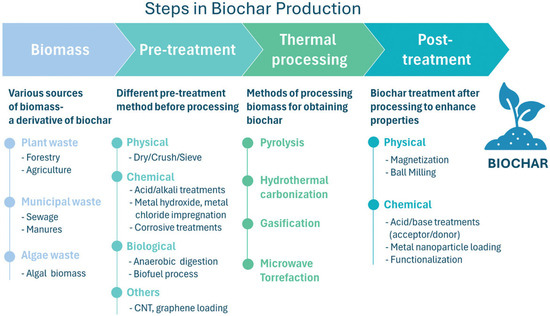
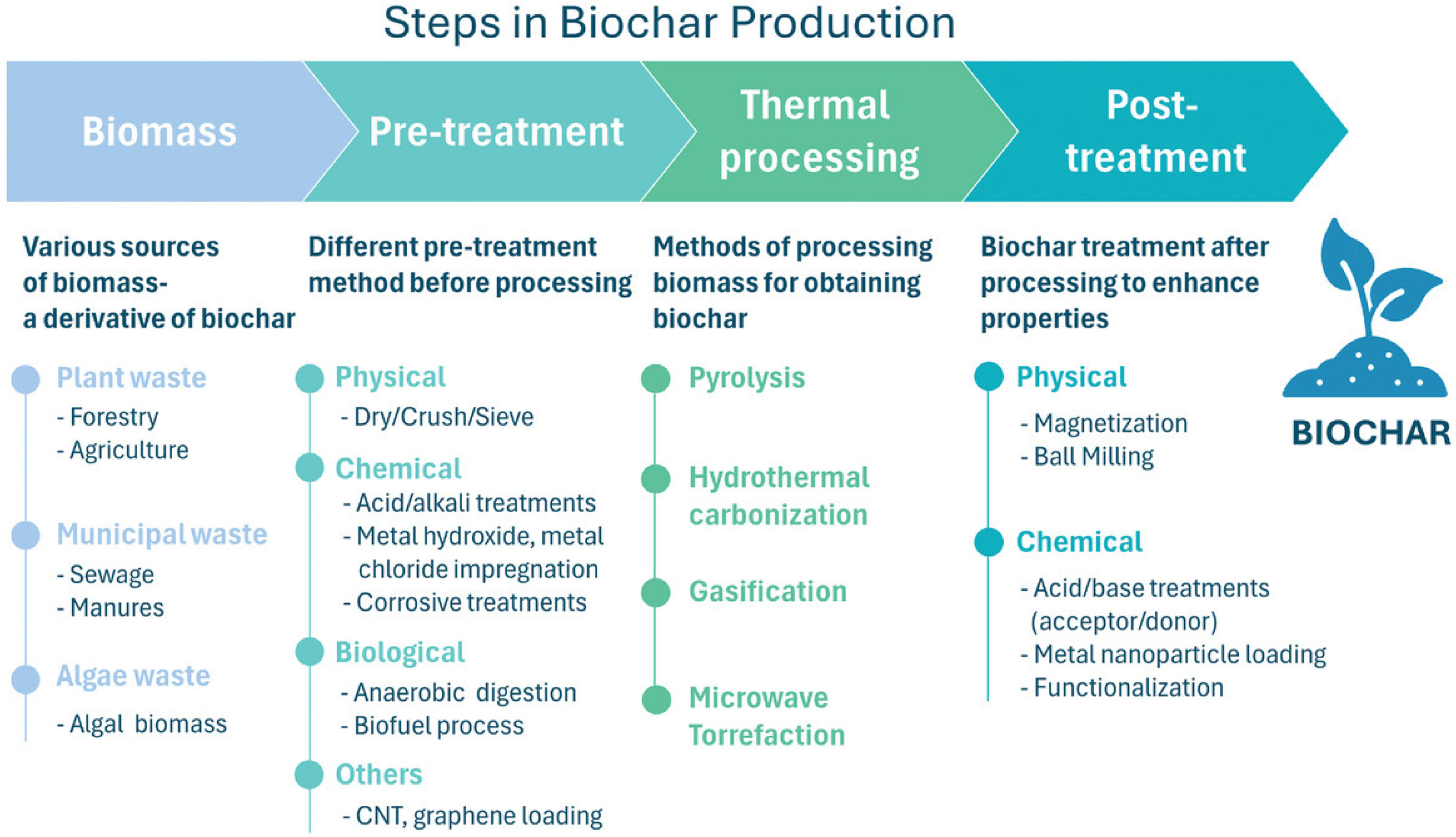
The term biochar is modern and has recently become widespread in research related to climate change mitigation and the recycling of materials in building applications. However, the process itself behind the term is quite ancient and refers to the creation of char through the thermal decomposition of plant or organic matter in the absence of sufficient oxygen for complete combustion. The production steps are shown in Figure 1 [4]. Pioneering biochar research began in the 1980s–90s in Japan [1], establishing a foundation for knowledge on carbon capture, years before it became a global focus and the global interest in biochar has grown significantly, largely due to research by Johannes Lehmann [2], whose nano-scale investigations of soil structure and use of synchrotron-based imaging techniques for carbon mapping have advanced the scientific understanding of biochar’s physicochemical behavior in soils and its potential role in regenerative agriculture and climate change mitigation.
Figure 1.
Overview of the steps and processes involved in biochar production [4].
Since PC production is a major contributor to global CO2 emissions, biochar-enhanced concrete enables permanent storage of biogenic carbon, thereby lowering embodied carbon, which is beneficial for concrete structures with long service lives. Alkali-activated concrete (AAC) is a specialized, cement-free concrete produced by blending aluminosilicate-based alkali-activated binders (AABs), used in a replacement of PC, with fine and coarse aggregates, an alkaline activator, and water to achieve cement-like hardening as well as comparable mechanical and physical properties [6].
The incorporation of biochar into AAC offers potential for the development of carbon-negative building materials [7]. However, optimizing the mix design is essential due to the limitations associated with biochar’s dosage in concrete, which may result in a reduced performance of the mechanical properties and increased sensitivity to the alkalinity of the activator. Several durability aspects may be improved compared to traditional Portland cement concrete (PCC), including shrinkage behavior, freeze–thaw resistance, alkali resistance, decarbonization, and chloride penetration.
In the context of optimizing biochar-based AAC, nanomaterials can play a significant role in improving the mechanical properties, durability, and overall performance of the material. For example, nano-silica (0.5–3.0 wt.% of binder) increases the reactivity of AABs by promoting the formation of additional gel phases and improving the microstructure, resulting in higher compressive strength and better durability. In turn, nano-calcium carbonate acts as a filler material, enhancing the packing density and refining the pore structure of the concrete, while also reacting with the alkali activator to form additional calcium silicate and calcium aluminate phases, further improving the material’s strength. Carbon nanotubes (CNTs), when incorporated at low concentrations (0.01–0.10 wt.% of binder), enhance the mechanical properties of concrete by interaction with the matrix at the nanoscale level, improving bonding and contributing to a greater crack resistance. When incorporated into biochar–AAC, graphene and graphene oxide (GO) can improve the interfacial bonding between biochar particles and AABs. The choice of nanomaterial always depends on the desired properties and specific application requirements.
The challenging aspect in the application of biochar in AAC is that this type of concrete already exhibits AABs-variable characteristics [8], combined with the fact that biochar properties depend on feedstock type (agricultural residues, forestry and wood waste, energy crops, animal-based biomass, and organic or municipal wastes), pyrolysis conditions (including temperature range, typically 500–700 °C to produce biochar with greater carbon content, heating rate, residence time, and oxygen availability), and the laboratory preparation methods, which are not systematically reported in research studies. Moreover, the characterization of biochar’s physical and chemical properties is absent in majority of studies (e.g., density, chemical composition, initial moisture content, etc.). Chemical composition and the pozzolanic activity index are key indicators of whether a material exhibits pozzolanic behavior and has the potential to partially replace PC. However, biochar is largely chemically inert and generally contains a very low silica content; therefore, it is not typically classified as a pozzolanic material. The elements commonly present in biochar include carbon (C), hydrogen (H), oxygen (O), nitrogen (N), along with small amounts of mineral elements such as potassium (K), calcium (Ca), magnesium (Mg), and sodium (Na) [9]. The complete oxide composition of biochar obtained from wood waste [10], for example, clearly shows different properties when compared to slag. All these factors make it challenging to develop a standardized mix design and achieve consistent performance in comparison to PCC.
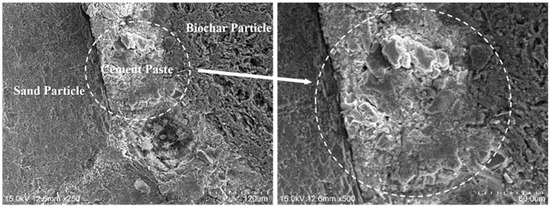
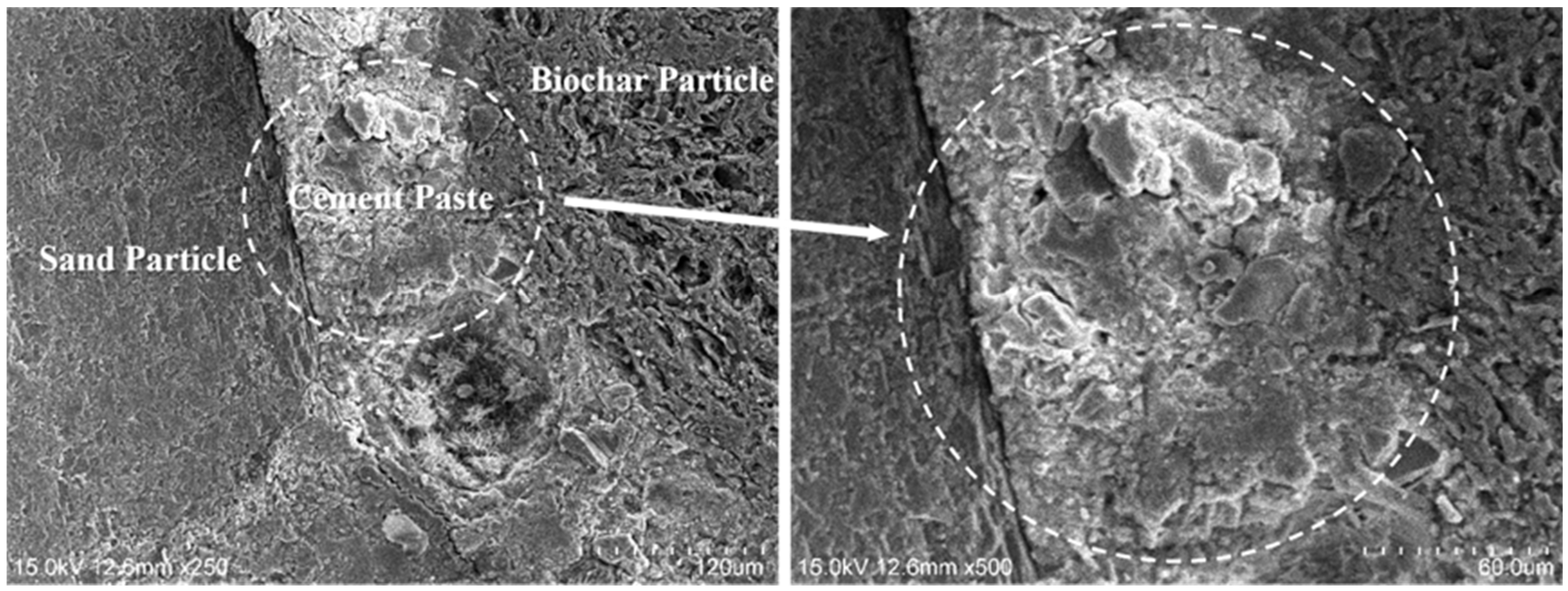
Biochar behaves primarily as a filler, contributing to the improvement of particle packing and refining the pore structure of concrete. It should be emphasized that biochar does not act as a cementitious replacement of PC; rather, it serves as an inert or quasi-inert filler in the concrete mix. Therefore, the overall concrete mix design components’ calculations should account for biochar as a filler component rather than as a substitute for PC. Incorrect mix proportioning makes it difficult to compare studies with one another, and may lead to misleading conclusions (for example, 2 out of 10 reviewed studies consider this aspect [9,10,11,12,13,14,15,16,17,18]). Biochar’s high water absorption also affects hydration. The interfacial transition zone (ITZ) between biochar and cement paste might be denser compared to that between sand and cement paste (see, as an example, Figure 2 [12]). This has been attributed to enhanced hydration through water migration and improved mechanical interlocking of hydration products within the pores of biochar [11]. However, a denser ITZ is not observed for all types of biochar; in particular, highly carbonized biochar produced at elevated pyrolysis temperatures, porous agricultural biochar (for example, rice-husk- or straw-derived), coarse or untreated biochar, and high-ash biochar (for example, sludge-derived) often result in a more porous and weaker ITZ compared to conventional sand–cement systems.
Figure 2.
ITZ between cementitious matrix and carya cathayensis peel biochar/sand particles [12].
In turn, this also leads to lower workability of biochar-based concrete, with the fact that an addition above 5 wt.% of cement may result in a significant loss of workability exceeding 20%. The initial moisture content of biochar is a very important factor affecting water-to-cement (w/c) or w/b ratio, and it should therefore be stored in a controlled environment [14]. For example, the presence of pre-wetted biochar in UHPC with 2 wt.% of cement can slightly increase the initial fluidity compared to the reference mix [19].
The globally reproducible slag-based AAC mix design with consistence class S4 and compressive strength above 50 MPA at 28 days [8] can serve as a starting point for limiting one variable, AABs characteristics, while ensuring good fresh properties capable of withstanding biochar incorporation in the AAC mix. The porosity of the filler tends to decrease workability and affect the mechanical properties; on the contrary, it may behave as a buffer, capable of controlling the alkalinity within the material, reducing the negative effects of the efflorescence, and mitigating the dimensional changes. Biochar has an intrinsic alkaline character, and its porosity can act as an alkaline reservoir that promotes and maintains the integrity of the 3D structure [15]. Considering that biochar particles may store part of the mixing water and later release it into the matrix during hydration, thereby compensating the moisture loss due to self-desiccation or external drying, this may favor the cracking resistance of AAC. Accelerated setting time is also another challenge of incorporation of biochar in AAC. Therefore, for practical application purposes, the dosage of biochar can be limited to below 0.5–2 wt.% of the binder [13]. The mechanical properties’ increase is not a key point in this regard; however, it is also known that the addition of biochar typically increases the compressive strength up to 10% when it is added at the level of ≥5 wt.% of cement, as reported in many research outputs [9,18,20,21]. As shown in [10], the addition of biochar up to 0.5 wt.% of the binder may increase compressive strength by 20% at 28 days for the alkali-activated slag (AAS) binder based on biochar composites. Though, pre-treated biochar with microstructural densification may cause moderate reductions in mechanical performance. An interesting aspect is that experimental results indicate that adding biochar of 1–3 wt.% of cement can reduce carbonation depth by 20–35% and lower the chloride diffusion coefficient by approximately 15–25% compared to the reference mix [16]. The formation of CaCO3 due to biochar [18] leads to a more refined and denser microstructure, and as a result, reduces permeability, limits the ingress of harmful substances such as chlorides and sulfates, and improves resistance to freeze–thaw cycles.
Pyrolysis temperature was found to be one of the most important parameters during biochar production, with high temperature (800 °C) contributing to an increase in the content of PAHs and heavy metals (chromium (Cr), copper (Cu), cadmium (Cd), lead (Pb), and manganese (Mn)), which in turn increases the toxic effects of biochars on the test plants [22]. In the study by Legan et al. [17], the Cr content in the biochar-containing mortar with 5% reduced content of PC was compared to a mortar with 5% higher PC content and no biochar; the results show that Cr concentration in leachates was two times higher in the latter. These findings suggest that the addition of biochar may contribute to an increased toxic effect of leachates on duckweed.
Future research is likely to focus on optimizing biochar selection and pre-treatment (based on feedstock, pyrolysis conditions, particle size, and surface chemistry) to enhance durability, internal curing, and mechanical performance in concrete and AAMs. There is potential to combine biochar with nanomaterials for synergistic effects, but challenges remain in achieving uniform dispersion, reproducibility, and scalable production. Biochar’s stable carbon structure also offers opportunities for carbon-negative construction, particularly when paired with low-CO2 binders, highlighting its role in sustainable, high-performance building materials. Elaboration of standardized guidelines, economic feasibility, and safe handling practices is critical for its wider adoption.
3. Advanced Nano-Engineered Concrete and AAMs
To meet the increasing demands of the global construction industry and infrastructure complexities, traditional construction materials need re-engineering [23,24]. This can be achieved in multiple ways by incorporating different raw materials which can function as binder replacements, aggregate replacements, fibers, strength-boosting additives, etc. However, the limitations of using traditional building materials like concrete are two-fold, and they include its associated carbon footprint [24,25] and the inherent limitations of its brittle nature along with its tendency towards micro-cracking [26,27].
These challenges prompted research into engineered concrete and thus diverted attention towards the incorporation of nanomaterials. The scope of nanomaterials is not just limited to performance-enhancing additives; they also target specific challenges faced when using traditional PCC. Nanomaterials work as nucleating sites; thus, their mechanism of action is rooted in a fundamental function change [26,28].
The nucleating mechanism of nanomaterials like nano-silica and nano-alumina is attributed to their ultrafine particle sizes which can range between 10 and 100 nm. This particle size enables filling of interstitial voids that increase packing density and refine ITZ via a filler effect [26,29]. The higher specific surface area of these nanomaterials acts as a nucleation site suitable for the growth of a C-S-H matrix. This results in the formation of a denser and more cohesive C-S-H matrix and subsequent strength and durability enhancement [26,30]. Furthermore, nanomaterials like nano-silica that have glassy pozzolanic phases react with portlandite, resulting in the formation of secondary C-S-H phases [31,32]. This not only densifies the matrix but also provides resistance to chemical attacks, improving long-term durability [31,32].
In spite of these attractive advantages in concrete, the in situ applications of nanomaterials are limited. The primary practical challenge is their dispersion. The natural tendency of nanomaterials is to agglomerate, owing to their high surface area and van der Waals forces [30,33]. The formed clusters function as weak zones and the advantages that nanomaterials offer are not realized in such a form [34,35].
Usually, researchers employ ultrasonication before the addition to the concrete mix at a laboratory scale. The effect of ultrasonication lasts only for a shorter duration, is difficult to scale-up for in situ applications, and generally the nanomaterials dispersed via ultrasonication agglomerate under high alkaline environments like in concrete mixes [30]. A more practical and reliable approach for large-scale dispersion of nanomaterials is high-shear dispersion (HSD). Specifically designed rotors operate at a speed of approximately 3000 rpm, generating mechanical shear forces strong enough to uniformly disperse nanomaterials [27,30].
A study on the inclusion of nano-alumina in a M40 grade concrete shows that HSD enabled functional dispersion of nano-alumina, which was realized via performance improvements. Nano-alumina with particle sizes ranging between 10 nm and 30 nm dosed at 1.5% by weight of cement when dispersed via HSD improved the compressive, splitting tensile, and flexural strengths at 28 days [27,30]. The microstructural analyses also showed a denser C-S-H matrix accompanied by a 65% reduction in void size [27,30]. This highlights the efficiency of HSD to disperse nanomaterials that can be in a stable dispersion throughout the mixing phase and carry out their functions [30].
Researchers have also demonstrated the potential of HSD via statistical reliability in addition to pure strength-enhancement data. The primary drawback of using nanomaterials in traditional PCC mixes is dispersion, as discussed earlier, but the variability in dispersion is also a significant obstacle in field-level applications. However, multivariable regression and Weibull statistical analyses have shown that the performance variability of mixes modified by HSD are significantly reduced. This positions HSD as a potential tool to enable in situ application of nanomaterials in critical infrastructure projects where predictability is paramount [30]. Table 1 highlights the mechanisms and stability comparison of ultrasonication and HSD.
Table 1.
Mechanisms and comparison of dispersion techniques.
Recent advancements in nanomaterials are moving towards incorporating hybrid approaches. The failure of concrete can occur across multiple scales—from nanoscale cracks to visible microcracks. Hence, to address this issue, research is progressing towards the use of nanomaterials of different geometries to achieve a synergistic effect that a single nanomaterial cannot provide.
One-dimensional carbon nanotubes (CNT), owing to their high tensile strength and aspect ratio, function as nanoscale bridges. They effectively function to bridge microcracks, thereby delaying crack propagation via load transfer and finally improving the fracture toughness [30,36]. Two-dimensional graphene oxide (GO) functions as a template for nucleation of the C-S-H matrix. The hydroxyl and carboxyl groups in GO containing oxygen have strong affinity to interact with calcium ions, leading to the formation of a more ordered and homogenized C-S-H matrix [37]. One of the drawbacks of GO is its tendency to agglomerate in the presence of calcium ions, owing to the strong affinity. When CNTs are introduced in such mixes, they help prevent restacking due to van der Waals forces and the subsequent collapse of GO [17,18]. This results in a “scaffold” effect that maintains uniform dispersion and maximizes the reinforcing efficiency of both materials [36,38].
Research on hybridization of CNT and GO show the significantly enhanced thermal stability of concrete up to temperatures as high as 600 °C compared to single-nanomaterial mixes [39,40]. At such high-temperatures, traditional PCC mixes dehydrate and C-S-H starts disintegrating. However, in hybridized CNT and GO concrete mixes, the template-grown hydrates formed around GO sheets exhibit superior resistance to thermal disintegration while CNT functions to provide the bridging effect [40].
The well-researched mechanisms of nanomaterials are summarized in Table 2.
Table 2.
Mechanisms and impacts of nano-additives.
There are other infrastructural advancements in nanomaterials in addition to their function as a passive structural material. An upcoming field of nanomaterial application is active sensing platforms. Conductive nanomaterials like multi-walled CNTs, graphene nanoplatelets, and nano-carbon blacks can be endowed with piezoelectric properties [52,53]. The inclusion of such materials enables concrete to detect stress, strain, and crack formation [54]. Using intrinsic self-sensing concrete helps to avoid compatibility and durability issues that are often faced with externally used sensors [52,54]. Recent works have also explored triboelectric nanogenerators that can harvest mechanical energy from traffic or wind to power sensing functions. This unlocks the development towards autonomous structural health monitoring [53].
Besides sensing and structural capabilities of nanomaterials, research towards environmental remediation is also gaining traction. Materials like nano-titanium provide photocatalytic functionality which, when exposed to light, generates reactive oxygen that can oxidize volatile organic compounds, sulfur dioxide, and nitrogen oxides [55]. This functionality of nano-titanium enables self-cleaning coatings and air-scrubbing pavement applications. Advanced surface engineering, such as with the surface-coated and impregnated (SURF-IMP) sample, has demonstrated over 67% pollutant degradation, outperforming bulk-modified samples where nanoparticles are trapped deep within the matrix [55]. Coating pavements with photocatalytic helps purify the rundown water. Research shows that the efficiency of such systems goes up to removal rates of 50% of chemical oxygen demand, 40% of ammonia nitrogen, and 60% of total phosphorous [56,57]. Additionally, at dosages of 1–6%, they have been found to refine the pore structure and improve the mechanical resistance of concrete, ensuring that environmental benefits persist throughout the structure’s lifecycle [55].
Nanomaterials are also incorporated into AAMs where they exhibited similar compatibility as traditional PCC systems. Nano-silica reduced the setting time in binary-blended AAMs comprising slag and fly ash as precursors while simultaneously improving the early stiffness of the matrix [58].
The mechanical and fresh-state properties of nano-modified AAMs data are summarized in Table 3.
Table 3.
Impact of nanomaterials on AAMs [58,59,60,61].
In a ternary-blended AAM system with calcined kaolin, slag, and fly ash as precursors, 2% of nano-alumina and 2% of nano-calcium carbonate provided substantial strength gains. However, the combination of nano-alumina and nano-calcium carbonate results in highest compressive and splitting tensile strengths. This synergistic effect is due to the refinement of the matrix network by nano-alumina and the accelerated formation of calcium-based reaction products by nano-calcium carbonate [61].
Nano-modified AAMs exhibit enhanced resistance to aggressive environments, which is imperative for their adoption in sustainable infrastructure [59]. Nano-metakaolin, added at dosages of 1–5%, has been shown to effectively inhibit corrosion and damage from chloride and sulfate erosion under dry–wet cycling conditions. Furthermore, in AAS mortars, the problem of efflorescence is mitigated using nano-silica. Nano-silica accelerates the hydration rate and refines the pore structure, thereby limiting the transport of ions and the formation of efflorescence products [62].
The future research and scope of nanomaterials is likely to focus on optimizing the dispersion methods and dosage via analytical and computational modeling. AI-driven material design will be critical for large-scale applications. More research into long-term durability along with standardized testing protocols for nanomaterials and nano-engineered concrete mixes is essential. Sustainable development will emphasize LCA, low-carbon binders, and eco-friendly nanomaterial synthesis.
4. Recycled Aggregates in Concrete and AAMs
4.1. Recycling of AAC Trends
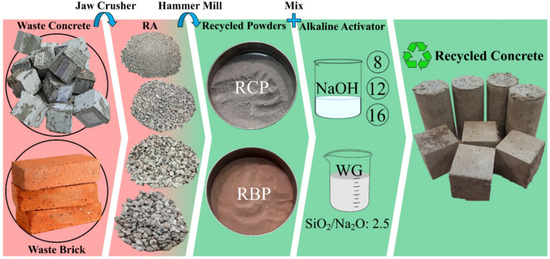
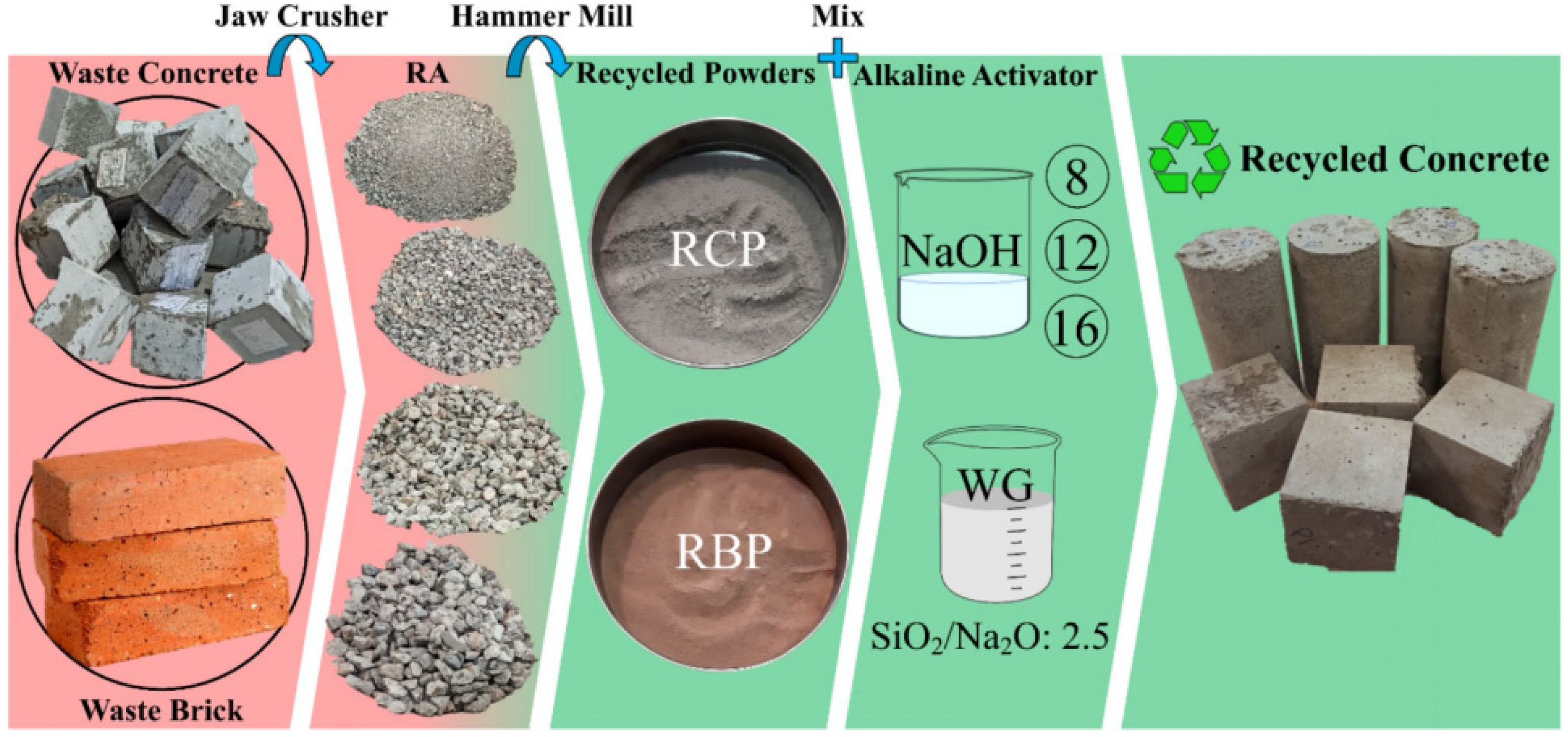
The increasing demand for sustainable construction practices has highlighted the significance of recycling and reusing materials, especially in the concrete industry. AAC has emerged as a promising alternative due to its ability to reduce carbon emissions compared to traditional PCC. For instance, recycled concrete and masonry materials prepared for alkali-activated applications further enhance sustainability by using CDW from landfills and incorporating it into low-carbon binder systems (see Figure 3). This section synthesizes recent trends and technological advancements in the recycling of AAC, examining its integration with conventional concrete-recycling efforts.
Figure 3.
Recycling of concrete and masonry materials using AAMs technology (RCP—recycled concrete powder, RBP—recycled brick powder, WG—water glass) [63].
Recent studies underscore the environmental benefits of recycling AAC. AAC is recognized for its reduced carbon footprint, primarily due to the utilization of industrial by-products such as fly ash and slag, which eliminates a significant portion of PC use [64]. The LCAs of these materials consistently indicate lower greenhouse gas emissions, with reductions of up to 50% compared to traditional PCC mixtures. A review conducted by Verma and Gulati [65] further supports this, showing that recycled materials offer significant reductions in environmental impact, making a case for their increased use in sustainable architecture.
Incorporating RA into AAC can enhance its mechanical properties while also contributing to sustainability. Research demonstrates that recycled concrete aggregates (RCA) can maintain structural integrity and improve the performance of AAC under certain conditions, such as optimized replacement ratios, proper pre-treatment of RA, controlled w/b ratios, suitable particle grading, and appropriate curing conditions. Furthermore, studies have focused on the durability of AAC made with recycled materials, finding that properties such as compressive strength and resistance to environmental factors are comparable to or even exceed those of conventional concrete mixtures [64,66]. This reinforces AAC viability as a sustainable material in construction.
Technological advancements also play an important role in the recycling of AAC. New methodologies such as the dry-washing technology for treating recycled concrete sludge effectively reduce waste and enhance recycling potential [67]. This method presents a feasible approach to capture and recycle aggregates from concrete operations, thereby integrating lower carbon footprint materials back into the production cycle.
In parallel, researchers have investigated the energy and environmental impacts of incorporating industrial waste, such as reclaimed wind turbine blades, into AAC [68]. The inclusion of various recycled materials into AAC formulations has shown promising results, resulting in enhanced performance characteristics while reducing reliance on virgin materials.
4.2. Combining AAC and Conventional Concrete Recycling
The transition towards a circular economy in the concrete sector is facilitated by policy frameworks aiming to promote greater recycling rates of construction and demolition waste [69]. The European Union’s Waste Framework Directive emphasizes the recycling of construction debris, aiming for 70% recovery by 2020 [70] and continuous application through 2026. Such policies create a conducive environment for the adoption of AAC alongside conventional concrete, enabling industry stakeholders to assess and implement sustainable practices collectively.
Economic considerations also play a crucial role in the adoption of AAC and recycled concrete. Comprehensive life cycle assessments reveal that structures employing recycled materials can achieve a substantial reduction in costs and environmental impacts [64,66]. As cited by Jasim et al. [71], detailed evaluations of life cycle costs reveal that using RA in concrete production can mitigate the overall expenses associated with conventional material sourcing and processing.
Despite the advantages, there are several challenges to the widespread adoption of recycled AAC. Variability in the properties of recycled materials can pose significant challenges in construction applications [72]. There is also ongoing research aimed at fine-tuning treatment and processing methods to enhance the quality of RA. Industry practitioners often express concerns regarding the performance consistency of recycled materials; thus, comprehensive guidelines and standards must be developed and adopted to address these issues [73,74]. A promising approach is using nano-modified RA treated with nano-silica slurry under vacuum, which allows nanoparticles to penetrate the pores and microcracks of old mortar [75]. This improves ITZ, reduces porosity, and results in higher concrete compressive strength and durability.
The recycling of AAC represents a critical aspect of sustainable construction practices. By integrating innovative technologies, adhering to regulatory frameworks, and emphasizing lifecycle assessments, stakeholders can harness the full potential of AAC as a superior alternative to traditional PCC. Continued research and development are essential in this field to overcome existing challenges and fully realize the environmental and economic benefits.
4.3. Recycled Aggregates
The environmental impact of concrete is not only the CO2 production related to cement. The natural resource depletion due to the production of natural aggregates is another big problem. A possible solution aiming at a circular economy is the use of RA [76]. RA from CDW are typically classified as recycled concrete aggregates (RCA), mixed recycled aggregates (MRA) (concrete + masonry), and recycled masonry aggregates (RMA). Their performance is governed by the parent material, crushing/processing route, grading, and contaminant content. Compared to natural aggregates, RCA usually exhibit lower density, higher water absorption, and a weaker old mortar phase; as a result, RA concretes (RAC) tend to show reduced elastic modulus and tensile strength, and may require specific mix design adaptations, see [77,78,79,80].
Key microstructural features include: (i) adhered mortar on RCA particles, (ii) pre-existing microcracks induced by demolition and crushing, and (iii) the presence of two ITZs (old ITZ and new ITZ). These features help explain why the same replacement ratio can lead to different responses depending on RA quality and moisture conditioning. Processing strategies such as improved crushing sequences, additional removal of fines/contaminants, and targeted aggregate treatments (e.g., carbonation, mechanical/thermal treatments) have been shown to improve aggregate quality and, consequently, mechanical and durability performance, see [78,81,82]. Fresh-state behavior is strongly affected by RA water absorption and shape. Comprehensive reviews identify RA moisture state, grading and adhered mortar content as primary drivers of workability loss; effective measures include controlled pre-wetting, compensation water approaches, and the combined use of superplasticizers and supplementary cementitious materials (SCMs), see [83,84].
For many structural applications, partial replacement levels (often up to ~30% coarse RCA, depending on specifications and target strength) can achieve satisfactory compressive strength, while reductions in stiffness and splitting tensile strength are more persistent. The role of parent concrete has been studied experimentally, showing that mechanical performance of RAC is not necessarily correlated with parent concrete strength, whereas durability indicators (e.g., chloride ingress resistance) can be more sensitive [80,84].
Durability remains the critical issue for design in aggressive environments. Reviews consistently report increased permeability-related transport properties (water absorption, sorptivity, chloride penetration) with increasing RA content, but also highlight that SCMs (fly ash, slag, silica fume) and optimized mix design can partially mitigate these effects. For freeze–thaw, results are more scattered and depend on an air-void system, aggregate quality and saturation degree, see [85].
While many studies focus on material-level properties, evidence on full-scale elements is growing. Design-oriented studies indicate that conventional reinforced concrete design frameworks (e.g., Eurocode 2 [86]) can be applied to RAC with evidence-based adjustments of key material parameters. Within this stream, experimental campaigns on slabs made with RCA have addressed shear-critical mechanisms such as punching shear and cracking behavior, providing data for the calibration of resistance models and for assessing serviceability limits [84,87]. Composite steel–concrete systems offer an additional pathway to the structural use of RAC, because composite action can compensate for reduced concrete stiffness and strength in some limit states. Recent experimental evidence on composite slabs with RCA suggests that global behavior can remain satisfactory when interface behavior and connector performance are properly accounted for, and the resulting environmental and economic benefits can be significant in circular retrofit and demolition/rebuild scenarios [88,89,90].
Open challenges include: (i) harmonized quality classes for RA linked to performance-based specifications, (ii) more robust durability models incorporating RA variability, (iii) reliable relationships between RA characteristics and structural-scale limit states (shear, fatigue, long-term deflection), and (iv) consistent LCA frameworks that capture transport, processing energy, and local CDW management chains.
5. Challenges and Opportunities
Construction materials undergo transformation towards reaching sustainability goals, urbanization, and technological innovation [91]. The current key opportunity is the development of low-carbon and carbon-neutral materials, including AAM binders, RA, and carbon-capturing technologies that help to reduce the environmental footprint of the built environment. RA plays an important role in promoting circular economy practices by reducing landfill waste and conserving natural resources. However, challenges such as variability in quality, higher water absorption, potential contaminants, and the need for improved standardization must be addressed to ensure consistent structural performance worldwide. Biochar offers a sustainable compound in cement composite, but its adoption is limited by variability in properties like porosity, surface area, and chemical composition, which depend on biomass source, pyrolysis conditions, and particle size. Large-scale use is constrained by availability and the challenge of maintaining consistent quality. Limited research also leaves gaps in economic feasibility, long-term durability, and standardized guidelines. Addressing these challenges requires further study, standardized testing approaches, and industry collaboration to optimize biochar integration in cementitious and AAMs. Meanwhile, nano-additives such as nano-silica, nano-alumina, CNTs, GO, and Nano-CaCO3 provide opportunities to improve mechanical properties, refine microstructure, improve crack resistance, and increase durability. The large-scale application of nano-additives in PCC and AAMs is limited to high production costs and difficulties in mass manufacturing. Technical issues such as particle agglomeration reduce performance. The limited long-term performance data make it difficult to fully access durability and lifecycle impacts under real-environment conditions.
By 2036, advancements will likely focus on standardizing production methods for biochar to ensure consistent quality, improving nanoparticle dispersion for more predictable composite material properties, and enhancing the processing of RA to reduce impurities. The integration of AI and machine learning could optimize mix designs, while LCA will guide greener, low-carbon formulations. Ultimately, these innovations will help reduce the environmental footprint of building materials, improving their durability and functionality, and making them more suitable for large-scale, sustainable infrastructure.
Author Contributions
Conceptualization—P.K.D.M. and F.S.; writing—original draft preparation, P.K.D.M., K.K.R. and F.S.; writing—review and editing, P.K.D.M. and F.S. All authors have read and agreed to the published version of the manuscript.
Funding
This research received no external funding. The APC was supported by P.K.D.M.
Data Availability Statement
The original contributions presented in this study are included in the article. Further inquiries can be directed to the corresponding author.
Conflicts of Interest
The authors declare that they have no known competing commercial or financial or personal relationships that could have appeared to influence the work reported in this article. K.K.R. was employed by the company MYK Laticrete (India).
References
- Ogawa, M.; Okimori, Y. Pioneering works in biochar research, Japan. Aust. J. Soil Res. 2010, 48, 489–500. [Google Scholar] [CrossRef] [Scilit]
- Lehmann, J.; Joseph, S. Biochar for Environmental Management. Science, Technology and Implementation, 3rd ed.; Routledge: London, UK, 2024; p. 902. [Google Scholar]
- How to Properly Disperse Nanoparticles or Microparticles and Avoid Agglomeration Issues. Available online: https://www.getnanomaterials.com/kb/how-to-properly-disperse-nanoparticles-or-microparticles-and-avoid-agglomeration-issues/ (accessed on 31 March 2026).
- Laishram, D.; Kim, S.-B.; Lee, S.-Y.; Park, S.-J. Advancements in biochar as a sustainable adsorbent for water pollution mitigation. Adv. Sci. 2025, 12, 2410383. [Google Scholar] [CrossRef] [Scilit]
- Barbhuiya, S.; Bhusan Das, B.; Kanavaris, F. Biochar-concrete: A comprehensive review of properties, production and sustainability. Case Stud. Constr. Mater. 2024, 20, e02859. [Google Scholar] [CrossRef] [Scilit]
- Kara De Maeijer, P.; Ramagiri, K.K.; Lukovic, M.; Rossi, L.; Masi, G.; Kar, A.; Ganapathi Chottemada, P.; Yliniemi, J.; Ichimiya, K.; Sha, W.; et al. Hardened AAM Properties. In Mechanical Properties of Alkali-Activated Materials: State-of-the-Art Report of the RILEM Technical Committee 294-MPA; Ye, G., Dehn, F., Eds.; Springer Nature Switzerland: Cham, Switzerland, 2026; pp. 225–276. [Google Scholar] [CrossRef] [Scilit]
- Marathe, S.; Sadowski, Ł. Developments in biochar incorporated geopolymers and alkali activated materials: A systematic literature review. J. Clean. Prod. 2024, 469, 143136. [Google Scholar] [CrossRef] [Scilit]
- Kara De Maeijer, P.; Ye, G.; Li, Z.; Ramagiri, K.K.; De Schutter, G.; Sun, Y.; Dehn, F.; Kar, A.; Yliniemi, J.; Ma, Y.; et al. Examining reproducible mix design, fresh and mechanical properties of ground granulated blast furnace slag-based alkali-activated concrete (GGBFS-based AAC): Results of an interlaboratory study of RILEM TC 294-MPA. Mater. Struct. 2025, 58, 235. [Google Scholar] [CrossRef] [Scilit]
- Chen, L.; Zhou, T.; Yang, J.; Qi, J.; Zhang, L.; Liu, T.; Dai, S.; Zhao, Y.; Huang, Q.; Liu, Z.; et al. A review on the roles of biochar incorporated into cementitious materials: Mechanisms, application and perspectives. Constr. Build. Mater. 2023, 409, 134204. [Google Scholar] [CrossRef] [Scilit]
- Tamošaitis, G.; Vaičiukynienė, D.; Kantautas, A.; Fornés, I.V.; Borg, R.P.; Vitola, L. Lightweight, heat-insulating, alkali-activated slag composites with carbon-based biochar additive and filler. Materials 2026, 19, 277. [Google Scholar] [CrossRef] [Scilit] [PubMed]
- Mrad, R.; Chehab, G. Mechanical and microstructure properties of biochar-based mortar: An internal curing agent for PCC. Sustainability 2019, 11, 2491. [Google Scholar] [CrossRef] [Scilit]
- Li, Z.; Xue, W.; Zhou, W. Mechanical properties of concrete with different carya cathayensis peel biochar additions. Sustainability 2023, 15, 4874. [Google Scholar] [CrossRef] [Scilit]
- Egodagamage, H.; Yapa, H.; Buddika, S.; Loh, T.; Navaratnam, S.; Patrisia, Y.; Nguyen, K. Enhancement of impact resistance of alkali-activated slag concrete through biochar supplementation. Struct. Concr. 2024, 25, 3630–3647. [Google Scholar] [CrossRef] [Scilit]
- Hylton, J.; Hugen, A.; Rowland, S.M.; Griffin, M.; Tunstall, L.E. Relevant biochar characteristics influencing compressive strength of biochar-cement mortars. Biochar 2024, 6, 87. [Google Scholar] [CrossRef] [Scilit]
- Saccani, A.; Baldazzi, L.; Manzi, S. Effects of biochar addition on the properties of alkali-activated materials. Materials 2025, 18, 486. [Google Scholar] [CrossRef] [Scilit]
- Abbas, A.A.; Thapa, S.J. Experimental investigation of low-carbon concrete using biochar as partial cement replacement. Sustainability 2025, 17, 10744. [Google Scholar] [CrossRef] [Scilit]
- Legan, M.; Štukovnik, P.; Zupan, K.; Žgajnar Gotvajn, A. Assessment of mechanical and ecotoxicological properties of mortar with wood waste biochar as partial cement replacement. Materials 2025, 18, 876. [Google Scholar] [CrossRef] [Scilit]
- Room, S.; Bahadori-Jahromi, A. Hydration kinetics of biochar-enhanced cement composites: A mini-review. Buildings 2025, 15, 2520. [Google Scholar] [CrossRef] [Scilit]
- Huang, C.; Zong, Z.; Chen, P. Enhancing the performance of ultra-high performance concrete using expansive agent and pre-wetted biochar to produce a synergistic effect. Buildings 2025, 15, 1348. [Google Scholar] [CrossRef] [Scilit]
- Zhou, Z.; Wang, J.; Tan, K.; Chen, Y. Enhancing Biochar Impact on the Mechanical Properties of Cement-Based Mortar: An Optimization Study Using Response Surface Methodology for Particle Size and Content. Sustainability 2023, 15, 14787. [Google Scholar] [CrossRef] [Scilit]
- Zhao, Z.; El-Naggar, A.; Kau, J.; Olson, C.; Tomlinson, D.; Chang, S.X. Biochar affects compressive strength of Portland cement composites: A meta-analysis. Biochar 2024, 6, 21. [Google Scholar] [CrossRef] [Scilit]
- Stefaniuk, M.; Oleszczuk, P.; Bartmiński, P. Chemical and ecotoxicological evaluation of biochar produced from residues of biogas production. J. Hazard. Mater. 2016, 318, 417–424. [Google Scholar] [CrossRef] [Scilit] [PubMed]
- Smart Transport Infrastructure with Nanoengineered Multifunctional Concrete. Available online: https://transweb.sjsu.edu/csutc/research/utc/Smart-Transport-Infrastructure-Nanoengineered-Multifunctional-Concrete (accessed on 26 February 2026).
- Artificial Intelligence Produces a Recipe for Lower-Carbon Concrete. Available online: https://cee.illinois.edu/news/artificial-intelligence-produces-recipe-lower-carbon-concrete (accessed on 26 February 2026).
- Using AI to Make Lower-Carbon, Faster-Curing Concrete. Available online: https://engineering.fb.com/2025/07/16/data-center-engineering/ai-make-lower-carbon-faster-curing-concrete/ (accessed on 26 February 2026).
- Vignesh, J.; Ramesh, B.; Xavier, J.R. Recent advances in nano-engineered cement composites for sustainable and smart infrastructure. Nanotechnol. Environ. Eng. 2025, 10, 81. [Google Scholar] [CrossRef] [Scilit]
- New Concrete Method Resists Heat, Chemicals, and Cracking with Nano-Alumina. Available online: https://www.azobuild.com/news.aspx?newsID=23988 (accessed on 26 February 2026).
- Smart Nano-Construction Materials Market. Global Market Analysis Report—2035. Available online: https://www.futuremarketinsights.com/reports/smart-nano-construction-materials-market (accessed on 26 February 2026).
- Jalil, T.A.; Fawzi, N.M. Effect of nano alumina on some properties of sustainable reactive powder concrete. J. Ecol. Eng. 2025, 26, 1–10. [Google Scholar] [CrossRef] [Scilit]
- Rahman, I.; Dev, N.; Arif, M.; Paruthi, S.; Khan, A.H.; Yusufi, F.N.K.; Alam, M.M. Effect of high shear-dispersed nano-alumina on concrete strength, durability, and microstructure. Sci. Rep. 2026, 16, 5346. [Google Scholar] [CrossRef] [Scilit]
- Rangarajan, J.; Mathisekaran, R. Enhanced mechanical performance of reinforced concrete beams with nano-alumina: An experimental and analytical flexural study. SciELO Matéria 2025, 30, e20250081. [Google Scholar] [CrossRef] [Scilit]
- Norhasri, M.S.M.; Hamidah, M.S.; Fadzil, A.M. Applications of using nano material in concrete: A review. Constr. Build. Mater. 2017, 133, 91–97. [Google Scholar] [CrossRef] [Scilit]
- Recent Progress in Nanoparticle Dispersion Using Bead Mill. Available online: https://www.jstage.jst.go.jp/article/kona/34/0/34_2017004/_html/-char/en (accessed on 26 February 2026).
- Sanchez, F.; Sobolev, K. Nanotechnology in concrete—A review. Constr. Build. Mater. 2010, 24, 2060–2071. [Google Scholar] [CrossRef] [Scilit]
- Shen, M.-Y.; Liao, W.-Y.; Wang, T.-Q.; Lai, W.-M. Characteristics and mechanical properties of graphene nanoplatelets-reinforced epoxy nanocomposites: Comparison of different dispersal mechanisms. Sustainability 2021, 13, 1788. [Google Scholar] [CrossRef] [Scilit]
- Pu, Y.; Yang, S.; Qi, M.; Sheng, K.; Bi, J.; Fan, F.; Yuan, X. Synergistic effect of graphene oxide and hydroxylated graphene on the enhanced properties of cement composites. RSC Adv. 2022, 12, 26733–26743. [Google Scholar] [CrossRef] [Scilit]
- Gupta, O.; Roy, S.; Rao, L.; Mitra, S. Graphene oxide-carbon nanotube (GO-CNT) hybrid mixed matrix membrane for pervaporative dehydration of ethanol. Membranes 2022, 12, 1227. [Google Scholar] [CrossRef] [Scilit]
- Yang, Y.; Shen, H.; Yang, J.; Gao, K.; Wang, Z.; Sun, L. Synergistic effect of reduced graphene oxide/carbon nanotube hybrid papers on cross-plane thermal and mechanical properties. RSC Adv. 2022, 12, 19144–19153. [Google Scholar] [CrossRef] [Scilit] [PubMed]
- Yao, Y.; Lu, H. Mechanical properties and failure mechanism of carbon nanotube concrete at high temperatures. Constr. Build. Mater. 2021, 297, 123782. [Google Scholar] [CrossRef] [Scilit]
- Han, S.; Hossain, M.S.; Ha, T.; Yun, K.K. Performance of carbon nanomaterials incorporated with concrete exposed to high temperature. Nanotechnol. Rev. 2024, 13, 20240036. [Google Scholar] [CrossRef] [Scilit]
- Tran, H.-B. The effects of nano SiO2 and silica fume on the engineering properties of cement concrete in construction, Vietnam. Xinan Jiaotong Daxue Xuebao/J. Southwest Jiaotong Univ. 2021, 56, 228–241. [Google Scholar] [CrossRef] [Scilit]
- Khan, K.; Ahmad, W.; Amin, M.N.; Nazar, S. Nano-silica-modified concrete: A bibliographic analysis and comprehensive review of material properties. Nanomaterials 2022, 12, 1989. [Google Scholar] [CrossRef] [Scilit]
- Manoj, G.; Thirugnanasambandam, S. Experimental investigations on nano silica concrete. E3S Web Conf. 2024, 559, 04046. [Google Scholar] [CrossRef] [Scilit]
- Labaran, Y.H.; Atmaca, N.; Tan, M.; Atmaca, K.; Aram, S.A.; Kaky, A.T. Nano-enhanced concrete: Unveiling the impact of nano-silica on strength, durability, and cost efficiency. Discov. Civ. Eng. 2024, 1, 116. [Google Scholar] [CrossRef] [Scilit]
- Wang, Y.; Li, G.; Li, C.; Gan, J.; Chen, D.; Zhang, H.; Wang, M.; Wang, X.; Zhang, Y.; Tang, L. A comparative study of nano-SiO2 and nano-Al2O3 on the improvement of concrete properties under low temperature curing conditions (5 °C). J. Meas. Eng. 2025, 14, 21–38. [Google Scholar] [CrossRef] [Scilit]
- Ziada, M. The effect of nano-TiO2 and Nano-Al2O3 on mechanical, microstructure properties and high-temperature resistance of geopolymer mortars. Arab. J. Sci. Eng. 2025, 50, 12977–12996. [Google Scholar] [CrossRef] [Scilit]
- Reis, E.D.; Borges, L.A.; Camargos, J.S.F.; Gatuingt, F.; Poggiali, F.S.J.; Bezerra, A.C.d.S. A systematic review on the engineering properties of concrete with carbon nanotubes. J. Braz. Soc. Mech. Sci. Eng. 2023, 45, 205. [Google Scholar] [CrossRef] [Scilit]
- Li, Q.; Lee, J.C.; Moon, W.C.; Ng, J.L.; Yusof, Z.M.; Hong, X.; He, Q.; Li, B. Mechanical and microstructural improvements of high-strength lightweight concrete with carbon nanotubes and shale-based aggregates. Discov. Appl. Sci. 2025, 7, 671. [Google Scholar] [CrossRef] [Scilit]
- Jenima, J.; Priya Dharshini, M.; Ajin, M.L.; Jebeen Moses, J.; Retnam, K.P.; Arunachalam, K.P.; Avudaiappan, S.; Arrue Munoz, R.F. A comprehensive review of titanium dioxide nanoparticles in cementitious composites. Heliyon 2024, 10, e39238. [Google Scholar] [CrossRef] [Scilit] [PubMed]
- Ravi Theja, A.; Sivaramakrishnaiah, M.; Sastry, K.V.S.G.K.; Sashidhar, C.; Paramasivam, P.; Kanti, P.K.; Ayani, A.G. Influence of nano titanium dioxide on strength and durability of ambient-cured GGBS-based geopolymer concrete. Res. Eng. 2025, 27, 105757. [Google Scholar] [CrossRef] [Scilit]
- Liu, C.; Yang, X.; Gu, Y.; Ge, Y. Uniaxial Dynamic Compressive Mechanical Properties of Alkali-Activated Recycled Aggregate Concrete Modified by Single and Combined Incorporation of CNTs/GO. Buildings 2026, 16, 918. [Google Scholar] [CrossRef] [Scilit]
- Li, X.; Feng, Z.-G.; Cui, Q.; Wang, Z.; Du, W.; Li, X. Piezoresistive behaviors of self-sensing cementitious composite with well-dispersed carbon nanotube. Constr. Build. Mater. 2025, 474, 141123. [Google Scholar] [CrossRef] [Scilit]
- Dong, W.; Peng, S.; Wang, K.; Huang, Y.; Shi, L.; Wu, F.; Li, W. Integrated triboelectric self-powering and piezoresistive self-sensing cementitious composites for intelligent civil infrastructure. Nano Energy 2025, 135, 110656. [Google Scholar] [CrossRef] [Scilit]
- D’Alessandro, A.; Meoni, A.; Ubertini, F. Smart self-sensing cement-based composites with carbon microfibers: Experimental tests on small-scale beam elements. Eng. Proc. 2023, 56, 278. [Google Scholar] [CrossRef] [Scilit]
- Bednarczyk, K.; Lewandowski, A. Photocatalytic degradation of organic compounds on TiO2-photocatalyst-coated concrete surfaces. Molecules 2025, 30, 4698. [Google Scholar] [CrossRef] [Scilit] [PubMed]
- Zhang, X.; Li, H.; Harvey, J.T.; Liang, X.; Xie, N.; Jia, M. Purification effect on runoff pollution of porous concrete with nano-TiO2 photocatalytic coating. Transp. Res. D Trans. Environ. 2021, 101, 103101. [Google Scholar] [CrossRef] [Scilit]
- Tang, S.; Mu, B.; Li, Y.; Tian, J.; Li, Y.; Cao, Y.; Bahnemann, D.W.; Pan, J. Advances in TiO2-enhanced photocatalytic building materials: Applications in cement and asphalt for environmental purification. Low-Carbon Mater. Green Constr. 2024, 2, 26. [Google Scholar] [CrossRef] [Scilit]
- Gao, X.; Yu, Q.L.; Brouwers, H.J.H. Characterization of alkali activated slag–fly ash blends containing nano-silica. Constr. Build. Mater. 2015, 98, 397–406. [Google Scholar] [CrossRef] [Scilit]
- Ibrahim, M.; Salami, B.A.; Khallaf, Z.; Bahraq, A.A.; Adewumi, A.A. Evaluating long-term durability of nanosilica-enhanced alkali-activated concrete in sulfate environments towards sustainable concrete development. Constr. Build. Mater. 2024, 438, 137315. [Google Scholar] [CrossRef] [Scilit]
- Shaikh, F.U.A.; Supit, S.W.M. Mechanical and durability properties of high volume fly ash (HVFA) concrete containing calcium carbonate (CaCO3) nanoparticles. Constr. Build. Mater. 2014, 70, 309–321. [Google Scholar] [CrossRef] [Scilit]
- Raheem, E.H.; Owaid, H.M. Assessing performance of alkali activated calcined kaolin clay based self-compacting geopolymer concrete using nanoparticles and micro steel fiber. Tikrit J. Eng. Sci. 2025, 32, 1455. [Google Scholar] [CrossRef] [Scilit]
- Wang, J.; Zhou, T.; Xu, D.; Zhou, Z.; Du, P.; Xie, N.; Cheng, X.; Liu, Y. Effect of nano-silica on the efflorescence of waste based alkali-activated inorganic binder. Constr. Build. Mater. 2018, 167, 381–390. [Google Scholar] [CrossRef] [Scilit]
- Rahimpour, H.; Esmaeili, J. Characterization, mechanical strength, rheological properties and life cycle assessment of fully recycled concrete through geopolymer technology. Sci. Rep. 2025, 15, 9424. [Google Scholar] [CrossRef] [Scilit] [PubMed]
- Ramesh, V.; Muthramu, B.; Rebekhal, D. A review of sustainability assessment of geopolymer concrete through AI-based life cycle analysis. AI Civ. Eng. 2025, 4, 3. [Google Scholar] [CrossRef] [Scilit]
- Verma, A.; Gulati, R.D. Advantage of recycle materials for life cycle assessment and carbon footprint. Int. J. Multidiscip. Res. 2025, 7, 1–34. [Google Scholar] [CrossRef]
- Imtiaz, L.; Kashif-ur-Rehman, S.; Alaloul, W.S.; Nazir, K.; Javed, M.F.; Aslam, F.; Musarat, M.A. Life cycle impact assessment of recycled aggregate concrete, geopolymer concrete, and recycled aggregate-based geopolymer concrete. Sustainability 2021, 13, 13515. [Google Scholar] [CrossRef] [Scilit]
- Rønning, A.; Engelsen, C.J.; Norman, S.H.; Mooselu, M.G.; Døssland, L.T.; Thorstensen, R.T. Beneficial use of recycled aggregates from concrete sludge using a new dry washing technology. IOP Conf. Ser. Earth Environ. Sci. 2024, 1363, 012102. [Google Scholar] [CrossRef] [Scilit]
- Pławecka, K.; Przybyła, J.; Korniejenko, K.; Lin, W.-T.; Cheng, A.; Łach, M. Recycling of mechanically ground windturbine blades as filler in geopolymer composite. Materials 2021, 14, 6539. [Google Scholar] [CrossRef] [Scilit]
- Gherman, I.-E.; Lakatos, E.-S.; Clinci, S.D.; Lungu, F.; Constandoiu, V.V.; Cioca, L.I.; Rada, E.C. Circularity outlines in the construction and demolition waste management: A literature review. Recycling 2023, 8, 69. [Google Scholar] [CrossRef] [Scilit]
- Colangelo, F.; Navarro, T.G.; Farina, I.; Petrillo, A. Comparative LCA of concrete with recycled aggregates: A circular economy mindset in Europe. Int. J. Life Cycle Assess. 2020, 25, 1790–1804. [Google Scholar] [CrossRef] [Scilit]
- Jasim, A.F.; Ali, Z.K.; Al-Saadi, I.F. A comprehensive review of life cycle cost assessment of recycled materials in asphalt pavements rehabilitation. Adv. Civ. Eng. 2024, 2024, 2004803. [Google Scholar] [CrossRef] [Scilit]
- Hamza, L.H.J.; Parmar, R.K.D.A.; Sethi, V.A.; Lakhanpal, S.; Chandrashekar, R.; Aswini, S. Advancements in concrete performance by using waste materials in the mixture. E3S Web Conf. 2024, 529, 01033. [Google Scholar] [CrossRef] [Scilit]
- Borada, D. Sustainable design: Advances in eco-friendly materials for construction and infrastructure. Int. J. Res. Mod. Eng. Emerg. Technol. 2022, 10, 17–25. [Google Scholar] [CrossRef] [Scilit]
- Llatas, C.; Quiñones, R.; Bizcocho, N. Environmental impact assessment of construction waste recycling versus disposal scenarios using an LCA-BIM tool during the design stage. Recycling 2022, 7, 82. [Google Scholar] [CrossRef] [Scilit]
- Wang, J.; Wu, M.; Zhou, H.; Ma, R.; Du, J.; Zhou, J.; Song, Y.; Wu, Y.; Ruan, S. Nano-modified recycled aggregates via vacuum impregnation: Towards stronger and durable recycled concrete. J. Build. Eng. 2024, 94, 110006. [Google Scholar] [CrossRef] [Scilit]
- Alibeigibeni, A.; Stochino, F.; Zucca, M.; Gayarre, F.L. Enhancing concrete sustainability: A critical review of the performance of recycled concrete aggregates (RCAs) in structural concrete. Buildings 2025, 15, 1361. [Google Scholar] [CrossRef] [Scilit]
- Limbachiya, M.C.; Leelawat, T.; Dhir, R.K. Use of recycled concrete aggregate in high-strength concrete. Mater. Struct. 2000, 33, 574–580. [Google Scholar] [CrossRef] [Scilit]
- Pepe, M.; Toledo Filho, R.D.; Koenders, E.A.B.; Martinelli, E. Alternative processing procedures for recycled aggregates in structural concrete. Constr. Build. Mater. 2014, 69, 124–132. [Google Scholar] [CrossRef] [Scilit]
- Shi, C.; Li, Y.; Zhang, J.; Li, W.; Chong, L.; Xie, Z. Performance enhancement of recycled concrete aggregate—A review. J. Clean. Prod. 2016, 112, 466–472. [Google Scholar] [CrossRef] [Scilit]
- Pani, L.; Francesconi, L.; Rombi, J.; Mistretta, F.; Sassu, M.; Stochino, F. Effect of parent concrete on the performance of recycled aggregate concrete. Sustainability 2020, 12, 9399. [Google Scholar] [CrossRef] [Scilit]
- Evangelista, L.; De Brito, J. Mechanical behaviour of concrete made with fine recycled concrete aggregates. Cem. Concr. Compos. 2007, 29, 397–401. [Google Scholar] [CrossRef] [Scilit]
- Silva, R.V.; de Brito, J.; Dhir, R.K. Fresh-state performance of recycled aggregate concrete: A review. Constr. Build. Mater. 2018, 178, 19–31. [Google Scholar] [CrossRef] [Scilit]
- Guo, H.; Shi, C.; Guan, X.; Zhu, J.; Ding, Y.; Ling, T.-C.; Zhang, H.; Wang, Y. Durability of recycled aggregate concrete—A review. Cem. Concr. Compos. 2018, 89, 251–259. [Google Scholar] [CrossRef] [Scilit]
- Silva, R.V.; de Brito, J. Reinforced recycled aggregate concrete slabs: Structural design based on Eurocode 2. Eng. Struct. 2020, 204, 110047. [Google Scholar] [CrossRef] [Scilit]
- Xiao, J.; Li, W.; Fan, Y.; Huang, X. An overview of study on recycled aggregate concrete in China (1996–2011). Constr. Build. Mater. 2012, 31, 364–383. [Google Scholar] [CrossRef] [Scilit]
- EN 1992-1-1:2023; Eurocode 2—Design of Concrete Structures—Part 1-1: General Rules and Rules for Buildings, Bridges and Civil Engineering Structures. European Committee for Standartization: Brussels, Belgium, 2023.
- Francesconi, L.; Pani, L.; Stochino, F. Punching shear strength of reinforced recycled concrete slabs. Constr. Build. Mater. 2016, 127, 248–263. [Google Scholar] [CrossRef] [Scilit]
- Stochino, F.; Alibeigibeni, A.; Zucca, M.; Valdes, M.; Concu, G.; Simoncelli, M.; Pisani, M.A.; Bernuzzi, C. Mechanical behavior of composite slabs with recycled concrete aggregates: A preliminary study. Structures 2024, 70, 107838. [Google Scholar] [CrossRef] [Scilit]
- Simoncelli, M.; Pisani, M.A.; Bernuzzi, C.; Zucca, M.; Alibeigibeni, A.; Stochino, F. Finite element simulation of composite slabs with recycled concrete aggregates: Collapse mechanisms and interface behaviour. Mater. Struct. 2025, 59, 17. [Google Scholar] [CrossRef] [Scilit]
- Saccone, M.; Stochino, F.; Zucca, M.; Simoncelli, M. Longitudinal shear behaviour in Recycled Aggregate Concrete Composite Slabs: A state-of-the-art review. J. Build. Eng. 2025, 113, 114002. [Google Scholar] [CrossRef] [Scilit]
- Kara De Maeijer, P. Innovative Solutions for Concrete Applications. Infrastructures 2025, 10, 59. [Google Scholar] [CrossRef] [Scilit]

Disclaimer/Publisher’s Note: The statements, opinions and data contained in all publications are solely those of the individual author(s) and contributor(s) and not of MDPI and/or the editor(s). MDPI and/or the editor(s) disclaim responsibility for any injury to people or property resulting from any ideas, methods, instructions or products referred to in the content. |
© 2026 by the authors. Licensee MDPI, Basel, Switzerland. This article is an open access article distributed under the terms and conditions of the Creative Commons Attribution (CC BY) license.