Review

Sustainable Asphalt Mixtures: A Review of Recycling and Low-Temperature Technologies for an Integrated Sustainability Assessment


by
Caroline F. N. Moura
1,
Hugo M. R. D. Silva
1,2,3,* and
Joel R. M. Oliveira
1,2,3
1
ISISE—Institute for Sustainability and Innovation in Structural Engineering, University of Minho, Azurem Campus, 4800-058 Guimaraes, Portugal
2
Department of Civil Engineering, University of Minho, Azurem Campus, 4800-058 Guimaraes, Portugal
3
ARISE—Advanced Production and Intelligent Systems Associated Laboratory, University of Minho, Azurem Campus, 4800-058 Guimaraes, Portugal
*
Author to whom correspondence should be addressed.
Infrastructures 2026, 11(4), 139; https://doi.org/10.3390/infrastructures11040139
Submission received: 22 March 2026 / Revised: 13 April 2026 / Accepted: 15 April 2026 / Published: 17 April 2026
(This article belongs to the Special Issue Sustainable Road Design and Traffic Management)

Abstract

Asphalt pavements are essential to modern transport infrastructure but remain highly dependent on virgin aggregates and petroleum-based binders, resulting in high energy demand and significant greenhouse gas emissions. In response, research has advanced recycled-material solutions and low-temperature asphalt technologies. However, sustainability is still often inferred from isolated environmental indicators, without consistent consideration of mechanical durability or economic feasibility throughout the life cycle. This review provides an integrated synthesis of sustainable asphalt mixtures by jointly examining recycling strategies, temperature-reduction processes (warm-mix, half-warm-mix, and cold-mix asphalt technologies), and their combined applications through an integrated performance–cost–environment perspective. The literature reveals substantial methodological fragmentation, with limited harmonisation of functional units, system boundaries, and allocation rules, which constrains cross-study comparability. Evidence indicates that reclaimed asphalt, recycled concrete aggregates, and steel slag can maintain or improve rutting resistance, stiffness, and moisture durability while enabling material cost savings of approximately 5–68%. Temperature-reduction technologies further achieve significant energy and GHG reductions in the production phase (20–70%), with integrated recycling–temperature-reduction systems showing the most consistent combined benefits. Overall, this review demonstrates that asphalt sustainability cannot be established through single-dimensional assessments but requires harmonised life-cycle frameworks that explicitly link environmental gains to mechanical performance, durability, and economic viability.

1. Introduction

The 2030 Agenda for Sustainable Development established an international commitment to environmentally responsible growth, placing increasing pressure on infrastructure systems to reduce resource consumption and emissions [1]. Within this context, asphalt pavements remain among the most material- and energy-intensive components of transport networks. Their production relies heavily on virgin aggregates and petroleum-based binders, resulting in substantial energy demand and greenhouse gas (GHG) emissions across the pavement life cycle [2,3]. These impacts directly challenge the principles of sustainable development defined in the Brundtland Report, which emphasised meeting present needs without compromising the ability of future generations to meet theirs.
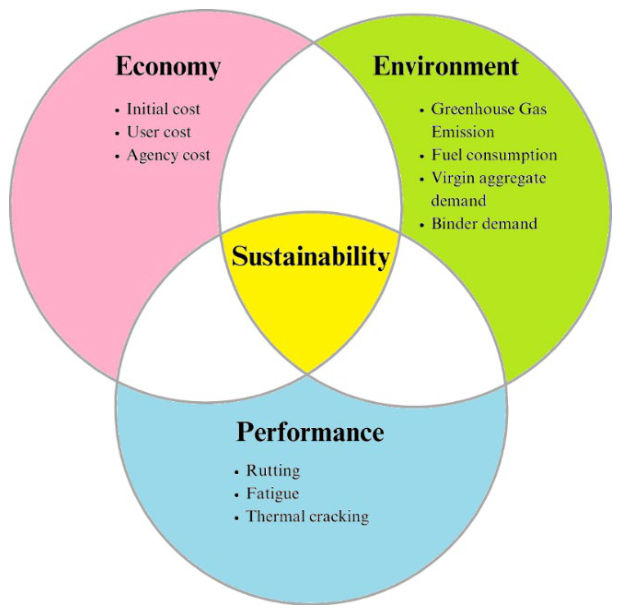
Sustainability in pavement engineering, however, cannot be addressed solely through emission reductions at the production stage. As highlighted by Plati [4], sustainable asphalt solutions must also remain technically durable and economically viable over long service periods. In practice, this requires balancing mechanical performance, environmental responsibility, and cost efficiency throughout pavement design, construction, and maintenance. Pouranian and Shishehbor [5] formalised this concept by proposing that the most effective sustainable pavement strategies emerge at the intersection of these three pillars, as illustrated in Figure 1.
While sustainability is commonly framed in terms of environmental, economic, and social dimensions [4], the present review focuses primarily on environmental and techno-economic aspects, which currently represent the most established evaluation frameworks in pavement engineering. Social sustainability considerations in asphalt and pavement assessment are still comparatively underexplored [6,7] and are therefore identified in this review as an emerging direction for future research.
Growing awareness of climate impacts and resource scarcity has stimulated extensive research into sustainable asphalt technologies. Many countries have promoted the incorporation of recycled and waste-derived materials to reduce dependence on non-renewable aggregates and virgin binders [8]. In parallel, temperature-reduction approaches—such as warm, half-warm, and cold asphalt mixtures—have been developed to lower fuel consumption, limit binder ageing, and decrease production-related emissions [9,10]. Despite the rapid expansion of these solutions, their overall sustainability contribution remains difficult to interpret consistently, since published studies often differ in experimental design, assessment boundaries, and reporting metrics.
Although numerous investigations report promising environmental and mechanical outcomes, most existing reviews address recycling strategies and low-temperature technologies separately, rarely evaluating their combined effects within integrated sustainability frameworks. This separation provides valuable insights, but it limits the evaluation of sustainability as a truly multi-dimensional concept. Mechanical durability determines service life and maintenance frequency, while economic feasibility governs large-scale implementation. Consequently, sustainability claims based solely on production-phase environmental indicators may be incomplete if long-term performance and cost implications are not simultaneously considered. Afshin and Behnood [11] emphasise that pavement life-cycle assessments (LCAs) are inherently more complex than product-level assessments, since service lives commonly extend beyond 20 years and require explicit representation of maintenance evolution and temporal performance effects.
In addition, the comparability of environmental evidence is further constrained by methodological inconsistencies in LCA practice. Variations in functional unit definitions, system boundary selection, allocation rules for recycled materials, and background datasets often produce wide dispersion in reported results. Sensitivity-based analyses by Kleizienė et al. [12] demonstrated that methodological choices in dataset selection can induce greater variability in global warming potential than operational measures such as temperature reduction or moisture control. These findings highlight the importance of harmonised evaluation practices for robust sustainability benchmarking.
Against this background, the present review provides an integrated assessment of sustainable asphalt mixtures by jointly examining recycled-material strategies, low-temperature production technologies, and their combined applications. Beyond summarising recent advances, this work critically examines the methodological gaps that prevent consistent sustainability ranking across alternative pavement solutions, particularly the limited integration of mechanical performance indicators, life-cycle environmental impacts, and life-cycle cost analysis (LCCA). In this review, this integrated assessment perspective is translated into a comparative synthesis organised around three interconnected dimensions: mechanical performance, economic implications, and life-cycle environmental assessment, which together form the basis for the discussion developed in Section 4, Section 5 and Section 6.
Although numerous studies report environmental or mechanical improvements, these dimensions are frequently assessed independently, often assuming equivalent service lives or neglecting durability-driven maintenance effects. As a result, technologies may be classified as environmentally advantageous despite potential long-term performance penalties, leading to inconsistent or even misleading sustainability interpretations.
Unlike many previous reviews that address recycling strategies and low-temperature technologies separately, this review examines these approaches jointly and interprets them within a unified sustainability perspective. In this way, environmental benefits are not considered in isolation but are linked to durability-informed mechanical behaviour and economic feasibility within a life-cycle context. By consolidating evidence across these dimensions, this review clarifies both the performance potential of the main sustainable asphalt strategies and the methodological limitations that currently hinder robust comparison across studies, thereby supporting more reliable decision making towards circular, resilient, and low-carbon pavement infrastructure.
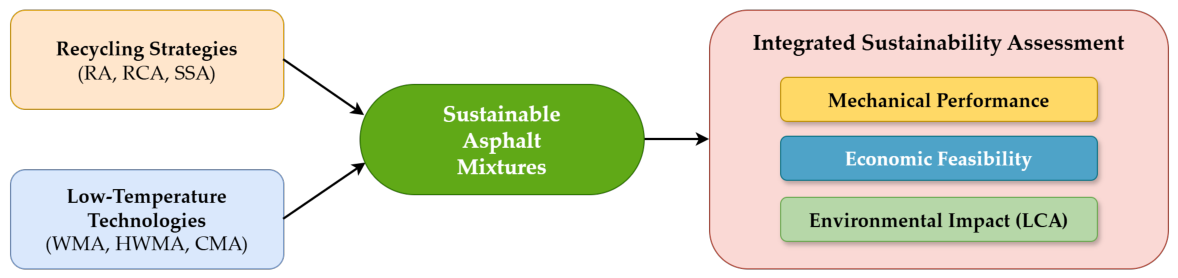
To clarify the structure and conceptual perspective adopted in this review, Figure 2 presents a simplified flowchart outlining how the main sustainable asphalt strategies are organised and subsequently evaluated across interconnected mechanical, economic, and environmental dimensions.

2. Methodology

This study adopted a state-of-the-art review approach to identify, organise, and critically analyse recent advances in sustainable asphalt mixtures, aiming to synthesise current knowledge and methodological trends rather than perform a strictly systematic meta-analysis. The review was structured around three main research axes: (i) the use of recycled and waste-derived materials, (ii) low-temperature asphalt production technologies, and (iii) integrated strategies combining material recycling with temperature reduction.

2.1. Literature Search Strategy

The literature search was primarily conducted using the Scopus database, selected for its broad coverage of peer-reviewed journals in civil engineering, materials science, and environmental sustainability. To ensure comprehensive coverage and reduce the risk of omitting relevant studies, complementary searches were performed in Web of Science, ScienceDirect, and Google Scholar. The latter was particularly useful for identifying recently published articles, highly cited contributions, and relevant proceedings that may not yet be fully indexed in traditional bibliographic databases.
The search encompassed both open-access and subscription-based publications published between 2005 and 2025, capturing early developments and recent advances in sustainable asphalt technologies. Instead of relying on a single generic query (e.g., “sustainable asphalt mixtures”), the search strategy used multiple targeted keyword combinations pairing sustainability-related terms with specific asphalt technologies and materials. The main keywords included “warm-mix asphalt (WMA)”, “half-warm-mix asphalt (HWMA)”, “cold-mix asphalt (CMA)”, “cold-recycled mixture (CRM)”, “foamed bitumen”, “reclaimed asphalt (RA)”, “recycled aggregates”, “recycled concrete aggregates (RCA)”, “steel slag aggregates (SSA)”, “life-cycle assessment (LCA)”, “life-cycle cost analysis (LCCA)”, and “economic feasibility”.
This targeted strategy minimised the inclusion of conceptually distant records retrieved by overly broad queries while ensuring strong thematic relevance to pavement engineering and sustainability assessment. The final search strategy was refined in consultation with subject experts to ensure adequate coverage of key methodological approaches and representative case studies.

2.2. Screening and Selection Criteria

Search results were further refined using database-specific filters, particularly within Scopus, to prioritise the journal literature in engineering-related subject areas (e.g., Engineering, Materials Science, Environmental Science). Document types unsuitable for technical synthesis, such as editorials and conceptually unrelated sources, were excluded. Records primarily focused on chemical, biomedical, or non-pavement-related applications were removed during title and abstract screening.
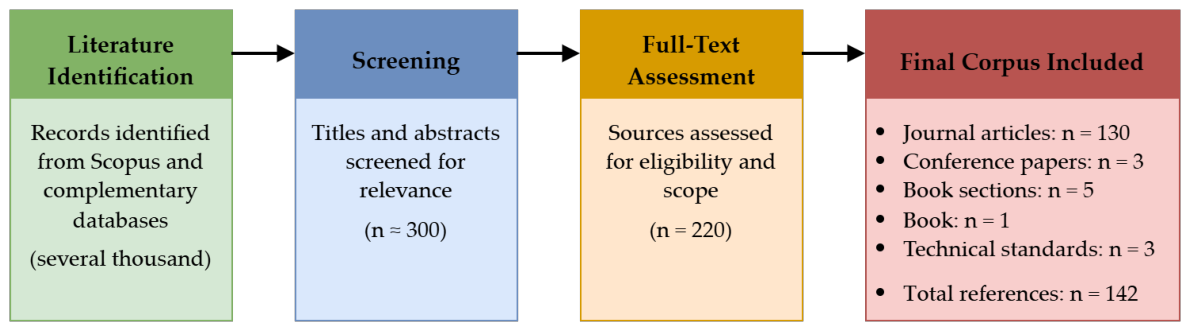
Across the different keyword combinations, the initial searches returned several thousand records. After removing duplicate records and performing preliminary title and abstract screening, approximately 300 articles were retained for full-text assessment.
Inclusion criteria comprised English-language scholarly publications reporting experimental or field-based evidence on the mechanical performance, economic assessment, or life-cycle-based environmental indicators of asphalt mixtures, with priority given to journal articles. Exclusion criteria removed studies focused exclusively on network-level pavement management, purely theoretical or numerical modelling without mixture-level validation, or materials not applicable to bituminous pavements.
Following this process, the structured qualitative synthesis was based on a corpus of 142 references, including 130 journal articles as the principal evidence base, together with 3 conference papers, 5 book sections, 1 book, and 3 technical standards. These complementary sources were retained where relevant to support methodological consistency, conceptual framing, and regulatory context. Additional contextual references were incorporated where necessary to clarify specific technical points and methodological discussion. The main stages of the literature search and selection process are summarised in Figure 3.

2.3. Data Synthesis and Thematic Organisation

The selected literature was qualitatively analysed and grouped according to its primary focus on recycled materials, low-temperature technologies, or integrated recycling–temperature reduction strategies. For each group, evidence was synthesised regarding mechanical performance, economic implications, and life-cycle-based environmental indicators, enabling the identification of dominant performance trends, methodological inconsistencies, and emerging research directions, as discussed in the following sections.
Overall, this review was deliberately scoped to the English-language scholarly literature, prioritising studies that report experimental validation of asphalt mixtures over purely theoretical or network-level analyses. The reviewed evidence is primarily derived from laboratory-based investigations, complemented where available by field trials, test sections, industrial-scale demonstrations, and selected in-service engineering applications. This approach emphasises technical relevance and ensures that the conclusions drawn are grounded in demonstrable engineering performance and realistic sustainability assessment practices.

3. Conceptual and Technological Framework for Sustainable Asphalt Mixtures

This section establishes the conceptual and technological foundation of the review. It first outlines the environmental and technical limitations of conventional asphalt mixtures, providing the baseline against which sustainability claims are assessed. It then introduces the principal strategies most frequently investigated in the literature for improving the sustainability of asphalt mixtures—namely, the incorporation of recycled and waste-derived materials, the adoption of low-temperature production technologies, and their integrated application. By organising these concepts, this section defines the solution space that is subsequently evaluated in terms of mechanical performance, economic feasibility, and life-cycle environmental impact in the following sections.

3.1. Environmental and Technical Challenges of Conventional Asphalt Mixtures

Hot-mix asphalt (HMA) remains the predominant technology for road construction worldwide. It is typically composed of aggregates, filler, and bituminous binder, with aggregates and filler accounting for approximately 94–96% of the total mixture mass, while the binder represents the remaining 4–6% [13]. To ensure adequate coating, workability, and compaction, conventional HMA is produced at high temperatures, typically ranging from 150 °C to 180 °C. This requirement translates into substantial thermal energy demand and significant greenhouse gas emissions, largely associated with fuel combustion during aggregate drying and heating operations [1,13,14].
Beyond process-related burdens, HMA production is also strongly dependent on non-renewable natural resources, including quarried virgin aggregates and petroleum-derived binders. These inputs contribute to high embodied energy and carbon intensity throughout the pavement life cycle [15]. As noted by Hu et al. [14], raw-material extraction and asphalt-mixture production are among the most energy- and emission-intensive stages in pavement construction.
Life-cycle assessment studies consistently confirm that the production phase alone can account for a major share of total pavement-related GHG emissions, primarily driven by aggregate heating and binder preparation. For instance, Giani et al. [16] and Santos et al. [17] reported that conventional HMA production typically requires 400–600 MJ/t, depending on plant efficiency, fuel type, and the target mixing temperature. Field-scale measurements by Rubio et al. [18] and Ventura et al. [19] yielded comparable values, reinforcing that asphalt production remains one of the most energy-intensive processes in the road construction industry.
These environmental and resource constraints have motivated the development of alternative approaches to reduce both material consumption and production emissions. In particular, two dominant pathways have emerged in the literature: the incorporation of recycled and waste-derived materials in asphalt mixtures (Section 3.2) and the adoption of lower-temperature production technologies [15,20].

3.2. Recycled and Waste-Derived Materials in Asphalt Mixtures

Growing environmental and economic pressures associated with conventional asphalt production have prompted the paving industry to adopt more sustainable practices by incorporating recycled and waste-derived materials. This strategy aligns with circular economy principles by promoting resource efficiency, reducing dependence on virgin raw materials, and diverting waste streams from landfill disposal [15,20,21].
A substantial body of research has demonstrated that industrial byproducts and construction-related wastes can partially or fully replace natural aggregates and fillers in asphalt mixtures, provided that material characterisation and mix design optimisation are properly addressed [1]. In this context, recent studies have confirmed that a variety of waste-derived constituents can be incorporated into asphalt mixtures, highlighting the growing interest in circular-material approaches within pavement engineering [22].
A wide range of recycled constituents has been investigated for asphalt applications, including reclaimed asphalt (RA), steel slag aggregates (SSA), recycled concrete aggregates (RCA), construction and demolition waste, crumb rubber, fly ash, foundry sand, glass powder, plastic waste, and other secondary resources [1,22]. Most applications reported in the literature focus on replacing conventional aggregates or partially substituting virgin asphalt constituents with recycled materials, with performance strongly dependent on compatibility, gradation, and mix design optimisation [20,22].
Among the diverse alternatives explored, three recycled materials have emerged as the most technically viable and widely adopted in asphalt mixture production:
  • Reclaimed asphalt (RA): Derived from milled pavement layers, RA enables the partial substitution of both aggregates and binder, substantially reducing the demand for virgin materials [23,24,25]. When rejuvenation and binder blending are appropriately managed, high-RA mixtures can be feasible; however, binder ageing and feedstock variability remain practical challenges.
  • Steel slag aggregates (SSA): As a byproduct of the steel industry, SSA offers high hardness and angularity, which can enhance aggregate interlock and potentially improve pavement durability. Nevertheless, excessive replacement levels may negatively affect workability and volumetric stability due to the high density and rough particle morphology of slag aggregates [26,27].
  • Recycled concrete aggregates (RCA): RCA from construction and demolition waste can be effectively incorporated at moderate replacement levels. At higher contents, its porous and angular structure tends to increase binder demand, requiring careful gradation control and mix design adjustments [28].
Overall, these recycled feedstocks support circular economy objectives and can contribute to improved sustainability in asphalt pavements. However, their suitability is strongly influenced by factors such as particle morphology, binder compatibility, and replacement ratio. Proper material characterisation and mix design optimisation are therefore essential to ensure consistent performance and reliable engineering application [15,20].
Detailed evidence regarding mechanical behaviour and cost implications is synthesised in Section 4, while environmental and life-cycle impacts are assessed in Section 5. While recycled-material incorporation represents a major pathway toward sustainable asphalt mixtures, further reductions in environmental burden can be achieved by lowering production temperatures. This complementary strategy is introduced in the following section.

3.3. Low-Temperature Production Technologies

Because conventional HMA production relies on energy-intensive aggregate drying, binder heating, and high-temperature mixing, it is strongly associated with fossil fuel consumption and GHG emissions [14,29]. Consequently, innovations aimed at lowering production and compaction temperatures have become a key strategy in sustainable pavement engineering [30,31].
Depending on the manufacturing temperature, asphalt mixtures are generally classified into four categories: hot-mix asphalt (HMA), produced at 150–180 °C; warm-mix asphalt (WMA), at 110–140 °C; half-warm-mix asphalt (HWMA), at 60–100 °C; and cold-mix asphalt (CMA), below 30 °C [13]. Any reduction in production temperature directly decreases fuel demand during aggregate drying and heating, as well as binder heating requirements, thereby lowering process-related energy consumption [5,16,17,32].
Warm mix asphalt technologies enable production and compaction at temperatures typically 20–40 °C lower than conventional HMA by reducing binder viscosity or improving wettability through organic, chemical, or foaming additives. Reported advantages include reduced fuel use and emissions during production, improved worker safety, and lower fumes and odours [33,34,35]. In addition, WMA can enhance field compaction and extend the paving season in colder climates. However, its performance is sensitive to additive type and dosage, with potential implications for moisture susceptibility and rutting resistance depending on the binder–aggregate interaction [29,33].
Half-warm-mix asphalt operates at intermediate temperatures, usually below the boiling point of water, and commonly relies on foamed bitumen or bitumen emulsions to promote aggregate coating and workability [36]. Experimental and industrial-scale studies indicate that HWMA can substantially reduce energy demand during production while maintaining mechanical behaviour comparable to that of HMA [18,19,33,34,35]. Nevertheless, adequate compaction, moisture control, and mix design optimisation remain critical, as reduced temperatures may narrow the construction window and increase sensitivity to field conditions.
Cold-mix asphalt eliminates the need for aggregate heating, enabling production at ambient temperatures. As a result, CMA represents the lowest-temperature alternative and offers the greatest potential for reducing production-related energy consumption compared with HMA [37,38]. However, slower curing rates and lower early-age strength typically restrict its application to low-volume roads, maintenance operations, or base and binder layers, unless supplemented with cementitious additives or emulsion-based binders to enhance durability [37]. In practice, CMA layers are often overlaid with an HMA or WMA surface course to ensure adequate structural and functional performance.
Overall, low-temperature asphalt technologies provide a major pathway for reducing the environmental burden of asphalt production while improving workplace conditions and, in some cases, mitigating binder ageing. However, successful implementation depends on optimised additive chemistry, production control, curing behaviour, and compaction procedures under realistic field conditions. Quantitative mechanical outcomes are synthesised in Section 4, while life-cycle environmental performance is discussed in Section 5.

3.4. Synergistic Integration of Recycling and Temperature-Reduction Strategies

Integrating recycled materials with low-temperature production technologies represents one of the most promising pathways toward truly sustainable asphalt pavements. While recycled-material incorporation primarily reduces the depletion of natural resources and diverts waste from landfill, temperature reduction decreases fuel consumption, process-related emissions, and binder ageing. When combined, these approaches can generate complementary effects that enhance both environmental and mechanical performance [5,13,33,34,35,37].
From a materials perspective, lowering production temperatures mitigates binder oxidation and thermal stress, thereby improving the potential for rejuvenating aged bitumen in reclaimed asphalt mixtures [13,16,17,29]. A less-aged binder environment may facilitate more effective blending between virgin and recycled components, enhancing cohesion and flexibility [39,40]. Conversely, the incorporation of recycled constituents—particularly those containing aged binders or high-strength, angular aggregates such as steel slag or recycled concrete aggregates—may partially offset stiffness variations sometimes observed in warm or half-warm systems, resulting in more balanced mixture behaviour [41,42].
The environmental complementarity between the two strategies is equally significant. Recycling reduces the extraction, transport, and processing of virgin aggregates and binders, while lower production temperatures substantially decrease energy demand and associated emissions. These combined effects align with circular economy principles by extending the value of secondary materials and reducing end-of-life disposal needs [13,15,20,21]. Mechanical implications are synthesised in Section 4, while quantitative life-cycle environmental outcomes are discussed in Section 5.
Despite these advantages, effective integration requires careful optimisation of mixture design and construction practices. Key factors include the rheological behaviour of the composite binder, the selection of appropriate rejuvenation strategies, compaction efficiency at reduced temperatures, and compatibility between recycled materials and foamed or emulsion-based binders. Standardised protocols for testing, temperature control, and binder-recycling procedures remain essential to ensure reproducibility and support large-scale implementation [29,43].
In summary, current evidence supports two complementary pillars for sustainable asphalt production: the reuse of secondary materials and the reduction of manufacturing temperatures. Their combined application provides a robust basis for more circular and low-carbon pavement systems [5,13,15,16,17,32]. However, successful implementation depends on performance verified under realistic field conditions, since variations in material composition, binder ageing, and construction practices can significantly influence overall effectiveness [15,29,43].
To conclude this framework section, Table 1 summarises the key characteristics, advantages, and limitations of the principal recycling and temperature-reduction strategies reviewed, providing a comparative overview of their technical scope and practical constraints.
The following section presents a comprehensive synthesis of experimental and field evidence on the mechanical performance and economic feasibility of sustainable asphalt mixtures, highlighting the benefits, trade-offs, and implementation challenges reported in the literature.

4. Mechanical Performance and Economic Assessment of Sustainable Asphalt Mixtures

Building on the conceptual framework established in the previous section, this section examines the practical performance and economic feasibility of sustainable asphalt technologies. The discussion focuses on asphalt mixtures incorporating recycled materials and low-temperature production techniques, considering both their individual contributions and their combined implementation. Accordingly, Section 4.1 synthesises evidence on mixtures containing recycled aggregates, Section 4.2 reviews the mechanical behaviour of low-temperature asphalt technologies, and Section 4.3 discusses integrated recycling–temperature-reduction systems, including their cost implications. Together with the environmental assessment presented in Section 5, this structure gives practical expression to the integrated performance–cost–environment perspective adopted in this review.

4.1. Mechanical Performance of Asphalt Mixtures with Recycled Materials

The mechanical performance of asphalt mixtures incorporating recycled materials has been widely investigated, reflecting the growing emphasis on resource efficiency and circular construction practices. Among the various recycled aggregates explored, RA, RCA, and SSA have shown remarkable technical feasibility and remain the most frequently studied options [23,24,25,26,27,28].
Reclaimed asphalt is the most established recycled material in asphalt production. When properly rejuvenated, RA can partially restore the aged binder’s viscoelastic behaviour, improve stiffness and durability, and reduce the demand for virgin bitumen [23,24]. Numerous studies indicate that mixtures containing 20–50% RA exhibit mechanical properties comparable to, or even superior to, those of conventional hot-mix asphalt, particularly with respect to rutting resistance and mixture stability [44,45,46,47]. In some cases, high-RA mixtures reaching up to 100% RA have been successfully produced using rejuvenating agents or foamed bitumen to mitigate binder ageing effects [48,49,50]. Nevertheless, excessive RA contents may increase brittleness and moisture susceptibility, especially when binder blending is incomplete or rejuvenation is insufficient [39,51].
An additional aspect affecting RA recyclability is the nature of the original binder present in the reclaimed material. Most conventional recycling studies implicitly address RA derived from mixtures containing unmodified binders. However, RA originating from polymer-modified systems, including SBS-modified or rubberised binders, may require more specific rejuvenation strategies due to ageing-related changes in binder structure and compatibility [52]. Recent binder-level studies have also highlighted emerging rejuvenation approaches for aged SBS-modified asphalt, suggesting that restoring performance in RA derived from SBS-containing mixtures may require strategies beyond conventional softening alone, including reactive or reaction-assisted rejuvenation concepts [53,54]. For RA derived from rubberised pavements or crumb-rubber-modified binders, recycling and rejuvenation have also been reported, but their effectiveness remains strongly dependent on binder interaction, ageing state, rejuvenation strategy, and mixture design [55,56].
From an economic perspective, reclaimed asphalt pavement is consistently identified as one of the most cost-effective recycling strategies. Pouranian and Shishehbor [5] reported that increasing RA content can reduce material and production costs by approximately 14–34% for mixtures containing 20–50% RA, primarily due to the reduced demand for virgin aggregates and binders. Broader evidence synthesised by Sukhija and Coleri [57] suggests that cost reductions may range from 5% to 68%, depending on processing requirements and local economic conditions. Santos et al. [58] further identified HMA incorporating 30% RA as a balanced solution in terms of both performance and cost. Meanwhile, field-oriented analyses by Aurangzeb and Al-Qadi [59] confirmed that significant savings are achievable, provided durability remains comparable to that of conventional asphalt.
Recycled concrete aggregates, derived from construction and demolition waste, can partially substitute natural aggregates in surface or base layers. Experimental studies indicate that mixtures containing 30–50% RCA can maintain adequate Marshall stability and deformation resistance [60,61]. Nevertheless, the mechanical response is strongly dosage dependent, since higher replacement levels tend to increase binder demand due to the porosity and angularity of RCA, leading to progressive reductions in stiffness, fatigue life, and moisture-related performance [51,62]. When properly graded and coated, moderate RCA incorporation may still provide adequate stiffness and moisture resistance, making it particularly suitable for dense-graded or base-layer applications [28]. From an economic perspective, RCA substitution remains feasible despite the higher binder requirement; positive benefit–cost ratios have been reported across different RCA contents, with maximum benefits of approximately 2 USD per ton when mechanically treated RCA is fully utilised [63].
Steel slag aggregates have likewise demonstrated promising mechanical performance. Their rough texture and high angularity enhance aggregate interlock and load transfer, improving stiffness, reducing rutting, and increasing fatigue resistance [26,64,65,66]. However, replacement levels exceeding approximately 75% may reduce workability and compaction efficiency due to the high density and angular morphology of slag particles [26]. Recent cost analyses further indicate that asphalt mixtures incorporating SSA can achieve pavement-level cost savings of approximately 14–20%, provided that transport distances are controlled, confirming the economic viability of steel slag substitution under favourable sourcing conditions [67].
Beyond single-material substitution, hybrid mixtures incorporating multiple recycled constituents have attracted attention as potential high-circularity asphalt solutions. Studies combining SSA with other recycled aggregates, including RA and RCA, indicate that mechanical performance comparable to conventional asphalt can be achieved, alongside overall cost reductions of approximately 20–40% when the mix design is carefully optimised [63,68,69,70]. Ramadan et al. [71] further confirmed that integrating RCA and RA can provide durable alternatives to virgin aggregate systems, with recycled incorporation influencing volumetric behaviour while maintaining acceptable rutting and fatigue performance. Nevertheless, these hybrid systems require precise control of gradation, binder compatibility, and additive dosage to ensure mixture homogeneity and long-term durability.
Overall, the literature consistently demonstrates that incorporating recycled aggregates into asphalt mixtures can maintain or improve stiffness, rutting resistance, and moisture durability, provided that materials are adequately characterised and the mix design is optimised. Key limitations include increased binder demand for RCA, potential ductility loss in high-RA mixtures, and workability challenges associated with high SSA contents. Future standardisation efforts should therefore focus on defining acceptable replacement thresholds, developing robust binder rejuvenation procedures, and expanding field-validation protocols to support large-scale implementation of these sustainable solutions.

4.2. Mechanical Behaviour of Low-Temperature Asphalt Mixtures

The mechanical performance of asphalt mixtures produced at reduced temperatures has been widely examined to determine whether the environmental advantages of these technologies are achieved without compromising structural integrity. Warm-mix asphalt (WMA), half-warm-mix asphalt (HWMA), and cold-mix asphalt (CMA) represent the main categories, each relying on different binder activation mechanisms and production temperature ranges [13,16,17,29,32].
For WMA, the use of organic, chemical, or foaming additives enables mixing and compaction at temperatures typically 20–40 °C lower than those required for conventional HMA. Experimental evidence indicates that, when properly designed, WMA mixtures can maintain mechanical properties comparable to those of HMA, including Marshall stability, stiffness, and moisture resistance, while offering improved workability and compaction efficiency [72,73,74]. Nevertheless, performance remains sensitive to additive chemistry and dosage, since viscosity reduction and changes in binder–aggregate interaction may influence rutting resistance and long-term durability in certain cases [29,73,75]. From an economic standpoint, Milad et al. [13] reported that WMA adoption can reduce production costs through lower energy demand during mixing, with reported energy savings varying widely (approximately 20–75%) depending on plant conditions, fuel type, aggregate moisture content, and target production temperature.
HWMA operates at intermediate temperatures, typically ranging from 60 °C to 100 °C, and often relies on foamed or emulsified bitumen to enhance coating and workability. Laboratory studies suggest that reduced production temperatures do not necessarily compromise fundamental viscoelastic behaviour, with dynamic modulus and phase angle responses indicating adequate stiffness across a range of loading frequencies [76]. In some cases, improved resistance to permanent deformation at elevated service temperatures has also been reported. However, reduced compactability and the relatively limited availability of long-term field validation remain important constraints for broader implementation. Botella et al. [50] further highlighted the economic potential of HWMA, reporting reductions in production costs of up to 50% under favourable conditions.
CMA, produced at ambient temperature, represents the lowest-temperature alternative and offers substantial reductions in production energy demand, but it faces challenges related to curing and early-age strength development. Studies by Cao et al. [77] and Gu et al. [78] found that cold recycled mixtures (CRM) stabilised with emulsified or foamed bitumen can achieve satisfactory stiffness and fatigue resistance when appropriately designed, particularly for base and sub-base applications. However, their mechanical behaviour depends strongly on curing conditions, emulsion formulation, and aggregate moisture control [78,79]. Malik et al. [80] further indicated that modern CMA systems, supported by optimised additives and curing protocols, can reach mechanical performance comparable to conventional asphalt in long-term applications, while also delivering production cost reductions typically on the order of 20–30%. In rehabilitation contexts, reported cost savings may be even higher, reaching up to approximately 60% depending on local conditions and project requirements [81,82].
Overall, the available evidence suggests that reducing production temperatures does not inherently compromise asphalt-mixture performance when mixture design and construction controls are properly managed. Under appropriate additive selection, compaction procedures, and curing conditions, WMA and HWMA can achieve strength, stiffness, and durability comparable to conventional HMA. CMA and CRM mixtures, although generally less suitable for high-traffic surface layers, provide adequate performance for rehabilitation works and low-volume road applications. Nevertheless, as emphasised by Malik et al. [80], the absence of globally harmonised mix design and curing protocols remains a major obstacle to consistent benchmarking and broader implementation of cold and half-warm technologies.
The following section examines how combining temperature-reduction approaches with recycled materials may further enhance sustainability while maintaining mechanical and economic viability.

4.3. Combined Effect of Recycling and Temperature Reduction: Experimental Evidence and Cost Analysis

Combining recycled materials with low-temperature asphalt technologies has emerged as one of the most effective approaches to improving pavement sustainability. By integrating both strategies, asphalt production can simultaneously address two major challenges—high energy consumption and heavy reliance on virgin aggregates and binders—while maintaining, and in many cases enhancing, mechanical performance [5,13,17]. Pouranian and Shishehbor [5] emphasised that the interaction between recycling and temperature reduction can yield synergistic benefits when mixture design, binder blending, and rejuvenation strategies are carefully optimised. Similarly, Milad et al. [13] highlighted that integrated systems can deliver measurable reductions in fuel use and production costs, supporting the circularity of asphalt materials.
WMA has been the most extensively investigated platform for incorporating reclaimed asphalt. Multiple studies have reported that RA–WMA combinations can improve rutting resistance and moisture stability, provided that additive selection and binder compatibility are properly managed [39,83,84,85]. Yousefi et al. [40] demonstrated that rejuvenating agents enable higher RA contents without compromising fatigue resistance, while field validation by D’Angelo et al. [48] confirmed that large-scale WMA–RA applications maintain mechanical strength and cracking resistance comparable to HMA. Field-oriented case studies have also reported that WMA surface mixtures with high RA content can exhibit mechanical behaviour comparable to that of conventional HMA and improved cracking tolerance [86]. Further evidence suggests that specific WMA additives may further enhance mixture density, compressive strength, and moisture durability while allowing lower production temperatures in field-oriented applications [87]. Overall, these findings indicate that WMA provides a technically robust pathway for integrating recycled binder and aggregate fractions at reduced temperatures.
Beyond RA, other recycled aggregates such as RCA and SSA have also been successfully incorporated into WMA systems. Martinho et al. [41] observed that mixtures containing substantial RCA or SSA contents maintained adequate stiffness and improved moisture resistance, while De Pascale et al. [42] found that combining SSA with aramid fibres enhanced durability and reduced water sensitivity. These results confirm that WMA can accommodate diverse recycled aggregates when binder type, additive chemistry, and mixing temperature are appropriately selected.
HWMA has shown comparable potential for incorporating high RA contents at substantially reduced production temperatures. Lizárraga et al. [49] demonstrated that HWMA mixtures containing 70–100% RA produced below 100 °C achieved stiffness and tensile strength equivalent to HMA. Complementary investigations further reported enhanced deformation resistance at elevated service temperatures and fatigue performance comparable to conventional mixtures [34,35]. Collectively, these studies suggest that HWMA can provide a viable pathway for high-recycling applications when compaction efficiency and curing behaviour are carefully controlled.
For CMA and CRM, the combination of RA with industrial byproducts and cementitious stabilisers has also proven mechanically and economically attractive. Meena et al. [37] reported that CMA mixtures containing approximately 50% RA achieved improved stability and moisture resistance. Chegenizadeh et al. [88] further demonstrated that CMA produced with 100% RA can achieve enhanced fatigue life and reduced rutting susceptibility when the emulsion binder content is adequately optimised. Gu et al. [78] and Skotnicki et al. [89] showed that CRM stabilised with foamed or emulsified bitumen can provide adequate stiffness and fatigue resistance for base-layer applications. Additional studies indicate that optimised binder and cement contents may allow very high RA incorporation without significant performance loss [90,91]. Importantly, field evaluations validated that cold central plant recycling and in-service CRM sections can maintain rutting resistance and fatigue performance comparable to HMA even after several years of operation [92,93,94,95]. These approaches offer substantial reductions in energy consumption relative to hot production, particularly when aggregate heating is eliminated.
The economic evidence associated with integrated recycling–temperature reduction strategies is consistently positive. Ibrahim et al. [96] reported that HWMA mixtures incorporating high RA contents can achieve nearly 50% lower total production costs, driven by reduced fuel consumption and decreased demand for virgin binders. Al-Busaltan et al. [81] further highlighted that cold recycling techniques represent cost-effective alternatives to conventional HMA due to simplified production processes and the elimination of aggregate heating. Life-cycle cost analyses by Rodríguez-Fernández et al. [97] demonstrated pavement-level cost reductions of 15% for solutions combining aggregate replacement with reduced manufacturing temperatures, while Li et al. [82] observed project-scale savings of up to 66% in large highway applications employing recycling-based pavement strategies. Taken together, these findings underline the strong financial viability of integrated sustainable technologies, particularly when reclaimed materials are locally available and energy prices are high.
In summary, experimental and field evidence indicate that coupling recycling strategies with temperature-reduction technologies can achieve balanced stiffness, rutting resistance, fatigue performance, and moisture durability, provided that binder rejuvenation, aggregate structure, and mixture design are appropriately optimised. From an economic standpoint, the most consistent benefits are observed when recycling and low-temperature production are combined, with case studies indicating that production-phase cost savings commonly range from 20% to 60% relative to conventional HMA. These savings are primarily driven by reduced fuel demand and lower consumption of virgin materials.
At the same time, it is important to distinguish between initial production or construction cost savings and full life-cycle cost performance, since lower upfront costs do not necessarily imply the lowest life-cycle costs when maintenance frequency, service life, transport distances, and regional energy and material prices are considered. However, their magnitude remains dependent on local material availability, production controls, and the specific technology combination adopted.
Table 2 provides a consolidated overview of the main mechanical performance trends and economic implications discussed throughout Section 4. Rather than reproducing individual study-level results, the table summarises the dominant findings reported across the reviewed literature, highlighting typical benefits, cost-related effects, and recurring technical limitations associated with each sustainable asphalt strategy.
The mechanical and economic outcomes discussed in Section 4 directly influence the environmental interpretation developed in Section 5, since factors such as binder demand, compaction sensitivity, and durability affect life-cycle inventories, service-life assumptions, and maintenance scenarios.
To complement the techno-economic synthesis presented in Table 2, Table 3 provides a more specific qualitative interpretation of the economic evidence and its implications for the joint reading of LCA and LCCA across the main sustainable asphalt strategies. Rather than presenting a direct quantitative comparison, the table highlights the typical economic tendencies reported in the literature, the nature of the available evidence, and the main methodological factors that constrain robust life-cycle economic interpretation across studies.
As shown in Table 3, the economic evidence for sustainable asphalt technologies is generally positive, but also more heterogeneous and less standardised than the environmental evidence synthesised later in Table 4. In many cases, the reported benefits refer primarily to production-stage or project-level costs. In contrast, fewer studies provide full LCCA-based comparisons that incorporate maintenance frequency, service life, and rehabilitation needs. This reinforces the importance of interpreting economic results together with durability-related mechanical performance and environmental life-cycle outcomes, particularly when comparing technologies across different regional and operational contexts.

5. Environmental and Life-Cycle Assessment of Sustainable Asphalt Mixtures

Beyond mechanical and economic considerations, environmental performance is essential to determining whether an asphalt mixture is truly sustainable. The potential gains discussed in the previous section only become meaningful when examined from a life-cycle perspective, in which material composition, production conditions, and long-term performance translate into system-level impacts. To preserve a consistent comparative structure, this section mirrors the technological organisation of Section 4, but focuses specifically on the life-cycle environmental burdens associated with asphalt pavements incorporating recycled materials and low-temperature production technologies.

5.1. LCA Framework and General Applications in Sustainable Asphalt Mixtures

Life-cycle assessment provides a standardised, science-based methodology for quantifying the potential environmental impacts of materials, products, or systems throughout their life cycles. According to ISO 14040 [98] and ISO 14044 [99] standards, LCA comprises four main phases: (i) goal and scope definition, (ii) life-cycle inventory (LCI), (iii) life-cycle impact assessment (LCIA), and (iv) interpretation of results [100,101]. Within the construction sector, and particularly in pavement engineering, LCA has become the most widely adopted and scientifically recognised approach for evaluating the sustainability of asphalt mixtures and transportation infrastructures [98,102,103].
In pavement applications, many LCAs follow the modular structure defined in the European standard EN 15804 [104], distinguishing between the product stage (raw-material extraction, aggregate processing, and asphalt-mixture production), the construction stage (transport and paving operations), the use and maintenance stage (service life evolution and periodic interventions), and the end-of-life stage (milling, recycling, disposal, or material recovery). The definition of system boundaries—most commonly cradle-to-gate (up to plant production) or cradle-to-grave (including use and end-of-life)—influences the magnitude and comparability of reported results [99,104,105].
Equally critical is the functional unit (FU), which serves as the basis for comparison. In asphalt LCAs, the FU is often defined as one metric ton of asphalt mixture or as one kilometre of pavement designed for a specified service life and performance level [106,107]. Such choices directly affect how environmental burdens are normalised and interpreted, particularly when durability and maintenance differ between alternative technologies.
The life-cycle inventory compiles quantitative data on material and energy inputs, emissions, and waste generation. These data are commonly derived from industrial and national databases, such as Ecoinvent or GaBi, and serve as the basis for impact assessment calculations. The most frequently reported environmental categories include global warming potential (GWP), acidification potential, eutrophication potential, photochemical ozone creation potential, and cumulative energy demand [108,109,110]. Among these indicators, GWP—expressed as CO2-equivalent emissions—remains the dominant metric for comparing asphalt-mixture sustainability in the literature [111].
Despite its widespread adoption, applying LCA to asphalt pavements involves substantial methodological challenges. Differences in system boundaries, functional unit definitions, data quality, allocation procedures for recycled materials, and regional energy mixes can lead to significant dispersion across published results [112,113,114,115]. Some studies restrict the analysis to the production stage, whereas others extend the scope to full service life, including maintenance evolution and end-of-life scenarios. Transport distances, binder ageing assumptions, and maintenance frequency further contribute to variability.
To improve robustness and comparability, future pavement LCAs should employ harmonised methodological practices, incorporate uncertainty and sensitivity analyses, and increasingly account for use-phase effects, such as vehicle fuel consumption influenced by pavement roughness and performance evolution [112,113]. Integrating life-cycle cost analysis (LCCA) and standardising reporting practices can further enhance the reliability and policy relevance of sustainability benchmarking in pavement engineering [116,117].
Beyond environmental interpretation alone, life-cycle cost analysis (LCCA) should be considered alongside LCA wherever sufficient durability and maintenance data are available. Several studies reviewed in Section 4 and Section 5 indicate that production-stage cost savings do not necessarily correspond to the most favourable life-cycle economic outcomes, particularly when maintenance frequency, transport distances, and service-life assumptions differ across alternatives.
For this reason, the sustainability of asphalt technologies is more robustly assessed when LCA and LCCA are interpreted jointly, rather than as separate indicators. A qualitative synthesis of the main economic interpretation patterns and the principal issues affecting joint LCA–LCCA interpretation across the reviewed strategies is provided in Table 3.
Over the past two decades, this framework has become a standard tool for evaluating the environmental performance of asphalt mixtures. Three dominant strategies are consistently addressed: incorporating recycled and waste-derived materials, reducing production temperatures, and combining both approaches within integrated systems [118]. Although studies differ in scope, functional units, and database choices, most report reductions in energy demand and GHG emissions relative to conventional HMA when these strategies are implemented [16,17,18,19,119,120,121].
The following sections examine how LCA has been applied across different categories of sustainable asphalt mixtures, focusing on mixtures incorporating recycled materials (Section 5.2), those produced at reduced temperatures (Section 5.3), and integrated recycling–temperature reduction systems (Section 5.4).

5.2. Environmental Performance of Asphalt Mixtures with Recycled Materials

Life-cycle assessment has become the primary framework for quantifying the environmental implications of incorporating recycled and waste-derived materials into asphalt mixtures. An increasing body of evidence confirms that strategies such as reclaimed asphalt reuse, recycled concrete aggregates, and industrial by-products can reduce greenhouse gas emissions and cumulative energy demand compared with conventional hot-mix asphalt, mainly by avoiding virgin aggregate extraction and reducing the need for new binder production [57,122].
Among the different recycling pathways, reclaimed asphalt has received the greatest attention. The environmental advantages of RA are largely attributed to reduced demand for virgin aggregates and partial substitution of petroleum-based binders. Vandewalle et al. [109] reported carbon-footprint reductions between 19% and 33% as RA content increased, while Aurangzeb et al. [123] quantified energy and GHG decreases of approximately 28% for high-RA mixtures under partial blending assumptions. More recently, Vangala et al. [124] found that increasing RA content from 30% to 40% resulted in reductions in global warming potential of approximately 4–11%, depending on the adopted binder strategy, while maintaining comparable mechanical performance. Santos et al. [58] similarly identified HMA with 30% RA as a balanced solution from both environmental and economic perspectives. However, multiple studies emphasise that plant efficiency, transport distances, and rejuvenator selection can significantly influence the magnitude of reported benefits [125,126,127].
Other recycled aggregate sources, such as recycled concrete and steel slag, have also demonstrated environmental improvements, although gains are often more moderate and highly context dependent. For RCA, Vega-Araujo et al. [128] showed that mixtures incorporating 15–30% RCA can be environmentally preferable to conventional alternatives, with reductions observed across all evaluated impact categories. Martinho et al. [60] reported decreases of approximately 7% in total GWP and 6% in fossil GWP relative to mixtures with natural aggregates, alongside pronounced reductions in biogenic GWP and land-use-related impacts. Additional integrated LCA–LCCA evidence suggests that these sustainability benefits are primarily achieved at low RCA contents, whereas higher replacement levels may increase environmental burdens due to elevated binder demand [62]. These outcomes suggest that RCA benefits are closely linked to local sourcing conditions and the balance between aggregate substitution and increased binder demand associated with RCA porosity.
For SSA, Esther et al. [116] and Bonoli et al. [125] reported notable reductions in GWP and cumulative energy demand due to avoided quarrying and enhanced material recovery. Zhong et al. [67] demonstrated that SSA substitution can reduce GHG emissions by approximately 1.1–8.6%, provided that haul distances remain controlled, highlighting transport as a dominant driver in SSA-based systems. Katanalp et al. [117] further discussed the benefits and trade-offs associated with incorporating SSA residues into bituminous binders. Overall, the net environmental performance of RCA- and SSA-containing mixtures depends strongly on local availability, density or porosity effects influencing binder consumption, and transportation requirements.
Although global warming potential and energy demand dominate most asphalt LCAs, a smaller number of studies also assess secondary impact categories, including acidification potential, eutrophication potential, photochemical ozone creation potential, and resource depletion. Esther et al. [116] observed moderate improvements of approximately 10–20% in these indicators for SSA-based mixtures, primarily driven by reduced extraction energy. Similar trends were reported by Vega-Araujo et al. [129] for RCA and by Bonoli et al. [125] for combined RA–SSA mixtures. These findings reinforce that while secondary categories often show consistent but smaller gains, the most significant improvements remain concentrated in carbon- and energy-related metrics.
In summary, incorporating recycled materials into asphalt mixtures can deliver substantial environmental benefits when reclaimed or industrial aggregates are locally sourced, rejuvenation strategies are appropriately selected, and production plants operate efficiently. The dominant drivers of improvement remain the avoidance of virgin material extraction and the reduction in virgin binder demand, which strongly shape the life-cycle impacts of conventional HMA [58,109,125]. Nevertheless, methodological factors such as system-boundary definition, transport modelling, and blending or allocation assumptions remain major sources of variability across published LCA results [58,105,109,123,130].
Section 5.3 examines how similar environmental assessments have been conducted for low-temperature asphalt technologies, focusing on the energy and emission implications of reduced production temperatures.

5.3. Environmental Performance of Low-Temperature Asphalt Technologies

Low-temperature asphalt technologies encompass processes that reduce mixing and compaction temperatures relative to conventional hot-mix asphalt, thereby lowering fuel consumption and emissions during production. A growing number of life-cycle assessment studies have quantified the environmental benefits of these technologies across partial or full pavement life cycles, consistently identifying production-temperature reduction as a major driver of impact mitigation [13,16,17,29,32]. Santos et al. [17] and Ferrotti et al. [119] demonstrated that reducing mixing temperatures by 20–40 °C yields direct savings in fuel use and cumulative energy demand. Furthermore, industrial-scale observations by Ventura et al. [19] and Rubio et al. [18] confirmed lower CO2, SO2, particulate matter, and volatile compound emissions for half-warm systems compared with conventional HMA.
WMA has been the most extensively documented low-temperature technology in environmental terms. Field and laboratory evidence suggest that WMA can achieve meaningful reductions in energy demand and global warming potential, primarily through decreased aggregate heating and reduced binder ageing [16,17,18,19,119]. Ventura et al. [19] and Rubio et al. [18] reported energy savings in the range of 15–35%, while Ferrotti et al. [119] and Santos et al. [17] observed GWP reductions on the order of 20–40% under typical production scenarios. Importantly, Giani et al. [16] noted that the magnitude of these benefits is sensitive to additive type, with organic modifiers often producing larger reductions than certain chemical foaming agents. Additional studies have also suggested that lower oxidation demand may indirectly improve durability, further influencing life-cycle impacts depending on the assessment scope [83,120]. Overall, the literature indicates that moderate temperature reductions can provide substantial benefits during the production phase without compromising mixture performance.
The environmental performance of half-warm-mix asphalt has been less widely reported but remains highly promising. Pasandín et al. [34] and Lizárraga et al. [49] found that lowering production temperatures to 60–100 °C can reduce total energy demand by approximately 50–60% and CO2 emissions by 60–70%, while Marcobal et al. [35] reported additional reductions in SO2 emissions exceeding 95%. These results highlight the strong mitigation potential of HWMA, even though several authors emphasise that smaller production scale, limited field deployment, and sensitivity to moisture control introduce uncertainty in large-scale extrapolation. Botella et al. [50] stressed that successful implementation requires adequate plant retrofitting and process control, while Ibrahim et al. [96] noted that consistent compaction efficiency is critical for achieving expected environmental gains.
Cold-mix asphalt is the lowest-temperature alternative, as it eliminates the need to heat aggregates. Accordingly, CMA and CRM often show the highest reported reductions in production energy demand. Gu et al. [78] quantified energy reductions of 56–64% and GHG decreases of 39–46% relative to HMA. Comparable benefits have also been reported for CMA systems stabilised with emulsified or foamed bitumen, with energy savings approaching 90% and GHG reductions typically ranging from 40% to 60% under optimised curing conditions [37,89]. Chomicz-Kowalska and Maciejewski [131] and DeLaFuente-Navarro et al. [38] further suggested that such reductions are strongly dependent on mixture type, system boundaries, and binder formulation. Field evaluations by Charmot et al. [95] and Cheng et al. [94] confirmed that cold-recycled layers can maintain adequate durability over their service life. Nevertheless, the net environmental advantage remains influenced by curing duration and the pavement layer in which CMA is applied.
Overall, LCA evidence consistently indicates that reducing asphalt production temperatures yields significant energy and emission savings. However, the magnitude of reported benefits varies with system boundaries, functional unit definitions, additive technologies, and field implementation conditions. Across the literature, production-stage GWP reductions commonly fall within the range of 20–70%, with the largest gains generally associated with half-warm and cold recycling approaches. Section 5.4 examines how combining temperature-reduction and material-recycling strategies can further enhance these environmental benefits and support more circular and low-carbon pavement systems.

5.4. Environmental Assessment of Combined Recycling and Temperature-Reduction Strategies

Integrating material recycling with temperature-reduction technologies is one of the most effective routes to low-carbon, circular pavement systems. These combined approaches simultaneously address two dominant environmental burdens of asphalt production—high fuel demand and intensive consumption of virgin aggregates and binders—while maintaining comparable mechanical and durability performance. From a life-cycle perspective, their integration often amplifies the advantages observed when each strategy is applied independently, resulting in some of the lowest environmental footprints reported for asphalt pavements [5,13,16,17]. Meta-analyses by Vidal et al. [130] and Bizarro et al. [132] further confirm this overall trend across multiple case studies.
The integration of reclaimed asphalt with warm-mix asphalt technologies remains the most extensively studied combined strategy. Pouranian and Shishehbor [5] highlighted the synergistic potential of incorporating RA into WMA systems, while Milad et al. [13] estimated combined reductions of 30–60% in production-phase GHG emissions. These findings are supported by LCAs conducted by Bizarro et al. [132] and Vidal et al. [130], which showed that RA–WMA configurations can achieve substantial environmental gains when additive chemistry, binder-blending assumptions, and plant fuel sources are properly optimised. Giani et al. [16] further demonstrated that combining WMA with 40–50% RA may reduce embodied energy to approximately half that of conventional HMA. Flores-Ruiz et al. [133] similarly confirmed that adopting WMA together with reclaimed asphalt incorporation consistently delivers meaningful emission mitigation, typically on the order of 15–45%, depending on system boundaries and the life-cycle stages included.
Beyond reclaimed asphalt, other recycled aggregates have also been successfully combined with WMA technologies. Vega-Araujo et al. [129] reported that replacing 30–50% of natural aggregates with RCA in WMA mixtures reduced total global warming potential by approximately 15–25%. LCAs by Esther et al. [116] and Bonoli et al. [125] likewise highlighted the advantages of incorporating steel slag aggregates, primarily through avoided quarrying and enhanced material recovery. Collectively, these studies indicate that the environmental performance of WMA systems incorporating RCA or SSA remains strongly influenced by transport distances, aggregate density, and mixture-specific effects on binder demand.
HWMA incorporating RA has shown comparable, and in some cases superior, environmental performance. Lizárraga et al. [49] and Ibrahim et al. [96] documented energy demand reductions of 50–60% and CO2-emission reductions exceeding 60% relative to HMA. These improvements arise from the combined effects of reduced production temperatures and the reuse of aged binder, which can promote more effective blending and limit oxidation. However, both studies emphasised that binder-blending assumptions critically shape LCA outcomes, with full-blending scenarios potentially overestimating environmental benefits. Additional analyses by Nanda and Siddagangaiah [134] and Li et al. [135] confirmed that local climate conditions and regional energy mixes can substantially modify the magnitude of reported reductions.
Cold recycling techniques further enhance the environmental advantages of integrated recycling and low-temperature strategies, often delivering the largest energy savings. Gu et al. [78] demonstrated that cold central plant recycling and in-place cold recycled mixtures reduce energy use by 56–64% and GHG emissions by 39–46% compared with HMA. Field monitoring by Charmot et al. [95] and Cheng et al. [94] confirmed that CCPR and CRM layers can maintain adequate structural performance over time, indicating that these environmental benefits do not necessarily compromise long-term durability. Nevertheless, curing time and emulsion-production variability remain critical factors that may offset early-stage advantages if they are not properly accounted for in LCA inventories [34].
In addition to environmental mitigation, integrated recycling and temperature-reduction strategies often provide clear economic co-benefits. Santos et al. [17] and Ibrahim et al. [96] reported that HWMA mixtures incorporating high RA contents can achieve nearly 50% lower production costs, while Li et al. [82] observed project-scale savings of up to 66% in large highway applications employing recycling-based pavement solutions. Lower fuel consumption, simplified production processes, and decreased demand for virgin materials primarily drive these reductions. However, broader assessments by Riekstins et al. [136] and Vidal et al. [130] indicate that regional differences in transport requirements and energy sources can alter total GWP by ±25%, underscoring the importance of locally calibrated datasets and harmonised methodological assumptions.
In summary, integrated recycling and temperature-reduction strategies consistently deliver substantial reductions in energy demand and GHG emissions, with the largest benefits observed when material reuse and low-temperature production are jointly optimised. Although the magnitude of reported improvements remains sensitive to mixture composition, process configuration, and regional context, these hybrid approaches represent one of the most robust pathways toward circular and low-carbon asphalt pavement systems.

5.5. Integrated Summary of LCA Results

This subsection consolidates the evidence presented in Section 5.2, Section 5.3 and Section 5.4 without introducing new data. The harmonised percentage ranges summarised in Table 4 provide a comparative overview of the environmental performance associated with the main strategies for sustainable asphalt production. Rather than offering an exhaustive mapping of individual studies, Table 4 synthesises the typical magnitude of reported energy and GHG reductions, highlighting consistent trends, dominant drivers, and recurring methodological sensitivities across the literature.
Across the reviewed evidence, both recycling-based approaches and temperature-reduction technologies consistently decrease the carbon footprint and total energy demand of asphalt pavements. However, the extent of reported benefits varies depending on mixture composition, regional context, and assessment scope. Recycling strategies primarily mitigate impacts related to virgin aggregate extraction and binder production. Typical reductions in GHG emissions reported for reclaimed asphalt mixtures are in the ~15–35% range, while RCA- and SSA-based systems generally show more moderate benefits, strongly influenced by transport distances and binder demand.
Temperature-reduction technologies primarily reduce process-related burdens during production, with WMA commonly achieving reductions of 20–40%, and larger savings reported for HWMA and cold recycling approaches due to substantially lower heating requirements.
The most pronounced environmental improvements are consistently observed for integrated systems combining recycling with low-temperature production. Configurations such as RA + WMA, RA + HWMA, and cold-recycled mixtures achieve the largest cumulative reductions in energy demand and global warming potential relative to conventional HMA, confirming the complementary nature of material reuse and reduced-temperature manufacturing. The methodological sources of variability and the implications of durability and field performance are further examined in the Section 6.

6. Discussion: Toward an Integrated Sustainability Assessment Perspective

The evidence synthesised in Section 4 and Section 5 confirms that recycling strategies and temperature-reduction technologies can deliver substantial benefits in mechanical performance, economic feasibility, and environmental impact mitigation. At the same time, the reviewed literature also reveals important contradictory and conditional outcomes, particularly at high recycled contents, under insufficient rejuvenation or curing, and in cases where durability losses or methodological assumptions offset the apparent environmental or economic gains.
Nevertheless, numerous studies demonstrate that mixtures incorporating reclaimed asphalt, recycled aggregates, or low-temperature production processes can achieve stiffness, rutting resistance, and durability comparable to those of conventional hot-mix asphalt, while also reducing energy demand and greenhouse gas emissions.
Despite these consistent trends, sustainability assessment in asphalt pavement research remains methodologically fragmented, limiting the robustness, transparency, and comparability of reported outcomes. Recent critical reviews emphasise that inconsistent system boundaries and background datasets continue to undermine benchmarking across pavement LCAs [11]. Moreover, fewer than 5% of pavement LCA studies incorporating waste reuse fully adhere to ISO 14040 recommendations, highlighting persistent gaps in methodological rigour [122]. Similar limitations extend beyond environmental indicators, as recent studies show that circularity assessment in asphalt mixtures remains methodologically heterogeneous and is strongly influenced by the selected indicators, assumptions, and system definitions [137,138,139]. Together, these findings underline the need for harmonised sustainability frameworks beyond isolated case-based evaluations.
A key implication of this methodological fragmentation is the limited comparability of conclusions across studies. Reported environmental and economic benefits are often influenced not only by the asphalt technology itself, but also by methodological choices such as functional unit definition, system boundary selection, allocation procedures for recycled materials, and the scope of economic assessment. For example, mass-based functional units may obscure durability-related differences between alternatives. At the same time, cradle-to-gate assessments may overemphasise production-stage benefits compared with cradle-to-grave approaches that include maintenance and end-of-life effects. Similarly, economic results are not always directly comparable because some studies report only material or production cost changes, whereas others consider project-level costs or life-cycle cost analysis (LCCA). As a result, the relative ranking of sustainable asphalt strategies should be interpreted cautiously unless methodological assumptions are transparently reported and aligned.
Although LCA has become the primary tool for quantifying environmental performance, methodological choices—including functional unit definition, system boundary selection, allocation procedures, and data quality—remain major sources of divergence in published results [140,141]. Limited availability of representative inventory data for emerging additives and recycled constituents may further reduce reliability by underestimating upstream burdens [11]. In addition, incomplete disclosure of software versions, databases, and inventory sources remains common, constraining reproducibility and cross-study comparability [122].
The magnitude of methodological influence is well illustrated through sensitivity-based evidence. Dataset selection for bitumen and aggregate production can alter global warming potential results by up to 42% and 35%, respectively, whereas operational measures such as mixing-temperature reduction often induce variations below 5% [12]. Such findings indicate that methodological assumptions may outweigh the environmental gains attributed to specific technologies, contributing substantially to dispersion across pavement LCA outcomes [11]. The limited application of uncertainty analysis amplifies this concern, since only about 36% of studies perform sensitivity checks and nearly 89% neglect uncertainty quantification altogether [122].
The functional unit definition is a particularly critical element requiring harmonisation. Mass-based indicators frequently overlook differences in durability, curing behaviour, and maintenance evolution, which is especially relevant for cold and half-warm mixtures where early-age performance may influence long-term service life. Accordingly, functional units should increasingly reflect performance and service-life expectations to enable meaningful comparisons between alternative pavement solutions [140,142]. Substantial heterogeneity in FU selection has been widely observed, limiting replicability across contexts [122].
System boundary selection constitutes another major source of variability. While many studies remain limited to cradle-to-gate assessments, others extend to construction, maintenance, and end-of-life stages. This inconsistency is particularly problematic for hybrid systems combining recycled materials with temperature-reduction technologies, since boundary differences alone can induce variations exceeding ±20% in reported GWP [130,136,143,144]. As noted by Afshin and Behnood [11], more comprehensive cradle-to-grave approaches are increasingly necessary to capture downstream burdens governed by durability and maintenance evolution.
Allocation rules and recycling assumptions further complicate sustainability evaluation. Differences in the treatment of avoided burdens, recycling credits, and binder blending models can substantially influence results and remain a principal driver of uncertainty in high-RA assessments [145]. Evidence from Vandewalle et al. [109] and Aurangzeb et al. [123] suggests that partial blending models often provide more realistic estimates than assuming complete binder homogenisation.
These methodological limitations also hinder the integration of environmental outcomes with mechanical durability, maintenance requirements, and long-term cost implications. Mechanical behaviour directly affects service life and intervention frequency, yet these extended performance effects remain insufficiently incorporated in many sustainability assessments [140,141,146,147]. This is particularly relevant for fatigue performance, since fatigue-related cracking has important implications for pavement durability, maintenance needs, rehabilitation timing, and the life-cycle cost consequences of repeated interventions [148]. Current models still struggle to represent temporal variations associated with traffic loading, climate influences, and evolving pavement condition [11].
Systematic reviews confirm that combining LCA with life-cycle cost analysis improves the relevance of sustainability evaluation for engineering decision making and infrastructure planning [141,142]. Nevertheless, such integration remains limited in practice and is frequently undermined by inconsistent assumptions and reporting. Comparative studies integrating LCA, LCCA, and mechanical performance illustrate both the value and complexity of multi-dimensional sustainability frameworks [135,136,143]. These works reinforce that sustainability cannot be inferred solely from reduced production emissions if durability or cost effectiveness is compromised over the pavement life cycle.
Overall, establishing an integrated sustainability assessment approach does not imply a single universal model, but rather the adoption of shared methodological principles linking mechanical performance, economic feasibility, and environmental outcomes. At a minimum, future studies should consistently report the functional unit, system boundaries, allocation assumptions for recycled materials, durability or service-life assumptions, cost scope (initial versus life-cycle), transport distances, and the basis of technical validation (laboratory, test section, or in-service application) to improve transparency and comparability.
Performance-based LCA approaches incorporating field-validated durability data, maintenance strategies, and use-phase effects would significantly strengthen sustainability evaluations and reduce the risk of over- or underestimating the benefits of recycling and low-temperature asphalt technologies [145]. In this context, the current review highlights that sustainability assessment in asphalt pavements must evolve from isolated case-by-case comparisons towards harmonised, performance-based life-cycle frameworks that reliably connect mechanical durability, economic viability, and environmental impact.

7. Conclusions

Based on the integrated analysis developed throughout this review, the main conclusions can be summarised as follows:
  • Recycling strategies and low-temperature production technologies represent two major and complementary pathways towards more sustainable asphalt pavement systems. Reclaimed asphalt, recycled concrete aggregates, and steel slag can maintain—and in many cases enhance—mechanical performance while reducing reliance on virgin aggregates and binders. In parallel, warm-, half-warm-, and cold-mix technologies can reduce production energy demand and associated greenhouse gas emissions, while also offering potential production-stage cost savings under favourable conditions.
  • The most significant sustainability gains are generally achieved when recycling and temperature-reduction approaches are combined. Integrated solutions can simultaneously reduce raw-material consumption, production-related environmental burdens, and, in many cases, initial production costs, while preserving key performance requirements such as stiffness, rutting resistance, fatigue behaviour, and long-term durability when mixture design is properly optimised.
  • The sustainability benefits of the reviewed solutions are strongly conditioned by material variability, binder demand, curing behaviour, construction quality control, and methodological assumptions. These factors may substantially influence the practical performance, environmental interpretation, and economic viability of the reviewed solutions, particularly at high recycled contents or very low production temperatures.
Overall, unlike many previous reviews that address recycling strategies and low-temperature technologies separately, this review provides an integrated synthesis of mechanical, economic, and environmental evidence on sustainable asphalt mixtures, clarifying both performance trends and the methodological limitations that currently impede robust sustainability comparison. Its main contribution lies in showing that sustainability cannot be reliably inferred from isolated environmental gains, but must instead be assessed through harmonised life-cycle approaches that explicitly account for durability and economic feasibility.
In this way, the review supports the development of more robust evaluation practices for circular, resilient, and low-carbon pavement infrastructure. The main future research priorities and implementation challenges arising from these findings are further outlined in Section 8.

8. Future Research Directions and Implementation Challenges

Although the reviewed literature demonstrates the strong potential of recycling strategies and low-temperature asphalt technologies, the present review also highlights important limitations in the current evidence base, particularly limited long-term field validation, inconsistent life-cycle modelling practices, and insufficient integration of durability and life-cycle cost considerations. Addressing these limitations should be a central objective of future research before these solutions can be adopted as routine pavement practices.
A primary priority is long-term field validation under realistic traffic and climatic conditions, particularly for half-warm and cold or emulsion-based systems, where curing behaviour and early-age performance strongly influence durability.
Future work should increasingly support performance-informed sustainability assessment through monitored service-life data. Expanded field datasets on cracking evolution, rutting progression, moisture damage, and maintenance frequency are essential to reduce uncertainty and to verify whether laboratory-scale benefits persist throughout pavement operation. This need is especially critical for hybrid mixtures combining high recycled contents with reduced production temperatures.
Further research is also required to improve consistency in life-cycle modelling practices and to strengthen integrated sustainability assessment. The adoption of service-life-oriented functional units, transparent system-boundary definitions, routine sensitivity and uncertainty analyses, and more consistent joint interpretation of LCA, LCCA, and durability-related performance would strengthen the reliability of comparative sustainability studies and enhance their value for engineering decision making.
Additional research attention is warranted for other emerging recycled constituents, particularly waste rubber and recycled plastics, as well as for bio-based additives and rejuvenation strategies in high-recycling systems. These approaches may offer further circularity and decarbonisation benefits. Still, they also raise important questions about durability, compatibility, ageing behaviour, emissions, and long-term sustainability performance, especially when their effects are assessed beyond the production stage [149,150].
Future research should also advance the integration of social sustainability dimensions into pavement assessment frameworks, including worker safety, community impacts, and value-chain effects, which are currently less developed than environmental and techno-economic evaluations in pavement studies.
Beyond technical gaps, implementation remains constrained by practical and institutional barriers. Current specifications often limit recycled material contents, recycled supply chains may be variable, and contractor familiarity with low-temperature production methods differs significantly across regions. In addition, road agencies may perceive higher risks associated with innovative mixtures due to limited standardised benchmarks and long-term monitoring experience.
Ultimately, the successful transition of sustainable asphalt mixtures from research to large-scale practice will depend on performance-based specifications supported by robust field evidence and aligned sustainability metrics. Strengthening the integration of engineering requirements, economic feasibility, and life-cycle environmental assessment will be essential to accelerate the deployment of circular, low-carbon pavement solutions.

Author Contributions

Conceptualisation, C.F.N.M., H.M.R.D.S. and J.R.M.O.; methodology, C.F.N.M., H.M.R.D.S. and J.R.M.O.; validation, C.F.N.M., H.M.R.D.S. and J.R.M.O.; formal analysis, C.F.N.M., H.M.R.D.S. and J.R.M.O.; investigation, C.F.N.M., H.M.R.D.S. and J.R.M.O.; writing—original draft preparation, C.F.N.M.; writing—review and editing, H.M.R.D.S. and J.R.M.O.; visualisation, C.F.N.M.; supervision, H.M.R.D.S. and J.R.M.O.; project administration, H.M.R.D.S. and J.R.M.O.; funding acquisition, H.M.R.D.S. and J.R.M.O. All authors have read and agreed to the published version of the manuscript.

Funding

This work was supported by national funds through FCT—Foundation for Science and Technology, under grant agreement 2021.08004.BD awarded to the first author. This work was also supported by FCT/MCTES under the R&D Unit Institute for Sustainability and Innovation in Structural Engineering (ISISE), under the references UID/04029/2025 (doi:10.54499/UID/04029/2025) and UID/PRR/04029/2025 (doi:10.54499/UID/PRR/04029/2025), and through the Advanced Production and Intelligent Systems Associate Laboratory (ARISE) under reference LA/P/0112/2020 (doi:10.54499/LA/P/0112/2020).

Data Availability Statement

No new data were created or analysed in this study. Data sharing is not applicable to this article.

Acknowledgments

The authors acknowledge the support of the University of Minho Pavements Laboratory, including its staff and researchers, for the exchange of ideas and technical discussions that contributed to the development of this work.

Conflicts of Interest

H.M.R.D.S. is a member of the Editorial Board of Infrastructures. This author had no involvement in the peer-review or editorial decision-making process for this manuscript and had no access to information regarding its peer review. The authors declare no other conflicts of interest.

References

  1. Oreto, C.; Veropalumbo, R.; Viscione, N.; Biancardo, S.A.; Botte, M.; Russo, F. Integration of life cycle assessment into a decision support system for selecting sustainable road asphalt pavement mixtures prepared with waste. Int. J. Life Cycle Assess. 2021, 26, 2391–2407. [Google Scholar] [CrossRef]
  2. Abdalla, A.; Faheem, A.F.; Walters, E. Life cycle assessment of eco-friendly asphalt pavement involving multi-recycled materials: A comparative study. J. Clean. Prod. 2022, 362, 132471. [Google Scholar] [CrossRef]
  3. Shiva Kumar, G.; Rahul, M.S.; Jakati, S.S.; Karthik, M.; Ramaraju, H.K. Eco-friendly warm mix asphalt mixtures incorporating electric arc furnace steel slag as substitute to conventional aggregates. Innov. Infrastruct. Solut. 2023, 8, 233. [Google Scholar] [CrossRef]
  4. Plati, C. Sustainability factors in pavement materials, design, and preservation strategies: A literature review. Constr. Build. Mater. 2019, 211, 539–555. [Google Scholar] [CrossRef]
  5. Pouranian, M.R.; Shishehbor, M. Sustainability Assessment of Green Asphalt Mixtures: A Review. Environments 2019, 6, 73. [Google Scholar] [CrossRef]
  6. Del Rosario, P.; Buttitta, G.; Lo Presti, D.; Traverso, M. Towards the Assessment of Social Sustainability: Identifying Social Hotspots for Road Pavement Materials. In Pavement, Roadway, and Bridge Life Cycle Assessment 2024; RILEM Bookseries; Springer: Berlin/Heidelberg, Germany, 2024; Volume 51, pp. 262–270. [Google Scholar]
  7. Sierra-Varela, L.; Calabi-Floody, A.; Valdés-Vidal, G.; Yepes, V.; Filun-Santana, Á. Determination of the Social Contribution of Sustainable Additives for Asphalt Mixes Through Fuzzy Cognitive Mapping. Appl. Sci. 2025, 15, 3994. [Google Scholar] [CrossRef]
  8. He, L.; Tao, M.; Liu, Z.; Cao, Z.; Zhu, J.; Gao, J.; Van den bergh, W.; Chailleux, E.; Huang, Y.; Vasconcelos, K.; et al. Biomass valorization toward sustainable asphalt pavements: Progress and prospects. Waste Manag. 2023, 165, 159–178. [Google Scholar] [CrossRef]
  9. Barandica, J.M.; Fernández-Sánchez, G.; Berzosa, Á.; Delgado, J.A.; Acosta, F.J. Applying life cycle thinking to reduce greenhouse gas emissions from road projects. J. Clean. Prod. 2013, 57, 79–91. [Google Scholar] [CrossRef]
  10. Llopis-Castelló, D.; Alonso-Troyano, C.; Álvarez-Troncoso, P.; Marzá-Beltrán, A.; García, A. Design of Sustainable Asphalt Mixtures for Bike Lanes Using RAP and Ceramic Waste as Substitutes for Natural Aggregates. Sustainability 2022, 14, 15777. [Google Scholar] [CrossRef]
  11. Afshin, A.; Behnood, A. Sustainability of Asphalt Pavements: The role of life cycle assessment (LCA) and emerging technologies. Clean. Mater. 2025, 18, 100346. [Google Scholar] [CrossRef]
  12. Kleizienė, R.; Buttitta, G.; Carreño, N.; Presti, D.L. Enhancing the Sustainability of Asphalt Mixtures: A Focus on Operational Factors and Dataset for Environmental Product Declarations. Sustainability 2025, 17, 9349. [Google Scholar] [CrossRef]
  13. Milad, A.; Babalghaith, A.M.; Al-Sabaeei, A.M.; Dulaimi, A.; Ali, A.; Reddy, S.S.; Bilema, M.; Yusoff, N.I.M. A Comparative Review of Hot and Warm Mix Asphalt Technologies from Environmental and Economic Perspectives: Towards a Sustainable Asphalt Pavement. Int. J. Environ. Res. Public Health 2022, 19, 14863. [Google Scholar] [CrossRef]
  14. Hu, W.; Shu, X.; Huang, B.S. Sustainability innovations in transportation infrastructure: An overview of the special volume on sustainable road paving. J. Clean. Prod. 2019, 235, 369–377. [Google Scholar] [CrossRef]
  15. Jamshidi, A.; White, G. Evaluation of Performance and Challenges of Use of Waste Materials in Pavement Construction: A Critical Review. Appl. Sci. 2020, 10, 226. [Google Scholar] [CrossRef]
  16. Giani, M.I.; Dotelli, G.; Brandini, N.; Zampori, L. Comparative life cycle assessment of asphalt pavements using reclaimed asphalt, warm mix technology and cold in-place recycling. Resour. Conserv. Recycl. 2015, 104, 224–238. [Google Scholar] [CrossRef]
  17. Santos, J.; Bressi, S.; Cerezo, V.; Presti, D.L.; Dauvergne, M. Life cycle assessment of low temperature asphalt mixtures for road pavement surfaces: A comparative analysis. Resour. Conserv. Recycl. 2018, 138, 283–297. [Google Scholar] [CrossRef]
  18. Rubio, M.d.C.; Moreno, F.; Martínez-Echevarría, M.J.; Martínez, G.; Vázquez, J.M. Comparative analysis of emissions from the manufacture and use of hot and half-warm mix asphalt. J. Clean. Prod. 2013, 41, 1–6. [Google Scholar] [CrossRef]
  19. Ventura, A.; Monéron, P.; Jullien, A.; Tamagny, P.; Olard, F.; Zavan, D. Environmental comparison at industrial scale of hot and half-warm mix asphalt manufacturing processes. In Proceedings of the Transportation Research Board 88th Annual Meeting, Washington, DC, USA, 11–15 January 2009; pp. 1–12. [Google Scholar]
  20. Victory, W. A review on the utilization of waste material in asphalt pavements. Environ. Sci. Pollut. Res. 2022, 29, 27279–27282. [Google Scholar] [CrossRef] [PubMed]
  21. Russo, F.; Oreto, C.; Veropalumbo, R. A Practice for the Application of Waste in Road Asphalt Pavements in an Eco-Friendly Way. Appl. Sci. 2021, 11, 9268. [Google Scholar] [CrossRef]
  22. Mushtaq, F.; Huang, Z.; Shah, S.A.R.; Zhang, Y.; Gao, Y.; Azab, M.; Hussain, S.; Anwar, M.K. Performance Optimization Approach of Polymer Modified Asphalt Mixtures with PET and PE Wastes: A Safety Study for Utilizing Eco-Friendly Circular Economy-Based SDGs Concepts. Polymers 2022, 14, 2493. [Google Scholar] [CrossRef]
  23. Mariyappan, R.; Palammal, J.S.; Balu, S. Sustainable use of reclaimed asphalt pavement (RAP) in pavement applications—A review. Environ. Sci. Pollut. Res. 2023, 30, 45587–45606. [Google Scholar] [CrossRef]
  24. Magar, S.; Xiao, F.; Singh, D.; Showkat, B. Applications of reclaimed asphalt pavement in India—A review. J. Clean. Prod. 2022, 335, 130221. [Google Scholar] [CrossRef]
  25. Antunes, V.; Freire, A.C.; Neves, J. A review on the effect of RAP recycling on bituminous mixtures properties and the viability of multi-recycling. Constr. Build. Mater. 2019, 211, 453–469. [Google Scholar] [CrossRef]
  26. Moura, C.; Nascimento, L.; Loureiro, C.; Rodrigues, M.; Oliveira, J.; Silva, H. Viability of Using High Amounts of Steel Slag Aggregates to Improve the Circularity and Performance of Asphalt Mixtures. Appl. Sci. 2022, 12, 490. [Google Scholar] [CrossRef]
  27. Loureiro, C.D.A.; Moura, C.F.N.; Rodrigues, M.; Martinho, F.C.G.; Silva, H.M.R.D.; Oliveira, J.R.M. Steel Slag and Recycled Concrete Aggregates: Replacing Quarries to Supply Sustainable Materials for the Asphalt Paving Industry. Sustainability 2022, 14, 5022. [Google Scholar] [CrossRef]
  28. Ramírez-Vargas, J.R.; Zamora-Castro, S.A.; Herrera-May, A.L.; Sandoval-Herazo, L.C.; Salgado-Estrada, R.; Diaz-Vega, M.E. A Review of Sustainable Pavement Aggregates. Appl. Sci. 2024, 14, 7113. [Google Scholar] [CrossRef]
  29. Liu, N.; Liu, L.P.; Li, M.C.; Sun, L.J. A comprehensive review of warm-mix asphalt mixtures: Mix design, construction temperatures determination, performance and life-cycle assessment. Road Mater. Pavement Des. 2024, 25, 1381–1425. [Google Scholar] [CrossRef]
  30. Santos, M.B.; Candido, J.; Baule, S.D.; Oliveira, Y.M.M.; Thives, L.P. Greenhouse gas emissions and energy consumption in asphalt plants. Rev. Eletrônica Em Gestão Educ.Tecnol. Ambient. 2020, 24, e7. [Google Scholar] [CrossRef]
  31. Chen, X.D.; Wang, H.; Horton, R.; DeFlorio, J. Life-cycle assessment of climate change impact on time-dependent carbon-footprint of asphalt pavement. Transp. Res. Part. D Transp. Environ. 2021, 91, 102697. [Google Scholar] [CrossRef]
  32. Franesqui, M.A.; Rodríguez-Alloza, A.M.; Yepes, J.; García-González, C. Cleaner technologies for asphalt mixtures combining reuse of residual aggregates, waste crumb rubber and warm mix asphalt additive. Sci. Rep. 2023, 13, 8153. [Google Scholar] [CrossRef]
  33. Qin, X.; Sun, X. Quantitative investigation and decision support of reducing effect of warm mixed asphalt mixture (WMA) on emission and energy consumption in highway construction. Environ. Sci. Pollut. Res. 2022, 29, 33383–33399. [Google Scholar] [CrossRef] [PubMed]
  34. Pasandín, A.R.; Pérez, I.; Gómez-Meijide, B. Performance of High Rap Half-Warm Mix Asphalt. Sustainability 2020, 12, 10240. [Google Scholar] [CrossRef]
  35. Marcobal, J.; Lizárraga, J.; Gallego, J. Laboratory Compaction Study and Mechanical Performance Assessment of Half-Warm Mix Recycled Asphalt Mixtures Containing 100% RAP. Materials 2019, 12, 1992. [Google Scholar] [CrossRef]
  36. Punith, V.S.; Xiao, F.P.; Wingard, D. Performance Characterization of Half Warm Mix Asphalt Using Foaming Technology. J. Mater. Civ. Eng. 2013, 25, 382–392. [Google Scholar] [CrossRef]
  37. Meena, P.; Naga, G.R.R.; Kumar, P.; Monu, K. Effect of Mechanical Properties of Cold Mix Asphalt Mixture Containing Different Proportion of Fillers. Int. J. Pavement Res. Technol. 2023, 17, 982–998. [Google Scholar] [CrossRef]
  38. DeLaFuente-Navarro, C.; Lastra-González, P.; Indacoechea-Vega, I.; Castro-Fresno, D. Novel cold asphalt mixture featuring fast curing and self-healing by means of magnetic induction. Case Stud. Constr. Mater. 2024, 21, e03799. [Google Scholar] [CrossRef]
  39. Yousefi, A.; Behnood, A.; Nowruzi, A.; Haghshenas, H. Performance evaluation of asphalt mixtures containing warm mix asphalt (WMA) additives and reclaimed asphalt pavement (RAP). Constr. Build. Mater. 2021, 268, 121200. [Google Scholar] [CrossRef]
  40. Yousefi, A.A.; Underwood, B.S.; Ghodrati, A.; Behnood, A.; Vahidi, E.; Nowrouzi, A.; Ayar, P.; Haghshenas, H.F. Towards a durable and sustainable warm mix asphalt: Techno-economic and environmental evaluation considering balanced mix design approach. J. Clean. Prod. 2025, 486, 144311. [Google Scholar] [CrossRef]
  41. Martinho, F.C.G.; Picado-Santos, L.G.; Capitão, S.D. Influence of recycled concrete and steel slag aggregates on warm-mix asphalt properties. Constr. Build. Mater. 2018, 185, 684–696. [Google Scholar] [CrossRef]
  42. De Pascale, B.; Tataranni, P.; Indacoechea-Vega, I.; Rodriguez-Hernandez, J.; Lantieri, C.; Bonoli, A. Enhancing road performance and sustainability: A study on recycled porous warm mix asphalt. Sci. Total Environ. 2025, 960, 178370. [Google Scholar] [CrossRef] [PubMed]
  43. Kowalski, K.J.; Bańkowski, W.; Król, J.B.; Andersen, B.H.; Komkova, A.; Casado Barrasa, R. Practical Application of Sustainable Road Structure: Mechanical and Environmental Approach. Appl. Sci. 2022, 12, 11914. [Google Scholar] [CrossRef]
  44. Kareem, Z.M.; Abed, A.H. Effect of High RAP Content on Marshal Performance of Hot Asphalt Mixture for Surface and Binder Layers. E3S Web Conf. 2023, 427, 03003. [Google Scholar] [CrossRef]
  45. Toth, C.; Petho, L.; Rosta, S.; Primusz, P. Performance assessment of full depth asphalt pavements manufactured with high recycled asphalt pavement content. Acta Tech. Jaurinensis 2023, 16, 18–26. [Google Scholar] [CrossRef]
  46. Fiore, N.; Bruno, S.; Del Serrone, G.; Iacobini, F.; Giorgi, G.; Rinaldi, A.; Moretti, L.; Duranti, G.M.; Peluso, P.; Vita, L.; et al. Experimental Analysis of Hot-Mix Asphalt (HMA) Mixtures with Reclaimed Asphalt Pavement (RAP) in Railway Sub-Ballast. Materials 2023, 16, 1335. [Google Scholar] [CrossRef]
  47. Zhang, H.Q.; Ma, Z.Y.; Huang, Y.M.; Zhang, Z.Q.; Xiang, X.M.; Luo, M.K.; Yu, H.Y. Design and Performance of High-RAP-Content Asphalt Mixture: A Case Study in Jianghe Expressway. Buildings 2025, 15, 3107. [Google Scholar] [CrossRef]
  48. D’Angelo, S.; Cardone, F.; Spadoni, S.; De Santis, F.; Canestrari, F. Laboratory investigation and in-plant production validation of dense-graded warm mixtures with reclaimed asphalt. In Bituminous Mixtures and Pavements VIII; CRC Press: Boca Raton, FL, USA, 2024; pp. 569–577. [Google Scholar]
  49. Lizárraga, J.M.; Ramírez, A.; Díaz, P.; Marcobal, J.R.; Gallego, J. Short-term performance appraisal of half-warm mix asphalt mixtures containing high (70%) and total RAP contents (100%): From laboratory mix design to its full-scale implementation. Constr. Build. Mater. 2018, 170, 433–445. [Google Scholar] [CrossRef]
  50. Botella, R.; Pérez-Jiménez, F.; Miró, R.; Guisado-Mateo, F.; Ramírez Rodríguez, A. Characterization of half-warm-mix asphalt with high rates of reclaimed asphalt pavement. Transp. Res. Rec. 2016, 2575, 168–174. [Google Scholar] [CrossRef]
  51. Naser, M.; Abdel-Jaber, M.T.; Al-shamayleh, R.; Louzi, N.; Ibrahim, R. Evaluating the effects of using reclaimed asphalt pavement and recycled concrete aggregate on the behavior of hot mix asphalts. Transp. Eng. 2022, 10, 100140. [Google Scholar] [CrossRef]
  52. Xu, X.; Sreeram, A.; Leng, Z.; Yu, J.; Li, R.; Peng, C. Challenges and opportunities in the high-quality rejuvenation of unmodified and SBS modified asphalt mixtures: State of the art. J. Clean. Prod. 2022, 378, 134634. [Google Scholar] [CrossRef]
  53. Li, S.; Yu, J.; Wei, R.; Li, R.; Sreeram, A.; Xu, X. Innovative reaction-rejuvenation of aged SBS modified asphalt binder: From physico-rheological behavior to rejuvenation mechanism. Dev. Built Environ. 2026, 25, 100822. [Google Scholar] [CrossRef]
  54. Xu, S.; Tang, G.; Pan, S.; Ji, Z.; Fang, L.; Zhang, C.; Cao, Z.; Zhou, X.; Jia, X. Application of reactive rejuvenator in aged SBS modified asphalt regeneration: A review. Constr. Build. Mater. 2024, 421, 135696. [Google Scholar] [CrossRef]
  55. Bocci, E.; Prosperi, E. Recyclability of reclaimed asphalt rubber pavement. Constr. Build. Mater. 2023, 403, 133040. [Google Scholar] [CrossRef]
  56. Lee, S.J.; Akisetty, C.K.; Amirkhanian, S.N. Recycling of laboratory-prepared long-term aged binders containing crumb rubber modifier. Constr. Build. Mater. 2008, 22, 1906–1913. [Google Scholar] [CrossRef]
  57. Sukhija, M.; Coleri, E. A systematic review on the role of reclaimed asphalt pavement materials: Insights into performance and sustainability. Clean. Mater. 2025, 16, 100316. [Google Scholar] [CrossRef]
  58. Santos, J.; Flintsch, G.; Ferreira, A. Environmental and economic assessment of pavement construction and management practices for enhancing pavement sustainability. Resour. Conserv. Recycl. 2017, 116, 15–31. [Google Scholar] [CrossRef]
  59. Aurangzeb, Q.; Al-Qadi, I.L. Asphalt Pavements with High Reclaimed Asphalt Pavement Content Economic and Environmental Perspectives. Transp. Res. Rec. 2014, 2456, 161–169. [Google Scholar] [CrossRef]
  60. Martinho, F.C.G.; Silva, H.M.R.D.; Oliveira, J.R.M.; Moura, C.F.N.; Loureiro, C.D.A.; Silvestre, J.D.; Rodrigues, M.M.M. Mechanical and Environmental Performance of Asphalt Concrete with High Amounts of Recycled Concrete Aggregates (RCA) for Use in Surface Courses of Pavements. Sustainability 2024, 16, 248. [Google Scholar] [CrossRef]
  61. Han, H.S.; Golestani, B.; Park, K.; Cho, B.; Nam, B.H. Utilization of Multiple Recycled Materials in Asphalt Concrete: Mechanical Characterization and Cost–Benefit Analysis. Materials 2024, 17, 4742. [Google Scholar] [CrossRef]
  62. Cantero-Durango, J.; Polo-Mendoza, R.; Martinez-Arguelles, G.; Fuentes, L. Properties of Hot Mix Asphalt (HMA) with Several Contents of Recycled Concrete Aggregate (RCA). Infrastructures 2023, 8, 109. [Google Scholar] [CrossRef]
  63. Al-Bayati, H.K.A.; Oyeyi, A.G.; Tighe, S.L. Framework for the Innovative Use of Recycled Materials in Pavement Structures: A Canadian Case Study. Ann. Chim. Sci. Mater. 2024, 48, 233–250. [Google Scholar] [CrossRef]
  64. Chaubey, N.K.; Mishra, A.K. Feasibility of Using Electric Induction Furnace Steel Slag and Copper Slag in the Production of Hot Mix Asphalt. Civ. Eng. Infrastruct. J. 2024, 57, 225–246. [Google Scholar] [CrossRef]
  65. Lee, E.J.; Park, H.M.; Suh, Y.C.; Lee, J.S. Performance Evaluation of Asphalt Mixtures with 100% EAF and BOF Steel Slag Aggregates Using Laboratory Tests and Mechanistic Analyses. KSCE J. Civ. Eng. 2022, 26, 4542–4551. [Google Scholar] [CrossRef]
  66. Hassan, H.F.; Al-Shamsi, K.; Al-Jabri, K. Effect of Steel Slag on the Permanent Deformation and Life Cycle Cost of Asphalt Concrete Pavements. Int. J. Pavement Res. Technol. 2024, 17, 1513–1530. [Google Scholar] [CrossRef]
  67. Zhong, T.; Zheng, Y.; Chen, Z.; Yao, L.; Zhang, W.; Zhu, Y.; Fu, L. Utilization of steel slag as coarse aggregate and filler in stone mastic asphalt (SMA) mixture: Engineering performance, environmental impact and economic benefits analysis. J. Clean. Prod. 2024, 450, 141891. [Google Scholar] [CrossRef]
  68. Abreu, L.P.F.; Oliveira, J.R.M.; Silva, H.M.R.D.; Fonseca, P.V. Recycled asphalt mixtures produced with high percentage of different waste materials. Constr. Build. Mater. 2015, 84, 230–238. [Google Scholar] [CrossRef]
  69. Sapkota, K.; Yaghoubi, E.; Wasantha, P.L.P.; Van Staden, R.; Fragomeni, S. Mechanical Characteristics and Durability of HMA Made of Recycled Aggregates. Sustainability 2023, 15, 5594. [Google Scholar] [CrossRef]
  70. Goli, A. The study of the feasibility of using recycled steel slag aggregate in hot mix asphalt. Case Stud. Constr. Mater. 2022, 16, e00861. [Google Scholar] [CrossRef]
  71. Ramadan, S.; Kassem, H.; Elkordi, A.; Joumblat, R. Advancing Pavement Sustainability: Assessing Recycled Aggregates as Substitutes in Hot Mix Asphalt. Sustainability 2025, 17, 5472. [Google Scholar] [CrossRef]
  72. Silva, H.; Oliveira, J.; Abreu, L.; Pereira, P. Performance and temperature reduction evaluation of different warm mix asphalt technologies. In Proceedings of the 7th International Conference on Maintenance and Rehabilitation of Pavements and Technological Control, MAIREPAV 2012, Auckland, New Zealand, 28–30 August 2012; pp. 1–10. [Google Scholar]
  73. Silva, H.M.R.D.; Oliveira, J.; Ferreira, C.I.G.; Pereira, P.A.A. Assessment of the performance of warm mix asphalts in road pavements. Int. J. Pavement Res. Technol. 2010, 3, 119–127. [Google Scholar] [CrossRef]
  74. Kamarudin, S.N.N.; Hainin, M.R.; Satar, M.K.I.M.; Warid, M.N.M.; Yaacob, H.; Lazi, M.K.A.M. Comparative assessment of hot and warm mix asphalt to develop a sustainable pavement: Kg Ayer Merah Mersing case study. IOP Conf. Ser. Earth Environ. Sci. 2024, 1369, 012025. [Google Scholar] [CrossRef]
  75. Ziaee, S.A.; Moghadas Nejad, F.; Dareyni, M.; Fakhri, M. Evaluation of rheological and mechanical properties of hot and warm mix asphalt mixtures containing Electric Arc Furnace Slag using gyratory compactor. Constr. Build. Mater. 2023, 378, 131042. [Google Scholar] [CrossRef]
  76. Autelitano, F.; Garilli, E.; Giuliani, F. Half-warm mix asphalt with emulsion. An experimental study on workability and mechanical performances. Transp. Res. Procedia 2021, 55, 1081–1089. [Google Scholar] [CrossRef]
  77. Cao, R.J.; Li, H.X.; Yao, L.Y.; Jiang, J.W.; Leng, Z.; Ni, F.J.; Zhao, Z.L. Comparative analysis of cold in-place recycling for roadway maintenance and rehabilitation from the perspectives of technical-cost-environmental nexus. J. Clean. Prod. 2024, 439, 140768. [Google Scholar] [CrossRef]
  78. Gu, F.; Ma, W.; West, R.C.; Taylor, A.J.; Zhang, Y. Structural performance and sustainability assessment of cold central-plant and in-place recycled asphalt pavements: A case study. J. Clean. Prod. 2019, 208, 1513–1523. [Google Scholar] [CrossRef]
  79. Buczyński, P.; Šrámek, J.; Mazurek, G. The Influence of Recycled Materials on Cold Mix with Foamed Bitumen Properties. Materials 2023, 16, 1208. [Google Scholar] [CrossRef] [PubMed]
  80. Malik, M.D.; Chen, Y.; Mu, J.; Dong, R. Sustainable Cold Mix Asphalt: A Comprehensive Review of Mechanical Innovations, Circular Economy Integration, Field Performance, and Decarbonization Pathways. Materials 2025, 18, 5452. [Google Scholar] [CrossRef]
  81. Al-Busaltan, S.; Al Nageim, H.; Atherton, W.; Sharples, G. Green Bituminous Asphalt relevant for highway and airfield pavement. Constr. Build. Mater. 2012, 31, 243–250. [Google Scholar] [CrossRef]
  82. Li, Y.; Zhang, Y.; Zhang, S. A High Proportion Reuse of RAP in Plant-Mixed Cold Recycling Technology and Its Benefits Analysis. Coatings 2022, 12, 1283. [Google Scholar] [CrossRef]
  83. Wang, W.; Cheng, H.; Sun, L.; Sun, Y.; Liu, N. Multi-performance evaluation of recycled warm-mix asphalt mixtures with high reclaimed asphalt pavement contents. J. Clean. Prod. 2022, 377, 134209. [Google Scholar] [CrossRef]
  84. Obaid, H.A.; Hashim, T.M.; Al-Abody, A.A.M.; Nasr, M.S.; Abbas, G.H.; Kadhim, A.M.; Sadique, M. Properties of Modified Warm-Mix Asphalt Mixtures Containing Different Percentages of Reclaimed Asphalt Pavement. Energies 2022, 15, 7813. [Google Scholar] [CrossRef]
  85. Zaremotekhases, F.; Sadek, H.; Hassan, M.; Berryman, C. Impact of warm-mix asphalt technologies and high reclaimed asphalt pavement content on the performance of alternative asphalt mixtures. Constr. Build. Mater. 2022, 319, 126035. [Google Scholar] [CrossRef]
  86. Bueche, N.; Probst, S.; Eskandarsefat, S. Warm-Mix Asphalt Containing Reclaimed Asphalt Pavement: A Case Study in Switzerland. Infrastructures 2024, 9, 79. [Google Scholar] [CrossRef]
  87. Viktorovich, G.N.; Almusawi, A.; Shoman, S.; Lupanov, A.P.; Albdairi, M. Integrating recycled asphalt pavement and warm mix additives for enhanced performance and reduced emissions in asphalt mixtures. Results Eng. 2025, 26, 104754. [Google Scholar] [CrossRef]
  88. Chegenizadeh, A.; Tufilli, A.; Arumdani, I.S.; Budihardjo, M.A.; Dadras, E.; Nikraz, H. Mechanical Properties of Cold Mix Asphalt (CMA) Mixed with Recycled Asphalt Pavement. Infrastructures 2022, 7, 45. [Google Scholar] [CrossRef]
  89. Skotnicki, L.; Kuźniewski, J.; Szydlo, A. Stiffness Identification of Foamed Asphalt Mixtures with Cement, Evaluated in Laboratory and In Situ in Road Pavements. Materials 2020, 13, 1128. [Google Scholar] [CrossRef]
  90. Mugume, R.B. Investigation of Foamed Bitumen Mixes Using Reclaimed Asphalt Pavement Materials for Cold Recycling Technology. Int. J. Pavement Res. Technol. 2021, 15, 98–110. [Google Scholar] [CrossRef]
  91. Kar, S.S.; Swamy, A.K.; Tiwari, D.; Jain, P.K. Impact of Recycled Asphalt Pavement on Properties of Foamed Bituminous Mixtures. Balt. J. Road Bridge Eng. 2018, 13, 14–22. [Google Scholar] [CrossRef]
  92. Vaitkus, A.; Gražulytė, J.; Baltrušaitis, A.; Židanavičiūtė, J.; Čygas, D. Long-Term Performance of Pavement Structures with Cold in-Place Recycled Base Course. Balt. J. Road Bridge Eng. 2021, 16, 48–65. [Google Scholar] [CrossRef]
  93. Bowers, B.F.; Powell, R.B. Use of a hot-mix asphalt plant to produce a cold central plant recycled mix: Production method and performance. Transp. Res. Rec. 2021, 2675, 451–459. [Google Scholar] [CrossRef]
  94. Cheng, H.L.; Sun, L.J.; Liu, L.P.; Li, H. Fatigue characteristics of in-service cold recycling mixture with asphalt emulsion and HMA mixture. Constr. Build. Mater. 2018, 192, 704–714. [Google Scholar] [CrossRef]
  95. Charmot, S.; Teh, S.Y.; Haris, R.E.A.; Ayob, M.A.; Ramzi, M.R.; Kamal, D.D.M.; Atan, A. Field performance of bitumen emulsion Cold Central Plant Recycling (CCPR) mixture with same day and delayed overlay compared with traditional rehabilitation procedures. Case Stud. Constr. Mater. 2022, 17, e01365. [Google Scholar] [CrossRef]
  96. Ibrahim, M.F.; Eloufy, A.M.; Ahmed, A.E.; Ouf, M.E. Investigating the Engineering Properties of Half-Warm Asphalt Mixes Using Chemical Additives. Egypt. Int. J. Eng. Sci. Technol. 2022, 40, 61–70. [Google Scholar] [CrossRef]
  97. Rodríguez-Fernández, I.; Lizasoain-Arteaga, E.; Lastra-González, P.; Castro-Fresno, D. Mechanical, environmental and economic feasibility of highly sustainable porous asphalt mixtures. Constr. Build. Mater. 2020, 251, 118982. [Google Scholar] [CrossRef]
  98. ISO 14040; Environmental Management—Life Cycle Assessment—Principles and Framework. International Organization for Standardization: Geneva, Switzerland, 2006.
  99. ISO 14044; Environmental Management—Life Cycle Assessment—Requirements and Guidelines. International Organization for Standardization: Geneva, Switzerland, 2006.
  100. Oliveira, J.A.; Silva, D.A.L.; Puglieri, F.N.; Saavedra, Y.M.B. Introduction to Life Cycle Engineering and Management (LCEM). In Life Cycle Engineering and Management of Products: Theory and Practice; Oliveira, J.A., Lopes Silva, D.A., Puglieri, F.N., Saavedra, Y.M.B., Eds.; Springer International Publishing: Cham, Switzerland, 2021; pp. 1–12. [Google Scholar]
  101. Hauschild, M.Z. Introduction to LCA Methodology. In Life Cycle Assessment: Theory and Practice; Hauschild, M.Z., Rosenbaum, R.K., Olsen, S.I., Eds.; Springer International Publishing: Cham, Switzerland, 2018; pp. 59–66. [Google Scholar]
  102. Laurin, L. Overview of LCA—History, Concept, and Methodology. In Encyclopedia of Sustainable Technologies; Abraham, M.A., Ed.; Elsevier: Oxford, UK, 2017; pp. 217–222. [Google Scholar]
  103. Shaked, S.; Crettaz, P.; Saade-Sbeih, M.; Jolliet, O.; Jolliet, A. Environmental Life Cycle Assessment; CRC Press: Boca Raton, FL, USA, 2015. [Google Scholar]
  104. EN 15804:2012+A2:2019/AC; Sustainability of Construction Works-Environmental Product Declarations-Core Rules for the Product Category of Construction Products. European Committee for Standardization (CEN): Brussels, Belgium, 2021.
  105. Anthonissen, J.; Van den Bergh, W.; Braet, J. Review and environmental impact assessment of green technologies for base courses in bituminous pavements. Environ. Impact Assess. Rev. 2016, 60, 139–147. [Google Scholar] [CrossRef]
  106. Rodríguez-Alloza, A.; Gulisano, F.; Garraín, D. Environmental benefits of microwave-assisted self-healing technology for pavements—A Life Cycle Assessment comparative study. Mater. Construcción 2024, 74, e346. [Google Scholar] [CrossRef]
  107. Farina, A.; Kutay, E.; Anctil, A. Mechanistic-empirical pavement design to include mechanical performance of rubberized asphalt pavements in the use stage of life cycle assessment. Resour. Conserv. Recycl. 2024, 206, 107618. [Google Scholar] [CrossRef]
  108. Farina, A.; Kutay, M.E.; Anctil, A. Environmental assessment of asphalt mixtures modified with polymer coated rubber from scrap tires. J. Clean. Prod. 2023, 418, 138090. [Google Scholar] [CrossRef]
  109. Vandewalle, D.; Antunes, V.; Neves, J.; Freire, A.C. Assessment of Eco-Friendly Pavement Construction and Maintenance Using Multi-Recycled RAP Mixtures. Recycling 2020, 5, 17. [Google Scholar] [CrossRef]
  110. Ibrahim, H.; Alam, G.; Faheem, A. Eco-economic analysis of utilizing high volumes of recycled plastic and rubber waste for green pavements: A comparative life cycle analysis. Case Stud. Constr. Mater. 2024, 21, e03690. [Google Scholar] [CrossRef]
  111. Boarie, A.; Abdelsalam, M.; Gamal, A.; Rabah, M. Laboratory and Environmental Assessment of Asphalt Mixture Modified with a Compound of Reclaimed Asphalt Pavement and Waste Polyethylene. Buildings 2024, 14, 1186. [Google Scholar] [CrossRef]
  112. Bressi, S.; Santos, J.; Orešković, M.; Losa, M. A comparative environmental impact analysis of asphalt mixtures containing crumb rubber and reclaimed asphalt pavement using life cycle assessment. Int. J. Pavement Eng. 2021, 22, 524–538. [Google Scholar] [CrossRef]
  113. Li, J.; Santos, J.; Vargas-Farias, A.; Castro-Fresno, D.; Xiao, F. Prospective LCA of valorizing end-of-life tires in asphalt mixtures with emerging pretreatment technologies of crumb rubber. Resour. Conserv. Recycl. 2024, 210, 107828. [Google Scholar] [CrossRef]
  114. Mattinzioli, T.; Sol-Sanchez, M.; Moreno-Navarro, F.; Rubio-Gamez, M.C.; Martinez, G. Benchmarking the embodied environmental impacts of the design parameters for asphalt mixtures. Sustain. Mater. Technol. 2022, 32, e00395. [Google Scholar] [CrossRef]
  115. Polo-Mendoza, R.; Martinez-Arguelles, G.; Peñabaena-Niebles, R. Environmental optimization of warm mix asphalt (WMA) design with recycled concrete aggregates (RCA) inclusion through artificial intelligence (AI) techniques. Results Eng. 2023, 17, 100984. [Google Scholar] [CrossRef]
  116. Esther, L.A.; Pedro, L.G.; Irune, I.V.; Gerardo, F. Comprehensive analysis of the environmental impact of electric arc furnace steel slag on asphalt mixtures. J. Clean. Prod. 2020, 275, 123121. [Google Scholar] [CrossRef]
  117. Katanalp, B.Y.; Tastan, M.; Ahmedzade, P. Recycling the electric arc furnace waste after geopolymerization in bitumen: Experimental analyses and LCA study. Mater. Struct. 2024, 57, 103. [Google Scholar] [CrossRef]
  118. Moura, C.F.N.; Silva, H.M.R.D.; Oliveira, J.R.M.; Loureiro, C.D.A. A Life Cycle Assessment of an Asphalt Mixture with Steel Slag and Reclaimed Asphalt. Lect. Notes Civil. Eng. 2024, 522, 605–615. [Google Scholar] [CrossRef]
  119. Ferrotti, G.; Mancinelli, E.; Passerini, G.; Canestrari, F. Comparison of energy and environmental performance between warm and hot mix asphalt concrete production: A case study. Constr. Build. Mater. 2024, 418, 135453. [Google Scholar] [CrossRef]
  120. Anthonissen, J.; Braet, J.; Van den Bergh, W. Life cycle assessment of bituminous pavements produced at various temperatures in the Belgium context. Transp. Res. Part. D Transp. Environ. 2015, 41, 306–317. [Google Scholar] [CrossRef]
  121. Tatari, O.; Nazzal, M.; Kucukvar, M. Comparative sustainability assessment of warm-mix asphalts: A thermodynamic based hybrid life cycle analysis. Resour. Conserv. Recycl. 2012, 58, 18–24. [Google Scholar] [CrossRef]
  122. Medina, T.; Calmon, J.L.; Vieira, D.; Bravo, A.; Vieira, T. Life Cycle Assessment of Road Pavements That Incorporate Waste Reuse: A Systematic Review and Guidelines Proposal. Sustainability 2023, 15, 14892. [Google Scholar] [CrossRef]
  123. Aurangzeb, Q.; Al-Qadi, I.L.; Ozer, H.; Yang, R. Hybrid life cycle assessment for asphalt mixtures with high RAP content. Resour. Conserv. Recycl. 2014, 83, 77–86. [Google Scholar] [CrossRef]
  124. Vangala, R.R.; Gatiganti, S.C.; Bowers, B.F.; Wright, T.Y.L. Balanced Mix Design as an Equalizer to Assess the Environmental Performance of Asphalt Mixtures. Transp. Res. Rec. 2025, 2679, 935–947. [Google Scholar] [CrossRef]
  125. Bonoli, A.; Degli Esposti, A.; Magrini, C. A case study of industrial symbiosis to reduce GHG emissions: Performance analysis and LCA of asphalt concretes made with RAP aggregates and steel slags. Front. Mater. 2020, 7, 572955. [Google Scholar] [CrossRef]
  126. Santolini, E.; Tarsi, G.; Torreggiani, D.; Sangiorgi, C. Towards more sustainable infrastructures through circular processes: Environmental performance assessment of a case study pavement with recycled asphalt in a life cycle perspective. J. Clean. Prod. 2024, 448, 141380. [Google Scholar] [CrossRef]
  127. Elnaml, I.; Mohammad, L.N.; Baumgardner, G.; Cooper, S.; Cooper, S. Sustainability of Asphalt Mixtures Containing 50% RAP and Recycling Agents. Recycling 2024, 9, 85. [Google Scholar] [CrossRef]
  128. Vega-Araujo, D.L.; Santos, J.; Martinez-Arguelles, G. Life cycle assessment of hot mix asphalt with recycled concrete aggregates for road pavements construction. Int. J. Pavement Eng. 2020, 23, 923–936. [Google Scholar] [CrossRef]
  129. Vega-Araujo, D.L.; Martinez-Arguelles, G.; Santos, J.M.O. Life cycle assessment of warm mix asphalt with recycled concrete aggregate. IOP Conf. Ser. Mater. Sci. Eng. 2019, 603, 052016. [Google Scholar] [CrossRef]
  130. Vidal, R.; Moliner, E.; Martínez, G.; Rubio, M.C. Life cycle assessment of hot mix asphalt and zeolite-based warm mix asphalt with reclaimed asphalt pavement. Resour. Conserv. Recycl. 2013, 74, 101–114. [Google Scholar] [CrossRef]
  131. Chomicz-Kowalska, A.; Maciejewski, K. Performance and viscoelastic assessment of high-recycle rate cold foamed bitumen mixtures produced with different penetration binders for rehabilitation of deteriorated pavements. J. Clean. Prod. 2020, 258, 120517. [Google Scholar] [CrossRef]
  132. Bizarro, D.E.G.; Steinmann, Z.; Nieuwenhuijse, I.; Keijzer, E.; Hauck, M. Potential Carbon Footprint Reduction for Reclaimed Asphalt Pavement Innovations: LCA Methodology, Best Available Technology, and Near-Future Reduction Potential. Sustainability 2021, 13, 1382. [Google Scholar] [CrossRef]
  133. Flores-Ruiz, D.; Montoya-Alcaraz, M.; García, L.; Gutiérrez, M.; Calderón-Ramírez, J. Mitigation Strategies Based on Life Cycle Assessment for Carbon Dioxide Reduction in Asphalt Pavements: Systematic Review. Sustainability 2025, 17, 695. [Google Scholar] [CrossRef]
  134. Nanda, H.; Siddagangaiah, A.K. Effect of RAP fractionation and dosage on design and mechanical behaviour of cold asphalt mixes. Constr. Build. Mater. 2024, 422, 135773. [Google Scholar] [CrossRef]
  135. Li, H.; Jiang, J.; Li, Q. Economic and environmental assessment of a green pavement recycling solution using foamed asphalt binder based on LCA and LCCA. Transp. Eng. 2023, 13, 100185. [Google Scholar] [CrossRef]
  136. Riekstins, A.; Haritonovs, V.; Straupe, V.; Izaks, R.; Merijs-Meri, R.; Zicans, J. Comparative environmental and economic assessment of a road pavement containing multiple sustainable materials and technologies. Constr. Build. Mater. 2024, 432, 136522. [Google Scholar] [CrossRef]
  137. Gholami, M.; Khodaii, A.; Hajikarimi, P. A multifaceted purpose-oriented approach to evaluate material circularity index for rejuvenated recycled asphalt mixtures. Sci. Rep. 2025, 15, 12213. [Google Scholar] [CrossRef]
  138. Mantalovas, K.; Di Mino, G. Integrating Circularity in the Sustainability Assessment of Asphalt Mixtures. Sustainability 2020, 12, 594. [Google Scholar] [CrossRef]
  139. Mantalovas, K.; Dunn, I.P.; Acuto, F.; Vijayan, V.; Inzerillo, L.; Di Mino, G. A Top-Down Approach Based on the Circularity Potential to Increase the Use of Reclaimed Asphalt. Infrastructures 2023, 8, 83. [Google Scholar] [CrossRef]
  140. Santero, N.J.; Masanet, E.; Horvath, A. Life-cycle assessment of pavements. Part I: Critical review. Resour. Conserv. Recycl. 2011, 55, 801–809. [Google Scholar] [CrossRef]
  141. Suwarto, F.; Parry, T.; Airey, G. Review of methodology for life cycle assessment and life cycle cost analysis of asphalt pavements. Road Mater. Pavement Des. 2023, 25, 1631–1657. [Google Scholar] [CrossRef]
  142. Alaloul, W.S.; Altaf, M.; Musarat, M.A.; Javed, M.F.; Mosavi, A. Systematic Review of Life Cycle Assessment and Life Cycle Cost Analysis for Pavement and a Case Study. Sustainability 2021, 13, 4377. [Google Scholar] [CrossRef]
  143. Asadi Azadgoleh, M.; Mohammadi, M.M.; AzariJafari, H.; Santos, J.; Ahmadi, A.; Alavi, M.Z.; Ayar, P. A comparative life cycle assessment (LCA), life cycle cost analysis (LCCA), mechanical and long-term leaching evaluation of road pavement structures containing multiple secondary materials. J. Clean. Prod. 2024, 458, 142484. [Google Scholar] [CrossRef]
  144. Jahan, H.; Kar, S.S.; Swamy, A.K. Performance of foamed bituminous mixtures for the construction of pavements: A review. Constr. Build. Mater. 2024, 453, 139024. [Google Scholar] [CrossRef]
  145. Haverkamp, P.; Traverso, M. Life Cycle Sustainability Assessment (LCSA) of pavements—A case study highlighting challenges and potentials. In Proceedings of the Advances in Materials and Pavement Performance Prediction IV: Contributions to the 4th International Conference on Advances in Materials and Pavement Performance Prediction (AM3P 2025), Vienna, Austria, 7–9 May 2025; pp. 479–482. [Google Scholar]
  146. Mattinzioli, T.; Sol-Sánchez, M.; Jiménez del Barco Carrión, A.; Moreno-Navarro, F.; Rubio-Gámez, M.d.C.; Martínez, G. Analysis of the GHG savings and cost-effectiveness of asphalt pavement climate mitigation strategies. J. Clean. Prod. 2021, 320, 128768. [Google Scholar] [CrossRef]
  147. Oreto, C.; Russo, F.; Dell’Acqua, G.; Veropalumbo, R. A comparative environmental life cycle assessment of road asphalt pavement solutions made up of artificial aggregates. Sci. Total Environ. 2024, 927, 171716. [Google Scholar] [CrossRef] [PubMed]
  148. Ali, Z.K.; Jasim, A.F. A Scenario-based Case Study Approach to Pavement Rehabilitation using Life Cycle Analysis of Recycled Asphalt Materials. Eng. Technol. Appl. Sci. Res. 2025, 15, 22072–22080. [Google Scholar] [CrossRef]
  149. Tabatabaee, H.; Listberger, S.; Black, J.; Machura, M. The Role of Bio-Based Additives in Achieving Sustainability in Asphalt Pavements. Roads Bridges—Drogi Mosty 2023, 22, 605–612. [Google Scholar] [CrossRef]
  150. Bańkowski, W.; Gajewski, M.; Horodecka, R. Reusability of reclaimed asphalt from SMA layers: Extended evaluation of recovered polymer-modified bitumen properties. Roads Bridges—Drogi Mosty 2025, 24, 405–416. [Google Scholar] [CrossRef]
Figure 1. Optimal balance between performance, environmental, and economic aspects in sustainable pavements, adapted from [5].
Infrastructures 11 00139 g001
Figure 2. Conceptual framework of the review, showing how the main sustainable asphalt strategies are linked to an integrated sustainability assessment based on mechanical, economic, and environmental dimensions.
Infrastructures 11 00139 g002
Figure 3. Literature search and selection workflow adopted in this review.
Infrastructures 11 00139 g003
Table 1. Concepts and technological framework for sustainable asphalt mixtures.
Approach/
Technology
Core MechanismTypical BenefitsMain LimitationsRepresentative References
Reclaimed asphalt (RA)Partial replacement of virgin aggregates and binder through reclaimed pavement materialReduced demand for raw material.
Improved circularity.
Potential cost savings.
Aged binder variability.
Incomplete blending.
Moisture sensitivity at high RA contents.
[23,24,25]
Steel slag aggregates (SSA)Industrial byproduct replacing coarse aggregates.High angularity improves aggregate interlock.
Potential durability enhancement.
High density affects workability.
Volumetric instability at high replacement levels.
[26,27]
Recycled concrete aggregates (RCA)Aggregate substitution using construction and demolition waste.Supports circular economy.
Reduces quarrying impacts.
Increased binder demand due to porosity.
Variability in gradation and structure.
[28]
Warm-mix asphalt (WMA)Additive-enabled viscosity reduction or improved wettability (110–140 °C).Lower production fuel use.
Improved compaction.
Reduced emissions.
Additive dependency.
Potential rutting or moisture issues, depending on additive chemistry and dosage.
[29,33]
Half-warm-mix asphalt (HWMA)Foamed or emulsified bitumen technologies
(60–100 °C).
Substantial production-phase energy and emissions reductions.Compaction sensitivity.
Moisture control requirements.
Narrow construction window.
[34,35,36]
Cold-mix asphalt (CMA)Ambient-temperature production without aggregate heating (<30 °C).Largest production energy savings.
Suitable for low-volume roads and as a base layer.
Slow curing.
Lower early-age strength.
Dependence on emulsion-based binders.
[37,38]
Integrated approaches (recycling + temperature reduction)Synergistic combination of recycled materials with low-temperature asphalt systems.Combined reduction of material- and process-related impacts.
Enhanced circularity.
Requires optimised rejuvenation, compaction control, and standardised protocols.[5,13,15,43]
Table 2. Summary of mechanical performance trends, economic implications, and key limitations of sustainable asphalt-mixture strategies discussed in Section 4.
Mixture Type/StrategyMechanical Findings* Economic
Implications
Key Insights and
Limitations
RA
mixtures
Comparable or improved stiffness and rutting resistance at moderate RA contents (20–50%); high RA may increase brittleness if blending is incomplete.Material and production cost reductions through reduced virgin binder and aggregate demand (~14–34%).Requires effective rejuvenation and control of binder ageing.
Variability at high RA contents.
RCA
mixtures
Adequate Marshall stability at moderate replacement levels (≈30–50%).
Performance declines at higher dosages due to porosity and binder demand.
Moderate economic feasibility depending on treatment and binder requirements.Strong dosage dependence.
Higher absorption affects volumetrics and durability.
SSA
mixtures
Increased stiffness, rutting resistance, and fatigue improvement due to angularity and interlock.Pavement-level savings (~14–20%) are possible under favourable sourcing conditions.Workability and compaction challenges at high contents.
Transport distance is critical.
WMA
mixtures
Mechanical performance is generally comparable to HMA, with improved workability and compaction.Reduced production costs driven by lower mixing temperatures and fuel demand (energy savings reported ~20–75%).Performance is sensitive to additive chemistry and dosage.
Moisture and rutting effects must be controlled.
HWMA
mixtures
Comparable stiffness and fatigue behaviour to HMA under optimised compaction and curing.Production cost reductions up to ~50% reported in favourable cases.Narrow construction window.
Limited large-scale field validation.
CMA
mixtures
Adequate stiffness and fatigue resistance for base and sub-base applications when stabilised with foamed/emulsified binders.Cost effective in rehabilitation contexts, with reported savings up to ~60%.Slow curing and lower early strength limit use in high-traffic surface layers.
Integrated
solutions
Balanced stiffness, rutting and fatigue performance when recycling and temperature reduction are jointly optimised.Consistent production-phase savings reported (commonly ~20–60%) due to reduced fuel and virgin material demand.Requires optimised rejuvenation, temperature control, and compaction procedures for reliable field performance.
* Note: Reported ranges are indicative.
Table 3. Qualitative synthesis of economic interpretation and LCA–LCCA integration issues across the main sustainable asphalt strategies discussed in this review.
Strategy/
System
Typical Economic TendencyNature of Economic EvidenceMain Limitations for LCA–LCCA IntegrationPractical Interpretation
RA
incorporation
Frequent material and production cost savings, especially at moderate RA contents.Mostly material/production cost studies; limited project-level and life-cycle evidence.Sensitive to blending assumptions, durability, transport distance, and binder demand.Attractive where RA is locally available and durability is maintained.
RCA
incorporation
Moderate or mixed cost effectiveness.Limited and heterogeneous evidence, often influenced by higher binder demand.Higher absorption and binder demand may offset initial savings; life-cycle evidence remains limited.More favourable at moderate replacement levels and under controlled sourcing and mix design conditions.
SSA
incorporation
Potentially favourable under local sourcing conditions.Case-specific studies combining cost, performance, and transport considerations.Transport distance strongly affects viability; benefits remain context dependent.Economically promising when haul distances are short and mechanical advantages are effectively used.
WMA
technologies
Lower production costs due to reduced fuel and energy demand.Mainly production-stage evidence; fewer full LCCA-based comparisons.Additive cost, durability assumptions, and plant conditions may alter life-cycle outcomes.Initial savings are often clear, but full economic advantage depends on long-term performance and local conditions.
HWMA
technologies
Favourable production- stage savings reported in selected cases.Limited but promising evidence, often based on laboratory or pilot-scale applications.Compaction, curing, and limited field validation constrain robust life-cycle interpretation.Promising option, but stronger field-based LCCA evidence is still needed.
CMA/CRM
technologies
Often associated with strong cost advantages in rehabilitation and base-layer applications.Project-level and rehabilitation case studies are more common than for other low-temperature systems.Service life, curing conditions, and maintenance frequency strongly affect full life-cycle interpretation.Particularly attractive in rehabilitation contexts, but long-term value depends on durability in service.
Integrated
technologies
Strong potential for combined economic and environmental gains.Heterogeneous evidence mixing production-cost, project-scale, LCA, and occasional LCCA studies.Comparability is limited by differing cost scopes, system boundaries, and durability assumptions.Best interpreted through an integrated assessment that combines cost, durability, and environmental outcomes.
Note: This table provides a qualitative synthesis because the reviewed economic evidence is methodologically heterogeneous and spans a range of costs, from material and production costs to project-level and life-cycle cost considerations.
Table 4. Summary of environmental and life-cycle assessment findings for sustainable asphalt mixtures.
Strategy/
System
* Energy
Reduction
* GHG
Reduction
Main Drivers/
Sensitivities
Limitations/
Research Gaps
RA
incorporation
~20–30%~15–35%Avoided virgin aggregate extraction.
Reduced virgin binder demand.
Blending and rejuvenation assumptions.
Strong sensitivity to transport distances.
Uncertainty in binder blending/allocation modelling.
RCA
incorporation
~5–20%~5–20%Aggregate substitution at low replacement levels.
Local availability.
Increased binder demand due to porosity may offset benefits at higher RCA contents.
SSA
incorporation
~5–15%~1–15%Avoided quarrying.
Industrial by-product recovery.
Reduced extraction burdens.
Transport dominates environmental performance.
Density effects and variability in mixture-specific binder demand.
WMA
technologies
~15–35%~20–40%Reduced heating fuel consumption.
Additive type and plant efficiency.
Reduced binder ageing.
The environmental footprint depends on assumptions about additive production and durability.
HWMA
technologies
~50–60%~60–70%Substantial temperature reduction.
Limited oxidation.
Lower production energy demand.
Limited large-scale field datasets.
Compaction sensitivity and moisture control requirements.
CMA
technologies
~56–90%~40–60%Near-elimination of aggregate heating.
High reuse of existing pavement materials.
Curing time, emulsion formulation, and application layer strongly influence net benefits.
Integrated
technologies
~30–90%~40–70%Synergistic combination of avoided virgin materials and reduced-temperature manufacturing.High variability due to methodological inconsistencies (system boundaries, allocation rules, blending assumptions).
* Note: Reported ranges are indicative; system boundaries and functional units vary across studies (see Section 5.1).
Disclaimer/Publisher’s Note: The statements, opinions and data contained in all publications are solely those of the individual author(s) and contributor(s) and not of MDPI and/or the editor(s). MDPI and/or the editor(s) disclaim responsibility for any injury to people or property resulting from any ideas, methods, instructions or products referred to in the content.