Skip Content
You are currently on the new version of our website. Access the old version .

Infrastructures

Infrastructures is an international, scientific, peer-reviewed open access journal on infrastructures published monthly online by MDPI.
Infrastructures is affiliated to International Society for Maintenance and Rehabilitation of Transport Infrastructures (iSMARTi) and their members receive a discount on the article processing charges.
Quartile Ranking JCR - Q2 (Construction and Building Technology | Engineering, Civil | Transportation Science and Technology)

All Articles (1,464)

This paper reviews constitutive models used to predict concrete spalling under elevated temperatures, with emphasis on fire exposure and concrete linings in deep geological repositories for spent fuel and nuclear waste. The review synthesizes (1) how material composition (ordinary Portland cement concrete, geopolymer concrete, and fiber-reinforced systems using polypropylene and steel fibers) affects spalling resistance; (2) how coupled environmental and mechanical actions (temperature, moisture, stress state, chloride ingress, and radiation) drive damage initiation and spalling; and (3) how constituent-scale characteristics (microstructure, porosity, permeability, elastic modulus, and water content) govern thermal–hydro–mechanical–chemical (THMC) transport and damage evolution. We compare major constitutive modeling frameworks, including plasticity–damage models (e.g., concrete damage plasticity), statistical damage approaches, and fully coupled THM/THMC formulations, and highlight how key parameters (e.g., water-to-binder ratio, temperature-driven pore-pressure gradients, and crack evolution laws) control predicted spalling onset, depth, and timing. Several overarching challenges emerge: lack of standardized experimental protocols for spalling tests and assessments, which limits cross-study benchmarking; continued debate on whether spalling is dominated by pore pressure, thermo-mechanical stress, or their interaction; limited integration of multiscale and constituent-level material characteristics; and high data and computational demands associated with advanced multi-physics models. The paper concludes with targeted research directions to improve model calibration, validation, and performance-based design of concrete systems for high-temperature and repository applications.

5 February 2026

Evolution of Damage Variable with Axial Strain in (a) C60 and (b) C70 Concrete (adapted from Zhang et al. [6]).

Structural Health Monitoring (SHM) of existing bridges increasingly relies on dynamic measurements to assess structural performance and detect potential damage. However, the practical implementation of long-term vibration-based monitoring is still constrained by the volume of data required and the complexity of continuous acquisition systems. In the context of ensuring the safety and performance of existing bridge infrastructure, vibration-based monitoring offers a powerful tool for detecting changes in structural behavior. This study presents an extended investigation of dynamic monitoring applied to composite steel–concrete viaducts, focusing particularly on the signal-analysis framework and methodological enhancements. Short-duration accelerometric records are processed through an automated signal-selection pipeline and advanced modal-parameter extraction algorithms to yield identification of modal features. Emphasis is placed on the statistical evaluation of modal-parameter stability, effects of operational and environmental variability, and the potential for long-term trend detection. The results highlight the limits of short-length recordings when OMA techniques are applied. Nevertheless, appropriate signal processing and data handling can provide acceptable insights into the dynamic characteristics of large bridge systems. The methodological findings provide a foundation for improved monitoring workflows, showing the amount of information that can be retrieved using a cost-effective hardware deployment and supporting further development toward structural digital twins.

2 February 2026

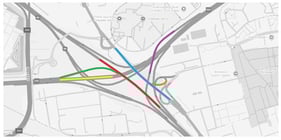
Interchange overview. The arrows indicate the traffic direction.

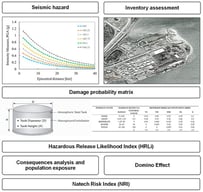
Marine ports located in regions of moderate seismicity can face high Natech (natural hazard-triggered technological) risk because large inventories of hazardous materials are stored near dense urban populations. This study proposes and applies a Natech risk framework to a representative port on the Saint-Laurence River in Quebec, Canada. Site-specific peak ground accelerations (PGA) are first estimated for 12 earthquake scenarios using regional ground motion prediction equations adjusted for local site conditions. These hazard levels are combined with a damage probability matrix to estimate Hazardous Release Likelihood Index (HRLi) scores for atmospheric steel storage tanks. Offsite consequences are then evaluated to obtain Maximum Distances of Effect (MDEs) for different types of hazardous materials. MDE footprints are intersected with block-level demographic data and complemented by a domino-effect based on inter-tank spacing, yielding a tank-level Natech Risk Index NRIi,s for each storage tank (i) and seismic scenario (s). These values are then averaged over all tanks to obtain a scenario-level mean Natech Risk Index (NRI¯) for each tank substance. Regression equations relating NRI¯  to PGA are provided as a practical tool for defining critical intensity thresholds for seismic Natech risk management in marine ports.

2 February 2026

Framework for Natech risk assessment of storage tanks in port facilities.

Shear Performance of High-Strength Concrete (HSC) Beams Reinforced with Steel and Fiber Composite Grids

  • Mohammad Azhar Mudaqiq,
  • Mohd Tahseen Islam Talukder and
  • Ahmed Ibrahim
  • + 1 author

This study investigates the shear performance of high-strength concrete (HSC) beams reinforced with steel, fiber composite grids (CFRP and GFRP), and their hybrid configurations in the absence of transverse reinforcement. A total of six full-scale beams with varying reinforcement configuration and shear span-to-depth (a/d) ratios were experimentally tested under monotonic loading to evaluate their load capacity, cracking characteristics, failure modes, and serviceability behavior. The results revealed that beams reinforced solely with fiber grids exhibited significantly reduced strength and brittle shear failure. Hybrid systems incorporating both steel and fiber grids demonstrated improved strength and ductility, closely matching or surpassing control specimens with conventional steel reinforcement. Key structural parameters such as effective moment of inertia, cracking moment, shear strength, and midspan deflection were compared against analytical predictions based on ACI 318-16 and the Canadian Education Module code. While predictions generally aligned for hybrid beams, notable discrepancies were found for FRP-only systems, particularly in serviceability performance. The findings highlight the potential of hybrid reinforcement as a viable design strategy for HSC beams, offering a balance between strength, ductility, and service performance.

30 January 2026

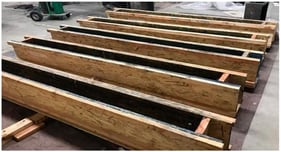
Prepared wooden formwork for concrete beams.

News & Conferences

Issues

Open for Submission

Editor's Choice

Get Alerted

Add your email address to receive forthcoming issues of this journal.

XFacebookLinkedIn
Infrastructures - ISSN 2412-3811