You are currently viewing a new version of our website. To view the old version click .
Infrastructures
  • Review
  • Open Access

12 December 2025

Environmentally Sustainable and Climate-Adapted Bitumen–Composite Materials for Road Construction in Central Asia


,
,
,
,
,
and
1
Department of Chemistry and Chemical Technology, Kh. Dosmukhamedov Atyrau University, Studenchesky Ave., 1, Atyrau 060011, Kazakhstan
2
Institute of Petrochemical Engineering and Ecology Named After N.K. Nadirov, Atyrau Oil and Gas University Named After S. Utebayev, M. Baimukhanov Street, 45A, Atyrau 060027, Kazakhstan
3
Chemical & Biochemical Department, Satbayev University, 13 Satbayev Street, Almaty 050013, Kazakhstan
4
A.V. Topchiev Institute of Petrochemical Synthesis, Russian Academy of Sciences, Leninsky Prospekt, 29, Moscow 119991, Russia
This article belongs to the Special Issue Safer Roads Ahead: Exploring the Latest Innovations and Advancements in Road Design and Safety Technology

Abstract

This review examines scientific and engineering strategies for adapting bituminous and asphalt concrete materials to the highly diverse climates of Central Asia. The region’s sharp gradients—from arid lowlands to cold mountainous zones—expose pavements to thermal fatigue, photo-oxidative aging, freeze–thaw cycles, and wind abrasion. Existing climatic classifications and principles for designing thermally and radiatively resilient pavements are summarized. Special emphasis is placed on linking binder morphology, rheology, and climate-induced transformations in composite bituminous systems. Advanced characterization methods—including dynamic shear rheometry (DSR), multiple stress creep recovery (MSCR), bending beam rheometry (BBR), and linear amplitude sweep (LAS), supported by FTIR, SEM, and AFM—enable quantitative correlations between phase composition, oxidative chemistry, and mechanical performance. The influence of polymeric, nanostructured, and biopolymeric modifiers on stability and durability is critically assessed. The review promotes region-specific material design and the use of integrated accelerated aging protocols (RTFOT, PAV, UV, freeze–thaw) that replicate local climatic stresses. A climatic rheological profile is proposed as a unified framework combining climate mapping with microstructural and rheological data to guide the development of sustainable and durable pavements for Central Asia. Key rheological indicators—complex modulus (G*), non-recoverable creep compliance (Jnr), and the BBR m-value—are incorporated into this profile.

1. Introduction

The modern paradigm of infrastructure development is increasingly shaped by ecological sustainability. The concepts of green roads [1,2], circular economy [3,4], and net-zero infrastructure [5] have become integral components of both engineering practice and policy frameworks. The term green roads implies not only the application of energy-efficient construction technologies but also a systemic materials approach—from raw material extraction and production to end-of-life recycling—aimed at minimizing greenhouse gas emissions and reducing the environmental footprint of transport infrastructure.
International strategies for carbon emission reduction reflect this direction: recent national and intergovernmental road maps include targeted plans to transition transport infrastructure toward low- or zero-emission systems, requiring the revision of materials, design methodologies, and construction processes.
At the core of this transformation lies a persistent engineering dilemma—how to balance durability, sustainability, and cost. Many environmentally friendly solutions either increase initial costs or exhibit reduced service life under extreme climatic conditions. Thus, economically viable and sustainable materials must simultaneously ensure adequate mechanical robustness and long-term durability under environmental stresses. This trade-off remains a central subject of ongoing research and pilot-scale validation.
Globally, there is a growing momentum toward integrating recycled materials into the road construction sector, with the European Union, China, and India leading in both implementation and standardization. In Europe, circular principles are being embedded directly into infrastructure value chains, supported by numerous research programs and B2B initiatives on material recycling. In Asia—particularly in India—large-scale programs utilizing shredded plastics and crumb rubber in asphalt concrete have demonstrated both industrial-scale deployment [6] and thousands of kilometers of pavement incorporating recycled plastics [7]. China continues to advance large national programs on reclaimed asphalt pavement (RAP) reuse in urban and highway networks. Parallel to these efforts, metric reviews have systematically analyzed the effects of recycled components on rutting resistance, elastic modulus, and bitumen savings [8,9].
Against this global background, there is an increasing demand for low-cost, low-carbon, and adaptive solutions that can be rapidly deployed in regions with limited recycling infrastructure. Such approaches should satisfy three principal criteria:
1.
availability of local secondary resources (plastics, lignin, rubber, industrial by-products);
2.
technological simplicity and compatibility with existing production processes (dry/wet integration, masterbatch techniques, local mini-plants);
3.
compliance with required mechanical and rheological performance under regional climatic conditions.
Comprehensive life-cycle assessment (LCA) and economic feasibility analyses are essential decision-making tools for policymakers and infrastructure stakeholders [10].
Central Asia—comprising primarily Kazakhstan, Uzbekistan, Kyrgyzstan, Tajikistan, Mongolia, and Afghanistan—occupies a strategically significant position within the evolving global transport architecture. The Middle Corridor and related Belt & Road initiatives [11] make the region a potential hub for both transcontinental and domestic transport routes, driving a growing demand for reliable and quickly deployable road infrastructure. This geopolitical and economic context dictates massive construction needs—from rural access roads to major highways—while the region’s climatic heterogeneity (continental temperature extremes, aridity, high wind loads, and mountainous hydrology) imposes stringent and often contrasting material requirements [12].
Consequently, solutions based on locally available secondary resources (such as lignin from wood processing, recycled plastics, waste tires, and carbon composite residues) or those enabling simple, cost-effective technological adaptation (e.g., masterbatch incorporation, dry dosing methods) emerge as priorities not only from an ecological but also from an economic standpoint. Recent analytical and policy reports highlight this scenario for the Middle Corridor as a catalyst for the development of locally sourced, affordable, and rapid road construction technologies [13].
According to current national and regional transport development programs, Central Asia faces a substantial increase in planned roadway expansion over the next decade. Kazakhstan’s “National Infrastructure Development Plan 2025” outlines more than 11,000 km of new or reconstructed highways, including ~3200 km of international corridors intended for heavy-load traffic classes TC-1 and TC-2 [14]. Uzbekistan’s “Transport Strategy 2035” similarly targets over 8000 km of upgraded roads, with projected increases in freight volumes of 40–45% and the expansion of high-category pavement structures designed for intense axle loads (>10 t/axle) [15]. Independent assessments confirm these trends: a regional feasibility review published by the Asian Development Bank highlights that cumulative demand for high-performance pavements along the Middle Corridor may exceed 25,000 km by 2035 due to expected freight redistribution between Europe and China. These figures underscore the urgency of developing climate-adaptive and resource-efficient binder technologies capable of withstanding the region’s extreme environmental loads and traffic classes.
Based on these considerations, the objectives of this review are:
  • to systematize current approaches to the recycling and adaptation of polymer–bitumen composites, from mechanical recycling of plastics to thermo-mechanical and chemical compatibilization methods;
  • to identify the interrelation between climatic and environmental factors in Central Asia and the performance requirements of materials, highlighting climate-determined rheological passports for asphalt binders and mixtures;
  • to outline technological and policy directions (LCA-oriented implementation scenarios, pilot standards, and localized supply chains) that may enable the safe and large-scale application of secondary resources in the regional road construction sector.
These goals lie at the intersection of materials science, rheology, and infrastructure policy, thus requiring an interdisciplinary perspective—which this review seeks to provide [9].
Building on this context, the present review introduces a novel integrative framework that links climatic zoning with rheological material design. First, the analysis explicitly incorporates Köppen–Geiger climate stratification into the formulation of rheological passports for bituminous binders and asphalt mixtures, enabling climate-informed performance benchmarking across the diverse environmental conditions of Central Asia. Second, the review synthesizes and evaluates combined aging protocols—including PAV, UV exposure, and freeze–thaw cycling—as a unified methodology for reproducing coupled climatic stressors characteristic of continental and sharply continental regions. Third, the study advances a climate-driven approach to binder selection, in which microstructural, morphological, and rheological criteria are directly anchored to regional temperature regimes, radiation loads, and hydrological variability. Finally, the core methodological contribution of this work is the introduction of the “Climate Rheology Profile”, a conceptual and practical framework that integrates climate mapping with multiscale binder characterization to support the development of adaptive, durable, and sustainable pavement materials tailored to Central Asia.

2. Nature, Structure, and Challenges of Road Materials: Adaptivity as a Key Parameter

2.1. The Functional Role of the Surface Layer and Its Relation to Binder Structure

The performance of the surface course is governed by the interplay between its rheological response and the multiscale structure of the binder. Mechanical durability under cyclic loading and environmental resistance to moisture, oxidation, and ultraviolet radiation arise from the microstructural organization of the binder film, its relaxation dynamics, and its susceptibility to oxidative densification. Accordingly, the functional state of the pavement surface cannot be interpreted solely through macroscopic mixture parameters but requires explicit consideration of binder chemistry, colloidal architecture, and aging kinetics.
Modern materials science tools for describing this transition “from molecule to pavement” include SARA fractionation and rheological characterization (DSR, BBR, MSCR), which provide a quantitative link between chemistry, microstructure, and performance behavior. Review studies emphasize that understanding the colloidal organization of bitumen is the key to controlling its functional properties [16].

2.2. Chemical–Fractional Composition and Colloidal Organization

Changes in the SARA ratio directly affect the viscoelastic response and aging susceptibility: an increased asphaltene fraction leads to higher stiffness, reduced plasticity, and a greater risk of low-temperature brittleness, whereas an excess of oily components decreases thermal stability. These correlations are consistently confirmed by both classical and recent studies employing SARA fractionation [17,18] and graph-analytical [19] methods.
Contemporary models describe bitumen as a colloidal system of complex composite structural entities (CSEs, micelle-like aggregates)—asphaltene cores surrounded by resin shells and dispersed in an aromatic matrix. The association–dissociation equilibrium of these entities depends on temperature, oxygen content, and the presence of modifiers.
Transitions between sol, sol–gel, and gel states explain the observed nonlinear rheological behavior [20,21,22]. The progressive growth of the aggregate network during aging accounts for the irreversible increase in complex modulus (G*) and the loss of relaxation capability [16].

2.3. Aging Mechanisms and Their Kinetics

Oxidative aging of bitumen manifests through the formation of carbonyl and sulfoxide groups, as identified by FTIR spectroscopy, and correlates with the increase in stiffness (G*) and non-recoverable compliance (Jnr) in rheological tests. Petersen and subsequent studies demonstrated that thermo-oxidative reactions are governed not only by temperature but also by mass transport factors—oxygen availability and nanofilm thickness—making the kinetics of aging strongly dependent on pavement geometry and service conditions.
Laboratory protocols such as RTFOT and PAV [23,24] simulate these effects, yet accurate correlation with field reality still requires comprehensive long-term data. Camargo et al. [25] further distinguished between purely thermal and oxidative pathways, demonstrating that temperature rise accelerates carbonyl formation and increases G*, while oxygen availability and UV exposure modify the oxidation pathway (thermo- vs. photo-oxidation) [25].
However, RTFOT and PAV procedures were developed to simulate generic thermal-oxidation exposure and do not capture several field-relevant coupled factors that dominate degradation in continental and sharply continental climates such as those across Central Asia. RTFOT/PAV omit direct ultraviolet (UV) irradiation, which drives photo-oxidative pathways producing chemical signatures (and surface embrittlement) distinct from thermal oxidation; combined heat+UV experiments show substantially faster increases in modulus and oxidation indices than heat alone [26].
The kinetics of oxidation in thin pavement surface films are controlled by oxygen diffusion and microstructural heterogeneity; standard oven-based protocols do not reproduce the spatial gradients of oxygen ingress, nor the influence of nanofilm thickness on reaction rates, leading to under- or mis-estimation of carbonyl/sulfoxide accumulation and consequent rheological stiffening [27].
Central Asia is characterized by large diurnal temperature amplitudes and frequent freeze–thaw and moisture cycles; these induce thermomechanical fatigue and microcracking that accelerate ingress of oxygen and water and thus alter aging pathways. RTFOT/PAV procedures do not include cyclic thermal or moisture loading and therefore cannot reproduce these coupled effects [27].
To improve correlation with field aging in the region should made adoption of combined accelerated protocols that superimpose UV exposure and controlled moisture/freeze–thaw cycles on top of RTFOT/PAV treatments, calibration of accelerated schedules against field-extracted binders from instrumented pilot sections (iterative matching of chemical indices—carbonyl/sulfoxide by FTIR and rheological measurings G*(T), δ(T), J; and reporting of film thickness, oxygen partial pressure and UV dose in aging experiments to allow reproducible comparison. Several recent studies show that such combined or alternative aging sequences produce chemical and mechanical signatures closer to field-aged binders than RTFOT/PAV alone [26].

2.4. Effects of Polymer and Biopolymer Modifiers on Structure and Rheology

Polymeric modifiers (SBS, EVA, PPA, crumb rubber) and biopolymeric additives (lignin, modified cellulose, bio-oils) affect bitumen structure through diverse mechanisms. Polymers may form continuous or semi-continuous networks, enhancing the elastic component; fillers act as rigid inclusions, increasing the modulus; biopolymers can function as antioxidants and compatibilizers.
Numerous studies have shown that the phase distribution of the polymer within the bituminous matrix is critical to achieving improved performance, whereas excessive coalescence of polymer domains may deteriorate low-temperature flexibility [16,28].
In the region, SBS (styrene-butadiene-styrene) is primarily imported from international manufacturers. Several SBS importers and distributors are registered in Kazakhstan and neighboring countries, and the global market exhibits price volatility due to fluctuating raw material prices (ICIS contract prices increased in 2024). The estimated price of commercial grades of SBS ranges widely from ≈1500 to 3500 USD/t, depending on the grade and logistics. Practical application requires wet-process equipment (heating bitumen to 160–190 °C, intense shear mixing; note: 180 °C, 4000 rpm, 2 h for laboratory formulations) [29]. These requirements increase the CAPEX of a PMB production plant and the energy intensity of production.
The availability of crumb rubber in Kazakhstan is confirmed by significant volumes of waste tire accumulation, as well as the emergence of domestic recycling lines. This makes it technically feasible to locally source raw materials for rubber modifiers, although the actual volumes of material suitable for asphalt production depend on fraction size, purification, and de-feeder technology. The production of rubberized bitumen typically involves mixing bitumen with crumbs at ~175–180 °C and high shear rates (in practice: 40–60 min in industrial plants, 175 °C/5000 rpm in the laboratory) [30], which requires specialized mixers and degassing control.
Lignin as a bio-raw material is potentially available through local pulp and paper mills: paper production volumes in Kazakhstan are measured in tens of thousands of tons per year (approx. ~83 × 103 tons of paper in 2022), which theoretically corresponds to the potential of by-product lignin. However, industrial-scale extraction is technically and economically dependent on the availability of pulp mills with cost-effective extraction systems (LignoBoost, etc.) [31]. Technical lignins are typically valued globally at approximately USD 250–600/t (depending on purity and extraction technology), making them an economically attractive additive given their local availability and minimal logistics costs [32]. Converting lignin into bitumen-compatible forms requires additional pre-processing (fractionation, sulfonation/esterification, fine mechanical processing) and thermal stability control at asphalt production temperatures (WMA/HMA strategies).

2.5. Design Challenges for Central Asia and Kazakhstan

The climatic conditions of the region—wide diurnal temperature ranges, high solar radiation in the south, prolonged frosts in the north, and rapidly changing humidity in mountain areas—amplify the degradation mechanisms discussed above. Field observations and regional monographs highlight the inconsistency between standard classification systems (PG, EN specifications) and local realities, suggesting the need to adapt test parameters and formulations accordingly [33,34,35].
Practically, this implies that:
  • Standard polymer modification recipes require regional adaptation (dosage, incorporation method, polymer pre-treatment);
  • Local raw material characteristics must be considered (bitumens derived from regional crudes exhibit distinctive SARA profiles);
  • Innovative modifiers (biocomponents, nanophases, combined polymer systems) should be tested under conditions that simulate real regional climates, including UV exposure and freeze–thaw cycling [36,37,38].

2.6. Section Summary and Research Gaps

While the fundamental principles of bitumen structure and aging are well established, several application-oriented research gaps remain critical for Central Asia:
  • systematic correlation of SARA profiles of local bitumens with pavement performance across climatic zones of Kazakhstan;
  • long-term field evaluation of polymer–biopolymer composites under regional solar radiation and thermocyclic conditions;
  • standardization of accelerated laboratory aging methods (combined RTFOT/PAV + UV + freeze–thaw protocols) to ensure valid correspondence with field performance.

3. Interrelation Between the Climate of Central Asia and Engineering Challenges

3.1. Climatic Stratification of Central Asia

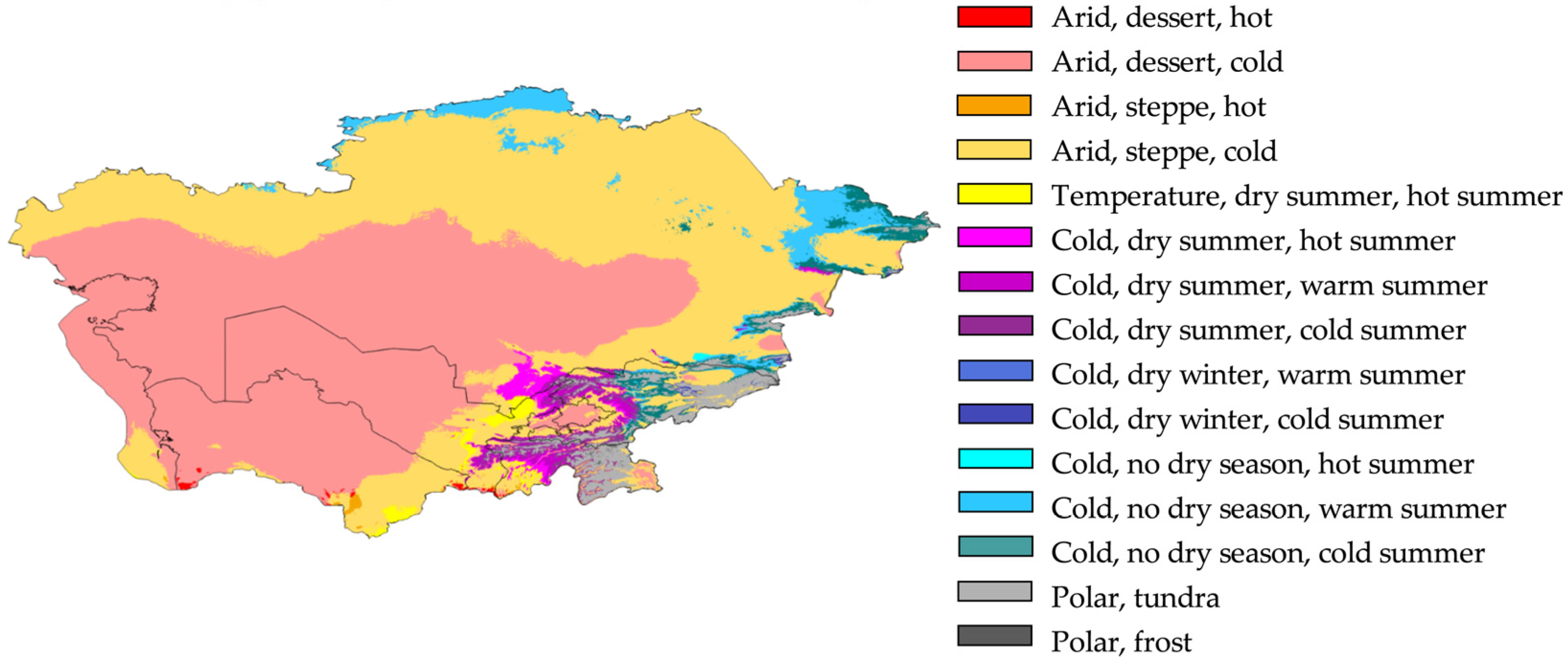
Central Asian countries, including Kazakhstan, Uzbekistan, Turkmenistan, Kyrgyzstan, Tajikistan, and Mongolia, are characterized by pronounced spatial variability of climatic conditions, ranging from moderately continental and continental steppe and semi-desert zones to high-mountain, alpine, and arctic climate types. For quantitative stratification of the region, the widely accepted Köppen–Geiger system is convenient; recent high-resolution mapping demonstrates significant zone shifts in Central Asia and predicts further warming and aridization in the 21st century [39]. Higher spatiotemporal resolution maps (1 km, historical and scenario-based data) additionally confirm that even within administratively homogeneous areas, shifts between climate types are observed (toward drier and warmer clusters), necessitating regionally targeted engineering (Figure 1) [40].
Figure 1. Koppen-Geiger climate classification map for Central Asia (1980–2016) [40].
Based on climatic stratification and available literature, several degradation scenarios and corresponding engineering challenges can be identified:
Northern Continental Zones (Northern and Eastern Kazakhstan)
These territories are characterized by long and harsh winters, several months of ground freezing, and large temperature and humidity fluctuations. The main threats to pavement integrity arise from low-temperature cracking, cohesive failures, and loss of adhesion due to moisture penetration into frozen layers. Studies of frost behavior of road structures in Kazakhstan document significant frost depth and complex thawing dynamics, which require the use of binders with low stiffness at subzero temperatures and high relaxation capacity (e.g., elastomers, plasticizers). Practices and standards (such as regional RILEM recommendations) emphasize the need to control BBR parameters (stiffness and m-value) for such climates [41,42].
Southern Semi-Desert and Continental Regions (Southern Kazakhstan, Uzbekistan)
These zones are dominated by high daytime temperatures, rapid nocturnal cooling, and intense insolation. Operational risks include rutting, thermo-oxidative, and photo-oxidative aging. Studies demonstrate that UV exposure not only increases bitumen stiffness but can also induce the formation of a surface “hard crust,” reducing elasticity, especially in polymer-modified bitumens [43]. For such regions, modifications with antioxidants, UV absorbers, nanofillers, as well as engineering measures such as reflective “light-colored” coatings, have been proposed to reduce thermal loading.
Mountainous and High-Mountain Territories (Tien Shan, Pamir, etc.)
Mountain regions combine extreme factors: intense radiation, large diurnal temperature fluctuations, moisture, and water penetration into the pavement. This combination creates a dual aging mechanism: photostress and thermo-cyclic fatigue. In high-altitude regions, as shown by experiments with reclaimed mixtures, combined aging (UV + freeze–thaw) significantly deteriorates structural stability and mechanical properties. Xie et al., 2025 studied asphalt mixture performance under combined UV radiation and freeze–thaw cycles, showing substantial reductions in fatigue durability [44]. Engineering solutions here must include multi-level modification: polymer grids, UV stabilizers, appropriate selection of aggregates, and climatically adapted laboratory testing.

3.2. Key Climatic Factors and Their Engineering Implications

Climatic changes determining the performance of asphalt pavements in the region include: the range and frequency of extreme temperatures (diurnal and seasonal amplitudes), relative humidity and precipitation patterns, total solar radiation (including UV intensity), wind speed (erosion potential, evaporation, and particle blow-off), and elevation above sea level (high-altitude regions are characterized by enhanced UV radiation and sharper diurnal temperature swings). These parameters affect three main degradation mechanisms: (1) thermo-oxidative aging of bitumen; (2) thermo-cyclic and low-temperature cracking; (3) mechanical damage: rutting and fatigue cracking under repeated loads [45,46,47].
Key parameters influencing pavement properties include:
Temperature. Thermal regimes determine the rate of thermo-oxidative kinetics and evaporation of light fractions [25]: upon heating with oxygen access, there is a rapid increase in carbonyl and sulfoxide groups, stiffness growth (|G*|), and reduced elasticity. Consequently, this is directly linked to brittle failure risk at low temperatures and decreased fatigue resistance in the medium temperature range [25].
UV Radiation and Elevation. In high-altitude regions (Pamir, Tien Shan), UV intensity increases; recent studies identify a specific mechanism of “photo-oxidative” aging [43], distinct from classical thermo-oxidation: photolysis of the surface layer produces a hard crust (surface hardening) and depth-wise property gradients (gradient aging) [48], increasing the risk of surface cracks and fragmentary pavement failure.
Moisture and Frost Regime. Frequent freeze–thaw cycles and high seasonal frost depth (in northern and mountainous Kazakhstan minima reach −46 °C in some locations) cause moisture accumulation and redistribution within structural layers, increasing internal pressure and promoting longitudinal and transverse thermal cracking; studies focused directly on Kazakhstan document low-temperature damage statistics and critical temperature strength calculation features [33,49].
Wind and Abrasive Factors. Wind speeds in desert and semi-desert areas intensify particle blow-off (dust, sand), leading to surface abrasion, rapid aggregate polishing, and roughness changes. These factors affect traction and braking performance. In addition, wind erosion modifies the surface thermal balance (locally increasing or decreasing evaporation/cooling rates), indirectly influencing aging rate and temperature distribution across the pavement [39,50].

3.3. Concept of “Climatically Selective” Formulations

The above indicates that a universal formulation for the entire region is infeasible: binder and mixture optimization must be linked to local climatic factors and operational loads. Practically, this means that for northern and high-altitude zones, binders with improved low-temperature plasticity (below critical brittle temperatures) or compounded/modification (plasticizers, elastomeric additives) that reduce stiffness at subzero temperatures are preferred, as demonstrated by studies on compounding and low-temperature performance [51]. For warm and sunny regions, binders with increased thermal resistance and photo-oxidative stability (antioxidants, UV stabilizers, nanomodifiers) are required, along with pavement designs with optimized reflective properties (heat-reflective coatings) to reduce surface temperature [43,52,53].
For semi-desert and wind-exposed areas requiring enhanced particle abrasion protection, careful selection of aggregates and gradation, with mandatory roughness control before and after sandblasting, is necessary. Additionally, water-draining pavement types and measures against fine-particle blow-off (engineered shoulder design, vegetation cover) are recommended [54,55,56].

3.4. Regional Standards and Engineering Practices

Regional adaptation of bituminous binders and asphalt mixtures is an essential component of modern pavement engineering, particularly in countries with pronounced climatic heterogeneity. Analysis of international practices shows that nearly all advanced road systems employ national or regional standards linked to specific temperature ranges, humidity, and material aging characteristics.
China is a prominent example, with climates ranging from humid subtropical to arid continental. National standards (JTG F40–2004 [57]) introduce climate-oriented categories of binders and asphalt mixtures based on service temperature ranges and solar radiation intensity. Mixes using crumb rubber and thermoplastic elastomers are actively developed to enhance aging resistance and rutting performance under hot climates. Xu et al., 2023 reported that using rubber powder with SBS-modified bitumen increased rutting resistance by 35–40% and significantly reduced sensitivity to temperature fluctuations in the 25–60 °C range [58]. Other studies [59,60] demonstrate that optimization based on MSCR and DSR criteria, along with UV stabilizers (TiO2, ZnO), increases pavement durability in regions with high solar insolation, such as western China (Xinjiang, Gansu).
Indian practice also follows climatic stratification. Considering extreme temperatures (from +50 °C in Rajasthan deserts to +15 °C in Himachal Pradesh mountains), regional guidelines recommend polymer-modified binders, primarily with polyethylene waste and natural latex [61]. These modifications enhance deformation and thermo-oxidative resistance while maintaining acceptable viscosity at low temperatures. India promotes the Waste-to-Road concept, dispersing plastic waste (PET, PP, HDPE) into bitumen at high temperatures, simultaneously addressing recycling and thermal resistance improvement [8].
In Europe, where climatic conditions range from subarctic to moderate Atlantic, binder classification systems are established in EN 12591 [62] and several national documents. Special attention is paid to northern countries (Sweden, Norway, Finland), where modified bitumens with increased low-temperature cracking resistance and improved adhesion under moisture saturation are used. Nordic Road Association (NVF) and FASpec (Finland Asphalt Specification) guidelines define low-temperature properties measured via BBR and DSR, and durability after artificial aging RTFOT+PAV [63]. For cold Scandinavian regions, formulations with reduced asphaltene content and biomodifiers (e.g., tall oil) are proposed, lowering shear modulus at −20 °C without adhesion loss [64,65].
In North America, a similar principle is implemented in the Superpave Performance Grading (PG) system, where climate parameters (maximum and minimum design pavement temperatures) directly determine binder selection.
Comparison of these regional approaches demonstrates that climate-oriented standardization and binder design have become a primary direction in pavement engineering. For Central Asia, where climate spans extremely cold (−40 °C) to hot (+45 °C) conditions, the experience of China, India, and Northern Europe is particularly relevant. Engineering adaptation must include both material-technological solutions (regulating binder phase composition and rheological properties, optimizing aggregates and modifiers) and regulatory measures—developing regional classifications, similar to the PG system, considering not only temperature extremes but also radiation levels, wind loads, and moisture cycles.

3.5. Conclusions and Implications for Design

Central Asia’s climatic stratification, with contrasting temperatures, high insolation, and seasonal humidity fluctuations, precludes the use of universal asphalt binder formulations. Various climatic factors, including temperature, UV radiation, moisture, wind, and elevation, differentially influence aging, cracking, and deformation processes. The Studies [39,40] show that using the Köppen–Geiger climate classification enables rational selection of binder types, modifiers, and structural solutions for specific zones.
Scientific justification of “climatically selective” formulations requires integration of climate mapping, accelerated laboratory aging scenarios, and rheological testing (DSR, BBR, MSCR). Such approaches quantitatively link climatic loads with binder property changes and allow prediction of pavement durability. Contemporary reviews emphasize the necessity of transitioning from universal standards to regionally adapted design systems [25,43].
Practical implementation requires combining material-science and engineering measures: targeted binder modification with antioxidants, UV stabilizers, and biopolymers; selection of mineral aggregates considering thermal and hydrophilic properties; and engineering measures such as reflective surfaces, drainage systems, and thermally stabilizing layers. Collectively, these approaches form the basis for climate-adaptive pavement structures resilient to Central Asia’s extreme conditions.
Central Asia’s climatic stratification dictates the need for regional adaptation of formulations: a “one-size-fits-all” binder is not justified from an engineering perspective. Analysis of combined climatic factors (temperature, UV load, moisture, wind, elevation) is essential when selecting binder type, modifiers, and pavement structure [39,40].
Scientific justification of “climatically selective” formulations requires a comprehensive methodology combining climate mapping, accelerated laboratory aging scenarios (including combined temperature and UV effects), rheological measurements (DSR, BBR, MSCR), and field observations. This approach is recommended by modern studies on bitumen aging and rheology [25,43].
Practical strategies should integrate material- and design-based measures: targeted binder modification (antioxidants, UV stabilizers, biocomponents), aggregate and gradation selection, as well as engineering measures (reflective coatings, drainage) to ensure long-term resilience of regional road infrastructure.

4. Recycled Polymers as Bitumen Modifiers

In recent years, global road construction practice has increasingly adopted polymer-modified asphalts (PMB), in which conventional petroleum bitumen is supplemented or partially replaced by various polymers. This development is driven by the need to enhance the operational performance of pavements—particularly their resistance to rutting, cracking, and aging—as well as by environmental and recyclability considerations. Classical polymers in this domain include styrene-butadiene-styrene (SBS) block copolymers, ethylene-vinyl acetate (EVA), polyisobutylene, and others. Their use has proven effective: the binder becomes more elastic, the recovery coefficient after deformation increases, low-temperature crack resistance improves, and high-temperature deformation resistance is enhanced [35]. Reviews of contemporary literature [66,67] emphasize that such modifications significantly broaden the temperature range of asphalt mixture applications and extend their service life.
Alongside commercial polymer additives, interest has grown in more readily available sources of modifiers, particularly secondary plastics and biopolymers. In many countries, pilot projects have successfully demonstrated the practical applicability of these approaches. For instance, in the Netherlands, the PlasticRoad project (VolkerWessels) demonstrated that road and bicycle pavements can be constructed from recycled plastics, with such structures exhibiting sufficient mechanical strength and resistance to loads and temperature fluctuations [68]. In India, where plastic waste is a particularly acute problem, technologies for incorporating shredded polyethylene (PE) and polypropylene (PP) into asphalt concrete have been implemented in field conditions: polymer content typically ranges from 5 to 10 wt.% of the mixture, and several studies and reports indicate a noticeable reduction in rutting and bitumen savings at this dosage [69]. Laboratory and field studies in North America and Europe also show that the addition of ground tire rubber (GTR), PE/PP, and combined modifiers improves the strength, damping, and durability of asphalt layers [70].
Thus, global practice demonstrates that asphalt modification with polymers has moved beyond academic research and is increasingly applied in infrastructure projects.

4.1. Technological Approaches to Producing Polymer-Bitumen Composites

Two primary technological approaches exist for incorporating polymer additives into asphalt concrete—the so-called “wet” and “dry” processes—each with distinct physicochemical characteristics, advantages, and limitations. In the wet approach, modification is performed during bitumen preparation: the polymer (most often SBS, EVA, LDPE, less commonly PP or recycled thermoplastics) is introduced into heated bitumen at 160–190 °C with intensive shear mixing for 30–60 min [35]. Two interaction scenarios are possible: partial polymer dissolution in bitumen or formation of a stable dispersion, depending on solubility parameters and system viscosity. The resulting structure is either a finely dispersed emulsion with polymer droplets in a bitumen matrix or a continuous structure in which the polymer phase forms a spatial network, imparting increased elasticity and thermal stability. Rheologically, this manifests as an increase in complex modulus (G*) and a reduction in the loss tangent (tanδ), indicating enhanced elasticity and, practically, improved resistance to rutting at high temperatures [71].
The dry method, in contrast, involves the direct introduction of polymer particles into the asphalt mixture without prior dispersion in bitumen. Shredded thermoplastics (HDPE, LDPE, PP, PET) or rubber crumbs are added to the mixer together with heated mineral aggregates at 160–180 °C. The polymer particles partially melt, coating the surfaces of the aggregate or sand, forming a thin polymer layer that improves adhesion and water resistance.
The physical distinction between these methods primarily relates to heat and mass transfer mechanisms and component compatibility. In the wet process, polymer chains can diffuse into the low-molecular-weight bitumen phase, forming a partially dissolved structure, whereas in the dry process, interaction is limited to surface wetting and localized melting. Compatibility is determined by the proximity of Hansen solubility parameters (δD, δP, δH); the highest degree of dissolution is observed for elastomers and polyolefins with δ values close to those of bitumen (approximately 17–19 MPa1/2) [72]. For PET, which has high crystallinity and a melting point of ~250 °C, direct melting in bitumen is impossible—preliminary chemical or thermomechanical processing (glycolysis, pyrolysis) is required to achieve an amorphous state and produce low-molecular-weight fragments compatible with the hydrocarbon matrix [73].
Technologically, the wet method requires specialized equipment—high-shear mixers, thermostated tanks, and bitumen circulation systems—raising energy consumption and process costs. However, polymer-bitumen binders (PBB) produced by this method exhibit high stability, controllable rheological properties, and standardization potential according to international specifications (e.g., Superpave PG). These composites are predominantly applied in highways, airfield pavements, and other high-load facilities. An example is the use of SBS-modified bitumen in high-traffic pavements, where service life extends to 12–15 years compared to 6–8 years for standard asphalt [74].
The dry method, however, has proven especially popular in countries focused on local waste recycling and low capital costs. A typical example is the Vasudevan technology (India), in which shredded polyethylene or polypropylene is added directly to heated aggregates; the polymer partially melts, binding mineral grains to form a composite with improved water resistance and crack resistance [75]. Similar implementations exist in the UK, Netherlands, and Australia, where the use of 5–8 wt.% recycled plastic reduced rutting by 30–40% and increased asphalt concrete modulus by 20–25% [70]. Despite lower homogeneity and potential property variations, the dry method offers simplicity of implementation and effective utilization of secondary resources, making it promising for regions with limited technological infrastructure, including Kazakhstan.
A clear and practically relevant distinction must be made between the wet and dry routes for the incorporation of recycled polymers into asphalt systems, as each method leads to different performance outcomes, constraints, and long-term risks.
In the wet process, low-melting-point recycled plastics (commonly PE or PP) are molten and blended directly into hot bitumen under high shear, producing a modified bitumen binder prior to mixture production. Recent experimental work demonstrates that such wet-modified binders with plastic contents in the range of 2–6 wt% of the binder can enhance rutting resistance and stiffness of asphalt mixes, though higher dosages often result in decreased storage stability and increased risk of phase separation [76,77]. Studies report that with plastic contents above ~6%, gains in performance are offset by poor homogeneity and long-term durability issues [78].
Alternatively, the dry (or “aggregate-addition”) process introduces shredded or pelletized recycled plastic directly into the asphalt mixture—either as partial aggregate substitute or as mixture modifier—typically without attempting full dissolution in bitumen. This route is technologically simpler, more compatible with decentralized or lower-cost production facilities, and avoids binder-blend instability. For example, dry-process asphalt mixtures with waste polyethylene dosages in the order of 0.25–1.5 wt% of total mixture mass demonstrated comparable workability, moisture resistance, and improved stiffness or permanent deformation resistance compared to reference mixtures [79].
However, both methods carry the risk of surface hardening and reduced low-temperature or fatigue performance when polymer content (or plastic fraction) becomes excessive. Several studies note that too high a polymer fraction (for wet method) or too large plastic content (for dry method) leads to increased mixture brittleness, poor fatigue crack resistance, and moisture-sensitivity under freeze–thaw cycles or cyclic loading [80,81].
Based on available experimental evidence and to maintain a balance between mechanical improvement and long-term durability, practical upper limits for polymer addition are recommended as follows:
For the wet process: 2–6 wt% of binder mass.
For the dry process: ~1–2 wt% of total asphalt mixture mass (equivalent to ~4–6 wt% of the binder/bitumen proportion, depending on mix design).
These dosage ranges provide sufficient modification to enhance high-temperature performance and rutting resistance, while minimizing the risks of phase separation, surface hardening, and durability degradation under variable climatic and load conditions.
Given the simpler logistics and lower cost requirements, the dry-process route appears particularly suitable for deployment in regions with limited industrial infrastructure or decentralized production—for example, in many parts of Central Asia. Nevertheless, adequate quality control (e.g., particle-size distribution, plastic type selection, mixing temperature, moisture control) remains critical to ensure consistent pavement performance.
There are notable differences in the energy demand associated with wet and dry modification pathways. Wet processing requires high-shear milling at elevated temperatures and therefore adds an additional ≈72 MJ·t−1 of energy consumption per tonne of PMB, as documented in the Bitumen Life Cycle Inventory of the Refined Bitumen Association. For each ton of modified asphalt produced using the conventional wet process, an average of 121.67 kg of carbon dioxide (CO2) is emitted, alongside 605.0 kg of nitrogen dioxide (NO2), 58.0 kg of carbon monoxide (CO), and 490.0 kg of methane (CH4) [82].
Baseline plant energy use for producing asphalt mixture (heating and drying aggregates) is typically 320–390 MJ·t−1, and remains similar for both approaches [83]. In contrast, dry modification does not require high-shear reactors and thus adds little to the plant-level energy input; however, the off-site pre-processing of recycled plastics can be significant, with mechanical shredding reported between 15 and 180 kWh·t−1 depending on feedstock and equipment [84]. Additional CO2-equivalent emissions associated with wet milling have also been reported in industrial LCA case studies, typically on the order of 10–15 kg CO2-eq·t−1 PMB. Taken together, these values indicate that wet modification introduces a predictable process-integrated energy penalty, whereas dry modification shifts the energy burden to upstream plastic preparation stages. A comparative overview of the energy demand, emission contribution, and capital requirements associated with wet and dry polymer incorporation routes is summarized in Table 1.
Table 1. Comparative analysis of energy consumption, emission footprint, and capital costs for wet and dry polymer incorporation methods.
The choice between wet and dry approaches depends on operational requirements, economic factors, and equipment availability. When predictable properties and high durability are required, the wet method is preferred; when priority is given to waste utilization and cost reduction, dry or combined approaches are advisable.

4.2. Modification of Asphalt Pavements

A major avenue for sustainable asphalt modification is the use of secondary polymers, such as polyethylene (PE), polypropylene (PP), polyethylene terephthalate (PET), and ground tire rubber (GTR) from end-of-life tires [85]. Incorporating these polymers into bitumen or the mixture alters mechanical and thermal properties: increasing stiffness and deformation resistance, while potential trade-offs include reduced low-temperature plasticity. The density, thermal conductivity, and heating behavior of recycled plastics are critical factors in optimizing the formulation of modified asphalt.
In addition to isotropic insoluble, partially soluble, and soluble polymers, fibers are frequently employed. These can be polymeric, such as non-melting cellulose [86,87,88] or high-melting polypropylene [89,90], or inorganic, such as glass fibers [91,92,93] or even carbon nanotubes [94,95,96]. Fibrous additives enhance the asphalt mixture structure, prevent bitumen drainage, increase fatigue resistance, and stabilize polymer particle distribution. When combined with polymers, a multicomponent matrix is formed: the polymer provides thermal stability and elasticity, while fibers confer structural stability and integrity under cyclic loading.
Contemporary formulations increasingly rely on complex granulometric filler systems: multimodal distributions of coarse, medium, and fine aggregates combined with polymer particles and fibers allow optimization of mixture density, minimization of porosity, and achievement of high mechanical strength and durability. This is especially important for pavements operating in climates with pronounced temperature fluctuations, such as the sharply continental climate of Kazakhstan, where temperatures can vary from −57 to +49 °C.

5. Biopolymer Modifiers for Asphalt-Bitumen Binders

In recent decades, there has been a steady increase in interest in using biopolymers and other biomaterials (such as lignin, bio-oil components, polysaccharides, protein fractions, etc.) as modifiers and/or extenders for bitumen binders. The reasons for this trend are manifold: the pursuit of a circular economy, reduction in the carbon footprint, availability of by-products from the pulp-and-paper and bio-manufacturing industries, and the potential to improve pavement performance. A synthesis of recent reviews and experimental studies indicates that biopolymers can exert a significant influence on the microstructure of bitumen, its rheology, and consequently, on rutting resistance, fatigue durability, and aging resistance of pavements [97,98,99].
Consequently, the modification of asphalt using biopolymers, such as lignin, has emerged as a key focus. Lignin is a naturally occurring biopolymer and a by-product of the pulp and paper industry. Its aromatic structure is similar to that of bitumen, and it exhibits antioxidant properties, which allow for enhanced aging resistance of the binder and adjustments of rheological parameters. Studies demonstrate that the incorporation of 3–5% lignin can increase stiffness and high-temperature deformation resistance while maintaining satisfactory low-temperature performance [100]. Moreover, at the laboratory scale, the addition of lignin has been actively investigated. Comparisons between mixtures containing 30% lignin and conventional asphalt mixtures show that lignin-containing binders reduce thermal sensitivity and age-related degradation while providing comparable strength and stability [97]. However, in terms of fatigue performance and workability, the addition of lignin may require formulation optimization to avoid deteriorating the mixture’s processability [101]. A recent study [102] demonstrated that bio-oil-lignin compositions (combining bio-oil and lignin) exhibit excellent storage stability and rheological properties.

5.1. Major Biopolymer Modifiers and Their Properties

Among the most studied biopolymers in the context of bitumen systems are some biopolymers:
Lignin (a by-product of the paper and biotechnological industries)—used as a modifier, antioxidant, filler/extender, and potential partial bitumen substitute. Extensive reviews and experimental studies indicate that lignin increases binder stiffness at high temperatures, enhances rutting resistance, and exerts a pronounced antioxidant effect, slowing thermo-oxidative aging [6,97].
In recent studies, the impact of lignin dosage on storage stability and long-term performance of bituminous binders has been carefully characterized, revealing both opportunities and limitations for its practical use. For instance, a comprehensive investigation demonstrated that composite binders modified with bio-oil and lignin remained stable after thermal storage at up to 165 °C for 48 h: the maximal softening point difference (top vs. bottom of storage container) was only 0.9 °C, and the calculated storage stability index (Is) remained below 0.1—indicating negligible phase separation even under prolonged heating [102].
However, when unmodified technical lignin or partially purified fractions with small molecular weight distributions are used, excess dosage may lead to inhomogeneity, aggregation or sedimentation during storage, which compromises binder homogeneity and thus service performance [103].
To mitigate these stability issues and improve compatibility of lignin with bitumen, several pretreatment methods have been proposed and successfully demonstrated. Among them: organosolv fractionation—which isolates lignin fractions with narrower molecular weight distribution and higher aromaticity; esterification (or oxyalkylation) of lignin to increase hydrophobicity; high-energy milling to achieve fine particle size (<10–50 µm); and pH neutralization/solvent washing to remove low-molecular-weight acidic or polar impurities. For example, a recent study reported that esterified lignin (PA-L) added at 5 wt% to an SBS-modified binder improved high-temperature stability, increased complex modulus, and preserved low-temperature crack resistance more effectively than unmodified lignin.
Similarly, using purified organosolv lignin fractions (e.g., fraction F4) yielded significant retardation of oxidative aging under PAV/UV protocols, with reduced formation of carbonyl and sulfoxide groups compared to neat bitumen [104].
Based on these data, a practical dosage window for lignin incorporation emerges: up to ~5–6 wt% appears acceptable for producing stable modified binders without significant risk of phase separation or poor workability, provided proper pretreatment and homogenization are implemented. Dosages exceeding this threshold should be accompanied by rigorous mixing protocols (e.g., high-shear blending at elevated temperature), or preferential use of pretreated lignin to ensure long-term storage stability, uniform dispersion, and acceptable rheological and aging behavior.
Polysaccharides: chitosan, cellulose (including micro- and nanocellulose), starch, and their derivatives. For example, chemically modified chitosan improves adhesion and provides some thermal stability; starch-based organic structures can form supramolecular networks within the bitumen matrix, exhibiting “anti-flow” behavior at elevated temperatures [105,106].
Bio-oils and plant-derived esters (rejuvenators/bio-oils)—primarily used to rejuvenate aged binders, but at specific dosages and in combination with polymers, they can adjust viscosity and fraction compatibility. Reviews of bioproduct rejuvenators highlight both their efficacy [107].
Other biopolymers (e.g., agar/alginate gels, protein fractions) are being investigated in pilot studies as potential structuring additives; although data are currently scattered, they suggest the possibility of achieving specific rheological effects by controlling molecular weight and surface chemistry [108,109].
The influence of biopolymers on bitumen rheology can be interpreted through three interrelated mechanisms:
Physical filling/dispersed phase formation — insoluble fractions (certain lignins, native cellulose, nonpolar structures) act as solid fillers, increasing effective modulus and reducing susceptibility to viscous deformation at high temperatures. This is reflected in increased complex modulus G* and decreased phase angle δ in DSR tests, positively affecting rutting resistance [110,111].
Certain biopolymer additives (e.g., functionalized lignin, carboxylated chitosan) engage in chemical interactions with heteroatomic components of bitumen (carboxyl, phenolic, etc.), forming adsorption/crosslinking sites that stabilize asphaltene-resin aggregates and slow their coagulation during heating/cooling. Such interactions are evidenced by changes in FTIR spectra and molecular weight shifts (GPC) after modifier incorporation [106,110].
Bitumen is an associative colloidal system; biopolymers can alter the balance between asphaltenes, resins, and the oil phase: either “binding” asphaltenes into more stable aggregates (enhancing stiffness) or acting as compatibilizers, improving dispersion of high-molecular-weight fractions (potentially improving low-temperature plasticity). These effects manifest in temperature-dependent modulus curves and changes in sample thixotropy [99].
To systematize the growing body of data on biopolymer-modified bituminous binders and to enable a comparative assessment of their functional roles, Table 2 summarizes the major classes of biopolymers currently investigated for asphalt modification, including their typical dosage ranges, dominant mechanisms of action, and the resulting rheological and performance-related effects. The table integrates results from recent experimental and review studies on lignin, polysaccharides, bio-oils, and emerging biopolymeric systems, highlighting both their technological advantages and practical limitations relevant to asphalt engineering applications.
Table 2. Major Biopolymer Modifiers for Bitumen: Properties, Mechanisms, and Performance Effects.

5.2. Rheological Evaluation Methods and Observed Effects

Classical tools for evaluating the effects of biopolymer modifiers include: dynamic shear rheology (DSR—measuring G*, δ), Multiple Stress Creep and Recovery (MSCR—for ranking rutting resistance), Bending Beam Rheometer (BBR) and low-temperature creep/fracture tests—for assessing low-temperature brittleness, as well as cyclic fatigue tests (LAS/four-point bending) for predicting durability under repeated loading. Recent studies demonstrate the following typical observations:
Improved resistance to plastic deformation (rutting). Incorporation of 3–10% lignin (by binder mass) often increases G* and reduces δ in the high-temperature working range; MSCR-Jnr decreases (improved recovery). The effect depends on lignin type (organosolv, kraft, soda) and molecular weight [101,110].
Effect on low-temperature behavior and fatigue cracking resistance. A duality is observed: some lignin forms increase low-temperature brittleness (modulus rise at −18 to −30 °C), while optimal functionalization or combination with elastomers (SBS, CTR) maintains or even improves low-temperature performance and fatigue resistance. Experiments indicate that dosage and form are critical—excessive solid biopolymer fractions can reduce crack resistance [111].
Antioxidant and anti-wear effect. Lignin and certain polysaccharides exhibit antioxidant properties, slowing the formation of oxygen-containing functions in resins during thermo-oxidative aging—reflected in aging indices (CMAI, PAAI) and reduced stiffness growth after RTFOT/PAV processes [110].
In comparative terms, the most widely investigated biopolymers differ substantially in their functional roles and applicable conditions. Lignin is generally advantageous for high-temperature performance and aging resistance, yet its benefits are dosage-sensitive and strongly dependent on pretreatment; unmodified or low-molecular-weight fractions may induce phase instability or brittleness at excessive loadings. Polysaccharides primarily as structuring or adhesion-enhancing agents, improving high-temperature stiffness but sometimes increasing low-temperature modulus if introduced as coarse solid fractions; chemically modified polysaccharides show improved compatibility with bitumen. Bio-oils and ester-based rejuvenators improve low-temperature flexibility and restore aged binders but may reduce rutting resistance unless combined with elastomers or used within narrow dosage windows. Emerging biopolymers, such as alginate/agar gels or protein-based additives, show promising but still system-specific effects, where molecular weight distribution and surface chemistry determine whether they act as compatibilizers or as rigid structuring phases. Overall, these distinctions highlight that each biopolymer class operates within a specific domain of effectiveness, governed by compatibility, molecular architecture, and the targeted rheological response of the binder.

5.3. Practical Results for Mixtures and Pavements

Laboratory and pilot studies indicate that with careful selection of biopolymer type, pretreatment (chemical functionalization, fractionation), and dosage, bio-modified binders and mixtures can achieve competitive performance: equivalent or improved rutting resistance, comparable fatigue durability, reduced aging susceptibility, and potentially lower environmental footprint [97,101,111].
However, the literature notes several cautions:
  • Different lignin types, chitosan sources, and starch polymerization degrees result in highly heterogeneous outcomes; standardization is currently lacking.
  • Many biopolymer fractions are poorly soluble in the aromatic fraction of bitumen, forming phase-inhomogeneous composites. Use of plasticizers, functionalization, or combined systems (biopolymer + small percentage of petroleum polymer/plasticizer) is often required. [99]
  • Some biopolymers decompose at temperatures typical for hot asphalt (160–180 °C), necessitating lower temperatures (WMA), pretreatment, or thermally stable biopolymer variants.

5.4. Current Limitations and Research Directions

For biopolymer modifiers to become industrially applicable, several scientific and technical challenges must be addressed:
  • Standardization of raw materials and pretreatment methods (fractionation, purification, functionalization) is critical to reproduce rheological effects.
  • Investigation of compatibility mechanisms at the molecular level (FTIR, GPC, NMR, MD simulations) to predict behavior in complex real systems; recent MD studies of rejuvenators demonstrate the potential of this approach [112].
  • Optimization of production processes (use of WMA technologies, sequential addition regimes, combined modifiers) to prevent thermal degradation of biopolymers.
  • Comprehensive field testing and LCA to evaluate long-term performance, the influence of climatic and operational factors, and actual environmental benefits.
Biopolymer modifiers represent a promising direction for sustainable modification of bitumen binders: lignin and several polysaccharides have shown the ability to improve high-temperature stiffness, reduce the rate of oxidative aging, and contribute to the circular economy. However, successful translation of laboratory successes to industrial practice requires raw material standardization, in-depth understanding of molecular compatibility mechanisms, and adaptation of production technologies. With careful coordination of these aspects, biocomponents can become a viable alternative or supplement to traditional polymer modifiers, particularly in regions with abundant biological feedstock.

6. Rheological and Structural Aspects of Composite Bitumens

The rheological properties of bituminous binders are a key mechanism through which the supramolecular organization of the material and its phase composition are translated into the macroscopic performance characteristics of pavement. Parameters measured in the laboratory (complex modulus G*, phase angle δ, non-recoverable creep compliance Jnr, recovery rate R%, cyclic fatigue according to LAS, etc.) directly correlate with rutting resistance, fatigue resistance, and susceptibility to low-temperature cracking in the field [113]. Furthermore, Jiang et al. [114] demonstrated that standard DSR parameters alone may under-predict binder softening after long-term aging, thus highlighting the importance of integrated rheological characterization. Therefore, a rigorous methodological framework for rheological measurement and interpretation forms a vital bridge between materials science and pavement engineering: without this bridge, laboratory results cannot reliably be translated into formulation requirements and service-life predictions [115]. Extensive reviews on the colloidal nature of bitumen [16] emphasize the role of rheology as an integrator of structural and performance data.

6.1. Interpretation of Key Parameters

DSR and MSCR parameters are used by practitioners as quantitative risk markers: high G* (and/or G*/sinδ) at elevated temperatures typically correlates with lower rutting susceptibility, while a low δ indicates a higher elastic component, positively affecting deformation recovery. However, unidirectional increases in stiffness carry the risk of reduced low-temperature crack resistance—a classical “stiffness vs. cracking” trade-off. [114] Jnr (MSCR) directly characterizes residual creep under a given load: lower Jnr and higher R% indicate better recovery and, consequently, higher resistance to plastic deformation in the field [116]. Meta-analyses indicate that Jnr and R% are significantly more sensitive to the type of polymeric/composite modifier than traditional DSR parameters [115].
For fatigue prediction, LAS/VECD parameters (cyclic stiffness, failure parameters) index binder durability under repeated loading. Collectively, these parameters form a “rheological passport” for the binder, essential for engineers when selecting formulations for specific climate and load conditions.

6.2. Influence of Composite Additives on Temperature Stability and Rheology

Composite additives—including polymers, rubber fractions, mineral and carbon-based nano-fillers, and biopolymers—modify bitumen rheology through multiple mechanisms: mechanical reinforcement (the filler acting as a solid phase), formation of a polymer network (such as SBS, EVA), surface chemical functionalization, and enhanced colloidal stabilization (resins acting as compatibilizers between asphaltenes and polymer). Empirical studies demonstrate that appropriately dispersed polymer fractions increase G* and reduce δ at high temperatures—improving rutting resistance; similarly, nanoparticle additives (SiO2, TiO2, CNTs) enhance stiffness and thermal stability via formation of a secondary structural network [117,118]. For example, Mielczarek et al. showed that even low levels (0.2%) of imidazoline in an SBS-modified binder improved low-temperature behavior without significantly degrading rutting performance [115]. However, an excess of rigid phase may reduce low-temperature ductility and accelerate crack formation under cyclic thermal loads [119]. A special group of modifiers includes biopolymers (lignin, modified celluloses), which, in addition to mechanical effects, provide antioxidant and compatibilizing properties: their addition can slow thermo-oxidative aging and shift the colloidal equilibrium, leading to more stable G*(T) master curves after aging [120,121]. Such modifiers typically require pre-chemical treatment and optimized laying conditions to avoid phase separation.

6.3. Rheology–Climate Correlation: Boundary Conditions for Central Asia

Climatic factors—including diurnal and seasonal temperature amplitudes, insolation/UV-exposure, humidity and freeze–thaw cycling—define rheological requirements for binders: namely resistance to plastic deformation at high temperatures (high G*, low δ, capacity for thermal stress-relaxation at subzero temperatures (low BBR modulus, favorable mmm-parameter), and structural stability under combined UV and thermo-oxidative action. In Central Asian contexts—characterized by high altitude, strong insolation and large diurnal temperature swings—it is imperative to develop “rheological passports” that include DSR, MSCR and BBR parameters specific to each climatic sub-region. Recent work [43] indicates that the key degradation predictors are not mean annual temperatures but rather maximum daily temperatures, diurnal amplitude and cumulative UV dose. Laboratory aging validation should accordingly include RTFOT/PAV aging plus UV and moisture cycling [122].

6.4. Practical Implementation of the “Climate Rheology Profile” Concept

The “Climate Rheology Profile” concept involves establishing target rheological metrics (e.g., G*(T) and δ(T) ranges, critical Jnr and R% under specified loads, BBR criteria) for each climatic zone, thereby guiding formulation and technological requirements. This profile is developed in three sequential stages: (1) climate analysis (Köppen–Geiger classification plus local meteorological data); (2) laboratory simulation of operational scenarios (combined thermal, UV and moisture cycling) with full rheological testing; (3) pilot field sections with monitoring of temperature, deformation, adhesion and corrosion. Implementing this methodology yields significant benefits in regions with marked climatic heterogeneity [113]. It is recommended to integrate combined modifications (polymer + nanofiller + antioxidant/UV stabilizer) and adapt technological regimes (e.g., Warm Mix Asphalt, additive sequencing) to align with the Zone-specific rheology profile. Composite bitumens are complex multiphase systems whose behavior is determined by the interplay of colloidal structure, chemical properties and additive interactions. Rheological methods (DSR, BBR, MSCR, LAS) combined with morphological and chemical analyses (SEM, AFM, FTIR) establish a reliable toolkit for scientifically grounded formulation design that is climate-specific. In Central Asia it is critical that binder and mixture development rely on zone-specific “rheological passports”, accounting for maximum temperatures, diurnal amplitude and UV load, while simultaneously integrating combined modifications and adapting technological regimes. Only an integrated approach—ranging from molecular-level structure and morphology analysis through to the finished pavement—enables durable, climate-adapted roads capable of withstanding extreme loads and significant climatic variations [16].
Figure 2 presents a conceptual decision-making scheme for climate-driven binder selection based on the proposed Climate Rheology Profile. The flowchart integrates climatic inputs derived from the Köppen–Geiger classification, pavement temperature extremes, freeze–thaw frequency, and traffic loading into a unified workflow for defining target rheological parameters. Through sequential interpretation of DSR, MSCR, and BBR criteria, the scheme provides a structured transition from climatic characterization to Performance Grade (PG) determination and final binder recommendation. Such an approach formalizes the otherwise fragmented selection process and ensures that materials are matched to the dominant degradation mechanisms of each climatic zone.
Figure 2. A conceptual decision-making scheme for climate-driven binder selection based on the proposed Climate Rheology Profile.
The practical implementation of this framework is illustrated through two contrasting climatic regions of Central Asia, whose key parameters and corresponding binder requirements are summarized in Table 3. The cold continental zone (Northern Kazakhstan, Mongolia) is characterized by extreme winter temperatures down to −40 °C, high freeze–thaw cycling intensity, and a predominance of low-temperature cracking and moisture-related damage. Accordingly, the target binder class is PG 64−34 (H), with stringent requirements on BBR stiffness and m-value, moderate MSCR traffic levels, and emphasis on elastomeric and rubber-based modification strategies to secure low-temperature relaxation and crack resistance.
Table 3. The quantitative climatic–rheological correlation.
In contrast, the hot semi-desert zone (Southern Uzbekistan, Turkmenistan) is governed by extreme summer pavement temperatures above +70 °C, intense solar radiation, and accelerated oxidative aging. For these conditions, the Climate Rheology Profile shifts toward high-temperature stiffness, rutting resistance, and UV durability, resulting in a target PG 70−22 (V) classification. Elevated MSCR demands and reinforced antioxidant protection become decisive, while modification strategies prioritize high-temperature SBS systems, recycled plastics, and stabilizing additives. The combined use of the decision scheme (Figure 2) and the quantitative climatic–rheological correlation (Table 3) demonstrates the operational applicability of the Climate Rheology Profile for region-specific material design.

6.5. Example Box: Translating Rheological Metrics into PG (Kazakhstan North Zone)

To demonstrate the practical connection between rheological parameters and binder selection in climate-driven design, Table 4 summarizes representative DSR, MSCR, and BBR values and their interpretation within the Performance Grade (PG) system. The climatic conditions of northern Kazakhstan—where pavement temperatures may reach +64…+70 °C during summer and drop to −34…−40 °C in winter—require binders with high rutting resistance and adequate low-temperature flexibility.
Table 4. Rheological criteria and corresponding PG thresholds.
In accordance with AASHTO M 320 and AASHTO M 332, the high-temperature grade is defined by DSR criteria (G*/sin δ ≥ 1.0 kPa for original binder and ≥2.2 kPa after RTFO), while traffic-loading categories are refined through MSCR (Jnr and recovery). Low-temperature performance is assessed via BBR, requiring stiffness S (60 s) ≤ 300 MPa and m-value ≥ 0.300 at the critical temperature after PAV aging. These thresholds are widely used in North America for climate-adaptive binder selection (FHWA-HRT-11-045; Asphalt Institute Binder Specification Guide 2021).
Assume a binder exhibits the following rheological properties:
  • DSR (original): G*/sin δ = 1.35 kPa at 64 °C
  • DSR (RTFO): G*/sin δ = 2.45 kPa at 64 °C
  • MSCR: Jnr3.2 = 1.8 kPa−1, recovery R3.2 = 24%
  • BBR (PAV-aged): S = 245 MPa, m = 0.315 at −34 °C
The DSR criteria satisfy the requirements for PG 64 high-temperature grade. The MSCR value of Jnr3.2 = 1.8 kPa−1 corresponds to the PG 64-H traffic category. The BBR data meet the low-temperature thresholds for PG −34

7. Experimental Approaches, Modeling, and Pilot Studies

The analysis of the durability and performance characteristics of road bitumens is based on a comprehensive set of laboratory tests aimed at investigating thermo-oxidative aging, photodegradation, moisture effects, freeze–thaw cycling, and structural and rheological changes. These methods are used to predict binder behavior under service conditions and to select optimal modifiers. Three main categories of bitumen testing can be distinguished: laboratory studies, modeling, and field trials.

7.1. Laboratory Studies of Road Bitumens

Thermo-oxidative aging is a key process governing the degradation of bitumen in asphalt pavements. Short-term aging is simulated using the Rolling Thin Film Oven Test (RTFOT, ASTM D2872 [127]), where a thin film of bitumen is exposed to hot air at 163 °C for 85 min, replicating the effects of mixing and laying. As an alternative, the Thin Film Oven Test (TFOT) can be used, although RTFOT is generally considered more reproducible and representative of real-world aging.
Long-term aging is modeled using the Pressure Aging Vessel (PAV, ASTM D6521 [128]/AASHTO R28 [129]), where RTFOT-aged samples are exposed to 2.1 MPa at 100 °C for 20 h, equivalent to several years of natural aging. After PAV treatment, the complex modulus and phase angle are measured using a DSR (AASHTO T315 [130]), while low-temperature stiffness and relaxation are determined by the BBR (AASHTO T313 [126]). The combined RTFOT + PAV procedure provides a comprehensive picture of both short- and long-term aging resistance [131].
During thermo-oxidative aging, viscosity and elastic modulus increase, while oxygen-containing functional groups form. FTIR spectroscopy detects these chemical changes, with characteristic carbonyl (≈1700 cm−1) and sulfoxide (≈1030 cm−1) bands serving as oxidation indices. ATR-FTIR is widely accepted as a reproducible tool for quantitative oxidation assessment, validated through interlaboratory comparisons [132,133,134].
Accelerated photoaging caused by ultraviolet radiation is another critical degradation mechanism. Laboratory xenon-arc or UV-fluorescent chambers replicate solar spectra under controlled temperature and humidity. UV exposure induces surface oxidation and bond cleavage (C–S, C–H), resulting in brittle films and reduced ductility [135]. Studies show that photoaging increases the carbonyl index more strongly than thermal aging, especially in surface layers [136].
In polymer-modified bitumens (e.g., SBS, EVA), UV radiation degrades the polymer phase, reducing elasticity as observed in Multiple Stress Creep and Recovery (MSCR, AASHTO T350 [137]) tests and FTIR spectra. Combining PAV + UV aging yields more realistic durability estimates than individual procedures [138].
Freeze–thaw cycling is crucial for regions with variable climates. The method involves saturating specimens with water and subjecting them to repeated freezing (−20 °C) and thawing (+20 °C), followed by evaluating strength, adhesion, and stiffness changes. For asphalt mixtures, this is defined in AASHTO T283 [139] (Modified Lottman Test) via the Tensile Strength Ratio (TSR). For neat bitumen, freeze–thaw testing is used to evaluate brittleness and BBR parameters [140].
Moisture sensitivity of bitumen and asphalt mixtures is assessed using AASHTO T283 or Hamburg Wheel-Tracking Test (AASHTO T324 [141]), which simulate water exposure under cyclic loading. TSR and rutting resistance data provide insight into adhesion loss under moisture. Additional measurements such as contact angle, surface free energy, and FTIR-based hydrolysis analysis complement binder testing [142,143,144].
Rheological tests form the backbone of bitumen characterization. The DSR (AASHTO T315 [130], ASTM D7175 [145]) measures G* and δ across temperatures to evaluate rutting and fatigue resistance, while MSCR (AASHTO T350) quantifies nonrecoverable compliance (Jnr) and percent recovery. These parameters underpin PG classification. Complementary methods (TGA, DSC, GPC, and GC-MS) are used to study volatility, molecular-weight distribution, and oxidation products [134].
In summary, modern bitumen analysis combines accelerated aging tests (RTFOT → PAV → UV) with mechanical, rheological, and spectroscopic measurements. The integrated use of DSR, MSCR, BBR, and FTIR provides predictive insight into performance and degradation mechanisms such as oxidation, polymer breakdown, volatilization, and moisture absorption. Incorporating freeze–thaw and water-sensitivity tests ensures that evaluations reflect actual climatic conditions.
The use of standardized methods (ASTM D2872, ASTM D6521, AASHTO R28, T283, T315, T350, T324) ensures cross-laboratory comparability. Together, these methods form a robust framework for assessing bitumen durability and environmental resistance, serving as the basis for developing long-life binders [66,132,135,136].

7.2. Field Studies of Road Bitumens and Pavements

Field assessment of asphalt pavement condition begins with instrumental surveys and the measurement of longitudinal/transverse deflections and deflection recovery using a Falling Weight Deflectometer (FWD), in order to evaluate structural capacity; lane rut depth and surface deformations are also recorded, as are periodic photometric and visual inspections of distress (cracks, displacements, potholes). These methods form the basis of monitoring programs used by national agencies and field experiments in countries such as China and India [146]. Extraction of the binder and investigation of pavement quality is a standard procedure: core samples are taken, the bitumen is extracted (via solvent), then the extracted binder is analyzed in the laboratory (DSR, FTIR, GPC) and compared with the laboratory-prepared specimens in the design. Large-scale studies have shown the practical value of this correlation for repair effectiveness and in situ recycling (such as hot in-place recycling) [146]. Quality control during field construction includes continuous monitoring of mix temperature (thermocouples/infrared), density (nuclear gauges/gamma sensors) and homogeneity (temperature and gradation segregation). In China and Turkey, such measurements have become routine in field comparative trials of different mixtures and technologies (WMA, PMA) [147]. Evaluation of moisture sensitivity and stripping in field sections is conducted via core sampling and Hamburg Wheel-Tracking and modified TSR tests on the extracted specimens, as well as monitoring of pavement condition under water exposure (drainage, infiltration). Practical reports show good correlation between Hamburg tests and field manifestations of rutting and adhesion loss across different climate zones, including the Central Asian belt. Measurement of surface friction and texture (DFT, sand patch, laser/3D scanning of macro- and micro-texture) is carried out in Turkey in periodic monitoring programs; these field tests are used for forecasting road safety and pavement wear. Field campaigns in Izmir demonstrated that frequent texture and skid measurements provide sensitive indicators of surface degradation under differing traffic intensities [148]. Specific field studies in Kazakhstan focus on the issue of low-temperature cracking and seasonal frost: they use multi-season measurements of the thermal-moisture regime of layers, monitor freeze–thaw depth, and compare asphalt stiffness with calculated thermal stresses; these data have formed the basis of adapted specifications and climate-zone [149]. In India, large field projects include quality control of sections with modified binders and warm-mix/RAP technologies: samples are collected, rutting and cracking are monitored over time, density and other performance indicators are recorded; reports from MORTH and national labs provide practical protocols for sampling and laboratory/field result comparison. Methodologically, it is important to implement a standardized observation program. It is fixed control points, regular survey intervals (minimal one before and one after winter), standardized core sampling and storage procedures (moisture, temperature), and correlation of field data with accelerated laboratory aging scenarios (to establish lab-to-field relationships). International comparative studies and guidance provide a methodological basis for networked field programs in Central Asia. The field methods described adapt to local climate and organizational conditions: in Kazakhstan the emphasis is on frost-resistance and freeze–thaw monitoring; in China the focus is on segregation and temperature control during paving on major highways; in Turkey on adhesion and texture monitoring; and in India on operational validation of new mixture technologies and RAP/WMA usage. The combination of instrumental field measurements (FWD, core analysis, Hamburg, friction, infrared temperature control, nuclear density) together with a standardized sampling program provides a representative picture of pavement durability and vulnerabilities in the Central Asia region.

7.3. Modeling of Climatic Loads on Road Bitumens and Pavements

Modeling of climatic loads on asphalt pavements involves solving coupled multi-physical problems: the distribution of temperature through depth and time, the migration and accumulation of moisture, thermo-mechanical deformation in a visco-viscoplastic medium and the accumulation of residual deformations (rutting). In numerical practice this is usually performed via thermo-moisture-mechanical coupled finite-element analyses, where the temperature field (day/night transitions, seasonal cycles, solar flux) is applied to the surface and sub-layers, while moisture fields affect the elastic/viscous properties and contact conditions between binder and aggregate. Commercial packages (ABAQUS, ANSYS) or proprietary codes with explicit/implicit integration schemes are used; correct implementation of boundary conditions and time-step control is critical to capture cyclic thermal shocks and slow accumulative processes (creep/viscoplasticity) [150,151].
To capture binder and mixture behavior under the extreme diurnal temperature swings and combined thermochemical loading typical of Central Asia, we advocate a coupled viscoelastic–viscoplastic (VE–VP) modeling framework rather than a purely elastic, viscous or purely plastic formulation. Practically, the recoverable response is well represented by generalized viscoelastic models (Prony-series/Gereralized Maxwell or Burgers/Huet–Sayegh type) with temperature dependence introduced via time–temperature superposition (WLF or Arrhenius shift factors) to reproduce rapid day–night relaxation changes [152,153]. Permanent (rutting) strains and cyclic accumulation require a viscoplastic component based on Perzyna-type flow rules (or equivalent VP formulations) coupled to the VE branch; combined VE–VP models have demonstrated superior predictive capability for rutting and cyclic creep under variable temperature histories and have been implemented in commercial codes via UMAT/VUMAT routines (ABAQUS/ANSYS) [154,155]. When extreme nonlinearities or tertiary creep are relevant, fractional-derivative VE–VP formulations or VE–VP with explicit damage/fracture (VEPF) provide improved accuracy at the cost of additional parameters and calibration effort [155,156]. In summary, a hierarchical modeling choice—generalized VE (Burgers/Huet–Sayegh) + Perzyna-type VP, with optional fractional/damage extensions—offers the best balance of mechanistic fidelity and practicability for Central Asian pavement simulations.
A key component of the model is the constitutive law for the asphalt concrete. Modern simulations use verified composite models: linear/nonlinear viscoelasticity (Burgers [157], generalized Maxwell [158]), temperature-dependent viscoplasticity (Perzyna [159], Duvaut–Lions [160]) and damage/fatigue evolution. For long-term rutting and cracking prediction, a combination of viscoelastic–viscoplastic–damage models implemented via user subroutines (UMAT/VUMAT) in the FE solver is often required. An alternative is a fractional creep model, which gives a compact approximation of the full creep curve and better captures the transition to tertiary creep at high temperatures. Practical validation of such models is described in the works by Levenberg & Uzan, Zhao and Zhang [156,161,162].
“Rheo-mapping” is a concept in which laboratory measured rheological parameters (DSR-curves G*(ω,T), MSCR/Jnr, creep compliance) are spatially mapped onto the pavement model. The practical workflow is:
  • take cores/field samples on a grid;
  • for each point measure a set of rheological parameters;
  • interpolate the point values (geostatistics/kriging, splines) into a continuous field of visco-viscoplastic parameters;
  • assign each finite element in the model its local parameter set.
This approach accounts for non-uniformity in paving, influence of RAP zones and thermal segregation, and yields accurate local predictions of rutting and cracking. Descriptions and examples of rheo-mapping in multi-scale and rheo-mechanical approaches are given in the literature [163].
For modeling of climatic loads, it is crucial to generate correct time series of temperature/solar flux/moisture (from meteorological stations, ERA5/NOAA), scale daily/seasonal amplitudes and account for extreme events (heat waves, multi-day frost). Practically, the following scenarios are used: (a) “current climate”—for assessment of present-day durability; (b) “climate on the hill”—selection of extreme 10-year/30-year patterns; (c) “climate change”—elevated mean temperatures and/or increased rainfall intensity. Models are calibrated against field measurements (FWD, embedded thermometers, core tests)—without calibration predictions remain qualitative [164,165]
For modeling of cracking initiation and propagation and damage growth, XFEM, cohesive-zone or peridynamics approaches are used—the choice depends on required accuracy and computing resources: XFEM/cohesive-zone allow targeted crack localization; peridynamics better captures complex crack networks without predefined directions. A hybrid multi-scale homogenization → local RVE insertion into FE structure offers a compromise between accuracy and computational cost [151,163].
As the result the working scheme which include the sequence: climatic load → T/H field → rheo-mapped properties → FEM (visco-viscoplastic + damage) → calibration with field data (FWD, cores, rutting) provides a practically applicable toolset for predicting pavement durability under changing climate. For operational use it is beneficial to maintain a library of UMAT/VUMAT subroutines and automated routines to import field weather data (ERA5/NOAA) and field-derived rheo-maps.

8. Economic and Environmental Efficiency

The evaluation of the applicability of novel materials in road construction must rely not only on laboratory mechanical tests, but also on an integrated “cost–effect” assessment over the life cycle (Life-Cycle Costing, LCC) and an environmental impact assessment (Life-Cycle Assessment, LCA) [166]. In the case of asphalt-bitumen composites incorporating recycled polymers and bio-modifiers, this requirement is especially acute: on one hand, plastic recycling and lignin incorporation potentially reduce consumption of primary non-renewable resources and CO2-intensity [167]; on the other hand, new technologies may alter the frequency of repairs, energy consumption in mixture production, and may introduce additional environmental risks (volatile organic compound (VOC) emissions during manufacturing, micro-plastic release during wear) [168]. The practical significance lies in understanding under which scenarios the use of recycled materials yields a net economic benefit and/or a reduced overall environmental footprint, and under which scenarios it instead creates new problems. This dual-assessment challenge is addressed by combining LCA and LCC, supplemented with risk assessments (e.g., micro-plastics, polycyclic aromatic hydrocarbons (PAH), VOCs) and durability monitoring (rutting, fatigue life) [166].
Recent work [169] demonstrated that use of recycled plastics as a polymer modifier or aggregate replacement can reduce the environmental burdens compared to virgin polymers and aggregates, when local recycling logistics are efficient. In that study the “wet” method (polymer modifier) achieved significant reductions in CO2 equivalent emissions compared to virgin-polymer routes.

8.1. Methodological Bases: LCA and LCC for Pavement Systems

The LCA methodology (international standard ISO 14040 [170]) is applied to evaluate indicators on a “cradle-to-gate” or “cradle-to-grave” basis. Typical inventory indicators include global warming potential (GWP, t CO2-eq), primary energy consumption, eutrophication, toxicity, etc. In several studies of plastic-modified asphalt, authors utilized attributional LCA with primary data from recycling plants and asphalt-mixture manufacturers [171]. For instance, that study found a 31% average reduction in all impact-category indicators for a pavement configuration using recycled aggregates and polymer pellets compared to a traditional solution.
Meanwhile, LCC (Life-Cycle Costing) assesses the discounted monetary flows over the service life:
L C C = C 0 + t = 1 T M t + R t 1 + i t
where C0 is the capital cost (construction), Mt are annual maintenance/repair costs in year t, Rt are disposal or replacement costs, i is the discount rate, and T is the design service life [172]. The integration of LCA + LCC gives a multi-criteria picture: for example, the introduction of recycled PET in bitumen may reduce GWP but increase initial CAPEX (processing, modification) while LCC shows the break-even point when the durability gain or reduction in repair frequency offsets the extra CAPEX [173].

8.2. What Recent LCA Studies Show for Plastic-Modifiers

The body of recent work reveals several consistent conclusions:
  • The “wet” method—melting and introducing recycled polymer into the bitumen (polymer-modified binder, PMB)—more often yields environmental benefit compared to using virgin polymers or full replacement of aggregates by plastic “synthetic filler” [169]. For example, Santos et al. found that with reasonable logistics and local recycling the wet route reduces GWP compared to virgin-polymer use, without a large increase in energy consumption [166].
  • The “dry” method—replacing part of the mineral aggregate with plastic granules—can lead to an increase in GWP and other inventory indicators at high replacement fractions (≈5–10% or more), mainly due to the energy required for synthetic-granule production and transportation [174]. In the Santos et al. study, at ~20% aggregate replacement the authors documented GWP increases in several hundred % in their specific technological implementation [166].
  • Review studies (Ashish et al., 2023; Xu et al., 2021) confirm that environmental gains are achieved when recycling is local, polymer loading is moderate (typically <4% by mass of binder for wet method), and when the modification truly extends the service life of the pavement (thus reducing repair frequency) [167,168].
  • Other metrics: several works observe simultaneous reductions in PAH and VOC emissions when plastic-modifiers are used in bitumen [175], while studies on micro-plastics caution about potential release of particles during wear [176].
Lifecycle studies of plastic recycling show mixed practices with respect to the inclusion of long-distance transport: some studies include distribution and transportation as part of the inventory, while others focus on the factory and process stages (pre-processing + recycling) [177]. In studies that include transport, its contribution to the total GWP varies significantly depending on the distance, modality, and share of recycling (from a small fraction to several tens of percent of total emissions) [178]. For Central Asia, where collection and recycling infrastructure is often sparse and distances between sources of recyclable materials and processing sites can be hundreds of kilometers, transportation can significantly increase the overall carbon footprint of powders/granulates and even offset some of the benefits of using recycled material. Therefore, when assessing the environmental feasibility of “wet” versus “dry” schemes for Central Asian countries, it is recommended to conduct a regionally specific scenario-based LCA with explicitly defined transport distances and modalities (road/rail/sea), and to include the energy intensity of pre-processing (shredding/granulation) in the off-site stage. Literary data on these issues are scattered and sensitive to local parameters, so in this paper we provide a generalized interpretation and recommend conducting a detailed LCA for specific regional supply chains.

8.3. Economic Efficiency: What Should the “Break-Even Threshold” Be

The key parameter is the increase in service life ΔT and/or reduction in annual maintenance costs. Substituting into the LCC equation and illustrating sensitivity (a brief numerical example):
Suppose:
  • Construction cost C0 = 1000 USD per lane-km (for example);
  • Annual maintenance cost for baseline M = 20 USD per lane-km;
  • The modification increases CAPEX by ΔC0 = 100USD per lane-km (due to recycling/modifier cost) and raises service life from 15 to 20 years (i.e., ΔT ≈ 33%);
  • Discount rate i = 3%.
A calculation shows that if the number of repair cycles falls and annual MM declines (due to durability), the net present cost may reduce by 10–30% relative to the baseline—provided the added CAPEX is moderate and durability gain is real. Specific break-even values depend critically on local material prices, recycling logistics, traffic intensity and labor costs [166,172,179,180,181].
Importantly: the economic benefit always correlates with durability gains—if the modification does not yield a statistically significant increase in service life or reduction in degradation rate (rutting/fatigue), the economic balance is generally negative due to additional CAPEX and quality-control/process costs. A comparative synthesis of recent studies on polymer-modified and recycled asphalt binders is presented in Table 5, summarizing both environmental and economic outcomes. As shown, life-cycle assessment (LCA) and performance-based analyses consistently highlight the complex trade-offs between reduced greenhouse gas emissions and increased energy demand associated with processing recycled polymers. For instance, studies comparing wet and dry modification methods demonstrate that the wet process generally results in lower global warming potential (GWP) when applied with moderate polymer dosages and local recycling logistics, whereas the dry process can lead to higher emissions at greater substitution levels.
Table 5. This is a table. Tables should be placed in the main text near to the first time they are cited.

8.4. Environmental Risks and Un-Balanced Externalities

Despite the potential environmental and economic advantages of incorporating recycled polymers and biomodifiers into bituminous binders, the literature increasingly emphasizes a range of secondary risks and unintended externalities that must be considered in any holistic assessment.
Micro-plastics (MPs). Recent experimental and field-based research indicates that road surfaces themselves, and particularly those containing polymer-modified bitumen or recycled plastics, can act as sources of micro-plastic particles. For example, a two-year field study demonstrated that pavement wear generates micro-plastics in storm-water runoff, with asphalt surfaces releasing measurable quantities of particles separate from tire wear [182]. Another study found that road dust associated with traffic contains micro-plastics and acts as a carrier of plastic additives into urban small-scale river sediment. [183]. A comprehensive review of plastic-modified asphalt identified that the “dry” introduction method (i.e., plastic granules replacing aggregates) appears more prone to shedding micro-plastics under traffic and wear conditions than the “wet” method (polymer blended into the binder) [169]. These findings emphasize that logistics of polymer integration, binder–plastic compatibility, traffic intensity, surface texture, and local climatic/abrasion conditions critically influence the magnitude of MP emissions from modified pavements. From an environmental policy perspective, these emissions pose potential risks to aquatic ecosystems via storm-water run-off, infiltration into soils and sediments, and accumulation of synthetic particles in the urban water-cycle. The presence of micro-plastics also raises questions of secondary pollution costs, e.g., filtration or storm-water treatment, which may undermine the assumed sustainability gains of recycled polymers.
Chemical emissions during production and use. High-temperature mixing, compaction and aging of bitumen compounds produce volatile organic compounds (VOCs), polycyclic aromatic hydrocarbons (PAHs), and other semi-volatile organics that can impact both occupational health and the environment. For instance, a study of recycled-plastic-modified bitumen reported quantification of 48 VOCs and 16 PAHs under different processing temperatures (160–200 °C) and polymer contents; interestingly, incorporation of plastics reduced some emissions, but specific compounds spiked depending on polymer type [176]. Independent research into binder fumes and PAHs during paving found that binder composition, paving temperature, outdoor temperature, workload and job category significantly influenced airborne concentrations of PAHs and VOCs [184]. Moreover, an investigation into modified binders with adsorbent additives (e.g., zeolites, LDHs) demonstrated reductions in VOC emissions of up to ~72% compared to virgin binders [185]. These works underscore that manufacturing conditions, additive type and processing temperature are crucial for emission control, and that simply substituting polymers without adjusting process parameters may inadvertently raise health or environmental risks.
Impact on subsequent recycling (RAP) and material end-of-life. The incorporation of plastic modifiers complicates standard recycling loops of asphalt pavement. Some LCA models assume reduced recyclability of polymer-modified layers, leading to higher end-of-life burdens if screening, separation or processing becomes necessary. For example, plastic inclusions may disrupt binder–aggregate adhesion, hamper milling operations, or require additional separation steps. While fewer studies provide quantitative data on this pathway, the systematic review by Lomeli-Banda et al. (2025) reported that the long-term recyclability of plastic-modified mixes is often assumed negative in LCA unless explicit mitigation strategies are implemented [186]. The cumulative message is that environmental and economic benefits may be eroded—or even reversed—if secondary risks (MPs, emissions, recyclability penalties) are not accounted for in the full life-cycle and systems assessment.
Quantified Environmental Emissions from Modified Asphalt Systems
In recent experimental investigations, the environmental impacts of polymer-modified asphalt (PMA) and recycled-plastic–modified pavements have begun to be quantified. For example, the study Paving roads with recycled plastics: Microplastic pollution or eco friendly solution? reported measurable release of microplastics from plastic-modified asphalt during simulated traffic abrasion: particles in the size range 2–40 µm were detected [1]. Similarly, the more recent study Pavement wear generates microplastics in stormwater runoff documented that stormwater collected from asphalt pavements exhibited median microplastic concentrations exceeding 600 particles per liter—significantly above field blanks (~7 particles/L) for the same sites [2].
On emissions during asphalt production and application, the work The Investigation of Volatile Organic Compounds (VOCs) Emissions in Environmentally Friendly Modified Asphalt demonstrated that by using modifiers (for example, 5% activated carbon + 3% surfactant in a 70# base asphalt), VOC emissions could be reduced markedly: peak emissions dropped to 86 ppm, with total emission load quantified as 1 385 min·ppm under their heating-emission collection setup [3]. Additional research on recycled-plastic modified bitumen Recycled plastic modified bitumen: Evaluation of VOCs and PAHs from laboratory generated fumes found that inclusion of plastics at 1–6 wt% of bitumen often reduces overall VOC and PAH emissions compared to unmodified bitumen, though with variability depending on polymer type and processing temperature [4].
These quantitative findings demonstrate that microplastic release and gaseous emissions from modified asphalts and pavements are non-negligible, and vary strongly with binder composition, temperature, and abrasion conditions—underscoring the need to include such numerical emissions data in environmental risk assessments for region-specific pavement design.

8.5. Environmental and Economic Recommendations

From the aggregated literature, a refined set of recommendations emerges, emphasizing contextualization, rigorous assessment, and integrated monitoring.
Prioritize local recycling loops. Several LCA studies indicate that optimal environmental and economic outcomes occur when polymer waste is processed in close proximity to the asphalt plant, thereby minimizing transport distances and overall logistics burdens. For example, dos Santos et al. found that when recycling is local, the wet-modification route yielded lower GWP than virgin-polymer systems [80,166].
Prefer the wet method under strict quality control. Empirical evidence shows that for polymer contents ≤ 4% by mass of binder, the wet method typically yields a positive GWP balance and durability improvements, provided mixing and dispersion are carefully managed. In contrast, the dry method shows potential for increased GWP and micro-plastic release if high substitution rates (>5–10%) or inefficient granule processing are used. The review by Lomeli-Banda et al. (2025) supports this threshold [186].
Undertake integrated LCA + LCC before scale-up. Every pilot or full implementation should incorporate attributional LCA alongside sensitivity LCC analysis (modified binder cost, expected service life gain, traffic conditions). For instance, the LCC methodology described by Rafiq et al. (2021) shows how increased CAPEX must be justified by measurable durability gains [172].
Monitor micro-plastics and emissions in field pilots. Field projects must include environmental monitoring protocols: road-dust sampling, storm-water run-off particle counts, VOC/PAH emissions from plants, and wear rate assessments. Without this, latent risks may remain hidden. The SMED report (Sweden, 2022) highlights the absence of national micro-plastic wear databases and calls for action.
Develop regional economic-environmental models. Local feedstock availability, production seasonality, traffic volumes, labor costs and potential subsidies must be considered. In regions such as Central Asia, where extreme temperature variations, high insolation and limited recycling infrastructure prevail, it is essential to adapt existing standards and build a dedicated regulatory framework that includes monitoring of aquatic and soil ecosystems.
Integrate cross-disciplinary governance. The convergence of materials science, engineering economics and sustainable-development policy is essential. For Central Asian countries, the adoption of biopolymer-modified bitumens and recycled-plastic systems represents one of the most realistic pathways to lowering the carbon footprint of transport infrastructure while enhancing durability. However, without alignment of regulatory norms, financial incentives and technical validation, benefits may not be realized.
In summary, implementing recycled-polymer technologies in bituminous systems can deliver combined environmental and economic benefits—but only when deployed with process discipline, regional optimization, comprehensive life-cycle assessment, and robust monitoring of unintended externalities. The future trajectory of sustainable road construction hinges on such integrated strategies rather than on isolated performance improvements.

9. Conclusions

The current development of modified bituminous binders demonstrates a clear shift toward renewable, environmentally compatible, and high-performance biopolymeric additives. Numerous studies confirm that such modifiers improve resistance to thermo-oxidative aging, rutting, and low-temperature cracking, while partially replacing petroleum-based products and reducing the overall carbon footprint. The most promising systems include polysaccharides, polylactide derivatives, and composite biopolymer–bitumen–filler formulations.
Rheological and morphological analyses show that biopolymers enhance network stability through associative intermolecular interactions, increasing high-temperature modulus while retaining adequate low-temperature elasticity. These improvements align with observed microstructural transformations—greater polymer domain continuity and chemical shifts detected by FTIR, SEM, and AFM—highlighting the coupled chemical–structural mechanisms responsible for durability. Synergistic combinations of bio- and synthetic modifiers further expand the design window, enabling improved cohesion and thermal stability.
Economic and environmental benefits are achievable but depend on several key challenges related to large-scale deployment:
  • availability of regional recycling and biomass processing infrastructure;
  • long-term stability of renewable feedstock supply chains;
  • variability in chemical composition of biopolymer feedstocks;
  • limited long-term field performance data under sharply continental climates;
  • insufficient adaptation of current international standards to extreme Central Asian climatic conditions.
For practical implementation, regional standardization becomes essential. Existing frameworks (Superpave, EN 14023, JTG) provide a foundation but require adaptation for continental and sharply continental climates characterized by extreme temperature gradients, intense solar radiation, and frequent freeze–thaw cycles. A region-specific annex, integrating local climatic zoning with rheological performance criteria, would significantly improve applicability and harmonization.

10. Challenges and Suggestions

Based on the conducted analysis of the applicability of polymer-modified asphalt for Central Asia, the following future development steps are proposed:
  • develop a Central Asia–specific rheological classification aligned with the proposed Climatic Rheology Profile;
  • establish accelerated aging protocols that reflect regional stressors;
  • conduct long-term field monitoring of biopolymer-modified pavements;
  • prepare a draft regional standard or guideline annex for adoption by road agencies;
  • initiate pilot projects under ongoing “green infrastructure” programs.
In summary, biopolymer-modified bituminous binders are transitioning from laboratory research toward scalable, standardized, and climate-adaptive solutions. Their further development—supported by region-specific standards and coordinated research–industry efforts—may enable more durable, economically viable, and environmentally sustainable road infrastructure across Central Asia.

Funding

This research was funded by the Science Committee of the Ministry of Science and Higher Education of the Republic of Kazakhstan (Grant No. AP26100713).

Conflicts of Interest

The authors declare no conflict of interest.

References

  1. Yang, R.; Xu, G.; Tao, W.; Wang, Q.; Tang, Y. Recycled Polymer: Green Roads for Polyester Plastics. Green Carbon 2024, 2, 1–11. [Google Scholar] [CrossRef]
  2. Su, Z.Z.; Zhang, D.Y.; Zhang, S. Green Road Design Concept. AMR 2013, 726–731, 3573–3579. [Google Scholar] [CrossRef]
  3. Corvellec, H.; Stowell, A.F.; Johansson, N. Critiques of the Circular Economy. J. Ind. Ecol. 2022, 26, 421–432. [Google Scholar] [CrossRef]
  4. Sehnem, S.; Vazquez-Brust, D.; Pereira, S.C.F.; Campos, L.M.S. Circular Economy: Benefits, Impacts and Overlapping. SCM 2019, 24, 784–804. [Google Scholar] [CrossRef]
  5. Neumann, F.; Hampp, J.; Brown, T. Green Energy and Steel Imports Reduce Europe’s Net-Zero Infrastructure Needs. Nat. Commun. 2025, 16, 5302. [Google Scholar] [CrossRef]
  6. Abd Karim, S.B.; Norman, S.; Koting, S.; Simarani, K.; Loo, S.-C.; Mohd Rahim, F.A.; Ibrahim, M.R.; Md Yusoff, N.I.; Nagor Mohamed, A.H. Plastic Roads in Asia: Current Implementations and Should It Be Considered? Materials 2023, 16, 5515. [Google Scholar] [CrossRef]
  7. Appiah, J.K.; Berko-Boateng, V.N.; Tagbor, T.A. Use of Waste Plastic Materials for Road Construction in Ghana. Case Stud. Constr. Mater. 2017, 6, 1–7. [Google Scholar] [CrossRef]
  8. Patil, P.; Stankevich, N.; Tsydenova, N.; Diana, Z. Plastic Waste In Road Construction: A Path Worth Paving? Methods 2023, 26, 28. [Google Scholar]
  9. Liu, Z.; Kringos, N. Transition from Linear to Circular Economy in Pavement Engineering: A Historical Review. J. Clean. Prod. 2024, 449, 141809. [Google Scholar] [CrossRef]
  10. IEA. Net Zero by 2050—A Roadmap for the Global Energy Sector; International Energy Agency (IEA): Paris, France, 2021. [Google Scholar]
  11. Izimov, R.; Muratalieva, Z. China’s Belt and Road Initiative: Impacts and Effects for Central Asia. In The “Roads” and “Belts” of Eurasia; Lukin, A., Ed.; Springer: Singapore, 2020; pp. 83–101. ISBN 978-981-15-0855-4. [Google Scholar]
  12. Sun, Y.; Li, H.; Yang, B.; Han, Y.; Zou, Z. Investigation on Rheological Properties and Aging Mechanism of Asphalt under Multiple Environmental Conditions. Constr. Build. Mater. 2024, 443, 137713. [Google Scholar] [CrossRef]
  13. OECD. Realising the Potential of the Middle Corridor; OECD Publishing: Paris, France, 2023; ISBN 978-92-64-32753-5. [Google Scholar]
  14. Bulatkulova, S. Nurly Zhol Infrastructure Project Pledges 95 Percent of Local Roads to Be Improved by 2025; The Astana Times: Astana, Kazakhstan, 2021. [Google Scholar]
  15. TERA International Group, Inc. REG: Central Asia Regional Economic Cooperation Transport Sector Strategy Study. 2008. Available online: https://www.adb.org/sites/default/files/project-documents/37362-reg-tacr.pdf (accessed on 28 November 2025).
  16. Lesueur, D. The Colloidal Structure of Bitumen: Consequences on the Rheology and on the Mechanisms of Bitumen Modification. Adv. Colloid Interface Sci. 2009, 145, 42–82. [Google Scholar] [CrossRef]
  17. Kheirollahi, S.; BinDahbag, M.; Bagherzadeh, H.; Abbasi, Z.; Hassanzadeh, H. Improved Determination of Saturate, Aromatic, Resin, and Asphaltene (SARA) Fractions Using Automated High-Performance Liquid Chromatography Approach. Fuel 2024, 371, 131884. [Google Scholar] [CrossRef]
  18. Li, J.; Xing, X.; Hou, X.; Wang, T.; Wang, J.; Xiao, F. Determination of SARA Fractions in Asphalts by Mid-Infrared Spectroscopy and Multivariate Calibration. Measurement 2022, 198, 111361. [Google Scholar] [CrossRef]
  19. Nurullayev, V.; Ismayilov, G. Graph-analytical method for determination of cavitation areas in oil pipelines in steady regime. PES 2024, 6, 1643–1652. [Google Scholar] [CrossRef]
  20. Dehghanghadikolaei, A.; Ansary, J.; Ghoreishi, R. Sol-Gel Process Applications: A Mini-Review. Proc. Nat. Res. Soc. 2018, 2, 02008–02029. [Google Scholar] [CrossRef]
  21. Malkin, A.Y.; Derkach, S.R. Gelation of Polymer Solutions as a Rheological Phenomenon (Mechanisms and Kinetics). Curr. Opin. Colloid Interface Sci. 2024, 73, 101844. [Google Scholar] [CrossRef]
  22. Skvortsov, I.Y.; Kuzin, M.S.; Gerasimenko, P.S.; Kulichikhin, V.G.; Malkin, A.Y. Role of Small Amounts of Water in the Gelation of Polyacrylonitrile Solutions in Dimethyl Sulfoxide: Rheology, Kinetics, and Mechanism. Macromolecules 2024, 57, 3647–3663. [Google Scholar] [CrossRef]
  23. Liu, X.; Li, T.; Zhang, H. Short-Term Aging Resistance Investigations of Polymers and Polyphosphoric Acid Modified Asphalt Binders under RTFOT Aging Process. Constr. Build. Mater. 2018, 191, 787–794. [Google Scholar] [CrossRef]
  24. Jin, T.; Feng, Y.; Li, M.; Liu, L.; Yuan, J.; Sun, L. Laboratory Short-Term Aging of Crumb Rubber Modified Asphalt: RTFOT Temperature Optimization and Performance Investigation. J. Clean. Prod. 2024, 434, 140327. [Google Scholar] [CrossRef]
  25. Camargo, I.G.D.N.; Hofko, B.; Mirwald, J.; Grothe, H. Effect of Thermal and Oxidative Aging on Asphalt Binders Rheology and Chemical Composition. Materials 2020, 13, 4438. [Google Scholar] [CrossRef]
  26. Abouelsaad, A.; White, G. The Combined Effect of Ultraviolet Irradiation and Temperature on Hot Mix Asphalt Mixture Aging. Sustainability 2022, 14, 5942. [Google Scholar] [CrossRef]
  27. Abouelsaad, A.; White, G. Comparing the Effect of Thermal-Oxidation and Photo-Oxidation of Asphalt Mixtures on the Rheological and Chemical Properties of Extracted Bituminous Binder. Materials 2022, 15, 6793. [Google Scholar] [CrossRef] [PubMed]
  28. Airey, G. Rheological Properties of Styrene Butadiene Styrene Polymer Modified Road Bitumens⋆. Fuel 2003, 82, 1709–1719. [Google Scholar] [CrossRef]
  29. Pipintakos, G.; Škulteckė, J.; Vaitkus, A.; Šernas, O.; Soenen, H.; Van Den Bergh, W. Optimising Bitumen Modification: How Styrene–Butadiene–Styrene (SBS) Characteristics and Content Affect Bitumen Behaviour. Road Mater. Pavement Des. 2025, 26, 443–463. [Google Scholar] [CrossRef]
  30. Sagitova, G.F.; Ainabekov, N.B.; Daurenbek, N.M.; Assylbekova, D.D.; Sadyrbayeva, A.S.; Bitemirova, A.E.; Takibayeva, G.A. Modified Bitumen Materials from Kazakhstani Oilfield. Adv. Polym. Technol. 2024, 2024, 1–10. [Google Scholar] [CrossRef]
  31. Tomani, P. The Lignoboost Process. Cellul. Chem. Technol. 2010, 44, 53. [Google Scholar]
  32. Koutinas, A. D5.2 Market Development Potential of Most Promising Ligninvalorisation Chains. 2025. Available online: https://lignocost.eu/wp-content/uploads/2023/04/D5.2-Market-development-potential-of-most-promising-lignin-valorisation-chains_approved.pdf (accessed on 28 November 2025).
  33. Teltayev, B.; Radovskiy, B. Low Temperature Cracking Problem for Asphalt Pavements in Kazakhstan. In 8th RILEM International Conference on Mechanisms of Cracking and Debonding in Pavements; Chabot, A., Buttlar, W.G., Dave, E.V., Petit, C., Tebaldi, G., Eds.; RILEM Bookseries; Springer: Dordrecht, The Netherlands, 2016; Volume 13, pp. 139–144. ISBN 978-94-024-0866-9. [Google Scholar]
  34. Budziński, B.; Ratajczak, M.; Majer, S.; Wilmański, A. Influence of Bitumen Grade and Air Voids on Low-Temperature Cracking of Asphalt. Case Stud. Constr. Mater. 2023, 19, e02255. [Google Scholar] [CrossRef]
  35. Isacsson, U.; Lu, X. Testing and Appraisal of Polymer Modified Road Bitumens—State of the Art. Mater. Struct. 1995, 28, 139–159. [Google Scholar] [CrossRef]
  36. Teltayev, B.; Kaganovich, E. Evaluating the Low Temperature Resistance of the Asphalt Pavement under the Climatic Conditions of Kazakhstan. In 7th RILEM International Conference on Cracking in Pavements; Scarpas, A., Kringos, N., Al-Qadi, I.A.L., Eds.; RILEM Bookseries; Springer: Dordrecht, The Netherlands, 2012; Volume 4, pp. 211–221. ISBN 978-94-007-4565-0. [Google Scholar]
  37. Suhaimi, N.H.; Yeong, Y.F.; Jusoh, N.; Chew, T.L.; Bustam, M.A.; Mubashir, M. RSM Modeling and Optimization of CO2 Separation from High CO2 Feed Concentration over Functionalized Membrane. Polymers 2022, 14, 1371. [Google Scholar] [CrossRef]
  38. Samal, K. THE POLYMER EFFECTS ON BITUMEN PERFORMANCE PROPERTIES IN KAZAKHSTAN. Int. J. GEOMATE 2022, 23, 34–43. [Google Scholar] [CrossRef]
  39. He, H.; Luo, G.; Cai, P.; Hamdi, R.; Termonia, P.; De Maeyer, P.; Kurban, A.; Li, J. Assessment of Climate Change in Central Asia from 1980 to 2100 Using the Köppen-Geiger Climate Classification. Atmosphere 2021, 12, 123. [Google Scholar] [CrossRef]
  40. Beck, H.E.; McVicar, T.R.; Vergopolan, N.; Berg, A.; Lutsko, N.J.; Dufour, A.; Zeng, Z.; Jiang, X.; Van Dijk, A.I.J.M.; Miralles, D.G. High-Resolution (1 Km) Köppen-Geiger Maps for 1901–2099 Based on Constrained CMIP6 Projections. Sci Data 2023, 10, 724. [Google Scholar] [CrossRef] [PubMed]
  41. Nahar, S.; Porot, L.; Apostolidis, P. RILEM TC272 PIM: Phase Morphology of Bituminous Binders with Liquid Additives. Mater. Struct. 2022, 55, 239. [Google Scholar] [CrossRef]
  42. Rønning, T.F.; Wigum, B.J.; Lindgård, J.; Nixon, P.; Sims, I. Recommendation of RILEM TC 258-AAA: RILEM AAR-0 Outline Guide to the Use of RILEM Methods in the Assessment of the Alkali-Reactivity Potential of Concrete. Mater. Struct. 2021, 54, 206. [Google Scholar] [CrossRef]
  43. Zheng, Q.; He, P.; Zhang, D.; Weng, Y.; Lu, J.; Wang, T. A Holistic View of Asphalt Binder Aging under Ultraviolet Conditions: Chemical, Structural, and Rheological Characterization. Buildings 2024, 14, 3276. [Google Scholar] [CrossRef]
  44. Xie, T.; He, Z.; Ma, Y.; Yu, H.; Wang, Z.; Huang, C.; Yang, F.; Wang, P. Performance Degradation and Fatigue Life Prediction of Hot Recycled Asphalt Mixture Under the Coupling Effect of Ultraviolet Radiation and Freeze–Thaw Cycle. Coatings 2025, 15, 849. [Google Scholar] [CrossRef]
  45. Moreno-Navarro, F.; Rubio-Gámez, M.C. A Review of Fatigue Damage in Bituminous Mixtures: Understanding the Phenomenon from a New Perspective. Constr. Build. Mater. 2016, 113, 927–938. [Google Scholar] [CrossRef]
  46. Zhou, L.; Airey, G.; Zhang, Y.; Huang, W.; Wang, C. A Novel Fatigue Test Method for Bitumen-Stone Combinations under Cyclic Tension-Compression Loading. Mater. Des. 2025, 249, 113577. [Google Scholar] [CrossRef]
  47. Babadopulos, L.F.D.A.L.; Orozco, G.; Sauzéat, C.; Di Benedetto, H. Reversible Phenomena and Fatigue Damage during Cyclic Loading and Rest Periods on Bitumen. Int. J. Fatigue 2019, 124, 303–314. [Google Scholar] [CrossRef]
  48. Hu, M.; Ma, J.; Sun, D.; Ling, S.; Lu, T.; Ni, H. Understanding the Aging Depth Gradient Distribution of High Viscosity Modified Asphalt under the Effect of Solar Radiation and Diffuse Oxygen. ACS Sustain. Chem. Eng. 2021, 9, 15175–15189. [Google Scholar] [CrossRef]
  49. Teltayev, B.; Radovskiy, B. Predicting Thermal Cracking of Asphalt Pavements from Bitumen and Mix Properties. Road Mater. Pavement Des. 2018, 19, 1832–1847. [Google Scholar] [CrossRef]
  50. Zhu, B.; Zhou, Z.; Li, Z. Soil Erosion and Controls in the Slope-Gully System of the Loess Plateau of China: A Review. Front. Environ. Sci. 2021, 9, 657030. [Google Scholar] [CrossRef]
  51. Teltayev, B.; Iskakbayev, A.; Oliviero Rossi, C.; Abu, B. Unsteady-State Creep of an Asphalt Concrete. Appl. Sci. 2022, 12, 1615. [Google Scholar] [CrossRef]
  52. Dias, C.R.C.; Núñez, W.P.; Fedrigo, W. A Bitumen-Stabilized Base Course as a Pavement Overlay Anti-Reflective Cracking Solution. In 14th International Conference on Asphalt Pavements ISAP2024 Montreal; Carter, A., Vasconcelos, K., Dave, E., Eds.; Springer: Cham, Switzerland, 2024; pp. 401–406. ISBN 978-3-031-67251-4. [Google Scholar]
  53. Cheela, V.; John, M.; Biswas, W.; Sarker, P. Combating Urban Heat Island Effect—A Review of Reflective Pavements and Tree Shading Strategies. Buildings 2021, 11, 93. [Google Scholar] [CrossRef]
  54. Støvring, J.; Dam, T.; Bergen Jensen, M. Surface Sedimentation at Permeable Pavement Systems: Implications for Planning and Design. Urban Water J. 2018, 15, 124–131. [Google Scholar] [CrossRef]
  55. Sousa, M.; Dinis Almeida, M.; Fael, C.; Bentes, I. Permeable Asphalt Pavements (PAP): Benefits, Clogging Factors and Methods for Evaluation and Maintenance—A Review. Materials 2024, 17, 6063. [Google Scholar] [CrossRef]
  56. Razzaghmanesh, M.; Beecham, S. A Review of Permeable Pavement Clogging Investigations and Recommended Maintenance Regimes. Water 2018, 10, 337. [Google Scholar] [CrossRef]
  57. JTG F40-2004; Technical Specifications for Construction of Highway Asphalt Pavements. People’s Republic of China Ministry of Transportation: Beijing, China, 2005.
  58. Vieira, F.R.; Gama, N.V.; Evtuguin, D.V.; Amorim, C.O.; Amaral, V.S.; Pinto, P.C.O.R.; Barros-Timmons, A. Bio-Based Polyurethane Foams from Kraft Lignin with Improved Fire Resistance. Polymers 2023, 15, 1074. [Google Scholar] [CrossRef]
  59. Wang, M.; Wang, C.; Yu, J.; Li, Y.; Wen, P.; Fan, Q. Investigation of the Grouting Effect of Blast Furnace Slag-Based Mortar on Void Road Bases Based on the Grouting Simulation Test. Constr. Build. Mater. 2021, 282, 122567. [Google Scholar] [CrossRef]
  60. Zhao, C.; Liu, M.; Du, H.; Gong, Y. The Evolutionary Trend and Impact of Global Plastic Waste Trade Network. Sustainability 2021, 13, 3662. [Google Scholar] [CrossRef]
  61. Karati, S.; Karmakar, S.; Roy, T.K. Moisture Effect Analysis on Bituminous Mix Containing Reclaimed Asphalt Pavement Material by Durability Index. J. Mater. Civ. Eng. 2022, 34, 04021482. [Google Scholar] [CrossRef]
  62. EN 12591; Bitumen for Road Construction. DYM RESOURCES GmbH: Berlin, Germany, 2009.
  63. Daehn, G.S. Modeling Thermally Activated Deformation with a Variety of Obstacles, and Its Application to Creep Transients. Acta Mater. 2001, 49, 2017–2026. [Google Scholar] [CrossRef]
  64. Zhang, F.; Zhu, J.; Sun, Y.; Mariam Benny, C.; Wang, D.; Cannone Falchetto, A. Effect Analysis of Using Tall Oil Pitch (TOP) to Partially Extend Bitumen in Asphalt Pavements: Comparison of Different TOPs. Road Mater. Pavement Des. 2025, 26, 361–380. [Google Scholar] [CrossRef]
  65. Bearsley, S.R.; Haverkamp, R.G. Adhesive Properties of Tall Oil Pitch Modified Bitumen. Road Mater. Pavement Des. 2007, 8, 449–465. [Google Scholar] [CrossRef]
  66. Enfrin, M.; Giustozzi, F. Recent Advances in the Construction of Sustainable Asphalt Roads with Recycled Plastic. Polym. Int. 2022, 71, 1376–1383. [Google Scholar] [CrossRef]
  67. Rashid, S.; Mudavath, R.; Chandra, H.; Shekhar, I.; Kumar, P.; Srivastava, M.; Kumar, K. A Review on Virgin or Waste Polymers in Bitumen Modification for Ageing and Rejuvenation. Chem. Eng. Technol. 2024, 47, 624–637. [Google Scholar] [CrossRef]
  68. Lysyannikov, A.V.; Egorov, A.V.; Lysyannikova, N.N.; Shram, V.G.; Kovaleva, M.A.; Lynev, A.S.; Kaizer, Y.F. Polymer Materials from Recycled Plastic in Road Construction. J. Phys. Conf. Ser. 2019, 1399, 044064. [Google Scholar] [CrossRef]
  69. Biswas, A.; Goel, A.; Potnis, S. Performance Evaluation of Sustainable Bituminous-Plastic Roads for Indian Conditions. IJEAT 2019, 9, 6384–6392. [Google Scholar] [CrossRef]
  70. Yang, Q.; Lin, J.; Wang, X.; Wang, D.; Xie, N.; Shi, X. A Review of Polymer-Modified Asphalt Binder: Modification Mechanisms and Mechanical Properties. Clean. Mater. 2024, 12, 100255. [Google Scholar] [CrossRef]
  71. González, O.; Peña, J.J.; Muñoz, M.E.; Santamaría, A.; Pérez-Lepe, A.; Martínez-Boza, F.; Gallegos, C. Rheological Techniques as a Tool To Analyze Polymer−Bitumen Interactions: Bitumen Modified with Polyethylene and Polyethylene-Based Blends. Energy Fuels 2002, 16, 1256–1263. [Google Scholar] [CrossRef]
  72. Hansen, C.M. Hansen Solubility Parameters: A User’s Handbook, 2nd ed.; CRC Press: Boca Raton, FL, USA, 2007; ISBN 978-0-429-12752-6. [Google Scholar]
  73. Peters, S.T. Handbook of Composites; Springer Science & Business Media: Berlin/Heidelberg, Germany, 2013; ISBN 1-4615-6389-5. [Google Scholar]
  74. Wei, H.; Bai, X.; Qian, G.; Wang, F.; Li, Z.; Jin, J.; Zhang, Y. Aging Mechanism and Properties of SBS Modified Bitumen under Complex Environmental Conditions. Materials 2019, 12, 1189. [Google Scholar] [CrossRef] [PubMed]
  75. Srikanth, G.; Saha, A.; Kumar, R. An Experimental Investigation on the Effect of Mixing Procedures on Polypropylene Modified Bituminous Mix. Int. J. Recent Technol. Eng. 2019, 8, 1204–1210. [Google Scholar]
  76. Li, H.; Han, Y.; Guangxun, E.; Sun, Y.; Wang, L.; Liu, X.; Ren, J.; Lin, Z. Recycling of Waste Polyethylene in Asphalt and Its Performance Enhancement Methods: A Critical Literature Review. J. Clean. Prod. 2024, 451, 142072. [Google Scholar] [CrossRef]
  77. Lu, D.X.; Enfrin, M.; Masood, H.; Giustozzi, F. Performance Evaluation of Post-Consumer and Post-Industrial Recycled Plastics as Binder Modifier in Asphalt Mixes. Int. J. Pavement Res. Technol. 2024. [Google Scholar] [CrossRef]
  78. Miranda, H.M.B.; Domingues, D.; Rato, M.J. The Influence of Recycled Plastics Added via the Dry Process on the Properties of Bitumen and Asphalt Mixtures. Transp. Eng. 2023, 13, 100197. [Google Scholar] [CrossRef]
  79. Pasetto, M.; Baliello, A.; Pasquini, E.; Poulikakos, L. Dry Addition of Recycled Waste Polyethylene in Asphalt Mixtures: A Laboratory Study. Materials 2022, 15, 4739. [Google Scholar] [CrossRef]
  80. Shah, S.K.; Gao, Y.; Abdelfatah, A. Plastic-Waste-Modified Asphalt for Sustainable Road Infrastructure: A Comprehensive Review. Sustainability 2025, 17, 9832. [Google Scholar] [CrossRef]
  81. Cardone, F.; Spadoni, S.; Ferrotti, G.; Canestrari, F. Asphalt Mixture Modification with a Plastomeric Compound Containing Recycled Plastic: Laboratory and Field Investigation. Mater. Struct. 2022, 55, 109. [Google Scholar] [CrossRef]
  82. Yu, L.; Kang, H.; Li, R.; Pei, J.; Du, Y. A Study on the Environmental Performance of an Asphalt Mixture Modified with Directly Added Waste Plastic. Materials 2025, 18, 1168. [Google Scholar] [CrossRef]
  83. Liu, Y.; Liu, Z.; Zhu, Y.; Zhang, H. A Review of Sustainability in Hot Asphalt Production: Greenhouse Gas Emissions and Energy Consumption. Appl. Sci. 2024, 14, 10246. [Google Scholar] [CrossRef]
  84. Yousef, S.; Stasiulaitiene, I. Life Cycle Assessment of Recycling Metallised Food Packaging Plastics Using Mechanical, Thermal and Chemical Processes. Heliyon 2024, 10, e36547. [Google Scholar] [CrossRef]
  85. Vanapalli, K.R.; Sharma, H.B.; Ranjan, V.P.; Samal, B.; Bhattacharya, J.; Dubey, B.K.; Goel, S. Challenges and Strategies for Effective Plastic Waste Management during and Post COVID-19 Pandemic. Sci. Total Environ. 2021, 750, 141514. [Google Scholar] [CrossRef] [PubMed]
  86. Ghabchi, R.; Pereira Castro, M.P. Effect of Laboratory-Produced Cellulose Nanofiber as an Additive on Performance of Asphalt Binders and Mixes. Constr. Build. Mater. 2021, 286, 122922. [Google Scholar] [CrossRef]
  87. Li, Z.; Guo, T.; Chen, Y.; Liu, J.; Ma, J.; Wang, J.; Jin, L. Study on Pavement Performance of Cotton Straw Cellulose Modified Asphalt. Mater. Res. Express 2022, 9, 025508. [Google Scholar] [CrossRef]
  88. Aljubory, A.; Teama, Z.T.; Salman, H.T.; Abd Alkareem, H.M. Effects of Cellulose Fibers on the Properties of Asphalt Mixtures. Mater. Today Proc. 2021, 42, 2941–2947. [Google Scholar] [CrossRef]
  89. Xu, X.; Chu, Y.; Chen, R.; Wu, Q.; Chen, X.; Zou, F.; Peng, C. Thermo-Mechanochemical Recycling of Waste Polypropylene into Degradation Products as Modifiers for Cleaner Production and Properties Enhancement of Bitumen. J. Clean. Prod. 2022, 379, 134792. [Google Scholar] [CrossRef]
  90. Hu, J.; Jiang, X.; Chu, Y.; Xu, S.; Xu, X. Mechanochemical Upcycling of Waste Polypropylene into Warm-Mix Modifier for Asphalt Pavement Incorporating Recycled Concrete Aggregates. Polymers 2024, 16, 2494. [Google Scholar] [CrossRef]
  91. Borhanuddin, N.; Mohd Satar, M.K.I.; Yaacob, H. Glass Fiber Waste as a Potential Bitumen Modifier and Stabilizing Agent in Asphalt Mixture. Environ. Sci. Pollut. Res. 2024. [Google Scholar] [CrossRef]
  92. MAHREZ, A.; Karim, M.R.; Katman, H.Y.B. Fatigue and deformation properties of glass fiber reinforced bituminous mixes. J. East. Asia Soc. Transp. Stud. 2005, 6, 997–1007. [Google Scholar]
  93. Yang, Q.; Hong, B.; Lin, J.; Wang, D.; Zhong, J.; Oeser, M. Study on the Reinforcement Effect and the Underlying Mechanisms of a Bitumen Reinforced with Recycled Glass Fiber Chips. J. Clean. Prod. 2020, 251, 119768. [Google Scholar] [CrossRef]
  94. Haq, M.F.U.; Ahmad, N.; Nasir, M.A.; Jamal; Hafeez, M.; Rafi, J.; Zaidi, S.B.A.; Haroon, W. Carbon Nanotubes (CNTs) in Asphalt Binder: Homogeneous Dispersion and Performance Enhancement. Appl. Sci. 2018, 8, 2651. [Google Scholar] [CrossRef]
  95. Faramarzi, M.; Arabani, M.; Haghi, A.K.; Mottaghitalab, V. Carbon Nanotubes-Modified Asphalt Binder: Preparation and Characterization. Int. J. Pavement Res. Technol. 2015, 8, 29–37. [Google Scholar] [CrossRef]
  96. Eisa, M.S.; Mohamady, A.; Basiouny, M.E.; Abdulhamid, A.; Kim, J.R. Mechanical Properties of Asphalt Concrete Modified with Carbon Nanotubes (CNTs). Case Stud. Constr. Mater. 2022, 16, e00930. [Google Scholar] [CrossRef]
  97. Gaudenzi, E.; Cardone, F.; Lu, X.; Canestrari, F. Performance Assessment of Asphalt Mixtures Produced with a Bio-Binder Containing 30% of Lignin. Mater. Struct. 2022, 55, 221. [Google Scholar] [CrossRef]
  98. Yao, H.; Wang, Y.; Liu, J.; Xu, M.; Ma, P.; Ji, J.; You, Z. Review on Applications of Lignin in Pavement Engineering: A Recent Survey. Front. Mater. 2022, 8, 803524. [Google Scholar] [CrossRef]
  99. Abe, A.A.; Oliviero Rossi, C.; Caputo, P. Biomaterials and Their Potentialities as Additives in Bitumen Technology: A Review. Molecules 2022, 27, 8826. [Google Scholar] [CrossRef]
  100. Norgbey, E.; Huang, J.; Hirsch, V.; Liu, W.J.; Wang, M.; Ripke, O.; Li, Y.; Takyi Annan, G.E.; Ewusi-Mensah, D.; Wang, X.; et al. Unravelling the Efficient Use of Waste Lignin as a Bitumen Modifier for Sustainable Roads. Constr. Build. Mater. 2020, 230, 116957. [Google Scholar] [CrossRef]
  101. Gaudenzi, E.; Cardone, F.; Lu, X.; Canestrari, F. The Use of Lignin for Sustainable Asphalt Pavements: A Literature Review. Constr. Build. Mater. 2023, 362, 129773. [Google Scholar] [CrossRef]
  102. Guo, G.; Gao, J.; Jin, D.; Wang, X.; Bi, Y.; Guo, P. Study on the Storage Stability and Rheological Property of Bio-Oil/Lignin Composite-Modified Asphalt. Polymers 2024, 16, 2484. [Google Scholar] [CrossRef]
  103. Li, S.; Wang, Y.; Zhou, S. Investigation of Purified Lignin as an Antioxidant for Sustainable Bitumen. Constr. Build. Mater. 2025, 458, 139499. [Google Scholar] [CrossRef]
  104. Zhang, Y.; Liu, X.; Apostolidis, P.; Jing, R.; Erkens, S.; Poeran, N.; Skarpas, A. Evaluation of Organosolv Lignin as an Oxidation Inhibitor in Bitumen. Molecules 2020, 25, 2455. [Google Scholar] [CrossRef] [PubMed]
  105. Iwaura, R.; Komba, S. Modification of Asphalt by Starch-Derived Supramolecular Fibers: A Simple Way to Tune Flow Resistance. ACS Sustain. Chem. Eng. 2022, 10, 7447–7452. [Google Scholar] [CrossRef]
  106. Malinowski, S.; Woszuk, A.; Wróbel, M.; Makowska, M.; Franus, W.; Zofka, A. Bitumen Binders Modified with Chemically-Crosslinked Chitosan. Road Mater. Pavement Des. 2023, 24, 3–18. [Google Scholar] [CrossRef]
  107. Cavalli, M.C.; Wu, W.; Poulikakos, L. Bio-Based Rejuvenators in Asphalt Pavements: A Comprehensive Review and Analytical Study. J. Road Eng. 2024, 4, 282–291. [Google Scholar] [CrossRef]
  108. Aydın, D.; Kizilel, R.; Caniaz, R.O.; Kizilel, S. Gelation-Stabilized Functional Composite-Modified Bitumen for Anti-Icing Purposes. Ind. Eng. Chem. Res. 2015, 54, 12587–12596. [Google Scholar] [CrossRef]
  109. Frey, M.R.; Williams, S.L.; Srubar, W.V.; Torres-Machi, C. Characterization and Evaluation of Agar as a Bio-Based Asphalt Binder Alternative. Infrastructures 2025, 10, 223. [Google Scholar] [CrossRef]
  110. Cai, M.; Peng, C.; Cheng, C. Study on the Rheological Properties of Formic Acid Lignin Modified Asphalt. Buildings 2023, 13, 655. [Google Scholar] [CrossRef]
  111. Zhang, Y.; Wang, X.; Ji, G.; Fan, Z.; Guo, Y.; Gao, W.; Xin, L. Mechanical Performance Characterization of Lignin-Modified Asphalt Mixture. Appl. Sci. 2020, 10, 3324. [Google Scholar] [CrossRef]
  112. Bhatt, B.; Wu, S. A Comprehensive State-of-Art Review on the Use of Rejuvenators in Asphalt Pavement. J. Road Eng. 2025, 5, 1–20. [Google Scholar] [CrossRef]
  113. Zhu, J.; Lu, X.; Langfjell, M.; Gudmarsson, A. Quantitative Relationship of Fundamental Rheological Properties of Bitumen with the Empirical Ring and Ball Softening Point. Road Mater. Pavement Des. 2021, 22, S345–S364. [Google Scholar] [CrossRef]
  114. Jiang, W.; Bao, R.; Lu, H.; Yuan, D.; Lu, R.; Sha, A.; Shan, J. Analysis of Rheological Properties and Aging Mechanism of Bitumen after Short-Term and Long-Term Aging. Constr. Build. Mater. 2021, 273, 121777. [Google Scholar] [CrossRef]
  115. Mielczarek, M.; Fornalczyk, S.; Słowik, M. Evaluation of Rheological Properties of Polymer-Modified Asphalt Binders and Mastics with Organic Additive—Imidazoline. Sustainability 2024, 16, 1434. [Google Scholar] [CrossRef]
  116. Druta, C. A Micromechanical Approach for Predicting the Complex Shear Modulus and Accumulated Shear Strain of Asphalt Mixtures from Binder and Mastics. Ph.D. Thesis, Louisiana State University and Agricultural and Mechanical College, Baton Rouge, LA, USA, 2006. [Google Scholar]
  117. Ali Shafabakhsh, G.; Sadeghneja, M.; Alizadeh, S. Engineering the Effect of Nanomaterials on Bitumen and Asphalt Mixture Properties. A Review. BJRBE 2023, 18, 1–31. [Google Scholar] [CrossRef]
  118. Alizadeh, S.; Shafabakhsh, G.; Sadeghnejad, M. Sustainable Asphalt Mixtures: Enhancing Environmental Impact by Partial Fine Aggregate Substitution with Rubber Powder and Bitumen Modification Using Nano-SiO2. Int. J. Pavement Eng. 2023, 24, 2257851. [Google Scholar] [CrossRef]
  119. Huo, D.; Yao, X.; Guo, M.; Luo, D. Effect of Simultaneous Changes in Asphalt Binder Bee Structure Components on Mechanical Properties during the Aging and Rejuvenation Process. Appl. Sci. 2023, 13, 10308. [Google Scholar] [CrossRef]
  120. Ren, S.; Zhang, Y.; Pipintakos, G.; Xu, S.; Liu, Q.; Den Bergh, W.V. Elucidating the Role of Lignin in Bio-Rejuvenated Bitumen: Insights into Rheological and Anti-Aging Properties via Experiments and Molecular Simulations. Fuel 2025, 395, 135244. [Google Scholar] [CrossRef]
  121. Ren, S.; Liu, X.; Lin, P.; Jing, R.; Erkens, S. Toward the Long-Term Aging Influence and Novel Reaction Kinetics Models of Bitumen. Int. J. Pavement Eng. 2023, 24, 2024188. [Google Scholar] [CrossRef]
  122. Guo, S.; Zhang, Y.; Tang, H. Investigation of Relationship between Accelerated Ultraviolet Radiation Aging in Laboratory and Weathering Aging for Asphalt Binder. Int. J. Pavement Res. Technol. 2021, 14, 466–472. [Google Scholar] [CrossRef]
  123. AASHTO M 320-10; Performance-Graded Asphalt Binder. American Association of State Highway and Transportation Officials: Washington, DC, USA, 2015.
  124. FHWA-HRT-11-045; Performance Testing for Superpave and Structural Validation. Office of Infrastructure Research and Development: Georgetown Pike, VA, USA, 2012.
  125. AASHTO M 332; Performance-Graded Asphalt Binder Using Multiple Stress Creep Recovery (MSCR) Test. American Association of State Highway and Transportation Officials: Washington, DC, USA, 2014.
  126. AASHTO T 313-12; Determining the Flexural Creep Stiffness of Asphalt Binder Using the Bending Beam Rheometer (BBR). American Association of State Highway and Transportation Officials: Washington, DC, USA, 2012.
  127. ASTM D2872; Standard Test Method for Effect of Heat and Air on a Moving Film of Asphalt Binder (Rolling Thin-Film Oven Test). American Society for Testing and Materials: West Conshohocken, PA, USA, 1997.
  128. ASTM D6521; Standard Practice for Accelerated Aging of Asphalt Binder Using a Pressurized Aging Vessel (PAV). American Society for Testing and Materials: West Conshohocken, PA, USA, 2022.
  129. AASHTO R 28-12; Accelerated Aging of Asphalt Binder Using a Pressurized Aging Vessel (PAV). American Association of State Highway and Transportation Officials: Washington, DC, USA, 2012.
  130. AASHTO T 315-12; Determining the Rheological Properties of Asphalt Binder Using a Dynamic Shear Rheometer (DSR). American Association of State Highway and Transportation Officials: Washington, DC, USA, 2012.
  131. Sirin, O.; Paul, D.K.; Kassem, E. State of the Art Study on Aging of Asphalt Mixtures and Use of Antioxidant Additives. Adv. Civ. Eng. 2018, 2018, 3428961. [Google Scholar] [CrossRef]
  132. Lamontagne, J. Comparison by Fourier Transform Infrared (FTIR) Spectroscopy of Different Ageing Techniques: Application to Road Bitumens. Fuel 2001, 80, 483–488. [Google Scholar] [CrossRef]
  133. Hofko, B.; Porot, L.; Falchetto Cannone, A.; Poulikakos, L.; Huber, L.; Lu, X.; Mollenhauer, K.; Grothe, H. FTIR Spectral Analysis of Bituminous Binders: Reproducibility and Impact of Ageing Temperature. Mater. Struct. 2018, 51, 45. [Google Scholar] [CrossRef]
  134. Poulikakos, L.; Wang, D.; Porot, L.; Hofko, B. Impact of Asphalt Aging Temperature on Chemo-Mechanics. RSC Adv. 2019, 9, 11602–11613. [Google Scholar] [CrossRef] [PubMed]
  135. Zou, L.; Zhang, Y.; Liu, B. Aging Characteristics of Asphalt Binder under Strong Ultraviolet Irradiation in Northwest China. Sustainability 2021, 13, 10753. [Google Scholar] [CrossRef]
  136. Stępień, J.; Remišová, E. Characterization of Hot-Applied Joint Sealants and Their Components in Terms of Their Chemical Composition and Basic Performance Properties. Materials 2023, 16, 6490. [Google Scholar] [CrossRef]
  137. AASHTO T 350-14; Multiple Stress Creep Recovery (MSCR) Test of Asphalt Binder Using a Dynamic Shear Rheometer (DSR). American Association of State Highway and Transportation Officials: Washington, DC, USA, 2014.
  138. Mačiūnas, D.; Nosewicz, S.; Kačianauskas, R.; Boris, R.; Stonys, R. Numerical Simulation of Thermal Conductivity and Thermal Stress in Lightweight Refractory Concrete with Cenospheres. Materials 2022, 16, 190. [Google Scholar] [CrossRef]
  139. AASHTO T 283:2014; Method of Test for Resistance of Compacted Asphalt Mixtures to Moisture-Induced Damage. American Association of State Highway and Transportation Officials: Washington, DC, USA, 2014.
  140. Wang, H.; Cheng, Y.; Liang, J.; Zhao, W.; Li, A. Evaluating the Fracture Characterization of Asphalt Mixtures under Freeze-Thaw Damage Based on Full-Field Measurements. Measurement 2024, 228, 114393. [Google Scholar] [CrossRef]
  141. AASHTO T 324-14; Hamburg Wheel-Track Testing of Compacted Hot Mix Asphalt (HMA). American Association of State Highway and Transportation Officials: Washington, DC, USA, 2014.
  142. Kringos, N.; Scarpas, A. Physical and Mechanical Moisture Susceptibility of Asphaltic Mixtures. Int. J. Solids Struct. 2008, 45, 2671–2685. [Google Scholar] [CrossRef]
  143. Caro, S.; Masad, E.; Bhasin, A.; Little, D.N. Moisture Susceptibility of Asphalt Mixtures, Part 1: Mechanisms. Int. J. Pavement Eng. 2008, 9, 81–98. [Google Scholar] [CrossRef]
  144. Saykin, V.V.; Zhang, Y.; Cao, Y.; Wang, M.L.; McDaniel, J.G. Pavement Macrotexture Monitoring through Sound Generated by a Tire-Pavement Interaction. J. Eng. Mech. 2013, 139, 264–271. [Google Scholar] [CrossRef]
  145. ASTM D 7175-08; Standard Test Method for Determining the Rheological Properties of Asphalt Binder Using a Dynamic Shear Rheometer. American Society for Testing and Materials: West Conshohocken, PA, USA, 2008.
  146. Pan, Y.; Han, D.; Yang, T.; Tang, D.; Huang, Y.; Tang, N.; Zhao, Y. Field Observations and Laboratory Evaluations of Asphalt Pavement Maintenance Using Hot In-Place Recycling. Constr. Build. Mater. 2021, 271, 121864. [Google Scholar] [CrossRef]
  147. Li, C.; Ning, F.; Gan, X.; Li, Y.; Li, H. Evaluation of the Field Segregation of Asphalt Pavement with 30# Low Penetration Asphalt Binder. Int. J. Pavement Res. Technol. 2019, 12, 139–146. [Google Scholar] [CrossRef]
  148. Salata, S.; Uzelli, T. Are Soil and Geology Characteristics Considered in Urban Planning? An Empirical Study in Izmir (Türkiye). Urban Sci. 2022, 7, 5. [Google Scholar] [CrossRef]
  149. Teltayev, B.; Kaganovich, E. Thermal Resistance of Blown Bitumens to The Conditions of Sharp-Continental Climate. J. Appl. Sci. 2012, 12, 1297–1302. [Google Scholar] [CrossRef][Green Version]
  150. Siao, J.-H.; Chang, T.-C.; Wang, Y.-M. A Finite Element Model for Simulating Stress Responses of Permeable Road Pavement. Materials 2024, 17, 3012. [Google Scholar] [CrossRef]
  151. Behnke, R.; Wollny, I.; Hartung, F.; Kaliske, M. Thermo-Mechanical Finite Element Prediction of the Structural Long-Term Response of Asphalt Pavements Subjected to Periodic Traffic Load: Tire-Pavement Interaction and Rutting. Comput. Struct. 2019, 218, 9–31. [Google Scholar] [CrossRef]
  152. Zbiciak, A.; Michalczyk, R.; Brzeziński, K. Time–Temperature Superposition for Viscoelastic Materials with Application to Asphalt–Aggregate Mixes. Int. J. Environ. Sci. Technol. 2019, 16, 5059–5064. [Google Scholar] [CrossRef]
  153. Huang, C.; Gao, D.; Meng, T.; Yang, C. Investigation into Viscoelastic Properties of Fiber-Reinforced Asphalt Composite Concrete Based on the Burgers Model. Buildings 2023, 13, 449. [Google Scholar] [CrossRef]
  154. Darabi, M.K.; Abu Al-Rub, R.K.; Masad, E.A.; Little, D.N. Cyclic Hardening-Relaxation Viscoplasticity Model for Asphalt Concrete Materials. J. Eng. Mech. 2013, 139, 832–847. [Google Scholar] [CrossRef]
  155. Zhang, Y.; Gu, F.; Birgisson, B.; Lytton, R.L. Viscoelasticplastic–Fracture Modeling of Asphalt Mixtures Under Monotonic and Repeated Loads. Transp. Res. Rec. J. Transp. Res. Board 2017, 2631, 20–29. [Google Scholar] [CrossRef]
  156. Zhang, Y.; Liu, X.; Yin, B.; Luo, W. A Nonlinear Fractional Viscoelastic-Plastic Creep Model of Asphalt Mixture. Polymers 2021, 13, 1278. [Google Scholar] [CrossRef]
  157. Chang, Z.; Gao, H.; Huang, F.; Chen, J.; Huang, J.; Guo, Z. Study on the Creep Behaviours and the Improved Burgers Model of a Loess Landslide Considering Matric Suction. Nat. Hazards 2020, 103, 1479–1497. [Google Scholar] [CrossRef]
  158. Nguyen, S.; Vu, M.-H.; Vu, M.; Nguyen, T.; Gasser, A.; Rekik, A. Generalized Maxwell Model for Micro-Cracked Viscoelastic Materials. Int. J. Damage Mech. 2017, 26, 697–710. [Google Scholar] [CrossRef]
  159. Heeres, O.M.; Suiker, A.S.J.; De Borst, R. A Comparison between the Perzyna Viscoplastic Model and the Consistency Viscoplastic Model. Eur. J. Mech.-A/Solids 2002, 21, 1–12. [Google Scholar] [CrossRef]
  160. Kabwe, E. Verification and Implementation of a Creep Model Considering the Duvaut-Lion Overstress Function. Min. Metall. Explor. 2021, 38, 1761–1771. [Google Scholar] [CrossRef]
  161. Levenberg, E.; Uzan, J. Triaxial Small-Strain Viscoelastic-Viscoplastic Modeling of Asphalt Aggregate Mixes. Mech. Time-Depend. Mater. 2004, 8, 365–384. [Google Scholar] [CrossRef]
  162. Zhao, J.; Zhao, W.; Xie, K.; Yang, Y. A Fractional Creep Constitutive Model Considering the Viscoelastic–Viscoplastic Coexistence Mechanism. Materials 2023, 16, 6131. [Google Scholar] [CrossRef]
  163. Mazzotta, F.; Tataranni, P.; Simone, A.; Fornai, D.; Airey, G.; Sangiorgi, C. Multi-Scale Rheo-Mechanical Study of SMA Mixtures Containing Fine Crumb Rubber in a New Dry-Hybrid Technology. Appl. Sci. 2020, 10, 3887. [Google Scholar] [CrossRef]
  164. Klimczak, M.; Cecot, W. Towards Asphalt Concrete Modeling by the Multiscale Finite Element Method. Finite Elem. Anal. Des. 2020, 171, 103367. [Google Scholar] [CrossRef]
  165. Gao, L.; Kong, H.; Deng, X.; Wang, Z. Multi-Scale Finite Element Simulation of Asphalt Mixture Anti-Cracking Performance. Theor. Appl. Fract. Mech. 2022, 121, 103490. [Google Scholar] [CrossRef]
  166. Santos, J.; Pham, A.; Stasinopoulos, P.; Giustozzi, F. Recycling Waste Plastics in Roads: A Life-Cycle Assessment Study Using Primary Data. Sci. Total Environ. 2021, 751, 141842. [Google Scholar] [CrossRef]
  167. Ashish, P.K.; Sreeram, A.; Xu, X.; Chandrasekar, P.; Jagadeesh, A.; Adwani, D.; Padhan, R.K. Closing the Loop: Harnessing Waste Plastics for Sustainable Asphalt Mixtures—A Comprehensive Review. Constr. Build. Mater. 2023, 400, 132858. [Google Scholar] [CrossRef]
  168. Xu, F.; Zhao, Y.; Li, K. Using Waste Plastics as Asphalt Modifier: A Review. Materials 2021, 15, 110. [Google Scholar] [CrossRef] [PubMed]
  169. Jaysawal, D.; Bandyopadhyaya, R. Behavior Analysis of Polymer Modified Bitumen in Wet Process: A Literature Review. Adv. Sci. Technol. Res. J. 2025, 19, 332–344. [Google Scholar] [CrossRef] [PubMed]
  170. ISO 14040; Environmental Management—Life Cycle Assessment—Principles and Framework. International Organization for Standardization: Geneva, Switzerland, 2006.
  171. Oreto, C.; Russo, F.; Veropalumbo, R.; Viscione, N.; Biancardo, S.A.; Dell’Acqua, G. Life Cycle Assessment of Sustainable Asphalt Pavement Solutions Involving Recycled Aggregates and Polymers. Materials 2021, 14, 3867. [Google Scholar] [CrossRef] [PubMed]
  172. Rafiq, W.; Musarat, M.A.; Altaf, M.; Napiah, M.; Sutanto, M.H.; Alaloul, W.S.; Javed, M.F.; Mosavi, A. Life Cycle Cost Analysis Comparison of Hot Mix Asphalt and Reclaimed Asphalt Pavement: A Case Study. Sustainability 2021, 13, 4411. [Google Scholar] [CrossRef]
  173. Trofimenko, I.; Chen, Y.; Müller, A.-K.; Liebau, U.; Flore, A. Real-Time LCA/LCC Integration: A Framework of Agile Sustainability and Cost Management. Sustainability 2025, 17, 9433. [Google Scholar] [CrossRef]
  174. Belyaev, P.S.; Frolov, V.A.; Belyaev, V.P.; Varepo, L.G.; Bezzateeva, E.G. Petroleum Bitumen and Polymer-Bitumen Binders: Current State and Russian Specifics. Review. AIP Conf. Proc. 2021, 2412, 060001. [Google Scholar] [CrossRef]
  175. Boom, Y.J.; Xuan, D.L.; Enfrin, M.; Swaney, M.; Masood, H.; Pramanik, B.K.; Robert, D.; Giustozzi, F. Engineering Properties, Microplastics and Emissions Assessment of Recycled Plastic Modified Asphalt Mixtures. Sci. Total Environ. 2023, 893, 164869. [Google Scholar] [CrossRef]
  176. Enfrin, M.; Myszka, R.; Giustozzi, F. Paving Roads with Recycled Plastics: Microplastic Pollution or Eco-Friendly Solution? J. Hazard. Mater. 2022, 437, 129334. [Google Scholar] [CrossRef]
  177. García-Gutiérrez, P.; Amadei, A.M.; Klenert, D.; Nessi, S.; Tonini, D.; Tosches, D.; Ardente, F.; Saveyn, H.G.M. Environmental and Economic Assessment of Plastic Waste Recycling and Energy Recovery Pathways in the EU. Resour. Conserv. Recycl. 2025, 215, 108099. [Google Scholar] [CrossRef]
  178. Rosmiati, V.; Hadiyanto. Life Cycle Assessment and Energy Efficiency from Industry of Plastic Waste Recycling. E3S Web Conf. 2020, 202, 06015. [Google Scholar] [CrossRef]
  179. Ibrahim, H.; Alam, G.; Faheem, A. Eco-Economic Analysis of Utilizing High Volumes of Recycled Plastic and Rubber Waste for Green Pavements: A Comparative Life Cycle Analysis. Case Stud. Constr. Mater. 2024, 21, e03690. [Google Scholar] [CrossRef]
  180. Jung, H.; Oli, T.; Nam, J.; Yun, K.; Kim, S.; Park, C. Life-Cycle Cost Analysis on Application of Asphalt and Concrete Pavement Overlay. Appl. Sci. 2022, 12, 5098. [Google Scholar] [CrossRef]
  181. Hasan, U.; Whyte, A.; Al Jassmi, H.; Hasan, A. Lifecycle Cost Analysis of Recycled Asphalt Pavements: Determining Cost of Recycled Materials for an Urban Highway Section. CivilEng 2022, 3, 316–331. [Google Scholar] [CrossRef]
  182. Smyth, K.; Tan, S.; Van Seters, T.; Henderson, V.; Passeport, E.; Drake, J. Pavement Wear Generates Microplastics in Stormwater Runoff. J. Hazard. Mater. 2025, 481, 136495. [Google Scholar] [CrossRef]
  183. Yamahara, S.; Nakata, H. Road Dust-Associated Microplastics as a Carrier of Plastic Additives in Urban Small-Scale River Sediment. EMCR 2025, 5, 10–25. [Google Scholar] [CrossRef]
  184. Germin-Aizac, J.; Maitre, A.; Balducci, F.; Montlevier, S.; Marques, M.; Tribouiller, J.; Demeilliers, C.; Persoons, R. Bitumen Fumes and PAHs in Asphalt Road Paving: Emission Characteristics, Determinants of Exposure and Environmental Impact. Environ. Res. 2023, 228, 115824. [Google Scholar] [CrossRef]
  185. Chen, S.; Wang, J.; Li, Q.; Zhang, W.; Yan, C. The Investigation of Volatile Organic Compounds (VOCs) Emissions in Environmentally Friendly Modified Asphalt. Polymers 2022, 14, 3459. [Google Scholar] [CrossRef]
  186. Calderón-Ramírez, J.; Sepúlveda-Valdez, D.; García, L.; Lomeli-Banda, M.A.; Salazar-Briones, C.; Montoya-Alcaraz, M. Recycled Plastics in Asphalt Mixtures: A Systematic Review of Mechanical Performance, Environmental Impact and Practical Implementation. Appl. Sci. 2025, 15, 9901. [Google Scholar] [CrossRef]
Disclaimer/Publisher’s Note: The statements, opinions and data contained in all publications are solely those of the individual author(s) and contributor(s) and not of MDPI and/or the editor(s). MDPI and/or the editor(s) disclaim responsibility for any injury to people or property resulting from any ideas, methods, instructions or products referred to in the content.

Article Metrics

Citations

Article Access Statistics

Multiple requests from the same IP address are counted as one view.