

You are currently viewing a new version of our website. To view the old version click .

Journal of Functional Morphology and Kinesiology, Volume 9, Issue 4

December 2024 - 108 articles

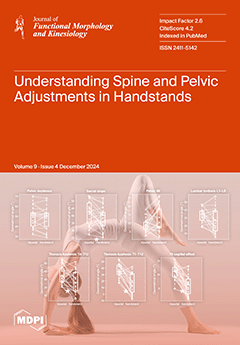
Cover Story: The handstand is a key exercise in many sports, but spino-pelvic sagittal alignment and balance during this posture remain poorly understood. Improved knowledge of these adaptations could enhance training and execution. Using biplanar radiography and 3D bone reconstructions, spino-pelvic parameters were analyzed in 19 national-level gymnasts in upright and handstand postures. Most gymnasts displayed pelvic retroversion during the handstand, reducing lumbar lordosis, thoracic kyphosis, and T9 sagittal offset. A few exhibited pelvic anteversion, potentially linked to their spine curvatures in an upright posture. This study provides initial insights into the biomechanics of the handstand, aiding in training, teaching, and rehabilitation. View this paper
  • Issues are regarded as officially published after their release is announced to the table of contents alert mailing list .
  • You may sign up for email alerts to receive table of contents of newly released issues.
  • PDF is the official format for papers published in both, html and pdf forms. To view the papers in pdf format, click on the "PDF Full-text" link, and use the free Adobe Reader to open them.

Articles (108)

  • Article
  • Open Access
1 Citations
2,966 Views
10 Pages

Single-Leg Balance and Lower Limb Strength: Quantitative Analysis with the Balance Master System

  • José Manuel Delfa-de-la-Morena,
  • Pedro Pinheiro Paes,
  • Débora Priscila Lima de Oliveira,
  • Frederico Camarotti Júnior,
  • Bruna Daniele Monteiro Lima,
  • Miriam García-González,
  • Juan-José Mijarra-Murillo and
  • Víctor Riquelme-Aguado

Objective: This study investigates the relationship between lower limb strength and postural stability in single-leg stance using the Balance Master system. Methods: The research involved 64 participants divided into sedentary and physically active g...

  • Article
  • Open Access
1 Citations
1,452 Views
15 Pages

Background: The proper development of balance is essential in the acquisition of a correct physical condition, as well as in the evolutionary follow-up at early ages, and its periodic evaluation is very relevant in the educational environment. Object...

  • Article
  • Open Access
2,902 Views
10 Pages

Short Term Effects of Proprioceptive Neuromuscular Facilitation Combined with Neuromuscular Electrical Stimulation in Youth Basketball Players: A Randomized Controlled Trial

  • Manuel Sos-Tirado,
  • Aser Campo-Manzanares,
  • Lidia Aguado-Oregui,
  • Carles Cerdá-Calatayud,
  • Juan Carlos Guardiola-Ruiz,
  • Celia García-Lucas,
  • Francisco Javier Montañez-Aguilera,
  • Juan Francisco Lisón and
  • Juan José Amer-Cuenca

Background: Hamstring muscle injuries are common in basketball and result in long periods of inactivity. To reduce their incidence, preventive protocols, including proprioceptive neuromuscular facilitation (PNF) stretches, have been proposed. The aim...

  • Article
  • Open Access
6 Citations
2,876 Views
13 Pages

Enhancing Adolescent Physical Fitness and Well-Being: A School-Based High-Intensity Interval Training Program

  • Petar Mitić,
  • Rade Jovanović,
  • Nikola Stojanović,
  • Valentin Barišić and
  • Nebojša Trajković

Background: The aim of this study is to investigate the effects of a school-based high-intensity interval training (HIIT) program on quality of life and physical fitness in adolescents. Methods: The study included 60 male adolescents (16.2 ± 0...

  • Article
  • Open Access
2 Citations
3,163 Views
15 Pages

Comparative Analysis of 2-Point Jump Shot and Free Throw Kinematics in High- and Low-Level U18 Male Basketball Players

  • Varvara Botsi,
  • Dimitrios I. Bourdas,
  • Antonios K. Travlos,
  • Panteleimon Bakirtzoglou,
  • Dimitrios C. Gofas,
  • Ioannis E. Ktistakis and
  • Emmanouil Zacharakis

Background/Objectives: This study examined the influence of competition level and player position on shooting accuracy and kinematic parameters in U18 male basketball players, focusing on two-point jump shots and free throws. Methods: Thirty-eight hi...

  • Article
  • Open Access
2 Citations
1,791 Views
16 Pages

Background and Objectives: Collision-sport athletes, such as rugby players, are at risk of sport-related concussion (SRC). Women are known to be at higher risk of SRC and may experience more severe and chronic symptomology than men. Knowledge of the...

  • Article
  • Open Access
2 Citations
2,447 Views
10 Pages

Background/Objectives: The active straight leg raise requires intricate coordination between the hip, knee, pelvis, and spine. Despite its complexity, limited research has explored the relationship between lower limb raising velocity and trunk muscle...

  • Article
  • Open Access
1 Citations
15,124 Views
17 Pages

Background: The Apple Watch provides promising health data that could aid in increasing exercise adherence; regular exercise can help individuals manage and prevent diseases such as obesity and cardiovascular disease. However, the impact of skin pigm...

  • Article
  • Open Access
5 Citations
7,778 Views
15 Pages

Accuracy and Reliability of Grip Strength Measurements: A Comparative Device Analysis

  • Pascale Gränicher,
  • Yael Maurer,
  • Jörg Spörri,
  • Bernhard Haller,
  • Jaap Swanenburg,
  • Rob A. de Bie,
  • Ton A. F. Lenssen and
  • Johannes Scherr

Background: Grip strength is widely used as a surrogate parameter for functional status. The current gold standard, the JAMAR® Hydraulic Dynamometer (JAMAR® Hydraulic), presents challenges for individuals with painful finger joints or low gri...

  • Article
  • Open Access
2,441 Views
12 Pages

Cycling Isokinetic Peak Force Explains Maximal Aerobic Power and Physiological Thresholds but Not Cycling Economy in Trained Triathletes

  • Felipe Giancáspero-Inostroza,
  • Carlos Burgos-Jara,
  • Carlos Sepúlveda,
  • Danni Haichelis,
  • Roberto Meneses-Valdés,
  • Ignacio Orizola-Cáceres and
  • Hugo Cerda-Kohler

Background: Assessments of muscle strength help prescribe and monitor training loads in cyclists (e.g., triathletes). Some methods include repetition maximum, joint isokinetic tests, and indirect estimates. However, their specificity for cycling&rsqu...

of 11

Get Alerted

Add your email address to receive forthcoming issues of this journal.

XFacebookLinkedIn
J. Funct. Morphol. Kinesiol. - ISSN 2411-5142