


Abstract
Scientific knowledge-based fishery management is essential to ensure the sustainability of marine resources, particularly in regions where fisheries are data-limited. This study assessed the stock status of six shallow-water demersal fish species (Bagre marinus, Cathorops mapale, Diapterus rhombeus, Eucinostomus argenteus, Haemulopsis corvinaeformis, and Lutjanus synagris) in the Colombian Caribbean Sea using three complementary length-based models: length-based indicators (LBIs), length-based spawning potential ratio (LBSPR), and the Length-Based Bayesian Biomass estimator (LBB). The integrated results demonstrated that five species (C. mapale, D. rhombeus, E. argenteus, H. corvinaeformis, and L. synagris) are currently overexploited (F/M > 1 and B/BMSY < 1), while B. marinus is experiencing overfishing (F/M > 1 and B/BMSY > 1), with a high risk of surpassing its maximum sustainable yield. These outcomes confirm that demersal fish populations in the Colombian Caribbean are being exploited beyond sustainable biological limits. With the aim of promoting stock recovery and long-term sustainability, this study recommends the implementation of recently evaluated management measures focused on (i) the implementation and enforcement of Bycatch Reduction Devices (BRDs); (ii) the regulation and monitoring of trawl net mesh sizes to improve selectivity patterns; (iii) the establishment of spatial and temporal closures in critical spawning areas for demersal fish species; and (iv) the strengthening of fishery monitoring and data collection systems. The findings provide critical baseline information and a methodological framework to support evidence-based fishery management and conservation strategies in tropical multispecies fisheries under data-limited conditions.
Keywords:
stock status; data-limited fisheries; demersal fishes; fishery management; Caribbean; Colombia Key Contribution:
This study provides the first integrated length-based assessment of six demersal fish species in the Colombian Caribbean Sea. The application of three complementary data-limited models (LBI, LBSPR, and LBB) reveals that most stocks are overexploited and recommends the implementation and enforcement of Bycatch Reduction Devices (BRDs), the regulation of trawl net mesh sizes, and the establishment of spatial and temporal closures.
1. Introduction
Fish are the group contributing the most to global marine catches; therefore, they significantly contribute to food security [1,2] and have the potential to improve fishermen’s livelihoods [3]. However, fishery resources are subject to high levels of exploitation, and many fish populations remain unassessed, with their current status unknown [4,5,6].
In Colombia, demersal fish are important as a source of food production and the generation of direct and indirect employment through fishing [7,8]. Demersal fish are commonly part of the target catch of various artisanal fisheries and represent more than 50% of the bycatch in industrial shallow-water shrimp trawl fisheries [9,10,11]. Among the demersal fish species that contribute most significantly to the bycatch biomass of the industrial shallow-water shrimp trawl fisheries in the Colombian Caribbean are the caitipa mojarra Diapterus rhombeus (12.67%), the lane snapper Lutjanus synagris (6.13%), the gafftopsail sea catfish Bagre marinus (5.00%), the silver mojarra Eucinostomus argenteus (4.48%), and the roughneck grunt Haemulopsis corvinaeformis (1.78%) [12]. This pattern is consistent with reported shrimp bycatch compositions in tropical and subtropical regions worldwide [13,14,15].
In the Colombian Caribbean Sea, both industrial and small-scale fisheries are data-limited, resulting in deficient information on biological fishery aspects and the status of exploited populations [16]. Currently, data-limited population assessment is a widely used tool for generating scientific knowledge on reference points and population status for the implementation of conservation and fishery management strategies [17,18]. These population assessment methods, depending on the availability of information, are categorized into catch-based [19,20], abundance-based [21], and length-based [22]. Comparatively, more length-based population assessment methods have been developed because it is operationally easier and less costly to obtain length frequency data in direct fishing surveys and fishery monitoring [23,24,25].
Among the fishery assessment methods that use size–frequency data are length-based indicators (LBIs) [26,27], length-based spawning potential ratio (LBSPR) [28,29,30], and Length-Based Bayesian Biomass estimator (LBB) [31]. These length-based analytical methods allow for predicting the population status by essentially considering life history parameters of the species, such as the asymptotic length (L∞), length at maturity (Lmat), and the ratio of natural mortality to the von Bertalanffy growth coefficient (M/k) [32,33,34]. Length-based methods are valuable tools for assessing fish populations, especially in fisheries with limited data. These methods utilize the information contained in size–frequency distributions to estimate key population parameters such as fishing mortality, biomass, and reproductive potential [26,28,29,31]. Length-based methods are particularly useful in multispecies fisheries or in those where age determination is complex or costly, enabling a faster and more efficient assessment of stock status and facilitating management decision-making [27].
Therefore, the objective of this research was to assess the status of six commercially important demersal fish species (B. marinus, Cathorops mapale, D. rhombeus, E. argenteus, H. corvinaeformis and L. synagris) in the Colombian Caribbean Sea. It is expected that the results of this study will generate new knowledge about the status of demersal fish populations and support the design and implementation of optimal fishery management strategies.
2. Materials and Methods
2.1. Sampling and Analysis
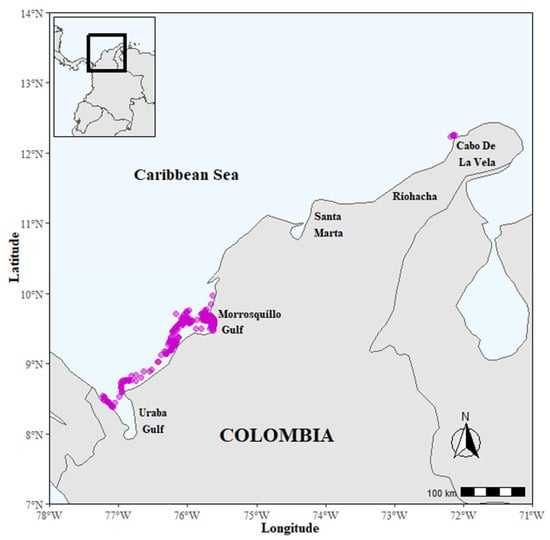
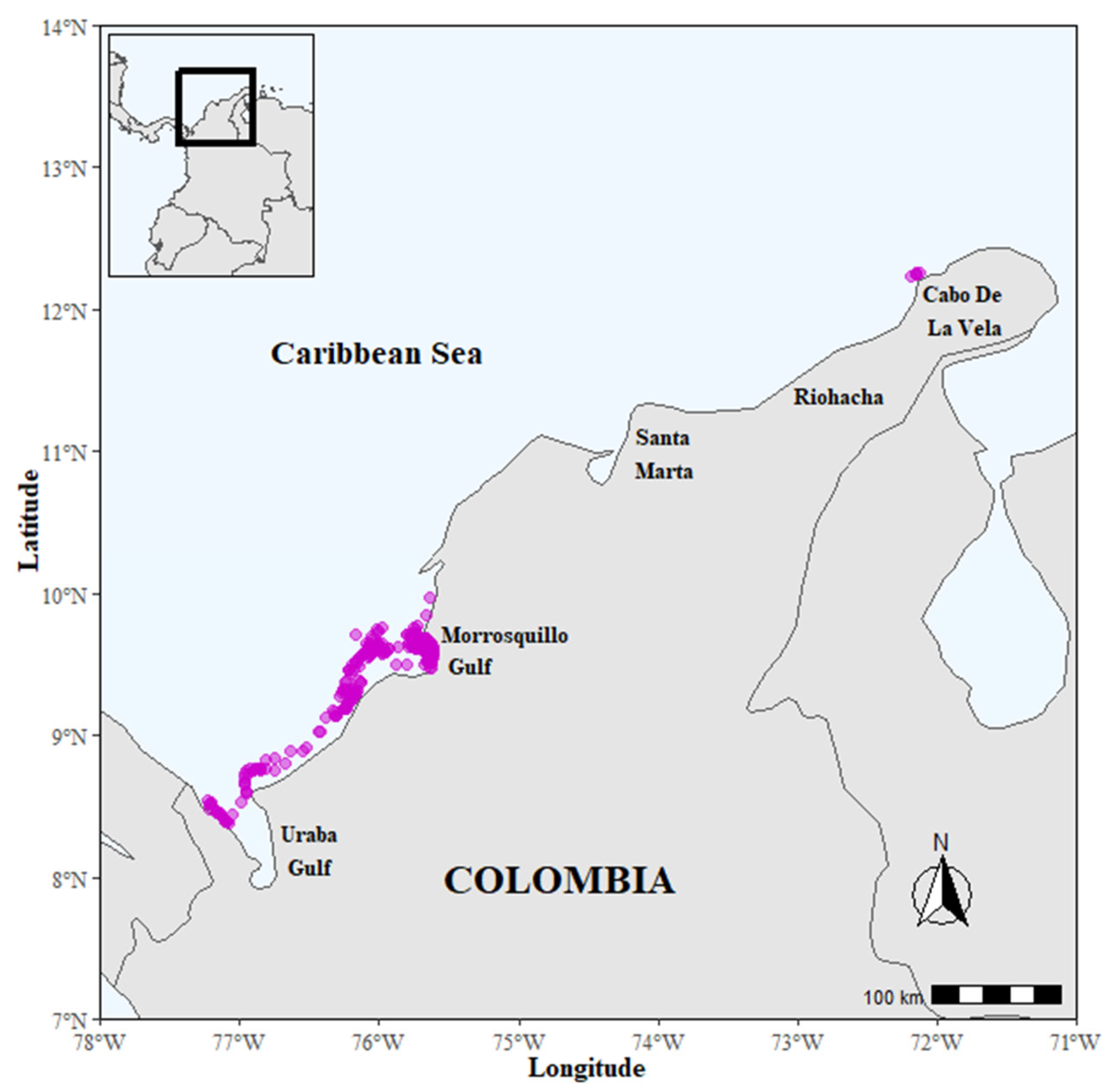
This study was located between Cabo de La Vela (12°15.334′ N; 72°07.828′ W) and the Gulf of Urabá (08°23.094′ N; 77°13.563′ W) in the Colombian Caribbean Sea (Figure 1). The size–frequency data (total length, TL) of the six demersal fish species (B. marinus, C. mapale, D. rhombeus, E. argenteus, H. corvinaeformis, and L. synagris) were collected by the Instituto de Investigaciones Marinas y Costeras (INVEMAR) under BPIN Project No. 2017011000113 between 2010 and 2022 through onboard monitoring of the industrial shallow-water shrimp trawl fleet at depths ranging from 11.9 to 63.9 m, where these species were recorded as shrimp bycatch (Figure 1).
Figure 1.
Study area in the Colombian Caribbean Sea in relation to six demersal fish species captured as shrimp trawl bycatch between 2010 and 2022. Magenta circles indicate the sampling stations on board the industrial shrimp trawl fishery.
Life history parameters, such as asymptotic length (L∞), maturity length (Lmat), and the length at which 95% of individuals are mature (L95%), were estimated from the data set mentioned above using standardized empirical relationships commonly used in stock assessment ([35,36]; see Table 1). Individual weight data were calculated using the length–weight relationship parameters reported for each evaluated species ([8,37]; see Table 2). Considering the sensitivity of length-based methods to the value of the asymptotic length (L∞), a quality index (QI) was applied, which calculates the proportional difference between the length of the largest fish in each length-at-age sample (Lmax) and the standardized estimate of L∞ for that sample. A QI value ≥ −0.2 indicated a high quality in the estimation of the L∞ parameter [38]:
Table 1.
Empirical relationships used to estimate life history parameters of demersal fish species. (L∞, asymptotic length; Lmat, maturity length; L95%, length at the 95% percentile).
Table 2.
Basic information and input life history parameters used in this study for the six fish stocks assessed. (N, number of individuals; Lmin, minimum total length in cm; Lmax, maximum total length in cm; L∞, asymptotic length in cm; QI, quality index for asymptotic length; Lmat, maturity length in cm; L95%, length at the 95% percentile in cm; M/k, ratio of natural mortality and the growth coefficient; intercept and slope, parameters from the length-weight relationships).
Three data-limited population assessment methods were employed: (i) length-based indicators (LBIs) [26,27], (ii) length-based spawning potential ratio (LBSPR) [28,29,30], and (iii) Length-Based Bayesian Biomass estimator (LBB) [31]. All basic information and input life history parameters are summarized in Table 2.
2.1.1. Length-Based Indicators (LBIs)
The LBI method was applied using data on the size composition of the catches, the average weight of individuals by size class, and life history parameters of six demersal fish species. The LBI is based on the relationships among several life history parameters, including the length at first capture (Lc), length at maturity (Lmat), 25th percentile of the length distribution (L25%), mean length of the largest 5% of individuals in the catch (Lmax5%), asymptotic length (L∞), and the proportion of individuals above the optimum length (Lopt) + 10%, where Lopt = L∞ 3/(3 + M/k). Additional indicators include the mean length of individuals (Lmean) > Lc, and a length-based proxy for maximum sustainable yield (MSY) defined as LF = M = 0.75Lc + 0.25 L∞ [27,43]. The reference indicators for population assessment within the traffic light system are presented in Table 3. LBIs were calculated annually for each species using the interactive web application LBIndicator (https://scott.shinyapps.io/LBIndicator_shiny/ (accessed on 28 June 2025)).
Table 3.
Indicator ratios used from LBI for stock status assessment with traffic light system.
2.1.2. Length-Based Spawning Potential Ratio (LBSPR)
The LBSPR method does not require knowing the natural mortality rate (M); instead, it uses the ratio of natural mortality to the von Bertalanffy growth coefficient (M/k), which typically varies less among populations and species than M [36]. LBSPR models assume equilibrium, meaning that the size composition data are representative of an exploited population at steady state [30]. Accordingly, the LBSPR approach compares the observed size composition to the expected unfished size structure to estimate the ratio of fishing mortality to natural mortality (F/M).
Selectivity parameters (SL50 and SL95) were estimated by minimizing a multinomial negative log-likelihood, thereby maximizing the fit between observed and expected size distributions and allowing derivation of the spawning potential ratio (SPR) [27,28,29]. SPR ranges from 1 (100%) in unexploited populations to 0 (0%) in fully exploited populations; an SPR threshold of 0.30 (30%) and an F/M of 1 were adopted as reference limits to evaluate exploitation [44,45,46,47,48]. Selectivity parameters (SL50 and SL95), the F/M ratio and SPR were estimated annually for each species using the LBSPR package (version 0.1.6) in R [30]. Finally, selectivity parameters were compared with length at maturity as a biological reference point.
2.1.3. Length-Based Bayesian Biomass (LBB)
Length-Based Bayesian Biomass (LBB) estimates the parameters L∞, Lc, M/k, and F/k. When a reliable estimate of L∞ is available, the uncertainty of LBB results is reduced [31,48]. Based on these parameters, indicators of current population status such as the biomass depletion ratio (B/B0) and the ratio of mean length to optimal length (Lmean/Lopt) were calculated using standard equations commonly applied in stock assessments of exploited fish populations. Only some of the principal equations are presented here; for further methodological details, see [31,49]. The LBB method assumes that fish growth follows the standard von Bertalanffy growth function [50,51]:
where Lt is the length at age t, L∞ is the asymptotic length, k is the growth coefficient and t0 is the theoretical age at zero length.
Under full selectivity, the curvature of the numbers-at-length distribution in catch samples is determined by Z/k (where Z is total mortality and k the von Bertalanffy growth coefficient) and is given by the following Equation [52]:
where NL is the number of survivors to length L, and NLstart is the number at length Lstart, which indicates the starting size of full selection by gears.
The population status was estimated based on the parameters L∞, M/k, F/k, and Lc [49]. The value of Lopt, which maximizes the biomass of the unexploited cohort, can be obtained from the following Equation:
Finally, based on the Lopt estimate and a given fishing pressure (F/M), the Lc, which maximizes catches and biomass (Lc_opt), can be obtained from the following Equation:
Then, Lc_opt estimates were used to calculate a proxy for the biomass capable of producing MSY (BMSY/B0) [31]. The essential reference points for the six fish species evaluated were estimated using the R code LBB_33a version [53].
The reference points derived from the LBB model were proposed as overfishing thresholds [48]. Accordingly, the population status was determined based on the estimates of F/M and B/BMSY: healthy when B/BMSY > 1 and F/M < 1; overfished when B/BMSY > 1 and F/M > 1; overexploited when B/BMSY < 1 and F/M > 1; and overfished with a tendency to recover when B/BMSY < 1 and F/M < 1 [29,54,55].
3. Results
3.1. Length-Based Indicators (LBIs)
LBI results for conservation (immature and adult individuals), optimal performance, and MSY are summarized in a traffic light indicator table for the six species evaluated (Table 4). The ratios Lc/Lmat and L25%/Lmat were below their respective reference points for all species, indicating that fishing is targeting juvenile individuals (length at first capture is smaller than length at maturity) (Table 4). The indicators Lmax5%/L∞ and Pmega were also below reference values, showing that large and mega-spawning individuals are uncommon in the populations, with the exception of B. marinus, which exhibited Lmax5%/L∞ > 0.8 during the last three years and Pmega= 0.55 in 2018 (Table 4). Both the optimal-performance indicator (Lmean/Lopt) and the MSY-related indicator (Lmean/LF = M) were below their reference points, indicating unsustainable exploitation levels for C. mapale, D. rhombeus, E. argenteus, H. corvinaeformis, and L. synagris. Only B. marinus showed values within acceptable biological limits for the optimal-performance and MSY indicators for at least the last two years (Table 4).
Table 4.
Traffic light indicator table for the last three years with available data for each of the six assessed stocks. Values are highlighted in red if below the threshold and in green if above the threshold.
3.2. Length-Based Spawning Potential Ratio (LBSPR)
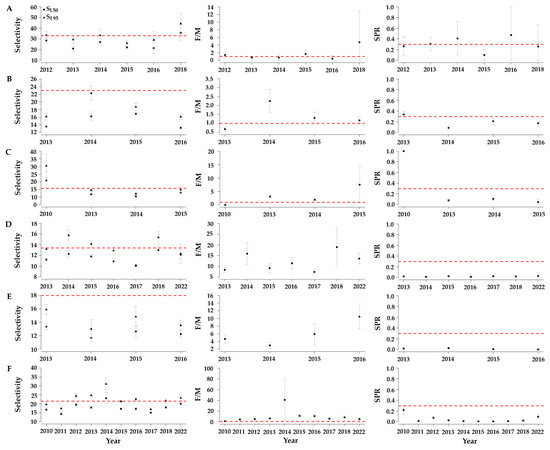
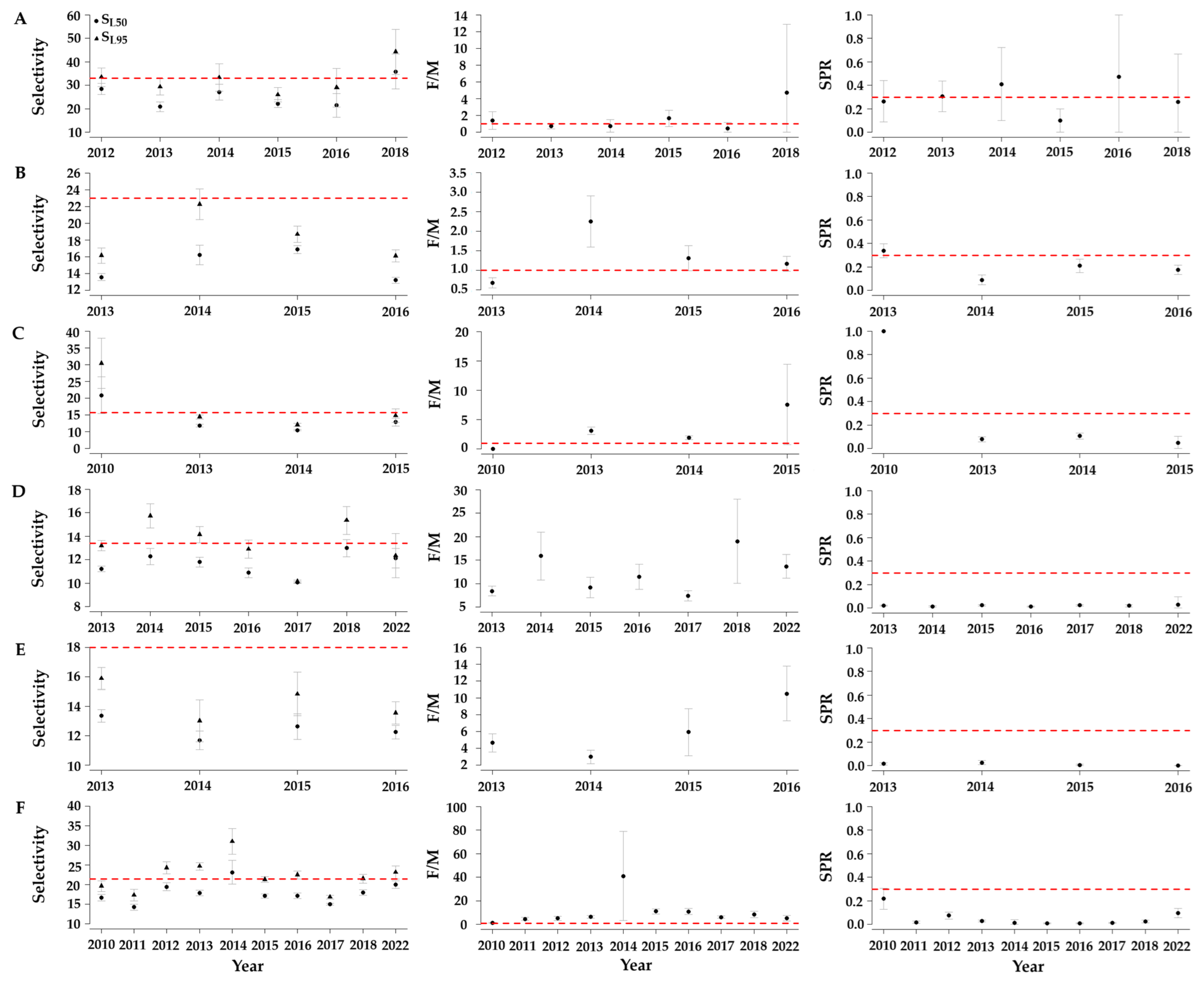
LBSPR results for the selectivity reference points (SL50 and SL95), the F/M ratio and SPR are presented in Figure 2. The estimated values of SL50 and SL95 were lower than the maturity length (Lmat) in almost all years for the six fish species evaluated, suggesting that the fishery is harvesting individuals smaller than the biological reference size (Figure 2). The F/M ratio exceeded 1 in all cases, indicating overfishing, as current exploitation is greater than the fishing mortality at maximum sustainable yield (FMSY). Temporal trends in SPR revealed values consistently below the 30% threshold, demonstrating that these populations are not being exploited at a sustainable level in the long term (Figure 2).
Figure 2.
Plots of selectivity parameters (SL50 and SL95), ratio of fishing mortality to natural mortality (F/M) and spawning potential ratio (SPR) derived from the LBSPR method applied for six fish stocks. (A) Bagre marinus, (B) Cathorops mapale, (C) Diapterus rhombeus, (D) Eucinostomus argenteus, (E) Haemulopsis corvinaeformis, (F) Lutjanus synagris. Gray bars represent ±0.95 confidence interval. Red dashed lines indicate the threshold values for selectivity (=length at maturity), F/M (=1) and SPR (=30%).
3.3. Length-Based Bayesian Biomass (LBB)
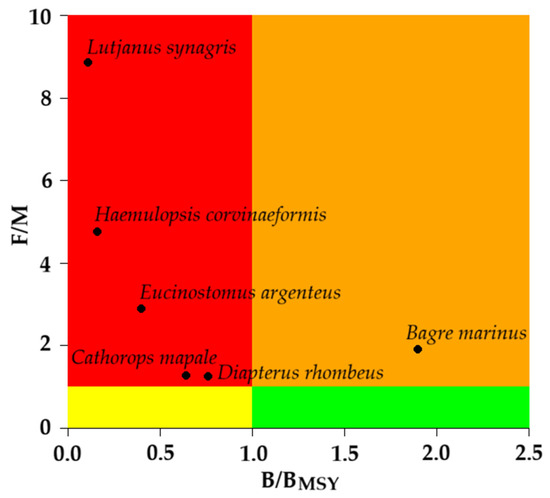
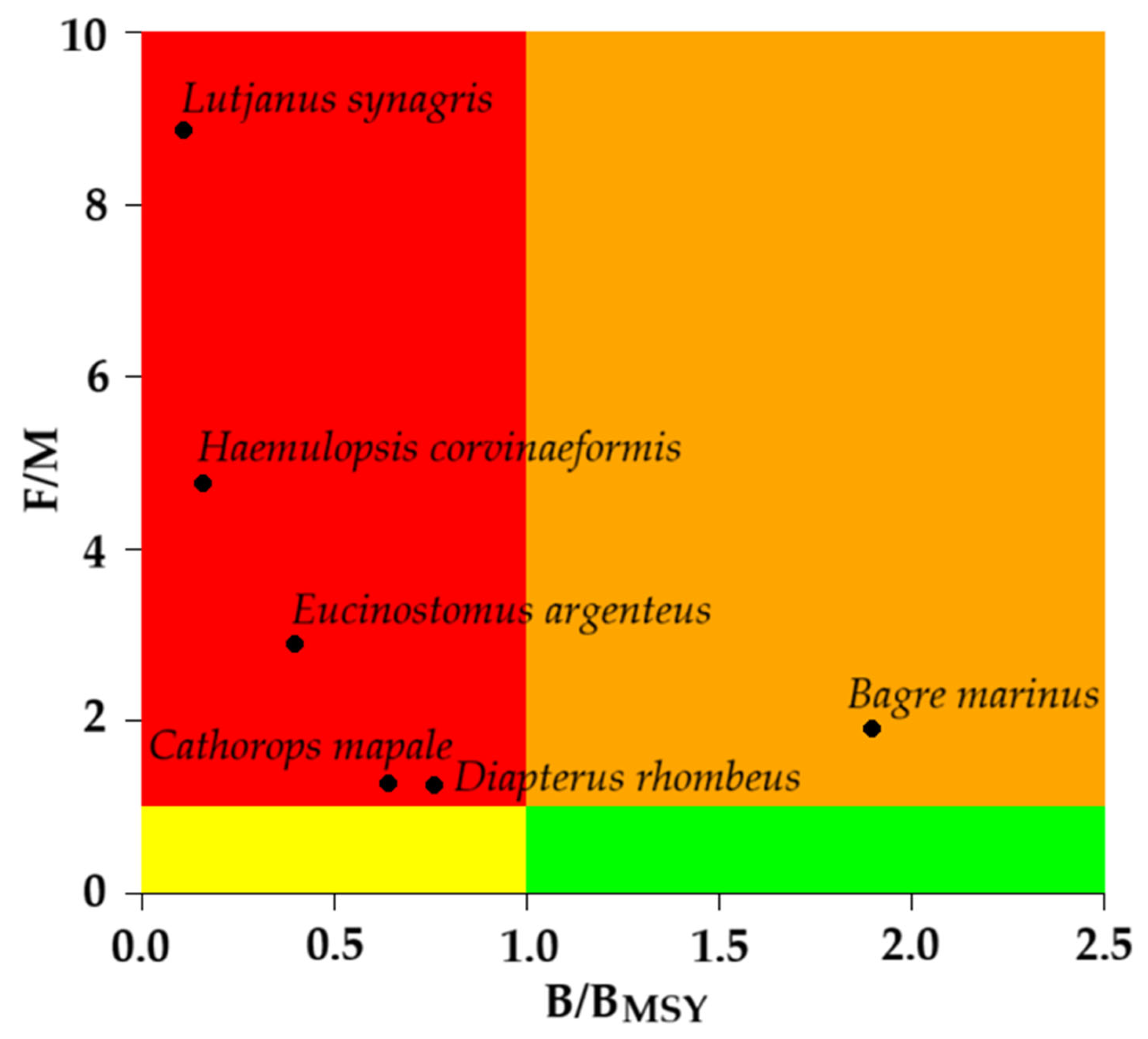
Essential reference points from LBB estimates are presented in Table 5. The ratios Lmean/Lopt and Lc/Lc_opt were <1.0 for the species C. mapale, D. rhombeus, E. argenteus, H. corvinaeformis, and L. synagris, suggesting a truncated size structure and that individuals below the regulatory size are being harvested. Only B. marinus exhibited Lmean/Lopt and Lc/Lc_opt values > 1.0 (Table 5). The L95%/L∞ ratio was <0.8 for H. corvinaeformis, indicating a marked depletion of the largest size classes, whereas the remaining species showed values between 0.81 and 0.97, consistent with the presence of at least some larger individuals in the population (Table 5). Five species C. mapale, D. rhombeus, E. argenteus, H. corvinaeformis, and L. synagris, had F/M > 1.0 and B/BMSY < 1.0, indicating these populations are overexploited (Table 5, Figure 3). For B. marinus, F/M = 1.89 (95% C.I.: 1.54–2.75) and B/BMSY = 1.90 (95% C.I.: 0.48–3.79). Although the point estimate of biomass is above BMSY, the elevated F/M and the wide confidence interval for B/BMSY indicate substantial uncertainty and a potential risk of overfishing; therefore, this species should be considered subject to high fishing pressure and at risk of reduced sustainable yield (Table 5, Figure 3).
Table 5.
Essential reference points estimated by the LBB model for the six assessed fish stocks. Values in parentheses indicate the 95% confidence intervals of the parameter estimates.
Figure 3.
Scatter plot of B/BMSY and F/M ratios derived from the LBB model for the six assessed fish stocks. The red area denotes stocks that are overfished or outside biologically safe limits; the yellow area indicates recovering stocks; the orange area corresponds to stocks subject to overfishing; and the green area represents stocks experiencing sustainable fishing pressure with healthy biomass levels.
4. Discussion
In tropical regions, the low selectivity of trawl fisheries increases the probability of capturing multiple species, mainly fish and crustaceans [56,57]. Consequently, negative impacts occur on marine biodiversity and population life cycles. Scientific evidence indicates that trawling affects the size spectrum [58,59], functional composition [60], and trophic interactions of species [61]. These impacts are exacerbated when the status of populations is unknown, which hinders the timely implementation of management strategies aimed at the recovery of overexploited stocks.
Demersal fish species are often considered vulnerable to the long-term impacts of fishing due to life history traits that, in many cases, include relatively slow growth, delayed sexual maturity, and low natural mortality. These characteristics limit their capacity for rapid recovery once populations are depleted [62] and have been associated with reduced resilience to exploitation and an increased risk of population decline under sustained fishing pressure [63,64,65]. However, these traits are not uniform across all demersal taxa. Considerable interspecific variability exists, and some demersal species exhibit comparatively rapid growth, early maturation (e.g., within the second year of life), and smaller body size, which may confer greater resilience to moderate exploitation levels when effective management is in place [35,66]. Therefore, the vulnerability of demersal fishes to fishing pressure should be evaluated within a species-specific framework that explicitly accounts for differences in life history strategies, demographic parameters, and population dynamics.
Overfishing and the removal of large, highly fecund individuals can alter the reproductive potential and age structure of populations, reducing recruitment success and resilience [67,68]. Furthermore, trawl-induced habitat degradation in benthic ecosystems intensifies the effects of overexploitation by modifying essential habitats used for spawning, feeding, and refuge [69,70]. These cumulative impacts lead to long-term declines in biomass and productivity, often requiring decades for populations to recover even after fishing pressure is reduced [71,72].
Scientific evidence from demersal fisheries in the North Sea, Mediterranean, and tropical regions indicates that the rebuilding of overexploited stocks is generally slow and uncertain due to density-dependent constraints and persistent environmental variability [55,73,74]. In tropical ecosystems, continuous pressure from multispecies trawl fisheries on demersal assemblages further hampers recovery due to overlapping exploitation by artisanal fisheries [47,48]. These findings highlight the necessity of adopting precautionary and adaptive management strategies that incorporate spatial closures, temporal fishing bans, and gear modifications to protect critical habitats and enhance the resilience of demersal fish populations [75,76].
In this study, data-limited stock assessment methods were applied and proved effective in determining the status of demersal fish populations belonging to the families Ariidae, Gerreidae, Haemulidae, and Lutjanidae. These four families are the most representative taxa in the bycatch of the industrial shrimp trawl fishery in the Colombian Caribbean [9,77]. The demersal fish species evaluated in this study (B. marinus, C. mapale, D. rhombeus, E. argenteus, H. corvinaeformis, and L. synagris), as well as closely related congeners, exhibit a broad geographic distribution throughout the Caribbean region, extending across the Southeastern United States, the Gulf of Mexico, Cuba, the Antilles, Central America, Colombia, Venezuela, and Brazil [78]. Consequently, demersal fishes constitute integral components of multispecies fisheries across the Caribbean basin of Central and South America, functioning either as target resources in small-scale fisheries or as recurrent components of bycatch in industrial and artisanal operations [79,80,81,82]. This regional exploitation pattern underscores a broader spatial risk of overexploitation for demersal stocks and highlights the need for regionally coordinated, science-based management frameworks grounded in robust biological and fisheries information.
Overall, the results of the length-based models (LBI, LBSPR, and LBB) indicated that the evaluated demersal fish species are not sustainable in the long term. Five species (C. mapale, D. rhombeus, E. argenteus, H. corvinaeformis, and L. synagris) were in a state of overexploitation (F/M > 1 and B/BMSY < 1), while B. marinus was subject to overfishing and showed a high risk of exceeding the maximum sustainable yield (F/M > 1 and B/BMSY > 1). In the Colombian Caribbean Sea, these demersal species are also targeted by artisanal fisheries [83,84] and, additionally, appear as bycatch in artisanal shrimp fisheries employing gillnets and small trawl nets locally known as “changas” [85,86]. Thus, information on the status of these multi-gear exploited populations, for which very limited scientific data are available, is urgently needed.
In this study, the evaluated species correspond to shallow continental shelf demersal fishes (<70 m), whose bathymetric distribution largely overlaps with the operational depth range of the industrial shrimp trawl fleet (11.9–63.9 m). For several of these taxa (e.g., Ariidae, Gerreidae, Haemulidae, and Lutjanidae), there is a strong affinity for coastal and estuarine soft-bottom habitats, with continuous ontogenetic use of shallow environments throughout much of their life cycle [78,87,88]. Consequently, although shrimp trawls may capture a substantial fraction of juveniles, they also intercept subadult and adult individuals within the same spatial domain exploited by the multispecies demersal fishery. This reduces the likelihood that the observed skew toward smaller sizes is solely a sampling bias of availability rather than a genuine signal of fishing pressure.
The applied models (LBI, LBSPR, and LBB) explicitly incorporate gear selectivity. The LBSPR method estimates selectivity parameters (SL50 and SL95) by fitting the observed length distribution to a logistic function through maximum likelihood [28,29], whereas LBB estimates length at first capture (Lc) and assumes full selection above Lstart, modeling the curvature of the length distribution as a function of Z/k [26]. These approaches allow, to a certain extent, the separation of selectivity effects from total mortality effects. If the length structure were exclusively dominated by juveniles due to dome-shaped selectivity with exclusion of large adults, poor parameter convergence, inconsistencies among indicators, and high uncertainty would be expected. However, the results show internal consistency across independent methods (LBI, LBSPR, and LBB), all converging toward diagnoses of F/M > 1 and B/BMSY < 1 for most species, thereby reinforcing the robustness of the assessment.
Furthermore, stock assessment studies have demonstrated that length-based models retain reasonable diagnostic performance under moderate deviations from selectivity assumptions, particularly when large sample sizes and multi-year datasets are available [26,29]. In this study, cumulative sample sizes are substantial (N > 700 for all species and >5000 for L. synagris), reducing sampling variance and improving the estimation of structural parameters. Regarding the hypothesis that adults may inhabit deeper waters or reef areas, it is important to note that several of the evaluated species predominantly occupy soft-bottom habitats of the inner and middle shelf, with limited dependence on deep reef environments [78,88]. Therefore, although a fraction of the biomass may be invulnerable to trawling, this does not necessarily invalidate the diagnosis; rather, it indicates that the estimates pertain to the exploited stock component, which is the management-relevant fraction of the population.
Accordingly, the congruence among biological indicators (Lc/Lmat < 1; L25%/Lmat < 1), exploitation parameters (F/M > 1), and biomass metrics (B/BMSY < 1) suggests that the signal of overexploitation does not rely solely on the absence of large adults but also on the systematic capture of immature individuals, which constitutes an independent criterion of biological unsustainability [26,36].
In multispecies fisheries where sufficient biological information is lacking, the high diversity of exploited species makes stock assessment particularly challenging [32,89]. In this context, data-limited methods are fundamental for evaluating demersal fish stocks. These approaches enable the estimation of population status, provide essential information to support decision-making for stock recovery, and contribute to long-term sustainability [31,54,90]. Fisheries benefit from data-limited methodologies because they allow the identification of changes in the distribution and productivity of fish populations caused by fishing pressure or climate change, thereby facilitating fishery planning and the design of appropriate management measures [25,91].
Globally, data-limited stock assessment methods have contributed to the definition of biological reference points and supported fisheries management in estuarine [92,93], demersal [32,47], and pelagic [33,34] systems. Based on the findings of this study, the Autoridad Nacional de Acuicultura y Pesca (AUNAP) in Colombia now has specific and high-quality information to implement some strategies previously evaluated by FAO and INVEMAR focused on (i) the implementation and enforcement of Bycatch Reduction Devices (square mesh panel to reduce bycatch of juveniles) [94,95]; (ii) the regulation and monitoring of trawl net mesh sizes to improve selectivity patterns (use of the prototype trawl net with gradual increase in mesh sizes) [96]; (iii) the establishment of spatial and temporal closures in critical spawning areas for demersal fish species; and (iv) the strengthening of fishery monitoring and data collection systems.
5. Conclusions
In conclusion, length-based models (LBI, LBSPR, and LBB) applied to stock assessment with limited data allowed for determining the exploitation status of six demersal fish species in the Colombian Caribbean Sea. The exploitation levels of the assessed demersal species are not sustainable in the long term, as five of them (C. mapale, D. rhombeus, E. argenteus, H. corvinaeformis, and L. synagris) are currently overexploited (F/M > 1 and B/BMSY < 1), whereas B. marinus is experiencing overfishing, with a high risk of surpassing the maximum sustainable yield of the population (F/M > 1 and B/BMSY > 1). The findings of this study are fundamental for the design and implementation of management strategies aimed at the recovery of overexploited populations, including the implementation and enforcement of Bycatch Reduction Devices; the regulation and monitoring of trawl net mesh sizes to improve selectivity patterns; the establishment of spatial and temporal closures in critical spawning areas for demersal fish species; and the strengthening of fishery monitoring and data collection systems.
Author Contributions
Conceptualization, A.R. and M.R.; methodology, A.R.; formal analysis, A.R. and J.M.; investigation, A.R. and M.R.; resources, M.R.; data curation, A.R.; writing—original draft preparation, A.R. and J.M.; writing—review and editing, A.R., M.R. and J.R.L.-C.; visualization, A.R.; supervision, A.R. and M.R.; project administration, M.R.; funding acquisition, M.R. All authors have read and agreed to the published version of the manuscript.
Funding
A.R. was sponsored by the Fondo de Ciencia, Tecnología e Innovación (FCTeI) of the Sistema General de Regalías (SGR) and by the Bicentennial Doctoral Excellence Scholarship Program of the Ministerio de Ciencia, Tecnología e Innovación (Minciencias) of Colombia. The scientific monitoring of fisheries was carried out by the Instituto de Investigaciones Marinas y Costeras (INVEMAR) under BPIN Project No. 2017011000113 and was financed by the Ministerio de Ambiente y Desarrollo Sostenible (Minambiente) of Colombia.
Institutional Review Board Statement
The fishing onboard monitoring of INVEMAR was conducted under the authorization of the Ministerio de Ambiente y Desarrollo Sostenible, Colombia, in accordance with Decree No. 1076 of 2015 (approval date: 26 May 2015).
Informed Consent Statement
Not applicable.
Data Availability Statement
The original contributions presented in this study are included in the article. Further inquiries can be directed to the corresponding author.
Acknowledgments
This study is a contribution from the Instituto de Investigaciones Marinas y Costeras (Invemar) and the Doctoral Program in Marine Sciences at the University of Magdalena, Colombia. We acknowledge the researchers of the Valuation Research Program at Invemar, who conducted the scientific monitoring aboard vessels of the industrial shrimp trawl fishery.
Conflicts of Interest
The authors declare no conflicts of interest.
References
- FAO. Review of the State of World Marine Fishery Resources; FAO Fisheries Technical Paper No. 457; FAO: Rome, Italy, 2005; Available online: https://www.fao.org/fishery/ru/publications/17047 (accessed on 15 October 2025).
- FAO. Towards Blue Transformation. In The State of World Fisheries and Aquaculture 2022; FAO: Rome, Italy, 2022; Available online: https://www.fao.org/fishery/ar/publication/295133 (accessed on 11 November 2025).
- Fiorella, K.J.; Hickey, M.D.; Salmen, C.R.; Nagata, J.M.; Mattah, B.; Magerenge, R.; Cohen, C.R.; Bukusi, E.A.; Brashares, J.S.; Fernald, L.H. Fishing for Food? Analyzing links between fishing livelihoods and food security around Lake Victoria, Kenya. Food Secur. 2014, 6, 851–860. [Google Scholar] [CrossRef] [Scilit]
- Costello, C..; Ovando, D.; Hilborn, R.; Gaines, S.D.; Deschenes, O.; Lester, S.E. Status and Solutions for the World’s Unassessed Fisheries. Science 2012, 338, 517–520. [Google Scholar] [CrossRef] [Scilit]
- Hilborn, R.; Amoroso, R.O.; Anderson, C.M.; Baum, J.K.; Branch, T.; Costello, C.; de Moor, C.L.; Faraj, A.; Hively, D.; Jensen, O.P.; et al. Effective fisheries management instrumental in improving fish stock status. Proc. Natl. Acad. Sci. USA 2020, 117, 2218–2224. [Google Scholar] [CrossRef] [Scilit] [PubMed]
- OECD. OECD Review of Fisheries 2022; OECD Publishing: Paris, France, 2022; Available online: https://www.oecd.org/ (accessed on 2 July 2024).
- FAO. Review of the State of World Marine Fishery Resources; FAO Fisheries Technical Paper. No. 569; FAO: Rome, Italy, 2011; Available online: https://www.fao.org/fishery/en/publications/45897 (accessed on 10 March 2024).
- Rodriguez, A.; Mendoza, K.; Paramo, J. Length-Weight Relationships and Relative Condition Factor of 53 Species of Shallow-Water Fish in the Colombian Caribbean Sea. J. Appl. Ichthyol. 2023, 2023, e6632464. [Google Scholar] [CrossRef] [Scilit]
- Manjarrés, L.; Duarte, L.O.; Altamar, J.; Escobar, F.; García, C.; Cuello, F. Effects of using bycatch reduction devices on the Colombian Caribbean Sea shrimp fishery. Cienc. Mar. 2008, 34, 223–238. [Google Scholar] [CrossRef] [Scilit]
- Duarte, L.O.; Manjarrés, L.; Escobar, F. Bottom trawl bycatch assessment of the shrimp fishery in the Caribbean Sea off Colombia. Proc. Gulf Caribb. Fish. Inst. 2010, 62, 114–119. [Google Scholar]
- INVEMAR. Informe del Estado de los Ambientes y Recursos Marinos y Costeros en Colombia 2018; Serie de Publicaciones Periódicas No. 3; INVEMAR: Santa Marta, Colombia, 2019; Available online: https://www.invemar.org.co/en/publicaciones (accessed on 22 February 2025).
- Bustos, D.; Rueda, M.; Viaña, J.; Rodriguez, A.; Girón, A.; García, L.; Pardo, E. Evaluación interanual del impacto de las pesquerías industriales de arrastre de camarón sobre la biodiversidad marina de Colombia. Proc. Gulf Caribb. Fish. Inst. 2013, 65, 370–374. Available online: https://agris.fao.org/search/en/providers/124521/records/667440dbeb5a381a33812446 (accessed on 10 February 2026).
- Ye, Y.; Alsafar, A.H.; Mohammed, H.M. Bycatch and discards of the Kuwait shrimp fishery. Fish. Res. 2000, 45, 9–19. [Google Scholar] [CrossRef] [Scilit]
- Gillett, R. Global Study of Shrimp Fisheries; FAO Fisheries Technical Paper No. 475; FAO: Rome, Italy, 2008; Available online: https://www.fao.org/4/i0300e/i0300e00.htm (accessed on 10 February 2026).
- Mendo, J.; Mendo, T.; Gil-Kodaka, P.; Martina, J.; Gómez, I.; Delgado, R.; Fernández, J.; Travezaño, A.; Arroyo, R.; Loza, K.; et al. Bycatch and discards in the artisanal shrimp trawl fishery in Northern Peru. PLoS ONE 2022, 17, e0268128. [Google Scholar] [CrossRef] [Scilit]
- Cáceres, C.; Kiszka, J.J.; Luna-Acosta, A.; Herrera, H.; Zarza, E.; Heithaus, M.R. Predatory fish exploitation and relative abundance in a data-poor region from the Caribbean coast of Colombia, inferred from artisanal fishery interview surveys and baited remote underwater video systems. Aquat. Conserv. Mar. Freshwater Ecosyst. 2022, 32, 1401–1415. [Google Scholar] [CrossRef] [Scilit]
- Dowling, N.A.; Smith, A.D.M.; Smith, D.C.; Parma, A.M.; Dichmont, C.M.; Sainsbury, K.; Wilson, J.R.; Dougherty, D.T.; Cope, J.M. Generic solutions for data-limited fishery assessments are not so simple. Fish Fish. 2019, 20, 174–188. [Google Scholar] [CrossRef] [Scilit]
- Min, M.A.; Cope, J.; Lowry, D.; Selleck, J.; Tonnes, D.; Andrews, K.; Pacunski, R.; Hennings, A.; Scheuerell, M.D. Data-limited fishery assessment methods shed light on the exploitation history and population dynamics of Endangered Species Act-listed Yelloweye Rockfish in Puget Sound, Washington. Mar. Coastal Fish. 2023, 15, e10251. [Google Scholar] [CrossRef] [Scilit]
- Cope, J.M. Implementing a statistical catch-at-age model (Stock Synthesis) as a tool for deriving overfishing limits in data-limited situations. Fish. Res. 2013, 142, 3–14. [Google Scholar] [CrossRef] [Scilit]
- Froese, R.; Demirel, N.; Coro, G.; Kleisner, K.M.; Winker, H. Estimating fisheries reference points from catch and resilience. Fish Fish. 2017, 18, 506–526. [Google Scholar] [CrossRef] [Scilit]
- Froese, R.; Winker, H.; Coro, G.; Demirel, N.; Tsikliras, A.C.; Dimarchopoulou, D.; Scarcella, G.; Palomares, M.L.D.; Dureuil, M.; Pauly, D. Estimating stock status from relative abundance and resilience. ICES J. Mar. Sci. 2020, 77, 527–528. [Google Scholar] [CrossRef] [Scilit]
- Rudd, M.B.; Thorson, J.T. Accounting for variable recruitment and fishing mortality in length-based stock assessments for data-limited fisheries. Can. J. Fish. Aquat. Sci. 2018, 75, 1019–1035. [Google Scholar] [CrossRef] [Scilit]
- Mildenberger, T.K.; Taylor, M.H.; Wolff, M. TropFishR: An R package for fisheries analysis with length-frequency data. Methods Ecol. Evol. 2017, 8, 1520–1527. [Google Scholar] [CrossRef] [Scilit]
- Chong, L.; Mildenberger, T.K.; Rudd, M.B.; Taylor, M.H.; Cope, J.M.; Branch, T.A.; Wolff, M.; Stäbler, M. Performance evaluation of data-limited, length-based stock assessment methods. ICES J. Mar. Sci. 2020, 77, 97–108. [Google Scholar] [CrossRef] [Scilit]
- Fujita, R. The assessment and management of data limited fisheries: Future directions. Mar. Policy 2021, 133, 104730. [Google Scholar] [CrossRef] [Scilit]
- Froese, R. Keep it simple: Three indicators to deal with overfishing. Fish Fish. 2004, 5, 86–91. [Google Scholar] [CrossRef] [Scilit]
- ICES. Technical Guidelines—ICES Reference Points for Stocks in Categories 3 and 4; ICES Technical Guidelines; Report; ICES: Oxford, UK, 2018; Available online: https://doi.org/10.17895/ices.pub.4128 (accessed on 12 June 2024).
- Hordyk, A.; Ono, K.; Valencia, S.; Loneragan, N.; Prince, J. A novel length-based empirical estimation method of spawning potential ratio (SPR), and tests of its performance, for small-scale, data-poor fisheries. ICES J. Mar. Sci. 2015, 72, 217–231. [Google Scholar] [CrossRef] [Scilit]
- Hordyk, A.; Loneragan, N.; Prince, J. An evaluation of an iterative harvest strategy for data-poor fisheries using the length-based spawning potential ratio assessment methodology. Fish. Res. 2015, 171, 20–32. [Google Scholar] [CrossRef] [Scilit]
- Hordyk, A. R package, version 0.1.6; LBSPR: Length-Based Spawning Potential Ratio; 2021. Available online: https://CRAN.R-project.org/package=LBSPR (accessed on 5 July 2025).
- Froese, R.; Winker, H.; Coro, G.; Demirel, N.; Tsikliras, A.C.; Dimarchopoulou, D.; Scarcella, G.; Probst, W.N.; Dureuil, M.; Pauly, D. A new approach for estimating stock status from length frequency data. ICES J. Mar. Sci. 2018, 75, 2004–2015. [Google Scholar] [CrossRef] [Scilit]
- Dimarchopoulou, D.; Mous, P.J.; Firmana, E.; Wibisono, E.; Coro, G.; Humphries, A.T. Exploring the status of the Indonesian deep demersal fishery using length-based stock assessments. Fish. Res. 2021, 243, e106089. [Google Scholar] [CrossRef] [Scilit]
- Han, Q.; Shan, X.; Jin, X.; Gorfine, H.; Yang, T.; Su, C. Data-Limited Stock Assessment for Fish Species Devoid of Catch Statistics: Case Studies for Pampus argenteus and Setipinna taty in the Bohai and Yellow Seas. Front. Mar. Sci. 2021, 8, 766499. [Google Scholar] [CrossRef] [Scilit]
- Baldé, B.S.; Brehmer, P.; Diaw, P.D. Length-based assessment of five small pelagic fishes in the Senegalese artisanal fisheries. PLoS ONE 2022, 17, e0279768. [Google Scholar] [CrossRef] [Scilit]
- Froese, R.; Binohlan, C. Empirical relationships to estimate asymptotic length, length at first maturity and length at maximum yield per recruit in fishes, with a simple method to evaluate length frequency data. J. Fish Biol. 2000, 56, 758–773. [Google Scholar] [CrossRef]
- Prince, J.D.; Hordyk, A.R.; Valencia, S.R.; Loneragan, N.R.; Sainsbury, K.J. Revisiting the concept of Beverton–Holt life-history invariants with the aim of informing data-poor fisheries assessment. ICES J. Mar. Sci. 2015, 72, 194–203. [Google Scholar] [CrossRef] [Scilit]
- Duarte, L.O.; Garcia, C.B.; Sandoval, N.; von Schiller, D.; Melo, G.; Navajas, P. Length-weight relationships of demersal fishes from the Gulf of Salamanca, Colombia. Naga ICLARM Q. 1999, 22, 34–36. Available online: http://hdl.handle.net/1834/25781 (accessed on 15 September 2025).
- Prince, J.D.; Wilcox, C.; Hall, N. How to estimate life history ratios to simplify data-poor fisheries assessment. ICES J. Mar. Sci. 2023, 80, 2619–2629. [Google Scholar] [CrossRef] [Scilit]
- De La Hoz, J.; Bustamante, C.; Manjarrés-Martínez, L. Análisis de la Estructura de Tallas de Captura de las Principales Especies Ícticas Explotadas por las Pesquerías Artesanales de Colombia Durante el Periodo Marzo-Diciembre de 2017; Autoridad Nacional de Acuicultura y Pesca (AUNAP): Santa Marta, Colombia, 2017. Available online: http://sepec.aunap.gov.co/Home/BoletinesEstadisticos (accessed on 8 August 2025).
- Tíjaro, R.; Rueda, M.; Santos-Martínez, A. Dinámica poblacional del chivo mapale Cathorops spixii en la Ciénaga Grande de Santa Marta y Complejo de Pajarales, Caribe colombiano. Bol. Investig. Mar. Costeras 1998, 27, 87–102. [Google Scholar] [CrossRef] [Scilit]
- Pacheco, M.; Paramo, J.; Sánchez, C. Estructura espacial de Eucinostomus argenteus (Pisces: Gerreidae) en la zona norte del Caribe colombiano. Acta Biol. Colomb. 2010, 15, 179–193. [Google Scholar]
- Rodriguez, A.; Paramo, J. Distribución espacial del pargo rayado Lutjanus synagris (Pisces: Lutjanidae) y su relación con las variables ambientales en el Caribe colombiano. Actu biol. 2012, 34, 55–66. [Google Scholar] [CrossRef] [Scilit]
- Jardim, E.; Azevedo, M.; Brites, N.M. Harvest control rules for data limited stocks using length-based reference points and survey biomass indices. Fish Res. 2015, 171, 12–19. [Google Scholar] [CrossRef] [Scilit]
- Goodyear, C.P. Spawning stock biomass per recruit in fisheries management: Foundation and current use. Can. J. Fish. Aquat. Sci. 1993, 120, 67–81. [Google Scholar]
- Restrepo, V.R.; Thompson, G.G.; Mace, P.M.; Gabriel, W.L.; Low, L.L.; MacCall, A.D.; Methot, R.D.; Powers, J.E.; Taylor, B.L.; Wade, P.R.; et al. Technical Guidance on the Use of Precautionary Approaches to Implementing National Standard 1 of the Magnuson-Stevens Fishery Conservation and Management Act; NOAA Technical Memorandu; National Marine Fisheries Service: Silver Spring, MA, USA, 1998. Available online: https://www.st.nmfs.noaa.gov/Assets/stock/documents/Tech-Guidelines.pdf (accessed on 15 July 2025).
- Nadon, M.; Ault, J.; Williams, I.; Smith, S.; Di Nardo, G.T. Length-based assessment of coral reef fish populations in the Main and Northwestern Hawaiian Islands. PLoS ONE 2015, 10, e0133960. [Google Scholar] [CrossRef] [Scilit]
- Tewfik, A.; Babcock, E.A.; Phillips, M.; Moreira-Ramírez, J.F.; Polanco, F.; Marroquin, J.; Castillo, M.; Gomez, N.A.; McNab, R. Simple length-based approaches offer guidance for conservation and sustainability actions in two Central American small-scale fisheries. Aquat. Conserv. Mar. Freshwater Ecosyst. 2022, 32, 1372–1392. [Google Scholar] [CrossRef] [Scilit]
- Medeiros-Leal, W.; Santos, R.; Peixoto, U.I.; Casal-Ribeiro, M.; Novoa-Pabon, A.; Sigler, M.F.; Pinho, M. Performance of length-based assessment in predicting small-scale multispecies fishery sustainability. Rev. Fish Biol. Fish. 2023, 33, 819–852. [Google Scholar] [CrossRef] [Scilit]
- Froese, R.; Winker, H.; Gascuel, D.; Sumaila, U.R.; Pauly, D. Minimizing the impact of fishing. Fish Fish. 2016, 17, 785–802. [Google Scholar] [CrossRef] [Scilit]
- von Bertalanffy, L.A. Quantitative Theory of Organic Growth (Inquires on Growth Laws. II). Hum. Biol. 1938, 10, 181–213. Available online: https://www.jstor.org/stable/41447359 (accessed on 15 September 2025).
- Beverton, R.J.H.; Holt, S.J. A Review of the Lifespans and Mortality Rates of Fish in Nature, and Their Relation to Growth and Other Physiological Characteristics. In Ciba Foundation Symposium-The Lifespan of Animals (Colloquia on Ageing); Wiley: London, UK, 1959; Volume 5, pp. 142–180. [Google Scholar]
- Quinn, T.J.; Deriso, R.B. Quantitative Fish Dynamics; Oxford University Press: New York, NY, USA, 1999; pp. 363–397. [Google Scholar]
- Froese, R.; Winker, H.; Coro, G.; Demirel, N.; Tsikliras, A.C.; Dimarchopoulou, D.; Scarcella, G.; Probst, W.N.; Dureil, M.; Pauly, D. A Simple User Guide for LBB (LBB_33a.R). 2019. Available online: https://oceanrep.geomar.de/44832/ (accessed on 13 February 2025).
- Punt, A.E.; Smith, A.D.; Smith, D.C.; Tuck, G.N.; Klaer, N. Selecting relative abundance proxies for BMSY and BMEY. ICES J. Mar. Sci. 2014, 71, 469–483. [Google Scholar] [CrossRef] [Scilit]
- Froese, R.; Winker, H.; Coro, G.; Demirel, N.; Tsikliras, A.C.; Dimarchopoulou, D.; Scarcella, G.; Quaas, M.; Matz-Lück, N. Status and rebuilding of European fisheries. Mar. Policy 2018, 93, 159–170. [Google Scholar] [CrossRef] [Scilit]
- FAO. Tropical shrimp fisheries and their impact on living resources. In Shrimp Fisheries in Asia: Bangladesh, Indonesia and the Philippines; in the Near East: Bahrain and Iran; in Africa: Cameroon, Nigeria and the United Republic of Tanzania; in Latin America: Colombia, Costa Rica, Cuba, Trinidad and Tobago, and Venezuela; FAO Fisheries Circular No. 974; FAO: Rome, Italy, 2001; Available online: https://www.fao.org/4/y2859e/y2859e00.htm (accessed on 25 June 2025).
- Rodriguez, A.; Rueda, M.; Viaña, J.; García, C.; Rico, F.; García, L.; Girón, A. Evaluación y Manejo de la Pesquería de Camarón de Aguas Profundas en el Pacífico Colombiano 2010–2012; Serie de publicaciones generales del INVEMAR No. 56; INVEMAR: Santa Marta, Colombia, 2012; Available online: https://www.invemar.org.co/en/publicaciones (accessed on 9 April 2025).
- Blanchard, F.; LeLoc’h, F.; Hily, C.; Boucher, J. Fishing effects on diversity, size and community structure of the benthic invertebrate and fish megafauna on the Bay of Biscay coast of France. Mar. Ecol. Prog. Ser. 2004, 280, 249–260. [Google Scholar] [CrossRef] [Scilit]
- de Juan, S.; Delius, G.; Maynou, F. A model of size-spectrum dynamics to estimate the effects of improving fisheries selectivity and reducing discards in Mediterranean mixed demersal fisheries. Fish. Res. 2023, 266, 106764. [Google Scholar] [CrossRef] [Scilit]
- Tillin, H.M.; Hiddink, J.G.; Jennings, S.; Kaiser, M.J. Chronic bottom trawling alters the functional composition of benthic invertebrate communities on a sea-basin scale. Mar. Ecol. Prog. Ser. 2006, 318, 31–45. [Google Scholar] [CrossRef] [Scilit]
- Johnson, A.F.; Gorelli, G.; Jenkins, S.R.; Hiddink, J.G.; Hinz, H. Effects of bottom trawling on fish foraging and feeding. Proc. R. Soc. B 2015, 282, 20142336. [Google Scholar] [CrossRef] [Scilit]
- Hutchings, J.A.; Reynolds, J.D. Marine Fish Population Collapses: Consequences for Recovery and Extinction Risk. BioScience 2004, 54, 297–309. [Google Scholar] [CrossRef] [Scilit]
- Jennings, S.; Reynolds, J.D.; Polunin, N.V.C. Predicting the vulnerability of tropical reef fishes to exploitation with phylogenies and life histories. Conserv. Biol. 1999, 13, 1466–1475. [Google Scholar] [CrossRef] [Scilit]
- Dulvy, N.K.; Sadovy, Y.; Reynolds, J.D. Extinction vulnerability in marine populations. Fish Fish. 2003, 4, 25–64. [Google Scholar] [CrossRef] [Scilit]
- Reynolds, J.D.; Dulvy, N.K.; Goodwin, N.B.; Hutchings, J.A. Biology of extinction risk in marine fishes. Proc. R. Soc. B 2005, 272, 2337–2344. [Google Scholar] [CrossRef] [Scilit]
- King, J.R.; McFarlane, G.A. Marine fish life history strategies: Applications to fishery management. Fish. Manag. Ecol. 2003, 10, 249–264. [Google Scholar] [CrossRef] [Scilit]
- Anderson, C.; Hsieh, C.; Sandin, S.; Hewitt, R.; Hollowed, A.; Beddington, J.; May, R.M.; Sugihara, G. Why fishing magnifies fluctuations in fish abundance. Nature 2008, 452, 835–839. [Google Scholar] [CrossRef] [Scilit] [PubMed]
- Hixon, M.A.; Johnson, D.W.; Sogard, S.M. BOFFFFs: On the importance of conserving old-growth age structure in fishery populations. ICES J. Mar. Sci. 2014, 71, 2171–2185. [Google Scholar] [CrossRef] [Scilit]
- Kaiser, M.J.; Clarke, K.R.; Hinz, H.; Austen, M.C.V.; Somerfield, P.J.; Karakassis, I. Global analysis of response and recovery of benthic biota to fishing. Mar. Ecol. Prog. Ser. 2006, 311, 1–14. [Google Scholar] [CrossRef] [Scilit]
- Collie, J.; Hiddink, J.G.; van Kooten, T.; Rijnsdorp, A.D.; Kaiser, M.J.; Jennings, S.; Hilborn, R. Indirect effects of bottom fishing on the productivity of marine fish. Fish Fish. 2017, 18, 619–637. [Google Scholar] [CrossRef] [Scilit]
- Neubauer, P.; Jensen, O.P.; Hutchings, J.A.; Baum, J.K. Resilience and recovery of overexploited marine populations. Science 2013, 340, 347–349. [Google Scholar] [CrossRef] [Scilit]
- Dulvy, N.K.; Fowler, S.L.; Musick, J.A.; Cavanagh, R.D.; Kyne, P.M.; Harrison, L.R.; Carlson, J.K.; Davidson, L.N.; Fordham, S.V.; Francis, M.P.; et al. Extinction risk and conservation of the world’s sharks and rays. eLife 2014, 3, e00590. [Google Scholar] [CrossRef] [Scilit]
- Caddy, J.; Agnew, D. An overview of recent global experience with recovery plans for depleted marine resources and suggested guidelines for recovery planning. Rev. Fish Biol. Fish. 2004, 14, 43–112. [Google Scholar] [CrossRef] [Scilit]
- Tovar-Verba, J.; Grazia-Pennino, M.; Coll, M.; Lopes, P.F.M. Assessing drivers of tropical and subtropical marine fish collapses of Brazilian Exclusive Economic Zone. Sci. Total Environ. 2020, 702, 134940. [Google Scholar] [CrossRef] [Scilit]
- Jennings, S.; Dinmore, T.A.; Duplisea, D.E.; Warr, K.J.; Lancaster, J.E. Trawling disturbance can modify benthic production processes. J. Anim. Ecol. 2002, 70, 459–475. [Google Scholar] [CrossRef] [Scilit]
- Crowder, L.; Norse, E. Essential ecological insights for marine ecosystem-based management and marine spatial planning. Mar. Policy 2008, 32, 772–778. [Google Scholar] [CrossRef] [Scilit]
- INVEMAR. Valoración Ecológica y Económica del uso Potencial de Recursos y Servicios Ambientales de la Zona Marino Marino-Costera; Informe Bpin Var 2015; INVEMAR: Santa Marta, Colombia, 2015; pp. 27–31. [Google Scholar]
- Froese, R.; Pauly, D. FishBase. 2026. Available online: https://fishbase.de/ (accessed on 10 February 2026).
- Ayala-Pérez, L.A.; Gómez-Montes, B.A.; Ramos-Miranda, J. Distribución, abundancia y parámetros poblacionales de la mojarra Diapterus rhombeus (Pisces: Gerreidae) en la Laguna de Términos, Campeche, México. Rev. Biol. Trop. 2001, 49, 635–642. Available online: https://www.scielo.sa.cr/scielo.php?script=sci_arttext&pid=S0034-77442001000200022 (accessed on 11 February 2026).
- Frédou, T.; Ferreira, B.P.; Letourneur, Y. Assessing the stocks of the primary snappers caught in Northeastern Brazilian Reef Systems. 2-A multi-fleet age-structured approach. Fish. Res. 2009, 99, 97–105. [Google Scholar] [CrossRef] [Scilit]
- Nuñez-Vallecillo, M.; Rivera, A.; Górski, K.; Brante, A.; Benítez, H.A. Ecomorphological analyses reveal impact of land-based stressors on stock structure of two commercially important fish species (Lutjanus synagris and Haemulon plumierii) in the Caribbean. Fish. Res. 2021, 234, 105812. [Google Scholar] [CrossRef] [Scilit]
- Andrade, F.F.; Sciarretta, T.R.; Chiquieri, J.; Cardoso, R.O.; Cattani, A.P.; Spach, H.L.; Hostim-Silva, M. Population structure of Diapterus rhombeus (Cuvier, 1829) (Perciformes, Gerreidae) in an estuarine environment of the State of Espírito Santo (Brazil). Braz. J. Aquatic. Sci. Technol. 2024, 28, 06–09. [Google Scholar] [CrossRef] [Scilit]
- Viloria-Maestre, E.; Santos-Acevedo, M.; Chávez, S.; Romero, J.A. Pesquería Artesanal del Margen Costero Entre Los Cocos (Magdalena) y Punta Gallinas (La Guajira), Caribe Colombiano; Serie de Publicaciones Generales del Invemar No. 92; INVEMAR: Santa Marta, Colombia, 2016; Available online: https://www.invemar.org.co/en/publicaciones (accessed on 19 September 2025).
- INVEMAR. Informe del Estado de los Ambientes y Recursos Marinos y Costeros en Colombia 2017; Serie de Publicaciones Periódicas No. 3; INVEMAR: Santa Marta, Colombia, 2018; Available online: https://www.invemar.org.co/en/publicaciones (accessed on 22 February 2025).
- Duarte, L.O.; Díaz-Vesga, R.; Cuello, F.; Manjarrés, L. Cambio estacional en la fauna acompañante de la pesquería artesanal de arrastre de camarón del Golfo de Salamanca, mar Caribe de Colombia. Acta Biol. Colomb. 2013, 18, 319–328. Available online: https://revistas.unal.edu.co/index.php/actabiol/article/view/37604 (accessed on 28 June 2025).
- Manjarrés-Martínez, L.; Cuello, F.; Orlando-Duarte, L.; Acevedo, R. Evaluación experimental del efecto de dispositivos reductores de pesca acompañante en una pesquería artesanal de arrastre camaronero del golfo de Salamanca, Caribe colombiano. Bol. Investig. Mar. Costeras 2014, 43, 329–349. [Google Scholar] [CrossRef] [Scilit]
- Cervigón, F.; Cipriani, R.; Fischer, W.; Garibaldi, L.; Hendrickx, M.; Lemus, A.J.; Márquez, R.; Poutiers, J.M.; Robaina, G.; Rodriguez, B. Fichas FAO de Identificación de Especies Para los Fines de la Pesca. Guía de Campo de las Especies Comerciales Marinas y de Aguas Salobres de la Costa Septentrional de Sur América; FAO: Rome, Italy, 1992; Available online: https://www.fao.org/4/t0544s/t0544s00.htm (accessed on 11 February 2026).
- Claro, R.; Lindeman, K.C. Spawning Aggregation Sites of Snapper and Grouper Species (Lutjanidae and Serranidae) on the Insular Shelf of Cuba. Gulf Caribb. Res. 2003, 14, 91–106. [Google Scholar] [CrossRef] [Scilit]
- Zamborain-Mason, J.; Cinner, J.E.; MacNeil, M.A.; Graham, N.A.J.; Hoey, A.S.; Beger, M.; Brooks, A.J.; Booth, D.J.; Edgar, G.J.; Feary, D.A.; et al. Sustainable reference points for multiespecies coral reef fisheries. Nat. Commun. 2023, 14, 5368. [Google Scholar] [CrossRef] [Scilit]
- Cope, J.M. The good practices of practicable alchemy in the stock assessment continuum: Fundamentals and principles of analytical methods to support science-based fisheries management under data and resource limitations. Fish. Res. 2024, 270, 106859. [Google Scholar] [CrossRef] [Scilit]
- Samy-Kamal, M.; Teixeira, C.M. Diagnosis and Management of Small-Scale and Data-Limited Fisheries. Fishes 2023, 8, 39. [Google Scholar] [CrossRef] [Scilit]
- Zhang, L.; Ren, Q.; Liu, M.; Xu, Q.; Kang, B.; Jiang, X. Fishery Stock Assessments in the Min River Estuary and Its Adjacent Waters in Southern China Using the Length-Based Bayesian Estimation (LBB) Method. Front. Mar. Sci. 2020, 7, 507. [Google Scholar] [CrossRef] [Scilit]
- Wang, Y.C.; Liang, C.; Xian, W.; Wang, Y.B. Using the LBB Method for the Assessments of Seven Fish Stocks from the Yangtze Estuary and Its Adjacent Waters. Front. Mar. Sci. 2021, 8, 679299. [Google Scholar] [CrossRef] [Scilit]
- Rueda, M.; Escobar-Toledo, F.; Acevedo, R.; Agudelo, V.; Altamar, J.; Álvarez, J.; Angulo, G.; Angulo, W.; Arango, F.; Baos, R.; et al. Colombia: Gestión Sostenible de la Captura Incidental de las Pesquerías de Arrastre en América Latina y el Caribe (REBYC II LAC) Año 3; LoA/06/2019; FAO, INVEMAR; Instituto de Investigaciones Marinas y Costeras José Benito Vives de Andréis: Santa Marta, Colombia, 2021. [Google Scholar]
- Eayrs, S.; Fuentevilla, C. Advances and Best Practices in Bycatch Reduction in Tropical Shrimp-Trawl Fisheries; FAO Fisheries and Aquaculture Technical Paper No. 678; FAO: Rome, Italy, 2021. [Google Scholar] [CrossRef] [Scilit]
- Herrera-González, A.M.; Rueda, M.; Torres, M.A.; Guillen, K.J.; Escobar-Toledo, F.A. Towards sustainable fisheries in the colombian Pacific coast: Economic performance of a new shrimp trawl net. Pan-Am. J. Aquat. Sci. 2021, 16, 176–188. Available online: https://panamjas.org/pdf_artigos/PANAMJAS_16(2)_176-188.pdf (accessed on 11 February 2026).

Disclaimer/Publisher’s Note: The statements, opinions and data contained in all publications are solely those of the individual author(s) and contributor(s) and not of MDPI and/or the editor(s). MDPI and/or the editor(s) disclaim responsibility for any injury to people or property resulting from any ideas, methods, instructions or products referred to in the content. |
© 2026 by the authors. Licensee MDPI, Basel, Switzerland. This article is an open access article distributed under the terms and conditions of the Creative Commons Attribution (CC BY) license.