


Abstract
P-glycoprotein (P-gp) is an ATP-dependent efflux transporter that contributes to cellular defense by exporting xenobiotics. While well characterized in mammals, its inducibility and physiological regulation in fish remain poorly understood. This study examined the functional induction of P-gp in juvenile rainbow trout (Oncorhynchus mykiss) hepatocytes following xenobiotic exposure and assessed how energy status (fed vs. fasted) influences both basal and inducible efflux activity. In vivo exposure to clotrimazole, dexamethasone, benzo[a]pyrene, and rifampicin significantly reduced rhodamine 123 (R123) accumulation in hepatocytes, indicating enhanced P-gp activity. Clotrimazole elicited the strongest response, with effects evident by day 3. Induction was dose-dependent and plateaued at doses ≥ 4 mg/kg. A single injection produced transient P-gp activity, while repeated exposures sustained efflux for 28 days. Fasting led to increased R123 accumulation, indicating suppressed basal P-gp function, though inducibility was retained but attenuated. These findings confirm that P-gp is inducible in trout and modulated by nutritional state. This functional plasticity has ecological relevance, as contaminant exposure during energetically limited periods (e.g., migration, overwintering) may compromise chemical defense. Understanding these trade-offs is key to assessing the resilience of wild fish to pollution stressors.
Keywords:
P-glycoprotein; ABC transporters; ATP-dependent transport; multixenobiotic resistance (MXR); rainbow trout; induction; fasting Key Contribution:
(1) P-gp is inducible by multiple xenobiotics; clotrimazole exhibits the strongest response. (2) Efflux activity increases rapidly upon induction but requires repeated exposure for persistence. (3) Fasting reduces both basal and inducible P-gp efflux activity. (4) P-gp function in trout is dynamic and environmentally responsive.
1. Introduction
Organisms have evolved diverse chemical defense strategies to mitigate cellular damage from toxic xenobiotics. These include both constitutively expressed systems that provide basal protection and inducible mechanisms that respond dynamically to environmental or physiological stressors. Detoxification enzymes such as cytochrome P450s and glutathione S-transferases are present at baseline levels but can be strongly upregulated in response to chemical exposure. Inducible responses encompass the activation of both Phase I functionalization and Phase II conjugation pathways, as well as efflux transporters such as P-glycoprotein (P-gp), and broader stress-responsive signaling networks [1,2,3].
P-glycoprotein (ABCB1) is a conserved ATP-binding cassette (ABC) transporter that confers resistance to a wide range of xenobiotics through ATP-dependent efflux [4]. Its physiological function includes limiting intracellular accumulation of harmful compounds in absorptive, excretory, and barrier tissues such as the intestine, kidney, liver, brain, and gonads. Recent work also suggests that P-gp plays a role in transporting endogenous compounds such as steroid hormones and bile acids, underscoring its broader contribution to chemical homeostasis in fish [5].
In fish, functional P-glycoprotein is primarily encoded by the abcb4 gene, which is orthologous to the ancestral gene that gave rise to mammalian abcb1 and abcb4 [5]. While many earlier studies referred to fish P-gp as abcb1, synteny analyses indicate that abcb1 is absent in most teleosts, including rainbow trout. Trout also express abcb5, which may play additional roles in epithelial development and endogenous transport, but abcb4 appears to be the major contributor to xenobiotic efflux in hepatic tissue.
In fish, P-gp function is closely integrated with other components of the chemical defense system, including solute carrier (SLC) importers, cytochrome P450 enzymes, glutathione S-transferases, and other ATP-binding cassette transporters such as MRPs (ABCC family) and BCRP (ABCG2). These proteins are often co-expressed in epithelial tissues where they act in concert to import, metabolize, and efflux xenobiotics or endogenous metabolites [5]. The relative expression levels of these components differ by tissue and exposure context, influencing the overall capacity for detoxification.
In aquatic species inhabiting polluted environments, elevated P-gp expression and activity underlies the multixenobiotic resistance (MXR) phenotype, analogous to multidrug resistance in tumor cells [6,7]. Induction of P-gp is tightly regulated and, in mammals, involves several nuclear receptors including pregnane X receptor (PXR), constitutive androstane receptor (CAR), and aryl hydrocarbon receptor (AhR), as well as transcription factors such as Nrf2 [8,9,10]. Functional PXR signaling networks have been identified in fish [11,12], suggesting conservation of some regulatory mechanisms, however, the CAR receptor is either absent or non-functional in most teleosts.
Despite increasing evidence for P-gp induction in fish, especially in field-exposed populations, laboratory data remain limited and sometimes contradictory. For example, 3-methylcholanthrene, a potent P-gp inducer in mammals, has no effect in Fundulus heteroclitus [13]. Compounding this, the energetic cost of mounting such chemical defenses is not fully understood. P-gp induction and activity require ATP, which may divert energy from other critical functions such as growth and reproduction, particularly in energetically constrained conditions like fasting [14,15,16].
Many teleost species experience seasonal or environmentally imposed periods of food deprivation [17,18,19]. Studies suggest that feeding status can modulate P-gp expression [20,21], with compensatory upregulation being observed [22,23]. Such responses reflect a trade-off between detoxification capacity and overall physiological function [14,24].
One common ecological scenario in which energetic constraints arise is seasonal fasting. In this study, the regulation of P-gp in rainbow trout (Oncorhynchus mykiss) was investigated, with two objectives: (1) to examine the induction of P-gp by selected xenobiotics under controlled conditions, and (2) to assess how energy status (fed vs. fasted) influences baseline and inducible P-gp expression and activity. It is hypothesized that P-gp will be inducible by prototypical nuclear receptor ligands in trout hepatocytes and that fasting will suppress both baseline and inducible efflux function. This work aims to clarify how trout balance chemical defense with metabolic constraints, providing insights into toxicological resilience under environmental and nutritional stress.
2. Materials and Methods
2.1. Fish
Mature rainbow trout (Oncorhynchus mykiss) with an average body mass of 329.8 ± 26.2 g (mean ± SEM) were obtained from LSL Living Seafoods Ltd. (Langley, BC, Canada). Fish were held in 120 L fiberglass tanks supplied with continuously flowing, dechlorinated municipal water at a minimum flow rate of 1 L·kg−1·min−1. Acclimation was conducted for a minimum of 4 weeks prior to experimentation. Throughout both acclimation and chemical exposure periods, water temperature was maintained at 12.6 ± 0.1 °C (mean ± SEM). Fish were fed every other day to satiety using a commercial salmonid diet (Ewos Pacifica, Surrey, BC, Canada) to maintain stable body condition while avoiding excess feed accumulation and deterioration of water quality. All procedures involving animals were conducted in accordance with the Canadian Council on Animal Care (CCAC) guidelines and were approved by the University animal care committee (permit #112B-16). No mortality occurred during the acclimation period or during any chemical exposure treatments.
2.2. Chemicals
All chemicals were analytical or cell culture grade and obtained from commercial suppliers. Rhodamine 123 (R123; Sigma-Aldrich, St. Louis, MO, USA (R8004)) was dissolved in dimethyl sulfoxide (DMSO; D8418) to make a 1 mM stock. Collagenase Type IV (Sigma-Aldrich C5138), HEPES (H3375), EGTA (E3889), and fatty acid-free bovine serum albumin (BSA; A7030) were used in hepatocyte perfusion and assay buffers. Calcium-free perfusion buffer included 1 mM EGTA, 10 mM HEPES, and standard HBSS salts; digestion buffer included 5 mM CaCl2 (Sigma-Aldrich C1016) and 0.025% collagenase. Dulbecco’s Modified Eagle Medium, glucose-free (DMEM; Thermo Fisher Scientific, Waltham, MA, USA (11966025)), and Hank’s Balanced Salt Solution (HBSS; Sigma-Aldrich 14025092) were used for cell handling.
Chemical inducers included clotrimazole (Sigma-Aldrich C6019), benzo[a]pyrene (B1760), dexamethasone (D4902), rifampicin (R3501), and 17β-estradiol (E8875), all dissolved in DMSO and diluted in isotonic saline (≤0.01% DMSO) prior to intraperitoneal injection. Triton X-100 (Sigma-Aldrich X100) was used for cell lysis. All solutions were prepared in Milli-Q water (18.2 MΩ·cm) and filtered through sterile 0.22 µm membranes (Millipore, Burlington, MA, USA; SLGP033RS).
2.3. Hepatocyte Isolation
Rainbow trout were euthanized in buffered MS 222 (Syndel, Naniamo, BC, Canada; 300 mg/L) and secondarily by severance of the spinal cord rostral to the operculum. The liver was accessed via abdominal incision and perfused in situ through the portal vein with ice-cold calcium-free Hanks’ balanced salt solution (HBSS) containing 1 mM EGTA and 10 mM HEPES (pH 7.7) to remove blood, following protocols established by [15]. This was followed by perfusion with collagenase digestion buffer (HBSS plus 5 mM CaCl2 and 0.025% collagenase Type IV) for approximately 10 min until the liver appeared pale. Dispersed hepatic tissue was gently agitated in digestion buffer, filtered through sterile 250 and then 70 µm nylon mesh, and washed three times by centrifugation (500× g, 4 min, 4 °C). Viability, assessed via trypan blue exclusion, always exceeded 85%. Cells were resuspended to 1 × 10⁶ viable cells/mL in glucose-free DMEM supplemented with 10 mM HEPES and 0.1% fatty acid-free BSA (Sigma-Aldrich).
2.4. Rhodamine 123 Accumulation Assays
Functional P-gp transport activity was quantified by measuring intracellular accumulation of R123 following [15]. P-gp activity measured in trout hepatocytes is presumed to reflect primarily Abcb4-mediated transport, consistent with previous characterizations of transporter isoform function in this species [5]. Hepatocytes were incubated at 12.5 °C with continuous gentle agitation and exposed to 5 µM R123 in assay buffer (DMEM + 10 mM HEPES + 0.1% BSA). Aliquots were collected at various time points from 0 to 240 min and centrifuged (500× g, 4 min) to pellet cells. Supernatants were discarded; cells were rinsed twice with ice-cold HBSS, lysed with 0.1% Triton X-100, and fluorescence (excitation 485 nm, emission 535 nm) was quantified using a microplate reader. Accumulation of R123 were calculated from calibration curves using R123 standards. Accumulation rates were calculated from the first 30 min of accumulation in the linear portion of total cellular accumulation graphs and expressed as ng R123/106 cells/min.
2.5. Chemical Exposure and Induction Protocols
In vivo chemical induction was achieved by intraperitoneal (IP) injection of one of the following P-gp inducers: clotrimazole, benzo[a]pyrene, dexamethasone, rifampicin, or 17β-estradiol at 10 mg/kg in sterile isotonic saline containing ≤ 0.01% DMSO. Control fish received vehicle injections. Dose-response experiments with clotrimazole (determined the most effective inducer) used single injections of 0 to 10 mg/kg, with hepatocyte isolation at 3 d post-dose. For persistence and reversibility assessment, fish received either one injection (and sampled at d 1, 3, 7, 14) or serial injections of clotrimazole (10 mg/kg every 3 d for 28 d with fish sampling (euthanization and hepatocyte isolation) at weekly intervals. For fed vs. fasted experiments, induced fish received one injection of clotrimazole (10 mg/kg) every 2 weeks by IP injection.
2.6. Nutritional Status
To investigate the interaction between energy status and P-gp function, trout were assigned to either a fed group (commercial salmon pellets provided ad libitum every other day) or a fasted group (no food for 12 weeks). Near-weekly hepatocyte isolations were performed on euthanized fish to monitor baseline P-gp activity over the duration of the experiment. At week 0, fish in both dietary groups received a single intraperitoneal injection of clotrimazole (10 mg/kg) to induce P-gp and every 2 weeks thereafter. Post-induction activity in hepatocytes was monitored periodically during the remaining experimental period to evaluate changes in efflux capacity over time.
2.7. Statistics
Differences in accumulation rates attributable to chemical induction were assessed using repeated-measures two-way analysis of variance (RM two-way ANOVA), followed by Holm–Šidák post hoc tests to compare treatment groups to controls. Where appropriate, nonlinear regression models were fitted to the data to visualize temporal patterns and to maximize the coefficient of determination (R2). To evaluate the effects of chemical exposure over time (e.g., days 0, 3, and 7), standard two-way ANOVAs were performed. For analyses involving a single variable (e.g., dose-response to clotrimazole), one-way ANOVA followed by Holm–Šidák post hoc comparisons against control groups was applied. This approach was also used when examining relationships such as single vs. repeated intraperitoneal (IP) injections, feeding status (fed vs. fasted), and induction status (induced vs. uninduced) in control and clotrimazole-treated fish. In all multi-factorial comparisons, two-way ANOVAs were used to assess interaction effects. Statistical significance was set at p < 0.05. All analyses were performed using SigmaPlot v. 15.0; Systat: San Jose, CA, USA.
3. Results
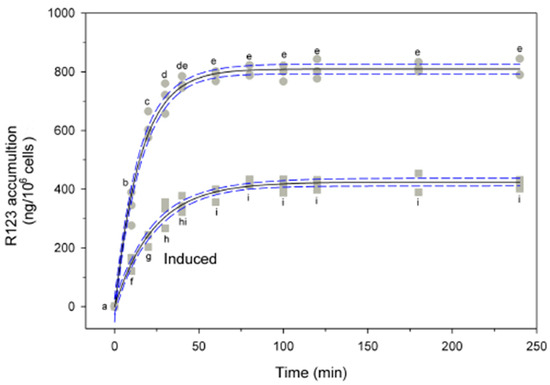
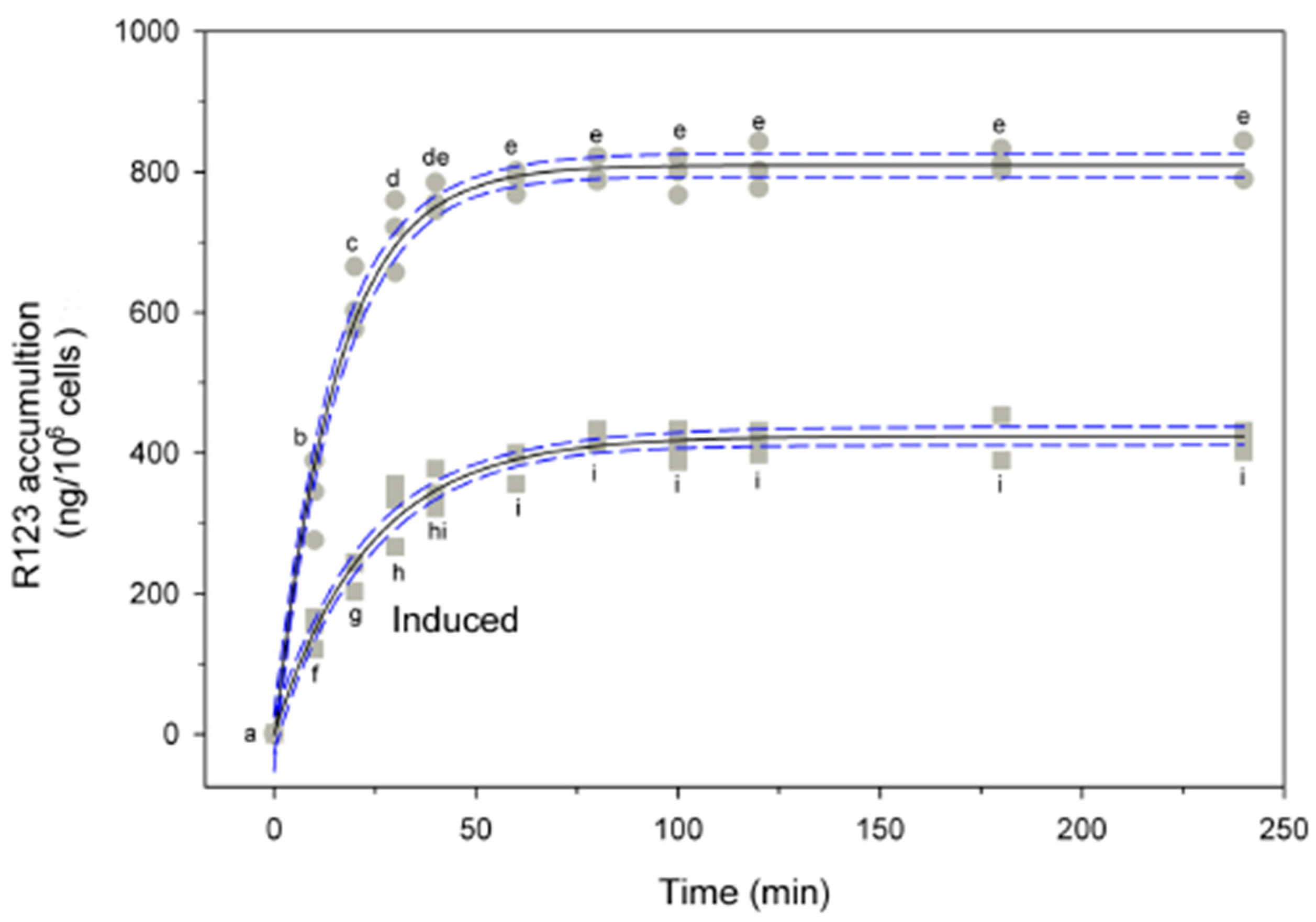
Rhodamine 123 (R123) accumulation was significantly reduced in hepatocytes from P-glycoprotein (P-gp)-induced rainbow trout compared to uninduced controls across the 240-min assay period (Figure 1 shown for clotrimazole 10 mg/kg IP dose as a typical example). In hepatocytes from uninduced fish, R123 accumulation increased rapidly, peaking within the first 60 min and plateauing at approximately 820 ng/106 cells. In contrast, hepatocytes from induced fish exhibited consistently lower R123 accumulation, stabilizing at approximately 400 ng/106 cells. Significant differences between treatment groups were evident as early as 15 min post-exposure and persisted throughout the assay (p < 0.05), as indicated by non-overlapping statistical groupings. Curve fitting indicated that induced hepatocytes approached steady-state accumulation more quickly and at a lower plateau, consistent with enhanced P-gp-mediated efflux. These findings confirm that chemical induction of P-gp effectively increases transport activity in trout hepatocytes, thereby reducing intracellular substrate retention and limiting R123 accumulation.
Figure 1.
The accumulation of R123 increased exponentially until reaching a statistical maximum at 40 min, regardless of induction. However, induction did decrease the total accumulation (F1,65 = 597.5, p < 0.001), with differences occurring at 10 min and continuing over the exposure period. Dissimilar letters indicate significant difference. Blue dashed lines represent 95% confidence intervals and grey symbols are data from individual fish.
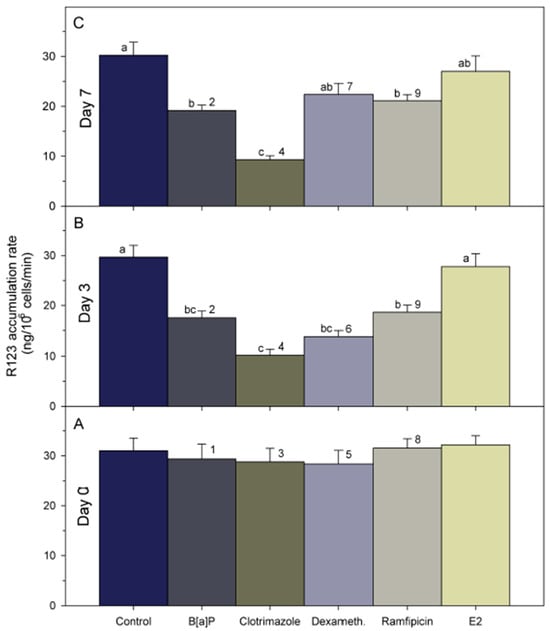
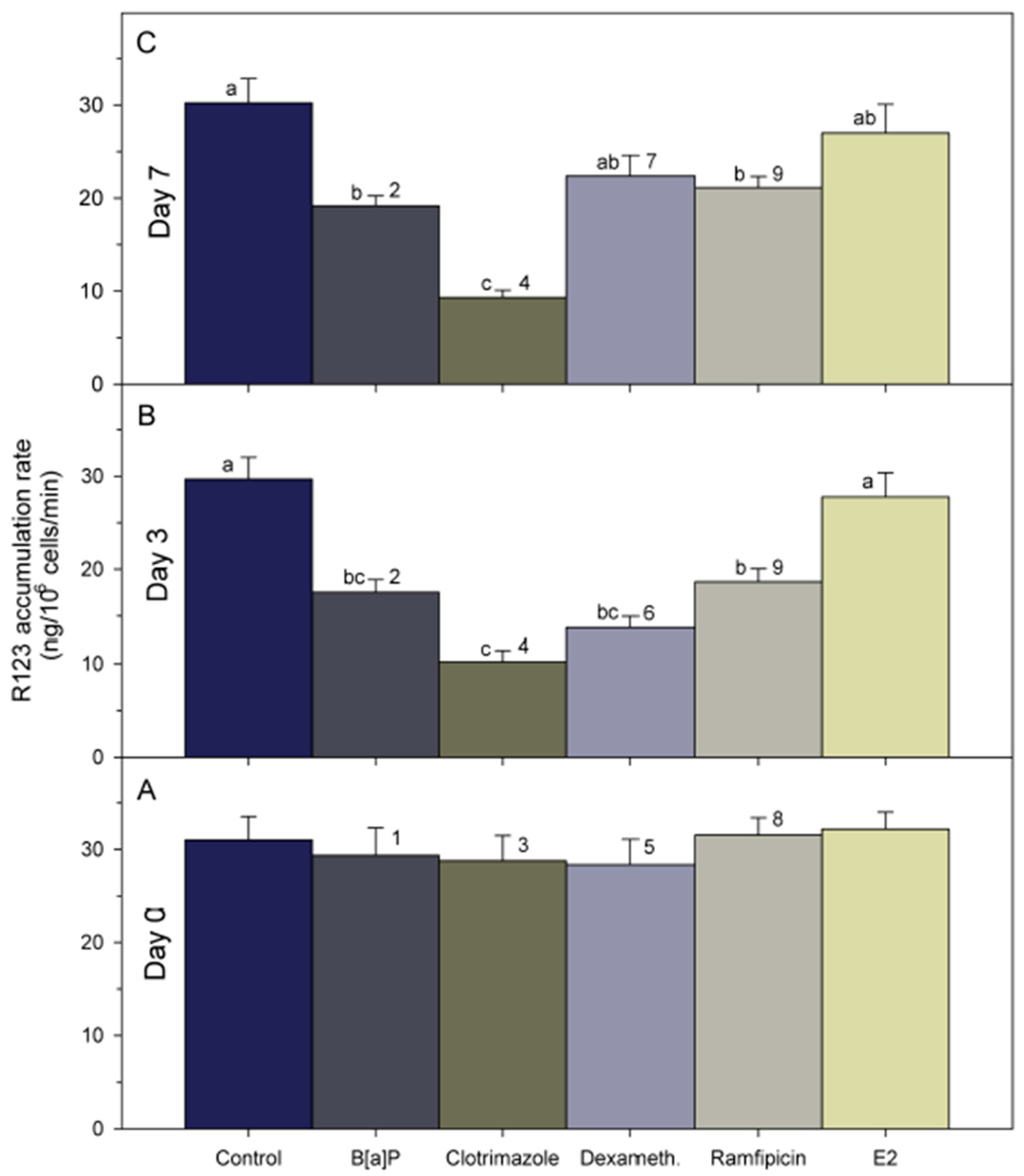
To assess the temporal effects of different P-glycoprotein (P-gp) inducers, R123 accumulation rates (from initial accumulations t = 0 to t = 30 min in linear section of total accumulation curves, e.g., Figure 1) were measured in isolated trout hepatocytes at d 0, 3, and 7 following IP administration of 10 mg/kg of known or suspected inducers. At d 0, no significant differences were observed among treatments, indicating equivalent baseline R123 accumulation rates across all groups prior to chemical exposure (Figure 2A). By d 3, significant reductions in R123 accumulation rates were observed in all treatment groups except for 17β-estradiol (E2), consistent with induced P-gp activity (Figure 2B). The largest decrease in R123 accumulation rates occurred in the clotrimazole-treated group (mean difference vs. control: 19.5 ng/106 cells/min, t = 6.538, p < 0.001), followed by dexamethasone, benzo[a]pyrene (B[a]P), and rifampicin. E2-treated fish did not differ from controls (mean difference: 1.92 ng/106 cells/min, t = 0.644, p = 0.521), suggesting that E2 was not an effective P-gp inducer under the conditions tested. At d 7, the pattern of R123 accumulation remained similar, with clotrimazole continuing to produce the greatest reduction in intracellular R123 accumulation rates. Notably, dexamethasone-treated fish exhibited a significant increase in R123 accumulation rates between d 3 and d 7 (mean difference: 8.62 ng/106 cells/min, t = 2.893, p = 0.005), indicating a loss of induction response. These findings demonstrate that several compounds, particularly clotrimazole, effectively induce P-gp activity in vivo in rainbow trout hepatocytes, with detectable effects emerging by d 3 and persisting or increasing by d 7.
Figure 2.
Dissimilar letters indicate significant difference across treatment; dissimilar numbers indicate difference across days (within a treatment). At day 0, R123 accumulation rates did not differ among treatments (A). At day 3, all treatments except E2 differed from control (mean difference for control vs. B[a]P: 12.2, t = 4.081, p < 0.001; vs. clotrimazole: 19.5, t = 6.538, p < 0.001; vs. dexamethasone: 15.9, t = 5.350, p < 0.001; vs. ramfipicin: 11.04, t = 3.705, p < 0.001; vs. E2: 1.92, t = 0.644, p = 0.521) (B). Of the differences, clotrimazole caused the largest difference. The differences at day 3 were similar to those at day 7, with the only exception being that rates in the dexamethasone-exposed fish increased from day 3 to 7 (mean difference: 8.62, t = 2.893, p = 0.005) (C).
The results from Figure 2 are consistent with the time-course data shown in Figure 1, where hepatocytes from P-gp–induced fish displayed significantly reduced R123 accumulation compared to uninduced controls over a 240-min assay. Together, these findings confirm that chemical induction of P-gp effectively enhances efflux capacity in trout hepatocytes. While Figure 1 demonstrates the kinetics and magnitude of P-gp activity in response to a single inducer, Figure 2 extends this by comparing multiple inducers and showing the onset and persistence of their effects over several days. The pronounced reduction in R123 accumulation observed with clotrimazole in both figures highlights its potency as a P-gp inducer, while the reduced persistence of induction for dexamethasone seen by d 7 (Figure 2C) and stability of induction for B[a]P and ramfipicin indicate variability in induction potential and stability. The lack of response to E2 across all time points in Figure 2 further supports the specificity of P-gp induction by certain xenobiotics. Collectively, these results provide strong functional evidence that P-gp activity in rainbow trout hepatocytes is inducible, time-dependent, and responsive to a subset of known mammalian P-gp inducers.
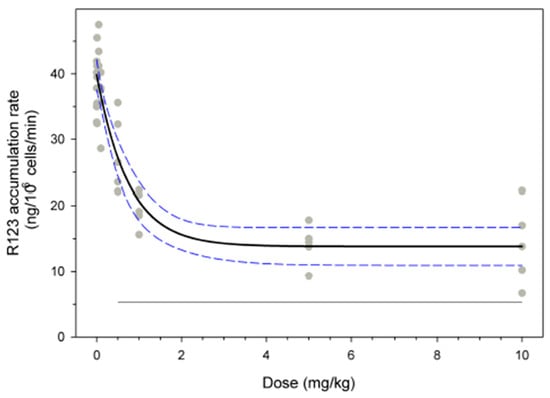
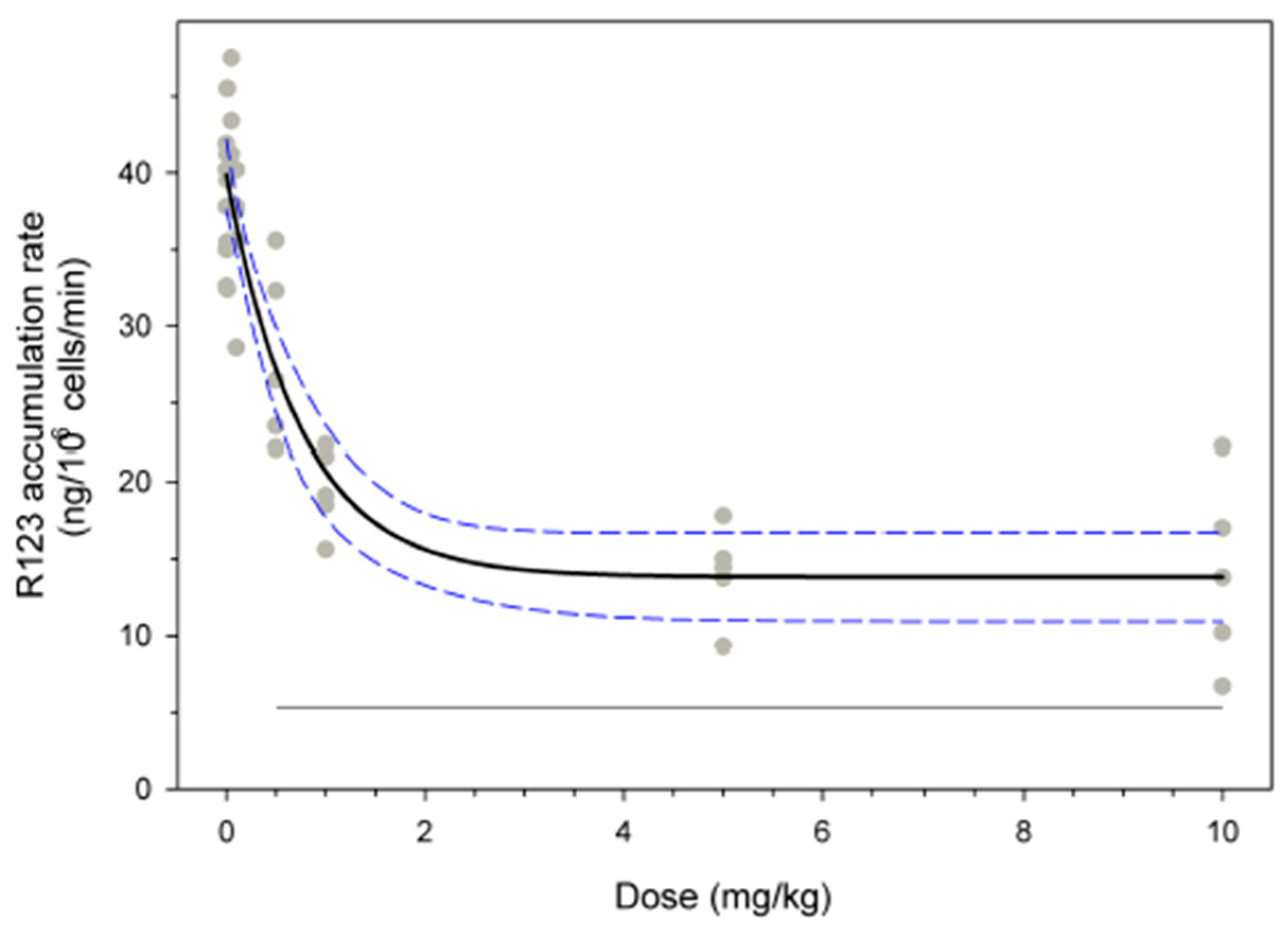
To determine the dose-dependency of P-glycoprotein (P-gp) induction, rainbow trout were injected with increasing concentrations of clotrimazole, and R123 accumulation rates in hepatocytes was measured at 3 d post-exposure. R123 accumulation rate decreased significantly in a concentration-dependent manner (F7,39 = 33.43, p < 0.001), consistent with enhanced P-gp efflux activity (Figure 3). Nonlinear regression revealed a steep decline in R123 accumulation between 0 and 2 mg/kg, followed by a plateau phase beyond 4 mg/kg, suggesting saturation of the induction response. All doses ≥0.5 mg/kg clotrimazole resulted in significantly lower R123 accumulation compared to controls, with mean differences exceeding 9.5 ng/106 cells/min. These data indicate that even relatively low clotrimazole doses are sufficient to upregulate functional P-gp activity in trout hepatocytes, with little additional effect at higher doses.
Figure 3.
R123 accumulation rate decreased in a concentration-dependent manner (F7,39 = 33.43, p < 0.001), with doses of 0.5 mg/kg and greater differing from control (mean differences > 9.5 ng/106 cells/min). The horizontal line indicates difference from control. Blue dashed lines represent 95% confidence intervals and grey circles are data from individual fish.
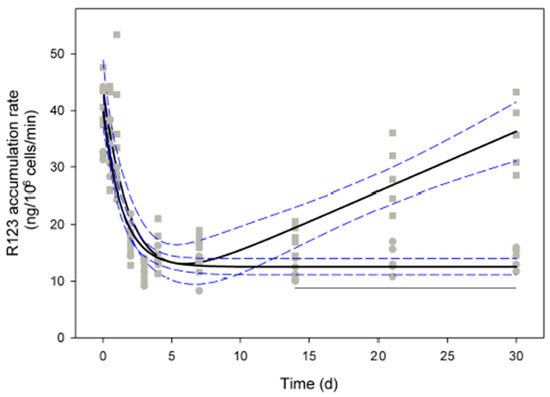
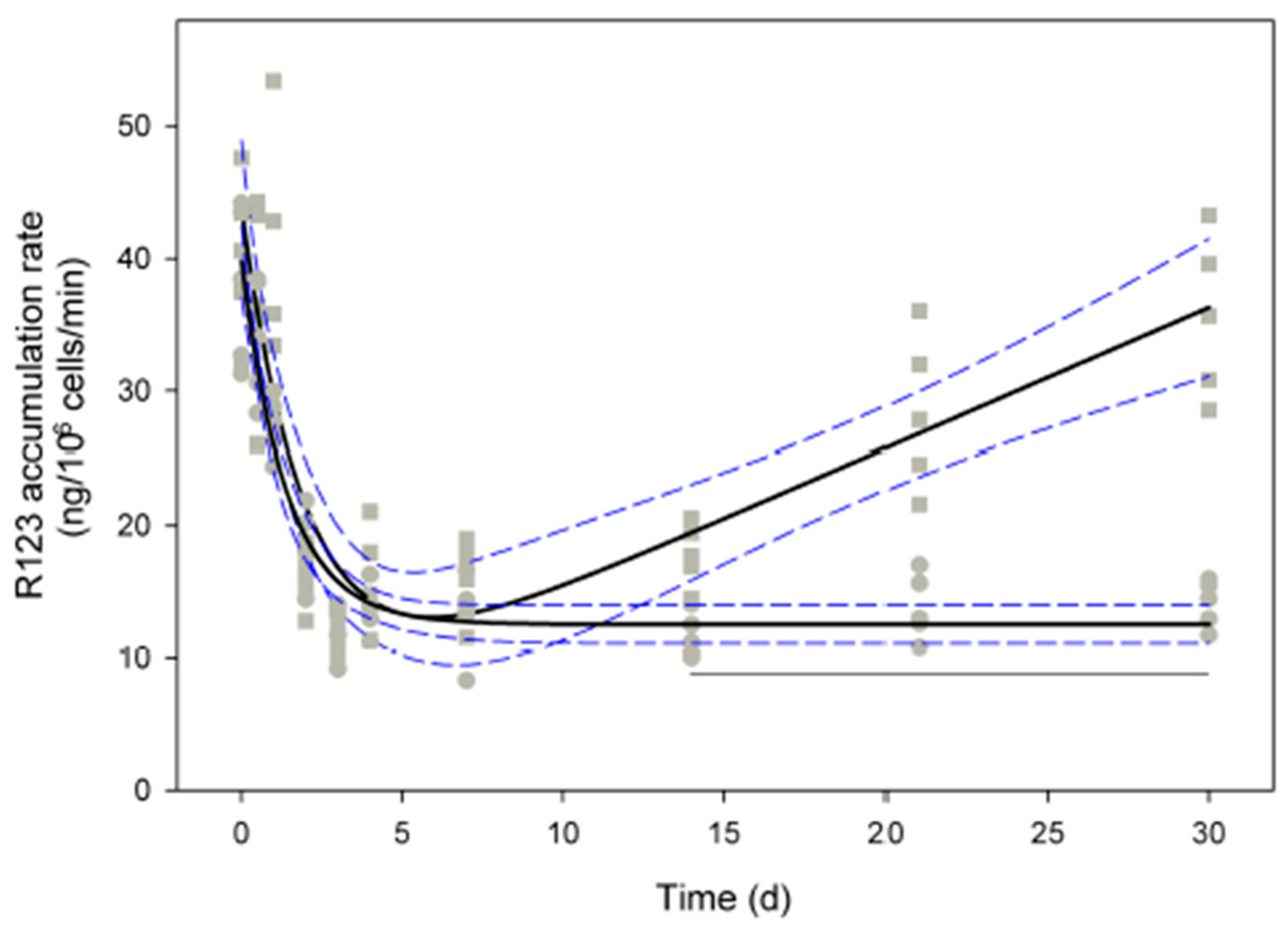
To evaluate the duration and reversibility of P-glycoprotein (P-gp) induction, R123 accumulation rates were monitored in hepatocytes from trout given either a single intraperitoneal (IP) injection or continuous IP injections of clotrimazole over a 28-d period. R123 accumulation decreased rapidly following injection in both treatment groups, with rates significantly lower than baseline (d 0) by d 1 in continuously injected fish and by d 2 in single-injection fish (Figure 4). In fish receiving a single injection, R123 accumulation reached a minimum at d 3 (mean: 12.0 ng/106 cells/min) and began to rise thereafter, approaching baseline levels by d 14. In contrast, accumulation rates in continuously injected fish remained suppressed over the entire 28-d period. From d 14 onward, significant differences were observed between the two treatment groups (mean differences > 6.19 ng/106 cells/min, t > 2.233, p < 0.028), indicating that sustained exposure is necessary to maintain maximal P-gp induction. These results demonstrate that P-gp activity is rapidly inducible following IP injection and suggest that its efflux capacity is reversible upon cessation of exposure, with induction dynamics governed by both dose and exposure duration.
Figure 4.
IP injections affected R123 accumulation rates rapidly, with rates differing from day 0 by days 1 and 2 post-injection for continuous and single IP injected fish, respectively. For the fish given the single injection, accumulation rates began to return to baseline after reaching the lowest (numeric) point on day 3 (mean: 12.0), and differed from fish given continuous injections on day 14 forward (mean differences > 6.19, t values > 2.233, p values < 0.028). The horizontal line indicates difference between given a single injection vs. continuous. Blue dashed lines represent 95% confidence intervals and grey symbols are data from individual fish.
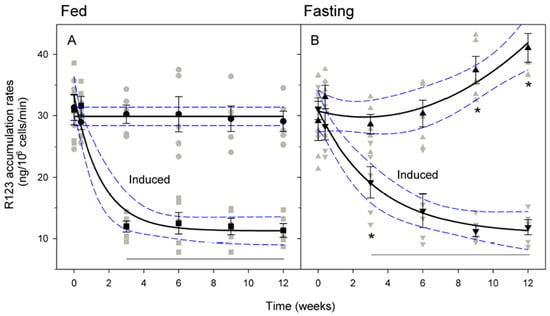
To evaluate the effects of dietary status on P-glycoprotein (P-gp) function over time, R123 accumulation rates were measured in hepatocytes from fed and fasted fish over a 12-week period. In fed fish, R123 accumulation remained stable across the duration of the experiment, indicating no significant change in baseline P-gp activity (Figure 5A). In contrast, fasted fish exhibited a gradual increase in R123 accumulation over time, with significant differences from fed fish emerging by week 9 (mean difference: 7.94 ng/106 cells/min, t = 2.818, p = 0.006) and increasing further by week 12 (mean difference: 12.0 ng/106 cells/min, t = 4.259, p < 0.001) (Figure 5B). These findings indicate a decline in basal P-gp function during prolonged fasting.
Figure 5.
R123 accumulation rate remained constant in fed fish over the 12 week experiment. In contrast, accumulation rate increased in fasted fish and was different from fed fish on weeks 9 and 12 (mean differences: 7.94, t = 2.818, p = 0.006; 12.0, t = 4.259, p < 0.001; respectively). Induction (2 week IP injections) caused exponential decreases in R123 accumulation rates regardless of dietary status, but dietary status did affect the rate of decrease. Specifically, accumulation rate was decreased by day 3 in both fed and fasted fish, however, the decrease in fed fish was greater (mean difference fed vs. fasted: 7.22, t = 2.563, p = 0.012). The horizontal line indicates difference between induced fish and control. Asterisks indicate difference between fasted and fed fish. Blue dashed lines represent 95% confidence intervals and grey symbols are data from individual fish.
Continuous chemical induction by clotrimazole significantly reduced R123 accumulation in both dietary groups, reflecting increased P-gp activity. Induction led to exponential decreases in R123 accumulation by d 3 in both fed and fasted fish; however, the reduction was significantly greater in the fed group (mean difference: 7.22 ng/106 cells/min, t = 2.563, p = 0.012). While fed fish maintained low R123 accumulation throughout the experiment, fasted fish showed a gradual rebound in accumulation, suggesting a decline in persistent inducible P-gp activity over time. These results indicate that while P-gp can be induced by clotrimazole under both nutritional states, fasting impairs both basal and inducible efflux capacity, potentially compromising xenobiotic defense during prolonged periods of energy deprivation.
4. Discussion
This study provides a comprehensive evaluation of P-glycoprotein (P-gp) inducibility, regulation, and energetic cost in juvenile rainbow trout (Oncorhynchus mykiss). As a key ATP-dependent efflux transporter in the multixenobiotic resistance (MXR) system, P-gp contributes to the cellular exclusion of diverse toxicants. Although its function is well characterized in mammals, regulation in fish under environmentally relevant physiological conditions remains poorly defined [25]. Our results demonstrate that P-gp is inducible by a variety of xenobiotics, that this response is dose-dependent and reversible, and that it is modulated by nutritional status with measurable physiological costs.
P-gp induction in fish involves conserved signaling pathways, likely mediated by nuclear receptors such as pregnane X receptor (PXR), potentially the constitutive androstane receptor (CAR), and Nrf2 [26,27]. The observed lag in dexamethasone response and differential responses across compounds support a role for these pathways in compound-specific regulation. Inter-species variability in P-gp inducibility (e.g., lack of response in Fundulus heteroclitus to canonical AhR ligands [13]) may reflect evolutionary divergence in promoter architecture or receptor expression profiles. Comparative genomics and transcriptomics could help elucidate these differences.
The ability of P-gp to be induced in this study is consistent with transcriptional upregulation of abcb4, which is the primary isoform expressed in the trout liver and a key component of the multixenobiotic resistance system [28,29,30]. Hepatic abcb4 plays a major role in the ATP-dependent efflux of a wide range of xenobiotics, consistent with its function in first-line chemical defense. Although abcb5 is also found in trout, its expression appears to be more limited in hepatocytes and is instead associated with regenerative epithelial tissues, such as gill or ovarian follicles, where it may support localized transport needs during development or repair [5,25,29,30]. Given these differences in tissue distribution and regulation, it is reasonable to interpret the induction patterns observed in our liver assays as being driven primarily by abcb4, rather than by abcb5. This distinction is essential when evaluating transporter function in hepatic models.
Clotrimazole exposure led to a noticeable reduction in R123 accumulation by day 3 in trout hepatocytes, pointing to a rapid induction of P-gp activity (Figure 1). Similar effects were observed for other mammalian inducers; dexamethasone, benzo[a]pyrene, and rifampicin, with the exception of 17β-estradiol, which had no significant impact (Figure 2). Among the tested compounds, clotrimazole showed the strongest response, consistent with its ability to activate PXR and CAR (CAR-like signaling has not been consistently demonstrated in fish) in other systems [31,32]. The delayed induction seen with dexamethasone likely reflects indirect signaling through glucocorticoid-mediated PXR activation [9,33] rather than direct CAR activation, contributing to the compound-specific kinetics observed.
This kind of compound-specific inducibility aligns well with patterns reported in mammals, where P-gp expression is regulated by nuclear receptors including PXR, CAR, and AhR [8,10]. Similar ligand sensitivity has been documented in fish: zebrafish PXR, for example, responds to rifampicin and clotrimazole [11], and trout hepatocytes have been shown to increase P-gp expression following exposure to AhR agonists like benzo[a]pyrene [28]. Overall, the data support the idea that inducibility of P-gp via nuclear receptor pathways is a conserved feature of the multixenobiotic resistance (MXR) system in aquatic species [30,34,35]. It should be noted that the present study relies on functional measurements of P-gp activity and does not directly assess nuclear receptor activation, transporter gene expression, or protein abundance. While the observed compound-specific, dose-dependent, and reversible changes in R123 accumulation are consistent with transcriptional regulation mediated by nuclear receptor pathways, alternative mechanisms including post-translational modification, membrane trafficking, or changes in cellular energetics may also contribute to the observed responses. Also, while rhodamine 123 is widely used as a functional probe of P-gp activity in fish hepatocytes, we cannot fully exclude minor contributions from other ABC transporters with overlapping substrate specificity, such as MRPs or BCRP.
Although the underlying receptors may differ somewhat in structure or ligand affinity across taxa, the functional outcome, a boost in efflux transporter expression in response to xenobiotic stress, appears broadly conserved. This highlights the importance of characterizing responses to individual compounds when evaluating transporter dynamics across species.
Dose–response experiments showed that P-gp activity was highly sensitive to low clotrimazole concentrations, with R123 accumulation dropping steeply between 0.25 and 2 mg/kg and then reaching a plateau (Figure 3). This sigmoidal trend is consistent with saturable, receptor-mediated transcriptional regulation, as has been described for PXR- and CAR-driven induction of abcb1 in mammals [26,31] and abcb4 in fish [11,28]. A similar non-linear response to AhR agonists has been reported in trout hepatocytes [34], supporting a conserved regulatory mechanism. The ceiling effect may reflect physiological constraints on transporter abundance, such as limits to membrane insertion, protein stability, or ATP-dependent turnover capacity as well.
In the time-course experiment, a single clotrimazole dose triggered transient P-gp activation, with activity returning to baseline by day 14. In contrast, fish receiving repeated doses maintained low R123 accumulation throughout the exposure period (Figure 4). This reversibility suggests that continued chemical presence is necessary to sustain efflux capacity. Such regulation likely reflects energy conservation, as maintaining high transporter expression can divert resources from other physiological functions [20,36]. Overall, these results highlight that P-gp induction in trout is both dose- and duration-dependent, echoing findings from other vertebrates. This plasticity may allow fish to balance chemical defense with metabolic cost, particularly under fluctuating exposure conditions common in aquatic environments [25,35].
Nutritional status significantly affected both baseline and inducible P-gp activity. In fed fish, R123 accumulation remained constant over 12 weeks, whereas fasted fish exhibited a progressive increase, indicating a decline in basal efflux capacity over time (Figure 5). Importantly, although P-gp could still be induced by clotrimazole in fasted fish, the response was attenuated and less sustained relative to fed counterparts. These findings suggest that fasting compromises both constitutive and inducible P-gp function, potentially impairing the capacity for xenobiotic efflux under energy-limited conditions. Although hepatic ATP availability, mitochondrial function, and upstream energy-sensing pathways (e.g., AMP-activated protein kinase [AMPK]) were not directly assessed in this study, reduced cellular energy status during prolonged fasting may contribute to diminished efflux capacity through both energetic limitation and regulatory modulation. Reduced basal activity during fasting may also reflect a decreased physiological demand for transport of endogenous substrates, such as bile acids, which are known P-gp substrates and whose synthesis and enterohepatic cycling are reduced during prolonged food deprivation. This contrasts with earlier observations by [36], who reported stable basal P-gp activity in trout fasted for up to nine weeks, suggesting that P-gp may initially be preserved as a prioritized defense mechanism. However, that study did not assess inducibility or longer-term fasting beyond nine weeks. The present results thus extend prior work by demonstrating that while basal P-gp activity may be transiently maintained, it declines with prolonged energy deprivation and shows reduced plasticity in response to chemical inducers. Together, these results underscore the energetic cost of maintaining inducible xenobiotic defenses and highlight a potential vulnerability to contaminant accumulation in fish during extended fasting periods.
Taken together, these results show that P-gp in trout is a dynamic and tightly regulated defense system. It is rapidly inducible, highly sensitive to low-dose exposures, and downregulated in the absence of continued stimulus. However, its function is compromised by energy limitation, particularly during prolonged fasting, which impairs both basal and inducible efflux activity. These findings highlight the dual role of P-gp as both a protective mechanism and a system constrained by physiological state, with implications for xenobiotic defense under environmental stress.
Finally, these results have clear ecological implications. Fish inhabiting contaminated environments during energetically constrained periods such as migration, smoltification, overwintering, or starvation may exhibit impaired P-gp responses, leading to increased internal toxicant burden. Additionally, sustained induction of P-gp may require metabolic investment that could trade off with other critical processes such as growth, reproduction, or immune competence. Understanding these dynamics is essential for assessing contaminant risk under realistic ecological scenarios.
The results presented here complement emerging data on the endogenous regulation of P-gp in fish, particularly in relation to substrate overlap with solute carrier importers and post-translational control mechanisms. As highlighted in recent reviews, P-gp shares broad substrate specificity with other transporters, including many hydrophobic and amphipathic molecules involved in signaling, metabolism, and endocrine function [5]. The regulation of P-gp under energy-limited conditions may therefore have broader implications, not only for xenobiotic resistance but also for maintaining chemical homeostasis during environmental or nutritional stress.
5. Conclusions
This study demonstrates that P-glycoprotein (P-gp) activity in rainbow trout is highly inducible, dose-sensitive, and regulated by both exposure duration and nutritional status. While P-gp provides an important line of defense against xenobiotic accumulation, its induction imposes physiological costs and is constrained under conditions of energy limitation. These findings provide critical insight into the adaptive and energetic trade-offs associated with chemical defense in fish. They underscore the need to consider metabolic condition and exposure history in environmental risk assessments and offer a mechanistic foundation for predicting contaminant susceptibility in wild fish populations.
Author Contributions
Conceptualization, Methodology, Formal analysis C.J.K.; Data curation and statistical analysis K.B.T. and C.J.K.; Writing: original draft preparation, K.B.T.; Writing: review and editing; Project administration and funding acquisition, C.J.K. All authors have read and agreed to the published version of the manuscript.
Funding
This research was supported by the Natural Sciences and Engineering Research Council of Canada (NSERC) through an Individual Discovery Grant #(R611305) awarded to CJK.
Institutional Review Board Statement
All procedures involving animals were conducted in accordance with the guidelines of the Canadian Council on Animal Care (CCAC) and approved by the Simon Fraser University Animal Care Committee (protocol #112B-16; approved on 1 April 2020).
Data Availability Statement
The original contributions presented in this study are included in the article. Further inquiries can be directed to the corresponding author.
Acknowledgments
The authors thank Elaine Taylor of animal care services for excellent fish care.
Conflicts of Interest
The authors declare no conflict of interest.
References
- Miller, D. Regulation of P-glycoprotein and other ABC drug transporters at the blood–brain barrier. Trends Pharmacol. Sci. 2010, 31, 246–254. [Google Scholar] [CrossRef] [Scilit]
- Monostory, K.; Jemnitz, K.; Vereczkey, L. Xenobiotic metabolizing enzymes in fish: Diversity, regulation and biomarkers for pollutant exposure. Acta Physiol. Hung. 1996, 84, 369–381. [Google Scholar]
- Kropf, C.; Segner, H.; Fent, K. ABC transporters and xenobiotic defense systems in early life stages of rainbow trout (Oncorhynchus mykiss). Comp. Biochem. Physiol. Part C Toxicol. Pharmacol. 2016, 185–186, 45–56. [Google Scholar] [CrossRef] [Scilit]
- Endicott, J.; Ling, V. The biochemistry of P-glycoprotein mediated multidrug resistance. Ann. Rev. Biochem. 1989, 58, 137–171. [Google Scholar] [CrossRef] [PubMed]
- Johnston, C.; Kennedy, C. A review of P-glycoprotein in fishes. Fishes 2024, 9, 51. [Google Scholar] [CrossRef] [Scilit]
- Kurelec, B. The multixenobiotic resistance mechanism in aquatic organisms. Crit. Rev. Toxicol. 1992, 22, 23–43. [Google Scholar] [CrossRef] [Scilit]
- Bard, S.; Bello, S.; Hahn, M.; Stegeman, J. Expression of P-glycoprotein in killifish (Fundulus heteroclitus) exposed to environmental xenobiotics. Aquat. Toxicol. 2002, 59, 237–251. [Google Scholar] [CrossRef] [Scilit] [PubMed]
- Staudinger, J.L.; Goodwin, B.; Jones, S.A.; Hawkins-Brown, D.; MacKenzie, K.I.; LaTour, A.; Liu, Y.; Klaassen, C.D.; Brown, K.K.; Reinhard, J.; et al. The nuclear receptor PXR is a lithocholic acid sensor that protects against liver toxicity. Proc. Natl. Acad. Sci. USA 2001, 98, 3369–3374. [Google Scholar] [CrossRef] [Scilit]
- Wang, X.; Campos, C.; Peart, J.; Smith, L.; Boni, J.; Cannon, R.; Miller, D. Nrf2 upregulates ATP binding cassette transporter expression and activity of the blood-brain barrier and blood-spinal cord barriers. J. Neurosci. 2014, 34, 8585–8593. [Google Scholar] [CrossRef] [Scilit]
- Tolson, A.; Wang, H. Regulation of drug-metabolizing enzymes by xenobiotic receptors: PXR and CAR. Adv. Drug Deliv. Rev. 2011, 62, 1238–1249. [Google Scholar] [CrossRef] [Scilit]
- Bainy, A.; Kubota, A.; Goldstone, J.; Lille-Langøy, R.; Karchner, S.; Celander, M.; Hahn, M.; Goksøyr, A.; Stegeman, J. Functional characterization of a full-length pregnane X receptor, expression in vivo, and identification of PXR alleles in zebrafish (Danio rerio). Aquat. Toxicol. 2013, 142–143, 447–457. [Google Scholar] [CrossRef] [Scilit]
- Reschly, E.; Krasowski, M. Evolution and function of the NR1I nuclear hormone receptor subfamily (VDR, PXR, and CAR) with respect to metabolism of xenobiotics and endogenous compounds. Curr. Drug Metab. 2006, 7, 349–365. [Google Scholar] [CrossRef] [Scilit]
- Cooper, P. Altered expression of the xenobiotic transporter P-glycoprotein in liver and liver tumours of mummichog Fundulus heteroclitus from a creosote-contaminated environment. Biomarkers 1999, 4, 48–58. [Google Scholar] [CrossRef] [Scilit] [PubMed]
- Bains, O.; Kennedy, C. Energetic costs of pyrene metabolism in isolated hepatocytes of rainbow trout, Oncorhynchus mykiss. Aquat. Toxicol. 2004, 67, 217–226. [Google Scholar] [CrossRef] [Scilit] [PubMed]
- Bains, O.; Kennedy, C. Alterations in respiration rate of isolated rainbow trout hepatocytes exposed to the P-glycoprotein substrate rhodamine 123. Toxicology 2005, 214, 87–98. [Google Scholar] [CrossRef] [Scilit]
- Brett, J.; Groves, T. Physiological energetics. In Fish Physiology, Volume 8 Bioenergetics and Growth; Hoar, W.S., Randall, D.J., Brett, J.R., Eds.; Academic Press: New York, NY, USA, 1979; Volume 8, pp. 279–352. [Google Scholar]
- Andersson, T. Cytochrome P-450-dependent metabolism in isolated liver cells from fed and starved rainbow trout. Fish. Physiol. Biochem. 1986, 1, 105–111. [Google Scholar] [CrossRef] [Scilit]
- Ruane, N.; Carballo, E. Increased stocking density influences the acute physiological stress response of common carp (Cyprinus carpio L.). Aquac. Res. 2002, 33, 777–784. [Google Scholar] [CrossRef] [Scilit]
- Salem, M.; Silverstein, J.; Rexroad, C.I.I.I.; Yao, J. Effect of starvation on global gene expression and proteolysis in rainbow trout (Oncorhynchus mykiss). BMC Genom. 2007, 8, 328. [Google Scholar] [CrossRef] [Scilit]
- Dou, L.; Mai, Y.; Madla, C.; Orlu, M.; Basit, A. P-glycoprotein expression in the gastrointestinal tract of male and female rats is influenced differently by food. Eur. J. Pharm. Sci. 2018, 123, 569–575. [Google Scholar] [CrossRef] [Scilit]
- Okyar, A.; Kumar, S.; Filipski, E.; Piccolo, E.; Ozturk, N.; Xandri-Monje, H.; Pala-Kara, Z.; Abraham, K.; Gato de Jesus Gomes, A.; Orman, M.; et al. Sex-, feeding-, and circadian time-dependency of P-glycoprotein expression and activity-implications for mechanistic pharmacokinetics modeling. Sci. Rep. 2019, 9, 10505. [Google Scholar] [CrossRef] [Scilit] [PubMed]
- Azevedo, V.; Kennedy, C. P-glycoprotein inhibition affects ivermectin-induced behavioural alterations in fed and fasted zebrafish (Danio rerio). Fish Physiol. Biochem. 2022, 48, 1267–1283. [Google Scholar] [CrossRef] [Scilit]
- Renaud, H.; Klaassen, C.; Csanaky, I. Calorie restriction increases P-glycoprotein and decreases intestinal absorption of digoxin in mice. Drug Metab. Dispos. 2016, 44, 366–369. [Google Scholar] [CrossRef] [Scilit] [PubMed]
- Morrow, M.; Higgs, D.; Kennedy, C. The effects of diet composition and ration on biotransformation enzymes and stress parameters in rainbow trout (Oncorhynchus mykiss). Comp. Biochem. Physiol. Part C Toxicol. Pharmacol. 2004, 137, 143–154. [Google Scholar] [CrossRef] [Scilit]
- Brox, S.; Ingerslev, F.; Skadsheim, A. Regulation of P-glycoprotein in fish. In Fish Physiology; Academic Press: London, UK, 2020; Volume 40, pp. 89–127. [Google Scholar]
- Kliewer, S.; Moore, J.; Wade, L.; Staudinger, J.; Watson, M.; Jones, S.; McKee, D.; Oliver, B.; Willson, T.; Zetterström, R.; et al. An orphan nuclear receptor activated by pregnanes defines a novel steroid signaling pathway. Cell 1998, 92, 73–82. [Google Scholar] [CrossRef] [Scilit]
- Yamashita, Y.; Ueyama, T.; Nishi, T.; Yamamoto, Y.; Kawakoshi, A.; Sunami, S.; Iguchi, M.; Tamai, H.; Ueda, K.; Ito, T.; et al. Nrf2-Inducing anti-oxidation stress response in the rat liver—New beneficial effect of lansoprazole. PLoS ONE 2014, 9, e97419. [Google Scholar] [CrossRef] [Scilit]
- Fischer, S.; Kluver, N.; Burkhardt-Medicke, K.; Pietsch Schmidt, A.; Wellner, P.; Schirmer, K.; Luckenbach, T. Abcb4 acts as a multixenobiotic transporter against chemical uptake in zebrafish (Danio rerio) embryos. BMC Biol. 2013, 11, 69. [Google Scholar] [CrossRef] [Scilit] [PubMed]
- Luckenbach, T.; Fischer, S.; Sturm, A. Current advances on ABC drug transporters in fish. Comp. Biochem. Physiol. Part C Toxicol. Pharmacol. 2014, 165, 28–52. [Google Scholar] [CrossRef] [Scilit]
- Ferreira, M.; Costa, J.; Reis-Henriques, M. ABC transporters in fish species: A review. Front. Physiol. 2014, 5, 266. [Google Scholar] [CrossRef] [Scilit]
- Pinne, M.; Ponce, E.; Raucy, J. Transactivation assays to assess canine and rodent pregnane X receptor (PXR) and constitutive androstane receptor (CAR) activation. PLoS ONE 2016, 11, e0164642. [Google Scholar] [CrossRef] [Scilit] [PubMed]
- Silva, R.; Vilas-Boas, V.; Carmo, H.; Dinis-Oliveira, R.; Carvalho, F.; Bastos, M.; Remião, F. Modulation of P-glycoprotein efflux pump: Induction and activation as a therapeutic strategy. Pharmacol. Ther. 2015, 149, 1–123. [Google Scholar] [CrossRef] [Scilit]
- Pascussi, J.; Drocourt, L.; Fabre, J.; Maurel, P.; Vilarem, M. Dexamethasone induced pregnane X receptor and retinoid X receptor-α expression in human hepatocytes: Synergistic increase of CYP3A4 induction by pregnane X receptor activators. Mol. Pharmacol. 2000, 58, 361–372. [Google Scholar] [CrossRef] [Scilit] [PubMed]
- Doi, A.; Holmes, E.; Kleinow, K. P-glycoprotein in the catfish intestine: Inducibility by xenobiotics and functional properties. Aquat. Toxicol. 2001, 55, 157–170. [Google Scholar] [CrossRef] [Scilit] [PubMed]
- Smital, T.; Luckenbach, T.; Sauerborn, R.; Hamdoun, A.; Vega, R.; Epel, D. Emerging contaminants--pesticides, PPCPs, microbial degradation products and natural substances as inhibitors of multixenobiotic defense in aquatic organisms. Mutat. Res. 2004, 552, 101–117. [Google Scholar] [CrossRef] [Scilit] [PubMed]
- Gourley, M.; Kennedy, C. Energy allocations to xenobiotic transport and biotransformation reactions in rainbow trout (Oncorhynchus mykiss) during energy intake restriction. Comp. Biochem. Physiol. Part C Toxicol. Pharmacol. 2009, 150, 270–278. [Google Scholar] [CrossRef] [Scilit]
Disclaimer/Publisher’s Note: The statements, opinions and data contained in all publications are solely those of the individual author(s) and contributor(s) and not of MDPI and/or the editor(s). MDPI and/or the editor(s) disclaim responsibility for any injury to people or property resulting from any ideas, methods, instructions or products referred to in the content. |
© 2026 by the authors. Licensee MDPI, Basel, Switzerland. This article is an open access article distributed under the terms and conditions of the Creative Commons Attribution (CC BY) license.