Article

Analysis of Respiratory Behaviour of Thicklipped Grey Mullet (Chelon labrosus) Juveniles Under Different Rearing Conditions

“El Bocal” Marine Aquaculture Plant, Oceanographic Centre of Santander COST–IEO (CSIC), Monte-Corbanera, 39012 Santander, Cantabria, Spain
*
Author to whom correspondence should be addressed.
Fishes 2026, 11(3), 128; https://doi.org/10.3390/fishes11030128
Submission received: 26 January 2026 / Revised: 18 February 2026 / Accepted: 22 February 2026 / Published: 24 February 2026
(This article belongs to the Special Issue Fish Health and Welfare in Aquaculture and Research Settings)

Abstract

Thicklipped grey mullet (Chelon labrosus) shows potential as an appealing species for aquaculture in the EU. Knowledge of its metabolic requirements is essential for species management and control of environmental conditions. We examined routine and postprandial oxygen consumption (OC) in juveniles as a function of body weight (Bw: 2–85 mg) and temperature (T: 14–26 °C), as well as OC and ventilatory frequency (VF) under gradual hypoxia as a function of T (14–22 °C). Multiple regression analyses determined the effects of Bw and T on mean daily (OCmean), postprandial (OCSDA), routine (OCroutine), and maximum (OCmax) levels, as well as on OCmax/OCroutine ratio (MSF), postprandial OC duration (DSDA) and time to reach maximum activity (Dpeak). The effects of dissolved oxygen (DO) and T on OC and of T on initial VF (VFini), maximum VF (VFmax), critical DO threshold (%DOcrit), and VF change threshold (%VFch) were also analysed. All OC levels increased with T and Bw, except MSF, DSDA, and Dpeak, uninfluenced by Bw. Under gradual hypoxia, OC decreased with falling DO, more sharply at higher T, consistent with oxyconformer behaviour. VF remained stable until 50% DO, then rose progressively, reaching higher VFmax at higher T. Simulations using derived equations estimate C. labrosus respiratory response and water flow requirements under aquaculture conditions.
Key Contribution: Modelling tools to estimate respiratory behaviour and water flow requirements under aquaculture conditions.

1. Introduction

Mugilids, in particular the thicklipped grey mullet (Chelon labrosus; Risso, 1827), have attracted growing interest as candidate species for aquaculture diversification. This interest stems from their particular biological and ecological characteristics, given that C. labrosus is a low trophic level organism with omnivorous feeding habits [1,2], and its euryhaline and eurythermic nature renders it highly adaptable to different farming conditions [3], as well as its recognition in relevant markets, such as the Mediterranean and Asian [4]. These characteristics align C. labrosus perfectly with the sustainability objectives for aquaculture encouraged by the EU [5].
In order to optimise the growth performance of an emerging fish species, its metabolic requirements must be comprehended. In this case, it is of the utmost importance to do so given that said requirements vary depending on multiple environmental factors and the developmental stage of the fish [6]. In aquatic environments, and especially under aquaculture conditions, the most critical factor controlling the physiological responses and behaviour in fish is the amount of dissolved oxygen available, ultimately influencing aspects such as respiration, growth, and activity patterns [7]. In general, oxygen consumption in fish is mainly influenced by temperature and body weight [8]. In scientific literature, there are numerous studies that attest to the effect of both variables on fish oxygen consumption [9,10,11,12,13]. As in most marine fish, the effect of temperature on the metabolism is strongly reflected in the regulation of metabolic rates and energy behaviour [14]. From a thermodynamic point of view, as temperature increases, catabolic reactions accelerate, increasing the energy demand required for maintenance, growth, and reproduction [15] and therefore the oxygen need. Whereas increases in temperature raise the metabolic rate, specific oxygen consumption shows an inverse relationship with body weight, such that smaller fish present higher values per unit of mass [16,17,18,19,20]. This pattern is associated with an accelerated metabolism in smaller fish that promotes rapid growth, reducing vulnerability to predators and increasing the chances of survival [20].
Oxygen consumption is commonly used as a proxy for energy metabolism in fish [21]. In aquaculture, understanding this aspect is crucial, as it directly influences factors such as survival rate, growth, welfare, and production efficiency of the species being farmed [22,23]. The measurement of oxygen consumption allows the estimation of energy used in metabolic processes, as demonstrated in previous studies with other marine species of interest in aquaculture [17,23,24]. Likewise, being aware of the oxygen consumption is also very useful to design recirculating aquaculture systems (RASs), and so is knowing the response of cultured fish to hypoxic stress conditions.
Hypoxia in fish can lead to slower appetite and growth, reproductive disorders, histological alterations, haematological responses, cardiac dysfunctions, changes in enzyme and hormone activities, energy metabolic responses, oxidative stress adaptations and immunological responses, and/or particular gene expression [25] (and references therein), which may ultimately influence production performance under aquaculture conditions. In response to environmental hypoxia, fish usually exhibit different behavioural responses, such as escaping, lowering movement, or increasing ventilatory frequency [25,26]. At rest, most fish species maintain their ventilatory frequency and oxygen consumption constant even when dissolved oxygen levels drop, i.e., they behave as regulators [27]. Conversely, some fish species show an oxygen consumption directly related to the available dissolved oxygen and are typically referred to as conformers [28]. In any case, if oxygen availability falls below a critical level, oxygen consumption slows down, ventilatory frequency increases [17,23], and metabolism could become anaerobic [29,30], resulting in a less efficient metabolism that negatively impacts the fish’s development. Determining these thresholds is of great importance in fish aquaculture to establish the optimal water flow and the requirements for water renewal and oxygenation in recirculating aquaculture systems and to know the margin for manoeuvre in situations in which water flow or oxygen might be cut off. In this context, it is also very important to understand variations in oxygen consumption throughout the daily cycle under cultivation conditions, such as feeding or resting.
Considering that the knowledge of specific environmental conditions required for the successful grow-out of C. labrosus is currently limited, the present study assesses this species respiratory behaviour, focusing specifically on oxygen consumption and ventilatory frequency in juvenile specimens during a normal daily growing cycle, including feeding and rest periods, under different growing conditions. The selected integrated approach to different fractions of oxygen consumption enables a breakdown of energy requirements linked to basal metabolism, spontaneous activity, and response to feeding [18]. These variables represent relevant physiological indicators for the characterisation of energy demands under different environmental conditions.

2. Materials and Methods

2.1. Fish Used in the Trials

The specimens of Chelon labrosus used in this study were obtained from catches in the wild (W) on the Cantabrian coast, North Spain, and also from the breeding at our facilities (F1) in the “El Bocal” Marine Aquaculture Plant belonging to the Oceanographic Centre of Santander (Spanish Institute of Oceanography, COST-IEO/CSIC). Wild fish underwent a 40–50-day quarantine period, which also served as an adaptation period to captivity and artificial feeding. Once acclimated, both W and F1 fish were kept stocked separately in 1.5-m3 tanks in a flow-through seawater system at natural temperature (12–24 °C), salinity (35‰), and photoperiod (43°29′15.6″ N, 3°49′37.1″ W) conditions.
The fish were always handled (routine management and experimentation) according to the Guidelines of the European Union [31] and the Spanish legislation [32] for the use of laboratory animals. Moreover, every person involved in the experiments was in possession of the required FELASA accreditations for each procedure [33]. The project in which this experiment is included was submitted for official ethics committee review, obtaining a favourable report with the number NTS-ES-285239.

2.2. Experimental Setups and Procedures

2.2.1. Oxygen Consumption Trials

These trials aim to ascertain the influence of body weight (Bw) and temperature (T) on oxygen consumption (OC) in C. labrosus juveniles at different relevant stages of the daily growing cycle, namely feeding and rest (including spontaneous activity), which is of interest to establish the optimal rearing conditions for this species. OC trials were performed between August 2023 and March 2025. For all experimental configurations, fish from the stock (wild or F1) were selected to form homogeneous experimental groups (CV < 20%) for each trial. Fish weighing between 2 and 85 g fresh Bw were used in the trials. Fish were transferred from the stocking tanks to their respective experimental tanks according to their Bw. The trials did not begin until the fish were fully adapted and showing a consistent daily feeding pattern [17]. Photoperiod was set as 14L:10D. The fish remained in the experimental tanks for at least 2 weeks to acclimatise prior the experiments and were starved for 24 h before the trials started. A total of 63 OC measurements were conducted according to the methodology described in Cerezo-Valverde et al. [23], albeit with some modifications. In all trials, OC measurements were taken hourly over 2 consecutive days, starting at 08:00 on the first day and finishing at 14:00 on the second day, for a total of 30 h. Feed was given at 11:00 and 16:00 on the first day only (1.5% of the fish biomass, divided equally between each feeding). According to Cerezo-Valverde and García-García [17], floating plastic sheets were used to cover the surface of the tanks in all trials to prevent oxygen diffusing from the atmosphere into the water (O2 diffusion is negligible), and aeration was dispensed with.
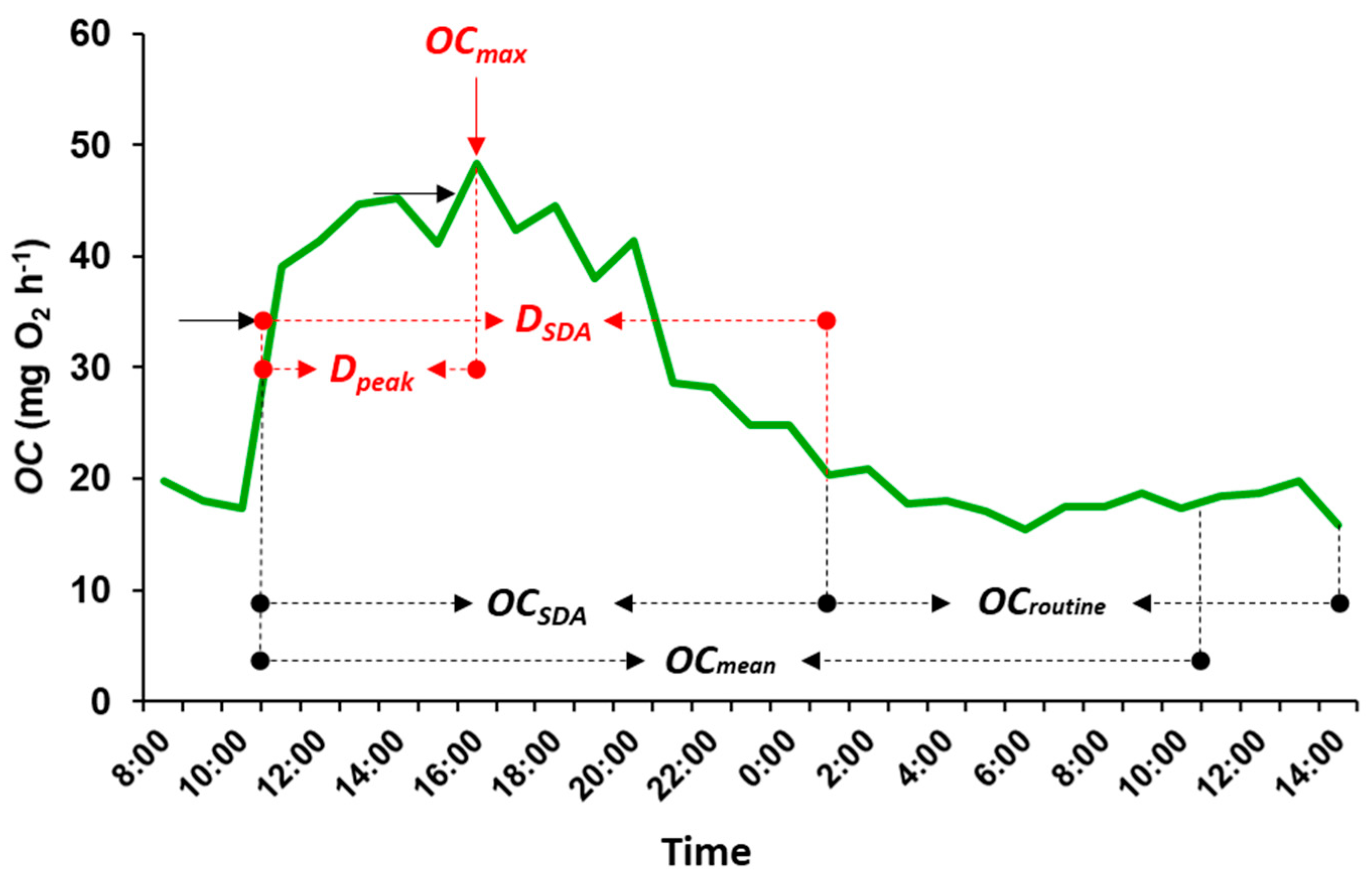
Three experimental setups were used depending on the size of the fish, as explained in Supplementary Materials (Method S1). In any case, OC is expressed as mg O2 h−1 based on the number of fish in each tank. After each trial, all fish were weighed again, and the mean weight was recorded. OC was plotted over time for each trial (63 in total). Figure 1 shows how OC measurements were partitioned over time to define data analysis and the variables to be considered:
  • Mean daily OC (OCmean): mean OC over 24 h, including feeding periods (from 11:00 on the first day until 11:00 on the second day), in mg O2 h−1.
  • Postprandial OC (OCSDA): frequently referred to as the specific dynamic action (SDA; [34] and references therein), it is the OC related to feeding calculated as the mean value of the OC values from the time the first feed is given until the routine level is reached, in mg O2 h−1.
  • Routine OC (OCroutine): mean OC excluding OCSDA. It is equivalent to standard metabolism and spontaneous activity, in mg O2 h−1.
  • Maximum OC (OCmax): maximum OC peak, usually during feeding time, in mg O2 h−1.
  • Metabolic scope due to feeding (MSF): relationship between OCmax and OCroutine.
  • Duration of OCSDA in hours (DSDA).
  • Time from the first feeding until OCmax is reached (Dpeak), in h.

2.2.2. Ventilatory Frequency Trials

The aim of these trials is to understand how OC and ventilatory frequency (VF) are influenced by a progressive decrease in available DO, as well as the effect of T. The results will enable us to determine the critical oxygen saturation values that cause changes in CO and VF according to temperature. Trials were conducted according to experimental configuration 2 described in Method S1. Fish with a mean Bw of 100 g remained in the experimental tanks for at least 2 weeks to acclimatise prior the experiments and were starved for 24 h before the trials started. The trial procedure was adapted from that in Cerezo-Valverde et al. [23] and is described in Method S2. Trials were conducted at three different temperatures: 14 °C (5 fish per tank), 18 °C (3 fish per tank), and 22 °C (3 fish per tank).
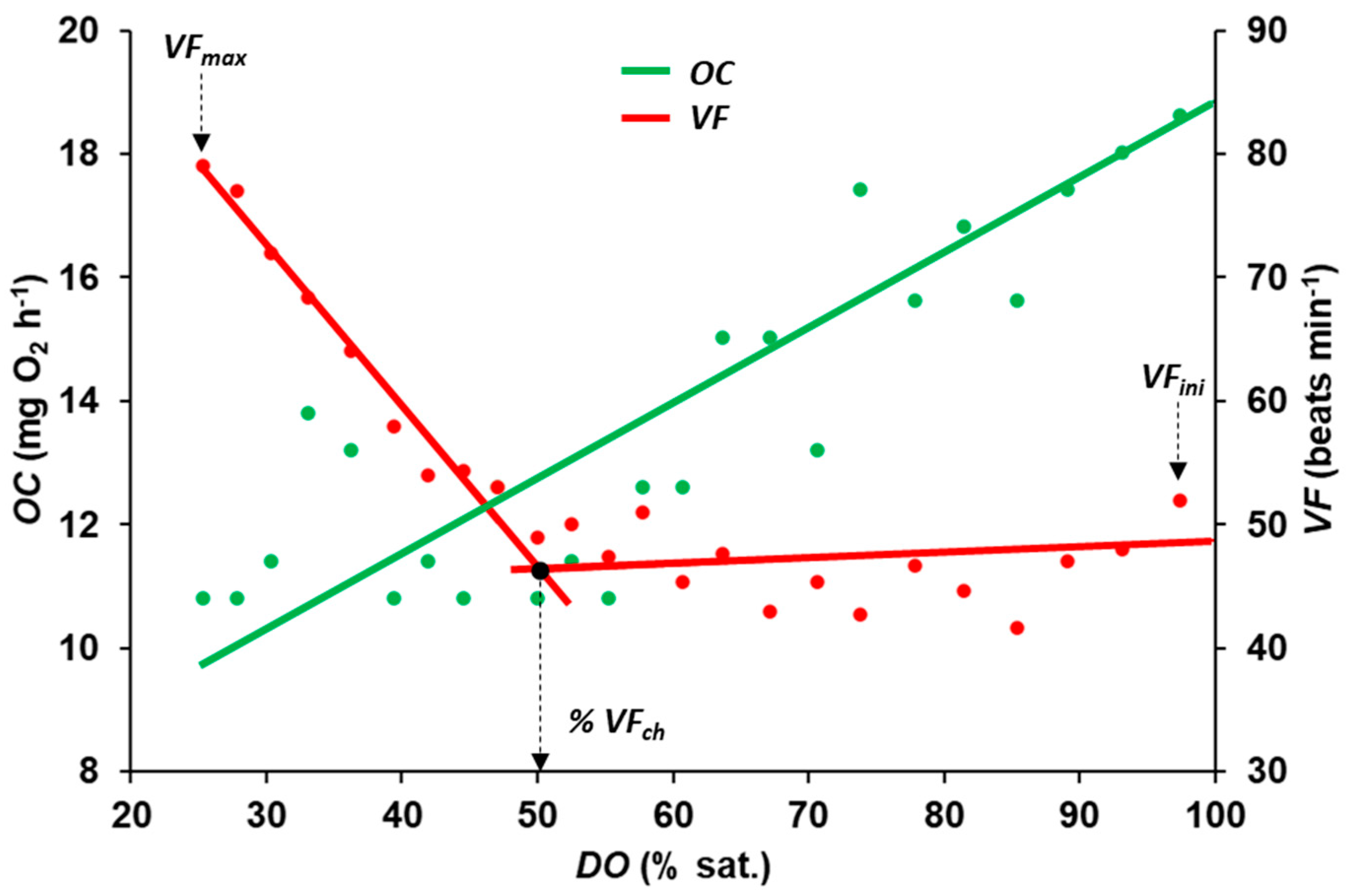
The following variables (Figure 2) were analysed according to Cerezo-Valverde and García-García [17,35] and Cerezo-Valverde et al. [23]:
  • OC: as mentioned in Method S1 for experimental configuration 2.
  • Initial VF (VFini): initial ventilatory frequency at 100% oxygen saturation (normoxia).
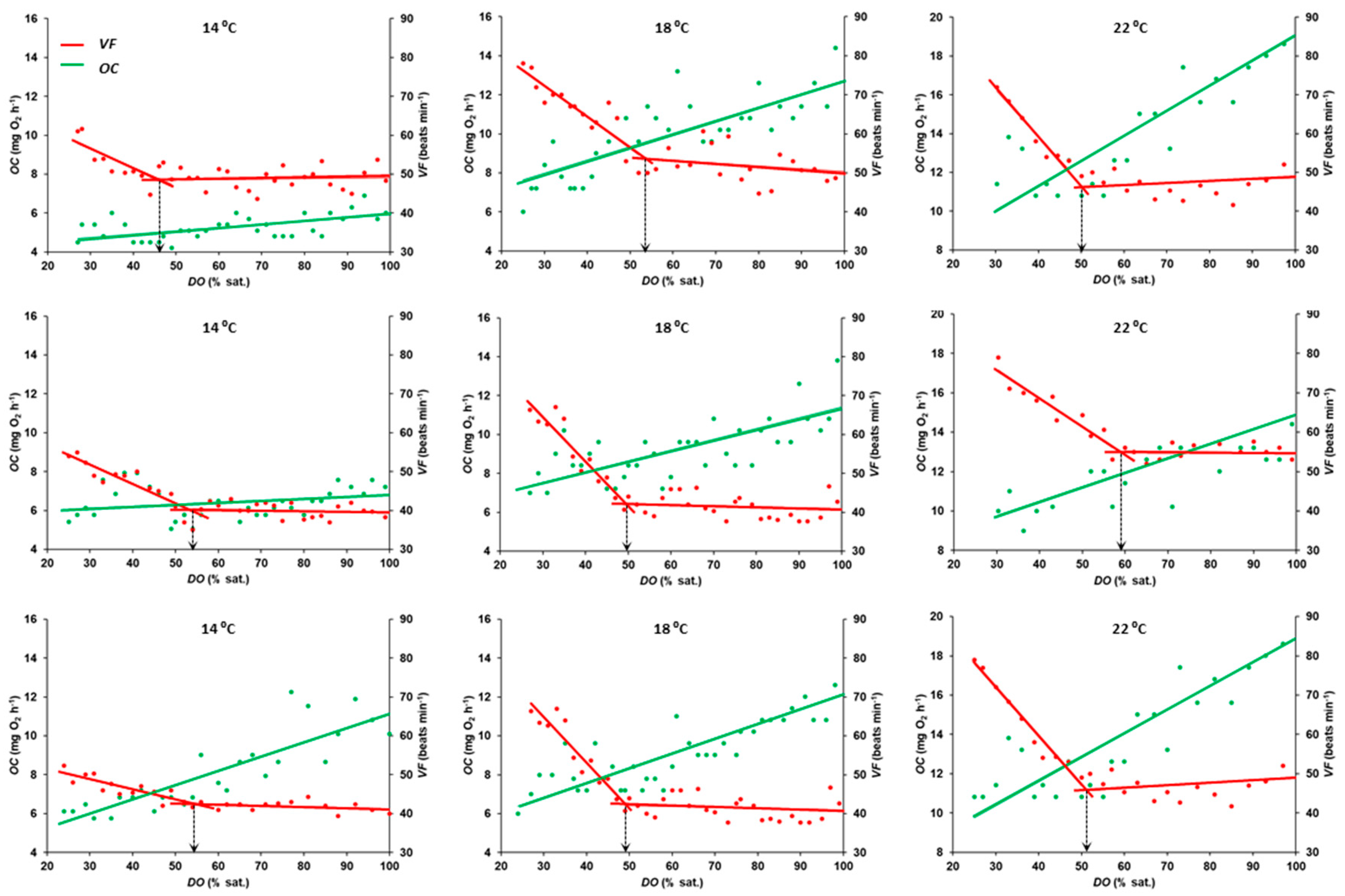
  • Critical DO threshold (%DOcrit): percentage of oxygen saturation at which a change in OC is identified. The determination of this value in each trial is based on the intersection of two regression lines, one in which the VF values were roughly constant and another in which they increased.
  • Maximum ventilatory frequency (VFmax) reached by a specimen.
  • DO (% sat.) threshold that triggers a change in VF (%VFch): intersection of the regression lines in which the VF values that remain constant meet those showing an increase.

2.3. Statistical Analysis

2.3.1. Oxygen Consumption Trials

To assess the influence of the independent variables (Bw and T) on DSDA and Dpeak, partial correlation coefficients were calculated. Partial correlation coefficients for OCmean, OCSDA, OCroutine, OCmax, and MSF and independent variables were also launched as a first step to establish the significant independent variables to be included in a regression analysis. Next, a multiple regression analysis was performed to understand the relationship between the dependent variables and the significant independent ones to estimate the former as a function of the latter. The OC data were fitted by multiple regression to Liao’s reference model [36]:
LnOC = Ln a + b ∙ Ln T + c ∙ Ln Bw,
where Ln means natural logarithm, Bw and T are mean body weight and temperature, respectively, and a, b, and c are the parameters in the equation. The natural log was added to or removed from the variables to find the best fit. The significance of the models was determined using analysis of variance (ANOVA); the simple (R2) and adjusted coefficient of determination (R2 adj.), as well as the standard error of the estimates (SEE) were calculated. Only models with the highest explained variability are shown.

2.3.2. Ventilatory Frequency Trials

Similar to the statistical approach used for OC trials (Section 2.3.1), partial correlation coefficients were calculated between OC and DO saturation and T as independent variables and between T and VFini, %DOcrit, VFmax, and %VFch. Next, a simple or multiple regression analysis was performed on the variables that showed significant correlation. The natural log was added to or removed from the variables to find the best fit. Significance of the models was determined using ANOVA; R2 or R2 adj. and SEE were calculated. Only models with the highest explained variability are shown.
All statistical analysis were performed with SPSS v26.

2.3.3. Simulations

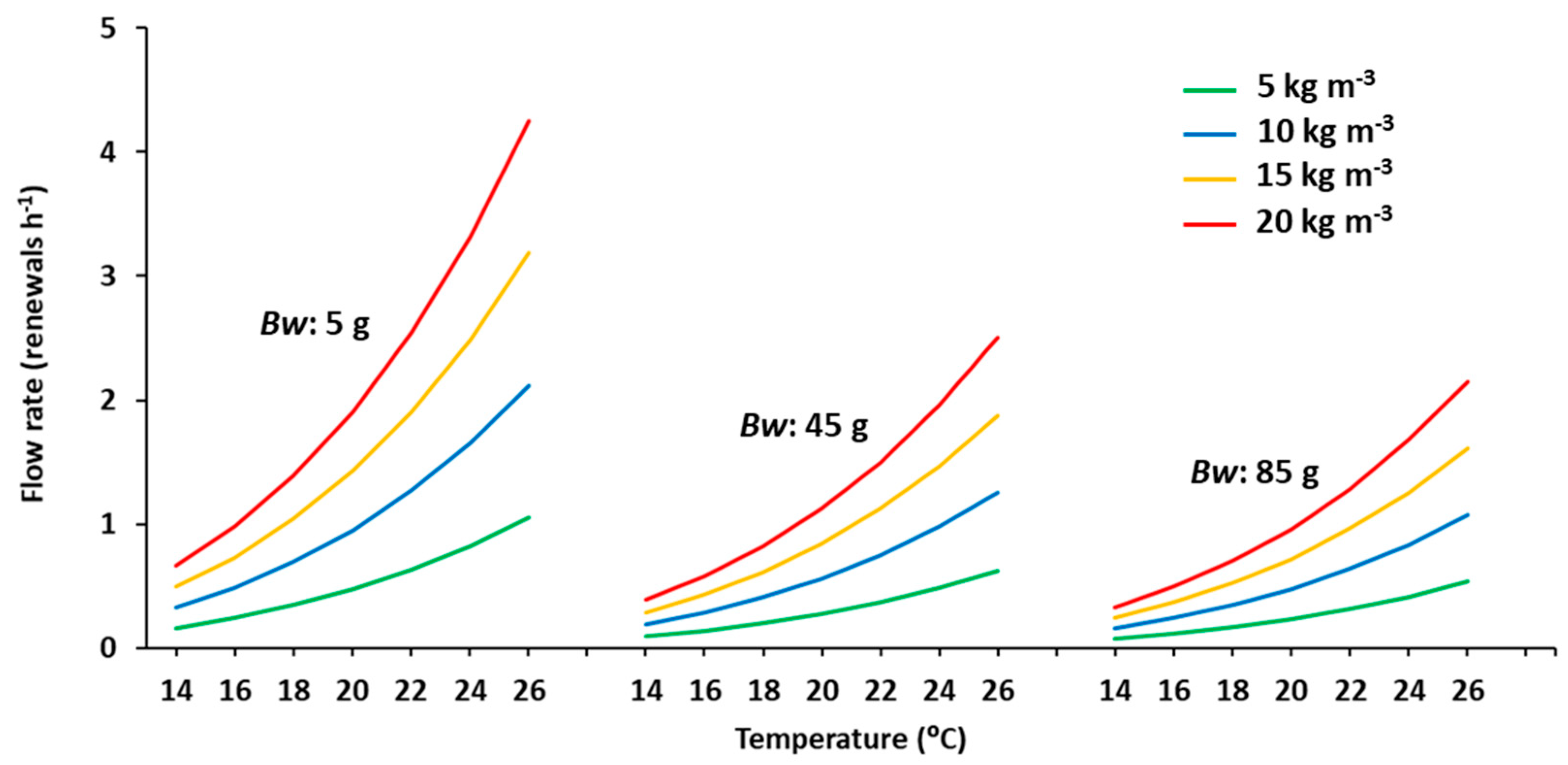
Simulations were performed using equations obtained through simple or multiple regression analysis to better understand the effect of independent variables on dependent ones. Similarly, to demonstrate the effectiveness of OC models in C. labrosus farming, simulations were performed to determine the necessary water flow rate (renewals per hour) within the studied Bw and T ranges for various rearing densities using the OCmean model. Simulations assumed the DO in the incoming water to be 100% and the DO at the outlet to be 60%.

3. Results

3.1. Oxygen Consumption Trials

The OCmean, OCSDA, OCroutine, OCmax, MSF, DSDA, and Dpeak data obtained in all trials are summarised in Table S1 (Supplementary Material) together with the mean Bw and T values corresponding to each trial. Figure 1 is representative of the OC results of all the experimental configurations, as well as Bw and T ranges, and helps us to explain the development of the trials in general. It shows an increase in OC just after the first feeding event maintained or even increased (OCmax) after the second feeding event and then gradually decreased (OCSDA) until reaching a value maintained over time until the end of the trial, which corresponds to OCroutine. This pattern is consistent across all 63 trials conducted. In all trials, as expected, the OCSDA was between 1.5 and 2.1 times higher than the OCroutine. Likewise, OCmax was 1.9–2.7 times higher than OCroutine.
A significant correlation was obtained for Bw with OCmean, OCSDA, OCroutine, and OCmax and for T with all dependent variables (Table 1). MSF values relating to OCmax/OCroutine ranged from 1.18 to 4.03, increasing as Bw and/or T increased. DSDA (8–21 h) and Dpeak (1–11 h) values were also greater the higher the Bw and/or T became. In other words, in smaller fish and/or at lower temperatures, the duration of DSDA is shorter and Dpeak is reached earlier, returning to routine mode sooner.
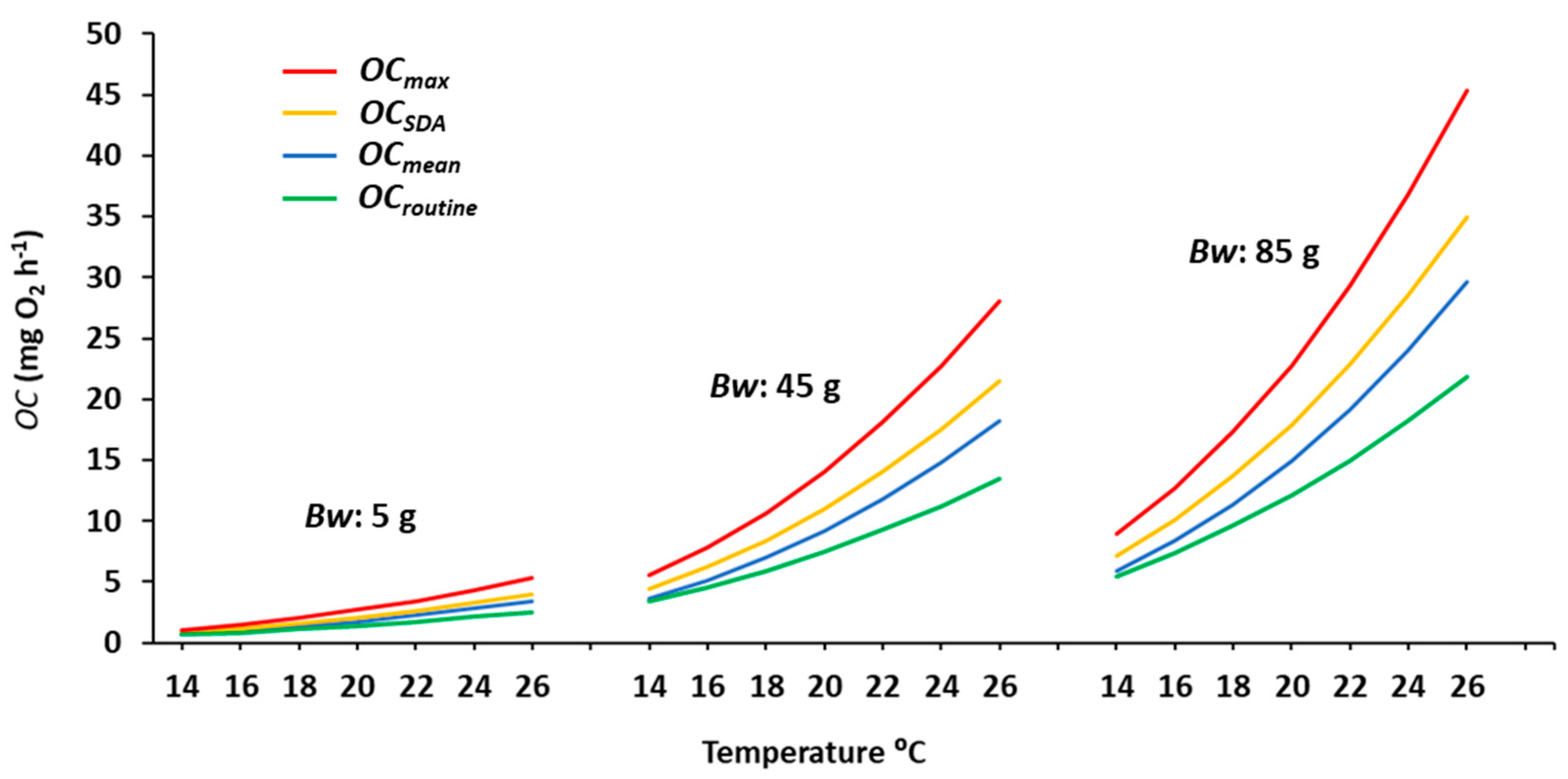
The equations obtained through multiple regression analysis (Table 2) show that OCmean, OCSDA, OCroutine, and OCmax tend to increase as T and Bw increase. Simulations performed using the resulting equations show this relation between dependent and independent variables (Figure 3). Overall, as expected, OCmean was always between OCSDA and OCroutine, with OCmax being higher than the other OC levels. Simulations revealed that OCmean, OCSDA, and OCmax increase progressively as the temperature rises, reaching values around five times higher at 26 °C than at 14 °C and four times higher in the case of OCroutine. Similarly, as Bw increases, OCmean, OCSDA, OCroutine, and OCmax increase, reaching values in fish weighing 85 g around 8.5 times higher than those in fish weighing 5 g.
Ln OCmean = −8.496 + 2.611 ∙ Ln T + 0.760 ∙ Ln Bw
Ln OCSDA = −8.187 + 2.561 ∙ Ln T + 0.765 ∙ Ln Bw
Ln OCroutine = −7.599 + 2.239 ∙ Ln T + 0.762 ∙ Ln Bw
Ln OCmax = −8.106 + 2.628 ∙ Ln T + 0.756 ∙ Ln Bw
Table 2. Results of multiple regression analysis for OCmean, OCSDA, OCroutine, and OCmax with Bw and T as independent variables. Only the results of the equations that provided the best fit for each of the dependent variables are shown. (a–c: coefficients; SEE: standard error of estimation; ***: p < 0.001).
Dep. Var.abcRANOVA
SEESEESEER2 adj.F
p-Valuep-Valuep-ValueSEEp-Value
Equation (1): OCmean−8.496
0.379
***
2.611
0.119
***
0.760
0.024
***
0.977
0.953
0.183

624.481
***
Equation (2): OCSDA−8.187
0.490
***
2.561
0.154
***
0.765
0.032
***
0.962
0.923
0.237

371.657
***
Equation (3): OCroutine−7.599
0.320
***
2.239
0.101
***
0.762
0.021
***
0.982
0.963
0.155

810.238
***
Equation (4): OCmax−8.106
0.584
***
2.628
0.184
***
0.756
0.038
***
0.947
0.893
0.283
260.997
***
Figure 3. Simulations of OCmean, OCSDA, OCroutine, and OCmax performed using the corresponding equations (Equations (1)–(4); Table 3) for the T range studied and for three Bw within the range studied.
Fishes 11 00128 g003
Table 3. Partial correlation coefficients obtained between DO saturation and T as independent variables and OC, and between T and % DOcrit, VFmax and %VFch. (**: p < 0.01; n.s.: non-significant).
OC%DOcritVFiniVFmax%VFch
T0.754 **0.57 n.s.0.92 **0.23 n.s.
DO (% sat.)0.393 **
The simulation performed with the OCmean model (Equation (1)) to estimate the renewal flow rate required for the cultivation of C. labrosus juveniles at different temperatures and rearing densities (Figure 4) reveals flow rates higher the lower the Bw gets (the number of specimens for the same density is higher the smaller the specimens) and the higher the T gets. Thus, if a flow rate < 2 renewals h−1 is to be maintained and T maximised, for specimens with Bw = 5 g, a density of 10 kg m−3 should not be exceeded, while for specimens with Bw = 45 g, a density of up to 15 kg m−3 could be reached. For specimens with Bw = 85 g, a density of even almost 20 kg m−3 could be reached without compromising the oxygenation of the rearing environment.

3.2. Ventilatory Frequency Trials

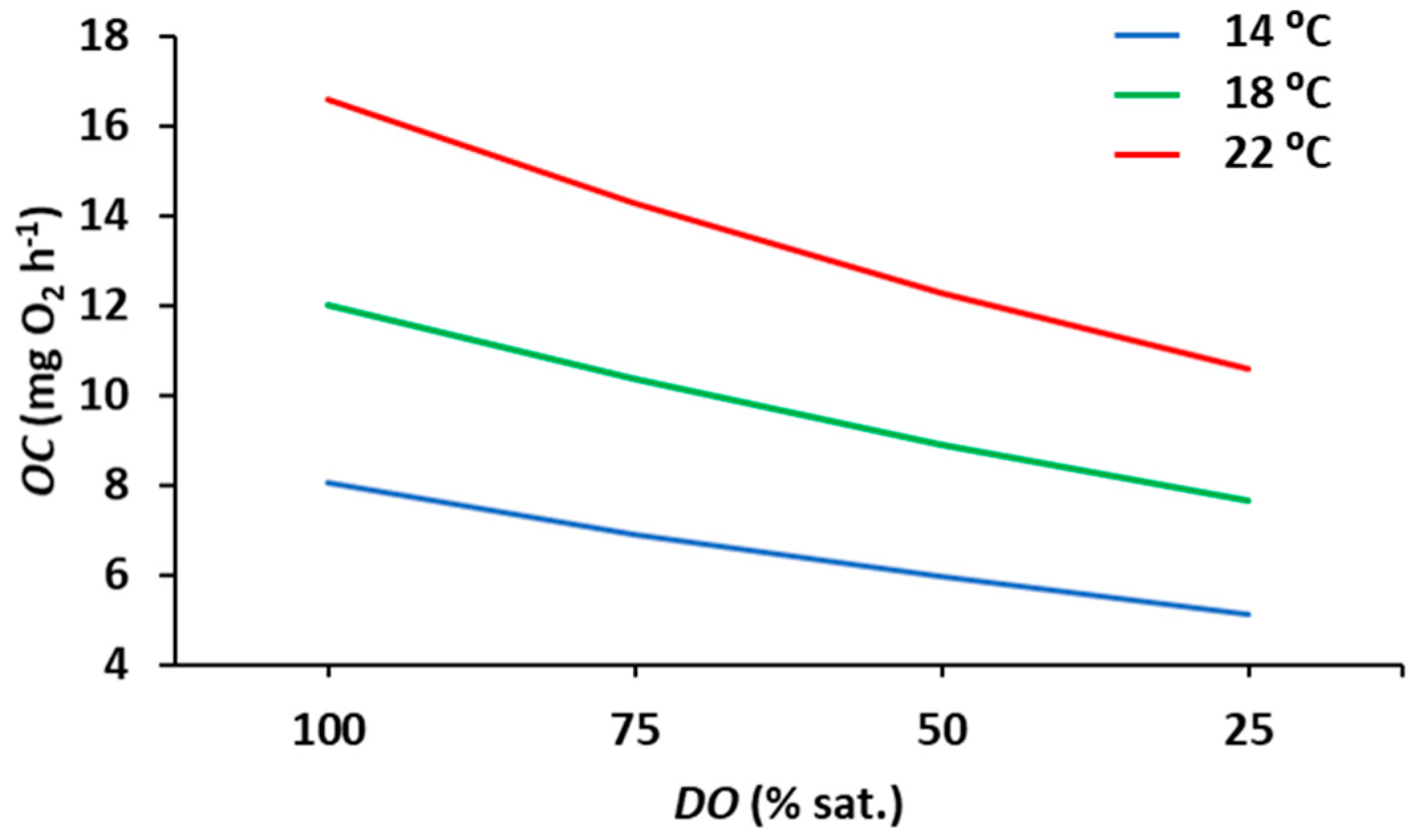
Results of OC and VF are summarised in Table S2 (Supplementary Material). A consistent pattern was observed in all these trials, consisting in a reduction in OC as DO decreases (Figure 5). Consequently, no % OScrit values were observed, suggesting that C. labrosus behaved as a conformer organism. The OC results in this trial and the partial correlation test (Table 3) confirmed the results of the previous trial, i.e., that OC significantly increases as T increases, and that OC decreases as DO (% sat.) decreases. Multiple regression analysis provided Equation (5) (Table 4), which allows the OC to be estimated based on DO (% sat.) and T for specimens with Bw = 100 g. Simulation performed with Equation (5) confirmed the pattern mentioned above (Figure 6). Furthermore, under normoxic conditions (90–100% saturation), the OC values at the temperatures tested in this trial (7.75, 12.35, and 16.98 mg O2 h−1 at 14, 18, and 22 °C, respectively) were very similar to the OCroutine values estimated with the model developed in the previous trial for fish weighing 100 g (6.16, 10.82, and 16.96 mg O2 h−1 at 14, 18, and 22 °C, respectively).
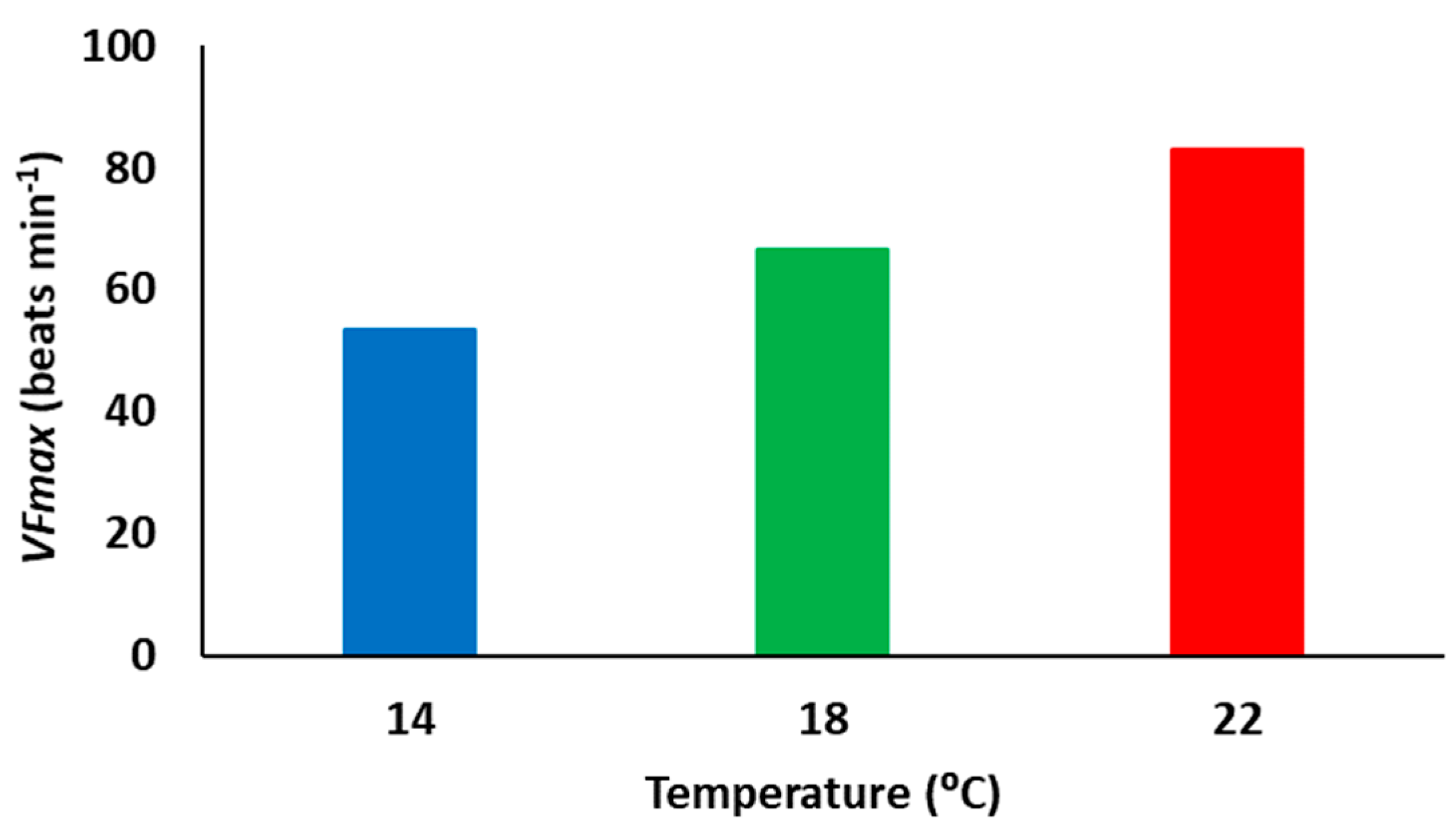
The partial correlation test (Table 3) revealed that only VFmax was significantly and positively correlated to T. This means that the higher the T, the higher the VFmax, which, under our experimental conditions, was reached at the lowest DO achieved, around 25–30%. At the beginning of the trials under normoxic conditions, VFini was around 50 beats min−1 in the bulk of trials, regardless T. VF remained roughly constant over the course of the trials until DO dropped to around 50% (Figure 5), with no significant effect of T on this variable (Table 4). From this critical level (VFch ≈ 50%), VF increased until it reached VFmax at the end of the test (Figure 5). VFmax can be estimated for individuals with Bw = 99.5 g as a function of T with Equation (6) (Table 4). The simulation performed with Equation (6) showed that the abovementioned relationship between VFmax and T (Figure 7) for individuals with Bw = 99.5 g: VFmax was 1.25 and 1.55 times greater at 18 °C and 22 °C than at 14 °C, respectively
Ln OC = −2.745 + 1.603 ∙ Ln T + 0.006 ∙ DO (% sat.)
Ln VFmax = 3.211 + 2.611 ∙ T

4. Discussion

In many freshwater, brackish, and marine fish, Bw and T represent key factors in determining OC [15,17,37,38,39,40,41], and this is also true for Chelon labrosus. The OC models obtained in the present study provide insight into the impact of these variables on the development of C. labrosus juveniles, thus enabling their different OC levels to be predicted. This provides valuable resources for the production management of the species under aquaculture conditions. The analysis of the ventilatory behaviour suggests a conformer performance of C. labrosus juveniles in terms of OC under conditions of progressive hypoxia. This controversial aspect will be discussed further on.
In the present work, the Bw coefficient for the different OC levels considered ranges between 0.75 and 0.77, which lies in the middle of the range observed in many fish species [8,11,42] (0.40–1.30). The values obtained for this coefficient by García-García [43] for gilthead seabream (Sparus aurata) and García-García et al. [44] for sharpsnout seabream (Diplodus puntazzo) were slightly lower than those in the present study. The latter authors suggested that a higher Bw coefficient is related to a higher metabolic rate, meaning that C. labrosus would show higher energy expenditure than that for those species.
While the effect of Bw on OC is related to the developmental stage and overall metabolism, the effect of T is related to the modulation of physiological processes and behaviour [6,18], covering processes from a cellular to an ecological scale from single-celled organisms, plants, and ectothermic and endothermic animals without distinction [45,46]. It has been widely documented in fish that an increase in temperature within tolerance ranges is associated with a boost in metabolic rate, feed intake, growth, and consequently OC [19,34,47,48,49,50,51,52]. The present study shows how an increase in T significantly delays the appearance of Dpeak after feeding and extends the duration of the effect of feeding on metabolism (DSDA). However, Guinea and Fernández [49] did not find a significant relationship between these variables in Chelon saliens (syn. Mugil saliens), a species related to C. labrosus, despite a tendency to increase with T. Nevertheless, these authors did observe a tendency for the maximum peak of OC to take longer to appear with the increase in T. Both studies, as well as the one by Niklitschek and Secor [53], showed feeding as the main cause of variation in OC throughout the day, or at least it proved to be important enough to mask any other daily rhythm.
The models developed here demonstrate the usefulness of these tools for managing aquaculture facilities by allowing water flow rates to be adjusted to environmental and husbandry conditions. The simulations performed in the present work revealed that, for C. labrosus juveniles, the lower their Bw, the higher the water flow renewal rates were needed to rise T if the stocking density increased. In flow-through aquaculture, water oxygenation mostly occurs with the inflow of new water, while in RASs, this occurs through water surface aeration, renewal with external water or liquid oxygen injection. Therefore, OC modelling is particularly important under RAS conditions, especially considering that these production systems conceptually tend to minimise the renewal rate. This means that a thorough monitoring of DO levels in RASs at all times is essential to ensure the welfare of the organisms being cultivated and to maximise production efficiency [54]. The current trend is to incorporate modelling into automated systems to control various variables relevant to cultivation in RAS, such as T, pH, and DO [55]. In this regard, the equations obtained in the present study are particularly useful for the cultivation of C. labrosus in RASs.
The most noteworthy, albeit controversial, finding of this study regarding the OC and VF trials is that C. labrosus juveniles showed a progressive decrease in OC as DO decreased, which is consistent with conformer behaviour in response to progressive hypoxia. This is quite unusual, since the most common behaviour in fish subjected to hypoxia is to maintain their metabolic rate up to a critical point, beyond which their metabolism slows down, i.e., they exhibit regulatory behaviour [27,30,56]. Steffensen [27] indicates water stratification and the resulting accumulation of metabolites (CO2, NH4+), spontaneous activity, and stress to be the key factors that can influence the results of respirometry experiments in closed systems such as the one used in our study. To minimise potential sources of error under our experimental conditions, we took several steps, such as to provide an acclimatisation period long enough for full adaptation (until normal feeding) to be achieved, to install complete visual isolation in the respirometer walls to avoid external sources of stress that could cause sudden activity, and to incorporate a pump/filter into each respirometer to prevent stratification and remove ions. However, this filter is not capable of removing the CO2 released into the environment, which could interfere with the determination of OC. Nevertheless, CO2 can begin to interfere with oxygen uptake only when hypoxia becomes severe [57], something that did not happen in our trials (only could have occurred at the end of some trial in the worst-case scenario).
In an oxyconformer fish such as sturgeon (Acipenser transmontanus), Burggren and Randall [58] observed that VF also decreased as DO and OC decreased, which is consistent with their adaptive mechanism, namely simply reducing the metabolic rate instead of entering anaerobic metabolism (as occurs in oxyregulator fish). Conversely, in our study, C. labrosus exhibited a ventilatory behaviour common to other oxyregulator fish, consisting in maintaining a constant VF until DO fell below ≈50% saturation (%VFch), at which point it increased until reaching a maximum at the end of the trials. In Diplodus puntazzo and Dentex dentex, both species coexisting with C. labrosus, %VFch is noticeably higher (66.5 and 64.7%, respectively) [17,23], which would indicate that C. labrosus is better adapted to inhabit hypoxic environments. In any case, oxyconformer behaviour is uncommon and is often determined by the masking of species-specific behaviours. This is the case of the Adriatic sturgeon (Acipenser naccarii), which behaves as an oxyconformer in static conditions but also as an oxyregulator when allowed to swim at a low sustained speed [59]. Mullets in general, and C. labrosus in particular, inhabit estuarine and lagoon environments prone to hypoxia events, and, throughout their evolution, they have developed adaptations such as aquatic surface respiration (ASR) [60,61]. Under our experimental conditions, C. labrosus juveniles were unable to display this behaviour in response to gradual hypoxia, as the floating plastic sheet placed on the surface of the respirometers to prevent gas exchange with the atmosphere prevented them from doing so. This impediment may have led to atypical behaviour, with C. labrosus acting as an oxyregulator in circumstances under which it can deploy its full range of mechanisms against hypoxia, similar to the case of the Adriatic sturgeon mentioned above.
Oxyconformer fish adjust their consumption and metabolism to the oxygen available in water rather than keeping it constant like oxyregulators do. This behaviour offers advantages, such as energy savings in cases of hypoxia, but also disadvantages, as it prevents the fish from maintaining a normal growth rate under these conditions [62]. Although the present study is far from being the first case in which rigorous experimentation has demonstrated oxyconformer behaviour, previous research into this aspect has revealed findings that highlight the ability to regulate OC under particular circumstances [27]. This opens the door to further research in this area with species such as C. labrosus.

5. Conclusions

As with so many fish species, the different OC levels (daily average, maximum, postprandial, and routine) in juvenile Chelon labrosus can be predicted based on their Bw and T. The models developed also allow the water renewal flow requirements to be determined based on fish density, their Bw, and T. These tools are very useful for managing the farming conditions of this species, particularly in RASs. Under conditions of gradual hypoxia, C. labrosus showed consistent oxyconformer behaviour with respect to DO, although the ventilatory behaviour displayed corresponds to an oxyregulator response. As has been demonstrated in other species such as the Adriatic sturgeon, C. labrosus may have behaved as an oxyconformer because it was unable to display normal behaviour; in the case of C. labrosus this may have occurred due to its ASR capacity, but this is more of a hypothesis than a conclusion.

Supplementary Materials

The following supporting information can be downloaded at: https://www.mdpi.com/article/10.3390/fishes11030128/s1, Method S1: Experimental tanks and procedures for Oxygen Consumption (OC) trials; Method S2: Description of experimental procedures for OC and VF measurements under progressive hypoxia; Table S1: Summary of the results of the OC trials showing the values of the independent variables (Bw and T) and the data obtained for the dependent variables (OCmean, OCSDA, OCroutine, and OCmax; MSF, DSDA, and Dpeak).; Table S2: Summary of the results of the OC and VF trials under gradual hypoxia.

Author Contributions

Conceptualization, F.A.-G. and D.S.; methodology, F.A.-G.; software, J.P.; validation, F.A.-G. and D.S.; formal analysis, F.A.-G. and D.S.; investigation, D.S., J.L., J.P., and M.d.l.Á.E.; resources, F.A.-G.; data curation, F.A.-G.; writing—original draft preparation, F.A.-G., D.S., and M.d.l.Á.E.; writing—review and editing, F.A.-G. and D.S.; visualisation, F.A.-G. and D.S.; supervision, F.A.-G.; project administration, F.A.-G.; funding acquisition, F.A.-G. All authors have read and agreed to the published version of the manuscript.

Funding

This research was funded by the Spanish Ministry of Science, Innovation and Universities of the Government of Spain with European Union NextGenerationEU funds and by the Government of Cantabria (Spain) through the Marine Sciences Programme ThinkInAzul (PRTR-C17.I1).

Institutional Review Board Statement

The fish were always handled (routine management and experimentation) according to the Guidelines of the European Union (2010/63/UE) and the Spanish legislation (RD 53/2013) for the use of laboratory animals. Moreover, all people involved in the experiments had the required FELASA accreditations for each procedure (ECC556/2015, approval date: 24 July 2024). The project was evaluated by official ethics committee with a favourable report, report number NTS-ES-285239.

Data Availability Statement

The original contributions presented in this study are included in the article/Supplementary Material. Further inquiries can be directed to the corresponding author.

Acknowledgments

The authors thank the staff of “El Bocal” aquaculture facilities for their technical assistance and the administrative staff of the COST-IEO/CSIC. We would also like to thank the reviewers for their comments and suggestions, which have made this work better and more understandable for the reader.

Conflicts of Interest

The authors declare no conflicts of interest.

Abbreviations

The following abbreviations are used in this manuscript:
OCoxygen consumption
Bwbody weight
Ttemperature
VFventilatory frequency
SDAspecific dynamic action
RASrecirculating aquaculture system
Wwild fish
F1fish from breeding
DOdissolved oxygen
OCmeanmean daily OC
OCSDApostprandial OC
OCroutineroutine OC
OCmaxmaximum OC
MSFmetabolic scope due to feeding
DSDAduration of OCSDA
Dpeaktime from the first feeding until OCmax is reached
VFiniinitial VF
%DOcritcritical DO threshold
VFmaxmaximum VF
%VFchDO that triggers a change in VF
Lnnatural logarithm
ANOVAanalysis of variance
R2simple coefficient of determination
R2 adj.adjusted coefficient of determination
SEEstandard error of estimate

References

  1. Lebreton, B.; Richard, P.; Parlier, E.P.; Guillou, G.; Blanchard, G.F. Trophic ecology of mullets during their spring migration in an European saltmarsh: A stable isotope study. Estuar. Coast. Shelf Sci. 2011, 91, 502–510. [Google Scholar] [CrossRef]
  2. Crosetti, D. Current state of grey mullet fisheries and culture. In Biology, Ecology and Culture of Grey Mullet (Mugilidae); Crosetti, D., Blaber, S., Eds.; CRC Press: Boca Ratón, FL, USA, 2016; pp. 398–450. [Google Scholar]
  3. Hotos, G.N.; Vlahos, N. Salinity tolerance of Mugil cephalus and Chelon labrosus (Pisces: Mugilidae) fry in experimental conditions. Aquaculture 1998, 167, 329–338. [Google Scholar] [CrossRef]
  4. Murgia, R.; Tola, G.; Archer, S.N.; Vallerga, S.; Hirano, J. Genetic identification of grey mullet species (Mugilidae) by analysis of mitochondrial DNA sequence: Application to identify the origin of processed ovary products (bottarga). Mar. Biotechnol. 2002, 4, 119–126. [Google Scholar] [CrossRef]
  5. European Commission. Strategic Guidelines for a More Sustainable and Competitive EU Aquaculture for the Period 2021 to 2030. 2021. Available online: https://eur-lex.europa.eu/resource.html?uri=cellar:bab1f9a7-b30b-11eb-8aca-01aa75ed71a1.0022.02/DOC_1&format=PDF (accessed on 18 February 2026).
  6. Jobling, M. Fish Bioenergetics, 1st ed.; Chapman & Hall: London, UK, 1994; 309p. [Google Scholar]
  7. Farrel, A.P.; Richards, J.G. Defining hypoxia: An integrative synthesis of the responses of fish to hypoxia. Fish Physiol. 2009, 27, 487–503. [Google Scholar] [CrossRef]
  8. Clarke, A.; Johnston, N.M. Scaling of metabolic rate with body mass and temperature in teleost fish. J. Anim. Ecol. 1999, 68, 893–905. [Google Scholar] [CrossRef]
  9. Beamish, F.W.H. Respiration of fishes with special emphasis on standard oxygen consumption. II. Influence of weight and temperature on respiration of several species. Can. J. Zool. 1964, 42, 177–188. [Google Scholar] [CrossRef]
  10. Beamish, F.W.H.; Mookherjii, P.S. Respiration of fishes with special emphasis on standard oxygen consumption. I. Influence of weight and temperature on respiration of goldfish, Carassius auratus L. Can. J. Zool. 1964, 42, 161–175. [Google Scholar] [CrossRef]
  11. Killen, S.S.; Atkinson, D.; Glazier, D.S. The intraspecific scaling of metabolic rate with body mass in fishes depends on lifestyle and temperature. Ecol. Lett. 2010, 13, 184–193. [Google Scholar] [CrossRef]
  12. Luo, Y.P.; Wang, Q.Q. Effects of body mass and temperature on routine metabolic rate of juvenile largemouth bronze gudgeon Coreius guichenoti. J. Fish Biol. 2012, 80, 842–851. [Google Scholar] [CrossRef] [PubMed]
  13. Patterson, J.T.; Mims, S.D.; Wright, R.A. Effects of body mass and water temperature on routine metabolism of American paddlefish Polyodon spathula. J. Fish Biol. 2013, 82, 1269–1280. [Google Scholar] [CrossRef]
  14. Volkoff, H.; Rønnestad, I. Effects of temperature on feeding and digestive processes. J. Exp. Mar. Biol. Ecol. 2020, 529, 151377. [Google Scholar] [CrossRef]
  15. Brett, J.R.; Groves, T.D.D. Physiological energetics. In Fish Physiology; Hoar, W.S., Randall, D.J., Brett, J.R., Eds.; Academic Press: New York, NY, USA, 1979; Volume 8, pp. 279–352. [Google Scholar]
  16. Fidhiany, L.; Winckler, K. Influence of body mass, age, and maturation on specific oxygen consumption in a freshwater cichlid fish, Cichlasoma nigrofasciatum (Günther, 1869). Comp. Biochem. Physiol. 1998, 119A, 613–619. [Google Scholar] [CrossRef]
  17. Cerezo-Valverde, J.; García-García, B. The effects of oxygen levels on oxygen consumption, survival and ventilatory frequency of sharpsnout seabream (Diplodus puntazzo Gmelin, 1789) at different conditions of temperature and fish weight. J. Appl. Ichthyol. 2004, 20, 488–492. [Google Scholar] [CrossRef]
  18. Reyes, I.; Díaz, F.; Re, A.D.; Pérez, J. Behavioral thermoregulation, temperature tolerance and oxygen consumption in the Mexican bullseye puffer fish, Sphoeroides annulatus Jenyns (1842), acclimated to different temperatures. J. Therm. Biol. 2011, 36, 200–205. [Google Scholar] [CrossRef]
  19. Nerici, C.; Merino, G.; Silva, A. Effects of two temperatures on the oxygen consumption rates of Seriolella violacea (palm fish) juveniles under rearing conditions. Aquac. Eng. 2012, 48, 40–46. [Google Scholar] [CrossRef]
  20. Weatherley, A.H.; Gill, H.S. Tissues and Growth. In The Biology of Fish Growth; Weatherley, A.H., Gill, H.S., Eds.; St. Edmundsbury Press: London, UK, 1987; pp. 147–173. [Google Scholar]
  21. Rees, B.B.; Reemeyer, J.E.; Binning, S.A.; Brieske, S.D.; Clark, T.D.; De Bonville, J.; Eisenberg, R.M.; Raby, G.D.; Roche, D.; Rummer, J.L.; et al. Estimating maximum oxygen uptake of fishes during swimming and following exhaustive chase—Different results, biological bases and applications. J. Exp. Biol. 2024, 227, jeb246439. [Google Scholar] [CrossRef]
  22. de la Gándara, F.; García-Gómez, A.; Jover, M. Effect of feeding frequency on the daily oxygen consumption rhythms in young Mediterranean yellowtails (Seriola dumerili). Aquac. Eng. 2002, 26, 27–39. [Google Scholar] [CrossRef]
  23. Cerezo-Valverde, J.; Martínez, F.J.; García-García, B. Oxygen consumption and ventilatory frequency responses to gradual hypoxia in common dentex (Dentex dentex): Basis for suitable oxygen level estimations. Aquaculture 2006, 256, 542–551. [Google Scholar] [CrossRef]
  24. Castanheira, M.F.; Martins, C.I.M.; Engrola, S.; Conceição, L.E.C. Daily oxygen consumption rhythms of Senegalese sole (Solea senegalensis Kaup, 1858) juveniles. J. Exp. Mar. Biol. Ecol. 2011, 407, 1–5. [Google Scholar] [CrossRef]
  25. Wang, Z.; Pu, D.; Zheng, J.; Li, P.; Lü, H.; Wei, X.; Li, M.; Li, D.; Gao, L. Hypoxia-induced physiological responses in fish: From organism to tissue to molecular levels. Ecotoxicol. Environ. Saf. 2023, 267, 115609. [Google Scholar] [CrossRef]
  26. Taylor, E.W.; Leite, C.A.C.; McKenzie, D.J.; Wang, T. Control of respiration in fish, amphibians and reptiles. Braz. J. Med. Biol. Res. 2010, 43, 409–424. [Google Scholar] [CrossRef]
  27. Steffensen, J.F. Oxygen consumption of fish exposed to hypoxia: Are they all oxyregulators or are any oxyconformers? In Fish Physiology, Toxicology, and Water Quality; Proceedings of the Ninth International Symposium, Capri, Italy, 24–28 April 2006; Brauner, C.J., Suvajdzic, K., Nilsson, G., Randall, D., Eds.; EPA: Athens, GA, USA, 2006; pp. 239–250. [Google Scholar]
  28. Shelton, G. The regulation of breathing. In Fish Physiology; Hoar, W.S., Randall, D.J., Eds.; Academic Press Inc.: London, UK, 1979; Volume 8, pp. 293–359. [Google Scholar]
  29. Maxime, V.; Pichavant, K.; Boeuf, G.; Nonnote, G. Effects of hypoxia on respiratory physiology of turbot, Scophthalmus maximus. Fish Physiol. Biochem. 2000, 22, 51–53. [Google Scholar] [CrossRef]
  30. Svendsen, M.B.S.; Johansen, J.L.; Bushnell, P.G.; Skov, P.V.; Norin, T.; Domenici, P.; Steffensen, J.F.; Abe, A. Are all bony fishes oxygen regulators? Evidence for oxygen regulation in a putative oxygen conformer, the swamp eel Synbranchus marmoratus. J. Fish Biol. 2018, 94, 178–182. [Google Scholar] [CrossRef]
  31. Directive 2010/63/EU; On the Protection of Animals Used for Scientific Purposes. European Union: Brussels, Belgium, 2010.
  32. Royal Decree 53/2013; Basic Regulations for the Protection of Animals Used in Experimentation and Other Scientific Purposes. Ministry of the Presidency: Madrid, Spain, 2013.
  33. ECC 556/2015; FELASA Recommendations for the Education and Training of Laboratory Animal Science Professionals. Federation of European Laboratory Animal Science Associations (FELASA): Brussels, Belgium, 2015.
  34. Goodrich, H.R.; Wood, C.M.; Wilson, R.W.; Clark, T.D.; Last, K.B.; Wang, T. Specific dynamic action: The energy cost of digestion or growth? J. Exp. Biol. 2024, 227, jeb246722. [Google Scholar] [CrossRef]
  35. Cerezo-Valverde, J.; García-García, B. Suitable dissolved oxygen levels for common octopus (Octopus vulgaris, Cuvier, 1797) at different weights and temperatures: Analysis of respiratory behaviour. Aquaculture 2005, 244, 303–314. [Google Scholar] [CrossRef]
  36. Liao, P.B. Water requirements of salmonids. Prog. Fish-Cult. 1971, 33, 210–215. [Google Scholar] [CrossRef]
  37. Brown, J.A.G.; Jones, A.; Matty, A.J. Oxygen metabolism of farmed turbot (Scophthalmus maximus). I. The influence of fish size and water temperature on metabolic rate. Aquaculture 1984, 36, 273–281. [Google Scholar] [CrossRef]
  38. Forsberg, O.I. Modelling oxygen consumption rates of postsmolt Atlantic salmon in commercial-scale, land-based farms. Aquac. Int. 1994, 2, 180–196. [Google Scholar] [CrossRef]
  39. Glencross, B.D.; Felsing, M. Influence of fish size and water temperature on the metabolic demand for oxygen by barramundi, Lates calcarifer (Bloch), in freshwater. Aquac. Res. 2006, 37, 1055–1062. [Google Scholar] [CrossRef]
  40. Tomalá, D.; Chavarría, J.; Ángeles, B. Evaluación de la tasa de consumo de oxígeno de Colossoma macropomum en relación al peso corporal y temperatura del agua. Lat. Am. J. Aquat. Res. 2014, 42, 971–979. [Google Scholar] [CrossRef]
  41. Prakoso, V.A.; Kim, K.T.; Ryu, J.H.; Min, B.H.; Chang, I.J. Oxygen consumption of Mugil cephalus on several temperatures under brackish water conditions. IOP Conf. Ser. Earth Environ. Sci. 2019, 278, 012060. [Google Scholar] [CrossRef]
  42. Jerde, C.L.; Kraskura, K.; Eliason, E.J.; Csik, S.R.; Stier, A.C.; Taper, M.L. Strong evidence for an intraspecific metabolic scaling coefficient near 0.89 in fish. Front. Physiol. 2019, 10, 1166. [Google Scholar] [CrossRef]
  43. García-García, B. Factors Influencing Oxygen Consumption, Feed Intake and Growth in Gilthead Seabream (Sparus aurata L.): An Approach to Establishing Linear Models. Ph.D. Thesis, University of Murcia, Murcia, Spain, 1994; 241p. [Google Scholar]
  44. García-García, B.; Egea, M.A.; Rueda, F.J.; Hernández, M.D.; Aguado-Giménez, F.; Faraco, F. Influencia del peso y la alimentación sobre el consumo de oxígeno en el sargo picudo (Diplodus puntazo, Gmelin 1789) en cultivo. Monogr. Inst. Canar. Cienc. Mar. 2001, 4, 35–83. [Google Scholar]
  45. Gillooly, J.F.; Brown, J.H.; West, G.B.; Savage, V.M.; Charnov, E.L. Effects of size and temperature on metabolic rate. Science 2001, 293, 2248–2251. [Google Scholar] [CrossRef] [PubMed]
  46. Arroyo, J.I.; Díez, B.; Kempes, C.P.; West, G.B.; Marquet, P.A. A general theory for temperature dependence in biology. Proc. Natl. Acad. Sci. USA 2022, 119, e2119872119. [Google Scholar] [CrossRef] [PubMed]
  47. Cerezo-Valverde, J.; García-García, B. Influence of body weight and temperature on post-prandial oxygen consumption of common octopus (Octopus vulgaris). Aquaculture 2004, 233, 599–613. [Google Scholar] [CrossRef]
  48. Requena, A.; Fernández-Borras, J.; Planas, J. The effects of a temperature rise on oxygen consumption and energy budget in gilthead sea bream. Aquac. Int. 1997, 5, 415–426. [Google Scholar] [CrossRef]
  49. Guinea, J.; Fernández, F. The effect of SDA, temperature and daily rhythm on the energy metabolism of the mullet Mugil saliens. Aquaculture 1991, 97, 353–364. [Google Scholar] [CrossRef]
  50. Remen, M.; Nederlof, M.A.J.; Folkedal, O.; Thorsheim, G.; Sitjà-Bobadilla, A.; Pérez-Sánchez, J.; Oppedal, F.; Olse, R.E. Effect of temperature on the metabolism, behaviour and oxygen requirements of Sparus aurata. Aquac. Environ. Interact. 2015, 7, 115–123. [Google Scholar] [CrossRef]
  51. Kir, M. Thermal tolerance and standard metabolic rate of juvenile gilthead seabream (Sparus aurata) acclimated to four temperatures. J. Therm. Biol. 2020, 93, 102739. [Google Scholar] [CrossRef]
  52. Liu, Y.; Liu, M.; Chen, J.; Jiang, D.; Hu, J.; Lin, Z. Effects of body weight, temperature, and daily time periods on oxygen consumption rate of juvenile silver pomfret (Pampus argenteus). Aquac. Res. 2025, 2025, 1513694. [Google Scholar] [CrossRef]
  53. Niklitschek, E.J.; Secor, D.H. Dissolved oxygen, temperature and salinity effects on the ecophysiology and survival of juvenile Atlantic sturgeon in estuarine waters: II. Model development and testing. J. Exp. Mar. Biol. Ecol. 2009, 381, S161–S172. [Google Scholar] [CrossRef]
  54. Chai, F.; Ge, Q.; Yin, Y.; Li, D.; Wang, Y. Modelling and control of dissolved oxygen in recirculating aquaculture systems: A circadian rhythm analysis approach and GSMPC controller. Comput. Electron. Agric. 2024, 227, 109515. [Google Scholar] [CrossRef]
  55. Reyes Yanes, A.; Martínez, P.; Ahmad, R. Towards automated aquaponics: A review on monitoring, IoT, and smart systems. J. Clean. Prod. 2020, 263, 121571. [Google Scholar] [CrossRef]
  56. Ultsch, G.R.; Jackson, D.C.; Moalli, R. Metabolic oxygen conformity among lower vertebrates: The toadfish revisited. J. Comp. Physiol. 1981, 142, 439–443. [Google Scholar] [CrossRef]
  57. Hamad, M.I.; Lamtane, H.A.; Munibi, R.N.; Skov, P.V. Individual and combined effects of hypoxia and hypercapnia on feeding and feed utilization in Nile tilapia (Oreochromis niloticus). Aquaculture 2023, 567, 739239. [Google Scholar] [CrossRef]
  58. Burggren, W.W.; Randall, D.J. Oxygen uptake and transport during hypoxic exposure in sturgeon Acipensser transmontanus. Respir. Physiol. 1978, 34, 171–183. [Google Scholar] [CrossRef]
  59. McKenzie, D.J.; Steffensen, J.F.; Korsmeyer, K.; Witheley, N.M.; Bronzi, P.; Taylor, E.W. Swimming alters responses to hypoxia in the Adriatic sturgeon Acipenser naccarii. J. Fish. Biol. 2007, 70, 651–658. [Google Scholar] [CrossRef]
  60. Dickson Hoese, H. Jumping mullet: The internal diving bell hypothesis. Environ. Biol. Fishes 1985, 13, 309–314. [Google Scholar] [CrossRef]
  61. Shingles, A.; McKenzie, D.J.; Claireaux, G.; Domenici, P. Reflex cardioventilatory responses to hypoxia in the flathead grey mullet (Mugil cephalus) and their behavioral modulation by perceived threat of predation and water turbidity. Physiol. Biochem. Zool. 2005, 78, 744–755. [Google Scholar] [CrossRef]
  62. Domenici, P.; Steffensen, J.F.; Marras, S. The effect of hypoxia on fish schooling. Philos. Trans. R. Soc. B 2017, 372, 20160236. [Google Scholar] [CrossRef] [PubMed]
Figure 1. Partitioning of OC measures over time to define the variables considered for data analysis. This graph shows the results of a trial for a batch of 14 individuals with a mean Bw of 56 g at a T of 26 °C. The rest of the trials yielded figures roughly similar to this one. Horizontal black arrows indicate feeding times (11:00 and 16:00).
Fishes 11 00128 g001
Figure 2. OC and VF recorded during a progressive decrease in oxygen saturation. This graph shows the results of a trial for a batch of 3 individuals with a mean Bw of 99.5 g at a T of 22 °C. Black arrows indicate de initial (VFini) and maximum (VFmax) ventilatory frequency recorded and the oxygen saturation at which VF increased (%VFch).
Fishes 11 00128 g002
Figure 4. Flow rate (renewals h−1) simulations for specimens with different Bw and at different T for different rearing densities using Equation (1) (OCmean).
Fishes 11 00128 g004
Figure 5. OC and VF recorded during a progressive decrease in oxygen saturation in all trials at 14 °C, 18 °C, and 22 °C. Black arrows indicate the intersection between the straight regression lines for constant and increasing VF values, indicating the DO (% sat.) at which the change in ventilatory behaviour occurred (%VFch).
Fishes 11 00128 g005
Figure 6. Simulation performed with Equation (5) for OC as a function of DO (% sat.) and T.
Fishes 11 00128 g006
Figure 7. Simulation performed with Equation (6) for VFmax as a function of T.
Fishes 11 00128 g007
Table 1. Partial correlation coefficients obtained between independent (Bw and T) and dependent variables (OCmean, OCSDA, OCroutine and OCmax; MSF, DSDA, and Dpeak). (*: p < 0.05; **: p < 0.01; n.s.: non-significant).
OCmeanOCSDAOCroutineOCmaxMSFDSDADpeak
Bw0.58 **0.58 **0.65 **0.55 **0.06 n.s.−0.10 n.s.−0.01 n.s.
T0.59 **0.57 **0.52 **0.58 **0.27 *0.71 **0.31 *
Table 4. Results of simple and multiple regression analysis for OC with T and DO (% sat.) as independent variables and for VFmax with T as independent variable. Only the results of the equations that provided the best fit for each of the dependent variables are shown (a–c: coefficients; SEE: standard error of estimation; **: p < 0.01; ***: p < 0.001).
Dep. Var.abcRANOVA
SEESEESEER2:R2 adj.F
p-Valuep-Valuep-ValueSEEp-Value
Equation (5): OC−2.745
0.177
***
1.603
0.061
***
0.006
0.001
***
0.867
0.751
0.179

419.467
***
Equation (6): VFmax3.211
0.191
***
0.055
0.011
***


0.919
0.845
0.088

27.329
**
Disclaimer/Publisher’s Note: The statements, opinions and data contained in all publications are solely those of the individual author(s) and contributor(s) and not of MDPI and/or the editor(s). MDPI and/or the editor(s) disclaim responsibility for any injury to people or property resulting from any ideas, methods, instructions or products referred to in the content.