


Abstract
We argue that turbulent irreversibility is best explained as an asymptotic feature of a singular inviscid limit—a reclassification of admissible entities and balances at —rather than as a mere residual effect of molecular viscosity. Tracing a conceptual line from Euler and Kármán–Howarth to Onsager, Duchon–Robert, Kato/Prandtl, and modern convex integration results, we show that the limit theory reclassifies the admissible entities: from smooth Euler fields (energy conserving) to rough weak solutions equipped with a positive defect measure in the energy balance. The constant inter-scale process (energy flux) observed at high-Reynolds number therefore persists at as a structural feature of the limit ontology. We articulate three selection principles—the local energy inequality, the exact third-order law, and scale-locality—as ontological constraints that reconcile mathematical non-uniqueness with physical uniqueness. A brief conceptual history clarifies how the arrow of time in turbulence emerged through successive shifts of entities and invariants, and a comparison with other singular limit explanations (Boltzmannian irreversibility, shocks, renormalization) situates the account within general foundations of physics. Methodologically, we recast LES/closures as asymptotic mediators validated by flux plateaus and viscosity-free diagnostics, not microscopic subgrid fidelity.
1. Introduction
Throughout this work, we consider the incompressible Navier–Stokes equations as effective continuum models
where is the velocity field, p the pressure, and the kinematic viscosity. The mean energy dissipation rate is defined as . Associated small scales include the Kolmogorov dissipation scale and the Taylor microscale . These quantities provide the standard reference framework for discussing high-Reynolds number turbulence and its inviscid limits.
- Scope of applicability.
In this paper, we analyze irreversibility within the incompressible Euler and Navier–Stokes equations understood as effective continuum theories. While Navier–Stokes provides an accurate description of many turbulent flows over a wide range of length scales, its validity is limited at sufficiently small scales where molecular or quantum effects become relevant. Our claims therefore concern the structure of these classical field equations and their singular limits, and do not directly apply to turbulence in quantum fluids, superfluids, or regimes beyond the continuum approximation.
- Ontological thesis.
We argue that turbulent irreversibility is best understood ontologically, in a regime-indexed and explanatory sense: the inviscid limit changes the admissible entities relevant to the description of high-Reynolds number turbulence. At finite viscosity, Leray–Hopf solutions dissipate energy through the viscous term. In the singular limit , the physically relevant theory is not smooth, energy-conserving Euler dynamics, but rough weak Euler solutions carrying a positive defect measure in the energy balance. The persistent inter-scale energy flux then functions as a real process of the limit dynamics, independently of molecular dissipation mechanisms. In this sense, irreversibility in turbulence is best understood as arising from a change in the effective ontology of the limit theory, rather than from a hidden micromechanism.
- State of the art (physics and mathematics).
Classical phenomenology (K41, K62) and modern coarse-grained balances support a picture in which the mean dissipation is set by large-scale injection and is asymptotically independent of viscosity [1,2]. Rigorous work has clarified how this can occur. First, filtering the equations at scale ℓ yields an exact energy budget with a subgrid flux ; if has a non-vanishing limit as while , one obtains anomalous dissipation in the inviscid theory [3,4]. Second, Onsager’s celebrated conjecture links anomalous dissipation to loss of Hölder regularity below [5,6]. Recent breakthroughs establish the existence of dissipative weak Euler solutions in for any (Isett), as well as abundance and non-uniqueness of weak solutions via convex integration (De Lellis–Székelyhidi; Buckmaster–Vicol) [7,8,9]. Third, in the presence of walls, Kato’s criterion shows that dissipation may concentrate in an boundary layer, explaining how the inviscid limit can fail even for smooth initial data [10,11]. Together, these results depict a singular inviscid limit in which the relevant limit dynamics is not smooth Euler but a non-smooth weak theory that supports irreversible energy loss through inter-scale flux.
- State of the art (philosophy of science).
In philosophy, the tension between reversible micro-dynamics and irreversible macro-phenomena has often been discussed through statistical mechanical arrows of time, coarse-graining, and typicality. Batterman’s program on explanations via singular limits argues that some macroscopic behaviors (e.g., caustics, critical phenomena) are explained asymptotically: the limit changes the theory’s structure and its class of admissible solutions, yielding novel properties not present in any finite- model [12]. Turbulence has been cited as a paradigm case, but most philosophical accounts still trade in qualitative metaphors (“cascade”, “coarse-graining”) rather than in the precise modern mathematics that underwrites anomalous dissipation.
- What remains unclear (research gap).
Despite substantial progress, three gaps persist at the physics–philosophy interface:
- Explanatory target and order of limits. While practitioners exploit the non-commutation of and , a systematic account of how this non-commutation grounds irreversibility (and which limit object is explanatorily relevant) is largely missing in philosophical discussions.
- From mathematical possibility to physical selection. Convex integration proves the existence of dissipative Euler flows but also creates enormous non-uniqueness. There is no agreed philosophical analysis of selection principles (energy inequality, exact laws, scale-locality) that bridge the space of weak solutions and physically realized turbulent states.
- Methodology of effective modeling. Large-eddy simulation (LES) and closures are evaluated by engineering criteria; their epistemic status as asymptotic flux theories of the limit (rather than micro-realistic models) remains under-theorized. How should validation proceed when the explanandum is an integral flux law (e.g., -law), not pointwise fidelity?
- Claim and strategy.
We defend an asymptotic explanation of turbulent irreversibility: in the singular limit , the relevant inviscid theory is a non-smooth weak Euler dynamics supporting a finite inter-scale flux and anomalous dissipation. The appearance of irreversibility is thus not a hidden mechanistic residue of viscosity, but a structural feature of the limit theory—precisely the sort of case Batterman’s account is designed to capture. We make this claim operational by (i) using the coarse-grained energy budget to identify the explanandum as flux, (ii) showing why limits do not commute, and (iii) articulating selection principles that recover empirical laws from the mathematical solution space. The explanans of irreversibility is the solution class shift at a singular limit (from smooth to rough weak Euler with a positive defect measure).
- Objectives and contributions.
Concretely, the paper pursues four objectives and delivers matching contributions:
- Explanatory target. Clarify that the correct target of explanation is the constancy of the inter-scale energy flux and the dissipation plateau, not microscopic trajectories.Contribution: A coarse-grained derivation that links Onsager regularity, Duchon–Robert diagnostics, and the -law, thereby specifying what is to be explained and why it survives .
- Order of limits. Analyze non-commutation of and as the hinge of irreversibility.Contribution: A precise account of the singular limit in terms of (a) bulk loss of regularity and (b) possible boundary layer dissipation (Kato/Prandtl), showing how reversibility is broken in the limit theory.
- Selection principles. Bridge mathematical non-uniqueness and physical uniqueness.Contribution: A selection schema based on (i) local energy inequality, (ii) exact third-order law, and (iii) scale-locality of flux, positioning these as epistemic constraints that pick out physically admissible weak Euler solutions.
- Methodology of models. Recast LES/closures as asymptotic flux theories.Contribution: Normative guidance for validation: prioritize integral constraints (flux, -law, DR measure) over pointwise subgrid accuracy; clarify the role of model parameters as encoding the singular limit structure, not microscopic realism.
- Outline.
Section 2 provides a concise conceptual history of turbulent irreversibility, tracing how successive developments (Kármán–Howarth, Onsager, Duchon–Robert, Kato, convex integration) shift the explanandum from reversible dynamics to invariant inter-scale fluxes and defect measures. Section 3 formulates the paper’s core claims (C1–C4) and the corresponding evidential links, identifying the persistence of inertial-range flux and dissipation as the primary explanatory target and highlighting the role of non-commuting limits. In Section 4, we analyze two kinds of explanation for ontological commitments. Section 5 introduces the minimal mathematical framework required for the analysis, including coarse-grained energy balances, Onsager regularity, the Duchon–Robert defect, convex integration results, and the Kato boundary layer criterion. Section 6 proposes a philosophic frame for the asymptotic explanation. and analyzes the singular nature of the inviscid limit, showing how bulk loss of regularity and near-wall concentration provide distinct asymptotic routes to irreversible energy dissipation. In Section 7, objections are expressed as a limitation of the view. Section 8 develops physically motivated selection principles that connect the mathematical non-uniqueness of weak Euler solutions to empirically realized turbulent states. Section 9 draws methodological consequences for turbulence modeling, interpreting large-eddy simulation and closures as asymptotic flux-based mediators rather than microscopic models. Finally, Section 10 synthesizes the results and situates turbulent irreversibility within a broader philosophy of explanation by singular limits.
2. A Short Conceptual History of Turbulent Irreversibility
- Euler (reversibility, smooth entities).
The incompressible Euler equations are time-reversible and conserve energy for sufficiently regular fields. The tacit ontology is that of smooth trajectories and forces in a conservative balance.
- Kármán–Howarth and K41 (flux as an invariant).
The Kármán–Howarth–Monin relation and Kolmogorov’s 1941 theory identify a constant inter-scale energy flux on inertial ranges, largely independent of viscosity. Conceptually, the explanandum shifts from pointwise dynamics to an invariant process (flux) across scales.
- Onsager (regularity threshold and rough entities).
Onsager’s criterion links anomalous dissipation to loss of Hölder regularity below : rough Euler flows may dissipate without viscosity. This reclassifies the admissible entities at the inviscid limit: smooth fields are not the correct limit objects.
- Duchon–Robert (defect as measurable object).
Coarse-grained balances yield a viscosity-free diagnostic of the inter-scale transfer; the distributional limit is a non-negative defect measure that appears in the Euler energy balance. The defect is thus an ontic bearer of dissipation in the limit theory.
- Kato/Prandtl (a boundary route to dissipation).
With no-slip walls, an Kato layer can carry finite dissipation as , clarifying a second asymptotic route to irreversibility via concentration near boundaries.
- Convex integration (existence and non-uniqueness).
Modern convex integration results (Isett; De Lellis–Székelyhidi; Buckmaster–Vicol) ensure abundance of rough Euler solutions, including dissipative ones. Selection principles are therefore needed to connect mathematics to physically realized turbulence.
Each milestone relocates the “entity” of interest: from smooth trajectories to measures and flux constraints. The arrow of time in turbulence emerges historically as a shift in ontology stabilized by asymptotic invariants.
3. Roadmap of Claims and Evidence
- (C1) What is explained: flux and dissipation plateau. The explanandum is the persistence, as , of a nonzero, viscosity-independent inter-scale energy flux and the associated dissipation plateau . Coarse-grained balances identify the inter-scale flux as the unique transfer term in the resolved energy equation; if as while , one obtains anomalous dissipation in the Euler limit [1,3,4]. Empirically, the exact -law and high-Reynolds DNS/experiments fix for [1,13,14].
Empirical evidence for a finite-Reynolds number-independent mean dissipation rate in high-Reynolds number turbulence is extensive. Classical grid turbulence experiments by Comte-Bellot and Corrsin [15] and atmospheric boundary layer measurements by Saddoughi and Veeravalli [16] demonstrate that the mean energy dissipation rate approaches a constant over more than two decades in Reynolds number, consistent with the zeroth law of turbulence. These observations support the existence of a sustained inertial-range energy flux that is insensitive to molecular viscosity, motivating descriptions in which dissipation is tracked through scale-resolved transfer rather than through explicit viscous terms.
We make this equivalence precise in Appendix A.
- (C2) Why the limits do not commute. Taking at fixed yields a statistical state with ; taking first within smooth Euler forces energy conservation. The inviscid limit is singular: (i) in the bulk, loss of Hölder regularity below enables a positive defect measure in Euler [3,5,7]; (ii) near walls, an Kato layer can carry a finite fraction of dissipation [10,11,17]. Hence the long-time and vanishing-viscosity limits do not commute (see Section 5.2).
- (C3) Selection principles for physical flows. Convex integration shows the existence and abundance of rough Euler solutions, but physical turbulence is constrained by (i) the local energy inequality (dissipative solutions), (ii) the exact third-order law () in HIT, and (iii) scale-locality of the cascade [1,8,9,14]. These empirical/variational constraints exclude pathological weak solutions and match DNS/experimental fluxes [2,3,18]. We develop operational selection criteria in Section 8.
- (C4) Methodological consequences: LES as flux theory. LES/closures should be validated against asymptotic invariants: a flat plateau for , the -law, and a non-negative Duchon–Robert defect measured without [3,18]. This “flux-first” stance fits singular limit explanation: the explanans is the structure of the limit, not micro-realistic subgrid fields (Section 9) [12,19,20].
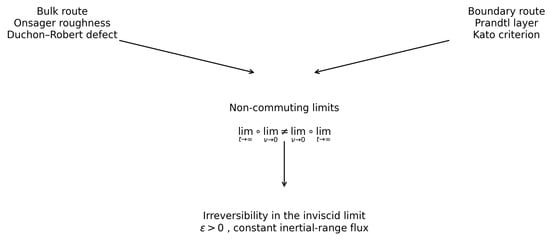
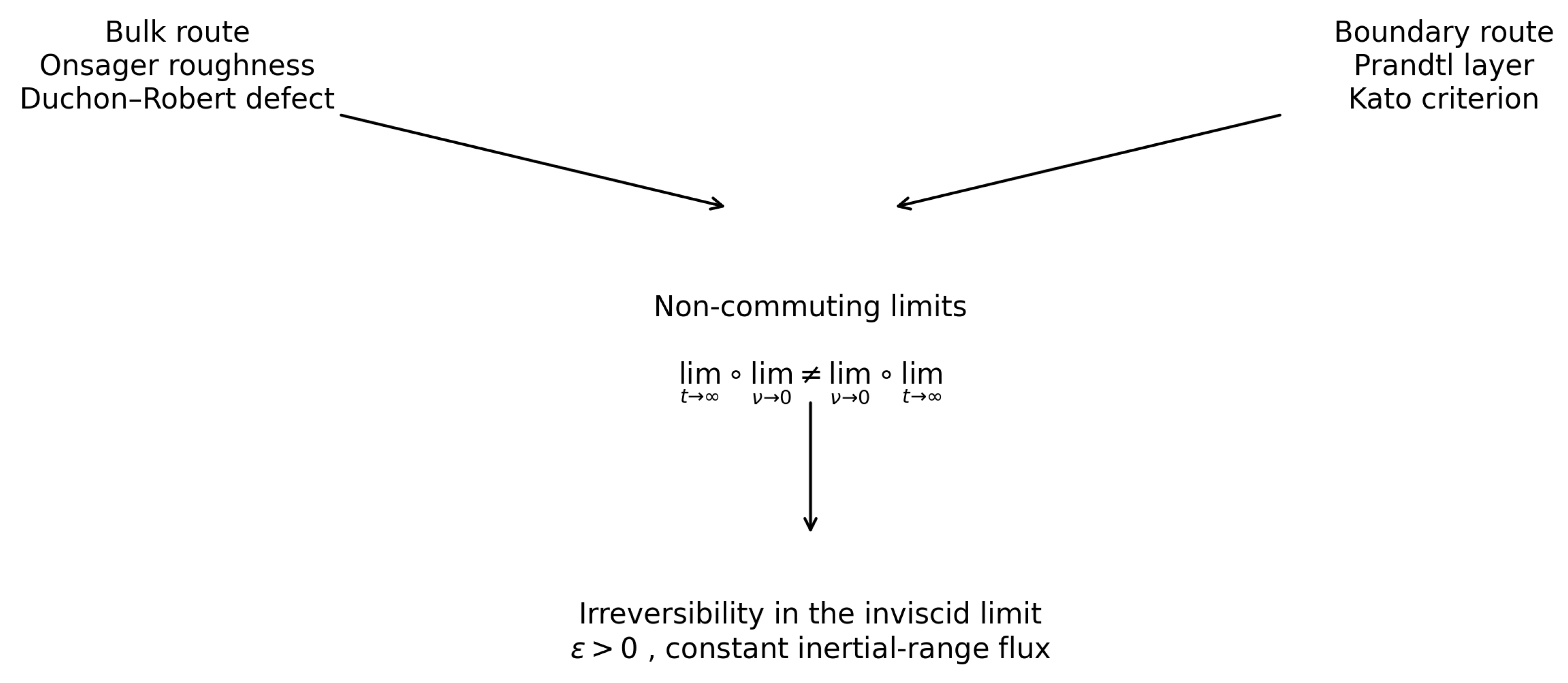
Figure 1 summarizes the two asymptotic routes to dissipation and the role of non-commuting limits discussed in the roadmap.
Figure 1.
Two asymptotic routes to irreversibility in the inviscid limit. Bulk roughness (Onsager/Duchon–Robert) and boundary layer mechanisms (Prandtl/Kato) both lead to irreversible energy dissipation through the non-commutation of the long-time and vanishing-viscosity limits.
- Intermittency and statistics of the defect.
Beyond its mean value, the Duchon–Robert flux provides direct access to the fluctuations that characterize intermittency. In homogeneous and isotropic turbulence, the probability density functions (PDFs) of exhibit heavy tails and scale-dependent skewness, reflecting rare but intense dissipative bursts and localized backscatter events. These statistics can be quantified through standard metrics: the skewness , the flatness (kurtosis) , and the fraction of negative flux events . Empirically, one observes a plateau of for together with growing and as ℓ decreases, signatures of multifractal intermittency [1]. Within the DR framework, these fluctuations correspond to the fine-scale variability of the defect measure , suggesting that the intermittent energy transfer can be described by the statistics of in the inviscid limit. A natural open problem is to identify a large-deviation principle for , or equivalently for the space–time averages of , that would quantify the probability of extreme dissipative events and connect the multifractal description of velocity increments to the measure-theoretic formulation of dissipation [14,18].
4. Two Styles of Explanation
4.1. (i) Mechanistic
On the mechanistic picture, irreversibility arrives with viscosity: the Navier–Stokes (NS) energy balance
contains an intrinsic arrow of time.1 If the inviscid limit were regular—in the sense that smoothly as and the relevant norms remained bounded—one would recover a smooth Euler solution, conserving energy and thereby erasing macroscopic irreversibility:
On this view, residual dissipation at high- is merely a vestige of small but nonzero .
That picture sits uneasily with core empirical facts. In laboratory and numerical high-Reynolds turbulence the mean dissipation rate per unit mass, , tends to a finite, nonzero plateau as (the “dissipation anomaly”), while structure functions display inertial-range scalings largely independent of the molecular microphysics [1,13,14]. Formally, the limits and do not commute,
so a purely mechanistic reduction (“ explains all ⇒ send at the end”) misses the phenomenon’s asymptotic character [12].
4.2. (ii) Asymptotic via Singular Limit
Across physics, singular limits reshape theory structure: geometric optics (caustics) emerges as ; mean–field critical phenomena and universality arise via renormalization; shock waves materialize in inviscid conservation laws. When the limit is singular, new solution classes appear and qualitative behavior changes [12,19]. Turbulence fits this template. The inviscid limit is singular in two complementary ways.
- (a)
- Bulk loss of regularity and anomalous dissipation.
Onsager argued that Euler flows with Hölder exponent can dissipate energy without viscosity [5]. A modern, precise route to this phenomenon is coarse-graining. Let be a standard mollifier and define the filtered (resolved) velocity . Then the coarse-grained NS reads
where and is the subfilter stress. Taking the dot-product with and using incompressibility yields the filtered energy balance
Here is the inter-scale energy flux from resolved scales to subfilter scales ; the double-contraction . If while in the sense of distributions as , then the limit solves Euler and obeys an energy balance with a positive defect measure [3,4,18]. This is no hidden force; it is a structural feature of rough solutions. The exact Kolmogorov -law
links to third-order statistics and provides a direct observational anchor for a nonzero forward flux in the inertial range [1].
- (b)
- Boundary layers and non-commuting limits.
Near walls, vorticity concentrates in a Prandtl layer of thickness [11]. We consider a bounded domain with boundary and no-slip . Define the Kato layer
For a no-slip Navier–Stokes solution on , convergence to the Euler solution in holds if
Thus a non-vanishing fraction of total dissipation can reside in an strip; the inviscid limit fails unless the boundary layer dissipation vanishes [10,17]. Irreversibility can therefore persist in two places: in the bulk, via loss of regularity (Onsager/Duchon–Robert), and at boundaries, via concentration (Prandtl/Kato).
This asymptotic stance aligns turbulence with other singular limit explanations of irreversibility and pattern (shocks in Burgers equation; caustics in optics; fixed points in RG). It also explains universality: inertial-range fluxes are insensitive to molecular details, as renormalization arguments anticipate [14,19,21]. The explanans is not a micro-mechanism that survives the limit, but the change in solution space when the limit is taken.
4.3. Ontological Commitments of the Limit Theory
- Scope of the ontological claim.
The term ontological is used here in a deliberately restricted, regime-indexed sense. Our claim is not a metaphysical thesis about fundamental reality, but an explanatory–ontological commitment relative to the singular inviscid limit relevant for high-Reynolds number turbulence. What counts as “ontological” in this sense are those structures that are indispensable to explanation, prediction, and validation in that asymptotic regime: inter-scale energy flux, exact inertial-range constraints, and (in the limit) a non-negative defect measure in the Euler energy balance. This stance is continuous with work on explanation by singular limits and with structural-realist readings of effective theories, where ontological commitment is indexed to scale, regime, and explanatory role rather than to ultimate fundamentality [12,22,23,24]. Readers who accept the physical/mathematical claims about rough inviscid limits but prefer a more instrumentalist gloss on the word “ontology” may do so without affecting the core asymptotic explanatory framework developed here.
Entities. The relevant entities at are (i) rough weak Euler fields and (ii) the non-negative defect measure entering the Euler energy balance; both are distributional objects.
Processes. The inter-scale energy flux is the recurrent process that realizes irreversibility on inertial ranges; its mean plateau is independent of .
Laws/invariants. Exact third-order relations (e.g., ) and flux plateaus function as asymptotic invariants. They fix what counts as a correct limit ontology.
Selection. The local energy inequality (), the exact third-order law, and scale-locality act as ontological constraints selecting physically realized weak solutions from a non-unique mathematical class.
5. Minimal Mathematical Framework
5.1. Previous Frameworks
- Onsager’s criterion (1949).
For incompressible Euler, if with , energy is conserved; if , anomalous dissipation is possible [5,6,25]. Heuristically, if velocity increments scale as , then the inertial range transfer rate vanishes as only when .
- Duchon–Robert (2000).
Define and as above. Then the exact resolved balance (6) holds. For weak Euler limits (), the Duchon–Robert defect is defined as the distributional limit
and is non-negative for vanishing-viscosity limits. It furnishes the anomalous dissipation measure in the Euler energy balance [3].
For Hölder fields , one has , reproducing Onsager’s threshold; the same object is directly computable in DNS/experiments [2,18].
In HIT, the equality between the mean DR flux on inertial scales and the mean dissipation is derived in Appendix A.
- Isett (2018) and convex integration.
Convex integration constructs weak Euler flows by adding fast oscillatory building blocks that correct a prescribed Reynolds stress while controlling Hölder norms. Isett proved Onsager’s conjecture by building dissipative Euler solutions in for every [7], following the De Lellis–Székelyhidi program [8]. For Navier–Stokes, non-uniqueness results indicate an abundance of irregular weak solutions at low regularity [9]. Philosophically, these results underwrite the asymptotic explanation: there exist inviscid flows (in the appropriate function spaces) that dissipate energy, and hence support irreversibility as .
- Kato (1984) and Prandtl (1904).
With solid boundaries, we take bounded with boundary and no-slip . Defining the Kato layer , one has the equivalence
Hence a finite fraction of dissipation may persist in an strip, obstructing the inviscid limit unless the boundary contribution vanishes [10,17].
- Pedagogical analogy: Burgers equation.
Inviscid Burgers equation, , develops shocks in finite time from smooth data. The entropy solution dissipates energy even with , and the vanishing-viscosity limit selects it. Burgers equation lacks vorticity and is 1D, but it vividly displays the same explanatory structure: a singular limit creates new solution classes (shocks) and a built-in arrow of time without microscopic friction [1]. Caveat: Burgers (1D, no vorticity) selects the entropy solution via vanishing-viscosity and produces shocks; in 3D Euler, intermittency, vorticity, and the geometry of the cascade differ profoundly. The analogy is therefore not mechanistic but structural: in both cases, a singular limit enlarges the class of admissible solutions and underwrites energy loss at the level of the limit model.
- Summary. The mechanistic story (“ dissipates”) is true but explanatorily incomplete for high- turbulence. The asymptotic story explains why irreversibility survives as : the limit is singular, produces boundary layers and/or bulk roughness, and thus changes the admissible solutions. Irreversibility is thereby a structural, emergent feature, aligning turbulence with the broader philosophy of singular limits in physics [12,19].
5.2. Non-Commuting Limits and Multi-Scale Structure
Kolmogorov’s 1941 picture (K41) posits an inertial cascade with constant energy flux , independent of , and a viscous cutoff . As , shrinks, but remains . In the filtered energy balance
so the work done by the nonlinear cascade equals the dissipation, even though the latter’s microscopic carrier vanishes in measure. That is the dissipation plateau [1,13].
Dynamically, this means the long-time, small-viscosity limit does not commute: taking at fixed lands on a statistical steady state with ; sending first in the smooth class would enforce energy conservation. The attractor of the dynamics is therefore a non-smooth (weak) Euler dynamics with constant flux, not smooth Euler [2,14]. The coarse-grained/Duchon–Robert diagnostics make this precise by exhibiting a nonzero defect in the Euler energy balance.
5.3. The Coarse-Grained Bridge: Flux and Anomalous Dissipation
Why is the coarse-grained route conceptually powerful?
- Exact bookkeeping by scale. The Germano identity expresses in terms of resolved and subfilter fields. The scalar is the only term that transfers kinetic energy across scales in the resolved balance; its sign and magnitude quantify forward/backward cascade at every point and time [18].
- Scale-locality. Under mild conditions, the forward cascade is dominated by triads of comparable scales; thus, is insensitive to remote ultraviolet/molecular details—explaining universality of inertial-range laws [14].
- Onsager via limits. If , then . Hence (energy conservation), while allows (anomalous dissipation) [3]. This connects observed roughness (via structure functions) to energy balance at the inviscid limit.
- Take-home: Irreversibility at high-Reynolds number is not a residual of ; it is a property of the multi-scale, non-smooth limit dynamics captured by and .
| Ontological invariant (inertial range). For , the mean inter-scale flux satisfies independently of and robustly to filter choice. In vanishing-viscosity limits, the distributional limit obeys . This equality makes the forward cascade a scale-local, viscosity-free invariant of the limit ontology. |
6. Asymptotic Explanation: Philosophical Frame
Following Batterman, some scientific explanations are fundamentally asymptotic: qualitative novelties arise at singular limits where the “limit object” (here: weak Euler with defect measure ) has properties absent from all finite-parameter antecedents (smooth Euler) [12]. Turbulence fits this pattern:
- Change in solution class. The physically relevant inviscid limit is not smooth Euler but a class of rough weak solutions. This change in admissible solutions—mathematically realized by convex integration and diagnosed by Duchon–Robert—is what grounds dissipation without viscosity.
- Asymptotic universality. Plateau dissipation , the exact -law, and robustness across DNS/LES/experiments reflect insensitivity to microphysics, just as renormalization explains universality near critical points [1,19,21].
- Idealization and legitimacy. Large-eddy models do not reproduce microscopic subgrid fields; they reproduce the flux and integral balances at scales . Within the asymptotic frame, that is the right target for explanation and validation, the explanans is the structure of the limit, not a detailed micro-mechanism.
- Philosophical upshot: Irreversibility in turbulence is best explained as an emergent, structural feature of a singular limit—precisely the sort of case where asymptotic explanation outperforms mechanistic reduction.
6.1. Philosophical Anchors and Related Work
Our account fits a family of singular limit explanations where novel macroscopic structure emerges at a limit that changes admissible solutions [12]. It complements discussions of emergence and reduction in statistical mechanics and field theory (e.g., renormalization group) [19,20]. Typicality-based arguments clarify why invariant laws (e.g., the -law) can be robust under coarse-graining despite micro-level indeterminacy [26]. Concerning methodology, we adopt the view that models are mediators whose legitimacy relies on capturing the right invariant structures (here, flux/defect), not on micro-realist detail [27], with idealization understood as explanatory, not merely convenient [28]. The upshot is an asymptotic rather than mechanistic explanation of irreversibility: the arrow of time is grounded in the singular limit’s structural reorganization (rough weak Euler with nonzero defect), much like universality at critical points [19,20].
6.2. Singular Limits and Explanatory Practice
Batterman argues that some scientific explanations crucially depend on singular limits, where the limit theory possesses qualitative features absent from every pre-limit model [12]. Canonical cases include geometric optics emerging from wave optics (formation of caustics), thermodynamics from statistical mechanics (entropy and irreversibility as ), and critical phenomena explained by the renormalization group (universality classes) [19]. What unifies these is a structural change at the limit: equations, admissible solutions, or state variables reorganize so that new macroscopic properties become well-defined and robust.
Turbulence fits this schema. The inviscid limit of Navier–Stokes () is singular: the relevant limit object is not the class of smooth Euler solutions (which conserve energy), but a broader class of rough weak solutions supporting a nonzero defect measure in the energy balance. This change in admissible solution space—established mathematically via Onsager’s criterion and convex integration [4,5,6,7,25]—grounds an emergent irreversibility at without positing any hidden microscopic dissipative force.
6.3. Change in Solution Class: From Smooth to Rough Euler
For sufficiently regular Euler flows, energy is conserved. Onsager’s scaling argument identifies a critical Hölder threshold: if with , energy conservation holds; if , anomalous dissipation is possible [5]. This was sharpened by modern PDE results using Besov spaces [4,6,25]. Isett’s theorem proves the existence of dissipative Euler solutions in for any [7]; related convex integration programs reveal a large, even non-unique, weak solution landscape for Euler and Navier–Stokes [8,9].
Philosophical upshot. The explanans of irreversibility is the solution class shift at a singular limit. Energy dissipation persists at because the limit theory permits rough solutions with a positive defect measure ; it is not because viscous micro-dynamics “secretly remain.”
6.4. Asymptotic Universality and Exact Laws
Kolmogorov’s 1941 picture isolates an inertial-range flux , nearly independent of viscosity, and predicts the exact -law for third-order structure functions [1,13]. These statements are universal: they hold across different fluids, forcings, and numerical methods. Coarse-grained balances make this precise: the inter-scale flux and its limit provide viscosity-free diagnostics of dissipation [2,3,18].
Analogy. Like critical exponents in phase transitions, the dissipation plateau and -law are asymptotic invariants. They are explained by the structure of the limit dynamics (constant flux sustained by roughness), not by molecular details [14,19,21].
6.5. The Role of Idealizations: LES and Closures
Large-eddy simulation (LES) filters the equations at scale ℓ and models the subgrid stress . From the asymptotic standpoint, a good subgrid model is one that yields the correct flux and integral balances as and ; microscopic fidelity of the subgrid fields is not the target [2,18]. This reframes model validation: we test against exact laws and flux diagnostics (including viscosity-free reconstructions of ), rather than pointwise accuracy at unresolved scales.
- Summary. Turbulent irreversibility exemplifies asymptotic explanation: a singular limit reorganizes the admissible solutions, delivers new invariants (flux laws), and renders the macroscopic property (nonzero at ) robust and universal.
- Is turbulence a strict Batterman-style singular limit?
Unlike geometric optics, where caustics do not exist away from the limit, rough Euler-type behavior has meaningful precursors at small but positive viscosity. What is structurally novel in the inviscid limit is not an ontic entity absent at any pre-limit, but the invariant explanatory structure: a constant inter-scale flux, exact third-order laws, and a non-negative defect measure that together license asymptotic validation criteria. This fits Butterfield’s “emergence with reduction” template, even if it stretches Batterman’s strict notion of novelty.
6.6. Fields, Events, and Processes
The defect is not a calculational artifact: it is a distributional bearer of energy loss in the Euler energy balance. The cascade, captured by , is the recurrent event-process that realizes irreversibility at the limit. This aligns with structural realism: what survives the limit is relational invariants (flux laws, defects), not fine-grained microstructures.
6.7. A Note on Spacetime Debates
We do not propose a reform of spacetime physics here, yet our case illuminates how ontological questions arise from limits: the primacy of relations (flux constraints) over smooth substances parallels relational stances about spacetime. The lesson is methodological: where a singular limit changes admissible entities and introduces viscosity-free invariants, ontology should track the limit relations, not the prelimit carriers.
7. Objections and Replies
Objections
- (O1) “Wild solutions” are unphysical.
Reply. Mathematical non-uniqueness does not imply physical indeterminism. One imposes selection principles: (i) the local energy inequality (dissipative solutions in the sense of Lions) rules out energy-increasing weak flows; (ii) compliance with exact constraints (e.g., the -law in homogeneous isotropic turbulence) selects constant flux states; (iii) scale-locality of the cascade (dominance of near-scale triads) excludes pathological non-local transfers [14]; (iv) coherence with Duchon–Robert diagnostics measured in DNS/experiments (non-negative reconstructed without using ) anchors the admissible class [2,3,18]. These empirical and variational constraints shrink the wild solution zoo to a physically relevant subclass.
- (O2) Where is the evidence for dissipation at ?
Reply. Multiple lines: (i) the dissipation plateau in high- flows (grids, jets, boundary layers) shows approaching a constant as [1,13]; (ii) the exact -law is verified in laboratory flows and DNS; (iii) can be recovered from coarse-grained balances (Duchon–Robert) without invoking ; (iv) modern DNS at find that statistics in the inertial range are asymptotically independent of [14]. Together these support the existence of a viscosity-independent flux (and thus a nonzero ) in the inviscid limit.
- (O3) Why not a purely mechanistic explanation via ?
Reply. Mechanistic reduction ties the arrow of time to the viscous term. But as , the explanatory targets are the inter-scale flux, exact laws, and limit invariants, all of which are independent of . Viscosity sets a cutoff scale and, near walls, can dominate an strip (Kato’s criterion), but the macroscopic irreversibility is carried by the constant flux of a rough, non-smooth limit dynamics [2,3,10,17]. In short, explains where energy is ultimately thermalized; the why of persistent macroscopic dissipation is asymptotic and structural.
Statistical mechanics (Boltzmannian irreversibility). Entropy increase and macroscopic irreversibility arise at limits and under coarse-graining; new state variables (entropy) and laws (H-theorem) organize behavior insensitive to microdetails. Analogy: reorganizes admissible solutions and yields viscosity-free invariants.
Shocks and entropy selection (hyperbolic conservation laws). Inviscid limits select entropy solutions with dissipation at . Ontologically, selection principles determine which weak solutions are physically real—mirroring our use of energy inequality, , and scale-locality.
Critical phenomena and renormalization. Universal exponents and scaling functions are independent of the microscopic Hamiltonian. Likewise, the inertial range flux plateau and third-order laws are universal invariants of the turbulent limit, not features of viscous microphysics.
8. Selection Principles: From Non-Uniqueness to Physical Admissibility
A potential concern is that the selection principles introduced below are historically and mathematically connected to vanishing-viscosity arguments for Navier–Stokes, while being used here to constrain the inviscid limit theory. We address this by distinguishing three roles played by viscosity in turbulence theory.
First, viscosity plays a historical and epistemic role: several admissibility criteria were originally motivated and controlled through the analysis of Navier–Stokes at small but finite . Second, viscosity plays a regularizing/stability role: it suppresses unstable or non-robust branches of weak Euler solutions and thereby helps access dynamically persistent limit behavior. Third and crucially for the present explanatory target, viscosity need not play an indispensable explanatory role for inertial-range irreversibility, which is tracked by scale-resolved flux and exact statistical constraints.
Indeed, the key constraints appealed to below can be formulated and confronted with data without explicit use of ν, using viscosity-free diagnostics such as the Duchon–Robert energy flux (from velocity increments), exact third-order laws in homogeneous/isotropic settings, and empirical scale-locality of energy transfer. Thus, while viscous models provide an important route to discovery and mathematical control, the justificatory force of (S1)–(S3) in the limit theory derives from their role as robust structural constraints on inertial-range flux and defect, not from treating viscosity as the persisting carrier of irreversibility.
We acknowledge that (S1)–(S3) were historically identified and, in part, mathematically controlled through vanishing-viscosity analysis of Navier–Stokes. Our claim is therefore not that these principles are epistemically independent of viscous dynamics. Rather, the point is that their explanatory role in the high-Reynolds regime is fixed by viscosity-free invariants and diagnostics: Duchon–Robert/filtered fluxes reconstructed from velocity increments, exact third-order relations (e.g., the -law in HIT), and empirical evidence for scale-local transfer.
These observables can be confronted with DNS and experiments without inserting into the measurement protocol. In this sense, Navier–Stokes provides a historical/epistemic and regularizing route to the principles, while their continued validity as asymptotic constraints is an empirical matter. This is analogous to renormalization group explanations, where microscopic models supply calculational control yet the universal critical behavior is assessed via regime-level invariants and experimental tests [19,20].
If future high-Re evidence were to show systematic violations of these invariants in specific configurations, the corresponding selection/validation criteria would have to be revised.
We now introduce three selection principles that constrain physically admissible weak Euler solutions in the inertial range (Table 1).
Table 1.
Summary of the selection principles (S1)–(S3) used to constrain physically admissible weak Euler solutions in the inviscid limit.
High-resolution numerical simulations provide direct support for these inertial-range constraints. In particular, direct numerical simulations of forced homogeneous isotropic turbulence by Ishihara et al. [29] at Taylor-scale Reynolds numbers up to verify the exact -law over an extended range of scales. These simulations also exhibit clear plateaus of the coarse-grained energy flux matching the measured dissipation rate to within a few percent, providing quantitative confirmation that inertial-range energy transfer is governed by viscosity-independent flux constraints. Such results directly support selection principle (S2).
Proposition 1
(Equivalence of mean DR flux and the law in vanishing-viscosity limits). Consider statistically steady, homogeneous, isotropic turbulence on or with vanishing-viscosity limits such that the local energy inequality holds. Then for any smooth radial filter ,
and, on any inertial interval where the Kármán–Howarth–Monin relation yields the law, one has
so that .
The proof, based on an integration-by-parts of the Duchon–Robert increment formula combined with the Kármán–Howarth–Monin identity, is given in Appendix A.
Sketch.
Use the DR increment formula to express in terms of third-order velocity increments, then apply the KHM relation in HIT to identify the mean flux with for separations . The local energy inequality ensures and justifies passage to the distributional limit after . □
Weak Euler solutions are non-unique in general; to connect mathematics with observed turbulence, we adopt selection principles that are satisfied by vanishing-viscosity limits of Navier–Stokes and by empirical flux laws. In wall-bounded flows, the Kato boundary layer mechanism provides a complementary route to dissipation: energy may concentrate in an strip adjacent to the wall, so the bulk criteria (S1)–(S3) below should be reported together with near-wall dissipation consistent with Kato’s criterion.
Crucially, the diagnostics underlying these constraints do not require explicit knowledge of the viscosity. Using particle image velocimetry data, Kholmyansky and Tsinober [30] reconstructed scale-dependent energy fluxes directly from velocity increments and reported predominantly non-negative defect distributions consistent with local energy dissipation. Related experimental and numerical studies employing coarse-grained or Duchon–Robert-type diagnostics confirm that inertial-range irreversibility can be quantified without invoking viscous dissipation explicitly. These observations support the interpretation of (S1) as a genuine inviscid admissibility constraint rather than a proxy for molecular dissipation.
- (S1) Local energy inequality (Duchon–Robert defect).
Let be a smooth mollifier, , and . The resolved energy balance reads
The viscous contribution in the resolved energy balance involves the filtered field, , up to a transport divergence term that vanishes upon space averaging under periodic/decaying boundaries.
For weak Euler limits (), the Duchon–Robert defect (in ) enters the Euler energy balance as
Physical admissibility requires the local energy inequality: for all non-negative
which is equivalent to as a distribution. Any vanishing-viscosity limit of Leray–Hopf Navier–Stokes satisfies this non-negativity, capturing the time asymmetry at and ruling out energy-creating weak solutions.
- (S2) Exact third-order law (inertial-range flux constraint).
In homogeneous, isotropic, stationary turbulence with mean dissipation , the Kármán–Howarth–Monin relation yields the Kolmogorov -law
which fixes the sign and magnitude of the forward cascade. Consistently, the mean inter-scale flux exhibits a viscosity-free plateau
An admissible Euler limit in HIT must satisfy these relations, linking to . At finite-Reynolds numbers, one checks the approximate linearity of the third-order structure function on a decade of scales and the overlap between inferred from and from .
A rigorous correspondence between the mean DR flux and the -law in vanishing-viscosity limits is established in Appendix A.
- (S3) Scale-locality of the cascade.
Writing in increment form (Duchon–Robert), the leading contributions come from separations . Under mild scaling assumptions (e.g., and finite second moments), ultraviolet and infrared contributions are subdominant. Quantitative locality bounds then imply that changing the filter smoothly or altering remote scales affects only at subleading order on the inertial range. This explains the robustness of the flux plateau and excludes weak solutions whose energy transfer is dominated by widely separated triads.
- Operational recipe (DNS/experiments/LES).
- Choose a smooth, radially symmetric filter ; pick ℓ with and ensure grid resolution .
- Compute or use the Duchon–Robert increment formula to avoid any use of ; average to obtain .
- Verify a flat plateau for and check robustness to moderate changes of the filter shape.
- In HIT, measure and confirm the slope on the same scale range; cross-validate from both diagnostics.
- Quantify backscatter: report the space–time fraction where and its contribution to the net flux.
- For wall flows, in addition to (S1)–(S3), report near-wall dissipation integrated over an strip to assess the Kato mechanism alongside the bulk defect .
- Example (forced HIT).
Filter a statistically steady DNS at large with , compute from velocity increments, and observe a scale interval where is flat and equal to the power input. On the same interval, third-order longitudinal structure functions display the slope. Backscatter occupies a modest fraction of space–time but does not alter the mean forward transfer. These checks together certify (S1)–(S3) for the bulk Euler limit.
- Reporting and common pitfalls.
Avoid estimating from when arguing about the inviscid limit; prefer viscosity-free DR or diagnostics. Ensure ℓ truly lies between and L; outside this range, will not be flat. In anisotropic or inhomogeneous flows, replace the HIT test by the appropriate exact third-order relations and condition the analysis on direction or position. For wall-bounded cases, separate the bulk from the near-wall contribution in an layer to make the role of Kato’s mechanism explicit.
- Bridge to foundations. The triplet (S1)–(S3) functions as a minimal admissibility schema that any physically realized weak Euler limit should satisfy: a local energy inequality encoding the thermodynamic arrow, an exact third-order constraint fixing the mean flux, and scale-locality ensuring universality and robustness. Together with the Kato near-wall route, these principles connect the large mathematical solution space to the narrower set of flows selected in nature and experiments, and they provide concrete, testable criteria for model validation in the singular limit framework.
9. Methodology: Models as Asymptotic Mediators
We treat LES/closures as asymptotic mediators: their task is to realize the limit ontology (positive defect, constant inertial-range flux, exact third-order laws, scale-locality), not to reconstruct microscopic subgrid fields. Validation should therefore target asymptotic invariants—flux plateaus, , and viscosity-free estimates of —as membership tests for the correct inviscid limit regime.
9.1. Validation by Integral and Flux Laws
Instead of demanding pointwise accuracy of subgrid fields, evaluate models by asymptotic criteria: the -law, correct plateau for , and a non-negative Duchon–Robert defect in the inviscid limit [2,3,18]. These are the invariants that survive .
9.2. Status of LES and Closures
LES should be viewed as asymptotic flux theories. The subgrid model’s task is to impose the right energy transfer across ℓ and reproduce the correct integral constraints as ℓ approaches the Kolmogorov scale. This legitimizes successful closures that do not attempt “microscopic” reconstruction of the subgrid velocity.
9.3. LES as an Asymptotic Flux Theory: A Validation Protocol
- Filtering. Choose a smooth, radially symmetric filter ; select ℓ with and ensure .
- Flux. Compute and , or use the DR increment formula (Box A) when only velocity increments are available.
- Plateau test. Verify flat over ; check robustness to moderate filter changes.
- -law. In HIT, confirm on the same range.
- Viscosity-free dissipation. Reconstruct from DR () and compare to (DNS) or power input (forced runs). In experiments, compute from PIV increments via the DR formula (Box A) and compare to power input and/or pressure drop measurements.
- Backscatter. Report the space–time fraction with and its contribution; excessive backscatter suggests model issues.
- Convergence. At fixed ℓ, refine to convergence, then vary ℓ within the inertial range. For wall flows, also monitor dissipation in an strip (Kato layer).
10. Conclusions
We argue that the macroscopic arrow of time in turbulence is best understood as arising from the singular limit reorganization of the effective inviscid theory (rough weak Euler dynamics with a non-negative defect), rather than from a persisting microscopic mechanism. As , admissible entities shift from smooth Euler fields to rough weak solutions with a positive defect measure, and a constant inter-scale flux becomes an invariant process of the limit dynamics. This anchors irreversibility in viscosity-free structures and clarifies why exact third-order laws and flux plateaus are the right targets for modeling and validation.
Irreversibility in high-Reynolds number turbulence is best explained as an asymptotic phenomenon produced by a singular limit. As , the effective dynamics is not smooth Euler but a rough weak Euler regime supporting a constant inter-scale flux and a positive energy-defect measure . This picture unifies Onsager’s threshold and modern existence theorems, coarse-grained energy balances and Duchon–Robert diagnostics, and empirical invariants such as the dissipation plateau and the -law. It also clarifies methodology: validate models against asymptotic invariants (flux and exact laws) and select physically admissible weak solutions by energy inequalities and universality constraints. Rather than signaling a failure of mechanistic explanation, turbulence showcases the success of a singular limit account in which the arrow of time is grounded in the structural change that occurs at the inviscid limit.
As perspectives and future work, a first priority is to determine whether the local energy inequality, the -law, and scale-locality can be derived as necessary conditions for vanishing-viscosity limits of Navier–Stokes, or else to pinpoint where such necessity fails. This includes quantitative bounds on admissible ultraviolet and infrared non-local transfer and decay rates for triadic interactions, consistent with observed plateaus of .
A second direction is to sharpen the interplay between bulk roughness of Onsager type and near-wall dissipation of Kato type. Rigorous criteria that partition the total dissipation into a bulk defect and boundary layer contributions would connect mathematical limits to measurable budgets. High-Reynolds DNS and targeted experiments could co-measure both using Duchon–Robert diagnostics alongside wall-resolved velocimetry.
A third avenue concerns intermittency and the statistics of the defect measure. Linking multifractal models to the geometry, fluctuations, and large deviations of and , together with Lagrangian probes of time asymmetry [31], would clarify how temporal irreversibility emerges in the inviscid limit.
For statistically steady, forced flows, it is important to obtain convergence rates and stability results that address the non-commutation of limits and characterize invariant measures of rough Euler dynamics. Such results should be tied to exact flux laws and to their finite-Reynolds corrections.
On the modeling side, large-eddy closures that enforce dissipativity, positivity of Duchon–Robert dissipation, and provable scale-locality suggest a practical path. Validation protocols should center on flux plateaus, exact third-order laws, and viscosity-free estimates of dissipation rather than pointwise fidelity of unresolved fields, including constraint-aware data-driven models trained against these asymptotic targets.
Beyond incompressible three-dimensional flows, extending the singular limit framework and Duchon–Robert-type diagnostics to compressible turbulence, magnetohydrodynamics, and rotating or stratified geophysical regimes will test the generality of the account and connect it to exact laws outside K41, such as Politano–Pouquet in MHD.
Finally, community benchmarks for filters, flux computation, and the reporting of and —including near-wall contributions—together with open datasets would enable reproducible admissibility tests and systematic comparison of models across codes, grids, and flows.
Recent numerical evidence provides an instructive test of the present framework. Direct numerical simulations of incompressible Navier–Stokes turbulence in periodic domains without solid boundaries suggest that the dissipation anomaly may decay at very high Reynolds numbers, potentially weakening the strict formulation of the zeroth law in homogeneous settings [32].
Rather than undermining the singular limit account, these results highlight the importance of distinguishing different asymptotic routes to irreversibility, in a manner analogous to the role played by singular limits and renormalization arguments in other domains of physics [33]. Within the present framework, robust dissipation anomalies are expected to persist either through sustained bulk roughness of Onsager type—consistent with recent Onsager-type singularity results for turbulent Euler solutions [34]—or through boundary layer mechanisms consistent with Kato’s criterion. The periodic-domain results therefore motivate a sharper empirical and theoretical separation between bulk and boundary contributions to dissipation, and a systematic investigation of how domain geometry, boundary conditions, and forcing shape the statistics of the defect measure and inter-scale flux.
Funding
This research received no external funding.
Institutional Review Board Statement
Not applicable.
Informed Consent Statement
Not applicable.
Data Availability Statement
No new data were created or analyzed in this study. Data sharing is not applicable.
Conflicts of Interest
The author declares no conflicts of interest.
Appendix A. Summary of Equations and Energy Balances
- Navier–Stokes (incompressible):
- Global energy balance (smooth solutions). For sufficiently regular solutions and either periodic domains or appropriate no-slip boundary conditions
Appendix B. Proof of the DR–Flux/4/5-Law Equivalence in Vanishing-Viscosity Limits
Appendix B.1. Setting and Statement
We consider statistically steady, homogeneous, and isotropic turbulence (HIT) for incompressible Navier–Stokes on or , with solutions at viscosity and a vanishing-viscosity limit as such that the local energy inequality holds. Let be a smooth, radial mollifier with . The Duchon–Robert (DR) subfilter energy flux at scale ℓ can be written in the increment form [3,18]:
Denote ensemble/spatial averages by (ergodicity in HIT).
Proposition A1
(Mean DR flux equals the dissipation in the inviscid limit on inertial scales). Let be the Kolmogorov length and L a large-scale. Fix ℓ in an inertial window (uniformly as ). Then
where is the mean dissipation rate (also equal to the mean power input in steady state). Consequently, if in , then .
Appendix B.2. Auxiliary Identities
We recall the exact Kármán–Howarth–Monin identity in HIT (see, e.g., [1]): for incompressible in a stationary, homogeneous state,
In the inertial range , the viscous term is negligible, yielding the “–law” form
which is equivalent to the Kolmogorov -law for the longitudinal third-order structure function.
Appendix B.3. Proof of Proposition A1
- Step 1: Integration by parts in the DR formula.
Take the average of (A1) and integrate by parts in (boundary terms vanish since is compactly supported/rapidly decaying and the statistics are homogeneous):
- Step 2: Insert the exact KHM identity.
Because by normalization, the first integral equals .
- Step 3: Negligibility of the viscous correction on the inertial window.
Rewrite the second term by integrating by parts once more:
The kernel localizes the integral to , and by assumption . Standard estimates on structure functions in HIT yield (or milder), while the prefactor brings a factor ; hence, the whole integral is as at fixed ℓ in the inertial window.2 Therefore
which is the first claim.
Estimate. In HIT, standard inertial-range scaling yields for . Since localizes and , the viscous contribution is
because and hence at fixed ℓ in the inertial window.
- Step 4: Passing to the inviscid DR defect.
By definition (Duchon–Robert), the anomalous dissipation is the distributional limit in , for any fixed vanishing-viscosity limit . Taking first at fixed ℓ and then
since is independent of ℓ. This completes the proof. □
Appendix B.4. Remarks
- (R1) Filter independence. The proof only uses and smoothness. Thus, on the inertial window equals independently of the filter shape (up to corrections at finite Reynolds), consistent with scale-locality [14,18].
- (R2) Order of limits. The order “ at fixed ℓ with , then ” reflects the physical regime: first, remove molecular effects at a resolved scale, then resolve smaller scales. Reversing the order (formal Euler first) would leave the defect measure undetermined and erase the flux plateau at the resolved level.
- (R3) Relation to the -law. The divergence form (A3) is equivalent to the Kolmogorov -law for the longitudinal third-order structure function in HIT. Hence, the equality on is just the coarse-grained statement of the constant flux inertial range implied by .
- (R4) Boundaries. For wall-bounded flows, homogeneity/isotropy fail and additional boundary contributions appear. The argument for bulk flux carries over locally away from walls; near walls, dissipation in an Kato layer may persist [10,17]. Reporting bulk together with near-wall budgets is then appropriate.
Notes
| 1 | Here and likewise for . Equation (2) follows by taking the inner product of NS with , integrating by parts, and using incompressibility together with either periodic/decaying boundary conditions or no-slip , which removes boundary terms. |
| 2 | Any standard inertial-range estimate (or directly the exact KHM with viscous term bounded by concentrated near ) suffices to show that, once , the contribution decays as . |
References
- Frisch, U. Turbulence: The Legacy of A. N. Kolmogorov; Cambridge University Press: Cambridge, MA, USA, 1995. [Google Scholar]
- Eyink, G.L.; Sreenivasan, K.R. Onsager and the theory of hydrodynamic turbulence. Rev. Mod. Phys. 2006, 78, 87–135. [Google Scholar] [CrossRef] [Scilit]
- Duchon, J.; Robert, R. Inertial energy dissipation for weak solutions of incompressible Euler and Navier-Stokes equations. Nonlinearity 2000, 13, 249–255. [Google Scholar] [CrossRef] [Scilit]
- Eyink, G.L. Energy dissipation without viscosity in ideal hydrodynamics. I. Fourier analysis and local energy transfer. Phys. D 1994, 78, 222–240. [Google Scholar] [CrossRef] [Scilit]
- Onsager, L. Statistical hydrodynamics. Il Nuovo C. (Suppl.) 1949, 6, 279–287. [Google Scholar] [CrossRef] [Scilit]
- Constantin, P.; E, W.; Titi, E.S. Onsager’s conjecture on the energy conservation for solutions of Euler’s equation. Commun. Math. Phys. 1994, 165, 207–209. [Google Scholar] [CrossRef] [Scilit]
- Isett, P. A proof of Onsager’s conjecture. Ann. Math. 2018, 188, 871–963. [Google Scholar] [CrossRef] [Scilit]
- De Lellis, C.; Székelyhidi, L., Jr. Dissipative continuous Euler flows. Invent. Math. 2013, 193, 377–407. [Google Scholar] [CrossRef] [Scilit]
- Buckmaster, T.; Vicol, V. Nonuniqueness of weak solutions to the Navier-Stokes equations. Ann. Math. 2019, 189, 101–144. [Google Scholar] [CrossRef] [Scilit]
- Kato, T. Remarks on zero viscosity limit for nonstationary Navier-Stokes flows with boundary. In Seminar on Nonlinear Partial Differential Equations; Chern, S.S., Ed.; (MSRI Publ. 2); Springer: Berlin/Heidelberg, Germany, 1984; pp. 85–98. [Google Scholar]
- Prandtl, L. Über Flüssigkeitsbewegung bei sehr kleiner Reibung. In Verhandlungen des III. Internationalen Mathematiker-Kongresses, Heidelberg 1904; B. G. Teubner: Leipzig, Germany, 1904; pp. 484–491. [Google Scholar]
- Batterman, R.W. The Devil in the Details: Asymptotic Reasoning in Explanation, Reduction, and Emergence; Oxford University Press: Oxford, UK, 2002. [Google Scholar]
- Sreenivasan, K.R.; Antonia, R.A. The phenomenology of small-scale turbulence. Annu. Rev. Fluid Mech. 1997, 29, 435–472. [Google Scholar] [CrossRef] [Scilit]
- Alexakis, A.; Biferale, L. Cascades and transitions in turbulence. Phys. Rep. 2018, 767–769, 1–101. [Google Scholar] [CrossRef] [Scilit]
- Comte-Bellot, G.; Corrsin, S. Simple Eulerian time correlation of full- and narrow-band velocity signals in grid-generated turbulence. J. Fluid Mech. 1971, 48, 273–337. [Google Scholar] [CrossRef] [Scilit]
- Saddoughi, S.G.; Veeravalli, S.V. Local isotropy in turbulent boundary layers at high Reynolds number. J. Fluid Mech. 1994, 268, 333–372. [Google Scholar] [CrossRef] [Scilit]
- Bardos, C.; Titi, E.S.; Wiedemann, E. The vanishing viscosity limit for an incompressible fluid with a porous medium boundary. J. Mathématiques Pures Appliquées 2013, 100, 748–788. [Google Scholar] [CrossRef] [Scilit]
- Aluie, H. Coarse-grained incompressible Navier-Stokes equations and the subgrid-scale stress. Phys. Rev. Fluids 2017, 2, 094603. [Google Scholar] [CrossRef] [Scilit]
- Goldenfeld, N. Lectures on Phase Transitions and the Renormalization Group; AddisonWesley: Boston, MA, USA, 1992. [Google Scholar]
- Wilson, K.G. The renormalization group: Critical phenomena and the Kondo problem. Rev. Mod. Phys. 1975, 47, 773–840. [Google Scholar] [CrossRef] [Scilit]
- Yakhot, V.; Orszag, S.A. Renormalization group analysis of turbulence. I. Basic theory. J. Sci. Comput. 1986, 1, 351. [Google Scholar] [CrossRef] [Scilit]
- Butterfield, J. Less is different: Emergence and reduction reconciled. Found. Phys. 2011, 41, 1065–1135. [Google Scholar] [CrossRef] [Scilit]
- Ruetsche, L. Interpreting Quantum Theories: The Art of the Possible; Oxford University Press: Oxford, UK, 2013. [Google Scholar]
- Ladyman, J.; Lorenzetti, L. Effective Ontic Structural Realism. Br. J. Philos. Sci. 2023. [Google Scholar] [CrossRef] [Scilit]
- Cheskidov, A.; Constantin, P.; Friedlander, S.; Shvydkoy, R. Energy conservation and Onsager’s conjecture for the Euler equations. Nonlinearity 2008, 21, 1233–1252. [Google Scholar] [CrossRef] [Scilit]
- Frigg, R.; Werndl, C. Explaining thermodynamic-like behaviour in terms of epsilon-ergodicity. Philos. Sci. 2011, 78, 628–652. [Google Scholar] [CrossRef] [Scilit]
- Morrison, M. Reconstructing Reality: Models, Mathematics, and Simulations; Oxford University Press: Oxford, UK, 2015. [Google Scholar]
- Strevens, M. Depth: An Account of Scientific Explanation; Harvard University Press: Cambridge, MA, USA, 2008. [Google Scholar]
- Ishihara, T.; Gotoh, T.; Kaneda, Y. Study of high-Reynolds-number isotropic turbulence by direct numerical simulation. J. Fluid Mech. 2009, 592, 335–366. [Google Scholar] [CrossRef] [Scilit]
- Kholmyansky, M.; Tsinober, A. Kolmogorov 4/5 law, local isotropy, and anisotropy in turbulent flows. Phys. Fluids 2009, 21, 025105. [Google Scholar]
- Drivas, T.D.; Eyink, G.L. Cascade direction and Lagrangian time asymmetry. Phys. Rev. X 2018, 8, 011023. [Google Scholar] [CrossRef] [Scilit]
- Iyer, K.P.; Drivas, T.D.; Eyink, G.L.; Sreenivasan, K.R. Turbulence without walls: Whither the zeroth law of turbulence? Phys. Rev. Lett. 2025, 135, 134001. [Google Scholar] [CrossRef] [Scilit] [PubMed]
- Butterfield, J.; Bouatta, N. Renormalization for philosophers. In Poznan Studies in the Philosophy of the Sciences & the Humanities; Brill: Leiden, The Netherlands, 2015. [Google Scholar]
- Drivas, T.D.; Eyink, G.L. An Onsager singularity theorem for turbulent solutions of incompressible Euler equations. Commun. Math. Phys. 2018, 359, 733–763. [Google Scholar] [CrossRef] [Scilit]

Disclaimer/Publisher’s Note: The statements, opinions and data contained in all publications are solely those of the individual author(s) and contributor(s) and not of MDPI and/or the editor(s). MDPI and/or the editor(s) disclaim responsibility for any injury to people or property resulting from any ideas, methods, instructions or products referred to in the content. |
© 2026 by the author. Licensee MDPI, Basel, Switzerland. This article is an open access article distributed under the terms and conditions of the Creative Commons Attribution (CC BY) license.