


Abstract
With conditional probability as a primitive notion rather than a ratio of classical probability, we extend the language of epistemic logic by introducing conditional probability operators. We propose a conditional probabilistic epistemic logic (CPEL) based on the general frame, which enables the assignment of conditional probabilities to any formula in the language defined in this paper. Furthermore, we discuss the relationship between knowledge and conditional probability in CPEL, as well as the connection between indicative conditionals and conditional probability. Finally, we present a sound and weakly complete axiomatization for our framework and demonstrate its application in analyzing the lottery paradox.
1. Introduction
In game theory, artificial intelligence, distributed systems and other related fields, integrating epistemic logic with conditional probability is essential. Fagin and Halpern [1] introduced probability operators into classical epistemic logic, constructing the first axiomatized system of probabilistic epistemic logic. Over the past few decades, computer scientists, economists, and logicians have built upon [1] to strengthen epistemic logic with the notion of probability [2,3,4,5,6,7,8], aiming to better understand and characterize human epistemic states and rational behavior.
In early studies of probabilistic logic, “probability” was often characterized as “the degree of belief an agent has in a proposition.” For instance, the formula is interpreted as agent i believing the proposition to be true with a probability of at least 50%. It is evident that, compared to the traditional representation in doxastic logic (“”), probabilistic logic provides a more precise characterization of the agent’s epistemic state. However, this representation remains limited; it fails to capture the contextual basis of such beliefs. For example, the belief that “it will rain” is often conditioned on the observation of “clouds in the sky”. Without this condition, the agent would not assign a high degree of belief to the proposition “it will rain.” Therefore, the development of a conditional probability logic becomes essential.
This motivates the question of how conditional probability can be formally captured in epistemic logic. Some logicians advocate for following Kolmogorov’s [9] view of defining conditional probability as a technical notion, where classical probability is considered as the primitive notion (in traditional probability theory, the conditional probability of A given B is defined as the ratio of their unconditional probabilities, , provided that ). For example, Fagin et al. [10] expanded their propositional probabilistic logic language by allowing expressions with probability products, defining as . However, the “ratio definition” fails to cover situations where the probability of the condition is zero or indeterminate. For instance, even if the subjective probability of “I smoke” is zero, I can still reasonably conclude that the probability assignment for “P(having lung cancer∣I smoke)” is greater than “P(having lung cancer∣I do not smoke).” Even when I have not assigned any probability to the proposition “I smoke,” I can arrive at the same conclusion.
Therefore, some logicians have abandoned the classical definition of conditional probability and introduced conditional probability to epistemic logic as a primitive concept. Rényi [11] was the first to propose an axiomatized theory based on this intuition. Following Rényi’s approach, Baltag and Smets [12] constructed a probabilistic dynamic logic to analyze belief revision. They explored probabilistic reasoning on finite discrete conditional probability models and built a model concerning knowledge and conditional beliefs on this basis. However, in their work, the conditional belief operator is treated as a qualitative modal operator rather than a quantitative modal operator. Based on the work of Baltag and Smets [12] and Zhou [13], Hernandes [14] constructed a sound and weakly complete system of conditional probability logic . Although Hernandes introduced a modal operator with S5 properties in his system, this operator, as a global operator, was mainly introduced out of technical needs and was not concerned with the relationship between conditional probability and knowledge.
The semantic models of conditional probabilistic epistemic logic can be categorized into two types: type 1 is the conditional probability space epistemic model, which establishes conditional probability functions on a probability space [10,15], and type 2 is the discrete probabilistic epistemic model, which establishes conditional probability functions in each state [12]. The drawback of type 1 is its inability to assign conditional probabilities to all formulas. The drawback of type 2 is that if the number of states is countably infinite, assigning equal conditional probabilities to countably infinite states becomes impossible.
To ensure that probabilities can be assigned to all formulas, Dautović et al. [15] proposed the -measurable structure, which requires each logical formula to correspond to a measurable set in the conditional probability space, thereby making conditional probability assignments based on the conditional probability space possible. However, since conditional probability is still defined via the Kolmogorov ratio, their system inherits several limitations: it becomes undefined when the conditioning event has zero probability and fails to ensure that all formulas are measurable. These issues constrain the expressiveness of the system, particularly in counterfactual reasoning scenarios.
Based on the work of Baltag and Smets [12] and Hernandes [14], we take conditional probability as a primitive notion, adopt the general frame introduced by Thomason [16] as the logical framework for integrating epistemic reasoning and conditional probability. A general frame is a triple , where W is a non-empty set of states, R is a binary relation on W, and the set of admissible valuations satisfies: (1) If , then ; (2) If , then ; (3) If , then , where . Based on this, we propose conditional probability epistemic logic (CPEL) based on the general frame. The definition of the set of admissible valuations in the general frame is similar to the -algebra (a -algebra over a set is a family of subsets of that includes itself and is closed under both complementation and countable union) in conditional probability spaces, but it has two advantages that -algebra does not possess: firstly, the general frame requires closure over epistemic formulas, thus resolving the drawback of type 1; secondly, the general frame requires that conditional probabilities be assigned to subsets of the set of states rather than to the states themselves, thereby resolving the drawback of type 2 and enabling the assignment of conditional probabilities to all formulas within the CPEL model.
Within CPEL, we explore the relationship between conditional probability and knowledge, as well as the properties of conditional probability operators. CPEL explicitly formalizes this relationship through axioms such as 1, which capture agents’ introspection2 about their own probabilistic beliefs. This is consistent with the S5 properties of knowledge, ensuring that agents know their conditional probability assignments. Dautović et al. [15] also address this interaction via consistency conditions (e.g., ), but their reliance on ratio-defined probabilities limits flexibility in zero-probability scenarios.
While prior works such as Dautović et al. [15] offer notable expressivity (e.g., first-order extensions), CPEL provides a streamlined, practically applicable framework where conditional probability and knowledge interact naturally, without the limitations of derived ratio definitions or restrictive measurability conditions.
Furthermore, we examine the connection between indicative conditionals and conditional probability within CPEL. Based on these findings, we propose a sound and weakly complete axiomatization of CPEL, and discuss its application to the lottery paradox.
The main contributions of this paper are summarized as follows:
- By treating conditional probability as a primitive notion, we introduce a conditional probabilistic epistemic logic (CPEL) based on the general frame, which resolves the unmeasurability of epistemic formulas and conditional probability formulas in the ordinary framework.
- We discuss the relationship between indicative conditionals and conditional probabilities within CPEL.
- We explore the relationship between conditional probability and knowledge within CPEL.
- We present a sound and weak complete axiomatization of CPEL.
- We analyze the lottery paradox within the CPEL framework, showing that the failure of the conjunction closure principle arises naturally from the conditional probabilistic calculus, rather than from ad hoc stipulations.
Sections below are organized as follows: Section 2 introduces the language and semantics of CPEL based on the general frame, Section 3 discusses the properties of conditional probability and its relationship with knowledge, Section 4 presents the axiomatization of CPEL based on the general frame and proves its soundness and weak completeness, Section 5 examines the application of CPEL in analyzing the lottery paradox, and Section 6 concludes with a summary of the main contributions and directions for future research.
2. CPEL: Syntax and Semantics
In this section, we introduce the language and semantics of CPEL based on the general frame.
2.1. Syntax
The syntax of CPEL is similar in spirit to that of probabilistic epistemic logics, such as the language proposed by Fagin and Halpern [1], which extend classical epistemic logic with conditional probability operators.
Definition 1
(The language of CPEL). Let denote a countable set of atomic propositions and denote a set of agents. The language of conditional probabilistic epistemic logic is defined as
where , , and , with denoting the set of rational numbers. indicates that agent i knows ϕ. The formula denotes that, given ψ, agent i considers the conditional probability of ϕ to be at least r. The superscript (numerical part only) in a formula of the form is referred to as the index. The language of CPEL is abbreviated as . The probability of ϕ, denoted in traditional probability theory as , is defined here as .
The following are some defined formulas and abbreviations in :
To facilitate the discussion on the lottery paradox, we also introduce the conditional belief operator as an abbreviation for assigning a conditional probability strictly greater than 0.5:
This definition is inspired by Lockean belief, according to which, given a condition, an agent believes a proposition if and only if the conditional probability assigned to that proposition is greater than the conditional probability assigned to its negation under the same condition. Other logical symbols, such as , are defined as in propositional logic.
2.2. Knowledge and Conditional Probability
Epistemic logic can be interpreted using a variety of semantic frameworks, including relational semantics, topological semantics, neighborhood semantics, and algebraic semantics. Among these approaches, relational semantics has been the most widely adopted since it was introduced by Hintikka [17]. In the study of probabilistic epistemic logic, most works likewise follow this tradition: the knowledge operator is interpreted via relational structures, while probability functions or probability spaces are incorporated into the semantics to interpret probabilistic propositions (see Fagin and Halpern [1]; Dautović et al. [15]).
Once conditional probability is incorporated into the logical language, a natural question arises: what interaction should hold between the epistemic operator and the conditional probability operator? Addressing this question requires clarifying how knowledge is intended to interact with conditional probability.
In this paper, we retain the core properties of S5 knowledge—namely, the axioms of truth, positive introspection, and negative introspection—while further examining the principles that the knowledge operator should satisfy in a conditional probabilistic setting.
First, we impose a consistency condition on the relationship between knowledge and probability, according to which knowledge entails probabilistic certainty. More precisely, if an agent knows a proposition, then the agent’s subjective probability for that proposition should be 1.
Second, we require the knowledge operator to satisfy a form of probabilistic introspection: a rational agent is aware of their own subjective probability assignments. Formally, this means that epistemically indistinguishable possible worlds must share the same conditional probability distribution. Under this assumption, probability assignments are treated as components of the agent’s epistemic state, and are therefore invariant across epistemically indistinguishable worlds.
2.3. Semantics
Based on Rényi’s [11] treatment of conditional probability, we propose the following definition of a conditional probability function.
Definition 2
(Conditional Probability Function). Given a set Ω, let Σ be a σ-algebra over Ω. Define . A conditional probability function , where is the set of rational numbers, satisfies the following conditions:
- (1)
- For any , ;
- (2)
- For any , if , then ;
- (3)
- For any , ;
- (4)
- For any , .
Lemma 1.
Let Ω be a non-empty set, and let Σ denote a σ-algebra over Ω. Assume μ is a conditional probability function based on Ω. Then, for any , the following properties hold:
- (1)
- ;
- (2)
- If , then ;
- (3)
- ;
- (4)
- ;
- (5)
- If , then .
Definition 3
(Conditional probabilistic epistemic frame). A conditional probabilistic epistemic frame is defined as , where
- Ω is a non-empty set of states;
- is an epistemic equivalence relation for agent i. For any , ;
- is the set of admissible valuations, which satisfies:
- (1)
- is a σ-algebra over Ω;
- (2)
- For any and any , if , then .
- The function 3 is specified to satisfy certain conditions.
Definition 4
(Conditional probabilistic epistemic model). A conditional probabilistic epistemic model is defined as , where
- is a conditional probabilistic epistemic frame;
- .
Unless otherwise stated, a conditional probabilistic epistemic model refers to a model based on a general frame. We abbreviate the conditional probabilistic epistemic general frame as the CPEL frame and the conditional probabilistic epistemic model as the CPEL model.
In a CPEL model, the set of admissible valuations is not only required to be a -algebra of , but also to be closed under modal operations. This requirement ensures that the extension of epistemic formulas is also contained in . The conditions on the function are as follows: the condition of normality ensures that satisfies the requirements of a conditional probability function; the condition of measurability ensures that the extension of conditional probability formulas belongs to ; the condition of consistency ensures that the agent assigns a conditional probability of 1 under ⊤; and the condition of probabilistic introspection characterizes the agent’s awareness of her own probability distribution.
Definition 5.
Given a CPEL model and a state , we define the satisfaction relation ⊧ inductively as follows:
The extension of a formula , denoted , is defined as the set , where holds at w in model . Given a CPEL model , we define a formula as valid on if, for every state w in , . This is denoted . Similarly, for a CPEL frame , a formula is valid on if holds for every model based on , denoted by . If holds for every CPEL frame , we say is valid in the class of CPEL frames, denoted as .
Definition 6
(Measurability). Given a conditional probabilistic epistemic model , a formula is measurable in if and only if .
Lemma 2.
For any formula , it holds that .
Proof.
We prove it by induction on .
- The cases for atomic propositions and Boolean formulas are straightforward.
- The case for : By the semantics, we have . According to the induction hypothesis, . From condition (2) for the set of admissible valuations in Definition 3, it follows that if , then 6.
- The case for : By the induction hypothesis, both and . From condition (2) for in Definition 3, we have .
□
Example 1.
There are two boxes labeled “Box 1” and “Box 2,” respectively. Box 1 contains exactly 100 red balls, while Box 2 contains 30 red balls and 70 blue balls. The host randomly selects one of the two boxes with equal probability (i.e., for each box) and then draws a ball from the selected box. The task of agents a and b is to infer which box the host has chosen based on the observed color of the drawn ball. During the drawing process, agent a follows the rules and keeps his eyes closed throughout, whereas agent b secretly opens his eyes and observes that the host draws a red ball from Box 2. Agent a is unaware of this information.
Before the host announces the result of the draw, the epistemic states of agents a and b are distinct: agent a cannot distinguish among the possible worlds, whereas agent b has successfully identified the actual world.
We formalize this example using a CPEL model. Let be a given CPEL model. Let denote that Box 1 is selected, denote that Box 2 is selected, r denote that a red ball is drawn, and q denote that a blue ball is drawn. As illustrated in Figure 1, solid arrows represent the epistemic accessibility relations of the agents, where
- ;
- ;
- ;;
- ;
- ,, where ;
- ,;7
- , , , .
Figure 1.
CPEL Model.
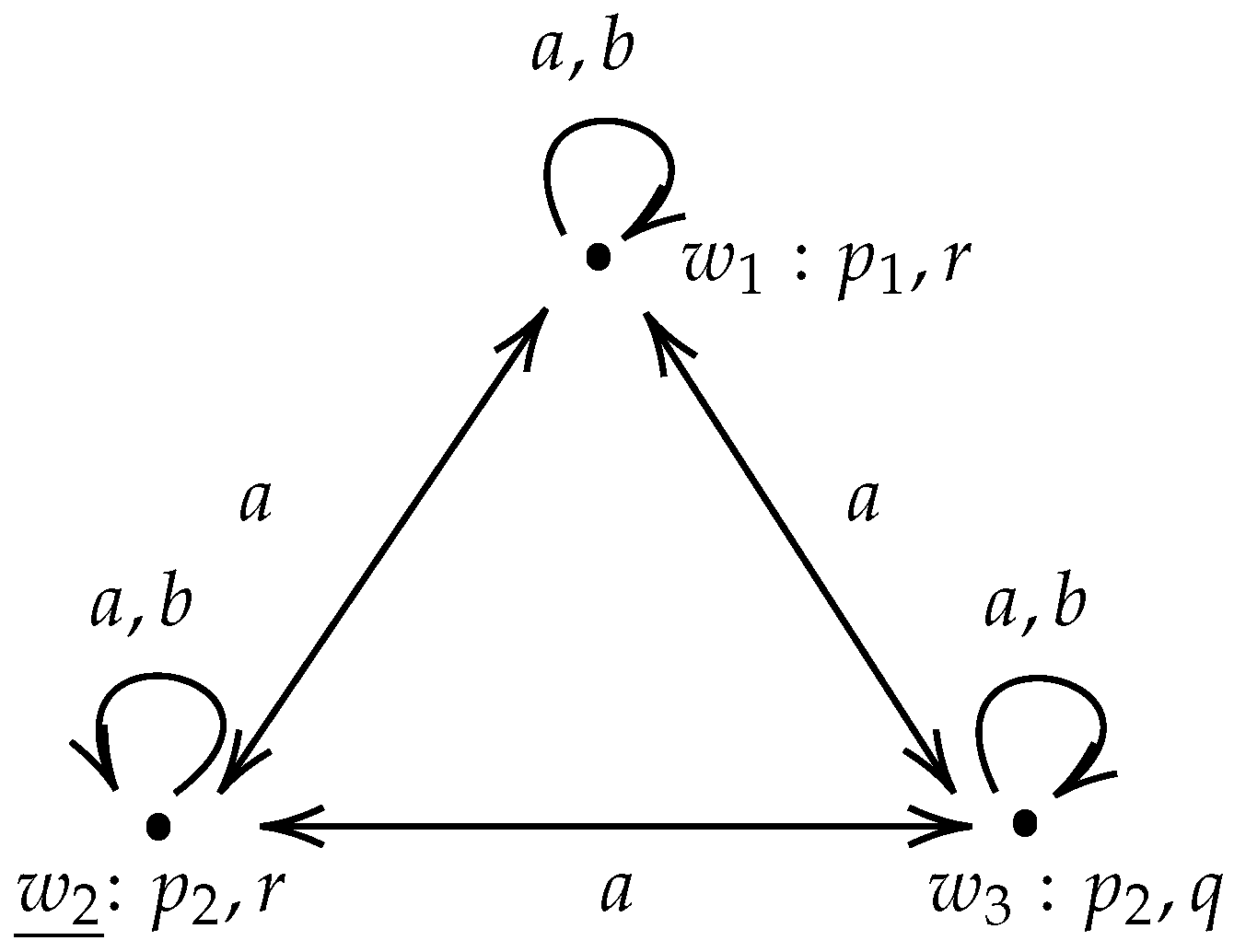
From the example and the definition of the CPEL model, it follows that for agent a, since he cannot distinguish any possible worlds, for any we have
Similarly, we obtain , and hence, by Definition 2 (2), we have . On this basis, by Lemma 1 (4),
Since agent b already knows that the actual world is , Lemma 1 (4) implies that
Therefore, in this example, and . We can see that for agent a, since he has no additional information, he can only reason on the basis of the game rules. As a result, he assigns probability to the event that Box 2 is selected, and, conditional on drawing a red ball, he assigns probability to the event that the ball is drawn from (since Box 1 contains more red balls). By contrast, agent b, having observed the drawing process, knows that the red ball was drawn from , i.e., holds. Consequently, conditional on drawing a red ball, he assigns probability 1 to the event that the ball is drawn from . This example illustrates that, within the CPEL framework, agents’ probability assignments to propositions may vary depending on the information available to them.
3. Properties of the Conditional Probability Operator
In this section, we examine the properties of the conditional probability operator in CPEL, as well as its interaction with the knowledge operator. We restrict attention to the single-agent case by fixing an arbitrary agent i and suppressing the agent index in what follows, unless confusion may arise.
Proposition 1.
The conditional probability function in the CPEL model satisfies the following property: for any , we have
Proof.
This follows directly from the properties of the conditional probability function. □
Proposition 2
(Properties of the Conditional Probability Operator). The following formulas for the conditional probability operator are valid:
- (1)
- , for ;
- (2)
- ;
- (3)
- ;
- (4)
- ;
- (5)
- ;
- (6)
- .
Proof.
(1) Given any point model , assume that . Then, based on the semantics, we have
- *
- If , then holds;
- *
- If . By Proposition 1, we have.Based on properties of sets, we derive that . Combining this with Lemma 1 (5), it follows that , which implies , and by the semantic definition, we have .
- (2)–(6) The proofs of these properties follow directly from the properties of the conditional probability function and are thus omitted.
□
Proposition 2 describes several key properties of conditional probability, with (1) corresponding to the finite additivity of the conditional probability operator; (2)–(4) corresponding to various forms of the product of conditional probabilities for the conjunction of formulas; (5) establishing that, under a same condition, if the conditional probability of a conjunctive statement is 1, then each conjunct’s conditional probability is also 1, and vice versa; and (6) asserting that, under any condition, the probability of a tautology is always 1.
Proposition 3.
For the conditional probability operator, we have
- (1)
- If , then ;
- (2)
- If , then ;
- (3)
- If , then .
Proof.
(1) Assuming , then for any point model , it follows that . Consequently, . From the definition of (condition (1)), we know that, for any , is a conditional probability function over . Using Lemma 1 (2), we conclude . Thus, by semantics, we have .
(2) Given a CPEL model , suppose that , that is, for any pointed model , and . According to the semantics, we have and . By Lemma 1 (4), . Since , we have , thus . From , it follows that . Combining this with Lemma 1 (2), we have . Therefore, we obtain . By the semantics, we have .
The proof of (3) is similar to (2) and is therefore omitted. □
Proposition 3 (1) indicates that if an implication is valid, the conditional probability formula stating “given its antecedent, the conditional probability of the consequent is assigned a value of 1” is also valid. This proposition characterizes a trivial case of the “Adams Thesis”8 of conditional statements: if a conditional is assertable (and indeed holds in all cases the conditional probability of the consequent given its antecedent should be 1. To explain why the premise of (1) can represent a conditional, a brief introduction to the formalization of conditionals in modal logic is necessary.
In modal logic, at least two primary approaches have been proposed for formalizing the conditional “If , then . (denoted )”.
- (1)
- The strict implication approach, which defines as , is derived from C. I. Lewis [19]. The truth condition for this formula is that does not hold in any state, which is the premise of Proposition 3 (1);
- (2)
- The relative similarity approach, which defines as , comes from David Lewis [20]. This approach combines relational semantics with David Lewis’s “similarity” between states. According to this, if and only if there is no state in which is true, or there exists an accessible state u of w where , and for any state v, if , then . Here, is a weak ordering representing the similarity between states relative to w, such that means that v is equally or more similar to w than u (This weak ordering is pre-defined, but Lewis’s discussion on how to establish such orderings remains vague. He opposed using a uniform standard to compare the similarity between states, claiming that for any two states, their similarities and differences should be weighed specifically). Thus, Proposition 3 (1) implies which leads to , and can therefore be seen as a valid conditional.
If the premise of an inference does not hold, proposition 3 (1) does not hold. Consider the following model: Let , represents “rolling a fair die and landing on n”, and denote “the die lands on an even number,” i.e., .
As shown in Figure 2, the numbers on the solid lines denote the conditional probability values assigned by the agent between connected states, conditioned on the universal set . These lines are undirected to reflect that the probability assignments are bidirectional. The details of the model are as follows:
- ;
- ;
- , where
- , where ;
- .
Figure 2.
Dice roll example.
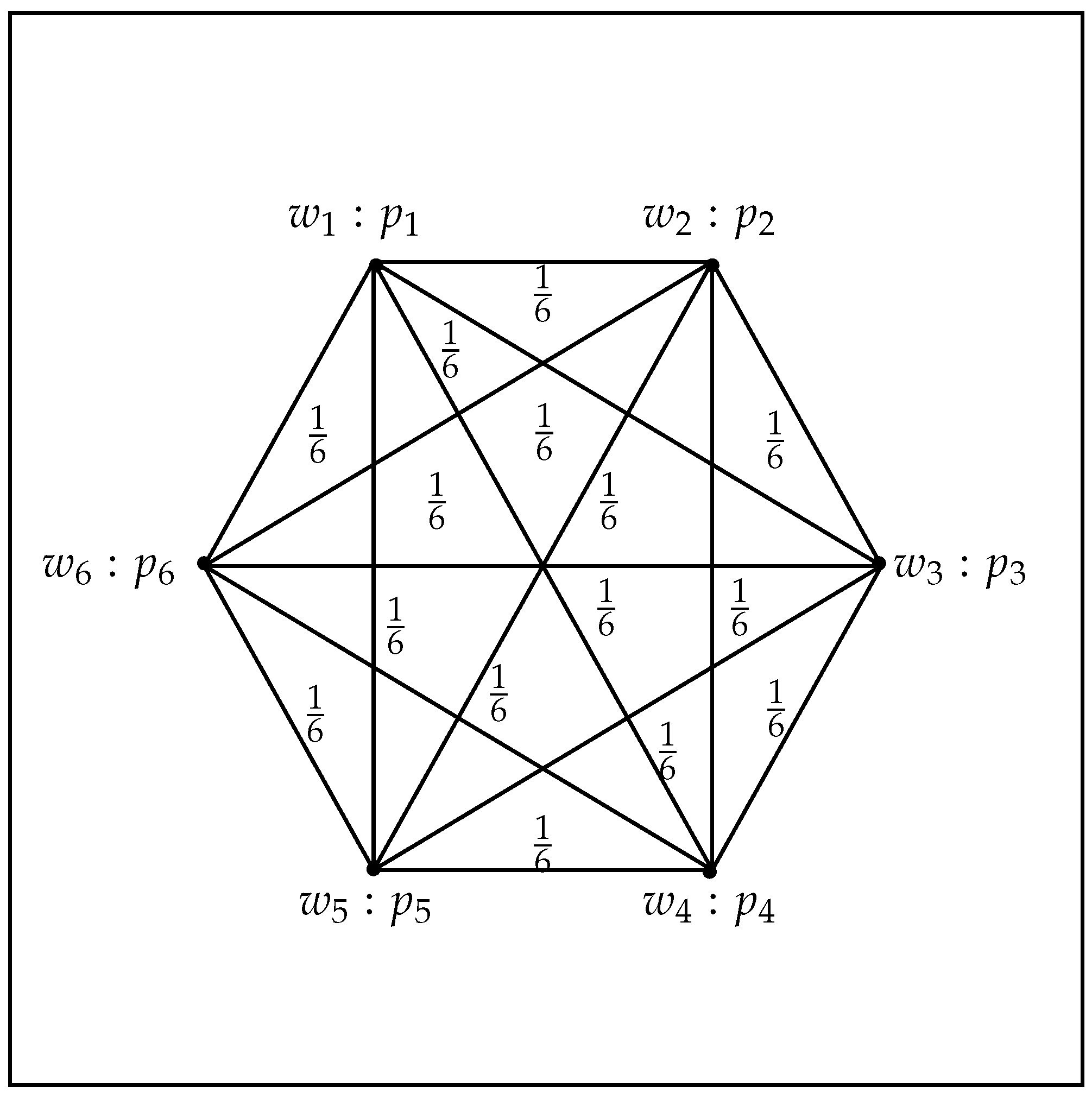
As shown in Figure 2, for pointed model , we have . However, under condition , the conditional probability of is , by Lemma 1 (4), we get . Thus, by the semantics, .
David Lewis [21] emphasized that Adams’s concept of “assertability” should not be understood as the “probability of a proposition being true.” Therefore, the assertability of a conditional is not equivalent to the probability assignment . In this view, Adams’s thesis actually denies that conditionals have any form of truth conditions and instead asserts that they can only be evaluated through “assertability,” which is defined by the agent’s subjective conditional probability assignment function.
Proposition 4.
There exist formulas , and a rational number such that
Proof.
Consider the model illustrated in Figure 2. Let denote . From this model, it can be derived that and . □
Proposition 4 further demonstrates that conditionals cannot be formalized as material implications. The probability that a material implication is true (which here is represented by the conditional probability assignment with the condition set to ⊤) does not necessarily equal the conditional probability of the consequent given its antecedent. This supports David Lewis’s conclusion: we should interpret the assertability of a conditional as , but we should never equate this interpretation with ).
In fact, there has been ongoing debate regarding whether conditionals have truth values. If conditionals are understood as expressions of an agent’s conditional beliefs, then conditionals should not have truth values but rather represent degrees of subjective belief. In this view, “assertability” is one of the suitable ways to characterize this subjective belief. For the lack of in-depth study of conditionals, we remain neutral on this debate. However, based on the preceding discussion, we can conclude that directly assigning subjective probabilities to material implications is not an appropriate method for characterizing an agent’s conditional beliefs.
Proposition 5.
There exist formulas , and a rational number such that
- (1)
- (2)
- (3)
Proof.
(1) Consider the model shown in Figure 2, where is defined as . From the proof of Proposition 4, we have . From this model, it follows that and , implying that .
(2) Consider the model in Figure 2, where is defined as . From this model, it follows that and .
(3) Consider the model in Figure 2, where is defined as . From the proof of Proposition 4, we have . Similarly, it follows that , and thus, . □
Proposition 6
(Interaction of Conditional Probability and Knowledge Operators). Based on the CPEL model, we derive
- (1)
- ;
- (2)
- ;
- (3)
- .
Proof.
The proofs of these validities follow directly from the conditions of defined in Definition 3. □
Proposition 6 (1) captures the certainty of an agent’s knowledge: under any condition, the conditional probability assigned to a known proposition is 1. Proposition 6 (2) and (3) imply that agents should know their probability distributions, which aligns with our basic understanding of knowledge.
Together, Propositions 2, 3, and 6 establish the foundation of probabilistic reasoning within the CPEL model, enabling it to precisely characterize the properties of conditional probability and the relationship between probability and knowledge. Thus, CPEL provides an ideal theoretical framework for formalizing and reasoning about related issues.
Proposition 7.
Given a conditional probabilistic epistemic model , the following formula is valid:
- 1
- 2
- .
Proof.
(1) Let be an arbitrary CPEL model and be an arbitrary state. Assume that . According to the semantic definition of the knowledge operator, for any , we have . Consequently, . By the CONS property of in Definition 3, we have . Since , it follows from the semantic definition of the belief operator that .
(2) Let be an arbitrary CPEL model and be an arbitrary state. Assume that and .
According to the semantic definition, from , we have . Furthermore, based on Proposition 1, we obtain .
On the other hand, from , it follows that . By the definition of the belief operator, this implies or . This contradicts the fact that . □
Proposition 7 (2) presents the formal features of Lockean belief within the framework of conditional probabilistic epistemic logic. That is, given the same condition, an agent believes only if the conditional probability assigned to the proposition is strictly greater than that of its negation (i.e., ). If the agent assigns the same probability to as to , then the agent believes neither nor .
Proposition 8.
There exist formulas such that
Proof.
Consider the following CPEL model , where
- ;
- ;
- ;
- For any , ;
- .
From this model, we have and . However, . It then follows from the semantic definition that . □
4. Axiomatization of CPEL
In this section, we present a proof system of CPEL, along with its soundness and weak completeness theorems and the proof sketch of these theorems.
Definition 7.
The Proof System CPEL consists of axioms and rules presented in Table 1.
Table 1.
System CPEL.
In Table 1, axioms – represent properties of conditional probability. expresses that holds only if . Specifically, A6 states that when a condition is “possibly known” to an agent, the sum of the agent’s conditional probability assignments to and under cannot exceed 1. Intuitively, this means that an agent cannot regard both a proposition and its negation as having probability greater than 0.5 under the same condition. Without this restriction, according to Definition 2 (4), in the case where , the agent could simultaneously assign probability 1 to both and , which clearly violates the fundamental principle of probabilistic consistency.
indicates that if an agent knows , then they assign a probability of at least 1 to under condition ⊤. and state that agents know their probabilistic assignments. KC4 reflects the consistency between the agent’s probabilistic assignments and her epistemic state. Let represent derivability in CPEL, or that is a theorem of CPEL. Unless otherwise specified, ⊢ will refer to .
Lemma 3.
For any conditional probabilistic epistemic model , the following two conditions are equivalent:
- (1)
- (2)
- There exists such that
Proof.
The proof of this lemma follows directly from the semantic definition and is thus omitted. □
Theorem 1
(Soundness). For any formula ϕ, if , then .
Proof.
To prove the soundness of CPEL, it is necessary to show that every axiom in CPEL is valid in any CPEL model and all rules preserve validity. The validity of axioms , , and is straightforward. Axioms , , , and are proven in Propositions 2 and 6. The validity of and the preservation of validity by the rule are provided below. The other axioms and rules follows naturally from the semantics.
- : Given any conditional probability epistemic model and a state w, assume and . If , then by Lemma 3, we know . According to the semantics,
iff iff and Adding these inequalities, by Proposition 1, we get , which impliesAccording to Definition 3 for , the assignment of is at most 1, which leads to , contradicting the condition . Thus, the assumption does not hold. - To show the rule preserves validity in the general frame, we assume that for any pointed model , we have for all , but there exists a point model such that . By the semantic definition, from , it follows that and . Further, from and , we obtain . Thus, we have , meaning there exists t with such that . However, for any specific probability value assigned to t, there always exists some r such that , leading to a contradiction. Consequently, the rule preserves validity within the general frame.
□
The CPEL system is non-compact, as illustrated by the following set of formulas:
Each finite subset of is satisfiable, but itself is unsatisfiable. Therefore, only the weak completeness of CPEL can be established.
Theorem 2
(Weak Completeness). CPEL is weakly complete with respect to the class of CPEL models; that is, for any formula , if , then .
Proof.
Our proof strategy follows a similar approach to that in [13,14]. The proof proceeds as follows, with full details provided in the Appendix A.
- (1)
- Define the depth and local languages to restrict formulas and prove finiteness of equivalence classes of formulas.
- (2)
- For a randomly given consistent formula , construct a canonical model . Here,
- -
- is the set of maximally consistent sets in that are equivalent, with respect to the equivalence relation ∼, to a fixed maximally consistent set containing , where if and only if they contain the same formulas with K and operators.
- -
- is an epistemic relation on , such that for any , if and only if and contain the same formulas with K and operators.
- -
- , and for any , .
- -
- is a mapping from to .
- -
- is the canonical valuation, satisfying .
Then, prove the truth lemma, which shows the equivalence between a formula being true in a state of the canonical model and belonging to the corresponding maximal consistent set. - (3)
- Prove that the frame in the canonical model is a CPEL frame.
The most challenging part of proving the weak completeness of CPEL is establishing the canonical conditional probability function within the canonical model. Specifically, it must be shown that for any , a conditional probability function exists that interprets all formulas with conditional probabilities in . Following the approach used in [13], we define
This serves as the required canonical conditional probability function, where denotes the maximal consistent extension of within . □
5. Applications of CPEL
This section examines how CPEL can be applied to analyze the lottery paradox. The lottery paradox, first proposed by Henry Kyburg in [22], is outlined as follows: In a fair lottery with 1000 tickets, it is known that exactly one ticket will win. Each ticket holder is justified in believing, for any ticket j (where ), that “ticket j will not win.” If each of these beliefs is accepted as reasonable and if conjunctions of reasonable beliefs are also reasonable, then the conjunction of all 1000 beliefs—“no ticket will win”—would itself be a reasonable belief. However, since it is known that one ticket will indeed win, this creates a contradiction.
The lottery paradox is commonly attributed to three principles:
- 1.
- High Probability Principle: An agent believes p if and only if the probability of p is sufficiently high. The accepted probability threshold is typically 0.5, i.e., a proposition is reasonably accepted if its subjective probability exceeds 0.5.
- 2.
- Closure Under Conjunction: If each belief in a set is reasonably accepted, then the conjunction of these beliefs is also reasonably accepted. Specifically, if propositions p and q are reasonably accepted, then their conjunction should also be reasonably accepted.
- 3.
- Consistency Principle: A set of reasonably accepted propositions must be logically consistent; that is, no contradictory propositions (e.g., ) should be simultaneously accepted.
Various solutions to the lottery paradox focus on revisiting these principles. The leading proponents of the high-probability acceptance rule include Laurence Bonjour, Sharon Ryan, and John L. Pollock. Bonjour [23] argued that in the formation of the lottery paradox, once an agent has already accepted the proposition that “at least one ticket will win,” then the belief that “ticket i will not win” is, in his view, a false belief and thus should not be accepted. This effectively amounts to a rejection of the high-probability acceptance rule. Ryan [24] advanced the “avoid error” principle, according to which, if an agent knows that among there must be at least one false proposition, then, out of epistemic caution, the agent should withhold acceptance of all such propositions. Pollock [25], by contrast, directly rejected the high-probability acceptance rule, maintaining that belief does not depend on probability and that certainty, rather than probabilistic support, is necessary for the formation of belief.
As for solutions concerning the deductive closure rule, the most representative view is that of Henry Kyburg, the originator of the lottery paradox. Kyburg [26] proposed weakening the deductive closure rule—introducing a “weak deductive closure” principle—as a way of resolving the paradox.
We noticed that the paradox arises not because the agent lacks adequate information about each ticket’s probability of losing, but because the agent is aware of the inconsistency within their belief set but is unable to resolve it. In the framework of CPEL, the lottery paradox can be formalized to help the agent clearly identify the inconsistent belief within the set.
We construct a CPEL model for the lottery paradox as follows. Let represent the fact that exactly one ticket will win, and let denote that ticket j will win (for ), where is true only in , is true only in , and so forth. Based on this notation, the CPEL model represents the lottery paradox (see Figure 3 for a detailed illustration).
- ;
- ;
- , where
- , ;
- .
Figure 3.
CPEL Model for the Lottery Paradox.
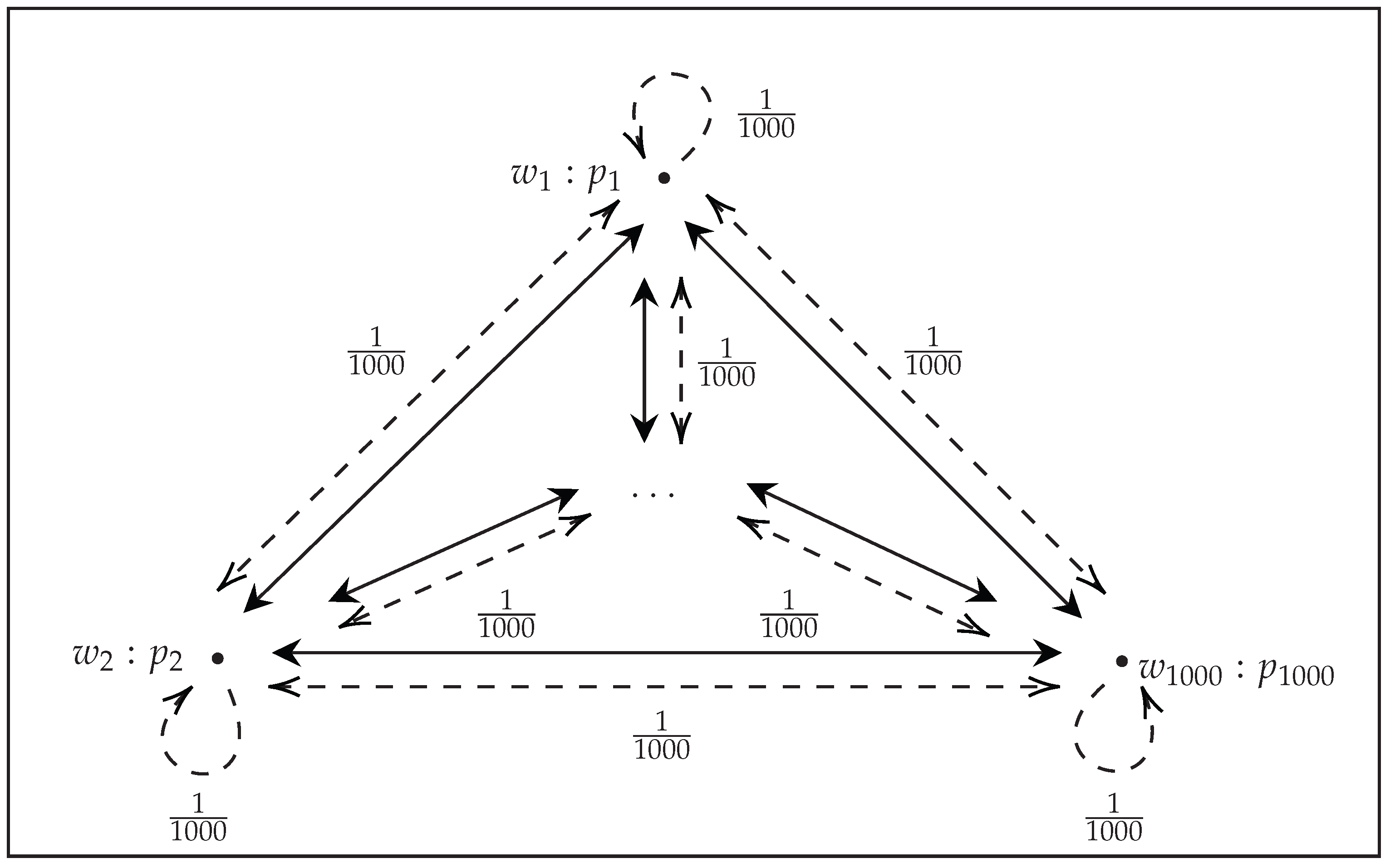
In this model, for any state and any specific ticket j, the agent assigns a high probability to the ticket losing:
Since , according to the semantics of the conditional belief operator, it follows that . Thus, we obtain
In this model, we also have . Accordingly, under conditioning on the , the agent believes and . However, .
From this, it follows that
Since , we have . Thus, we cannot infer
from
This analysis, together with Proposition 8, leads to two conclusions regarding the lottery paradox and the conjunction closure principle within CPEL:
1. CPEL formally verifies that beliefs defined by a high probability threshold are not closed under conjunction. As shown in the lottery paradox analysis, while the agent holds a belief for each individually ( holds), the belief in the total conjunction is explicitly rejected ( holds). Furthermore, Proposition 8 demonstrates that this failure is not limited to cases of logical inconsistency; even when the conjunction of propositions is logically consistent (i.e., the intersection of their extensions is non-empty), the belief in the conjunction may still fail if the probability of the intersection drops below the threshold.
2. CPEL explicates the mechanism behind this failure through the semantic properties of the conditional probability measure. In the specific case of the lottery paradox, the failure arises because the extension of the total conjunction is inconsistent with the condition , resulting in an empty intersection and a probability of exactly zero. More generally, as illustrated in the proof of Proposition 8, the probability of a conjunction is determined by the measure of the intersection of events (). Since the measure of an intersection is bounded by the measure of the individual conjuncts, the probability of the conjunction naturally decreases (or becomes zero) relative to the individual probabilities. This demonstrates that the high-probability threshold criterion for belief is inherently sensitive to the accumulation of uncertainty.
Therefore, after analyzing the lottery paradox and the general properties of the belief operator within the CPEL framework, we demonstrate that the failure of the conjunction closure principle is a natural consequence of the probabilistic calculus and the threshold-based definition of belief, rather than a result of ad hoc stipulations. This aligns with Kyburg’s intuition but provides a precise formal language to describe how rational agents manage high-probability beliefs under uncertainty.
6. Conclusions and Future Work
Based on studies by [12,14], we have adopted conditional probability as a primitive notion. By replacing the standard frame with the general frame, we proposed conditional probabilistic epistemic logic (CPEL), and assigned conditional probabilities to the set of admissible valuations, which resolves the issue of unmeasurability of epistemic formulas and conditional probability formulas in the ordinary framework. In a nutshell, CPEL has two strengths compared with related works: 1. Compared with Dautović et al. [15]), CPEL can represent and reason about events with zero-probability conditions, which are ubiquitous in our everyday life; 2. Compared with Baltag and Smets [12] and Hernandes [14], CPEL solves the measurability problem, which lays a solid mathematical foundation for epistemic-probabilistic interaction. Then, by analyzing the relationship between conditionals and conditional probabilities, we clarified that directly assigning subjective probabilities to conditionals is not an appropriate method for characterizing subjective conditional beliefs. Furthermore, through the exploration of the relationship between conditional probability and knowledge, we incorporated two conditions, CONS and SDP, into the epistemic model of conditional probability, clarifying the properties that the knowledge operator should have in CPEL. Finally, we constructed a sound and weakly complete CPEL axiomatic system, and explored how to use CPEL to resolve the lottery paradox.
The notion of knowledge presented in this paper is formulated within the S5 framework and corresponds to deterministic knowledge: once an agent knows a proposition , it assigns conditional probability 1 to under any condition. This constitutes a rather strong idealizing assumption. By contrast, in real-life epistemic contexts, notions of “fallible knowledge”—which allow for the possibility of revision—often offer greater explanatory power. Against this background, and in light of the discussion in Section 3 concerning the relationship between logical systems and conditionals, there remains an important direction for further investigation: if the deterministic knowledge in the S5 system is weakened to a notion of “fallible knowledge”, what kind of intrinsic relationship arises between such fallible knowledge and conditional belief? More specifically, can these two notions be formally characterized in terms of one another, or even mutually defined?
On this basis, we can further explore the connection between belief in conditionals and conditional belief. Existing studies have shown that these two notions are neither conceptually equivalent nor identical in their core properties, but instead differ in essential respects (see [27]). Consequently, a key issue is the extent to which conditional belief can serve as an adequate representation of belief in conditionals, as well as how belief in conditionals may be more finely captured using the tools of conditional probability—particularly with regard to providing a semantic account that is better suited to its distinctive features.
In this context, Rosella et al. [28] gave an algebraic semantics for Lewisian counterfactuals, and integrated the belief function into their algebraic models as the combination of probability measures and the normal necessity operator □. Although belief in conditionals and belief update was the topic in their work, conditional probability is not a fundamental concept in their models, which showed their reductionist position, namely, belief in conditionals is the calculation of something more basic. However, we are still curious about the other way around: with conditional probability as a primitive notion, to what extent can belief in conditionals be expressed (with no reduction) in our language, and how can we present the difference between belief in conditionals and conditional beliefs in our model? To answer these questions, further investigation of this approach is needed.
Beyond the core distinction between these two types of beliefs, future work can also extend to comparing frameworks for modeling uncertainty. As Flaminio et al. [29] note, “There are two important mathematical theories of uncertainty: the theory of probability and the theory of fuzzy sets.” Building on [30,31], we observe that the definition of fuzzy conditional probability in fuzzy logic shares many similarities with the conditional probability function in CPEL. For this reason, a promising direction for future work is to compare the representational accuracy of uncertainty in the two frameworks—namely, the quantitative probabilities in CPEL and the qualitative constraints of lower probabilities. It is also worth investigating whether, under appropriate conditions, these two logic systems can be translated into one another. Such a study would provide useful tools for modeling more complex forms of epistemic uncertainty, such as agents’ fuzzy assessments of probability distributions.
Another natural extension of the current work lies in scaling CPEL from a single-agent to a multi-agent framework. Specifically, we need to clarify how to define and describe the knowledge and beliefs of groups—a direction that deserves further investigation. Particularly in the context of conditional probability, it is essential to determine how to define group conditional beliefs based on individual beliefs, and to explore how to model the belief update mechanisms in multi-agent interactions as well as their impact on group decision-making.
Finally, how to integrate CPEL with dynamic epistemic logic raises an intriguing question. In probabilistic dynamic epistemic logic, the update mechanism for probability functions closely parallels Bayesian updating. Intuitively, the probability of a formula given should be equal to the probability of after the public announcement of . Kooi [2] examines the relationship between the conditional probability formula and the probabilistic formula with public announcement , demonstrating that these two formulations are not equivalent within probabilistic dynamic epistemic logic. Introducing a public announcement operator into CPEL and analyzing its interaction with the conditional probability operator under different models offer promising avenues for exploring the similarities and differences in probability updating.
Author Contributions
Q.S.: writing—review and editing, writing—original draft, methodology, formal analysis, conceptualization. S.T.: methodology, formal analysis, conceptualization. All authors have read and agreed to the published version of the manuscript.
Funding
This research received no external funding.
Data Availability Statement
No new data were created or analyzed in this study.
Conflicts of Interest
The authors declare no conflicts of interest.
Appendix A. CPEL Completeness Proof
Proposition A1.
The following are some theorems and derived rules in CPEL:
- 1.
- , for ;
- 2.
- ;
- 3.
- ;
- 4.
- ;
- 5.
- ;
- 6.
- ;
- 7.
- ;
- 8.
- ;
- 9.
- If , then , for .
Proof.
Here, we present the proof for item 9 only.
9. If , then , for
| (1) | Premise |
| (2) | |
| (3) | |
| (4) | |
| (5) | |
| (6) | |
| (7) | |
| (8) | |
| (9) | |
| (10) | |
| (11) | |
| (12) | -rule, K-axiom, |
| (13) | -rule, K-axiom, |
| (14) |
□
Definition A1.
For any formula , the depth dp of ϕ is defined recursively as follows:
- dp, where p is an atomic proposition;
- dp;
- dpdp, dp;
- dpdp;
- dpdp, dp.
Definition A2
(Local Language). Let P denote a finite set of atomic propositions such that , , where represents the set of positive integers, and denote the maximum depth of formulas. Define the sublanguage of as the set of formulas meeting the following conditions:
- Atomic Proposition Constraint: P is the set of atomic propositions that appear in formulas in ;
- Index Constraint: If a formula with a conditional probability operator appears in , its index must be a multiple of ;
- Depth Constraint: Formulas in have a depth no greater than s;
Here, z is called the accuracy of the language .
Definition A3.
For any formula , define the equivalence class of ϕ as
Lemma A1.
If the set of atomic propositions P is finite, then the set is also finite.
Proof.
This proof follows directly from Lemma 3.10 in [14]. □
Definition A4
(Finite Local Language). Let P denote a finite set of atomic propositions such that , , where represents the set of positive integers, and denote the maximum depth of formulas. A finite sublanguage of is defined as any largest set of formulas satisfying the following conditions:
- ;
- For any formula , contains exactly one formula from .
Based on Lemma A1, if P is a finite set of atomic propositions and , then there exists a finite subset such that every formula in is provably equivalent to one of . Let denote the conjunction of . By definition of and , we have .
Definition A5
(Maximal consistent set of formulas of ). Let , Γ is Maximal consistent iff:
- Γ is consistent: ;
- Γ is maximal: If and , then .
Definition A6
(Maximal consistent set of ). Let , Γ is a maximal consistent iff:
- Γ is consistent: ;
- Γ is maximal: If and , then .
The definition of the maximal consistent set in and are essentially identical. Consequently, the following lemmas and their proofs apply to both.
Lemma A2
(Lindenbaum’s Lemma). Let denote either or , if a set of formulas Γ is -consistent, then there exists a maximal consistent set such that .
This proof follows directly from Lemma 7.3 in [32].
Lemma A3.
Let denote either or , if Γ is a maximal consistent set, then for any formula , the following properties hold:
- Γ is deductively closed.
- if and only if .
- if and only if and .
This proof follows directly from Lemma 7.4 in [32].
Lemma A4.
Let be maximal consistent sets of , if , then .
Proof.
If , then . Since both are maximal consistent, it follows from the definition of maximal consistent set that . □
Definition A7.
Given a consistent formula , the language is defined as , where
- is the set of atomic propositions appearing in ψ.
- is the least common multiple of the denominators of all indices in ψ.
- is the depth of ψ.
Definition A8.
Given a consistent formula , let be the finite local language associated with ψ. We construct the canonical model components as follows:
- 1.
- Let W be the set of all maximal consistent sets in .
- 2.
- Fix a specific maximal consistent set such that .
- 3.
- For any , let be the set of formulas in Γ restricted to the modal and conditional probability operators. Specifically:
- 4.
- For any , define the relation if and only if .
- 5.
- The set of states is defined as the set of maximal consistent sets equivalent to :
- 6.
- For any , the epistemic relation is defined as .
- 7.
- For any formula , define the extension .
- 8.
- The set of admissible valuations is .
Lemma A5.
For any choice of , .
Proof.
The proof follows directly from Lemma 3.12 in [14]. □
Lemma A6.
.
Proof.
By Definition A8, we have .
Let and define . Clearly, . From Definition A8 (6), it follows that , implying .
Assume . By Definition A8 (6), we have ; thus, there exists such that and . By Lemma A4, we have , and thus . Combining these results, , which implies . □
Lemma A7.
The relation ∽ is an equivalence relation on .
Proof.
This proof follows directly from Definition A8. □
Lemma A8.
forms a σ-algebra on , and for any , if , then .
Proof.
This proof follows immediately from Lemma A6. □
We have demonstrated that , and satisfy the conditions required by a CPEL model. We now proceed to construct the probability function in the canonical model.
Definition A9.
Let be a maximal consistent set in , and let . Define
Let denote . Clearly, . For any , Lemma A2 ensures the existence of a maximal consistent extension . Note that is not unique. In subsequent proofs, the superscripts + and * will indicate extensions in and , respectively.
Lemma A9.
For any and formulas :
- (1)
- If , then either or .
- (2)
- If , then and .
Proof.
(1) This follows from Lemma 3.14(a) in [14].
(2) If , then by Lemma A3, we have . By propositional logic, it follows that . By K-rule, K-axiom and -rule, we have . For any , By Proposition A1 (5) and , we have . By -axiom and Definition A9, we also have and . By Definition A9, we know that and . □
Definition A10.
For any , let be a maximal consistent extension of in and be formulas in . Define
Lemma A10.
If t is a rational number and , then .
Proof.
The proof follows from Lemma 3.16 in [14]. □
Lemma A11.
Let and , then .
Proof.
The proof follows from Lemma 3.17 in [14]. □
Definition A11.
For any formulas and any , the function is defined as follows:
Lemma A12.
For any , the following holds:
Proof.
The proof follows directly from the definition of in Definition A8, the 4-axiom, the 5-axiom, the -axiom, and the -axiom. □
Lemma A13.
For any formulas and any , the following equation holds:
Proof.
The proof follows from Lemma 3.21 in [14]. □
Lemma A14.
For any formulas and any , the following equation holds:
Proof.
Assume , by Lemma A3, for any , if , then . It follows that .
Let , assume . Then is consistent, and there exists such that . Consequently, and , contradicting . Hence, . □
Proposition A2.
The function is well-defined.
Proof.
This result follows from Lemma 3.24 in [14]. □
Lemma A15.
For any formulas and any . If and , the following equation holds:
Proof.
This result follows from Lemma 3.18 in [14]. □
Lemma A16.
For any formulas and any , the following equation holds:
Proof.
This result follows from Lemma 3.19 in [14]. □
Lemma A17.
For any formula and any . if and only if .
Proof.
If , by Definition A8 (6), we know that there exists such that . Assume , by Lemma A3, we have . Then, by the T-axiom and Lemma A3, we get , contradicting .
If , by Lemma A3, we know that . assume that is inconsistent, which implies . By K-rule and K-axiom, we have . Then by Lemma A3, we know that , which contradicts . Thus, is consistent. By Lemma A2, and . Hence, it holds that . □
Lemma A18.
For any , .
Proof.
By Lemma A6 and Definition A11, we know that any subset of belongs to . Thus, . □
Lemma A19.
For any , the following hold:
- (1)
- For any , .
- (2)
- If and with , then
- (3)
- If , then
- (4)
- For any , if , then .
- (5)
- For any , if , then for any , .
- (6)
- For any , .
Proof.
Proofs for (1)–(3) can be found in Lemma 3.25 of [14].
(4) By Definition A8, we have . If and , then by Lemma A6, we have . Consequently, by Lemma A19 (1), we obtain .
(5) By Definition A8, if , then and contain the same formulas of the form . Thus, for any formulas , it holds that . Then, by Definition A11, we get .
(6) Let . By the Definition A8, there exists a formula such that . Similarly, , since no maximal consistent set contains ⊥. According to the Definition A11, we have , where (Definition A11). From Proposition A1 (5), we know that is a theorem of CPEL. Since is a maximal consistent set, it is deductively closed (Lemma A3). Therefore, it must contain all theorems, which implies . Since the probability value r is bounded by 1, so we have . Consequently, . □
Definition A12
(Canonical Model). The canonical model is defined as , where
- .
Lemma A20
(Canonicity). The canonical model is a CPEL model.
Proof.
By Definition A8 and Lemma A7, we know that forms a -algebra over , and for any , if , then . Lemma A8 shows that satisfies the necessary conditions for R. Lemmas A18 and A19 prove that satisfies measurability, normality, consistency, and the property of state-determined probability. Thus, is a CPEL model. □
Lemma A21.
For any , let such that is consistent, where . For any formulas , if , then there exists a rational number such that is consistent.
Proof.
This proof follows from Lemma 3.26 in [14]. □
Lemma A22.
For any , there exists a maximal consistent extension of in that satisfies the following condition:
For any formulas , if , then .
Proof.
This proof follows from Lemma 3.27 in [14]. □
Lemma A23.
If , then is consistent.
Proof.
Assume that is inconsistent, it follows that . By the K-rule and K-axiom, we have . Furthermore, by Lemma A12, we get . Then by propositional logic, we obtain . Since , it follows from Lemma A3 that . However, this contradicts the assumption that . □
After proving these lemmas, we proceed to establish the truth lemma. Enumerate the elements of as . By Definition A11, we have
Lemma A24
(Truth Lemma). Let be the canonical model generated over . For any and for any formula :
Proof.
We prove it by induction on . The cases for atomic propositions and Boolean formulas are straightforward. We focus on the cases and .
- The case for .
- *
- Suppose . If , then by Lemma A23, is consistent. Thus, there exists a maximal consistent set such that . Since , we have . By and Lemma A3, we get , the induction hypothesis implies . Thus, . This contradicts the hypothesis.
- *
- If , then for any , it follows by Definition A8 that . By the T-axiom, . Thus, by Lemma A3,we have and the induction hypothesis implies . Therefore, .
- The case for .
- *
- Suppose , that is, .If , we have two cases to consider:
- (1)
- If , then in this case , it follows that . Thus, .
- (2)
- If , in this case . By Lemma A9 (1) and Lemma A22, we have . Since we have . Hence, .
If , then by Lemma A9, , and by Proposition A1 (7), it follows that . - *
- Assume , it follows that . Thus, .
□
Theorem A1
(Weak Completeness). CPEL is weakly complete with respect to the class of CPEL models. That is, for any :
Proof.
Suppose that , it follows that is consistent. Then, by Lemma A2, there exists a maximal consistent set such that . By the truth lemma, there exists a canonical model such that . Furthermore, by Lemma A20, is a CPEL model. Therefore, . □
Notes
| 1 | the formula can be read as “If given , agent i considers the conditional probability of to be at least r, then agent i knows that “the conditional probability of given is at least r” |
| 2 | In epistemic logic, introspection means that an agent knows what she knows or does not know. It is formally expressed by the axioms (positive introspection) and (negative introspection). The justification lies in the assumption of rationality: if “agent i knows ” is true, then, provided the agent is rational, “agent i knows that she knows ” is also true. In CPEL, probabilistic introspection is understood as the agent’s knowledge of its own conditional probability distribution. Positive probabilistic introspection states that if agent i, given , assigns a probability greater than r to , then, provided the agent is rational, the agent also knows that the probability of given exceeds r. This formulation not only aligns with the intuitive understanding of knowledge but also satisfies the basic requirements imposed on rational agents in fields such as game theory. In this paper, introspection specifically refers to probabilistic introspection. |
| 3 | In this paper, probability values are restricted to rational numbers primarily for technical reasons related to the proof of weak completeness. |
| 4 | The CONS property is derived from the property introduced by Fagin and Halpern [1]: Given an epistemic model for probability spaces, for each probability space , it holds that . Although this paper does not explicitly define a probability space, the effect of CONS in CPEL is essentially the same: at a state , given the universal set as the conditioning event, the agent assigns probability 1 to any set containing , and assigns probability less than or equal to 0 to its complement . This stipulation is motivated by two philosophical considerations. First, if an agent at state knows a proposition (that is, is true at all worlds epistemically accessible from w), yet does not assign it maximal credence 1, the agent would fall into an epistemically incoherent state of “knowing but not being certain.” This is analogous to a weakened version of Moore’s Paradox. Second, the probability function in this paper represents the agent’s subjective uncertainty and thus forms part of the agent’s epistemic state at a particular world . At state w, when the universal set is taken as the condition, the fact that the agent assigns probability 0 to the complement of simply indicates that the states in are epistemically inaccessible at w; it does not mean that these worlds are removed from the model. Hence, it is necessary for a CPEL model to contain multiple equivalence classes, which represent objectively existing alternative possibilities. Conditioning in static CPEL reflects a redistribution of probability mass within the fixed indistinguishability set , rather than any change in the set of worlds itself. |
| 5 | The SDP property is derived from Fagin and Halpern [1]: Given an epistemic model for probability spaces, if , then . |
| 6 | The present argument crucially relies on the closure of admissible valuation sets under the extensions of epistemic formulas, which is ensured in general frames. In standard conditional probabilistic frames, where no such admissible valuations are specified, the required measurability may not hold. This is precisely the motivation for adopting general frames. |
| 7 | Sinceagent b already knows that the actual world is , the probability functions at other states play no essential role in this example and are thus omitted. |
| 8 | Adams [18] argued that using propositional logic to analyze the validity of reasoning involving conditionals leads to fallacies. Thus, he proposed that “assertability” rather than the condition of truth should be used to analyze conditionals. For a conditional “If , then ”, its assertability depends on the subjective probability of the consequent holding, given its antecedent. This definition is known as the “Adams Thesis”.) |
References
- Fagin, R.; Halpern, J.Y. Reasoning about knowledge and probability. J. ACM (JACM) 1994, 41, 340–367. [Google Scholar] [CrossRef] [Scilit]
- Kooi, B.P. Probabilistic dynamic epistemic logic. J. Log. Lang. Inf. 2003, 12, 381–408. [Google Scholar] [CrossRef] [Scilit]
- van Benthem, J.; van Eijck, J.; Kooi, B. Logics of communication and change. Inf. Comput. 2006, 204, 1620–1662. [Google Scholar] [CrossRef] [Scilit]
- van Benthem, J.; Gerbrandy, J.; Kooi, B. Dynamic update with probabilities. Stud. Log. 2009, 93, 67–96. [Google Scholar] [CrossRef] [Scilit]
- Lorenz, D.; Sack, J. Epistemic Probabilistic Logic. In Handbook of Epistemic Logic; van Ditmarsch, H., van der Hoek, W., Halpern, J.Y., Kooi, B., Eds.; College Publications: Gregory Hills, Australia, 2015; Volume Chapter 4, pp. 147–202. [Google Scholar]
- Achimescu, A.; Baltag, A.; Sack, J. The probabilistic logic of communication and change. J. Log. Comput. 2019, 29, 1015–1040. [Google Scholar] [CrossRef] [Scilit]
- Deng, M.; Guo, M. Probabilistic Epistemic Logic Based on General Frame. Stud. Log. 2022, 15, 57–75. [Google Scholar]
- Pan, Y.; Guo, M. Probabilistic epistemic logic based on neighborhood semantics. Synthese 2024, 203, 135. [Google Scholar] [CrossRef] [Scilit]
- Kolmogorov, A. Grundbegriffe der Wahrscheinlichkeitsrechnung Foundations of the Theory of Probability; Springer: Berlin/Heidelberg, Germany; Chelsea Publishing Company: New York, NY, USA, 1933; English translation. [Google Scholar]
- Fagin, R.; Halpern, J.Y.; Megiddo, N. A logic for reasoning about probabilities. Inf. Comput. 1990, 87, 78–128. [Google Scholar] [CrossRef] [Scilit]
- Rényi, A. On a new axiomatic theory of probability. Acta Math. Hung. 1955, 6, 285–335. [Google Scholar] [CrossRef] [Scilit]
- Baltag, A.; Smets, S. Probabilistic dynamic belief revision. Synthese 2008, 165, 179–202. [Google Scholar] [CrossRef] [Scilit]
- Zhou, C. A Complete Deductive System for Probability Logic. J. Log. Comput. 2009, 19, 1427–1454. [Google Scholar] [CrossRef] [Scilit]
- Hernandes, M.S.C. A Complete Conditional Probability Logic and Its Dynamic Extensions. Ph.D. Thesis, The Graduate University for Advanced Studies, Ishikawa, Japan, 2015. [Google Scholar]
- Dautović, Š.; Doder, D.; Ognjanović, Z. Reasoning about knowledge and conditional probability. Int. J. Approx. Reason. 2023, 163, 109037. [Google Scholar] [CrossRef] [Scilit]
- Thomason, S.K. Semantic analysis of tense logics. J. Symb. Log. 1972, 37, 150–158. [Google Scholar] [CrossRef] [Scilit]
- Hintikka, K.J.J. Knowledge and Belief: An Introduction to the Logic of the Two Notions; Cornell University Press: Ithaca, NY, USA, 1962. [Google Scholar]
- Adams, E. The logic of conditionals. Inquiry 1965, 8, 171–172. [Google Scholar] [CrossRef] [Scilit]
- Lewis, C.I. Implication and the algebra of logic. Mind 1912, 21, 522–523. [Google Scholar] [CrossRef] [Scilit]
- Lewis, D.K. Counterfactuals; Blackwell: Malden, MA, USA, 1973. [Google Scholar]
- Lewis, D. Probabilities of Conditionals and Conditional Probabilities. Philos. Rev. 1976, 85, 297–315. [Google Scholar] [CrossRef] [Scilit]
- Kyburg, H. Probability and the Logic of Rational Belief; Wesleyan University Press: Middletown, CT, USA, 1961. [Google Scholar]
- BonJour, L. The Structure of Empirical Knowledge; Harvard University Press: Cambridge, MA, USA, 1985. [Google Scholar]
- Ryan, S. The epistemic virtues of consistency. Synthese 1996, 109, 121–141. [Google Scholar] [CrossRef] [Scilit]
- Pollock, J.L. Epistemology and probability. Synthese 1983, 55, 231–252. [Google Scholar] [CrossRef] [Scilit]
- Kyburg, H.E., Jr. Conjunctivitis. In Induction, Acceptance and Rational Belief; Springer: Berlin/Heidelberg, Germany, 1970; pp. 55–82. [Google Scholar]
- Leitgeb, H. Beliefs in conditionals vs. conditional beliefs. Topoi 2007, 26, 115–132. [Google Scholar] [CrossRef] [Scilit]
- Rosella, G.; Flaminio, T.; Bonzio, S. Counterfactuals as modal conditionals, and their probability. Artif. Intell. 2023, 323, 103970. [Google Scholar] [CrossRef] [Scilit]
- Flaminio, T.; Montagna, F. A logical and algebraic treatment of conditional probability. Arch. Math. Log. 2005, 44, 245–262. [Google Scholar] [CrossRef] [Scilit]
- Godo, L.; Marchioni, E. Coherent conditional probability in a fuzzy logic setting. Log. J. IGPL 2006, 14, 457–481. [Google Scholar] [CrossRef] [Scilit]
- Corsi, E.A.; Flaminio, T.; Godo, L.; Hosni, H. A modal logic for uncertainty: A completeness theorem. In Proceedings of the International Symposium on Imprecise Probability: Theories and Applications, PMLR, Oviedo, Spain, 11–14 July 2023; pp. 119–129. [Google Scholar]
- van Ditmarsch, H.; van Der Hoek, W.; Kooi, B. Dynamic Epistemic Logic; Springer Science & Business Media: Berlin/Heidelberg, Germany, 2007; Volume 337. [Google Scholar]

Disclaimer/Publisher’s Note: The statements, opinions and data contained in all publications are solely those of the individual author(s) and contributor(s) and not of MDPI and/or the editor(s). MDPI and/or the editor(s) disclaim responsibility for any injury to people or property resulting from any ideas, methods, instructions or products referred to in the content. |
© 2026 by the authors. Licensee MDPI, Basel, Switzerland. This article is an open access article distributed under the terms and conditions of the Creative Commons Attribution (CC BY) license.