


Abstract
To travel safely, drivers must attend to various elements in their driving environment. When visually scanning for these elements, attention can be guided by a prime that provides target information. In a vehicle, this prime could be shown as a visual (alert) message to alert the driver in various situations. In an online experiment (N = 72), four primes (text warning, symbol warning, scene picture, target picture) were used in a visual search for five targets (pedestrian, cyclist, car, traffic sign, roadway). Reaction time until finding the target was measured via a button press. All primes led to a decrease in search time compared to the control condition. The text warning and scene picture did not differ significantly and were the least effective in improving reaction time. The symbol warning was the next more effective prime. Finally, the target picture resulted in the quickest visual search. The effectiveness of a prime depends on its characteristics. To reduce cognitive processing time, the prime should be visual rather than semantic (i.e., text). Also, it should share as many visual features with the target as possible to provide optimal attentional guidance.
1. Introduction
The reduction in road crashes continues to be a major challenge in traffic safety research. Despite a minor drop when compared to 2016, the number of deaths remains unacceptably high, with 1.19 million people killed and up to 50 million injured in 2021 [1]. Additionally, the impact of road crashes goes beyond human suffering—they also impose economic harm, as the damages (e.g., production loss) amount to billions [2]. To improve road safety, interventions may tackle the driver’s behavior, infrastructure, vehicles, or a combination thereof [3].
Focusing on driver behavior, to safely navigate along their path, drivers have to perceive relevant road elements and allocate their attention towards them. If they “fail to look at the right thing at the right time” (p. 525, [4]), the crash risk increases considerably. In an analysis of German road crashes, 30% of severe crashes were caused by drivers failing to notice another road user. The main reasons for this perceptual error were inattention or distraction (59%), wrong attention allocation (23%), misinterpretation of the situation (15%), or an insufficient driver state (3%, [5]). Driver distraction is well-researched and both visual-manual (e.g., [6]) and cognitive distraction (e.g., [7]) are shown to divert the driver’s attention away from the road. Given that wrong attention allocation accounts for nearly a quarter of perceptual errors, optimizing this process becomes critical.
2. Literature Review
Although rather trivial, attention should be oriented forwards in the direction of travel. As not all stimuli can be perceived equally, drivers need to use scanning strategies to identify relevant regions or elements in their forward view [8]. These strategies, in turn, are influenced by the driving environment and the task as they unfold dynamically [9]. Several factors influence where drivers shift their attention, for example, the infrastructure, driving maneuvers, or traffic density [10]. Furthermore, attention also needs to be shared between road elements outside the vehicle and in-vehicle elements to which the driver may need to respond to (e.g., vehicle system messages, [11]).
When allocating their attention, drivers select between different elements in the road environment. This selection can either happen exogenously or endogenously [12]. Exogenous attention is bottom-up, stimulus-driven and automatically draws attention to salient stimuli. Endogenous attention, on the other hand, is top-down, goal-oriented and relies on information present in memory. This selection process can also be applied to driving, for example, when monitoring the driving environment for potential hazards [13]. Here, some hazards become salient and are detected automatically (exogenously) while others are much more latent. To detect these, drivers utilize anticipatory cues and visually search the driving scene for the potential hazard (endogenously). Of course, hazard perception goes beyond the simple selection of stimuli in the driving environment. It also requires an understanding of the situation and how it will unfold. Hazard perception usually improves with driving experience, so that more experienced drivers are better at detecting hazards compared to novice drivers [14,15]. With more experience, they leverage more efficient visual scanning strategies to monitor their driving environment [16]. However, a recent meta-analysis indicates that there is no or even an inverse relation between driving experience and hazard perception [17]. Also, expert drivers (e.g., emergency workers) differ from experienced drivers and may not show improved attention allocation abilities [18]. Overall, the results indicate that attention allocation is linked to driving experience.
When scanning their environment, drivers essentially perform a visual search to select objects to attend to. Therefore, visual search theories such as Guided Search 6.0 [19] may be applied to the driving environment as well. According to this model, attention is not deployed randomly. Instead, a priority map of the visual field (or driving scene) that guides the attention towards the most relevant regions is created. This map integrates five sources of information, four of which are relevant in the driving context: Bottom-up guidance is established by salient stimuli—such as roadside advertisements that drivers automatically look at [20,21]. Top-down guidance is based on the expectations of the driver and thus closely linked to predicting the behavior of other road users [22]. Scene guidance refers to scenes containing semantic and syntactic information that points towards relevant target regions [23]. While driving, this is probably often accompanied by top-down guidance to perform specific maneuvers. For example, when turning, attention is guided to road markings for positioning or to areas where other traffic participants are expected [24]. Finally, history guidance utilizes knowledge from previous searches. Often, this includes the provision of target information by presenting a cue or prime (for an overview: [25]).
In the vehicle cockpit, dashboard messages and warnings can be seen as primes if they provide details on the target that is relevant in a driving situation. Their aim is to activate the driver’s attention and provide general guidance. The messages are usually semantic in the form of short texts [26] or pictograms [27] and are shown when situations become critical to prevent road crashes [28]. Cues can also be presented spatially, i.e., in the windscreen overlapping the stimulus or with an LED band to orient the driver’s attention towards the driving environment elements [29,30,31].
However, the contents of the visual message itself may also be utilized to direct the driver’s attention towards relevant elements (history guidance). In visual search research, primes are used to provide information about the target to accelerate the search process. Priming refers to the (very brief) presentation of one stimulus to further the reaction to a second stimulus following the first one. Therefore, priming in the vehicle cockpit may also be used to guide attention in time-critical circumstances. With the provision of a prime, drivers can create a target template that guides their attention towards objects containing target features [19].
Visual search studies demonstrate that different kinds of primes can be employed. For example, the context itself may be used as a prime: Robbins & Hout [32] showed that scenes can activate target features that can be used to set up the guiding template and subsequently speed up visual search. Vickery et al. [33] compared different types of primes in how effective they are in setting up the guiding template and shortening search time. Their results suggest that an exact visual prime (target picture with the same size and orientation) is more effective at setting up the guiding template compared to a visual prime that deviates in size or orientation. Furthermore, a semantic prime (word of the target) is less effective than any of the visual primes. Finally, a semantic prime requires a longer leading time to be effective when compared to a visual prime. A study by Koyuncu and Amado [34] using traffic signs for priming demonstrates that repetitive priming (traffic sign used both as prime and target) is more effective than semantic priming (traffic sign used only as a prime, the target was a traffic scene). Taken together, the results indicate that visual primes are more effective than semantic primes (text) and that exact visual primes are the most effective. Also, semantic visual primes (scenes) can be used as a prime but they are less effective than exact visual primes.
For safe driving, attention has to be allocated to relevant road elements. This is especially important when a situation becomes hazardous to mitigate a crash. The visual scanning behavior of drivers is essentially a visual search process that utilizes different forms of guidance. To accelerate this process and optimize both attention allocation and driving safety, visual messages or warnings could be used to draw the driver’s attention to relevant road objects. Visual warnings can grab the driver’s attention [26,27,28] and can be used to guide their attention towards relevant driving environment elements [29,30,31]. Still, the guiding process is often not achieved via the contents of the message but with its spatial placement. When the visual message contained information about the target, it could act as a prime. Based on visual search research, different primes could be used, ideally an exact picture of the target. Semantic primes are less effective and scenes could also be employed as a prime [32,33,34].
Prior driving-related priming studies have typically presented the target either as a single object to be classified as target or non-target, or among a small number of fixed positions without concurrent distractor objects [34], rather than requiring a visual search among multiple concurrently visible objects. The present study addresses this methodological gap by combining priming with a visual search display containing five concurrently presented driving-relevant objects, thereby more closely approximating the demands drivers face when monitoring multiple objects for potential hazards in complex traffic situations. In addition, while prior visual search research has established that exact visual primes are more effective than semantic primes [33] and that scene-based primes can also guide attention [32], no study has so far systematically compared text, scene, symbol, and exact-picture primes within a single paradigm. The present study therefore extends established visual search priming theory to the applied context of driver attention guidance.
Based on the level-of-processing framework (see Table 1), it was hypothesized that priming would reduce visual search times relative to a no-prime control condition (H1), and that this reduction would be more pronounced for visual primes (scene picture, symbol warning, target picture) than for the semantic text warning [33,34] (H2). Further, it was hypothesized that reaction times would decrease with decreasing level of processing required by the prime, i.e., that the target picture would yield the fastest and the text warning the slowest visual search performance (H3). Finally, how quickly individual driving environment elements can be perceived and how their characteristics interact with the priming process (RQ1) was examined.
Table 1.
Prime characteristics.
3. Materials and Method
3.1. Sample
Seventy-six participants took part in the current study. Of these, N = 72 participants (57 female, 13 male, 1 diverse, 1 not specified) were included in the final sample reported below (see Section 4 for details on participant exclusion). They were aged between 19 and 61 years (M = 23.1, SD = 6.3). Participants were recruited online via an email list of the Institute of Psychology at Technische Universität Braunschweig. They could receive course credit as compensation if they were psychology students. In the recruitment email, participants were informed about the experimental task and the requirements for participation. To participate, they needed a valid driver’s license and a computer with a built-in or an attached keyboard to carry out the online experiment.
Prior to the study, a power analysis was conducted in G*Power (version 3.1.9.7) [35] to determine the minimum sample size. In accordance with the experimental design (see Section 3.2), the statistical test for “ANOVA: Repeated measures, within factors” was chosen. The effect size was set to f = 0.10, with a desired power of 0.80 and a significance level of α = 0.05. As the design of the study was purely within-subjects, the number of groups was set to one, and the number of measurements was set to 25. With these parameters, the minimum sample size was 46 participants.
3.2. Design and Dependent Variables
The experiment was a visual search task with a two-factor (5 × 5) within-subjects design. The first factor was the prime (visual message) with five levels (control, text warning, scene picture, symbol warning, target picture). The second factor was the search target (driving environment element) with five levels as well (pedestrian, cyclist, car, traffic sign, roadway). The participants completed 150 trials, so that each of the 25 conditions was measured six times. In each trial, two dependent measures were collected, the reaction time to find the target and the errors in confirming the target position.
3.3. Stimuli
3.3.1. Primes (Visual Messages)
In line with Vickery et al. [33] and Robbins and Hout [32], four types of primes (visual messages) with different characteristics were deployed, each demanding a different level of cognitive processing (see Table 1). On the lowest level (early perceptual), an exact picture of the target was used. On the next higher level (late perceptual), a symbol warning was shown that visually somewhat deviates from the target. Next, a scene picture depicting numerous objects of the target category was used (early cognitive). Finally, on the highest level (late cognitive), a text warning was used, which was purely semantic.
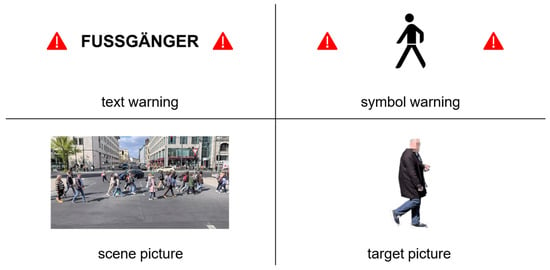
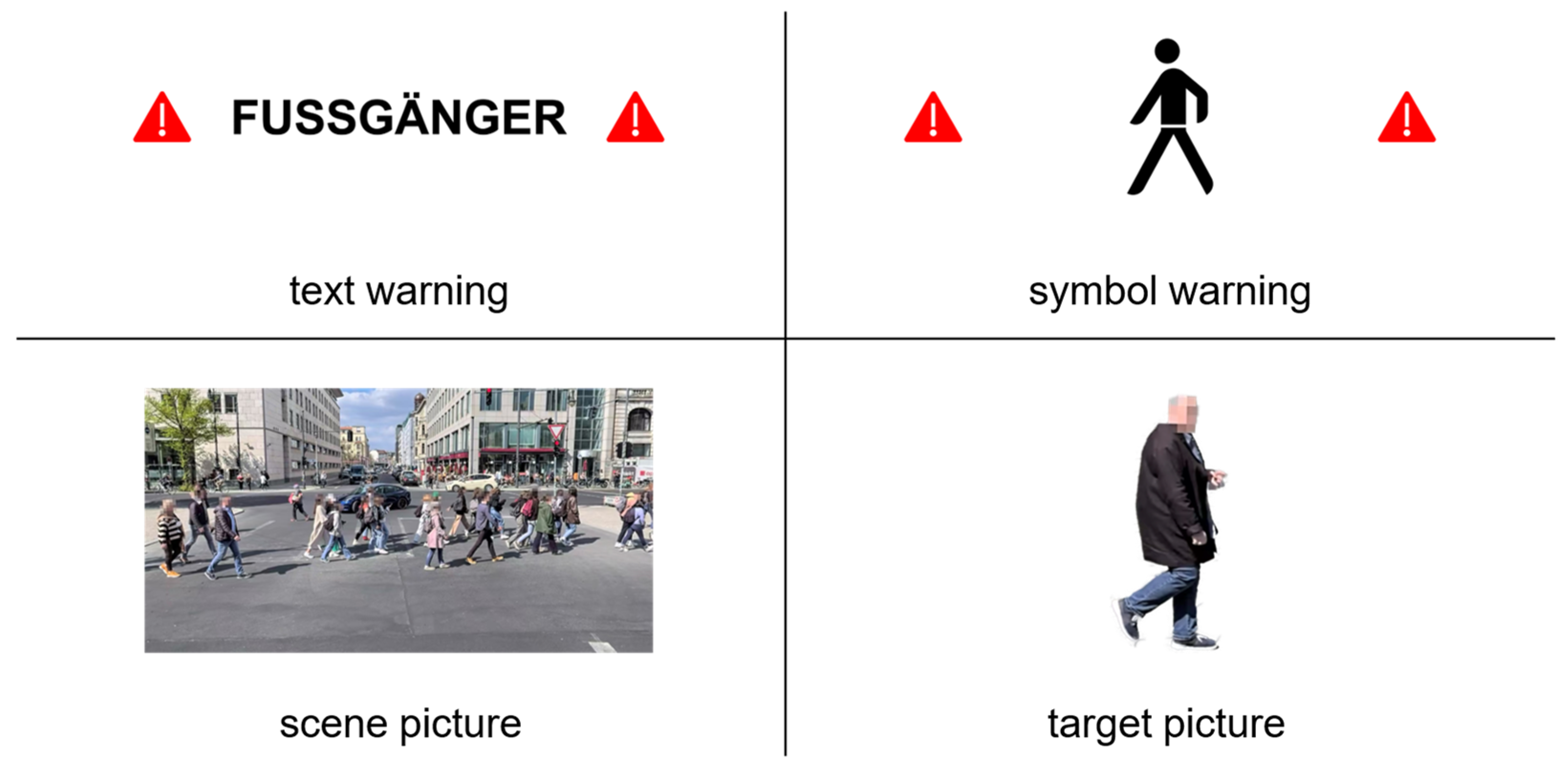
Figure 1 shows the resulting four primes for the pedestrian target: The text warning (semantic) says “Fussgänger” (German for pedestrian). The scene picture (visual–semantic) shows numerous pedestrians crossing a road. The symbol warning (visual–schematic) contains a symbol of a pedestrian. Finally, the target picture (visual–perceptual) is identical to the pedestrian that is used as a target in the search display. These four prime types were created for each of the five targets (see Section 3.3.2), resulting in a total of 20 different primes.
Figure 1.
The four different primes used for the pedestrian target (the text warning shows the German word “Fussgänger”, meaning “pedestrian”). The same prime types were employed for the other driving environment elements.
The primes belong to two general groups: visual alert messages (text warning, symbol warning) and visual messages (scene picture, target picture). Warning messages include attention-activating elements (caution signs) and feature a more simplistic visual makeup to mimic currently employed dashboard warnings.
The text warning and symbol warning primes were created in PowerPoint (version 2304) [36]. In both types of warnings, the main stimulus (symbol or text) was framed by two “caution” signs that mimic the German traffic sign for a hazard (hazard sign 101 according to Annex 1 to § 40 paragraph 6 StVO, [37]). In the text warning, the target word was placed in capital letters between the two “caution” signs (e.g., “FUSSGÄNGER”; German for pedestrian). In the symbol warning, a pictogram was shown there instead. The pictograms were based on the following German traffic signboards [37]: pictograms according to § 39 paragraph 7 StVO (for the pedestrian, cyclist, and car target), hazard signs according to Annex 1 to § 40 paragraph 6 StVO (for the traffic sign target) and regulatory signs according to Annex 2 to § 41 paragraph 1 StVO (for the roadway target).
The scene picture prime featured a forward view of the road as seen from the driver’s perspective. The images were taken from the “Look Around” feature of Apple Maps (version 3.0) [38]. For dynamic targets (pedestrian, cyclist, car), the footage was recorded in Berlin in April 2022. For static targets (traffic sign, roadway), images were collected in a rural area in northern Saxony-Anhalt in August 2020. In each scene, large areas were covered by objects related to the target, either due to the abundance of these objects (pedestrians, cyclists, cars) or because the objects were the main subject of the scene (traffic signs, roadway).
The target picture prime displayed an exact picture of the target. The targets and their creation are described in Section 3.3.2.
3.3.2. Targets (Driving Environment Objects)
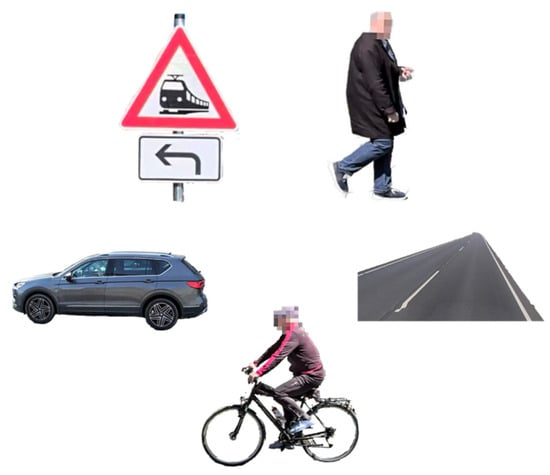
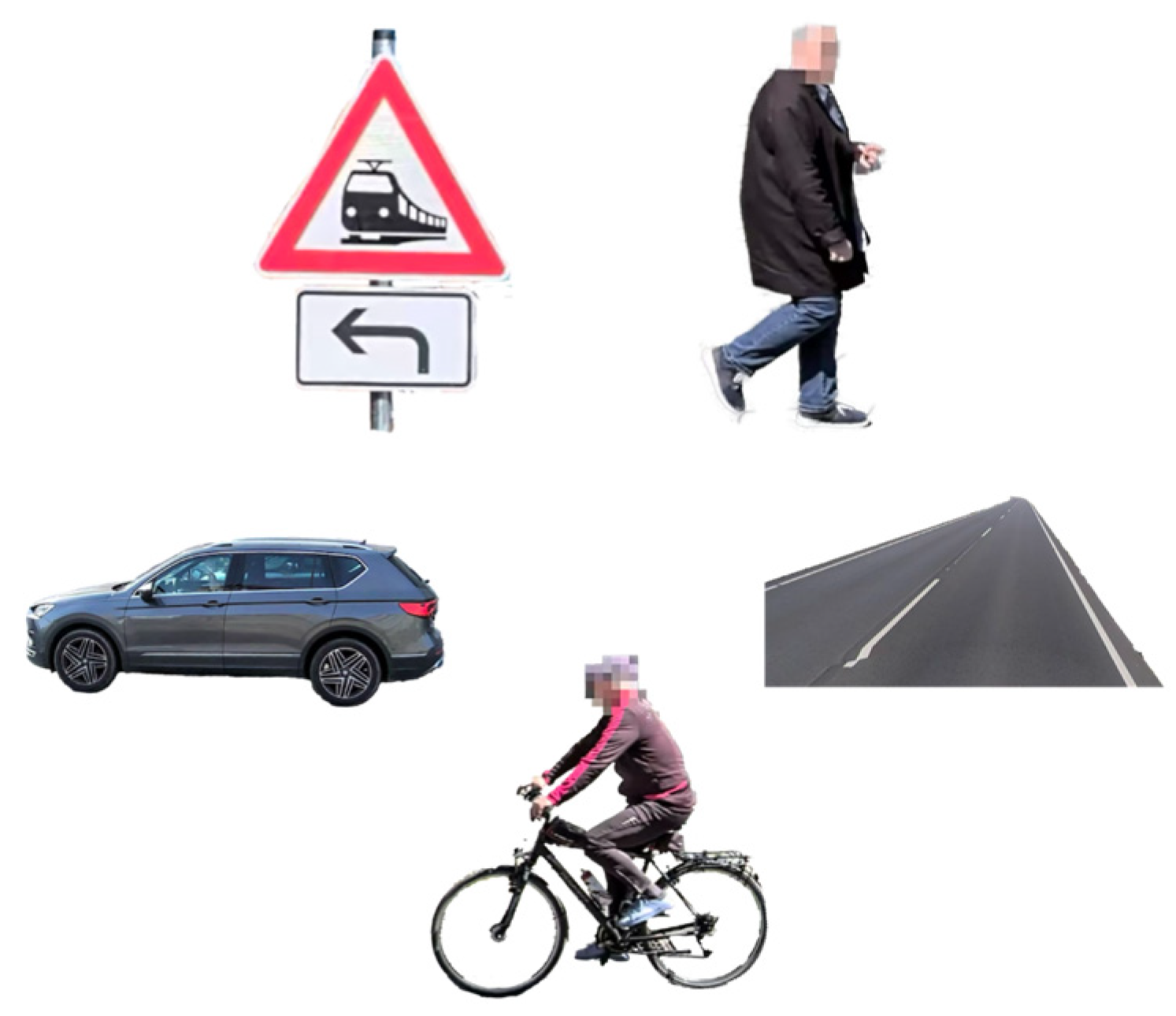
Five driving environment elements (see Figure 2) that drivers regularly need to pay attention to were selected: a pedestrian, a cyclist, a car, a traffic sign, and a roadway. Depending on the experimental condition, one of the elements was the target in the visual search task while the rest acted as distractors.
Figure 2.
One example of the search display where the instructed target had to be found.
The driving environment elements can be split into two groups. First, the pedestrian, cyclist, and car represent other traffic participants that can dynamically change their position in the driving environment. Accordingly, drivers have to carefully monitor them to mitigate safety critical situations. Second, the traffic sign and roadway are static infrastructure elements that exhibit no movement. Still, they are relevant for the orientation on the road or for the provision of information. Therefore, drivers need to allocate their attention to these elements as well.
As with the scene picture prime, Apple Maps’ “Look Around” feature [38] was employed to create images of the traffic environment elements. For the other traffic participants (pedestrian, cyclist, car), images from Berlin taken in April 2022 were used. For the infrastructure elements (traffic sign, roadway), images from a rural area in northern Saxony-Anhalt recorded in August 2020 were used. For all elements, the background was removed with Affinity Photo (version 1.10.5) [39]. This was done to prevent the image context from influencing performance in the visual search task.
The traffic participants (pedestrian, cyclist, car) were selected so that they were viewed from the side and did not contain features that would lead to a pop-out effect. The traffic sign was the German hazard sign 131 for a traffic light (according to Annex 1 to § 40 paragraph 6 StVO, [37]) under which the supplementary sign 1000-21 was positioned (according to § 39 paragraph 3 StVO, [37]). For the roadway, a two-lane road was shown.
To create the search display, the five driving environment elements were positioned in a circle (see Figure 2). The search display therefore represents a collection of road elements a driver might encounter concurrently while driving. Five variations of the search display were created, containing the same five objects but at different positions in the circle. The search displays were arranged in PowerPoint [36]. Unfortunately, due to limitations in the experimental software PsyToolkit (version 3.4.4) [40,41], the elements could not be randomly assigned to each individual position in the search display circle. Therefore, the five variations with fixed arrangements were used and randomly selected for each trial instead.
3.4. Procedure
The online study was created in PsyToolkit [40,41] and ran in participants’ web browsers. As stated previously, the experiment could only be completed on a computer with a keyboard, but not on a smartphone or tablet.
If the requirements were met, participants arrived at the welcome page, containing basic information about the study and experiment. Next, they had to answer a basic demographic questionnaire and questions regarding their driving experience. Following this, participants could start the experiment that began with detailed instructions, at the end of which ten practice trials had to be completed. Then, the main experiment with 150 trials began. A pause screen was shown after the first 75 trials, to reduce fatigue. At the end of the experiment, participants were thanked for their participation and could claim their course credit if they were entitled to it.
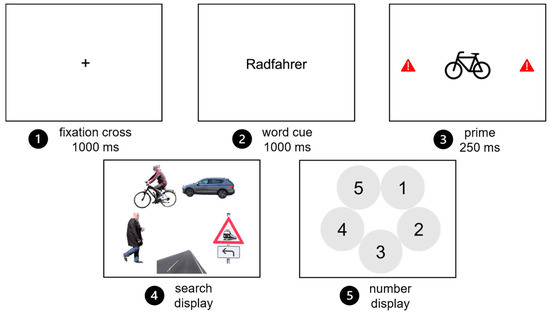
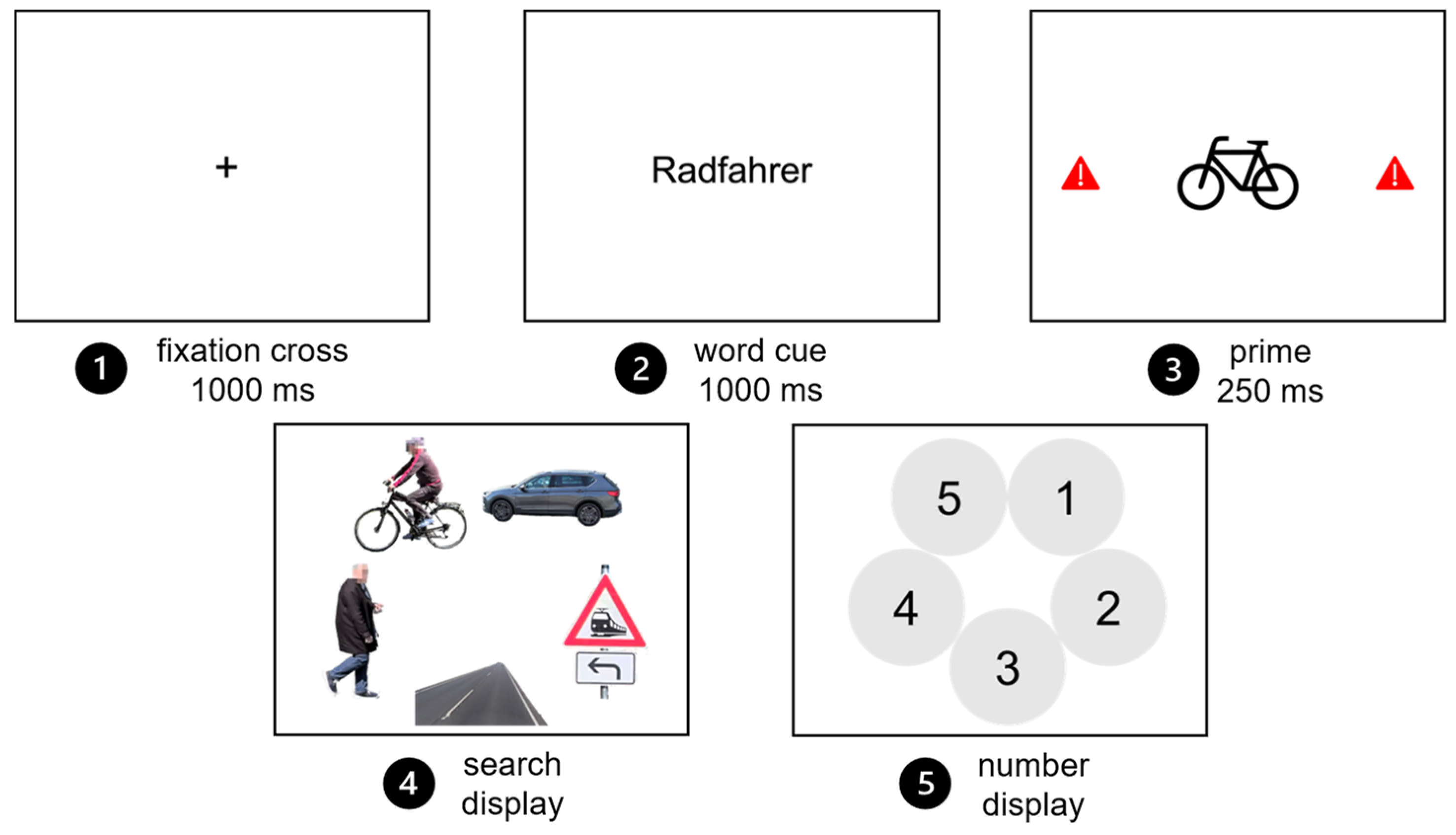
The general trial structure is shown in Figure 3. Each trial started with a fixation cross presented for 1000 ms. Then a word cue was shown for 1000 ms, informing the participant about the target of the visual search. Following this, one of the four primes was displayed for 250 ms. In the control condition, the screen stayed blank. Immediately after the prime, the search display was shown, where one of the driving environment elements was the target. When they had found the target, participants pressed the space bar. This caused the elements in search display to be replaced by numbers (number display). The participants were then required to enter the number corresponding to the target’s location using the keyboard. The word cue was needed to inform participants about the target of the visual search. It also acted as a prime in addition to those that were part of the experimental plan (see Table 1). However, it was kept at a constant level, i.e., it was used in every trial.
Figure 3.
The different events and their duration during one trial.
4. Results
In the first step, an explorative data analysis was conducted to check the reaction time until finding the target in each experimental condition (prime × target) for potential outliers. Of the initial sample of N = 76, four participants were excluded from further analysis for having a reaction time larger than three standard deviations above or below the participant average in at least one condition (extreme values). Outliers in between 1.5 and three standard deviations were not excluded from further analysis [42]. Thus, the final sample size was N = 72.
As subjects experienced six repetitions of each combination of prime (five) and target (five), the mean reaction time and number of errors in confirming the target position for each of the 25 combinations were computed. Reaction time and number of errors were then analyzed using repeated measures analysis of variance (RM-ANOVA), with prime and target as independent variables (within-subject factors). In cases where sphericity was violated, Greenhouse–Geisser corrected degrees of freedom were used. Pairwise comparisons were conducted only following a significant omnibus RM-ANOVA effect; no additional correction for multiple comparisons was applied, consistent with Fisher’s protected least-significant-difference approach.
Averaged across the 25 experimental conditions (prime × target), the mean number of errors in confirming the target position per condition (out of six trials each) was very low (M = 0.11, SD = 0.10, i.e., approximately 1.9% of trials). Thus, there was no indication that participants did not correctly take part in the task. There were no main effects of prime or target on the number of errors (p > 0.05). However, there was an interaction effect of both factors on error rates, F(11.06, 785.05) = 2.36, p < 0.01, partial η2 = 0.03.
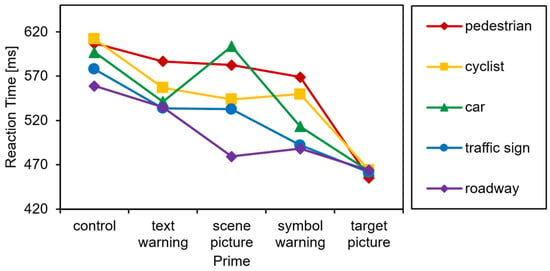
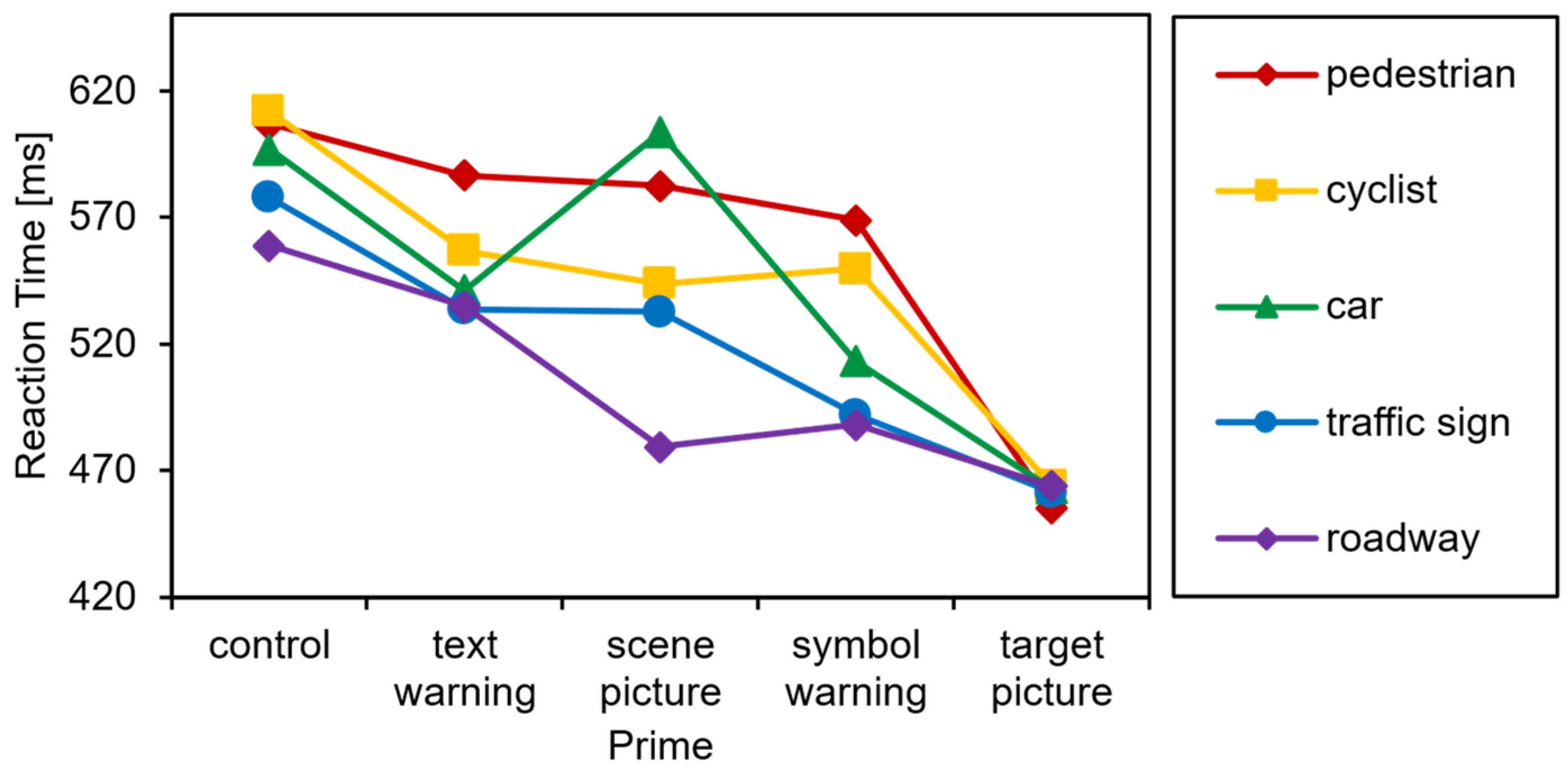
Results for the RM-ANOVA of reaction time are given in Table 2. There was a main effect of both prime and target on reaction time, with an interaction of both factors. Figure 4 gives the average reaction time for each experimental condition (prime × target).
Table 2.
Results of the ANOVA for reaction time.
Figure 4.
Mean reaction time for every prime and target.
Overall, there is a clear trend that reaction time improved from the control condition to the early perceptual prime (target picture). There are two exceptions, however, that are probably responsible for the significant interaction between prime and target. First, for the scene picture prime, the reaction time for the car target did not differ significantly from the control condition while for the roadway target it approached the reaction time for the symbol warning. Second, the reaction time for the target picture did not differ significantly across all target types.
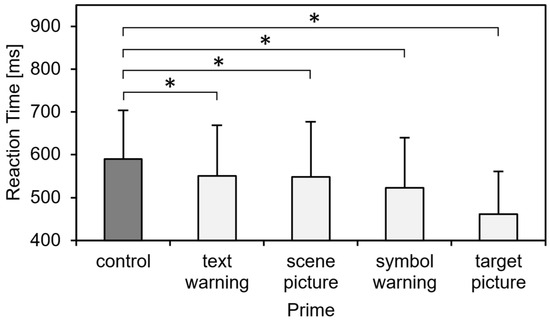
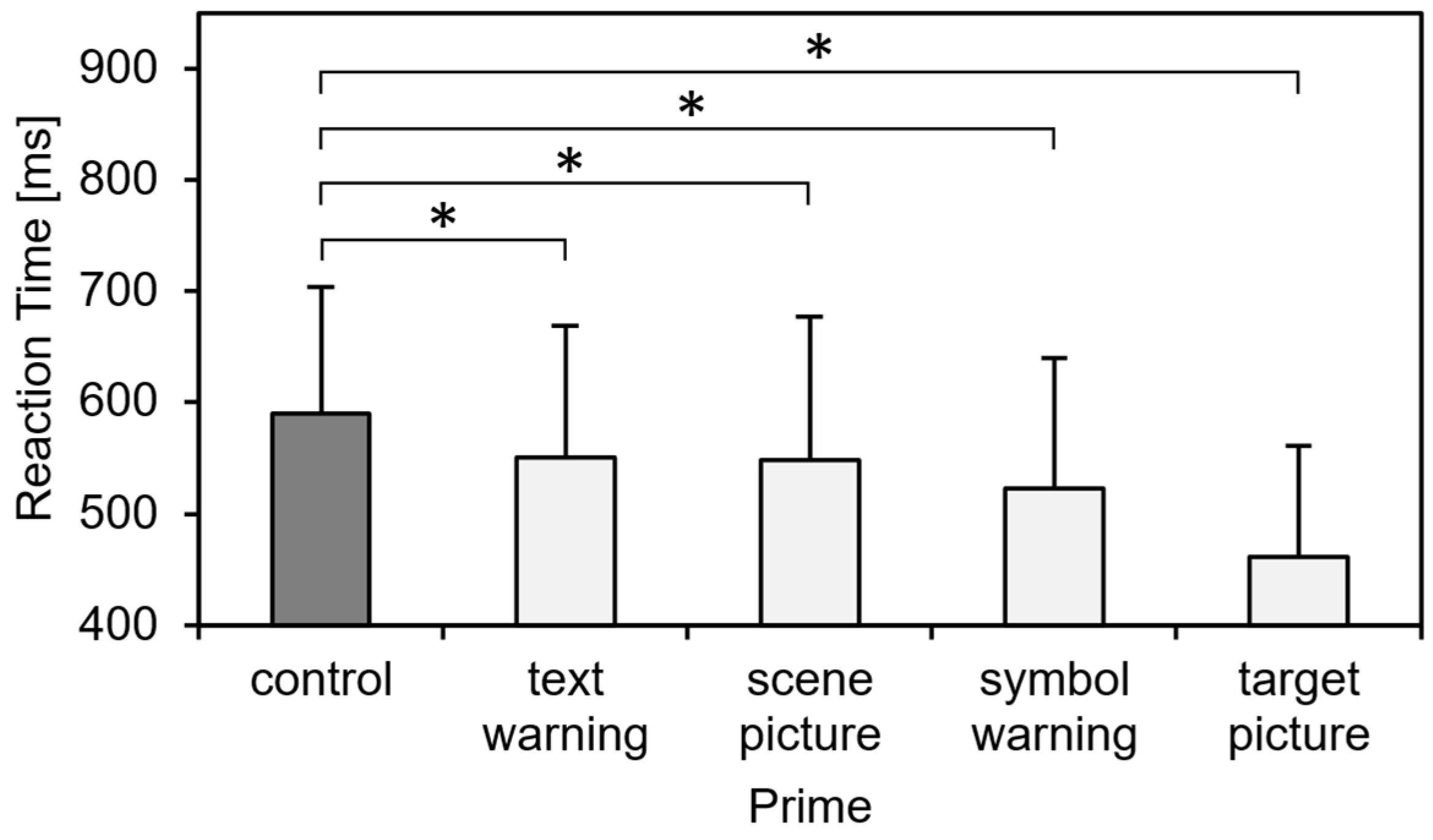
For a more detailed look at the effect of the prime type (level of processing), the first part of the analysis was focused on the comparison of the different primes. Here, the reaction times for each prime type were averaged across the five targets. Accordingly, Figure 5 depicts the mean reaction time for each prime. Pairwise comparisons revealed that all primes led to shorter reactions times than the control condition (all p < 0.001).
Figure 5.
Mean reaction time in milliseconds comparing the control condition to each of the primes. Asterisks indicate significant differences from the control condition (* p < 0.05). The control condition is shown as a dark grey bar, primes are shown as light grey bars.
To determine and rank the effectiveness of the prime types, additional pairwise comparisons of the mean reaction time across targets were conducted. The analysis revealed that the reaction times differed between all types of primes (always p < 0.001), with the only exception being the scene picture when compared to the text warning (p = 0.718). Thus, no statistically significant difference was found between the text warning and scene picture prime (40 ms vs. 42 ms improvement as compared to the control condition, respectively).
This is likely due to the reaction time distribution of the scene picture prime, which shows irregularities for the car and roadway target (see Figure 4). Here, the reaction time for the car target is even longer than in the control condition (604 ms vs. 567 ms, respectively). Conversely, the reaction time for the roadway target is rather short, nearing the reaction time of the symbol warning prime (480 ms vs. 488 ms, respectively). In both cases, the pairwise comparisons did not reach statistical significance (p > 0.05). Computing the average reaction time of the scene picture prime without the car and roadway target results in an improvement of 37 ms compared to the control condition. With this “correction”, the text warning and scene picture would still not differ significantly for the remaining targets (p = 0.742). Thus, they would still be similarly effective (40 ms vs. 37 ms improvement as compared to the control condition, respectively).
The next more effective prime was the symbol warning with an improvement of 68 ms compared to the control condition. Finally, the target picture was the most effective prime with an average improvement of 129 ms in comparison to the control condition. As shown in Figure 5, the reaction time reduction was significant for all prime types (p < 0.001).
For the target picture prime, the effect of target type on reaction time was not statistically significant. Or simply put, the reaction time of the target picture did not differ significantly across targets (p > 0.05). This is in stark contrast to the scene picture, where the effect on reaction time differed between targets (especially the car and roadway target, see above). These two exceptions are probably the reason for the interaction between prime and target type on reaction time (see Table 2).
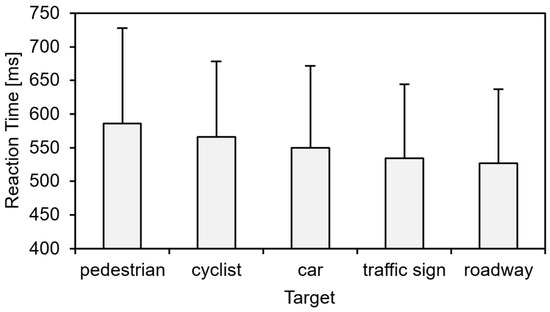
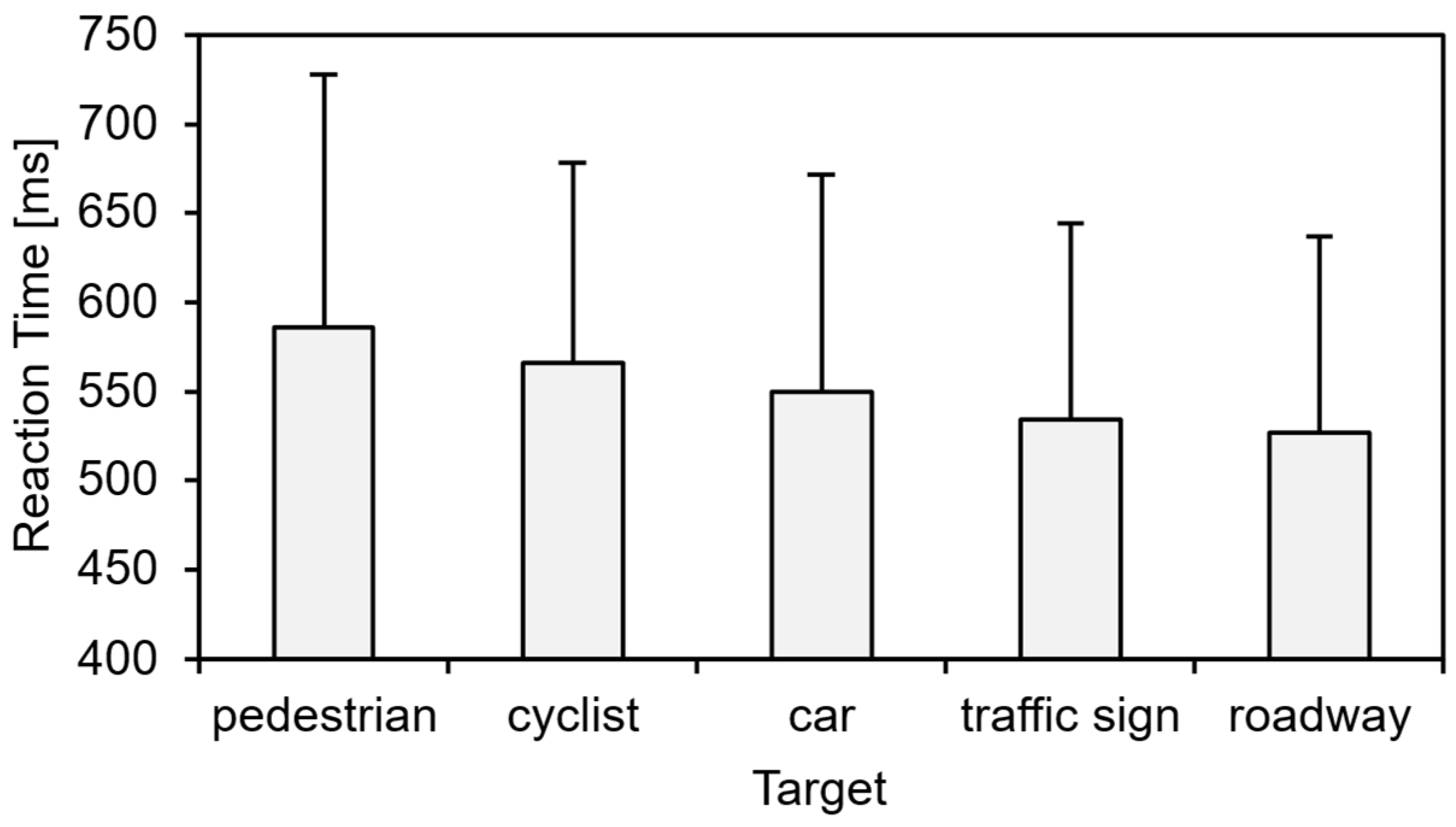
The second part of the analysis was focused on a comparison of the targets against each other. Like with the prime types, average reaction times were computed—but this time across prime types to compare the targets against each other. Figure 6 shows the mean reaction time for every target type. Note, however, that all cases that are likely responsible for the interaction effect were excluded from the analysis (see above). Thus, for every target, the reaction time for the exact target picture was omitted. Additionally, for the car and roadway targets, the reaction time for the scene picture prime was also omitted.
Figure 6.
Mean reaction time in milliseconds comparing the targets against one another.
Pairwise comparisons revealed that the reaction times differed between nearly all pairs of targets (p < 0.022). The only exception was the difference between the traffic sign and roadway target (p = 0.241). Thus, no statistically significant difference in reaction time was found between these two types of targets. Overall, reaction times were the longest for the pedestrian (586 ms) and cyclist target (566 ms), with the car being in the middle (550 ms). The fastest reaction times occurred for the traffic sign (534 ms) and roadway target (527 ms).
Given that driving experience has been discussed as a factor influencing hazard perception (see Section 2), an exploratory analysis examined whether driving experience (operationalized as years since obtaining a driver’s license) was associated with reaction time. A median-split comparison (participants with less than 5 years since licensure, n = 42, vs. 5 years or more, n = 29) revealed no significant differences in reaction time for any of the five priming conditions (all p > 0.30, η2 < 0.02). A supplementary analysis found weak positive correlations between years of licensure and reaction time in some conditions (r = 0.21–0.28), which is likely attributable to the strong correlation between years of licensure and age in this sample (r = 0.99) rather than to an effect of driving experience.
Concerning the gender imbalance in the sample (57 female, 13 male, one diverse, one not specified), an exploratory 2 (gender: female vs. male) × 5 (prime) mixed ANOVA was conducted on reaction time, averaged across targets. Participants who identified as diverse or did not specify their gender were excluded from this analysis due to insufficient cell sizes for meaningful comparison. There was no significant main effect of gender, F(1, 68) = 0.39, p = 0.534, partial η2 = 0.006, nor a significant gender × prime interaction, F(4, 272) = 1.32, p = 0.263, partial η2 = 0.019. Given the small number of male participants (n = 13), however, this analysis should be interpreted with caution due to limited statistical power to detect potential interaction effects.
5. Discussion
On the road, drivers must closely monitor their environment and attend to road elements that are relevant to the driving task. Especially in complex or hazardous situations, this is crucial to avoid road crashes. In general, attention is guided both via exogenous and endogenous processes [12]. When visually scanning the driving scene and searching for driving environment elements, further forms of guidance can be established (Guided Search, [19]). One form of guidance, history guidance, works by the provision of target information. Vehicles can already display warning messages about relevant road objects to which a driver should react. However, these messages usually do not contain specific target information and only guide attention via their spatial placement (e.g., [31]). Focusing on the contents of the message, another promising approach for improving attentional guidance is to provide specific target information. This way, the visual message acts as a prime and should optimize the driver’s attention allocation. Visual search studies demonstrate that priming is an effective tool to improve attention deployment [32,33,34]. To achieve this, different kinds of primes can be used, ideally an exact visual representation of the target.
To examine whether visual messages containing target information can be used as primes to improve attention allocation, an online study was conducted. Four primes (text warning, scene picture, symbol warning, and target picture) were used in a visual search for five driving environment elements (pedestrian, cyclist, car, traffic sign, and roadway). Based on their characteristics, each prime required a different level of cognitive processing to be understood and guide the visual search.
Overall, priming led to a reduction in search time in a visual search for driving environment elements when compared to a control condition without any prime. Thus, every prime provided information that could be used to guide the attention towards the target (see [19]), confirming H1.
As expected, the primes differed in their effects on reaction time. When comparing the prime types without taking the targets into account, the text warning and scene picture prime did not differ significantly. They were the least effective in improving search times. The symbol warning showed better performance, while the target picture resulted in the quickest visual search. Two aspects are likely responsible for the different effects on reaction time: First, and with regard to the different levels of cognitive processing required [43], the semantic primes (text warning, scene picture) probably affected late cognitive processes, while the visual primes (symbol warning, target picture) responded more to early perceptual processes. With faster processing, the visual primes have likely optimized the visual search process earlier. Second, and more importantly, the primes differ in the level of information they provide. The text warning and scene picture offer the least amount of information. As they are semantic primes, they only contain very general information of the target. With the symbol warning, the information becomes more specific and contains some visual features of the target. Finally, the target picture contains the exact visual features of the target, offering the most information for attentional guidance. These results are compatible with visual search studies showing that visual primes are more effective than semantic primes and that exact visual primes are more effective than those deviating from the target’s visual structure [33,44]. Taken together, these findings provide support for H3, with the ranking of prime effectiveness broadly matching the predicted order, with the exception that the scene picture and text warning did not differ significantly from each other rather than the scene picture outperforming the text warning as predicted. The results also somewhat support H2: two of the three visual primes (symbol warning, target picture) were significantly more effective than the semantic text warning, while the scene picture prime performed on par with the text warning. H2 is therefore only partially confirmed.
However, when taking the individual targets into account, the effect of the primes depended to some extent on the target type. This is represented by the interaction effect between prime and target. Here, the reaction times showed a large variation for the scene picture prime while for the target picture prime, there was nearly no variation in reaction times across individual targets. For the scene picture prime, the car target led to unusually long reaction times. In this case, the scene picture is likely uninformative as it mainly shows an empty road ahead of the ego vehicle. Cars can only be seen in some distance in the adjacent lanes waiting at an intersection. Further, these cars are seen from the back while the target car is shown from the side. So, this lack of a priming effect is probably due to the scene not prominently showing cars that are visually related to the car target.
For the roadway target, the scene picture led to unusually quick reaction times. Here, the scene picture prime is more of a target picture than a scene full of target candidates. It shows an empty, two-lane road ahead of the ego vehicle with grass and trees on the sides. This largely matches the target picture that also contains an empty two-lane road albeit without any objects on the sides of the road.
Together, these two post hoc explanations illustrate a broader limitation of the present design: both the primes and the targets were each represented by only a single stimulus exemplar (see Section 3.3.1 and Section 3.3.2). Consequently, some of the observed effects, particularly the pattern found for the scene picture prime, may partly reflect idiosyncrasies of the specific prime images used rather than properties of the prime type in general (see Section Strengths, Implications and Limitations).
Finally, and in contrast to the scene picture prime, reaction times did not differ significantly between targets for the target picture primes. This consistency lends some confidence that the target picture findings generalize beyond the specific images used, whereas the pronounced heterogeneity observed for the scene picture prime is consistent with a stronger influence of stimulus-specific idiosyncrasies for that prime type. Thus, the priming effect of a target picture appears to be relatively robust across various targets. Consequently, for the use of priming with other targets and in other contexts, the exact target picture appears to be the most effective approach.
Regarding the interaction effect between prime and target it should be noted that it was statistically significant but numerically small (partial η2 = 0.09; see Table 2). Given the large number of trials per participant (150), even comparatively small deviations from a purely additive pattern of prime and target effects could reach statistical significance; the practical relevance of this interaction should therefore be considered modest relative to the much larger main effects of prime (partial η2 = 0.59) and target (partial η2 = 0.29).
Although not the main focus of this study, reaction times were also compared between targets without taking the primes into account. The fastest responses occurred for the traffic sign and roadway target. This was followed by the car and cyclist with the pedestrian target leading to longest response times. This difference in reaction time probably stems from the visual structure of the objects, which in turn affected attention allocation. The “non-human” objects’ (roadway, traffic sign, car) visual structure is likely “simpler” in the sense that they have a clear shape, contain one color gradient and do not feature complex structures. Furthermore, their surface is larger compared to the other targets. On the other hand, the “human” objects (pedestrian, cyclist) contain complex visual features (shapes, fine details, and textures) that are presumably detrimental to attention allocation during visual search. One might argue that the simple visual features allow for a bottom-up feature guidance in addition to the top-down guidance established by the prime [19]. So, even when a prime does not establish optimal top-down guidance (e.g., not an exact match of the target’s visual features), visual search can still be guided exogenously by the target. Consequently, for a visual search utilizing primes, one might rely on targets that feature a visual structure that is simple rather than complex. This ensures fast reaction times even when the prime does not exactly match the targets’ features. Please note that the previous interpretation of the differences in visual structure is offered as a post hoc explanation, as visual complexity was not directly measured in this study (e.g., via image entropy, contour count, or a validated complexity rating); it should therefore be regarded as speculative pending direct empirical assessment.
The target-related findings address RQ1, showing that individual driving environment elements are perceived at different speeds and that this depends both on their own visual characteristics and on their interaction with the prime stimulus.
Strengths, Implications and Limitations
The findings of this study need to be interpreted in light of several strengths and limitations. A key strength is its focus on the perception of driving environment elements in isolation. By doing so, it demonstrates that primes, which may be displayed as a visual message in the vehicle cockpit, can be used to speed up attention allocation. Besides that, the study shows that drivers tend to perceive targets with simpler visual structures quicker than those with complex structures.
For visual messages or warnings, the results indicate that they can be used to allocate the driver’s attention if they provide detailed information about the visual makeup of the target (i.e., the exact visual features). In a vehicle, such a message could be displayed on a colored screen in the instrument cluster. The message would not include any context as the warning system would remove the background. However, this imposes several problems: First, the driver is focused on the road, so a visual or acoustic signal would be needed to alert them to look towards the visual message. This would result in the driver looking away from the road to perceive the message, basically distracting them. Second, the prime would be shown in isolation whereas the target is embedded into the context of the driving scene. Therefore, it would probably still be hard to find the target even with a prime. A second option to show a visual message would be in the heads-up display. This would reduce the distance the driver has to look away from the road. However, the perception of the prime would change since the heads-up display is translucent. The prime would also be embedded into a different context influencing the perception of its visual features. Therefore, it is unclear whether the results of this study would translate into the actual driving context. It can also be questioned whether priming would work at all and how it would compare to spatially placed messages for guiding driver attention [30]. Next, the results indicate that elements with simpler visual features are perceived faster than those with more complex visual features. Although the difference between the longest and shortest reaction time is only 59 ms (see Figure 6), it could still be useful for the design of driving environment elements. These should be visually simple with clear shapes and colors instead of complex for fast perception. As stated before, however, the driving environment elements in real life are embedded into a context. This makes it hard to say whether the perceptual effects would translate to real driving contexts.
The remarks discussed before point towards a major limitation of the study: Its external validity is highly limited, and it is unclear whether the results transfer to real life. Therefore, the results can, for now, only be used to better understand how driving environment objects are perceived in isolation. The experimental design could be improved step-wise to further explore the perceptual effects and to increase external validity. Starting with the currently employed experimental design and its limitations: It used the same five road objects that were all used as a target in a circular constellation. The use of different objects (e.g., several cars instead of one or other road objects altogether) or arranging them in different constellations would probably alter the results. Also, the inclusion of a context or the use of dynamic stimuli would result in an increase in external validity.
A related concern is that the five search display layouts were fixed and repeated across trials due to limitations of the experimental software (see Section 3.3.2). To assess whether familiarity with these layouts affected the results, reaction times in the first and second half of the experiment (trials 1–75 vs. 76–150) were compared. This revealed a significant overall decrease in reaction time (M1–75 = 557 ms vs. M76–150 = 512 ms, t(71) = 7.09, p < 0.001, dz = 0.84), consistent with a general practice or familiarization effect. Importantly, this effect did not interact with the priming manipulation: none of the four priming effects differed significantly between the first and second half of the experiment (all p > 0.09), suggesting that the reported priming effects are not confounded by learning of the fixed display layouts.
Besides the stimuli used, an interpretive limitation concerns the control condition: as the word cue naming the target was presented in every trial, including the control condition, the control condition itself already contained a semantic prime. Consequently, the reported reductions in reaction time reflect improvements relative to a baseline that was itself partially primed, rather than a true no-prime baseline. This partial priming by the word cue may have also affected the results of the “true” primes tested. Future studies could address this by using a trial structure without a word cue, which would allow the effects of the individual primes to be identified more precisely. Also, using eye tracking measures would allow for a more precise capture of attentional shifts.
Further, both the primes and the targets used in this study were each represented by only a single stimulus exemplar (see Section 3.3.1 and Section 3.3.2), as discussed above in relation to the scene picture prime. Future studies should employ multiple stimulus exemplars for both primes and targets to disentangle stimulus idiosyncrasies from genuine prime-type or target-type effects.
A further limitation concerns the composition of the sample. The sample was strongly gender-imbalanced (57 female, 13 male, one diverse, one not specified) and was recruited exclusively from the authors’ own institution via a psychology-student mailing list, resulting in a relatively young and homogeneous sample (M = 23.1 years, SD = 6.3). This convenience-sampling approach limits the generalizability of the findings to the broader driver population. An exploratory analysis found no significant effect of gender on reaction time and no significant gender × prime interaction (see Section 4). However, given the small number of male participants, this analysis had limited power to detect potential differences, and the findings should therefore not be interpreted as evidence for the absence of gender-related effects.
Beyond the current experimental design, which focuses solely on the search task, future studies could incorporate an actual driving task. This way, the perceptual effects could be examined in a dual task (driving and visual search) scenario. The attentional shifts should be measured with eye tracking instead of a response task as it would introduce visual-manual distraction. If a response shall be measured, however, the priming system could be used in situations that are hazardous and require the driver to brake or steer. Such an experimental design would greatly improve external validity and could be used to test whether the priming effects translate into a more realistic scenario. Furthermore, different guiding options could be compared against each other. For example, salient warnings that physically mark the driving environment element could be compared against visual priming messages. It is likely that the former are more effective as they rely on exogenous (automatic) attention when compared to endogenous priming.
Finally, the practical feasibility of an in-vehicle priming system can be discussed. As indicated by the results, an exact prime is the most effective way to improve attention allocation. To achieve this, an in-vehicle priming system would need to generate primes in real-time, which requires the system to first identify relevant objects, either through the planned driving maneuver or because objects become hazardous. This would demand advanced sensors, computing hardware, and software. However, on a more fundamental level, this raises the question of why the vehicle should use visual warnings to alert the driver. If the system can already detect hazards, it would make more sense for it to perform a safety maneuver rather than relying on the driver’s response. Therefore, a priming system would be more useful in uncritical situations to notify the driver. Examples could be when parking the car to avoid obstacles or in other slow maneuvering tasks that require attentional guidance. Another area where the system could be used is in driver education. Here, primes could guide the driver’s attention towards objects that are relevant for certain driving maneuvers. Maybe this could be done in a driving simulator where situations can be stopped and where primes can be easily generated and displayed. This could be helpful to train new drivers’ attention allocation or hazard perception abilities.
6. Conclusions
Driving requires efficient attention allocation, so that objects relevant to the driving task can be sufficiently perceived. To guide the driver’s attention, information about relevant driving environment elements could be provided by a prime [19]. These primes could then be displayed as a visual message in the vehicle. This study demonstrates that priming can indeed guide a driver’s attention to driving environment elements by shortening reaction times in a visual search task. Search times were affected both by prime and target characteristics. Primes that exactly matched the targets’ visual features were the most effective in improving search times. Targets with simpler visual structures (shape, color, textures) offered a reaction time advantage over those with more complex visual features. The findings may be useful for designing visual (warning) messages in the vehicle and for the design of the driving environment elements. Future studies should incorporate a more realistic setting with a dual-task scenario (visual search and driving) and use eye tracking to examine how priming affects attention allocation in the real world.
Author Contributions
Conceptualization, K.K.; methodology, K.K.; validation, K.K.; formal analysis, K.K.; investigation, K.K.; resources, M.V.; data curation, K.K.; writing—original draft preparation, K.K.; writing—review and editing, M.V. and K.K.; visualization, K.K.; supervision, M.V.; project administration, K.K. All authors have read and agreed to the published version of the manuscript.
Funding
This research received no external funding. The publication of this work was funded by the publication fund of the Technische Universität Braunschweig.
Institutional Review Board Statement
The study was conducted in accordance with the Declaration of Helsinki and exempted by the Ethics Committee of Faculty 2 (Faculty of Life Sciences) of the Technische Universität Braunschweig (protocol code MA-2026-14, dated 9 July 2026).
Informed Consent Statement
Written informed consent was obtained from all participants prior to their participation, via an electronic consent form presented at the start of the online experiment. Participants were fully informed about the aims and procedure of the study beforehand and were free to withdraw at any time without any negative consequences.
Data Availability Statement
The datasets supporting the conclusions of this article are currently only available in German. Translated versions will be prepared upon reasonable request. Requests to access the dataset should be directed to the corresponding author.
Conflicts of Interest
The authors declare no conflicts of interest.
References
- World Health Organization. Global Status Report on Road Safety 2023; World Health Organization: Geneva, Switzerland, 2023. [Google Scholar]
- Wijnen, W.; Stipdonk, H. Social Costs of Road Crashes: An International Analysis. Accid. Anal. Prev. 2016, 94, 97–106. [Google Scholar] [CrossRef] [Scilit]
- Wegman, F. The Future of Road Safety: A Worldwide Perspective. IATSS Res. 2017, 40, 66–71. [Google Scholar] [CrossRef] [Scilit]
- Lee, J.D. Fifty Years of Driving Safety Research. Hum. Factors 2008, 50, 521–528. [Google Scholar] [CrossRef] [Scilit]
- Vollrath, M. Welche Fehler führen zu Unfällen? Z. Für Verkehrssicherheit 2010, 56, 31–36. [Google Scholar]
- Vlakveld, W.; Doumen, M.; Van Der Kint, S. Driving and Gaze Behavior While Texting When the Smartphone Is Placed in a Mount: A Simulator Study. Transp. Res. Part F Traffic Psychol. Behav. 2021, 76, 26–37. [Google Scholar] [CrossRef] [Scilit]
- Yang, S.; Kuo, J.; Lenné, M.G. Analysis of Gaze Behavior to Measure Cognitive Distraction in Real-World Driving. Proc. Hum. Factors Ergon. Soc. Annu. Meet. 2018, 62, 1944–1948. [Google Scholar] [CrossRef] [Scilit]
- Underwood, G. Visual Attention and the Transition from Novice to Advanced Driver. Ergonomics 2007, 50, 1235–1249. [Google Scholar] [CrossRef] [Scilit]
- Risteska, M.; Kanaan, D.; Donmez, B.; Winnie Chen, H.-Y. The Effect of Driving Demands on Distraction Engagement and Glance Behaviors: Results from Naturalistic Data. Saf. Sci. 2021, 136, 105123. [Google Scholar] [CrossRef] [Scilit]
- Wong, J.-T.; Huang, S.-H. Attention Allocation Patterns in Naturalistic Driving. Accid. Anal. Prev. 2013, 58, 140–147. [Google Scholar] [CrossRef] [Scilit]
- Ezzati Amini, R.; Al Haddad, C.; Batabyal, D.; Gkena, I.; De Vos, B.; Cuenen, A.; Brijs, T.; Antoniou, C. Driver Distraction and In-Vehicle Interventions: A Driving Simulator Study on Visual Attention and Driving Performance. Accid. Anal. Prev. 2023, 191, 107195. [Google Scholar] [CrossRef] [Scilit]
- Chun, M.M.; Golomb, J.D.; Turk-Browne, N.B. A Taxonomy of External and Internal Attention. Annu. Rev. Psychol. 2011, 62, 73–101. [Google Scholar] [CrossRef] [Scilit]
- Barragan, D.; Peterson, M.S.; Lee, Y.-C. Hazard Perception–Response: A Theoretical Framework to Explain Drivers’ Interactions with Roadway Hazards. Safety 2021, 7, 29. [Google Scholar] [CrossRef] [Scilit]
- Crundall, D. Hazard Prediction Discriminates between Novice and Experienced Drivers. Accid. Anal. Prev. 2016, 86, 47–58. [Google Scholar] [CrossRef] [Scilit]
- Scialfa, C.T.; Borkenhagen, D.; Lyon, J.; Deschênes, M.; Horswill, M.; Wetton, M. The Effects of Driving Experience on Responses to a Static Hazard Perception Test. Accid. Anal. Prev. 2012, 45, 547–553. [Google Scholar] [CrossRef] [Scilit]
- Borowsky, A.; Shinar, D.; Oron-Gilad, T. Age, Skill, and Hazard Perception in Driving. Accid. Anal. Prev. 2010, 42, 1240–1249. [Google Scholar] [CrossRef] [Scilit]
- Habibzadeh, Y.; Yarmohammadian, M.H.; Sadeghi-Bazargani, H. Driving Hazard Perception Components: A Systematic Review and Meta-Analysis. Bull. Emerg. Trauma 2023, 11, 1–12. [Google Scholar] [CrossRef] [Scilit]
- Pammer, K.; Blink, C. Visual Processing in Expert Drivers: What Makes Expert Drivers Expert? Transp. Res. Part F Traffic Psychol. Behav. 2018, 55, 353–364. [Google Scholar] [CrossRef] [Scilit]
- Wolfe, J.M. Guided Search 6.0: An Updated Model of Visual Search. Psychon. Bull. Rev. 2021, 28, 1060–1092. [Google Scholar] [CrossRef] [Scilit]
- Belyusar, D.; Reimer, B.; Mehler, B.; Coughlin, J.F. A Field Study on the Effects of Digital Billboards on Glance Behavior during Highway Driving. Accid. Anal. Prev. 2016, 88, 88–96. [Google Scholar] [CrossRef] [Scilit]
- Costa, M.; Bonetti, L.; Vignali, V.; Bichicchi, A.; Lantieri, C.; Simone, A. Driver’s Visual Attention to Different Categories of Roadside Advertising Signs. Appl. Ergon. 2019, 78, 127–136. [Google Scholar] [CrossRef] [Scilit]
- Jackson, L.; Chapman, P.; Crundall, D. What Happens next? Predicting Other Road Users’ Behaviour as a Function of Driving Experience and Processing Time. Ergonomics 2009, 52, 154–164. [Google Scholar] [CrossRef] [Scilit]
- Biederman, I.; Mezzanotte, R.J.; Rabinowitz, J.C. Scene Perception: Detecting and Judging Objects Undergoing Relational Violations. Cogn. Psychol. 1982, 14, 143–177. [Google Scholar] [CrossRef] [Scilit]
- Dukic, T.; Broberg, T. Older Drivers’ Visual Search Behaviour at Intersections. Transp. Res. Part F Traffic Psychol. Behav. 2012, 15, 462–470. [Google Scholar] [CrossRef] [Scilit]
- Wolfe, J.M.; Horowitz, T.S. Five Factors That Guide Attention in Visual Search. Nat. Hum. Behav. 2017, 1, 0058. [Google Scholar] [CrossRef] [Scilit]
- Phongphaew, N.; Jiamsanguanwong, A. Text-Based Information Design for in-Vehicle Displays: A Systematic Review. Transp. Res. Part F Traffic Psychol. Behav. 2024, 103, 442–459. [Google Scholar] [CrossRef] [Scilit]
- Van Der Heiden, R.M.A.; Janssen, C.P.; Donker, S.F.; Merkx, C.L. Visual In-Car Warnings: How Fast Do Drivers Respond? Transp. Res. Part F Traffic Psychol. Behav. 2019, 65, 748–759. [Google Scholar] [CrossRef] [Scilit]
- Kazazi, J.; Winkler, S.; Vollrath, M. Accident Prevention through Visual Warnings: How to Design Warnings in Head-up Display for Older and Younger Drivers. In Proceedings of the 2015 IEEE 18th International Conference on Intelligent Transportation Systems; IEEE: Las Palmas de Gran Canaria, Spain, 2015; pp. 1028–1034. [Google Scholar]
- Hajiseyedjavadi, F.; Zhang, T.; Agrawal, R.; Knodler, M.; Fisher, D.; Samuel, S. Effectiveness of Visual Warnings on Young Drivers Hazard Anticipation and Hazard Mitigation Abilities. Accid. Anal. Prev. 2018, 116, 41–52. [Google Scholar] [CrossRef] [Scilit]
- Lees, M.N.; Cosman, J.; Lee, J.D.; Vecera, S.P.; Dawson, J.D.; Rizzo, M. Cross-Modal Warnings for Orienting Attention in Older Drivers with and without Attention Impairments. Appl. Ergon. 2012, 43, 768–776. [Google Scholar] [CrossRef] [Scilit]
- Schmidt, G.J.; Rittger, L. Guiding Driver Visual Attention with LEDs. In Proceedings of the 9th International Conference on Automotive User Interfaces and Interactive Vehicular Applications; ACM: Oldenburg, Germany, 2017; pp. 279–286. [Google Scholar]
- Robbins, A.; Hout, M.C. Scene Priming Provides Clues about Target Appearance That Improve Attentional Guidance during Categorical Search. J. Exp. Psychol. Hum. Percept. Perform. 2020, 46, 220–230. [Google Scholar] [CrossRef] [Scilit]
- Vickery, T.J.; King, L.-W.; Jiang, Y. Setting up the Target Template in Visual Search. J. Vis. 2005, 5, 81–92. [Google Scholar] [CrossRef] [Scilit]
- Koyuncu, M.; Amado, S. Effects of Stimulus Type, Duration and Location on Priming of Road Signs: Implications for Driving. Transp. Res. Part F Traffic Psychol. Behav. 2008, 11, 108–125. [Google Scholar] [CrossRef] [Scilit]
- Faul, F.; Erdfelder, E.; Buchner, A.; Lang, A.-G. Statistical Power Analyses Using G*Power 3.1: Tests for Correlation and Regression Analyses. Behav. Res. Methods 2009, 41, 1149–1160. [Google Scholar] [CrossRef] [Scilit] [PubMed]
- Microsoft Corporation. PowerPoint, Version 2304; Microsoft Corporation: Redmond, WA, USA, 2023. [Google Scholar]
- Bundesministerium für Verkehr. Straßenverkehrs-Ordnung (StVO); Bundesministerium der Justiz und für Verbraucherschutz: Berlin, Germany, 2013. [Google Scholar]
- Apple Inc. Apple Maps, Version 3.0; Apple Inc.: Cupertino, CA, USA, 2023.
- Serif Europe Ltd. Affinity Photo, Version 1.10.5; Serif Europe Ltd.: Nottingham, UK, 2023.
- Stoet, G. PsyToolkit: A Software Package for Programming Psychological Experiments Using Linux. Behav. Res. Methods 2010, 42, 1096–1104. [Google Scholar] [CrossRef] [Scilit]
- Stoet, G. PsyToolkit: A Novel Web-Based Method for Running Online Questionnaires and Reaction-Time Experiments. Teach. Psychol. 2017, 44, 24–31. [Google Scholar] [CrossRef] [Scilit]
- Field, A. Discovering Statistics Using IBM SPSS Statistics; SAGE Publications: Thousand Oaks, CA, USA, 2024. [Google Scholar]
- Reinitz, M.T.; Wright, E.; Loftus, G.R. Effects of Semantic Priming on Visual Encoding of Pictures. J. Exp. Psychol. Gen. 1989, 118, 280–297. [Google Scholar] [CrossRef]
- Wolfe, J.M.; Horowitz, T.S.; Kenner, N.; Hyle, M.; Vasan, N. How Fast Can You Change Your Mind? The Speed of Top-down Guidance in Visual Search. Vis. Res. 2004, 44, 1411–1426. [Google Scholar] [CrossRef] [Scilit]

Disclaimer/Publisher’s Note: The statements, opinions and data contained in all publications are solely those of the individual author(s) and contributor(s) and not of MDPI and/or the editor(s). MDPI and/or the editor(s) disclaim responsibility for any injury to people or property resulting from any ideas, methods, instructions or products referred to in the content. |
© 2026 by the authors. Licensee MDPI, Basel, Switzerland. This article is an open access article distributed under the terms and conditions of the Creative Commons Attribution (CC BY) license.