


Abstract
Safety culture has become a central construct in occupational safety management due to its recognized influence on organizational performance and accident prevention. However, the absence of a universally applicable assessment methodology has contributed to substantial methodological fragmentation. Therefore, this scoping review aimed to identify, classify, and critically analyze methodological approaches for safety culture assessment. Following PRISMA-ScR guidelines, studies published between January 2016 and October 2025 were retrieved from Scopus, Web of Science, and Dimensions. Study selection and methodological quality appraisal were conducted using predefined eligibility criteria and the Mixed Methods Appraisal Tool (MMAT, version 2018). Through a descriptive synthesis, the 25 included studies revealed a heterogeneous landscape encompassing psychometric surveys, multi-criteria and maturity-based models, and triangulated approaches. The findings indicate that each methodological family captures different dimensions of safety culture. Psychometric approaches provide scalability and comparability but remain dependent on self-reported perceptions, whereas multi-criteria models support structured organizational diagnosis. Triangulated approaches integrate multiple sources of evidence and facilitate the examination of discrepancies between formal organizational arrangements and operational practices. Overall, the review highlights the diversity of available assessment approaches and suggests that the evaluation’s objectives, context, and scope should guide the selection of the methodology.
1. Introduction
The accelerated processes of globalization and the modernization of production systems have sparked profound debates about environmental, social, and institutional sustainability worldwide. To promote sustainable development, the United Nations established the 2030 Agenda for Sustainable Development, founded on five crucial pillars: People, Planet, Prosperity, Peace, and Partnership. Based on these pillars, 17 Sustainable Development Goals (SDGs) were defined, representing a commitment to ensure the prosperity of nations by promoting better working conditions, health, and well-being [1]. In this context, occupational safety plays a transversal role, directly contributing to several of these Goals, in particular: SDG 3 (Good Health and Well-being), focused on ensuring access to health and promoting well-being; SDG 8 (Decent Work and Economic Growth), which highlights the urgency of protecting labor rights and promoting safe working environments; and SDG 12 (Responsible Consumption and Production), oriented towards the environmentally sound management of chemicals and waste reduction.
While its integration into these global goals reinforces the role of occupational safety as a pillar of sustainable development, ensuring truly safe workplaces transcends mere normative and technical compliance; it is inherently tied to the human dimension, particularly in decision-making dynamics and organizational behavior. Within this framework, the concept of safety culture emerges as a relevant indicator for assessing, quantifying, and enhancing an organization’s safety maturity.
The genesis of the safety culture concept dates to September 1986, following the Chernobyl nuclear accident. At that time, the International Nuclear Safety Advisory Group (INSAG) published the INSAG-1 report, which presented the first account of management failures and worker attitudes as systemic causes of the event [2]. The concept was formally refined in the INSAG-4 report, which introduced two interdependent components: the necessary organizational framework (management responsibility) and the attitude of personnel (individual response at all levels) [3].
Subsequently, the term became a key concept in official reports and academic research. Reason transformed safety culture into a psychological, behavioral, and systemic concept, defining it as the “engine” that drives the system toward the goal of sustaining maximum resistance to its operational hazards [4]. The author further proposes the concept of an informed culture, comprising reporting, just, flexible, and learning subcultures [5]. In the quest to render safety culture measurable, Cooper proposed the Reciprocal Safety Culture Model [6]. The model suggests that culture is derived from the reciprocal relationships among three factors: Psychological (perceptions and attitudes), Behavioral (observable behavior), and Situational (work environment and systems) [7].
The distinction between safety culture and safety climate is a central point in the literature. Safety climate, introduced by Zohar, is defined as the reflection of employees’ perceptions regarding the relative importance of safe conduct in their occupational behavior [8]. From a psychosocial perspective, Guldenmund highlights that safety climate functions as a quantifiable performance indicator through questionnaires; however, there is a scarcity of empirical evidence relating these measures to actual safety performance, such as accident rates [9]. A methodological paradox intensifies this debate: while safety climate can be evaluated semi-quantitatively, safety culture, conceptualized as a set of implicit, basic assumptions, resists direct quantification, and often requires qualitative case studies for comparative purposes. While safety climate provides only a superficial indication of performance, safety culture offers a deeper understanding of organizational risks and “the way things are done around here” [9].
The evolution of this culture can be assessed using maturity models, such as Hudson’s, which categorizes organizations into five evolutionary stages: Pathological, Reactive, Calculative, Proactive, and Generative [10]. However, maturity assessment faces challenges, for instance, the emergence of a “facade safety culture”, where bureaucratic compliance masks severe gaps in actual practiced safety. Consequently, capturing true operational reality demands robust assessments that go beyond superficial metrics. Despite the vast theoretical framework, there remains a pressing need to understand how these concepts are operationalized through concrete assessment instruments. To address this gap and synthesize a highly heterogeneous body of literature, this study is structured as a scoping review. Consequently, the primary research question guiding this review is: what are the prevailing methodological approaches used to assess safety culture in occupational contexts, and how are these diagnostic strategies operationalized? Specifically, the review aims to map, classify, and critically describe the methodological approaches used to assess safety culture, safety climate as an operational indicator of safety culture, and safety culture maturity in occupational and organizational contexts. By examining the types of instruments, data sources, and validation strategies used, this review provides a structured overview of how current diagnostic practices capture the perceptual, behavioral, and organizational aspects of safety. In this scoping review, “assessment methodologies” is used as an operational umbrella term encompassing instruments, analytical methods, models, frameworks, and research strategies involved in the diagnosis of safety culture. These elements are compared according to their diagnostic purpose, evidence sources, construct coverage, validation procedures, and analytical function, rather than being treated as epistemologically equivalent.
2. Methods
2.1. Information Sources and Search Strategy
The literature search was conducted according to the Preferred Reporting Items for Systematic reviews and Meta-Analyses extension for Scoping Reviews (PRISMA-ScR) [11] on 3 November 2025, across three electronic databases: Scopus, Web of Science, and Dimensions. Scopus and Web of Science were selected for their extensive coverage and rigorous indexing of high-impact engineering and safety literature. Dimensions was included to capture additional relevant peer-reviewed content and broaden the search scope. Automatic database filters were applied during the search process to restrict the retrieved literature to peer-reviewed journal articles and proceedings, studies published in English, and records published between January 2016 and October 2025. A formal review protocol was not registered for this scoping review. These parameters were deliberately chosen to capture the most recent decade of methodological developments (2016–2025), focusing on internationally peer-reviewed literature (English language).
The search strategy was structured using three groups of keywords combined with Boolean operators. The first group focused on keywords related to the core theme of the investigation and was restricted to studies containing the terms “safety culture” or “safety climate” in their titles. This deliberate restriction ensures that these constructs serve as the core analytical focus of the retrieved studies rather than being mentioned only tangentially. Additionally, the second group aimed to limit the analysis to studies that included tools, models, frameworks, methods, or assessment instruments in their titles, abstracts, or keywords. To eliminate studies focused on food and patient safety, a third group was used to exclude records containing these specific terms. To ensure full reproducibility, the complete and exact search strings, including the specific field codes and syntax adapted for each database, are detailed in Table 1.
Table 1.
Database search queries.
2.2. Eligibility Criteria
The inclusion and exclusion criteria were defined to ensure the relevance of the literature retrieved. Studies were eligible if they presented, developed, validated, adapted, applied, or critically evaluated a methodology, instrument, model, framework, or diagnostic approach for assessing safety culture, safety culture maturity, or safety climate when explicitly used as a component, proxy, or operational indicator of safety culture in occupational or organizational contexts. Studies were excluded if they focused exclusively on individual perceptions of safety climate without linking the assessment to broader organizational, behavioral, structural, or cultural dimensions; if they addressed patient safety, food safety, road safety, or other unrelated domains; if they were purely theoretical without application, validation, or methodological description; or if they did not provide extractable information on the assessment method.
2.3. Selection Process
The study selection process was managed using Rayyan, a collaborative web application for literature reviews. Initially, automated filters were applied directly within the databases to exclude records that did not meet the defined parameters for publication date, document type, and language. The remaining records were then exported to Rayyan, where duplicate entries were automatically detected and manually resolved.
Following this, the screening process was conducted in two distinct phases. In the first phase, titles and abstracts were screened to assess alignment with the occupational safety scope, resulting in the exclusion of research on unrelated domains (such as patient safety in healthcare, food safety, or traffic safety). In the second phase, the full texts of the remaining articles were retrieved and analyzed to verify their methodological depth. Because the terms “safety culture” and “safety climate” are frequently used interchangeably, a critical verification of the alignment between the declared and effectively operationalized constructs was conducted. This ensured the inclusion of robust instruments to assess safety culture through behavioral and situational dimensions, going beyond mere perceptions. To ensure the reliability of the selection, the process was conducted by two independent reviewers. Any discrepancies or disagreements regarding the inclusion of specific studies were resolved through discussion and consensus between the reviewers.
2.4. Data Charting Process and Data Items
Data charting was performed independently by the reviewers using a standardized extraction form developed specifically for this review. To ensure consistency and minimize extraction errors, any discrepancies were resolved through discussion and consensus. The extracted data items were selected to support the mapping and comparison of safety culture assessment methodologies. For each study, information was collected regarding the study characteristics (authors, year of publication, country, sector, and organizational context), the construct assessed (e.g., safety culture, safety climate, safety culture maturity, or related safety performance proxies), the methodological approach adopted, the data collection techniques employed, the assessment dimensions included, the validation procedures reported, any linkage to operational safety indicators, and the diagnostic utility of the assessment. Additionally, methodological strengths, limitations, and relevant findings concerning the application of the assessment approach were extracted to support the comparative mapping and critical appraisal of the evidence. This structured extraction process enabled a comprehensive analysis of the methodological characteristics, validation strategies, and diagnostic capabilities of the identified safety culture assessment approaches.
2.5. Critical Appraisal of Individual Sources of Evidence
To conduct the critical appraisal of the included sources of evidence, the Mixed Methods Appraisal Tool (MMAT, version 2018) [12] was applied. This tool enables the critical appraisal of qualitative, quantitative, and mixed-methods studies using design-specific criteria within a unified framework, making it highly suited to accommodate the methodological heterogeneity of this scoping review. In strict accordance with MMAT guidelines, the appraisal remained entirely criterion-based, deliberately avoiding the assignment of aggregated numerical scores to prevent the oversimplification of complex methodological designs. Purely quantitative descriptive studies were assessed using Category 4 criteria. For mixed-methods studies, the qualitative (Category 1) and quantitative (Category 4) components were first independently appraised, followed by an evaluation of their overall integration (Category 5). Each study was evaluated across five methodological criteria and rated as “yes”, “no”, or “can’t tell” according to the MMAT recommendations. Critical appraisals were independently conducted by two reviewers, with any disagreements resolved through consensus.
2.6. Synthesis Methods and Effect Measures
The data synthesis methods were structured to provide a comprehensive mapping of safety culture assessment frameworks. Rather than using a predefined framework, the methodologies were inductively grouped by epistemological approach, data collection instruments, and analytical techniques to identify prominent methodological typologies. Data from each study were synthesized using standardized summary tables, which facilitated comparisons of assessment tools, core dimensions, and validation strategies. A narrative and descriptive synthesis approach was then applied to analyze the relationship between the theoretical constructs and their operational application. To contextualize the differences between studies, the specific sector of activity, geographic origin, and levels of organizational maturity were systematically described. Finally, formal sensitivity analyses, standard effect measures, and certainty assessments were deemed inapplicable, as this review aimed to map and synthesize diagnostic methodologies rather than evaluate intervention effectiveness. The robustness of the synthesis was instead supported through the critical appraisal of the methodological limitations of the included studies.
3. Results
3.1. Research Results
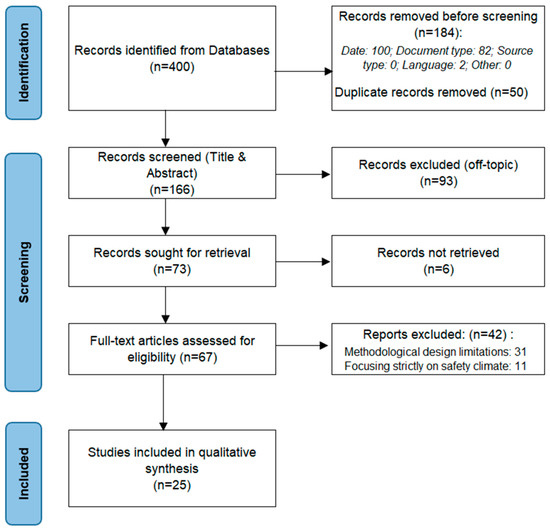
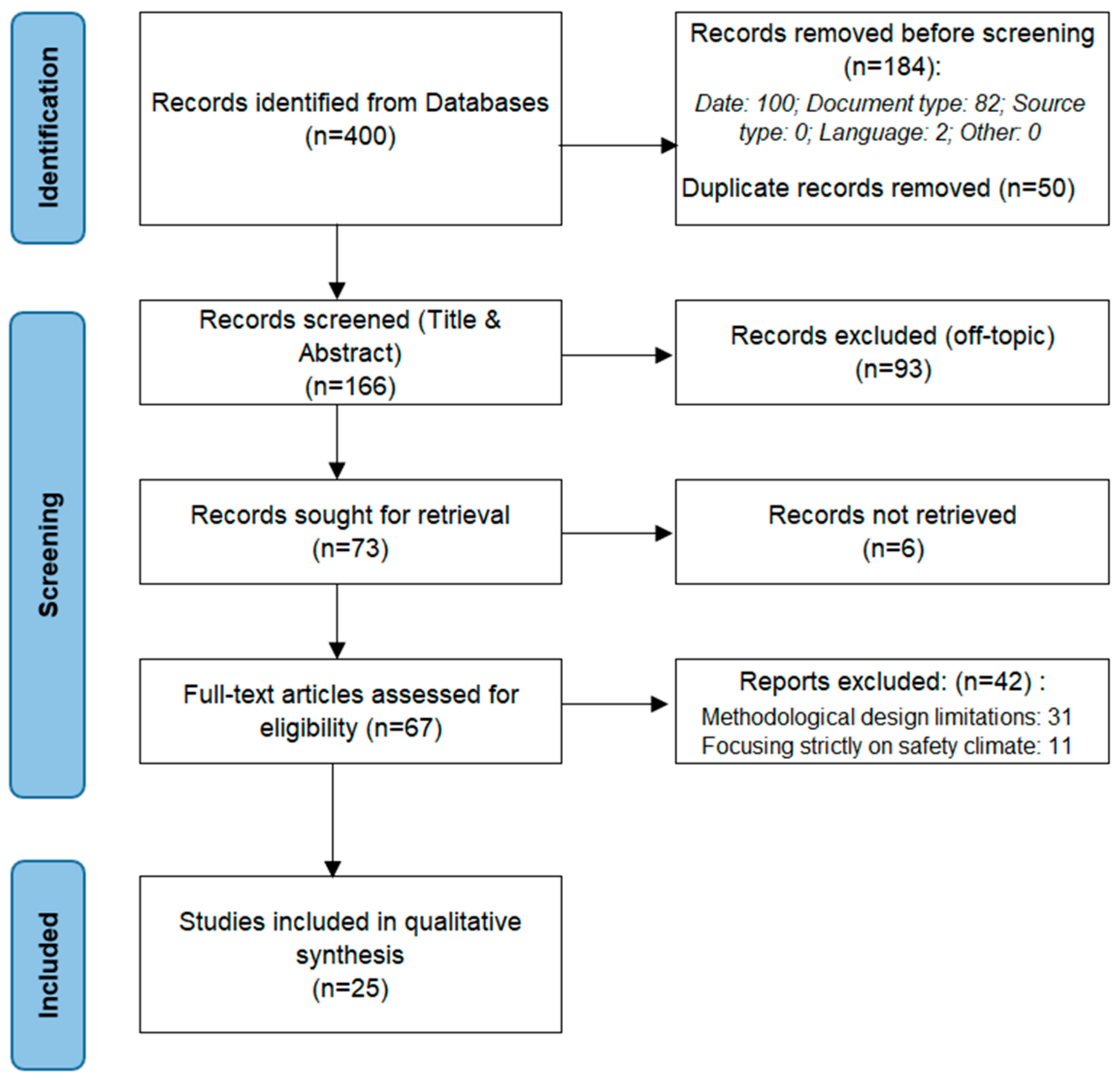
A total of 400 scientific records were identified through a scoping search of Scopus (n = 116), Web of Science (n = 48), and Dimensions (n = 236). Before exporting the data, 184 records were excluded directly within the databases using automated filters based on publication date (n = 100), document type (n = 82), and language (n = 2). The remaining 216 records were imported into Rayyan, where 50 duplicate entries were identified and removed. Subsequently, the titles and abstracts of the remaining 166 unique records were screened, resulting in the exclusion of 93 reports for being off-topic (e.g., healthcare, food, or traffic safety). Consequently, 73 records were retained and sought for retrieval, of which six reports could not be retrieved. The remaining 67 full-text articles were fully assessed for eligibility. During this phase, 42 articles were excluded: 31 due to methodological design limitations (such as lack of empirical application or validation) and 11 for focusing strictly on safety climate rather than culture. Ultimately, 25 studies were selected for the final qualitative synthesis, as detailed in Figure 1.
Figure 1.
PRISMA flow diagram (Supplementary File S1), adapted from Page et al. [13].
3.2. Methodological Overview and Study Typologies
The scoping review of the selected studies reveals a heterogeneous methodological landscape regarding safety culture assessment. The findings underscore the lack of consolidated methodological standards, as demonstrated during the synthesis process by the frequent development of bespoke instruments tailored to specific organizational contexts. While self-report questionnaires remain the dominant tool due to their scalability, methodological advances are evident in validation strategies and dimensional definitions. Rather than indicating a linear transition, current research demonstrates the coexistence of diverse approaches, where traditional perception-based diagnostics operate alongside triangulated frameworks that contrast prescribed work with operational reality and performance metrics.
To provide a structured comparative analysis, the identified methodologies were categorized into three primary typologies: (i) psychometric approaches and statistical modeling; (ii) multi-criteria models and expert assessment; and (iii) triangulation strategies and multidimensional diagnosis. The classification of the included studies into these typologies was guided by operational definitions based on their core analytical focus, as detailed in the subsequent subsections. For studies exhibiting hybrid methodologies, categorization was determined by the primary methodological contribution explicitly stated in the study’s objectives. The entire classification process was conducted independently by two reviewers, with any disagreements resolved through consensus.
3.2.1. Psychometric Approaches and Statistical Modeling
The studies included in this methodological axis operationalize safety culture through quantifiable constructs and statistically verifiable relationships between organizational and cultural factors. There is a predominance of self-report psychometric instruments supported by advanced statistical validation processes. This approach enables the transformation of the subjective dimensions of organizational culture into variables suitable for measurement, comparison, and predictive modeling. Across the sectors analyzed, there is strong convergence in the use of techniques such as Exploratory Factor Analysis (EFA), Confirmatory Factor Analysis (CFA), Structural Equation Modeling (SEM/PLS-SEM), multilevel regression, and Latent Profile Analysis [14,15,16,17,18,19,20,21,22,23,24,25,26,27]. Table 2 summarizes the methodological characteristics and main findings of these studies.
Table 2.
Studies based on psychometric approaches and statistical modeling.
These methodologies were used to statistically validate instrument structures and to analyze relationships among organizational dimensions, leadership, and safety performance. Nascimento et al. [25], Kalteh et al. [20], and Hosseinzadeh et al. [26] resorted to a combination of EFA and CFA to validate the dimensional structure of the developed instruments. At the same time, Priambodo [23] used PLS-SEM to demonstrate the direct impact of transformational leadership on safety culture. In parallel, Schwatka et al. [27] applied Latent Profile Analysis to categorize distinct organizational patterns of cultural maturity, highlighting the increasing analytical complexity of psychometric approaches.
Despite sectoral heterogeneity, several studies reported recurring associations between specific organizational dimensions and safety culture measures. Leadership was one of the most frequently assessed dimensions across the reviewed studies, particularly through management commitment, organizational communication, continuous training, and resource availability. Priambodo [23] reported a significant relationship between transformational leadership and safety culture. In contrast, Musonda et al. [16], by integrating SCMM into the LIP + 3C model, confirmed a positive association among leadership, organizational involvement, and safe behaviors. Similarly, Al-Waqfi [17] reported significant associations between training, leadership, tool availability, and preventive attitudes in the industrial context.
Concurrently, several studies identified significant perceptual misalignments across hierarchical levels and organizational groups, particularly between top management and operational workers. Arslan et al. [22] found statistically significant differences in perceptions between crews and onshore managers in the maritime sector. At the same time, Mahesh & MD [14] and Chan [15] identified cultural fragmentation among clients, contractors, subcontractors, and other stakeholders in the construction industry. Similarly, Siuta et al. [18] found that top executives exhibited lower maturity than specialized technicians, indicating differences in maturity levels across organizational groups. In addition to hierarchical asymmetries, psychometric tools reveal demographic and functional vulnerabilities; notably, Roth et al. [21], by applying covariance and multiple regression models in the healthcare sector, demonstrated that weaknesses in safety culture affect both native and migrant nurses, and reported associations between language-related challenges and exhaustion. These studies reported variations in perceptions of safety culture and maturity levels across hierarchical, demographic, and functional groups.
Another trend observed in the literature concerns the distinction between assessments centered on climate perceptions and those focused on structural and organizational dimensions. Andishe et al. [19] reported greater temporal stability for instruments focused on structural and organizational factors than questionnaires based solely on subjective climate perceptions. This conclusion aligns with the results of Stemn et al. [24], who found higher maturity in systemic components than in human and behavioral factors. Additionally, Schwatka et al. [27] demonstrated that organizations with highly formalized policies do not necessarily exhibit better safety behaviors, identifying differences between formalized organizational profiles and behavioral indicators.
Several studies reported limitations associated with exclusively quantitative methodologies. The reliance on self-report data, the subjectivity of individual perceptions, and the difficulty in capturing discrepancies between prescribed work and actual work emerge as recurrent limitations. In this context, Arslan et al. [22] and Nascimento et al. [25] explicitly advocate that psychometric results should not be interpreted in isolation and recommend integrating interviews, direct observations, document analysis, and objective operational indicators. These studies reported limitations related to capturing contextual aspects of safety culture, which motivated the subsequent development of integrative approaches and methodological triangulation strategies. These recommendations are reflected in the development of the triangulation-based approaches presented in the following section.
3.2.2. Multi-Criteria Models and Expert Assessment
Unlike approaches centered on workers’ perceptions, this axis is based on a normative definition of safety culture grounded in technical consensus and organizational maturity assessments. The literature predominantly employs multi-criteria decision-making tools, such as the Delphi method, the Analytic Hierarchy Process (AHP), and fuzzy logic, to translate abstract constructs into quantitative, auditable, and comparable indicators. Studies within this category show that expert validation reduces the inherent subjectivity in purely perceptual diagnoses, steering assessment toward strategic decision support and the identification of systemic weaknesses [28,29,30,31,32,33]. Table 3 summarizes their methodological characteristics and main findings.
Table 3.
Studies based on multi-criteria models and expert evaluation.
Within this group, the adoption of fuzzy comprehensive evaluation models combined with AHP stands out for hierarchical weight calibration and maturity index calculation. Hu et al. [33] and Li et al. [32], for instance, developed quantitative frameworks that convert qualitative expert judgments into structured classifications of cultural maturity. Similarly, Pei et al. [31] applied the grey fuzzy comprehensive evaluation method, replacing AHP with an influence matrix to assign relative weights to organizational dimensions dynamically. Although the methodologies differ in their operational approaches, these studies converge in their efforts to develop more robust assessments that are less dependent on individual perceptual variability.
Concurrently, a growing body of models focuses on assessing organizational maturity. Golabchi et al. [29] proposed the Safety Maturity Framework, structured into hierarchical maturity levels and designed to evaluate institutional safety management capabilities systematically. The model prioritizes criteria related to governance, monitoring, compliance, and the integration of safety into organizational processes. Similarly, Elkaseh et al. [30] developed the FLARE matrix, based on occupational safety standardsand empirically applied in the construction sector, reinforcing the use of structured audits, checklists, and formal continuous evaluation mechanisms as diagnostic instruments for cultural maturity.
Despite the methodological robustness of these instruments, the literature cautions that an excessive focus on documentary compliance can obscure weaknesses in actual behaviors and informal culture. In their empirical application, Pei et al. [31] identified a critical asymmetry between systemic and behavioral dimensions, noting that physical and structural components exhibited significantly higher maturity levels than the conceptual and human dimensions. This finding indicates differences between structural and behavioral dimensions of maturity.
In response to these limitations, Trinh & Feng [28] propose incorporating behavioral descriptors for each maturity level to bring normative auditing closer to actual work practices. This approach aims to mitigate the documentary bias, transforming organizational assessment into a diagnosis oriented toward observable routines and concrete adaptive capacities. In conclusion, multi-criteria and expert-based evaluation models privilege a normative perspective on safety culture, focusing on the organizational capacity to systematize formal control practices, processes, and mechanisms. Furthermore, the literature highlights that the use of multi-criteria methods enables the prioritization of critical safety factors and the structuring of maturity models tailored to the sector-specific organizational characteristics [28,29,30,31,32,33].
3.2.3. Triangulation Strategies and Multidimensional Diagnosis
Seeking to overcome the limitations inherent in self-reporting (perceptual axis) and technical auditing (normative axis), the most integrative methodological approach involves triangulation strategies. Studies within this category employ mixed methods to examine different sources of evidence, including prescribed, actual, and perceived work. The central focus of this approach is identifying discrepancies between formal organizational narratives and operational practices, thereby supporting a more comprehensive assessment of safety culture [34,35,36,37,38]. Table 4 summarizes their methodological characteristics and main findings.
Table 4.
Studies based on triangulation strategies and multidimensional diagnosis.
To operationalize this assessment, studies such as those by Amol et al. [38] and Rocha et al. [36] combine quantitative metrics with qualitative evidence. In the steel industry context, Amol et al. [38] assessed the three levels of Schein’s organizational culture through the integration of direct observation checklists to evaluate artifacts (visible elements such as equipment and signage), document analysis to examine espoused values (formal policies), and questionnaires to explore basic assumptions (underlying beliefs). Their findings indicated that high levels of compliance in visible artifacts coexisted with weaknesses in workers’ underlying beliefs, suggesting that visible compliance may not fully reflect safety culture. Similarly, in the oil and gas sector, Rocha et al. [36] compared visual metrics (radar charts) derived from surveys with evidence obtained through collective confrontation interview sessions. This triangulated approach identified differences between managerial perceptions and operational demands that were not fully captured by aggregated survey indicators.
Advancing toward a more integrated assessment of the work system, van Nunen et al. [34] and Corrigan et al. [37] developed diagnostic approaches that combine multiple operational dimensions. The Integrated Safety Culture Assessment proposed by van Nunen et al. [34] examines organizations from a sociotechnical and macroergonomic perspectives, integrating the human, organizational, and technological domains through observable and unobservable measurement matrices. Likewise, in the European port environment, Corrigan et al. [37] employed a mixed-methods approach that combined quantitative survey data with qualitative evidence obtained through semi-structured interviews based on the SCOPE framework. Together, these studies highlight the value of combining standardized safety metrics with contextual information derived from operational practice.
The literature also highlights limitations associated with the isolated use of survey-based assessments, including those based on established maturity models. Boskeljon-Horst et al. [35], in a study conducted on military aviation, observed that frequent selection of the “Generative” maturity level by pilots did not correspond to the safety performance expected from that classification. Instead, qualitative evidence suggested that some responses reflected operational interpretations that accepted deviations from procedures in favor of mission efficiency. This discrepancy became apparent only through the comparison of survey results with evidence from an independent accident investigation report.
Overall, the studies grouped within this axis indicate that the isolated application of maturity assessment tools may provide only a partial representation of safety culture. The use of triangulation methodologies enables the comparison of formal compliance indicators with evidence from actual work practices, thereby supporting the identification of discrepancies between organizational discourse and operational reality [34,35,36,37,38].
3.3. Critical Appraisal Within Sources of Evidence
Following the study selection process, the methodological quality of the 25 included articles was critically appraised using the MMAT [12]. In accordance with the MMAT guidelines, the appraisal was conducted through a two-stage sequential process rather than applying a uniform analytical grid to all articles. First, an initial screening was performed using two screening questions (S1 and S2) to verify the clarity of the research questions and the adequacy of the collected data. All 25 studies met these initial screening criteria.
Subsequently, because the critical aspects of appraisal differ by study design, each article was assessed according to its methodological category. Nineteen articles were appraised using the criteria for quantitative descriptive studies (Category 4), while six articles were evaluated using the criteria for mixed-methods studies (Category 5, following independent appraisals of their qualitative and quantitative components using Categories 1 and 4). All selected studies fulfilled at least three of the five design-specific methodological criteria. A detailed overview of the critical appraisal results for both quantitative and mixed-methods studies is presented in Table 5. These appraisal findings informed the descriptive synthesis by contextualizing the results and enabling a more cautious interpretation of the evidence where methodological vulnerabilities were identified.
Table 5.
Mixed Methods Appraisal Tool, adapted from [12].
Overall, the critical appraisal revealed distinct patterns of strengths and vulnerabilities across study designs. Among the quantitative descriptive studies, criteria related to the appropriateness of measurement procedures (criterion 4.3) and analytical methods (criterion 4.5) were frequently fulfilled. In contrast, lower compliance was observed for criteria concerning sample representativeness (criterion 4.2) and the risk of nonresponse bias (criterion 4.4). Among the mixed-methods studies, the individual qualitative components generally demonstrated high methodological rigor, whereas the quantitative components exhibited vulnerabilities similar to those in purely quantitative studies. Regarding their integration, criteria related to the rationale for using a mixed-methods design (criterion 5.1) and the integration of qualitative and quantitative components (criterion 5.2) were generally fulfilled, whereas greater variability was observed regarding the management of divergences between quantitative and qualitative results (criterion 5.4).
4. Discussion
The scoping review highlights the lack of a scientific consensus on a universally replicable methodology for assessing safety culture. This overarching conclusion is supported by the mapping of diagnostic tools across the included studies, which revealed a highly fragmented landscape. The wide dispersion of approaches reflects the multiplicity of realities inherent to safety culture itself, leading to extensive contextual adaptation of assessment instruments that, in some cases, prevents their exact replication across different industrial settings. It is precisely in response to this scenario of methodological fragmentation and the impossibility of identifying a transferable reference standard that the studies included in this review were grouped into three major methodological categories: psychometric, multi-criteria, and triangulation-based approaches.
This categorization enabled the discussion to be structured not around isolated, highly customised tools but rather around underlying methodological paradigms, providing a coherent analytical framework for a body of literature characterised by substantial empirical dispersion. This categorization represents the novel contribution of this review, advancing the field by providing a structured guide for selecting methodologies. Fundamentally, the pronounced sectoral and geographical heterogeneity inherent in the included literature, encompassing diverse operational domains such as healthcare, aviation, and construction, precluded any direct quantitative comparison of safety performance metrics. Consequently, this contextual diversity structurally dictated the analytical synthesis of the present review, necessitating a methodological focus on the architectural design and epistemological premises of the assessment frameworks rather than on comparative diagnostic outcomes.
Another limitation identified in the literature concerns the cross-cultural validity and transferability of the assessment instruments. Data charting revealed that the vast majority of tools are developed, calibrated, and validated within a highly specific sociotechnical and geographic context, often within the same organization or sector where the empirical study is conducted. Consequently, discussions of the applicability of these methodologies across sectors and national contexts were examined only rarely in the included studies. This methodological gap suggests that an instrument deemed statistically valid for a specific industrial or national context may not retain the same validity and diagnostic performance without appropriate adaptation and revalidation across different sectors or countries with distinct labor, legislative, and sociocultural dynamics, potentially placing greater emphasis on procedural compliance than on context-specific cultural and operational dynamics. The scarcity of cross-validation studies compromises the generalizability of maturity models, underscoring the need for future research to test the empirical resilience of these tools across heterogeneous organizational and cultural settings.
When analyzed through this structure, the reviewed studies indicate a diversification of methodological approaches to safety culture. This diversification became apparent during the categorisation process, which revealed a clear methodological split: a predominant reliance on psychometric and perception-based instruments, alongside structural, normative, and integrative frameworks. Rather than representing a linear methodological evolution, these approaches differ in the dimensions of safety culture they emphasize and in the type of evidence they generate. While perceptually driven models focus primarily on workers’ perceptions and attitudes, multi-criteria and triangulated approaches incorporate organizational, operational, and sociotechnical dimensions, offering alternative perspectives for assessing safety culture.
The predominance of psychometric approaches identified in this review confirms the historical consolidation of questionnaires as the primary mechanism for safety culture assessment, given their high applicability and scalability. Furthermore, the use of techniques such as exploratory and confirmatory factor analysis, structural equation modeling, and latent profile analysis demonstrates the growing pursuit of analytical sophistication in quantitative assessment models. These methodologies have contributed significantly to the dissemination of diagnostic instruments and the statistical validation of relationships between leadership, organizational climate, communication, training, and safety-related behaviors. In particular, the recurrent identification of leadership as a main predictor of cultural maturity reinforces the theoretical assumptions classically proposed by Cooper [6] and Hudson [10] regarding the central role of management commitment in the development of proactive and generative organizational environments.
On the one hand, the systematic validation of classic dimensions, such as leadership, communication, and training, through advanced analytical techniques robustly consolidates the recognized relevance of these factors as core pillars of safety culture. However, this pattern raises a critical theoretical implication for the field’s advancement. From a conceptual standpoint, it is questionable to what extent methodological refinement has translated into genuine conceptual innovation. Although there is an observable trend towards analytical complexity, the vast majority of assessment frameworks continue to focus predominantly on these same dimensions. This pattern suggests that increases in quantitative rigor do not necessarily correspond to equivalent advances in theoretical understanding. Consequently, the use of increasingly complex statistical models risks serving primarily as a revalidation mechanism for widely established assumptions, limiting the theoretical expansion of new predictors and the understanding of emerging nuances in work systems.
Despite the search for statistical robustness, the psychometric studies analyzed also revealed recurring limitations, including self-report bias, perceptual fragmentation, and the inability of questionnaires to capture discrepancies between prescribed work and actual operational practices. Several studies have demonstrated significant asymmetries across hierarchical levels, particularly between senior management and operational workers, suggesting that cultural maturity is unevenly distributed throughout the organizational structure. These findings support classical criticisms of the distinction between safety climate and safety culture, particularly those proposed by Guldenmund [9], who argues that quantitative climate assessments may oversimplify the dynamic complexity of organizational culture.
The reviewed evidence indicates that this perceptual divergence across hierarchical levels raises implications that are not only methodological but also organizational and ethical. These findings can be extended to a broader theoretical implication for safety science: when assessments rely predominantly on averaged or aggregated indicators, combining more positive management responses with frontline responses may obscure vulnerabilities reported by operational workers. From an organizational and methodological perspective, aggregating responses may unintentionally obscure vulnerabilities experienced by frontline workers. Consequently, safety diagnoses that do not stratify findings across hierarchical levels yield overly homogeneous interpretations of organizational reality, limiting the theoretical understanding of how safety is practiced versus how it is managed.
The scoping review further demonstrates that the development of multi-criteria and expert-based models represents an attempt to increase diagnostic objectivity through structured organizational assessment. Unlike perception-based approaches, these methods operationalize safety culture through normative indicators, maturity matrices, governance mechanisms, and institutional safety management capabilities. The adoption of methodologies such as AHP, fuzzy logic, Delphi techniques, and hierarchical maturity frameworks reflects the growing effort to transform abstract cultural dimensions into auditable, comparable organizational criteria. In this context, multi-criteria models make significant contributions to benchmarking, strategic decision-making, and systematic organizational auditing, particularly in sectors characterized by high operational complexity and strong regulatory pressure, such as the construction, energy, and process industries.
However, the findings also demonstrate that these structural models are not exempt from limitations. Several studies identified organizations presenting high levels of documentary compliance and formal safety management maturity while simultaneously exhibiting significant weaknesses in the behavioral internalization of safety values. This phenomenon is consistent with the possibility of a “facade safety culture”, in which formal structures, procedures, and indicators do not effectively reflect actual operational practices.
As a response to some of the limitations identified in both psychometric and normative approaches, several studies have adopted triangulated and integrative methodologies. These approaches combine quantitative survey instruments with interviews, direct observations, document analysis, and operational indicators, enabling the examination of multiple sources of evidence. Rather than interpreting safety culture as an exclusively perceptual or structural phenomenon, triangulated models seek to compare formal organizational arrangements, managerial perceptions, and operational practices. The reviewed studies suggest that such approaches may facilitate the identification of discrepancies between prescribed and actual work. However, they generally require greater methodological complexity, more extensive data-collection procedures, and a higher level of resource investment than standardized survey-based assessments. Furthermore, studies that adopt integrative frameworks emphasize the interactions among human, technological, organizational, and environmental dimensions. This perspective supports the interpretation of safety culture as a multidimensional organizational phenomenon influenced by operational conditions, leadership practices, technological constraints, and broader organizational processes.
Although considerable advances in diagnostic sophistication have been identified, a critical gap in the literature remains regarding the empirical link between assessed cultural maturity and actual operational safety performance indicators. The analyzed methodologies provide detailed assessments of organizational and behavioral dimensions. However, the predictive validity was examined in only a limited number of the included studies. There is a scarcity of longitudinal studies investigating the relationship between the evolution of maturity levels over time and tangible lagging indicators, such as accident frequency rates, severity indices, and injury severity. Most approaches remain limited to cross-sectional assessments, providing descriptive evaluations without establishing mechanisms for continuous monitoring or for examining how interventions influence safety performance over time.
Consequently, these methodologies frequently remain restricted to diagnostic purposes, overlooking not only the implementation of corrective actions but also the evaluation of their long-term effectiveness in reducing negative safety indicators. Thus, the theoretical observation of high cultural maturity may not always translate into superior operational performance and genuinely safer work environments. Framing this disconnect as a core theoretical implication raises a fundamental question for the field: are current assessment frameworks effectively measuring an organization’s capacity to support safety performance, or do they primarily characterize perceptions and formal management structures at a given point in time?
Overall, the evidence reviewed does not support identifying a universally superior method for safety culture assessment. Instead, it indicates that each methodological family captures different dimensions of the phenomenon. Psychometric approaches provide scalability, standardization, and comparability but remain dependent on self-reported perceptions and are susceptible to perceptual aggregation. Multi-criteria and maturity-based models support organizational diagnosis and benchmarking through structured evaluation frameworks, although they may place greater emphasis on formal organizational arrangements and compliance mechanisms. Triangulated approaches incorporate multiple sources of evidence and may facilitate the examination of discrepancies between organizational discourse and operational practice, but they generally entail greater methodological complexity and resource investment and are less easily standardized across contexts.
Consequently, the reviewed literature suggests that the selection of an assessment methodology should be guided by the objectives, context, and scope of the evaluation rather than by the assumption that a single approach is universally applicable. Future research should continue to explore the relationship between safety culture assessment outcomes and operational safety performance, particularly through longitudinal studies that examine how cultural changes are reflected in safety indicators over time. To systematize the findings extracted from the scoping review, Table 6 presents a comparative matrix that outlines the assessment purposes, validation requirements, and inherent limitations of the three methodological categories.
Table 6.
Comparison of methodological categories for safety culture assessment.
These methodological families should not necessarily be understood as mutually exclusive alternatives. Depending on the assessment purpose and available resources, psychometric instruments may provide an initial scalable diagnosis of workers’ perceptions; multi-criteria or maturity-based models may subsequently support the structured evaluation of organizational systems and governance mechanisms; and triangulation strategies may contrast these findings with interviews, observations, documentary evidence, and operational safety indicators. This complementary use represents an evidence-informed synthesis of the reviewed approaches rather than a validated prescriptive framework, and its practical implementation requires further empirical testing.
Despite the rigorous methodological approach guided by PRISMA-ScR [11], this scoping review presents certain limitations that should be acknowledged. First, the search strategy was deliberately delimited by specific parameters: the 2016–2025 timeframe, the English-language filter, and a keyword requirement limited to document titles. While these boundaries were necessary to focus the scope on contemporary, internationally accessible, and core-targeted methodologies, they inherently constrain the breadth of coverage, potentially omitting earlier foundational works, non-English studies, or approaches where safety culture was framed under broader terminology. Second, the included studies represented heterogeneous sectors, such as construction, healthcare, aviation, and process industries. Although this broad scope enabled a comprehensive methodological overview, the strong contextual dependence of safety culture limited the direct comparability of findings across different organizational settings. Safety culture is inherently influenced by sector-specific operational, organizational, and sociotechnical characteristics, which may affect the transferability of assessment approaches across different contexts.
Additionally, the critical appraisal conducted using the MMAT identified recurrent limitations related to sample representativeness and the reporting of nonresponse bias, particularly among quantitative descriptive studies. These methodological gaps may reduce the generalizability of the findings and create uncertainty about the extent to which the reported perceptions reflect broader organizational realities. Consequently, caution should be exercised when interpreting cultural maturity across heterogeneous contexts and extrapolating findings beyond the settings in which the assessment instruments were originally developed and applied.
5. Conclusions
This scoping review demonstrated that safety culture assessment remains characterized by substantial methodological fragmentation, reflecting the complexity and contextual dependence of organizational safety phenomena. Although no universally transferable assessment framework was identified, the studies analyzed revealed a broad methodological diversification, in which predominantly psychometric and perception-based approaches coexist with structural, multi-criteria, and integrative assessment models.
By organizing the literature into three major methodological typologies (psychometric, multi-criteria, and triangulation-based approaches), this review provides a structured analytical perspective that synthesizes a highly dispersed field. The findings suggest that no single methodological approach is sufficient to fully capture the multidimensional nature of safety culture, reinforcing the need for integrated assessment strategies that combine quantitative validation, organizational auditing, behavioral observation, and operational analysis.
Finally, this review highlights important scientific gaps that remain underexplored in the literature, particularly the predominance of cross-sectional designs and the limited integration of real-time operational data, digital monitoring systems, and cultural assessment models. Future research should therefore prioritize longitudinal, sociotechnical, and data-driven frameworks that capture the dynamic and adaptive nature of safety culture in complex organizational systems.
Supplementary Materials
The following supporting information can be downloaded at: https://www.mdpi.com/article/10.3390/safety12050114/s1, File S1: Preferred Reporting Items for Systematic reviews and Meta-Analyses extension for Scoping Reviews (PRISMA-ScR) Checklist.
Author Contributions
Conceptualization, V.M. and J.D.; methodology, V.M. and J.D.; software, V.M.; validation, V.M. and J.D.; formal analysis, V.M.; investigation, V.M.; resources, J.G. and J.D.; data curation, V.M.; writing—original draft preparation, V.M.; writing—review and editing, V.M. and J.D.; visualization, V.M.; supervision, J.G. and J.D.; project administration, V.M. and J.D. All authors have read and agreed to the published version of the manuscript.
Funding
This research received no external funding.
Institutional Review Board Statement
Not applicable.
Informed Consent Statement
Not applicable.
Data Availability Statement
No new data were created or analyzed in this study. Data sharing is not applicable to this article.
Acknowledgments
During the preparation of this manuscript, the authors used Gemini 1.5 Pro (Google) for the purposes of English translation, academic proofreading, and language polishing. The authors have reviewed and edited the output and take full responsibility for the content of this publication.
Conflicts of Interest
The authors declare no conflicts of interest.
Abbreviations
The following abbreviations are used in this manuscript:
| AHP | Analytic Hierarchy Process |
| AIC | Akaike Information Criterion |
| ANOVA | Analysis of Variance |
| AVE | Average Variance Extracted |
| BIC | Bayesian Information Criterion |
| BLRT | Bootstrapped Likelihood Ratio Test |
| CFA | Confirmatory Factor Analysis |
| CFI | Comparative Fit Index |
| CMIN/DF | Chi-Square/Degrees of Freedom Ratio |
| CR | Consistency Ratio/Composite Reliability |
| CV | Coefficient of Variation |
| CVI | Content Validity Index |
| CVR | Content Validity Ratio |
| EFA | Exploratory Factor Analysis |
| GFI | Goodness of Fit Index |
| ICC | Intraclass Correlation Coefficient |
| INSAG | International Nuclear Safety Advisory Group |
| KMO | Kaiser–Meyer–Olkin |
| LMR | Lo–Mendell–Rubin |
| MMAT | Mixed Methods Appraisal Tool |
| NFI | Normed Fit Index |
| PCA | Principal Component Analysis |
| PLS-SEM | Partial Least Squares Structural Equation Modeling |
| PRISMA-ScR | Preferred Reporting Items for Systematic reviews and Meta-Analyses extension for Scoping Reviews |
| RMSEA | Root Mean Square Error of Approximation |
| SCMM | Safety Culture Maturity Model |
| SD | Standard Deviation |
| SDG | Sustainable Development Goals |
| SEM | Structural Equation Modeling |
| SME | Small and Medium-sized Enterprises |
| SPSS | Statistical Package for the Social Sciences |
References
- ONU Transforming Our World: The 2030 Agenda for Sustainable Development|Department of Economic and Social Affairs. Available online: https://sdgs.un.org/2030agenda (accessed on 29 March 2026).
- International Nuclear Safety Advisory Group. Summary Report on the Post-Accident Review Meeting on the Chernobyl Accident; Safety Series No. 75-INSAG-1; International Atomic Energy Agency: Vienna, Austria, 1986. [Google Scholar]
- International Nuclear Safety Advisory Group. Safety Culture; Safety Series No. 75-INSAG-4; International Atomic Energy Agency: Vienna, Austria, 1991. [Google Scholar]
- Reason, J. Achieving a Safe Culture: Theory and Practice. Work. Stress 1998, 12, 293–306. [Google Scholar] [CrossRef] [Scilit]
- Reason, J. Managing the Risks of Organizational Accidents; Routledge: London, UK, 1997; pp. 1–252. [Google Scholar] [CrossRef] [Scilit]
- Cooper, M.D. Towards a Model of Safety Culture. Saf. Sci. 2000, 36, 111–136. [Google Scholar] [CrossRef] [Scilit]
- Bandura, A. Self-Efficacy: Toward a Unifying Theory of Behavioral Change. Psychol. Rev. 1977, 84, 191–215. [Google Scholar] [CrossRef] [PubMed]
- Zohar, D. Safety Climate in Industrial Organizations: Theoretical and Applied Implications. J. Appl. Psychol. 1980, 65, 96. [Google Scholar] [CrossRef] [Scilit]
- Guldenmund, F.W. The Nature of Safety Culture: A Review of Theory and Research. Saf. Sci. 2000, 34, 215–257. [Google Scholar] [CrossRef] [Scilit]
- Hudson, P.T.W. Safety Culture-Theory and Practice; RTO/NATO: Neuilly-sur-Seine, France, 2001. [Google Scholar]
- Tricco, A.C.; Lillie, E.; Zarin, W.; O’Brien, K.K.; Colquhoun, H.; Levac, D.; Moher, D.; Peters, M.D.J.; Horsley, T.; Weeks, L.; et al. PRISMA Extension for Scoping Reviews (PRISMA-ScR): Checklist and Explanation. Ann. Intern. Med. 2018, 169, 467–473. [Google Scholar] [CrossRef] [Scilit] [PubMed]
- Hong, Q.N.; Pluye, P.; Fàbregues, S.; Bartlett, G.; Boardman, F.; Cargo, M.; Dagenais, P.; Gagnon, M.-P.; Griffiths, F.; Nicolau, B.; et al. Mixed Methods Appraisal Tool (MMAT) Version 2018 User Guide; Canadian Intellectual Property Office: Gatineau, QC, Canada, 2018.
- Page, M.J.; Moher, D.; Bossuyt, P.M.; Boutron, I.; Hoffmann, T.C.; Mulrow, C.D.; Shamseer, L.; Tetzlaff, J.M.; Akl, E.A.; Brennan, S.E.; et al. PRISMA 2020 Explanation and Elaboration: Updated Guidance and Exemplars for Reporting Systematic Reviews. BMJ 2021, 372, n160. [Google Scholar] [PubMed]
- MD, D.; Mahesh, G. Influence of Knowledge-Based Safety Culture in the Construction Industry: A Stakeholder’s Perspective. Int. J. Workplace Health Manag. 2021, 14, 111–128. [Google Scholar] [CrossRef] [Scilit]
- Chan, E. A Multi-Level Safety Culture Maturity Model for (New) Building Projects in Hong Kong. HKIE Trans. Hong Kong Inst. Eng. 2023, 30, 95–105. [Google Scholar] [CrossRef] [Scilit]
- Musonda, I.; Lusenga, E.; Okoro, C. Rating and Characterization of an Organization’s Safety Culture to Improve Performance. Int. J. Constr. Manag. 2021, 21, 181–193. [Google Scholar] [CrossRef] [Scilit]
- Al-Waqfi, M.S.E.-A. Development of a Safety Culture Assessment Tool for Jordanian Enterprises. Int. J. Saf. Secur. Eng. 2025, 15, 643–651. [Google Scholar] [CrossRef] [Scilit]
- Siuta, D.; Kukfisz, B.; Kuczyńska, A.; Mitkowski, P.T. Methodology for the Determination of a Process Safety Culture Index and Safety Culture Maturity Level in Industries. Int. J. Environ. Res. Public Health 2022, 19, 2668. [Google Scholar] [CrossRef] [Scilit] [PubMed]
- Andishe, S.; Jafari, M.J.; Fasih Ramandi, F.; Khodakarim, S.; Salehi, A. Psychometrics of Questionnaires Designed for the Evaluation of Safety Levels and Safety Culture Case Study: Power Plant Generator Manufacturing Company. Int. J. Occup. Hyg. 2022, 13, 337–346. [Google Scholar] [CrossRef] [Scilit]
- Kalteh, H.O.; Salesi, M.; Cousins, R.; Mokarami, H. Assessing Safety Culture in a Gas Refinery Complex: Development of a Tool Using a Sociotechnical Work Systems and Macroergonomics Approach. Saf. Sci. 2020, 132, 104969. [Google Scholar] [CrossRef] [Scilit]
- Roth, C.; Berger, S.; Krug, K.; Mahler, C.; Wensing, M. Internationally Trained Nurses and Host Nurses’ Perceptions of Safety Culture, Work-Life-Balance, Burnout, and Job Demand during Workplace Integration: A Cross-Sectional Study. BMC Nurs. 2021, 20, 77. [Google Scholar] [CrossRef] [Scilit] [PubMed]
- Arslan, V.; Kurt, R.E.; Turan, O.; De Wolff, L. Safety Culture Assessment and Implementation Framework to Enhance Maritime Safety. In Proceedings of the Transportation Research Procedia; Elsevier: Amsterdam, The Netherlands, 2016; Volume 14, pp. 3895–3904. [Google Scholar]
- Priambodo, Y.P. Influence of Leadership Behavior on Safety Culture Integration at PT Cipta Kridatama Site PT Borneo Indobara. Int. J. Econ. (IJEC) 2025, 4, 1–9. [Google Scholar] [CrossRef] [Scilit]
- Stemn, E.; Bofinger, C.; Cliff, D.; Hassall, M.E. Examining the Relationship between Safety Culture Maturity and Safety Performance of the Mining Industry. Saf. Sci. 2019, 113, 345–355. [Google Scholar] [CrossRef] [Scilit]
- Nascimento, C.S.; Andrade, D.A.; Mesquita, R.N. Psychometric Model for Safety Culture Assessment in Nuclear Research Facilities. Nucl. Eng. Des. 2017, 314, 227–237. [Google Scholar] [CrossRef] [Scilit]
- Hosseinzadeh, K.; Mohammadfam, I.; Soltanzadeh, A.; Soltanian, A. Designing and Constructing a Tool for Safety Culture Evaluation in a Processing Industry Based on Factor Analysis. Iran. Rehabil. J. 2023, 21, 565–576. [Google Scholar] [CrossRef] [Scilit]
- Schwatka, N.V.; Dally, M.; Shore, E.; Dexter, L.; Tenney, L.; Brown, C.E.; Newman, L.S. Profiles of Total Worker Health® in United States Small Businesses. BMC Public Health 2021, 21, 1010. [Google Scholar] [CrossRef] [Scilit] [PubMed]
- Trinh, M.T.; Feng, Y. A Maturity Model for Resilient Safety Culture Development in Construction Companies. Buildings 2022, 12, 733. [Google Scholar] [CrossRef] [Scilit]
- Golabchi, H.; Pereira, E.; Lefsrud, L.; Mohamed, Y. Proposal of a Safety Maturity Framework in Construction: Implementing Leading Indicators for Proactive Safety Management. J. Saf. Sustain. 2025, 2, 207–221. [Google Scholar] [CrossRef] [Scilit]
- Elkaseh, A.A.A.; Zakaria, R.; Shamsudin, S.M.; Mazlan, A.N.; Vighio, A.A. Adapting ISO 45001:2018 for optimizing safety performance in developing countries: A case study on Libya’s construction sector. Plan. Malays. 2025, 23. [Google Scholar] [CrossRef] [Scilit]
- Pei, J.; Liu, L.; Chi, Y.; Yu, C. Research on the Maturity Evaluation Model of Enterprise Safety Culture. Int. J. Environ. Res. Public Health 2023, 20, 2664. [Google Scholar] [CrossRef] [Scilit] [PubMed]
- Li, L.; Yan, P.; Wang, X.; Liu, S.; Zhang, Y.; Cheng, Y. Research on the Safety Culture in Medium and Small Enterprises. Emerg. Manag. Sci. Technol. 2024, 4, e021. [Google Scholar] [CrossRef] [Scilit]
- Hu, R.; Zhang, Y.; Gu, B. Comprehensive Evaluation of University Safety Culture Construction Level Based on “2–4” Model. Int. J. Environ. Res. Public Health 2022, 19, 16145. [Google Scholar] [CrossRef] [Scilit] [PubMed]
- van Nunen, K.; Reniers, G.; Ponnet, K. Measuring Safety Culture Using an Integrative Approach: The Development of a Comprehensive Conceptual Framework and an Applied Safety Culture Assessment Instrument. Int. J. Environ. Res. Public Health 2022, 19, 13602. [Google Scholar] [CrossRef] [Scilit] [PubMed]
- Boskeljon-Horst, L.; Sillem, S.; Dekker, S.W.A. ‘Ladder’-Based Safety Culture Assessments Inversely Predict Safety Outcomes. J. Contingencies Crisis Manag. 2023, 31, 372–391. [Google Scholar] [CrossRef] [Scilit]
- Rocha, R.; Duarte, F.; Lima, F.P.A.; Mercado, M.; Araújo, A.; Garotti, L.; Campos, M. Framework for the Assessment of the Safety Culture in the Oil and Gas Industry. Int. J. Occup. Saf. Ergon. 2024, 30, 224–237. [Google Scholar] [CrossRef] [Scilit] [PubMed]
- Corrigan, S.; Kay, A.; Ryan, M.; Brazil, B.; Ward, M.E. Human Factors & Safety Culture: Challenges & Opportunities for the Port Environment. Saf. Sci. 2020, 125, 103854. [Google Scholar] [CrossRef] [Scilit]
- Amol, D.A.; Wanjohi, A.; Bichanga, R. Occupational Safety Culture in Devki Steel Mills Limited in Athi River, Machakos County, Kenya. Open Access Libr. J. 2023, 10, e10527. [Google Scholar] [CrossRef]

Disclaimer/Publisher’s Note: The statements, opinions and data contained in all publications are solely those of the individual author(s) and contributor(s) and not of MDPI and/or the editor(s). MDPI and/or the editor(s) disclaim responsibility for any injury to people or property resulting from any ideas, methods, instructions or products referred to in the content. |
© 2026 by the authors. Licensee MDPI, Basel, Switzerland. This article is an open access article distributed under the terms and conditions of the Creative Commons Attribution (CC BY) license.