Review

Fuzzy Logic-Based Aggregated Risk Values in Occupational Safety Risk Assessment: A Systematic Review

1
Doctoral School on Safety and Security Sciences, Obuda University, József Blvd 6, 1088 Budapest, Hungary
2
Keleti Karoly Faculty of Business and Management, Obuda University, Tavaszmező Str. 15–17, 1084 Budapest, Hungary
3
Department of Industrial Design, Technical University of Varna, Levski Primorski, ul. “Studentska” 1, 9010 Varna, Bulgaria
4
Donat Banki Faculty of Mechanical and Safety Engineering, Obuda University, József Blvd 6, 1088 Budapest, Hungary
*
Author to whom correspondence should be addressed.
Safety 2026, 12(4), 112; https://doi.org/10.3390/safety12040112
Submission received: 19 June 2026 / Revised: 8 August 2026 / Accepted: 17 August 2026 / Published: 20 August 2026

Abstract

Occupational safety risk assessment combines measured data, qualitative observations, and expert judgment to prioritize preventive action. Fuzzy logic can structure linguistic and uncertain information, but poorly justified variables, membership functions, rules, or weights can embed bias, while aggregation can obscure hazard-specific differences. Following a PRISMA-aligned selection process, this systematic review examined 30 fuzzy-based occupational safety studies, focusing not only on technical design but also on output types, intended decision users and purposes, traceability, temporal operation, and evidence of safety outcomes. Fifteen models primarily produced a score, index, level, or class; nine produced a ranking or priority; and six preserved a relational or causal representation. Only two directly supported workers, one operated in real time, and none demonstrated recalibration driven by observed safety outcomes. Although 28 studies reported positive evaluations of their own solutions, only one reported improvement in accident outcomes observed over time, and one provided partial follow-up. Aggregated fuzzy values are therefore most defensible as traceable, context-bound decision-support indicators. They should complement rather than replace hazard-specific assessment and should be linked to worker participation, documented control actions, assigned responsibilities, and verification of implemented measures.

1. Introduction

Occupational safety and health (OSH) risk assessment is a central element of preventive workplace safety management. Its practical purpose is to identify hazards, evaluate risks, support the selection of preventive and corrective measures, and provide traceable documentation for organizational and regulatory decision-making. In everyday occupational safety practice, risk assessment is rarely based solely on directly measured data. It often requires professional judgment, interpretation of workplace conditions, and evaluation of hazards that differ in their source, severity, likelihood, exposure pattern, and time horizon [1,2,3]. OSH risk assessment is therefore not merely a measurement task but also a judgment-based decision process in which uncertainty, interpretation, and hazard-specific knowledge play central roles.
This creates a persistent practical challenge. OSH risk assessment often has to address mechanical hazards, chemical exposures, ergonomic loads, organizational conditions, environmental factors, and human behavior within the same workplace or work process. These hazards are not readily comparable. Some are associated with acute accident scenarios, whereas others relate to long-term exposure or cumulative strain. Some can be described by technical measurements, while others depend on observation, worker feedback, or expert interpretation. This heterogeneity directly affects what can be compared, ranked, and aggregated, and what can be translated into preventive action. From a complexity perspective, workplace risk may also emerge from nonlinear interactions among technical, organizational, environmental, and human conditions [4,5,6]. A simplified indicator therefore need not preserve the system’s entire causal structure to be useful, but it must retain enough hazard-specific information for the basis of the decision to remain auditable and linked to an appropriate intervention.
In practice, occupational safety decisions often require simplified or aggregated outputs. An organization must decide which hazard to address first, which workplace requires immediate intervention, which preventive measure should receive priority, and how to allocate limited resources among competing safety problems. Such decisions are frequently supported by risk scores, indices, levels, rankings, or priority lists. These outputs are useful because they condense complex information into a communicable and actionable form. However, producing an aggregated risk value is not a neutral technical operation: it requires assumptions about which hazards or criteria can be compared, weighted, and combined [7,8,9]. Aggregated risk values should therefore be understood as decision-support compressions: they make complex risk information manageable, but may reduce the visibility of differences that remain essential for hazard-specific prevention and control planning.
Fuzzy logic has been widely applied in research as one possible way of addressing this problem. Its advantage is that it represents imprecise or linguistic information through membership values, captures gradual transitions between risk categories, and combines expert-based input variables in structured decision-support models. In occupational safety research, it has appeared in the form of fuzzy inference systems, fuzzy AHP, fuzzy TOPSIS, fuzzy DEMATEL, fuzzy Fine–Kinney, and other hybrid multi-criteria frameworks. These models are typically used for risk scoring, hazard ranking, prioritization of interventions, or comparison of preventive measures [10,11,12]. In this sense, fuzzy logic does not eliminate uncertainty or establish that the selected variables adequately represent the workplace problem; rather, it provides a formal structure for processing imprecise and judgment-dependent information.
Nevertheless, the role of fuzzy logic in producing aggregated occupational risk values remains insufficiently clarified. Although fuzzy models can support the processing of uncertain and expert-based information, they often depend on predefined membership functions, expert rules, and weighting systems. They also routinely compress different hazards or criteria into simplified outputs. These outputs may support decision-making, but may reduce the visibility of hazard-specific differences needed for the auditability of decisions, documentation, accountability, and control planning [1,2,3,13,14]. The central question is therefore not whether fuzzy logic can aggregate uncertain risk information, but what occupational safety knowledge remains traceable after aggregation.
Previous reviews have primarily classified fuzzy-based risk assessment methods according to their technical structure, computational approach, or hybridization with other decision-support techniques. These are valuable contributions, but they provide less direct insight into the aggregated risk values produced by fuzzy models, the decision-support purposes of these outputs, and the limitations that arise when heterogeneous workplace hazards are transformed into simplified risk outputs [10,11,12]. In particular, limited attention has been paid to aggregated fuzzy risk values as representations that both support decisions and reshape how workplace risk is interpreted, communicated, and managed.
This review therefore shifts the focus from fuzzy logic as a modeling technique to the aggregated risk values produced by fuzzy-based occupational safety models. It addresses three research questions: what types of aggregated risk values are produced; how these values are used for decision support, prioritization, and risk management; and what methodological and practical limitations arise when heterogeneous workplace hazards are transformed into aggregated fuzzy outputs. Beyond technical classification, the review examines the practical safety problem addressed, the intended decision user and purpose, whether the model responds to changing working conditions, and whether its claimed utility is supported by observed safety outcomes. By linking these functional dimensions to technical architecture, the review provides a cross-disciplinary basis for model developers to assess whether a solution adequately represents the safety problem and for occupational safety professionals to judge whether its output is fit for the intended decision. This perspective helps identify when aggregation supports decision-making, when it may obscure essential hazard information, and under what conditions of oversight, documentation, and feedback it can be used responsibly [15,16].

2. Materials and Methods

2.1. Review Design and Analytical Scope

The reporting of the review was aligned with the PRISMA 2020 guidance because its checklist and flow diagram provide a consistent framework for transparently presenting record identification, multi-stage screening, reasons for exclusion, and formation of the final corpus [16,17]. PRISMA served here as a reporting framework; it did not predetermine which fuzzy architectures or outputs could enter the corpus. The unit of analysis was a fuzzy or fuzzy-based solution applied to a problem in occupational safety or workplace safety. The objective was to identify how the international literature uses fuzzy approaches to represent occupational safety problems and support decisions. The completed PRISMA 2020 checklist is provided in Supplementary Table S1.
A broad inclusion logic was applied during the exploratory stage to capture a diverse range of occupational safety tasks and fuzzy technical solutions rather than restrict the review to predefined architectures or output types. During exploratory analysis of the more comprehensively reported studies, we developed a standardized data-extraction matrix and subsequently applied its minimum fields consistently to all candidate reports. The available publication material had to support basic coding of the purpose, principal fuzzy method or model structure, aggregated output, and occupational safety role of the solution. Lack of full-text access did not in itself lead to exclusion. The final corpus comprised 25 studies coded from full texts and five coded from detailed abstracts; for the latter, details that could not be verified were coded as “not reported.” The types of inputs, aggregation procedures, outputs, and functional roles emerged from the coding rather than serving as prior search or inclusion restrictions [18,19].
The technical data extraction was supplemented by a descriptive-functional analytical layer because technical parameters alone did not show which occupational safety decisions the models were intended to support, who the output was intended to assist, whether the result was linked to an intervention, or whether its claimed utility was supported by an observed safety outcome. Source-reported characteristics were recorded separately from review-level analytical codes, and unavailable information was coded as “not reported” rather than interpreted as evidence of absence. Because the corpus combined heterogeneous engineering models, ergonomic assessments, multi-criteria methods, and applied decision-support systems, neither statistical meta-analysis nor a single conventional risk-of-bias instrument was applicable across all studies. The review therefore did not assign an overall comparative study-quality score. Instead, it recorded validation and effectiveness evidence, time-horizon evidence, source access, evidence locations, and unresolved uncertainty, and interpreted claims according to the available level of support. The synthesis relied on descriptive comparison of reported methods and results and on standardized coding of traceability, validation, temporal operation, expert dependence, context specificity, and worker roles [15,19,20].

2.2. Data Sources and Search Strategy

The literature search began on 7 November 2025. Scopus was used as the principal conventional bibliographic database [21]. It was supplemented by natural-language searches in the Consensus scientific search engine and by ChatGPT-assisted exploratory literature discovery used to identify potentially relevant publications. Records identified through these supplementary routes were subjected to the same title-and-abstract screening and eligibility criteria as records identified through Scopus. The retained Consensus search history documents supplementary searches conducted on 25–26 March 2026. Because a complete contemporaneous search log was not retained, the exact Scopus Boolean strings, field settings, and full sequence of natural-language queries cannot be reconstructed. The documented and reconstructed query concepts combined terms related to fuzzy logic and fuzzy multi-criteria methods—including fuzzy AHP, TOPSIS, DEMATEL, Fine–Kinney, and related approaches—with concepts associated with occupational safety, workplace risk assessment, accident prevention, and accident investigation. Potentially relevant publications identified in the main result lists were supplemented by related-study suggestions provided by search and publisher websites and by backward snowball searching of the reference lists of relevant articles [20,22]. Publisher websites were used as discovery or access routes rather than treated as separate bibliographic databases.
The final corpus consisted of English-language scientific journal articles and conference papers. However, the surviving documentation does not establish that uniform language or document-type filters were applied across every search route. No documented evidence of an a priori publication-year restriction was found, and no exact title, abstract, or keyword-field restrictions can be claimed for the natural-language searches. The included studies were published between 2009 and 2025; the earliest item was a construction-related fuzzy risk analysis published in 2009 [23].
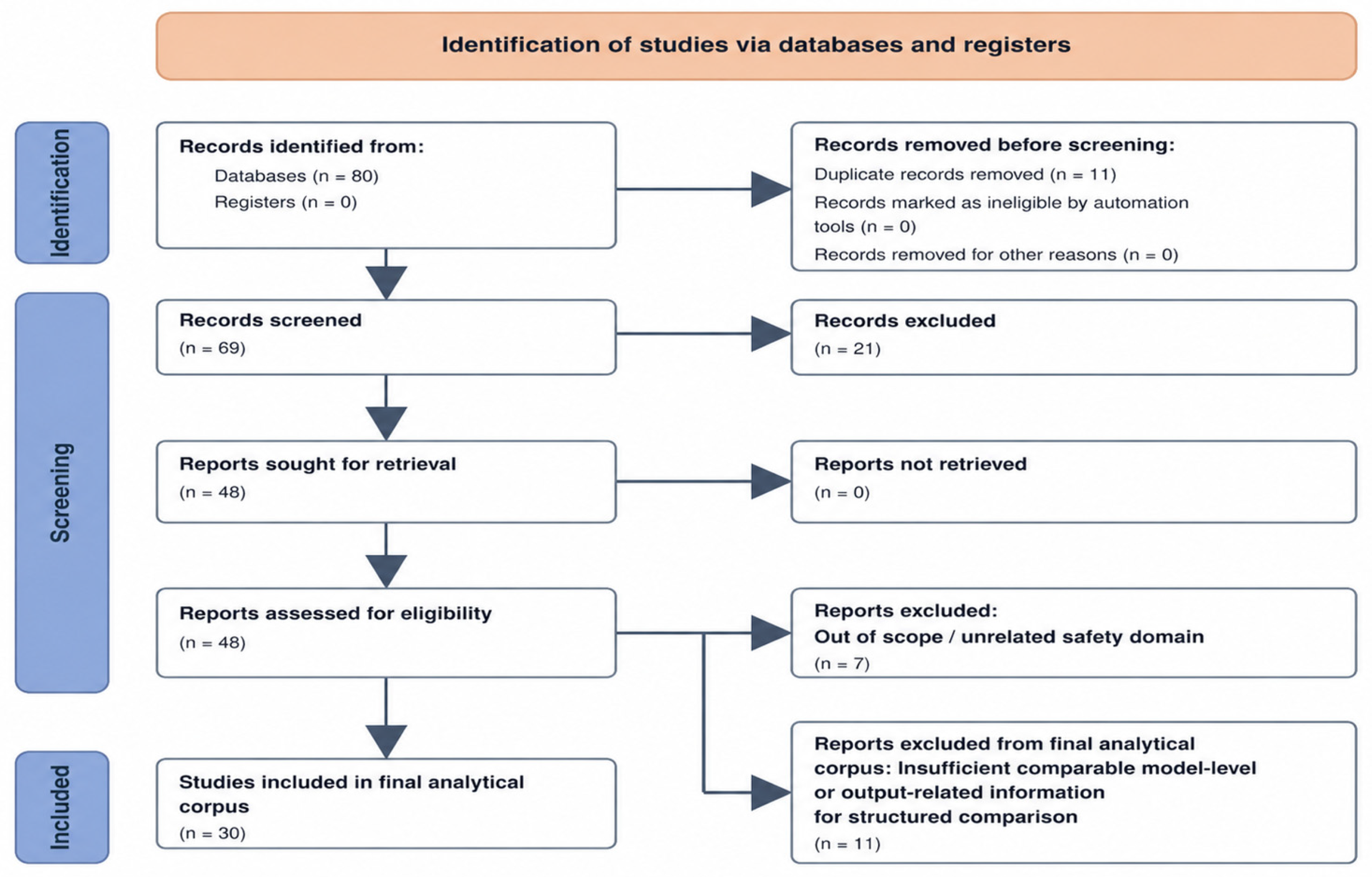
Combining records identified through the documented and supplementary search routes produced a preliminary set of 80 records. Eleven exact duplicates—records representing the same publication identified through more than one search route—were removed. The titles and abstracts of the remaining 69 unique records were screened, of which 21 were excluded at this stage. Reports were sought, retrieved, and assessed for the remaining 48 records. Seven publications fell outside the scope of workplace or occupational safety, leaving 41 reports for assessment of information sufficiency. A further 11 were excluded because the available publication material did not permit reliable coding of the solution’s purpose, principal fuzzy method or model structure, aggregated output, and occupational safety role. The absence of an accessible full-text PDF did not in itself constitute a reason for exclusion, and this information-sufficiency assessment was not an overall appraisal of methodological quality. The final analytical corpus comprised 30 studies [16,17]. Of these, 25 were coded from full-text publications and five from sufficiently detailed abstracts; information that could not be verified in the latter group was recorded as “not reported.”
The study-selection process is summarized in Figure 1.

2.3. Inclusion and Exclusion Criteria

Studies were included when they met all three of the following core requirements:
  • The study applied fuzzy logic or a fuzzy-based method.
  • The application context concerned occupational safety and health, workplace risk assessment, industrial or construction safety, ergonomic risk assessment, or a closely related occupational risk domain.
  • The available publication material provided sufficient information to identify and code the purpose, principal fuzzy method or model structure, aggregated output, and occupational safety role of the applied solution.
A publication was excluded if it failed to meet any of these three core requirements: it did not apply a fuzzy or fuzzy-based solution; it did not address a workplace safety or occupational health problem; or the available information did not permit standardized coding of the solution’s purpose, principal fuzzy method or model structure, aggregated output, and occupational safety role. The absence of a predefined input type, output category, or aggregation architecture was not a reason for exclusion, and lack of full-text access did not in itself lead to exclusion if the available publication material supported reliable coding of the four minimum fields. The information-sufficiency assessment did not constitute an overall methodological or quality appraisal of the excluded studies [18,24].

2.4. Data Extraction and Coding

For every study in the final corpus, we extracted the application domain, problem examined, fuzzy method, membership-function specification and defuzzification method where applicable, input information, aggregation strategy, output type, decision-support purpose, intended decision user, temporal operation, feedback and recalibration, validation and effectiveness evidence, context specificity, worker role, and reported limitations. Source-derived characteristics were distinguished from review-level analytical codes assigned according to the operational definitions developed for the present review (see Supplementary Table S2). Audit metadata—including source access, evidence grade, evidence location, and unresolved uncertainty—were recorded separately and were not treated as study characteristics. Information unavailable in the accessible publication material was coded as “not reported” rather than interpreted as evidence that the respective feature was absent. Table 1 presents the coding dimensions; Table 2 presents the overlapping technical configurations; Table 3 presents the mutually exclusive primary output families of the 30 studies; Table 4 presents the aggregation logics; Table 5 presents the decision-support roles; and finally the functional synthesis of the corpus is presented in Section 3.6 [18,19,20]. Study-level traceability is provided by Supplementary Table S3, which identifies the studies and their core technical characteristics, and Supplementary Table S4, which records the functional codes, source-derived evidence, review-level classifications, audit metadata, and unresolved uncertainty [18,20,24].
Data extraction and coding were organized using Microsoft Excel for Microsoft 365 (Microsoft Corporation, Redmond, WA, USA). No physical equipment was used in this systematic review.

2.5. Synthesis Method

Analysis focused primarily on fuzzy logic, while the probabilistic, multi-criteria, causal, and other methods with which it was combined were also recorded. The primary outputs emerging from the coding were classified into three mutually exclusive families according to their dominant function: score/index/level, ranking/prioritization, or relational/causal representation. Where a study produced more than one type of output, it was assigned to the family representing its principal decision-support output.
Second, every model was coded according to its intended decision user, worker role, direct worker support, temporal operation, feedback, and outcome-driven recalibration. Direct worker support was coded only when the output was explicitly delivered to, or designed to support, a worker or operator; merely assessing worker exposure or treating workers as data sources was insufficient. Third, reported validation and effectiveness evidence was distinguished among internal model performance, decision utility, partial follow-up, longitudinally observed safety outcomes, and cases in which an outcome-based evaluation was not reported. Fourth, context specificity was classified as detailed local, sectoral/occupational, or general/aggregated and interpreted together with hazard heterogeneity, expert dependence, traceability, linkage to action, and worker participation.
This staged descriptive synthesis treated aggregation as a modeling and decision-support choice rather than solely as a mathematical operation. It therefore connected the technical architecture of each model to the practical occupational safety problem addressed, the intended use of its output, and the boundaries of the available evidence [15,18,19,20,22].

3. Results

3.1. Technological Configurations of Fuzzy-Based Models

The 30 studies in the analytical corpus used several recurring and partly overlapping fuzzy-based technical configurations. Rule-based or inference-centered fuzzy systems appeared frequently, while fuzzy methods were also integrated with AHP, TOPSIS, DEMATEL, Fine–Kinney, Bayesian reasoning, regression, maintenance frameworks, and other multi-criteria decision structures [8,9,25,26]. Table 2 assigns at least one technical configuration or component to every study. Because five studies combined components represented in more than one category, the component frequencies sum to 37 rather than 30. These overlapping technical categories differ from the mutually exclusive primary output families presented in Table 3.
The distribution indicates that fuzzy logic was used both as a primary inference mechanism and as a component embedded in broader weighting, ranking, causal, or context-specific decision-support architectures. The configuration affects not only how occupational safety information is processed, but also the form and traceability of the resulting output. The corpus included rule-based fuzzy risk assessments, fuzzy TOPSIS rankings, BWM–fuzzy VIKOR combinations, IoT-supported fuzzy inference, and Fine–Kinney-based fuzzy scoring approaches [27,28,29,30,31,32,33]. Relational approaches based on fuzzy DEMATEL and fuzzy cognitive maps are examined separately because they preserve influence or cause–effect information that conventional scores and rankings do not retain. The technical components are summarized in Table 2 and Table 4, while the mutually exclusive primary output families are presented in Table 3.

3.2. Application Domains and Occupational Safety Contexts

The studies examined a broad range of operational occupational safety contexts, including construction, manufacturing, logistics, mining, maintenance, laboratories, healthcare, gas and chemical operations, and ergonomic risk assessment [23,27,31,34,35,36,37,38]. Most applications were situated at the level of particular tasks, workplaces, processes, occupations, or sector-specific operational activities. This breadth is important because the models addressed safety problems that differed not only in industrial setting but also in causal structure, exposure pattern, temporal development, available evidence, and required preventive response.
The dominant purposes were preventive risk assessment, hazard comparison, prioritization, and support for control planning [26,34,35]. Other studies addressed real-time or strategic safety monitoring [29,39], while relational models focused on accident analysis, causal-factor identification, systemic root-cause analysis, or prediction of the consequences of hazardous actions [40,41,42,43,44]. Chemical hazard evaluation, university laboratory risk assessment, and liquefied petroleum gas filling operations further illustrate how fuzzy models translated qualitative or semi-quantitative information into risk indices, priority orders, precaution levels, or other decision-support outputs [36,37,45].
The study-level heterogeneity coding confirmed that this diversity was also present within the models. Twenty-three studies were classified as combining highly heterogeneous hazards, evidence forms, criteria, or measurement scales; six combined moderately heterogeneous information; and only one addressed a comparatively homogeneous hazard or criterion structure. These review-level categories describe the diversity of the information combined by the models rather than the quality of the respective studies.
Across the corpus, fuzzy methods were applied when risk information was partly qualitative, uncertain, observation-based, or dependent on expert judgment. The models processed combinations of workplace observations, linguistic ratings, expert assessments, historical accident data, checklist information, severity–likelihood–exposure dimensions, and multi-criteria evaluations [28,30,46,47,48,49]. Taken together, these patterns suggest that the practical value of fuzzy methods lies in formally organizing heterogeneous occupational safety information for decision support. However, interpretation of the resulting output must remain connected to the application context, hazard composition, evidence base, and preventive decision for which the model was developed.

3.3. Types of Aggregated Fuzzy Risk Outputs

The principal finding of the review is that most fuzzy logic-based occupational safety models produce an aggregated output intended to support comparison, prioritization, or risk-management action. Although these outputs differ in form, they commonly condense multiple input variables into a simplified representation of risk [7,8,9]. The final output is therefore not merely a computational result: it is a decision-support representation that determines which aspects of a complex workplace problem become visible, comparable, and actionable.
Table 3 answers a different question from Table 2. Table 2 identifies the overlapping technical components from which the models were constructed, whereas Table 3 reports the mutually exclusive primary decision-support output assigned to each study. Where a model produced more than one output, classification was based on its principal decision-support function. The three output-family frequencies therefore sum exactly to the 30-study corpus.
In the corpus, the primary output was a risk score, index, level, or class in 15 models; a ranking or priority in nine; and a relational or causal representation in six. The predominance of the 24 score- or ranking-based solutions indicates that fuzzy methods were used primarily for decision-oriented compression and ordering. These outputs can facilitate comparison, communication, and prioritization, but their interpretation depends on whether the underlying hazards, assumptions, and criteria remain recoverable [13,40,41,42,43,44].
Five of the six relational models explicitly retained directed influences, interactions, cause–effect groupings, or causal hierarchies through DEMATEL, STAMP-based structures, or a fuzzy cognitive map. The sixth organized unsafe acts and unsafe conditions within an integrated accident-precursor representation [13,40,41,42,43,44]. Under the review-level traceability coding, four of these six models provided direct traceability to the represented factors or pathways, while two provided partial traceability. These models do not reconstruct the complete causal system of real accidents, but their final outputs preserve more of the modeled relationship structure than a single score or ranking.

3.4. Aggregation Logic and Input Structures

The reviewed models applied several aggregation logics. Rule-based fuzzy inference systems first represented numerical or linguistic inputs through membership functions, evaluated their combinations through IF–THEN rules, and then produced a linguistic or defuzzified risk output [28,29,31,37,45,47,50]. Fuzzy AHP models represented pairwise expert judgments using fuzzy numbers and derived relative weights or priorities within a hierarchical criterion structure [25,35,36,50]. Fuzzy TOPSIS models ranked hazards, alternatives, or interventions according to their relative distance from the most favorable ideal and least favorable negative-ideal reference solutions [8,27,51]. Fuzzy DEMATEL models aggregated judgments about direct influence relationships and separated factors into influence-giving and influence-receiving groups [40,42,43,44]. Fine–Kinney-based fuzzy models transformed dimensions such as probability or likelihood, exposure, and consequence into a risk magnitude, class, or intervention priority [8,25,33,49]. Other hybrid fuzzy MCDM models combined multiple weighting, normalization, comparison, and ranking stages [9,32,38].
Although these approaches differ technically, they perform a common practical function: they determine which occupational safety information is selected, how it is represented and weighted, which relationships remain visible, and what form of decision-oriented output is produced. The recurring aggregation logics, their typical outputs, and the principal interpretive boundaries identified in the present review are summarized in Table 4.
Review-level coding classified expert dependence as high in 25 studies and moderate in five; no model was classified as having low expert dependence. High dependence indicates that core membership functions, linguistic scales, weights, rules, or model structures were predominantly defined through expert judgment with limited empirical calibration. Traceability was classified as direct in nine studies and partial in 21. Thus, every model retained at least some connection to its inputs or represented factors, but in most cases aggregation obscured part of the hazard-specific chain between the original information and the final output [46,50,51].
Model-design decisions therefore shape the resulting risk representation. The selection of variables, membership functions, expert panels, weights, rules, normalization procedures, and output scales affects the aggregated value, class, or ranking. Fuzzy risk aggregation should consequently be interpreted as a decision-support modeling process rather than as an objective calculation of risk [46,50,51]. Similar aggregated values may be compatible with substantially different causal pathways, exposure patterns, levels of urgency, and control requirements. The practical value of an aggregation logic therefore depends not only on computational consistency, but also on whether its assumptions and intermediate transformations are documented and whether the output remains understandable, traceable, and usable for hazard-specific prevention.

3.5. Decision-Support and Risk-Management Purposes

The aggregated outputs served several distinct decision-support purposes. Score- and class-based models supported hazard assessment, risk interpretation, and communication [23,45,49]. Ranking-based models supported comparison, prioritization, resource allocation, and selection among hazards, workplaces, or interventions [7,8,9,27,38]. Relational, monitoring, and planning-oriented models supported accident-factor analysis, prediction of changing risk conditions, maintenance planning, and interpretation of cause–effect structures [29,34,40,41,42,43,44]. These roles identify the practical decision question addressed by the output; they are distinct from both the technical components in Table 2 and the primary output families in Table 3. The broad roles identified in the corpus and their links to risk management are summarized in Table 5.
The review-level action-linkage coding further distinguished how directly these outputs were connected to preventive or corrective action. Fifteen studies provided strong action linkage by selecting, ranking, or explicitly specifying preventive measures, control actions, or management responses. Thirteen provided moderate linkage: their outputs supported assessment, comparison, or prioritization but did not themselves identify a particular intervention. Two provided weak linkage because their contribution remained primarily interpretive or strategic. These categories describe the functional connection between the model output and action; they do not indicate whether the proposed action was implemented or proved effective [8,9,44].
The functional synthesis therefore indicates that the outputs are not merely computational results, but representations designed to prepare practical decisions. Their utility can be assessed through several distinct questions: whether the output helps delimit the actual safety problem; whether it supports an appropriate and contextually justified action; whether the reasoning remains transparent and traceable; and whether a favorable safety outcome can be demonstrated after implementation [8,9,44]. Robustness, scalability, discrimination, and computational consistency are important model characteristics, but they do not by themselves demonstrate that an output results in an appropriate preventive measure or sustained safety improvement.

3.6. Functional Synthesis of the Reviewed Models

The corpus-level functional characteristics of the reviewed models, including their outputs, worker orientation, temporal operation, feedback mechanisms, validation, and contextual scope, are summarized in Table 6.
The functional synthesis revealed a marked asymmetry between the technical capabilities of the reviewed models and their integration into occupational safety practice. Although 23 models combined highly heterogeneous hazards, criteria, evidence forms, or measurement scales, only nine provided direct traceability from the aggregated output to the represented hazards, factors, or causal pathways. Similarly, 25 models showed high dependence on expert-defined assumptions, while none demonstrated recalibration based on observed safety outcomes.
This asymmetry was also evident in worker support and temporal operation. All 30 models addressed worker safety, but only two directly supported workers or operators [29,41]. One model operated in near real time [29], and two showed partially dynamic operation through repeated assessment or scenario updating [29,41]; the remaining 27 were essentially static, retrospective, cross-sectional, or one-off applications. Although some models allowed data refresh or repeated assessment, none demonstrated outcome-driven learning.
The models were more closely connected to decisions than to subsequent verification. Fifteen showed strong links to preventive or corrective action, yet only one study reported longitudinally observed safety improvement [52], while one additional study provided partial follow-up evidence [13]. No study demonstrated worker co-design or post-implementation evaluation by workers. These findings indicate that fuzzy models were commonly used to structure and support safety decisions, whereas worker participation, temporal responsiveness, and feedback from implemented actions remained uncommon. The practical implications of this imbalance are considered further in the Discussion.

3.7. Validation and Evidence of Safety Improvement

Although 28 studies reported positive evaluations of model performance or usefulness, these claims usually concerned internal differentiation, agreement, accuracy, ranking stability, or decision utility. Only one study reported a reduction in occupational accidents and related damage over a three-year observation period [52]. One additional study found reductions in the treated unsafe acts and conditions during audits conducted three and six months after the implementation of selected measures, but the complete observation and analysis were not repeated for full validation [13]. No common dataset, success criterion, or safety endpoint enabled an objective comparison of the competing architectures.

3.8. Context Specificity, Heterogeneity, and Generalizability

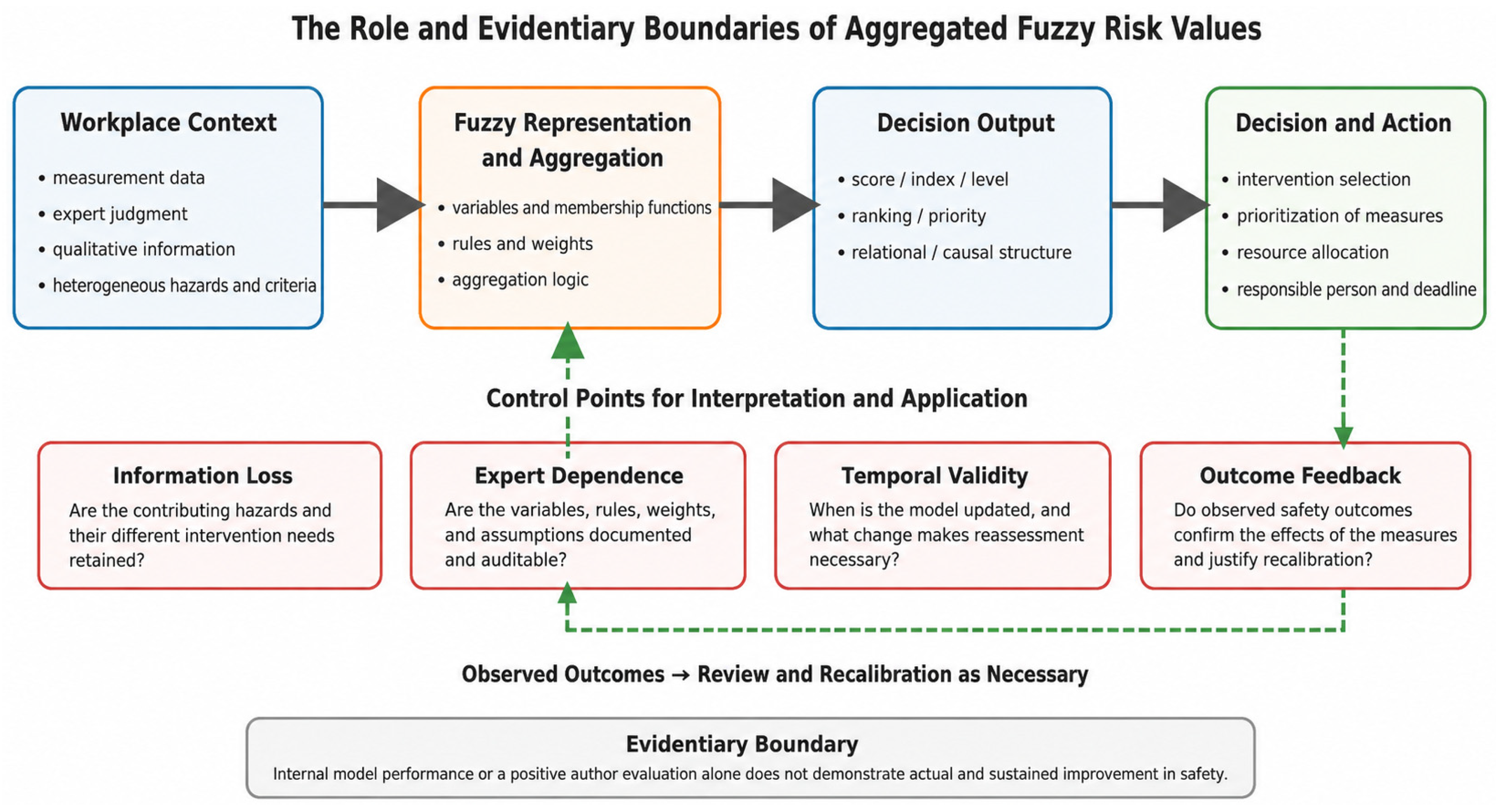
Context specificity was a dominant characteristic of the corpus: 18 studies examined a particular workplace, process, workstation, or detailed local hazard set; 10 used sector-, occupation-, or accident-specific factors; and only two operated at a general or aggregated application level. High hazard heterogeneity was identified in 23 studies and high expert dependence in 25. Structurally different models nevertheless received positive evaluations in similar application domains [23,28,30,47]. Because their validation remained context-specific and no common benchmark was available, these findings do not establish the general superiority of any fuzzy architecture, but they indicate that problem delimitation warrants particular attention (Figure 2).

4. Discussion

4.1. Structure, Use, and Information Content of the Outputs

The distribution of primary outputs revealed a clear preference for operational comparability over relational representation. Twenty-four models reduced heterogeneous information to a score, level, ranking, or priority, thereby making risks or alternatives easier to compare and order. The six relational models retained modeled influences, interactions, or causal hierarchies through structures such as DEMATEL matrices, STAMP-based hierarchies, or fuzzy cognitive maps [13,40,41,42,43,44]. Four of these provided direct traceability and two partial traceability. Even in these models, however, the represented relationships should not be interpreted as a reconstruction of the complete causal system underlying real accidents.
A similar asymmetry appeared in the intended use of the outputs. Fifteen models were strongly linked to preventive or corrective action, but 28 primarily supported experts, occupational safety professionals, or managers; only two directly supported workers or operators [29,41]. The corpus therefore appears more mature in converting uncertain safety information into planned managerial priorities than in delivering operational support to workers at the moment of a safety-critical decision. A technically coherent output may consequently support planning without necessarily preserving all information required for hazard-specific interpretation or immediate action [8,9,44].

4.2. What Fuzzy Logic Provides and What It Does Not Resolve

The clearest contribution of fuzzy logic in the reviewed models was the formal representation of vague or linguistically expressed concepts and gradual category boundaries. Exposure, visibility, workload, severity, likelihood, or risk acceptability could be represented without imposing an artificial binary division between membership and non-membership [28,46,48,50]. This capability should be distinguished from aleatory uncertainty arising from variability and epistemic uncertainty arising from incomplete knowledge. Fuzzy membership can express the degree to which an observation belongs to a defined concept, but it does not by itself supply missing evidence, identify omitted causal factors, or demonstrate that the selected variables adequately represent the accident-generating process [4,6].
This boundary is important because 25 of the 30 models showed high dependence on expert-defined variables, membership functions, rules, weights, or linguistic scales, while none demonstrated recalibration based on observed safety outcomes. Expert judgment is not inherently a weakness in occupational safety; the limitation arises when its assumptions become embedded in a mathematically coherent output without remaining visible and testable. Smooth transitions between categories may improve the representation of vague information, but they cannot correct an incorrectly delimited problem or replace missing causal knowledge. Outcome-informed recalibration should therefore be regarded as a research need identified by the review rather than as a capability demonstrated by the corpus.

4.3. Aggregation, Complexity, and Reductionism

The corpus-level pattern makes the reduction problem particularly visible. Twenty-three studies combined highly heterogeneous hazards, criteria, evidence forms, or measurement scales, while 24 of the 30 primary outputs were scores or rankings. A fuzzy model may contain nonlinear membership functions and inference rules; therefore, fuzzy aggregation is not necessarily mathematically linear. Reduction occurs when multidimensional information is represented by a single value, class, or ordering that may subsequently be interpreted as if the underlying hazards were directly comparable. Similar totals may consequently represent different causal pathways, exposure dynamics, organizational conditions, time horizons, and control requirements [4,5,6].
This corpus-level finding can be interpreted against complexity-informed and system-theoretic approaches that address a different analytical need. FRAM represents functions and their performance variability; STAMP models safety through constraints and control relationships; and AcciMap represents contributing factors across multiple socio-technical levels [53,54,55]. These approaches are not members of the analytical corpus and are not used here to validate its quantitative findings. They provide an external conceptual contrast to single-output aggregation.
Within the analytical corpus itself, the six relational models—including fuzzy DEMATEL, STAMP-based structures, and fuzzy cognitive maps—retained modeled relationships among factors. However, these representations do not reconstruct the complete causal system of real accidents, and the corpus does not establish their general superiority over score- or ranking-based models.
The comparison suggests a layered design principle: systemic or relational analysis can delimit relevant structures and interactions; fuzzy logic can represent genuinely vague variables within that structure; and hazard-specific assessment can preserve the controls, responsibilities, documentation, and follow-up required for prevention. This is an interpretive implication of the synthesis, not an architecture whose superiority was directly tested by the reviewed studies.

4.4. Context, Organizational Bias, and Worker Knowledge

Context specificity was not merely a background characteristic of the reviewed models. Eighteen studies were developed around a particular workplace, process, workstation, or detailed local hazard set; 10 used sector-, occupation-, or accident-specific factors; and only two operated at a general or aggregated application level. Structurally different models nevertheless received positive evaluations in similar application domains. This pattern does not demonstrate that precise problem delimitation caused favorable outcomes, but it suggests that defining the relevant local problem may be at least as important as selecting the fuzzy architecture.
Organizational context also shapes which variables enter a model, how membership functions and weights are defined, and whose objectives the resulting output serves [5]. This is particularly important because 25 models showed high expert dependence. Production pressure, communication failures, routine adaptations, informal work practices, and the practical reasons for apparently unsafe decisions may remain invisible when model development relies exclusively on managerial or expert interpretations. In such cases, the model may reproduce organizational priorities or biases while presenting them through a formally coherent output. One study used on-site correspondence to provide workers with predictive safety information [29], while another used an operator-centered knowledge representation [41], but neither demonstrated joint model development or subsequent worker validation. Workers can therefore be represented in a model without their operational knowledge influencing its assumptions or interpretation. Future studies should examine worker involvement in variable selection, interpretation of behavior, validation of weights and rules, and assessment of whether proposed interventions are feasible in actual work.

4.5. Success Criteria, Feedback, and Temporal Validity

Positive assessments of model performance were abundant, but their evidential reach was narrow. Twenty-eight studies described their solutions positively, usually on the basis of internal differentiation, agreement, accuracy, ranking stability, sensitivity analysis, or perceived decision utility. Only one study linked implemented measures to reductions in occupational accidents and related damage observed over three years [52]. One additional study reported reductions in treated unsafe acts and conditions during audits conducted three and six months after selected measures were introduced, but the complete observation and analysis were not repeated for full validation [13]. Because the studies used no shared dataset, success criterion, or safety endpoint, these positive evaluations support context-specific utility rather than objective comparative effectiveness [13,52].
The temporal pattern reinforces this evidential limitation. One model operated in near real time [29]; two were partially dynamic through repeated assessment or scenario updating; and 27 remained static, retrospective, cross-sectional, or one-off applications. Five models permitted some form of data refresh, repeated assessment, or scenario update, but none demonstrated recalibration of variables, membership functions, rules, or weights based on observed safety outcomes. Updating the represented risk state must therefore be distinguished from learning whether a previous decision actually improved safety. Without explicit review intervals, change-triggering events, and outcome-feedback criteria, the continued validity of an output cannot be assumed under changing personnel, equipment, production conditions, or organizational pressures [6].

4.6. Conditions for Responsible Application

The responsible use of an aggregated fuzzy value depends less on the mathematical sophistication of its calculation than on whether the decision it supports remains traceable, contestable, and correctable. Such values are most defensible for clearly delimited decision problems in which the relevant variables are defined explicitly, linguistic inputs are genuinely vague, rules and weights are transparent, and the resulting output can be traced back to hazard-specific evidence. Under these conditions, fuzzy aggregation can support the preliminary screening of alternatives, the structured integration of expert judgement, and the prioritization of further analysis or intervention [7,8,9].
Its use becomes more problematic when materially different hazards are collapsed into a single total, expert assumptions are treated as objective facts, weakly traceable outputs directly trigger control decisions, static results are projected onto changed working conditions, or positive internal model metrics are interpreted as evidence of fewer accidents. These are not merely hypothetical concerns. The combination identified in the reviewed corpus—high hazard heterogeneity in 23 studies, high expert dependence in 25, only partial traceability in 21, and predominantly static operation in 27—shows how easily a mathematically coherent indicator may acquire more practical authority than its evidential basis warrants. An aggregated fuzzy value should therefore not be interpreted as a complete or inherently objective representation of occupational risk [6].
Accordingly, the aggregated indicator should be retained together with the contributing hazards, input evidence, assumptions, weights and rules, uncertainty boundaries, and the hazard-specific controls to which the result is linked. Documentation should also specify the responsible person, implementation deadline, review trigger, and criteria for outcome feedback. Decision-makers, OSH professionals, and affected workers should be able to determine why a particular result was produced, what action it supports, and under what conditions the decision must be reconsidered. Aggregated fuzzy values can therefore complement—but should not replace—hazard-specific risk assessment, documented control planning, worker involvement, and professional judgement [1,2,3,8,9].

4.7. Knowledge Gaps and Directions for Further Research Identified from the Corpus

The findings apply exclusively to the reviewed corpus of 30 studies and do not demonstrate that alternative solutions are entirely absent from the broader literature. Within this corpus, however, real-time or dynamically updated decision support was rare; only two models directly supported workers; no demonstrated worker co-design or post-implementation worker evaluation was reported; and no system recalibrated its parameters on the basis of observed safety outcomes. Systematic investigation of why workers make hazardous decisions, using workers’ own knowledge of tasks and workplace constraints, was also not identified as a prominent model function.
These gaps suggest that future research should move beyond the development of increasingly complex aggregation algorithms alone. Greater attention should be given to transparent input selection, explicit membership functions, weights and rules, hazard-specific traceability, and the translation of model outputs into preventive actions [11,49]. Models should also be evaluated under changing workplace conditions and linked to feedback from implemented controls, observed incidents, near misses, audit findings, and worker experience. This would allow fuzzy systems not only to represent uncertainty at the time of assessment, but also to revise their assumptions when the practical evidence changes.
Future studies should further investigate layered or otherwise explainable outputs that preserve the identity of contributing hazards while still supporting comparison and prioritization [46,49,51]. Particular attention should be given to worker-informed model development, the organizational and causal relationships behind unsafe situations, and the different recipients of model-supported decisions. The central research challenge is therefore not simply to calculate a more sophisticated aggregated value, but to develop decision-support systems that remain traceable, adaptable, and connected to hazard-specific prevention in real work settings.

4.8. Limitations of the Review

The review is limited to 30 English-language studies that provided sufficient model-level information for consistent coding. This improved functional comparability but may have excluded relevant studies with incomplete reporting and restricts the generalizability of the findings. Heterogeneity in application contexts, outputs, and validation designs precluded meta-analysis and direct performance ranking. The review also relied on evidence reported by the original authors and did not independently verify the mathematical correctness or practical effectiveness of individual models. As only one study linked an implemented intervention to accident outcomes observed over time, the synthesis should be interpreted as a map of recurring functions, evidence boundaries, and research gaps rather than as proof of the general superiority or safety effectiveness of particular fuzzy architectures [15,16,18].

5. Conclusions

This systematic review examined 30 fuzzy logic-based occupational safety models from a functional and practical decision-support perspective. The analysis extended beyond the technical configuration of the models to consider what information they aggregated, what outputs they produced, which decisions and recipients they supported, and whether their results remained connected to hazard-specific evidence, preventive actions, and observed safety outcomes.
The dominant function of the reviewed models was the decision-oriented compression of heterogeneous, uncertain, and judgement-dependent information. Fifteen studies produced a risk score, index, or level, nine produced a ranking or priority, and six retained a relational or causal representation. These outputs can make complex occupational safety information easier to compare and use, but aggregation may also reduce the visibility of hazard-specific differences, causal relationships, and assumptions underlying the final value.
A marked imbalance was identified between the sophistication of aggregation and the development of the surrounding safety decision process. Only two models directly supported workers, dynamic operation was rare, and the corpus contained no demonstrated worker co-design, post-implementation worker evaluation, or outcome-driven recalibration. Similarly, although 28 studies evaluated their models positively, only one linked an implemented intervention to accident outcomes observed over time. Positive model performance therefore cannot be interpreted as equivalent to demonstrated improvement in workplace safety.
The principal contribution of this review is the finding that the practical meaning of an aggregated fuzzy value depends on the decision chain in which it is embedded. Its most defensible role is as a transparent and context-bound layer of occupational safety decision support that remains connected to contributing hazards, assumptions, control measures, responsibilities, review conditions, and feedback from observed outcomes. Aggregated fuzzy values should therefore complement rather than replace hazard-specific assessment, worker involvement, documented control planning, and professional judgement. Future development should focus not only on more elaborate calculations, but also on causal traceability, changing workplace conditions, worker knowledge, and learning from safety outcomes. When these connections are lost, the same simplification that supports decision-making may convert uncertainty into an unjustified appearance of certainty.


Supplementary Materials

The following supporting information can be downloaded at: https://www.mdpi.com/article/10.3390/safety12040112/s1, Table S1: PRISMA 2020 Checklist; Table S2: Coding provenance and operational definitions; Table S3: Study-level data-extraction and identification matrix for the 30-study analytical corpus; Table S4: Study-level functional coding, validation evidence, context specificity, and interpretive boundaries [23,24,25,26,27,28,29,30,31,32,33,34,35,36,37,38,39,40,41,42,43,44,45,46,47,48,49,50,51,52].

Author Contributions

Conceptualization, Z.H. and G.S.; methodology, Z.H. and G.S.; investigation, Z.H.; formal analysis, Z.H.; data curation, Z.H.; visualization, Z.H.; writing—original draft preparation, Z.H.; writing—review and editing, G.S., A.T. and T.D.; supervision, G.S.; project administration, A.T. All authors have read and agreed to the published version of the manuscript.

Funding

This research received no external funding.

Institutional Review Board Statement

Not applicable.

Informed Consent Statement

Not applicable.

Data Availability Statement

The data supporting the findings of this study are available within the article and its Supplementary Materials. Further details are available from the corresponding author upon reasonable request.

Acknowledgments

Generative AI Statement: During preparation of this manuscript, the authors used OpenAI’s ChatGPT with GPT-5.1 during the initial preparation and GPT-5.6 Sol during the revision conducted after 21 July 2026 (OpenAI, San Francisco, CA, USA; accessed between 7 December 2025 and 4 August 2026). The models were used for language refinement, text structuring, editorial assistance, figure preparation and graphical refinement, and critical examination of the manuscript’s argumentation and internal consistency. Consensus (https://Consensus.app/; accessed between 7 December 2025 and 26 March 2026) was additionally used as an AI-assisted scientific search tool to support the identification of potentially relevant publications, as described in Section 2.2. All decisions concerning study eligibility, data extraction, coding, interpretation, figure content, manuscript revision, and final wording were made or verified by the authors. The authors critically reviewed and revised all AI-assisted content as necessary and take full responsibility for the content of the manuscript.

Conflicts of Interest

The authors declare no conflicts of interest.

Abbreviations

The following abbreviations are used in this manuscript:
OSHoccupational safety and health
AHPanalytic hierarchy process
TOPSIStechnique for order preference by similarity to ideal solution
DEMATELdecision-making trial and evaluation laboratory
MCDMmulti-criteria decision making
FISfuzzy inference system
PRISMAPreferred Reporting Items for Systematic Reviews and Meta-Analyses

References

  1. Council of the European Communities. Council Directive 89/391/EEC of 12 June 1989 on the Introduction of Measures to Encourage Improvements in the Safety and Health of Workers at Work; Council of the European Communities: Brussels, Belgium, 1989. [Google Scholar]
  2. European Parliament and Council. Directive 2009/104/EC of 16 September 2009 Concerning the Minimum Safety and Health Requirements for the Use of Work Equipment by Workers at Work (Codified Version); European Parliament and Council: Brussels, Belgium, 2009. [Google Scholar]
  3. Hungarian Parliament. Act XCIII of 1993 on Occupational Safety and Health; Hungarian Parliament: Budapest, Hungary, 1993. [Google Scholar]
  4. Dekker, S.; Cilliers, P.; Hofmeyr, J.H. The Complexity of Failure: Implications of Complexity Theory for Safety Investigations. Saf. Sci. 2011, 49, 939–945. [Google Scholar] [CrossRef] [Scilit]
  5. Komljenovic, D.; Loiselle, G.; Kumral, M. Organization: A New Focus on Mine Safety Improvement in a Complex Operational and Business Environment. Int. J. Min. Sci. Technol. 2017, 27, 617–625. [Google Scholar] [CrossRef] [Scilit]
  6. Årstad, I.; Aven, T. Managing Major Accident Risk: Concerns about Complacency and Complexity in Practice. Saf. Sci. 2017, 91, 114–121. [Google Scholar] [CrossRef] [Scilit]
  7. Ferrari, G.N.; Leal, G.C.L.; Galdamez, E.V.C.; de Souza, R.C.T. Prioritization of Occupational Health and Safety Performance Indicators Using Fuzzy-AHP and Fuzzy TOPSIS. Production 2020, 30, e20200054. [Google Scholar] [CrossRef] [Scilit]
  8. Dogan, B.; Oturakci, M.; Dagsuyu, C. Action Selection in Risk Assessment with Fuzzy Fine–Kinney-Based AHP-TOPSIS Approach: A Case Study in Gas Plant. Environ. Sci. Pollut. Res. 2022, 29, 66222–66234. [Google Scholar] [CrossRef] [Scilit] [PubMed]
  9. Demir, G.; Bouraima, M.B.; Badi, I.; Stević, Ž.; Das, D.K. Identification of Industrial Occupational Safety Risks and Selection of Optimum Intervention Strategies: Fuzzy MCDM Approach. Mathematics 2025, 13, 301. [Google Scholar] [CrossRef] [Scilit]
  10. Gul, M. A Review of Occupational Health and Safety Risk Assessment Approaches Based on Multi-Criteria Decision-Making Methods and Their Fuzzy Versions. Hum. Ecol. Risk Assess. 2018, 24, 1723–1760. [Google Scholar] [CrossRef] [Scilit]
  11. James, S.; Renjith, V.R. A Comprehensive Review on the Application of Fuzzy Logic in Risk Analysis. Int. J. Comput. Appl. 2024, 186, 16–38. [Google Scholar] [CrossRef] [Scilit]
  12. Mitrakas, C.; Xanthopoulos, A.; Koulouriotis, D. Techniques and Models for Addressing Occupational Risk Using Fuzzy Logic, Neural Networks, Machine Learning, and Genetic Algorithms: A Review and Meta-Analysis. Appl. Sci. 2025, 15, 1909. [Google Scholar] [CrossRef] [Scilit]
  13. Baldissone, G.; Comberti, L.; Bosca, S.; Murè, S. The Analysis and Management of Unsafe Acts and Unsafe Conditions. Data Collect. Anal. Saf. Sci. 2019, 119, 240–251. [Google Scholar] [CrossRef] [Scilit]
  14. Mehri, H.; Sepahi-Zoeram, F.; Karimi, A.; Golbabaei, F. Presenting a Method for Evaluating the Safety Risk Management Process in Industries Using Fuzzy Logic Approach. Arch. Occup. Health 2021, 5, 1012–1021. [Google Scholar] [CrossRef] [Scilit]
  15. Grant, M.J.; Booth, A. A Typology of Reviews: An Analysis of 14 Review Types and Associated Methodologies. Health Info Libr. J. 2009, 26, 91–108. [Google Scholar] [CrossRef] [Scilit] [PubMed]
  16. Page, M.J.; McKenzie, J.E.; Bossuyt, P.M.; Boutron, I.; Hoffmann, T.C.; Mulrow, C.D.; Shamseer, L.; Tetzlaff, J.M.; Akl, E.A.; Brennan, S.E.; et al. The PRISMA 2020 Statement: An Updated Guideline for Reporting Systematic Reviews. BMJ 2021, 372, n71. [Google Scholar] [CrossRef] [Scilit] [PubMed]
  17. Moher, D.; Liberati, A.; Tetzlaff, J.; Altman, D.G.; Antes, G.; Atkins, D.; Barbour, V.; Barrowman, N.; Berlin, J.A.; Clark, J.; et al. Preferred Reporting Items for Systematic Reviews and Meta-Analyses: The PRISMA Statement. PLoS Med. 2009, 6, e1000097. [Google Scholar] [CrossRef] [Scilit] [PubMed]
  18. Okoli, C. A Guide to Conducting a Standalone Systematic Literature Review. Commun. Assoc. Inf. Syst. 2015, 37, 43. [Google Scholar] [CrossRef] [Scilit]
  19. Snyder, H. Literature Review as a Research Methodology: An Overview and Guidelines. J. Bus. Res. 2019, 104, 333–339. [Google Scholar] [CrossRef] [Scilit]
  20. Tranfield, D.; Denyer, D.; Smart, P. Towards a Methodology for Developing Evidence-Informed Management Knowledge by Means of Systematic Review. Br. J. Manag. 2003, 14, 207–222. [Google Scholar] [CrossRef] [Scilit]
  21. Elsevier Scopus. Content Coverage Guide. Available online: https://assets.ctfassets.net/o78em1y1w4i4/EX1iy8VxBeQKf8aN2XzOp/c36f79db25484cb38a5972ad9a5472ec/Scopus_ContentCoverage_Guide_WEB.pdf (accessed on 8 April 2026).
  22. Xiao, Y.; Watson, M. Guidance on Conducting a Systematic Literature Review. J. Plan. Educ. Res. 2019, 39, 93–112. [Google Scholar] [CrossRef] [Scilit]
  23. Gürcanli, G.E.; Müngen, U. An Occupational Safety Risk Analysis Method at Construction Sites Using Fuzzy Sets. Int. J. Ind. Ergon. 2009, 39, 371–387. [Google Scholar] [CrossRef] [Scilit]
  24. Kitchenham, B.; Charters, S. Guidelines for Performing Systematic Literature Reviews in Software Engineering; EBSE Technical Report EBSE-2007-01; Keele University: Keele, UK; Durham University: Durham, UK, 2007. [Google Scholar]
  25. Ilbahar, E.; Karaşan, A.; Cebi, S.; Kahraman, C. A Novel Approach to Risk Assessment for Occupational Health and Safety Using Pythagorean Fuzzy AHP & Fuzzy Inference System. Saf. Sci. 2018, 103, 124–136. [Google Scholar] [CrossRef] [Scilit]
  26. Gul, M. A Fuzzy-Based Occupational Health and Safety Risk Assessment Framework and a Case Study in an International Port Authority. J. Mar. Eng. Technol. 2020, 19, 161–175. [Google Scholar] [CrossRef] [Scilit]
  27. Gul, M.; Lo, H.-W.; Yucesan, M. Fermatean Fuzzy TOPSIS-Based Approach for Occupational Risk Assessment in Manufacturing. Complex Intell. Syst. 2021, 7, 2635–2653. [Google Scholar] [CrossRef] [Scilit]
  28. Engin, O.; Canlar Durmaz, R. An Occupational Safety Fuzzy Risk Analysis: An Application in a Building Construction Sites. Celal Bayar Univ. J. Sci. 2023, 19, 159–165. [Google Scholar] [CrossRef] [Scilit]
  29. Xu, R.; Kim, B.W.; Moe, S.J.S.; Khan, A.N.; Kim, K.; Kim, D.H. Predictive Worker Safety Assessment through On-Site Correspondence Using Multi-Layer Fuzzy Logic in Outdoor Construction Environments. Heliyon 2023, 9, e19408. [Google Scholar] [CrossRef] [Scilit] [PubMed]
  30. Topal, S.; Atasoylu, E. A Fuzzy Risk Assessment Model for Small Scale Construction Work. Sustainability 2022, 14, 4442. [Google Scholar] [CrossRef] [Scilit]
  31. Gallab, M.; Bouloiz, H.; Alaoui, Y.L.; Tkiouat, M. Risk Assessment of Maintenance Activities Using Fuzzy Logic. Procedia Comput. Sci. 2019, 148, 226–235. [Google Scholar] [CrossRef] [Scilit]
  32. Ansari, R.; Dehghani, P.; Mahdikhani, M.; Jeong, J. A Novel Safety Risk Assessment Based on Fuzzy Set Theory and Decision Methods in High-Rise Buildings. Buildings 2022, 12, 2126. [Google Scholar] [CrossRef] [Scilit]
  33. Över Özçelik, T.; Yilmaz Yalciner, A.; Cetinkaya, M.; Aker, A. Risk Assessment with the Fuzzy Fine–Kinney Method in a Business Operating in the Metal Industry. Int. J. Occup. Saf. Ergon. 2025, 31, 308–317. [Google Scholar] [CrossRef] [Scilit] [PubMed]
  34. Tubis, A.; Werbińska-Wojciechowska, S.; Sliwinski, P.; Zimroz, R. Fuzzy Risk-Based Maintenance Strategy with Safety Considerations for the Mining Industry. Sensors 2022, 22, 441. [Google Scholar] [CrossRef] [Scilit] [PubMed]
  35. Kulaç, S.; Kiraz, A. An Integrated Ergonomic Risk Assessment Framework Based on Fuzzy Logic and IVSF-AHP for Optimising Ergonomic Risks in a Mixed-Model Assembly Line. Ergonomics 2024, 67, 2009–2029. [Google Scholar] [CrossRef] [Scilit] [PubMed]
  36. de Almeida Calixto, B.S.; Michaloski, A.O. Assessment of Occupational Risk Using Multi-Criteria Fuzzy AHP Methodology in a University Laboratory. Sustainability 2025, 17, 2715. [Google Scholar] [CrossRef] [Scilit]
  37. Hicham, O.; Aziz, S. Risk Assessment for the Liquefied Petroleum Gas Filling Industry Using Fuzzy Logic and Hazard and Operability. Salud Cienc. Tecnol. 2024, 4, 749. [Google Scholar] [CrossRef] [Scilit]
  38. Soltani, E.; Mohammadinejad, A.; Rashnoudi, P.; Ahmadi, O. A Fuzzy Based Hybrid Approach for Risk Assessment of Anesthesiologists Using OPA and EDAS Methods. Sci. Rep. 2025, 15, 32028. [Google Scholar] [CrossRef] [Scilit] [PubMed]
  39. Li, Q.; Xiang, Q.; Wang, J.; Sevastyanov, B.V.; Shadrin, R.O.; Lisin, V.A. On the Application of Methods of Correlation-Regression Analysis and Fuzzy Logic in the Analysis of Industrial Injury Rates. IOP Conf. Ser. Mater. Sci. Eng. 2020, 962, 042037. [Google Scholar] [CrossRef] [Scilit]
  40. Seker, S.; Zavadskas, E.K. Application of Fuzzy DEMATEL Method for Analyzing Occupational Risks on Construction Sites. Sustainability 2017, 9, 2083. [Google Scholar] [CrossRef] [Scilit]
  41. Longo, F.; Padovano, A.; Nicoletti, L.; Fusto, C.; Elbasheer, M.; Diaz, R. Fuzzy Cognitive Map-Based Knowledge Representation of Hazardous Industrial Operations. Procedia Comput. Sci. 2021, 180, 1042–1048. [Google Scholar] [CrossRef] [Scilit]
  42. Mohandes, S.R.; Sadeghi, H.; Fazeli, A.; Mahdiyar, A.; Hosseini, M.R.; Arashpour, M.; Zayed, T. Causal Analysis of Accidents on Construction Sites: A Hybrid Fuzzy Delphi and DEMATEL Approach. Saf. Sci. 2022, 151, 105730. [Google Scholar] [CrossRef] [Scilit]
  43. Chen, X.; Qiao, W. A Hybrid STAMP-Fuzzy DEMATEL-ISM Approach for Analyzing the Factors Influencing Building Collapse Accidents in China. Sci. Rep. 2023, 13, 19745. [Google Scholar] [CrossRef] [Scilit] [PubMed]
  44. Ebrahimi, H.; Zarei, E.; Ansari, M.; Nojoumi, A.; Yarahmadi, R. A System Theory Based Accident Analysis Model: STAMP-Fuzzy DEMATEL. Saf. Sci. 2024, 173, 106445. [Google Scholar] [CrossRef] [Scilit]
  45. Aziz, A.; Suzon, M.M.; Hasan, R. A Fuzzy Logic-Based Risk Evaluation and Precaution Level Estimation of Explosive, Flammable, and Toxic Chemicals for Preventing Damages. Heliyon 2025, 11, e41216. [Google Scholar] [CrossRef] [Scilit] [PubMed]
  46. Rodrigues, M.A.; Leão, C.P.; Nunes, E.; Sousa, S.; Arezes, P. A Fuzzy Logic Approach in the Definition of Risk Acceptance Boundaries in Occupational Safety and Health. ASCE-ASME J. Risk Uncertain. Eng. Syst. Part B Mech. Eng. 2016, 2, 044501. [Google Scholar] [CrossRef] [Scilit]
  47. Jana, D.K.; Pramanik, S.; Sahoo, P.; Pal, A. Interval Type-2 Fuzzy Logic and Its Application to Occupational Safety Risk Performance in Industries. Soft Comput. 2019, 23, 557–567. [Google Scholar] [CrossRef] [Scilit]
  48. Ramaswamy Govindan, A.; Li, X. Fuzzy Logic-Based Decision Support System for Automating Ergonomic Risk Assessments. Int. J. Ind. Ergon. 2023, 96, 103459. [Google Scholar] [CrossRef] [Scilit]
  49. Li, H.; Wang, Y.; Chong, D.; Rajendra, D.; Skitmore, M. Fine-Kinney Fuzzy-Based Occupational Health Risk Assessment for Workers in Different Construction Trades. Autom. Constr. 2024, 168, 105738. [Google Scholar] [CrossRef] [Scilit]
  50. Salari, S.; Sadeghi-Yarandi, M.; Golbabaei, F. An Integrated Approach to Occupational Health Risk Assessment of Manufacturing Nanomaterials Using Pythagorean Fuzzy AHP and Fuzzy Inference System. Sci. Rep. 2024, 14, 180. [Google Scholar] [CrossRef] [Scilit] [PubMed]
  51. Abbasinia, M.; Mohammadfam, I. Identifying, Evaluating and Prioritizing the Causes of Occupational Accidents in the Construction Industry Using Fuzzy AHP and Fuzzy TOPSIS. Work 2022, 72, 933–940. [Google Scholar] [CrossRef] [Scilit] [PubMed]
  52. Murè, S.; Comberti, L.; Demichela, M. How Harsh Work Environments Affect the Occupational Accident Phenomenology? Risk Assessment and Decision Making Optimisation. Saf. Sci. 2017, 95, 159–170. [Google Scholar] [CrossRef] [Scilit]
  53. Hollnagel, E. FRAM: The Functional Resonance Analysis Method: Modelling Complex Socio-Technical Systems; CRC Press: Boca Raton, FL, USA, 2017. [Google Scholar]
  54. Leveson, N.G. Engineering a Safer World: Systems Thinking Applied to Safety; MIT Press: Cambridge, MA, USA, 2012. [Google Scholar] [CrossRef] [Scilit]
  55. Rasmussen, J. Risk Management in a Dynamic Society: A Modelling Problem. Saf. Sci. 1997, 27, 183–213. [Google Scholar] [CrossRef] [Scilit]
Figure 1. PRISMA flow diagram of record identification, screening, eligibility assessment, and formation of the final 30-study analytical corpus. Arrows indicate the progression of records through the selection process, while the colors distinguish the identification, screening, and inclusion stages.
Safety 12 00112 g001
Figure 2. Pathway of an aggregated fuzzy risk value from heterogeneous workplace information to a decision, including the main control points for information loss, expert dependence, temporal validity, and outcome feedback. Solid arrows indicate the forward decision pathway, whereas dashed green arrows represent outcome feedback and potential recalibration; the box colors distinguish the principal processing stages and control points.
Safety 12 00112 g002
Table 1. Coding dimensions used in the analysis of aggregated fuzzy risk values.
Coding DimensionAnalytical QuestionCoded Values or Examples
Aggregated output typeWhat principal output does the model produce?Score, index, level, class, ranking, or relational/causal representation
Aggregated input informationWhich factors, criteria, or evidence sources does the model combine?Severity, likelihood, exposure, workplace observations, expert judgment, multiple hazards, or multiple criteria
Decision-support purposeWhich decision is the output intended to support?Comparison, prioritization, intervention selection, control planning, or monitoring
Action linkageHow directly is the output linked to preventive or corrective action?Strong, moderate, weak, or not reported
TraceabilityCan the output be traced back to specific hazards or criteria?Direct, partial, weak, or not reported
Expert dependenceTo what extent does the model depend on expert-defined assumptions?High, medium, or low
Hazard heterogeneityTo what extent does the model combine materially different hazards, evidence forms, criteria, or measurement scales?High, medium, or low
Intended decision userWho is intended to use the output?Management or employer, safety professional or expert, researcher or developer, worker or operator
Worker roleHow do workers participate in the model, its application, or its evaluation?Data source, indirect beneficiary, direct user, participant, co-designer, or evaluator
Temporal operationHow does the model operate over time?Static, retrospective, periodically updated, partially dynamic, or real-time
Validation and effectiveness evidenceWhat evidence supports the reported utility or success of the model?Internal model performance, expert agreement, case application, decision utility, partial follow-up, or observed safety outcome
Outcome feedbackAre observed safety outcomes or user feedback used to modify the model?Recalibration of variables, rules, membership functions or weights; other feedback; no; or not reported
Context specificityAt what contextual level was the solution developed or evaluated?Detailed local, sectoral or occupational, or general/aggregated
Table 2. Main fuzzy-based technological configurations in the final analytical corpus.
ConfigurationNumber of Studies *Main Function in Risk AggregationTypical Output
Rule-based or inference-centered fuzzy systems10Linguistic or uncertain inputs are processed through fuzzy inference, rules, or controllersRisk score, index, level, or class
Fuzzy AHP-based systems6Expert weighting and hierarchical structuring of criteriaCriterion weights, risk priority, score or class
Fuzzy TOPSIS-based systems3Ranking relative to ideal and anti-ideal solutionsHazard, cause, or intervention ranking
Other fuzzy MCDM systems3Weighting or ranking through VIKOR, WENSLO–ARTASI, OPA–EDAS, or related structuresRisk or intervention ranking
Fine–Kinney-based fuzzy systems4Fuzzy treatment of probability, exposure, and consequence-related dimensionsRisk magnitude, class, score, or action ranking
Relational or causal fuzzy systems5Representation of influence, cause–effect relations, or scenario propagationCausal map, influence diagram, control priority
Fuzzy + probabilistic/Bayesian system1Integration of fuzzy-compatible and probabilistic reasoningIntegrated precursor or risk representation
Other context-specific fuzzy or hybrid structures5Integration with historical data, clustering, regression, or maintenance frameworksRisk indicator, boundary, surface, or recommendation
Note: * The technical configuration categories are non-exclusive. Five studies contributed to more than one category; therefore, the frequencies represent 37 component occurrences across the 30-study corpus.
Table 3. Types of aggregated fuzzy risk outputs identified in the analytical corpus.
Output TypeOccurrence in the CorpusDecision-Support FunctionRisk-Management Relevance
Risk score/index/level/class15Provides a compact numerical or linguistic representation of risk magnitudeSupports comparison, communication, prioritization, and threshold- or class-based decisions where defined
Ranking/prioritization9Orders hazards, causes, workplaces, alternatives, or interventionsSupports resource allocation, sequencing of interventions, and action selection
Relational/causal representation6Represents influence relationships, accident-precursor structures, interactions, or cause–effect hierarchiesSupports accident analysis, systemic interpretation, root-cause investigation, and corrective-action planning
Table 4. Aggregation logics and their principal limitations.
Aggregation LogicCombined Factors, Criteria, or RelationshipsTypical Decision OutputPrincipal Limitation
Rule-based fuzzy inference systemNumerical or linguistic inputs represented by membership functions and processedRisk score, linguistic level, class, or indexResults are sensitive to the selection and justification of membership functions, rules, and defuzzification
Fuzzy AHPFuzzy pairwise comparisons within criteria and subcriteria hierarchiesCriterion weights, risk priority, or weighted scorePriorities depend on expert judgments, hierarchy design, and consistency of pairwise comparisons
Fuzzy TOPSISWeighted alternatives or hazards compared with ideal and negative-ideal reference solutionsRanking, priority order, or closeness coefficientRankings depend on criterion selection, weighting, normalization, and the definition of reference solutions
Fuzzy DEMATEL and related relational modelsExpert judgments about direct influence relationships among factorsCause–effect grouping, influence map, or factor priorityThe modeled influence structure depends on expert input and system boundaries and does not by itself establish empirical causality
Fuzzy Fine–Kinney variantsProbability or likelihood, exposure, consequence, and related dimensionsRisk magnitude, class, score, or intervention priorityCompression into predefined dimensions may obscure differences in causal pathways and required controls
Hybrid fuzzy MCDMMultiple criteria, alternatives, expert judgments, and successive weighting or ranking operationsRisk score, ranking, or intervention priorityMultiple processing stages may make the result and the influence of individual assumptions difficult to audit
Table 5. Broad decision-support and risk-management roles synthesized from the study-level coding.
Broad Decision-Support RolePractical Decision QuestionRisk-Management Use
Risk assessment, interpretation, and classificationWhat is the estimated risk magnitude or category, and is it acceptable?Supports hazard evaluation, communication, screening, and threshold- or class-based decisions
Comparison and prioritizationWhich hazard, task, workplace, cause, or occupational group requires attention first?Supports inspection planning, prioritization, resource allocation, and sequencing of actions
Intervention and control selectionWhich preventive, corrective, or management measure should be preferred?Supports selection and prioritization of controls and safety investments
Accident-factor and relational analysisWhich factors, relationships, or control-system failures contribute most strongly to the event or scenario?Supports investigation, systemic interpretation, root-cause analysis, and corrective-action planning
Monitoring, prediction, and operational planningHow may the risk state change, and where is continuing or anticipatory action required?Supports real-time assessment, strategic monitoring, maintenance planning, and prediction of action consequences
Table 6. Functional synthesis of fuzzy logic-based occupational safety decision-support models.
Analytical DimensionCorpus-Level EvidenceFunctional InterpretationInterpretive Boundary
Primary output function15 score/index/level; 9 ranking/prioritization; 6 relational/causalMost models compress heterogeneous evidence into a decision-oriented value, ordering, or relational representation.Aggregation may reduce the visibility of hazard-specific differences.
Direct worker support2 of 30 studies [29,41]Workers were generally studied populations, data sources, or beneficiaries rather than direct system users.Direct support at the moment of a safety-critical decision remained uncommon.
Temporal operation1 real-time; 2 partially dynamic; 27 static [29,34,41]Most models provided static assessments rather than continuously updated decision support.Static assessment does not track changing working conditions.
Outcome feedback0 models with outcome-driven recalibrationSome models allowed data refresh or repeated assessment, but none learned from observed safety outcomes.Representing uncertainty or updating a risk state is not equivalent to adaptive learning.
Evidence of safety impact28 positive model evaluations; 1 longitudinal improvement; 1 partial follow-up [13,52]Reported success mainly concerned model behavior, ranking performance, or decision utility.Model utility is not equivalent to demonstrated improvement in safety outcomes.
Context specificity18 detailed local; 10 sector-/occupation-specific; 2 general/aggregatedMost solutions were developed for a delimited occupational safety problem and context.Context-specific success does not establish general superiority.
Common benchmark0 studies using a shared dataset, success criterion, and safety endpointModels were evaluated on different problems and mostly against internal criteria.The corpus does not support direct performance ranking between architectures.
Worker participation and evaluation0 demonstrated co-design; 0 post-implementation worker evaluationsWorkers were rarely active participants in model development or subsequent evaluation.Worker experience and interpretation were represented only to a limited extent.
Disclaimer/Publisher’s Note: The statements, opinions and data contained in all publications are solely those of the individual author(s) and contributor(s) and not of MDPI and/or the editor(s). MDPI and/or the editor(s) disclaim responsibility for any injury to people or property resulting from any ideas, methods, instructions or products referred to in the content.