


Abstract
Work-related musculoskeletal disorders (MSDs) are leading causes of disability and productivity loss globally, yet registry-based evidence from low- and middle-income countries remains limited. The study analyzed compensated work-related MSDs claims reported to the Workers’ Compensation Fund (WCF) in Tanzania between 2016 and 2022 to identify patterns and associated risk factors. A registry-based cross-sectional design was conducted using de-identified WCF data on demographics, occupation, industry, diagnosis, and recorded workplace exposures. Modified Poisson regression was used to estimate associations between work-related MSDs and risk factors. Among the 243 workers with work-related MSDs whose claims were accepted and compensated, 84% had low back pain (LBP), predominantly males (90%) and middle-aged workers (mean age 41.6 years). Mining and quarrying accounted for 50% of the cases, with drivers and mobile plant operators being the most affected. Whole-body vibration (WBV) exposure and work in mining and quarrying were significant predictors of LBP (adjusted PR = 1.25; 95% CI: 1.061.49 and PR = 1.21; 95% CI: 1.01–1.44, respectively). These findings highlight WBV and mining work as significant risk factors of work-related MSDs and underscore the need for targeted interventions alongside enhanced health surveillance systems for exposure documentation.
1. Introduction
Work-related musculoskeletal disorders (MSDs) are prevalent occupational health challenges worldwide across industries and economic sectors and are the leading cause of disability and impaired quality of life [1,2]. MSDs involve impairments of muscles, joints, tendons, ligaments, nerves, cartilage, and bones and present as both acute injuries and chronic cumulative disorders [3,4]. When primarily caused or aggravated by workplace exposures, they are classified as work-related MSDs [3]. Work-related MSDs impose substantial economic and social costs and are linked with elevated absenteeism, reduced productivity, and early labor-market exit [5,6]. The World Health Organization (WHO) estimates that approximately 1.7 billion people live with musculoskeletal conditions worldwide, of which low back pain contributes a significantly high proportion [7]. Furthermore, the Global Burden of Diseases (GBDs) study indicated that MSDs significantly impair quality of life and are the sixth leading cause of years lived with disability (YLDs) [8]. The prevalence of work-related MSDs varies substantially by sector and occupation. Occupations at high risk include construction, mining, transportation, agriculture, forestry, fishing, and health and social care [9]. Truck drivers and heavy mobile equipment operators are among the major occupations with increased risk of work-related MSDs resulting in undesirable health conditions and disability [10,11,12].
The etiology of work-related MSDs is multifactorial, resulting from a complex interplay of occupational and non-occupational factors that influence both onset and recovery [13]. The established physical risk factors in the literature include awkward and static postures, repetitive hand and arm movements, manual handling of heavy loads, whole-body and hand–arm vibrations, and exposure to low temperatures [2,14]. These risk factors are influenced by the magnitude, frequency, and duration of exposure [13,15]. Organizational and psychosocial stressors such as high job demands, low autonomy, limited recovery time, fatigue, anxiety, sleep disturbances, and poor mental well-being also contribute to both onset and recovery, underscoring the need for integrated prevention strategies [16,17,18]. Work-related MSDs may be particularly critical in developing countries, where rapid industrialization, limited regulatory enforcement, and resource constraints often increase exposure to high-risk tasks while restricting access to ergonomic interventions and occupational health services [19,20]. Therefore, in countries such as Tanzania and many LMICs, the burden of work-related MSDs is likely underestimated because occupational injuries and disease surveillance are often limited, reporting is inconsistent, and workplace exposure information is incompletely documented.
Tanzania has both formal and informal employment sectors. The number of workers employed in the formal sector is approximately 4.1 million [21]. The Workers Compensation Fund (WCF) in Tanzania, established in 2015, currently works with the formal sector and addresses all registered organizations that make a monthly contribution for each worker. However, not all formal enterprises are registered with WCF; the registration is ongoing.
Workers’ compensation registries and datasets are increasingly recognized as critical resources for occupational health surveillance and research when they are systematically curated and linked to exposure proxies such as industry, occupation, and disease or injury cause [22]. For example, the U.S. National Institute for Occupational Safety and Health (NIOSH) actively promotes the use of claims data to identify risk factors, benchmark high-risk sectors, and evaluate prevention strategies, particularly those targeting musculoskeletal disorders through integrated research and compensation systems [23]. However, such registry-based approaches remain rare in low- and middle-income countries (LMICs), where surveillance systems are fragmented, informal employment is widespread, and the digitization of claims is limited. This challenges evidence-based policy and sector-specific prevention efforts. The WCF in Tanzania represents a unique opportunity to address this gap. It archives occupational injury and disease claims across mainland Tanzania, covering the formal sector, both public and private, and has progressively digitalized claims reporting and adjudication, an uncommon feature in LMIC contexts.
While a prior pilot study described work-related injuries reported between 2016 and 2019, it did not include work-related MSDs [24]. Given the global recognition of MSDs as leading contributors to disability and productivity loss, analyzing WCF data offers a chance to study and analyze work-related MSD factors of accepted work-related MSD claims in a developing country setting. This study aimed to address key occupational health surveillance and preventive challenges by using WCF registry data to generate sector-wide and exposure-related evidence on compensated MSDs in Tanzania. The primary objective was to determine the prevalence and distribution of accepted and compensated work-related MSD claims (2016–2022) and to estimate associations between work-related MSD outcomes and recorded occupational risk factors.
2. Materials and Methods
2.1. Study Design and Setting
This was a registry-based cross-sectional study of compensated claims from Workers compensation Fund (WCF, 41104 Dodoma, Tanzania) for occupational disease claims categorized as work-related MSDs from June 2016 to July 2022. The WCF database includes compensation claims for work-related injuries, occupational diseases, and fatalities reported by employers or workers for adjudication and benefit purposes. The variables of interest included: sociodemographic characteristics, number of claims, sector/industry, economic category, occupation, year of claim, related risk factors, and nature of disease, in this case, work-related musculoskeletal disorders. Data were extracted in April 2024.
2.2. Data Source
The study utilized the Tanzania WCF registry (2016–2022). De-identified extracts of accepted work-related MSD claims were assessed, including sociodemographic characteristics (sex, age), occupation, industry/economic activity (ISIC-aligned codes within WCF), diagnosis/nature of disease, recorded risk factors (e.g., vibration, manual handling), and year of compensation.
2.3. Case Definition and Classification
Work-related MSD cases were defined as accepted WCF occupational disease claims where the nature of the disease and/or diagnosis indicated a musculoskeletal condition attributable to work and coded as per WCF—Guidelines for Diagnosis of Occupational Diseases 2021 [25]. The anatomical categories used included low back, neck, shoulder, elbow/forearm, wrist/hand, hip, knee, ankle/foot, and risk factors such as vibration, whole-body vibration, manual handling, prolonged sitting with awkward posture, and traumatic injury.
In examining the WCF database, classification of claims was guided by internationally recognized standards and national legislation. Specifically, the established list of occupational diseases published by the International Labor Organization (ILO) and the provisions of the Tanzanian Workers’ Compensation Act [CAP.263 R.E 2015] served as primary references [26,27]. Under this Act, every employee insured under the Workers’ Compensation Fund is entitled to be compensated for any disease arising out of and in the course of employment. The compensable conditions are detailed in the Third Schedule of the Act, with additional procedures outlined in the Workers’ Compensation Regulations—2016 and the Guidelines for Diagnosis of Occupational Diseases—2021 [25]. The Tanzanian list of occupational diseases closely mirrors the ILO list of Occupational Diseases—2010, ensuring harmonization with global standards. This alignment provided a robust framework for categorizing claims into musculoskeletal disorders (MSDs) and subsequently identifying work-related MSDs.
The classification of economic activities and occupations in the WCF database adhered to internationally recognized standards to ensure comparability and analytical rigor. Economic activities for insured employers were categorized using the International Standard Industrial Classification of All Economic Activities (ISIC), Revision 4, as established by the United Nations Department of Economic and Social Affairs (2008) [28]. This framework enables harmonized reporting across sectors and facilitates benchmarking against global occupational health data. In our analysis, economic activity was a key variable of interest, providing insights into sector-specific patterns of work-related MSD claims.
Similarly, the occupations of compensated employees were classified according to the Tanzania Standard Classification of Occupations (TASCO), which aligns with the International Standard Classification of Occupations (ISCO-08) [29]. This approach ensures both national relevance and international comparability, allowing findings to inform local policy while contributing to global evidence on occupational risk. Standardized coding of industry and occupation is critical for identifying high-risk groups, guiding targeted interventions, and supporting integrated prevention strategies. The two frameworks, ISIC and TASCO, strengthened the validity of registry-based analyses and enhanced the utility and interpretation of results for improvement and interventions.
2.4. Variables and Outcomes
The outcome variable of interest for this study was work-related MSDs of LBP, neck pain, and shoulder pain, coded as a binary variable and defined as “1”, and entries with work-related MSDs other than LBP, neck pain, and shoulder pain were coded as “0”. The explanatory variables or covariates included social demographics (age, sex, job category, occupations, and economic activity); sector of employment (such as transport and mining); occupation (e.g., heavy equipment operators and truck drivers); and reported risk factors (e.g., manual handling, prolonged sitting with awkward posture, and vibration).
2.5. Statistical Analysis
Data were analyzed using Stata version 17. Descriptive statistics summarize demographic characteristics, occupational categories, industry sectors, and anatomical distribution of work-related MSDs (low back, neck, and shoulder). Continuous variables such as age, were expressed as means with standard deviations, while categorical variables were presented as frequencies and percentages. Temporal trends in accepted work-related MSD claims were illustrated using a bar chart across fiscal years. The Chi-square test of independence was used to check relationships between work-related MSDs of LBP, neck, and shoulders and the risk factors, including vibration, manual handling, prolonged sitting with awkward posture, disease agent, and traumatic injury.
To identify factors associated with work-related MSDs of LBP, neck, and shoulders, we fitted modified Poisson regression models with robust estimators to estimate Risk Ratios (RRs) and 95% CIs, appropriate for binary outcomes in cross-sectional datasets. Univariable models were used to assess crude associations between work-related MSDs of LBP, neck, and shoulder pain and recorded risk factors (whole-body vibration, manual handling, prolonged sitting with awkward posture, traumatic injury, and industry category). Variables with p ≤ 0.20 in the univariable analysis were included in the multivariable model. The final multivariable model adjusted for age group and significant occupational exposure variables. Statistical significance was set at p < 0.05. Model diagnostics included checks for collinearity and goodness-of-fit to validate the model. Results were presented in tables with both unadjusted and adjusted PRs.
2.6. Effect Size Estimation
Since this study used an existing dataset from the WCF database, no sample size estimation was performed. To assess the precision of the reported findings, effect size estimation was performed using the available sample size (n) of 243 participants.
Therefore, the estimated effect size is 4%. The estimated proportion, the 95% confidence interval, ranges from 83% to 91%. The narrow width of this confidence interval indicates adequate precision, providing sufficient evidence for the reliability of the reported results.
3. Results
3.1. Demographic Characteristics of Employees Compensated for Work-Related MSDs
A total of 243 accepted compensation claims for work-related MSDs were included in the analysis. The male constituted the majority, accounting for 219 cases (90%). The mean age of the study population was 41.6 years (SD ± 8.8), with an age range of 24–66 years. The largest proportion of cases fell within the 35–44-year age group (n = 98; 40.2%). Occupational distribution revealed that truck drivers and mobile plant operators represented the highest share of accepted claims (n = 59; 24.2%), followed by stationary plant and machine operators (Table 1).
Table 1.
Demographic characteristics and reported work-related MSDs among compensated employees between 2016 and 2022 in Tanzania (n = 243).
The medical diagnoses recorded in the WCF database were categorized into three anatomical groups: LBP, neck pain, and shoulder pain. The multiple response results indicated that LBP comprised a large diagnostic spectrum, i.e., 204 cases (84%) of all accepted work-related MSDs (Table 1). Neck pain was relatively low (n = 11; 4.5%) and was most frequently reported among individuals in elementary occupations (n = 6; 54.5%). Shoulder-related MSDs were rarely reported (n = 3; 1.3%), whereas other MSDs comprised 30 cases (12.3%) (Table 1).
3.2. Trend of Work-Related MSD Claims Compensated for Between 2016 and 2022
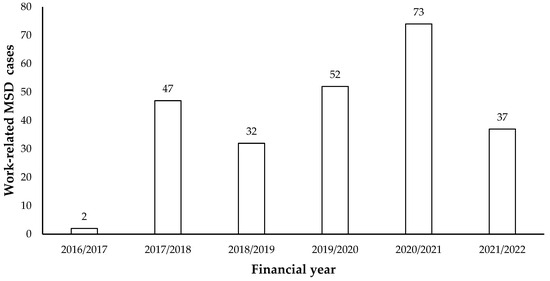
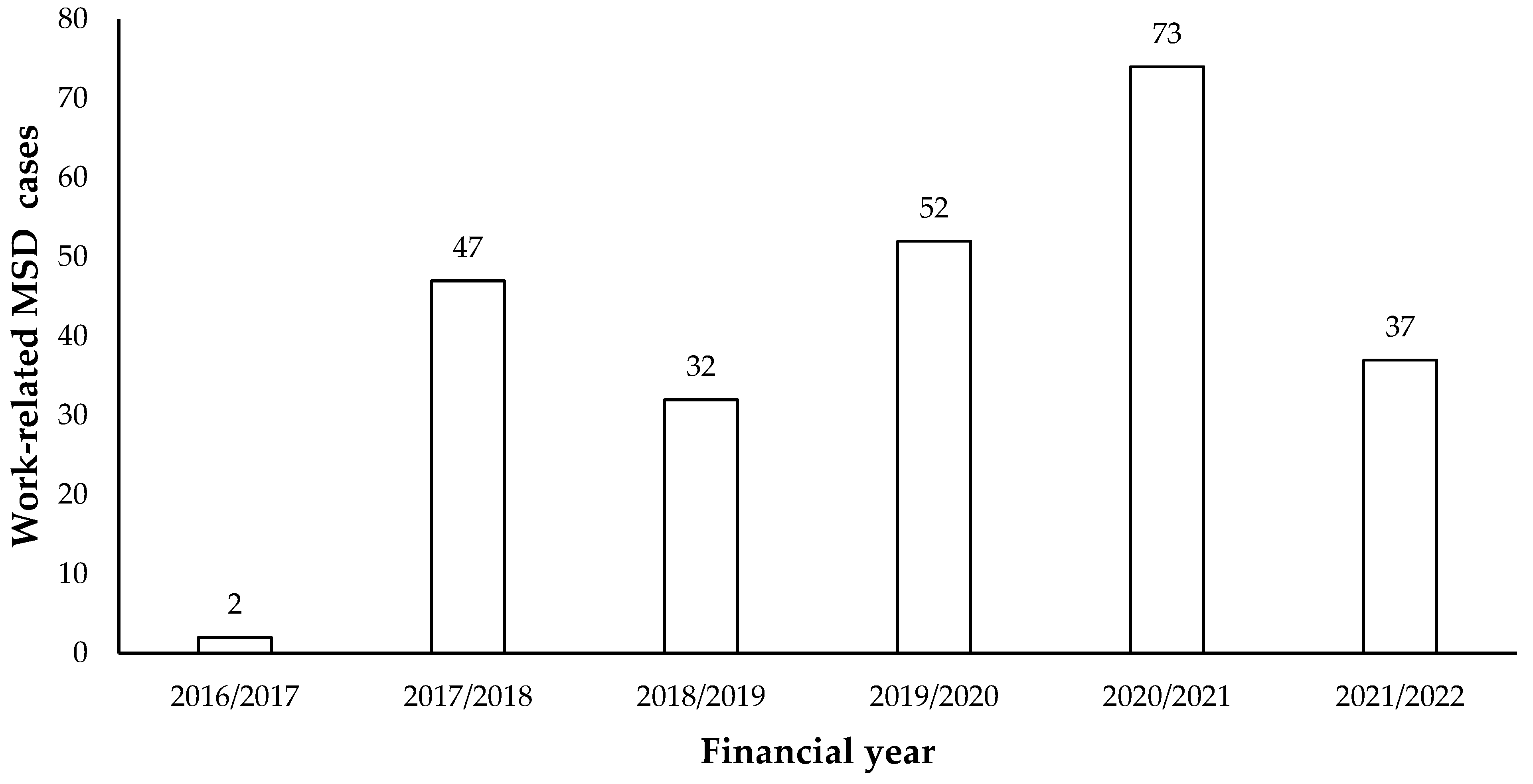
Over the six-year observation period, 243 cases were compensated as work-related MSDs, and the fiscal year (July 2020/June 2021) recorded the highest number of accepted claims, although the overall distribution across years showed noticeable fluctuations (Figure 1).
Figure 1.
Work-related musculoskeletal disorder cases compensated by WCF between June 2016 and July 2022 financial year.
3.3. Low Back Pain (LBP) Distribution Among Employees Compensated for Work-Related MSDs (n = 204)
Low back pain (LBP) was the predominant diagnosis among compensated work-related MSDs, accounting for 204 cases (84%). Age-stratified analysis revealed that employees aged 24–34 years (n = 56; 82.5%) and 35–44 years (n = 98; 91.8%) represented the highest proportions of LBP cases compared with those aged 45–54 years (n = 74; 75.7%) and 55–66 years (n = 15; 66.7%). Sectoral distribution revealed that the mining and quarrying industry had the largest share of compensated LBP claims (n = 123; 90%), reflecting the high biomechanical and vibration exposure characteristic of this sector, followed by construction (n = 35; 71%), transport and storage (n = 26; 69%), and manufacturing (n = 25; 68%) (Table 1). Drivers and mobile operators and stationary plant and machine operators accounted for the highest proportion of LBP among occupational groups, i.e., (n = 53; 89.8% and n = 44; 93.6%), respectively, (Supplementary Table S1). There were significant differences between those with and without LBP in age, sex, occupation, and economic activity (Chi-square test, p < 0.05) (Supplementary Table S1).
3.4. Relationship Between Occupational Risk Factors and Work-Related MSDs Among Compensated Claims
Identified risk factors for work-related MSDs included vibration exposure, the nature of the disease agent, specific tasks performed, working posture, and traumatic injuries. Among reported work-related MSD claims, variables such as vibration exposure and disease agent were significantly associated with having work-related MSDs (Table 2).
Table 2.
Relationship between risk factors and work-related MSDs among the compensated employees from 2016 to 2022 (n = 243).
3.5. Factors Associated with Work-Related MSDs Among Compensated Employees
Compensated employees with work-related MSDs of LBP, neck, and shoulders were exposed to one or more risk factors listed in Table 2. Univariable Modified Poisson regression with a robust estimator showed that exposure to WBV had a Risk Ratio (cRR) = 1.16; 95% CI: 1.05–1.27), and employment in the mining and quarrying sector (cRR = 1.14; 95% CI: 1.04–1.26) was significantly associated with work-related MSDs. Other factors, such as manual handling, did not have statistical significance in the univariable model. The analysis relied on registry data; additional exposure variables could not be assessed.
In multivariable analysis, adjusting for age and sex, WBV exposure, and performing manual handling work were significant predictors. Employees who reported being exposed to the WBV vibration had a 25% increased risk of work-related MSDs of LBP, neck and shoulder pain (aRR = 1.25; 95% CI: 1.06–1.49), whereas those who worked in mining and quarrying sector had a 21% increased risk of developing work-related MSDs (aRR = 1.21; 95% CI: 1.01–1.44). The workers who performed manual handling had a 6% greater risk of work-related MSDs of LBP, neck, and shoulder pain (aRR = 1.06; 95% CI: 0.97–1.17), although this difference was not significant at 95% confidence level (Table 3).
Table 3.
Risk factors associated with work-related MSDs among compensated employees in Tanzania (2016–2022) (n = 243).
4. Discussion
This registry-based study quantified the prevalence and risk factors for work-related MSDs among employees compensated by the WCF in Tanzania between 2016 and 2022 to identify priority areas for intervention. The findings from this study emphasize the significant ergonomic hazards inherent in mining and quarrying operations, particularly exposure to WBV [30]. These exposures are strongly linked to the nature of tasks performed by drivers and operators of heavy mobile equipment, who constituted the largest proportion of compensated employees in our dataset. The predominance of LBP among these workers aligns with established biomechanical evidence that WBV accelerates degenerative changes in spinal structures and increases the risk of lumbar disorders when combined with static postures and repetitive loading [31,32,33]. These findings underscore the critical role of vibration hazards and sector-specific ergonomic risks in shaping work-related MSD burdens and provide a foundation for targeted interventions in high-risk industries.
This registry-based study revealed a fluctuating trend in work-related MSDs reported to WCF between June 2016 and July 2022. These variations should not be interpreted as a definitive temporal trend, as multiple contextual factors likely influenced reporting patterns. For example, two cases compensated in 2016 can be explained by the fact that the WCF was established in 2015, and the registry was developed then. Several other plausible explanations exist for these observations. First, progressive awareness among workers and employers regarding the existence of the Workers’ Compensation Fund (WCF) and compliance with reporting procedures may have contributed to increased claim submissions, particularly considering that WCF began receiving claims in 2016. Second, the severity of injuries and diseases requiring extensive medical care or surgical intervention could have driven reporting peaks in certain years. Third, workforce dynamics such as retrenchments, project closures, and contract terminations often trigger exit medical examinations, which may lead to identification and reporting of previously undocumented conditions. Additionally, WCF has implemented significant system improvements over time, including the adoption of simplified and user-friendly Information and Communication Technology (ICT) platforms for claim submission and adjudication. Capacity-building initiatives targeting system users and stakeholders have further enhanced reporting efficiency and data completeness.
Our analysis revealed that employees in mining and quarrying accounted for nearly half of all reported and compensated work-related MSD claims, with nearly 54% being drivers or operators of mobile and stationary equipment. This finding is consistent with the literature, which documented elevated MSD prevalence among heavy equipment operators in mining and quarrying industries. For instance, studies from Colombia and India reported WBV levels exceeding established limit values of 0.5 m/s2 (the European Directive 2002/44/EC- vibration) in mining environments, attributing these exposures to unpaved haul roads, high vehicle speeds, and inadequate suspension systems [34,35]. Similarly, a study conducted in Ghana’s mining sector identified LBP as the most commonly reported work-related MSD among equipment operators [36]. These parallels suggest that WBV is not only a local concern but a widespread risk factor in mining operations [37,38,39].
A plausible explanation for this pattern lies in the combined biomechanical and vibrational stresses inherent in mining tasks. WBV transmitted through seats during prolonged driving induces cyclic compressive loading on intervertebral disks, accelerating degenerative changes in the annulus fibrosus and nucleus pulposus [40,41]. When WBV is coupled with static sitting postures and constrained cabin ergonomics, spinal musculature experiences sustained tension, reducing nutrient diffusion and promoting microtrauma [42]. Chronic WBV exposure may alter disk homeostasis, trigger inflammatory cascades, and facilitate nociceptive nerve ingrowth, all of which contribute to discogenic pain [42]. Furthermore, rough haul roads and high vehicle speeds amplify vibration amplitudes, while inadequate suspension systems fail to attenuate these forces, increasing cumulative exposure beyond ISO 2631-1:1997 (International Organization for Standardization, ISO, Geneva, Switzerland) thresholds [43]. Over time, these conditions compromise spinal stability and heighten susceptibility to LBP.
Notably, awkward postures and manual handling, although prevalent and documented across several occupations, did not retain statistical significance in adjusted analysis. This could be due to multicollinearity of co-exposure patterns and limitations in registry information recorded [44,45]. The findings highlight the need for improved exposure information documentation within compensation systems, including structured fields for ergonomic hazards and standardized ICD-10 coding, as recommended by the ILO diagnostic guidelines [26]. Interestingly, our analysis revealed that neck and shoulder disorders were infrequently reported and compensated, a trend mirrored in other mining-related assessments [46,47]. This may reflect underreporting, diagnostic prioritization of LBP, or true lower exposure intensity for upper-body regions compared to the lumbar spine during seated vibration tasks. Future research should investigate these patterns through prospective studies that incorporate objective clinical assessments and detailed exposure profiling.
While this registry-based analysis provides valuable insights into the trends and risk factors for work-related MSDs in Tanzania, several limitations warrant cautious interpretation. First, incomplete exposure data and a lack of equipment-specific details constrained the precision of risk attribution. Second, reliance on administrative records introduces potential selection bias, as claims may underrepresent mild cases or sectors with limited reporting compliance and do not leave room to compare with the whole workforce. Despite these constraints, the consistency of our findings with global evidence reinforces the conclusion that whole-body vibration (WBV) and mining employment are significant risk factors for work-related MSDs. Addressing these risks through evidence-based interventions such as seat suspension optimization, haul-road maintenance, and speed regulation, and strengthening workplace health surveillance systems will be essential in reducing work-related MSD burdens and improving worker health and productivity.
5. Conclusions
In conclusion, this registry-based study highlights that employees in the mining and transportation sectors experience a disproportionate burden of work-related MSDs, predominantly LBP. WBV exposure and mining employment were significant predictors, which is consistent with global evidence linking WBV and heavy equipment operation to spinal degeneration and chronic lumbar disorders. Incomplete exposure data and lacking equipment-specific details restrict causal inference. However, the findings underscore the need for targeted interventions, such as seat suspension optimization, haul-road maintenance, speed regulation, and ergonomic redesign. The study provided insight into the presence of a high number of LBPs among the work-related MDS cases being compensated. Measures have to be taken by the competent authority and employers to prevent and reduce the risk factors related to workplace exposures.
Supplementary Materials
The following supporting information can be downloaded at: https://www.mdpi.com/article/10.3390/safety12020033/s1, Table S1: Distribution of the proportion of LBP among 2016–2022 compensated employees (n = 243).
Author Contributions
Conceptualization, G.H.S., I.P.N., N.M., S.R., and R.D.; Methodology, G.H.S., I.P.N., N.M., R.D., S.C., S.L., and S.R.; Software, S.C., I.P.N., G.H.S., R.D., S.R., and N.M.; Validation, I.P.N., G.H.S., A.O., and J.K.M.; Formal Analysis, I.P.N., S.C., G.H.S., and R.D.; Investigation, G.H.S., I.P.N., N.M., S.L., S.R., and R.D. Resources, N.M., S.R., A.O., and J.K.M.; Data Curation, I.P.N., S.C., G.H.S., and S.R. Writing—Original Draft Preparation, G.H.S., I.P.N., N.M., S.R., and R.D.; Writing—Review and Editing, G.H.S., I.P.N., N.M., S.R., R.D., S.L., A.O., J.K.M., and R.D.; Visualization, I.P.N. and S.C. Supervision, N.M., A.O., and J.K.M.; Project Administration, I.P.N., N.M., A.O., and J.K.M.; Funding Acquisition, N.M., A.O., and J.K.M. All authors have read and agreed to the published version of the manuscript.
Funding
This research was supported by the Workers Compensation Fund (WCF), Tanzania. The technical team was a collaboration between the WCF, the Occupational Safety and Health Tanzania, the Muhimbili University of Health and Allied Sciences, and the University of Bergen, Norway.
Institutional Review Board Statement
This study was conducted in accordance with the Declaration of Helsinki of 1975 (as revised in 2013, point 23) and was approved by the MUHAS Institutional Review Board (IRB) with No. MUHAS-REC-09-2023-1894 dated 8 September 2023. In addition, permission for data acquisition was granted by WCF.
Data Availability Statement
The data that support the findings of this study are available from the corresponding author upon reasonable request.
Acknowledgments
We are grateful to the management and staff of the Workers’ Compensation Fund (WCF) for granting permission to access and utilize registry data on compensation claims for this study.
Conflicts of Interest
The authors declare no conflicts of interest.
Abbreviations
The following abbreviations are used in this manuscript:
| BMI | Body mass index |
| CI | Confidence interval |
| GBDs | Global Burden of Diseases |
| ICT | Information and Communication Technology |
| ILO | International Labor Organization |
| ISCOs | International Standard Classification of Occupations |
| ISO | International Standardization Organization |
| LBP | Low back pain |
| LMICs | Low-and middle-income countries |
| MUHAS | Muhimbili University of Health and Allied Sciences |
| RR | Risk Ratio |
| TASCO | Tanzania Standard Classification of Occupations |
| WBV | Whole body vibration exposure |
| WCF | Workers Compensation Fund |
| WHO | World Health Organization |
References
- Geto, A.K.; Mekonnen, H.; Yemane, T.T.; Andargie, E.M.; Sewunet, B.; Natnael, T.; Daba, C. Work-related musculoskeletal disorder and its associated factors among bank workers in Ethiopia: A systematic review and meta-analysis. PLoS ONE 2025, 20, e0323958. [Google Scholar] [CrossRef] [Scilit] [PubMed]
- Greggi, C.; Visconti, V.V.; Albanese, M.; Gasperini, B.; Chiavoghilefu, A.; Prezioso, C.; Persechino, B.; Iavicoli, S.; Gasbarra, E.; Iundusi, R.; et al. Work-Related Musculoskeletal Disorders: A Systematic Review and Meta-Analysis. J. Clin. Med. 2024, 13, 3964. [Google Scholar] [CrossRef] [Scilit]
- European Union. Work-Related Musculoskeletal Disorders—Prevalence, Costs and Demographics in the EU; Publications Office: Luxembourg, 2019. Available online: https://data.europa.eu/doi/10.2802/66947 (accessed on 19 October 2025).
- Van Eerd, D.; Beaton, D.; Cole, D.; Lucas, J.; Hogg-Johnson, S.; Bombardier, C. Classification systems for upper-limb musculoskeletal disorders in workers: A review of the literature. J. Clin. Epidemiol. 2003, 56, 925–936. [Google Scholar] [CrossRef] [Scilit]
- Bevan, S. Economic impact of musculoskeletal disorders (MSDs) on work in Europe. Best Pract. Res. Clin. Rheumatol. 2015, 29, 356–373. [Google Scholar] [CrossRef] [Scilit]
- Rosado, A.S.; Baptista, J.S.; Guilherme, M.N.H.; Guedes, J.C. Economic Impact of Work-Related Musculoskeletal Disorders—A Systematic Review. In Occupational and Environmental Safety and Health IV; Arezes, P.M., Baptista, J.S., Melo, R.B., Castelo Branco, J., Carneiro, P., Colim, A., Costa, N., Costa, S., Duarte, J., Guedes, J.C., et al., Eds.; Springer International Publishing: Cham, Switzerland, 2023; pp. 599–613. [Google Scholar]
- World Health Organization. Musculoskeletal Health. Fact Sheets. 2022. Available online: https://www.who.int/news-room/fact-sheets/detail/musculoskeletal-conditions (accessed on 19 October 2025).
- Gill, T.K.; Mittinty, M.M.; March, L.M.; Steinmetz, J.D.; Culbreth, G.T.; Cross, M.; Kopec, J.A.; Woolf, A.D.; Haile, L.M.; Hagins, H.; et al. Global, regional, and national burden of other musculoskeletal disorders, 1990–2020, and projections to 2050: A systematic analysis of the Global Burden of Disease Study 2021. Lancet Rheumatol. 2023, 5, e670–e682. [Google Scholar] [CrossRef] [Scilit] [PubMed]
- Al-Worafi, Y.M. Musculoskeletal Diseases: Causes and Risk Factors in Developing Countries. In Handbook of Medical and Health Sciences in Developing Countries: Education, Practice, and Research; Al-Worafi, Y.M., Ed.; Springer International Publishing: Cham, Switzerland, 2023; pp. 1–21. [Google Scholar]
- Mozafari, A.; Vahedian, M.; Mohebi, S.; Najafi, M. Work-related musculoskeletal disorders in truck drivers and official workers. Acta Med. Iran. 2015, 53, 432–438. [Google Scholar]
- Nazerian, R.; Korhan, O.; Shakeri, E. Work-related musculoskeletal discomfort among heavy truck drivers. Int. J. Occup. Saf. Ergon. 2020, 26, 233–244. [Google Scholar] [CrossRef] [Scilit] [PubMed]
- Pickard, O.; Burton, P.; Yamada, H.; Schram, B.; Canetti, E.F.D.; Orr, R. Musculoskeletal Disorders Associated with Occupational Driving: A Systematic Review Spanning 2006–2021. Int. J. Environ. Res. Public Health 2022, 19, 6837. [Google Scholar] [CrossRef] [Scilit]
- Descatha, A.; Evanoff, B.A.; Leclerc, A.; Roquelaure, Y. Occupational Determinants of Musculoskeletal Disorders. In Handbook of Disability, Work and Health; Bültmann, U., Siegrist, J., Eds.; Springer International Publishing: Cham, Switzerland, 2020; pp. 169–188. [Google Scholar]
- Afsharian, A.; Dollard, M.F.; Glozier, N.; Morris, R.W.; Bailey, T.S.; Nguyen, H.; Crispin, C. Work-related psychosocial and physical paths to future musculoskeletal disorders (MSDs). Saf. Sci. 2023, 164, 106177. [Google Scholar] [CrossRef] [Scilit]
- Andersen, J.H.; Evanoff, B.A.; Descatha, A. Biomechanical Hazards at Work and Adverse Health Using Job-Exposure Matrices. In Handbook of Life Course Occupational Health; Wahrendorf, M., Chandola, T., Descatha, A., Eds.; Springer International Publishing: Cham, Switzerland, 2023; pp. 1–14. [Google Scholar]
- Stock, S.R.; Nicolakakis, N.; Vézina, N.; Vézina, M.; Gilbert, L.; Turcot, A.; Sultan-Taïeb, H.; Sinden, K.; Denis, M.A.; Delga, C.; et al. Are work organization interventions effective in preventing or reducing work-related musculoskeletal disorders? A systematic review of the literature. Scand. J. Work Environ. Health 2018, 44, 113–133. [Google Scholar] [CrossRef] [Scilit]
- Hauke, A.; Flintrop, J.; Brun, E.; Rugulies, R. The impact of work-related psychosocial stressors on the onset of musculoskeletal disorders in specific body regions: A review and meta-analysis of 54 longitudinal studies. Work Stress 2011, 25, 243–256. [Google Scholar] [CrossRef] [Scilit]
- Oakman, J.; Macdonald, W.A.; McCredie, K.; Clune, S. Impact of work-related psychosocial versus biomechanical hazards on risk of musculoskeletal disorders: A systematic review and meta-analysis. Appl. Ergon. 2025, 125, 104481. [Google Scholar] [CrossRef] [Scilit]
- Mrema, E.J.; Ngowi, A.V.; Mamuya, S.H. Status of Occupational Health and Safety and Related Challenges in Expanding Economy of Tanzania. Ann. Glob. Health 2015, 81, 538–547. [Google Scholar] [CrossRef] [Scilit]
- Soares, C.O.; Pereira, B.F.; Pereira Gomes, M.V.; Marcondes, L.P.; de Campos Gomes, F.; de Melo-Neto, J.S. Preventive factors against work-related musculoskeletal disorders: Narrative review. Rev. Bras. Med. Trab. 2019, 17, 415–430. [Google Scholar] [CrossRef] [Scilit] [PubMed]
- National Bureau of Statistics (NBS). Tanzania Formal Sector Employment Survey, 2023/24 Analytical Report. 2025. Available online: https://www.nbs.go.tz/uploads/statistics/documents/en-1755335179-Tanzania%20Formal%20Sector%20Employment%20and%20Earnings%20Survey%202023-24%20-%20Report.pdf (accessed on 27 January 2026).
- Moore, L.L.; Wurzelbacher, S.J.; Shockey, T.M. Workers’ compensation insurer risk control systems: Opportunities for public health collaborations. J. Saf. Res. 2018, 66, 141–150. [Google Scholar] [CrossRef] [Scilit]
- National Institute for Occupational Safety and Health (NIOSH). Musculoskeletal Health Program. 2024. Available online: https://www.cdc.gov/niosh/research-programs/portfolio/musculoskeletal.html (accessed on 20 October 2025).
- Shewiyo, B.S.; Mwanga, H.H.; Mrema, E.J.; Mamuya, S.H. Work-Related Injuries Reported to Workers Compensation Fund in Tanzania from 2016 to 2019. Int. J. Environ. Res. Public Health 2021, 18, 9152. [Google Scholar] [CrossRef] [Scilit] [PubMed]
- United Republic of Tanzania. Workers Compensation Fund (WCF): Guidelines on Diagnosis of Occupational Diseases; United Republic of Tanzania: Dodoma, Tanzania, 2021. [Google Scholar]
- United Republic of Tanzania. The Workers Compensation Act; No. 20 of 2008 cap 263 R.E of 2015; United Republic of Tanzania: Dodoma, Tanzania, 2008. [Google Scholar]
- International Labour Organization. List of Occupational Diseases: Identification and Recognition of Occupational Diseases: Criteria for Incorporating Diseases in the ILO List of Occupational Diseases; Revised 2010; International Labour Organization: Geneva, Switzerland, 2010. [Google Scholar]
- United Nations. The International Standard Industrial Classification of All Economic Activities; United Nations: New York City, NY, USA, 2008. [Google Scholar]
- United Republic of Tanzania. Tanzanian Standard Classification of Occupations (TASCO); United Republic of Tanzania: Dodoma, Tanzania, 2015. [Google Scholar]
- Chambi Quiroz, N.; Mauricio, D.; Inche Mitma, J.; Sanga, C. Systematic literature review of Ergonomic evaluation methods in the mining sector (2015–2024). J. Saf. Sci. Resil. 2025, 6, 100215. [Google Scholar] [CrossRef] [Scilit]
- Jin, L.Y.; Yin, H.L.; Xu, Y.Q.; Xu, S.; Song, X.X.; Luo, Y.; Li, X.F. Long-term whole-body vibration induces degeneration of intervertebral disc and facet joint in a bipedal mouse model. Front. Bioeng. Biotechnol. 2023, 11, 1069568. [Google Scholar] [CrossRef] [Scilit]
- McCann, M.R.; Veras, M.A.; Yeung, C.; Lalli, G.; Patel, P.; Leitch, K.M.; Holdsworth, D.W.; Dixon, S.J.; Séguin, C.A. Whole-body vibration of mice induces progressive degeneration of intervertebral discs associated with increased expression of Il-1β and multiple matrix degrading enzymes. Osteoarthr. Cartil. 2017, 25, 779–789. [Google Scholar] [CrossRef] [Scilit]
- Bainbridge, A.; Moutsos, I.; Johnson, A.; McMenemy, L.; Ramasamy, A.; Masouros, S.D. Whole body vibrations and lower back pain: A systematic review of the current literature. BMJ Mil. Health 2025, 171, 492–499. [Google Scholar] [CrossRef] [Scilit]
- Marin, L.S.; Rodriguez, A.C.; Rey-Becerra, E.; Piedrahita, H.; Barrero, L.H.; Dennerlein, J.T.; Johnson, P.W. Assessment of Whole-Body Vibration Exposure in Mining Earth-moving Equipment and Other Vehicles Used in Surface Mining. Ann. Work Expo. Health 2017, 61, 669–680. [Google Scholar] [CrossRef] [Scilit]
- Kumar, S.; Choudhary, B.S.; Mishra, A.K. Modelling the effects of ground vibrations on the surface due to blasting in underground coal mines. Nat. Hazards 2021, 110, 315–323. [Google Scholar] [CrossRef] [Scilit]
- Tawiah, A.; Oppong-Yeboah, B.; Bello, A. Work-related Musculoskeletal Disorders among Workers at Gold Mine Industry in Ghana: Prevalence and Patterns of Occurrence. Br. J. Med. Med. Res. 2015, 9, 1–9. [Google Scholar] [CrossRef] [Scilit]
- Stewart Williams, J.; Ng, N.; Peltzer, K.; Yawson, A.; Biritwum, R.; Maximova, T.; Wu, F.; Arokiasamy, P.; Kowal, P.; Chatterji, S. Risk Factors and Disability Associated with Low Back Pain in Older Adults in Low- and Middle-Income Countries. Results from the WHO Study on Global AGEing and Adult Health (SAGE). PLoS ONE 2015, 10, e0127880. [Google Scholar] [CrossRef] [Scilit] [PubMed]
- Kumar, V.; Palei, S.K.; Karmakar, N.C.; Chaudhary, D.K. Whole-Body Vibration Exposure vis-à-vis Musculoskeletal Health Risk of Dumper Operators Compared to a Control Group in Coal Mines. Saf. Health Work 2022, 13, 73–77. [Google Scholar] [CrossRef] [Scilit]
- Murtoja Shaikh, A.; Bhusan Mandal, B.; Mangani Mangalavalli, S. Causative and risk factors of musculoskeletal disorders among mine workers: A systematic review and meta-analysis. Saf. Sci. 2022, 155, 105868. [Google Scholar] [CrossRef] [Scilit]
- Mohd Isa, I.L.; Teoh, S.L.; Mohd Nor, N.H.; Mokhtar, S.A. Discogenic Low Back Pain: Anatomy, Pathophysiology and Treatments of Intervertebral Disc Degeneration. Int. J. Mol. Sci. 2022, 24, 208. [Google Scholar] [CrossRef] [Scilit]
- Ito, K.; Creemers, L. Mechanisms of intervertebral disk degeneration/injury and pain: A review. Glob. Spine J. 2013, 3, 145–152. [Google Scholar] [CrossRef] [Scilit]
- De Simone, M.; Choucha, A.; Ciaglia, E.; Conti, V.; Pecoraro, G.; Santurro, A.; Puca, A.A.; Cascella, M.; Iaconetta, G. Discogenic Low Back Pain: Anatomic and Pathophysiologic Characterization, Clinical Evaluation, Biomarkers, AI, and Treatment Options. J. Clin. Med. 2024, 13, 5915. [Google Scholar] [CrossRef] [Scilit]
- de la Hoz-Torres, M.L.; Aguilar, A.J.; Ruiz, D.P.; Martínez-Aires, M.D. Whole Body Vibration Exposure Transmitted to Drivers of Heavy Equipment Vehicles: A Comparative Case According to the Short- and Long-Term Exposure Assessment Methodologies Defined in ISO 2631-1 and ISO 2631-5 (International Organization for Standardization, ISO, Geneva, Switzerland). Int. J. Environ. Res. Public Health 2022, 19, 5206. [Google Scholar] [CrossRef] [Scilit]
- Barthelme, J.; Sauter, M.; Mueller, C.; Liebers, F. Association between working in awkward postures, in particular overhead work, and pain in the shoulder region in the context of the 2018 BIBB/BAuA Employment Survey. BMC Musculoskelet. Disord. 2021, 22, 624. [Google Scholar] [CrossRef] [Scilit] [PubMed]
- Ogedengbe, T.S.; Abiola, O.A.; Ikumapayi, O.M.; Afolalu, S.A.; Musa, A.I.; Ajayeoba, A.O.; Adeyi, T.A. Ergonomics Postural Risk Assessment and Observational Techniques in the 21st Century. Procedia Comput. Sci. 2023, 217, 1335–1344. [Google Scholar] [CrossRef] [Scilit]
- Rabiei, H.; Malakoutikhah, M.; Vaziri, M.H.; Sahlabadi, A.S. The Prevalence of Musculoskeletal Disorders among Miners around the World: A Systematic Review and Meta-Analysis. Iran. J. Public Health 2021, 50, 676–688. [Google Scholar] [CrossRef] [Scilit] [PubMed]
- Kunda, C.; Lupenga, J.; Meki, C.D. The Prevalence and Work-Related Risk Factors of Musculoskeletal Disorders Among Miners at Kalumbila Mine, Kalumbila District Zambia: A Cross-Sectional Study. Health Sci. Rep. 2025, 8, e70907. [Google Scholar] [CrossRef] [Scilit]

Disclaimer/Publisher’s Note: The statements, opinions and data contained in all publications are solely those of the individual author(s) and contributor(s) and not of MDPI and/or the editor(s). MDPI and/or the editor(s) disclaim responsibility for any injury to people or property resulting from any ideas, methods, instructions or products referred to in the content. |
© 2026 by the authors. Licensee MDPI, Basel, Switzerland. This article is an open access article distributed under the terms and conditions of the Creative Commons Attribution (CC BY) license.