


Abstract
The effective utilization and effective valorization of various organic industrial wastes have become increasingly important issues. One significant area for enhancing the circular economy is the processing of waste generated from vegetable oils and animal fats. This article focuses on the processing and use of soapstocks, which result from the chemical reaction between fatty acids and alkali. These soapstocks represent the most significant portion (approximately 70–90 wt% by weight) of waste produced by the oil and fat industry. The raw material for this study was soapstock obtained from the neutralization of sunflower oil at the PJSC “Zaporizhzhya Oil and Fat Plant,” designed by the Belgian company “De Smet.” The soapstock yield was found to be 9.95 wt% based on 100 wt% oil. Through a series of treatments involving water, acid, and multiple washes, a low-sulfur fuel component was produced that nearly meets the standards for boiler fuels as outlined in DSTU 4058-2001 and PN-C-96024:2020, except for the heat of combustion. It fully complies with the requirements specified in ISO 8217:2024. The sulfur content of the final product was determined to be 0.12 wt%. Additionally, the fuels produced contained 75.33 wt% carbon, 11.64 wt% hydrogen, and 12.00 wt% oxygen. Due to the relatively low oxygen content, the resulting product exhibits approximately twice the heat of combustion of similar fuels derived from other waste streams in the oil and fat industry.
1. Introduction
Over the past decade, the significant demand for energy resources and environmental degradation have become urgent problems caused by the excessive exploitation and use of fossil fuels. In this regard, many scientists focus their research on identifying and implementing new energy sources while simultaneously addressing environmental protection issues. Industrial enterprises are actively seeking alternative energy sources to address the ongoing growth in energy demand and the reliance on fossil fuels. At the same time, the use of waste, namely plastic [1], waste tires [2], waste oils [3], waste from vegetable oil processing [4], etc., is for the production of energy resources and can reduce the negative impact on the environment and improve the efficiency of the energy industry as a whole by increasing the volume of the circular economy.
Renewable fuel sources, produced from waste oil production, are an attractive alternative to fossil fuels. They can be obtained from various types of fuels by applying purification and processing methods.
According to the Ukrainian Research Institute of Oils and Fats of the National Academy of Agrarian Sciences of Ukraine, approximately 800,000 tons of oils are refined at Ukrainian enterprises annually, with waste totaling 12–15 thousand tons/year (1.2–1.5%) [5].
The oil refining process generates several by-products and wastes, such as acid oil, deodorized distillate, spent bleaching clays and filter powders, and tank and cleaning fat sludges. The largest share (70–90 wt%) of the waste is soapstock, which forms on the lines during the alkaline neutralization of vegetable oils as a result of the chemical reaction between fatty acids (FFA) and alkali (NaOH). They include: neutral fat, soap, water, various mucus, proteins, salts, coloring agents, and other substances. The composition depends on the raw material (fat) being refined and the method used in the technological process, among other factors. Saponified fatty acids (40–50 wt%) and neutral fat (50–60 wt%) are collectively referred to as soapstock, which can be further treated with technical sulfuric acid (H2SO4) to convert sodium soaps into free fatty acids. As a result of this processing, a marketable product, acid oil, is obtained [6].
Technical and low-grade oils, sour oils, and deodistillates are traditionally used as raw materials for the production of soap, lubricants, plasticizers, and other products. Additionally, these wastes serve as the basis for the production of distilled fatty acids. Recently, there has been a growing trend towards using these wastes for the production of biodiesel and other alternative fuels.
The use of waste from vegetable oil processing for fuel production can be divided into several methods:
- -
- Mixing vegetable oil processing waste with diesel and biodiesel fuel;
- -
- Co-pyrolysis waste vegetable oil and other waste (plastic, rubber);
- -
- Hydrogenation of waste vegetable oil;
- -
- Other non-traditional methods.
The authors of ref. [7] compared the combustion efficiency of fatty acid distillation residues and heavy fuel oil. The article shows that the calorific value of heavy fuel oil is higher than that of fatty acid distillation residues. However, since the latter do not contain sulfur, emissions during their combustion are reduced, which is their greatest advantage. Additionally, in refs. [8,9,10,11,12,13], the properties of diesel fuel and oil mixed in various volume ratios were investigated. The experimental results showed that increasing the vegetable oil volume ratio decreased both the flame length and the combustion stability in the burner. The specific emissions of nitrogen oxides (NOx) in the test cycle are usually higher. In contrast, the specific emissions of carbon monoxide (CO), hydrocarbons (HC), and particulate matter (PM) tend to be lower with vegetable oils than with diesel fuel.
In ref. [14], an attempt was made to use waste vegetable oil as fuel for a kitchen stove. The kerosene stove has been modified to use vegetable oil as fuel. It is observed that the efficiency of the stove using vegetable oil as fuel is 48.9% compared to 34.9% for kerosene.
In refs. [15,16], fossil diesel fuel was blended with biodiesel; namely, pure coconut oil and sunflower oil were used together with ethanol, propanol, and n-butanol. The prepared component fuel mixtures were investigated using a single-cylinder four-stroke diesel engine; the physicochemical properties of the mixtures were also tested, including performance and emissions. It is concluded that a diesel-biodiesel-vegetable oil-pentanol blend may be a suitable fuel blend for improving performance and combustion behavior, and for reducing exhaust emissions.
The authors of [17] investigated the effect of hydrogen on engine performance properties during the use of biodiesel and vegetable oil. According to scientists, hydrogen has significant fuel potential, but its high auto-ignition temperature limits its use in internal combustion engines.
One of the most promising methods is pyrolysis, particularly co-pyrolysis, for processing vegetable waste. Ref. [4] conducted catalytic co-pyrolysis of vegetable oil waste and high-density polyethylene to produce hydrocarbon fuel. Compared with biodiesel, the resulting hydrocarbon fuel has the following advantages: a higher calorific value, better low-temperature fluidity, and lower density and viscosity. The authors [18] investigated the catalytic fast pyrolysis of vegetable oil soapstock, carefully considering the pyrolysis temperature and the catalyst-to-oil ratio, as well as the distribution of pyrolysis products.
In ref. [19], the utilization of palm fatty acid waste was investigated using a heterogeneous solid acid catalyst for the esterification process. The resulting biodiesel yield was 93.5%. The study also evaluated the possibility of multiple uses of the catalyst, which showed excellent stability, with a biodiesel yield of 80%, and was maintained after five consecutive runs.
Recent investigations into waste-derived boiler fuels increasingly address techno-economic feasibility, emission profiles, and life-cycle implications. Studies evaluating direct combustion of industrial by-products and waste oils in stationary boilers indicate that simplified processing routes may significantly reduce capital intensity compared to biodiesel pathways, though challenges remain in combustion stability and pollutant formation [20,21]. Furthermore, emission-focused research highlights the importance of sulfur content, particulate matter formation, and NOx behavior when integrating unconventional lipid-based residues into combustion systems [22]. Life-cycle assessment (LCA) studies demonstrate that bypassing transesterification can reduce cumulative energy demand and greenhouse gas emissions, provided that combustion efficiency and material logistics are optimized [23]. However, acidulated soapstock has been insufficiently evaluated within this direct-combustion framework, particularly under controlled industrial operating conditions, creating a clear research gap addressed by the present study.
To improve the characteristics of oil production waste, the authors [24,25,26,27] proposed hydrogenating it. It is expected that the produced “green” diesel fuel will perform better than biodiesel due to its higher cetane number, higher calorific value, and greater thermal stability.
In ref. [28], the hydrotreating of vegetable oil and liquid fraction obtained from tire pyrolysis in the presence of a CoMo/Al2O3 catalyst was studied as a method for processing vegetable oil to improve the quality of liquid tire pyrolysis products for fuel production. The yield of hydrotreated oils was very high (above 90 wt%), and the yield of coke was very low.
Additionally, in refs. [29,30], it was proposed to utilize the hydroprocessing process of vegetable oil to produce fuel. The resulting fuel has a high cetane number, low density, excellent low-temperature fluidity, and can be used in the same materials used for petroleum diesel engines. It can effectively reduce NOx, HC, CO, and unregulated emissions as well as greenhouse gases compared to diesel.
Fatty acid photodecarboxylase can efficiently catalyze C16–C18 fatty acids to C1-shortened hydrocarbons under visible light. This provides an alternative approach for producing hydrocarbon fuels under mild conditions [31].
The processes for processing waste fats are complex and non-core for existing refineries, requiring significant capital investments in new equipment. An alternative could be to use the waste directly as a fuel source. This is an attractive option, as such use requires little capital investment.
In contrast to the prevailing research trajectory, where acidulated soapstock is primarily valorised as an intermediate feedstock for biodiesel production, fatty acid distillate upgrading, or further catalytic conversion into refined biofuels, the present study proposes its direct utilisation as a boiler fuel component without transesterification or deep upgrading. This approach eliminates energy-intensive processing stages, reduces capital expenditures associated with biodiesel plants, and enables immediate integration into existing industrial combustion systems. While previous studies focus on maximising fuel quality through chemical modification, the current work shifts the paradigm toward operational feasibility, material balance stability, and controlled combustion performance under industrial boiler conditions. Thus, the novelty of this study lies in demonstrating a technically stable and environmentally assessable route for the direct energetic valorisation of acidulated soapstock as a waste-derived boiler fuel component.
This article examines the utilization of vegetable oil soapstock, a byproduct of edible oil refining, as a potential alternative fuel source for steam generators. The use of liquid fuel to replace the typical gaseous energy carrier in a deodorization steam generator has shown that soapstocks can be used with only additional purification. The resulting products should have a relatively low viscosity and, as much as possible, meet the requirements of regulatory documents for boiler fuels.
2. Results
2.1. Processing Soapstock
The soapstock was treated with sulfuric acid and washed twice with water. The average material balance is given in Table 1.
Table 1.
Material balance of soapstock processing.
The balance is calculated both on a raw-material basis and per processing load, enabling a clear evaluation of mass redistribution during conversion. The initial feed consists of 100 wt% soapstock, corresponding to 42.60 wt% of the total process load, with water (43.50 wt%), sodium soaps (29.65 wt%), and triglycerides (15.78 wt%) as the dominant components. Additional inputs include sulfuric acid (0.80 wt% on raw material) and a large amount of process water (133.95 wt%), highlighting the aqueous nature of the treatment and washing operations.
The material balance presented in Table 1 demonstrates full mass closure (100% on load basis). No unaccounted material losses were observed. Minor laboratory-scale deviations (<1%) related to sampling and handling were not included in the balance calculation.
Table 1 demonstrates efficient redistribution of organic and inorganic fractions during acidulation and washing. The conversion of 32.78 wt% of raw material into the fuel component indicates substantial recovery of energy-rich compounds, while the majority of inorganic salts and residual acid are transferred to the aqueous phase. The relatively low residual impurity content confirms the effectiveness of the applied separation scheme. Experimental variability across repetitions did not exceed ±4%, indicating stable process performance.
Table 2 compares the levels of undesirable components in sour oil with the volumes of water at different stages of washing.
Table 2.
Dependence of oil characteristics on processing conditions.
The data in Table 2 confirm that increasing washing intensity significantly reduces residual sulfuric acid and moisture content while maintaining a high fat fraction. The most pronounced purification effect is achieved after the second washing stage, where sulfur content approaches trace levels and moisture is stabilized below 1 wt%. Relative variability between repetitions remained within ±3–5%, supporting the reproducibility of the washing configuration.
2.2. Characteristics of Acid Oils After Washing
The obtained fuels are similar in their physicochemical characteristics to boiler fuel, so it was decided to compare their characteristics with Ukrainian and international regulatory documents for boiler fuels.
Additionally, to utilize the obtained fuel as an energy source for the deodorization column steam generators, the heat of combustion and the elemental composition of the product were determined.
Table 3 shows the physicochemical characteristics of the obtained fuel.
Table 3.
Physico-chemical characteristics of acid oil and other fuels.
Quantitative comparison with regulatory limits shows that sulfur content (0.12 wt%) is significantly below the maximum allowable 2.0 wt%, representing a reduction margin of approximately 94%. Ash content slightly exceeds the strictest RMG 180 requirement by 0.03 wt% but remains within limits for heavier fuel grades. The net calorific value (36.9 MJ/kg) is approximately 7–10% lower than conventional heavy fuel oil but substantially higher than many oxygen-rich bio-derived fuels reported in the literature (typically 20–30 MJ/kg). These results indicate competitive fuel characteristics despite minimal upgrading.
The slightly elevated ash content (0.15 wt%) may increase the risk of nozzle fouling, deposit formation, or slagging depending on the burner configuration and mineral composition of the ash. Since combustion behavior and ash fusion characteristics were not experimentally evaluated within this study, the operational implications of the measured ash level should be interpreted cautiously. Further combustion testing is required to assess flame stability, fouling tendency, and long-term equipment performance.
If the regulatory document’s requirements determine the calorific value, the resulting product has a slightly too-low value. Therefore, the resulting fuel can only be used as a boiler component.
The ultimate composition of the obtained fuels is given in Table 4.
Table 4.
Ultimate composition of refined oil.
The ultimate analysis data explain the somewhat low calorific value of combustion (high oxygen content). However, comparing the results obtained in Table 4 with fuels obtained from biomass from palm oil production, it can be stated that the product obtained in the studies has a higher content of carbon and hydrogen elements and a lower content of oxygen (according to ref. [35] Fuels from biomass palm oil production are characterized by the content, % wt.:C—54.39, H—8.38, O—36.17) The fuel obtained in the studies [31] has a lower calorific value 4631 kcal/kg, while fuel obtained from sunflower oil production waste is characterized by a calorific value of 8803 kcal/kg (36.9 MJ/kg).
2.3. Environmental Assessment
The gate-to-gate assessment indicates that the proposed process enables the recovery of a substantial fraction of energy-rich organic material while avoiding disposal pathways that typically generate uncontrolled emissions.
Unlike landfilling or wastewater treatment, which may lead to methane formation or secondary pollution, converting soapstock into a fuel component supports immediate energy recovery and reduces reliance on fossil-derived boiler fuels.
Furthermore, the relatively low process temperature and the absence of catalytic upgrading contribute to a reduced environmental burden compared with thermochemical conversion technologies.
The defined functional unit and gate-to-gate system boundaries ensured methodological consistency of the assessment. The results suggest that soapstock valorization through acidulation and washing represents a resource-efficient pathway aligned with circular economy principles.
Overall experimental repeatability for key fuel parameters (sulfur, ash, calorific value) showed relative standard deviations within 3–5%, confirming the measurement reliability and stability of the purification process.
3. Discussion
The results of this study confirm that sunflower oil soapstock, after acidulation and two-stage aqueous washing, can be effectively transformed into a low-sulfur liquid fuel component suitable for boiler applications. Unlike many waste-to-fuel pathways that rely on high-temperature thermo-chemical conversion or catalytic upgrading, the applied process preserves the intrinsic energy-rich molecular structure of fatty acids and triglycerides while selectively removing inorganic salts, residual alkali, and sulfuric acid into the aqueous phase. This is reflected in the high fat content of the purified product (≈99 wt%) and the very low sulfur concentration (0.12 wt%). Similar conclusions regarding the effectiveness of soapstock acidulation have been reported for other vegetable oil wastes, where sulfur removal and phase separation were identified as key determinants of fuel applicability in stationary combustion systems [36]. However, most previous studies focused on soapstock as an intermediate for biodiesel or hydrocarbon fuel production, rather than on its direct use as a boiler fuel component.
Compared with reported calorific values of palm oil-derived residues (typically below 25 MJ/kg) and untreated vegetable oil wastes (20–30 MJ/kg), the obtained fuel demonstrates a 30–45% higher energy density, primarily due to reduced oxygen content and the efficient removal of inorganic impurities.
A comparison of the energetic characteristics of the obtained acid oil with the literature data highlights several important advantages. The net calorific value of 36.9 MJ/kg, although lower than that of conventional petroleum fuel oils, is substantially higher than values reported for many biomass-derived and waste-based fuels. For example, fuels obtained from palm oil processing residues or other oxygen-rich lipid wastes typically exhibit calorific values below 25 MJ/kg due to their high oxygen content. Recent analyses have emphasized that oxygen concentration is a primary factor governing the energy density of bio-derived fuels [37]. In this context, the relatively low oxygen content of the produced fuel (12.0 wt%) explains its significantly higher calorific value compared with many alternative oil-industry wastes. Comparable trends were reported in studies examining acid oils and fatty acid distillation residues, in which reduced oxygen and sulfur contents led to improved combustion efficiency and lower emissions of SO2 and particulate matter [38].
To better contextualize the sustainability of the proposed approach, a comparison was conducted between the investigated soapstock valorization pathway and conventional waste-management practices. The key differences in terms of resource recovery, environmental implications, and circular-economy alignment are summarized in Table 5.
Table 5.
Comparison of soapstock management pathways.
As shown in Table 5, traditional disposal pathways do not capitalize on the inherent energy potential of soapstock and primarily treat it as a waste stream that requires management. Landfilling and wastewater treatment offer no resource recovery and may introduce additional environmental burdens, while incineration without energy recovery utilizes the material inefficiently.
To meet the Special Issue’s requirement for system-level comparison, a functional-unit-based screening comparison against conventional “linear” management scenarios was performed using the experimental inventory data (Table 1) and fuel properties (Table 3). The quantitative comparison is summarized in Table 6.
Table 6.
Screening system-level comparison of soapstock management scenarios (functional unit: treatment of 1 ton of soapstock).
As shown in Table 6, the proposed valorization route provides a measurable system-level benefit compared with linear management scenarios because it converts 1 ton of soapstock into 328 kg of fuel component and enables recovery of approximately 12.1 GJ of usable energy (based on the net calorific value of 36.9 MJ/kg). In contrast, disposal/wastewater handling and incineration without energy recovery do not generate a usable product or quantified energy recovery. Therefore, even at a screening level, the proposed pathway demonstrates higher resource recovery potential and fossil fuel displacement capability, while its sustainability remains dependent on proper sour water treatment and further combustion validation.
In contrast, the proposed processing route enables the conversion of lipid-rich residues into a usable boiler fuel, thereby supporting immediate energy recovery and reducing dependence on fossil fuels. This shift from disposal to resource utilization reflects a transition from a linear to a circular industrial model.
Consequently, the investigated valorization strategy demonstrates clear advantages in terms of resource efficiency and environmental performance when compared with conventional soapstock handling practices.
From a regulatory compliance standpoint, the physicochemical properties of the purified acid oil largely meet the requirements of Ukrainian, Polish, and international standards for heavy boiler fuels, except for ash content and calorific value. Slightly elevated ash content is a recurring issue for minimally processed bio-oils and acid oils, as noted by several researchers working with vegetable oil residues [37]. Nevertheless, recent studies demonstrate that simple mechanical filtration or inline purification before combustion is sufficient to mitigate ash-related operational issues in stationary boilers [39]. Importantly, the sulfur content achieved in this work is substantially lower than that reported for most fossil fuel oils and many waste-derived alternatives, providing a clear environmental advantage. Ultra-low sulfur levels are increasingly recognized as a decisive factor in the adoption of alternative boiler fuels, particularly amid tightening emission regulations and decarbonization strategies [37].
In a broader perspective, the obtained results are consistent with current circular economy concepts in the oil and fat industry, where priority is given to low-complexity, low-capital solutions that enable direct energy recovery from industrial waste. Recent studies published in Scientific Reports highlight that the direct utilization of organic industrial residues as energy carriers can deliver immediate reductions in fossil fuel consumption and greenhouse gas emissions, without the need for capital-intensive upgrading technologies [40]. Compared with advanced routes such as catalytic pyrolysis, hydroprocessing, or co-processing with petroleum fractions, the approach investigated in this study offers a pragmatic balance between fuel quality, technological simplicity, and economic feasibility. Consequently, the present findings not only corroborate previous research on the energetic potential of soapstock-derived products but also demonstrate that sunflower oil soapstock can be valorized into a boiler fuel component with a unique combination of low sulfur content, acceptable viscosity, and relatively high calorific value, making it particularly attractive for steam generation and other stationary energy applications.
4. Materials and Methods
4.1. Materials
This section is structured to emphasize parameters directly affecting fuel quality, process reproducibility, and regulatory compliance, while excluding non-essential descriptive characteristics of the raw material.
4.1.1. Raw Materials
The raw material for the research is soapstock from sunflower oil, neutralized without concentration, obtained at PJSC “Zaporizhzhya Oil and Fat Plant”, which was designed by the company “De Smet” (Brussels, Belgium). The soapstock yield is 9.95 wt% by weight based on 100 wt% oil. The average composition of the soapstock is given in Table 7, the physicochemical characteristics in Table 8.
Table 7.
Average composition of soapstock.
Table 8.
Physicochemical characteristics of soapstock.
The data indicate that soapstock is a highly heterogeneous system, dominated by water (43.50 wt%), reflecting the aqueous nature of the neutralization process and subsequent phase separation. The organic fraction is mainly represented by sodium soaps of fatty acids (29.65 wt%), confirming that saponified fatty acids constitute the principal solid–organic component of this waste stream. Triglycerides account for 15.78 wt%, indicating a significant amount of unreacted neutral oil is retained in the soapstock.
The total fat content (45.43 wt%) and fatty acid content (29.65 wt%) confirm the high proportion of combustible organic matter, supporting further fuel-oriented processing.
4.1.2. Reagents
The following reagents were used to conduct the study:
- Sulfuric acid, concentration 96%—the manufacturer is Sigma-Aldrich, St. Louis, MO, USA;
- Distilled water, according to ref. [42].
4.2. Methods
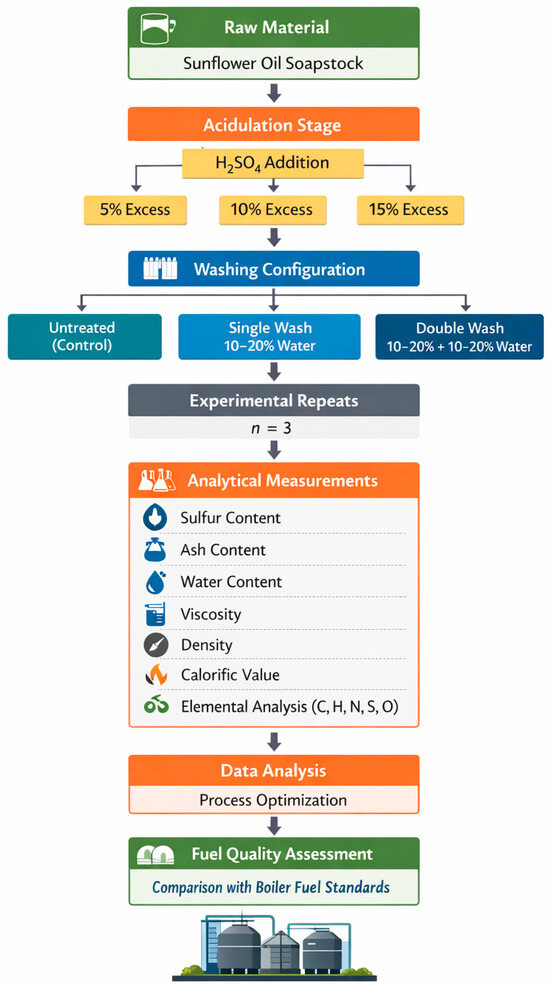
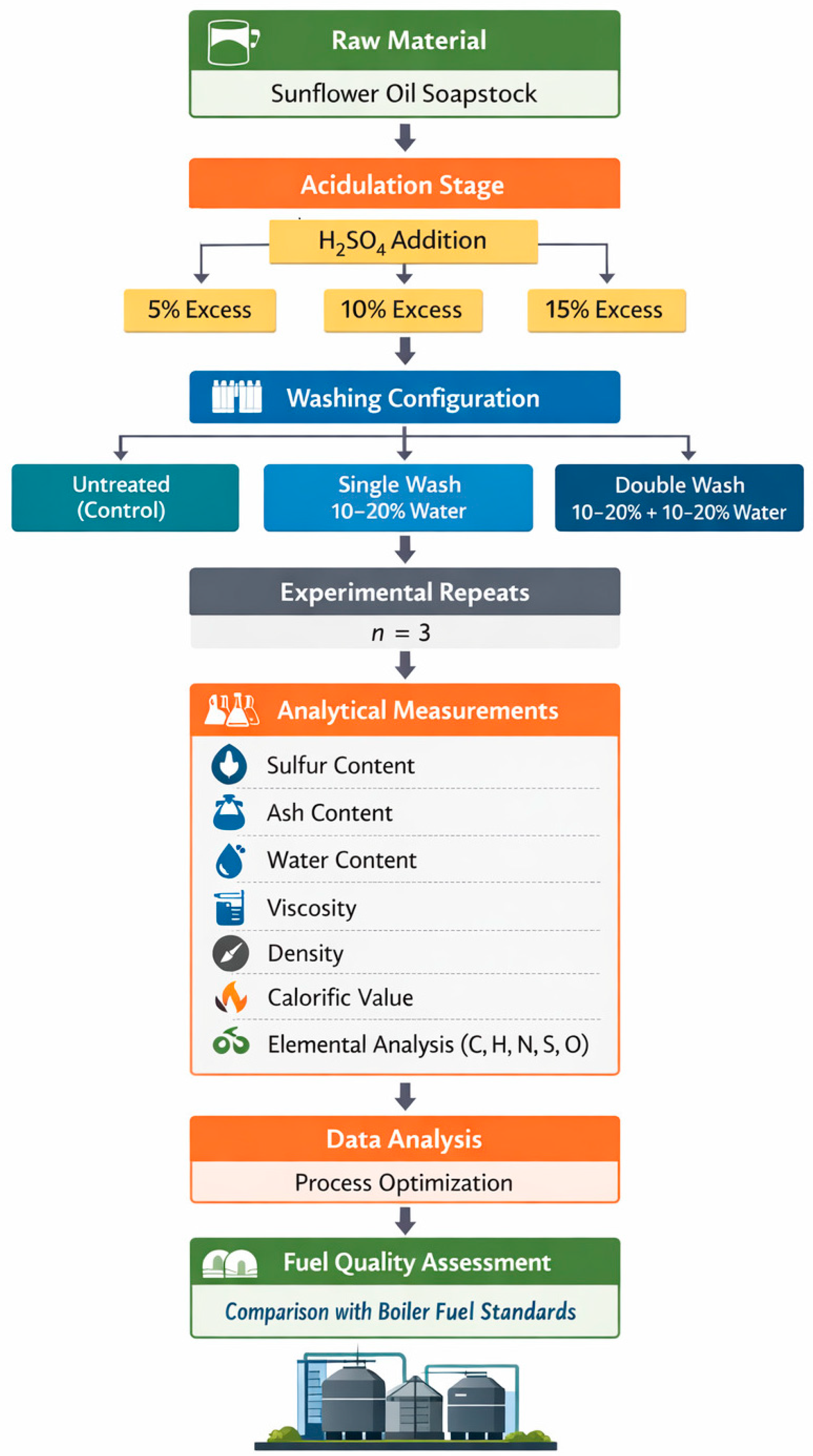
The study design is illustrated in Figure 1.
Figure 1.
The study design.
4.2.1. Research Methodology
Obtaining a Sample of Diluted Soapstock
A sample of soapstock was weighed into a reactor flask. Water was added for dilution. The mixture was heated to 90–95 °C with constant stirring. Heating and all subsequent processes were carried out in a water bath.
A portion of sulfuric acid with 5 wt%, 10 wt%, and 15 wt% excess over the theoretically required amount for neutralization was added to the heated mixture of soapstock and wash water, with constant stirring for 10 min. The selected excess levels (5–15%) were chosen based on preliminary stoichiometric calculations of sodium soap neutralization and literature data indicating that slight acid excess improves phase separation efficiency while preventing excessive residual free acid in the oil phase. The lower limit (5%) ensures complete conversion of sodium soaps, whereas the upper limit (15%) allows evaluation of over-acidification effects on sulfur content and washing efficiency. This range was therefore selected to balance conversion completeness and downstream purification requirements.
After the reaction with sulfuric acid, the sample was left to settle for 30 min. The reactor separated the phases into a fatty phase and an aqueous phase. The settled acidic water was collected from the bottom, leaving the upper phase as a sample for the second stage of the process: washing with water to remove residual sulfuric acid.
First Washing of the Separated Sample
Washing was carried out in the same reactor vessel by adding 10% and 20% water, with stirring for 10 min at 90–95 °C. Then the sample was left to settle for 30 min. The separation of the phases into a fatty and an aqueous phase occurred in the reactor. The settled acidic water was taken from the lower part, leaving the upper phase as a sample for the next stage of the process.
Second Washing of the Separated Sample
Washing was carried out in the same reactor vessel by adding 10% and 20% water, with stirring for 10 min at 90–95 °C. Then, the sample was left to settle for 180 min. The phases were separated into a fatty and an aqueous phase in the reactor. The settled acidic water was taken from the lower part, leaving the upper phase as a sample for the next stage of the process.
The sample isolated after the second wash was used for research into its use as fuel.
To evaluate process optimization, a comparative assessment was conducted between untreated soapstock, single-wash treatment, and double-wash treatment. The untreated material exhibited elevated sulfur, ash, and water content, limiting its suitability as a boiler fuel component. The single-wash configuration significantly reduced sulfur and mechanical impurities; however, residual acidity and phase instability remained. The double-wash treatment ensured improved phase separation, reduced sulfur content, and enhanced physicochemical stability of the final product. Based on this comparative evaluation, the double-wash approach was selected as the optimal processing configuration for further characterization and LCA.
The influence of treatment intensity on key fuel quality parameters was evaluated through comparative analysis of untreated soapstock, single-wash, and double-wash configurations. The results are summarized in Table 9.
Table 9.
Comparative effect of washing stages on key fuel parameters.
As shown in Table 9, untreated soapstock exhibits elevated sulfur, ash, and water content, limiting its direct application as a boiler fuel component. The single-wash stage significantly reduces sulfur and moisture; however, residual impurities and phase instability remain. The double-wash treatment provides the most stable and compliant fuel characteristics, reducing sulfur to 0.12 wt% and minimizing ash and water content. This confirms that process optimization was achieved through sequential washing, ensuring improved physicochemical stability and compatibility with industrial boiler fuel standards. Filtration was performed under controlled vacuum conditions to ensure efficient separation of solid and liquid phases.
Each experimental condition (acid excess level and washing configuration) was performed in three independent repetitions under identical thermal and mixing conditions. The reported values represent averaged results of these repetitions.
4.2.2. Analysis Methods
The soapstock characteristics were determined by ref. [41] according to Appendices B–D.
The determination of the physicochemical characteristics of the obtained sour oil was carried out as for boiler fuel using the following standardized methods: viscosity—according to ref. [43]; ash content—according to ref. [44]; mass fraction of mechanical impurities—according to ref. [45]; mass fraction of water—according to ref. [46]; flash point in an open crucible—according to ref. [47]; freezing point—according to ref. [48]; densities—according to ref. [49]; sulfur content—according to ref. [50]; heat of combustion [51]; ultimate composition [52].
All measurements were performed in triplicate to ensure reproducibility, and average values are reported. Prior to analysis, samples were homogenized at 60 °C to ensure uniform phase distribution.
Sulfur content was determined using wavelength-dispersive X-ray fluorescence spectrometry in accordance with the cited standard, following instrument calibration with certified reference materials covering the expected concentration range (0.05–2.0 wt%). Calibration verification was performed before each analytical series. The relative standard deviation for sulfur measurements did not exceed ±3%.
Ash content was determined by the controlled combustion of pre-weighed samples in a muffle furnace at 775 ± 25 °C until constant mass was achieved. Blank corrections were applied, and analytical balance precision was ±0.0001 g. The relative uncertainty of ash determination was estimated at ±2%.
The higher calorific value was determined using an isoperibol bomb calorimeter calibrated with benzoic acid reference material. Each measurement was repeated at least three times, and the standard deviation did not exceed 0.2 MJ/kg. The lower calorific value was calculated based on hydrogen content and moisture correction according to the cited standard.
Measurement uncertainty was assessed based on instrument precision, repeatability, and calibration error, and overall expanded uncertainty for key fuel parameters was estimated to be within ±3–5%.
Statistical treatment of experimental data was performed using standard deviation and relative standard deviation (RSD) calculations. Differences between washing stages were evaluated descriptively due to the limited experimental matrix size. The variability of key parameters remained within ±3–5%, confirming acceptable experimental repeatability.
Experimental uncertainty was evaluated by combining instrumental precision, repeatability error, and calibration deviation according to standard uncertainty propagation principles. The expanded uncertainty (k = 2) for sulfur, ash, and calorific value measurements did not exceed ±5%.
4.3. Gate-to-Gate Life Cycle Assessment
To evaluate the environmental performance of the proposed soapstock valorization pathway, a gate-to-gate Life Cycle Assessment (LCA) was conducted. The assessment focused exclusively on the processing stage, from the receipt of soapstock at the facility through the production of the purified fuel component.
The functional unit was defined as treating 1 ton of sunflower oil soapstock, providing a consistent basis for evaluating material flows and environmental implications.
System boundaries were established according to a gate-to-gate approach, covering the stages from raw soapstock reception to the production of the purified fuel component. Upstream processes associated with sunflower cultivation and oil production, as well as downstream combustion emissions, were excluded from the assessment to maintain focus on the processing stage.
Given the experimental nature of the study, an uncertainty analysis was conducted qualitatively by examining the process’s sensitivity to variations in key operational parameters, including sulfuric acid dosage, washing water consumption, and phase separation efficiency. The analysis indicates that moderate fluctuations in these variables do not significantly alter the overall environmental interpretation, as the primary outcome, the recovery of energy-rich organic material, remains consistent.
The primary objective of the LCA was to quantify the environmental implications of converting sunflower oil soapstock into a boiler fuel component and to determine whether the process constitutes an environmentally preferable alternative to conventional waste-handling practices.
The inventory data were derived directly from the experimental material balance (Table 1) and physicochemical characterization results presented in this study. Key inputs included soapstock, sulfuric acid, and process water, while outputs consisted of the fuel component and sour water.
Given the moderate process temperature (90–95 °C) and the absence of high-temperature thermochemical conversion, the energy demand of the process is considerably lower than that reported for pyrolysis or hydroprocessing routes described in the literature.
Global Warming Potential (GWP) was selected as the primary impact indicator due to its relevance in evaluating waste-to-energy technologies and circular economy strategies.
To provide a quantitative screening-level system assessment, the Global Warming Potential (GWP) of the gate-to-gate process was estimated based on the experimental life cycle inventory data. The calculated contributions of major process inputs are summarized in Table 10.
Table 10.
Screening-level GWP contribution of main inputs (per functional unit: 1 ton soapstock).
As shown in Table 10, the dominant contributor to the gate-to-gate GWP is the thermal energy required for heating the reaction mixture to 90–95 °C. Sulfuric acid consumption represents a comparatively minor contribution due to the low reagent dosage (8 kg per functional unit). Process water contributes indirectly through pumping and heating demand but does not represent a primary environmental burden.
Under conservative assumptions, the total screening-level GWP of the processing stage is estimated to range between 50 and 250 kg CO2-eq per functional unit, depending on the assumed heat source. This confirms that the environmental performance of the proposed pathway is primarily heat-source dependent rather than chemically intensive.
Sensitivity analysis indicates that a ±10% variation in sulfuric acid dosage results in less than ±3% variation in total GWP. In contrast, changes in thermal energy source significantly influence the overall environmental profile. Therefore, integration with waste heat recovery or low-carbon heat supply would substantially improve system-level sustainability.
The analysis was performed using a functional unit of 1 ton of processed soapstock under steady-state operating conditions.
From a life-cycle perspective, the proposed approach demonstrates that even relatively simple upgrading processes can deliver meaningful environmental benefits by transforming problematic industrial residues into usable energy carriers. This reinforces the role of low-complexity valorization technologies in advancing circular economy strategies within the oil and fat industry.
The comparative evaluation of untreated, single-wash, and double-wash treatments confirms that process optimization was achieved through the empirical assessment of treatment stages. While the second washing step increases water consumption, it ensures substantial reductions in sulfur and ash content, directly improving fuel compatibility with industrial boiler standards. Therefore, the double-wash configuration represents a balanced solution between environmental performance and fuel quality enhancement.
The analytical uncertainty associated with key fuel parameters was incorporated into the environmental interpretation to ensure consistency between laboratory measurements and LCA inventory data.
A substantial fraction of the process output consists of sour water generated during acidulation and washing stages (Table 1 and Table 11). This aqueous phase contains dissolved sulfates, residual acidity, and minor organic residues. In an industrial setting, such effluent would require neutralization (e.g., with alkaline agents such as NaOH or Ca(OH)2), followed by phase clarification and potential integration into existing wastewater treatment systems at oil-refining facilities.
Table 11.
Life Cycle Inventory for Soapstock Processing.
Given that vegetable oil processing plants are already equipped with wastewater treatment infrastructure for alkaline neutralization effluents, the generated sour water can be incorporated into conventional neutralization–sedimentation–biological treatment schemes. Additionally, partial recovery of fatty residues through flotation or decantation may further reduce organic loading prior to discharge.
Therefore, while the process generates a significant aqueous stream, its composition is compatible with standard industrial wastewater treatment practices, and it does not introduce novel hazardous contaminants beyond those already managed in conventional oil-refining operations.
A preliminary energy feasibility estimation was performed to assess the practical relevance of the process. Heating the reaction mixture to 90–95 °C represents the primary thermal input; however, given the moderate operating temperature and relatively short residence time, the estimated thermal energy demand remains significantly lower than the net calorific value of the produced fuel (36.9 MJ/kg). Even when accounting for water heating and mixing energy, the energy recovered in the fuel component substantially exceeds the process energy input at laboratory scale.
While a full techno-economic analysis was beyond the scope of this study, these preliminary considerations suggest that the process has a favorable energy balance. A detailed cost assessment, including water recycling and heat recovery integration, should be addressed in future work.
4.4. Methodological Framework for System-Level Assessment
To ensure methodological rigor and alignment with the Special Issue requirements, a structured system-level framework was defined for the evaluation of the proposed soapstock valorization pathway.
The functional unit (FU) was defined as the treatment of 1 ton of sunflower oil soapstock under steady-state processing conditions. All material flows (Table 1) and fuel output characteristics (Table 3) were normalized to this functional unit to ensure internal consistency of system-level interpretation.
System boundaries were defined according to a gate-to-gate approach. The assessment includes soapstock reception, acidulation with sulfuric acid, two-stage washing, phase separation, and production of the fuel component. Upstream processes such as sunflower cultivation and oil refining, as well as downstream combustion emissions, were excluded to maintain methodological focus on the conversion stage.
The inventory data used for the system-level evaluation were derived directly from the experimental material balance (Table 1) and physicochemical fuel properties (Table 3), ensuring that the assessment is grounded in measured laboratory data rather than secondary assumptions.
A screening-level uncertainty analysis was performed to evaluate the robustness of the system-level conclusions. Variations in sulfuric acid dosage (±10%) have a limited impact on overall interpretation due to the low reagent mass fraction (8 kg per functional unit). In contrast, thermal energy demand required for heating to 90–95 °C represents the dominant variable influencing environmental performance.
However, moderate operational fluctuations in washing water consumption or phase separation efficiency do not alter the primary system outcome, namely the recovery of 328 kg of fuel component per functional unit. Therefore, the comparative and environmental conclusions of this study remain stable under realistic processing variability.
5. Conclusions
The present study demonstrates that sunflower oil soapstock can be converted into a low-sulfur liquid fuel component through acidulation and two-stage aqueous washing under moderate operating conditions. The applied process enables the recovery of an energy-rich organic fraction while transferring the majority of inorganic impurities into the aqueous phase.
The obtained fuel exhibits a sulfur content of 0.12 wt% and a net calorific value of 36.9 MJ/kg, indicating compliance with several regulatory requirements for heavy boiler fuels, although certain parameters such as ash content and calorific value may require further optimization depending on the target fuel grade.
The results confirm the technical feasibility of the valorization of soapstock into a boiler fuel component at the laboratory scale. However, combustion performance, emission behavior, and long-term operational stability were not evaluated within the scope of this study and require further investigation.
Therefore, the findings should be interpreted as a preliminary demonstration of process feasibility rather than as validation of full-scale industrial substitution of petroleum fuels or gas-fired systems. Future research should include combustion testing, emission characterization, and pilot-scale validation to assess practical implementation potential.
Author Contributions
Conceptualization, D.M. and S.P.; methodology, Y.P. and Y.L.; software, M.S.; validation, V.R., Y.L. and B.K.; formal analysis, Y.P. and S.P.; investigation, Y.P., Y.R. and Y.L.; resources, M.S. and V.R.; data curation, D.M.; writing—original draft preparation, Y.P. and Y.L.; writing—review and editing, S.P.; visualization, B.K.; supervision, S.P.; project administration, D.M. All authors have read and agreed to the published version of the manuscript.
Funding
This research received no external funding.
Data Availability Statement
The original contributions presented in this study are included in the article. Further inquiries can be directed to the corresponding author.
Conflicts of Interest
The authors declare no conflicts of interest.
References
- Hrynyshyn, K.; Chervinskyy, T.; Helzhynskyy, I.; Skorokhoda, V. Study on regularities of polyethylene waste low-temperature pyrolysis. Chem. Chem. Technol. 2023, 17, 923–928. [Google Scholar] [CrossRef] [Scilit]
- Pyshyev, S.; Lypko, Y.; Korchak, B.; Poliuzhyn, I.; Hubrii, Z.; Pochapska, I.; Rudnieva, K. Study on the composition of gasoline fractions obtained as a result of waste tires pyrolysis and production of bitumen modifiers from it. J. Energy Inst. 2024, 114, 101598. [Google Scholar] [CrossRef] [Scilit]
- Korchak, B.; Grynyshyn, O.; Chervinskyy, T.; Nagurskyy, A.; Stadnik, V. Integrated regeneration method for used mineral motor oils. Chem. Chem. Technol. 2021, 15, 239–246. [Google Scholar] [CrossRef] [Scilit]
- Wang, Y.; Dai, L.; Fan, L.; Cao, L.; Zhou, Y.; Zhao, Y.; Ruan, R. Catalytic co-pyrolysis of waste vegetable oil and high-density polyethylene for hydrocarbon fuel production. Waste Manag. 2017, 61, 276–282. [Google Scholar] [CrossRef] [Scilit] [PubMed]
- Ukrainian Research Institute of Oils and Fats of the National Academy of Agrarian Sciences of Ukraine. Oil and Fat Industry of Ukraine: Information and Analytical Bulletin; Ukrainian Research Institute of Oils and Fats of the National Academy of Agrarian Sciences of Ukraine: Kharkiv, Ukraine, 2021; Volume 2. [Google Scholar]
- Jeevarathinam, G.; Rahul, R.; Deepa, J.; Kumar, N.S.; Neethu, C.S.; Sarojini, G.; Asdaq, S.M.B. De-acidification of vegetable oils: Advanced technologies, mechanistic insights, and emerging strategies. Food Chem. 2026, 499, 147325. [Google Scholar] [CrossRef] [Scilit] [PubMed]
- Lasek, J.; Głód, K.; Czardybon, A.; Li, Y.H.; Huang, C.W. Application of fatty acids distillation products as a substitute for heavy fuel oil in stationary combustion chambers. Appl. Sci. 2023, 13, 13233. [Google Scholar] [CrossRef] [Scilit]
- Dey, P.; Ray, S.; Newar, A. Defining a waste vegetable oil–biodiesel-based diesel substitute blend fuel by response surface optimization of density and calorific value. Fuel 2021, 283, 118978. [Google Scholar] [CrossRef] [Scilit]
- Emberger, P.; Hebecker, D.; Pickel, P.; Remmele, E.; Thuneke, K. Emission behavior of vegetable oil fuel compatible tractors fueled with different pure vegetable oils. Fuel 2016, 167, 257–270. [Google Scholar] [CrossRef] [Scilit]
- Kleinová, A.; Vailing, I.; Lábaj, J.; Mikulec, J.; Cvengroš, J. Vegetable oils and animal fats as alternative fuels for diesel engines with dual fuel operation. Fuel Process. Technol. 2011, 92, 1980–1986. [Google Scholar] [CrossRef] [Scilit]
- Alabi, O.O.; Gbadeyan, O.J.; Bala, A.; Ogunsiji, G.O.; Deenadayalu, N. Study of combustion characteristics of diesel–vegetable oil blends using an industrial fuel burner. Fuel Commun. 2024, 18, 100104. [Google Scholar] [CrossRef] [Scilit]
- Cheng, C.; Hu, Y.; Jiang, Y. Investigation of evaporation and combustion characteristics of diesel and fatty acid methyl esters emulsified fuel droplets. Fuel 2024, 360, 130609. [Google Scholar] [CrossRef] [Scilit]
- Costa, M.; Marchitto, L.; Piazzullo, D.; Prati, M.V. Comparison between the energetic and environmental performance of a combined heat and power unit fueled with diesel and waste vegetable oil: An experimental and numerical study. Renew. Energy 2021, 168, 791–805. [Google Scholar] [CrossRef] [Scilit]
- Natarajan, R.; Karthikeyan, N.S.; Agarwaal, A.; Sathiyanarayanan, K. Use of vegetable oil as fuel to improve the efficiency of the cooking stove. Renew. Energy 2008, 33, 2423–2427. [Google Scholar] [CrossRef] [Scilit]
- Musthafa, B.; Saravanan, B.; Asokan, M.A.; Devendiran, S.; Venkatesan, K. Effect of ethanol, propanol and butanol on karanja biodiesel with vegetable oil fueled in a single cylinder diesel engine. Egypt. J. Pet. 2023, 32, 35–40. [Google Scholar] [CrossRef] [Scilit]
- Yesilyurt, M.K.; Aydin, M.; Yilbasi, Z.; Arslan, M. Investigation on the structural effects of the addition of alcohols having various chain lengths into vegetable oil–biodiesel–diesel fuel blends. Fuel 2020, 269, 117455. [Google Scholar] [CrossRef] [Scilit]
- Thiyagarajan, S.; Varuvel, E.; Karthickeyan, V.; Sonthalia, A.; Kumar, G.; Saravanan, C.G.; Pugazhendhi, A. Effect of hydrogen on compression-ignition engines fueled with vegetable oil/biodiesel: A review. Int. J. Hydrogen Energy 2022, 47, 37648–37667. [Google Scholar] [CrossRef] [Scilit]
- Wang, Y.; Ke, L.; Peng, Y.; Yang, Q.; Du, Z.; Dai, L.; Jiang, L. Characteristics of the catalytic fast pyrolysis of vegetable oil soapstock for hydrocarbon-rich fuel. Energy Convers. Manag. 2020, 213, 112860. [Google Scholar] [CrossRef] [Scilit]
- Aliyu, M.; Moser, B.R.; Alharthi, F.A.; Rashid, U. Efficient production of biodiesel from palm fatty acid distillate using a novel hydrochar-based solid acid catalyst. Process Saf. Environ. Prot. 2024, 187, 1126–1139. [Google Scholar] [CrossRef] [Scilit]
- Cammarata, A.; Colbertaldo, P.; Kuschel, F.; Rapp, D.; Campanari, S. Techno-economic assessment of a novel oxy-fuel cycle based on steam-nitrogen expansion after ammonia oxidation in a membrane reactor. Energy Convers. Manag. 2026, 348, 120583. [Google Scholar] [CrossRef] [Scilit]
- Cretarola, L.; Luo, H.; Larson, E.; Scaccabarozzi, R.; Jones, A.; Viganò, F.; Consonni, S. Decarbonizing pulp production: A techno-economic study of Carbon Capture from Tomlinson Recovery Boiler flue gas via Molten Carbonate Fuel Cells. Energy Convers. Manag. 2025, 347, 120525. [Google Scholar] [CrossRef] [Scilit]
- Vershinina, K.; Dorokhov, V.; Kartashova, K.; Kovtunets, I.; Strizhak, P. Fuel mixtures of oil sludge and waste oils: Comprehensive ignition and combustion analysis. Energy Convers. Manag. 2026, 348, 120717. [Google Scholar] [CrossRef] [Scilit]
- Lin, Y.; Liu, H.; Wei, G.; Li, T.; Han, Q.; Liu, Z.; Su, X.; Chen, Y. Preparation of sludge derived fuels for co-incineration in waste incinerators: Industrial tests and life cycle assessment. Sustain. Prod. Consum. 2025, 59, 99–111. [Google Scholar] [CrossRef] [Scilit]
- Hor, C.J.; Tan, Y.H.; Mubarak, N.M.; Tan, I.S.; Ibrahim, M.L.; Yek, P.N.Y.; Khalid, M. Techno-economic assessment of hydrotreated vegetable oil as a renewable fuel from waste sludge palm oil. Environ. Res. 2023, 220, 115169. [Google Scholar] [CrossRef] [Scilit]
- Aziz, I.; Sugita, P.; Darmawan, N.; Dwiatmoko, A.A.; Rustyawan, W. Hydrodeoxygenation of palm fatty acid distillate over natural zeolite-supported nickel phosphide catalyst. Case Stud. Chem. Environ. Eng. 2024, 9, 100571. [Google Scholar] [CrossRef] [Scilit]
- Kim, S.H.; Ko, H.; Lee, M.R.; Kim, J.K.; Suh, Y.W. Hydroprocessing characteristics of palm fatty acid distillate into low-carbon biofuel. Fuel 2024, 364, 131058. [Google Scholar] [CrossRef] [Scilit]
- Aziz, I.; Sugita, P.; Darmawan, N.; Dwiatmoko, A.A. Effect of desilication process on natural zeolite as Ni catalyst support in hydrodeoxygenation of PFAD. S. Afr. J. Chem. Eng. 2023, 45, 328–338. [Google Scholar]
- Han, Y.; Stankovikj, F.; Garcia-Perez, M. Co-hydrotreatment of tire pyrolysis oil and vegetable oil for the production of transportation fuels. Fuel Process. Technol. 2017, 159, 328–339. [Google Scholar] [CrossRef] [Scilit]
- Sonthalia, A.; Kumar, N. Hydroprocessed vegetable oil as a fuel for the transportation sector: A review. J. Energy Inst. 2019, 92, 1–17. [Google Scholar] [CrossRef] [Scilit]
- Mata, C.; Cárdenas, D.; Esarte, C.; Soriano, J.A.; Gómez, A.; Fernández-Yáñez, P.; Armas, O. Performance and regulated emissions of a Euro VI-D hybrid bus fueled with hydrotreated vegetable oil. J. Clean. Prod. 2023, 383, 135472. [Google Scholar] [CrossRef] [Scilit]
- Li, F.; Xia, A.; Guo, X.; Zhang, W.; Huang, Y.; Zhu, X.; Liao, Q. Continuous hydrocarbon fuel production by photoenzymatic decarboxylation of free fatty acids. J. Environ. Chem. Eng. 2023, 11, 110748. [Google Scholar] [CrossRef] [Scilit]
- DSTU 4058-2001; Solid Fuels. Methods for Determination of Calorific Value. SE «USREC»: Kyiv, Ukraine, 2001. Available online: https://online.budstandart.com/ua/catalog/doc-page?id_doc=54025 (accessed on 1 July 2002).
- PN-C-96024:2020; Petroleum Products—Heating Oils. PKN: Warsaw, Poland, 2020. Available online: https://www.pkn.pl/ (accessed on 1 December 2002).
- ISO 8217:2024; Products from Petroleum, Synthetic and Renewable Sources—Fuels (Class F)—Specifications of Marine Fuels. International Organization for Standardization (ISO): Geneva, Switzerland, 2024. Available online: https://www.iso.org/standard/80579.html (accessed on 1 May 2024).
- Hidayat, H.; Anam, A.; Destian, E.F.; Noor, I.; Ghofar, A.; Rosjidi, M.; Priambodo, T.B. Oil palm biomass ash removal for boiler fuel optimization: A case study. Case Stud. Chem. Environ. Eng. 2024, 11, 101049. [Google Scholar] [CrossRef] [Scilit]
- Balaeva, Y.; Miroshnichenko, D.; Kaftan, Y. Method for calculating the gross calorific value of coal on a moist ash-free basis. Solid Fuel Chem. 2018, 52, 279–288. [Google Scholar] [CrossRef] [Scilit]
- Pyshyev, S.; Romanchuk, O.; Topilnytskyy, P.; Romanchuk, V.; Miroshnichenko, D.; Rohovyi, Y.; Omelianchuk, H.; Parkhomov, Y. Animal fats and vegetable oils as resources for corrosion inhibitors. Resources 2025, 14, 30. [Google Scholar] [CrossRef] [Scilit]
- Miroshnichenko, D.; Malik, I. Prediction of the higher heats of combustion of plant raw materials. Solid Fuel Chem. 2021, 55, 216–222. [Google Scholar] [CrossRef] [Scilit]
- Zhylina, M.; Shishkin, A.; Miroshnichenko, D.; Sterna, V.; Ozolins, J.; Ansone-Bertina, L.; Klavins, M.; Goel, G.; Goel, S. Granulation and pyrolysis of agricultural residues for an enhanced circular economy. Results Eng. 2025, 26, 104919. [Google Scholar] [CrossRef] [Scilit]
- Zhylina, M.; Miroshnichenko, D.; Melnykov, A.; Stepanova, V.; Lazdovica, K.; Zemcenkovs, V.; Sterna, V. Biochar structure development during slow pyrolysis of pellets from barley straw and bran. Sci. Rep. 2025, 15, 42624. [Google Scholar] [CrossRef] [Scilit] [PubMed]
- DSTU 5033:2008; Soapstock. Technical Conditions. SE «USREC»: Kyiv, Ukraine, 2009. Available online: https://online.budstandart.com/ua/catalog/doc-page?id_doc=81707 (accessed on 1 January 2009).
- DSTU ISO 3696:2003; Water for Laboratory Use. Requirements and Test Methods (ISO 3696:1987, IDT). SE «USREC»: Kyiv, Ukraine, 2004. Available online: https://online.budstandart.com/ua/catalog/doc-page.html?id_doc=58881 (accessed on 1 July 2004).
- DSTU GOST 33-2003; Petroleum Products. Transparent and Opaque Liquids. Determination of Kinematic Viscosity and Calculation of Dynamic Viscosity (GOST 33-2000 (ISO 3104-94), IDT). SE «USREC»: Kyiv, Ukraine, 2003. Available online: https://online.budstandart.com/ua/catalog/doc-page.html?id_doc=62368 (accessed on 1 July 2003).
- GOST 1461-75; Petroleum and Petroleum Products. Method for Determining Ash Content. With Amendments No. 1, 2, 3. State Standard of the USSR: Moscow, Russia, 1975. Available online: https://online.budstandart.com/ua/catalog/doc-page.html?id_doc=60681 (accessed on 11 February 2024).
- DSTU GOST 6370:2021; Oil, Petroleum Products and Additives. Method for Determining Mechanical Impurities (GOST 6370-2018, IDT). SE «USREC»: Kyiv, Ukraine, 2021. Available online: https://online.budstandart.com/ua/catalog/doc-page.html?id_doc=96746 (accessed on 15 December 2021).
- DSTU GOST 2477:2021; Oil and Petroleum Products. Method for Determining Water Content (GOST 2477-2014, IDT). With Amendment (IPS No. 10-2018). SE «USREC»: Kyiv, Ukraine, 2021. Available online: https://online.budstandart.com/ua/catalog/doc-page.html?id_doc=96745 (accessed on 15 December 2021).
- DSTU GOST 4333:2018; Petroleum Products. Methods for Determining Flash and Ignition Temperatures in an Open Crucible (GOST 4333-2014, IDT; ISO 2592:2000, MOD). SE «USREC»: Kyiv, Ukraine, 2018. Available online: https://online.budstandart.com/ua/catalog/doc-page.html?id_doc=78565 (accessed on 1 October 2018).
- GOST 20287-91; Petroleum Products. Methods for Determining Pour and Pour Point. State Standard of the USSR: Moscow, Russia, 1991. Available online: https://online.budstandart.com/ua/catalog/doc-page.html?id_doc=66085 (accessed on 11 February 2024).
- DSTU 7261:2012; Technical Chemicals. Methods for Determining the Density of Liquids. SE «USREC»: Kyiv, Ukraine, 2012. Available online: https://online.budstandart.com/ua/catalog/doc-page.html?id_doc=54397 (accessed on 1 March 2013).
- DSTU EN ISO 20884:2022; Petroleum Products—Determination of Sulfur Content in Automotive Fuels—Wavelength-Dispersive X-Ray Fluorescence Spectrometry (EN ISO 20884:2019, IDT; ISO 20884:2019, IDT). SE «USREC»: Kyiv, Ukraine, 2022. Available online: https://online.budstandart.com/ua/catalog/doc-page.html?id_doc=110466 (accessed on 31 December 2023).
- DSTU ISO 5508:2001; Animal and Vegetable Fats and Oils—Analysis of Fatty Acid Methyl Esters by Gas Chromatography (ISO 5508:1990, IDT). SE «USREC»: Kyiv, Ukraine, 2001. Available online: https://online.budstandart.com/ua/catalog/doc-page?id_doc=92877 (accessed on 1 January 2003).
- DSTU ISO 1928:2006; Solid Mineral Fuels—Determination of the Highest Calorific Value by the Bomb Calorimeter Method and Calculation of the Lowest Calorific Value (ISO 1928:1995, IDT). SE «USREC»: Kyiv, Ukraine, 2006. Available online: https://online.budstandart.com/ua/catalog/doc-page.html?id_doc=50700 (accessed on 1 July 2008).

Disclaimer/Publisher’s Note: The statements, opinions and data contained in all publications are solely those of the individual author(s) and contributor(s) and not of MDPI and/or the editor(s). MDPI and/or the editor(s) disclaim responsibility for any injury to people or property resulting from any ideas, methods, instructions or products referred to in the content. |
© 2026 by the authors. Licensee MDPI, Basel, Switzerland. This article is an open access article distributed under the terms and conditions of the Creative Commons Attribution (CC BY) license.