


Abstract
Fast-charging lithium-ion batteries require graphite anodes with low ionic transport resistance, yet systematic links between electrode manufacturing parameters and fast-charge performance remain scarce. This study shows that twin-screw extrusion (TSE) process conditions control electrode tortuosity, the geometric complexity of ionic pathways, by reshaping the binder network architecture without altering active material integrity. A central composite experimental design combined with multi-scale diagnostics identifies pore network tortuosity as the primary transport bottleneck. The optimized mild kneading condition (K4: 60 kneading zone solids, 7% kneading length, gentle screw design) reduces the 8–80% state-of-charge (SOC) charging time by % relative to the intensive baseline (B1–B3: 70 , 50% kneading length), matching conventional batch mixing. Regression analysis confirms a strong correlation between tortuosity and fast-charge performance (), whereas the correlation with charge-transfer resistance is weaker (). Mechanistically, mild kneading promotes reversible, sterically stabilized carboxymethyl cellulose (CMC) networks consistent with extended “loop-tail” polymer conformations. Intensive kneading is consistent with the formation of bridging gels that fail to arrest binder migration during drying and clog surface pores. A Pore-Homogeneity Index (PHI), derived from mercury porosimetry, quantifies the resulting microstructural heterogeneity, correlates with tortuosity (), and characterizes pore network uniformity. The results identify local stress intensity as a primary factor influencing binder network formation and support tortuosity as an adjustable design parameter in continuous anode processing.
1. Introduction
1.1. The Tortuosity Bottleneck in Fast-Charge Anodes
Widespread electric vehicle adoption depends on rapid recharging. The U.S. Department of Energy defines “Extreme Fast Charging” (XFC) as reaching 80% state-of-charge (SOC) within 10–15 [1,2]. Sustaining rates above 4 C in high-energy cells forces a trade-off between energy density and power density [3,4,5].
Transport and kinetic processes at the graphite anode limit fast-charge capability. Under high charging currents, ohmic losses, sluggish interfacial kinetics, and restricted mass transport produce large overpotentials. Once the local anode potential falls below 0 V vs. Li/Li+ (the thermodynamic stability threshold of the electrolyte), metallic lithium is deposited [6,7]. The resulting plating causes irreversible capacity loss through electrolyte consumption and accelerated solid electrolyte interphase (SEI) growth, and poses safety risks from dendrite formation [8,9].
Single-particle measurements confirm that solid-state lithium diffusion within graphite supports rates above 20 C. In porous composite electrodes, however, the rate-determining step shifts toward ionic transport in the liquid electrolyte [5,10]. In this liquid-phase-limited regime, tortuosity () is the decisive parameter. It quantifies the geometric impediment to ion migration and scales the effective diffusion coefficient via . Measured tortuosity values in manufactured electrodes (–10) far exceed predictions from the Bruggeman relation () [11,12]. The discrepancy stems largely from the morphology of the Carbon-Binder Domain (CBD). Depending on processing conditions, the CBD blocks pore entrances or masks active material surfaces, extending effective transport paths and shrinking the electrochemically active surface area. The Diffusion-Limited C-Rate (DLC) falls [13,14,15], local overpotentials rise at a given current, and the lithium plating risk increases. Although desolvation energy and charge-transfer resistance () also affect kinetics at low temperatures or low SOCs [16,17], methods that directly correlate process-induced CBD morphology with tortuosity and fast-charge performance remain lacking.
1.2. Twin-Screw Extrusion: Opportunities and Challenges
The industrial transition from discontinuous planetary batch mixers to co-rotating twin-screw extruders (TSE) marks a fundamental shift in electrode manufacturing. Conventional batch processes suffer from non-productive downtimes and significant batch-to-batch variation [18]. Quasi-continuous TSE processing offers a six-fold reduction in process time, lower energy consumption, and a smaller facility footprint [19,20].
A key advantage of extrusion is its controllable process–structure–property relationships. The modular screw configuration decouples local shear intensities from residence time distributions, enabling slurry processing at solid contents ranging from “high-solid” to “semi-dry” states [21,22,23]. High solid fractions reduce downstream drying energy and suppress post-coating binder migration [24,25]. They also permit deagglomeration of conductive carbon without exceeding the critical damage threshold of the active material [26]. Continuous extrusion yields energy savings during mixing [19,26,27] and allows shear-sensitive components such as styrene–butadiene rubber (SBR) binder to be introduced only during the final dilution stage, preserving molecular integrity [28].
Because TSE operates at elevated solid concentrations, the slurry enters a restrictive rheological regime in which local stress fields dictate the irreversible spatial arrangement of the CBD [13,29,30]. Two competing dispersion mechanisms govern this regime: rupture (sudden fragmentation above a critical stress) and erosion (gradual surface attrition under sustained shear) [31,32]. Effective dispersion depends on the interplay of maximum shear stress, stress frequency, and specific stress intensity [33,34,35,36]. Hydrodynamic simulations show that local stress history, rather than global specific mechanical energy (SME), determines the final dispersion quality [37,38]. Backward-conveying kneading blocks create intensive kneading zones by maximizing fill level and forcing material over high-shear disc crests [39,40,41,42].
Managing shear intensity in graphite anodes requires a narrow operational window. Insufficient shear leaves carbon black agglomerates intact, causing coating defects and poor electronic conductivity [43,44]. Excessive shear disrupts carbon percolation networks and can induce graphitic delamination. At solid concentrations above 70 wt%, wall slip may interrupt shear transmission at the barrel–slurry interface [45,46]. Elevated stress intensities can also fracture particles, exposing fresh surfaces that consume available binder and elevate tortuosity by clogging surrounding pores. Recent graphite–anode mixing studies have primarily focused on graphite delamination and particle fracture [24,26,29,30,47]. As a result, concurrent slurry-network mechanisms, particularly carboxymethyl cellulose (CMC) adsorption, CBD redistribution, and drying-induced pore blockage, remain less clearly resolved.
1.3. The Slurry Network Formation Gap
Microstructural evolution in aqueous graphite slurries is governed by interactions among graphite, CMC, carbon black, and SBR. CMC acts as the primary dispersant, adsorbing onto solid surfaces and providing electrosteric anionic repulsion [48,49]. Electrode mechanical stability depends on the specific adsorption conformation of CMC. Hofmann and Willenbacher [50] showed that intense adsorption onto porous domains depletes binder from particle–particle contacts. Binder polarity further dictates carbon black dispersion [51].
Scheutjens–Fleer self-consistent field theory [52,53] describes how polymer chains at solid–liquid interfaces adopt distinct conformations: trains (surface-anchored segments), loops (segments protruding into the solvent), and tails (unbound terminal ends). Extended “loop and tail” conformations maximize steric layer thickness. Elevated shear rates alter these conformations or strip polymer chains from surfaces [54]. Adsorption efficiency depends on molecular weight, degree of substitution, and processing stress [54,55,56,57]. If the resulting network lacks sufficient yield strength, capillary forces during drying drive SBR latex and carbon additives toward the evaporation front, causing binder depletion at the current collector and surface enrichment [25,54,58,59].
The susceptibility to such migration reflects a kinetic competition: capillary pressure (scaling with drying rate and pore size) competes against the network yield stress that resists particle rearrangement. Delayed structural recovery prolongs the window during which capillary forces exceed the yield stress, enabling sustained particle transport. Rapid gelation, by contrast, immobilizes the suspension effectively [60]. This thixotropic competition between shear-induced network breakdown and Brownian structure recovery determines the electrode architecture at the point of film solidification during drying [61,62,63,64]. Processing above 65 wt% solids increases particle contact frequency and can intensify CMC–surface interactions. Subsequent dilution may then leave part of the polymer strongly adsorbed in train-like conformations, while weakly attached tail segments and free CMC remain available for interparticle bridging. Compared with moderately kneaded slurries, in which loop-rich adsorption layers provide steric stabilization, this state is more prone to bridging flocculation and the formation of physical particle–polymer–particle bridges [52,53,65,66,67]. Hydrodynamic shear rate, controlled mainly by screw speed and geometric screw design, must be distinguished from local stress intensity, which is governed by solids loading, particle contact frequency, and local force transmission. A unified framework that connects local stress intensity and CMC conformational states to macroscopic tortuosity and fast-charge capability has not been established.
1.4. Objectives and Hypothesis
This study investigates how TSE process parameters, specifically kneading zone solid concentration and stress intensity, relate to binder network formation, electrode tortuosity, and fast-charge capability.
The experimental design separates the effects of local stress intensity from hydrodynamic shear rate through a central composite design. “Mild kneading” denotes a processing regime that constrains peak shear stresses while preserving the extensional flow needed to deagglomerate carbon black via surface erosion rather than mechanical rupture [31,68].
The underlying hypothesis is that constrained kneading zone solid concentrations promote extended CMC conformations (loops and tails), generating sterically stabilized, reversible suspension networks. Such networks recover rapidly after coating, providing the yield stress needed to arrest capillary-driven SBR migration. This stabilization should preserve pore homogeneity and reduce tortuosity without modifying the active material.
The objectives are to (i) provide quantitative evidence identifying the primary transport limitation in fast-charge graphite anodes, (ii) establish process–structure–property relationships linking specific TSE parameters to effective tortuosity, and (iii) validate rheological and electroacoustic slurry metrics as diagnostic proxies for industrial process control. The porosimetric and impedance-based reference methods used to establish these correlations remain post-process laboratory analyses; in production, the correlated quantities of viscosity and color are intended to be tracked by available in-line surrogates, such as pressure-based capillary viscometry at the extruder outlet for the slurry network state and an optical color (CIELAB) sensor at the end of the coater for surface binder enrichment.
2. Experimental Methods
2.1. Materials
The anode formulation comprised synthetic graphite (VW3, Showa Denko; , BET surface area m2 g−1), Super C45 conductive carbon black (Imerys; BET 45 m2 g−1), sodium carboxymethyl cellulose (CMC, MAC500L, Nippon Paper Industries Co., Ltd., Tokyo, Japan; g mol−1, DS = 0.70), and an aqueous styrene–butadiene rubber latex dispersion (SBR, Zeon 451-B, Zeon Corporation, Tokyo, Japan; ). The dry mass ratio was 96:1:1:2 (graphite:carbon black:CMC:SBR), corresponding to a CMC fraction of in the final dry electrode. During continuous processing, CMC was introduced as a aqueous master solution as this was the highest concentration that could be pumped. The CMC concentration in the aqueous phase during processing lies well above the critical overlap concentration c*, i.e., the concentration at which polymer coils begin to overlap and interpenetrate rather than remain isolated, ensuring a chain-entangled rheological regime [69]. Pre-dissolution was selected deliberately: preliminary trials (data not available) with direct dry-CMC powder dosing resulted in lower electrode adhesion, consistent with the observations of Haarmann et al. [20] for cathode slurry, because the swelling and chain-relaxation time of CMC in water exceeds the residence time available in the extruder and prevents complete hydration and adsorption-layer formation within the process.
2.2. Electrode Fabrication
The above-mentioned CMC master solution was prepared using a rotor-stator mixer (IKA XPP 200L, IKA-Werke GmbH & Co. KG, Staufen, Germany; CMX geometry) at for followed by for , then aged for at ambient temperature to ensure full polymer relaxation.
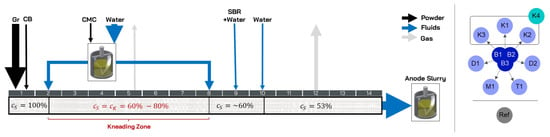
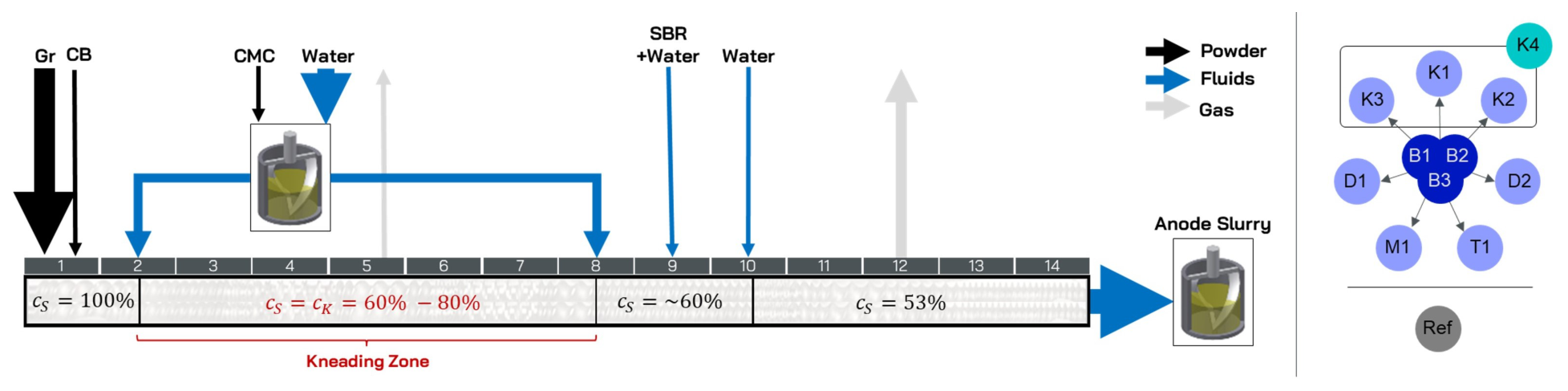
Continuous processing used a co-rotating intermeshing twin-screw extruder (BTSK 30/44, Bühler AG, Uzwil, Switzerland; barrel diameter , ) divided into four functional zones: (1) dry solid feeding, (2) CMC injection, (3) high-solid kneading ( 60–80 ), and (4) SBR integration and final dilution to a coating solid content of . This tolerance reflects the achievable control band of the final coating solid content under two continuous gravimetric dosing of four liquid feed streams on the pilot-scale line. Here, the kneading zone solid concentration denotes the local solid mass fraction of the suspension within the high-solid kneading section (Figure 1), i.e., the concentration at which the material experiences the intensive dispersive stresses. The kneading length denotes the relative axial share of the total process length configured at this levelled kneading concentration. A larger value exposes the material to the high-solid, high-stress regime over a longer fraction of the screw. The screw design in the kneading zone incorporated two mixing elements, followed by kneading blocks with a stagger angle and 5 mm in forward conveying direction, followed by backwards conveying blocks. Water-jacketed barrel cooling maintained isothermal processing at °C.
Figure 1.
TSE process layout and experimental design. (Left): Schematic of four functional zones showing solid feeding (graphite/carbon black), CMC solution injection, high-solid kneading ( 60–80 ), and SBR dilution to final coating viscosity. (Right): Central composite star design mapping the experimental space. The primary comparison distinguishes mild kneading (K4, , %) from intensive kneading (B1–B3, , %).
Process–structure mapping followed a central composite star design with 12 distinct operating conditions (Figure 1, Table 1). That means the process parameters were each varied as single star-point excursions from the central operating point across their widest technically feasible span for this machine and material and avoiding agglomerates or particle fracture. This screening layout resolves the direction and relative magnitude of each parameter’s influence in a single, statistically economical campaign, while replication is concentrated on the intensive baseline (B1–B3) to establish the reference variance. The matrix included three baseline intensive kneading replicates (B1–B3: , %, intensive design), a low-concentration kneading condition at otherwise intensive configuration (K1: , , intensive design), and an optimized mild kneading condition (K4: , , gentle design). The varied parameters were throughput (, 25–50 kg h−1), screw speed (n, 600–1200 ), barrel temperature (T, 20–40 °C), and binder injection position (, 50–93%).
Table 1.
Central composite star design for evaluation of TSE process parameters. B1–B3 represent the intensive baseline (, %, intensive design). K1 isolates the effect of reduced kneading zone solids at otherwise intensive conditions (, %, intensive design). K4 represents the optimized mild kneading condition (, %, gentle design). K2 and K3 modify the kneading length and the screw design, respectively. D1 varies mass throughput (), D2 varies screw speed (n), M1 varies the binder injection position (), and T1 varies the barrel temperature (T). “Int.” denotes the intensive kneading block design; “Gnt.” denotes the gentle conveying element design; “Ref” denotes the planetary batch mixing reference.
A reference batch (Ref) was manufactured using a planetary mixer (HIVIS MIX 2P-03/1, PRIMIX Corporation, Awaji, Hyogo, Japan) and served as the batch-processing baseline. The process parameters matched the formulation kinetics of K4: dry components and CMC solution were kneaded at solids for at , followed by gradual CMC dilution (, ), SBR addition (, ), and vacuum degassing (, ).
Holding density and porosity constant ensures that the measured tortuosity and pore-morphology differences arise from mixing-induced mechanisms rather than from differences in loading and compaction. The electrode design parameters correspond to the application-relevant compaction of a high-energy automotive graphite anode with an areal capacity of . Slurries were applied onto copper current collectors using a doctor blade at 1 m/min−1. The wet film gap was set individually per sheet in a range of 200–220 μm. A two-stage drying protocol separated intrinsic network formation effects from thermal artifacts: of ambient convection followed by at 60 °C. Electrodes were calendered to a target density of g cm−3 (30% porosity, approximately depending on individual loading of the sheet), dried under vacuum at 120 °C for 12 h, and transferred into an argon-filled glovebox.
2.3. Slurry Characterization
2.3.1. Particle Size Analysis
Particle size distributions were measured by laser diffraction (Mastersizer 3000 with Hydro MV dispersion unit, Malvern Panalytical Ltd., Malvern, Worcestershire, UK) under stirring at a 0.5:1.5 mass dilution. A 0–50 μm grindometer ruled out macroscopic agglomerates. The Mie optical model used a particle refractive index of 1.81 and an absorption index of 0.1 for graphite and 1.33 for water as dispersant. The analysis served as a comparative particle-integrity check; the identical parametrization has repeatedly resolved process-induced particle damage in other material systems and process windows of this material system.
2.3.2. Shear Viscosity
Steady-state shear viscosity was measured using a cone-plate rheometer (Kinexus Pro+, Malvern Panalytical Ltd., Malvern, Worcestershire, UK; CP 1°/50 mm, 25.0 °C) over a shear rate ramp of 0.1–1000 s−1. Serrated-plate testing checked for wall slip artifacts. The CP 1°/50 mm geometry was used with a truncation gap of 30 µm. Cone-plate geometry was selected because it imposes a spatially uniform shear rate, required for an unambiguous flow curve of a shear-thinning suspension. Because the measured torque scales with the third power of the radius, the narrow apex region contributes negligibly to the signal; consistency of the flow curves with serrated plate–plate control measurements, whose gap far exceeds the largest particle dimension, confirmed the absence of wall-slip and particle-confinement artifacts.
2.3.3. Viscoelastic Properties
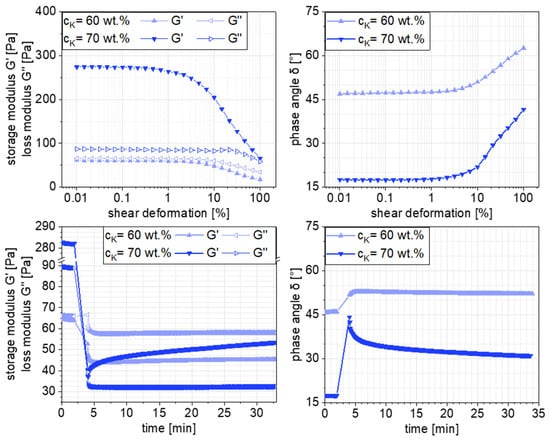
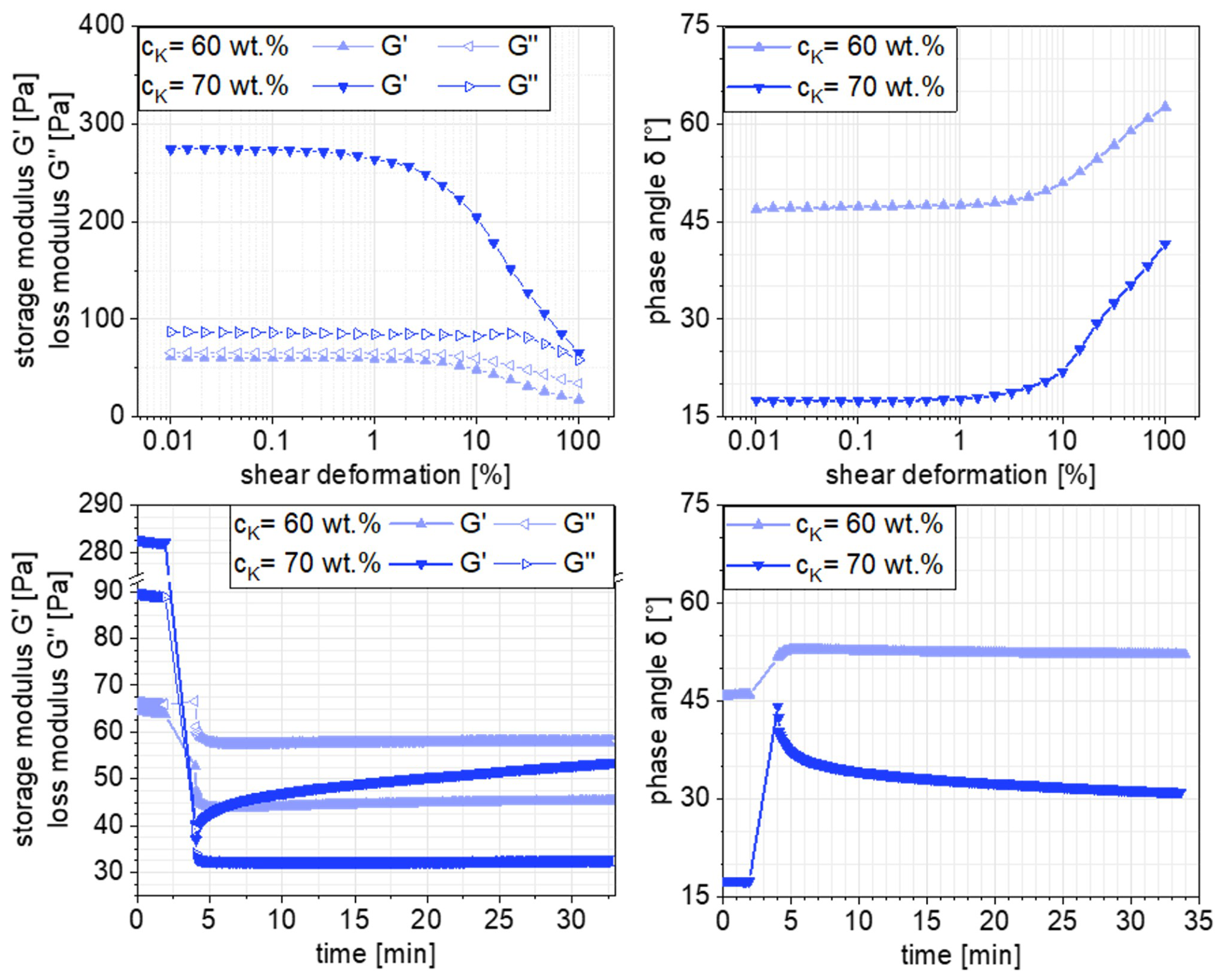
Viscoelastic properties were determined using a coaxial-cylinder setup (MCR 302e, Anton Paar GmbH, Graz, Austria; CC27, 20.0 °C) with oscillatory strain sweeps (, 0.01–100% strain) to obtain the storage () and loss () moduli.
2.3.4. Structural Recovery Kinetics
Three-interval thixotropy tests (3ITT) assessed post-coating network regeneration: Interval I (0.1% strain, 1 Hz, 30 s), Interval II (shear breakdown at 100 s−1, 30 s), and Interval III (recovery at 0.1%, 1 Hz, 30 min).
2.3.5. CMC Adsorption Coverage
CMC adsorption density was quantified by electroacoustic spectroscopy (ZetaProbe Analyzer, Colloidal Dynamics, LLC, Ponte Vedra Beach, FL, USA), measuring zeta potential () magnitude during bidirectional pH titration (HNO3/KOH). In this technique, an applied alternating electric field drives the charged particles into oscillatory motion; the density contrast between particle and fluid causes this motion to emit a pressure wave (electrokinetic sonic amplitude, ESA), whose amplitude and phase are detected. The signal is proportional to the dynamic mobility of the particle and hence to the zeta-potential, which in this case reflects the density and conformation of the adsorbed, charge-bearing CMC layer. Unlike classical microelectrophoresis, the method operates directly in the concentrated suspension, preserving the adsorption state established at process solid content.
2.4. Electrode Microstructure
2.4.1. Spectrophotometry
Vertical binder stratification was assessed non-destructively by surface spectrophotometry (sp900, ColorLite GmbH, Katlenburg-Lindau, Germany). CIELAB color coordinates (, , ) were extracted from five locations per sample; reduced and elevated serve as optical proxies for surface enrichment of SBR and carbon black [70]. CIELAB color coordinates L*: lightness; a*: green–red axis; b*: blue–yellow axis) were extracted from three positions distributed across each sheet, using at least two four per condition to capture both within-sheet variability and sheet-to-sheet reproducibility; cells were subsequently assembled from the characterized sheets. Surface enrichment of dark carbon black and SBR manifested as reduced L* and shifted b*, whereas a* showed no systematic variation across conditions and was not used as a proxy.
2.4.2. Pore Network Morphology
The volumetric pore size distribution was mapped by mercury intrusion porosimetry (MIP, AutoPore V, Micromeritics GmbH, Unterschleißheim, Germany) over a pressure range of 0.1–61.000 psia, calculating with a contact angle of θ = 130° and surface tension of γ = 0.485 N m−1.
2.5. Electrochemical Performance Evaluation
2.5.1. Cell Assembly and Formation
Three-electrode PAT-Core cells (PAT-Core, EL-Cell GmbH, Tempowerkring 8, 21079 Hamburg, Germany) were assembled against NMC811 cathodes (capacity ratio ) with a metallic lithium reference electrode and LP572 electrolyte. Cells underwent a three-cycle formation protocol at within a graphite anode potential window of 0.05–1.5 V vs. Li/Li+, with an additional full-cell safety cut-off at . Five cells were assembled and cycled for each parameter set. The intensive baseline was additionally produced as three independent extrusion replicates (B1–B3), so that the reported statistics capture both the cell-level (assembly-to-assembly) variance within each condition and the process-level (extrusion-to-extrusion) variance of the baseline.
2.5.2. Fast-Charge Capability
Fast-charge performance was quantified using a 5 C constant-current–constant-voltage (5CCV) protocol [4]: constant-current (CC) charging at 5 C until the graphite anode potential reached 50 mV vs. Li/Li+, followed by a potentiostatic constant-voltage (CV) hold to a cut-off. The effective charging time between 8% and 80% SOC () served as the performance benchmark.
2.5.3. Impedance Spectroscopy and DRT Deconvolution
Electrochemical impedance spectroscopy (EIS) was performed at 50% SOC (8 mV perturbation, 200 kHz to 10 mHz). The SOC operating point lies on the flat stage-II region of the graphite potential curve, where the minimal ensures stationarity over the low-frequency sweep and thereby supports the verified Kramers–Kronig linearity; it also provides a reproducible reference state for between-sample comparison.
The Distribution of Relaxation Times (DRT) was computed using Tikhonov regularization with an optimized smoothing parameter, , according to Hahn et al. [71], Plank et al. [72]:
2.5.4. Tortuosity Measurement
Symmetrical blocking cells with a non-intercalating electrolyte (1 mol L−1 TBAClO4 in propylene carbonate) isolated ionic transport resistance from electronic and interfacial contributions. Tortuosity factors () were calculated from the transmission line model [11,14]:
where is the ionic resistance derived from Nyquist intercepts, A the electrode area, the porosity, and the total electrode thickness.
3. Results and Discussion
3.1. Fast-Charge Performance and Rate-Limiting Mechanisms
3.1.1. Charge Time Statistics
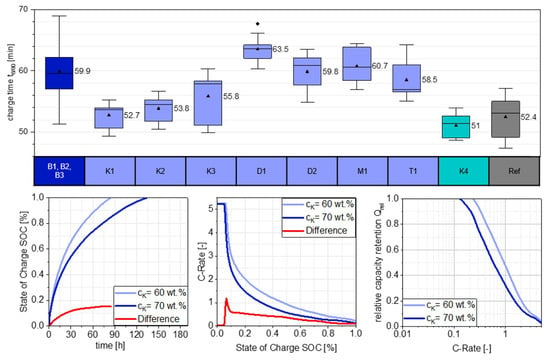
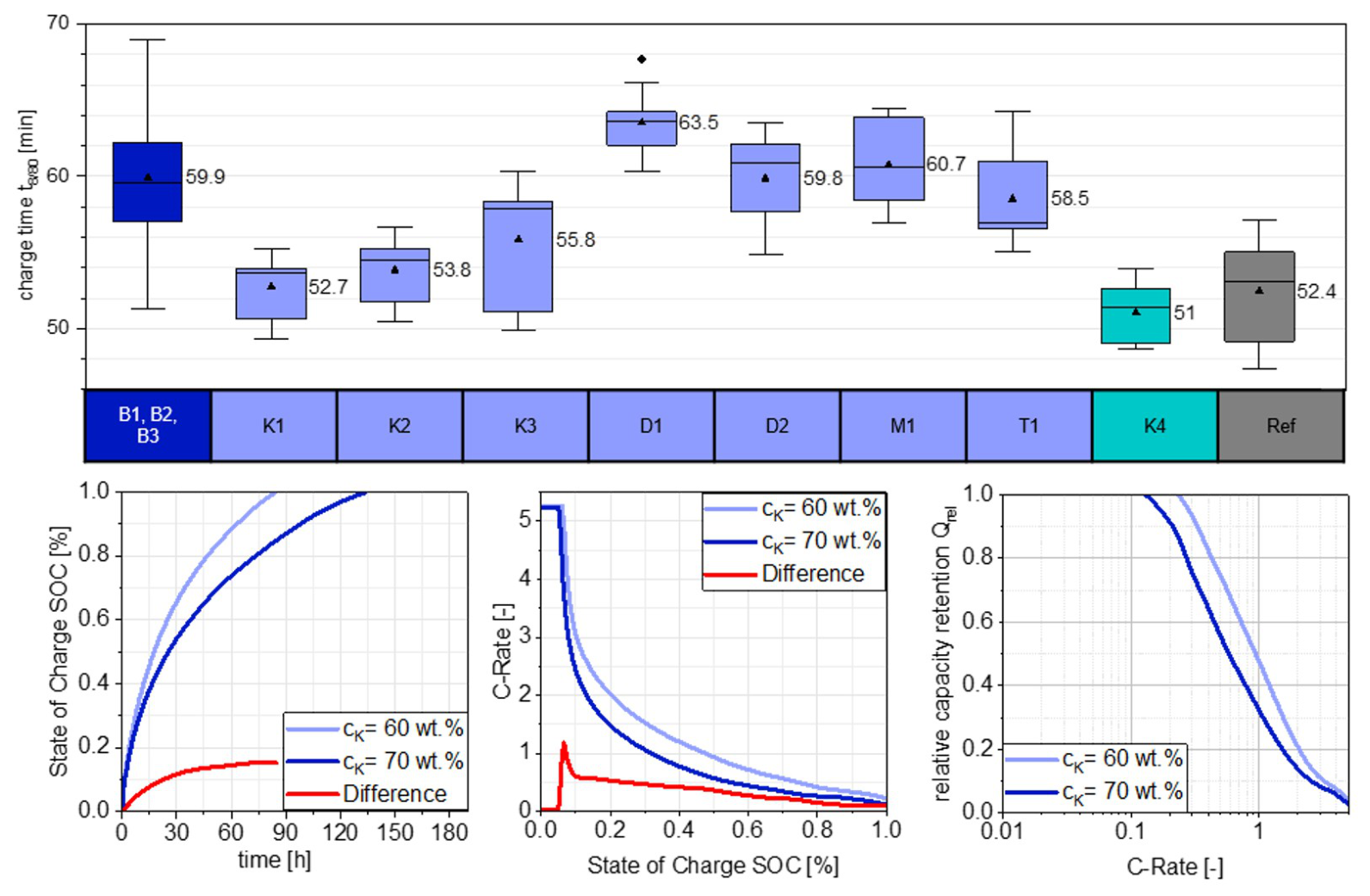
The 5CCV protocol quantified how processing history affects fast-charge performance. The effective charging time t8–80% depended strongly on process conditions (Figure 2). Intensive kneading (B1–B3, ) produced a mean charge time of . The optimized mild kneading configuration (K4: , %, gentle design) reduced this to , corresponding to a % reduction (). Analysis of variance (ANOVA) ranked the parameter hierarchy as ; individual p-value evaluation eliminated statistically insignificant terms [73].
Figure 2.
Fast-charge performance comparison between all trials and fast charge diagnostics for the optimized mild kneading condition and the intensive baseline. (Top): Charge time distributions showing a % reduction. (Bottom left): SOC evolution during the constant-current phase. The curves diverge at low SOCs (below 20%), indicating improved interfacial charge transfer. (Bottom center): C-rate profiles showing sustained higher charging rates for mild kneading throughout the CC phase. (Bottom right): Discharge capability confirming preserved rate performance across all C-rates.
Reduced mass throughput (D1) correlated with longer charging times. This inverse relationship contradicts the common assumption that extended residence times uniformly improve dispersion homogeneity. At constant screw speed, lower throughput reduces the degree of fill, which scales with the throughput-to-screw-speed ratio [42], but it prolongs the residence time and raises the specific mechanical energy, which scales inversely with throughput [74,75]; the elevated cumulative stress exposure per unit mass pushes the network beyond the threshold at which its integrity is preserved. The dominance of solid concentration over screw speed indicates that local stress intensity, set by particle–particle collision frequencies at high solid loading, dictates structural formation far more than the hydrodynamic shear rate does, as assumed in the simulations of Gonzalez et al. [38].
The planetary batch reference (Ref, 52.4 min) was prepared to match the formulation kinetics of K4 and therefore represents an optimized batch electrode. Continuous TSE processing thus achieves electrochemical parity with optimized batch mixing when operated at reduced kneading concentration, while retaining the throughput, footprint and energy advantages of continuous manufacturing.
3.1.2. Mechanism of Fast-Charge Limitation
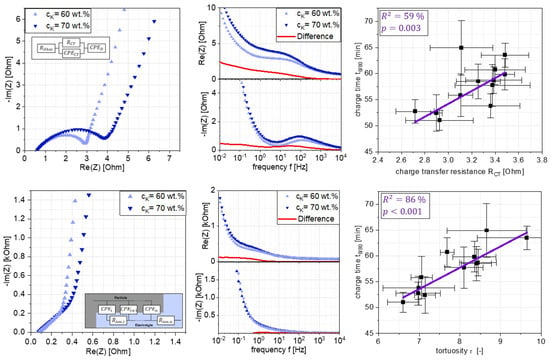
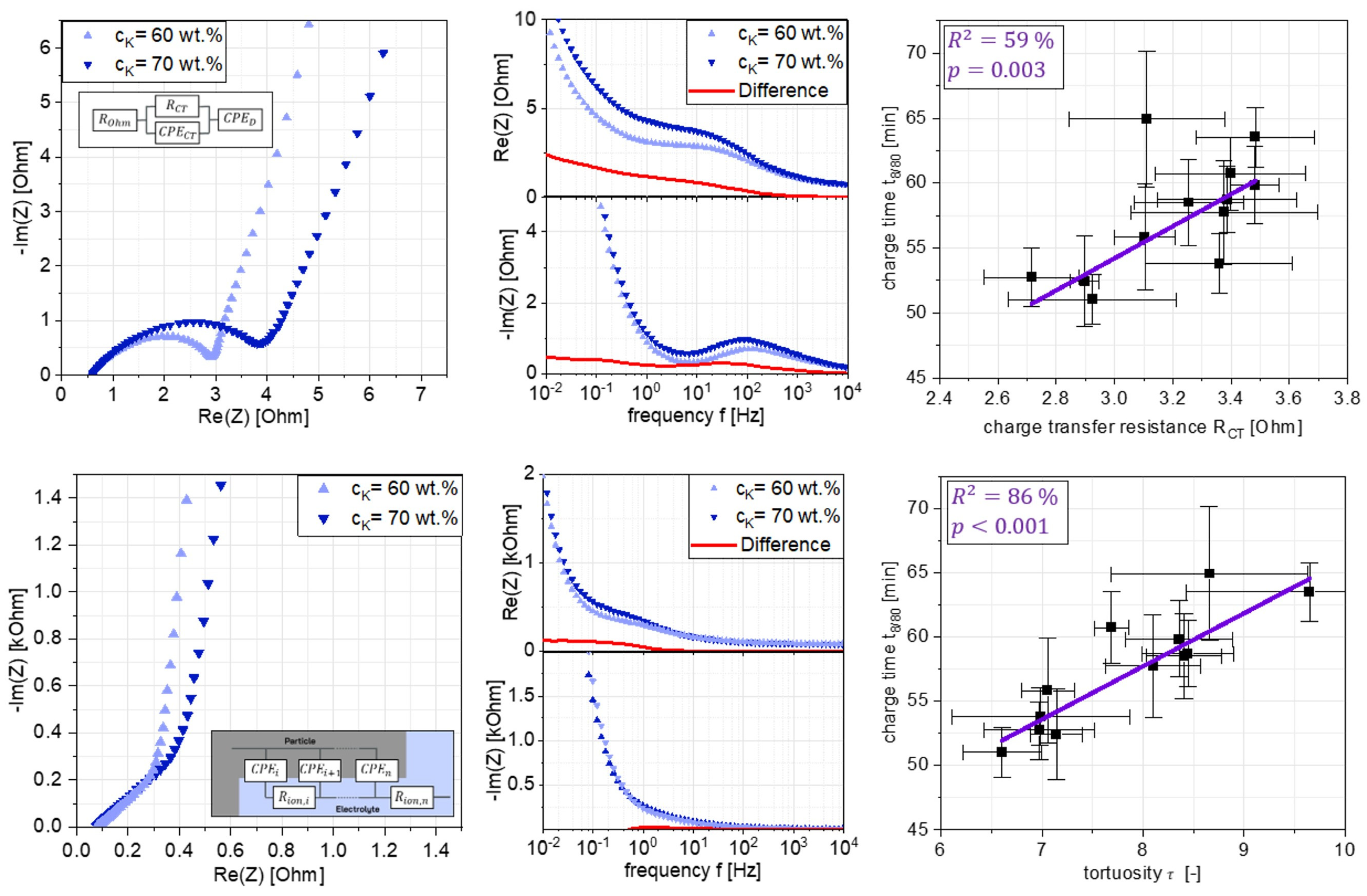
Kinetic and transport contributions were separated to identify the physical origin of the performance gain. The rate–SOC trajectory shows that performance divergence begins at low SOC (<20%), where bulk concentration gradients are minimal. This indicates a localized improvement in interfacial charge transfer at early charging stages, secondary to the dominant transport improvement at higher SOCs discussed below. Full-cell Nyquist plots support this kinetic contribution: the intensive kneading group displays enlarged semicircles (Figure 3). Fitting with a modified R-RC-Warburg model (using Constant Phase Elements for porous surface heterogeneity) isolated the combined interfacial resistance (), dominated by the charge-transfer resistance (). correlates with charge time (), but the coefficient of determination reaches only .
Figure 3.
EIS diagnostics identifying transport limitations as the primary fast-charge bottleneck. (Top left): Full-cell Nyquist plots showing enlarged semi-circles for intensive kneading (). (Top middle): Bode representation revealing elevated low-frequency impedance (below 1 ) characteristic of diffusion constraints. (Top right): —charge time correlation with moderate explanatory power (), indicating that interfacial kinetics alone do not explain the performance difference. (Bottom): Symmetric blocking cell analysis indicates a 17% tortuosity reduction for the optimized mild kneading condition K4 compared with the intensive baseline (), correlating strongly with fast-charge time ().
Interfacial kinetics alone cannot account for the macroscopic performance difference; the primary bottleneck is mass transport. The Bode representation is consistent with this: intensive kneading shows elevated and below , a signature characteristic of diffusion limitation [4]. Symmetrical blocking cells quantified the effect directly: tortuosity dropped 17%, from to .
Interpreted as an SOC-window-normalized transport metric rather than as the instantaneous current of the initial 5 C constant-current step, the DLC model [10,15] predicts an increase in the effective diffusion-limited charging capability from to . This trend is consistent with the observed C-rate relaxation during the CV phase and with the limited SOC interval over which the 5 C constant-current step can be sustained, indicating that the system operates in the transport-limited regime [4,76].
The moderate coefficient of determination of the correlation () is itself mechanistically meaningful: it quantifies the subordinate role of interfacial kinetics, in contrast to the strong tortuosity correlation (). The residual scatter reflects sample-to-sample variation in active surface area and CBD surface masking, which is only partially coupled to the bulk-transport-controlled charge time, together with the fit uncertainty of the CPE-based extraction of from overlapping semicircles. The correlations could be further improved by increasing the sampling density within the relevant process parameter space, increasing the number of measured cells per condition, and further reducing process-induced variability along the manufacturing chain through tighter tolerances.
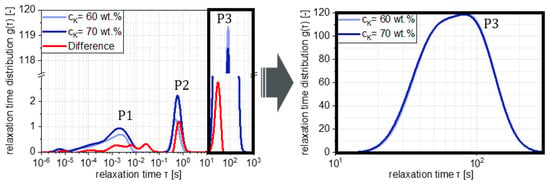
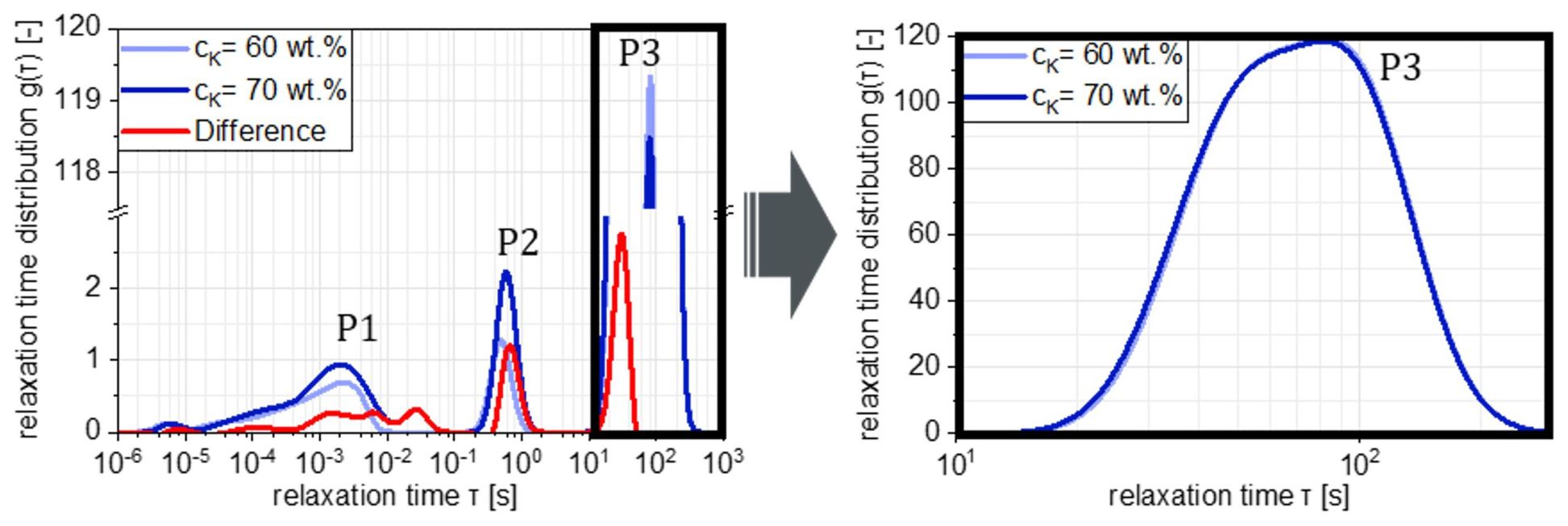
DRT analysis supports this hierarchy (Figure 4). The low-frequency diffusion peak (P3, 1–100 s) reaches distribution amplitudes () two orders of magnitude above those of the ohmic (P1, ) and charge-transfer (P2, 1 ) processes. P1 remains invariant across all conditions, indicating intact electronic percolation [13,77]. P2 attenuation under mild kneading indicates reduced CBD masking of the active surface [14,71,78]. The DRT difference spectrum shows that mild kneading predominantly suppresses the transport resistance associated with P3, directly addressing the dominant bottleneck [71,72,79,80,81,82].
Figure 4.
DRT analysis identifying diffusion as the rate-limiting process. (Left): Full DRT spectra showing three characteristic peaks: P1 (SEI/contact resistance, ), P2 (charge transfer) 1 × 10⁻³–1 × 10⁻¹ s), and P3 (liquid-phase diffusion, 1–100 s). P3 dominates with , exceeding kinetic contributions by two orders of magnitude. (Right): Magnified P3 view with difference spectrum (red line) showing that mild kneading specifically reduces transport resistance in the diffusion-limited regime.
3.2. Microstructural Evidence for Tortuosity Differences
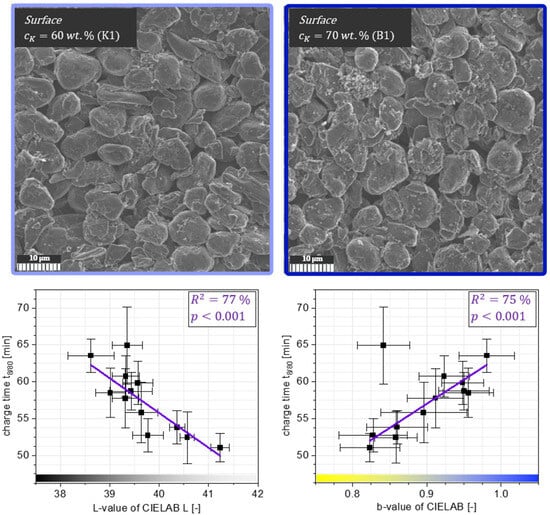
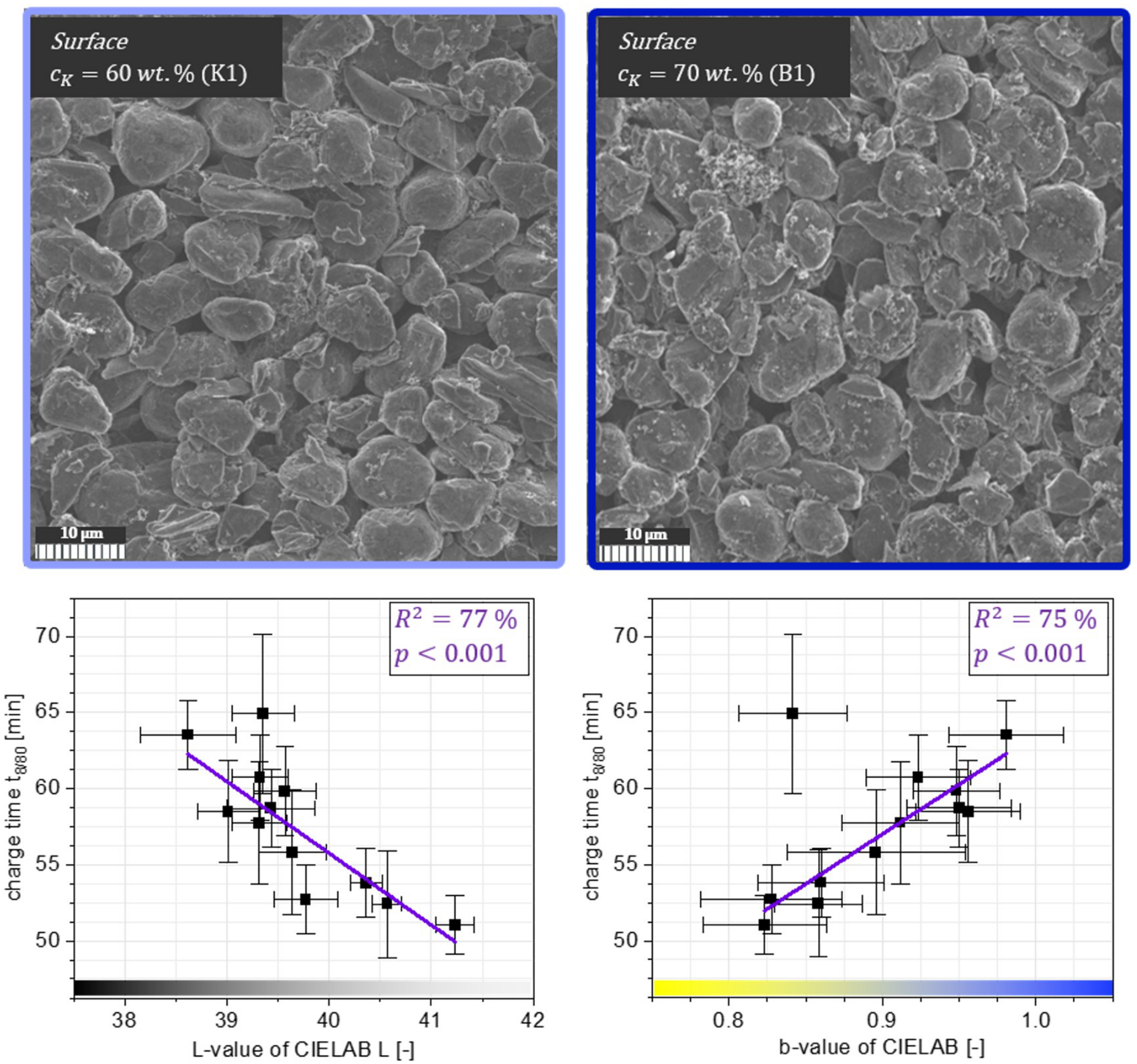
Total active material porosity was constant across all samples. The tortuosity differences arise from the spatial arrangement of the Carbon Binder Domain [13,83]. Such differences appear in electrode surface properties (Figure 5). Electrodes from intensive kneading () exhibited dark, mottled surfaces, reflecting localized accumulation of carbon black and SBR at the separator interface. Mild kneading () produced bright, uniform textures consistent with homogeneous bulk retention. Spectrophotometric analysis confirmed that higher lightness () and yellow–blue chromaticity () correlate with reduced tortuosity and shorter charge times. Darker surfaces can be attributed to capillary-driven vertical binder migration during drying, which clogs the uppermost pores [84].
Figure 5.
Surface morphology as a migration indicator linking process conditions to transport properties. (Top): Scanning electron microscopy (SEM) images comparing intensive kneading (B1, , dark/mottled surface indicating CBD surface enrichment) and mild kneading (K1, , bright/uniform surface indicating homogeneous CBD distribution). (Bottom): CIELAB colorimetry correlations with fast-charge time—higher (lightness, ) and (yellow–blue axis, ) indicate reduced surface enrichment and correlate with faster charging.
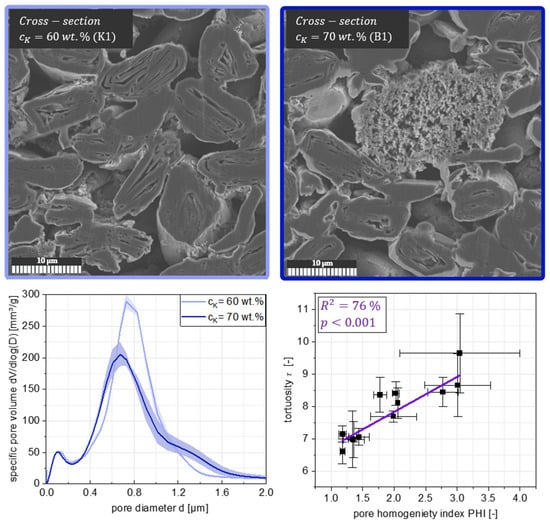
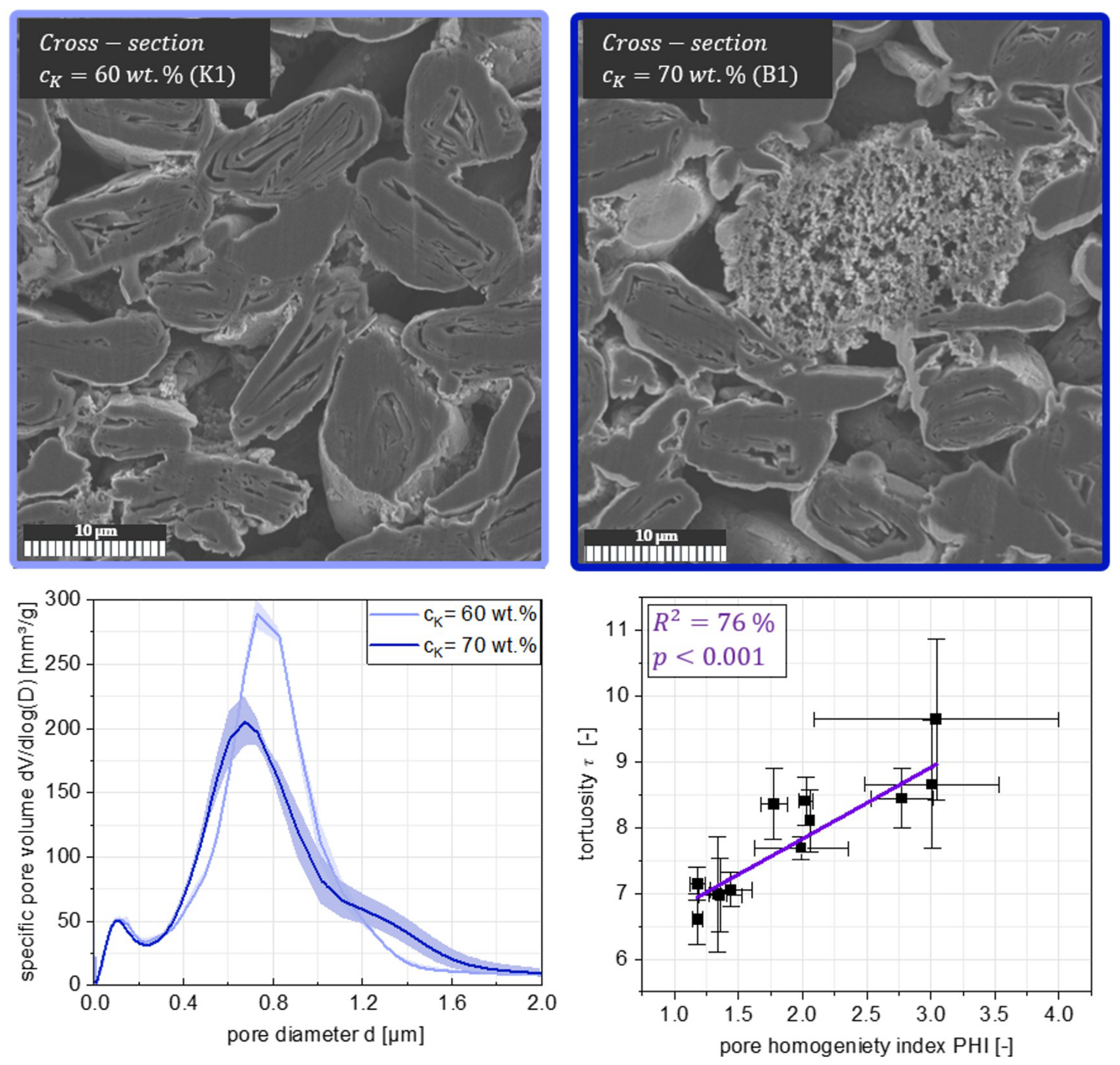
Cross-sectional cryogenic focused-ion-beam scanning electron microscopy (Cryo-FIB/SEM) imaging visualizes these blockages directly (Figure 6). Intensive kneading produces dense, impermeable agglomerates up to 10 μm in diameter. Mild kneading preserves a permeable, filigree network.
Figure 6.
Pore topology linking CBD distribution to transport properties. (Top): Cross-sectional Cryo-FIB/SEM images comparing finely distributed “filigree” CBD morphology (mild kneading, K1, ) versus dense agglomerates up to 10 obstructing ionic pathways (intensive kneading, B1, ). (Bottom left): Mercury porosimetry showing narrow monomodal pore size distribution for mild kneading versus broadened bimodal distribution for intensive kneading. (Bottom right): PHI–tortuosity correlation () confirming that pore heterogeneity drives transport limitations.
Mercury intrusion porosimetry quantifies this morphological contrast. Mild kneading yields a narrow, monomodal pore size distribution; intensive kneading produces a broadened, bimodal one. A Pore-Homogeneity Index (PHI), defined as the full-width-at-half-maximum divided by the median pore diameter (), formalizes this observation. A narrow distribution gives a low PHI; migration-induced pore clogging broadens the distribution and raises the ratio. Tortuosity and the MacMullin number quantify the macroscopic outcome of restricted transport but cannot distinguish between different spatial distributions at equal total void volume. The PHI diagnoses the structural cause: migration-induced size heterogeneity within the pore network. PHI decreased from 2.52 (intensive kneading) to 1.18 (mild kneading) and correlated well with both impedance-derived tortuosity () and fast-charge duration ().
Because mercury intrusion registers the pore throat governing access to a given volume rather than the pore body, ink-bottle geometries shift the apparent diameter toward the constriction size and can broaden the recorded distribution. The PHI is therefore used strictly comparatively, between identically prepared and identically measured samples: at fixed formulation the artifact acts in the same direction for all conditions and does not alter the ranking of the index. The broadening observed under intensive kneading moreover reflects a genuine, migration-induced volumetric heterogeneity rather than a pure throat effect, consistent with the independent Cryo-FIB/SEM cross-sections. Absolute PHI values are accordingly not interpreted as quantitative pore-geometry descriptors.
3.3. Slurry-Level Origins of Microstructural Differences
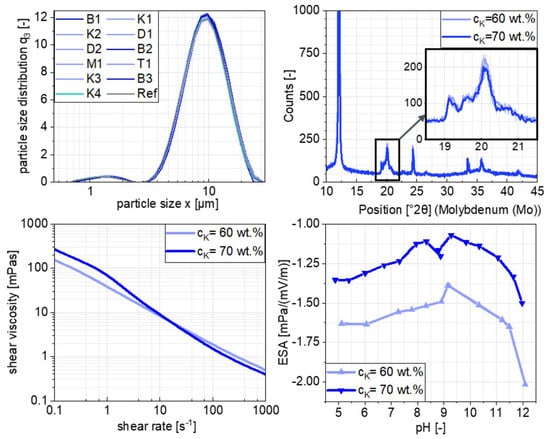
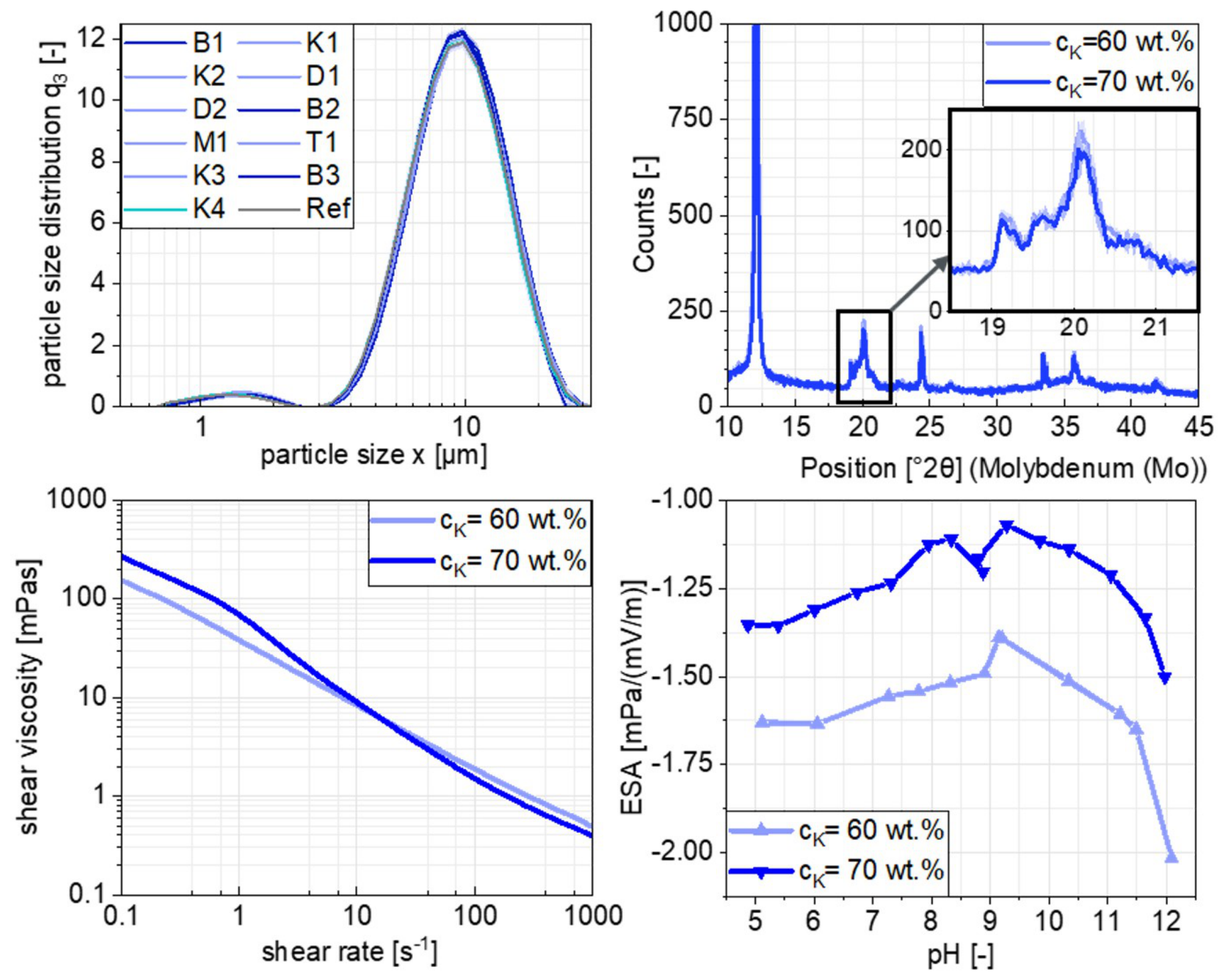
Particle size analysis rules out active-material comminution as the source of the observed microstructural variation (Figure 7). All processing conditions yielded nearly identical particle-size distributions with overlapping curves and a median particle size of approximately . In addition, X-ray diffraction (XRD) revealed no detectable changes in graphite crystallinity. Together, these findings indicate that neither particle fracture nor crystal-structure degradation occurred during processing. Furthermore, operation at 60–70 wt% solids remains well below the 80–82.5 wt% solids “reversal point” identified by Borzutzki et al. [26]. Under such conditions, dispersion is expected to proceed predominantly through gradual surface erosion and deagglomeration rather than catastrophic particle rupture [31,33,38].
Figure 7.
Particle integrity and suspension dispersion state. (Top left): Particle size distributions () overlap across all processing conditions (), verifying the absence of graphite comminution. (Top right): XRD patterns confirm preserved graphitic crystal structure without exfoliation. (Bottom left): Steady-state flow curves exhibit shear-thinning behavior with a viscosity crossover near 5 s−1. (Bottom right): Electroacoustic spectroscopy (ESA) measurements reveal a stronger negative zeta potential for the 60 mild kneading variant ( vs. 1.3 mV), indicating higher CMC adsorption and stronger steric stabilization.
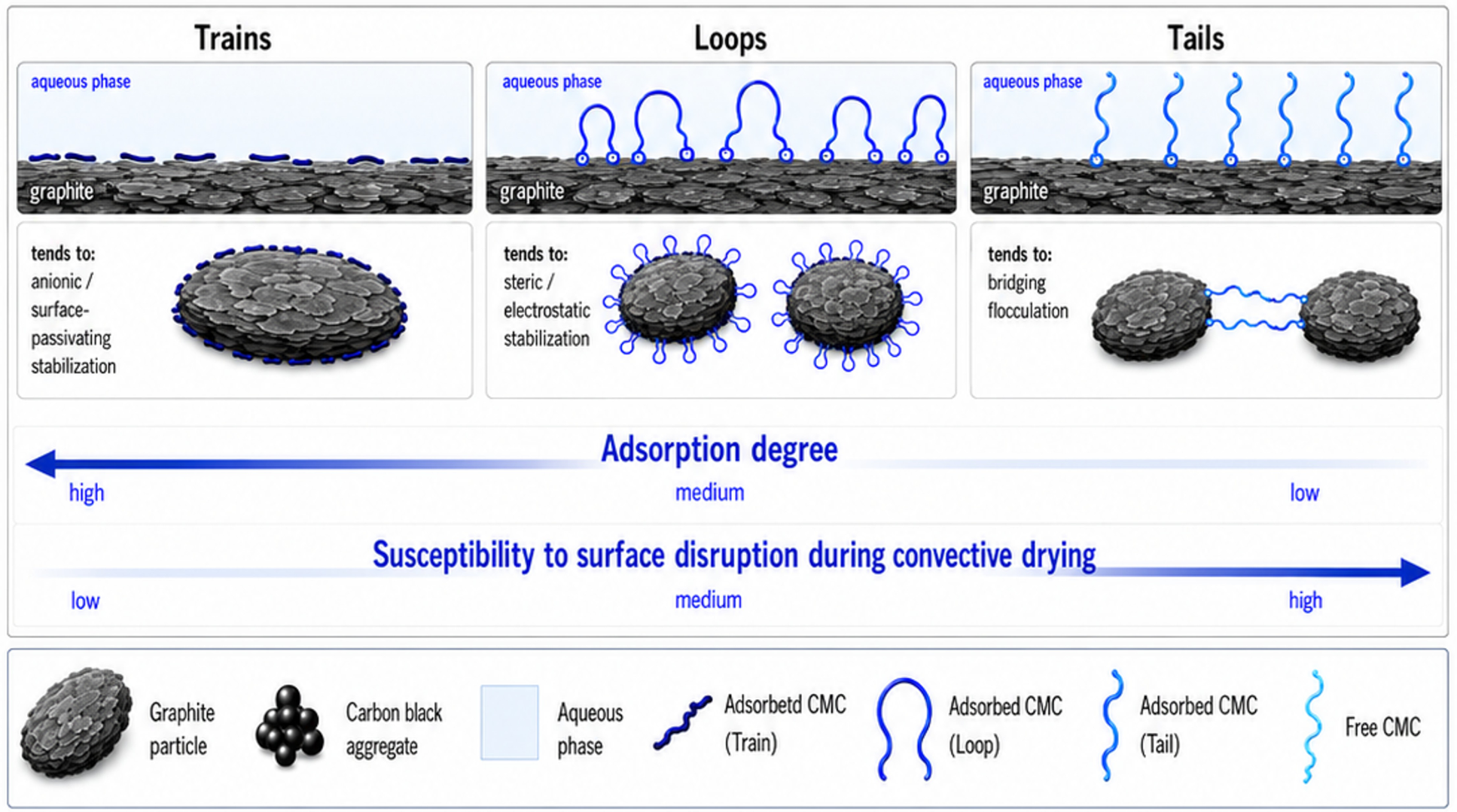
Electroacoustic spectroscopy revealed an 18% increase in apparent CMC adsorption for the mild kneading case. The ESA signal magnitude (corresponding to an apparent ) was compared to for the intensive condition. Processing was strictly isothermal at 20 °C, excluding thermal desorption; the observed difference is therefore attributed to purely mechanical effects. At , frequent particle–particle contacts generate sufficient local stress to compress adsorbed CMC layers. Within the Scheutjens–Fleer framework [52,53], this mechanical stripping is consistent with a conformational shift. Mild stress () is consistent with preserved, extended loop-and-tail conformations (Figure 8), generating strong steric repulsion that resists capillary collapse. Elevated stress () is consistent with compression of these chains into flat, train-dominated conformations; upon subsequent dilution and coating shear, weakly anchored tail segments and free CMC detach and become available for interparticle bridging, promoting bridging flocculation [57].
Figure 8.
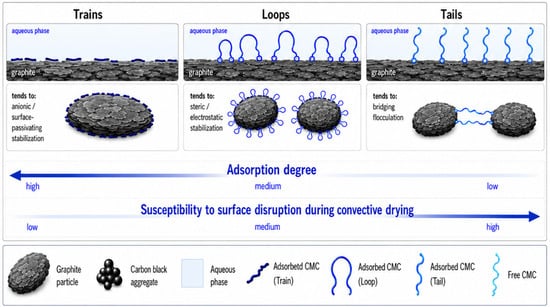
Schematic classification of adsorbed CMC conformations, proposed as an interpretive framework rather than a directly measured molecular state. Trains exhibit the highest adsorption degree and lowest susceptibility to surface disruption, loops represent an intermediate state with stabilizing electrosteric repulsion, whereas tails and free CMC show the lowest adsorption degree and the highest susceptibility to shear- and drying-induced redistribution.
3ITT measurements distinguish the two network regimes (Figure 9). After shear, the mild kneading variant recovers rapidly (>95% within 2 min), re-establishing a low-shear yield stress that immobilizes the particulate matrix before capillary transport can proceed during solvent evaporation [64,84,85,86]. After this initial recovery, the system equilibrates to a state dominated by viscous dissipation (, ), characteristic of sterically repulsive, liquid-like inter-particle interactions. This equilibrium phase angle reflects the nature of the inter-particle potential (repulsive rather than bridging) rather than the immobilization mechanism itself.
Figure 9.
Viscoelastic characterization distinguishing network regimes. (Left): Amplitude sweeps showing and evolution; mild kneading exhibits lower initial moduli but maintains structural integrity over a wider strain range. (Right): 3ITT structural recovery revealing the critical phase angle difference (): mild kneading recovers to (liquid-like, , steric repulsion), while intensive kneading drops to (solid-like, , bridging gel).
The intensive kneading variant exhibits a solid-like recovery phase (, <71% recovery, ). This rheological signature is characteristic of a bridging gel that resists Brownian reorganization. The delayed recovery sustains a window during which capillary forces exceed the network yield stress, triggering a dual-failure mechanism: (1) binder depletion at the current collector interface and (2) surface enrichment of CBD components. Peel-test results support this interpretation: mild kneading achieved significantly higher mechanical adhesion (). The loss of physical integrity is attributed to structural failure rather than to mechanochemical degradation of SBR.
Bridging flocculation, as distinct from electrostatic coagulation, denotes the assembly of particles by individual polymer chains that adsorb onto two particles simultaneously, forming physical particle–polymer–particle bridges [87,88,89]; at the molecular weight used here, detached tails and free CMC are sufficiently long to span interparticle gaps. This bridging network corresponds to the solid-like, slowly recovering gel [89,90] identified rheologically in Figure 9 and is the direct origin of the delayed recovery that permits capillary-driven binder migration during drying.
The steady-shear flow curves of the two slurries intersect (Figure 7). Since the final composition is identical, the difference arises from the network structure imprinted by kneading: at low shear rates the intensively kneaded slurry is more viscous due to a rigid bridged network; with increasing shear this network collapses and the curve falls below that of the mildly kneaded slurry, whose sterically stabilized network thins more gradually. The crossover marks the yielding of the bridging network and corresponds to the abrupt breakdown of the K1 variant in the amplitude sweep (Figure 9). The crossover of and reflects a change in interparticle interactions: intensive kneading forms an elastic bridging network (), whereas mild kneading yields steric stabilization without permanent connectivity, leading to viscous dissipation () [57].
3.4. Mechanistic Summary and Design Rules
The experimental evidence supports a process–structure–property chain. Kneading concentration strongly influences CMC adsorption conformation, which sets structural recovery kinetics. Network reversibility controls post-coating migration, dictating the final CBD morphology and tortuosity, which in turn limit fast-charge capability.
This analysis separates hydrodynamic shear rate (controlled by rotational speed and influencing residence time) from local stress intensity (driven by solids content and strongly influencing network formation). Localized stress fields rather than the averaged shear rate dictate the dispersion outcome, which supports the stress intensity model developed for stirred media mills in the context of high-solid extrusion [34]. SPH and Langevin dynamics simulations support this finding: extensional flow facilitates agglomerate rupture, but intermediate shear rates are needed to optimize cluster stability [22,38].
We note that the local stress intensity is employed here as an inferred mechanistic descriptor rather than a directly measured quantity. Following the stress-intensity concept established for other mixing methods [34,91] it scales with the particle–particle contact frequency and the force transmitted per contact and is therefore governed chiefly by the kneading zone solid content and element geometry, as distinct from the hydrodynamic shear rate set by screw speed.
These results yield three design rules for TSE-based graphite anode manufacturing:
- Target a minimized kneading concentration ( for CMC systems) to achieve adequate dispersion while promoting extended polymer conformations that prevent migration.
- Prioritize tortuosity minimization for electrodes exceeding 4 mA h cm−2, as tortuosity statistically dominates fast-charge performance ().
- Implement slurry-level diagnostic proxies (3ITT recovery, electroacoustic potential, PHI, and surface colorimetry) for continuous manufacturing quality control.
3.5. Limitations and Scope
Several experimental constraints apply. The study used a single CMC grade; molecular weight and degree of substitution will shift optimal adsorption concentrations [54,55]. All analyses were performed at fixed areal capacity and porosity. Thin-film electrode architectures may exhibit a different hierarchy between transport and kinetic limitations.
Macroscopic rheology (3ITT) and electroacoustics strongly imply distinct conformational states, but direct molecular quantification (e.g., via TD-NMR) would strengthen these conclusions. The hypothesis of permanent damage to reversible structures relies on theoretical structural kinetics models [61,64]. The PHI metric, derived from MIP, is used comparatively to assess relative structural shifts, acknowledging the inherent “ink-bottle” limitations of the technique. Translating the % performance gain to industrial practice requires validation in commercial pouch cells under complex thermal gradients and long-term cycling.
4. Conclusions
This study presents a scalable processing methodology for optimizing fast-charging graphite anodes via twin-screw extrusion. Decoupling particulate dispersion mechanics from binder network evolution indicates that slurry microstructuring is the primary determinant of ionic transport properties, consistent with manufacturing-centric perspectives on XFC technology [2]. The physical origin of the charge time differences across all conditions due to the local stress intensity during kneading is related to the way CMC is transferred into train-dominated conformations and different adsorbtion states on the carbon surfaces. The trials with more intense kneading have shown network characteristics rather than bridging flocculation and a slowly recovering network that permits capillary-driven binder migration during drying; the resulting pore clogging in the electrode raises tortuosity and, in the transport-limited regime, the charge time.
- Objective (i):
Pore network tortuosity () emerged as the dominant performance bottleneck, superseding interfacial kinetics ().
- Objective (ii):
The solid concentration within the kneading zone strongly influences binder network architecture. Mild kneading at reduced the fast-charging duration by % (from to ), delayed lithium plating onset at elevated C-rates, and achieved electrochemical parity with optimized batch systems [1,6].
- Objective (iii):
The Pore-Homogeneity Index, rheological phase angle recovery, and surface colorimetry demonstrated practical potential as cell performance predictors.
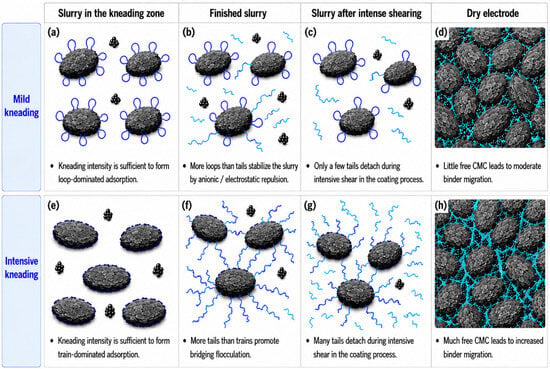
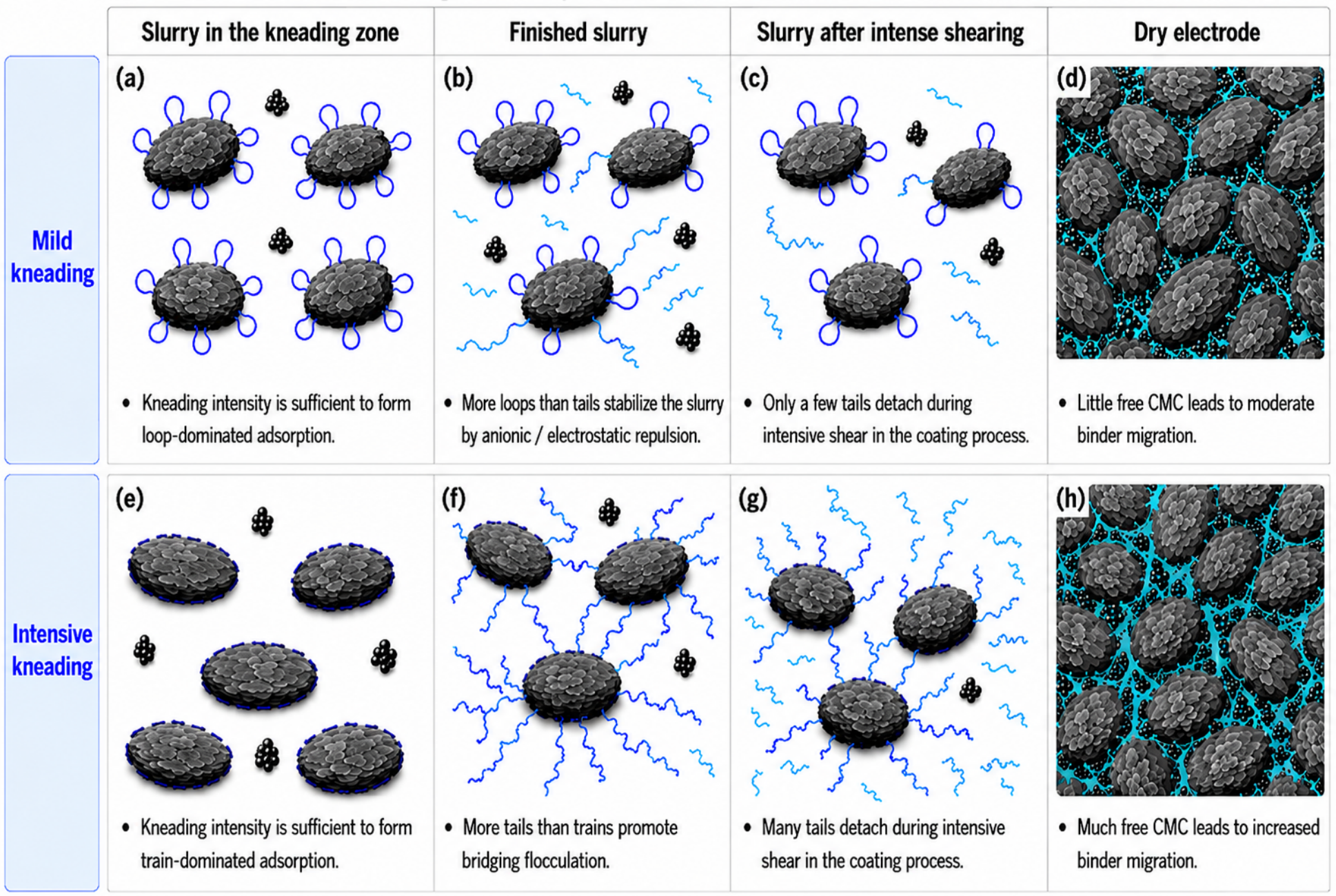
The performance degradation under intensive kneading () does not originate from active material fracture, provided operation remains below established structural reversal points [26]. It is consistent with the compression of polymer conformations into bridging gels that permit post-coating capillary migration (Figure 10). Within the investigated process window, higher shear does not universally improve dispersion quality. Local stress intensity must be tailored to preserve the polymer conformations that strongly influence network reversibility.
Figure 10.
Proposed mechanism linking kneading intensity to CMC adsorption conformation, slurry stability, and CBD redistribution during electrode drying. Blue lines represent CMC chains, cyan regions indicate the carbon-binder domain (CBD), black clusters represent carbon black, and gray particles represent graphite. (Top row, optimized mild kneading, K4: , %, gentle design): (a) loop-dominated CMC adsorption; (b) predominance of loops over tails associated with steric and electrostatic stabilization; (c) limited tail detachment under coating-induced shear; and (d) moderate binder migration during drying. (Bottom row, intensive baseline, B1–B3: , %, intensive design): (e) train-dominated CMC adsorption; (f) predominance of tails over trains associated with bridging flocculation; (g) extensive tail detachment under coating-induced shear; and (h) increased binder migration during drying. The schematic represents a proposed interpretation consistent with the diagnostic results and does not depict directly measured polymer conformations.
The consistent thread across all diagnostics is that, at fixed formulation, the extruder parameters act on the electrode through the local stress intensity as a single intermediate variable which sets the adsorption conformation of the CMC. The same polymer population can adopt extended loop-and-tail conformations under mild stress or compressed, train-dominated conformations that release bridging tails and free chains upon dilution under intensive stress; the identical formulation is thereby steered into either a sterically stabilized, rapidly recovering network or a slowly recovering bridging gel. This explains why parameters as diverse as solid content, kneading length, screw design and throughput map onto the same tortuosity axis: they are different handles on the same stress-intensity variable. The rheological recovery (3ITT and the G′/G″ regimes), the electroacoustic adsorption magnitude, the surface colorimetry, and the pore-homogeneity index constitute four independent measurement windows onto this conformational switch, and their joint, consistent variation across conditions carries the mechanistic interpretation beyond the evidence of any single technique. Network reversibility then governs post-coating migration, which sets the carbon-binder-domain distribution and pore homogeneity, which set the tortuosity and, in the transport-limited regime, the fast-charge time.
This study presents a continuous processing methodology for optimizing fast-charging graphite anodes via twin-screw extrusion. Although a dedicated scale-up campaign was beyond the scope of this work, transferability across scales is expected on established grounds: TSE scale-up preserves geometric and kinematic similarity (L/D ratio, kneading-element shear-gap geometry, specific mechanical energy) [42], under which the controlling local stress history can be reproduced at larger barrel diameter, and the process–structure–property relationships derived here are formulated in machine-independent quantities (kneading zone solid content, kneading length fraction, element design). Experimental validation of the scale-up in commercial-format cells remains necessary future work.
Author Contributions
Conceptualization, P.G.; methodology, P.G. and K.N.; software, P.G.; validation, P.G. and O.L.; formal analysis, P.G.; investigation, P.G.; resources, A.H.; data curation, P.G.; writing—original draft preparation, P.G.; writing—review and editing, M.P. and A.P.; visualization, P.G.; supervision, A.H., M.P. and A.M.; project administration, A.H.; funding acquisition, A.H. and A.M. All authors have read and agreed to the published version of the manuscript.
Funding
This research received no external funding.
Institutional Review Board Statement
Not applicable.
Informed Consent Statement
Not applicable.
Data Availability Statement
The data presented in this study are available on request from the corresponding author due to restrictions related to ongoing industrial research and proprietary process information.
Acknowledgments
We thank Ingo Wojahn and Mike Streithoff for their dedicated support in extruder operation and maintenance over several years. We also thank Mike van Dorp Luis and Svea Groenendijk for their assistance with analysis at the slurry, electrode, and cell levels.
Conflicts of Interest
P.G. is employed by PowerCo SE and A.H. by Volkswagen AG. The authors declare no other conflicts of interest. The employers had no role in the design of the study; in the collection, analyses, or interpretation of data; in the writing of the manuscript; or in the decision to publish the results beyond the scientific contributions disclosed in the Author Contributions statement.
Abbreviations
The following abbreviations are used in this manuscript:
| TSE | Twin-screw extrusion |
| CMC | Carboxymethyl cellulose |
| SBR | Styrene–butadiene rubber |
| CBD | Carbon-Binder Domain |
| SME | Specific mechanical energy |
| SOC | State-of-charge |
| XFC | Extreme Fast Charging |
| DLC | Diffusion-Limited C-Rate |
| SEI | Solid electrolyte interphase |
| EIS | Electrochemical impedance spectroscopy |
| DRT | Distribution of Relaxation Times |
| MIP | Mercury intrusion porosimetry |
| PHI | Pore-Homogeneity Index |
| 3ITT | Three-interval thixotropy test |
| 5CCV | 5 C constant-current–constant-voltage protocol |
| ANOVA | Analysis of variance |
| XRD | X-ray diffraction |
| SEM | Scanning electron microscopy |
| FIB | Focused ion beam |
References
- Tomaszewska, A.; Chu, Z.; Feng, X. Lithium-ion battery fast charging: A review. eTransportation 2019, 1, 100011. [Google Scholar] [CrossRef] [Scilit]
- Yao, Y.X.; Xu, L.; Yan, C.; Zhang, Q. Principles and trends in extreme fast charging lithium-ion batteries. EES Batter. 2025, 1, 9–22. [Google Scholar] [CrossRef] [Scilit]
- Heubner, C.; Nickol, A.; Seeba, J.; Reuber, S.; Junker, N.; Wolter, M.; Schneider, M.; Michaelis, A. Understanding thickness and porosity effects on the electrochemical performance of LiNi0.6Co0.2Mn0.2O2-based cathodes for high energy Li-ion batteries. J. Power Sources 2019, 419, 119–126. [Google Scholar] [CrossRef] [Scilit]
- Adam, A.; Huber, K.; Knobbe, E.; Grießl, D.; Wandt, J.; Kwade, A. Development of an innovative workflow to optimize the fast-charge capability of lithium-ion battery cells. J. Power Sources 2021, 512, 230469. [Google Scholar] [CrossRef] [Scilit]
- Heubner, C.; Nikolowski, K.; Reuber, S.; Schneider, M.; Wolter, M.; Michaelis, A. Recent Insights into Rate Performance Limitations of Li-ion Batteries. Batter. Supercaps 2021, 4, 268–285. [Google Scholar] [CrossRef] [Scilit]
- Sieg, J.; Bandlow, J.; Mitsch, T.; Dragicevic, D.; Materna, T.; Spier, B. Fast charging of an electric vehicle lithium-ion battery at the limit of the lithium deposition process. J. Power Sources 2019, 427, 260–270. [Google Scholar] [CrossRef] [Scilit]
- Weng, S.; Yang, G.; Zhang, S.; Liu, X.; Zhang, X.; Liu, Z. Kinetic Limits of Graphite Anode for Fast-Charging Lithium-Ion Batteries. Nano-Micro Lett. 2023, 15, 215. [Google Scholar] [CrossRef] [Scilit] [PubMed]
- Sieg, J.; Schmid, A.U.; Rau, L.; Gesterkamp, A.; Storch, M.; Spier, B. Fast-charging capability of lithium-ion cells: Influence of electrode aging and electrolyte consumption. Appl. Energy 2022, 305, 117747. [Google Scholar] [CrossRef] [Scilit]
- Ren, D.; Smith, K.; Guo, D.; Han, X.; Feng, X.; Lu, L.; Ouyang, M.; Li, J. Investigation of Lithium Plating-Stripping Process in Li-Ion Batteries at Low Temperature Using an Electrochemical Model. J. Electrochem. Soc. 2018, 165, A2167–A2178. [Google Scholar] [CrossRef] [Scilit]
- Zuo, A.; Fang, R.; Wu, X.; Li, Z. Diffusion-limited C-rate: A criterion of rate performance for lithium-ion batteries. J. Energy Storage 2022, 56, 105920. [Google Scholar] [CrossRef] [Scilit]
- Landesfeind, J.; Hattendorff, J.; Ehrl, A.; Wall, W.A.; Gasteiger, H.A. Tortuosity Determination of Battery Electrodes and Separators by Impedance Spectroscopy. J. Electrochem. Soc. 2016, 163, A1373–A1387. [Google Scholar] [CrossRef] [Scilit]
- Pouraghajan, F.; Knight, H.; Wray, M.; Mazzeo, B.; Subbaraman, R.; Christensen, J.; Wheeler, D. Quantifying Tortuosity of Porous Li-Ion Battery Electrodes: Comparing Polarization-Interrupt and Blocking-Electrolyte Methods. J. Electrochem. Soc. 2018, 165, A2644–A2653. [Google Scholar] [CrossRef] [Scilit]
- Entwistle, J.; Ge, R.; Pardikar, K.; Smith, R.; Cumming, D. Carbon binder domain networks and electrical conductivity in lithium-ion battery electrodes: A critical review. Renew. Sustain. Energy Rev. 2022, 166, 112624. [Google Scholar] [CrossRef] [Scilit]
- Landesfeind, J.; Ebner, M.; Eldiven, A.; Wood, V.; Gasteiger, H.A. Tortuosity of Battery Electrodes: Validation of Impedance-Derived Values and Critical Comparison with 3D Tomography. J. Electrochem. Soc. 2018, 165, A469–A476. [Google Scholar] [CrossRef] [Scilit]
- Heubner, C.; Schneider, M.; Michaelis, A. Diffusion-Limited C-Rate: A Fundamental Principle Quantifying the Intrinsic Limits of Li-Ion Batteries. Adv. Energy Mater. 2020, 10, 1902523. [Google Scholar] [CrossRef] [Scilit]
- Jow, T.R.; Delp, S.A.; Allen, J.L.; Jones, J.P.; Smart, M.C. Factors Limiting Li+ Charge Transfer Kinetics in Li-Ion Batteries. J. Electrochem. Soc. 2018, 165, A361–A367. [Google Scholar] [CrossRef] [Scilit]
- Zhang, S.S. Identifying rate limitation and a guide to design of fast-charging Li-ion battery. InfoMat 2020, 2, 942–949. [Google Scholar] [CrossRef] [Scilit]
- Raczka, K.; Öksüz, F.; Galahroudi, N.; Schiessl, E.; Nirschl, H.; Rhein, F. Cleaning and Cross-Contamination in Continuous Twin-Screw Extrusion of Battery Slurries. Batteries 2025, 11, 464. [Google Scholar] [CrossRef] [Scilit]
- Dreger, H.; Bockholt, H.; Haselrieder, W.; Kwade, A. Discontinuous and Continuous Processing of Low-Solvent Battery Slurries for Lithium Nickel Cobalt Manganese Oxide Electrodes. J. Electron. Mater. 2015, 44, 4434–4443. [Google Scholar] [CrossRef] [Scilit]
- Haarmann, M.; Grießl, D.; Kwade, A. Continuous Processing of Cathode Slurry by Extrusion for Lithium-Ion Batteries. Energy Technol. 2021, 9, 2100250. [Google Scholar] [CrossRef] [Scilit]
- Seeba, J.; Reuber, S.; Heubner, C.; Müller-Köhn, A.; Wolter, M.; Michaelis, A. Extrusion-based fabrication of electrodes for high-energy Li-ion batteries. Chem. Eng. J. 2020, 402, 125551. [Google Scholar] [CrossRef] [Scilit]
- Meza Gonzalez, J.F.; Nirschl, H.; Rhein, F. Continuous Anode Slurry Production in Twin-Screw Extruders: Effects of the Process Setup on the Dispersion. Batteries 2024, 10, 145. [Google Scholar] [CrossRef] [Scilit]
- Meyer, F.; Meza, J.; Völp, A. Continuous Twin-Screw Extrusion and Rheological Analysis of Electrode Slurries for Optimizing Lithium-Ion Battery Manufacturing; Poster; Thermo Fisher Scientific: Karlsruhe, Germany; Karlsruhe Institute of Technology (KIT): Karlsruhe, Germany, 2024. [Google Scholar]
- Wiegmann, E.; Kwade, A.; Haselrieder, W. Solvent Reduced Extrusion-Based Anode Production Process Integrating Granulate Coating, Drying, and Calendering. Energy Technol. 2022, 10, 2200020. [Google Scholar] [CrossRef] [Scilit]
- Burger, D.; Klemens, J.; Keim, N.; Müller, M.; Bauer, W.; Schmatz, J. Additive Influence on Binder Migration in Electrode Drying. Energy Technol. 2024, 12, 2400057. [Google Scholar] [CrossRef] [Scilit]
- Borzutzki, K.; Börner, M.; Fromm, O.; Rodehorst, U.; Winter, M. Process–Structure–Property Correlations in Twin-Screw Extrusion of Graphitic Negative Electrode Pastes for Lithium Ion Batteries Focusing on Kneading Concentrations. Batteries 2025, 11, 299. [Google Scholar] [CrossRef] [Scilit]
- Dreger, H.; Haselrieder, W.; Kwade, A. Influence of dispersing by extrusion and calendering on the performance of lithium-ion battery electrodes. J. Energy Storage 2019, 21, 231–240. [Google Scholar] [CrossRef] [Scilit]
- Park, J.; Willenbacher, N.; Ahn, K.H. How the interaction between styrene-butadiene-rubber (SBR) binder and a secondary fluid affects the rheology, microstructure and adhesive properties of capillary-suspension-type graphite slurries used for Li-ion battery anodes. Colloids Surf. Physicochem. Eng. Asp. 2019, 579, 123692. [Google Scholar] [CrossRef] [Scilit]
- Huber, K.; Adam, A.; Grießl, D.; Kwade, A. Understanding Slurry Mixing Effects on the Fast Charging Capability of Lithium-Ion Battery Cells: Methodology and Case Study. J. Power Sources 2022, 536, 231455. [Google Scholar] [CrossRef] [Scilit]
- Griessl, D.; Adam, A.; Huber, K.; Kwade, A. Effect of the Slurry Mixing Process on the Structural Properties of the Anode and the Resulting Fast-Charging Performance of the Lithium-Ion Battery Cell. J. Electrochem. Soc. 2022, 169, 020531. [Google Scholar] [CrossRef] [Scilit]
- Rwei, S.P.; Manas-Zloczower, I.; Feke, D.L. Characterization of agglomerate dispersion by erosion in simple shear flows. Polym. Eng. Sci. 1991, 31, 558–562. [Google Scholar] [CrossRef] [Scilit]
- Shariq, M.; Nemec, D. Modelling Approaches of the Dispersion Process for Conductive Slurries in Chemical Process Industries. Adv. Eng. Mater. 2024, 26, 2401089. [Google Scholar] [CrossRef] [Scilit]
- Schilde, C.; Kampen, I.; Kwade, A. Dispersion kinetics of nano-sized particles for different dispersing machines. Chem. Eng. Sci. 2010, 65, 3518–3527. [Google Scholar] [CrossRef] [Scilit]
- Kwade, A.; Blecher, L.; Schwedes, J. Beanspruchungsintensität und Bewegung der Mahlkörper in Rührwerkmühlen. Chem. Ing. Tech. 1997, 69, 836–839. [Google Scholar] [CrossRef] [Scilit]
- Rumpf, H. Grundlagen und Methoden des Granulierens. Chem. Ing. Tech. 1958, 30, 144–158. [Google Scholar] [CrossRef] [Scilit]
- Finke, P.B. Rheologie- und Prozessmodelle zur Herstellung Hochviskoser Nanopartikulärer Suspensionen. Ph.D. Thesis, Technische Universität Carolo-Wilhelmina zu Braunschweig, Braunschweig, Germany, 2022. [Google Scholar]
- Bauer, H.; Matic, J.; Evans, R.C.; Gryczke, A.; Ketterhagen, W.; Sinha, K.; Khinast, J. Determining local residence time distributions in twin-screw extruder elements via smoothed particle hydrodynamics. Chem. Eng. Sci. 2022, 247, 117029. [Google Scholar] [CrossRef] [Scilit]
- Meza Gonzalez, J.F.; Nirschl, H. Numerical Investigation of the Local Shear Rate in a Twin-Screw Extruder for the Continuous Processing of Li-Ion Battery Electrode Slurries. Energy Technol. 2023, 11, 2201517. [Google Scholar] [CrossRef] [Scilit]
- Eitzlmayr, A.; Koscher, G.; Reynolds, G.; Huang, Z.; Booth, J.; Shering, P.; Khinast, J. Mechanistic modeling of modular co-rotating twin-screw extruders. Int. J. Pharm. 2014, 474, 157–176. [Google Scholar] [CrossRef] [Scilit] [PubMed]
- Eitzlmayr, A.; Khinast, J.; Hörl, G.; Koscher, G.; Reynolds, G.; Huang, Z.; Booth, J.; Shering, P. Experimental Characterization and Modeling of Twin-Screw Extruder Elements for Pharmaceutical Hot Melt Extrusion. AIChE J. 2013, 59, 4440–4450. [Google Scholar] [CrossRef] [Scilit]
- Eitzlmayr, A.; Matić, J.; Khinast, J. Analysis of flow and mixing in screw elements of corotating twin-screw extruders via SPH. AIChE J. 2017, 63, 2451–2463. [Google Scholar] [CrossRef] [Scilit]
- Kohlgrüber, K. (Ed.) Der Gleichläufige Doppelschneckenextruder: Grundlagen, Technologie, Anwendungen, 2nd neu bearbeitete und erweiterte auflage ed.; Hanser eLibrary, Carl Hanser Fachbuchverlag: München, Germany, 2016. [Google Scholar]
- Schoo, A.; Moschner, R.; Hülsmann, J.; Kwade, A. Coating Defects of Lithium-Ion Battery Electrodes and Their Inline Detection and Tracking. Batteries 2023, 9, 111. [Google Scholar] [CrossRef] [Scilit]
- Weber, M.; Mayer, J.K.; Kwade, A. The Carbon Black Dispersion Index DICB—A novel approach describing the dispersion progress of carbon black containing battery slurries. Energy Technol. 2023, 11, 2201299. [Google Scholar] [CrossRef] [Scilit]
- Kalyon, D.M.; Aktaş, S. Factors affecting the rheology and processability of highly filled suspensions. Annu. Rev. Chem. Biomol. Eng. 2014, 5, 229–254. [Google Scholar] [CrossRef] [Scilit] [PubMed]
- Sanetrnik, D.; Hausnerova, B.; Novak, M.; Mukund, B.N. Effect of Particle Size and Shape on Wall Slip of Highly Filled Powder Feedstocks for Material Extrusion and Powder Injection Molding. 3D Print. Addit. Manuf. 2023, 10, 236–244. [Google Scholar] [CrossRef] [Scilit] [PubMed]
- Grenda, T.; Weber, M.; Jagau, R.; Wiegmann, E.; Müller, J.; Strzelczyk, N. Impact of Screw Geometry and Solids Content on the Properties of Continuously Produced Si Anodes. Energy Technol. 2024, 12, 2301556. [Google Scholar] [CrossRef] [Scilit]
- Bauer, W.; Nötzel, D. Rheological properties and stability of NMP based cathode slurries for lithium ion batteries. Ceram. Int. 2014, 40, 4591–4598. [Google Scholar] [CrossRef] [Scilit]
- Ishii, M.; Makino, S.; Nakamura, H. The role of carboxymethyl cellulose on the rheology of anode slurries in lithium-ion batteries. Curr. Opin. Colloid Interface Sci. 2024, 74, 101858. [Google Scholar] [CrossRef] [Scilit]
- Hofmann, K.; Willenbacher, N. How carboxymethylcellulose adsorption and porous active material particles diminish the adhesion of graphite-silicon anodes in lithium-ion batteries. Energy Mater. 2025, 5, 500092. [Google Scholar] [CrossRef] [Scilit]
- Weber, A.; Keim, N.; Koch, P.; Müller, M.; Bauer, W.; Ehrenberg, H. The impact of binder polarity on the properties of aqueously processed positive and negative electrodes for lithium-ion batteries. Sci. Rep. 2025, 15, 10024. [Google Scholar] [CrossRef] [Scilit] [PubMed]
- Scheutjens, J.M.H.M.; Fleer, G.J. Statistical theory of the adsorption of interacting chain molecules. 2. Train, loop, and tail size distribution. J. Phys. Chem. 1980, 84, 178–190. [Google Scholar] [CrossRef] [Scilit]
- Fleer, G.J.; Cohen Stuart, M.A.; Scheutjens, J.M.H.M.; Cosgrove, T.; Vincent, B. Polymers at Interfaces; Springer: Dordrecht, The Netherlands, 1998. [Google Scholar] [CrossRef] [Scilit]
- Komoda, Y.; Ueyama, M.; Sofue, A.; Nishikawa, A.; Ohmura, N. Quantitative evaluation of adsorption behavior of carboxymethylcellulose on carbon nanotubes by time-domain NMR with the aim of obtaining stable dispersions. Colloids Surf. Physicochem. Eng. Asp. 2024, 683, 133064. [Google Scholar] [CrossRef] [Scilit]
- Kinjo, T.; Tsuji, M.; Kusano, T.; Jinnouchi, R.; Makino, S.; Nakamura, H. Effect of substitution degree and dissociation on adsorption behavior of carboxymethyl cellulose on graphite surfaces. Chem. Phys. Lett. 2026, 883, 142514. [Google Scholar] [CrossRef] [Scilit]
- Haberzettl, P.; Filipovic, N.; Vrankovic, D.; Willenbacher, N. Processing of Aqueous Graphite–Silicon Oxide Slurries and Its Impact on Rheology, Coating Behavior, Microstructure, and Cell Performance. Batteries 2023, 9, 581. [Google Scholar] [CrossRef] [Scilit]
- Kitamura, K.; Mori, T. Effect of particle concentration during kneading on the particle dispersion state of carbon slurry. Chem. Eng. Sci. 2025, 302, 120897. [Google Scholar] [CrossRef] [Scilit]
- Lee, J.H.; Kim, J.; Jeong, M.H.; Ahn, K.H.; Lee, H.L.; Youn, H.J. Visualization of styrene-butadiene rubber (SBR) latex and large-scale analysis of the microstructure of lithium-ion battery (LIB) anodes. J. Power Sources 2023, 557, 232552. [Google Scholar] [CrossRef] [Scilit]
- Kumano, N.; Yamaguchi, Y.; Akimoto, Y.; Ohshima, A.; Nakamura, H.; Yamamura, M. Migration of binder and conductive agent during drying process of Li-ion battery cathodes. J. Power Sources 2024, 591, 233883. [Google Scholar] [CrossRef] [Scilit]
- Zhao, B.; Gao, Y.; Ren, J.; Yin, D. Structural Kinetics Model to Describe the Thixotropic Behavior of Cathode Slurry for Lithium-Ion Batteries. J. Electron. Mater. 2021, 50, 6818–6827. [Google Scholar] [CrossRef] [Scilit]
- Larson, R.G.; Wei, Y. A review of thixotropy and its rheological modeling. J. Rheol. 2019, 63, 477–501. [Google Scholar] [CrossRef] [Scilit]
- Mewis, J.; Wagner, N.J. Thixotropy. Adv. Colloid Interface Sci. 2009, 147–148, 214–227. [Google Scholar] [CrossRef] [Scilit] [PubMed]
- Dullaert, K.; Mewis, J. A structural kinetics model for thixotropy. J. Non-Newton. Fluid Mech. 2006, 139, 21–30. [Google Scholar] [CrossRef] [Scilit]
- de Souza Mendes, P.R.; Abedi, B.; Thompson, R.L. Constructing a thixotropy model from rheological experiments. J. Non-Newton. Fluid Mech. 2018, 261, 1–8. [Google Scholar] [CrossRef] [Scilit]
- Napper, D.H. Polymeric Stabilization of Colloidal Dispersions; Academic Press: London, UK, 1983. [Google Scholar]
- Gregory, J. Effects of Polymers on Colloid Stability. In The Scientific Basis of Flocculation; Springer: Dordrecht, The Netherlands, 1978; pp. 101–130. [Google Scholar] [CrossRef] [Scilit]
- Mortimer, L.F.; Fairweather, M. Langevin dynamic predictions of polymer-particle adsorption and saturation in shear flows. Int. J. Heat Fluid Flow 2024, 110, 109606. [Google Scholar] [CrossRef] [Scilit]
- Oldemeier, J.P.; Schöppner, V. Analysis of the Dispersive and Distributive Mixing Effect of Screw Elements on the Co-Rotating Twin-Screw Extruder with Particle Tracking. Polymers 2024, 16, 2952. [Google Scholar] [CrossRef] [Scilit] [PubMed]
- Behra, J.S.; Mattsson, J.; Cayre, O.J.; Robles, E.S.J.; Tang, H.; Hunter, T.N. Characterization of Sodium Carboxymethyl Cellulose Aqueous Solutions to Support Complex Product Formulation: A Rheology and Light Scattering Study. ACS Appl. Polym. Mater. 2019, 1, 344–358. [Google Scholar] [CrossRef] [Scilit]
- Weber, M.; Schoo, A.; Sander, M.; Mayer, J.K.; Kwade, A. Introducing Spectrophotometry for Quality Control in Lithium-Ion-Battery Electrode Manufacturing. Energy Technol. 2023, 11, 2201083. [Google Scholar] [CrossRef] [Scilit]
- Hahn, M.; Schindler, S.; Triebs, L.C.; Danzer, M.A. Optimized Process Parameters for a Reproducible Distribution of Relaxation Times Analysis of Electrochemical Systems. Batteries 2019, 5, 43. [Google Scholar] [CrossRef] [Scilit]
- Plank, C.; Rüther, T.; Jahn, L.; Schamel, M.; Schmidt, J.P.; Ciucci, F.; Danzer, M.A. A review on the distribution of relaxation times analysis: A powerful tool for process identification of electrochemical systems. J. Power Sources 2024, 594, 233845. [Google Scholar] [CrossRef] [Scilit]
- Montgomery, D.C. Design and Analysis of Experiments, 10th ed.; John Wiley & Sons: Hoboken, NJ, USA, 2019. [Google Scholar]
- Thompson, S.A.; Williams, R.O., III. Specific mechanical energy—An essential parameter in the processing of amorphous solid dispersions. Adv. Drug Deliv. Rev. 2021, 173, 374–393. [Google Scholar] [CrossRef] [Scilit] [PubMed]
- Hawley, W.B.; Li, J. Electrode manufacturing for lithium-ion batteries—Analysis of current and next generation processing. J. Energy Storage 2019, 25, 100862. [Google Scholar] [CrossRef] [Scilit]
- Chen, Z.; Danilov, D.L.; Raijmakers, L.H.J.; Chayambuka, K.; Jiang, M.; Zhou, L. Overpotential analysis of graphite-based Li-ion batteries seen from a porous electrode modeling perspective. J. Power Sources 2021, 509, 230345. [Google Scholar] [CrossRef] [Scilit]
- Seidl, C.; Thieme, S.; Frey, M.; Nikolowski, K.; Michaelis, A. Comparison of Electronic Resistance Measurement Methods and Influencing Parameters for LMFP and High-Nickel NCM Cathodes. Batteries 2024, 10, 105. [Google Scholar] [CrossRef] [Scilit]
- Katzer, F. Operando-Methoden der Diagnose und Laderegelung von Lithium-Ionen-Batterien. Ph.D. Thesis, Universität Bayreuth, Bayreuth, Germany, 2023. [Google Scholar]
- Saban, O.B.; Arslan, M.A.; Serincan, M.F. Multiphysics modeling of lithium-ion batteries: A novel DRT-enhanced electro-thermal framework. Ionics 2025, 31, 10327–10351. [Google Scholar] [CrossRef] [Scilit]
- Hallemans, N.; Courtier, N.E.; Please, C.P.; Planden, B.; Dhoot, R.; Timms, R.; Chapman, S.J.; Howey, D.; Duncan, S.R. Physics-Based Battery Model Parametrisation from Impedance Data. J. Electrochem. Soc. 2025, 172, 060507. [Google Scholar] [CrossRef] [Scilit]
- Huang, J.D.; Meisel, C.; Sullivan, N.P.; Zakutayev, A.; O’Hayre, R. Rapid mapping of electrochemical processes in energy-conversion devices. Joule 2024, 8, 2049–2072. [Google Scholar] [CrossRef] [Scilit]
- Danzer, M.A. Generalized Distribution of Relaxation Times Analysis for the Characterization of Impedance Spectra. Batteries 2019, 5, 53. [Google Scholar] [CrossRef] [Scilit]
- Pinilla, S.; Zanotto, F.M.; Dominguez, D.Z.; García, T.; Franco, A.A. Carbon-binder-domain porosity extraction through lithium-ion battery electrode impedance data. Energy Storage Mater. 2025, 74, 103818. [Google Scholar] [CrossRef] [Scilit]
- Lippke, M.; Ohnimus, T.; Frankenberg, F.; Schilde, C.; Kwade, A. Drying and calendering of Lithium Ion battery electrodes: A combined simulation approach. Powder Technol. 2024, 444, 119984. [Google Scholar] [CrossRef] [Scilit]
- Wu, C.C.; Li, C.C. Distribution Uniformity of Water-Based Binders in Si Anodes and the Distribution Effects on Cell Performance. ACS Sustain. Chem. Eng. 2020, 8, 6868–6876. [Google Scholar] [CrossRef] [Scilit]
- Zhang, Y.S.; Courtier, N.E.; Zhang, Z.; Liu, K.; Bailey, J.J.; Boyce, A.M. A Review of Lithium-Ion Battery Electrode Drying: Mechanisms and Metrology. Adv. Energy Mater. 2022, 12, 2102233. [Google Scholar] [CrossRef] [Scilit]
- Hogg, R. Bridging Flocculation by Polymers and Polymer Mixtures. KONA Powder Part. J. 2013, 30, 3–14. [Google Scholar] [CrossRef] [Scilit]
- Gurumoorthy, A.V.P.; Juvekar, V.A. Bridging Flocculation: A Modeling Study of the Role of Polymer Adsorption Dynamics. Int. J. Chem. Sci. 2014, 12, 315–326. [Google Scholar]
- Mortimer, L.F.; Fairweather, M. Effect of Shear Rate on Polymer-Induced Flocculation for Behavioural Modification Techniques. In Proceedings of the Conference on Modelling Fluid Flow (CMFF’22); Vad, J., Ed.; Department of Fluid Mechanics, Budapest University of Technology and Economics: Budapest, Hungary, 2022; pp. 21–29. [Google Scholar]
- Malkin, A.Y.; Kulichikhin, V.G. Rheology of Gels and Yielding Liquids. Gels 2023, 9, 715. [Google Scholar] [CrossRef] [Scilit] [PubMed]
- Grießl, D.; Huber, K.; Scherbauer, R.; Kwade, A. Dispersion kinetics of carbon black for the application in lithium-ion batteries. Adv. Powder Technol. 2021, 32, 2280–2288. [Google Scholar] [CrossRef] [Scilit]

Disclaimer/Publisher’s Note: The statements, opinions and data contained in all publications are solely those of the individual author(s) and contributor(s) and not of MDPI and/or the editor(s). MDPI and/or the editor(s) disclaim responsibility for any injury to people or property resulting from any ideas, methods, instructions or products referred to in the content. |
© 2026 by the authors. Licensee MDPI, Basel, Switzerland. This article is an open access article distributed under the terms and conditions of the Creative Commons Attribution (CC BY) license.