

Skip to Content
You are currently on the new version of our website. Access the old version .

Magnetochemistry, Volume 7, Issue 11

2021 November - 11 articles

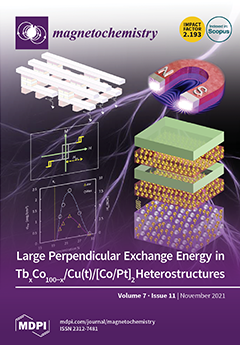
Cover Story: Utilizing a large perpendicular EB field as pinned layers has been the subject of intense attraction because of its potential in spintronic applications. However, typical AFM/FM systems indicate a limitation in attaining large EB fields (usually below 1 KOe). Thus, it seems that these cannot provide reasonable necessities for future spintronic applications. This experimental study shows that by replacing the commonly used AFM pinned layer with the ferrimagnet pinning layer, large PEE is generated by varying the Tb content of the Tb–Co layer. The developed FIM/FM films with great PEE show possibilities for pinned layers in spintronics and memory device applications. View this paper
  • Issues are regarded as officially published after their release is announced to the table of contents alert mailing list .
  • You may sign up for email alerts to receive table of contents of newly released issues.
  • PDF is the official format for papers published in both, html and pdf forms. To view the papers in pdf format, click on the "PDF Full-text" link, and use the free Adobe Reader to open them.

Articles (11)

  • Feature Paper
  • Article
  • Open Access
7 Citations
3,359 Views
11 Pages

Counterintuitive Single-Molecule Magnet Behaviour in Two Polymorphs of One-Dimensional Compounds Involving Chiral BINOL-Derived Bisphosphate Ligands

  • Carlo Andrea Mattei,
  • Bertrand Lefeuvre,
  • Vincent Dorcet,
  • Gilles Argouarch,
  • Olivier Cador,
  • Claudia Lalli and
  • Fabrice Pointillart

The coordination reaction of the [Dy(hfac)3(H2O)2] units (hfac = 1,1,1,5,5,5-hexafluoroacetylacetonate) with the [8′-(Diphenoxylphosphinyl)[1,1′-binaphthalen]-8-yl]diphenoxylphosphine oxide ligand (L) followed by a crystallisation in a 1:3 CH2Cl2:n-...

  • Article
  • Open Access
4 Citations
3,674 Views
12 Pages

Magnetic Behaviour of Perovskite Compositions Derived from BiFeO3

  • Andrei N. Salak,
  • João Pedro V. Cardoso,
  • Joaquim M. Vieira,
  • Vladimir V. Shvartsman,
  • Dmitry D. Khalyavin,
  • Elena L. Fertman,
  • Alexey V. Fedorchenko,
  • Anatoli V. Pushkarev,
  • Yury V. Radyush and
  • Erik Čižmár
  • + 3 authors

The phase content and sequence, the crystal structure, and the magnetic properties of perovskite solid solutions of the (1−y)BiFeO3yBiZn0.5Ti0.5O3 series (0.05 ≤ y ≤ 0.90) synthesized under high pressure have been studied. Two perovskite phases, nam...

  • Article
  • Open Access
3 Citations
3,142 Views
13 Pages

In order to prove the usefulness of having a structurally disordered precursor to the formation of FePt L10 phase and to facilitate the co-existence of exchange coupled hard and soft magnetic phases with optimized magnetic properties in various condi...

  • Article
  • Open Access
10 Citations
4,276 Views
10 Pages

Pt(0) complexes have been widely used as catalysts for important reactions, such as the hydrosilylation of olefins. In this context, nuclear magnetic resonance (NMR) spectroscopy plays an important role in characterising of new structures and elucida...

  • Article
  • Open Access
4 Citations
4,368 Views
8 Pages

Revisiting the Potential Functionality of the MagR Protein

  • Alexander Pekarsky,
  • Herwig Michor and
  • Oliver Spadiut

Recent findings have sparked great interest in the putative magnetic receptor protein MagR. However, in vivo experiments have revealed no magnetic moment of MagR at room temperature. Nevertheless, the interaction of MagR and MagR fusion proteins with...

  • Article
  • Open Access
9 Citations
4,796 Views
13 Pages

Magnetic Properties of Bi-Magnetic Core/Shell Nanoparticles: The Case of Thin Shells

  • Alexander Omelyanchik,
  • Silvia Villa,
  • Gurvinder Singh,
  • Valeria Rodionova,
  • Sara Laureti,
  • Fabio Canepa and
  • Davide Peddis

Bi-magnetic core/shell nanoparticles were synthesized by a two-step high-temperature decomposition method of metal acetylacetonate salts. Transmission electron microscopy confirmed the formation of an ultrathin shell (~0.6 nm) of NiO and NiFe2O4 arou...

  • Review
  • Open Access
209 Citations
24,483 Views
34 Pages

Increased request for metal and metal oxide nanoparticles nanoparticles has led to their large-scale production using high-energy methods with various toxic solvents. This cause environmental contamination, thus eco-friendly “green” synthesis methods...

  • Article
  • Open Access
1 Citations
3,468 Views
27 Pages

In the current study, the coupling of a cooling problem with the electromagnetic resonance of a bulk acoustic wave (BAW) material is investigated. As well, a new cooling method by the addition of nanoparticles to a phase change material surrounding t...

  • Article
  • Open Access
4 Citations
2,625 Views
9 Pages

The surface chirality was investigated in magnetoelectrodeposition (MED) of copper films on micro-disc electrodes with the diameters of 100 and 25 µm. The MED was conducted in the magnetic fields of 1–5 T, which were parallel or antiparallel to the i...

  • Review
  • Open Access
3 Citations
4,073 Views
15 Pages

Magnetic force microscopy (MFM) belongs to the methods that enable spatially resolved magnetization measurements on common thin-film samples or magnetic nanostructures. The lateral resolution can be much higher than in Kerr microscopy, another spatia...

  • Article
  • Open Access
4 Citations
3,396 Views
9 Pages

Large Perpendicular Exchange Energy in TbxCo100−x/Cu(t)/[Co/Pt]2 Heterostructures

  • Sina Ranjbar,
  • Satoshi Sumi,
  • Kenji Tanabe and
  • Hiroyuki Awano

In order to realize a perpendicular exchange bias for applications, a robust and tunable exchange bias is required for spintronic applications. Here, we show the perpendicular exchange energy (PEE) in the TbxCo100−x/Cu/[Co/Pt]2 heterostructures. The...

Get Alerted

Add your email address to receive forthcoming issues of this journal.

XFacebookLinkedIn
Magnetochemistry - ISSN 2312-7481