Skip to Content
You are currently on the new version of our website. Access the old version .

Magnetochemistry, Volume 4, Issue 4

2018 December - 18 articles

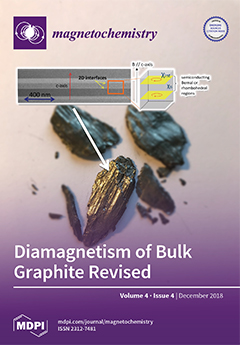
Cover Story: A STEM is picture of a highly oriented graphite sample with metalliclike 2D interfaces that shields the applied field B with c-axis susceptibility χint < 0. The interfaces are embedded between semiconducting, Bernal, or rhombohedral stacking order (regions with different gray colors) with |χB|<<|χint|. The measured diamagnetic susceptibility depends on the number of 2D interfaces in the sample. Oriented samples, as pyrolytic, kish, or natural graphite, show interfaces of different sizes and distances between them. The interfaces exist between twisted Bernal stacking regions, between Bernal and rhombohedral stacking (twisted or untwisted), or between twisted rhombohedral stacking regions. View this paper.
  • Issues are regarded as officially published after their release is announced to the table of contents alert mailing list .
  • You may sign up for email alerts to receive table of contents of newly released issues.
  • PDF is the official format for papers published in both, html and pdf forms. To view the papers in pdf format, click on the "PDF Full-text" link, and use the free Adobe Reader to open them.

Articles (18)

  • Article
  • Open Access
9 Citations
5,118 Views
14 Pages

Herein, we report a novel Tb(III) single chain magnet with the chemical formulae [Tb(μ-OH2)(phen)(μ-OH)(nb)2]n by using 4-nitrobenzoic acid (Hnb) and 1,10-phenanthroline (phen) as ligand system. The single-crystal X-ray diffraction reveals that...

  • Article
  • Open Access
21 Citations
3,787 Views
15 Pages

Two Dimensional Magnetic Coordination Polymers Formed by Lanthanoids and Chlorocyananilato

  • Samia Benmansour,
  • Antonio Hernández-Paredes and
  • Carlos J. Gómez-García

Here we show the important role played by the size of the lanthanoid and the solvent used in the final structures of several two-dimensional magnetic coordination polymers with the ligand chlorocyananilato, (C6O4(CN)Cl)2−. With this aim we have...

  • Article
  • Open Access
1 Citations
3,513 Views
11 Pages

A new tetranuclear mixed-valence manganese(II/IV) compound [MnIIMnIV3(μ-Cl)33-O)(L)3] (1) (where H3L = (3E)-3-((Z)-4-hydroxy-4-phenylbut-3-en-2-ylideneamino)propane-1,2-diol) has been synthesized and characterized by different physicochemi...

  • Article
  • Open Access
8 Citations
3,927 Views
12 Pages

A Co(II)-Hydrazone Schiff Base Single Ion Magnet Exhibiting Field Induced Slow Relaxation Dynamics

  • Dipali Sadhukhan,
  • Prithwi Ghosh,
  • Carlos J. Gómez-García and
  • Mathieu Rouzieres

An octahedral Co(II) complex with N′-(2-hydroxybenzylidene)acetohydrazide Schiff base ligand [HL] forms a 3D supramolecular assembly supported by non-coordinating ClO4 ions and H2O molecules. Individual spin centres are non-interacting a...

  • Article
  • Open Access
40 Citations
9,827 Views
19 Pages

DFT Protocol for EPR Prediction of Paramagnetic Cu(II) Complexes and Application to Protein Binding Sites

  • Giuseppe Sciortino,
  • Giuseppe Lubinu,
  • Jean-Didier Maréchal and
  • Eugenio Garribba

With the aim to provide a general protocol to interpret electron paramagnetic resonance (EPR) spectra of paramagnetic copper(II) coordination compounds, density functional theory (DFT) calculations of spin Hamiltonian parameters g and A for fourteen...

  • Article
  • Open Access
5 Citations
4,054 Views
9 Pages

Synthesis, Structure and Magnetic Study of a Di-Iron Complex Containing N-N Bridges

  • Abhishikta Chatterjee,
  • Laurence K. Thompson and
  • Subrata K. Dey

The iron (II) coordination compound, {[Fe(3,6 pzdc)](H2O)2}2. (1) has been synthesized from a mixture of FeCl2.4H2O and pyridazinedicarboxylate (3,6 pzdc). The molecular structure of complex 1 was determined by single crystal X-ray diffraction study....

  • Article
  • Open Access
11 Citations
4,780 Views
17 Pages

The effect of transition metal substitution for Fe and the structural and magnetic properties of Gd2Fe16Ga0.5TM0.5 (TM = Cr, Mn, Co, Ni, Cu, and Zn) compounds were investigated in this study. Rietveld analysis of X-ray data indicates that all the sam...

  • Feature Paper
  • Article
  • Open Access
24 Citations
8,976 Views
15 Pages

Diamagnetism of Bulk Graphite Revised

  • Bogdan Semenenko and
  • Pablo D. Esquinazi

Recently published structural analysis and galvanomagnetic studies of a large number of different bulk and mesoscopic graphite samples of high quality and purity reveal that the common picture assuming graphite samples as a semimetal with a homogeneo...

  • Article
  • Open Access
9 Citations
4,113 Views
14 Pages

Three trinuclear Ni(II)-Na(I) complexes, [Ni2(L1)2NaCl3(H2O)]·H2O (1), [Ni2(L2)2NaCl3(H2O)] (2), and [Ni2(L3)2NaCl3(OC4H10)] (3) have been synthesized using three different NNO donor tridentate reduced Schiff base ligands, HL1 = 2-[(3-methylam...

  • Review
  • Open Access
27 Citations
13,545 Views
85 Pages

Biomolecular EPR Meets NMR at High Magnetic Fields

  • Klaus Möbius,
  • Wolfgang Lubitz,
  • Nicholas Cox and
  • Anton Savitsky

In this review on advanced biomolecular EPR spectroscopy, which addresses both the EPR and NMR communities, considerable emphasis is put on delineating the complementarity of NMR and EPR regarding the measurement of interactions and dynamics of large...

  • Article
  • Open Access
12 Citations
5,012 Views
16 Pages

Self-Assembly Properties of Amphiphilic Iron(III) Spin Crossover Complexes in Water and at the Air–Water Interface

  • Paulo N. Martinho,
  • Irina A. Kühne,
  • Brendan Gildea,
  • George McKerr,
  • Barry O’Hagan,
  • Tia E. Keyes,
  • Tibebe Lemma,
  • Claudio Gandolfi,
  • Martin Albrecht and
  • Grace G. Morgan

The assembly properties of three known spin crossover iron(III) complexes 13, at the air–water interface, are reported. All three complexes are amphiphiles, each bearing a pair of Cn alkyl chains on the polyamino Schiff base sal2trien li...

  • Article
  • Open Access
27 Citations
8,653 Views
35 Pages

Exploring the pH-Induced Functional Phase Space of Human Serum Albumin by EPR Spectroscopy

  • Jörg Reichenwallner,
  • Marie-T. Oehmichen,
  • Christian E. H. Schmelzer,
  • Till Hauenschild,
  • Andreas Kerth and
  • Dariush Hinderberger

A systematic study on the self-assembled solution system of human serum albumin (HSA) and paramagnetic doxyl stearic acid (5-DSA and 16-DSA) ligands is reported covering the broad pH range 0.7–12.9, mainly using electron paramagnetic resonance...

  • Article
  • Open Access
9 Citations
4,232 Views
13 Pages

A New {Dy5} Single-Molecule Magnet Bearing the Schiff Base Ligand N-Naphthalidene-2-amino-5-chlorophenol

  • Dimitris I. Alexandropoulos,
  • Alysha A. Alaimo,
  • Di Sun and
  • Theocharis C. Stamatatos

A new {Dy5} cluster compound has been synthesized and structurally characterized from the initial use of the Schiff base ligand N-naphthalidene-2-amino-5-chlorophenol (nacpH2) in coordination chemistry. The 1:1 reaction between Dy(hpd)3∙2H2O and nacp...

  • Article
  • Open Access
18 Citations
4,765 Views
17 Pages

Intramolecular Spin State Locking in Iron(II) 2,6-Di(pyrazol-3-yl)pyridine Complexes by Phenyl Groups: An Experimental Study

  • Yulia Nelyubina,
  • Alexander Polezhaev,
  • Alexander Pavlov,
  • Dmitrii Aleshin,
  • Svetlana Savkina,
  • Nikolay Efimov,
  • Teimur Aliev and
  • Valentin Novikov

Here we report a series of 1-phenyl-5-substituted 2,6-di(pyrazol-3-yl)pyridine complexes with iron(II) ion found in a high spin state in solids (according to magnetochemistry) and in solution (according to NMR spectroscopy), providing experimental ev...

  • Article
  • Open Access
13 Citations
5,024 Views
29 Pages

Mononuclear Lanthanide(III)-Salicylideneaniline Complexes: Synthetic, Structural, Spectroscopic, and Magnetic Studies

  • Ioannis Mylonas-Margaritis,
  • Diamantoula Maniaki,
  • Julia Mayans,
  • Laura Ciammaruchi,
  • Vlasoula Bekiari,
  • Catherine P. Raptopoulou,
  • Vassilis Psycharis,
  • Sotirios Christodoulou,
  • Albert Escuer and
  • Spyros P. Perlepes

The reactions of hydrated lanthanide(III) [Ln(III)] nitrates and salicylideneaniline (salanH) have provided access to two families of mononuclear complexes depending on the reaction solvent used. In MeCN, the products are [Ln(NO3)3(salanH)2(H2O)]&mid...

  • Article
  • Open Access
12 Citations
4,258 Views
14 Pages

Closing the Circle of the Lanthanide-Murexide Series: Single-Molecule Magnet Behavior and Near-Infrared Emission of the NdIII Derivative

  • Gang Huang,
  • Guillaume Calvez,
  • Yan Suffren,
  • Carole Daiguebonne,
  • Stéphane Freslon,
  • Olivier Guillou and
  • Kevin Bernot

Up to now, even if murexide-based complexometric studies are performed with all 3d or 4f ions, the crystal structures of the light-lanthanide derivatives of the lanthanide-murexide series are unknown. In this work, we report the crystal structure of...

  • Article
  • Open Access
7 Citations
3,773 Views
15 Pages

New Silver(I) Coordination Polymer with Fe4 Single-Molecule Magnets as Long Spacer

  • Luca Rigamonti,
  • Manuela Vaccari,
  • Fabrizio Roncaglia,
  • Carlo Baschieri and
  • Alessandra Forni

In continuation of our work on supramolecular architectures of single-molecule magnets (SMMs) as a promising strategy in developing their magnetic performance, in this paper we report the synthesis and single crystal X-ray structure of the centered t...

  • Article
  • Open Access
12 Citations
5,311 Views
16 Pages

Unraveling Nanoscale Magnetic Ordering in Fe3O4 Nanoparticle Assemblies via X-rays

  • Karine Chesnel,
  • Dalton Griner,
  • Dallin Smith,
  • Yanping Cai,
  • Matea Trevino,
  • Brittni Newbold,
  • Tianhan Wang,
  • Tianmin Liu,
  • Emmanuelle Jal and
  • Roger G. Harrison
  • + 1 author

Understanding the correlations between magnetic nanoparticles is important for nanotechnologies, such as high-density magnetic recording and biomedical applications, where functionalized magnetic particles are used as contrast agents and for drug del...

Get Alerted

Add your email address to receive forthcoming issues of this journal.

XFacebookLinkedIn
Magnetochemistry - ISSN 2312-7481