


Abstract
Pure Fe soft magnetic composites (SMCs) hold a prominent position in cost-sensitive 10–100 kHz medium-to-low-frequency power devices owing to their low raw-material expenditure and high saturation magnetisation. Nevertheless, the inherently poor interparticle electrical resistivity permits the formation of contiguous conduction paths under alternating magnetic fields, giving rise to marked eddy-current dissipation and localised thermal accumulation. To surmount this limitation, the present work introduces γ-mercaptopropyltriethoxysilane (KH580)-functionalised silicon nitride (Si3N4) nanosheets as a multifunctional interfacial regulating layer that simultaneously establishes an electrically insulating barrier and a thermally conductive network on the surface of Fe particles. The structural integrity, surface chemical speciation and deposition behaviour of Si3N4-s nanosheets on Fe particles were systematically examined, and correlations among lamellar coverage completeness, interfacial bonding robustness and the coupled electrical–magnetic–thermal response were elucidated. The findings reveal that KH580 silanisation introduces a surface functional layer while preserving the parent α-Si3N4 crystal structure, and XPS analysis suggests possible local N–Fe and Fe–S interfacial interactions between Si3N4-s and the Fe surface. At a loading of 4 wt.% Si3N4-s, a comparatively continuous and uniform lamellar coating develops on the Fe particle surfaces. The corresponding Fe/Si3N4 SMCs exhibit the highest volume resistivity and a peak thermal conductivity of approximately 12.1 W·m−1·K−1, while maintaining a core loss of approximately 600.2 kW·m−3 at 50 mT and 100 kHz. These results indicate that the 4 wt.% specimen provides the most favourable overall balance among electrical insulation, magnetic response, core-loss suppression and thermal transport within the investigated composition range, furnishing a functionalised lamellar interfacial engineering strategy for performance advancement of low-cost Fe-based SMCs.
1. Introduction
Soft magnetic composites (SMCs) represent a class of engineered materials produced by compacting and heat-treating ferromagnetic powders whose surfaces have been rendered electrically insulating [1]. They integrate the elevated saturation magnetisation characteristic of ferromagnetic metals with the three-dimensional magnetic isotropy and near-net-shape processing advantages conferred by powder metallurgy routes. With the progressive evolution of new energy vehicles, photovoltaic inverters, and high-efficiency power supply systems towards elevated power densities, increased switching frequencies and compact form factors, the service conditions imposed on SMCs have grown increasingly stringent: the materials are required not only to sustain low core loss across an extended frequency window but also to deliver effective thermal dissipation so as to restrain magnetic performance degradation and insulation-layer deterioration triggered by localised temperature excursions.
Among diverse SMC families, pure Fe magnetic powder cores retain irreplaceable relevance in 10–100 kHz cost-driven application sectors—including power-factor-correction inductors, electromagnetic interference filters and low-frequency line filters—by virtue of their minimal raw-material cost and superior saturation magnetisation [2,3]. A critical drawback, however, stems from the intrinsically low electrical resistivity of pure Fe (~10−7 Ω·m): cold compaction brings about extensive direct metal-to-metal contacts among adjacent Fe particles, thereby establishing low-resistance conduction channels. Under alternating magnetic excitation, these pathways sustain interparticle macroscopic eddy currents whose loss contribution scales with the square of the frequency and constitutes a substantial fraction of the total dissipation [4]. Concurrently, Joule heating arising from the eddy-current effect, if not efficiently conducted away, generates internal hot spots that further impair magnetic performance stability [5]. Hence, the central challenge confronting pure Fe SMCs lies in realising synergistic optimisation among high interparticle electrical resistance, low aggregate loss and effective thermal transport—all while retaining the inherent cost advantage and scalability of the Fe system.
Surface insulation coating constitutes the primary route for suppressing interparticle eddy currents in SMCs. An ideal coating layer ought to strike a balance among electrical insulation efficacy, interfacial adhesion strength, thermal endurance and the degree of magnetic dilution. Present-day coating strategies may be broadly categorised into three groups [6]. Organic resin coatings (epoxy, silicone, phenolic resin, etc.) offer straightforward processing and satisfactory film-forming characteristics; their thermal stability, however, is generally limited to below 400 °C, and thermal decomposition during the subsequent annealing step leads to insulation failure [7]. Inorganic oxide (Al2O3, SiO2, MgO, TiO2, etc.) and phosphate coatings possess superior electrical resistivity and thermal resistance, yet their intrinsically nonmagnetic nature induces a magnetic dilution penalty that lowers the effective permeability and saturation magnetisation. Furthermore, physically adsorbed inorganic layers lack robust chemical bonding with the Fe substrate and are susceptible to cracking or delamination under high-pressure compaction (>800 MPa), thereby compromising the practical insulation performance [8,9]. In recent years, organic–inorganic hybrid coatings, silane-coupling-agent-assisted surface modification, and interfacial microstructure engineering have been deployed to improve coating continuity and interfacial adhesion, with appreciable advances being documented [10,11]. Representative oxide-based and multilayer SMCs further demonstrate that insulating-layer composition and thickness strongly regulate resistivity and magnetic performance [12,13,14]. More recently, two-dimensional nitride-based insulating architectures have emerged as a promising strategy for multifunctional SMCs. Zheng et al. reported that the incorporation of h-BN nanosheets into FeSi SMCs improved both magnetic and thermal transport performance [15], while Fan et al. demonstrated that a layered Fe–Si/BN architecture could provide a favourable combination of high permeability and magnetic-loss suppression [16]. Furthermore, Xu et al. recently employed a SiO2/h-BN bilayer insulating coating in FeSiAl SMCs to simultaneously regulate core loss and thermal conductivity [17]. Recent Fe@BN, FeSi@BN and FeSiCr@BN core–shell systems further demonstrated that thiol-functionalised or lamellar BN-based interfaces can improve interfacial attachment, electrical insulation and thermal transport [18,19,20]. Collectively, these studies highlight the potential of combining two-dimensional insulating phases with interfacial functionalisation to achieve coupled electromagnetic and thermal regulation in SMCs. Although recent studies have begun to consider both magnetic-loss suppression and thermal transport, systematic understanding of how interfacial coating architecture simultaneously governs electrical insulation, magnetic flux continuity, and thermal diffusion remains limited, particularly in low-cost pure Fe SMCs.
Examined from a material-selection vantage point, silicon nitride (Si3N4) presents a design pathway worthy of exploration for multifunctional interfacial regulation in pure Fe SMCs. Si3N4 possesses a wide bandgap of approximately 5.1 eV, affording efficient electrical insulation; its theoretical thermal conductivity can surpass 50 W·m−1·K−1, placing it among the higher tiers of inorganic non-metallic ceramics. Additionally, its decomposition temperature exceeds 1800 °C under inert atmosphere and its oxidation resistance extends to roughly 1400 °C—far above the conventional SMCs annealing temperature window of 400–600 °C [21,22,23]. Relative to cognate nitride ceramics, Si3N4 combines the thermal conduction capability of AlN with the oxidation stability of BN, and importantly exhibits markedly reduced sensitivity to moisture-induced hydrolysis compared with AlN [24,25]—a property of particular consequence for liquid-phase coating processes that employ water or hydrous ethanol as the dispersing medium. Moreover, the lamellar morphology of Si3N4 favours face-contact-type physical isolation over irregular Fe particle surfaces, delivering higher spatial blocking efficiency relative to particulate coating materials; simultaneously, the sheet-like thermally conductive network can establish thermal bridges at particle boundaries, offering low-resistance pathways for heat dissipation from the core interior towards the exterior. That said, pristine Si3N4 suffers from pronounced surface chemical inertness: the saturated Si–N bonding environment yields limited interfacial affinity towards Fe particles, and simple physical blending is insufficient to achieve uniform adsorption and stable spreading.
KH580 (γ-mercaptopropyltriethoxysilane) exhibits distinctive compatibility within the present system: the silanol groups generated upon hydrolysis can undergo condensation with surface hydroxyls on Si3N4 to form Si–O–Si bridges [26], whilst the terminal mercapto (–SH) moiety is expected to enhance the interfacial affinity of the functionalised nanosheets towards Fe surfaces and may facilitate local S–Fe-related interactions [18,27]. Grounded in the foregoing rationale, the present investigation constructs KH580-functionalised Si3N4 nanosheet (Si3N4-s)-modified Fe/Si3N4-s composite powders and the corresponding Fe/Si3N4 SMCs, and pursues a systematic inquiry organised along three interconnected tiers: (i) the surface chemical state and structural stability of Si3N4-s, together with its adsorption–spreading–coating behaviour on Fe particle surfaces; (ii) the quantitative influence of Si3N4-s content (1–5 wt.%) on the static magnetic properties, high-frequency permeability, DC-bias characteristic, volume resistivity and Bertotti loss-separation components of the Fe/Si3N4 SMCs; and (iii) the manner in which lamellar coverage completeness modulates interparticle thermal transport channels, along with the competition–synergy relationships among the electrical, magnetic and thermal responses. The novelty of the present work lies not in the mere addition of Si3N4 as an insulating filler, but rather in the use of KH580 to transform lamellar Si3N4 into a multifunctional regulatory unit that simultaneously provides electrical insulation, thermal bridging, and interfacial anchoring capability. The study further correlates lamellar coverage completeness, localised N–Fe and S–Fe interfacial interactions, Bertotti loss components, and thermal diffusion behaviour, thereby establishing the competition–synergy relationships among electrical insulation, magnetic flux continuity, and thermal dissipation in pure Fe SMCs. This integrated perspective differs from the focus of recent studies on FeSi@BN, FeSiCr@BN, and conventional silane-assisted coating strategies [19,20,26], which have largely addressed individual property improvements rather than the coupled multi-physical trade-offs. Through this investigation, we aim to furnish a functionalised lamellar regulation strategy—distinct from conventional insulation coating approaches—for the interfacial architecture design of low-cost Fe-based SMCs.
2. Experimental Section
2.1. Raw Materials and Preparation
Silicon nitride nanosheets (Si3N4, purity ≥ 99.5%, thickness ~5–15 nm, lateral dimension ~200–600 nm) were procured from Shanghai Macklin Biochemical Technology Co., Ltd. (Shanghai, China). γ-Mercaptopropyltriethoxysilane (KH580, purity ≥ 98%) was sourced from Sinopharm Chemical Reagent Co., Ltd. (Shanghai, China). Analytical-grade absolute ethanol (C2H5OH, purity ≥ 99.9%) served as the dispersing medium throughout. Water-atomised iron powder (mean particle size 45 μm), supplied by Ansteel (Anshan) Metallurgical Powder Materials Co., Ltd. (Anshan, China), was employed as the magnetic matrix powder. High-purity argon (≥99.99%) was used as the annealing protective atmosphere. Silicone resin (binder) and analytical-grade zinc stearate (lubricant) were employed in the compaction step.
Preparation of Si3N4-s nanosheets: A predetermined mass of Si3N4 nanosheets was dispersed in 150 mL of absolute ethanol and subjected to continuous ultrasonication for 12 h using an ultrasonic disperser (WH001, Jinghao Machinery Co., Ltd., Hangzhou, China) to obtain a homogeneous Si3N4 suspension. KH580 was added dropwise to the suspension at a Si3N4-to-KH580 mass ratio of 10:1, followed by an additional 30 min of ultrasonication to ensure uniform mixing. In this system, KH580 hydrolysis and condensation proceed primarily through water adsorbed on the Si3N4 nanosheet surfaces and trace moisture present in the ethanol medium. The resultant mixture was transferred to a vacuum drying oven and dried under vacuum at 85 °C until complete solvent removal. After cooling to ambient temperature, the product was re-dispersed in 10 mL of absolute ethanol, filtered and washed with absolute ethanol at least three times to eliminate physically adsorbed, unreacted KH580. The product was subsequently dried in a vacuum oven at 80 °C for 8 h, yielding mercapto-modified silicon nitride nanosheets (designated as Si3N4-s), which were stored in sealed, light-shielded containers until further use.
Preparation of Fe/Si3N4-s composite powders: Si3N4-s and water-atomised Fe powder were combined at various mass ratios, with Si3N4-s loadings set at 1.0, 2.0, 3.0, 4.0 and 5.0 wt.%. Absolute ethanol (50 mL) was introduced as the dispersing medium, and the mixture was stirred mechanically at 300 rpm for 30 min to promote the intimate contact and homogeneous dispersion of Si3N4-s with the Fe particles. The mixed suspension was sealed and allowed to stand in a shaded, cool environment for 8 h to enhance the adsorption and deposition of Si3N4-s onto the Fe particle surfaces. After standing, the supernatant was decanted, and the residual solid was placed in a fume hood. Once the remnant absolute ethanol had fully evaporated, Fe/Si3N4-s composite powders featuring a lamellar surface-modified architecture were obtained.
Fabrication of Fe/Si3N4 SMCs: A 6 g portion of Fe/Si3N4-s composite powder was sequentially mixed with 0.5 wt.% silicone resin (binder), 0.2 wt.% zinc stearate (lubricant) and 3 mL of acetone, with continuous stirring until complete solvent evaporation. The blended powder was compacted at ambient temperature under 1400 MPa to produce toroidal specimens (outer diameter 26.9 mm, inner diameter 14.5 mm, height 10 mm). The compacted toroids were annealed at 500 °C for 1 h under an argon atmosphere to relieve compaction-induced residual stress, ultimately yielding Fe/Si3N4 SMCs.
2.2. Structural Characterisation and Property Measurements
Field-emission scanning electron microscopy (SEM, JSM-6490LV, JEOL, Tokyo, Japan) coupled with energy-dispersive X-ray spectroscopy (EDS) was employed to characterise the surface morphology and elemental mapping of powder specimens; a minimum of three distinct fields of view was examined per batch to ensure representativeness. X-ray diffraction (XRD, D8 ADVANCE, Bruker, Germany) was performed to analyse the phase constitution of the powders using Cu Kα radiation (λ = 0.15406 nm), with a scan range of 2θ = 10–90°, a step size of 0.02° and a scan rate of 2°/min. X-ray photoelectron spectroscopy (XPS, Thermo ESCALAB 250Xi, Thermo Fisher Scientific, Waltham, MA, USA) was utilised to probe surface elemental chemical states, employing an Al Kα excitation source (hν = 1486.6 eV) with the C 1s peak (284.8 eV) as the binding-energy calibration reference. Thermogravimetric–differential thermal analysis (TG-DTA, DTG-60H, Shimadzu, Kyoto, Japan) was conducted to evaluate the thermal stability of Si3N4 and Si3N4-s under an argon atmosphere, at a heating rate of 5 °C/min over a temperature range of 100–900 °C with a specimen mass of approximately 10 mg.
Effective volume resistivity was determined using a four-probe resistance analysis system (FT-3110, Beijing Fangzheng Gaoke, Beijing, China). Considering the finite dimensions of the bulk toroidal specimens, all samples were measured under identical geometric and contact conditions to minimise the influence of non-uniform current distribution. The reported values are therefore regarded as effective volume resistivities and are primarily used for relative comparison among the different compositions. Core loss was measured with a B–H analyser (SY-8219, Iwatsu, Tokyo, Japan) over magnetic flux densities of 5–50 mT and frequencies of 10–500 kHz. For clarity, representative frequency-dependent core-loss curves at magnetic flux densities of 10, 30, and 50 mT are presented. Room-temperature hysteresis loops were acquired using a vibrating sample magnetometer (VSM, Lakeshore 8604, Lake Shore, Westerville, OH, USA) at 25 °C over an applied field range of ±20,000 Oe with a step size of 50 Oe. The real part of the effective permeability (μe′) and the quality factor were measured using an LCR meter (IM3536, HIOKI, Nagano, Japan) over a frequency range of 1–1000 kHz.
Room-temperature thermal conductivity was measured in accordance with ISO 22007-2:2008 using a thermal constants analyser (TPS3500, Hot Disk, Gothenburg, Sweden); values were derived by fitting the transient temperature-rise curve in conjunction with the linear relationship between the thermal resistance of the nickel-wire probe and temperature. Thermal response behaviour was assessed by placing the specimens on an aluminium heating plate maintained at 158 °C and recording the surface temperature distribution at 5 s intervals over a continuous monitoring period of 1200 s with an infrared thermal imager (Fotric 226S-L28, Shanghai Thermal Imaging Technology Co., Ltd., Shanghai, China). This externally driven heating test was designed to compare the thermal diffusion behaviour of the specimens rather than their electromagnetic self-heating response.
For each composition, resistivity and thermal conductivity were measured five times on the same representative specimen under identical testing conditions. The corresponding mean values and standard deviations were calculated to evaluate measurement repeatability. Core-loss and permeability measurements were likewise repeated five times under identical conditions, with relative deviations below 1%.
3. Results and Discussion
3.1. Structural Stability and Surface Functionalisation of Si3N4-s Nanosheets
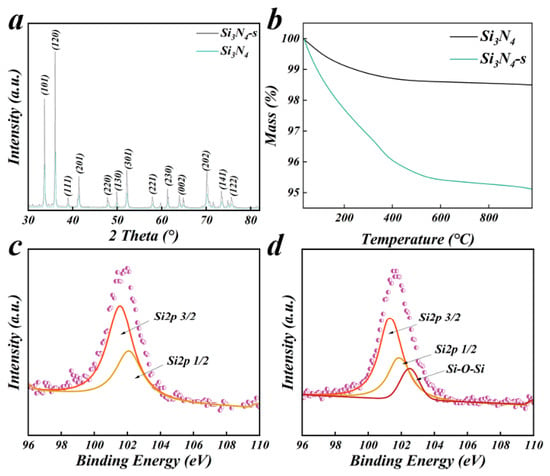
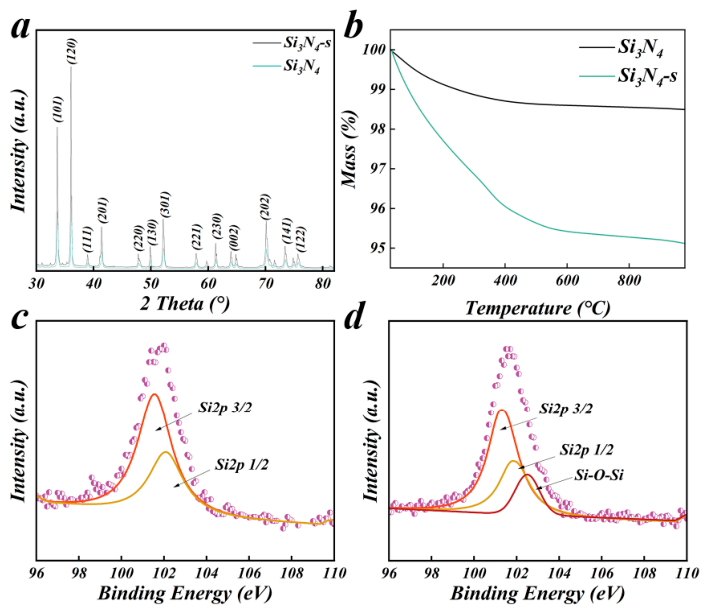
Prior to constructing Fe/Si3N4-s interfaces with Si3N4-s, two prerequisites warrant confirmation: whether the KH580 silanisation treatment compromises the parent crystal structure of the Si3N4 nanosheets, and whether surface organic functional groups have been successfully introduced. Figure 1a compares the XRD patterns of pristine Si3N4 and KH580-modified Si3N4-s. Pristine Si3N4 displays characteristic diffraction peaks at 2θ = 33.7°, 36.0°, 41.4°, 52.2° and 70.2°, which are respectively indexed to the (101), (120), (201), (301) and (202) planes of α-Si3N4 (ICDD No. 01-073-3035), consistent with reported α-Si3N4 crystallographic data [28]. The peaks are sharp and free of extraneous signals, indicative of high α-phase purity and crystalline integrity in the as-received material. Following KH580 treatment, all characteristic reflections of α-Si3N4 are fully retained in Si3N4-s, and no new crystalline diffraction features emerge. Slight variations in the relative diffraction intensities of certain planes (e.g., (210) and (301)) are discernible, which are tentatively ascribed to alterations in the stacking configuration and preferred orientation of the nanosheets after surface grafting, rather than to modifications of the bulk crystal structure. This result unambiguously demonstrates that KH580 silanisation acts exclusively on the Si3N4 nanosheet surfaces and does not induce detectable disruption of the α-phase host lattice.
Figure 1.
Structural and chemical characterisation of pristine and KH580-functionalised Si3N4 nanosheets: (a) XRD patterns; (b) TGA curves measured in Ar atmosphere; (c,d) high-resolution Si 2p XPS spectra.
Thermogravimetric analysis (Figure 1b) further discriminates the thermal stability difference between pristine Si3N4 and Si3N4-s. Pristine Si3N4 undergoes virtually no mass change over the 100–900 °C window (total mass loss < 0.2 wt.%), reflecting the exceptional intrinsic thermal robustness of its Si–N covalent network backbone. In contrast, Si3N4-s exhibits progressive mass loss with increasing temperature, retaining a residual mass of 95.2 wt.% at 900 °C, which corresponds to a total mass loss of approximately 4.8 wt.%. Combined with the XRD findings, it can be inferred that KH580 has successfully introduced thermally labile organosilane functional species onto the Si3N4 surface, and that this functionalisation step leaves the bulk crystalline integrity of Si3N4 unimpaired.
To characterise the changes in surface chemical environment induced by KH580 modification, Si 2p XPS analysis was carried out on pristine Si3N4 and Si3N4-s (Figure 1c,d). The Si 2p spectrum of pristine Si3N4 presents a doublet distribution with binding energies at approximately 101.6 and 102.0 eV, corresponding to the N–Si bonding environment within the Si3N4 lattice. In addition to retaining the N–Si principal peaks, Si3N4-s displays a new fitted component on the higher-binding-energy side (~102.5 eV) that can be assigned to surface Si–O–Si species. The emergence of this component suggests that, during the KH580 hydrolysis–condensation sequence, partial Si–N bonds on the Si3N4 surface may undergo hydrolysis to generate Si–OH surface moieties, which subsequently serve as reactive anchoring sites for silane grafting.
The convergent evidence from XRD, TGA and XPS permits the following conclusion: KH580 surface functionalisation, whilst preserving the host α-Si3N4 crystal structure and its intrinsic thermal stability, introduces a mercaptopropyl-bearing organosilane functional layer onto the Si3N4 nanosheet surfaces via the partial hydrolytic activation of surface Si–N bonds and subsequent silanol condensation reactions. This functionalised surface is expected to improve the interfacial affinity of Si3N4-s towards the water-atomised Fe particles, thereby favouring subsequent adsorption, spreading and coating formation.
3.2. Coating Morphology Evolution and Interfacial Bonding Mechanism of Fe/Si3N4-s Composite Powders
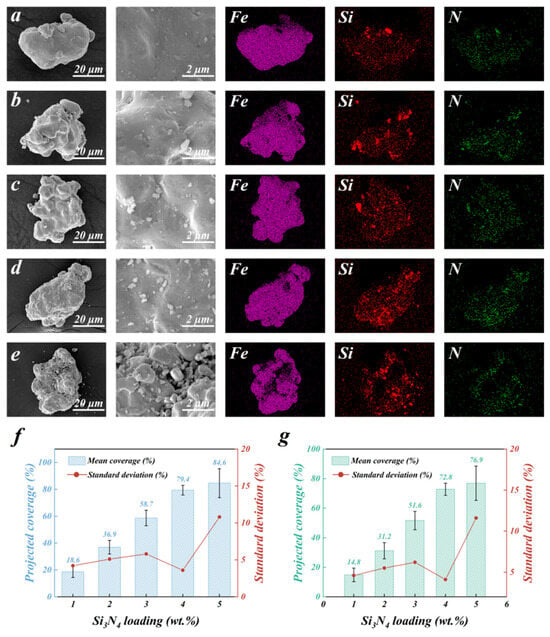
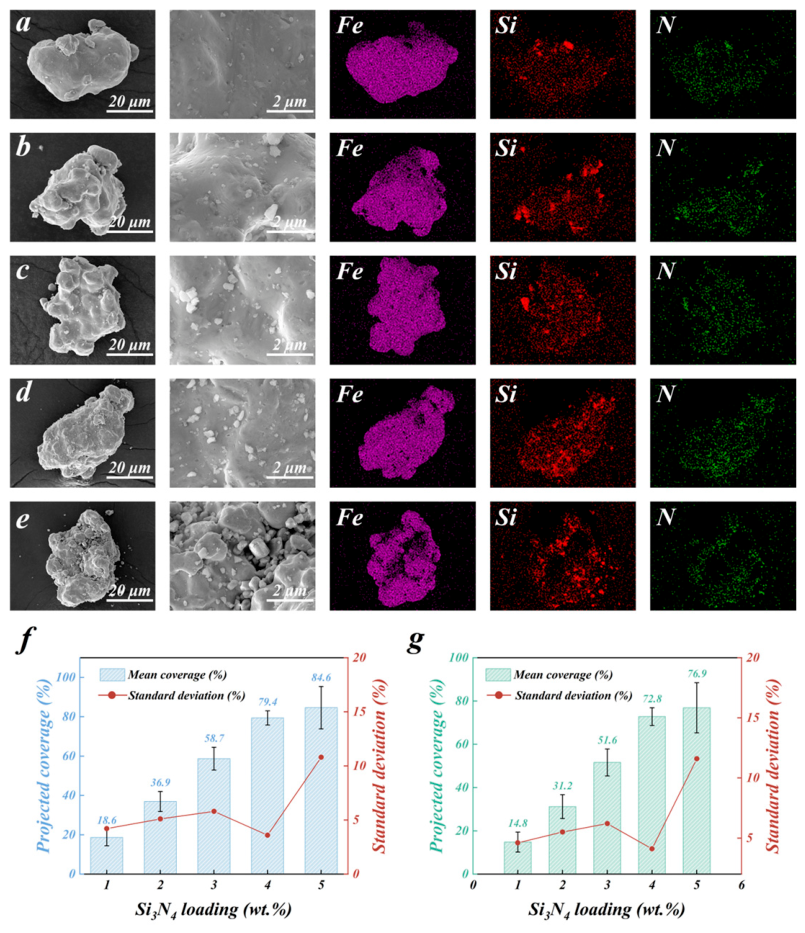
Having confirmed the surface functionalisation characteristics of Si3N4-s, attention is next directed to its deposition behaviour on Fe particle surfaces. Figure 2 systematically illustrates the surface morphology and Si/N elemental distribution evolution of Fe/Si3N4-s composite powders as the Si3N4-s loading is incremented from 1 to 5 wt.%. All composite powders retain the characteristic irregular, near-spherical morphology of water-atomised Fe powder, with no discernible particle fragmentation, severe plastic deformation or large-scale cold-welding agglomeration, indicating that the mild liquid-phase ethanol-mediated dispersion–stirring–standing protocol exerts minimal influence on the original morphology of the Fe matrix. As the Si3N4-s content rises, the surface coverage state of the Fe particles traverses four typical regimes: discrete attachment (1 wt.%) → discontinuous coverage (2–3 wt.%) → comparatively uniform coating (4 wt.%) → localised stacking agglomeration (5 wt.%).
Figure 2.
Morphology, elemental distribution and projected coverage of Fe/Si3N4-s composite powders with different Si3N4-s loadings: (a–e) SEM images and corresponding Fe, Si and N EDS maps for 1–5 wt.% Si3N4-s; (f) Si projected coverage; (g) N projected coverage.
In detail, the 1 wt.% specimen (Figure 2a) exhibits only sparse lamellar fragments scattered on the Fe particle surfaces, with Si and N elemental signals appearing as weak, dispersed spot-like distributions, signifying that extensive Fe–Fe direct-contact regions remain largely uninsulated at this low loading. For the 2–3 wt.% specimens (Figure 2b,c), the surface coverage expands appreciably, and a spatial correspondence between the Si/N elemental distributions and the Fe particle contours begins to take shape; nonetheless, discontinuous gaps persist between adjacent lamellae. The 4 wt.% specimen (Figure 2d) displays the optimal coating morphology: Si3N4-s nanosheets form a relatively continuous and uniform overlayer on the Fe particle surfaces, Si and N elemental signals are densely distributed along the Fe particle outlines, and no prominent large-scale aggregates are observed. This indicates that 4 wt.% Si3N4-s achieves a favourable balance between lamellar coverage completeness and dispersion uniformity. When the loading is further raised to 5 wt.% (Figure 2e), although the total surface coverage is higher, localised regions begin to exhibit nanosheet self-stacking and coarse aggregates, suggesting that excessive Si3N4-s tends to agglomerate as inter-nanosheet van der Waals forces intensify, thereby reducing the effective coating efficiency. This morphological evolution bears qualitative similarity to the BN nanosheet deposition behaviour documented by Wang et al. in FeSi@BN [19] and FeSiCr@BN [20] systems—namely, a critical loading exists at which coating continuity and dispersibility attain optimal balance, beyond which nanosheet agglomeration becomes the dominant factor.
To further quantify the coating evolution, the apparent projected coverage was evaluated from the EDS elemental maps using unified threshold analysis over at least 20 independent fields of view for each composition. As shown in Figure 2f,g, the mean Si projected coverage increases from 18.6% at 1 wt.% to 79.4% at 4 wt.% and 84.6% at 5 wt.%, with the N distribution exhibiting a consistent trend. Notably, the 4 wt.% specimen combines a high projected coverage with a relatively small standard deviation, whereas the markedly increased data scatter at 5 wt.% indicates greater spatial heterogeneity, consistent with the localised nanosheet stacking observed by SEM.
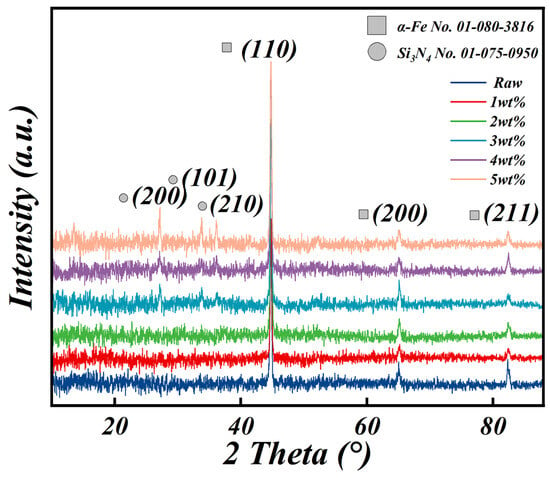
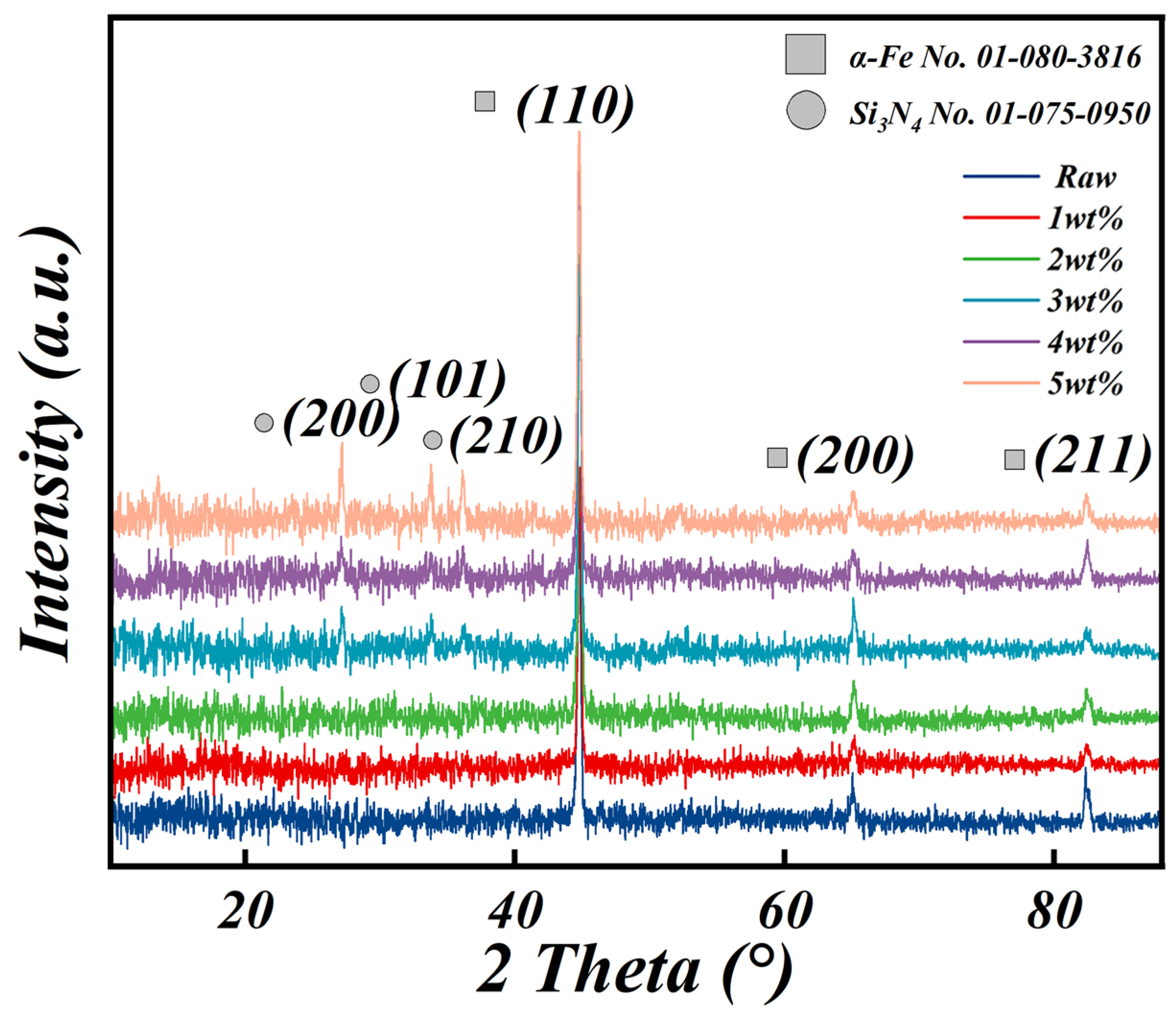
XRD phase analysis (Figure 3) further corroborates the phase constitution of the Fe/Si3N4-s composite powders. The pristine water-atomised Fe powder exhibits the (110), (200) and (211) characteristic diffraction peaks of body-centred-cubic α-Fe at 2θ = 44.7°, 65.0° and 82.4° (ICDD No. 01-071-8390), with sharp and symmetric peak profiles attesting to good crystallinity of the Fe matrix. All Fe/Si3N4-s composite powders fully preserve the three principal α-Fe reflections, and no detectable peak shift is observed, confirming that the introduction of Si3N4-s and the liquid-phase processing leave the host crystal structure of the Fe matrix unchanged and do not induce appreciable lattice expansion or contraction. With increasing Si3N4-s loading, weak diffraction signals progressively emerge and intensify near 2θ ≈ 27.2°, 33.8° and 36.2°, which can be respectively assigned to the (200), (101) and (210) planes of α-Si3N4; their intensity growth trend is consistent with the intensification of Si and N elemental distributions observed in Figure 2. It is noteworthy that no diffraction peaks attributable to crystalline iron oxides (Fe2O3, Fe3O4 or FeO) are detected across the entire scan range, nor are signals corresponding to iron silicides or iron nitrides observed. Within the detection limit of conventional XRD, these results indicate that no diffraction-detectable crystalline oxide, silicide or nitride phases are present in appreciable amounts. However, conventional XRD cannot exclude ultrathin, amorphous or low-content surface oxide layers. Accordingly, the interfacial interactions discussed below are interpreted primarily from the XPS evidence rather than from the absence of XRD peaks.
Figure 3.
XRD patterns of pristine water-atomised Fe powder and Fe/Si3N4-s composite powders with different Si3N4-s loadings.
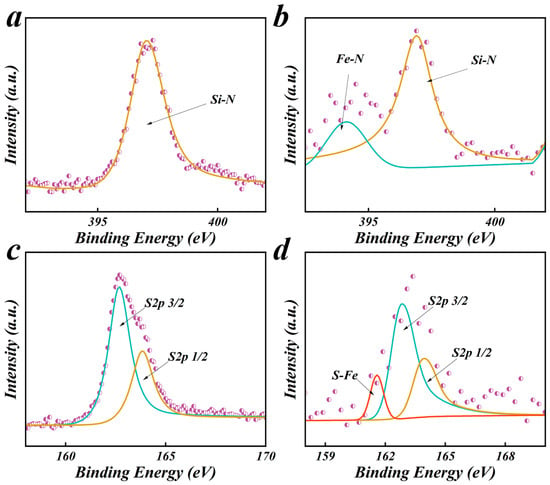
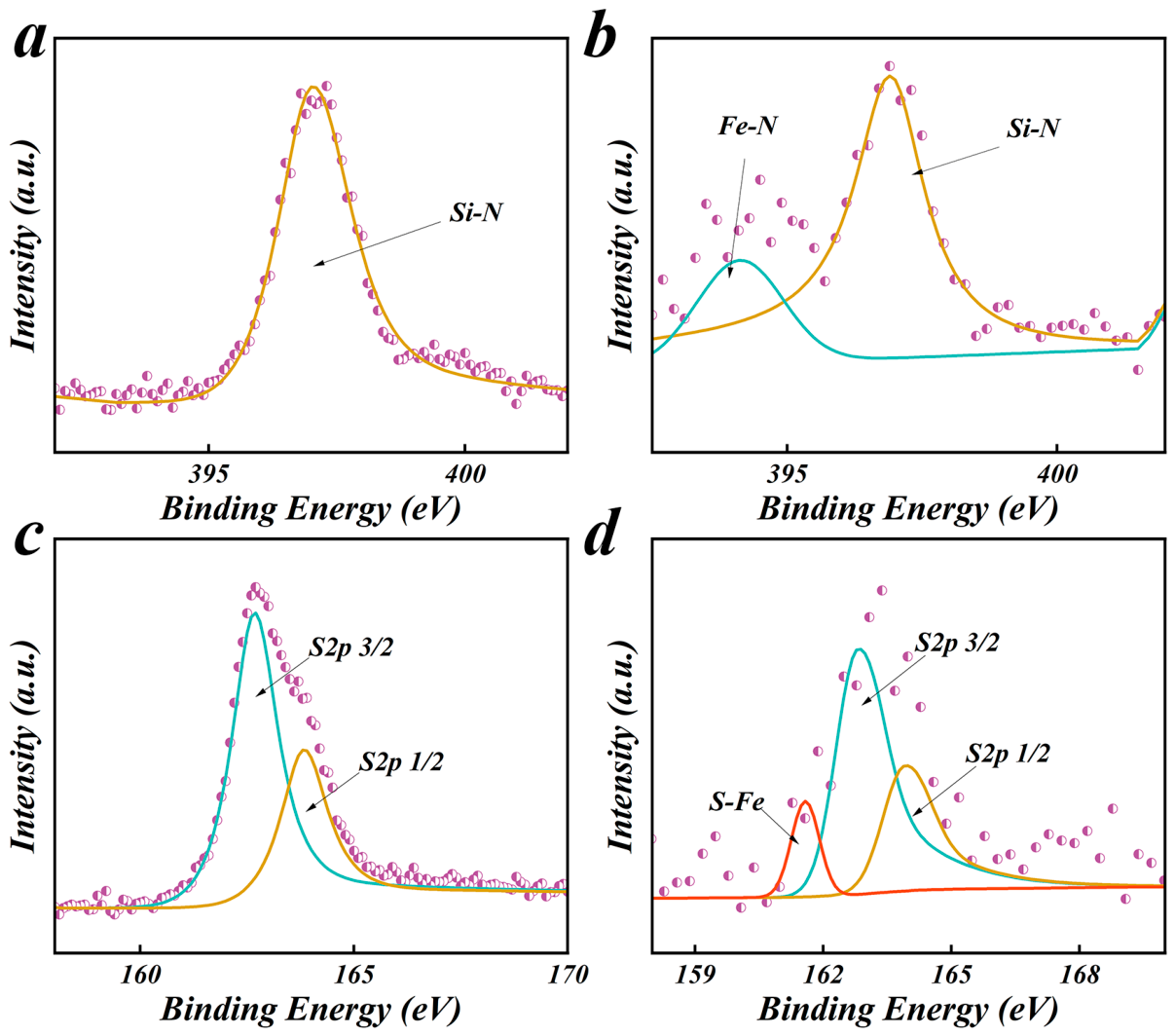
To further elucidate the chemical nature of the interfacial bonding between Si3N4-s and Fe particles, the 4 wt.% Fe/Si3N4-s composite powder—which exhibits the most favourable coating uniformity—was selected for comparative N 1s and S 2p high-resolution XPS analysis alongside Si3N4-s (Figure 4). The N 1s spectrum of Si3N4-s (Figure 4a) can be fitted with a component at 397.1 eV assigned to N–Si bonds within the Si3N4 lattice. The N 1s spectrum of the 4 wt.% Fe/Si3N4-s composite powder (Figure 4b) retains this component while displaying an additional fitted contribution at a lower binding energy (~394.8 eV). The appearance of this low-binding-energy component indicates a change in the local electronic environment of a fraction of the N atoms after contact with Fe, which is consistent with possible local N–Fe interfacial interactions [29]. However, the exact bonding configuration cannot be determined from the N 1s spectrum alone. The S 2p spectra provide complementary information regarding the possible participation of the KH580 mercapto terminal groups in the Fe/Si3N4-s interfacial interaction. The S 2p spectrum of Si3N4-s (Figure 4c) exhibits the typical spin–orbit splitting doublet (S 2p3/2 ~163.3 eV, S 2p1/2 ~164.5 eV), corresponding to the C–S–H covalent bonding environment within KH580. The S 2p spectrum of the 4 wt.% Fe/Si3N4-s specimen (Figure 4d) preserves the C–S component whilst displaying a new low-binding-energy fitted contribution at ~161.9 eV, which is tentatively attributed to, and is consistent with, Fe–S interfacial interactions [30]. In accordance with the hard–soft acid–base (HSAB) principle [27], the mercapto group (–SH), as a soft base, possesses an inherent affinity advantage towards the soft-acid Fe0 surface, rendering S–Fe coordination thermodynamically plausible. Taken together, the N 1s and S 2p spectral changes suggest plausible local N–Fe and Fe–S interfacial interactions, indicating that chemical interactions may contribute to the attachment between Si3N4-s and the Fe surface in addition to physical adsorption. However, the exact local coordination configurations cannot be established from XPS alone.
Figure 4.
High-resolution XPS spectra of Si3N4-s and the 4 wt.% Fe/Si3N4-s composite powder: (a,b) N 1s; (c,d) S 2p.
3.3. Modulation of Electromagnetic Properties and Core Loss Mechanisms by Si3N4-s Content
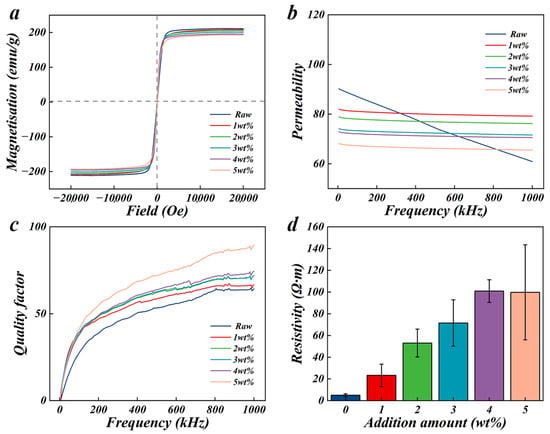
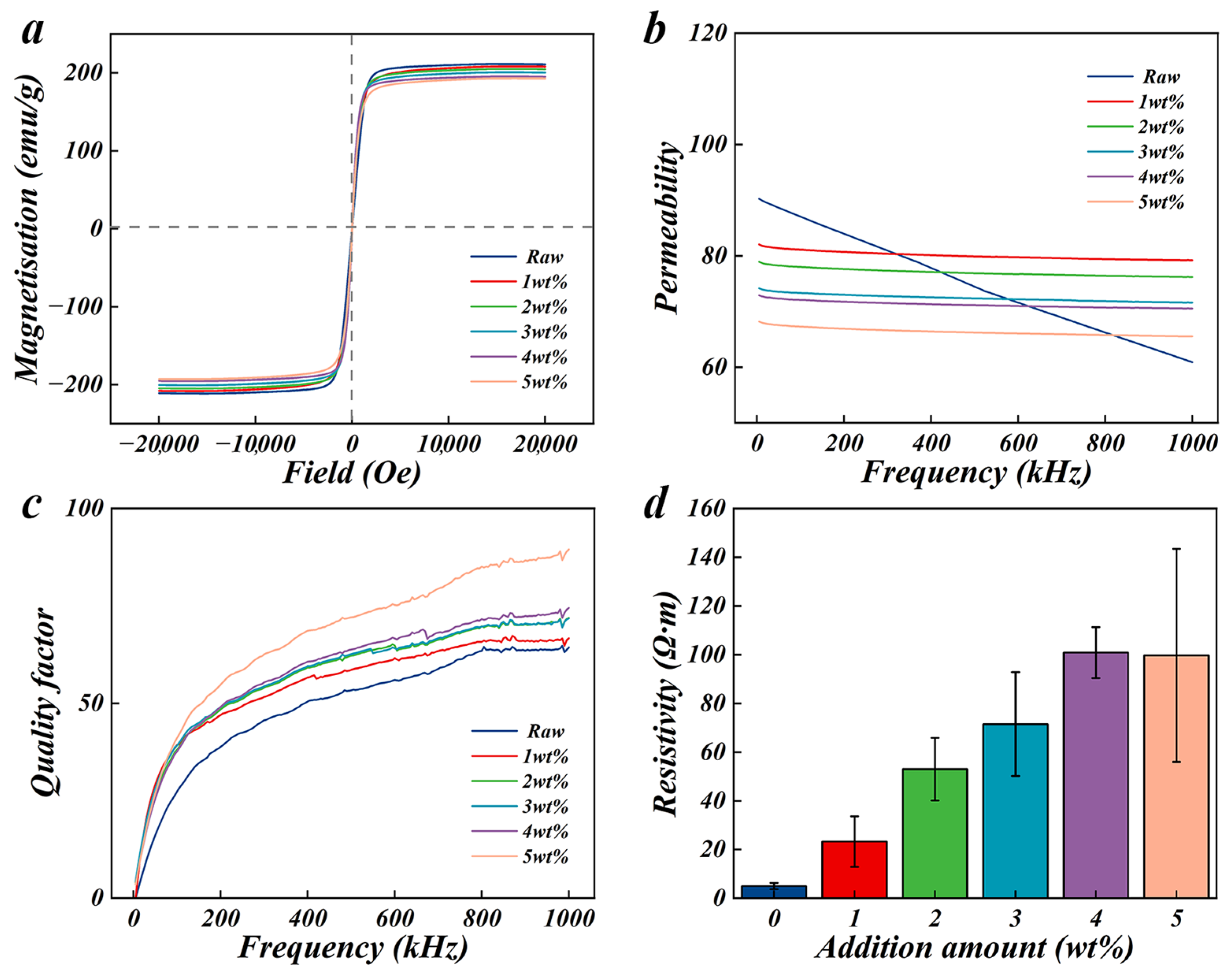
When Si3N4-s lamellar coatings introduce nonmagnetic interfaces onto Fe particle surfaces, the interparticle electrical insulation state, magnetic exchange coupling strength and magnetic flux transmission continuity are concurrently affected. Evaluating the efficacy of Si3N4-s therefore demands a multi-dimensional assessment of the electromagnetic response. Figure 5a presents the room-temperature hysteresis loops of the pure Fe SMCs and Fe/Si3N4 SMCs with varying Si3N4-s loadings. All specimens display narrow loops, low remanence and rapid saturation—hallmarks of soft magnetic behaviour [31]—indicating that Si3N4-s incorporation does not alter the intrinsic soft magnetic response mode governed by the Fe matrix. The saturation magnetisation Ms decreases monotonically from approximately 210.8 emu/g for the pure Fe SMCs to roughly 192.7 emu/g for the 5 wt.% specimen. This decline in Ms primarily obeys a dilution rule [32]: the introduction of the nonmagnetic Si3N4-s phase reduces the effective magnetic Fe content per unit mass.
Figure 5.
Magnetic and electrical properties of pure Fe SMCs and Fe/Si3N4 SMCs: (a) room-temperature hysteresis loops; (b) real part of effective permeability; (c) quality factor; (d) electrical resistivity.
Figure 5b displays the frequency dependence of the real part of effective permeability μe′ over the investigated frequency range. SMCs lacking an insulating layer exhibit a pronounced decline in permeability with increasing frequency. This trend may be ascribed to direct interparticle contacts among soft magnetic powders creating magnetic short-circuit paths that concentrate the magnetic field at contact points, engendering an inhomogeneous field distribution and causing the permeability to drop steeply as frequency rises. In contrast, all specimens incorporating the Si3N4 insulating layer show a relatively minor fluctuation in μe′ across the test frequency band, signifying satisfactory frequency stability within this range. The overall μe′ level shifts downward with increasing Si3N4-s loading: the pure Fe SMCs exhibit a μe′ of approximately 90.2 at 100 kHz, whilst the 4 wt.% and 5 wt.% specimens register values of roughly 72.4 and 68.5, respectively. The reduction in μe′ originates from the series magnetic reluctance introduced by the nonmagnetic Si3N4-s lamellae between adjacent Fe particles, which is equivalent to enlarging the effective air-gap length in the magnetic circuit and attenuating the continuity of interparticle magnetic flux coupling. The quality factor Q = μe′/μe′′ (where μe′ and μe′′ are the real and imaginary parts of the effective permeability, respectively) provides a composite measure of the energy-storage-to-energy-dissipation ratio during alternating magnetisation and serves as an important indicator of overall soft magnetic performance. The Q value rises initially and subsequently declines with increasing Si3N4-s content, reflecting a composition-dependent balance between magnetic energy storage and dissipation. The Q response therefore provides one aspect of the magnetic performance evaluation, whereas identification of the optimum Si3N4-s loading requires the combined consideration of magnetic, electrical, core-loss and thermal properties.
Figure 5d charts the volume resistivity evolution as a function of Si3N4-s content. The pure Fe SMCs exhibit an extremely low resistivity—an inevitable consequence of plastic flow and metallic bonding at Fe–Fe contact points during cold compaction at 1400 MPa. The introduction of 1 and 2 wt.% Si3N4-s raises the resistivity, albeit to values that remain modest, indicating that Fe–Fe metallic contacts still constitute the dominant interparticle electrical transport pathway at low coverage. The 3 wt.% specimen shows a further resistivity increase, suggesting that the Si3N4-s coverage fraction has approached the percolation threshold and that conduction pathways are beginning to be effectively disrupted. The 4 wt.% specimen attains the peak volume resistivity of approximately 100.8 Ω·m—a level that ranks favourably among reported inorganic coating systems for pure Fe-based SMCs [33] and even approaches the resistivity range of certain FeSiAl alloy systems. When the Si3N4-s content is raised to 5 wt.%, the mean resistivity changes little, yet the measurement scatter increases markedly, a finding that correlates directly with the localised lamellar agglomeration and inhomogeneous coverage observed in Figure 2e: agglomerated zones create excessive barriers whilst denuded regions retain residual Fe–Fe direct contacts, producing a spatially non-uniform distribution of conduction pathways within the specimen. The microscopic mechanisms responsible for the resistivity enhancement operate on three levels: (i) the physical blocking effect of the high-resistivity Si3N4-s lamellae, which severs direct metallic contacts between Fe particles; (ii) the auxiliary insulation contribution of the KH580-derived organosilane layer, which introduces additional tunnelling barriers at particle boundaries; and (iii) the possible local N–Fe and Fe–S interfacial interactions suggested by XPS, which may contribute to improved interfacial stability during high-pressure compaction.
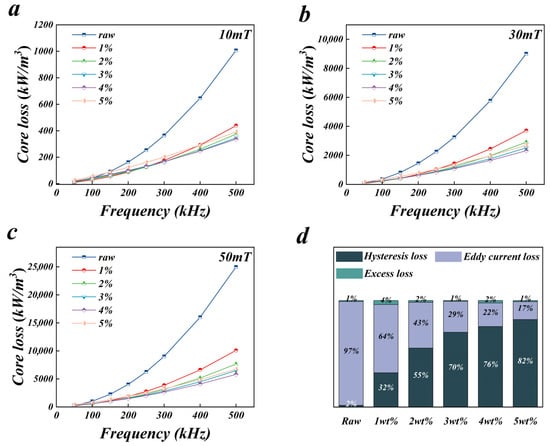
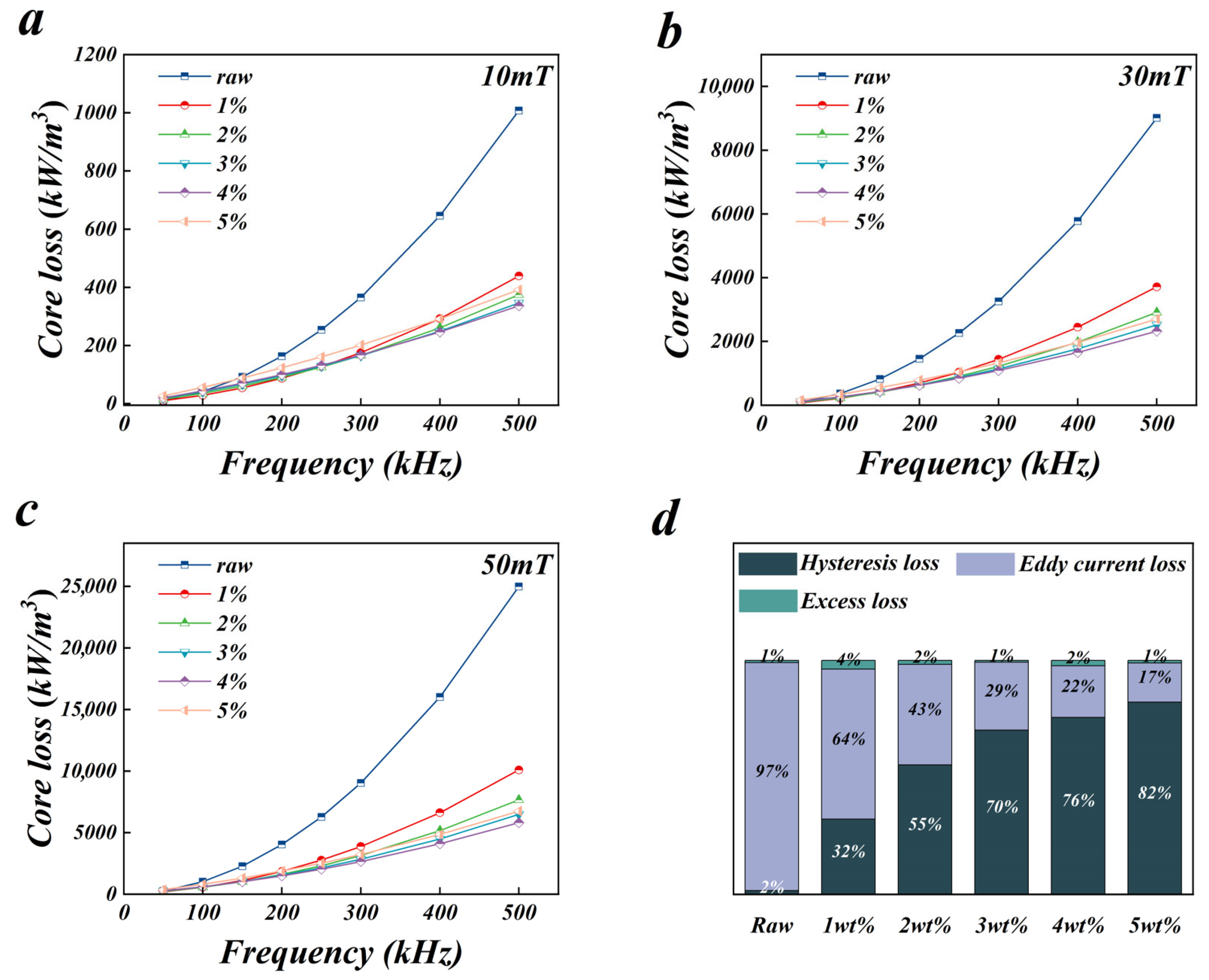
Figure 6a–c present the frequency dependence of the total core loss (Pcv) at representative magnetic flux densities of 10, 30 and 50 mT, respectively. For all specimens, Pcv increases monotonically with increasing frequency and magnetic flux density, following the general behaviour of dynamic losses in soft magnetic materials [34]. At 50 mT and 100 kHz, the Pcv values of the pure Fe and 1–5 wt.% Si3N4-s specimens are 1015.5, 555.8, 556.7, 595.2, 600.2 and 801.3 kW·m−3, respectively. The introduction of Si3N4-s therefore markedly suppresses the total core loss relative to the pure Fe SMCs. The 1 and 2 wt.% specimens exhibit the lowest and nearly identical loss levels, whereas the 3 and 4 wt.% specimens show moderately higher and mutually comparable losses; a pronounced increase occurs when the Si3N4-s loading reaches 5 wt.%. Notably, the highest effective volume resistivity obtained at 4 wt.% does not correspond to the minimum core loss, demonstrating that increasing electrical resistivity alone does not necessarily result in the lowest total magnetic loss. The principal electromagnetic properties of the different compositions are summarised in Table 1.
Figure 6.
Core-loss characteristics of pure Fe SMCs and Fe/Si3N4 SMCs: (a–c) frequency-dependent total core loss at 10, 30 and 50 mT, respectively; (d) loss-component distribution at 50 mT and 100 kHz.
Table 1.
Comparison of the electromagnetic properties of pure Fe SMCs and Fe/Si3N4 SMCs with different Si3N4-s contents.
The loss components were separated following the Bertotti framework [4]. Similar loss-separation procedures have also been applied to FeSiAl/Al2O3 and FeSiAl/Si3N4 SMC systems [35,36]. The eddy-current loss (Pec) is further divided into interparticle eddy-current loss (Pinter-ec) and intraparticle eddy-current loss (Pintra-ec) (Equation (1)).
where deff is the effective eddy-current dimension; w and h are the length and width of the magnetic path cross-section, respectively; ρs and ρp are the resistivities of the SMCs and particles, respectively; d is the particle diameter and β is the geometric factor. In the present calculation, deff = 6.2 mm, w = 6.2 mm and h = 10 mm were used for the interparticle eddy-current contribution, corresponding to β1 ≈ 9.80. For the intraparticle contribution, d = 45 μm and β2 = 20 were adopted using a spherical-particle approximation and ρs was taken from the measured effective volume resistivity of each SMC, whereas ρp was taken from the resistivity of the Fe powder.
Excess loss (Pexc) was obtained after determining the hysteresis and eddy-current contributions and was fitted using Equation (2).
where Cexc is the excess-loss coefficient and x and y are the fitting parameters. Polynomial curve fitting was used to determine the relationship between Pcv/f and f for the SMCs at different magnetic flux densities. The extrapolation to the zero frequency yields a hysteresis loss intercept under quasistatic conditions. Chyst and α were calculated based on the fitting of the hysteresis loss under different conditions. Using Equation (1) and specific parameters, the values of Pinter-ec and Pintra-ec were calculated. Finally, the excess-loss parameters Cexc, x and y were obtained by nonlinear least-squares fitting according to Ref. [37]. The corresponding fitting parameters and coefficients of determination (R2) are summarised in Table 2. The resulting R2 values range from 0.991 to 0.997, indicating good fitting consistency for all compositions.
Table 2.
Fitted excess-loss parameters of pure Fe SMCs and Fe/Si3N4 SMCs.
Figure 6d compares the loss-component distribution at 50 mT and 100 kHz for the different Si3N4-s loadings. The relative contribution of hysteresis loss (Ph) increases progressively with increasing Si3N4-s content, which can be associated with enhanced domain-wall pinning and a broader local demagnetising-field distribution caused by the increasing density of nonmagnetic interfaces. In contrast, the relative contribution of eddy-current loss (Pe) decreases continuously with increasing Si3N4-s content. This trend is consistent with the substantial enhancement in effective volume resistivity shown in Figure 5d, because the high-resistance interparticle boundaries restrict the spatial extent of interparticle eddy-current loops and thereby suppress the eddy-current contribution. The excess-loss contribution (Pexc) remains relatively small throughout the investigated composition range, indicating that it is not the dominant component governing the total core loss in the present system.
3.4. Thermal Transport Behaviour of Fe/Si3N4 SMCs
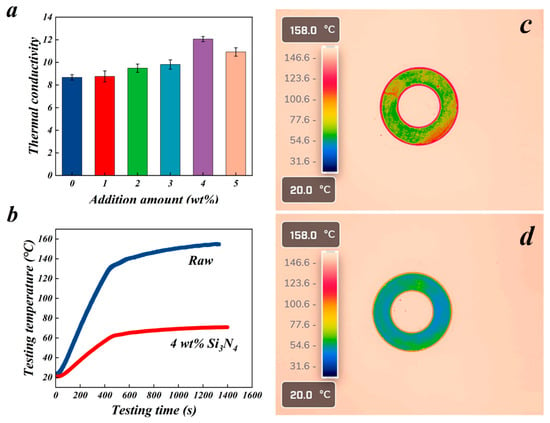
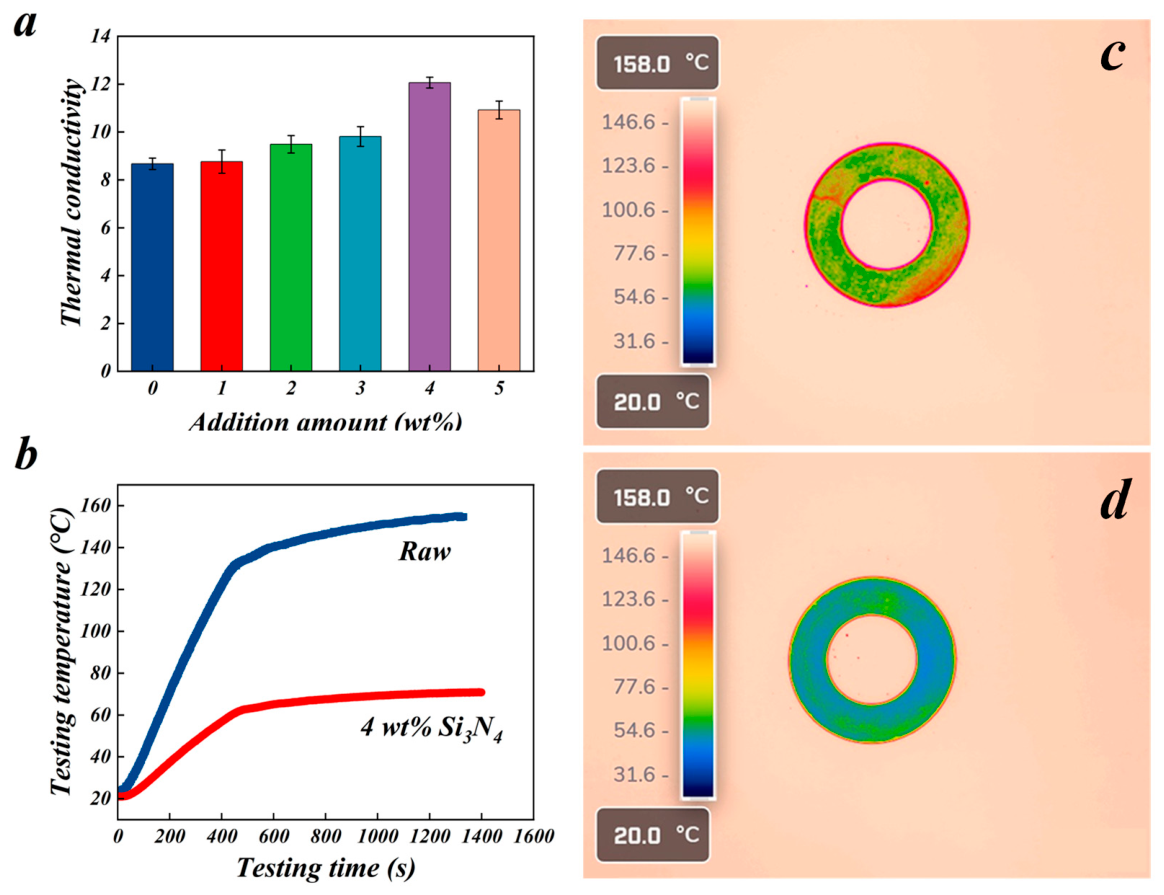
In the practical service of high-frequency power magnetic devices, the Joule heat generated from core loss conversion, if not promptly dissipated through effective thermal conduction, will give rise to escalating internal temperature gradients and the formation of localised hot spots, which in turn trigger temperature-dependent permeability drift and accelerated insulation-layer degradation. Thermal transport capability therefore constitutes a dimension of equal importance to electromagnetic performance in appraising the Si3N4-s coating effect. The pure Fe SMCs exhibit a thermal conductivity of 8.67 W·m−1·K−1, which is markedly lower than that of dense α-Fe owing to the presence of particle boundaries, interfacial thermal resistance, the binder phase, and residual structural defects within the powder compact [38]. With increasing Si3N4-s content, the thermal conductivity initially increases gradually and reaches a maximum value of 12.07 W·m−1·K−1 at 4 wt.%, corresponding to an enhancement of approximately 39.1% relative to the pure Fe SMCs. The relatively limited increase at 1–3 wt.% is consistent with the incomplete lamellar coverage observed in Figure 2. As the Si3N4-s loading approaches 4 wt.%, the more continuous interparticle distribution of the nanosheets is favourable for establishing more effective heat-transfer pathways across particle boundaries. When the Si3N4-s content is further increased to 5 wt.%, the thermal conductivity decreases to 10.92 W·m−1·K−1, approximately 9.5% lower than that of the 4 wt.% specimen. This decrease is consistent with the localised nanosheet stacking and increased spatial heterogeneity observed by SEM/EDS, which may introduce additional interfacial thermal resistance and partially offset the beneficial contribution of the thermally conductive Si3N4-s phase. Therefore, the non-monotonic thermal-conductivity evolution is qualitatively consistent with the coating-morphology transition observed in Figure 2.
Infrared thermal imaging experiments furnish a visualised comparison of the thermal diffusion behaviour. Figure 7 characterises externally driven heat diffusion rather than electromagnetic self-heating; therefore, the temperature difference reflects thermal transport capability and cannot be directly calculated from the core-loss separation model without a fully coupled electromagnetic–thermal model and independently measured thermal boundary parameters. Under identical external heating conditions using a heating plate maintained at 158 °C, the surface temperature of the outer annular region of the 4 wt.% Fe/Si3N4 SMCs was approximately 61.3 °C, substantially lower than the approximately 152.3 °C recorded for the corresponding region of the pure Fe SMCs. The temperature–time profiles exhibit a nonlinear evolution towards a plateau, characteristic of transient heat diffusion under a constant external-temperature boundary. Accordingly, the lower thermal resistance of the 4 wt.% specimen facilitates more efficient lateral heat transfer from the centrally heated region towards the outer annular region [39]. In practical electromagnetic applications, this enhanced thermal diffusion capability would promote more rapid and uniform transport of the heat generated within the core towards its surface and external heat-sinking structures, thereby mitigating localised hot spots and non-uniform temperature distributions.
Figure 7.
Thermal transport characteristics of pure Fe SMCs and Fe/Si3N4 SMCs: (a) thermal conductivity as a function of Si3N4-s content; (b) surface temperature–time profiles of the pure Fe and 4 wt.% specimens under external heating at 158 °C; (c,d) corresponding infrared thermal images of the pure Fe and 4 wt.% specimens, respectively.
Taken together, the 1–2 wt.% specimens provide the lowest core-loss levels, whereas the 4 wt.% specimen combines the highest volume resistivity and peak thermal conductivity with substantially lower core loss than the pure Fe SMCs while retaining an acceptable magnetic response. Therefore, the 4 wt.% Si3N4-s loading is regarded as the most favourable overall composition within the investigated range rather than the optimum for every individual performance metric.
To further position the integrated performance of the present Fe/Si3N4 SMCs, Table 3 compares their electrical resistivity, core loss and thermal conductivity with those of representative Fe-based SMCs reported in the recent literature. Since core loss is strongly dependent on magnetic flux density and frequency, the corresponding measurement conditions are explicitly listed for comparison. The 4 wt.% Fe/Si3N4 SMC exhibits a volume resistivity of approximately 100.8 Ω·m, a core loss of 600.2 kW·m−3 at 50 mT/100 kHz, and a thermal conductivity of approximately 12.1 W·m−1·K−1. Although several reported SMC systems exhibit superior performance in an individual property, the present pure-Fe-based composite provides a favourable overall balance among electrical insulation, core-loss suppression and thermal transport.
Table 3.
Comparison of electrical resistivity, core loss and thermal conductivity of representative Fe-based soft magnetic composites.
4. Conclusions
The key conclusions of this work are summarised as follows:
- (1)
- KH580 functionalisation preserved the α-Si3N4 crystal structure while introducing an organosilane functional layer onto the Si3N4 nanosheets. XPS analysis suggests plausible local N–Fe and Fe–S interfacial interactions between Si3N4-s and the Fe surface.
- (2)
- The Fe/Si3N4 SMC containing 4 wt.% Si3N4-s provided the most favourable overall electromagnetic balance within the investigated composition range, achieving the highest volume resistivity of approximately 100.8 Ω·m while maintaining a core loss of approximately 600.2 kW·m−3 at 50 mT and 100 kHz, a saturation magnetisation of approximately 195.4 emu/g, and a real part of effective permeability (μe′) of approximately 72.4 at 100 kHz.
- (3)
- The 4 wt.% Si3N4-s specimen achieved the highest thermal conductivity of approximately 12.1 W·m−1·K−1, representing an enhancement of approximately 39.1% relative to the pure Fe SMCs. Infrared thermography further provided a complementary visualisation of the transient surface-temperature response under external heating.
From an application perspective, the present Fe/Si3N4 SMCs show potential for cost-sensitive magnetic components operating in the 10–100 kHz range, such as PFC inductors, EMI filters, and medium-to-low-frequency line-filter cores. Nevertheless, the present study remains limited to laboratory-scale specimens and a Si3N4-s composition interval of 1 wt.%, so the 4 wt.% loading should be regarded as the optimum overall composition within the investigated range rather than the optimum for every individual performance metric. Long-term thermal cycling, hygrothermal ageing, mechanical reliability, large-scale coating uniformity, and electromagnetic self-heating under actual device operating conditions have not yet been systematically evaluated and require further investigation.
Author Contributions
Conceptualization, S.C.; writing—original draft preparation, S.C.; methodology, Z.F.; project administration, K.W., G.J. and C.L.; Funding acquisition, C.L. All authors have read and agreed to the published version of the manuscript.
Funding
This research was funded by the Anhui Province Major Industrial Innovation Plan (AHZDCYCX-LSDT2023-01).
Data Availability Statement
The raw data supporting the conclusions of this article will be made available by the authors on request.
Conflicts of Interest
The authors declare no conflicts of interest.
References
- Shokrollahi, H.; Janghorban, K. Soft magnetic composite materials (SMCs). J. Mater. Process. Technol. 2007, 189, 1–12. [Google Scholar] [CrossRef] [Scilit]
- Périgo, E.A.; Weidenfeller, B.; Kollár, P.; Füzer, J. Past, present, and future of soft magnetic composites. Appl. Phys. Rev. 2018, 5, 031301. [Google Scholar] [CrossRef] [Scilit]
- Gutfleisch, O.; Willard, M.A.; Brück, E.; Chen, C.H.; Sankar, S.G.; Liu, J.P. Magnetic materials and devices for the 21st century: Stronger, lighter, and more energy efficient. Adv. Mater. 2011, 23, 821–842. [Google Scholar] [CrossRef] [Scilit] [PubMed]
- Bertotti, G. General properties of power losses in soft ferromagnetic materials. IEEE Trans. Magn. 1988, 24, 621–630. [Google Scholar] [CrossRef] [Scilit]
- Taghvaei, A.H.; Shokrollahi, H.; Janghorban, K.; Abiri, H. Eddy current and total power loss separation in the iron-phosphate-polyepoxy soft magnetic composites. Mater. Des. 2009, 30, 3989–3995. [Google Scholar] [CrossRef] [Scilit]
- Pošković, E.; Franchini, F.; Ferraris, L.; Fracchia, E.; Bidulska, J.; Carosio, F.; Bidulsky, R.; Actis Grande, M. Recent advances in multi-functional coatings for soft magnetic composites. Materials 2021, 14, 6844. [Google Scholar] [CrossRef] [Scilit] [PubMed]
- Sunday, K.J.; Taheri, M.L. Soft magnetic composites: Recent advancements in the technology. Met. Powder Rep. 2017, 72, 425–429. [Google Scholar] [CrossRef] [Scilit]
- Peng, Y.; Yi, Y.; Li, L.; Yi, J.; Nie, J.; Bao, C. Iron-based soft magnetic composites with Al2O3 insulation coating produced using sol–gel method. Mater. Des. 2016, 109, 390–395. [Google Scholar] [CrossRef] [Scilit]
- Huang, M.; Wu, C.; Jiang, Y.; Yan, M. Evolution of phosphate coatings during high-temperature annealing and its influence on the Fe and FeSiAl soft magnetic composites. J. Alloys Compd. 2015, 644, 124–130. [Google Scholar] [CrossRef] [Scilit]
- Luo, D.; Wu, C.; Yan, M. Incorporation of the Fe3O4 and SiO2 nanoparticles in epoxy-modified silicone resin as the coating for soft magnetic composites with enhanced performance. J. Magn. Magn. Mater. 2018, 452, 5–9. [Google Scholar] [CrossRef] [Scilit]
- Wu, S.; Sun, A.; Zhai, F.; Wang, J.; Zhang, Q.; Xu, W.; Logan, P.; Volinsky, A.A. Annealing effects on magnetic properties of silicone-coated iron-based soft magnetic composites. J. Magn. Magn. Mater. 2012, 324, 818–822. [Google Scholar] [CrossRef] [Scilit]
- Huang, Z.Y.; Huang, H.Q.; He, H.; Li, K.X.; Wu, Z.Y.; Wang, R. Fabrication and soft magnetic properties of Fe–Si–Cr composites with double-insulating layers suitable for high-frequency power applications. Magnetochemistry 2023, 9, 145. [Google Scholar] [CrossRef] [Scilit]
- Fan, X.; Wang, J.; Wu, Z.; Li, G. Core–shell structured FeSiAl/SiO2 particles and Fe3Si/Al2O3 soft magnetic composite cores with tunable insulating layer thicknesses. Mater. Sci. Eng. B 2015, 201, 79–86. [Google Scholar] [CrossRef] [Scilit]
- Hsiang, H.I.; Wang, S.K.; Chen, C.C. Electromagnetic properties of FeSiCr alloy powders modified with amorphous SiO2. J. Magn. Magn. Mater. 2020, 514, 167151. [Google Scholar] [CrossRef] [Scilit]
- Zheng, Z.; Wang, X.; Li, S.; Peng, K. Improved magnetic and thermal conductivity performance of FeSi soft magnetic composites by adding h-BN. Mater. Sci. Eng. B 2025, 312, 117869. [Google Scholar] [CrossRef] [Scilit]
- Fan, X.; Jin, Q.; Yang, Z.; Wu, W.; Li, G.; Luo, Z. High permeability and low magnetic loss of Fe–Si/BN soft magnetic composites with layered structure. J. Mater. Sci. 2025, 60, 8015–8025. [Google Scholar] [CrossRef] [Scilit]
- Xu, T.; Qin, F.; Liu, W.; Hu, F.; Gu, X.; Zhang, Z.; Su, H.; Zhang, X. Dual optimization of core loss and thermal conductivity in FeSiAl soft magnetic composites by SiO2/h-BN bilayer insulating coating. J. Alloys Compd. 2026, 1071, 188875. [Google Scholar] [CrossRef] [Scilit]
- Peng, H.; Xie, Y.; Zhu, D.; Wang, L.; Han, L.; Cai, Y. Low-loss Fe@BN magnetic powder cores enabled by thiol-functionalised boron nitride interfacial coating. Magnetochemistry 2026, 12, 71. [Google Scholar] [CrossRef] [Scilit]
- Wang, R.; Huang, H.; Kong, H.; Xia, A.; Zhou, L.; Wu, Z.; Gao, X. FeSi@BN soft magnetic composites inspired by fried glutinous rice balls: A core–shell design for enhanced magnetic and thermal performance in high-frequency power applications. Chem. Eng. J. 2025, 515, 163501. [Google Scholar] [CrossRef] [Scilit]
- Wang, R.; Li, K.; Liu, Y.; Wu, Z.; Wu, X.; Li, S.; Liu, L. Design and fabrication of FeSiCr@BN soft magnetic composites with improved thermal management and core loss performance. J. Alloys Compd. 2025, 1026, 180342. [Google Scholar] [CrossRef] [Scilit]
- Riley, F.L. Silicon nitride and related materials. J. Am. Ceram. Soc. 2000, 83, 245–265. [Google Scholar] [CrossRef] [Scilit]
- Hirao, K.; Zhou, Y.; Hyuga, H.; Ohji, T.; Kusano, D. High thermal conductivity silicon nitride ceramics. J. Korean Ceram. Soc. 2012, 49, 380–384. [Google Scholar] [CrossRef] [Scilit]
- Hampshire, S. Silicon nitride ceramics—Review of structure, processing and properties. J. Achiev. Mater. Manuf. Eng. 2007, 24, 43–50. [Google Scholar]
- Taghvaei, A.H.; Ebrahimi, A.; Ghaffari, M.; Janghorban, K. Investigating the magnetic properties of soft magnetic composites based on mechanically alloyed nanocrystalline Fe–5 wt% Ni powders. J. Magn. Magn. Mater. 2011, 323, 149–155. [Google Scholar] [CrossRef] [Scilit]
- Golberg, D.; Bando, Y.; Huang, Y.; Terao, T.; Mitome, M.; Tang, C.; Zhi, C. Boron nitride nanotubes and nanosheets. ACS Nano 2010, 4, 2979–2993. [Google Scholar] [CrossRef] [Scilit] [PubMed]
- Arkles, B. Tailoring surfaces with silanes. Chemtech 1977, 7, 766–778. [Google Scholar]
- Pearson, R.G. Hard and soft acids and bases. J. Am. Chem. Soc. 1963, 85, 3533–3539. [Google Scholar] [CrossRef] [Scilit]
- Wang, C.M.; Pan, X.; Rühle, M.; Riley, F.L.; Mitomo, M. Silicon nitride crystal structure and observations of lattice defects. J. Mater. Sci. 1996, 31, 5281–5298. [Google Scholar] [CrossRef] [Scilit]
- Diekmann, W.; Panzner, G.; Grabke, H.J. The bonding state of nitrogen segregated on Fe(100) and on iron nitrides Fe4N and Fe2N studied by XPS. Surf. Sci. 1989, 218, 507–518. [Google Scholar] [CrossRef] [Scilit]
- Laibinis, P.E.; Whitesides, G.M.; Allara, D.L.; Tao, Y.T.; Parikh, A.N.; Nuzzo, R.G. Comparison of the structures and wetting properties of self-assembled monolayers of n-alkanethiols on the coinage metal surfaces, copper, silver, and gold. J. Am. Chem. Soc. 1991, 113, 7152–7167. [Google Scholar] [CrossRef] [Scilit]
- Anhalt, M. Systematic investigation of particle size dependence of magnetic properties in soft magnetic composites. J. Magn. Magn. Mater. 2008, 320, e366–e369. [Google Scholar] [CrossRef] [Scilit]
- Silveyra, J.M.; Ferrara, E.; Huber, D.L.; Monson, T.C. Soft magnetic materials for a sustainable and electrified world. Science 2018, 362, eaao0195. [Google Scholar] [CrossRef] [Scilit] [PubMed]
- Wang, P.; Zhu, Z.Q.; Liu, J.Q.; Wang, C.F.; Pang, J.; Zhang, J.Q. Industrial-scale fabrication of FeSiCr magnetic powder cores with high magnetic permeability and low loss. J. Alloys Compd. 2023, 962, 171095. [Google Scholar] [CrossRef] [Scilit]
- Zhao, G.; Wu, C.; Yan, M. Enhanced magnetic properties of Fe soft magnetic composites by surface oxidation. J. Magn. Magn. Mater. 2016, 399, 51–57. [Google Scholar] [CrossRef] [Scilit]
- Wu, Z.; Liu, L.; Hu, Z.; Wang, R.; Liu, Y.; Sun, Z. Synergistic enhancement of thermal conductivity and magnetic performance in FeSiAl soft magnetic composites via in-situ growth of Al2O3 insulating layer. Colloids Surf. A Physicochem. Eng. Asp. 2026, 736, 139673. [Google Scholar] [CrossRef] [Scilit]
- Wang, J.; Li, K.; Zhao, X.; Zhao, H.; Liu, L.; Wang, R.; Wu, Z. Synergistic fabrication of FeSiAl/Si3N4 soft magnetic composites by two-step plasma-assisted ball milling and magnetic-field-induced orientation. Mater. Des. 2026, 267, 116420. [Google Scholar] [CrossRef] [Scilit]
- Bertotti, G. Physical interpretation of eddy current losses in ferromagnetic materials. I. Theoretical considerations. J. Appl. Phys. 1985, 57, 2110–2117. [Google Scholar] [CrossRef] [Scilit]
- Hasselman, D.P.H.; Johnson, L.F. Effective thermal conductivity of composites with interfacial thermal barrier resistance. J. Compos. Mater. 1987, 21, 508–515. [Google Scholar] [CrossRef] [Scilit]
- Wu, C.; Huang, M.; Luo, D.; Jiang, Y.; Yan, M. SiO2 nanoparticles enhanced silicone resin as the matrix for Fe soft magnetic composites with improved magnetic, mechanical and thermal properties. J. Alloys Compd. 2018, 741, 35–43. [Google Scholar] [CrossRef] [Scilit]
- Huang, S.; Ma, J.; Liu, Y.; He, H.; Lyu, P.; Huang, H.; Dai, B. Regulation of interface compatibility and performance in soft magnetic composites with inorganic insulation layers by FePO4 intermediate transition layer. Molecules 2024, 29, 5281. [Google Scholar] [CrossRef] [Scilit] [PubMed]
- Zheng, Z.; Wang, X.; Peng, K. Optimization of magnetic and thermal performance of FeSi soft magnetic composites by hybrid coating of epoxy silane resin and tetrapod ZnO. Ceram. Int. 2026, in press. [Google Scholar] [CrossRef] [Scilit]
- Xie, Q.; Yu, H.; Yuan, H.; Han, G.; Chen, X.; Liu, Z. Enhanced magnetic properties and thermal conductivity of FeSiCr soft magnetic composite with Al2O3 insulation layer prepared by sol–gel process. Metals 2023, 13, 813. [Google Scholar] [CrossRef] [Scilit]
- Wang, J.; Zhao, H.; Wang, R.; Li, K.; Liu, L.; Wu, Z. Bulk-phase synergistic regulation of Fe–Si–Al/AlN soft magnetic composites via plasma-assisted ball milling for enhanced magnetic and thermal management performance. Ceram. Int. 2026, in press. [Google Scholar] [CrossRef] [Scilit]
- Li, Z.; Zhang, L.; Zhao, J.; Hu, H.; Sun, Y.; Liu, X.; Zhang, X. Low core loss and high DC bias performance of FeSiAl soft magnetic composites cores with hybrid insulating layers of MgO/SiO2. Ceram. Int. 2024, 50, 23744–23753. [Google Scholar] [CrossRef] [Scilit]
- Cheng, H.; Li, X.; Zhang, L.; Shen, F.; Liu, X.; Sun, Y. Ultra-low core loss FeSiAl soft magnetic composites with in-situ double oxidation layers of outer Fe3O4 layer and inner super-thin Al2O3/SiO2 hybrid layer. Ceram. Int. 2023, 49, 26568–26577. [Google Scholar] [CrossRef] [Scilit]

Disclaimer/Publisher’s Note: The statements, opinions and data contained in all publications are solely those of the individual author(s) and contributor(s) and not of MDPI and/or the editor(s). MDPI and/or the editor(s) disclaim responsibility for any injury to people or property resulting from any ideas, methods, instructions or products referred to in the content. |
© 2026 by the authors. Licensee MDPI, Basel, Switzerland. This article is an open access article distributed under the terms and conditions of the Creative Commons Attribution (CC BY) license.