


Abstract
Two diastereoisomers of bis(mepirizole)bis(isothiocyanato-κ,N)cobalt(II) (1 and 2) are isolated from the reaction of cobalt(II) thiocyanate and mepirizole, depending on the crystallization solvent (ethanol, 1; acetonitrile, 2). In both crystal structures, the Co(II) ions exhibit distorted octahedral [CoN4N′2] environment. The analysis of the packing frameworks shows a cooperative relationship between non-classical H-bonds C(sp3)-H···X (X = N, O, S, π) and π-hole bonds, which control the arrangement of the supramolecular 3D networks. The values of the shortest intermolecular metal–metal separation are 8.584(2) Å in 1 and 8.249(1) Å in 2. Both diastereoisomers exhibit magnetic behavior typical of mononuclear Co(II) systems with significant zero-field splitting (ZFS) values, with D being 75.8(1) and 52.9(2) cm−1 for 1 and 2, respectively. Q-band EPR studies confirm the positive value for the D parameters for both compounds. Alternating current dynamic susceptibility measurements show that 1 and 2 exhibit field-induced slow relaxation of the magnetization, which is reminiscent of single-ion magnet (SIM) behavior.
1. Introduction
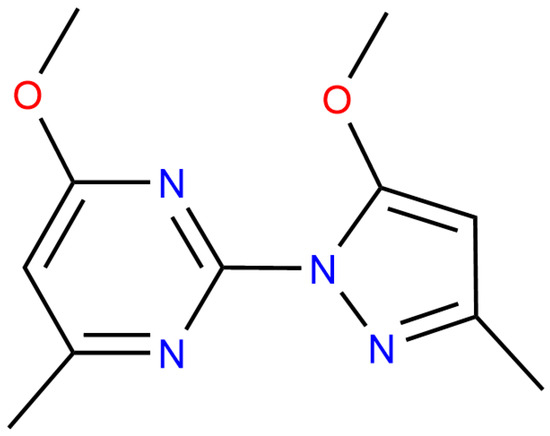
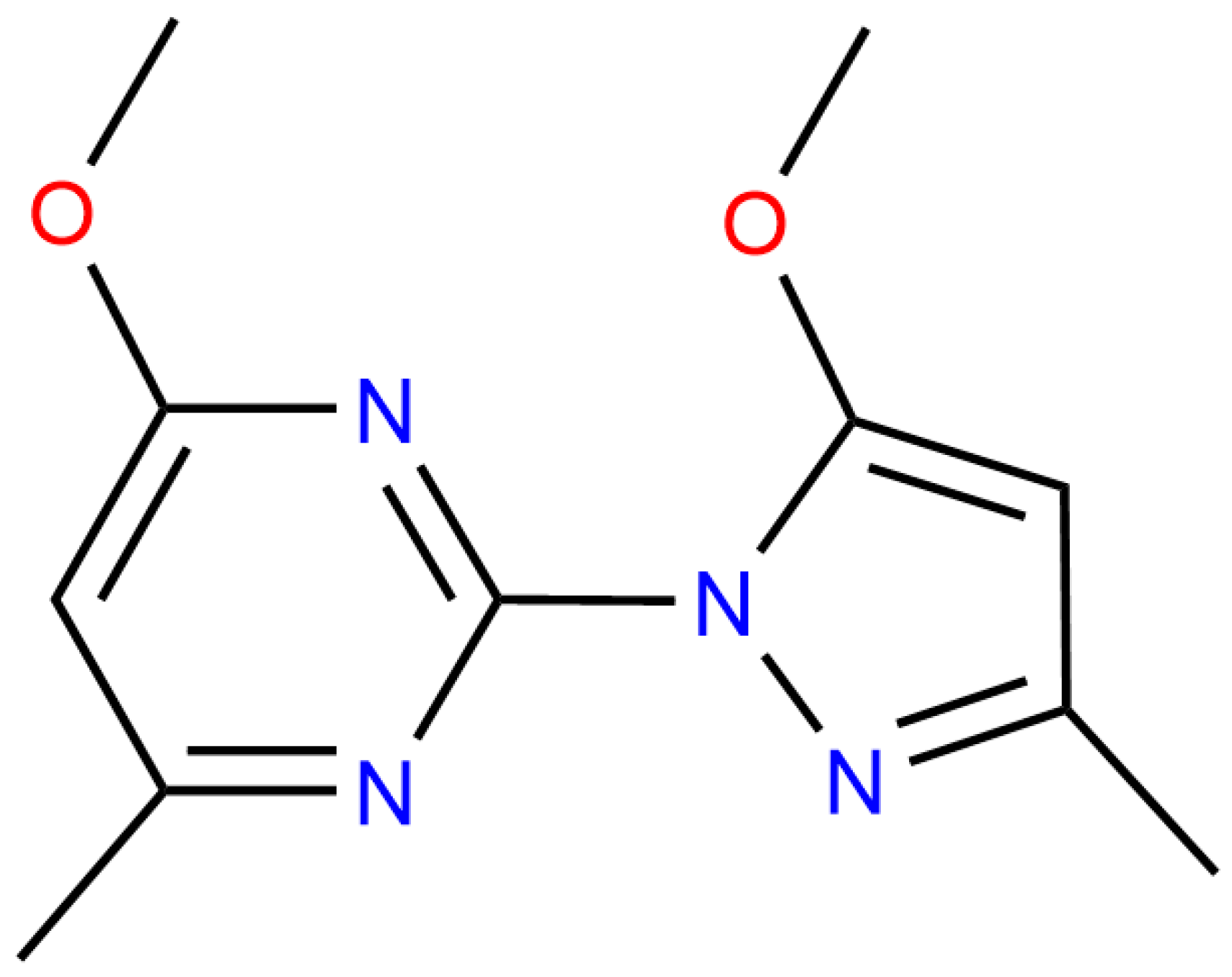
Mepirizole, or 4-methoxy-2-(5-methoxy-3-methyl-1H-pyrazol-1-yl)-6-methylpyrimidine, is a non-steroidal anti-inflammatory drug which has been investigated for decades [1,2,3]. In addition to its biological activity, this pyrimidine-pyrazole derivative molecule has been studied in coordination chemistry as a bidentate ligand, through two free nitrogen atoms, one from each ring, with significant steric hindrance in the formation of metal complexes (Scheme 1) [4,5,6,7,8,9,10,11].
Scheme 1.
Molecular structure of mepirizole (mep).
The mepirizole ligand has allowed the construction of systems of variable dimensionality generated from [L-M-X] and/or [L-M-X-L] molecular building blocks (MBBs), where L is the mepirizole, M is a 3d metal ion and X is an extended-bridging ligand as oxalate, squarato or pyrazolato [4,5,6,7,8,9,10]. Thus, we have previously reported the structural, spectroscopic and magnetic characterization of some transition metal networks ranging from mononuclear entities [4,5,6], through dinuclear compounds [7,8,9], to polymeric systems [10]. Significantly, no single-ion magnet (SIM) based on the mepirizole molecule has been reported up to date.
One of the current challenges in the design of new molecular materials is the preparation and characterization of supramolecular metal–organic materials (MOMs), in which the assembly of MBBs through intermolecular interactions can afford non-covalent networks. The presence of non-conventional interactions (NCIs) in MOMs has been relatively little studied and their role in the modulation of magnetic properties is in many cases controversial. Thus, the study of NCIs can become a difficult task in terms of their definition and type and also of their influence on the magnetic properties of crystalline solids [12,13,14,15,16,17,18,19,20,21,22,23,24,25].
Structural studies conducted in numerous systems involving N-containing heterocyclic ligands frequently show the formation of intricate structural frameworks supported by weak/moderate NCIs, such as non-classical H-bonds [26,27,28] and π-hole bonds [29,30], such as π···π interactions [31,32,33,34,35,36,37,38] and/or lone-pair···π/anion···π contacts [39,40,41,42,43,44,45,46,47,48,49,50,51,52]. In this context, the chemistry of multifunctional N-containing heterocyclic derivatives (especially those that combine the presence of both diazoles and diazines rings) has been a focus of interest in recent decades, partially due to the role that these systems develop in many biological processes [53]. Their coordinative capacity in conjunction with their proven ability to take part simultaneously in several NCIs provide the directional motifs necessary to lead to the self-assembly of new metallo-organic networks with interesting properties [54,55,56,57,58,59].
In the last decades, the study on the synthesis and characterization of the so-called single-molecule magnets (SMMs) and single-chain magnets (SCMs) has received notable attention in various research areas, particularly in the coordination chemistry and materials science fields [60,61,62,63,64,65,66,67,68]. In recent years, great attention has been focused on the characterization of coordination compounds in which the MBBs are neutral or charged entities with a single spin carrier with high magnetic anisotropy. When SMM-based systems show characteristic behavior of a single ion, they are known as single-ion magnets (SIMs). These requirements mean that certain 3–5d and 4f ions can be considered as potential candidates for the design and characterization of this type of systems [69,70,71,72,73,74,75,76]. One of the candidates that has aroused the most interest is the octahedral high-spin Co(II) (S = 3/2). The relative plasticity of their coordination sphere, the variability of zero-field splitting (ZFS) values, and the versatility of coordination environments are factors that make cobalt(II) ion an excellent candidate for building SIM-based systems [77,78,79,80,81,82,83,84,85,86,87,88,89,90].
We herein report the preparation, crystal structure, and magnetic characterization of two diastereoisomers of Co(II) based on mepirizole (mep) and thiocyanate ligands, with formula [Co(mep)2(NCS)2] (1 and 2). The analysis of their crystal lattices shows that these are supported by weak C(sp3)-H···X (X = N, O, S, π) interactions as well as π-hole contacts, the latter being those that would determine the differences between both supramolecular structures. The ac magnetic susceptibility study performed on 1 and 2 reveals field-induced slow relaxation of magnetization, which is typical of SIM behavior in both systems. Hence, 1 and 2 are the first examples of SIM systems based on the mepirizole molecule that have been reported up to date.
2. Results and Discussion
2.1. Description of the Crystal Structures
Compounds 1 and 2 are mononuclear systems that crystallize as purple crystals in the triclinic system (space group Pī) and as pink crystals in the monoclinic system (space group P21/n), respectively. Compound 1 is isostructural with the previously reported manganese(II) derivative of formula [Mn(mep)2(NCS)2] [6]. The crystal structure of both compounds is built up of isolated [Co(mep)2(NCS)2] molecules (or molecular building blocks, MBBs) connected through an extended and intricate π···π and weak C-H···X (X = N, O, S, π) interactions network. Compounds 1 and 2 are achiral, as they are centrosymmetric structures.
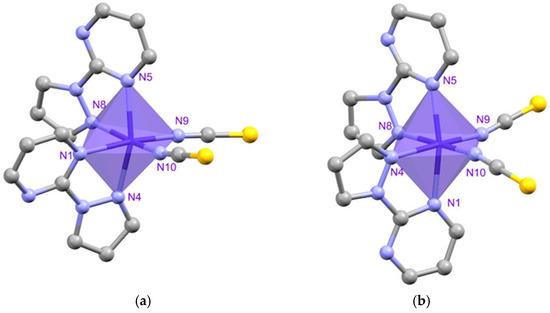
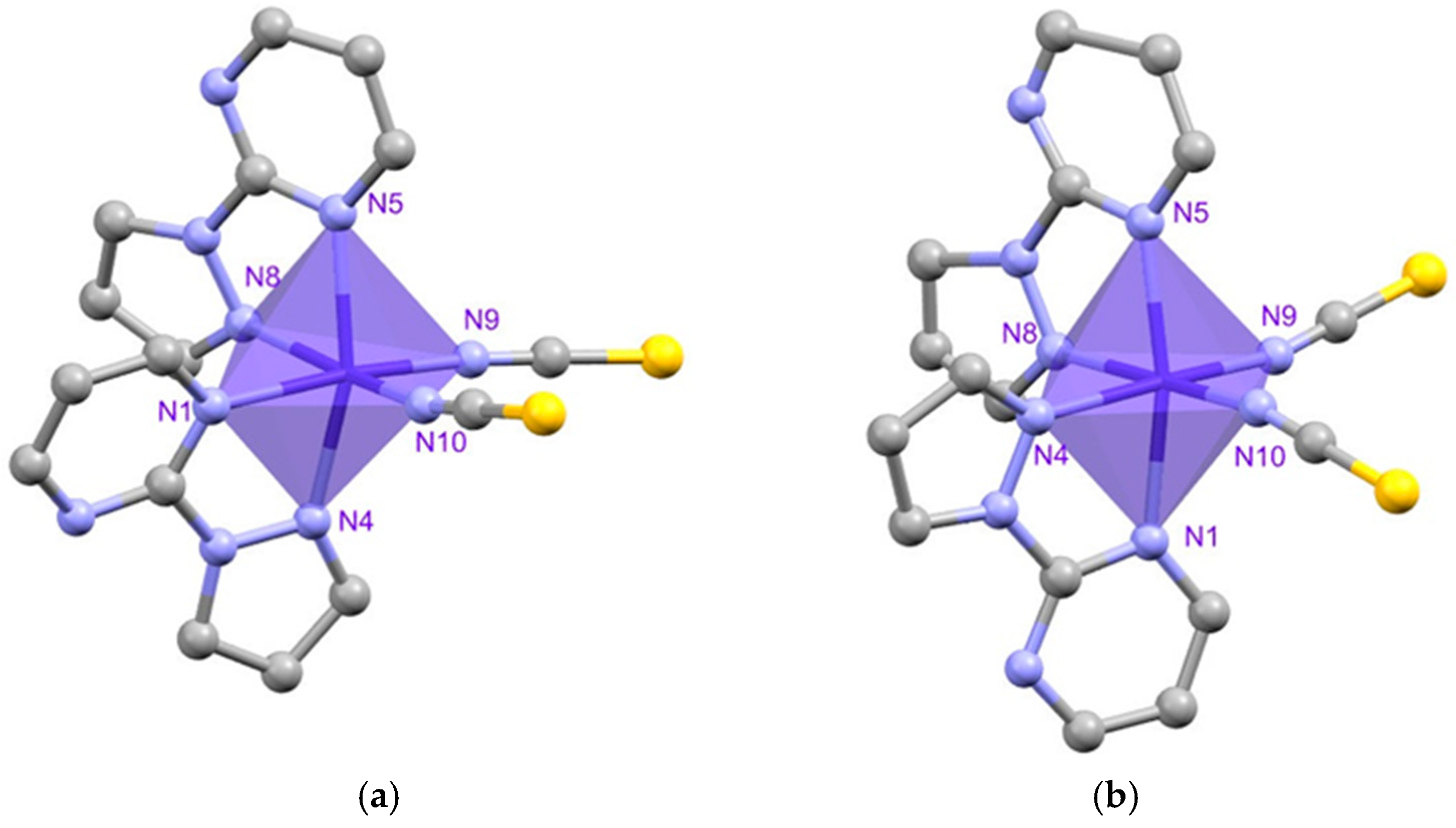
Figure 1 shows a simplified view of the mononuclear [Co(mep)2(NCS)2] entities with detailed labels of the atoms (Figure S1 displays a perspective view of the complexes with more extended labeled atoms). Selected bond distances and angles are listed in Table S1. Each cobalt(II) ion in 1 and 2 is surrounded by six nitrogen atoms, belonging to two thiocyanato κN ligands groups in the cis position and two mepirizole bidentate (κ2N,N’) ligands. The Co-N(mep) bond lengths (with mean values of approximately 2.20(1) (1) and 2.17(1) Å (2)) are longer than those corresponding to the Co-NCS ones (with mean values of ca. 2.06(1) and ca. 2.05(1) Å for 1 and 2, respectively), which describe a distorted octahedral environment around the metal ion (with CoN6 chromophores in both complexes).
Figure 1.
(a) Diastereoisomer of [Co(mep)2(NCS)2] (1) as cis-isothiocyanato-κN and cis-Npymd; (b) diastereoisomer of [Co(mep)2(NCS)2] (2) as cis-isothiocyanato-κN and cis-Npyz (see text). Aromatic ring substituents and H atoms have been omitted for clarity. Only the labels of the coordinated N atoms are displayed.
In 1, a pyrimidine nitrogen atom (Npymd) and a pyrazole nitrogen atom (Npyz) of two different ligand molecules, along with two nitrogen atoms from two thiocyanato-κN ligands, define the equatorial plane around the metal ion. However, in 2, the equatorial plane is made up of two pyrazole nitrogen (Npyz) atoms and the two nitrogen atoms from the coordinated thiocyanates. The axial positions are occupied by two nitrogen atoms, Npymd and Npyz in 1 and two Npymd in 2 (Figure 1).
Consequently, these mononuclear octahedral [Co(mep)2(NCS)2] (1 and 2) complexes are diastereoisomers systems, as they are non-superimposable and non-mirror images [91,92]. The thiocyanate anions are nearly linear, with a mean NCS angle value of 179.1(1)° in 1 and 179.4(1)° in 2. All the molecular parameters observed for the mepirizole molecules are similar to those previously found in other mepirizole-containing complexes [4,5,6,7,8,9,10,11]. The dihedral angles between the pyrazole and pyrimidine rings vary between 11.5(1)° and 12.4(1)° in 1 and between 13.0(1)° and 14.0(1)° in 2. The octahedral distortion can be described through the Δ parameter (Δ = 0 for a regular octahedron and Δ = 1 for a trigonal prism) defined by Muetterties and Guggenberger [93]. Compounds 1 and 2 show Δ values of approximately 0.07 and 0.03, respectively. This indicates a slightly distorted octahedral geometry for both polyhedral systems, being more strongly marked in 1, which would affect the magnetic properties. This distortion could be produced by the bite angles of the mepirizole ligand on the metal ion (these values are 74.0(1)° for 1 and 76.1(1)° for 2, which are far from the value for a regular octahedron (90°)).
The crystal packing of both crystal structures is mainly determined by the interplay of non-classical H-bonds and π-hole bonds (π···π or anion···π interactions), but with subtle differences. With regard to the non-classical H-bonds network, the only possible H-donors are the groups C(sp2)-H (from pyrimidine and pyrazole rings) and C(sp3)-H (from methyl groups). On the other hand, the possible H-acceptors are the oxygen atoms (from methoxide groups), the nitrogen atoms (from heterocyclic rings as well as the thiocyanate groups) and the sulfur atoms from the thiocyanate ligand. Additionally, weak C-H···π interactions may contribute to the stabilization of the supramolecular framework. In the characterized compounds, only evidence of C(sp3)-H···X contacts (X = N, O, S, π) has been found. It must be pointed out that the main differences observed in the three-dimensional frameworks of 1 and 2 are the presence of significant π···π interactions in 1, but not in 2, and the presence of NCS···π contacts in 2, but not in 1 (Figures S2 and S3).
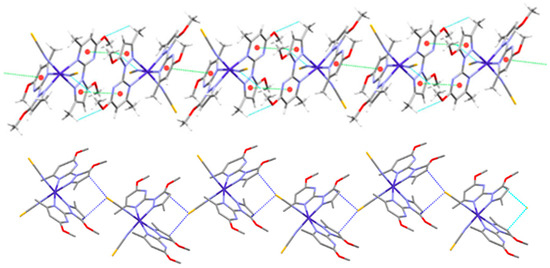
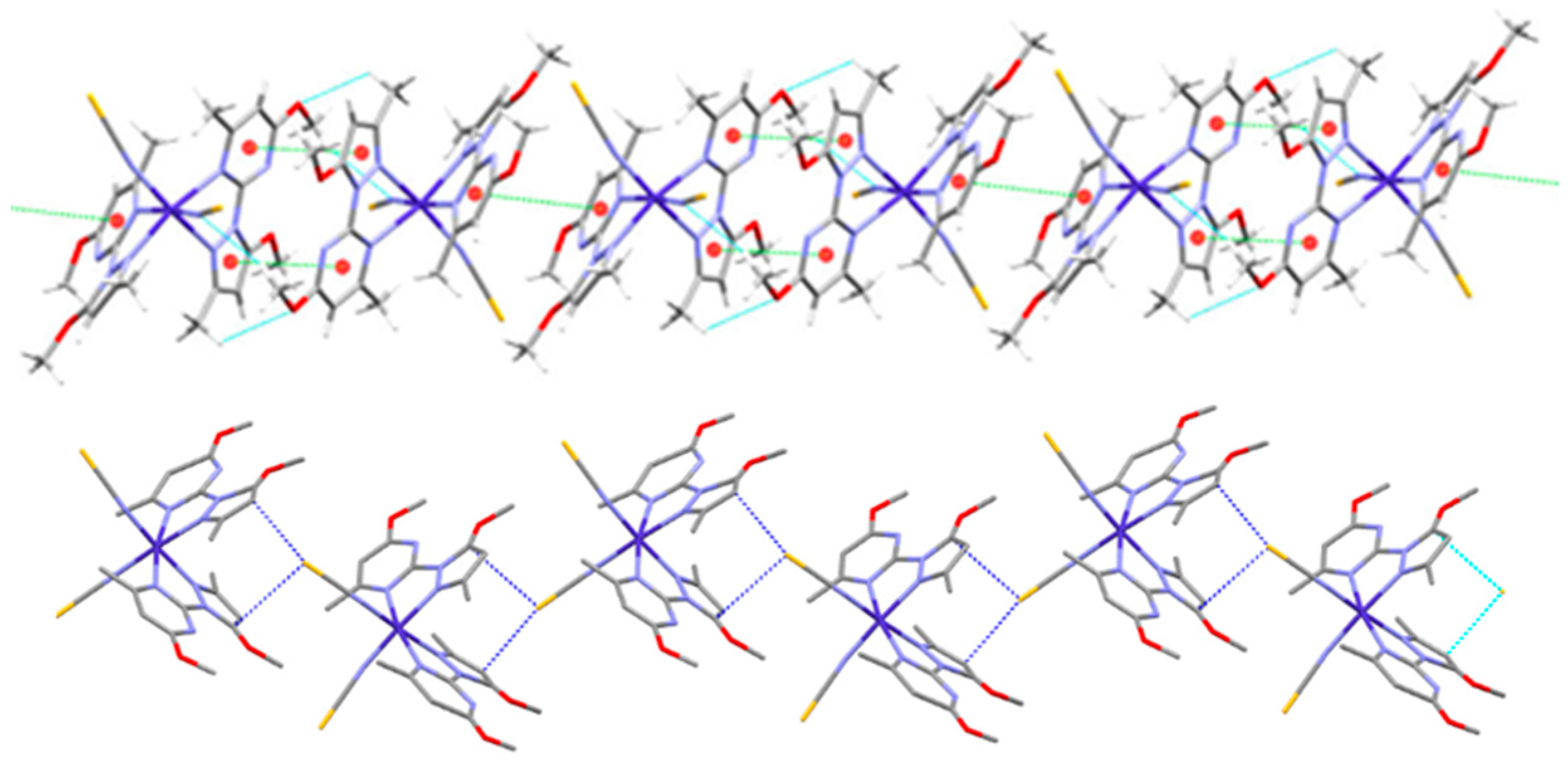
Packing of the MMBs in the crystals is mainly controlled by offset face-to-face (OFF) π–π interactions involving pyrazole and pyrimidine aromatic rings from mepirizole, with significant differences between both compounds. Therefore, in the structure of 1, each [Co(mep)2(NCS)2] entity is joined to a centrosymmetrically related one by means of two OFF π(pyrazole)···π(pyrimidine) interactions (centroid-to-centroid distance = 3.42(1) Å and plane-to-plane distance = 3.66(1) Å) (Figure 2 and Figure S2). The interdinuclear Co···Co distance is ca. 8.58(2) Å. In addition, four weak C-H···X (X = N, O) interactions contribute to stabilize the dinuclear entities (Table S1). Then, these dimers are further connected to each other through a weaker OFF π(pyrimidine)···π(pyrimidine) interaction to afford infinite chains running parallel to the [101] direction, with the shortest intermetallic Co···Co separation being ca. 10.62(2) Å (Figure 2).
Figure 2.
View of the π···π interactions (dotted green line) between adjacent [Co(mep)2(NCS)2] entities generating a 1D structure along the [101] direction in 1 (top). View of the weak C-H···S (dotted blue line) interactions between neighboring [Co(mep)2(NCS)2] units showing the formation of a 1D structure running parallel to the [202] direction in 2 (bottom).
With regard to the packing of 2, the main interactions connecting the neighboring [Co(mep)2(NCS)2] entities are based on the C16-H16A···S2 interaction (Figure S3 and Table S1). This interaction forms infinite chains (the shortest interdinuclear Co···Co distance being ca. 8.25(1) Å) and is roughly running parallel to the [202] direction (Figure 2).
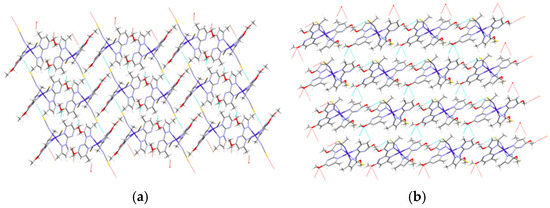
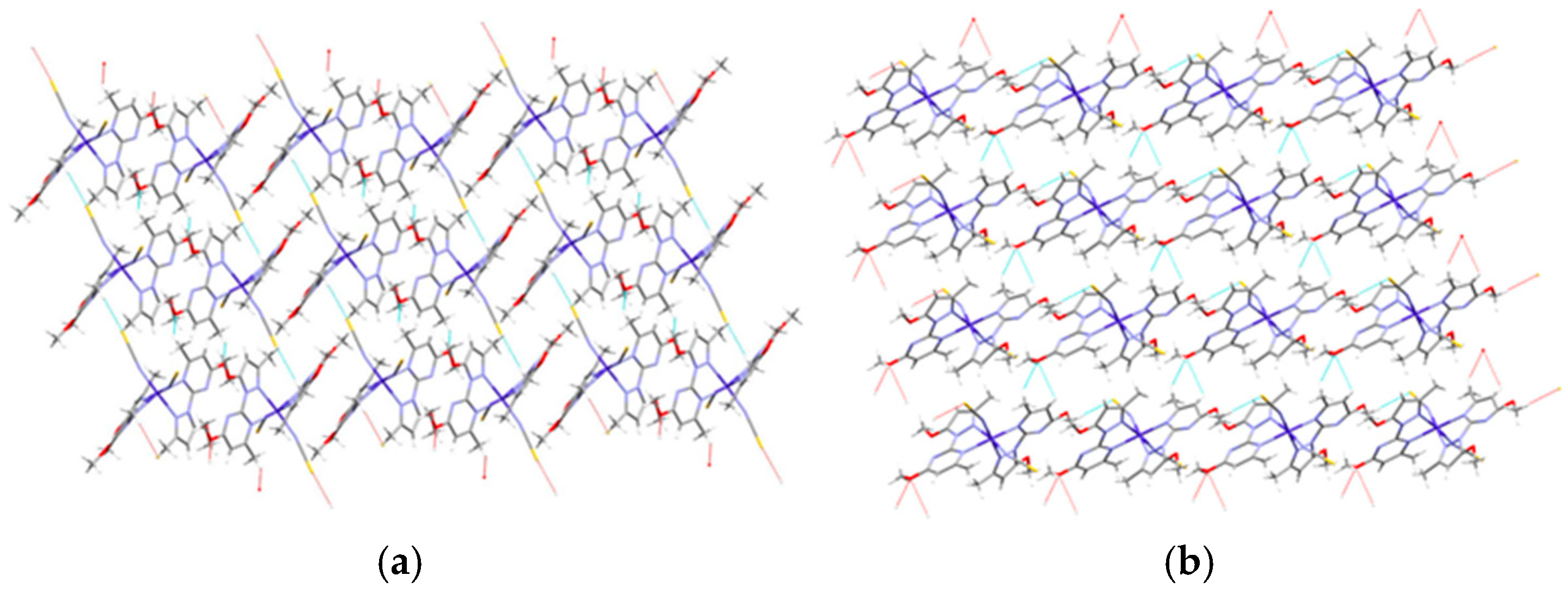
In both 1 and 2, additional weak C-H···X (X = N, O, S) interactions generate 2D networks (Figure 3). In 1, the C17-H17B···O3 and C11-H11B···S2 interactions connect the chains together into sheets parallel to the crystallographic ac plane. On the other hand, the layered structure in 2 is formed by cross-linking the above-described chains by means of the intermolecular C17-H17B···O1 and C14-H14A···O1 interactions (Figure 3).
Figure 3.
(a) View along the crystallographic b axis of the 2D network formed through intermolecular C-H···X [X = N, O and S] and π···π interactions in 1. (b) View along the crystallographic b axis of the 2D network formed mainly through intermolecular C-H···X [X = N, O and S] interactions in 2.
Finally, in both systems, the third dimension of the supramolecular assembly is generated by the connection of these layers via additional C-H···X (X = N, O, S) interactions, which contribute to the stabilization of the crystal structures of 1 and 2 (Table S1).
2.2. Magnetic Properties
2.2.1. Dc Magnetic Susceptibility
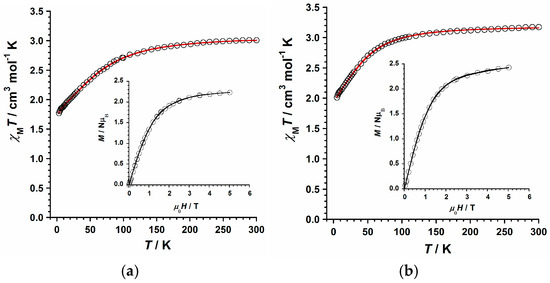
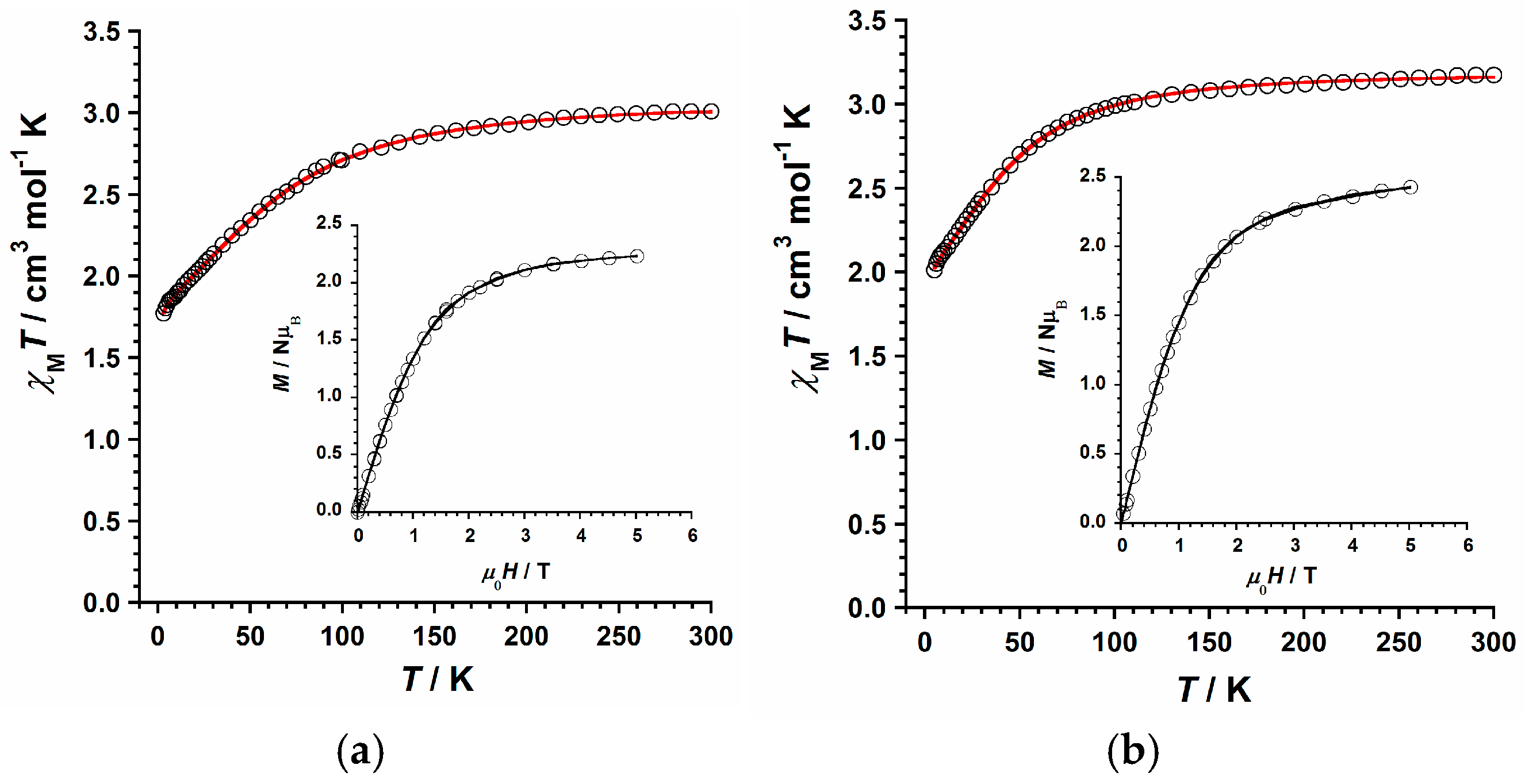
The dc magnetic susceptibility measurements were carried out on microcrystalline samples of 1 and 2 (Figure 4) in the 2–300 K temperature range and under an external magnetic field of 0.1 T. The thermal variation of the χMT product plots (χM being the molar magnetic susceptibility per mononuclear Co(II) unit) for 1 and 2 are shown in Figure 5a and Figure 5b, respectively. At 300 K, the χMT values are approximately 3.00 (1) and 3.17 cm3mol−1K (2), which are somewhat greater than that expected for a magnetically isolated center with S = 3/2 and g = 2.00, indicating a significant orbital contribution typical of mononuclear high-spin (HS) Co(II) complexes [85,86,87]. The χMT values in both compounds decrease with temperature slowly until they reach 100 K, then they decrease much faster, reaching a minimum value of 1.80 (1) and 1.90 cm3mol−1K (2) at ca. 2.0 K (Figure 5).
Figure 4.
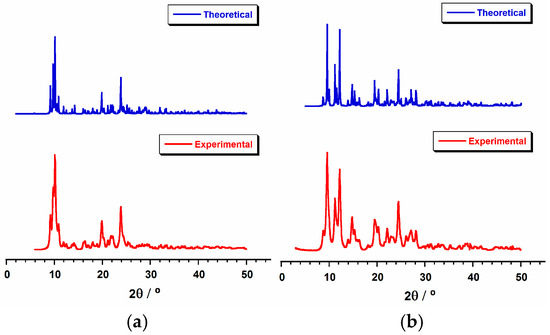
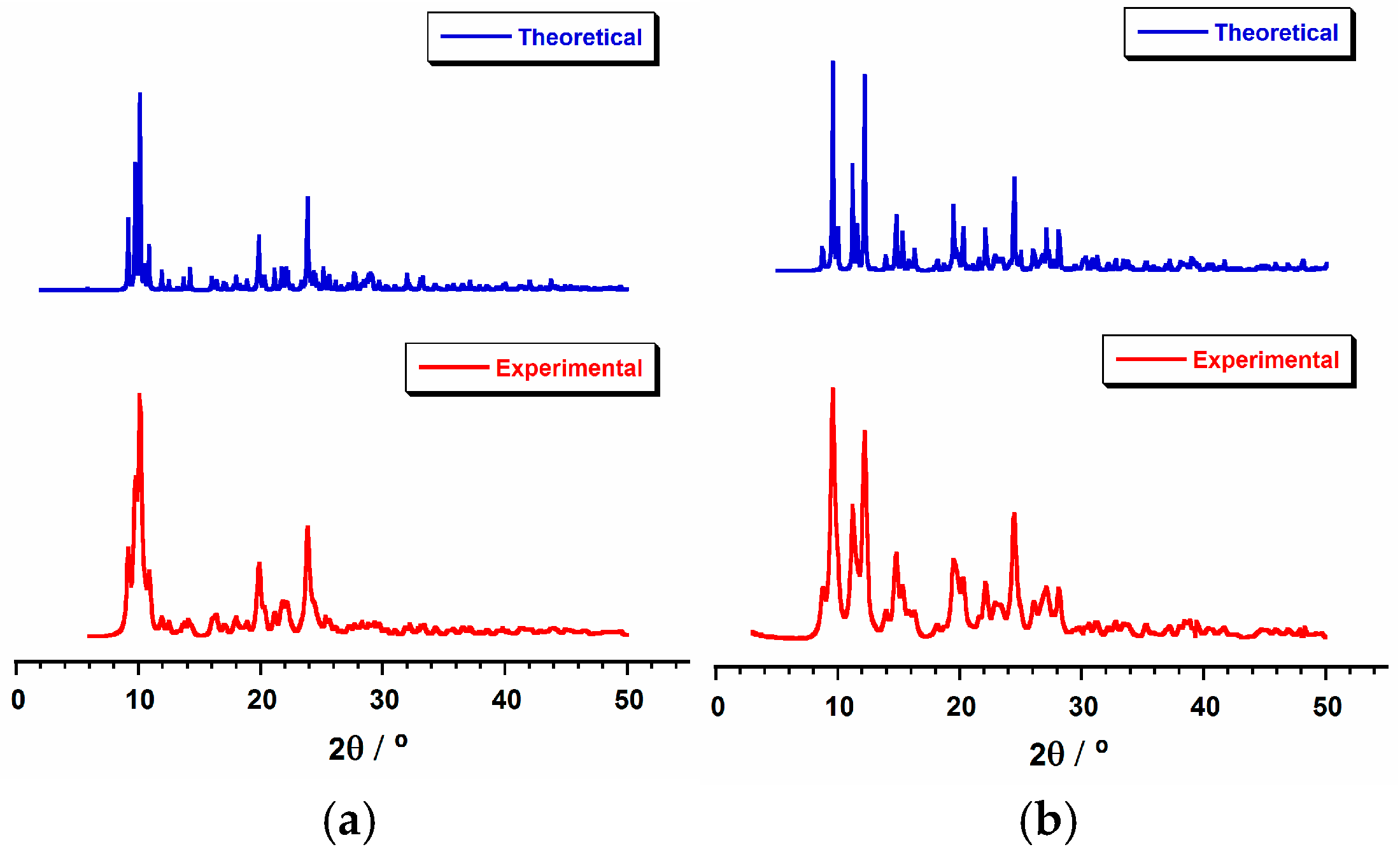
(a) Plot of the theoretical and experimental powder X-ray diffraction (PXRD) patterns (2θ/°) in the range 0–50° for 1; (b) plot of the theoretical and experimental powder X-ray diffraction (PXRD) patterns (2θ/°) in the range 0–50° for 2.
Figure 5.
Thermal variation of the χMT product for 1 (a) and 2 (b), with the red solid line being the best theoretical curve. The insets in (a,b) display the field dependence of the magnetization at 2.0 K for both compounds, with the black solid line being a guide for the eye.
Considering the large metal···metal distance indicated in the crystal structure description of compounds 1 and 2 (ca. 8.2–8.5 Å), the decrease in their χMT values may be assigned to zero-field splitting (ZFS) effects rather than to the presence of strong intermolecular interactions. The field dependence of the molar magnetization (M) plot at 2.0 K for 1 and 2 is given in the respective insets of Figure 5. As observed for both compounds, this plot displays a continuous increase in the M values with the applied magnetic field, and no hysteresis loop is detected at the studied temperature, with the higher M values being approximately 2.2 and 2.4 µB for 1 and 2, respectively. These values agree with those observed for previously reported mononuclear Co(II) complexes exhibiting similar structural parameters [85,86,87,94].
The experimental data of the molar magnetic susceptibility of 1 and 2 were analyzed by means of the Hamiltonian in Equation (1) [94] where S is the spin ground state (quartet) for Co(II) metal ion, D and E are the axial and rhombic zero-field splitting (ZFS) parameters, respectively, and g is the Landé factor, µB is the Bohr magneton, and H is the applied magnetic field. In the expected octahedral environment of both compounds, the D value would lead to the splitting of the four sublevels into the MS = ±1/2 and MS = ±3/2 doublets of the paramagnetic Co(II) metal ion (S = 3/2).
In order to avoid any overparameterization, it was considered that g = = g⊥ for both compounds. As in previous works [25,95], the experimental data for 1 and 2 were fitted by using the PHI program in the 2–300 K temperature range [96], with the best fitting process generating the following magnetic parameters: D = 75.8(1) cm−1, E/D = 0.11(1) and g = 2.52(1) with R = 3.7 × 10⁻⁵ for 1 and D = 52.9(2) cm−1, E/D = 0.00(0) and g = 2.64(2) with R = 4.1 × 10⁻⁵ for 2, with R being the agreement factor which is equal to ∑i[(χMT)obs(i) − (χMT)calc(i)]2/∑i[(χMT)obs(i)]2.
As shown in Figure 5, the theoretical curve for 1 and 2 (red solid line) reproduces quite well the experimental magnetic data in the whole studied temperature range. The computed magnetic parameters, mainly D and g, are found to be consistent with those previously reported for systems based on mononuclear Co(II) complexes [85,86,87,94]. The distinguishable D values obtained for 1 and 2 would account for the different geometries that these diastereoisomers exhibit, with 1 displaying a higher D value and a more distorted octahedral geometry than 2.
Given that it is difficult to obtain a reliable sign of D just from magnetic susceptibility measurements performed on microcrystalline powder samples, EPR measurements were also carried out on our systems. Thus, additional powder Q-band EPR measurements support a positive sign of the D parameter for both 1 and 2 (Figure S4), as in these spectra it is observed that the signal intensities invariably decrease when the temperature is increased. These features are consistent with a positive value of D, as previously observed in systems exhibiting these transitions of the Kramers’ doublet of hexacoordinate Co(II) complexes, with the Kramers’ doublet Ms = ±3/2 not contributing to these signals [94,97]. Indeed, the magnitude and the sign of the D value obtained for compounds 1 and 2 would indicate that these mononuclear systems behave at low temperature as a doublet rather than as a quartet, with the MS = ±1/2 doublet lying below the MS = ±3/2 doublet in energy [94,97,98].
2.2.2. Ac Magnetic Susceptibility
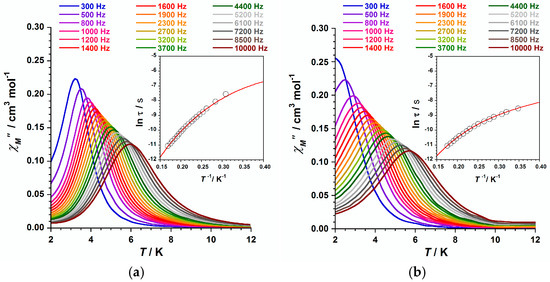
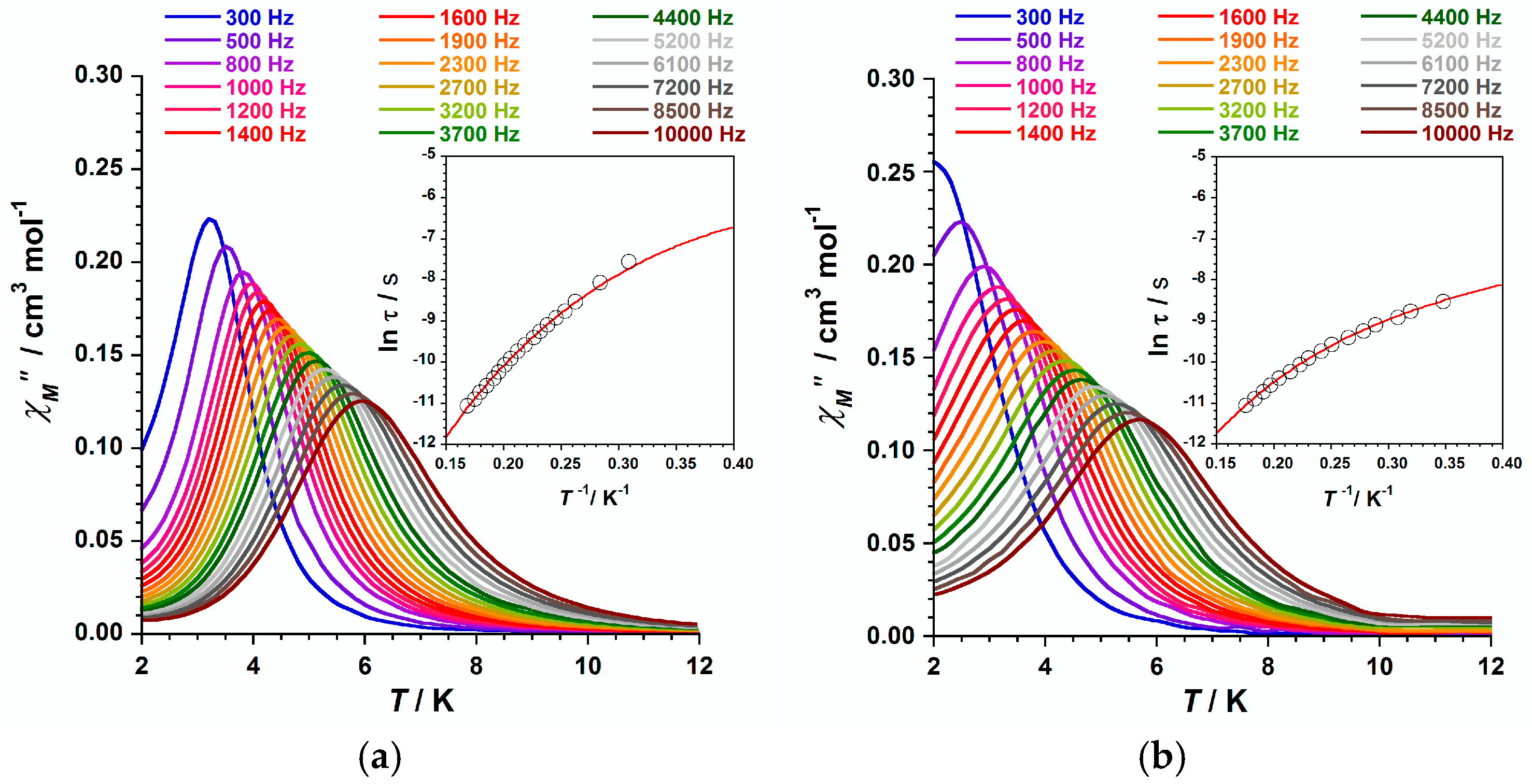
In order to explore the possible single-ion magnet (SIM) phenomenon in 1 and 2, ac susceptibility measurements were performed on microcrystalline samples of both compounds in the temperature range of 2–12 K and under a 5.0 G ac field oscillating at several frequencies (300–10,000 Hz). No out-of-phase ac signals (χ″M) are observed at Hdc = 0 G for either 1 or 2, a fact which could suggest a fast quantum tunneling (QT) of the magnetization (QTM) or strong hyperfine interaction with the I = 7/2 nuclear spin of the Co(II) metal ion, as previously reported [98]. However, both compounds exhibit out-of-phase ac signals at very low temperatures when an external dc magnetic field is applied, which is indicative of a system showing slow relaxation of magnetization typical of SIM behavior. Several dc magnetic fields were studied in the 1000–5000 G range, with Hdc = 1000 G being the optimal one. Out-of-phase (χ″M) ac signals for 1 and 2 are shown in their respective temperature-dependent ac magnetic susceptibility plots at the 300–10,000 Hz range of frequencies in Figure 6.
Figure 6.
Temperature dependence of out-of-phase ac magnetic susceptibility signals, under a dc field of 1000 G and frequencies of 300–10,000 Hz, for 1 (a) and 2 (b). Each inset in (a,b) shows the ln (τ) versus 1/T plot with the best fit (red solid line) considering the contribution of two mechanisms (direct + Raman).
In both cases, the χ″M versus T plot maxima are observable in the temperature ranges 3–6 K for 1 and 2–6 K for 2, and decrease their intensity with increasing temperature and frequency (Figure 6). The ln(τ) versus 1/T plot for 1 and 2 show experimental data drawing a straight line (high-temperature region) followed by a small curved line (low-temperature region), most likely indicating the occurrence of a sum of diverse relaxation processes, such as thermally activated, Orbach, QT, direct or Raman mechanisms, which could contribute to the relaxation of the magnetization (Figure 6). Consequently, the high-temperature data were fitted to the Arrhenius equation (τ = τoexp(Ea/kBT)), thus evaluating the anisotropy energy barrier to the magnetization reorientation (Ea) and the pre-exponential factor (τo) in this region for 1 and 2 (kB being the Boltzmann constant), just for comparison with previously reported values (Table 1).
Table 1.
Parameters of the magnetic relaxation obtained through the dc applied magnetic field of 1000 G for compounds 1 and 2.
The values obtained for the parameters Ea and τo are gathered in Table 1. Compounds 1 and 2 show Ea values, which would be associated with a high-temperature Orbach relaxation process, which are close in order of magnitude to 20 cm−1, which has been previously reported for other similar hexacoordinated Co(II) complexes with SIM behavior and D > 0. However, the Ea values obtained for 1 and 2 should be carefully considered, as their orders of magnitude are smaller than the energy gap between the ground state and the next excited energy level, which would involve a real transition to an intermediate magnetic energy level that actually does not exist at such energies, as previously reported [94,98]. Nevertheless, the whole experimental ln(τ) versus 1/T curves of 1 and 2 were well reproduced when a direct and a Raman mechanism were considered simultaneously in the expression τ−1 = AT + CTn, where the first and second terms are assigned to one-phonon direct and two-phonon Raman processes, respectively (Figure 6). However, the existence of other involved processes of relaxation cannot be totally excluded.
The final A, C and n parameters obtained for 1 and 2 are listed in Table 1. These calculated values are in agreement with those previously reported for SIMs based on octahedral Co(II) complexes with similar structural parameters [94,97,98,99]. The n values obtained for 1 and 2 are less than 9 (a figure which is associated with the Raman relaxation of Kramer ions) [97,98,99,100]. Nevertheless, the n values tabulated in Table 1 fall into the range typical of SIMs with relaxation through optical and acoustic Raman-like processes, as studied previously on both 3–5d-based and 4f-based SIMs [97,98,99,100].
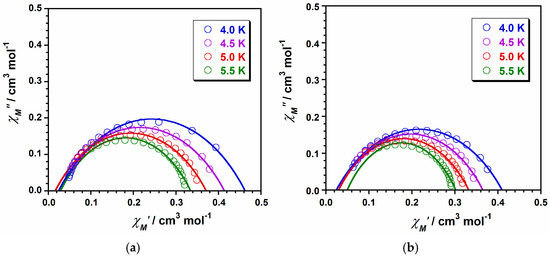
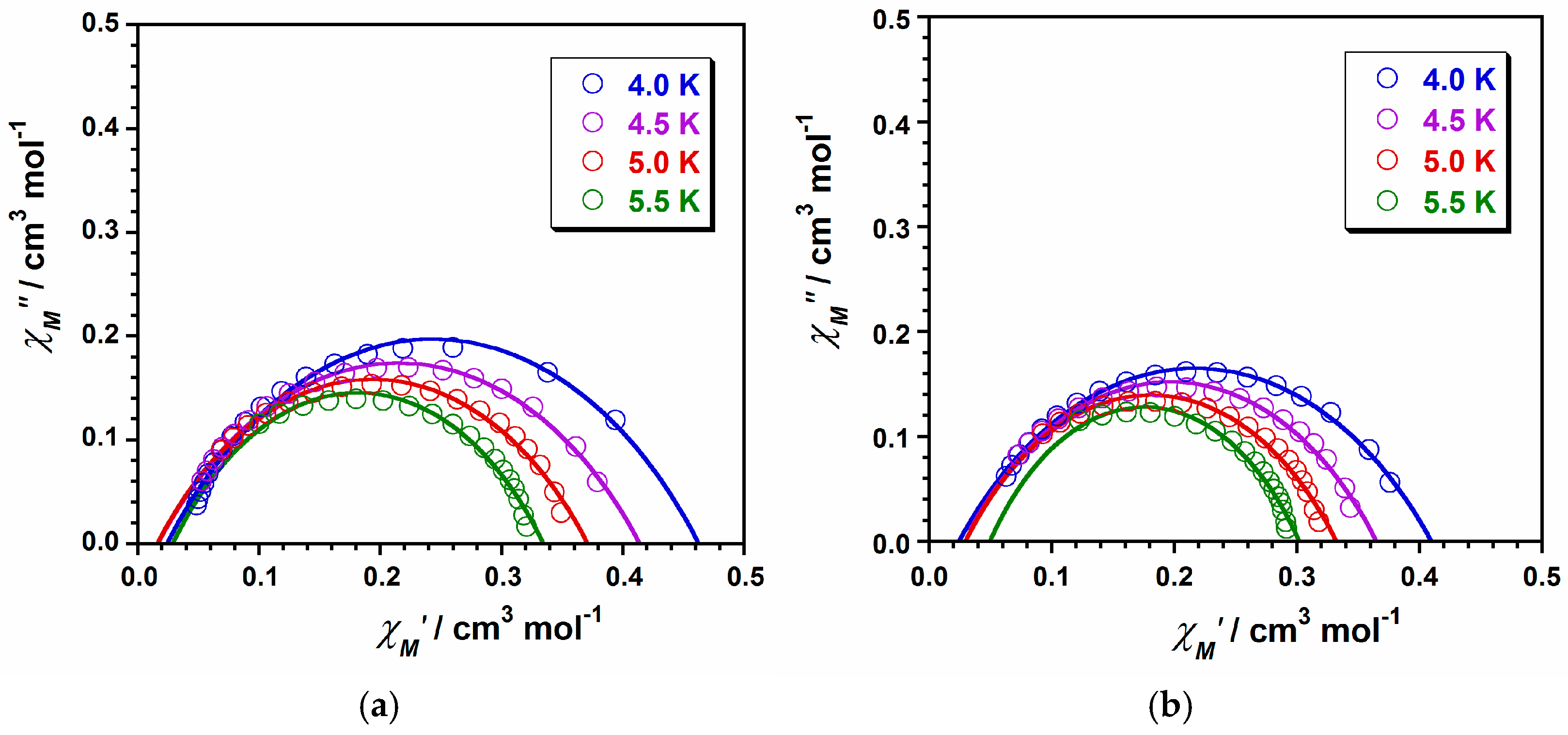
Cole–Cole curves for 1 and 2 obtained in the range of frequencies 100–10,000 Hz, in the range of temperatures 4.0–5.5 K and under a dc magnetic field of 1000 G are plotted in Figure 7. The experimental data drew semicircular curves, which were accordingly treated through the Cole–Cole expression χ = χS + [χT − χS/(1 + (iωτ)1−α)], which is written for magnetic susceptibility, where 0 ≤ α <1 and χS and χT are the adiabatic and isothermal magnetic susceptibilities, respectively [101,102,103,104,105,106]. The final α values that were obtained cover the ranges 0.03–0.15 for 1 and 0.05–0.17 for 2 in the explored temperatures selection (Figure 7). Given that these α values are close to zero (and far from α = 1), a very narrow distribution of slow relaxation times in the regions of relaxation of our mononuclear Co(II) complexes would be expected [94]. Hence, our results support a single relaxation process in the temperature range investigated for these Co(II)-based SIM systems, thus discarding any possible behavior of spin-glass material [106,107,108,109,110,111].
Figure 7.
Cole–Cole plots for 1 (a) and 2 (b) obtained from ac magnetic susceptibility measurements at the indicated temperatures and under an applied dc magnetic field of 1000 G. The solid lines are the best-fit curves.
3. Materials and Methods
3.1. Reagents and Instruments
All the reagents used in this work were used as supplied by commercial sources, and the syntheses were carried out under aerobic conditions. Elemental analyses were performed in an analyzer in the Central Service for the Support to Experimental Research (SCSIE) at the University of Valencia (Hitachi High-Tech, GLOBAL, Minato-ku, Tokyo, Japan). Infrared spectra were recorded (as KBr pellets) with a PerkinElmer Spectrum 65 FT-IR spectrometer in the 4000–400 cm−1 region (PerkinElmer, Inc., Waltham, MA, USA; OMNIC 9.0 software). EPR spectra were obtained on a Bruker ELEXSYS E580 EPR spectrometer (Billerica, MA, USA), working on a solid sample at temperatures ranging from 4 to 20 K, with Q-band (~34 GHz) and applied magnetic fields up to 2 T (Figure S4). Variable-temperature, solid-state (dc and ac) magnetic susceptibility data down to 2.0 K were collected on Quantum Design MPMS-XL SQUID and Physical Property Measurement System (PPMS) magnetometers (Quantum Design, San Diego, CA, USA). The experimental magnetic data were corrected for the diamagnetic contributions of the constituent atoms as well as for the sample holder [112].
3.2. Preparation of the Compounds
3.2.1. Synthesis of Compound 1
An ethanolic solution of mepirizole (1.0 mmol, 20 mL) was added dropwise and with continuous stirring to Co(II) thiocyanate (0.5 mmol) dissolved in ethanol (20 mL). The resulting violet solution was filtered off and left to evaporate at 20–25° C. Purple crystals of 1 were obtained after 1 week. These crystals were filtered off and washed first with cold ethanol and then with diethyl ether. Yield: ca. 45%. Anal. Calcd. for C24H28N10O4S2Co (1): C, 44.8; H, 4.4; N, 21.8. Found: C, 45.0; H, 4.9; N, 21.7. IR peaks (KBr pellets, ν/cm−1): 3432(w), 3100(m), 2979(m), 2944(m), 2875(w), 2073(vs), 1611(vs), 1559(s), 1500(s), 1437(s), 1372(s), 1330(m), 1257(m), 1225(m), 1189(s), 1077(m), 1055(m), 1037(m), 1005(m), 932(w), 848(m), 794(m), 762(m), 682(w), 620(w), 582(m), 550(m), 477(m).
3.2.2. Synthesis of Compound 2
Compound 2 was prepared following the same synthetic procedure as that of 1, but by using acetonitrile instead of ethanol, thus obtaining pink crystals of 2. Yield: ca. 35%. Anal. Calcd. for C24H28N10O4S2Co (2): C, 44.8; H, 4.4; N, 21.8. Found: C, 44.9; H, 4.3; N, 21.5. IR peaks (KBr pellets, ν/cm−1): 3430(w), 3100(s), 2978(m), 2944(m), 2876(w), 2068(vs), 1610(vs), 1558(s), 1500(s), 1435(m), 1373(m), 1330(m), 1257(m), 1225(m), 1190(m), 1075(m), 1055(m), 1036(m), 1005(m), 905(w), 800(m), 778(w), 682(w), 620(w), 581(m), 551(m), 480(m), 421(w).
3.3. X-Ray Diffraction Data Collection and Structure Refinement
X-ray diffraction (XRD) data collection from single crystals of 1 and 2 was performed using a Bruker D8 Venture diffractometer (Bruker, Billerica, MA, USA) with graphite-monochromated Mo–Kα radiation (λ = 0.7107 Å). Both crystal structures were solved by standard direct methods and subsequently completed by Fourier recycling by using the SHELXTL (version 2017/1; Bruker Analytical, Madison, WI, USA) software packages. The obtained model was refined with the SHELXL program against F2 on all data by full-matrix least squares [113]. All non-hydrogen atoms were anisotropically refined, whereas the hydrogen atoms of the mepirizole molecule were set in calculated positions and refined isotropically by using the riding model. The graphical manipulations were performed with the Mercury 3.8 program [114]. Powder X-ray diffraction (PXRD) measurements were performed using a PANalytical Empyrean diffractometer (PANalytical B.V., Almelo, The Netherlands, with PIXcel detector and Cu–Kα radiation, λ = 1.5406 Å). The 2θ peaks of both systems compare well with the theoretical diffractograms obtained from Mercury program, thus indicating homogeneity of the bulk samples for 1 and 2 (Figure 4). The CCDC numbers for 1 and 2 are 2574445 and 2574446, respectively.
4. Conclusions
In this work, we showed that the use of solvents of different polarity allowed us to isolate two diastereoisomers of the complex [Co(mep)2(NCS)2] (mep = mepirizole). Both mononuclear cobalt(II) complexes had two thiocyanato-kN ligands (in cis positions) and four nitrogen atoms from two mepirizole molecules (1, cis-isothiocyanato-κ1N, cis-Npymd; 2, cis-isothiocyanato-κ1N, cis-Npyz), describing somewhat distorted octahedral surroundings. Both diastereoisomers differed in the spatial arrangement of the mepirizole molecules as well as in the role played by the π-hole interactions in the organization of the supramolecular networks. Alternating current magnetic susceptibility measurements show that both diastereoisomers exhibit field-induced slow relaxation of the magnetization with not-negligible differences in their relaxation dynamics, which can be associated with some variations in their respective geometries and spin lattices. The reported systems are the first examples of SIMs based on the mepirizole molecule and, no doubt, many other mepirizole-based SIMs will be investigated and reported in future research works.
Supplementary Materials
The following supporting information can be downloaded at: https://www.mdpi.com/article/10.3390/magnetochemistry12080090/s1, Figure S1: Perspective view and atomic numbering of [Co(mep)2(NCS)2] entities in the crystal structures of compounds 1 and 2; Figure S2: Perspective view of the [Co(mep)2(NCS)2] units showing the π···π and the C-H···X (X = N, O) interactions (dotted blue lines) of compound 1; Figure S3: Perspective view of NCS···π contacts in 2; Figure S4: Q-band polycrystalline powder EPR spectra of 1 and 2; Table S1: Selected non-conventional hydrogen bonds (D-H···A) and contacts (D···A) (Å) and angles (°).
Author Contributions
Conceptualization and methodology, E.E.; formal analysis and investigation, E.E. and J.M.-L.; writing—original draft preparation, E.E. and J.M.-L.; writing—review and editing, E.E. and J.M.-L.; funding acquisition, J.M.-L. All authors have read and agreed to the published version of the manuscript.
Funding
This research was mainly funded by the Universitat de València (UV), Project REDAMET, with grant number UV-INV-AE25-4216008.
Institutional Review Board Statement
Not applicable.
Informed Consent Statement
Not applicable.
Data Availability Statement
The reported data are available on request from the corresponding author.
Acknowledgments
The authors would like to thank José María Martínez and Nicolás Moliner for their advice and assistance in EPR and SQUID measurements, respectively.
Conflicts of Interest
The authors declare no conflicts of interest.
References
- Kobayashi, K.; Chono, S.; Yamada, H. Mepirizole, a non-steroidal antiinflammatory compound, its ulcerogenicity and inhibitory action on lesions induced by acidic antiinflammatory agents in the rat stomach. Gastroenterol. Jpn. 1980, 15, 427–432. [Google Scholar] [CrossRef] [Scilit] [PubMed]
- Tabata, K.; Jacobson, E.D.; Chen, M.H.; Murphy, R.F.; Joffe, S.N. Decrease in alkaline secretion during duodenal ulceration induced by mepirizole in rats. Gastroenterology 1984, 87, 396–401. [Google Scholar] [CrossRef] [Scilit]
- Ikeda, M.; Maruyama, K.; Nobuhara, Y.; Yamada, T.; Okabe, S. Synthesis and cytoprotective antiulcer activity of 2- or 4-(1H-pyrazol-1-yl)pyrimidine derivatives related to mepirizole and dulcerozine. Chem. Pharm. Bull. 1996, 44, 1700–1706. [Google Scholar] [CrossRef] [Scilit] [PubMed]
- Soto, L.; García-Lozano, J.; Escrivà, E.; Legros, J.-P. Crystal and molecular structure of tris(mepirizole) copper(II) hexafluorophosphate [mepirizole = 4-methoxy-2-5-methoxy-3-methyl-1h-pyrazol-1-yl)-6-methylpyrimidine. Polyhedron 1992, 11, 647–654. [Google Scholar] [CrossRef] [Scilit]
- García-Lozano, J.; Server-Carrió, J.; Escrivà, E.; Folgado, J.V.; Molla, M.C.; Lezama, L. X-ray crystal structure and electronic properties of chlorobis(mepirizole)copper(II) tetrafluoroborate (mepirizole = 4-methoxy-2-(5-methoxy-3-methyl-1H-pyrazol-1-yl)-6-methylpyrimidine). Polyhedron 1997, 16, 939–944. [Google Scholar] [CrossRef] [Scilit]
- García-Lozano, J.; Server-Carrió, J.; Molla, M.C.; Escrivà, E. Monomeric cis-isothiocyanato complexes. Crystal and molecular structure of [Mn(mep)2(NCS)2] (mep = 4-methoxy-2-(5-methoxy-3-methyl-1H-pyrazol-1-yl)-6-methylpyrimidine). Transit. Met. Chem. 1997, 22, 161–163. [Google Scholar] [CrossRef] [Scilit]
- Soto, L.; Escrivà, E.; Legros, J.-P.; Tuchagues, J.-P.; Dahan, F.; Fuertes, A. Synthesis, Characterization, and Magnetic Properties of µ-Oxalato- and µ-Oxamido-Bridged Copper(II) Dimers. Crystal and Molecular Structures of [Cu2(mepirizole)2(C2O4)(H2O)2](PF6)2-mepirizole-3H2O and [Cu2(mepirizole)2(C2O4)(NO3)2(H2O)]2[Cu2(mepirizole)2(C2O4)(NO3)2]. Inorg. Chem. 1989, 28, 3378. [Google Scholar]
- Soto, L.; García-Lozano, J.; Benetó, M.; Dahan, F.; Tuchagues, J.-P.; Legros, J.-P. Crystal and molecular structure and magnetic properties of a new µ-oxalato binuclear copper(II) complex containing mepirizole. J. Chem. Soc. Dalton Trans. 1991, 20, 2619–2624. [Google Scholar] [CrossRef] [Scilit]
- Escrivà, E.; García-Lozano, J.; Martínez-Lillo, J.; Núñez, H.; Server-Carrió, J.; Soto, L.; Carrasco, R.; Cano, J. Synthesis, Crystal Structure, Magnetic Properties, and Theoretical Studies of [{Cu(mepirizole)Br}2(μ-OH)(μ-pz)] (Mepirizole = 4-Methoxy-2-(5-methoxy-3-methyl-1H-pyrazol-1-yl)-6-methylpyrimidine; pz = Pyrazolate), a Novel μ-Pyrazolato−μ-Hydroxo-Dibridged Copper(II) Complex. Inorg. Chem. 2003, 42, 8328–8336. [Google Scholar] [CrossRef] [Scilit] [PubMed]
- Benetó, M.; Soto, L.; García-Lozano, J.; Escrivà, E.; Legros, J.-P.; Dahan, F. Crystal and molecular structure and properties of the first characterized copper(II) one-dimensional polymer containing mepirizole [4-methoxy-2-(5-methoxy-3-methyl-1H-pyrazol-1-yl)-6-methylpyrimidine]. J. Chem. Soc. Dalton Trans. 1991, 20, 1057–1061. [Google Scholar] [CrossRef] [Scilit]
- Onoa, G.B.; Moreno, V.; Font-Bardía, M.; Solans, X.; Pérez, J.M.; Alonso, C. Structural and cytotoxic study of new Pt(II) and Pd(II) complexes with the bi-heterocyclic ligand mepirizole. J. Inorg. Biochem. 1999, 75, 205–212. [Google Scholar] [CrossRef] [Scilit] [PubMed]
- Martínez-Lillo, J.; Armentano, D.; De Munno, G.; Marino, N.; Lloret, F.; Julve, M.; Faus, J. A self-assembled tetrameric water cluster stabilized by the hexachlororhenate (IV) anion and diprotonated 2,2′-biimidazole: X-ray structure and magnetic properties. CrystEngComm 2008, 10, 1284–1287. [Google Scholar] [CrossRef] [Scilit]
- Cook, T.R.; Zheng, Y.-R.; Stang, P.J. Metal–Organic Frameworks and Self-Assembled Supramolecular Coordination Complexes: Comparing and Contrasting the Design, Synthesis, and Functionality of Metal–Organic Materials. Chem. Rev. 2013, 113, 734–777. [Google Scholar] [CrossRef] [Scilit] [PubMed]
- Atzori, M.; Serpe, A.; Deplano, P.; Schlueter, J.A.; Mercuri, M.L. Tailoring magnetic properties of molecular materials through non-covalent interactions. Inorg. Chem. Front. 2015, 2, 108–115. [Google Scholar] [CrossRef] [Scilit]
- Martínez-Lillo, J.; Faus, J.; Lloret, F.; Julve, M. Towards multifunctional magnetic systems through molecular-programmed self-assembly of Re(IV) metalloligands. Coord. Chem. Rev. 2015, 289–290, 215–237. [Google Scholar] [CrossRef] [Scilit]
- Martínez-Lillo, J.; Kong, J.; Julve, M.; Brechin, E.K. Self-assembly of the hexabromorhenate (IV) anion with protonated benzotriazoles: X-ray structure and magnetic properties. Cryst. Growth Des. 2014, 14, 5985–5990. [Google Scholar] [CrossRef] [Scilit]
- Martínez-Lillo, J.; Kong, J.; Barros, W.P.; Faus, J.; Julve, M.; Brechin, E.K. Metamagnetic behaviour in a new Cu(II)Re(IV) chain based on the hexachlororhenate(iv) anion. Chem. Commun. 2014, 50, 5840–5842. [Google Scholar] [CrossRef] [Scilit] [PubMed]
- Martínez-Lillo, J.; Pedersen, A.H.; Faus, J.; Julve, M.; Brechin, E.K. Effect of Protonated Organic Cations and Anion−π Interactions on the Magnetic Behavior of Hexabromorhenate(IV) Salts. Cryst. Growth Des. 2015, 15, 2598–2601. [Google Scholar] [CrossRef] [Scilit]
- Armentano, D.; Martínez-Lillo, J. Aquapentachlororhenate (IV): A singular and promising building block for metal assembly. RSC Adv. 2015, 5, 54936–54940. [Google Scholar] [CrossRef] [Scilit]
- Frost, J.M.; Harriman, K.L.M.; Murugesu, M. The rise of 3-d single-ion magnets in molecular magnetism: Towards materials from molecules? Chem. Sci. 2016, 7, 2470–2491. [Google Scholar] [CrossRef] [Scilit] [PubMed]
- Torres, J.F.; Bello-Vieda, N.J.; Macías, M.A.; Rabelo, R.; Lloret, F.; Muñoz-Castro, A.; Hurtado, J.J. Intermolecular interaction energies and magnetic properties of spin-isolated multinuclear CuII complexes. Acta Cryst. 2020, B76, 166–176. [Google Scholar] [CrossRef] [Scilit] [PubMed]
- Mahmudov, K.T.; Kopylovich, M.N.; Guedes da Silva, M.F.C.; Pombeiro, A.J.L. Non-covalent interactions in the synthesis of coordination compounds: Recent advances. Coord. Chem. Rev. 2017, 345, 54–72. [Google Scholar] [CrossRef] [Scilit]
- Rusbridge, E.K.; Peng, Y.; Powell, A.K.; Robinson, D.; Fitzpatrick, A.J. An octahedral tetrachlorido Fe(II) complex with aminopyrazinium ligands from a serendipitous redox synthesis exhibiting magnetic exchange through non-covalent 3-D architectures. Dalton Trans. 2018, 47, 7644–7648. [Google Scholar] [CrossRef] [Scilit] [PubMed]
- Kuzniak-Glanowska, E.; Kobylarczyk, J.; Jedrzejowska, K.; Glosz, D.; Podgajny, R. Exploring the structure–property schemes in anion–π systems of d-block metalates. Dalton Trans. 2021, 50, 10999–11015. [Google Scholar] [CrossRef] [Scilit] [PubMed]
- Orts-Arroyo, M.; Monfort, J.; Moliner, N.; Martínez-Lillo, J. Enantiomeric Complexes Based on Ruthenium(III) and 2,2′-Biimidazole: X-ray Structure and Magnetic Properties. Molecules 2023, 28, 7213. [Google Scholar] [CrossRef] [Scilit] [PubMed]
- Meyer, E.A.; Castellano, R.K.; Diederich, F. Interactions with Aromatic Rings in Chemical and Biological Recognition. Angew. Chem. Int. Ed. 2003, 42, 4120. [Google Scholar] [CrossRef] [Scilit]
- Desiraju, G.R. C–H⋯O and other weak hydrogen bonds. From crystal engineering to virtual screening. Chem. Commun. 2005, 41, 2995–3001. [Google Scholar] [CrossRef] [Scilit] [PubMed]
- Wu, A.-K.; Lee, K.-M. Self-assembly of seven diamide-containing pyridinium salts via nonconventional C–H⋯O hydrogen bonding catemers. CrystEngComm 2012, 14, 3424. [Google Scholar] [CrossRef] [Scilit]
- Bauzá, A.; Mooibroek, T.J.; Frontera, A. The Bright Future of Unconventional σ/π-Hole Interactions. ChemPhysChem 2015, 16, 2496–2517. [Google Scholar] [CrossRef] [Scilit] [PubMed]
- Wang, H.; Wang, W.; Jin, W.J. σ-Hole Bond vs π-Hole Bond: A Comparison Based on Halogen Bond. Chem. Rev. 2016, 116, 5072–5104. [Google Scholar] [CrossRef] [Scilit] [PubMed]
- Hunter, C.A.; Sanders, J.K.M. The nature of pi.-pi. Interactions. J. Am. Chem. Soc. 1990, 112, 5525–5534. [Google Scholar] [CrossRef] [Scilit]
- Claessens, C.G.; Stoddart, J.F. π–π interactions in self-assembly. J. Phys. Org. Chem. 1997, 10, 254–272. [Google Scholar] [CrossRef] [Scilit]
- Janiak, C. A critical account on π–π stacking in metal complexes with aromatic nitrogen-containing ligands. J. Chem. Soc. Dalton Trans. 2000, 29, 3885–3896. [Google Scholar] [CrossRef] [Scilit]
- Mignon, P.; Loverix, S.; Geerlings, P. Interplay between π–π interactions and the H-bonding ability of aromatic nitrogen bases. Chem. Phys. Lett. 2005, 401, 40–46. [Google Scholar] [CrossRef] [Scilit]
- Sony, M.M.; Ponnuswamy, M.N. Nature of π-interactions in nitrogen-containing heterocyclic systems: A structural database analysis. Cryst. Growth Des. 2006, 6, 736–742. [Google Scholar] [CrossRef] [Scilit]
- Khavasi, H.R.; Fard, M.A. π−π Interactions Affect Coordination Geometries. Cryst. Growth Des. 2010, 10, 1892–1896. [Google Scholar] [CrossRef] [Scilit]
- Martinez, C.R.; Iverson, B.L. Rethinking the term “pi-stacking”. Chem. Sci. 2012, 3, 2191–2201. [Google Scholar] [CrossRef] [Scilit]
- Wheeler, S.E.; Bloom, J.W.G. Toward a More Complete Understanding of Noncovalent Interactions Involving Aromatic Rings. J. Phys. Chem. A 2014, 118, 6133–6147. [Google Scholar] [CrossRef] [Scilit] [PubMed]
- Schottel, B.L.; Chifotides, H.T.; Dunbar, K.R. Anion-π interactions. Chem. Soc. Rev. 2008, 37, 68–83. [Google Scholar] [CrossRef] [Scilit] [PubMed]
- Gung, B.W.; Zou, Y.; Xu, Z.; Amicangelo, J.C.; Irwin, D.G.; Ma, S.; Zhou, H.-C. Quantitative study of interactions between oxygen lone pair and aromatic rings: Substituent effect and the importance of closeness of contact. J. Org. Chem. 2008, 73, 689–693. [Google Scholar] [CrossRef] [Scilit] [PubMed]
- Mooibroek, T.J.; Black, C.A.; Gamez, P.; Reedijk, J. What’s new in the realm of anion−π binding interactions? Putting the anion−π interaction in perspective. Cryst. Growth Des. 2008, 8, 1082–1093. [Google Scholar] [CrossRef] [Scilit]
- Mooibroek, T.J.; Gamez, P.; Reedijk, J. Lone pair–π interactions: A new supramolecular bond? CrystEngComm 2008, 10, 1501–1515. [Google Scholar] [CrossRef] [Scilit]
- Wang, D.-X.; Wang, M.-X. Anion− π interactions: Generality, binding strength, and structure. J. Am. Chem. Soc. 2013, 135, 892–897. [Google Scholar] [CrossRef] [Scilit] [PubMed]
- Fiol, J.J.; Barceló-Oliver, M.; Tasada, A.; Frontera, A.; Terrón, A.; García-Raso, A. Structural characterization, recognition patterns and theoretical calculations of long-chain N-alkyl substituted purine and pyrimidine bases as ligands: On the importance of anion–π interactions. Coord. Chem. Rev. 2013, 257, 2705–2715. [Google Scholar] [CrossRef] [Scilit]
- Gamez, P. The anion–π interaction: Naissance and establishment of a peculiar supramolecular bond. Inorg. Chem. Front. 2014, 1, 35–43. [Google Scholar] [CrossRef] [Scilit]
- Brooker, S.; White, N.G.; Bauzá, A.; Deyà, P.M.; Frontera, A. Understanding the Forces That Govern Packing: A Density Functional Theory and Structural Investigation of Anion−π–Anion and Nonclassical C–H···Anion Interactions. Inorg. Chem. 2012, 51, 10334–10340. [Google Scholar] [CrossRef] [Scilit] [PubMed]
- Singh, S.K.; Das, A. The n → π* interaction: A rapidly emerging non-covalent interaction. Phys. Chem. Chem. Phys. 2015, 17, 9596–9612. [Google Scholar] [CrossRef] [Scilit] [PubMed]
- Bauzá, A.; Mooibroek, T.J.; Frontera, A. Towards design strategies for anion–π interactions in crystal engineering. CrystEngComm 2016, 18, 10–23. [Google Scholar] [CrossRef] [Scilit]
- Giese, M.; Albrecht, M.; Rissanen, K. Experimental investigation of anion–π interactions—Applications and biochemical relevance. Chem. Commun. 2016, 52, 1778–1795. [Google Scholar] [CrossRef] [Scilit] [PubMed]
- Neel, A.J.; Hilton, M.J.; Sigman, M.S.; Toste, F.D. Exploiting non-covalent π interactions for catalyst design. Nature 2017, 543, 637–646. [Google Scholar] [CrossRef] [Scilit] [PubMed]
- Martins, M.A.P.; Salbego, P.R.S.; de Moraes, G.A.; Bender, C.R.; Zambiazi, P.J.; Orlando, T.; Pagliari, A.B.; Frizzo, C.P.; Hörner, M. Understanding the crystalline formation of triazene N-oxides and the role of halogen⋯π interactions. CrystEngComm 2018, 20, 96–112. [Google Scholar] [CrossRef] [Scilit]
- Alexandropoulos, D.I.; Dolinar, B.S.; Xie, H.; Vignesh, K.R.; Dunbar, K.R. A Co8 metallacycle stabilized by double anion–π interactions. Chem. Commun. 2019, 55, 12356–12359. [Google Scholar] [CrossRef] [Scilit] [PubMed]
- Karrouchi, A.K.; Radi, S.; Ramli, Y.; Taoufik, J.; Mabkhot, Y.; Al-aizari, F.; Ansar, M. Synthesis and Pharmacological Activities of Pyrazole Derivatives: A Review. Molecules 2018, 23, 134. [Google Scholar] [CrossRef] [Scilit] [PubMed]
- Steel, J.P. Aromatic nitrogen heterocycles as bridging ligands; a survey. Coord. Chem. Rev. 1990, 106, 227–265. [Google Scholar] [CrossRef] [Scilit]
- Bode, R.H.; Bol, J.E.; Driessen, W.L.; Hulsbergen, F.B.; Reedijk, J.; Spek, A.L. Formation of Dinuclear Copper(II) Complexes from a Macrocycle with Built-in Pyrazole Groups. Inorg. Chem. 1999, 38, 1239–1243. [Google Scholar] [CrossRef] [Scilit] [PubMed]
- Ortiz, M.I.; Soriano, M.L.; Carranza, M.P.; Jalón, F.A.; Steed, J.W.; Mereiter, K.; Rodríguez, A.M.; Quiñonero, D.; Deyà, P.M.; Manzano, B.R. New [2 × 2] Copper(I) Grids as Anion Receptors. Effect of Ligand Functionalization on the Ability to Host Counteranions by Hydrogen Bonds. Inorg. Chem. 2010, 49, 8828–8847. [Google Scholar] [CrossRef] [Scilit] [PubMed]
- Cañellas, P.; Torres, M.; Bauzá, A.; Cánaves, M.M.; Sánchez, K.; Cabra, M.I.; García-Raso, A.; Fiol, J.J.; Deyà, P.M.; Molins, E.; et al. Complexes of Zinc(II) with N-Imidazolyl- and N-Pyrazolylpyrimidine Donor Ligands: Synthesis, Crystal Structures, and Theoretical Study. Eur. J. Inorg. Chem. 2012, 2012, 3995–4003. [Google Scholar] [CrossRef] [Scilit]
- Cañellas, P.; Bauzá, A.; García-Raso, A.; Fiol, J.J.; Deyà, P.M.; Molins, E.; Mata, I.; Frontera, A. Synthesis, X-ray characterization and computational studies of Cu(II) complexes of N-pyrazolyl pyrimidine. Dalton Trans. 2012, 41, 11161–11169. [Google Scholar] [CrossRef] [Scilit] [PubMed]
- Cánaves, M.M.; Cabra, M.I.; Bauzá, A.; Cañellas, P.; Sánchez, K.; Orvay, F.; García-Raso, A.; Fiol, J.J.; Terrón, A.; Barceló-Oliver, M.; et al. Crystal structures and DFT calculations of new chlorido-dimethylsulfoxide-MIII (M = Ir, Ru, Rh) complexes with the N-pyrazolyl pyrimidine donor ligand: Kinetic vs. thermodynamic isomers. Dalton Trans. 2014, 43, 6353–6364. [Google Scholar] [CrossRef] [Scilit] [PubMed]
- Sessoli, R.; Gatteschi, D.; Caneschi, A.; Novak, M.A. Magnetic bistability in a metal-ion cluster. Nature 1993, 365, 141–143. [Google Scholar] [CrossRef] [Scilit]
- Wernsdorfer, W.; Sessoli, R. Quantum Phase Interference and Parity Effects in Magnetic Molecular Clusters. Science 1999, 284, 133–135. [Google Scholar] [CrossRef] [Scilit] [PubMed]
- Gatteschi, D.; Sessoli, R. Quantum Tunneling of Magnetization and Related Phenomena in Molecular Materials. Angew. Chem. Int. Ed. 2003, 42, 268–297. [Google Scholar] [CrossRef] [Scilit] [PubMed]
- Martínez-Lillo, J.; Mastropietro, T.F.; Lhotel, E.; Paulsen, C.; Cano, J.; De Munno, G.; Faus, J.; Lloret, F.; Julve, M.; Nellutla, S.; et al. Highly anisotropic rhenium(IV) complexes: New examples of mononuclear single-molecule magnets. J. Am. Chem. Soc. 2013, 135, 13737–13748. [Google Scholar] [CrossRef] [Scilit] [PubMed]
- Pedersen, K.S.; Bendix, J.; Clérac, R. Single-molecule magnet engineering: Building-block approaches. Chem. Commun. 2014, 50, 4396–4415. [Google Scholar] [CrossRef] [Scilit] [PubMed]
- Chilton, N.F. Design Criteria for High-Temperature Single-Molecule Magnets. Inorg. Chem. 2015, 54, 2097–2099. [Google Scholar] [CrossRef] [Scilit] [PubMed]
- Cosquer, G.; Shen, Y.; Almeida, M.; Yamashita, M. Conducting single-molecule magnet materials. Dalton Trans. 2018, 47, 7616–7627. [Google Scholar] [CrossRef] [Scilit] [PubMed]
- Atzori, M.; Sessoli, R. The Second Quantum Revolution: Role and Challenges of Molecular Chemistry. J. Am. Chem. Soc. 2019, 141, 11339–11352. [Google Scholar] [CrossRef] [Scilit] [PubMed]
- Aravena, D.; Ruiz, E. Spin dynamics in single-molecule magnets and molecular qubits. Dalton Trans. 2020, 49, 9916–9928. [Google Scholar] [CrossRef] [Scilit] [PubMed]
- Blagg, R.J.; Ungur, L.; Tuna, F.; Speak, J.; Comar, P.; Collison, D.; Wernsdorfer, W.; McInnes, E.J.L.; Chibotaru, L.F.; Winpenny, R.E.P. Magnetic relaxation pathways in lanthanide single-molecule magnets. Nat. Chem. 2013, 5, 673–678. [Google Scholar] [CrossRef] [Scilit] [PubMed]
- Woodruff, D.N.; Winpenny, R.E.P.; Layfield, R.A. Lanthanide Single-Molecule Magnets. Chem. Rev. 2013, 113, 5110–5148. [Google Scholar] [CrossRef] [Scilit] [PubMed]
- Craig, G.A.; Murrie, M. 3d single-ion magnets. Chem. Soc. Rev. 2015, 44, 2135–2147. [Google Scholar] [CrossRef] [Scilit] [PubMed]
- Sanchis-Perucho, A.; Martínez-Lillo, J. A new family of one-dimensional bromo-bridged Ir(IV)–Cu(II) complexes based on the hexabromoiridate(IV) metalloligand. Dalton Trans. 2022, 51, 3323–3330. [Google Scholar] [CrossRef] [Scilit] [PubMed]
- Dey, A.; Kalita, P.; Chandrasekhar, V. Lanthanide(III)-Based Single-Ion Magnets. ACS Omega 2018, 3, 9462–9475. [Google Scholar] [CrossRef] [Scilit] [PubMed]
- Feng, M.; Tong, M.L. Single ion magnets from 3d to 5f: Developments and strategies. Chem. Eur. J. 2018, 24, 7574–7594. [Google Scholar] [CrossRef] [Scilit] [PubMed]
- Perlepe, P.S.; Maniaki, D.; Pilichos, E.; Katsoulakou, E.; Perlepes, S.P. Smart Ligands for Efficient 3d-, 4d- and 5d-Metal Single-Molecule Magnets and Single-Ion Magnets. Inorganics 2020, 8, 39. [Google Scholar] [CrossRef] [Scilit]
- Marin, R.; Brunet, G.; Murugesu, M. Shining New Light on Multifunctional Lanthanide Single-Molecule Magnets. Angew. Chem. Int. Ed. 2021, 60, 1728–1746. [Google Scholar] [CrossRef] [Scilit] [PubMed]
- Murrie, M. Cobalt(II) single-molecule magnets. Chem. Soc. Rev. 2010, 39, 1986–1995. [Google Scholar] [CrossRef] [Scilit] [PubMed]
- Jurca, T.; Farghal, A.; Lin, P.-H.; Korobkov, I.; Murugesu, M.; Richeson, D.S. Single-Molecule Magnet Behavior with a Single Metal Center Enhanced through Peripheral Ligand Modifications. J. Am. Chem. Soc. 2011, 133, 15814–15817. [Google Scholar] [CrossRef] [Scilit] [PubMed]
- Habib, F.; Luca, O.R.; Vieru, V.; Shiddiq, M.; Korobkov, I.; Gorelsky, S.I.; Takase, M.K.; Chibotaru, L.F.; Hill, S.; Crabtree, R.H.; et al. Influence of the Ligand Field on Slow Magnetization Relaxation versus Spin Crossover in Mononuclear Cobalt Complexes. Angew. Chem. Int. Ed. 2013, 52, 11290–11293. [Google Scholar] [CrossRef] [Scilit] [PubMed]
- Chen, L.; Wang, J.; Wei, J.-M.; Wernsdorfer, W.; Chen, X.-T.; Zhang, Y.-Q.; Song, Y.; Xue, Z.-L. Slow Magnetic Relaxation in a Mononuclear Eight-Coordinate Cobalt(II) Complex. J. Am. Chem. Soc. 2014, 136, 12213–12216. [Google Scholar] [CrossRef] [Scilit] [PubMed]
- Martínez-Lillo, J.; Mastropietro, T.F.; De Munno, G.; Lloret, F.; Julve, M.; Faus, J. Enhancing the Magnetic Coupling of Oxalato-Bridged ReIV2MII (M = Mn, Co, Ni, and Cu) Trinuclear Complexes via Peripheral Halide Ligand Effects. Inorg. Chem. 2011, 50, 5731–5739. [Google Scholar] [CrossRef] [Scilit] [PubMed]
- Rajnák, C.; Titiš, J.; Moncoľ, J.; Renz, F.; Boča, R. Field-Supported Slow Magnetic Relaxation in Hexacoordinate CoII Complexes with Easy Plane Anisotropy. Eur. J. Inorg. Chem. 2017, 2017, 1520–1525. [Google Scholar] [CrossRef] [Scilit]
- Ding, Z.-Y.; Meng, Y.-S.; Xiao, Y.; Zhang, Y.-Q.; Zhu, Y.-Y.; Gao, S. Probing the influence of molecular symmetry on the magnetic anisotropy of octahedral cobalt(II) complexes. Inorg. Chem. Front. 2017, 4, 1909–1916. [Google Scholar] [CrossRef] [Scilit]
- Nemec, I.; Herchel, R.; Trávníček, Z. Two polymorphic Co(II) field-induced single-ion magnets with enormous angular distortion from the ideal octahedron. Dalton Trans. 2018, 47, 1614–1623. [Google Scholar] [CrossRef] [Scilit] [PubMed]
- Vallejo, J.; Viciano-Chumillas, M.; Lloret, F.; Julve, M.; Castro, I.; Krzystek, J.; Ozerov, M.; Armentano, D.; De Munno, G.; Cano, J. Coligand Effects on the Field-Induced Double Slow Magnetic Relaxation in Six-Coordinate Cobalt(II) Single-Ion Magnets (SIMs) with Positive Magnetic Anisotropy. Inorg. Chem. 2019, 58, 15726–15740. [Google Scholar] [CrossRef] [Scilit] [PubMed]
- Świtlicka, A.; Palion-Gazda, J.; Machura, B.; Cano, J.; Lloret, F.; Julve, M. Field-induced slow magnetic relaxation in pseudooctahedral cobalt(II) complexes with positive axial and large rhombic anisotropy. Dalton Trans. 2019, 48, 1404–1417. [Google Scholar] [CrossRef] [Scilit] [PubMed]
- Świtlicka, A.; Machura, B.; Penkala, M.; Bieńko, A.; Bieńko, D.C.; Titiš, J.; Rajnák, C.; Boča, R.; Ozarowski, A. Slow magnetic relaxation in hexacoordinated cobalt(II) field-induced single-ion magnets. Inorg. Chem. Front. 2020, 7, 2637–2650. [Google Scholar] [CrossRef] [Scilit]
- Orts-Arroyo, M.; Sanchis-Perucho, A.; León-Barcenas, P.; Pacheco, M.; Moliner, N.; Tubau, À.; Mayans, J.; Rabelo, R.; Lloret, F.; Castro, I.; et al. Vaporesponsive Lanthanide Metal–Organic Frameworks as Selective Luminescent Spin Quantum Sensors for Biogenic Amines. Inorg. Chem. 2025, 64, 20111–20121. [Google Scholar] [CrossRef] [Scilit] [PubMed]
- Ferrari-Argachá, C.; Valiero, S.; Rojas-Dotti, C.; Loaces, A.; Chiozzone, R.; Moliner, N.; Suescun, L.; Cano, J.; Lloret, F.; Martínez-Lillo, J.; et al. Self-assembly of lanthanide-based single-ion magnets (SIMs) into 1D networks via Re(IV)-based metalloligand. Dalton Trans. 2026, 55, 854–864. [Google Scholar] [CrossRef] [Scilit] [PubMed]
- Pacheco, M.; El Alouani Dahmouni, N.; Sanchis-Perucho, A.; Orts-Arroyo, M.; Martínez-Lillo, J.; Castro, I.; Cano, J.; Julve, M.; Stiriba, S.-E.; Ruiz-García, R.; et al. Reticular coordination chemistry of oxalate-type ligands: Design principles for advanced multifunctional magnetic materials in emerging technologies. Coord. Chem. Rev. 2026, 562, 217838. [Google Scholar] [CrossRef] [Scilit]
- Constable, E.C. Stereogenic metal centres—From Werner to supramolecular chemistry. Chem. Soc. Rev. 2013, 42, 1637–1651. [Google Scholar] [CrossRef] [Scilit] [PubMed]
- Danelli, P.; Tsantis, S.T.; Kitos, A.; Psycharis, V.; Raptopoulou, C.P.; Tsipis, A.; Perlepes, S.P. Investigating the isolation and interconversion of two diastereoisomers in an octahedral system. New J. Chem. 2019, 43, 17141–17145. [Google Scholar] [CrossRef] [Scilit]
- Muetterties, E.L.; Guggenberger, L.J.J. Idealized Polytopal Forms. Description of Real Molecules Referenced to Idealized Polygons or Polyhedra in Geometric Reaction Path Form. J. Am. Chem. Soc. 1974, 96, 1748–1756. [Google Scholar] [CrossRef] [Scilit]
- Roy, S.; Oyarzabal, I.; Vallejo, J.; Cano, J.; Colacio, E.; Bauza, A.; Frontera, A.; Kirillov, A.M.; Drew, M.G.B.; Das, S. Two Polymorphic Forms of a Six-Coordinate Mononuclear Cobalt(II) Complex with Easy-Plane Anisotropy: Structural Features, Theoretical Calculations, and Field-Induced Slow Relaxation of the Magnetization. Inorg. Chem. 2016, 55, 8502–8513. [Google Scholar] [CrossRef] [Scilit] [PubMed]
- Orts-Arroyo, M.; Moliner, N.; Lloret, F.; Martínez-Lillo, J. Ferromagnetic Coupling and Single-Ion Magnet Phenomenon in Mononuclear Ruthenium(III) Complexes Based on Guanine Nucleobase. Magnetochemistry 2022, 8, 93. [Google Scholar] [CrossRef] [Scilit]
- Chilton, N.F.; Anderson, R.P.; Turner, L.D.; Soncini, A.; Murray, K.S. PHI: A powerful new program for the analysis of anisotropic monomeric and exchange-coupled polynuclear d- and f-block complexes. J. Comput. Chem. 2013, 34, 1164–1175. [Google Scholar] [CrossRef] [Scilit] [PubMed]
- Landart-Gereka, A.; Quesada-Moreno, M.M.; Díaz-Ortega, I.F.; Nojiri, H.; Ozerov, M.; Krzystek, J.; Palacios, M.A.; Colacio, E. Large easy-axis magnetic anisotropy in a series of trigonal prismatic mononuclear cobalt(II) complexes with zero-field hidden single-molecule magnet behavior: The important role of the distortion of the coordination sphere and intermolecular interactions in the slow relaxation. Inorg. Chem. Front. 2022, 9, 2810–2831. [Google Scholar] [CrossRef] [Scilit]
- Gómez-Coca, S.; Urtizberea, A.; Cremades, E.; Alonso, P.J.; Camón, A.; Ruiz, E.; Luis, F. Origin of slow magnetic relaxation in Kramers ions with non-uniaxial anisotropy. Nat. Commun. 2014, 5, 4300. [Google Scholar] [CrossRef] [Scilit] [PubMed]
- Cuevas-Contreras, L.; Quesada-Moreno, M.M.; Ruiz-Bilbao, E.; Gutiérrez-Zorrilla, J.M.; Krzystek, J.; Ozerov, M.; Jiménez, J.R.; Colacio, E. Symmetry control and magnetic exchange coupling in SMMs based on Co(II) complexes. Inorg. Chem. Front. 2026, 13, 2882–2903. [Google Scholar] [CrossRef] [Scilit]
- Mayans, J.; Escuer, A. Correlating the axial Zero Field Splitting with the slow magnetic relaxation in GdIII SIMs. Chem. Commun. 2021, 57, 721–724. [Google Scholar] [CrossRef] [Scilit] [PubMed]
- Cole, K.S.; Cole, R.H. Dispersion and Absorption in Dielectrics I. Alternating Current Characteristics. J. Chem. Phys. 1941, 9, 341–351. [Google Scholar] [CrossRef] [Scilit]
- Peikov, V.T.; Lane, A.M. Characterization of Concentrated Magnetic Colloids by Measurements of Frequency Dependence of AC Magnetic Susceptibility. J. Colloid Interface Sci. 1998, 206, 350–353. [Google Scholar] [CrossRef] [Scilit] [PubMed]
- Aubin, S.M.J.; Sun, Z.M.; Pardi, L.; Krzystek, J.; Folting, K.; Brunel, L.C.; Rheingold, A.L.; Christou, G.; Hendrickson, D.N. Reduced anionic Mn-12 molecules with half-integer ground states as single-molecule magnets. Inorg. Chem. 1999, 38, 5329–5340. [Google Scholar] [CrossRef] [Scilit]
- Martínez-Lillo, J.; Armentano, D.; De Munno, G.; Wernsdorfer, W.; Clemente-Juan, J.M.; Krzystek, J.; Lloret, F.; Julve, M.; Faus, J. Heterotetranuclear Oxalato-Bridged ReIV3MII (M = Mn, Fe, Co, Ni, Cu) Complexes: A New Example of a Single-Molecule Magnet (M = Ni). Inorg. Chem. 2009, 48, 3027–3038. [Google Scholar] [CrossRef] [Scilit] [PubMed]
- Rinkevich, A.B.; Perov, D.V. Cole-Cole formula for dependence of dynamic magnetic susceptibility of rare-earth titanates on magnetic field. J. Magn. Magn. Mater. 2021, 530, 167917. [Google Scholar] [CrossRef] [Scilit]
- Petracic, O.; Glatz, A.; Kleemann, W. Models for the magnetic ac susceptibility of granular superferromagnetic CoFe/Al2O3. Phys. Rev. B 2004, 70, 214432. [Google Scholar] [CrossRef] [Scilit]
- Fannin, P.C.; Mac Oireachtaigh, C.; Cohen-Tannoudji, L.; Bertrand, E.; Bibette, J. Complex susceptibility measurements of a suspension of magnetic beads. J. Magn. Magn. Mater. 2006, 300, e210–e212. [Google Scholar] [CrossRef] [Scilit]
- Vrábel, P.; Orendáč, M.; Orendáčová, A.; Čižmár, E.; Tarasenko, R.; Zvyagin, S.; Wosnitza, J.; Prokleška, J.; Sechovský, V.; Pavlík, V.; et al. Slow spin relaxation induced by magnetic field in [NdCo(bpdo)(H2O)4(CN)6]·3H2O. J. Phys. Condens. Matter. 2013, 25, 186003. [Google Scholar] [CrossRef] [Scilit] [PubMed]
- Wada, H.; Ooka, S.; Iwasawa, D.; Hasegawa, M.; Kajiwara, T. Slow Magnetic Relaxation of Lanthanide(III) Complexes with a Helical Ligand. Magnetochemistry 2016, 2, 43. [Google Scholar] [CrossRef] [Scilit]
- Chowdhury, D. Spin Glasses and Other Frustrated Systems; Princeton University Press: Princeton, NJ, USA, 1986. [Google Scholar]
- Girtu, M.A.; Wynn, C.M.; Fujita, W.; Awaga, K.; Epstein, A. Coexistence of glassiness and canted antiferromagnetism in triangular quantum Heisenberg antiferromagnets with weak Dzyaloshinskii-Moriya interaction. J. Phys. Rev. B 1998, 57, R11058. [Google Scholar] [CrossRef] [Scilit]
- Bain, G.A.; Berry, J.F. Diamagnetic Corrections and Pascal’s Constants. J. Chem. Educ. 2008, 85, 532–536. [Google Scholar] [CrossRef] [Scilit]
- Bruker Analytical X-ray Instruments. SHELXL-2017/1; Bruker Analytical X-ray Instruments: Madison, WI, USA, 2017. [Google Scholar]
- Macrae, C.F.; Edgington, P.R.; McCabe, P.; Pidcock, E.; Shields, G.P.; Taylor, R.; Towler, M.; van de Streek, J. Mercury: Visualization and analysis of crystal structures. J. Appl. Crystallogr. 2006, 39, 453–457. [Google Scholar] [CrossRef] [Scilit]

Disclaimer/Publisher’s Note: The statements, opinions and data contained in all publications are solely those of the individual author(s) and contributor(s) and not of MDPI and/or the editor(s). MDPI and/or the editor(s) disclaim responsibility for any injury to people or property resulting from any ideas, methods, instructions or products referred to in the content. |
© 2026 by the authors. Licensee MDPI, Basel, Switzerland. This article is an open access article distributed under the terms and conditions of the Creative Commons Attribution (CC BY) license.