


Abstract
Excessive flavonol accumulation in berry skin under high solar radiation may increase the risk of quercetin-related instability in red wines. In 2024, a field trial was conducted on ‘Sangiovese’ grapevines grown in a non-irrigated vineyard in central Italy to evaluate the effects of a novel β-carotene-based bio-protector (NBP). The product was applied once at veraison at 1% or 2% (v/v). At harvest, yield components and technological maturity parameters were assessed; berry-skin phenolics and carotenoids were quantified by HPLC, and the expression of CHS, CHI, FLS, and a MYB regulator was quantified by RT-qPCR. NBP application did not significantly affect yield components or must composition. In contrast, both NBP concentrations reduced quercetin-3-O-glucoside and quercetin-3-O-glucuronide, as well as kaempferol derivatives, while flavan-3-ols were unaffected. Lutein content increased in treated berries, reaching the highest levels in 2% NBP vines, whereas β-carotene remained unchanged. Consistent with these findings, gene expression analysis showed downregulation of flavonol-biosynthetic transcripts, with FLS exhibiting the strongest repression. Overall, a single NBP application at veraison effectively limited flavonol accumulation under warm, high-radiation conditions without compromising yield or ripening. Differences between the two NBP concentrations were more evident for lutein accumulation than for flavonol reduction, suggesting distinct metabolic responsiveness of these pathways to the treatment.
1. Introduction
Global viticulture faces growing challenges from climate change, which is driving a progressive rise in growing season temperatures, a higher frequency of heatwaves, and increased exposure to solar radiation in many winegrowing regions [1,2]. In Mediterranean environments, these trends are often associated with reduced summer rainfall, higher evaporative demand, and increased warm-night occurrences, resulting in prolonged stress during berry ripening [3]. Such environmental constraints can strongly affect grapevine physiology and berry metabolism, ultimately altering grape composition and wine quality [4,5]. Among the main drivers shaping grape phenolic composition, sunlight exposure and UV-B radiation play a central role. In grape berry skins, high irradiance promotes the accumulation of flavonols, which act as photoprotective compounds by functioning as UV screens and antioxidants, limiting oxidative damage under excessive light conditions [6,7,8]. Recent field studies have further confirmed the strong responsiveness of berry-skin flavonol accumulation to UV exposure, showing reduced flavonol concentrations when UV radiation was limited and increased accumulation following supplemental UV-B treatments [9,10]. In particular, quercetin and its glycosylated derivatives represent the dominant flavonol class in many Vitis vinifera L. cultivars, and their biosynthesis is closely linked to the light microclimate surrounding the clusters [11,12]. Therefore, vineyard management practices that modify canopy structure, leaf area distribution, and fruit-zone exposure, such as basal leaf removal, strongly influence flavonol accumulation at harvest [13,14].
Although flavonol accumulation is generally considered an adaptive response to high radiation, excessive quercetin biosynthesis has recently emerged as a critical issue for wine stability. Under high UV-B conditions, grape berries may accumulate large amounts of quercetin glycosides, which, after extraction into wine, can undergo progressive hydrolysis over time, leading to elevated levels of quercetin aglycone. When the aglycone concentration exceeds its solubility threshold, precipitation may occur, even after bottling, generating undesirable deposits and compromising wine clarity and consumer perception [15,16]. Recent studies have clarified that quercetin precipitation is governed by the limited solubility of the aglycone form and is strongly influenced by ethanol content, storage temperature, and wine matrix composition, reinforcing the importance of preventive approaches to limit excessive flavonol accumulation at the vineyard level [17]. This phenomenon has become increasingly relevant in warm, highly exposed environments, such as Mediterranean areas, where climate change is intensifying conditions that favour flavonol accumulation [2]. This issue is particularly important for ‘Sangiovese’, a red cultivar widely cultivated in Italy and well known for its strong responsiveness to berry exposure in terms of flavonol accumulation [8,18,19]. Recent evidence indicates that ‘Sangiovese’ wines are among the most affected by quercetin instability, likely due to their high initial quercetin glycoside concentration and subsequent conversion into insoluble aglycone forms during ageing [16]. Consequently, there is increasing interest in developing vineyard-level strategies aimed at mitigating excessive quercetin accumulation while preserving vine productivity and technological maturity, thereby improving wine stability over time and preventing the formation of undesirable precipitates or suspended residues that may compromise sensory quality, visual acceptance, and commercial value.
From a biochemical perspective, quercetin synthesis occurs via the phenylpropanoid-flavonoid pathway and is biosynthesized by structural genes such as chalcone synthase (CHS), chalcone isomerase (CHI), and flavonol synthase (FLS), whose transcription is strongly induced by UV-related signalling [20,21]. In grapevine, the transcription factor VvMYBF1 has been identified as a key regulator of flavonol biosynthesis, activating flavonol-related genes and promoting quercetin accumulation in berry skins [20]. Therefore, determining whether viticultural mitigation strategies can modulate this transcriptional regulation is an important step toward controlling flavonol accumulation in high-radiation environments. Alongside flavonol induction, grapevine tissues activate additional photoprotective mechanisms involving carotenoids, particularly lutein and xanthophyll-cycle intermediates, which contribute to thermal energy dissipation and reduce photooxidative stress [22]. On this basis, the use of natural-based bio-protectors containing β-carotene and α-pinene (NBP) has recently been proposed as a sustainable strategy to enhance photoprotection at the canopy and cluster levels, potentially reducing the metabolic requirement for flavonol biosynthesis in berry skins [8]. In this framework, Giordano et al. [8] demonstrated that a single application of NBP significantly reduced flavonol accumulation across different cultivars and environments, without affecting grape yield or technological maturity, suggesting that improved photoprotection may be a promising approach to mitigate quercetin overaccumulation under high UV radiation. While these findings established the efficacy of NBP under field conditions, the effect of different application concentrations of this formulation remains poorly explored, and it is still unclear whether increasing the concentration provides additional benefits in reducing flavonol accumulation without unnecessary costs or excessive application rates. In this context, the present study aimed to compare the effects of two concentrations (1% and 2%) of NBP applied to ‘Sangiovese’ vines grown in a non-irrigated commercial vineyard in central Italy.
The working hypothesis was that NBP applications could modulate UV-induced flavonol accumulation in grape berry skins by altering carotenoid metabolism (particularly β-carotene and lutein) and the transcriptional regulation of key flavonol biosynthesis genes (CHS, CHI, FLS, and MYB). By integrating agronomic, metabolic, and molecular evidence, this work aims to identify the most effective NBP dosage that reduces flavonol accumulation under high UV conditions, providing growers with a sustainable, cost-effective tool to mitigate quercetin-related wine instability amid ongoing climate change.
2. Materials and Methods
2.1. Experimental Site and Plant Material
The trial was carried out during the 2024 growing season in a non-irrigated commercial vineyard in central Italy (Umbria region) near Magione (Perugia, 44°42′ N, 12°57′ E, elevation 272 m a.s.l.). The vineyard was established on a loam-textured soil, characterized by a relatively balanced proportion of sand, silt, and clay. No fertilisation was applied during the 2024 growing season. The vineyard was conventionally managed, and both pest and disease control were carried out according to standard local commercial practices. The vineyard is a 27-year-old planting of Vitis vinifera L. cv. ‘Sangiovese’, grafted onto 3309 C rootstock, planted at 2.5 m × 0.8 m inter-row and intra-row spacing (5000 vines per hectare), and trained to a vertically shoot-positioned, spur-pruned cordon trellis with a budload of 5–6 nodes per vine. Pest management followed local standard practice, and shoots were mechanically trimmed when most began to grow above the top wire.
2.2. Experimental Design and NBP Treatments
The trial was arranged in a randomized complete block design. Three uniform rows were selected, with each row serving as a block. Within each block, ten vines were randomly assigned to NBP applied at 1% (v/v) (NBP 1), the other ten vines were assigned to NBP applied at 2% (v/v) (NBP 2), and ten vines were sprayed with water and served as controls (C). Each experimental row was separated by an isolation row to avoid potential spray interference among treatments. NBP is a new formulation based on a mixture of a terpenic polymer matrix, derived from distilled conifer resins, and β-carotene. Treatments were applied once just before veraison, at the BBCH 81 growth stage (beginning of ripening). Following Giordano et al. [8], NBP solutions (1% and 2%) were prepared using tap water and gently stirred to obtain stable emulsions. Control vines were sprayed with the same tap water. Using a portable electric pump sprayer, the solutions were applied to the basal portion of the canopy, ensuring complete wetting of both clusters and leaves. The NBP formulation and its active components have been previously described by Giordano et al. [8]. Weather conditions were monitored using an automatic meteorological station located near the vineyard, which recorded daily maximum and minimum air temperatures and rainfall. These data were used to calculate accumulated heat units expressed as growing degree days (GDDs), using a base temperature of 10 °C, from 1 April to 30 September.
2.3. Yield and Grape Composition at Harvest
At harvest (11 September 2024), all the experimental vines were harvested individually, and the number of clusters per vine and total yield (kg vine−1) were recorded. Average cluster weight was calculated as yield per vine divided by the number of clusters. Berry weight was determined from three subsamples of 250 berries per treatment (750 berries in total), randomly collected and weighed.
After crushing, must total soluble solids (°Brix) were measured with a temperature-compensating refractometer. Titratable acidity was determined by titration with 0.1 N NaOH to a pH endpoint of 8.2 and expressed as g L−1 tartaric acid equivalents. Must pH was measured with a PHM82 pH meter (Radiometer, Copenhagen, Denmark). Total anthocyanins and total phenols, expressed as mg cm−2 of berry skin, were determined on the skins of 50 berries per treatment following the methods of Ough and Amerine [23] and Slinkard and Singleton [24], respectively.
For phenolic profiling, berry skins were separated and ground to a fine powder. Flavonol compounds were extracted from three biological replicates per treatment. For each replicate, 5 g of skin powder was suspended in 50 mL of ethanol–water (70:30, v/v) and incubated for 24 h at 4 °C in the dark under continuous agitation. After extraction, samples were centrifuged at 5000× g for 10 min, and the supernatant was collected for HPLC analysis. Individual flavonols were quantified by high-performance liquid chromatography (HPLC) as described by Ritchey and Waterhouse [25]. HPLC analyses were performed on a Dionex system (Dionex Corporation, Sunnyvale, CA, USA) controlled by Chromeleon software (version 6.50), equipped with a P680 quaternary pump, a Rheodyne manual injector (20 µL loop), a TCC-100 thermostatic oven, and a PDA-100 photodiode array detector. Separation was achieved using a C18 column (Dionex Acclaim® 120 C18, 5 µm, 4.6 × 250 mm) maintained at 40 °C, with a flow rate of 0.5 mL min−1. The mobile phases consisted of solvent A (50 mM ammonium dihydrogen phosphate adjusted to pH 2.8 with orthophosphoric acid), solvent B (20% solvent A and 80% acetonitrile), and solvent C (0.2 M orthophosphoric acid adjusted to pH 1.5 with NaOH). Quantification was performed using external calibration curves (0.1–200 mg L−1) prepared for each standard compound (Sigma-Aldrich, Milan, Italy).
Carotenoid analysis was performed according to Crupi et al. [26]. Carotenoid extraction was performed separately on three biological replicates of fresh berries. All procedures were carried out on ice under dim yellow light to prevent light- and temperature-induced degradation. For each replicate, a 50 g sample of fresh berries was homogenised using an Ultraturrax, spiked with 200 μL of β-apo-8-carotenal (183.2 mg/L) as an internal standard, and then diluted with 40 mL of water. The extraction was performed three times using a diethyl ether–hexane (1:1, v/v) solution containing 0.1% BHT as an antioxidant. The first extraction used 40 mL of the solvent, followed by two subsequent extractions with 20 mL each, with the mixture being agitated for 30 min each time. The combined organic phases were filtered, evaporated to dryness under vacuum, and the final residue was resuspended in 1 mL of acetone–hexane (1:1, v/v) for HPLC analysis. Carotenoids were identified by comparing their UV-visible spectra with those of commercially available standards: β-carotene (Sigma 95%, synthetic, C-9750), lutein (Sigma 70%, from alfalfa), and neoxanthin (0234.1) from CaroteNature GmbH (Erlenauweg 17, 3110 Münsingen, Switzerland).
2.4. RNA Extraction and RT-qPCR Analysis
Total RNA was extracted from berry skins using the Spectrum™ Plant Total RNA Kit (Sigma-Aldrich, St. Louis, MO, USA) according to the manufacturer’s instructions. RNA integrity and potential genomic DNA contamination were assessed by electrophoresis on a 1.5% (w/v) agarose gel. RNA purity and concentration were determined using a NanoDrop spectrophotometer (Thermo Fisher Scientific, Waltham, MA, USA). First-strand cDNA was synthesized from 1 µg of total RNA using the SuperScript™ IV First-Strand cDNA Synthesis Kit (Thermo Fisher Scientific), following the manufacturer’s protocol.
Quantitative real-time PCR (RT-qPCR) was performed using the KAPA SYBR® FAST qPCR Master Mix (2×) (Sigma-Aldrich, St. Louis, MO, USA) on an Agilent Stratagene Mx3000P thermal cycler. Each reaction was run in three technical replicates, and a no-template control (NTC) was included for each primer pair to monitor contamination and primer–dimer formation.
Relative expression levels of CHI, CHS, FLS, and MYBF1 were normalized using elongation factor 1-alpha (EF-1α) and ubiquitin (UBI) as reference genes [20]. Primer amplification efficiency was assessed for all primer pairs, and only those with efficiencies between 95% and 105% and R2 ≥ 0.99 were retained.
Gene expression levels were compared across targets within the flavonoid pathway. Relative transcript abundance was calculated using the 2−ΔΔCt method. Primer sequences, gene loci, statistical analyses, and details of the experimental design are provided in Supplementary Table S1.
2.5. Statistical Analysis
Experimental data, with the exception of RT-qPCR gene expression data, were statistically analysed using one-way ANOVA (SigmaStat software package, Systat Software, Inc., San Jose, CA, USA) to evaluate the effect of NBP treatments (control, NBP 1%, and NBP 2%). When significant differences were detected (p < 0.05), mean comparisons were performed using the Student–Newman–Keuls (SNK) post-hoc test.
For statistical analysis of RT-qPCR gene expression data, relative expression values (2−ΔΔCt) were used directly as the response variable. Since diagnostic plots revealed heteroscedasticity among groups, data were analysed using a Generalized Least Squares (GLS) model (gls, package nlme) with group-specific variance weights (varIdent(form = ~1|condition)), at a significance level of p < 0.05, followed by Tukey-adjusted pairwise contrasts via the glht function (package multcomp). All statistical analyses were performed using RStudio software (version 4.2.2; RStudio Inc., Boston, MA, USA).
3. Results
3.1. Meteorological Data
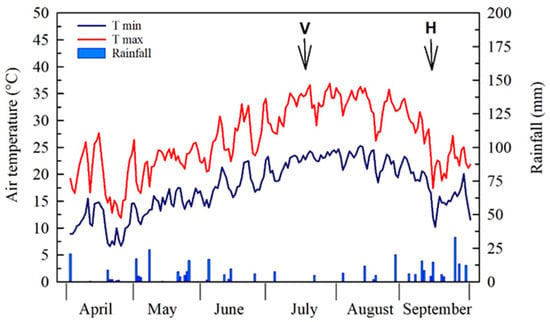
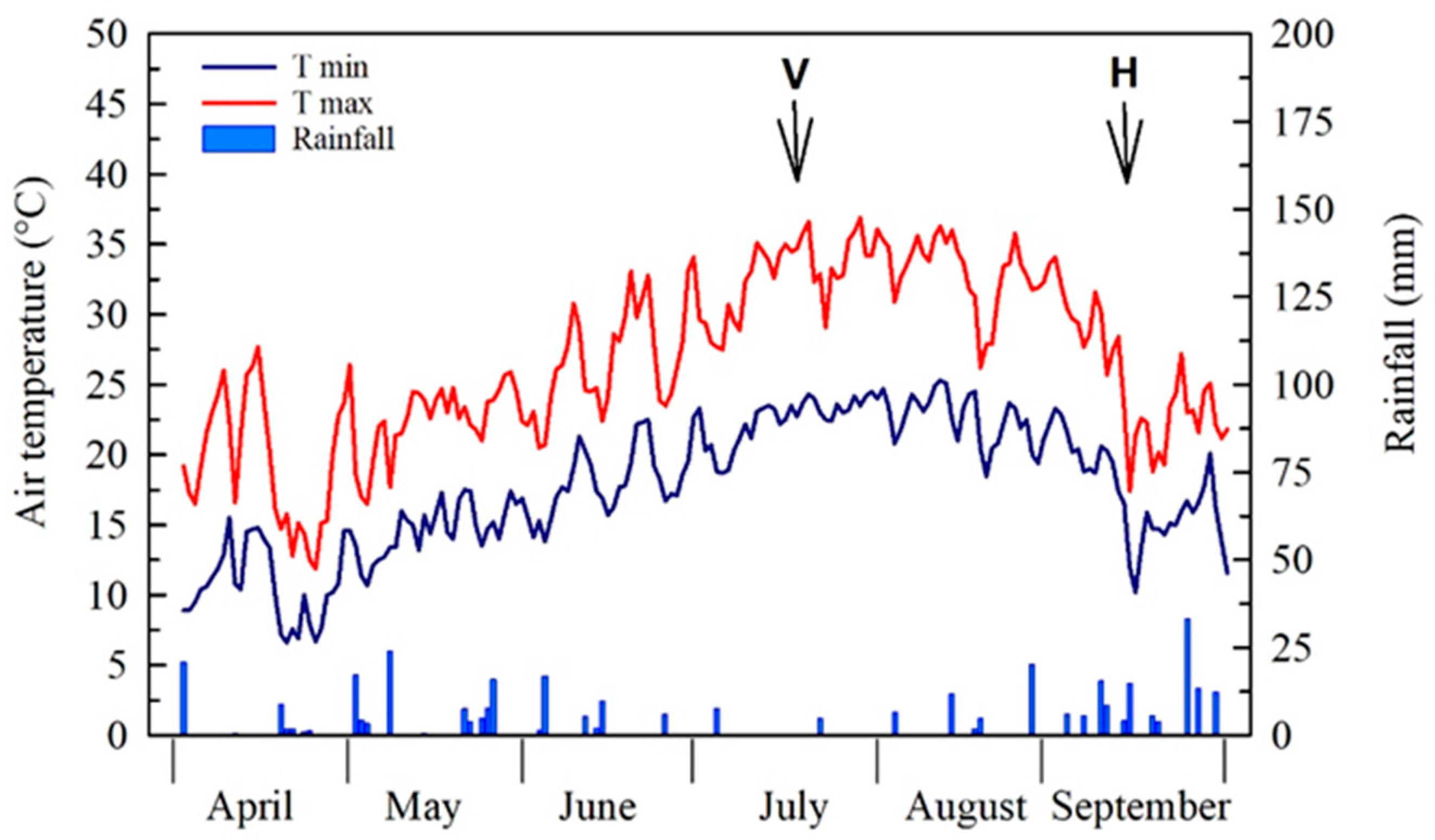
During the 2024 season, the air temperature showed a clear seasonal pattern from April to September, with both minimum and maximum temperatures steadily rising from spring to mid-summer and then falling afterwards (Figure 1). The ripening period was characterized by consistently high temperatures, with maximum daily temperatures often exceeding 30 °C and reaching 35 °C on 14 days. Night temperatures were also notably high, with 70 tropical nights (Tmin > 20 °C), as defined by Vincent et al. [27], indicating limited nighttime cooling throughout the summer. Heat accumulation was significant, with GDD reaching 382, 548, and 552 in June, July, and August, respectively, representing 17%, 25%, and 26% of the total April–September GDD (2230), highlighting the strong thermal contribution of mid-summer. Total rainfall from April to September was 349.6 mm, but precipitation was irregular, mainly occurring in spring and early autumn, while the summer months were particularly dry (41.8 mm in June, 12.6 mm in July, 45.3 mm in August). The combination of high daytime temperatures, frequent tropical nights, and low rainfall likely increased the risk of heat and water stress between veraison (V) and harvest (H), creating favourable conditions for enhanced photoprotective secondary metabolism in berry skins.
Figure 1.
Seasonal trends of maximum and minimum air temperatures and rainfall recorded in ‘Sangiovese’ vineyards located in Magione (Umbria region, central Italy), from April to September 2024. V = veraison; H = harvest.
3.2. Vine Performance and Berry Composition at Harvest
At harvest, NBP application did not significantly affect vine yield components (Table 1). The number of clusters per vine and yield per vine were similar across treatments. Likewise, there were no statistically significant differences in average cluster weight and berry weight between control vines and those treated with NBP at either 1% or 2%. At harvest, no significant differences among treatments were observed in total soluble solids, titratable acidity, must pH, and total anthocyanins (Table 1). Total phenols exhibited a numerical increase in treated vines, although this was not statistically significant (Table 1).
Table 1.
Yield components, grape composition, and phenolic profile in berry skins recorded at harvest in cv. ‘Sangiovese’ vines treated with NBP at two concentrations (1% and 2%) compared with untreated control vines during the 2024 season.
At harvest, no symptoms of sunburn, browning, or berry shrivelling damage were visually observed in any of the treatments.
3.3. Phenolic Profile of Berry Skin
NBP treatments decreased the accumulation of the main flavonols in berry skins compared to controls, whereas myricetin showed a significant decrease only at NBP 2 (−16.2%) (Table 2). Both quercetin derivatives were lower in treated grapes, with quercetin-3-O-glucoside decreasing by 12.3% in NBP 1 and 17.4% in NBP 2, while quercetin-3-O-glucuronide showed an even greater reduction (−19.1% and −22.1%, respectively). Kaempferol-3-O-glucoside was also negatively impacted, precisely −26.3% at the 1% concentration and −21.4% at the 2% concentration, whereas myricetin showed a significant decrease at NBP 2 (−16.2%). However, no significant differences were observed between the 1% and 2% NBP treatments for quercetin-3-O-glucoside, quercetin-3-O-glucuronide, and kaempferol-3-O-glucoside, indicating comparable effects of the two concentrations on these compounds. Flavan-3-ols did not display significant differences among treatments. In contrast, the stilbene fraction changed under NBP. Polydatin (the glycosylated form of resveratrol) increased significantly only in NBP 1 concentration (+24%), while resveratrol showed only a modest, non-significant increase compared to the control (Table 2).
Table 2.
Phenolic profile and carotenoid concentrations in berry skins recorded at harvest in cv. ‘Sangiovese’ vines treated with NBP at two concentrations (1% and 2%) compared with untreated control vines during the 2024 season.
3.4. Carotenoid Profile of Berry Skin
NBP 2 treatment resulted in a significantly higher lutein concentration in grape skins than in control vines, consistent with the findings of Giordano et al. [8], while NBP 1 showed intermediate levels (Table 2). Despite including β-carotene in the formulation, no differences were observed in grape skin concentrations. This may be because the compound mainly served a photoprotective role and was subsequently oxidized into catabolic products.
3.5. Expression Patterns of Flavonol Biosynthetic Genes Under NBP Treatments
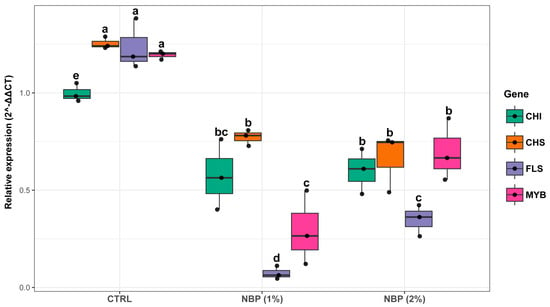
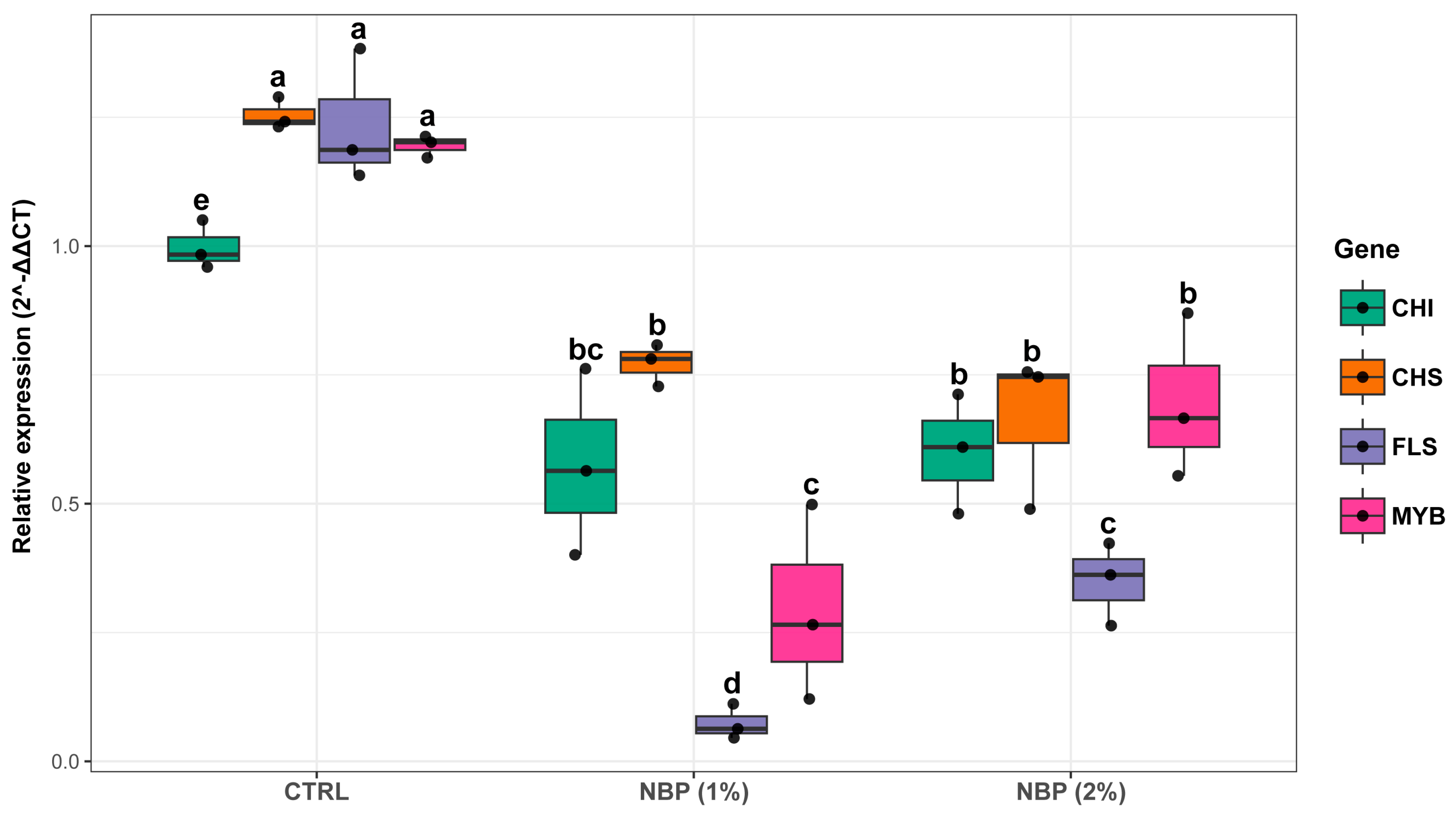
The expression levels of the structural genes involved in flavonol biosynthesis (CHS, CHI, and FLS), as well as the MYB transcription factor included in this pathway, were significantly affected by NBP treatments (Supplementary Table S1B). Overall, NBP led to a general downregulation of the pathway, with FLS showing the strongest suppression (Figure 2).
Figure 2.
Relative expression levels of CHI, CHS, FLS, and MYB genes in berry skins of cv. ‘Sangiovese’ under control, NBP 1, and NBP 2 treatments. Gene expression was calculated using the 2−ΔΔCt method and normalized against EF-1α and UBI reference genes. Control samples were set to 1. Data are presented as the mean + SE of three biological replicates. Different letters indicate statistically significant differences among treatments according to Tukey’s HSD test (p < 0.05).
The relative expression of FLS decreased from approximately 1.24 ± 0.19 in the control to 0.07 ± 0.03 in NBP 1% and 0.35 ± 0.09 in NBP 2%, indicating a strong downregulation at this terminal step (Supplementary Table S1C). For CHS, transcript levels decreased in response to NBP treatments: control samples showed higher expression (~1.25 ± 0.19), while NBP 1 and NBP 2 showed reduced values (0.77 ± 0.11 and 0.66 ± 0.14, respectively), without evidence of a clear dose effect. CHI expression was also consistently reduced by NBP treatments, though to a lesser degree, declining from approximately 1.00 ± 0.06 in the control to 0.58 ± 0.20 and 0.60 ± 0.12 in NBP 1 and NBP 2, respectively (Supplementary Table S1C). The MYB transcript was significantly reduced under NBP 1% compared to the control. Under NBP 2%, expression levels were significantly higher than under NBP 1% but remained lower than control values (Figure 2; Supplementary Table S1B). Comparisons of genes within each treatment revealed distinct transcriptional hierarchies (Supplementary Table S1B; Figure 2). Under control conditions, CHS, FLS, and MYB showed similar expression levels and were all higher than CHI, indicating coordinated basal activity of the pathway. After NBP 1 treatment, FLS was the least expressed gene, while CHS and CHI maintained similar moderate expression; MYB remained significantly lower than CHS/CHI but higher than FLS. At NBP 2, FLS partially recovered but stayed significantly lower than CHS/CHI/MYB, while CHS and CHI showed no significant difference from their levels at 1% NBP. Notably, MYB expression was significantly higher under NBP 2 than NBP 1, indicating a differential transcriptional response between the two NBP treatments.
4. Discussion
In central Italy, the 2024 season was marked by high thermal availability and limited rainfall during the ripening period, with several days exceeding 35 °C and a high frequency of tropical nights. These conditions are increasingly observed in Mediterranean viticultural areas and are known to enhance berry exposure stress, especially under high irradiance and UV-B radiation [1,2,27]. The gradual rise in nighttime heat accumulation may negatively affect vine physiology, particularly as respiration rates typically increase while carbohydrate translocation decreases [28]. Consequently, berry ripening kinetics, as well as the repair of damaged photosystems, slow down dramatically [28]. The high frequency of tropical nights observed during the central part of summer may have further intensified the thermal stress experienced by the vines, as elevated night temperatures can increase respiration and impair carbohydrate translocation and photosynthetic performance [29]. Since these environmental stresses act synergistically, they are highly dangerous and require further study.
In the present study, NBP application did not affect vine yield and relative components, indicating that the treatments, applied once at the onset of veraison, had no negative effects on vine productivity or other yield components. Similarly, grape soluble solids, titratable acidity, and pH were not significantly affected, confirming that NBP did not substantially alter dynamics of main ripening parameters. This is in agreement with previous observations reporting that β-carotene-based protective formulations can reduce stress-related responses without negatively affecting yield performance [8].
The core finding of this study is that NBP significantly reduced the accumulation of major flavonols in berry skins. Both NBP concentrations significantly reduced quercetin-3-O-glucoside, quercetin-3-O-glucuronide, and kaempferol-3-O-glucoside compared with the Control, while no significant differences were observed between the 1% and 2% treatments. Therefore, the two NBP concentrations produced comparable effects on the accumulation of these major flavonols under the conditions tested. These results are particularly relevant for cv. ‘Sangiovese’, a variety often displaying high grape flavonol content under direct light exposure and high air temperatures, with consequent negative outcomes on wine quality due to quercetin instability and precipitation during aging [15,16,30]. In parallel with flavonol changes, NBP-treated vines did not show modification in the content of catechin and epicatechin. In contrast to resveratrol, polydatins were significantly higher in NBP 1 than in the other two treatments (Table 2). The significant increase in polydatin observed only at 1% NBP may indicate that a moderate treatment stimulus was sufficient to activate stilbene biosynthesis, whereas this response was not evident at 2%.
Carotenoid profiling provided further insight into the physiological response induced by NBP. Lutein concentration increased significantly, particularly in the 2% treatment, whereas β-carotene remained unchanged. Lutein is a key photoprotective carotenoid that dissipates energy through xanthophyll-related mechanisms and helps limit oxidative damage under excessive light stress [22]. The higher lutein content detected at 2% suggests that the flavonol reduction observed under this dosage may be partially associated with enhanced carotenoid-based photoprotection: the higher lutein could indeed be at the basis of a lower requirement for flavonol accumulation as a UV-screening mechanism. The lack of β-carotene increase, despite its presence in the formulation, is consistent with previous reports and may reflect its rapid oxidation and utilization in stress-mitigation processes rather than its long-term storage in berry tissues [8].
The transcriptional analysis supports the metabolite data and provides a mechanistic interpretation of the observed flavonol response. NBP treatment significantly downregulated the expression of key flavonol biosynthetic genes, with FLS showing the strongest repression.
Since FLS encodes the terminal enzyme responsible for the conversion of dihydroflavonols into flavonols, its suppression represents a highly effective bottleneck in limiting quercetin accumulation. Interestingly, the strongest repression occurred at 1%, whereas the 2% showed partial recovery of FLS expression, suggesting a complex regulatory response rather than a simple linear inhibition. Such hierarchical regulation, in which late flavonoid genes respond more strongly to environmental signals than early pathway genes, has been reported in grapevine under various stress conditions [20,31]. Flavonol biosynthesis is highly responsive to UV-B radiation through regulatory cascades involving HY5 and MYB transcription factors. UV-B-induced activation of HY5 can stimulate MYB regulators such as VvMYBF1, which in turn enhances the transcription of flavonol-related structural genes, including FLS and glycosyltransferases [20,29]. In this context, the coordinated downregulation of CHS, CHI, and, most notably, FLS under NBP together with the marked repression of MYB at 1% suggests that NBP may attenuate the activation of UV-responsive transcriptional programs in berry skins. A plausible explanation is that NBP reduces berry-skin stress and oxidative signalling associated with high radiation/temperature, thereby lowering the induction of flavonol-promoting regulators and their downstream targets.
Interestingly, at 2% NBP, VvMYBF1 expression increased significantly relative to the 1% treatment, and FLS transcript levels showed a concordant, though incomplete, upward trend. This partial transcriptional recovery, however, did not translate into a detectable metabolic difference: flavonol concentrations were similarly reduced at both concentrations, with no significant difference between 1% and 2% NBP. This dissociation between transcript levels and metabolic output suggests that the transcriptional recovery at 2% is insufficient to restore enzymatic flux through the terminal flavonol biosynthetic step. Post-transcriptional regulation, enzyme activity constraints, substrate competition within the flavonoid network, and/or accelerated flavonol turnover may collectively attenuate the impact of the partial gene reactivation on the final flavonol profile. An alternative interpretation is that the higher NBP dose elicits a compensatory regulatory response, such as feedback control of flavonoid flux or rebalancing of phenylpropanoid allocation, that is nonetheless counteracted by the sustained suppression of upstream enzymes and/or continued modulation of UV-induced signalling.
Overall, the combined metabolic and transcriptional evidence showed that NBP influences secondary metabolism in grape berry skins under high UV and thermal stress. Flavonols reacted similarly to 1% and 2% NBP, whereas lutein showed a stronger response at 2%, suggesting that different metabolic branches exhibit varying sensitivity to NBP concentration. These results demonstrate the potential of NBP as a practical vineyard tool to limit excessive flavonol accumulation, especially in cultivars such as ‘Sangiovese’ that are increasingly exposed to high-radiation environments under climate change.
5. Conclusions
A single NBP application at the onset of veraison reduced the accumulation of major flavonols, particularly quercetin derivatives, in ‘Sangiovese’ berry skins without affecting yield components or technological maturity parameters. The 1% and 2% application rates produced comparable reductions in quercetin-3-O-glucoside, quercetin-3-O-glucuronide, and kaempferol-3-O-glucoside, indicating that increasing the concentration to 2% did not provide an additional benefit in limiting flavonol accumulation. Moreover, total anthocyanins and flavan-3-ols were not significantly affected, suggesting that NBP selectively influenced specific branches of berry-skin phenolic metabolism rather than causing a general reduction in phenolic compounds. Carotenoid profiling also revealed a treatment-related change in berry-skin composition, with lutein increasing significantly, particularly at the 2% application rate, while β-carotene remained unchanged; however, the functional significance of this response requires confirmation through direct physiological and biochemical measurements. At the molecular level, the downregulation of flavonol-biosynthetic genes, particularly FLS, together with changes in MYBF1 expression, was consistent with transcriptional modulation of the flavonol pathway and supported the observed metabolic responses. Overall, these findings indicate that NBP may represent a practical vineyard strategy for limiting excessive quercetin–glycoside accumulation without compromising vine productivity or grape ripening. The comparable response obtained with the 1% treatment further suggests that the lower application rate may be sufficient under the conditions tested, potentially reducing product use and associated treatment costs.
Supplementary Materials
The following supporting information can be downloaded at: https://www.mdpi.com/article/10.3390/horticulturae12111338/s1, Table S1: (A) List of genes (LocusID, GenBank_link) and their corresponding primer sequences used for the validation by RT-qPCR; (B) Multiple Statistical Comparisons and Tukey’s test; (C) Experimental design of RT-qPCR and 2−ΔΔCt/Mean/SD values from biological and technical replicates.
Author Contributions
Conceptualization, L.G., G.M. and A.P.; Experimental Setup, L.G., T.F., G.A. and Data Collection, L.G., T.F., G.A. and D.F.S.; Data Analysis, L.G., G.M., T.F., J.G.B. and A.P.; Writing—Original Draft Preparation, L.G., G.M., A.B., E.A. and A.P.; Supervision, L.G., G.M., J.G.B., A.B., E.A. and A.P. All authors have read and agreed to the published version of the manuscript.
Funding
This research received no external funding.
Data Availability Statement
The data that support the findings of this study are available from the corresponding author upon reasonable request.
Conflicts of Interest
The authors declare no conflicts of interest.
References
- Jones, G.V.; White, M.A.; Cooper, O.R.; Storchmann, K. Climate change and global wine quality. Clim. Chang. 2005, 73, 319–343. [Google Scholar] [CrossRef] [Scilit]
- van Leeuwen, C.; Darriet, P. The impact of climate change on viticulture and wine quality. J. Wine Econ. 2016, 11, 150–167. [Google Scholar] [CrossRef] [Scilit]
- Palliotti, A.; Tombesi, S.; Silvestroni, O.; Lanari, V.; Gatti, M.; Poni, S. Changes in vineyard establishment and canopy management urged by earlier climate-related grape ripening: A review. Sci. Hortic. 2014, 178, 43–54. [Google Scholar] [CrossRef] [Scilit]
- Schultz, H.R. Climate change and viticulture: A European perspective on climatology, carbon dioxide and UV-B effects. Aust. J. Grape Wine Res. 2000, 6, 2–12. [Google Scholar] [CrossRef] [Scilit]
- Cataldo, E.; Eichmeier, A.; Mattii, G.B. Effects of Global Warming on Grapevine Berries Phenolic Compounds—A Review. Agronomy 2023, 13, 2192. [Google Scholar] [CrossRef] [Scilit]
- Kolb, C.A.; Käser, M.A.; Kopecký, J.; Zotz, G.; Riederer, M.; Pfündel, E.E. Effects of natural intensities of visible and ultraviolet radiation on epidermal ultraviolet screening and photosynthesis in grape leaves. Plant Physiol. 2001, 127, 863–875. [Google Scholar] [CrossRef] [Scilit]
- Downey, M.O.; Harvey, J.S.; Robinson, S.P. The effect of bunch shading on berry development and flavonoid accumulation in Shiraz grapes. Aust. J. Grape Wine Res. 2004, 10, 55–73. [Google Scholar]
- Giordano, L.; Frioni, T.; Nicolosi, E.; Rapisarda, L.; Ferlito, F.; Las Casas, G.; Alfieri, G.; Bellincontro, A.; Collins, C.; Cinosi, N.; et al. New bio-protector for combating heat and light stress across different grape cultivars and environments. OENO One 2025, 59, 9472. [Google Scholar] [CrossRef] [Scilit]
- Wilson, A.; Ferrandino, A.; Giacosa, S.; Novello, V.; Guidoni, S. The Effect of Temperature and UV Manipulation on Anthocyanins, Flavonols, and Hydroxycinnamoyl-Tartrates in cv. Nebbiolo Grapes (Vitis vinifera L.). Plants 2024, 13, 3158. [Google Scholar] [CrossRef] [Scilit]
- Hidalgo-Sanz, R.; Del-Castillo-Alonso, M.-Á.; Monforte, L.; Tomás-Las-Heras, R.; Núñez-Olivera, E.; Martínez-Abaigar, J. Field Supplements of Ultraviolet-B Radiation in Veraison and Pre-Harvest Differentially Modify the Phenolic Composition of Grape Skins and Wines. Phyton Int. J. Exp. Bot. 2025, 94, 3453–3470. [Google Scholar] [CrossRef] [Scilit]
- Price, S.F.; Breen, P.J.; Valladao, M.; Watson, B.T. Cluster sun exposure and quercetin in Pinot Noir grapes and wine. Am. J. Enol. Vitic. 1995, 46, 187–194. [Google Scholar] [CrossRef] [Scilit]
- Spayd, S.E.; Tarara, J.M.; Mee, D.L.; Ferguson, J.C. Separation of sunlight and temperature effects on the composition of Vitis vinifera cv. Merlot berries. Am. J. Enol. Vitic. 2002, 53, 171–182. [Google Scholar] [CrossRef] [Scilit]
- Poni, S.; Casalini, L.; Bernizzoni, F.; Civardi, S.; Intrieri, C. Effects of early defoliation on shoot photosynthesis, yield components, and grape composition. Am. J. Enol. Vitic. 2006, 57, 397–407. [Google Scholar] [CrossRef] [Scilit]
- Frioni, T.; Zhuang, S.; Palliotti, A.; Sivilotti, P.; Falchi, R.; Sabbatini, P. Leaf removal and cluster thinning efficiencies are highly modulated by environmental conditions in cool climate viticulture. Am. J. Enol. Vitic. 2017, 68, 325–335. [Google Scholar] [CrossRef] [Scilit]
- Cheynier, V.; Dueñas-Paton, M.; Salas, E.; Maury, C.; Souquet, J.-M.; Sarni-Manchado, P.; Fulcrand, H. Structure and properties of wine pigments and tannins. Am. J. Enol. Vitic. 2006, 57, 298–305. [Google Scholar] [CrossRef] [Scilit]
- Gambuti, A.; Picariello, L.; Rinaldi, A.; Ugliano, M.; Moio, L. New insights into the formation of precipitates of quercetin in Sangiovese wines. J. Food Sci. Technol. 2020, 57, 2602–2611. [Google Scholar] [CrossRef] [Scilit]
- Luciano, A.; Moio, L.; Gambuti, A. Quercetin instability in red wines: Insights into precipitation and control approaches. Curr. Res. Food Sci. 2026, 12, 101319. [Google Scholar] [CrossRef] [Scilit]
- Mattivi, F.; Guzzon, R.; Vrhovsek, U.; Stefanini, M.; Velasco, R. Metabolite profiling of grape: Flavonols and anthocyanins. J. Agric. Food Chem. 2006, 54, 7692–7702. [Google Scholar] [CrossRef] [Scilit]
- Allegro, G.; Pastore, C.; Valentini, G.; Filippetti, I. The influence of leaf removal and the within-canopy microclimate on grape flavonols: A field study on a white cultivar. Sci. Hortic. 2019, 252, 1–10. [Google Scholar]
- Czemmel, S.; Stracke, R.; Weisshaar, B.; Cordon, N.; Harris, N.N.; Walker, A.R.; Robinson, S.P.; Bogs, J. The grapevine R2R3-MYB transcription factor VvMYBF1 regulates flavonol synthesis in developing grape berries. Plant Physiol. 2009, 151, 1513–1530. [Google Scholar] [CrossRef] [Scilit]
- Shi, T.; Su, Y.; Lan, Y.; Duan, C.; Yu, K. The molecular basis of flavonoid biosynthesis response to water, light, and temperature in grape berries. Front. Plant Sci. 2024, 15, 1441893. [Google Scholar] [CrossRef] [Scilit]
- Demmig-Adams, B.; Adams, W.W., III. The role of the xanthophyll cycle in the protection of photosynthesis. Annu. Rev. Plant Physiol. Plant Mol. Biol. 1996, 47, 599–626. [Google Scholar]
- Ough, C.S.; Amerine, M.A. Methods for Analysis of Musts and Wines; Wiley: New York, NY, USA, 1988. [Google Scholar]
- Slinkard, K.; Singleton, V.L. Total phenol analysis: Automation and comparison with manual methods. Am. J. Enol. Vitic. 1977, 28, 49–55. [Google Scholar] [CrossRef] [Scilit]
- Ritchey, J.G.; Waterhouse, A.L. A standard red wine: Monomeric phenolic analysis of commercial Cabernet Sauvignon wines. Am. J. Enol. Vitic. 1999, 50, 91–100. [Google Scholar] [CrossRef] [Scilit]
- Crupi, P.; Preedy, V.R.; Antonacci, D. HPLC-DAD-MS (ESI+) determination of carotenoids in fruit. In Vitamin A and Carotenoids; Royal Society of Chemistry: Cambridge, UK, 2012. [Google Scholar] [CrossRef] [Scilit]
- Vincent, L.A.; Peterson, T.C.; Barros, V.R.; Marino, M.B.; Rusticucci, M.; Caravajal, G.; Dias, C.G.; Garcia, R.R.; Guedes, M.G.; Alves, L.M.; et al. Observed trends in indices of daily temperature extremes in South America 1960–2000. J. Clim. 2005, 18, 5011–5023. [Google Scholar] [CrossRef] [Scilit]
- Tombesi, S.; Cincera, I.; Frioni, T.; Ughini, V.; Gatti, M.; Palliotti, A.; Poni, S. Relationship among night temperature, carbohydrate translocation and inhibition of grapevine leaf photosynthesis. Environ. Exp. Bot. 2019, 157, 293–298. [Google Scholar] [CrossRef] [Scilit]
- Gambuti, A.; Luciano, A.; Moio, L.; Picariello, L. Screening of Italian red wines for quercetin precipitation risk index. OENO One 2025, 59, 1–11. [Google Scholar] [CrossRef] [Scilit]
- Matus, J.T.; Poupin, M.J.; Cañón, P.; Bordeu, E.; Alcalde, J.A.; Arce-Johnson, P. Isolation of WDR and bHLH genes related to flavonoid synthesis in grapevine (Vitis vinifera L.). Plant Mol. Biol. 2010, 72, 607–620. [Google Scholar] [CrossRef] [Scilit]
- Koyama, K.; Ikeda, H.; Poudel, P.R.; Goto-Yamamoto, N. Light quality affects flavonoid biosynthesis in young berries of Cabernet Sauvignon grape. Phytochemistry 2012, 78, 54–64. [Google Scholar] [CrossRef] [Scilit]

Disclaimer/Publisher’s Note: The statements, opinions and data contained in all publications are solely those of the individual author(s) and contributor(s) and not of MDPI and/or the editor(s). MDPI and/or the editor(s) disclaim responsibility for any injury to people or property resulting from any ideas, methods, instructions or products referred to in the content. |
© 2026 by the authors. Licensee MDPI, Basel, Switzerland. This article is an open access article distributed under the terms and conditions of the Creative Commons Attribution (CC BY) license.