


Abstract
Shoot regeneration is an important prerequisite for many plant transformation and genome-editing protocols, but responses can vary among commercial cultivars. We screened 43 Luffa cultivars, recorded as 21 ridged and 22 smooth types, on four MS-based media using seedling-derived cotyledon and cotyledonary-axis explants. At a common six-week endpoint, 10,433 of 10,517 explants formed callus (99.20%), 2074 showed browning (19.72%), and 353 produced a recognizable small shoot bud and/or young leaves (3.36%; descriptive 95% Wilson CI: 3.03–3.72%). Twenty-five cultivars were shoot-positive on at least one medium, whereas 18 were negative on all four. Cuihua2212 had the highest pooled response (60/250 (24.0%)). A cultivar-clustered, denominator-weighted binomial-family generalized estimating equation gave a global medium Wald χ2(3) of 7.48 (p = 0.058). In six exploratory pairwise comparisons, C exceeded D (OR: 2.51, 95% CI: 1.30–4.88; BH-adjusted q = 0.039). The medium-adjusted ridged/smooth OR was 2.54 (95% CI: 1.04–6.17), with substantial uncertainty and sensitivity to cultivar composition. Frequent callus formation, therefore, coincided with infrequent visible shoot recovery under the conditions tested. The screen identifies candidates for independent regeneration optimization; it does not establish a callus-derived shoot pathway, species-wide differences or transformation competence.
1. Introduction
Recovery of organized shoots and ultimately fertile plants is required for many genetic transformation and genome-editing applications. Gene delivery alone does not establish successful plant transformation [1]. Cucurbit regeneration and transformation protocols are sensitive to source genotype, explant preparation, growth regulators and selection conditions [2,3]. Screening commercially available cultivars can identify useful starting materials, provided that visible shoot formation is distinguished from subsequent rooting, acclimatization and stable transformation.
Ridged luffa (Luffa acutangula) and smooth or sponge luffa (L. aegyptiaca, also reported in the literature as L. cylindrica) are important, cultivated forms of Luffa. Their germplasm identity can be investigated using morphological and phylogenetic evidence [4]; commercial horticultural labels alone do not provide equivalent authentication. Regeneration has been reported in selected Luffa materials [5,6]. Wu et al. [6] obtained 95.83% adventitious-bud induction with a cotyledon protocol containing thidiazuron (TDZ), indole-3-butyric acid (IBA) and silver nitrate and examined the effect of explant position. Such optimization in a particular material does not establish comparable performance across a broader cultivar panel.
Genetic variation in cucumber regeneration [7,8] and effects of genotype and explant source in melon [9] support broader screening in Luffa. Callus growth, however, is not equivalent to shoot organogenesis: proliferating tissue may not acquire or express the cellular organization required for a shoot meristem, and shoots can originate through different developmental routes [10,11,12,13]. Low shoot recovery may, therefore, reflect the tested medium, dissection pattern or assessment window as well as cultivar responsiveness. This study evaluated 43 commercial cultivars on four empirical formulations to describe callus formation, browning and morphologically recognizable shoot recovery at six weeks. Its purpose was to identify contrasting materials for further validation, rather than establish an optimized regeneration or transformation system.
2. Materials and Methods
2.1. Plant Materials and Explant Preparation
Forty-three commercially sourced Luffa cultivars were included in the screening panel (Supplementary Table S1). Seed records and horticultural type classified 21 as ridged luffa, putatively L. acutangula, and 22 as smooth luffa, putatively L. aegyptiaca. Thirty-two entries were recorded as F1 hybrids and 11 as non-F1 materials. Species identity was not independently authenticated by diagnostic botanical vouchers or molecular markers. The panel was assembled from commercial materials and was not a probability sample of either species. Complete supplier, seed lot, geographical origin and breeding history records were unavailable. Cultivar codes and recorded classifications are supplied in Tables S1 and S2.
Seeds were surface-sterilized with a commercial sodium hypochlorite disinfectant containing approximately 5.0% available chlorine for 30 min and soaked in sterile water for 24 h. After aseptic removal of the outer seed coat, the de-coated seeds were sterilized with the same disinfectant for another 10 min and rinsed three times in sterile water. Excess moisture was removed with sterile filter paper, and the dark-green inner seed coat was removed. Healthy embryos were inserted vertically into half-strength MS germination medium containing 20 g L−1 sucrose, with the radicle downward and approximately one-third of each embryo embedded in the medium. The germination medium had a pH of 5.8 and was autoclaved at 121 °C for 15 min. Cultures were established in disposable Petri dishes (90 mm in diameter). The cultures were incubated in darkness at 25 ± 2 °C for 2–3 days before explant excision.
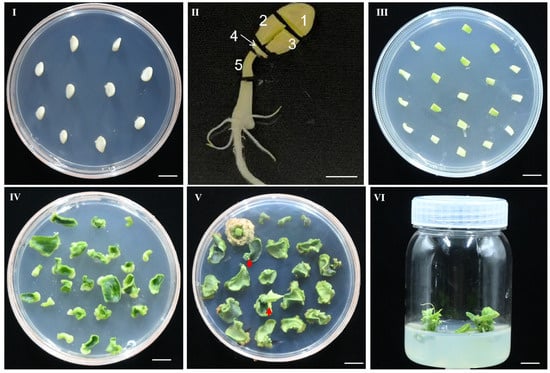
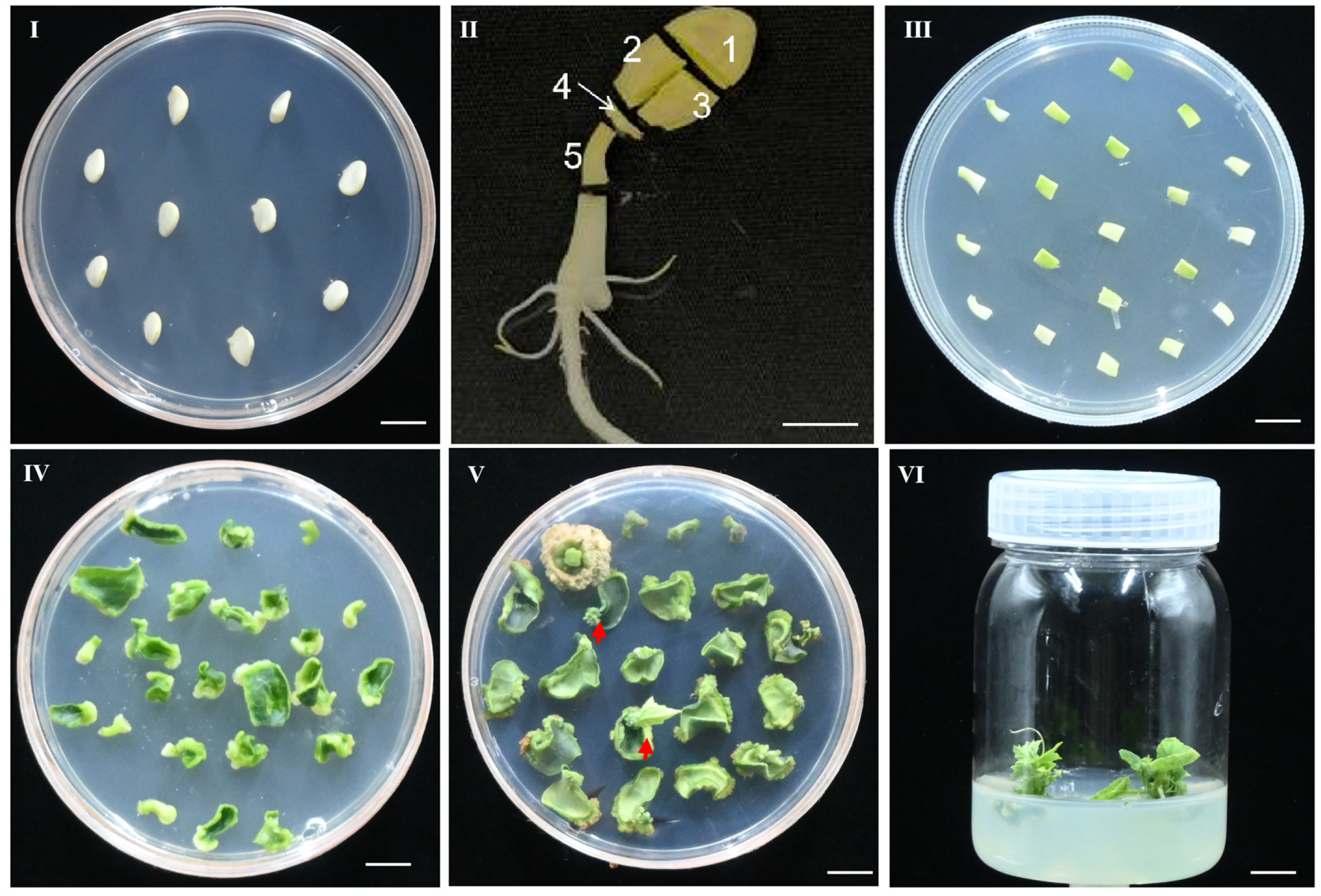
Cotyledon segments and cotyledonary axis pieces were excised for culture as shown in Figure 1(II,III). Exact segment dimensions and region-specific counts were not retained. Exclusion of the visible growing point does not exclude all residual meristematic tissue in the cultured material; the developmental origin of recovered shoots was not examined histologically.
Figure 1.
Representative photographs of explant preparation and culture responses in Luffa. (I) Embryos on germination medium. (II) Excision regions: 1–3, cotyledon tissue; 4, visible growing point; 5, cotyledonary axis. Regions 2, 3 and 5 were cultured, whereas 1 and 4 were excluded. (III) Prepared tissue segments on culture medium. (IV) Tissue proliferation and callus-like growth. (V) Browning and early bud-like structures (red arrows). (VI) Cultures bearing visible shoots and developing leaves. These are representative appearances, not serial images of one explant. Histological origin and direct versus indirect organogenesis were not established. Scale bars = 1 cm.
2.2. Regeneration Screening
Explants were cultured on Murashige and Skoog (MS) basal medium [14] with four plant growth regulator formulations: A, 2.0 mg L−1 6-benzylaminopurine (6-BA) plus 0.05 mg L−1 α-naphthaleneacetic acid (NAA); B, 2.0 mg L−1 6-BA plus 0.1 mg L−1 NAA; C, 1.0 mg L−1 6-BA plus 0.5 mg L−1 IBA; and D, 1.0 mg L−1 6-BA plus 0.1 mg L−1 NAA. Each regeneration medium contained 20 g L−1 sucrose and 8 g L−1 agar, with pH adjusted to 5.8. The formulations were an empirical comparison based on the established role of cytokinin–auxin balance in organ formation [15], not a full factorial optimization. A versus B changes NAA concentration with fixed 6-BA, and B versus D changes 6-BA concentration with fixed NAA. Comparisons involving C also change auxin identity and concentration, so a response difference cannot be attributed specifically to IBA.
Cotyledon pieces were placed abaxial side down where applicable. Cultures were maintained at 25 ± 2 °C under a 16 h light/8 h dark photoperiod at approximately 40–50 μmol m−2 s−1. Callus formation, browning and shoot recovery were assessed and recorded for every cultivar–medium combination six weeks after culture initiation. Visible proliferative tissue was scored as callus and visible brown discoloration as browning. An explant was scored as shoot-positive only when a recognizable small shoot bud and/or emerging young leaves were clearly visible. Undifferentiated callus and unorganized green swellings alone were excluded. Each explant contributed one binary shoot outcome at the final assessment, irrespective of the number of buds or shoots present. Thus, shoot recovery is the number of shoot-positive explants divided by all explants cultured in that treatment. Callus, browning and shoot recovery were separate characteristics; their percentages are not mutually exclusive. No cross-tabulation of these characteristics was retained. Figure 1 provides representative external appearances, without determining shoot origin.
Each cultivar–medium treatment comprised three independently established culture plates, with approximately 15–25 explants obtained from six to seven seedlings per plate. Plates were randomly arranged within the growth chamber. The 43 cultivars were evaluated on all four media, giving 172 cultivar–medium combinations with 45–75 explants per combination and 10,517 explants in total. The retained numeric record pools the three plate counts within each combination. Individual plate responses, seedling identities, allocation of the two cotyledons and explant regions across treatments, independent experimental dates and the original position map were not retained. Consequently, plate replication cannot be used to estimate between-plate variability or demonstrate independence of experimental runs, and possible shared-seedling dependence cannot be reconstructed.
2.3. Statistical Analysis
The response for each cultivar–medium combination was its shoot-positive count divided by its recorded explant total. A logit-link, binomial-family generalized estimating equation (GEE) was fitted to these 172 pooled proportions, using explant totals as case weights and cultivars as 43 clusters, each with four medium observations. An exchangeable working correlation and robust sandwich covariance were used. The medium model contained an intercept and indicators for B, C and D, with A as a reference; its overall medium association was tested by a three-degree-of-freedom Wald test. Six pairwise medium contrasts were examined as one exploratory family, with Benjamini–Hochberg (BH) adjustment. Odds ratios (ORs), marginal 95% confidence intervals (CIs), two-sided unadjusted p-values and BH-adjusted q-values are reported. The pairwise CIs are not multiplicity-adjusted. A second model added recorded ridged/smooth group as a predictor to estimate its medium-adjusted OR. Sensitivity analyses excluded each of the four cultivars with the highest pooled response in turn and refitted both models; a working independence GEE was also fitted. These models assume independence between cultivar clusters and a common medium association across cultivars. No cultivar-by-medium interaction, plate random effect or seedling/region effect was estimated. The GEE provides a marginal association analysis of the retained aggregates, rather than a reconstruction of plate-level binomial trials. Robust inference is asymptotic with 43 cultivar clusters. Wilson 95% CIs for pooled percentages are descriptive and do not account for cultivar, plate or seedling dependence. The analysis used Python 3.12 and statsmodels 0.14.6. Counts, contrasts, sensitivity results and executable code are provided in Tables S1–S6 and Code S1.
3. Results
3.1. Callus Formation, Browning and Shoot Recovery
At the common six-week endpoint, 10,433 of 10,517 explants formed callus (99.20%), 2074 showed browning (19.72%), and 353 were shoot-positive (3.36%; descriptive 95% Wilson CI: 3.03–3.72%; Table 1). Across media, callus formation ranged from 98.87% to 99.59%, browning from 14.56% to 26.79%, and shoot recovery from 1.87% to 4.57%. All percentages use the full explant denominator. The representative photographs show prepared explants, proliferative tissue, browned tissue, early visible bud structures and cultures bearing shoots (Figure 1). They do not document the continuous development of any single explant.
Table 1.
Pooled explant outcomes at six weeks on media A–D.
The cultivar-clustered GEE gave an overall medium Wald χ2(3) of 7.48 (p = 0.058). In the exploratory family of six pairwise contrasts, C had higher estimated odds of shoot recovery than D (OR: 2.51, 95% CI: 1.30–4.88; unadjusted p = 0.0064; BH-adjusted q = 0.039). The other five contrasts had q > 0.05 (Table S3). The working independence sensitivity analysis gave a similar overall result (χ2(3) = 7.51; p = 0.057) and C–D contrast (OR: 2.51; q = 0.038; Table S5). The omnibus and pairwise tests address different hypotheses; the exploratory C–D result identifies a comparison for follow-up and does not establish an optimal formulation across cultivars.
3.2. Distribution of Shoot Recovery Among Cultivars
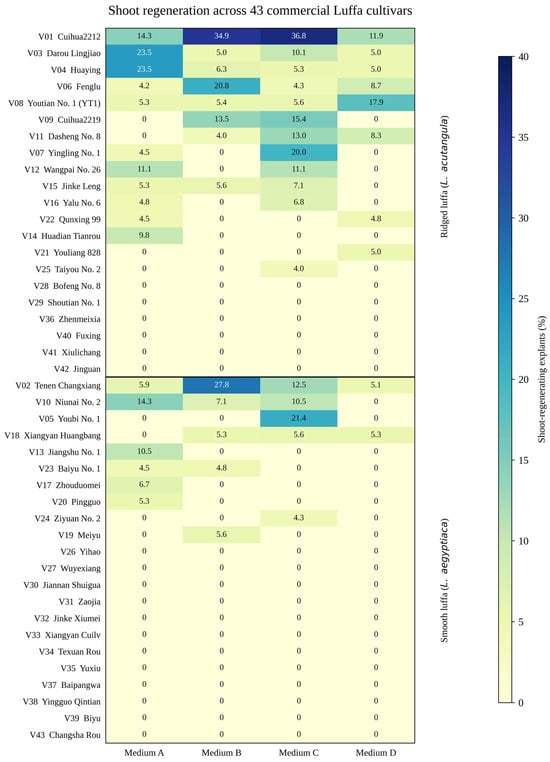
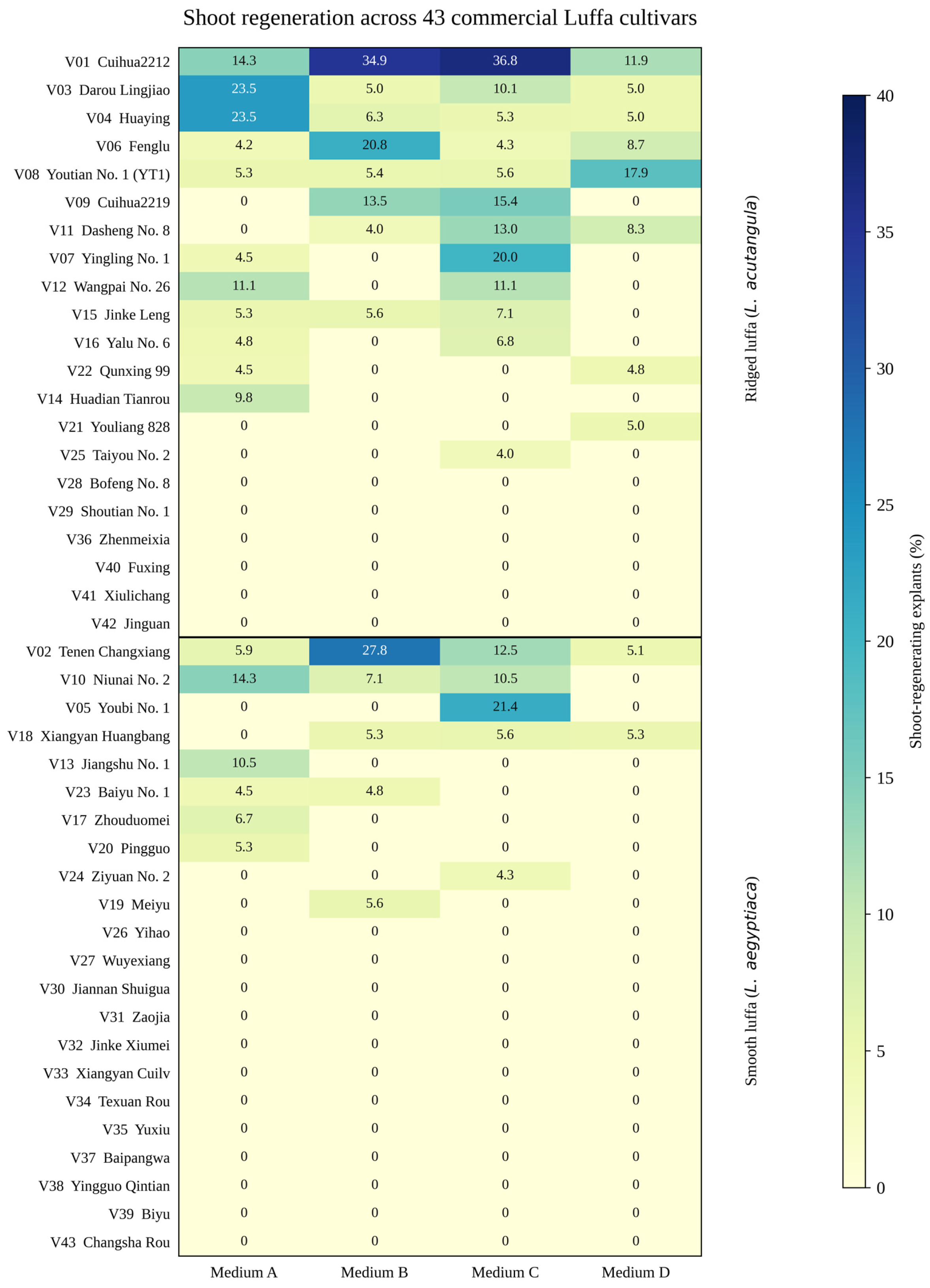
Among the 172 cultivar–medium combinations, 57 contained at least one shoot-positive explant, and 115 recorded zero. Twenty-five cultivars were shoot-positive on at least one medium; 18 recorded no shoots on any of the four. The full 43 × 4 matrix, including all zero outcomes, is shown in Figure 2. Within each recorded horticultural group, cultivars showed different response profiles across media.
Figure 2.
Shoot recovery (%) for all 43 commercial Luffa cultivars on media A–D at six weeks. Each cell shows the percentage of all cultured explants with at least one recognizable small shoot bud and/or young leaves. All 172 combinations, including zeros, are displayed. The upper block contains 21 recorded ridged cultivars, putatively L. acutangula; the lower contains 22 recorded smooth cultivars, putatively L. aegyptiaca. These horticultural classifications were not independently authenticated. Cultivars are ordered within groups by pooled shoot recovery. Percentages are rounded to one decimal place; denominators and exact counts are in Tables S1 and S2. The species names in the figure denote the recorded horticultural assignments.
Cuihua2212 (V01, recorded ridged group) had the highest pooled shoot recovery, with 60/250 explants (24.0%) across all media. It produced 21/57 shoot-positive explants on C (36.8%) and 22/63 on B (34.9%). Three other cultivars exceeded 10% when pooled across media: Tenen Changxiang (V02, smooth; 30/245, 12.24%), Darou Lingjiao (V03, ridged; 25/240, 10.42%) and Huaying (V04, ridged; 27/266, 10.15%). These are descriptive rankings of this screen, rather than statistically established differences between every cultivar pair or evidence of reproducibility in independent runs. Exact counts and denominators for all entries are in Tables S1 and S2.
3.3. Comparison Between Recorded Ridged- and Smooth-Luffa Groups
The 21 recorded ridged cultivars yielded 256/5235 shoot-positive explants (4.89%), compared with 97/5282 (1.84%) for the 22 smooth cultivars. The medium-adjusted GEE gave a ridged/smooth OR of 2.54 (95% CI: 1.04–6.17; p = 0.040). Excluding Cuihua2212 gave an OR of 2.09 (95% CI: 0.91–4.76); excluding Darou Lingjiao or Huaying gave ORs of 2.38 (0.94–6.02) and 2.40 (0.94–6.09), respectively. Excluding the smooth cultivar Tenen Changxiang increased the estimated OR to 3.45 (1.42–8.39; Table S4). The working independence estimate was 2.76 (1.13–6.70; Table S5). These changes in magnitude and precision show dependence on sampled cultivar composition. They do not establish a general difference between authenticated species.
4. Discussion
Nearly universal callus formation and infrequent visible shoot recovery were the principal observations of this screen. They describe different endpoints and do not constitute a measured callus-to-shoot conversion rate. In particular, the retained counts do not link each shoot to an individual callus, and the simultaneous presence of abundant callus and few shoots does not show that all shoots arose from callus. Studies of callus and organ regeneration distinguish cell proliferation from acquisition of organogenic organization [10,12]. In Arabidopsis, callus formation from different tissues can recruit a root-associated developmental program [11], and organ regeneration depends on the acquisition of appropriate cellular states within callus [13]. These findings provide a conceptual explanation for why abundant proliferative tissue need not yield abundant shoots; the corresponding cell identities and regulatory events were not measured in Luffa here.
Explant anatomy provides an additional limit on developmental interpretation. Regions 2 and 3 contained cotyledon tissue, whereas region 5 contained cotyledonary-axis tissue. Excluding the visible growing point reduced intentional inclusion of the apex but did not demonstrate complete removal of all pre-existing meristematic cells. The recovered structures could, therefore, include shoots arising directly from explant tissue, through intervening callus, or from residual meristematic tissue. A visible small bud or young leaves was required for a positive score, which avoids equating green swelling with shoot formation, but external morphology cannot resolve these alternative origins. Region-specific culture with documented excision boundaries and serial histological observations would be needed. Histological work in melon illustrates how examination of developing meristematic structures can distinguish early regeneration events from their subsequent failure to yield transformed plants [16]. The present photographs are useful records of appearance, rather than evidence of a single developmental pathway.
The restricted growth regulator comparison may have left substantial regenerative potential unexpressed. A–B and B–D provide local concentration comparisons, but C changes both auxin identity and concentration relative to the NAA media. Its higher pooled response, therefore, cannot be assigned to IBA alone. TDZ, silver nitrate, a wider concentration series and sequential induction/elongation treatments were not assessed. Wu et al. [6] reported 95.83% adventitious-bud induction on MS with 0.3 mg L−1 TDZ, 0.02 mg L−1 IBA, 2 mg L−1 AgNO3 and 3% sucrose, with explant position also investigated. Earlier work on a selected Luffa accession used leaf and nodal explants and found that regulator choice affected shoot production and elongation differently [5]. These studies justify testing additional formulations and anatomically defined explants. Their rates and shoot counts cannot be treated as equivalent to the proportion of explants with visible buds or leaves in this six-week screen because material, tissues, formulations and endpoints differ.
The observed cultivar profiles support follow-up comparisons of contrasting materials, rather than a claim that low responders have irreversibly lost competence. Genetic differences in cucumber regeneration and genotype/explant effects in melon [7,8,9] make cultivar dependence plausible, but this experiment cannot separate genetic effects from seed-lot condition, anatomical sampling or unrecorded culture-unit variation. Cuihua2212 is a practical candidate because its pooled response was highest, and it responded on all four media. The other comparatively responsive cultivars, including the smooth entry Tenen Changxiang, provide additional candidates. Conversely, zero recovery at six weeks records failure under the tested conditions and time window; it is not evidence that an entry cannot regenerate under another protocol or after longer culture.
The medium and horticultural group estimates require interpretation at the scale of the retained data. Denominator weighting uses the actual explant totals, while cultivar clustering allows dependence among the four observations for each entry. Neither step restores the plate-level information that was pooled. Robust covariance also does not verify the assumed independence of cultivar clusters or estimate variation between experimental runs. The broad CIs for the ridged/smooth contrast and its sensitivity to influential cultivars limit the precision of that comparison. Crossing a p-value threshold after an exclusion does not itself demonstrate that two effect estimates differ. Furthermore, commercial group labels were not independently authenticated, and the panel was not randomly sampled from species populations. The findings, therefore, concern these recorded cultivar groups and do not support an intrinsic species-wide difference.
Visible browning was common enough to merit attention, but the retained data cannot test whether browned explants were the same individuals that did or did not form shoots. Browning, tissue viability and organogenic competence should, consequently, not be treated as interchangeable measurements. Likewise, weekly visual inspection does not supply a quantitative trajectory of callus growth or bud emergence. A common six-week endpoint improves comparability within this screen, while potentially missing later responses. Further validation should preserve plate-level numerators and denominators, identify contributing seedlings and explant regions, record culture dates and randomization, and use predefined observation times. These records would allow a hierarchical analysis and a direct test of whether particular materials retain their relative performance.
Shoot recovery is also distinct from transformation competence. In cucurbits, gene delivery, survival during selection and recovery of stable plants introduce further constraints [1,2,3,16]. Recent work showing improved cucurbit transformation through AtGRF5 overexpression provides a directly relevant avenue for testing developmental regulation [17], without demonstrating that the same intervention will work in Luffa. No Agrobacterium infection, selection response, molecular integration or editing, rooted-plant conversion or fertility assessment was performed in the present screen. The responsive entries are, therefore, candidates for regeneration optimization followed by separately validated transformation or genome-editing experiments.
5. Conclusions
Screening 43 commercial Luffa cultivars on four empirical media revealed frequent callus formation (99.20%) and infrequent morphologically recognizable shoot recovery (3.36%) at a common six-week endpoint. Twenty-five cultivars were shoot-positive on at least one medium; Cuihua2212 had the highest pooled recovery. The exploratory C–D contrast and cultivar profiles identify priorities for independent validation. Pooled plate records, unverified horticultural assignments and mixed explant regions limit inference about treatment variability, species differences and shoot origin. The results do not demonstrate obligatory callus-mediated organogenesis or irreversible loss of competence. Responsive cultivars should be tested in independently replicated regeneration experiments before making any claim of transformation suitability.
Supplementary Materials
The following supporting information can be downloaded at https://www.mdpi.com/article/10.3390/horticulturae12111337/s1.
Author Contributions
Conceptualization, X.S. and Z.C.; methodology, S.L. and C.M.; formal analysis, D.K.; investigation, X.C., Y.L., Z.Z., L.Z., X.H., Y.G., Q.C., G.S., H.S. and J.D.; data curation, D.K.; writing—original draft preparation, X.S.; writing—review and editing, S.L., C.M. and Z.C.; supervision, C.M. and Z.C.; project administration, Z.C.; funding acquisition, Z.C. All authors have read and agreed to the published version of this manuscript.
Funding
This research was funded by the Guangxi Innovation-driven Development Project (GUIKE AA23062048), the Guangxi Agricultural Science and Technology Innovation Alliance Project (GUINONGKEMENG 202512), the Basic Research Program of Guangxi Academy of Agricultural Sciences (GUINONGKE 2025YP103 and GUINONGKE 2026YP128), and the Project for Establishment and Optimization of Genetic Transformation and Gene Editing Systems in Major Fruit and Vegetable Crops of Guangxi (GUINONGKE 2025YP087).
Institutional Review Board Statement
Not applicable.
Informed Consent Statement
Not applicable.
Data Availability Statement
All retained cultivar–medium counts are supplied in Tables S1 and S2. Tables S3–S6 and Code S1 reproduce the aggregate analyses and sensitivity checks. The horticultural species assignments in Table S1 derive from commercial records and do not represent independent taxonomic authentication. Counts are pooled over three culture plates per treatment. Individual plate outcomes, seedling identifiers and allocation, explant region outcomes, independent run dates, positional assignments and quantitative weekly scores are unavailable. These levels of variation cannot be recovered from the aggregate dataset.
Acknowledgments
The authors thank the colleagues involved in cultivar collection, tissue culture maintenance, and data recording.
Conflicts of Interest
The authors declare no conflicts of interest.
References
- Altpeter, F.; Springer, N.M.; Bartley, L.E.; Blechl, A.E.; Brutnell, T.P.; Citovsky, V.; Conrad, L.J.; Gelvin, S.B.; Jackson, D.P.; Kausch, A.P.; et al. Advancing crop transformation in the era of genome editing. Plant Cell 2016, 28, 1510–1520. [Google Scholar] [CrossRef] [Scilit] [PubMed]
- Nanasato, Y.; Tabei, Y. A method of transformation and current progress in transgenic research on cucumbers and Cucurbita species. Plant Biotechnol. 2020, 37, 141–146. [Google Scholar] [CrossRef] [Scilit] [PubMed]
- Liu, H.; Zhao, J.; Chen, F.; Wu, Z.; Tan, J.; Nguyen, N.H.; Cheng, Z.; Weng, Y. Improving Agrobacterium tumefaciens-mediated genetic transformation for gene function studies and mutagenesis in cucumber (Cucumis sativus L.). Genes 2023, 14, 601. [Google Scholar] [CrossRef] [Scilit] [PubMed]
- Kumari, S.A.S.M.; Nakandala, N.D.U.S.; Nawanjana, P.W.I.; Rathnayake, R.M.S.K.; Senavirathna, H.M.T.N.; Senevirathna, R.W.K.M.; Wijesundara, W.M.D.A.; Ranaweera, L.T.; Mannanayake, M.A.D.K.; Weebadde, C.K.; et al. The establishment of the species-delimits and varietal-identities of the cultivated germplasm of Luffa acutangula and Luffa aegyptiaca in Sri Lanka using morphometric, organoleptic and phylogenetic approaches. PLoS ONE 2019, 14, e0215176. [Google Scholar] [CrossRef] [Scilit] [PubMed]
- Sujatha, D.; Chithakari, R.; Raghuvardhan, L.; Prasad, B.; Gulab Khan, R.; Sadanandam, A.; Christopher Reuben, T. In vitro plantlet regeneration and genetic transformation of sponge gourd (Luffa cylindrica L.). Afr. J. Plant Sci. 2013, 7, 244–252. [Google Scholar] [CrossRef] [Scilit]
- Wu, Z.; Li, C.; Gao, Y.; Zhang, H.; Long, Y.; An, B.; Liu, S.; Wu, J. Development of an efficient and reproducible in vitro regeneration and transformation protocol for Luffa cylindrica (L.). Roem. S. Afr. J. Bot. 2024, 175, 115–121. [Google Scholar] [CrossRef] [Scilit]
- Nadolska-Orczyk, A.; Malepszy, S. In vitro culture of Cucumis sativus L. 7. Genes controlling plant regeneration. Theor. Appl. Genet. 1989, 78, 836–840. [Google Scholar] [CrossRef] [Scilit] [PubMed]
- Wang, Y.; Zhou, Q.; Zhu, G.; Wang, S.; Ma, Y.; Miao, H.; Zhang, S.; Huang, S.; Zhang, Z.; Gu, X. Genetic analysis and identification of a candidate gene associated with in vitro regeneration ability of cucumber. Theor. Appl. Genet. 2018, 131, 2663–2675. [Google Scholar] [CrossRef] [Scilit] [PubMed]
- Kiss-Bába, E.; Pánczél, S.; Velich, I.; Bisztray, G.D. Influence of genotype and explant source on the in vitro regeneration ability of different melon varieties. Acta Biol. Hung. 2010, 61, 498–511. [Google Scholar] [CrossRef] [Scilit] [PubMed]
- Ikeuchi, M.; Sugimoto, K.; Iwase, A. Plant callus: Mechanisms of induction and repression. Plant Cell 2013, 25, 3159–3173. [Google Scholar] [CrossRef] [Scilit] [PubMed]
- Sugimoto, K.; Jiao, Y.; Meyerowitz, E.M. Arabidopsis regeneration from multiple tissues occurs via a root development pathway. Dev. Cell 2010, 18, 463–471. [Google Scholar] [CrossRef] [Scilit] [PubMed]
- Ikeuchi, M.; Ogawa, Y.; Iwase, A.; Sugimoto, K. Plant regeneration: Cellular origins and molecular mechanisms. Development 2016, 143, 1442–1451. [Google Scholar] [CrossRef] [Scilit] [PubMed]
- Zhai, N.; Xu, L. Pluripotency acquisition in the middle cell layer of callus is required for organ regeneration. Nat. Plants 2021, 7, 1453–1460. [Google Scholar] [CrossRef] [Scilit] [PubMed]
- Murashige, T.; Skoog, F. A revised medium for rapid growth and bio assays with tobacco tissue cultures. Physiol. Plant. 1962, 15, 473–497. [Google Scholar] [CrossRef] [Scilit]
- Skoog, F.; Miller, C.O. Chemical regulation of growth and organ formation in plant tissues cultured in vitro. Symp. Soc. Exp. Biol. 1957, 11, 118–130. [Google Scholar] [PubMed]
- Chovelon, V.; Restier, V.; Giovinazzo, N.; Dogimont, C.; Aarrouf, J. Histological study of organogenesis in Cucumis melo L. after genetic transformation: Why is it difficult to obtain transgenic plants? Plant Cell Rep. 2011, 30, 2001–2011. [Google Scholar] [CrossRef] [Scilit] [PubMed]
- Li, Y.; Wang, N.; Feng, J.; Liu, Y.; Wang, H.; Deng, S.; Dong, W.; Liu, X.; Lv, B.; Sun, J.; et al. Enhancing genetic transformation efficiency in cucurbit crops through AtGRF5 overexpression: Mechanistic insights and applications. J. Integr. Plant Biol. 2025, 67, 1843–1860. [Google Scholar] [CrossRef] [Scilit] [PubMed]

Disclaimer/Publisher’s Note: The statements, opinions and data contained in all publications are solely those of the individual author(s) and contributor(s) and not of MDPI and/or the editor(s). MDPI and/or the editor(s) disclaim responsibility for any injury to people or property resulting from any ideas, methods, instructions or products referred to in the content. |
© 2026 by the authors. Licensee MDPI, Basel, Switzerland. This article is an open access article distributed under the terms and conditions of the Creative Commons Attribution (CC BY) license.