


Abstract
Grape-associated microbial communities are key contributors to wine quality and microbial terroir, yet their dynamics during withering, a critical post-harvest stage for premium sweet and fortified wine production, remain poorly characterized. Using high-throughput metabarcoding (16S rRNA and ITS), we monitored bacterial and fungal communities on Corvina grape berries throughout withering under controlled (C) and non-controlled (NC) dehydration conditions, integrating microbiome data with previously determined volatile organic compound (VOC) and stilbene profiles to uncover taxon–metabolite relationships. Microbial communities underwent progressive restructuring during dehydration. Moreover, the two withering conditions exhibited distinct dehydration kinetics, with C reaching 30% weight loss 14 days earlier than NC, with a significant effect on the abundance of several wine-relevant and spoilage-associated taxa. Metschnikowia was significantly more abundant under C conditions at 10% and 20% weight loss, while Botrytis reached 26.5% relative abundance at 30% weight loss under NC compared with 2.4% under C. A correlation network analysis identified significant associations between Lactobacillus, Acinetobacter, Clostridium, and metabolite accumulation, with Metschnikowia showing positive associations with bioactive compounds and negative associations with spoilage fungi. This first joint time-course analysis of mycobiome and bacteriome dynamics alongside metabolome changes during withering highlights significant associations between microbial succession and grape biochemical changes during withering.
1. Introduction
The microbial communities inhabiting the fruit surface play a crucial role in plant biology, as they closely interact with host tissues, including fruits, leaves, and roots. This occurs not only throughout the plant growing phase but also during both ripening and post-harvest stages [1,2]. In particular, the carposphere microbiota is essential for the plant health status over the seasonal cycle, including the impact of post-harvest diseases, which greatly affect yield and quality features [3]. In this context, the characterization of the resident microbiome and its dynamic relationship with the metabolome is gaining increasing importance for understanding how post-harvest processes can be managed to support fruit and vegetable health while shaping the sensory profiles of both fresh and processed food [4]. Additionally, a high microbial functional diversity together with well-established microbial networks have been linked to fruit and vegetable health and related fruits features [1,5]. Indeed, the microbial diversity loss can offer an advantage for the emergence and outbreak of pathogens and quality losses [5]. Therefore, a range of strategies is employed to minimize post-harvest losses and prevent pathogen development, which often results from microorganisms colonizing fruits during the ripening stage [6]. These strategies also include the preservation of resident microbial biodiversity. Nowadays, the sensory and nutritional quality of a fruit (or of a related processed product) is the result of the combination of several factors, including post-harvest management and its impact on the carposphere microbiota [4]. In this context, grapes are a complex model and a notable case study because they can undergo several post-harvest destinies: storage (e.g., table grapes and withering grapes), processing (fermentation for winemaking or pre-treatments and drying for raisin production), or both (vinification of withered/stored grapes) [4,7]. Strategies aimed at preventing grape deterioration must therefore be highly versatile, as the grapevine represents one of the most widely cultivated woody perennial crops worldwide. Global grape production currently exceeds 77.7 million tons (Mt), with approximately 47% of the total output destined for winemaking, while the remainder is consumed fresh as table grapes or juice or processed into dried products such as raisins [8]. Some studies report that the grape microbiota presence on the carposphere can be involved in the process of winemaking [9]. At harvest, grapes harbor a highly abundant and specific microbiota including beneficial, pathogenic, and spoilage microorganisms [1,10,11,12], as observed in most fruits and vegetables [13]. Species heterogeneity on the berry surface is highly variable due to several factors, such as environmental conditions, ripening stage, grape variety, and agrochemical treatments, that affect the amount and composition of microbial populations [12,14,15,16,17]. The presence of these epiphytic microorganisms and their interactions affect the grape quality [18] and the resulting wine sensory profiles [19]. In recent years, the surface microbiota of grape berries has been largely investigated using Next-Generation Sequencing (NGS) approaches [13,14,20,21,22,23,24,25,26,27]. Most of the studies focused on vine grapes throughout the ripening season [18,28,29] mature grapes at harvest [12,13,22,27,30,31], or crushed grapes after harvest (grape juices/musts) [26,27,32,33,34].
In contrast, relatively few NGS-based studies have explored the grape microbiome during the wine industry-relevant phases occurring post-harvest, although grape dehydration is a common oenological process used for the production of high-quality reinforced and sweet wines worldwide [35]. Indeed, some specific wines (sweet or dry) are produced by drying the harvested grapes in the open air (Moscato di Pantelleria) or by storing them in withering (dehydration) chambers before vinification to achieve a weight loss (WL) of around 30% (Pedro Ximenez of Montilla-Moriles, Riesling, Commandaria of Cipro, Vin Santo di Santorini, Valpolicella Amarone) [36]. Among the few studies available in the literature about the withering grape microbiome, there is a metagenomic study comparing controlled and uncontrolled withering at the end of the process [37] and a metabarcoding study assessing the relationship between microbiome and metabolome dynamics throughout withering under a single experimental condition [38]. Additionally, some recent studies based on classical techniques also added knowledge about post-harvest grape microbiology [10,39]. On the other hand, to the best of our knowledge, there is currently no evidence of studies specifically focused on the epiphytic microbiome of grapes during natural drying for raisin production, although this process has been extensively investigated from a technological perspective and is well documented in the literature [40].
Thus, understanding the composition of the microbial ecology on the grape carposphere may provide direct guidance for winemaking, since the structure and diversity of these communities may greatly influence the volatile organic compounds (VOCs) (e.g., aromas precursors), as well as stilbene production. Specifically, the former serve as inter- and intra-organismic communication signals in general and have an important influence on microbial ecology [41,42] while the latter is important for the grape health status and wine-related profile [43,44]. In grapevine, Verginer et al. [42] found a large spectrum of different VOCs and stilbenes, known components of red wines, with a correlation to a wide variety of microbes, including, among others, Aureobasidium pullulans.
Here, we present a multidisciplinary approach that integrates a time-course characterization of the grape carposphere microbiome during withering, using NGS metabarcoding of both fungal and bacterial communities, with an analysis of the metabolic dynamics of selected quality-related compounds in berries. Specifically, we focus on stilbenes, as indicators of plant cell status, and VOCs, which are key contributors to the sensory profile of wines made from post-harvest dehydrated grapes [43,45,46]. Our research has been carried out on cv. Corvina, used for the production of Amarone wine and recognized as a reference variety in previous studies investigating grape post-harvest biology [47,48], processing [46,49,50], and microbiological features [35,36]. Indeed, the present study is based on the same experimental platform previously used to investigate the effects of different withering systems on grape metabolites and wine sensory traits [44,51]. However, earlier studies focused primarily on chemical and oenological outcomes without addressing the temporal dynamics of the grape-associated microbiome or its potential relationships with metabolite accumulation during dehydration. Here, we provide a complementary and previously unexplored microbiological interpretation of the same experimental system by integrating bacterial and fungal community profiling with metabolomic data generated from the corresponding grape samples.
We hypothesized that (i) the grape carposphere microbiome undergoes a progressive restructuring during withering, (ii) these microbial shifts are associated with changes in key quality-related metabolites including stilbenes and VOCs, and (iii), different withering systems affect bacterial and fungal communities. By testing these hypotheses through a time-resolved analysis, this work aims to clarify the contribution of microbial dynamics to the biochemical evolution of grapes during post-harvest withering and to further advance the understanding of these aspects of microbial terroir in premium wine production.
2. Materials and Methods
2.1. Plant Materials, Study Sites, and Sampling
The study was carried out in the Italian viticultural area Valpolicella (Verona), mainly devoted to production of the renowned wine Amarone obtained from non-botrytized withered grapes. This work was repeated over two consecutive vintages (2016 and 2017), and the withering process was performed by the winery staff at a traditional withering room named “fruttaio” located in Arbizzano di Negrar di Valpolicella (45.493983 N, 10.942905 E), Italy, according to local regulations governing “passito” wine production (Regione Veneto, [52]). Lots of grapes (4 × 250 kg) of V. vinifera L. cv. Corvina were collected from two distinct vineyards, named “Colombaia” and “Quaiara”, different for their soil characteristics [51]. Each lot was then split up and put under two different post-harvest conditions—non-controlled (NC) and controlled (C) withering environments—as displayed in Table 1. Grapes for NC were placed on wooden racks in the fruttaio, whereas grapes for C were stored in plastic boxes in a modern warehouse equipped with fans (GOBI Cornwall Electronics 50L/GG, Cornwall Electronics Ltd., Valencia, Spain) to maintain air relative humidity (RH) between 60 and 70%.
Table 1.
Experimental design.
During the withering process, the temperature and RH were constantly monitored by sensors placed within each space (Lascar Electronics EL–USB–2, Bergamo, Italy). The grape weight loss (WL) was also recorded. It is important to note that under both local tradition and current production regulations, different containers are used for NC and C withering systems at the industrial scale, namely wooden racks (arelle) and plastic boxes, respectively. Therefore, the variable “withering type” (C vs. NC) does not exclusively reflect differences in temperature and humidity conditions. Rather, it encompasses a set of confounding factors, including container material, structure, and berry spatial distribution, which may also contribute to the observed microbiological and metabolic differences between treatments.
The experimental design consisted of two batches issued from each vineyard (Colombaia and Quaiara) for each withering condition (controlled, C, and non-controlled, NC; Table 1); each batch represents one biological replicate. At the start of the withering process (0% weight loss, WL), one sample was collected from each newly established batch. Subsequently, two independent samples were collected from distal positions within each batch to account for potential spatial heterogeneity appearing over time within the arelle or plastic box sets: the number of samples is reported in Table 1, and the number of biological replicates (batches) from which they were issued is reported in brackets. Sampling was performed at three time points corresponding to 10%, 20%, and 30% WL due to dehydration. For each sample, three bunches were placed in sterile plastic bags and transported to the laboratory in a refrigerated container. Under aseptic conditions, 100 randomly selected grape berries were carefully detached from the stems and pooled to obtain a representative sample for NGS analysis (the same samples were used for chemical analyses as described in [44]). Only healthy, undamaged bunches were included in the analyses. Samples were stored at −20 °C until processing for chemical and microbiome analyses (see below).
2.2. Microbial Cell Sampling, Genomic DNA Extraction, and Sequencing
DNA extraction of epiphytic grape berry microorganisms was carried out as previously described [12], with some minor modifications. Initially, 25 berries were placed in a sterile 250 mL flask containing a 20 mL solution of Phosphate-Buffered Saline (PBS) at pH 7.4 to wash them and release all microorganisms from the surface. This step was repeated twice at 23 °C for 1.5 h with a slow shaking. The collected washing solution was then centrifuged at 4000× g for 15 min at 4 °C, and the pellet was stored at 4 °C until DNA extraction. DNA was extracted using the PowerSoil DNA Isolation Kit (Qiagen, Germantown, MD, USA), according to the manufacturer’s instructions for wet soil samples, including the PowerBead steps.
For each sample, total genomic DNA was isolated, quantified, and checked for purity and quality (Nanodrop, Thermo Fisher Scientific, Waltham, MA, USA). DNA sequencing was performed at BMR Genomics S.R.L. (Padua, Italy).
Both bacterial and fungal community compositions were studied using high-throughput amplicon sequencing, as previously reported [53,54,55,56]. In detail, Bacteria V3–V4 regions of 16S rRNA genes were amplified using the primers Pro341F: 5′-CCTACGGGNBGCASCAG-3′ and Pro805R: Rev 5′-GACTA CNVGGGTATCTAATCC-3′ [55]. The fungi ITS2 region was amplified using the ITS3: 5′-GCATCGATGAAGAACGCAGC-3′ and ITS4: 5′-TCCTCCGCTTATTGATATGC-3′ primers [57]. Primers were modified with the forward overhang: 5′-TCGTCGGCAGCGT CAGATGTGTATAAGAGACAG-[locus-specific sequence]-3′ and with reverse overhang: 5′-GTCTCGTGGGCTCGGAGATGTGTATAAGAGACAG-[locus-specific sequence]-3′ necessary for dual index library preparation, following the Illumina protocol. Samples were normalized, pooled, and run on Illumina MiSeq with a 2 × 300 bp approach. At the end, the sequence FASTQ files were demultiplexed as previously described [12,58].
2.3. Bioinformatics Processing of the Sequences
PrinSeq v0.20.4 [59] was used for initial strict quality control on raw data that were then processed in Qiime2, 2024.5 version [60]. A specific pipeline was used for bacteria: quality filtering was performed with DADA2, which is able to perform chimera removal, error correction, sequence variant calling with reads truncated at 260 bp, and displaying a quality score above 20. Obtained feature sequences were summarized and annotated using the RDP classifier [56] trained to the full-length 16S database retrieved from the curated NCBI database. A different pipeline was used for fungal analysis: retained reads were then used to identify the start and stop sites for the ITS region using the hidden Markov models (HMMs) [61] created for fungi and other groups of eukaryotes. Briefly, the software allows for distinguishing true sequences from sequencing errors. In order to distinguish true sequences from those containing errors, sequences were sorted by abundance and then clustered in a greedy fashion at a threshold percentage of identity (97 %). Trimmed sequences are then analyzed with DADA2 [62], which models correct Illumina-sequenced amplicon errors. Sequence variants are then taxonomically classified through the UNITE database (we selected the reference database built on a dynamic use of clustering thresholds) [54]. For graphic representation, only genera with an average relative abundance higher than the settled threshold (0.1 %) were retained.
2.4. Data Processing and Statistics
Statistical analysis for microbiome data was performed with R (Version 3.4.4) using phyloseq (version 1.24.0) to import, store, and analyze the data [63]. Fungal and bacterial communities were used to evaluate beta-diversity deriving from the Bray–Curtis distance matrix (the complete dataset was considered at the operational taxonomic unit (OTU) level clustered with a cutoff threshold of 97 % identity). The matrix was further used as input to run a non-parametric multivariate analysis (PERMANOVA) (p values were corrected with sequential Bonferroni significance), and non-metric multidimensional scaling (NMDS) was calculated among both the fungal and bacterial diversity in the samples using PAST 5.1 version [64].
3.0CoNet software (plugin of Cytoscape 3., 1.1.1. beta version) [65] was used to correlate the microbiome findings with the remaining data (VOCs and stilbenes). Indeed, all chemical data about VOCs and stilbenes treated in this article were previously published [36,50] and have been hereby related with the microbiome data through co-occurrence statistical analysis. As described by Tomasi et al. [44], the aglycones liberated from glycoside-bound aroma precursors were analyzed by gas chromatography/mass spectrometry after performing enzymatic hydrolysis. All raw data about chemical determinations are available in the Supplementary Materials of [36]. Metabolite–metabolite and metabolite–OTU correlation networks were assembled from matrixes of metabolites and OTU values using the MetScape plugin from Cytoscape version 3.8.1, as described in [66]). Flourish tools (available at https://flourish.studio/ accessed on 9 August 2026) were employed for data visualization of the resulting correlation scores.
3. Results
To ensure consistency with previously published findings on the same samples from the identical extensive research project on grape withering conditions [44,51] and to facilitate comparison with the abovementioned literature, the experimental design (Table 1) includes all variables investigated within the project. These comprised the type of withering system (C, controlled; NC, non-controlled), the vineyard of origin (Quaiara and Colombara), the vintage (2016 and 2017), and the stage of withering, expressed as percentage weight loss (10% WL, T10; 20% WL, T20; and 30% WL, T30).
For the microbiome analyses and correlation with the metabolome, however, only the type of withering system (C, controlled; NC, non-controlled) and the withering stage (T10, T20, and T30) were retained as explanatory variables. This was because the previous studies had demonstrated that the withering system was the only factor exerting a consistent effect across vintages on stilbene accumulation and volatile compound composition [44]. In contrast, vineyard origin and associated soil characteristics, although influencing the sensory properties of the resulting wines, did not have a consistent effect across the two vintages examined [51]. Indeed, the previous studies showed that the drying process carried out in NC conditions was slower than in C due to higher RH, lower T, and no air-forced movement in the NC environment. This slower process led to a major accumulation of sugars, acids, polyphenols, and anthocyanins in NC. In terms of total aroma compounds, significant differences were found between C and NC, also confirmed by the different wine profiles. Finally, to achieve a considerable concentration of compounds and obtain balanced wines, the study reports that it is desirable to reach a 30% WL [44,51]. To further support this approach, an exploratory Permutational Multivariate Analysis of Variance (PERMANOVA) was performed to assess the effects of the aforementioned variables on microbial community composition. No significant differences in microbial biodiversity were detected between grapes harvested from the two vineyards or between the two vintages (Wilcoxon test, p > 0.05). Therefore, the results presented here focus on the dynamics of microbial communities during the withering process in the two different withering systems (C and NC), considering for each condition data from both vintages and vineyards, as displayed in Table 1 (8 samples for T0; 16 samples for T10, T20, and T30).
3.1. Evolution of Grapevine Microbiome Throughout the Withering Process
As a first insight into the dataset, microbiome data were processed as a function of the withering stage, regardless of the drying system (controlled or not), to have a descriptive overlook of changes among the bacterial and fungal communities over time. Data are analyzed (combining both withering systems) and reported both at the class and genus level (Figure 1 and Figure 2) and compared with the microbial communities on fresh grapes just set into the withering system (T0).
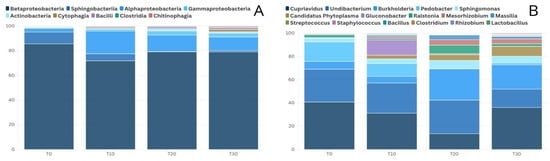
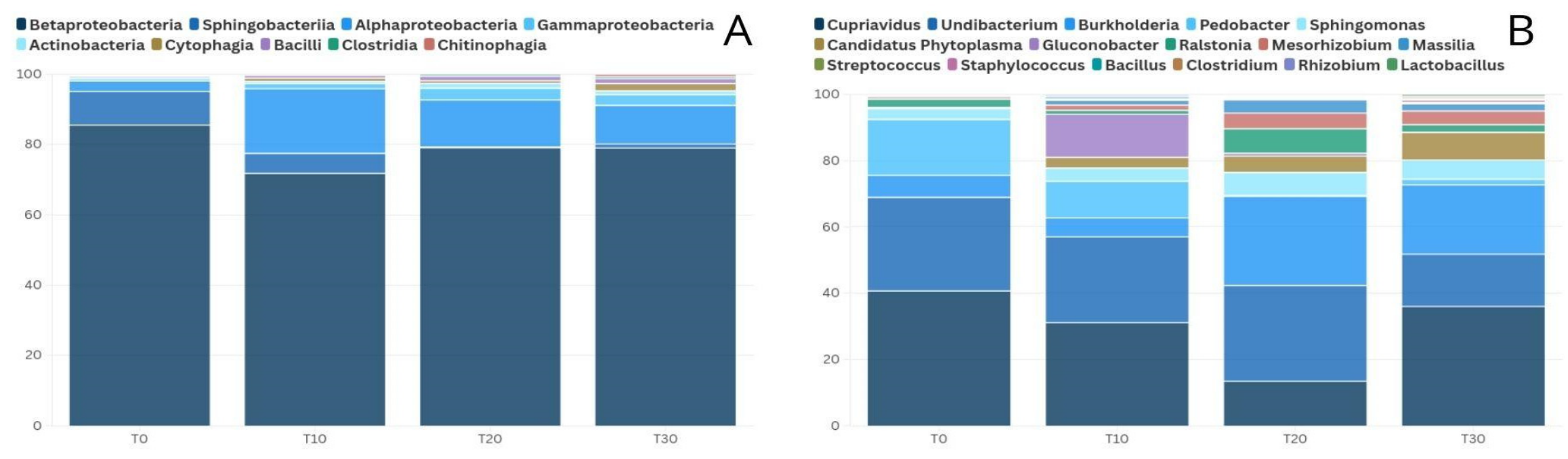
Figure 1.
Composition profiles of bacteriome. Relative abundance of operational taxonomic units (OTUs) from bacterial taxa in Corvina grape samples throughout withering. Colors correspond to classes (A) or genera (B); top 15 genera are listed in the displayed legend.
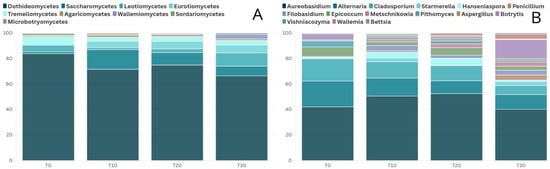
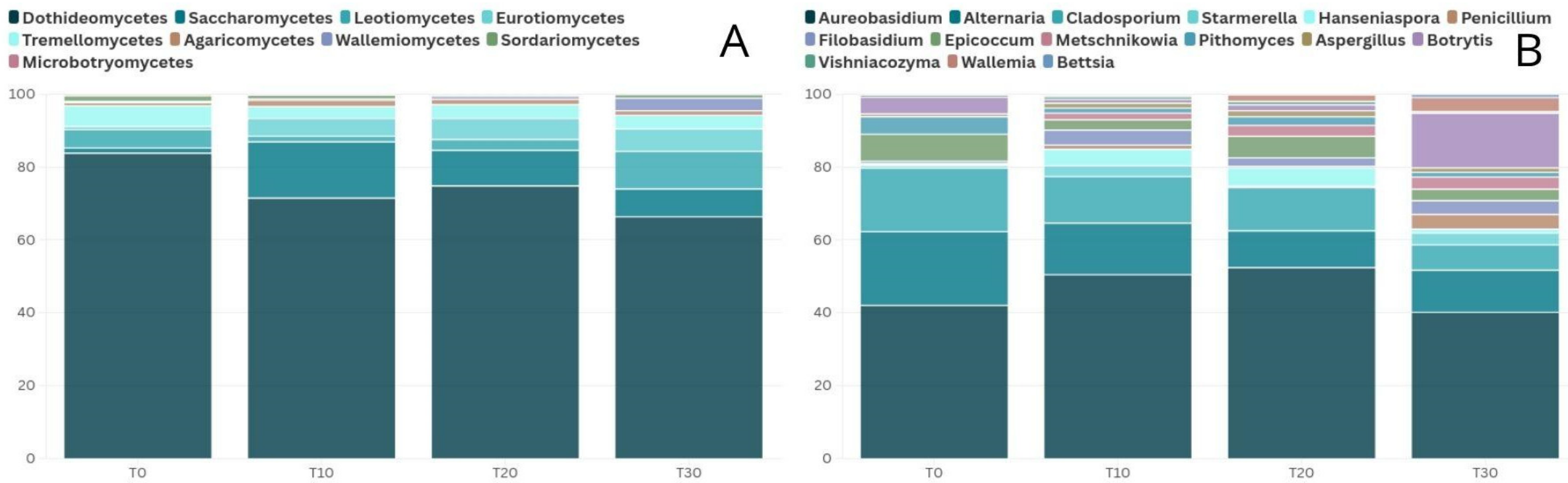
Figure 2.
Composition profiles of mycobiome. Relative abundance of operational taxonomic units (OTUs) from fungal taxa in Corvina grape samples throughout withering. Colors correspond to classes (A) or genera (B); top 15 genera are listed in the displayed legend.
3.1.1. Dominating Bacterial Taxa
In regard to the bacteria classes, the study identified eight of them at T0, T10, and T20: Betaproteobacteria, Sphingobacteria, Alphaproteobacteria, Gammaproteobacteria, Bacilli, Cytophagia, Actinobacteria, and Clostridia (Figure 1A). Additionally, the Chitinophagia class, not present at the first sampling points, was found at T30. Together, the nine classes represented more than 99% of the taxonomic units (OTUs) throughout the withering stage. Observing the overall trend of the microbial communities during the drying process, regardless of the conditioning system, at T0, Betaproteobacteria was clearly the main class (84.92% of the total), followed by Sphingobacteria (9.45%) and Alphaproteobacteria (2.99%). These three classes constituted 97.5% of the total at T0. As shown in Figure 1A, at T10, these classes were still the most representative, and Betaproteobacteria and Sphingobacteria showed a decrease (69.42% and 5.49%, respectively), while Alphaproteobacteria increased (17.76%). Gammaproteobacteria grew to 1.39% at T10. At T20, Betaproteobacteria grew to 74.99% and also remained stable at T30 (75.91%). Sphingobacteria dropped to 0.23% at T20, Alphaproteobacteria showed a decrease to 12.70% at T20 and 10.55% at T30. At T20, Gammaproteobacteria increased up to 3.17%, Actinobacteria to 1.27%, and Bacilli to 1.25%. At T30, Gammaproteobacteria showed a decrease to 3.00% and Actinobacteria to 1.00%, while Bacilli grew to 1.39%. Cytophagia grew from 0.71% at T20 to 1.97% at T30 (Figure 1A).
Looking at the bacterial community at the genus level, a total of 143 genera were recorded. The top 15 genera found over the different times (each attaining the threshold value of 0.1% in all conditions) are hereby displayed (Figure 1B), showing a wide variation during the withering process, consistent with the results at the class level. Considering the most abundant genus at T0, Cupriavidus, which accounted for 39% of the total OTUs, a decrease was observed at T20, where its relative abundance dropped to 12%. However, its prevalence increased again to 30% by the end of the dehydration process (T30). Among the other major taxa, Pedobacter showed a substantial decline, decreasing from 16.3% at T0 to 0.18% at T20, with only a partial recovery observed at T30. From a technological point of view, a feature worth noting is the presence of the acetic acid bacterium and potential spoiler Gluconobacter, reaching 12.9% at T20 and then getting back to around 1% at T30, and the presence of the lactic acid and potentially pro-technologic genus Lactobacillus at T30, although at a very low abundance (0.6%) (Figure 1B).
3.1.2. Dominating Fungal Taxa
Regarding yeasts and other fungi, the overall trend at the class level (Figure 2A) showed that Dothideomycetes remained the dominant class throughout the dehydration process, representing more than 80% of the fungal community at T0, around 70% at both T10 and T20, and subsequently declining to 65% at T30. In contrast, Saccharomycetes, a class closely associated with winemaking and only marginally represented on fresh grapes (1.42% at T0), increased markedly to 15% at T10 and maintained substantial relative abundances until the end of the process (10% at T20 and 8% at T30). Alongside the low and relatively stable occurrence of Agaricomycetes (1–2%), the progression from T0 to T30 was characterized by a gradual increase in Leotiomycetes, whose relative abundance nearly doubled over the course of dehydration. In addition, Wallemiomycetes emerged at T30, although at a relatively low abundance (3.5%).
Looking at the fungal community at the genus level, a total of 176 genera were recorded. The top 15 genera (each attaining the threshold value of 0.1% in all conditions) are hereby shown (Figure 2B), showing a wide variation during the withering process.
Aureobasidium was the predominant genus throughout the process, accounting for approximately 40% at T0 and T30 and exceeding 50% at T20. The second most abundant genus was Alternaria, which represented 18.22% at T0, 12.94% at T10, 9.29% at T20, and 11.12% at T30. The third most common genus was Cladosporium, gradually decreasing from 15.70% at T0 to 6.72% at T30.
Particularly important due to the damage it can cause to grapes during drying is the genus Botrytis. It initially showed a decreasing trend, dropping from 4.11% at T0 to 0.9% at T10, before increasing sharply between T20 (1.49%) and T30, where it reached 14.48% of the OTUs. A genus often associated with Botrytis during parasitic attacks is Penicillium. It is scarcely present at T0 (0.1%), rises at T10 (1.04%), decreases again at T20 (0.4%), and, similar to Botrytis, grows rapidly at T30 (3.9%).
From a technological point of view, a feature worth noting is the presence of the wine-related genera Hanseniaspora, Starmerella, and Metschnikowia, all barely noticeable on grapes at T0 (with 0.4%, 0.5%, and 0.1% presence, respectively) and rising to values around 3% for Starmerella and Metschnikowia (maximal rate at T30) or 5% for Hanseniaspora (at T10 and T20) during withering (Figure 2B).
Overall, some of the genera found at T30 had not previously been spotted at T10 (Wallemia, Vishniacozyma, and Bettsia) or T20 (Starmerella), as different genera developed over the withering process.
3.2. Impact of Different Withering Systems on the Grape Carposphere Microbiome
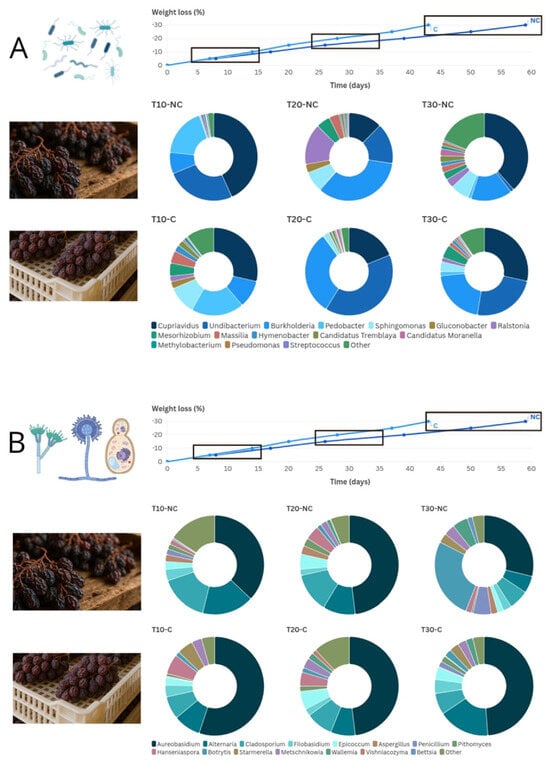
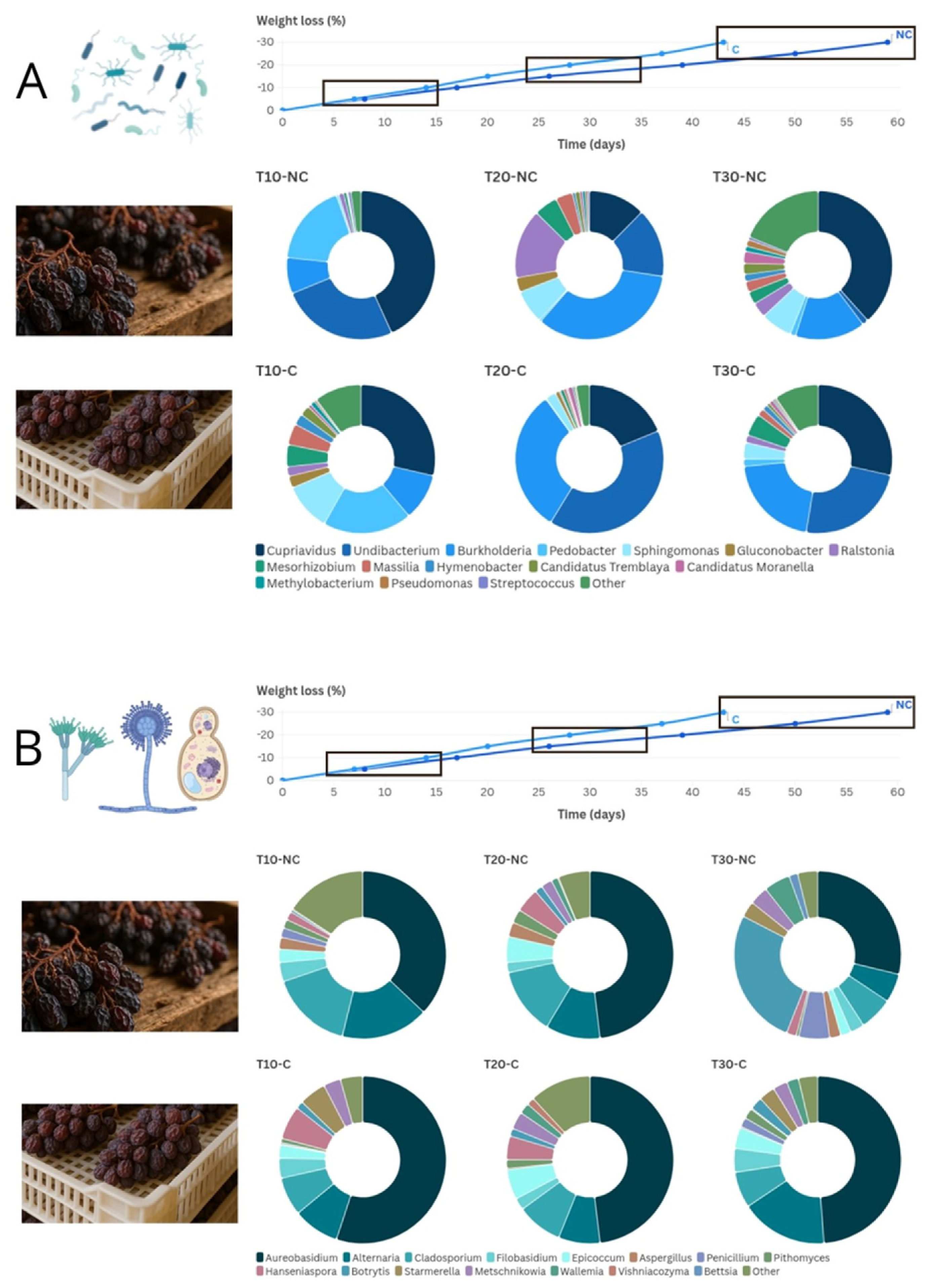
The first observation coming from our results is the different kinetics of withering between the two treatments, since C (controlled environment) reached 30% weight loss 14 days earlier than NC (non-controlled environment), as previously described and discussed from a technological point of view [44]. This trend was constant during the whole dehydrating period, as shown in Figure 3. This figure, which presents genus-level data for both bacteria (Figure 3A) and fungi (Figure 3B), highlights differences in microbial communities between C and NC conditions throughout the withering process. Additional data and statistical analyses performed at both the genus and class levels are provided in Supplementary Information Table S1.
Figure 3.
Composition profiles of bacteriome (A) and mycobiome (B) under withering, following the withering rate in both controlled (C) and non-controlled (NC) conditions (graph plotting weight loss vs. time, upper side of both panels). Relative abundance of operational taxonomic units (OTUs) from different taxa: colors correspond to bacterial (1A) or fungal (1B) genera; top 15 genera are listed in the displayed legend. Images representing microorganisms were created with Biorender®.
Concerning bacteria, different trends are observable (Figure 3A): the genus Cupriavidus, for instance, followed a coherent trend in both environments over time (first decreased and then increased). On the other hand, the genus Burkholderia seemed to be associated with the NC environment, mainly at T20. Statistical significance between treatments, nevertheless, was confirmed only for genera that did not reach the 0.01% cutoff (namely Brevundimonas, Bradyrhizobium, Acetobacter, and Prevotella at T0, Brachybacterium at T30, and none at T20; Supplementary Information Table S1), probably due to the variance among the 16 biological replicates of each condition (which were, in turn, issued from different vintages and vineyards, as shown in the experimental design in Table 1). At the class level, Clostridia displayed statistical significance between treatments at T20, showing a higher presence in NC than in C, although the abundance was low in both environments (0.6 and 1.4%, respectively). Furthermore, Chitinophagia abundance was statistically higher in C compared to NC at the T30 sampling time (1.3 and 0.4%, respectively; for statistics, see Supplementary Information, Table S1).
Looking at the evolution of fungal communities (Figure 3B), the genus Aureobasidium, found as the most represented throughout the process (Par. 3.1), ranged between 28 to 56% of total OTUs, but with significantly lower percentages in NC than in C, both at T10 and T30 (Supplementary Information, Table S1).
At T10, the genera Aureobasidium, Starmerella, Hanseniaspora, Botrytis, and Metschnikowia were significantly higher in C than in NC, whereas Alternaria, Cladosporium, Penicillium, Pithomyces, and Aspergillus were more abundant in NC. No differences were observed for Filobasidium and Epicoccum. At T20, Cladosporium, Alternaria, Aspergillus, and Pithomyces showed a significant higher presence in NC, while Metschnikowia, Vishniacozyma, and Wallemia in C. No statistical differences were observed at this stage for Aureobasidium, Epicoccum, Botrytis, Filobasidium, and Hanseniaspora. At this sampling time, the statistical differences tended to lower. At T30, there was a clear dominance of Aureobasidium (28.7%) and Botrytis (26.5%) in NC and Aureobasidium (48.8%) and Alternaria (16.8%) in C. Botrytis, in particular, was ten-fold more represented in NC than in C (2.4%), with statistical significance. Furthermore, Wallemia and Penicillum also showed the highest presence in NC, whereas Aureobasidium, Alternaria, Epicoccum, and Filobasidium were statistically higher in C. For Metschnikowia, Aspergillus, Hanseniaspora, Pithomyces, Bettsia, Cladosporium, and Starmerella, no statistical differences are highlighted between treatments.
3.3. Relationship Between Metabolome and Microbiome
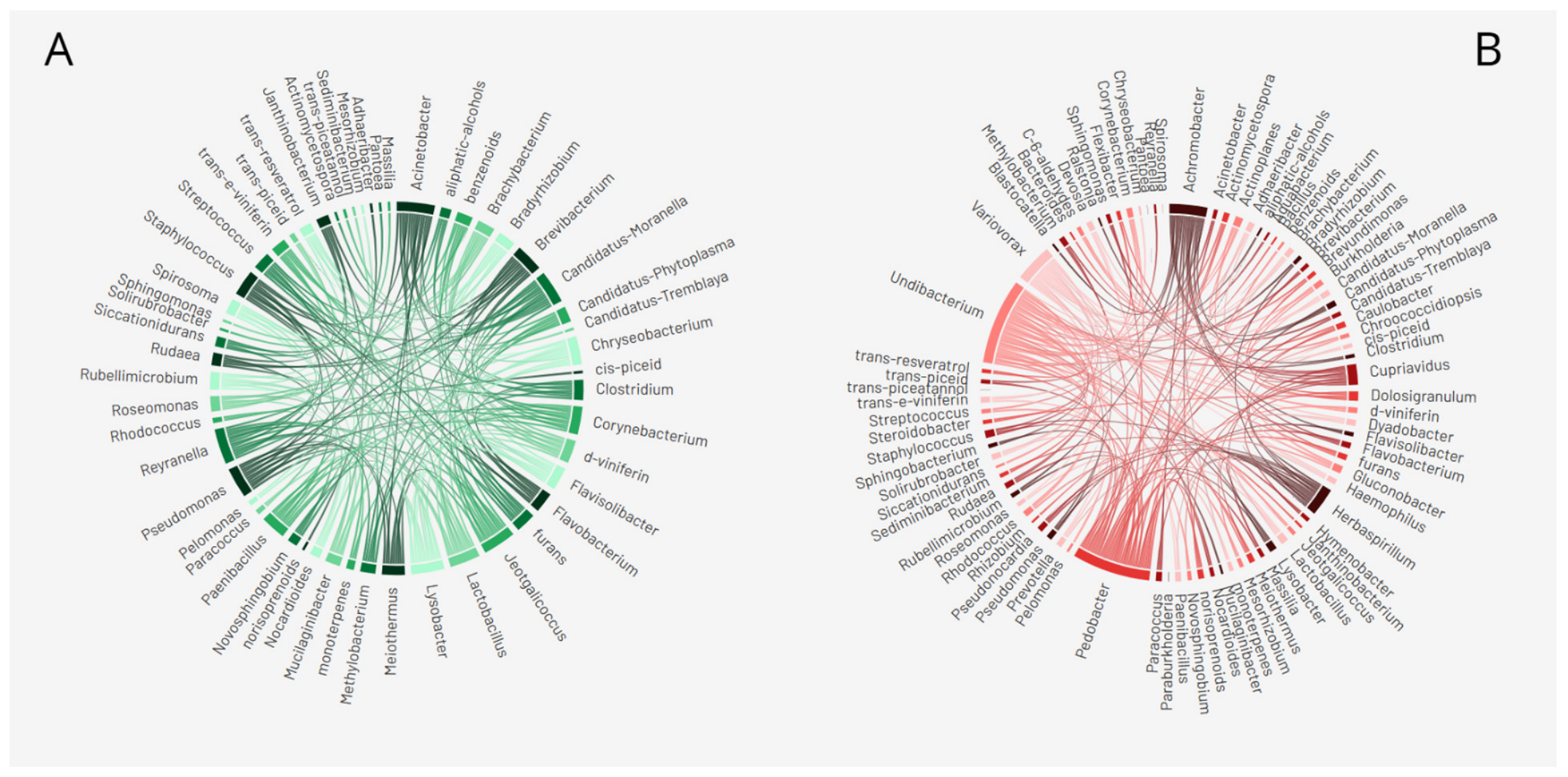
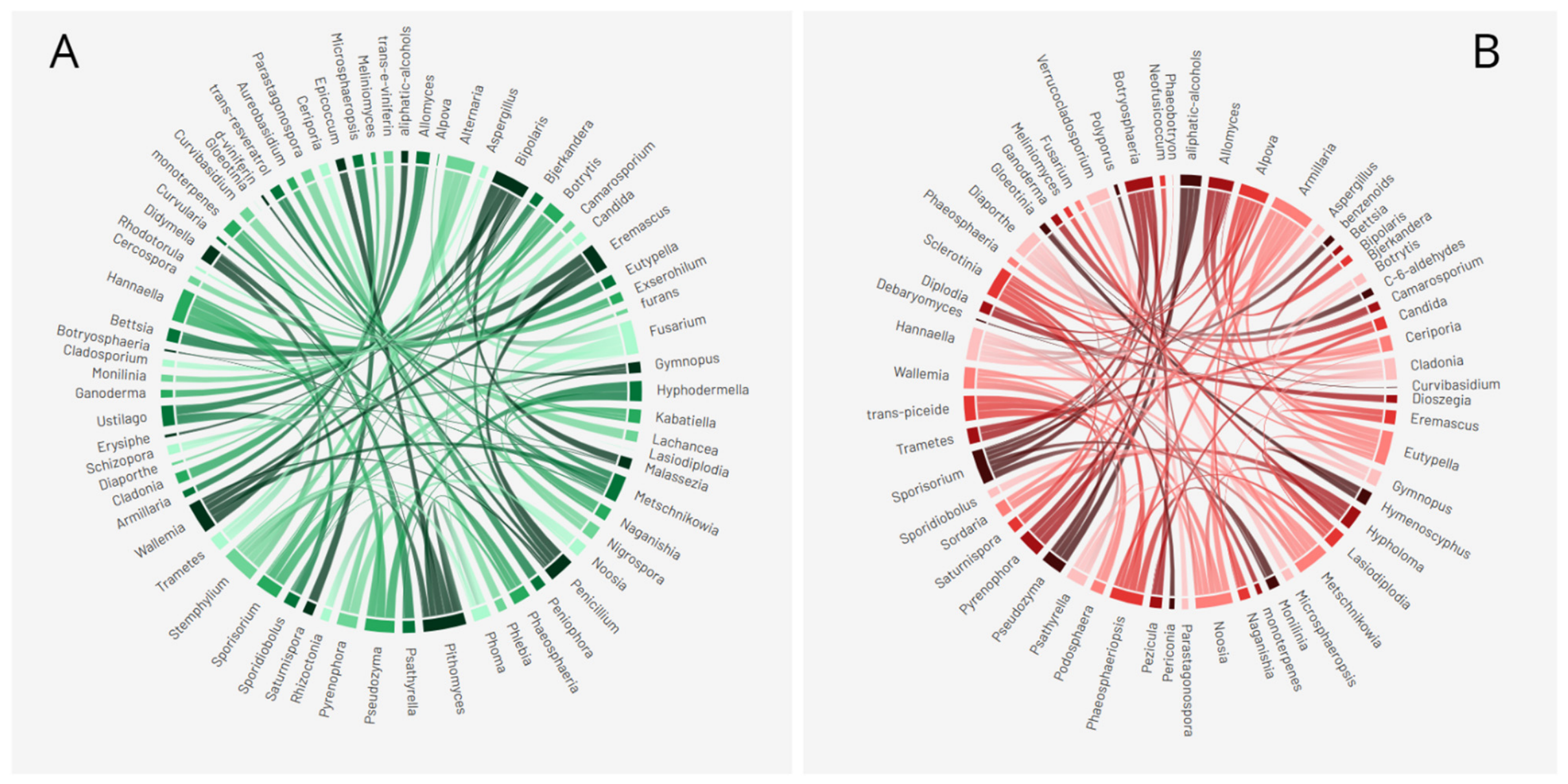
In order to investigate the relationships between microbial taxa and chemical compounds in grape berries, such as secondary metabolites (including stilbenes and VOCs), a further comparison of the data was performed. These compounds had previously been measured in all the samples of the experimental design described in Table 1 and published separately by Tomasi et al. (2021): in our work, their abundances have been processed together with microbiome data as described in the Methods [36]. The overall dataset has been analyzed, keeping the information collected from each of the two treatments (C and NC) and each of the weight loss times and assessing if any positive or negative correlation existed between microbial taxa and VOCs. To enhance clarity, chord diagrams are hereby used to display co-occurrences (Figure 4 and Figure 5): positive correlations are colored in green and negative correlations in red; chord width reflects the weight of the relationship (Ori-score based on Pearson correlation). Co-occurrences between microbial taxa themselves are also displayed, whereas correlations between different metabolites are not included, as these aspects were already described in a previous work [44]. Raw network diagrams, generated using a perfuse force direct layout algorithm, are also available as Supplementary Information Figure S1.
Figure 4.
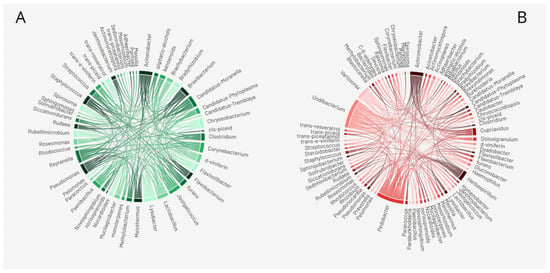
Co-occurrences between bacterial genera and grape metabolites and among bacterial genera. Positive correlations (ρ > 0.95) are colored in green (A) and negative correlations (ρ > −0.95) in red (B). Chord width reflects the weight of the relationship (Ori-score based on Pearson correlation).
Figure 5.
Co-occurrences between fungal genera and grape metabolites and among fungal genera. Positive correlations (ρ > 0.95) are colored in green (A) and negative correlations (ρ > −0.95) in red (B). Chord width reflects the weight of the relationship (Ori-score based on Pearson correlation).
Regarding bacterial genera, when examining stilbenes as chemical compounds (including δ-viniferin, trans-ε-viniferin, cis- and trans-piceid, trans-piceatannol, and trans-resveratrol), a total of 24 genera show positive correlations, specifically Rhodococcus with cis-piceid; Jeotgalicoccus, Lysobacter, Acinetobacter, Brevibacterium, Lactobacillus, Pseudomonas, and Staphylococcus with δ-viniferin; Clostridium, Rubellimicrobium, Brachybacterium, Flavisolibacter, and Streptococcus with trans-ε-viniferin; Nocardioides with trans-piceid; and Brevibacterium, Jeotgalicoccus, Candidatus-Moranella, Methylobacterium, and Clostridium with trans-resveratrol.
Conversely, Pedobacter, Variovorax, Undibacterium, and Achromobacter show negative correlations with at least one stilbene compound. Notably, Undibacterium exhibits mutual exclusion with all stilbenes, while Pedobacter negatively correlates with four out of six compounds (δ-viniferin, trans-piceid, trans-resveratrol, and trans-ε-viniferin).
It is worth noting that the genera Pedobacter, Undibacterium, and Achromobacter show mutual exclusion, not only with the abovementioned molecules but also with a substantial number of other bacterial taxa (31, 36, and 16 genera, respectively). In contrast, positive co-occurrences among multiple bacterial taxa are less pronounced: Lactobacillus and Acinetobacter show positive correlations with 11 other genera each, while Lysobacter is positively associated with 10 (complete tables of co-occurrences are available in Supplementary Information Table S2).
As for VOCs (aliphatic-alcohols, benzenoids, furans, and monoterpenes), overall Flavisolibacter and Streptococcus positively correlate with benzenoids, furans, and monoterpenes, Flavobacterium and Clostridium only with benzenoids, and Nocardioides with aliphatic alcohols (Figure 4A). On the other hand, Variovorax, Achromobacter, Pedobacter, and Undibacterium negatively correlate with at least one compound, with the outstanding case of Pedobacter that displays mutual exclusion with all of them (Figure 4B).
Co-occurrences regarding fungi (Figure 5) highlighted that the most represented genus Aureobasidium did not significantly correlate with any chemical compound. As for correlation with stilbenes, co-presence was recorded between Metschnikowia and both δ-viniferin and trans-resveratrol, Wallemia and trans-ε-viniferin, and Penicillium with trans-resveratrol (Figure 5A), whereas only three instances of mutual exclusion were found, namely Noosia, Pyrenophora, and Podosphaera, all with trans-picedide (Figure 5B). Looking at VOCs, on the other hand, few co-occurrences were statistically significant: Armillaria positively correlated with aliphatic alcohols and Kabatiella and Psathyrella with monoterpens, whereas mutual exclusion was found between aliphatic alcohols and Pseudozyma, Pyrenophora, and Hannaella, which also correlates negatively with benzenoids, and between C-6-aldehyde and Diaporthe (Figure 5B and Supplementary Information Table S2). It is worth noting that among the taxa showing multiple co-occurrences (Figure 5A), we found the detrimental fungi Fusarium (positively correlating with five other genera) and Botrytis (positively correlating with three genera, including Penicillium). On the other hand, both the genus Armillaria and Metschnikowia showed mutual exclusion with six other genera, the latter including Penicillium (Figure 5B).
4. Discussion
In this study, we provide a time-course characterization of the grape carposphere microbiome during the withering process, using NGS-based metabarcoding to investigate both fungal and bacterial communities under two different drying conditions (C and NC). Furthermore, we examine the relationships between microbial dynamics and the metabolic changes of selected berry quality-related compounds, including volatile organic compounds (VOCs) and stilbenes, by analyzing the same grape samples throughout the withering period.
As a first finding about the microbiome, all the microbial taxa identified in this project on the grape carposphere were previously observed on grapevine berries, leaves, or juices in other research works [11,12,16,33,35].
Regarding the bacterial community, a predominance of taxonomic groups including environmental ubiquitous microorganisms such as Betaproteobacteria, Sphyngobacteria, Gammaproteobacteria, Bacilli, Clostridia, and Chitinophagia has been observed throughout withering regardless of specific conditions (C and NC). Our results are different from what was found by Salvetti et al. [35] in cv. Corvina withered berries at the end of the dehydration process, since we found mainly Betaproteobacteria, with a relevant presence of Alphaproteobacteria, instead of a significant predominance of Gammaproteobacteria. However, in line with that research, we found relatively high abundances of Sphyngobacteria, Clostridium, and Bacilli, findings that are also in accordance with those of Pinto et al. [15] on fresh grapes. Betaproteobacteria and Alphaproteobacteria, the most represented classes in our research, are mostly described in soil studies since they are usually dominant in the rhizosphere, playing a crucial role in nitrogen fixation [67]. The origin of these bacteria could be the grapevine phyllosphere, since they are part of the microbiota found in grapevine leaves and flowers [17,24,68,69]. In addition, other sources of contamination could be represented by the harvest, transfer, and storage of grapes. In the case of withering, the fruttaio itself could represent an important source of environmental microbial species [10]. The Clostridia class was higher in the plastic box condition (C) at T20, whereas it was Chitinophagia at T30. Clostridia are known to include some species recognized as human and animal pathogens, yet they are correlated with cell hydrolytic enzymes [70]. This class was already found in Corvina withered grapes [35]. Possibly, the faster withering in C led to more marked decay of grape peel, and as a consequence, Clostridia developed more than other bacteria. Yet, what we identified is in accordance with previous studies [11,36]. Chitinophagia and Actinobacteria presence was also higher in C than NC; these bacterial classes are strongly correlated with biomass degradation [71].
Scaling down to the genus level, the results obtained in this study highlighted the genera Cupriavidus, Undibacterium, Pedobacter, and Burkholderia as the most abundant in the carposphere, similarly to what Stefanini and co-workers found both in grapes and musts of the same variety [11,36]. Several Cupriavidus species play a role in plant growth promotion activities, such as the production of siderophores and indole-acetic acid and phosphate solubilization [72]. Cupriavidus was also found to be abundant in the carposphere of other varieties [73]. The Burkholderia genus holds a great biotechnological potential ranging from plant growth and development to protection from several abiotic and biotic stresses, such as gray mold disease caused by B. cinerea [74]. Pedobacter was previously found abundant on the carposphere of Cabernet Sauvignon at harvest [75]; however, we noticed a reduction over the time of dehydration until a disappearance at T20 and T30. This behavior could depend on the low degree of drought tolerance of some strains belonging to this genus that could have been affected by the higher percentage of dehydration at the end of withering [76]. Similar outcomes in Corvina grape and must taxonomical compositions, when compared samples during the withering process, are available in the literature [36].
Regarding the fungal community, the ITS analysis revealed that the Dothideomycetes class had the highest abundance throughout the withering process under both conditions (C and NC). This group has previously been identified as playing a pivotal role in shaping the grape berry microbial community, where it was found to be associated with Alphaproteobacteria, even though the latter were not among the most abundant bacterial taxa [66]: a similar pattern was observed in our data. Specifically, within the Dothideomycetes class, the most represented genus was Aureobasidium, which holds species such as A. pullulans, which has a well-recognized antagonistic activity against plant pathogens (especially post-harvest pathogens) for nutrient and space competition [4,7] and for the production of hydrolytic enzymes and antimicrobial compounds (antibacterial and antifungal) [77]; it is also responsible for the production of volatile organic compounds [42]. Its presence in the fruttaio environments therefore brings several positive aspects. Conversely, a particularly important role is associated with the genus Botrytis, due to the damage it can cause to grapes during drying [78]. In our study, this genus developed throughout withering, as previously observed [36], in particular in NC conditions (raising to 26.5% at T30). The strong interest in this mold in withering stems comes from its dual role: it is widely known as the causal agent of gray mold, which causes severe damage to grapes, but it is also recognized as “noble rot,” used in the production of certain specialty wines [79,80]. The appearance of noble rot symptoms depends largely on microclimatic conditions, with important consequences for the production of traditional botrytized sweet wines worldwide [79]. Indeed, previous research works have shown that Corvina berries, either naturally or artificially infected with B. cinerea, produce wines with distinctive organoleptic characteristics [37,79]. In our case, the intrinsic limitation of non-culture techniques such as metabarcoding does not allow us to determine whether the increase in Botrytis at T30, particularly under NC conditions, resulted in the development of gray mold. However, according to visual assessments by the winery staff, no decay attributable to gray mold was ever observed in the batches. This observation is further supported by chemical analyses performed on the same samples [44], which reported low benzaldehyde levels relative to benzyl alcohol. Such a pattern indicates that little to no oxidative processes linked to B. cinerea infection occurred. Based on this evidence, we hypothesize that the noble rot form was likely predominant.
Among other yeasts or fungi differently present in C and NC conditions, it is worth noting that the technologically interesting wine-related genera Hanseniaspora, Starmerella, and Metschnikowia [81] were recorded throughout the withering process. Among them, Metschnikowia displayed significant differences both at T10 and T20, being higher in C than in NC. In the winemaking environment, the effects of Metschnikowia spp. are well known: its antimicrobial activity towards grape and wine spoilage organisms [82], the release of hydrolytic enzymes, production increases in glycerol and glutathione [83], and its impact on wine aroma [81]. Conversely, the fungus Penicillium was significantly higher in NC, both at T10 and T30: even with the low rates of this genus (always lower than 6%), the situation deserves attention, as its possible increase can cause a concern for winemakers [79].
Interesting insights emerge from the correlation between the microbiota and the metabolome. Overall, although grape secondary metabolites and wine aroma are typically affected by the metabolism of grape-associated yeasts [84], in our study, bacterial co-occurrences with these compounds were more frequent than fungal ones.
Regarding stilbenes (including δ-viniferin, trans-ε-viniferin-, cis and trans-piceid, trans-piceatannol, and trans-resveratrol), a total of 24 bacterial genera—among them Acinetobacter and Lactobacillus—showed positive correlations. Co-occurrence was also observed with the yeasts Metschnikowia, Wallemia, and Penicillium. One possible explanation is that the presence of these microorganisms triggers the activation of stilbene biosynthesis. It is well established that microbial-induced biotic stress in grape berries leads to transcriptional changes involving genes responsible for stilbene production [43], including post-harvest dehydration [85].
Conversely, Pedobacter, Variovorax, Undibacterium, and Achromobacter displayed negative correlations with at least one stilbene compound. Among these, the genera Pedobacter, Undibacterium, and Achromobacter also showed mutual exclusion with a substantial number of other bacterial taxa (31, 36, and 16 genera, respectively) and exhibited negative correlations with several VOCs. These patterns may suggest that these bacteria have the capacity to suppress various microbial taxa and thereby reduce the level of biotic stress that would otherwise trigger both stilbene synthesis [85] and VOC production [86]. This hypothesis is consistent with the well-established biocontrol properties of the endophytic species Achromobacter xylosoxidans [87], including in grapevine systems [39,88,89].
Nevertheless, we cannot rule out the opposite interpretation: the aforementioned bacteria may instead be sensitive to the grape berry responses triggered by biotic stress. Indeed, ref. [66] showed how the grapevine metabolome can directly influence the microbial fingerprint of grape berries.
Regarding the correlations between microorganisms and VOCs, few recent studies have examined the impact of grape skin microbiota on these molecules. Our findings show an important convergence with a work in which the bacteria Achromobacter, Pedobacter, and Lactobacillus and the fungi Cladosporium, Alternaria, and Filobasidium dominated the grape epidermis [87]: the authors demonstrated that in such a situation, some key indigenous microorganisms including Aspergillus, Achromobacter, Lactobacillus, Gluconobacter, Acinetobacter, and Cladosporium, which we also detected, contributed to volatile substances such as esters, higher alcohols, terpenes, and aldehydes. Moreover, among the fungal taxa showing multiple co-occurrences, we found the detrimental fungi Fusarium (positively correlating with five other genera) and Botrytis (positively correlating with three genera, including Penicillium), whereas the Metschnikowia genus, well known for its biocontrol potential [7,82], showed mutual exclusion with six other genera, notably including Penicillium, potentially confirming its behavior during withering also.
Finally, although mycotoxin content was not directly measured in this study, Li et al. [88] reported that species belonging to the genera Cupriavidus (highly represented in our dataset), Metschnikowia, Flavobacterium, Bacillus, and Lactobacillus (all represented and showing correlations with grape metabolites) are able to degrade aflatoxins produced by Aspergillus, Penicillium, and ochratoxins produced by Fusarium. These fungi were also present in the withering setup examined here. This evidence further supports the importance of microbial interactions during post-harvest storage processes such as withering and suggests deepening aspects such as mycotoxin production and degradation in further studies.
5. Conclusions
Our research confirms, with a time-course analysis, previous literature observations attesting that during withering there is a partial rearrangement in both the bacterial and fungal communities owing to the gradual dehydration to which grapes are subjected. From an oenological standpoint, this study further corroborates previous observations regarding the shifts in the grape metabolome and wine quality that occur during withering, including the influence of different industrial-scale drying systems, as previously investigated using the same dataset. From a microbiological perspective, the effect of withering systems on the microbial communities and the correlation of the microbiome with the abovementioned modifications in relevant grape metabolites are evidenced. This underscores the importance of the microbial signature in grape and wine quality, offering a specific example of how the grape microbiome—in turn linked to the concept of microbial terroir—can influence post-harvest grape evolution. Considering that grapevine secondary metabolites can shape the resident microbiota but that microbial activity also influences host metabolism by modulating the biosynthesis of various compounds in grape berries, correlations between metabolites and the microbiota should be viewed as bidirectional associations that mirror the constantly evolving host–microbe interactions. The study also opens the field to further research that could deepen mechanisms involved in the observed correlations, given that the metabarcoding approach adopted here provides information on community composition but does not allow for direct assessment of microbial metabolic activity, viability, or functional gene expression during the withering process.
Supplementary Materials
The following supporting information can be downloaded at https://www.mdpi.com/article/10.3390/fermentation12090435/s1, Table S1: p-Val and ANOVA based statistics of comparison between C and NC conditions; Table S2: Co-occurrence raw data; Figure S1: Raw diagrams of co-occurrence interactions.
Author Contributions
Conceptualization, T.N. and L.N.; methodology, L.N. and W.C.; software, L.N. and W.C.; validation, T.N. and A.R.; formal analysis, L.N. and W.C., investigation, L.L., T.N. and A.R., resources, D.T., data curation, R.R., A.R., L.N., W.C., G.M. and T.N.; writing—original draft preparation, G.M. and T.N.; writing—review and editing, R.R., A.R., L.N., W.C. and T.N.; supervision, T.N.; funding acquisition, D.T. All authors have read and agreed to the published version of the manuscript.
Funding
This research was funded entirely by the private company “Bertani Domains Società Agricola A R.L.”, Grezzana, Verona (Italy).
Institutional Review Board Statement
Not applicable.
Informed Consent Statement
Not applicable.
Data Availability Statement
The NGS dataset supporting the conclusions of this article is available in the NCBI BioProject repository, under the unique identifier https://www.ncbi.nlm.nih.gov/bioproject/ (accessed on 7 August 2026) PRJNA1413547. All the figures in the paper are accessible at their highest resolution through the Canva project: https://canva.link/zlssfr2u1zna7yb (accessed on 9 August 2026).
Acknowledgments
The authors thank Andrea Lonardi, MW, director at Bertani Domains Società Agricola A R.L. at the time of the study, and all the Bertani winery staff involved in the trials for participating in the setup of the experiments in their vineyards and withering chambers, providing all the support required. The authors are grateful to the Fondazione Caritro “TRASMISSIONI” Project, an initiative aimed at supporting researchers for the transformation of scientific data into accessible content.
Conflicts of Interest
The authors declare no conflicts of interest.
References
- Kusstatscher, P.; Cernava, T.; Abdelfattah, A.; Gokul, J.; Korsten, L.; Berg, G. Microbiome Approaches Provide the Key to Biologically Control Postharvest Pathogens and Storability of Fruits and Vegetables. FEMS Microbiol. Ecol. 2020, 96, fiaa119. [Google Scholar] [CrossRef] [Scilit] [PubMed]
- Mian, G.; Cantone, P.; Golinelli, F. First Evidence of the Effect of a New Biostimulant Made by Fabaceae Tissue on Ripening Dynamics and Must Technological Main Parameters in Vitis vinifera ‘Ribolla Gialla’. Acta Hortic. 2022, 1333, 317–322. [Google Scholar] [CrossRef] [Scilit]
- Angeli, D.; Sare, A.R.; Jijakli, M.H.; Pertot, I.; Massart, S. Insights Gained from Metagenomic Shotgun Sequencing of Apple Fruit Epiphytic Microbiota. Postharvest Biol. Technol. 2019, 153, 96–106. [Google Scholar] [CrossRef] [Scilit]
- Luziatelli, F.; Ficca, A.G.; Colla, G.; Baldassarre Švecová, E.; Ruzzi, M. Foliar Application of Vegetal-Derived Bioactive Compounds Stimulates the Growth of Beneficial Bacteria and Enhances Microbiome Biodiversity in Lettuce. Front. Plant Sci. 2019, 10, 60. [Google Scholar] [CrossRef] [Scilit] [PubMed]
- Berg, G.; Rybakova, D.; Fischer, D.; Cernava, T.; Vergès, M.-C.C.; Charles, T.; Chen, X.; Cocolin, L.; Eversole, K.; Corral, G.H.; et al. Microbiome Definition Re-Visited: Old Concepts and New Challenges. Microbiome 2020, 8, 103. [Google Scholar] [CrossRef] [Scilit] [PubMed]
- Qadri, R.; Azam, M.; Khan, I.; Yang, Y.; Ejaz, S.; Akram, M.T.; Khan, M.A. Conventional and Modern Technologies for the Management of Post-Harvest Diseases. In Plant Disease Management Strategies for Sustainable Agriculture Through Traditional and Modern Approaches; Ul Haq, I., Ijaz, S., Eds.; Sustainability in Plant and Crop Protection; Springer International Publishing: Cham, Switzerland, 2020; pp. 137–172. ISBN 978-3-030-35955-3. [Google Scholar]
- Sellitto, V.M.; Zara, S.; Fracchetti, F.; Capozzi, V.; Nardi, T. Microbial Biocontrol as an Alternative to Synthetic Fungicides: Boundaries between Pre- and Postharvest Applications on Vegetables and Fruits. Fermentation 2021, 7, 60. [Google Scholar] [CrossRef] [Scilit]
- OIV. OIV Statistical Brief: Wine Table Grapes and Dried Grapes. Available online: https://www.oiv.int/sites/default/files/documents/OIV_Statistical_Brief-Wine_Table_Grapes_and_Dried_Grapes_in_2024.pdf (accessed on 3 December 2025).
- Zhang, S.; Chen, X.; Zhong, Q.; Zhuang, X.; Bai, Z. Microbial Community Analyses Associated with Nine Varieties of Wine Grape Carposphere Based on High-Throughput Sequencing. Microorganisms 2019, 7, 668. [Google Scholar] [CrossRef] [Scilit] [PubMed]
- Lorenzini, M.; Zapparoli, G. Epiphytic Bacteria from Withered Grapes and Their Antagonistic Effects on Grape-Rotting Fungi. Int. J. Food Microbiol. 2020, 319, 108505. [Google Scholar] [CrossRef] [Scilit] [PubMed]
- Stefanini, I.; Cavalieri, D. Metagenomic Approaches to Investigate the Contribution of the Vineyard Environment to the Quality of Wine Fermentation: Potentials and Difficulties. Front. Microbiol. 2018, 9, 991. [Google Scholar] [CrossRef] [Scilit] [PubMed]
- Vitulo, N.; Lemos, W.J.F.J.; Calgaro, M.; Confalone, M.; Felis, G.E.; Zapparoli, G.; Nardi, T. Bark and Grape Microbiome of Vitis vinifera: Influence of Geographic Patterns and Agronomic Management on Bacterial Diversity. Front. Microbiol. 2019, 9, 3203. [Google Scholar] [CrossRef] [Scilit] [PubMed]
- Sun, D.; Qu, J.; Huang, Y.; Lu, J.; Yin, L. Analysis of Microbial Community Diversity of Muscadine Grape Skins. Food Res. Int. 2021, 145, 110417. [Google Scholar] [CrossRef] [Scilit] [PubMed]
- Bokulich, N.A.; Thorngate, J.H.; Richardson, P.M.; Mills, D.A. Microbial Biogeography of Wine Grapes Is Conditioned by Cultivar, Vintage, and Climate. Proc. Natl. Acad. Sci. USA 2014, 111, E139–E148. [Google Scholar] [CrossRef] [Scilit] [PubMed]
- Pinto, C.; Gomes, A.C. Vitis vinifera Microbiome: From Basic Research to Technological Development. BioControl 2016, 61, 243–256. [Google Scholar] [CrossRef] [Scilit]
- Martins, G.; Miot-Sertier, C.; Lauga, B.; Claisse, O.; Lonvaud-Funel, A.; Soulas, G.; Masneuf-Pomarède, I. Grape Berry Bacterial Microbiota: Impact of the Ripening Process and the Farming System. Int. J. Food Microbiol. 2012, 158, 93–100. [Google Scholar] [CrossRef] [Scilit] [PubMed]
- Martins, G.; Vallance, J.; Mercier, A.; Albertin, W.; Stamatopoulos, P.; Rey, P.; Lonvaud, A.; Masneuf-Pomarède, I. Influence of the Farming System on the Epiphytic Yeasts and Yeast-like Fungi Colonizing Grape Berries during the Ripening Process. Int. J. Food Microbiol. 2014, 177, 21–28. [Google Scholar] [CrossRef] [Scilit] [PubMed]
- Carmichael, P.C.; Siyoum, N.; Chidamba, L.; Korsten, L. Exploring the Microbial Communities Associated with Botrytis cinerea during Berry Development in Table Grape with Emphasis on Potential Biocontrol Yeasts. Eur. J. Plant Pathol. 2019, 154, 919–930. [Google Scholar] [CrossRef] [Scilit]
- Barata, A.; Malfeito-Ferreira, M.; Loureiro, V. The Microbial Ecology of Wine Grape Berries. Int. J. Food Microbiol. 2012, 153, 243–259. [Google Scholar] [CrossRef] [Scilit] [PubMed]
- Setati, M.E.; Jacobson, D.; Andong, U.-C.; Bauer, F. The Vineyard Yeast Microbiome, a Mixed Model Microbial Map. PLoS ONE 2012, 7, e52609. [Google Scholar] [CrossRef] [Scilit] [PubMed]
- Portillo, M.d.C.; Mas, A. Analysis of Microbial Diversity and Dynamics during Wine Fermentation of Grenache Grape Variety by High-Throughput Barcoding Sequencing. LWT—Food Sci. Technol. 2016, 72, 317–321. [Google Scholar] [CrossRef] [Scilit]
- Grangeteau, C.; Roullier-Gall, C.; Rousseaux, S.; Gougeon, R.D.; Schmitt-Kopplin, P.; Alexandre, H.; Guilloux-Benatier, M. Wine Microbiology Is Driven by Vineyard and Winery Anthropogenic Factors. Microb. Biotechnol. 2017, 10, 354–370. [Google Scholar] [CrossRef] [Scilit] [PubMed]
- Oliveira, M.; Arenas, M.; Lage, O.; Cunha, M.; Amorim, M.I. Epiphytic Fungal Community in Vitis vinifera of the Portuguese Wine Regions. Lett. Appl. Microbiol. 2018, 66, 93–102. [Google Scholar] [CrossRef] [Scilit] [PubMed]
- Gilbert, J.A.; van der Lelie, D.; Zarraonaindia, I. Microbial Terroir for Wine Grapes. Proc. Natl. Acad. Sci. USA 2014, 111, 5–6. [Google Scholar] [CrossRef] [Scilit] [PubMed]
- Belda, I.; Zarraonaindia, I.; Perisin, M.; Palacios, A.; Acedo, A. From Vineyard Soil to Wine Fermentation: Microbiome Approximations to Explain the “Terroir” Concept. Front. Microbiol. 2017, 8, 821. [Google Scholar] [CrossRef] [Scilit] [PubMed]
- Morrison-Whittle, P.; Goddard, M.R. From Vineyard to Winery: A Source Map of Microbial Diversity Driving Wine Fermentation. Environ. Microbiol. 2018, 20, 75–84. [Google Scholar] [CrossRef] [Scilit] [PubMed]
- Mezzasalma, V.; Sandionigi, A.; Bruni, I.; Bruno, A.; Lovicu, G.; Casiraghi, M.; Labra, M. Grape Microbiome as a Reliable and Persistent Signature of Field Origin and Environmental Conditions in Cannonau Wine Production. PLoS ONE 2017, 12, e0184615. [Google Scholar] [CrossRef] [Scilit] [PubMed]
- Liu, D.; Howell, K. Community Succession of the Grapevine Fungal Microbiome in the Annual Growth Cycle. Environ. Microbiol. 2020, 23, 1842–1857. [Google Scholar] [CrossRef] [Scilit] [PubMed]
- Rantsiou, K.; Giacosa, S.; Pugliese, M.; Englezos, V.; Ferrocino, I.; Río Segade, S.; Monchiero, M.; Gribaudo, I.; Gambino, G.; Gullino, M.L. Impact of Chemical and Alternative Fungicides Applied to Grapevine cv Nebbiolo on Microbial Ecology and Chemical-Physical Grape Characteristics at Harvest. Front. Plant Sci. 2020, 11, 700. [Google Scholar] [CrossRef] [Scilit] [PubMed]
- Morrison-Whittle, P.; Lee, S.A.; Goddard, M.R. Fungal Communities Are Differentially Affected by Conventional and Biodynamic Agricultural Management Approaches in Vineyard Ecosystems. Agric. Ecosyst. Environ. 2017, 246, 306–313. [Google Scholar] [CrossRef] [Scilit]
- Sunyer-Figueres, M.; Fernández-Vázquez, D.; Cuesta-Martí, C.; Horcajo-Abal, I.; Sánchez-Mateos, C.; Domènech, A.; Nart, E.; Castillo-Olaya, V.A.; Andorrà, I.; Puxeu, M. Impact of Grape Harvest Time on Wild Yeast Biodiversity and Its Influence on Wine Fermentation. Microorganisms 2025, 13, 2836. [Google Scholar] [CrossRef] [Scilit] [PubMed]
- Bokulich, N.A.; Collins, T.S.; Masarweh, C.; Allen, G.; Heymann, H.; Ebeler, S.E.; Mills, D.A. Associations among Wine Grape Microbiome, Metabolome, and Fermentation Behavior Suggest Microbial Contribution to Regional Wine Characteristics. mBio 2016, 7, e00631-16. [Google Scholar] [CrossRef] [Scilit] [PubMed]
- Knight, S.; Klaere, S.; Fedrizzi, B.; Goddard, M.R. Regional Microbial Signatures Positively Correlate with Differential Wine Phenotypes: Evidence for a Microbial Aspect to Terroir. Sci. Rep. 2015, 5, 14233. [Google Scholar] [CrossRef] [Scilit] [PubMed]
- Liu, D.; Chen, Q.; Zhang, P.; Chen, D.; Howell, K.S. The Fungal Microbiome Is an Important Component of Vineyard Ecosystems and Correlates with Regional Distinctiveness of Wine. Msphere 2020, 5, 10–1128. [Google Scholar] [CrossRef] [Scilit] [PubMed]
- Mencarelli, F.; Tonutti, P. Sweet, Reinforced and Fortified Wines: Grape Biochemistry, Technology and Vinification; John Wiley & Sons: Hoboken, NJ, USA, 2013. [Google Scholar]
- Tomasi, D.; Lonardi, A.; Boscaro, D.; Nardi, T.; Marangon, C.M.; De Rosso, M.; Flamini, R.; Lovat, L.; Mian, G. Effects of Traditional and Modern Post-Harvest Withering Processes on the Composition of the Vitis v. Corvina Grape and the Sensory Profile of Amarone Wines. Molecules 2021, 26, 5198. [Google Scholar] [CrossRef] [Scilit] [PubMed]
- Salvetti, E.; Campanaro, S.; Campedelli, I.; Fracchetti, F.; Gobbi, A.; Tornielli, G.B.; Torriani, S.; Felis, G.E. Whole-Metagenome-Sequencing-Based Community Profiles of Vitis vinifera L. cv. Corvina Berries Withered in Two Post-Harvest Conditions. Front. Microbiol. 2016, 7, 937. [Google Scholar] [CrossRef] [Scilit] [PubMed]
- Stefanini, I.; Carlin, S.; Tocci, N.; Albanese, D.; Donati, C.; Franceschi, P.; Paris, M.; Zenato, A.; Tempesta, S.; Bronzato, A. Core Microbiota and Metabolome of Vitis vinifera L. cv. Corvina Grapes and Musts. Front. Microbiol. 2017, 8, 457. [Google Scholar] [CrossRef] [Scilit] [PubMed]
- Lorenzini, M.; Zapparoli, G. Yeast-like Fungi and Yeasts in Withered Grape Carposphere: Characterization of Aureobasidium Pullulans Population and Species Diversity. Int. J. Food Microbiol. 2019, 289, 223–230. [Google Scholar] [CrossRef] [Scilit] [PubMed]
- Khiari, R.; Zemni, H.; Mihoubi, D. Raisin Processing: Physicochemical, Nutritional and Microbiological Quality Characteristics as Affected by Drying Process. Food Rev. Int. 2019, 35, 246–298. [Google Scholar] [CrossRef] [Scilit]
- Ugliano, M.; Moio, L. Free and Hydrolytically Released Volatile Compounds of Vitis vinifera L. cv. Fiano Grapes as Odour-Active Constituents of Fiano Wine. Anal. Chim. Acta 2008, 621, 79–85. [Google Scholar] [CrossRef] [Scilit] [PubMed]
- Verginer, M.; Leitner, E.; Berg, G. Production of Volatile Metabolites by Grape-Associated Microorganisms. J. Agric. Food Chem. 2010, 58, 8344–8350. [Google Scholar] [CrossRef] [Scilit] [PubMed]
- Vannozzi, A.; Dry, I.B.; Fasoli, M.; Zenoni, S.; Lucchin, M. Genome-Wide Analysis of the Grapevine Stilbene Synthase Multigenic Family: Genomic Organization and Expression Profiles upon Biotic and Abiotic Stresses. BMC Plant Biol. 2012, 12, 130. [Google Scholar] [CrossRef] [Scilit] [PubMed]
- Brillante, L.; De Rosso, M.; Dalla Vedova, A.; Maoz, I.; Flamini, R.; Tomasi, D. Insights on the Stilbenes in Raboso Piave Grape (Vitis vinifera L.) as a Consequence of Postharvest vs on-Vine Dehydration. J. Sci. Food Agric. 2018, 98, 1961–1967. [Google Scholar] [CrossRef] [Scilit] [PubMed]
- Rosso, M.D.; Soligo, S.; Panighel, A.; Carraro, R.; Vedova, A.D.; Maoz, I.; Tomasi, D.; Flamini, R. Changes in Grape Polyphenols (V. vinifera L.) as a Consequence of Post-Harvest Withering by High-Resolution Mass Spectrometry: Raboso Piave versus Corvina. J. Mass Spectrom. 2016, 51, 750–760. [Google Scholar] [CrossRef] [Scilit] [PubMed]
- Fasoli, M.; Dell’Anna, R.; Amato, A.; Balestrini, R.; Dal Santo, S.; Monti, F.; Zenoni, S. Active Rearrangements in the Cell Wall Follow Polymer Concentration during Postharvest Withering in the Berry Skin of Vitis vinifera cv. Corvina. Plant Physiol. Biochem. 2019, 135, 411–422. [Google Scholar] [CrossRef] [Scilit] [PubMed]
- Dal Santo, S.; Tornielli, G.B.; Zenoni, S.; Fasoli, M.; Farina, L.; Anesi, A.; Guzzo, F.; Delledonne, M.; Pezzotti, M. The Plasticity of the Grapevine Berry Transcriptome. Genome Biol. 2013, 14, r54. [Google Scholar] [CrossRef] [Scilit] [PubMed]
- Slaghenaufi, D.; Boscaini, A.; Prandi, A.; Dal Cin, A.; Zandonà, V.; Luzzini, G.; Ugliano, M. Influence of Different Modalities of Grape Withering on Volatile Compounds of Young and Aged Corvina Wines. Molecules 2020, 25, 2141. [Google Scholar] [CrossRef] [Scilit] [PubMed]
- De Rosso, M.; Mayr, C.M.; Girardi, G.; Dalla Vedova, A.; Flamini, R. High-Resolution Mass Spectrometry Metabolomics of Grape Chemical Markers to Reveal Use of Not-Allowed Varieties in the Production of Amarone and Recioto Wines. Metabolomics 2018, 14, 124. [Google Scholar] [CrossRef] [Scilit] [PubMed]
- Tomasi, D.; Marcuzzo, P.; Nardi, T.; Lonardi, A.; Lovat, L.; Flamini, R.; Mian, G. Influence of Soil Chemical Features on Aromatic Profile of V. Vinifera Cv. Corvina Grapes and Wines: A Study-Case in Valpolicella Area (Italy) in a Calcareous and Non-Calcareous Soil. Agriculture 2022, 12, 1980. [Google Scholar] [CrossRef] [Scilit]
- Kauserud, H. ITS Alchemy: On the Use of ITS as a DNA Marker in Fungal Ecology. Fungal Ecol. 2023, 65, 101274. [Google Scholar] [CrossRef] [Scilit]
- Abarenkov, K.; Nilsson, R.H.; Larsson, K.-H.; Taylor, A.F.S.; May, T.W.; Frøslev, T.G.; Pawlowska, J.; Lindahl, B.; Põldmaa, K.; Truong, C.; et al. The UNITE Database for Molecular Identification and Taxonomic Communication of Fungi and Other Eukaryotes: Sequences, Taxa and Classifications Reconsidered. Nucleic Acids Res. 2024, 52, D791–D797. [Google Scholar] [CrossRef] [Scilit] [PubMed]
- Wang, Q.; Cole, J.R. Updated RDP Taxonomy and RDP Classifier for More Accurate Taxonomic Classification. Microbiol. Resour. Announc. 2024, 13, e01063-23. [Google Scholar] [CrossRef] [Scilit] [PubMed]
- Takahashi, S.; Tomita, J.; Nishioka, K.; Hisada, T.; Nishijima, M. Development of a Prokaryotic Universal Primer for Simultaneous Analysis of Bacteria and Archaea Using Next-Generation Sequencing. PLoS ONE 2014, 9, e105592. [Google Scholar] [CrossRef] [Scilit] [PubMed]
- White, T.J.; Bruns, T.; Lee, S.; Taylor, J. Amplification and Direct Sequencing of Fungal Ribosomal RNA Genes for Phylogenetics. PCR Protoc. 1990, 18, 315–322. [Google Scholar]
- BMR Genomics. Sequenziamento e Analisi di Ampliconi con NGS. Available online: https://www.bmr-genomics.it/servizi/servizi-ricerca/ngs-next-generation-sequencing/ampliconi-ngs/ (accessed on 19 December 2025).
- Schmieder, R.; Edwards, R. Quality Control and Preprocessing of Metagenomic Datasets. Bioinformatics 2011, 27, 863–864. [Google Scholar] [CrossRef] [Scilit] [PubMed]
- Caporaso, J.G.; Kuczynski, J.; Stombaugh, J.; Bittinger, K.; Bushman, F.D.; Costello, E.K.; Fierer, N.; Peña, A.G.; Goodrich, J.K.; Gordon, J.I.; et al. QIIME Allows Analysis of High-Throughput Community Sequencing Data. Nat. Methods 2010, 7, 335–336. [Google Scholar] [CrossRef] [Scilit] [PubMed]
- Cole, J.R.; Wang, Q.; Fish, J.A.; Chai, B.; McGarrell, D.M.; Sun, Y.; Brown, C.T.; Porras-Alfaro, A.; Kuske, C.R.; Tiedje, J.M. Ribosomal Database Project: Data and Tools for High Throughput rRNA Analysis. Nucleic Acids Res. 2014, 42, D633–D642. [Google Scholar] [CrossRef] [Scilit] [PubMed]
- Rivers, A.R.; Weber, K.C.; Gardner, T.G.; Liu, S.; Armstrong, S.D. ITSxpress: Software to Rapidly Trim Internally Transcribed Spacer Sequences with Quality Scores for Marker Gene Analysis. F1000Research 2018, 7, 1418. [Google Scholar] [CrossRef] [Scilit] [PubMed]
- Callahan, B.J.; McMurdie, P.J.; Rosen, M.J.; Han, A.W.; Johnson, A.J.A.; Holmes, S.P. DADA2: High-Resolution Sample Inference from Illumina Amplicon Data. Nat. Methods 2016, 13, 581–583. [Google Scholar] [CrossRef] [Scilit] [PubMed]
- Abarenkov, K.; Nilsson, R.H.; Larsson, K.-H.; Alexander, I.J.; Eberhardt, U.; Erland, S.; Høiland, K.; Kjøller, R.; Larsson, E.; Pennanen, T.; et al. The UNITE Database for Molecular Identification of Fungi—Recent Updates and Future Perspectives. New Phytol. 2010, 186, 281–285. [Google Scholar] [CrossRef] [Scilit] [PubMed]
- McMurdie, P.J.; Holmes, S. Waste Not, Want Not: Why Rarefying Microbiome Data Is Inadmissible. PLoS Comput. Biol. 2014, 10, e1003531. [Google Scholar] [CrossRef] [Scilit] [PubMed]
- Hammer, O.; Harper, D.A.T.; Ryan, P.D. PAST: Paleontological Statistics Software Package for Education and Data Analysis. Palaeontol. Electron. 2001, 4, 9. [Google Scholar]
- Faust, K.; Raes, J. CoNet App: Inference of Biological Association Networks Using Cytoscape. F1000Research 2016, 5, 1519. [Google Scholar] [CrossRef] [Scilit]
- Martins, V.; Szakiel, A.; Teixeira, A.; Abdallah, C.; Moreira, C.; Pączkowski, C.; Lanoue, A.; Gerós, H. Combined Omics Approaches Expose Metabolite-Microbiota Correlations in Grape Berries of Three Cultivars of Douro Wine Region. Food Chem. 2023, 429, 136859. [Google Scholar] [CrossRef] [Scilit] [PubMed]
- Maheshwari, P. Culture-Independent and Culture-Dependent Approaches in Symbiont Analysis: In Proteobacteria. In Microbial Symbionts; Academic Press: Cambridge, MA, USA, 2023; pp. 743–763. [Google Scholar]
- Rolli, E.; Marasco, R.; Vigani, G.; Ettoumi, B.; Mapelli, F.; Deangelis, M.L.; Gandolfi, C.; Casati, E.; Previtali, F.; Gerbino, R. Improved Plant Resistance to Drought Is Promoted by the Root-Associated Microbiome as a Water Stress-Dependent Trait. Environ. Microbiol. 2015, 17, 316–331. [Google Scholar] [CrossRef] [Scilit] [PubMed]
- Bettenfeld, P.; Cadena i Canals, J.; Jacquens, L.; Fernandez, O.; Fontaine, F.; van Schaik, E.; Courty, P.-E.; Trouvelot, S. The Microbiota of the Grapevine Holobiont: A Key Component of Plant Health. J. Adv. Res. 2021, 40, 1–15. [Google Scholar] [CrossRef] [Scilit] [PubMed]
- Yousaf, S.; Bulgari, D.; Bergna, A.; Pancher, M.; Quaglino, F.; Casati, P.; Campisano, A. Pyrosequencing Detects Human and Animal Pathogenic Taxa in the Grapevine Endosphere. Front. Microbiol. 2014, 5, 327. [Google Scholar] [CrossRef] [Scilit] [PubMed]
- Funnicelli, M.I.G.; Pinheiro, D.G.; Gomes-Pepe, E.S.; de Carvalho, L.A.L.; Campanharo, J.C.; Fernandes, C.C.; Kishi, L.T.; Carareto Alves, L.M.; de Macedo Lemos, E.G. Metagenome-Assembled Genome of a Chitinophaga sp. and Its Potential in Plant Biomass Degradation, as Well of Affiliated Pandoraea and Labrys Species. World J. Microbiol. Biotechnol. 2021, 37, 162. [Google Scholar] [CrossRef] [Scilit] [PubMed]
- Jo, J.-H.; Lee, E.-Y.; Lee, K.-E.; Im, W.-T. Pedobacter anseongensis sp. nov., Pedobacter immunditicola sp. nov. and Pedobacter superstes sp. nov., Three Novel Species Isolated from Hydrocarbon- and Heavy Metal-Contaminated Soils. Int. J. Syst. Evol. Microbiol. 2025, 75, 006800. [Google Scholar] [CrossRef] [Scilit] [PubMed]
- Nardi, T. Microbial Resources as a Tool for Enhancing Sustainability in Winemaking. Microorganisms 2020, 8, 507. [Google Scholar] [CrossRef] [Scilit] [PubMed]
- Bozoudi, D.; Tsaltas, D. The Multiple and Versatile Roles of Aureobasidium pullulans in the Vitivinicultural Sector. Fermentation 2018, 4, 85. [Google Scholar] [CrossRef] [Scilit]
- Elmer, P.A.G.; Reglinski, T. Biosuppression of Botrytis cinerea in Grapes. Plant Pathol. 2006, 55, 155–177. [Google Scholar] [CrossRef] [Scilit]
- Lorenzini, M.; Azzolini, M.; Tosi, E.; Zapparoli, G. Postharvest Grape Infection of Botrytis cinerea and Its Interactions with Other Moulds under Withering Conditions to Produce Noble-Rotten Grapes. J. Appl. Microbiol. 2013, 114, 762–770. [Google Scholar] [CrossRef] [Scilit] [PubMed]
- Fournier, P.; Pellan, L.; Barroso-Bergadà, D.; Bohan, D.A.; Candresse, T.; Delmotte, F.; Dufour, M.-C.; Lauvergeat, V.; Le Marrec, C.; Marais, A.; et al. The Functional Microbiome of Grapevine throughout Plant Evolutionary History and Lifetime. In Advances in Ecological Research; Academic Press: Cambridge, MA, USA, 2022. [Google Scholar] [CrossRef] [Scilit]
- Morata, A.; Escott, C.; Bañuelos, M.A.; Loira, I.; del Fresno, J.M.; González, C.; Suárez-Lepe, J.A. Contribution of Non-Saccharomyces Yeasts to Wine Freshness. A Review. Biomolecules 2020, 10, 34. [Google Scholar] [CrossRef] [Scilit] [PubMed]
- Morata, A.; Loira, I.; Escott, C.; del Fresno, J.M.; Bañuelos, M.A.; Suárez-Lepe, J.A. Applications of Metschnikowia Pulcherrima in Wine Biotechnology. Fermentation 2019, 5, 63. [Google Scholar] [CrossRef] [Scilit]
- Binati, R.L.; Maule, M.; Luzzini, G.; Martelli, F.; Felis, G.E.; Ugliano, M.; Torriani, S. From Bioprotective Effects to Diversification of Wine Aroma: Expanding the Knowledge on Metschnikowia pulcherrima Oenological Potential. Food Res. Int. 2023, 174, 113550. [Google Scholar] [CrossRef] [Scilit] [PubMed]
- Lambrechts, M.G.; Pretorius, I.S. Yeast and Its Importance to Wine Aroma—A Review. S. Afr. J. Enol. Vitic. 2000, 21, 97–129. [Google Scholar] [CrossRef] [Scilit]
- Zenoni, S.; Fasoli, M.; Guzzo, F.; Dal Santo, S.; Amato, A.; Anesi, A.; Commisso, M.; Herderich, M.; Ceoldo, S.; Avesani, L.; et al. Disclosing the Molecular Basis of the Postharvest Life of Berry in Different Grapevine Genotypes. Plant Physiol. 2016, 172, 1821–1843. [Google Scholar] [CrossRef] [Scilit] [PubMed]
- Nepi, P.E.; Pisuttu, C.; Nali, C.; Pellegrini, E.; Shmuleviz, R.; Brizzolara, S.; Tonutti, P. Volatile Organic Compounds as Potential Markers of Botrytis cinerea Infection in Intact Harvested Grape Berries. Plant Stress 2025, 16, 100803. [Google Scholar] [CrossRef] [Scilit]
- Rivas-García, T.; Preciado-Rangel, P.; Murillo-Amador, B.; Schwentesius-Rindermann, R.; Estrada, R.R.G.; Hernandez-Vazquez, B.; Torres-Rodríguez, J.A. Microbial Consortia Used as Biofertilizers and Biocontrol Agents in Agriculture. In Microbial Consortia in Plant Science and Sustainable Agriculture; John Wiley & Sons, Ltd.: Hoboken, NJ, USA, 2025; pp. 1–14. ISBN 978-1-394-32500-9. [Google Scholar]
- Bertazzoli, G.; Nerva, L.; Chitarra, W.; Fracchetti, F.; Campedelli, I.; Moffa, L.; Sandrini, M.; Nardi, T. A Polyphasic Molecular Approach to Characterize a Collection of Grapevine Endophytic Bacteria with Bioprotective Potential. J. Appl. Microbiol. 2024, 135, lxae050. [Google Scholar] [CrossRef] [Scilit] [PubMed]
- Deyett, E.; DiSalvo, B.; Massonnet, M.; Ashworth, V.; Cantu, D.; Lindow, S.; Rolshausen, P.E.; Roper, M.C. Grapevines Pre-Treated with Biocontrol Bacteria Have an Altered Transcriptional Response to Xylella Fastidiosa and a Reduction in Pierce’s Disease Severity. Mol. Plant-Microbe Interact. 2026, 39, 114–126. [Google Scholar] [CrossRef] [Scilit] [PubMed]
- Li, L.; Guo, D.; Xue, S.; Quan, D.; Yang, H.; Meng, H. Microbiota Succession from Grape Epidermis to Wine and Its Impact on Volatile Compounds in Spontaneous and Inoculated Fermentation of Marselan Wine from Yanqi Basin, Xinjiang. LWT 2025, 234, 118598. [Google Scholar] [CrossRef] [Scilit]
- Li, H.; James, A.; Shen, X.; Wang, Y. Roles of Microbiota in the Formation of Botrytized Grapes and Wines. CyTA—J. Food 2021, 19, 656–667. [Google Scholar] [CrossRef] [Scilit]
- Deyett, E.; Roper, M.C.; Ruegger, P.; Yang, J.-I.; Borneman, J.; Rolshausen, P.E. Microbial Landscape of the Grapevine Endosphere in the Context of Pierce’s Disease. Phytobiomes J. 2017, 1, 138–149. [Google Scholar] [CrossRef] [Scilit]

Disclaimer/Publisher’s Note: The statements, opinions and data contained in all publications are solely those of the individual author(s) and contributor(s) and not of MDPI and/or the editor(s). MDPI and/or the editor(s) disclaim responsibility for any injury to people or property resulting from any ideas, methods, instructions or products referred to in the content. |
© 2026 by the authors. Licensee MDPI, Basel, Switzerland. This article is an open access article distributed under the terms and conditions of the Creative Commons Attribution (CC BY) license.