


Abstract
Sparkling wines are produced through a second fermentation of a base wine, whose composition strongly determines the final product quality. Yeast selection for primary fermentation is therefore crucial, as it influences both fermentation performance and sensory attributes. In this study, 156 yeasts were isolated from spontaneous fermentations of Vitis vinifera cv. Torrontés sanjuanino from Paraje de Hilario (1550 m.a.s.l., San Juan, Argentina), aiming to select autochthonous strains with oenological potential for sparkling base wine production. Isolates were phenotypically characterized and molecularly identified by sequencing the D1/D2 domain of the 26S rDNA. A total of 44 Saccharomyces cerevisiae and 60 non-conventional yeasts, mainly Hanseniaspora uvarum, were identified. Based on relevant oenological traits, two S. cerevisiae (M138M, F172M) and two H. uvarum (Mi14M, C135MJ) strains were selected. Laboratory and pilot-scale co-inoculation trials showed that the Mi14M/M138M (50:50) combination exhibited stable fermentation kinetics, low acetic acid production (0.44 g/L), high glycerol levels (7.1 g/L), and suitable pH (3.08) and ethanol content (11.2% v/v). Despite higher residual sugars than the control, no technological issues were observed. These findings support co-inoculation of autochthonous strains of S. cerevisiae and H. uvarum as a promising strategy to enhance wine quality and reinforce regional identity in sparkling base wines.
1. Introduction
According to current winemaking regulations, sparkling wines are obtained through the second fermentation of a base wine (prise de mousse), during which an internal pressure between 3 and 7 atmospheres is generated [1]. The final quality of the sparkling wine largely depends on the physicochemical and sensory properties of the base wine [2]. In this context, parameters such as acid–aromatic balance, fermentative cleanliness, and protein stability must be precisely defined at this early stage, as they exert a decisive influence on both the organoleptic profile and the stability of the final product. The selection of yeast strains responsible for conducting the primary fermentation therefore assumes a strategic role, not only for their influence on process efficiency, but also for their contribution to the sensory expression of the wine [3,4].
Extensive evidence indicates that autochthonous yeasts (also referred to as indigenous or wild) form distinctive microbial consortia that mirror the edaphoclimatic conditions, viticultural practices, and ecological history of each vineyard [5,6,7]. These communities are encompassed within the concept of the microbial terroir, an extension of the classical terroir paradigm that incorporates the unique microbiological fingerprint of a given region [3,8,9]. Studies carried out in emblematic wine regions such as Burgundy, Priorat, Napa Valley, and the Uco Valley have revealed correlations between yeast biodiversity and the sensory profiles of wines, reinforcing the notion of a functional microbiota with tangible impact on oenological quality [10,11,12,13].
Although the use of commercial Saccharomyces cerevisiae starter cultures ensures more controlled and reproducible fermentations, it may simultaneously constrain the expression of the local microbiological identity and reduce sensory complexity. Conversely, the isolation, characterization, and selection of autochthonous yeast strains represent a high-value biotechnological approach for crafting wines with a clear territorial identity particularly in emerging wine regions or those with limited microbiological characterization. In sparkling wine production, this strategy holds considerable promise for enhancing product differentiation, increasing added value, and fostering winemaking practices grounded in the vineyard’s inherent microbiological resources. In the context of mixed fermentations involving Saccharomyces and non-Saccharomyces yeasts, different inoculation strategies can be employed, including sequential and simultaneous inoculation. Sequential inoculation generally allows non-Saccharomyces species to dominate the early stages of fermentation before the addition of S. cerevisiae, whereas simultaneous inoculation promotes direct interactions between species throughout the fermentative process. These approaches may differ substantially in terms of fermentation kinetics, metabolite production, and sensory outcomes [3,4]. Simultaneous co-inoculation has attracted increasing interest because it may combine the fermentative reliability of S. cerevisiae with the metabolic contributions of non-Saccharomyces yeasts while reducing the risk of sluggish or stuck fermentations. Therefore, evaluating indigenous strains under simultaneous co-inoculation conditions represents a relevant strategy for developing differentiated base wines for sparkling wine production.
Argentina is internationally recognized for the diversity of its winegrowing regions, characterized by a wide variability in altitude, climate, and soil types. Among the main producing provinces, San Juan stands out, located in the arid northwest of the country. This region exhibits distinctive agroclimatic conditions (high solar radiation, low relative humidity, and pronounced diurnal temperature variation) that favor vineyard health and the production of grapes with distinctive aromatic profiles. In recent years, high-altitude viticulture has gained prominence, particularly in valleys located above 1200 m above sea level (m.a.s.l.), where extreme environmental conditions give rise to unique and underexplored terroirs.
Within this framework, several high-altitude microregions of San Juan have recently been officially recognized as Geographical Indications (GIs) by the Instituto Nacional de Vitivinicultura (INV). One of the most recent incorporations is the Paraje Hilario, located in the Calingasta department (GI Res. No. 37/2023). This site, situated at 1550 m.a.s.l., with minimal anthropogenic intervention and an incipient winemaking tradition, represents a frontier for research and the development of sustainable oenology based on the study of local microbiomes. The area is notable for plantings of Vitis vinifera criollas varieties, including Torrontés sanjuanino grape of high cultural and patrimonial value for the region, historically undervalued from an oenological standpoint and with no documented precedent in the production of base wines for sparkling wine.
Torrontés sanjuanino, one of the Argentine Torrontés biotypes and a natural offspring of the cross between Listán Prieto (also known as Criolla Chica) and Muscat of Alexandria, exhibits distinctive characteristics that justify its differential study [14,15]. Compared to the Riojano biotype, this variety generally displays less exuberant aromatic profiles, but greater acid balance and a more moderate sensory expression. These attributes favor its use in winemaking processes aimed at preserving freshness, aromatic complexity, and aroma stability [16], qualities that are essential for the final quality of premium white wines and base wines intended for sparkling wine production [17].
Based on this premise, the present study aims to isolate, identify, and characterize (both phenotypically and molecularly) autochthonous yeast strains (both Saccharomyces and non-Saccharomyces yeasts) from Hilario Paraje with oenological potential for the production of base wine from the Torrontés sanjuanino variety destined for sparkling wine. This choice reflects an innovative approach focused on revalorizing local genetic resources, integrating recent advances in the understanding of vineyard native microbiomes, such as those reported by [18] in Argentina’s winegrowing regions.
2. Materials and Methods
2.1. Study Site and Sampling
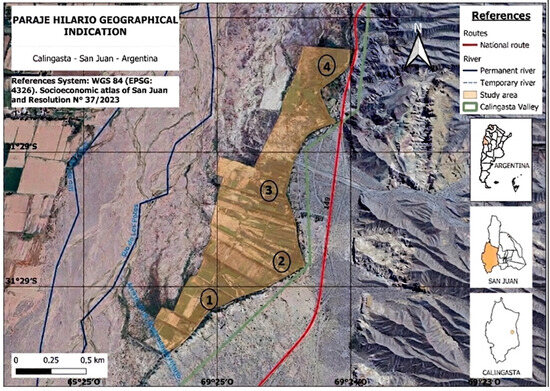
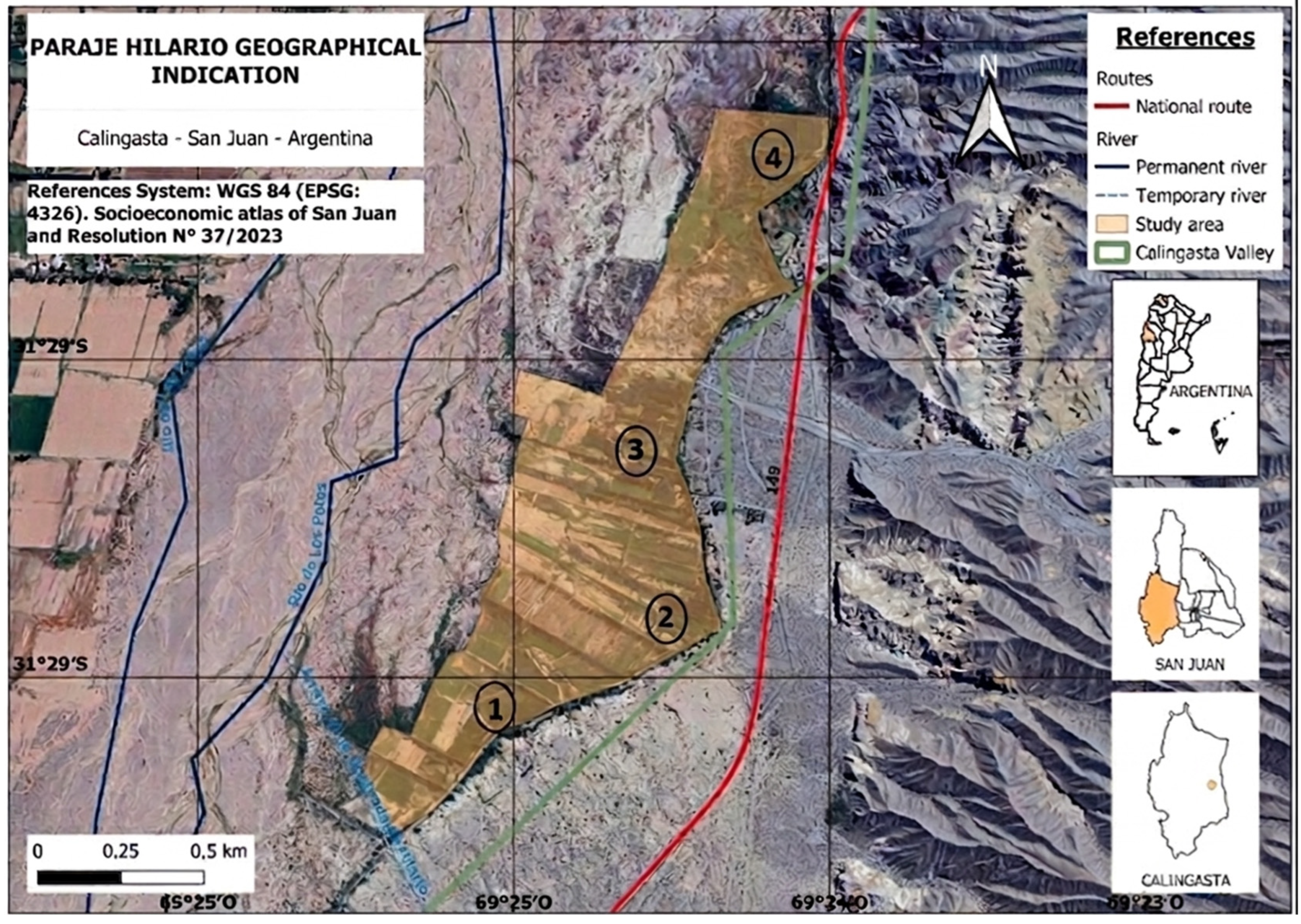
During the 2022 harvest, grape clusters of Vitis vinifera cv. Torrontés sanjuanino were randomly collected from four vineyards located within the Paraje Hilario geographical area (Calingasta, San Juan, Argentina). The selected vineyards were characterized by traditional management practices, low-intensity agricultural intervention, and the cultivation of heritage grapevine material under the traditional “parral cuyano” training system, which is widely preserved throughout the region. The study area is centered around 31°29′56″ S and 69°25′47″ W, at an average altitude of 1550 m a.s.l. (Figure 1).
Figure 1.
Study area and sampling—Paraje Hilario—Valle de Calingasta—San Juan—Argentina. ① Finca Muñoz, ② Finca Maggio Roberto, ③ Finca Maggio José y ④ Finca Pastorelli.
This valley (Paraje Hilario), located from north to south, is bordered by the El Tontal mountain range to the east and by the Los Patos riverbed to the west. Harvesting was performed manually and randomly, selecting only healthy clusters with no visible damage and at optimal physiological and technological maturity. The harvest time was determined based on the average °Brix of the study area (19.5 °Bx). Berries were collected in sterile plastic bags, hermetically sealed, and transported at 4 ± 1 °C to the Institute of Biotechnology, Engineering Faculty, National University of San Juan (UNSJ).
2.2. Isolation and Preservation of Yeasts
The grape clusters were destemmed, and the berries manually crushed. The resulting must (5 L) from each vineyard was transferred to separate 7 L containers, previously sanitized with 0.5% peracetic acid, where spontaneous fermentations were carried out. The containers were sealed, and a Müller valve was installed for CO2 release. Fermentations were monitored daily by measuring weight loss and expressed in mg CO2/100 mL. Samples were taken at 5 key stages of the fermentation process: initial must (Mi), beginning of fermentation (I—onset of fermentative activity), one-quarter fermentation (C—2.5% weight loss), mid-fermentation (M—5% weight loss), and end of fermentation (F—10% weight loss). From each fermentation system, 1 mL aliquots were extracted, serially diluted, and plated on Petri dishes containing Wallerstein Laboratory (WL) Nutrient Agar medium (Oxoid, Hampshire, UK) supplemented with 0.2 g/L dicloran and 0.5 g/L chloramphenicol. Plates were incubated at 28 ± 1 °C for 5 days. To ensure a representative sampling of species diversity, colonies were selected in proportion to the total CFU counts. From each genus and species, colonies were recovered based on morphological and colour characteristics, following the criteria described by [19]. Each isolate was cultured on YEPD-agar medium (Yeast Extract 10 g/L, Peptone 20 g/L, Dextrose 20 g/L, and Agar 20 g/L) and incubated at 28 ± 1 °C for 3 days. Yeast biomass from each isolate was then preserved in a 30% glycerol solution at −80 °C for subsequent analysis.
2.3. Physiological Characterization of Oenological Interest
The isolates were evaluated to perform a preliminary screening for undesirable traits during the winemaking process and/or in the final product. Each isolate was evaluated in triplicate on the corresponding culture media.
2.3.1. Undesirable Oenological Traits
H2S Production
The production of hydrogen sulfide (H2S), a volatile compound produced by yeasts and associated with sensory defects during fermentation, was evaluated on BBL™ BIGGY agar medium (Becton Dickinson, Franklin Lakes, NJ, USA). Yeast isolates were streaked onto the medium and incubated at 25 ± 1 °C for 4 days. H2S production was assessed using the ordinal scale proposed by [20], ranging from 1 to 5, where 1 (white colonies) indicates no production, and 5 (dark brown colonies) indicates high production. Pichia occidentalis PB120b was used as a positive control for H2S production [21]. For selection purposes, a binary scale was then applied, where values of 1, 2, and 3 were assigned a score of 1 (acceptable), and values of 4 and 5 were assigned a score of 0 (unacceptable).
Volatile Acids Production
The production of volatile acids, mainly acetic acid, was assessed on Chalk agar (Yeast extract 3 g/L, Glucose 10 g/L, CaCO3 3 g/L, and Agar 20 g/L) by spot inoculation and incubation at 25 ± 1 °C for 5 days. The appearance of a clear halo around the colonies indicated positive acid production [22]. The diameter (in mm) of both the colony and the halo was measured using a digital caliper, and a production index (Pz) was calculated using the formula:
Pz = colony diameter (mm)/halo diameter (mm)
A binary scale was applied: values of Pz between 0.7 and 1 were considered low producers (binary value = 1), whereas values < 0.7 indicated high production (binary value = 0).
Amino Acid Decarboxylation Activity
YEPD agar was supplemented with 1% (w/v) of the amino acid under evaluation and 0.006% (w/v) bromocresol purple as a pH indicator. The amino acids analyzed were L-lysine, L-tyrosine, L-histidine, L-arginine, and L-methionine, which, when decarboxylated, form polyamines with potentially toxic or allergenic effects. Each amino acid solution was added to the remaining medium, and the final pH was adjusted to 6.0 with 1 N HCl. Yeast isolates were spot-inoculated and incubated at 25 ± 1 °C for 7 to 14 days. The appearance of a violet coloration around the colonies indicated a positive reaction for biogenic amine production [23].
2.4. Molecular Identification of Yeast Isolates
For identification, all selected isolates were activated in liquid YEPD medium at 26 ± 1 °C with shaking at 120 rpm. Presumptive Saccharomyces cerevisiae isolates were incubated for 24 h, while non-Saccharomyces yeasts were incubated for 48 h. Genomic DNA was extracted following the protocol of [24] with phenol–chloroform, and its quality was verified by electrophoresis on a 0.7% agarose gel. For taxonomic identification, the D1/D2 domain of the 26S rDNA was sequenced using the primers NL1 and NL4 [25]. The amplified DNA fragments were purified and sequenced using the Sanger capillary sequencing method, with the Premix BigDye Terminator v3.1 Cycle Sequencing Kit (Applied Biosystems, Warrington, UK). Sequences were compared to NCBI database entries using BLAST (https://blast.ncbi.nlm.nih.gov/Blast.cgi accessed on 6 March 2024), and identification was considered valid when similarity was ≥99%.
Strain level differentiation of S. cerevisiae was carried out using Interdelta PCR following the protocol of [26]. Additionally, for intraspecific analysis of Hanseniaspora uvarum, the TRtRNA PCR technique with specific primer combinations was used, according to [27]. In all cases, PCR products were analyzed by agarose gel electrophoresis stained with ethidium bromide and visualized under UV light (Table 1).
Table 1.
Molecular techniques used for species identification and strain-level differentiation of the obtained isolates. Conditions for DNA extraction, amplification, and detection.
2.5. Identification of Oenological Positive Traits in Isolates Identified by 26S rDNA Sequencing
2.5.1. Fermentation Capacity Under Ethanol Stress, Low pH, and 15 ± 1 °C
Yeast strains were characterized under stress conditions simulating a base wine destined for sparkling wine production. Two parallel assays were performed: one assessing the effect of pH (3.0 and 3.5), and another the effect of ethanol (11 and 13% v/v), both at a constant temperature of 15 ± 1 °C. Fermentations were conducted in test tubes containing 4 mL of synthetic juice (25 g/L Glucose, 25 g/L Fructose, 2 g/L Yeast Extract), adjusted to experimental conditions. Durham tubes were used to monitor CO2 production as an indicator of fermentative activity. A binary scale (0 or 1) was applied, where strains that began to fill the tubes within 24 or 48 h were scored as 1, while those that did so at 72 h or later were scored as 0. Strains scored as 1 were selected for subsequent screening.
2.5.2. SO2 Resistance
SO2 resistance was assessed by spotting 5 μL of a fresh culture onto YPD plates solidified with 20 g/L agar, with pH adjusted to 3.5 using tartaric acid. Plates were previously supplemented with different concentrations of a sterile 10% (w/v) potassium metabisulfite solution, reaching total SO2 levels between 50 and 200 mg/L. Yeasts showing visible growth after 72 h of incubation at 26 ± 1 °C were considered resistant. Control plates without metabisulfite were included [28]. A binary scale was used, with 1 indicating resistance to all SO2 concentrations tested.
2.5.3. Urease Activity
Urease activity was qualitatively assessed following [29] using Christensen Medium Agar (Britania, Argentina). Fifty microliters of each strain were inoculated into screw-cap tubes containing slanted medium (flute-shaped) and incubated at 26 ± 1 °C for 48 h. Urease activity was indicated by a color change in the medium from orange to pink.
2.5.4. Flocculation Capacity
Flocculation was assessed according to the protocol described by [30] only S. cerevisiae yeast isolates. Cells previously activated in YEPD were harvested by centrifugation and washed with deionized water. They were then resuspended in a CaCl2 solution (80 mg/L) adjusted to pH 4.0. The suspensions were briefly shaken and left to stand at room temperature. Floc formation and sedimentation were visually evaluated over 30 min, with sedimentation time recorded at 10-min intervals. Strains that settled within the first 10 min were selected.
2.5.5. Killer Phenotype
Killer activity was assessed in vitro using cross-reactions between selected strains following [31], with modifications. Killer-KM medium was used. Strains were previously activated in YEPD broth for 48 h at 20 ± 1 °C and 130 rpm. Each isolate (1 × 10⁶ cells/mL) was spread as a lawn. Then, 20 μL spots (1 × 10⁸ cells/mL) of the remaining isolates were seeded on the lawn. Plates were incubated for 48 h at 17 ± 1 °C. The presence of inhibition halos indicated killer activity.
2.6. Base Wine Fermentation Under Mono- and Co-Culture Conditions of Selected Yeasts at Laboratory Scale
Fermentations were performed in 250 mL Erlenmeyer flasks containing 175 mL of Torrontés sanjuanino grape must (2022 vintage), with the following initial characteristics: pH 3.5, total acidity 5.5 g/L, yeast assimilable nitrogen (YAN) 213 mg/L, and 19.5 °Brix. Fermentations were carried out under two conditions: mixed cultures and monocultures, using a total inoculum of 2 × 10⁶ cells/mL and a constant fermentation temperature of 17 ± 1 °C. In mixed cultures, two inoculation ratios between non-Saccharomyces and Saccharomyces strains were tested: 90:10 (90% non-Saccharomyces and 10% Saccharomyces yeasts) and 50:50 (equal proportions of both yeasts). Additionally, each strain (non-Saccharomyces and Saccharomyces yeasts) was inoculated independently as a monoculture, serving as a control. Fermentation progress was monitored daily by weight loss until a constant value was reached, indicating the end of fermentation.
2.7. Pilot-Scale Base Wine Fermentation
Fermentations were conducted in 30 L tanks containing 25 L of Torrontés sanjuanino grape must (2025 vintage) at 17 ± 1 °C. Must parameters were: 19.5 °Brix (190.2 g/L sugar), total acidity 5.9 g/L, pH 3.55, SO2 25 mg/L, and YAN 220 mg/L. The selected co-inoculation strategy from Section 6 was applied at a final concentration of 2 × 10⁶ cells/mL. Weight loss was periodically measured to monitor fermentation kinetics, and population dynamics were assessed by sampling and plating on WLN medium. Pure-culture fermentations with S. cerevisiae were used as positive controls. Pilot-scale fermentation was performed as a validation trial of the selected inoculation strategy under winemaking conditions. As the objective of this stage was technological validation rather than statistical comparison, biological replicates were not included.
2.8. Chemical Analysis
In both micro- and pilot-scale fermentations, ethanol (% v/v), pH, residual sugars, titratable acidity, and acetic acid (g/L) were determined using an ALPHA FT-IR Wine Analyzer (Bruker Optics, Ettlingen, Germany) equipped with an ATR sampling system. Analyses were performed according to the manufacturer’s instructions using the wine calibration models supplied by Bruker. The instrument was routinely calibrated and quality-controlled according to the protocols established by the regulatory laboratory, and a background spectrum was recorded with distilled water before each analytical sequence. FT-IR results were subsequently verified using the corresponding OIV reference methods. Additionally, in pilot-scale fermentations, SO2 (mg/L), ethanol (% v/v), total acidity (g/L), volatile acidity (g/L), and yeast assimilable nitrogen (YAN, mg/L) were analyzed according to OIV standard methods which were also used to verify and validate the FT-IR results.
3. Data Analysis
Each experiment was independently performed in triplicate (except for pilot-scale fermentation), and results are reported as mean values ± standard deviation. The chemical parameters and metabolic end-products from the fermentations were subjected to a one-way Analysis of Variance (ANOVA). A 95% confidence level (α = 0.05) was used, and mean separations were determined using Tukey’s post hoc test. The analysis was performed using Infostat professional version 2018. Fermentation kinetics data (weight loss over time) were plotted to illustrate metabolic trends, and significant differences at specific physiological milestones were evaluated using the standard error of the means. Molecular banding patterns from gel electrophoresis were analyzed using GelJ software (version 2.0). This tool enables digital gel image analysis and band profile comparison. Dendrogram construction and pattern similarity analysis were conducted using the UPGMA hierarchical clustering algorithm.
4. Results
The main objective of this study was to obtain selected yeast strains that reflect the identity of the terroir to produce a white base wine intended for sparkling wine. To this end, autochthonous yeasts belonging to the species S. cerevisiae and non-Saccharomyces yeasts were isolated from spontaneous fermentations of grape musts from the Torrontés sanjuanino variety. A total of 156 yeasts were isolated on differential media plates. These isolates showed morphological characteristics compatible with Saccharomyces (37.82%) and non-Saccharomyces yeasts (62.18%).
In order to establish a more restricted and technologically suitable group of isolates, the 156 yeasts isolated during the vinification process were evaluated to produce compounds considered undesirable in winemaking. None of the isolates showed biogenic amine production. Regarding the analysis of volatile acids (measured based on the clarification halo on specific medium) and H2S production, 104 yeast isolates were selected as low or non-producers of both compounds.
4.1. Molecular Identification of Yeast Isolates
Genus and Species Characterization
In the present study, the analysis of the 26S rDNA sequence allowed for precise taxonomic identification of the isolates at the species level, obtained during spontaneous fermentation. As detailed in Table 2, out of the 104 isolates evaluated, 44 belonged to the genus Saccharomyces, specifically the species S. cerevisiae, while the remaining 60 were classified as non-Saccharomyces yeasts.
Table 2.
Identification and distribution of the 104 selected yeast isolates without undesirable oenological traits, based on D1–D2 domain sequencing of the 26S rRNA gene.
4.2. Oenological Characterization of Desirable Traits
The 104 isolates identified at the species level by molecular methods were subjected to various assays to evaluate oenological traits of interest, with the aim of selecting yeasts with the greatest aptitude for conducting base wines intended for sparkling wine production. None of the isolates evaluated was able to ferment under conditions of pH 3 and 15 ± 1 °C (Table 3). On the other hand, it is worth noting that all 104 isolates showed resistance to all concentrations of sulphur dioxide (SO2) tested.
Table 3.
Oenological traits evaluated in 104 yeast isolates. Molecular characterization at strain level and final selection.
With regard to the performance of non-Saccharomyces yeasts, it was observed that both Cryptococcus uzbekistanensis and Naganishia albidus failed to ferment under any of the conditions evaluated. Among the 18 isolates of Metschnikowia pulcherrima, 4 initiated fermentations under conditions of pH 3.5 at 15 ± 1 °C after 96 h of incubation. Due to this low fermentative efficiency and lack of tolerance to the stress conditions tested, these three species were discarded for potential use in co-inoculations to produce sparkling base wines.
With respect to Hanseniaspora uvarum, when the pH was increased to 3.5 at 15 ± 1 °C, 12 isolates-initiated fermentations after 48 h, and this number increased to 26 after 72 h. Of the 12 initial isolates, three were also able to ferment under conditions of 13% v/v ethanol at 15 ± 1 °C within 48 h. Based on these results, the 12 isolates (including the three with ethanol tolerance) were selected as an oenologically relevant group for future co-inoculation assays.
Among the 44 isolates of S. cerevisiae, 17 were selected for their ability to ferment under conditions of pH 3.5 and 15 ± 1 °C. This subgroup represents the most oenologically relevant candidates, as it included isolates that, in addition to fermenting under these conditions, also showed tolerance to 13% v/v ethanol at 15 ± 1 °C. Within this group, three isolates displayed positive urease activity and two exhibited flocculation ability. Therefore, these 17 isolates were considered the most promising candidates to produce sparkling base wines.
4.3. Molecular Characterization at Strain Level and Final Selection
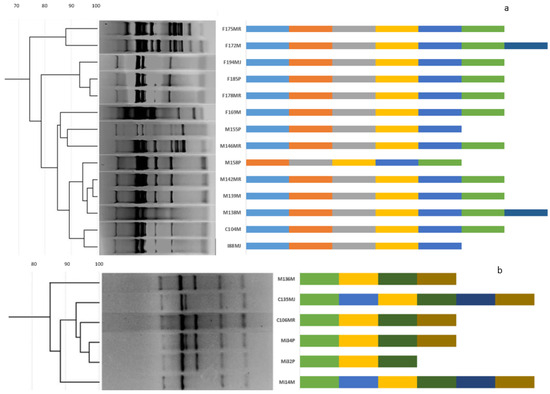
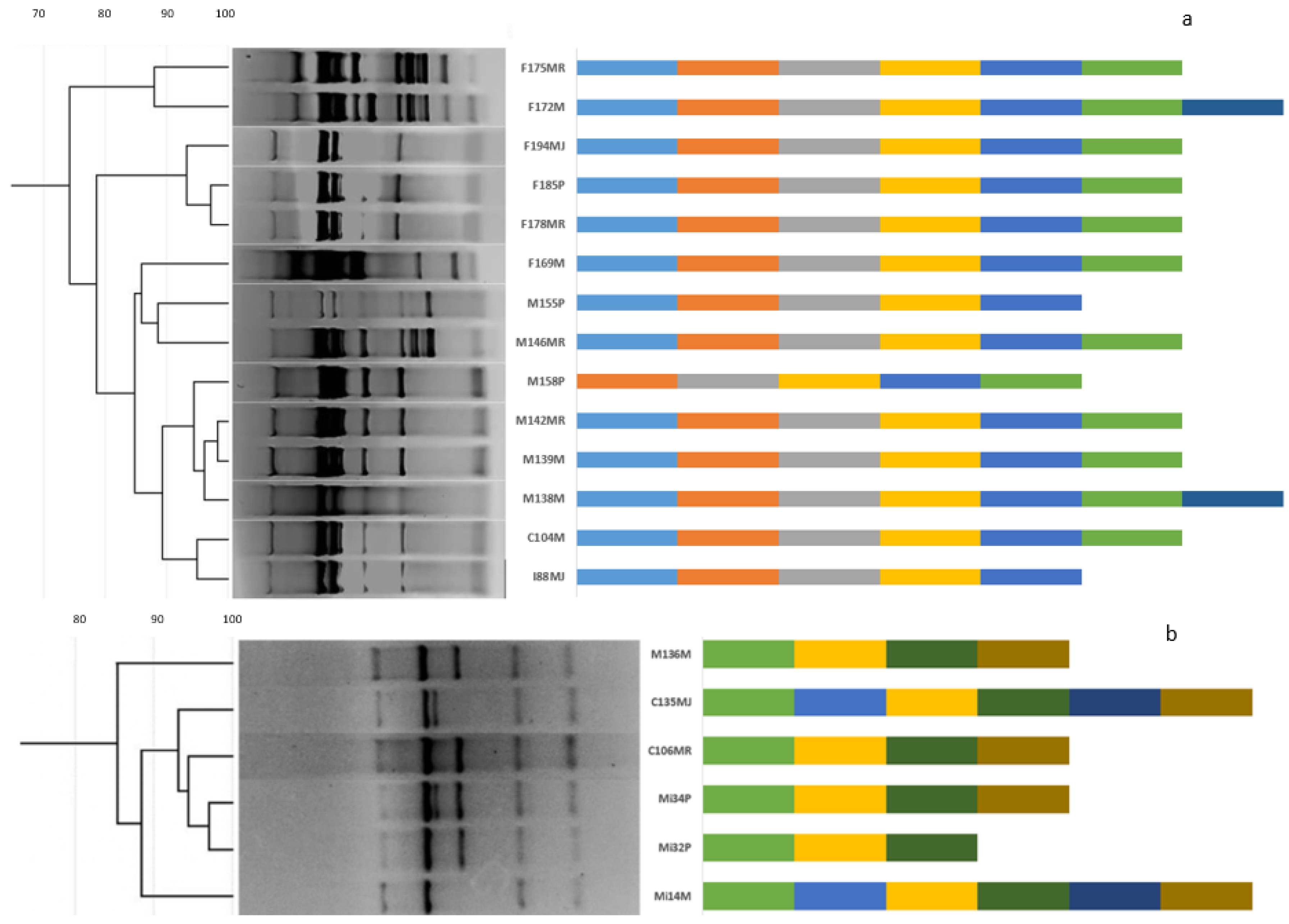
The 17 S. cerevisiae isolates and the 12 Hanseniaspora isolates were subjected to DNA-level molecular analysis to discriminate between different strains and discard clones. Genetic typing by interdelta PCR revealed that 14 out of the 17 selected S. cerevisiae isolates were genetically distinct from each other (Figure 2a), whereas in the case of H. uvarum, 6 strains showed genotypic differences (Figure 2b).
Figure 2.
Dendrogram, molecular profiles, and enological characterization of the evaluated yeast strains. The stacked horizontal bars indicate the cumulative performance of each strain across different technological attributes. Color codes are defined as follows: light blue = volatile acidity; orange = H2S production; grey = biogenic amines; yellow = ethanol resistance (13% v/v); medium blue = SO2 tolerance; green = pH 3.5–15 ± 1°C resistance; dark blue = flocculation (10 min); and brown = urease activity.Trait presence is represented by colored bars. For selection purposes, the extreme oenological conditions are presented in the graphs. Each isolate is labeled with a code in which the initial letter denotes the fermentation stage at which it was recovered (I = initial, C = quarter, M = middle, F = final). (a): Dendrogram showing the genetic relationships among Saccharomyces cerevisiae strains based on inter-δ (delta) PCR fingerprinting. (b): Dendrogram showing the genetic relationships among Hanseniaspora uvarum isolates obtained by TRtRNA-PCR technique [27].
Based on the results obtained, all S. cerevisiae isolates exhibited low H2S production, the ability to ferment under conditions of 13% v/v ethanol and pH 3.5 at 15 ± 1 °C, and 200 ppm SO2. None of the 14 isolates produced biogenic amines and urease. Regarding volatile acidity production, S. cerevisiae M158P formed a clarification halo on Chalk agar medium, associated with acetic acid production. I88MJ and M155P isolates were discarded due to their null fermentation capacity at pH 3.5 and 15 ± 1 °C. In the flocculation assay, only S. cerevisiae M138M and F172M showed flocculating ability during the evaluation period. Based on these results and the oenological characteristics of the strains, M138M and F172M were selected to conform co-inoculation strategies for base wine production at laboratory scale.
In contrast to S. cerevisiae, all 6 H. uvarum strains exhibited positive urease activity. Furthermore, all showed low/null H2S and biogenic amine production. Mi14M and C135MJ strains stood out from the rest due to their low volatile acidity production and tolerance to fermentation conditions of 13% v/v ethanol at 15 ± 1 °C. Based on these findings, H. uvarum Mi14M and C135MJ were selected for co-inoculation with the chosen S. cerevisiae strains.
Prior to establishing the co-inoculations, and in order to verify the absence of negative interactions among these 4 yeast strains, they were subjected to cross-reaction assays in specific culture medium for killer factor detection. The results indicated the absence of killer activity among the yeasts evaluated.
4.4. Base Wine Fermentation with Single and Co-Cultures of Yeasts at Laboratory Scale
A full factorial 2 × 2 × 2 design was implemented, considering 2 H. uvarum strains (Mi14M and C135MJ), 2 S. cerevisiae strains (M138M and F172M), and 2 co-inoculation ratios (90:10 and 50:50), resulting in a total of 8 experimental combinations (Table 4). Each strain was also used under pure culture conditions as a control treatment.
Table 4.
Chemical analysis and metabolic parameters of lab-scale fermentations in Torrontés sanjuanino wines, conducted with co-inoculation of Hanseniaspora uvarum (Mi14M and C135MJ) and Saccharomyces cerevisiae (M138M and F172M) at 50:50 and 90:10 ratios, along with their respective controls: H. uvarum (Mi14M and C135MJ) and S. cerevisiae (M138M and F172M).
Regarding ethanol and total acidity concentrations, as well as fermentative efficiency, no significant differences were observed among treatments (Table 4). Fermentations conducted with H. uvarum (Mi14M and C135MJ) in pure culture recorded higher acetic acid values (0.91 ± 0.02 and 0.89 ± 0.017 g/L, respectively), exceeding the limits established by current regulations (>0.7 g/L). These treatments also presented the highest glycerol concentrations, with values of 7.23 and 7.33 g/L. In contrast, both pure S. cerevisiae fermentations and co-inoculations showed glycerol values ranging from 6.17 to 7.17 g/L, all above the sensory threshold for this compound (5.2 g/L) [32].
The lowest acetic acid production was recorded in the 50:50 Mi14M/M138M combination, indicating efficient sugar metabolism towards ethanol rather than acetic acid. This treatment, together with the pure S. cerevisiae controls (M138M and F172M), also recorded the lowest total residual sugars (5.97 g/L). Although total acidity did not differ significantly among treatments, the lowest pH values were found in Mi14M/M138M fermentations at both evaluated ratios (50:50 and 90:10; Table 4).
Based on these results, and with the aim of conducting co-inoculation fermentations to enhance the value of the studied varietal, the 50:50 co-inoculation of H. uvarum Mi14M with S. cerevisiae M138M showed the best performance, standing out for its balanced fermentative capacity and oenological potential for the production of base wines intended for sparkling wine. It is worth noting that fermentations involving S. cerevisiae F172M showed greater variability in residual sugar concentrations among biological replicates than those involving strain M138M. This variability was accompanied by differences in ethanol production, suggesting heterogeneous fermentation completion rather than analytical inconsistencies. In contrast, treatments containing M138M displayed more consistent fermentative performance, supporting its selection for subsequent pilot-scale validation.
4.5. Pilot-Scale Base Wine Fermentation
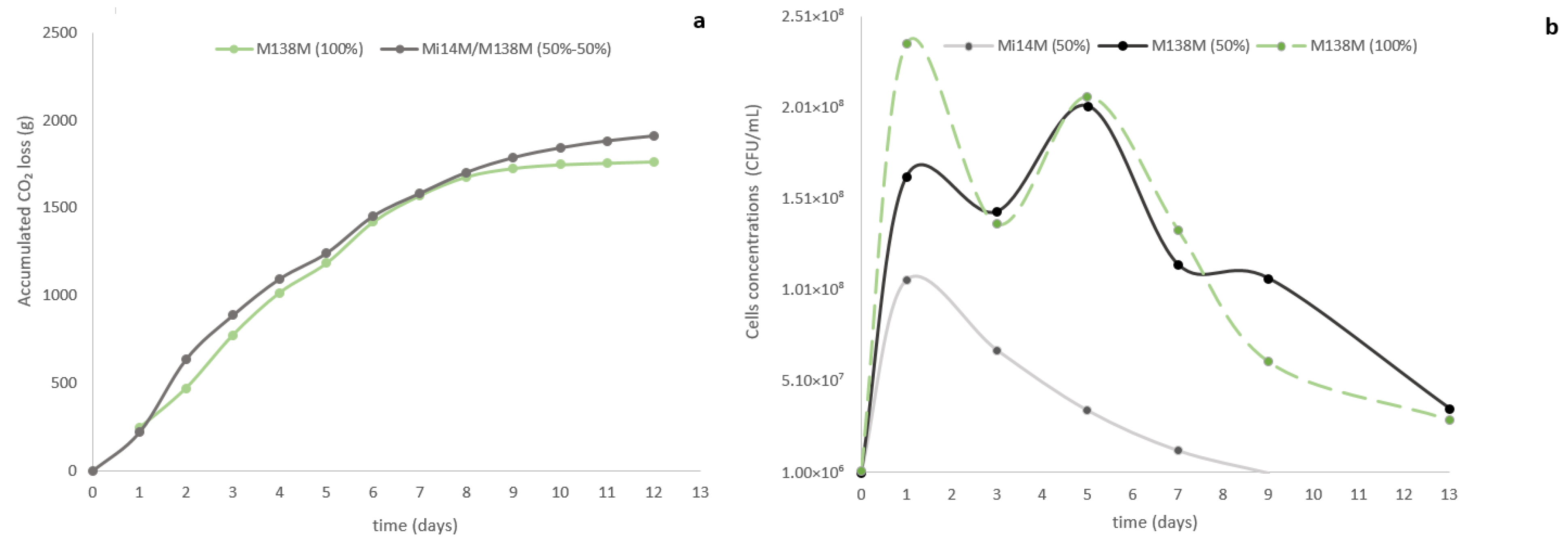
Fermentation of 25 L of Vitis vinifera cv. Torrontés sanjuanino grape must for base wine production was carried out using a 50:50 co-inoculation strategy with H. uvarum Mi14M and S. cerevisiae M138M (both strains previously selected according to the oenological criteria described in Section 4.1). S. cerevisiae M138M fermentation as monoculture was conducted as control. In both treatments, fermentation was completed within 13 days (Figure 3a). Fermentation kinetics, measured as accumulated CO2 release, showed a constant daily weight loss in both treatments (Figure 3a).
Figure 3.
(a) Fermentation kinetics in pilot scale (measured as CO2 release) of H. uvarum Mi14M/S. cerevisiae M138M (50%–50%) grey line, compared with treatment control of S. cerevisiae M138M (100%) green line. (b) Population dynamics during pilot-scale fermentation, comparing co-inoculation (grey and black lines) of H. uvarum Mi14M and S. cerevisiae M138M with single inoculation of S. cerevisiae M138M (green line).
Regarding population kinetics (Figure 3b), in the co-culture, H. uvarum was detectable until day 9 of the process, reaching its maximum population (1.06 × 10⁸ cells/mL) 24 h after fermentation onset. In co-inoculation conditions, S. cerevisiae M138M reached its maximum concentration (1.6 × 10⁸ cells/mL) on day 5, in contrast to S. cerevisiae M138M in pure culture (control), which reached its peak population (2.36 × 10⁸ cells/mL) on day 2. After day 3, the population dynamics of S. cerevisiae M138M were similar under both pure culture and co-inoculation conditions. In both cases, S. cerevisiae was detected until day 13 of fermentation.
The analytical data of the wines obtained at pilot scale are presented in Table 5. In terms of residual sugars, the M138M treatment achieved complete fermentation, with a total sugar content of 3.6 g/L, compared to 8.5 g/L observed in the Mi14M/M138M treatment. This difference was reflected in both fructose concentration (1.3 vs. 5.4 g/L) and glucose concentration (0.1 vs. 0.8 g/L), indicating greater fermentative efficiency under the M138M treatment conditions. Conversely, glycerol content was higher in the Mi14M/M138M treatment (7.1 g/L) compared to M138M (6.4 g/L). Ethanol, acetic acid, total acidity, and pH values were similar and within acceptable limits according to current regulations for both treatments. The alcoholic content was 11.2% and 11.7% v/v for Mi14M/M138M and M138M, respectively, while acetic acid remained low and similar (0.44 and 0.47 g/L), with no evidence of microbial or metabolic spoilage. Total acidity was 5.6 and 5.2 g/L, and pH was virtually identical in both cases (3.08 and 3.05), suggesting overall stability of the fermentation system without marked differences in freshness perception or acid–base balance between treatments.
Table 5.
Analytical composition of wines (cv Torrontés sanjuanino) obtained from pilot-scale fermentations using co-inoculation of H. uvarum Mi14M and S. cerevisiae M138M (50:50) compared to single inoculation with S. cerevisiae M138M (100%). Parameters include ethanol content, organic acids, residual sugars, glycerol, total acidity, and pH.
5. Discussion
The isolation and characterization of indigenous yeasts from Paraje Hilario revealed a diverse microbial population with oenological potential. Given the absence of previous studies describing the fermentative microbiota of this winegrowing region, these findings provide the first evidence of its microbial biodiversity and support the relevance of local yeast resources for the development of differentiated winemaking strategies. Furthermore, the results contribute to a better understanding of the relationship between regional microbial diversity and the unique characteristics associated with the local terroir. Paraje Hilario is characterized as a viticultural area with vineyards of native varieties over 90 years old. Particularly noteworthy in this area is the Torrontés sanjuanino varietal, a progeny of Muscat of Alexandria × Criolla Chica (Listan Prieto).
It is widely recognized that yeasts strongly impact the final quality of wines [3]. Therefore, a better understanding of the population distribution and metabolism of the different yeast species involved in winemaking is essential. The objective of this study was focused on isolating both Saccharomyces and non-Saccharomyces yeasts associated with the vinification process, with the aim of employing them in the production of base wines of the Torrontés sanjuanino varietal. As highlighted by [33], there is currently a global expansion in sparkling wine production, especially with emerging or non-traditional grape varieties. These varieties challenge the wine industry from a technological perspective, both at the level of primary aromatic expression and in the selection of autochthonous yeast strains for the first and second fermentations. In line with this objective, 4 vineyards in Paraje Hilario were sampled, and 156 yeasts were isolated from spontaneous fermentations of Torrontés sanjuanino.
As initial exclusion criteria, the production of biogenic amines, acetic acid, and H2S was assessed. The main biogenic amines present in wine are histamine, tyramine, and putrescine [34,35,36]. These molecules can exert direct or indirect toxic effects on human health, causing symptoms such as nausea, palpitations, headaches, and diarrhea. Their presence in wine is considered an indicator of quality deterioration with negative implications for international trade; consequently, some countries have established specific concentration limits in various foods [37]. Similarly, excessive acetic acid production is associated with increased volatile acidity, a critical sensory parameter in oenology that imparts vinegar-like aromas and harsh taste, thereby reducing commercial acceptability [38]. In turn, hydrogen sulfide (H2S) is responsible for off-odors reminiscent of “rotten egg” or “burnt rubber,” defects that can mask varietal aromatic expression and compromise the sensory quality of the final product [39]. For these reasons, both acetic acid and H2S are undesirable metabolites whose formation must be strictly monitored during yeast selection. Among the 156 isolates evaluated, none produced biogenic amines. However, high production of acetic acid and H2S was detected in 33 Hanseniaspora isolates (21%), 8 Metschnikowia isolates (5%), 5 Cryptococcus isolates (3.2%), and 6 Saccharomyces isolates (3.8%). Based on these parameters, the number of isolates was reduced to 104, which were subsequently subjected to molecular identification by sequencing of the D1/D2 domain. This screening step allowed us to focus on yeasts with greater oenological potential, while discarding those producing undesirable compounds that negatively impact wine sensory quality and consumer acceptance.
The yeast community composition during fermentation showed a predominance of S. cerevisiae (45.7%), followed by H. uvarum (39.5%) and M. pulcherrima (18.7%). Although more than 100 yeast species have been described in wine producing regions worldwide [40], only a few typically dominate, which agrees with the results of this work. A clear example is the study by [11], who reported that in spontaneous Malbec fermentations from Mendoza (Argentina), Kloeckera apiculata (anamorph of H. uvarum) and M. pulcherrima were initially predominant, but S. cerevisiae, though initially scarce, rapidly displaced non-Saccharomyces species as ethanol levels increased. In concordance, ref. [41] found relative abundances of S. cerevisiae ranging from 21–53% and H. uvarum from 7–57% in spontaneous fermentations of eight grape varieties from Qingtong Xia (China). Similarly, in the Priorat region (Spain), [42] identified H. uvarum as the most frequent non-Saccharomyces yeast, consistently detected across culture-dependent and independent techniques (qPCR, DGGE, massive sequencing). Therefore, the results of this work reinforce the premise that the species H. uvarum, M. pulcherrima, and, above all, the main fermentative S. cerevisiae, remain the dominant yeasts associated with grapes and must [43,44].
The evaluation of oenological traits favorable for driving alcoholic fermentation (such as tolerance to different ethanol and pH levels, enzymatic activities, fermentation kinetics, among others) has become a sine qua non tool to optimize winemaking processes in wineries and ensure product quality. These criteria have been broadly adopted and applied across diverse viticultural regions [22,45,46,47]. By understanding the performance of each strain under different fermentation scenarios, it is possible to design more predictable and efficient inoculation strategies, reducing the risk of sluggish or stuck fermentations and improving product consistency. In particular, the main purpose of this study was to select yeasts suitable for co-fermentation of base wines intended for sparkling production. Since these matrices are characterized by low pH values and fermentation temperatures ranging from 15 to 18 °C, assessing yeast performance under such conditions is a critical selection criterion. In this study, yeast capacity to ferment under severe stress conditions (13% v/v ethanol and pH 3 or 3.5, at 15 °C) was evaluated. None of the 104 isolates were able to ferment at pH 3 and 15 °C under these conditions. Generally, yeasts are acidophilic and adapt well to the initial pH of the medium; however, the pH decrease resulting from organic acid production negatively affects their viability and fermentative performance [48]. When exposed to low temperatures and reduced pH simultaneously, yeasts face a dual physiological challenge: slowdown of fermentative metabolism and the need to maintain intracellular ionic homeostasis. This explains the absence of fermentative activity at pH 3–15 °C. Nevertheless, under slightly less restrictive conditions (pH 3.5 and 15 °C), all isolates of S. cerevisiae and H. uvarum, together with 4 isolates of M. pulcherrima species, were able to initiate fermentation, albeit at different times. Since a rapid onset of fermentation provides a competitive advantage for implantation, those isolates that started fermentation within the first 48 h after inoculation were selected, yielding 17 preselected strains of S. cerevisiae and 12 of H. uvarum.
Under the selection criteria evaluated, Metschnikowia, Cryptococcus, and Naganishia isolates showed low or no fermentative activity. It has been widely reported that Metschnikowia exhibits limited fermentative capacity. In the present study, the evaluated isolates initiated sugar metabolism under restrictive conditions only after 96 h, indicating a slow fermentation rate that makes them unsuitable as starter cultures. The genus Naganishia, a basidiomycete, displays limited fermentative ability and contribution to wine fermentation [49]. This was confirmed in our assays, where no fermentative activity was detected under the tested conditions. Regarding Cryptococcus uzbekistanensis, this yeast species has been detected in mature vineyards, especially in the absence of fungicide applications [50]. This aligns with the vineyards sampled here, which were organically managed without agrochemical use. However, both Cryptococcus and Naganishia were only detected at the onset of fermentation and became undetectable at later stages using culture-based methods. These findings confirm their limited ability to sustain fermentation.
With respect to the dominant species, S. cerevisiae and H. uvarum, the first is well known for its fermentative robustness and tolerance to hostile winemaking conditions, while the case of H. uvarum remains controversial. Some authors have reported its inability to withstand fermentative stress or its contribution of negative traits [51,52], whereas others highlight its potential as a non-Saccharomyces yeast, particularly due to its contribution to glycerol production, ester synthesis, and relevant oenological enzymes [9,53,54]. Given that fermentative activity is strain-dependent, an intraspecific analysis was performed for the selected isolates of S. cerevisiae and H. uvarum. Strain-level characterization ensures the identification of unique autochthonous isolates with specific fermentative and sensory potential [3,10]. Among S. cerevisiae isolates, 82% (14 of 17) showed genetic variability, whereas in H. uvarum, 50% (6 of 12) represented distinct strains. The lower proportion of distinct strains observed in H. uvarum compared with S. cerevisiae may reflect differences in the population structure and evolutionary dynamics of these species. Recent genomic studies have reported distinctive evolutionary features within the Hanseniaspora genus, particularly among species belonging to the fast-evolving lineage (FEL) clade [55]. However, the fingerprinting approach employed in the present study does not allow direct assessment of the genomic mechanisms underlying the observed diversity patterns. Therefore, these observations should be interpreted only as a description of the genetic variability detected among the isolates analyzed.
The simultaneous co-inoculation strategy of selected autochthonous yeasts, H. uvarum/S. cerevisiae, for the production of base wines for sparkling winemaking achieved oenologically relevant results in this study. First, a clear complementarity between both species was observed, as they coexisted in the fermenting medium until the ending stage of the process. Second, the resulting wine displayed analytical parameters comparable to those obtained in pure S. cerevisiae fermentations, with values within acceptable oenological ranges. Third, the lower SO2 concentration observed in the co-inoculated wines may be advantageous for sparkling wine production, as excessive SO2 levels can negatively affect yeast activity during the secondary fermentation in bottles. Previous studies support this approach, as several authors have evaluated the co-inoculation of H. uvarum and S. cerevisiae in red and white winemaking, consistently reporting improvements in overall wine quality and sensory attributes [56,57,58]. Overall, these studies indicate that H. uvarum, under co-culture conditions, contributes to the development of more diverse and balanced aromatic profiles. Nevertheless, to the best of our knowledge, no previous research has specifically applied this co-inoculation strategy to base wines for sparkling production, thus highlighting the novelty of our proposal. In this regard, the findings reported by [2] are particularly relevant, since sequential fermentations with non-Saccharomyces commercial yeasts such as Torulaspora delbrueckii and M. pulcherrima in combination with S. cerevisiae resulted in increased glycerol production, reduced volatile acidity, and positive shifts in the aromatic profile. Taken together, these findings reinforce the premise that the use of mixed-culture fermentations, even under different inoculation schemes, can serve as an effective strategy to modulate wine quality and enhance sensory complexity.
6. Conclusions
The isolates obtained in this work, including both Saccharomyces and non-Saccharomyces yeasts, demonstrated their potential as a strategic tool for the development of differentiated white base wines for sparkling wine production. In particular, the sequential inoculation of Hanseniaspora uvarum Mi14M and Saccharomyces cerevisiae M138M proved technologically feasible at both micro- and pilot-scale fermentations, yielding base wines with physicochemical characteristics suitable for sparkling wine elaboration.
This study contributes to the valorization of Torrontés sanjuanino and the indigenous microbial resources associated with the Paraje Hilario viticultural area. The results obtained provide a solid basis for the application of these native strains in the production of traditional-method (Champenoise) sparkling wines, supporting their technological suitability for this winemaking approach. Future studies will focus on evaluating their impact on the sensory and quality attributes of the final sparkling wines.
Author Contributions
Investigation, D.B.P.; Methodology, M.V.M.F., Y.P.M., V.B., L.R., S.T. and M.J.V.; Project administration, Y.P.M. and M.V.M.F.; M.J.V. and F.C.; Supervision, M.V.M.F.; Writing—original draft, D.B.P., Y.P.M. and M.V.M.F.; Writing—review & editing, D.B.P., Y.P.M., M.J.V., F.C. and M.V.M.F. All authors have read and agreed to the published version of the manuscript.
Funding
The authors declare financial support was received for the research, authorship, and/or publication of this article. This work was supported by grants from PDTS National University of San Juan-Argentina-SECITI [1499-23 R] and PIBBA National Council for Scientific and Technical Research [2872021010 0017CO].
Institutional Review Board Statement
Not applicable.
Informed Consent Statement
Not applicable.
Data Availability Statement
The original contributions presented in this study are included in the article. Further inquiries can be directed to the corresponding author.
Acknowledgments
The authors would like to thank: National Vitiviniculture Institute (INV)-San Juan for their analytical assistance with ALPHA FT-IR Wine Analyzer (Bruker Optics, Ettlingen, Germany). The authors declare financial support was received for the research, authorship, and/or publication of this article. During the preparation of this work the authors used ChatGPT 5 in order to improve readability and language. After using this tool, the authors reviewed and edited the content as needed and take full responsibility for the content of the publication.
Conflicts of Interest
The authors declare no conflicts of interest.
References
- Carrascosa, A.V.; Martinez-Rodriguez, A.; Cebollero, E.; González, R. Saccharomyces yeasts II: Secondary fermentation. In Molecular Wine Microbiology; Academic Press: Cambridge, MA, USA, 2011; pp. 33–49. [Google Scholar] [CrossRef] [Scilit]
- González-Royo, E.; Pascual, O.; Kontoudakis, N. Oenological consequences of sequential inoculation with non-Saccharomyces yeasts (Torulaspora delbrueckii or Metschnikowia pulcherrima) and Saccharomyces cerevisiae in base wine for sparkling wine production. Eur. Food Res. Technol. 2015, 240, 999–1012. [Google Scholar] [CrossRef] [Scilit]
- Alexandre, H. Wine yeast terroir: Separating the wheat from the chaff for an open debate. Microorganisms 2020, 8, 787. [Google Scholar] [CrossRef] [Scilit] [PubMed]
- Jolly, N.P.; Varela, C.; Pretorius, I.S. Not your ordinary yeast: Non-Saccharomyces yeasts in wine production uncovered. FEMS Yeast Res. 2014, 14, 215–237. [Google Scholar] [CrossRef] [Scilit] [PubMed]
- Bokulich, N.A.; Thorngate, J.H.; Richardson, P.M.; Mills, D.A. Microbial biogeography of wine grapes is conditioned by cultivar, vintage, and climate. Proc. Natl. Acad. Sci. USA 2014, 111, E139–E148. [Google Scholar] [CrossRef] [Scilit] [PubMed]
- Gilbert, J.A.; Van der Lelie, D.; Zarraonaindia, I. Microbial terroir for wine grapes. Proc. Natl. Acad. Sci. USA 2014, 111, 5–6. [Google Scholar] [CrossRef] [Scilit] [PubMed]
- Valentini, B.; Gatti, N.; Bossi, S.; Vigani, G.; Stefanini, I. Environmental characteristics and weather impact yeast populations and their dynamics in spontaneous fermentations. Curr. Res. Microb. Sci. 2025, 9, 100410. [Google Scholar] [CrossRef] [Scilit] [PubMed]
- Carrau, F.; Boido, E.; Ramey, D. Yeasts for low input winemaking: Microbial terroir and flavor differentiation. Adv. Appl. Microbiol. 2020, 111, 89–121. [Google Scholar] [CrossRef] [Scilit] [PubMed]
- Varela, C.; Borneman, A.R. Yeasts found in vineyards and wineries. Yeast 2017, 34, 111–128. [Google Scholar] [CrossRef] [Scilit] [PubMed]
- Bokulich, N.A.; Collins, T.S.; Masarweh, C.; Allen, G.; Heymann, H.; Ebeler, S.E.; Mills, D.A. Associations among Wine Grape Microbiome, Metabolome, and Fermentation Behavior Suggest Microbial Contribution to Regional Wine Characteristics. MBio 2016, 7, 10–1128. [Google Scholar] [CrossRef] [Scilit] [PubMed]
- Combina, M.; Elía, A.; Mercado, L.; Catania, C.; Ganga, A.; Martinez, C. Dynamics of indigenous yeast populations during spontaneous fermentation of wines from Mendoza, Argentina. Int. J. Food Microbiol. 2005, 99, 237–243. [Google Scholar] [CrossRef] [Scilit] [PubMed]
- David, V.; Terrat, S.; Herzine, K.; Claisse, O.; Rousseaux, S.; Tour-dot-Maréchal, R.; Masneuf-Pomarede, I.; Ranjard, L.; Alexandre, H. High-throughput sequencing of amplicons for monitoring yeast biodiversity in must and during alcoholic fermentation. J. Ind. Microbiol. Biotechnol. 2014, 41, 811–821. [Google Scholar] [CrossRef] [Scilit] [PubMed]
- Padilla, B.; Garcia-Fernandez, D.; Gonzalez, B.; Izidoro, I.; Esteve Zarzoso, B.; Beltran, G.; Mas, A. Yeast biodiversity from DOQ priorat uninoculated fermentations. Front. Microbiol. 2016, 7, 930. [Google Scholar] [CrossRef] [Scilit] [PubMed]
- Agüero, C.B.; Rodríguez, J.G.; Martínez, L.E.; Dangl, G.S.; Meredith, C.P. Identity and parentage of Torrontés cultivars in Argentina. Am. J. Enol. Vitic. 2003, 54, 318–321. [Google Scholar] [CrossRef] [Scilit]
- Instituto Nacional de Tecnología Agropecuaria. Variedades Criollas de Vid: Diversidad Genética y Potencial Enológico aún sin Explotar; INTA: Rivadavia, Argentina, 2017.
- Jackson, R.S. Wine Science: Principles and Applications, 5th ed.; Academic Press: Cambridge, MA, USA, 2020. [Google Scholar]
- Ribéreau-Gayon, P.; Dubourdieu, D.; Donèche, B.; Lonvaud, A. (Eds.) Handbook of Enology, Volume 1: The Microbiology of Wine and Vinifications; John Wiley & Sons: Hoboken, NJ, USA, 2006; Volume 1. [Google Scholar]
- Torres, R.; Aliquó, G.; Toro, A.; Fernandez, F.; Tornello, S.; Palazzo, E.; Sari, S.; Fanzone, M.; De Biazi, F.; Oviedo, H.J.; et al. Identification and recovery of local Vitis vinifera L. cultivars collected in ancient vineyards in different locations of Argentina. Aust. J. Grape Wine Res. 2022, 28, 581–589. [Google Scholar] [CrossRef] [Scilit]
- Pallmann, C.; Brown, J.A.; Olineka, T.L.; Cocolin, L.; Mills, D.; Bisson, L. Use of WL medium to profile native flora fermentations. Am. J. Enol. Vitic. 2001, 52, 198–203. [Google Scholar] [CrossRef] [Scilit]
- Mendes-Ferreira, A.; Mendes-Faia, A.; Leão, C. Survey of hydrogen sulphide production by wine yeasts. J. Food Prot. 2002, 65, 1033–1037. [Google Scholar] [CrossRef] [Scilit] [PubMed]
- Mestre Furlani, M.V.; Maturano, Y.P.; Combina, M.; Mercado, L.A.; Toro, M.E.; Vazquez, F. Selection of non-Saccharomyces yeasts to be used in grape musts with high alcoholic potential: A strategy to obtain wines with reduced ethanol content. FEMS Yeast Res. 2017, 17, fox010. [Google Scholar] [CrossRef] [Scilit] [PubMed]
- Sidari, R.; Ženišová, K.; Tobolková, B.; Belajová, E.; Cabicarová, T.; Bučková, M.; Puškárová, A.; Planý, M.; Kuchta, T.; Pangallo, D. Wine Yeasts Selection: Laboratory Characterization and Protocol Review. Microorganisms 2021, 9, 2223. [Google Scholar] [CrossRef] [Scilit] [PubMed]
- Zullo, B.A.; Ciafardini, G. Evaluation of physiological properties of yeast strains isolated from olive oil and their in vitro probiotic trait. Food Microbiol. 2019, 78, 179–187. [Google Scholar] [CrossRef] [Scilit] [PubMed]
- Hoffman, C.S.; Winston, F.A. A ten-minute preparation from yeast effiently releases autonomous plasmids for transformation of Escherichia coli. Gene 1987, 57, 267–272. [Google Scholar] [CrossRef] [Scilit] [PubMed]
- Valente, P.; Ramos, J.; Leoncini, O. Sequencing as a tool in yeast molecular taxonomy. Can. J. Microbiol. 1999, 45, 949–958. [Google Scholar] [CrossRef] [PubMed]
- Legras, J.; Karst, F. Optimisation of interdelta analysis for Saccharomyces cerevisiae strain characterization. FEMS Microbiol. Lett. 2003, 221, 249–255. [Google Scholar] [CrossRef] [Scilit] [PubMed]
- Barquet, M.; Martín, V.; Medina, K. Tandem repeat-tRNA (TRtRNA) PCR method for the molecular typing of non-Saccharomyces subspecies. Appl. Microbiol. Biotechnol. 2012, 93, 807–814. [Google Scholar] [CrossRef] [Scilit] [PubMed]
- Vigentini, I.; Barrera Cardenas, S.; Valdetara, F.; Faccincani, M.; Pa-nont, C.A.; Picozzi, C.; Foschino, R. Use of native yeast strains for in bottle fermentation to face the uniformity in sparkling wine production. Front. Microbiol. 2017, 8, 1225. [Google Scholar] [CrossRef] [Scilit] [PubMed]
- Perricone, M.; Bevilacqua, A.; Corbo, M.R.; Sinigaglia, M. Technological characterization and probiotic traits of yeasts isolated from Altamura sourdough to select promising microorganisms as functional starter cultures for cereal-based products. Food Microbiol. 2014, 38, 26–35. [Google Scholar] [CrossRef] [Scilit] [PubMed]
- Soares, E.V.; Seynaeve, J. Induction of flocculation of brewer’s yeast strains of Saccharomyces cerevisiae by changing the calcium concentration and pH of culture medium. Biotechnol. Lett. 2000, 22, 1827–1832. [Google Scholar] [CrossRef] [Scilit]
- Buzzini, P.; Turchetti, B.; Martini, A. Assessment of discriminatory power of three different fingerprinting methods based on killer toxin sensitivity for the differentiation of Saccharomyces cerevisiae strains. J. Appl. Microbiol. 2004, 96, 1194–1201. [Google Scholar] [CrossRef] [Scilit] [PubMed]
- Noble, A.C.; Bursick, G.F. The contribution of glycerol to perceived viscosity and sweetness in white wine. Am. J. Enol. Vitic. 1984, 35, 110–112. [Google Scholar] [CrossRef] [Scilit]
- Raymond Eder, M.L.; Rosa, A.L. Non-conventional grape varieties and yeast starters for first and second fermentation in sparkling wine production using the traditional method. Fermentation 2021, 7, 321. [Google Scholar] [CrossRef] [Scilit]
- Ancín-Azpilicueta, C.; González-Marco, A.; Jiménez-Moreno, N. Current knowledge about the presence of amines in wine. Crit. Rev. Food Sci. Nutr. 2008, 48, 257–275. [Google Scholar] [CrossRef] [Scilit] [PubMed]
- García-Ruiz, A.; González-Rompinelli, E.M.; Bartolomé, B.; Moreno-Arribas, M.V. Potential of wine associated lactic acid bacteria to degrade biogenic amines. Int. J. Food Microbiol. 2011, 148, 115–120. [Google Scholar] [CrossRef] [Scilit] [PubMed]
- Smit, A.Y.; Du Toit, W.J.; Du Toit, M. Biogenic amines in wine: Understanding the headache. S. Afr. J. Enol. Vitic. 2008, 29, 109–127. [Google Scholar] [CrossRef] [Scilit]
- Galgano, F.; Caruso, M.; Favati, F. Biogenic amines in wines: A review. In Red Wine Health; Nova Science Publishers, Inc.: Hauppauge, NY, USA, 2009; pp. 173–203. [Google Scholar]
- Bartowsky, E.J.; Pretorius, I.S. Microbial formation and modification of flavor and off-flavor compounds in wine. In Biology of Microorganisms on Grapes, in Must and in Wine; Springer: Berlin/Heidelberg, Germany, 2009; pp. 209–231. [Google Scholar] [CrossRef] [Scilit] [PubMed]
- Swiegers, J.H.; Pretorius, I.S. Modulation of volatile sulfur compounds by wine yeast. Appl. Microbiol. Biotechnol. 2007, 74, 954–960. [Google Scholar] [CrossRef] [Scilit] [PubMed]
- Kurtzman, C.; Fell, J.W.; Boekhout, T. (Eds.) The Yeasts: A Taxonomic Study; Elsevier: Amsterdam, The Netherlands, 2011. [Google Scholar]
- Chen, Y.; Jiang, J.; Song, Y.; Zang, X.; Wang, G.; Pei, Y.; Song, Y.; Qin, Y.; Liu, Y. Yeast diversity during spontaneous fermentations and oenological characterization of indigenous Saccharomyces cerevisiae for potential as wine starter cultures. Microorganisms 2022, 10, 1455. [Google Scholar] [CrossRef] [Scilit] [PubMed]
- Wang, C.; Mas, A.; Esteve-Zarzoso, B. Interaction between Hanseniaspora uvarum and Saccharomyces cerevisiae during alcoholic fermentation. Int. J. Food Microbiol. 2015, 206, 67–74. [Google Scholar] [CrossRef] [Scilit] [PubMed]
- Mendoza, L.M.; Vega-Lopez, G.A.; Fernandez de Ullivarri, M.; Raya, R.R. Population and oenological characteristics of non-Saccharomyces yeasts associated with grapes of Northwestern Argentina. Arch. Microbiol. 2019, 201, 235–244. [Google Scholar] [CrossRef] [Scilit] [PubMed]
- Milanović, V.; Comitini, F.; Ciani, M. Grape berry yeast communities: Influence of fungicide treatments. Int. J. Food Microbiol. 2013, 161, 240–246. [Google Scholar] [CrossRef] [Scilit] [PubMed]
- Capozzi, V.; Tufariello, M.; Berbegal, C.; Fragasso, M.; De Simone, N.; Spano, G.; Russo, P.; Venerito, P.; Bozzo, F.; Grieco, F. Microbial Resources and Sparkling Wine Differentiation: State of the Arts. Fermentation 2022, 8, 275. [Google Scholar] [CrossRef] [Scilit]
- Garofalo, C.; Berbegal, C.; Grieco, F.; Tufariello, M.; Spano, G.; Capozzi, V. Selection of indigenous yeast strains for the production of sparkling wines from native Apulian grape varieties. Int. J. Food Microbiol. 2018, 285, 7–17. [Google Scholar] [CrossRef] [Scilit] [PubMed]
- Tristezza, M.; Vetrano, C.; Bleve, G.; Spano, G.; Capozzi, V.; Logrieco, A.; Mita, G.; Grieco, F. Biodiversity and safety aspects of yeast strains characterized from vineyards and spontaneous fermentations in the Apulia Region, Italy. Food Microbiol. 2013, 36, 335–342. [Google Scholar] [CrossRef] [Scilit] [PubMed]
- Bitew, D.; Tesfaye, A.; Andualem, B. Isolation, screening and identification of ethanol producing yeasts from Ethiopian fermented beverages. Biotechnol. Rep. 2023, 40, e00815. [Google Scholar] [CrossRef] [Scilit] [PubMed]
- Vicente, J.; Ruiz, J.; Tomasi, S.; de Celis, M.; Ruiz de Villa, C.; Gombau, J.; Rozès, N.; Zamora Santos, A.; Marquina, D.; Belda, I. Impact of rare yeasts in Saccharomyces cerevisiae wine fermentation performance: Population prevalence and growth phenotype of Cyber-lindnera fabianii, Kazachstania unispora, and Naganishia globosa. Food Microbiol. 2023, 110, 104189. [Google Scholar] [CrossRef] [Scilit] [PubMed]
- Mateo, J.J.; Garcerà, P.; Maicas, S. Unusual non-Saccharomyces yeasts isolated from unripened grapes without anti-fungal treatments. Fermentation 2020, 6, 41. [Google Scholar] [CrossRef] [Scilit]
- Andorrà, I.; Berradre, M.; Rozès, N.; Mas, A.; Guillamón, J.M.; Es-teve-Zarzoso, B. Effect of pure and mixed cultures of the main wine yeast species on grape must fermentations. Eur. Food Res. Technol. 2010, 231, 215–224. [Google Scholar] [CrossRef] [Scilit]
- Vilela-Moura, A.; Schuller, D.; Mendes-Faia, A.; Silva, R.D.; Chaves, S.R.; Sousa, M.J.; Côrte-Real, M. The impact of acetate metabolism on yeast fermentative performance and wine quality: Reduction of volatile acidity of grape musts and wines. Appl. Microbiol. Biotechnol. 2011, 89, 271–280. [Google Scholar] [CrossRef] [Scilit] [PubMed]
- Borren, E.; Tian, B. The important contribution of non-Saccharomyces yeasts to the aroma complexity of wine: A review. Foods 2020, 10, 13. [Google Scholar] [CrossRef] [Scilit] [PubMed]
- Jolly, N.P.; Augustyn, O.P.; Pretorius, I.S. The effect of non-Saccharomyces yeasts on fermentation and wine quality. S. Afr. J. Enol. Vitic. 2003, 24, 55–62. [Google Scholar] [CrossRef] [Scilit]
- Onetto, C.A.; Ward, C.; Varela, C.; Hale, L.; Schmidt, S.A.; Borneman, A. Genetic and phenotypic diversity of wine associated Hanseniaspora species. FEMS Yeast Res. 2025, 25, foaf031. [Google Scholar] [CrossRef] [Scilit] [PubMed]
- Hu, K.; Jin, G.J.; Xu, Y.H.; Tao, Y.S. Wine aroma response to different participation of selected Hanseniaspora uvarum in mixed fermentation with Saccharomyces cerevisiae. Food Res. Int. 2018, 108, 119–127. [Google Scholar] [CrossRef] [Scilit] [PubMed]
- Tristezza, M.; Tufariello, M.; Capozzi, V.; Spano, G.; Mita, G.; Grieco, F. The Oenological Potential of Hanseniaspora uvarum in Simultaneous and Sequential Co-fermentation with Saccharomyces cerevisiae for Industrial Wine Production. Front. Microbiol. 2016, 7, 670. [Google Scholar] [CrossRef] [Scilit] [PubMed]
- Zhang, Z.; Wang, H.; Xia, H.; Sun, L.; Zhang, Q.; Yang, H.; Zhang, J. Wine aroma modification by Hanseniaspora uvarum: A multiple step strategy for screening potential mixed starters. Food Chem. X 2023, 20, 100930. [Google Scholar] [CrossRef] [Scilit] [PubMed]

Disclaimer/Publisher’s Note: The statements, opinions and data contained in all publications are solely those of the individual author(s) and contributor(s) and not of MDPI and/or the editor(s). MDPI and/or the editor(s) disclaim responsibility for any injury to people or property resulting from any ideas, methods, instructions or products referred to in the content. |
© 2026 by the authors. Licensee MDPI, Basel, Switzerland. This article is an open access article distributed under the terms and conditions of the Creative Commons Attribution (CC BY) license.