


Abstract
This study reports cellulase production by Bacillus paralicheniformis using Plumeria alba leaf powder under submerged fermentation with a focus on systematic bioprocess optimization. Physical parameters were first optimized using a one-factor-at-a-time (OFAT) approach, followed by optimization of yeast extract, MgSO4 and (NH4)2SO4 via a central composite design (CCD) and response surface methodology (RSM). An artificial neural network (ANN) with a 5:3:1 network trained by the Levenberg–Marquardt algorithm further improved prediction of carboxylmethylcellulase (CMCase) and filter paper cellulase (FPase) activities. This study is the first to exploit Plumeria alba leaf powder as an untapped, low-cost lignocellulosic substrate for cellulase production by B. paralicheniformis and uniquely benchmarks RSM against ANN-based modeling to identify superior predictive frameworks for bioprocess optimization. Under optimized conditions (24 h, 4% w/v substrate, 1% v/v inoculum), the maximum FPase and CMCase activities reached 60.53 IU/mL/min and 332.10 IU/mL/min respectively. Partial characterization showed optimum FPase and CMCase activities at 50 °C and 70 °C, respectively, at pH 7.5. Enzymes also showed activation by NaCl and some select solvents while tolerating a broad range of metal ions. The enzymatic hydrolysis of P. alba biomass released 59.42 mg/mL total reducing sugars after 8hr, confirming efficient saccharification from a low-cost feedstock. The ANN model (R2 = 97.59% for CMCase; 85.95% for FPase) outperformed RSM (R2 = 85.95% and 78.25%, respectively), while radial basis function optimization reached 99.99%. These findings highlight B. paralicheniforms cellulase as a promising biocatalyst for biorefinery applications and demonstrate the value of integrating RSM and ANN for process optimization.
1. Introduction
Lignocellulosic biomass has received increasing attention as renewable, low-cost substrate to produce cellulolytic enzymes, including endoglucanase [1,2]. Lignocellulosic materials are primarily composed of three structural polymers: cellulose, hemicelluloses and lignin [3]. Cellulose is the most abundant organic polymer, accounting for 30% to 50% of all organic materials [4,5]. Its high energy content and availability make it a cost-effective and sustainable resource for bioconversion applications [6,7].
Soil vegetation is largely composed of cellulosic materials, making cellulose decomposition fundamental to the biological carbon cycle [2]. Enzymes are preferred for this purpose due to their high substrate specificity, catalytic efficiency and minimal impact compared with their chemical alternatives [8,9]. Cellulose can be hydrolyzed to glucose by the synergistic action of a cellulase enzyme system comprising endoglucanase (carboxymethylcellulase), exoglucanase (cellobiohydrolase), and β-glucosidase [10,11]. Endoglucanase starts hydrolysis by randomly cleaving internal β-1,4-glucosidic bonds within amorphous regions of the cellulose chain, generating new reducing and non-reducing chain ends and reducing the degree of polymerization [12,13,14]. Subsequently, exoglucanase acts on these free chain ends, releasing cellobiose as the primary product. Finally, β-glucosidase cleaves cellobiose into fermentable glucose monomers, relieving product inhibition of the upstream enzymes [13].
Microbial cellulases are advantageous for industrial applications due to their low production cost, biodegradability and environmental safety [15]. Cellulase-producing bacteria have been isolated from diverse environments, such as soil, compost, decaying plant matter and organic-rich substrates, enabling the selection of strains with high cellulolytic potential [16,17]. Among cellulolytic microorganisms, organisms of the genus Bacillus are particularly known for their rapid growth, biosafety, and capacity to secrete thermostable and alkali-stable extracellular cellulases under extreme environmental conditions [18,19,20,21,22,23,24,25,26]. Notable cellulase-producing species include Bacillus cellulosilyticus [27], Bacillus subtilis, and Bacillus sphaericus [18]. Other genera with documented cellulolytic activity include Clostridium, Pseudomonas, and Cellulomonas [28,29]; Actinomycetes, Streptomyces, and Erwinia [30]; Thermomonospora and Microbispora [31]; and Acetovibrio, Paenibacillus, and Bacteroides [10,11].
Cellulase can be produced via two major fermentation strategies: submerged fermentation (SmF) and solid-state fermentation (SSF) [32,33]. Both approaches have been extensively investigated using low-cost agro-industrial substrates [34,35]. SmF is generally preferred for bacterial fermentation because bacteria require some water content for growth, whereas SSF, which is conducted in the absence of free water, is more suited to filamentous fungi [36]. SmF also offers distinct process advantages, including ease of sterilization, precise parameter control, and simpler downstream processing compared with SSF [37,38]. Consequently, cellulase production from Bacillus species and related bacteria, including Pseudomonas aeruginosa [39], Bacillus sp. LFC15 [40], B. subtilis [41], B. thuringiensis [42], B. subtilis BS06 [43], and Bacillus megaterium BM05 [44], has been predominantly studied under SmF conditions.
Maximizing cellulase yield requires systematic optimization of fermentation and medium parameters [45]. Optimization strategies include one-variable-at-a-time (OVAT) approaches and statistical designs such as central composite design, full factorial design [9], and response surface methodology (RSM) [46,47,48]. Although OVAT is straightforward, it is time-consuming and fails to capture interactions among variables [49]. RSM overcomes this limitation by enabling simultaneous optimization of multiple parameters through a reduced number of experimental runs while also modeling the interactions between process variables [50,51,52]. RSM is a well-established statistical and mathematical tool used to evaluate the relationship between independent variables and a response function. More recently, artificial neural networks (ANNs) have been employed alongside RSM to improve predictive accuracy in nonlinear bioprocess systems, given their ability to model complex input–output relationships without assuming a predetermined functional form [53,54].
Cellulases have many industrial applications, including in textile processing, food and beverage production, brewing, and paper and pulp industries, where they have replaced several chemically intensive treatments [55]. Given this versatility and the growing demand for cost-effective enzyme production, the present study was conducted to evaluate cellulase production by B. paralicheniformis using Plumeria alba as a lignocellulosic substrate under submerged fermentation conditions. P. alba is a fast-growing tropical tree widely distributed across South and Southeast Asia, the Caribbean, and Sub-Saharan Africa, where its leaves accumulate as underexploited botanical waste. Unlike conventional lignocellulosic substrates such as sugarcane bagasse or rice straw, P. alba leaf biomass remains largely unutilized industrially, offering a non-competitive, low-cost feedstock option [56]. Its leaves are rich in cellulose and associated cell wall polymers that serve as both carbon source and inducer for cellulase biosynthesis in cellulolytic microorganisms [57]. Process parameters were optimized using both RSM and ANN approaches, and the resulting enzyme was further characterized.
2. Materials and Methods
2.1. Microorganism
Bacillus paralicheniformis was obtained from the microbial culture collection of the Department of Biotechnology, University of Sargodha, Sargodha, Pakistan. The strain was previously isolated from soil and was maintained on nutrient agar slants at 4 °C until further use in cellulase studies.
2.2. Preparation of Inoculum
Inoculum was prepared by transferring a loopful of a 24-h old strain of B. paralicheniformis culture into nutrient broth, followed by incubation at 35 °C and shaking at 120 rpm for 24 h. The resulting cell suspension (optical density = 600) was used directly as the inoculum source in further fermentation studies.
2.3. Substrate Preparation
Leaves of Plumeria alba were obtained from University of Sargodha, Sargodha, Pakistan. The leaves were washed thoroughly to remove surface debris and then oven-dried at 70 °C until constant weight was achieved. The dried biomass was ground into fine powder, sieved to a uniform particle size and stored in air-tight containers at room temperature until use.
2.4. Fermentation Technique
Fermentation was carried out in a 250 mL Erlenmeyer flask containing 15 mL of medium supplemented with 4% (w/v) of P. alba leaf powder as the substrate. Flasks were autoclaved at 121 °C and at 15 psi for 15 min. After cooling, flasks were inoculated under aseptic conditions with 1% (v/v) of 24-h old vegetative culture of B. paralicheniformis and incubated at 35 °C and 120 rpm in a shaking incubator. After 24 h, the fermented broth was filtered through muslin cloth and centrifuged at 10,000× g for 10 min at 4 °C to remove cell debris. The clarified supernatant was collected as the crude enzyme extract for subsequent assays.
2.5. Enzyme Activity Assay
CMCase (Carboxymethyl cellulase) and FPase (filter paper cellulase) were estimated as previously described [58]. One unit of enzyme activity was defined as the amount of enzyme required to release 1 µmol of glucose per minute under standard assay conditions.
2.6. Optimization of Fermentation Parameters
2.6.1. One-Factor-at-a-Time (OFAT) Approach
Inoculum size and substrate concentration were initially screened using the one-factor-at-a-time (OFAT) strategy, where one variable is varied while all others are held constant [59]. Substrate concentration varied from 0.5% to 5% (w/v), and inoculum size ranged from 0.5% to 3% (v/v). Optimum values identified by the OFAT approach were subsequently used as baseline conditions for central composite design (CCD) optimization of nutritional parameters.
2.6.2. Central Composite Design (CCD) and Response Surface Methodology (RSM)
A CCD under RSM was designed to optimize three nutritional variables: yeast extract (A), MgSO4 (B) and (NH4)2SO4 (C). Each variable was tested at five coded levels (−2, −1, 0, +1, and +2), as shown in Table 1. The relationship between coded and actual values is given by Equation (1).
where is the coded value, is the actual value of the variable, is the actual value at the center point, and is the step change. Experimental data were fitted to the second-order polynomial model (Equation (2)) using STATISTICA version 13.5 (TIBCO Software Inc., Palo Alto, CA, USA) software.
where Y is the predicted response (enzyme activity); is the intercept; , , and are linear coefficients; , , and are quadratic coefficients; and , , and are interaction coefficients.
Y = βO + β1A + β2B + β3C + β11A2 + β22B2 + β33C2 + β12AB + β13AC + β23BC
Table 1.
Coded and actual levels of three independent variables used in CCD.
2.7. Artificial Neural Network (ANN)
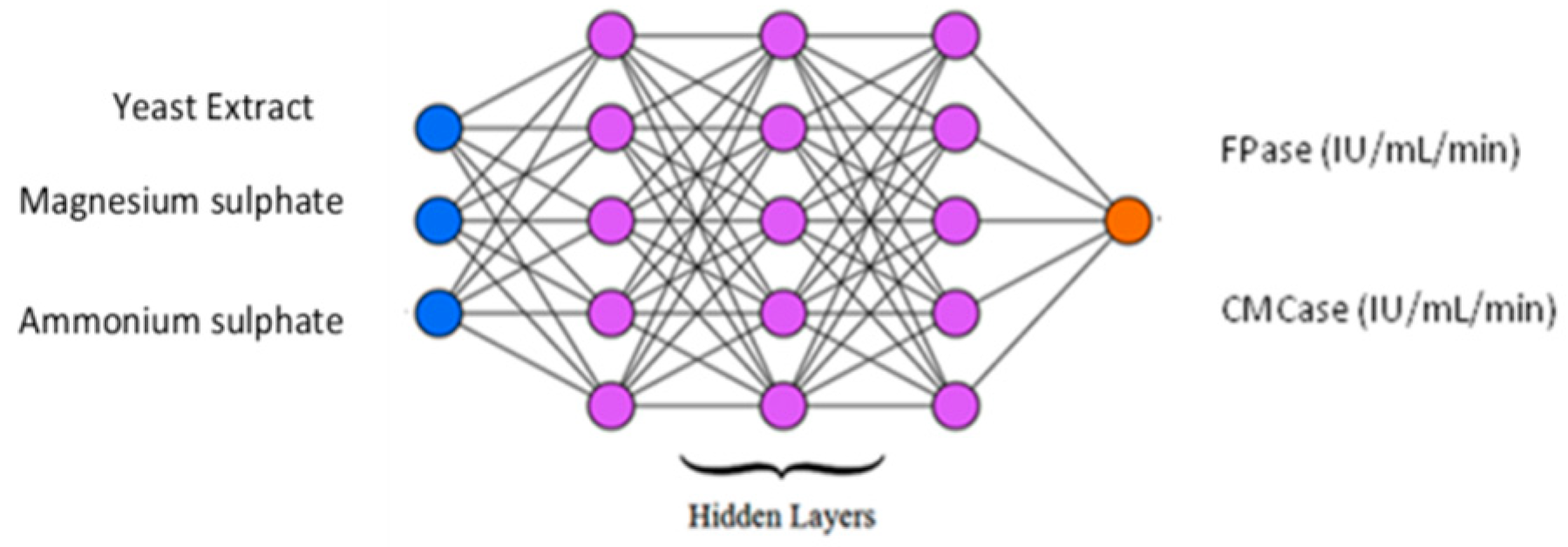
An ANN model was designed using the Neural Network Toolbox in MATLAB R2015a (The MathWorks Inc., Natick, MA, USA), to predict and optimize CMCase and FPase production. The network architecture consisted of three input variables (yeast extract, MgSO4, and (NH4)2SO4), one hidden layer, and one output layer (enzyme activity), corresponding to a (3–n − 1) topology. The optimal number of neurons in the hidden layer was determined iteratively by training multiple networks and selecting the configuration that minimized root mean square error (RMSE). The Levenberg–Marquardt backpropagation algorithm (trainlm) was used for training. The dataset was partitioned into training (70%), validation (15%), and test (15%) subsets. Model performance was evaluated using the coefficient of determination (R2) and RMSE. The ANN architecture is shown in Figure 1. In which Blue nodes show the input variables, purple nodes show the hidden layers (five neurons in each hidden layer), and orange node represent the output layer.
Figure 1.
ANN network architecture.
2.8. Enzyme Characterization
2.8.1. Effect of pH on Cellulase Activity
The effect of pH on cellulase activity was determined by incubating crude enzyme in appropriate buffers across a pH range of 4.0–11.0 (at 0.5-unit intervals) at 50 °C for 30 min. Residual activity was measured using the DNS (3.5-dinitrosalicylic acid) colorimetric method [59].
2.8.2. Effect of Temperature on Cellulase Activity and Thermostability
The effect of temperature on activity was assessed by incubating CMCase with 0.5 mL of 1% (w/v) carboxymethyl cellulose (CMC) prepared in 0.05 M sodium citrate buffer (pH 5.0), and FPase with 0.5 mL of 0.05 M sodium citrate buffer (pH 5.0), across a temperature range of 30–90 °C. Thermostability was evaluated by pre-incubating the enzyme at the same temperature range for a defined period, after which residual activity was measured under standard assay conditions.
2.8.3. Effect of Metals Ions on Cellulase Activity
The influence of metal ions (FeSO4, AlCl3, CaCl2, MgSO4, MnSO4, NaCl, and CuSO4) on cellulase activity was assessed at concentrations of 1, 3, and 5 mM. CMCase and FPase activities were measured using the standard DNS assay [59].
2.8.4. Effect of Surfactants and Organic Solvents on Cellulase Activity
The effects of surfactants (SDS and Triton X-100) and organic solvents (hexane, propanol, butanol, and ethanol) on enzyme activity were evaluated using the standard DNS assay [59].
2.8.5. Saccharification
Saccharification was performed in 500 mL Erlenmeyer flasks containing 100 mL of crude enzyme and 4% (w/v) P. alba leaf powder substrate, incubated at 50 °C for varying time intervals. Following hydrolysis, the reaction mixture was filtered through muslin cloth and centrifuged at 10,000× g for 10 min. The percentage saccharification was calculated using Equation (3) [43].
3. Results and Discussion
3.1. Effect of Inoculum Size on Cellulase Production
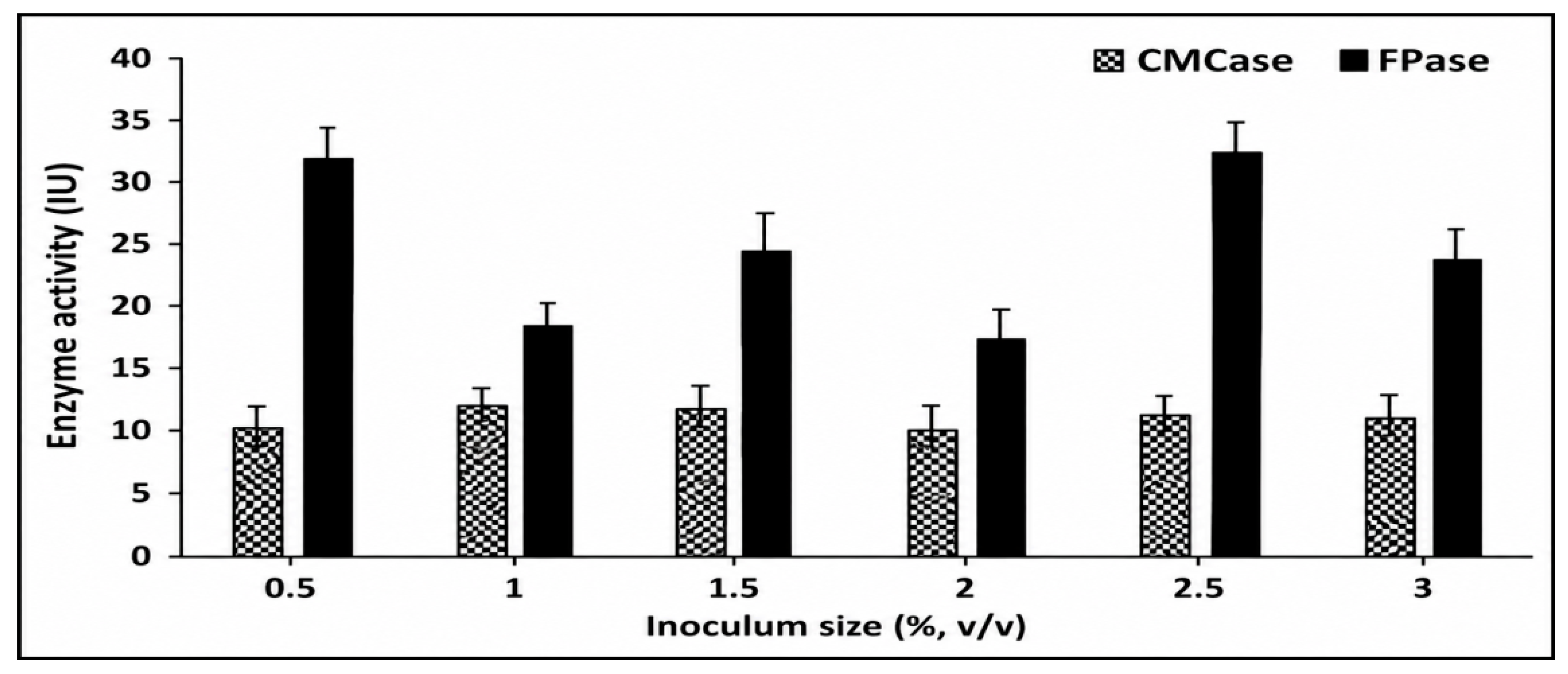
Inoculum size was optimized by evaluating concentrations of 0.5, 1.0, 1.5, 2.0, 2.5, and 3.0% (v/v). Maximum CMCase (13.09 IU/mL/min) and FPase (31.19 IU/mL/min) activities were achieved at inoculum sizes of 1.0% and 0.5%, respectively, while minimum enzyme production was observed at 2.5% (Figure 2). Enzyme yield declined progressively beyond the optimal inoculum concentration, likely due to the rapid depletion of nutrients and the accumulation of metabolic by-products under high-cell-density conditions, which impose substrate limitation and catabolite repression [60]. These results are consistent with previous reports of maximum cellulase production at 1% inoculum size in B. amyloliquefaciens and Bacillus megaterium under submerged fermentation conditions. Optimal inoculum sizes of 2% [61,62,63] and 5% have also been reported for other Bacillus strains, indicating that the optimal cell density for cellulase production is strain- and medium-dependent [19].
Figure 2.
Effect of inoculum size on CMCase and FPase activities produced by Bacillus paralicheniformis using Plumeria alba leaf powder as substrate under submerged fermentation conditions.
3.2. Effect of Substrate Concentration on Cellulase Production
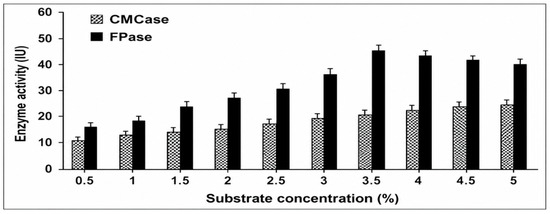
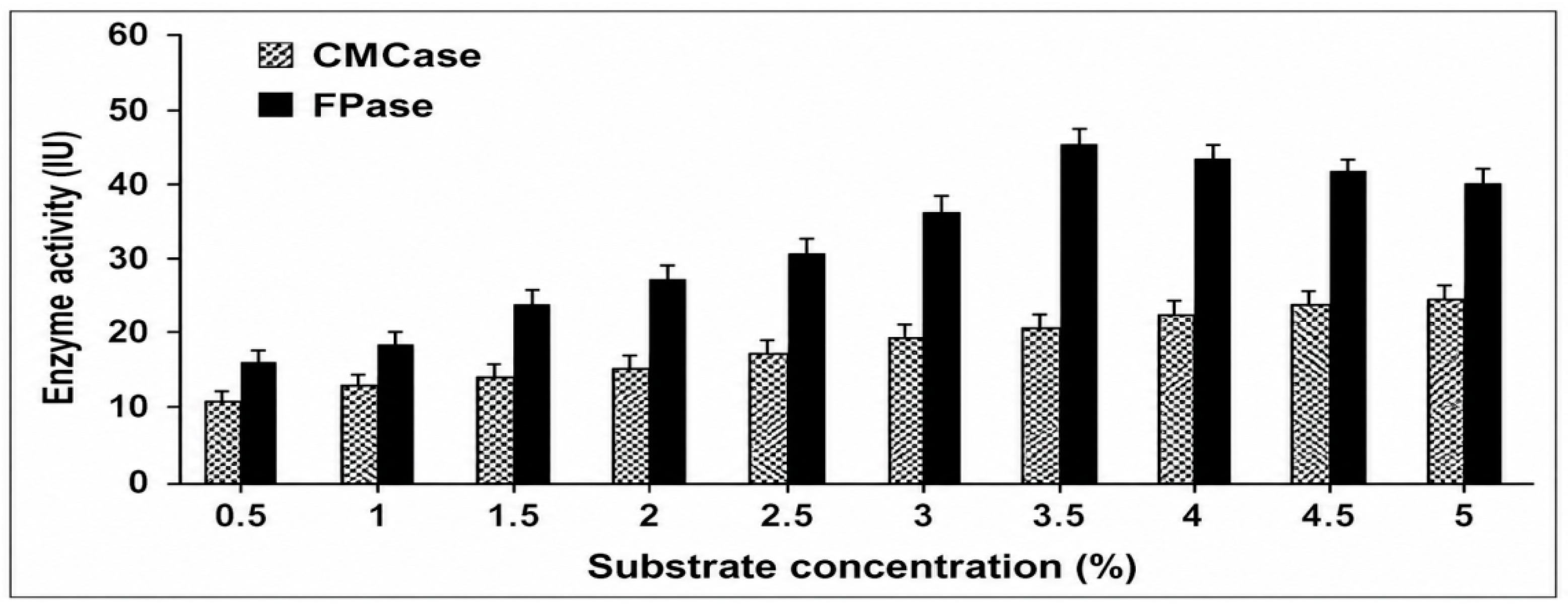
The effect of P. alba leaf powder concentration on cellulase production was evaluated across a range of 0.5–5.0% (w/v). Maximum CMCase (18.62 IU/mL/min) and FPase (46.61 IU/mL/min) activities were achieved at 4% (w/v) substrate, while minimum activities of 3.72 IU/mL/min (CMCase) and 11.44 IU/mL/min (FPase) were recorded at 0.5% substrate (Figure 3). Enzyme production declined at concentrations exceeding 4%, likely due to substrate inhibition of microbial growth and reduced mass transfer efficiency at elevated solid loadings [44]. These findings are consistent with previous reports of optimal cellulase production at 4% wastepaper substrate by Cellulomonas sp. TSU03 [64] and at 3% substrate by a newly isolated Cellulomonas sp. Lower optimal substrate concentrations have also been reported, including 2% wheat straw for Bacillus megaterium BM05 (yielding 0.716 ± 0.04 U/mL) [44], 2% rice hull [65] and 1% fruit pulp [2] for B. amyloliquefaciens, 1–2% wheat straw [66] for Aeromonas sp., and 0.5% cellobiose for Bacillus strain CTP-09, collectively indicating that optimal substrate concentration is substrate- and strain-specific [67].
Figure 3.
Effect of P. alba leaf powder concentration on CMCase and FPase activities produced by Bacillus paralicheniformis under submerged fermentation conditions.
3.3. CCD for CMCase and FPase Production by Bacillus paralicheniformis Under SMF
A CCD under RSM was employed to investigate the effects of three nutritional variables—yeast extract (A), MgSO4 (B), and (NH4)2SO4 (C)—on CMCase and FPase production. A total of 20 experimental runs were conducted, and the observed and predicted enzyme activities for each run are presented in Table S1. CMCase activity ranged from 41.03 to 60.53 IU/mL/min across all runs; Run 19 yielded the maximum CMCase activity (60.53 IU/mL/min), with a residual difference of 1.84 IU/mL/min between observed and predicted values. FPase activity ranged from 100.40 to 332.10 IU/mL/min; Run 6 yielded the maximum FPase activity (332.10 IU/mL/min), with a residual difference of 72.12 IU/mL/min, reflecting the sensitivity of FPase production to medium composition. The relationships between the independent variables and CMCase and FPase responses are described by the following second-order polynomial regression equations (Equations (4) and (5)):
CMCase IU/mL = 10.70 + 94.4A + 225.3B + 108.9C − 12.4A2 − 204B2 − 59.2C2 − 295.3AB − 127.0AC − 344.4BC
FPase IU/mL = 143.6 + 529A + 568B + 233C − 585A2 + 1233B2 − 124C2 − 1458AB − 270AC − 2418BC
3.4. Analysis of Variance (ANOVA) for CCD Models
The statistical significance of both regression models was assessed by ANOVA. The CMCase and FPase models were significant at p = 0.003 and p = 0.021, respectively (Table 2), confirming that the models adequately describe the relationship between the independent variables and enzyme production. The coefficient of determination (R2) was 85.95% and 78.25% for CMCase and FPase, respectively, indicating that the models accounted for most of the variability in the observed responses. The adjusted R2 values of 73.31% (CMCase) and 58.67% (FPase) further confirm model reliability, with the lower adjusted R2 for FPase suggesting greater unexplained variance, possibly attributable to uncontrolled environmental factors or additional interaction terms not included in the model. All linear terms (A, B, and C), quadratic terms (A2, B2, and C2), and interaction terms (A × B, A × C, and B × C) were statistically significant, indicating that both individual variable effects and their pairwise interactions are important determinants of cellulase production.
Table 2.
Analysis of variance (ANOVA) for CMCase and FPase production through B. paralicheniformis in SmF.
3.5. Interaction Effects of Process Variables: Response Surface and Contour Plot Analysis
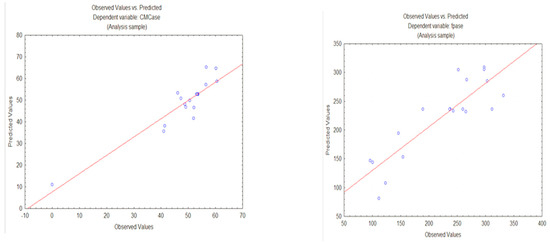
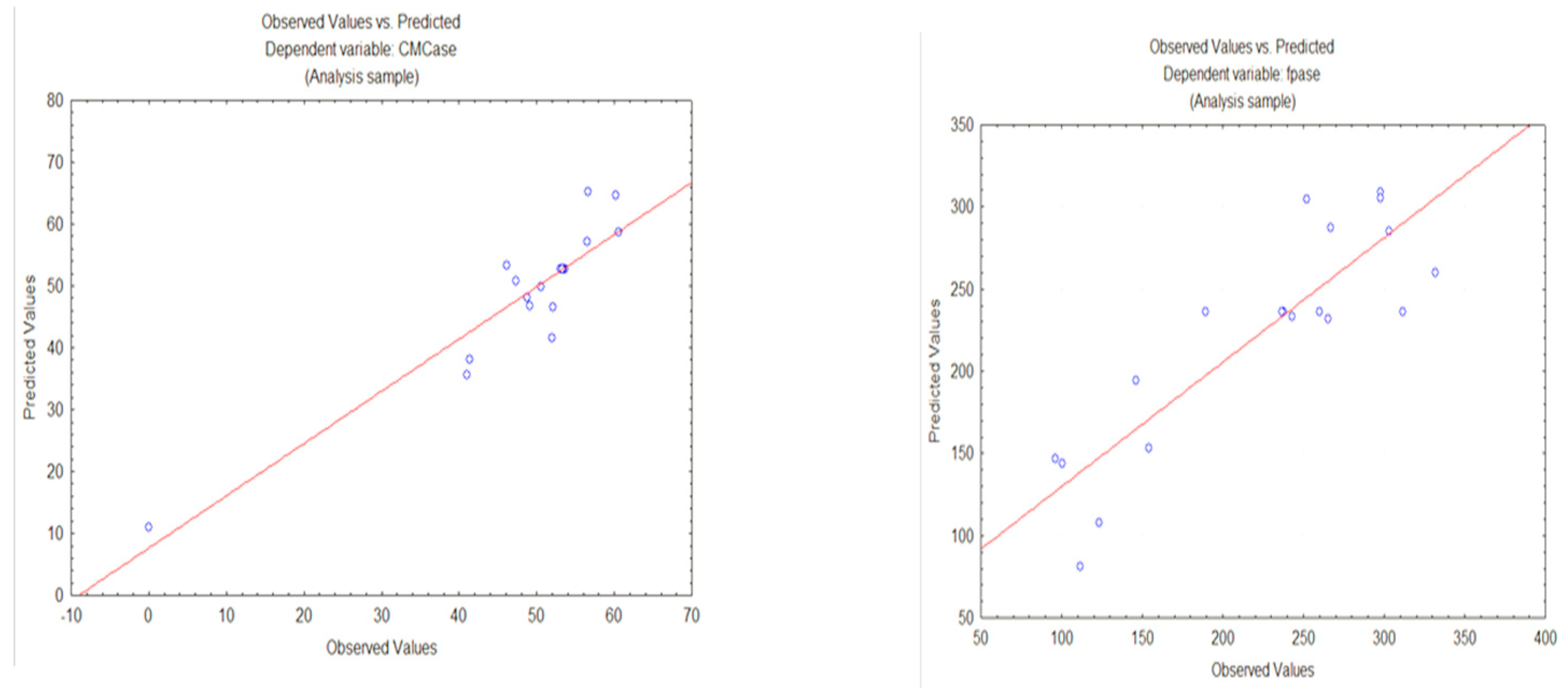
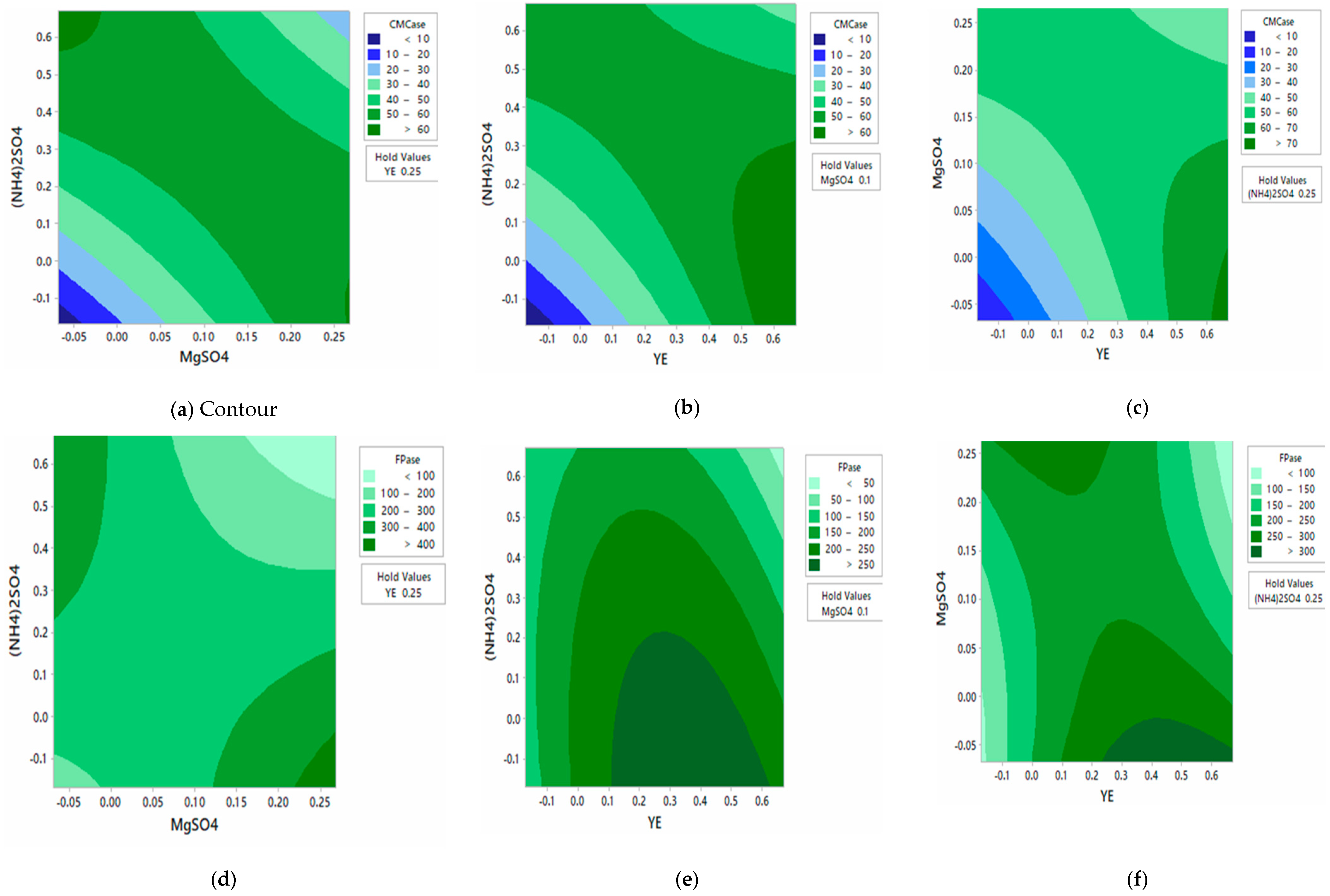
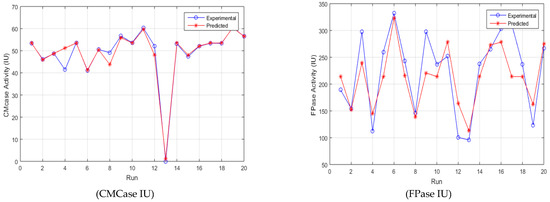
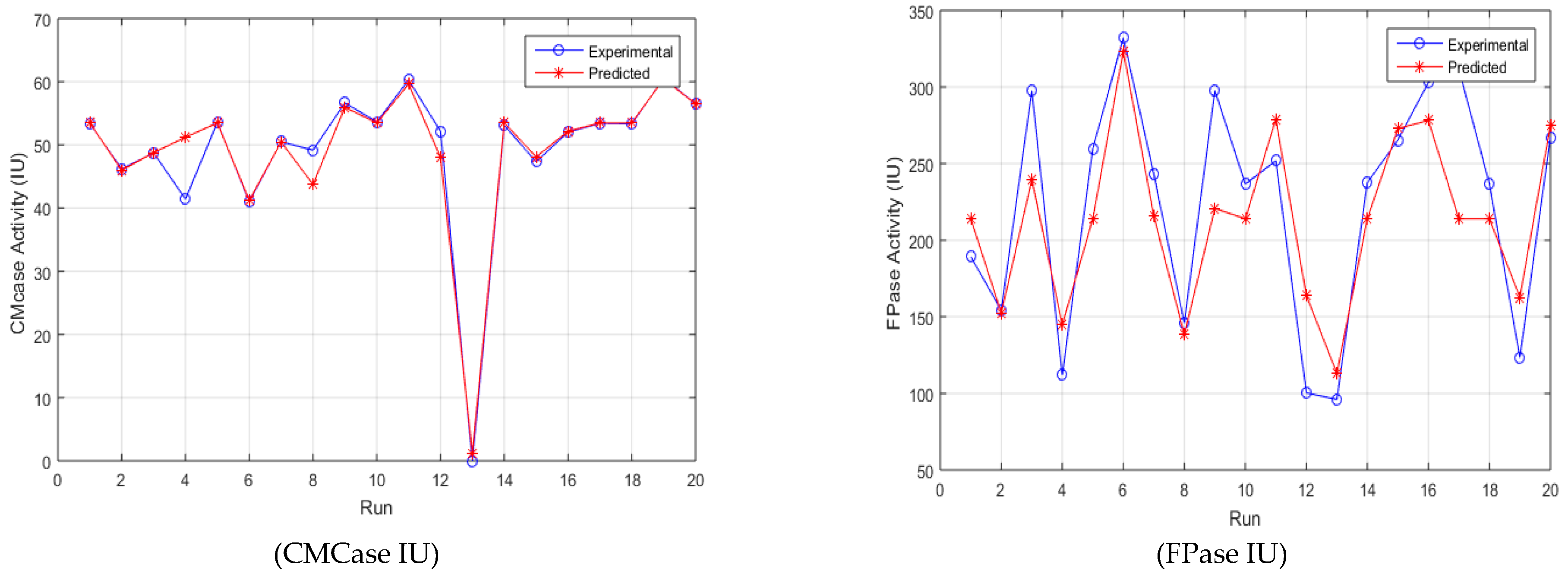
Response surface and contour plots were generated to visualize the pairwise interaction effects of the three independent variables on CMCase and FPase production. Observed and predicted value plots of CMCase (IU) and FPase (IU) shown in Figure 4. Clustering of blue circles around the 45° line predicts the agreement strength between observed and predicted values, circles closed to line show greater predictive performance between observed and predicted values as compared to points which are far away from line which indicate weaker predictions. For each contour plot, two variables were varied simultaneously, while the third was held at its central (zero-coded) level. The interactions examined were yeast extract (A) × MgSO4 (B), yeast extract (A) × (NH4)2SO4 (C), and MgSO4 (B) × (NH4)2SO4 (C). These plots enabled identification of the optimal variable combinations for maximum cellulase production, as shown in Figure 5.
Figure 4.
Observed values vs. predicted values of CMCase and FPase activities.
Figure 5.
Response surface contour plots explaining interrelating effects of (a) MgSO4 vs. (NH4)2SO4, (b) yeast extract vs. (NH4)2SO4 and (c) MgSO4 vs. yeast extract on CMCase and (d) MgSO4 vs. (NH4)2SO4, (e) yeast extract vs. (NH4)2SO4 and (f) MgSO4 vs. yeast extract on FPase production by Bacillus paralicheniformis by using Plumeria alba in submerged fermentation. The plot was made by keeping one variable constant.
3.6. Characterization of Cellulases
3.6.1. Effect of pH on Activity of Cellulases
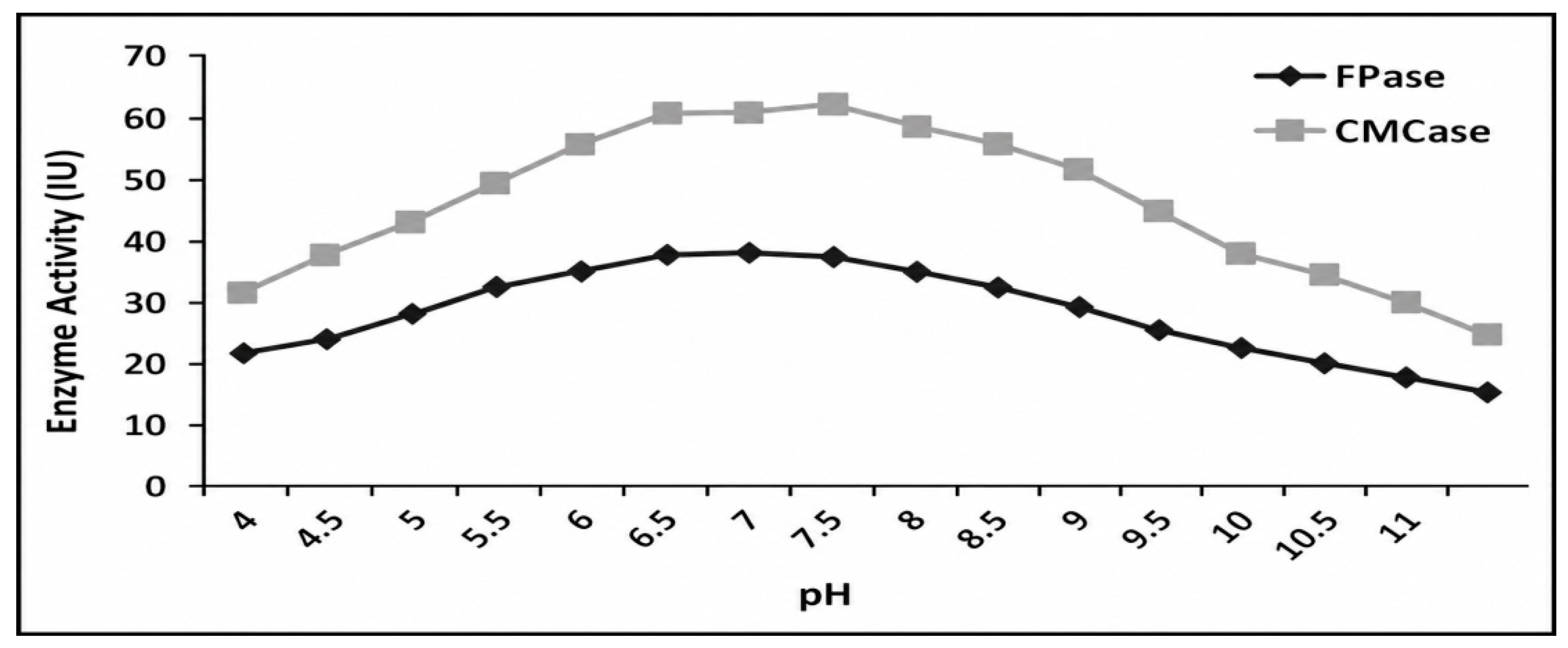
The effect of pH on cellulase activity was studied across a range of pH 4.0–11.0 using appropriate buffer systems. Maximum CMCase activity (19.99 IU/mL/min) and FPase activity (39.07 U/mL/min) were both observed at pH 7.5, while minimum CMCase (9.587 IU/mL/min) and FPase (14.98 IU/mL/min) were recorded at pH 11.0 (Figure 6). The enzyme retained activity across pH 7.0–11.0, with activity declining progressively beyond the optimum, consistent with denaturation of the active site at extreme pH values. The observed neutral-to-alkaline optimum is characteristic of Bacillus-derived cellulases and aligns with reports of optimal CMCase activity at pH 7.5 in Bacillus licheniformis and endoglucanase stability across pH 6.5–9.5 [17]. Similar neutral optima have been reported [68] for cellulases from B. subtilis M-11 (stable at pH 7.0–9.5) [69] and B. subtilis subsp. subtilis A-54 (optimum at pH 6.5 and stable at pH 6.5–8.0) [70], as well as for B. megaterium (peak activity at pH 6.5 and stable at pH 6.0–8.0) [44]. Lower pH optima have also been reported within the genus, including pH 5.0 for B. mycoides AR20-61 [71], pH 5.0 for B. subtilis subsp. JJBS300 CMCase, pH 5.0–6.5 for various Bacillus strains [72], and pH 9.2 for extracellular cellulase from B. subtilis, collectively demonstrating that optimal pH for Bacillus cellulases is strain-specific and spans a broad range from acidic to alkaline conditions [73].
Figure 6.
Effect of pH on CMCase and FPase activities by Bacillus paralicheniformis.
3.6.2. Effect of Temperature on Cellulase Activity and Thermostability
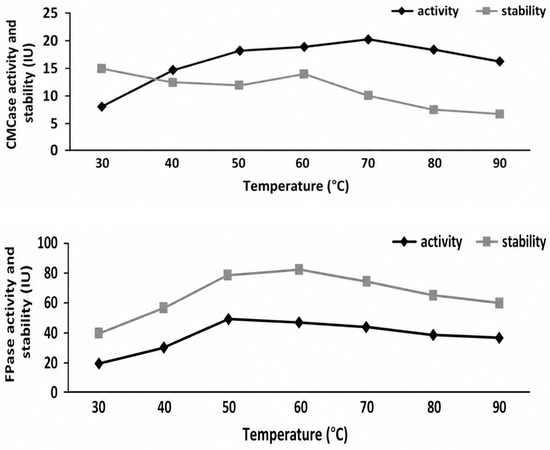
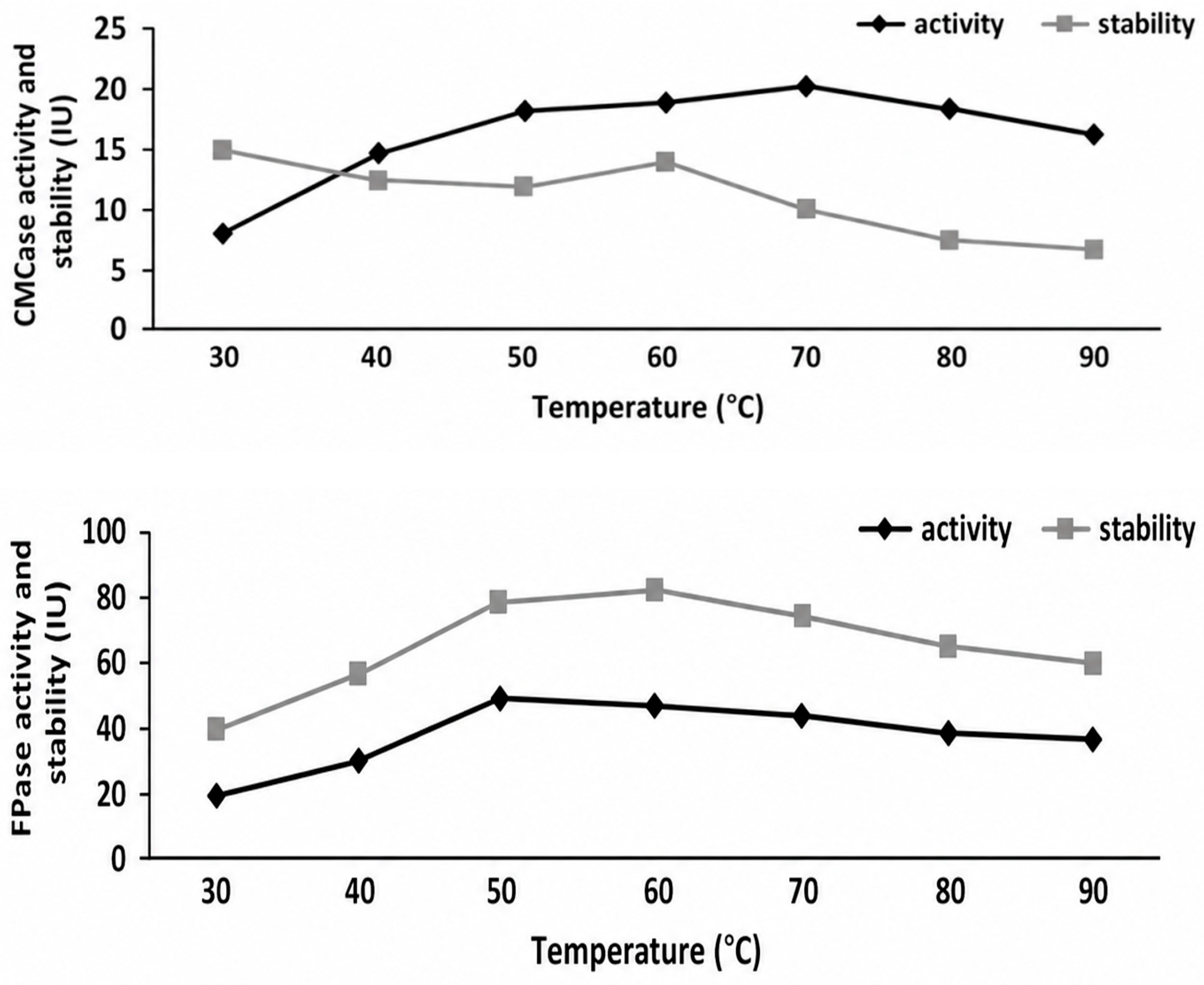
Maximum CMCase activity (19.58 IU/mL/min) and FPase activity (49.75 IU/mL/min) were recorded at 70 °C and 50 °C, while maximum thermostability of CMCase (15.88 IU/mL/min) and FPase (39.86 IU/mL/min) were estimated at 30 °C and 60 °C respectively (Figure 7). The difference in optimum activity and stability (70 °C vs. 30 °C) suggests that the enzyme achieves a peak catalytic turnover at high temperatures but prolonged exposure above 30 °C leads to progressive thermal denaturation. Moderate temperature optima have also been reported [68] for B. subtilis M-11 (stable at 25–60 °C), Bacillus licheniformis (optimum at 50 °C) [73], Bacillus sp. (optimum at 50 °C), and B. subtilis (stable at 20–45 °C) [74], while Bacillus strain CTP-09 exhibited exceptional thermostability at 80 °C [75]. Collectively, these indicate that thermal optima among Bacillus cellulases vary considerably by strain and enzyme type. This thermophilic activity of CMCase is consistent with reports of Bacillus-derived cellulases at elevated temperatures such as Bacillus sp. strain G4 (maximum activity at 60 °C and stable below 50 °C) and Bacillus licheniformis AU01 (optimum activity at 50 °C and retaining 80% activity at 80 °C) [76].
Figure 7.
Effect of temperature on CMCase and FPase activity and thermostability in Bacillus paralicheniformis.
3.6.3. Effect of Solvents and Surfactants on Cellulase Activity
The effect of organic solvents (ethanol, propanol, butanol, and hexane) and surfactants (SDS and Triton X-100) on CMCase and FPase activity were determined at 0.5% concentration (Table 3). Ethanol had the highest relative activity, with CMCase and FPase reaching 235.26% and 169.56% of control, respectively. This indicates that the enzyme is ethanol-tolerant. Butanol and SDS produced the lowest CMCase and FPase activities, respectively. Similar reports indicate that SDS inhibits cellulases from B. subtilis YJ1, Bacillus sp. strain G4 [77], and Bacillus licheniformis [78]. This is likely due to SDS-induced disruption of the enzyme’s hydrophobic core and active site architecture. Activation by Triton X-100 has been reported for cellulase from Bacillus sp. AC-1, though in the present study, Triton X-100 yielded intermediate activity (CMCase: 91.45%; FPase: 149.54%), suggesting surfactant effects are enzyme- and concentration-dependent [79].
Table 3.
Effect of solvents and surfactants on relative activity (%) of CMCase and FPase by Bacillus paralicheniformis.
3.6.4. Effect of Metal Ions on Cellulase Activity
The effects of seven metal ion supplements at concentrations of 1, 3 and 5% on CMCase and FPase activities are presented in Table 4. Maximum CMCase (185%) and FPase (273.3%) were obtained with 1% and 5% NaCl respectively. This shows that Na+ is a good activator of both enzyme components, which is consistent with reports of NaCl-mediated cellulase activation in Bacillus pumilus EWBCM1 [62] and B. subtilis subsp. JJBS300 [72]. Minimum CMCase (53.7%) and FPase (58.7%) activities were recorded with 1% MnSO4 and 3% CaCl2 respectively. FeSO4, AlCl3, MgSO4, and CuSO4 showed concentration-dependent activating effects on both CMCase and FPase. This is generally consistent with reports of Fe3+ and Mg2+ activation and Co2+/Mn2+ activation in B. subtilis YJ1 [77], while inhibitory effects of ZnCl2 on B. licheniformis cellulase and Cu2+ on Bacillus sp. have been attributed to coordination with catalytic residues at the enzyme active site [80,81].
Table 4.
Effect of different metal ion concentrations on relative activity (%) of CMCase and FPase from Bacillus paralicheniformis.
3.7. Saccharification of Plumeria alba by Crude Cellulase
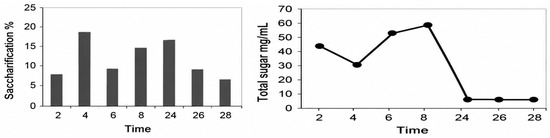
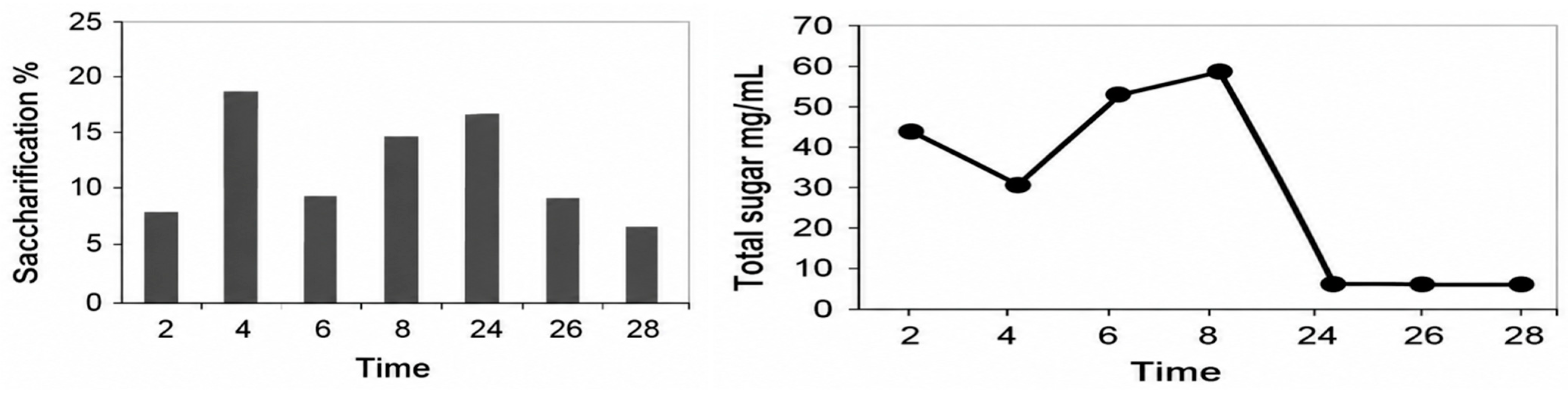
The saccharification potential of crude cellulase was evaluated using P. alba leaf powder as the substrate. The maximum saccharification (19.81%) was achieved after 4 h, while maximum total reducing sugar release (59.42 mg/mL) was observed at 8 h of incubation at 50 °C (Figure 8). The efficiency of saccharification decreased after 24 h, likely due to product inhibition of cellulase activity from accumulated glucose and cellobiose at extended incubation times. The noted decrease in reducing sugar concentration may be attributed to microbial uptake of released sugars for biomass formation, maintenance, growth, enzyme production, and other metabolic activities. These values agree with previously reported saccharification yields from Bacillus cellulases, including 11.45% from B. subtilis BS06 [43] and 54.39% from B. subtilis K-18 [48]. In terms of total sugar release, reported values range from 12.71 mg/mL (B. subtilis K-18, 24 h) [14], 0.74 mg/mL (pretreated substrate, B. subtilis, 53 h) [82], and 38.0 ± 0.23 mg/mL (B. paralicheniformis, 8 h) [83] to 31.42 mg/mL (B. cereus, 6 h at 50 °C) [52], indicating that the present enzyme’s saccharification performance is competitive within the Bacillus genus, though variability across studies reflects differences in substrate type, pretreatment, and assay conditions.
Figure 8.
Percentage saccharification and total reducing sugar yield (mg/mL) of Plumeria alba hydrolyzed by crude cellulase from Bacillus paralicheniformis at defined time intervals.
3.8. Artificial Neural Network (ANN) Modeling
An Artificial Neural Network (ANN) model was developed using experimental data collected from the RSM-CCD optimization process to predict CMCase and FPase production [84]. The model also tried to capture nonlinear relationships among the fermentation variables which may not be fully described by the second-order polynomial RSM model. For CMCase (Figure S2), regression plots, error histograms, and training state plots confirmed strong agreement between observed and predicted values across all data subsets. The R2 value of 0.9524 and RMSE of 2.6928 IU/mL indicate that the ANN model accurately describes the relationship between the nutritional variables and CMCase production (Table 5). Key training performance metrics included a final MSE of 4.62 × 10⁻⁶, the best validation MSE of 1.68 × 10⁻², the best test MSE of 3.50 × 10⁻², and convergence at epoch 9 of 12 total epochs using the Levenberg–Marquardt (trainlm) algorithm [85,86].
Table 5.
Comparative predictive performance of MLP, RBF, and GRNN models on CMCase and FPase production.
For FPase (Figure S3), the ANN model yielded an R2 of 0.7033 and an RMSE of 40.30 IU/mL, reflecting greater variability in FPase prediction, consistent with the lower adjusted R2 observed for FPase in the RSM model (Section 3.4). The training MSE was 7.02 × 10⁻², the best validation MSE was 3.42 × 10⁻¹, the best test MSE was 1.07 × 10⁻¹, and the model converged at epoch 2 of eight total epochs. The lower predictive accuracy for FPase suggests that additional variables or a larger training dataset may be required to fully capture the complexity of FPase production dynamics. Observed vs. predicted values for both enzymes are presented in Figure 9, and best validation performance plots are shown in Figure S4. The regression plots for CMCase (Figure S2a) and FPase (Figure S3a) demonstrate excellent predictive performance across all three data partitions. The 70% of CCD data allocated for training effectively captured the nonlinear relationships governing enzyme production, as reflected in the high training R values for both responses. Similarly, the 15% of data reserved for testing yielded well-optimized predictions, confirming that the trained model generalizes reliably to unseen data points. The low mean square error (MSE) values observed across the training, validation, and test phases collectively affirm the robustness and statistical acceptability of the ANN model [87]. The mild overfitting observed in the validation performance plots is attributable to the relatively small size of the experimental dataset [88]. This is a common limitation when CCD-generated data are used as ANN inputs and does not meaningfully compromise model utility. The error histogram further supports model integrity, with most prediction errors concentrated near zero, indicating minimal systematic bias and high prediction accuracy in the model outputs. Overall, these diagnostic metrics confirm that the ANN model trained on CCD-derived data constitutes a reliable and well-fitted tool for predicting cellulase activity under the fermentation conditions examined in this study.
Figure 9.
Observed vs. predicted values for CMCase and FPase activities generated by the ANN model.
Comparative Evaluation of ANN Architectures (RBF, MLP and GRNN)
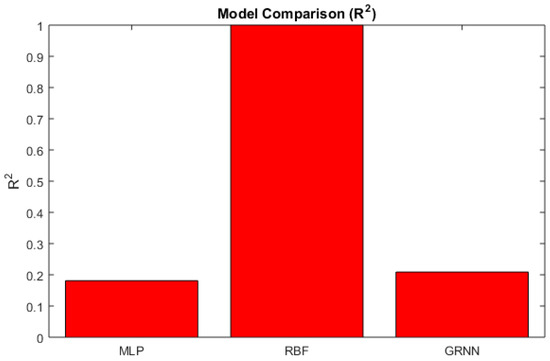
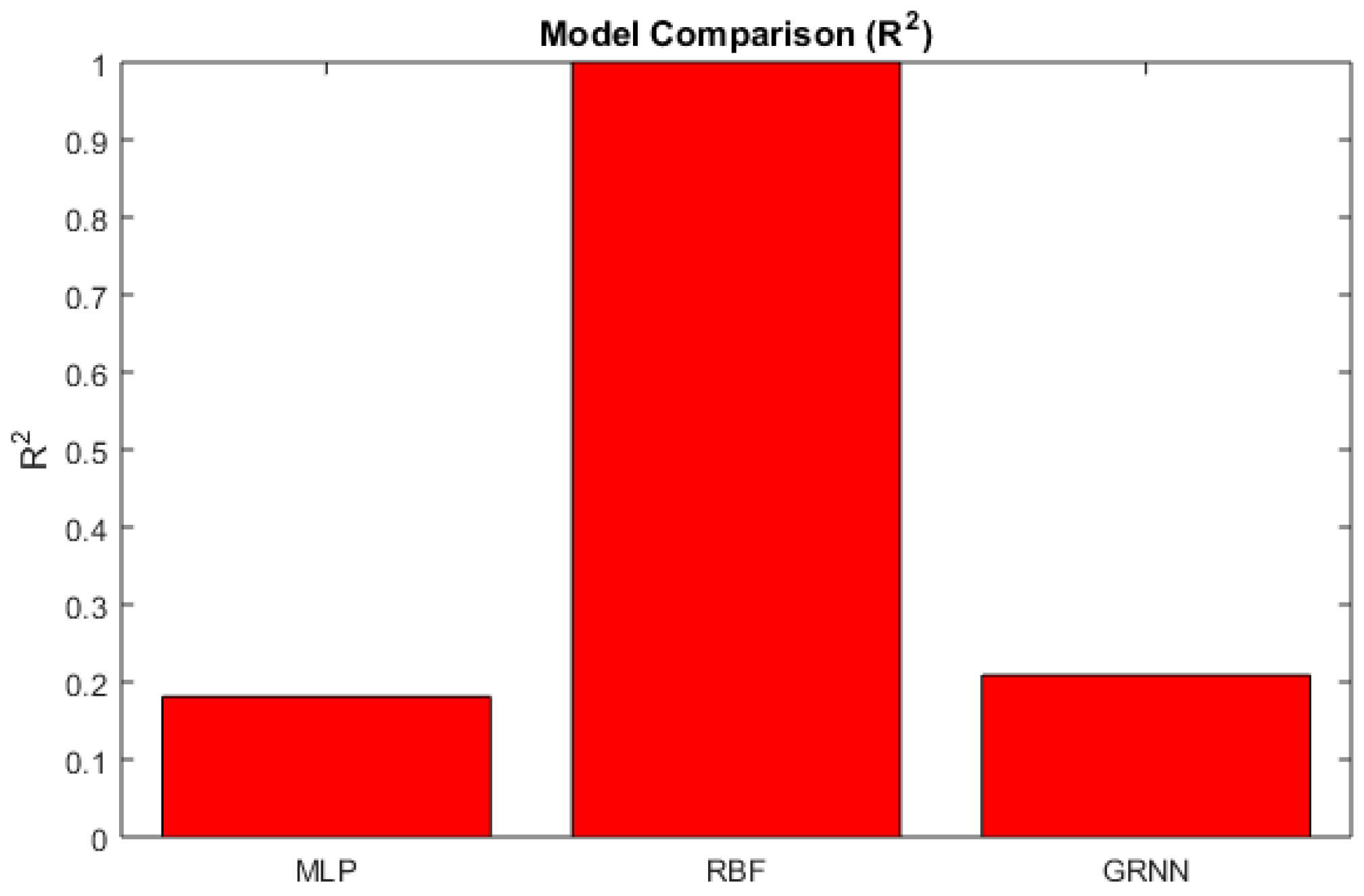
Three ANN architectures, multilayer perceptron (MLP), radial basis function network (RBF), and generalized regression neural network (GRNN), were compared in their ability to predict CMCase and FPase production from the CCD dataset [89] (Figure 10; Table 5). The RBF model substantially outperformed both MLP and GRNN, achieving an R2 of 0.99994, an RMSE of 0.00162, and an MAE of 0.000683, compared with R2 values of 0.181 (MLP) and 0.209 (GRNN). The superior performance of RBF is consistent with its known advantage in approximating complex, localized nonlinear input–output relationships through Gaussian radial basis functions, making it particularly well suited for small, structured datasets such as those generated by a CCD [90]. Regression plots and error histograms for all three architectures are presented in Figure S5, further confirming the superior fit of the RBF model to the CCD experimental data.
Figure 10.
Comparison of R2 values for MLP, RBF, and GRNN models for CMCase and FPase prediction.
4. Conclusions
Bacillus paralicheniformis showed strong cellulolytic activity when cultivated on Plumeria alba leaf powder as a sole carbon source under submerged fermentation conditions, yielding maximum CMCase and FPase activities under RSM-optimized nutritional parameters. A central composite design under RSM identified optimal combinations of yeast extract, MgSO4, and (NH4)2SO4. ANN modeling, particularly the RBF architecture (R2 = 99.99%), outperforming RSM (R2 = 85.95% and 78.25% for CMCase and FPase, respectively), and confirming the ANN’s superior capacity to capture nonlinear variable interactions. Enzyme characterization revealed a neutral-to-alkaline pH optimum (7.5), broad thermostability, activation by ethanol and NaCl, and a saccharification efficiency of 19.81% with 59.42 mg/mL total reducing sugars released from P. alba substrate. This supports its potential for lignocellulosic biomass conversion. This study makes two novel contributions: the first documented use of P. alba leaf powder as a low-cost lignocellulosic substrate for B. paralicheniformis cellulase production and a rigorous comparative validation establishing the ANN as the preferred optimization framework. It also offers a scalable, cost-effective strategy for industrial cellulase production and biorefinery applications.
Supplementary Materials
The following supporting information can be downloaded at: https://www.mdpi.com/article/10.3390/fermentation12070312/s1, Figure S1. Desirability plots for predicted optimal levels of yeast extract (A), MgSO4 (B), and (NH4)2SO4 (C) maximizing CMCase (top) and FPase (bottom) activities produced by Bacillus paralicheniformis using Plumeria alba as substrate under submerged fermentation conditions; Figure S2: (a) ANN model performance on CMCase activity prediction: (a) regression plots showing the fit between observed and predicted values across training, validation, testing, and all data subsets; (b) error histogram; and (c) training state plot; Figure S3: ANN model performance on FPase activity prediction: (a) regression plots showing the fit between observed and predicted values across training, validation, testing, and all data subsets; (b) error histogram; and (c) training state plot; Figure S4: Plots of best validation performance for CMCase and FPase ANN models; Figure S5: Regression plots and error histograms for MLP, GRNN, and RBF network architectures; Table S1: CCD matrix with observed and predicted CMCase and FPase activities produced by Bacillus paralicheniformis using Plumeria alba as substrate under submerged fermentation conditions.
Author Contributions
Conceptualization, M.I. and E.A.-O.; methodology, J.B.; software, M.Z.A.; validation, T.H.K., and I.H.; investigation, J.B. and M.Z.A.; data curation, J.B.; writing—original draft preparation, J.B.; writing—review and editing, M.I. and E.A.-O.; supervision, M.I.; project administration, M.I. and E.A.-O. All authors have read and agreed to the published version of the manuscript.
Funding
This research received no external funding.
Institutional Review Board Statement
Not applicable.
Informed Consent Statement
Not applicable.
Data Availability Statement
Data can be made available upon request.
Acknowledgments
During the preparation of this manuscript, the authors used Perplexity AI for grammar revision and language editing. The authors have reviewed and edited the output and take full responsibility for the content of this publication.
Conflicts of Interest
The authors declare no conflicts of interest.
Abbreviations
The following abbreviations are used in this manuscript:
| RSM | Response Surface Methodology |
| OFAT | One Factor At a Time |
| CCD | Central Composite Design |
| ANN | Artificial Neural Network |
| CMCase | Carboxymethyl Cellulase |
References
- Goswami, T.; Satya, P.; Sharma, L.; Roy, S.; Kar, G.; Singh, A.K.; Dutta, G. Comparative analysis of microbial saccharification and enzymatic hydrolysis of lignocellulosic biomass under optimal process conditions using Aspergillus fumigatus and Trichoderma reesei cultured on agro-waste. Biomass Bioenergy 2026, 215, 109612. [Google Scholar] [CrossRef] [Scilit]
- Lilaria, K.; Tiwari, S.; Jadhav, S.K. Comparative RSM–ML analysis to predict cellulase production from Lysinibacillus capsici isolate using banana pseudostem as a sustainable substrate. Int. J. Biol. Macromol. 2026, 368, 152665. [Google Scholar] [CrossRef] [Scilit] [PubMed]
- Yang, H.; Zhu, L.; Li, W.; Tang, Y.; Li, X.; Xu, T.; Liu, K.; Si, C. Lignocellulose-Mediated Gel Polymer Electrolytes Toward Next-Generation Energy Storage. Nano-Micro Lett. 2026, 18, 84. [Google Scholar] [CrossRef] [Scilit]
- Hlaing, M.M.; Sofeo, N.; Wollborn, D.; Terefe, N.S.; Sana, B. Enzymatic and microbial valorization of lignocellulosic biomass for food applications. Sustain. Food Technol. 2026, 4, 2475–2503. [Google Scholar] [CrossRef] [Scilit]
- Zhuang, H.; Yang, Y.S.; Liu, X.; Zhou, T.; Xu, L.; Leu, S.Y. From waste to resource: Cellulose recovery and application in wastewater treatment. In High-Value Bioenergy Recovery from Wastewater; Woodhead Publishing: Cambridge, MA, USA, 2026; pp. 207–233. [Google Scholar]
- Bandyopadhaya, S.; Bera, D. Feasible and Cost-Effective Approaches for the Conversion of Biomass Wastes into Value-Added Products. Convers. Util. Wastes Sustain. Prod. 2026, 1, 567–601. [Google Scholar] [CrossRef] [Scilit]
- Narayanaperumal, S.; Suyambulingam, I.; Divakaran, D.; Senthamaraikannan, P.; Selvan, A.; Avudaiappan, S.; Ayrilmis, N. A Critical Review on Green Conversion Techniques of Biomass Waste to Value-Added Bioproducts: Advances, Challenges, and Future Technological Strategies. GCB Bioenergy 2026, 18, e70118. [Google Scholar] [CrossRef] [Scilit]
- Shao, S.; Hirschbiegel, C.M.; Allan, E.F.; Somerville, S.V.; Gooding, J.J.; Rotello, V.M.; Xia, X. Can nanozymes achieve more than enzymes? Nat. Rev. Mater. 2026, 11, 413–429. [Google Scholar] [CrossRef] [Scilit] [PubMed]
- Farhan, M.; Hasani, I.W.; Khafaga, D.S.R.; Ragab, W.M.; Kazi, R.N.A.; Aatif, M.; Muteeb, G.; Fahim, Y.A. Enzymes as catalysts in industrial biocatalysis: Advances in engineering, applications, and sustainable integration. Catalysts 2025, 15, 891. [Google Scholar] [CrossRef] [Scilit]
- Baghmare, P.; Namdeo, A.; Thakur, V.; Kumar, P.; Verma, J.S.; Geed, S.R. Advancements in lignocellulolytic multienzyme bioprocesses for sustainable biofuels and biochemicals: Strategies, innovations, and future prospects. Biomass Convers. Biorefinery 2025, 15, 28789–28820. [Google Scholar]
- Saharan, V.; Tushir, S.; Yadav, M.; Dhaka, N.; Kapoor, R.K. Optimization of Cellulase Enzyme System for Lignocellulosic Biomass Hydrolysis: Challenges and Future Perspectives. In Lignocellulosic Biomass and Enzymes: Fundamentals, Emerging Technologies and Applications; Springer: Singapore, 2025; pp. 127–154. [Google Scholar]
- Dasari, D.; Manyapu, V.; Mandpe, A. Advancements in biomass degradation: The role of cross-linked endocellulase in agroindustrial waste processing. In Environmental Engineering and Waste Management: Recent Trends and Perspectives; Springer Nature: Cham, Switzerland, 2024; pp. 499–538. [Google Scholar]
- Raheja, Y.; Islam, T.; Gaur, V.K.; Singh, C.B. Enzymatic Hydrolysis: A Key Process. In Biofuels; CRC Press: Boca Raton, FL, USA, 2025; pp. 99–123. [Google Scholar]
- Ghazanfar, M.; Irfan, M.; Tabssum, F.; Shakir, H.A.; Qazi, J.I. Effect of different pretreatment conditions on Saccharum spontaneum for cellulase production by B. subtilis K-18 through Box–Bhenken design. Iran. J. Sci. Technol. Trans. A Sci. 2018, 42, 313–320. [Google Scholar] [CrossRef] [Scilit]
- Khan, M.F. Recent advances in microbial enzyme applications for sustainable textile processing and waste management. Sci 2025, 7, 46. [Google Scholar] [CrossRef] [Scilit]
- Maitra, S.; Pal, P.; Agrawal, D.; Tripathi, A.; Hoque, M.; Rajeswari, G.; Jacob, S. Consolidated bioprocessing of sugarcane bagasse using compost derived microbial consortium for butanol production. Indian Chem. Eng. 2025, 67, 936–952. [Google Scholar] [CrossRef] [Scilit]
- Korsa, G.; Bekele, G.K.; Beyene, A.; Alemu, D.; Meka, A.F.; Tibebu, S.; Gutema, B.T.; Ayele, A. Microbial fuel cells for sustainable biofuel production: Cutting-edge technology. Green Energy Environ. Technol. 2025, 4, 1–89. [Google Scholar] [CrossRef] [Scilit]
- Digel, I.; Kistaubayeva, A.; Savitskaya, I.; Akimbekov, N.S. Biological Agents as Potential Resources of Biotechnological Production. In Introduction to Industrial Biotechnology; Springer Nature: Cham, Switzerland, 2025; pp. 1–50. [Google Scholar]
- Jatoi, A.S. Xylanase Production Techniques. In Xylanase from Microorganisms: Trends and Future; Springer: Singapore, 2025; pp. 35–66. [Google Scholar]
- Acharya, S.; Chaudhary, A. Optimization of fermentation conditions for cellulases production by Bacillus licheniformis MVS1 and Bacillus sp. MVS3 isolated from Indian hot spring. Braz. Arch. Biol. Technol. 2012, 55, 497–503. [Google Scholar] [CrossRef] [Scilit]
- Nguyen, V.M.L.; Ndao, A.; Peterson, E.C.; Blais, J.F.; Adjallé, K. Bacillus species: Evolving roles in bio-based detergents. Processes 2025, 13, 1885. [Google Scholar] [CrossRef] [Scilit]
- Gaur, R.; Tiwari, S. Isolation, production, purification and characterization of an organic-solvent-thermostable alkalophilic cellulase from Bacillus vallismortis RG-07. BMC Biotechnol. 2015, 15, 19. [Google Scholar] [CrossRef] [Scilit] [PubMed]
- Maravi, P.; Kumar, A. Isolation, screening and identification of cellulolytic bacteria from soil. Biotechnol. J. Int. 2020, 24, 1–8. [Google Scholar] [CrossRef] [Scilit]
- Kour, D.; Sharma, B.; Kaur, T.; Kaur, S.; Alqahtani, A.M.S.; Khan, S.S.; Jan, T.; Kadasah, S.F.; Singh, S.; Maithini, D. Extremozymes: Unlocking potential of extreme environments for sustainable biotechnology. Syst. Microbiol. Biomanuf. 2025, 5, 915–947. [Google Scholar] [CrossRef] [Scilit]
- Miloudi-Agha, L.; Kebdani, M. Mechanisms Underpinning the Biocontrol Potential of Halophilic and Halotolerant Bacillus Species Against Fusarium and Other Fungal Phytopathogens: An Eco-Friendly Alternative for Sustainable Agriculture. Bacteria 2026, 5, 16. [Google Scholar] [CrossRef] [Scilit]
- Oke, M.A.; Annuar, M.S.M.; Simarani, K. Enhanced endoglucanase production by Bacillus aerius on mixed lignocellulosic substrates. BioResources 2016, 11, 5854–5869. [Google Scholar] [CrossRef] [Scilit]
- Zadorozhny, A.V.; Slynko, N.M.; Bannikova, S.V.; Bogacheva, N.V.; Shlyakhtun, V.N.; Vasilieva, A.R.; Bukatich, E.Y.; Ushakov, V.S.; Uvarova, Y.E.; Korzhuk, A.V.; et al. Cellulases: Key properties, natural sources, and industrial applications. Vavilov J. Genet. Breed. 2025, 25, 1348. [Google Scholar]
- Chatterjee, A.; Chakroborty, S.; Kumar Patel, A.; Singhania, R.R. Unraveling Cellulase Complexes: Innovations and Applications. In Enzymes Applied in Biofuels Production: New Technologies and Innovation; Springer Nature: Cham, Switzerland, 2025; pp. 43–73. [Google Scholar]
- Badoni, V.; Rana, G.S.; Dubey, A.; Verma, A.K. β-Glucosidase production and its applications. Microb. Enzym. Prod. Purif. Ind. Appl. 2025, 2, 437–476. [Google Scholar]
- Santra, H.K.; Banerjee, D. Actinobacteria’s role in plant defense and their effectiveness as biocontrol agents against plant pathogens. In Elicitors for Sustainable Crop Production: Overcoming Biotic Stress Challenges in Plants; Springer Nature: Singapore, 2025; pp. 63–101. [Google Scholar]
- Utami, S.; Winarni, I.; Kurniawati, H.; Pratomo, H.; Supardi, S. Diversity of cellulolytic bacteria from mangroves in Blanakan, West Java, Indonesia. Aquac. Aquar. Conserv. Legis. 2025, 18, 126–137. [Google Scholar]
- Karimi, F.; Mazaheri, D.; Saei Moghaddam, M.; Mataei Moghaddam, A.; Sanati, A.L.; Orooji, Y. Solid-state fermentation as an alternative technology for cost-effective production of bioethanol as useful renewable energy: A review. Biomass Convers. Biorefinery 2025, 15, 29523–29539. [Google Scholar]
- Sharma, V.; Nargotra, P.; Patel, A.K.; Singhania, R.R. Solid-State Fermentation as a Sustainable Bioprocessing Approach. In Microbial Fermentation: Innovations, Challenges, and Future Directions; Springer Nature: Cham, Switzerland, 2026; pp. 139–165. [Google Scholar]
- Shoukat, K.; Ahmad, I.; Shakir, H.A.; Khan, M.; Franco, M.; Irfan, M. Production, optimization and characterization of cellulase produced from Aspergillus niger in submerged fermentation through response surface methodology. J. Microbiol. Methods 2025, 240, 107357. [Google Scholar] [CrossRef] [Scilit] [PubMed]
- Mahima Rani, V.; Vishal, K.; Doharey, P.K.; Tanveer, A.; Yadav, P.K.; Yadav, D. Fungal cellulases: A comprehensive review on production, innovations, and applications. Arch. Microbiol. 2026, 208, 291. [Google Scholar] [CrossRef] [Scilit] [PubMed]
- Zhang, Y.; Ishikawa, M.; Jiang, N.; Zhang, X. Fermentation-Based Strategies for the Feed Industry: Nutritional Augmentation, Environmental Sustainability. Fermentation 2026, 12, 103. [Google Scholar] [CrossRef] [Scilit]
- Gangakhedkar, P.S.; Deshpande, H.W.; Törős, G.; El-Ramady, H.; Elsakhawy, T.; Abdalla, N.; Shaikh, A.; Kovács, B.; Mane, R.; Prokisch, J. Fermentation of fruits and vegetables: Bridging traditional wisdom and modern science for food preservation and nutritional value improvements. Foods 2025, 14, 2155. [Google Scholar] [CrossRef] [Scilit] [PubMed]
- Malminen, V. Downstream Operations in Precision Fermentation in the Food Industry. Bachelor’s Thesis, Lappeenranta-Lahti University of Technology LUT, Lappeenranta, Finland, 2025. [Google Scholar]
- Biswas, S.; Saber, M.; Tripty, I.A.; Karim, M.; Islam, M.; Hasan, M.; Kabir, I. Molecular characterization of cellulolytic (endo-and exoglucanase) bacteria from the largest mangrove forest (Sundarbans), Bangladesh. Ann. Microbiol. 2020, 70, 68. [Google Scholar] [CrossRef] [Scilit]
- Korpole, S.; Sharma, R.; Verma, D. Characterization and phylogenetic diversity of carboxymethyl cellulase producing Bacillus species from a landfill ecosystem. Indian J. Microbiol. 2011, 51, 531–535. [Google Scholar] [CrossRef] [Scilit] [PubMed]
- Deka, D.; Bhargavi, P.; Sharma, A.; Goyal, D.; Jawed, M.; Goyal, A. Enhancement of cellulase activity from a new strain of Bacillus subtilis by medium optimization and analysis with various cellulosic substrates. Enzym. Res. 2011, 2011, 151656. [Google Scholar] [CrossRef] [Scilit] [PubMed]
- Chukwuma, O.B.; Rafatullah, M.; Kapoor, R.T.; Tajarudin, H.A.; Ismail, N.; Alam, M.; Siddiqui, M.R. Optimization and comparative study of Bacillus consortia for cellulolytic potential and cellulase enzyme activity. Open Life Sci. 2025, 20, 20251066. [Google Scholar] [CrossRef] [Scilit] [PubMed]
- Mohsin Arshad, M.I.; Asad-Ur-Rehman, M.N.; Zile Huma, H.A.S. Optimization of medium substrate for CMCase production by Bacillus subtilis-BS06 in submerged fermentation and its application in saccharification. Punjab Univ. J. Zool. 2017, 32, 179–188. [Google Scholar]
- Shahid, Z.H.; Irfan, M.; Nadeem, M.; Syed, Q.; Qazi, J.I. Production, purification, and characterization of carboxymethyl cellulase from novel strain Bacillus megaterium. Environ. Prog. Sustain. Energy 2016, 35, 1741–1749. [Google Scholar] [CrossRef] [Scilit]
- Myeong, S.; Lee, Y.Y.; Yun, J. Optimization and bioreactor scale-up of cellulase production in Trichoderma sp. KMF006 for higher yield and performance. Int. J. Mol. Sci. 2025, 26, 3731. [Google Scholar] [CrossRef] [Scilit] [PubMed]
- Abu-Elghait, M.; Soliman, M.K.; Azab, M.S.; Salem, S.S. Response surface methodology: Optimization of myco-synthesized gold and silver nanoparticles by Trichoderma saturnisporum. Biomass Convers. Biorefinery 2025, 15, 4211–4224. [Google Scholar]
- Ayele, G.; Admassu, H.; Mosisa, G.; Desalegn, A.; Abeje, M. Fermentation Strategies for Enhanced Bioconversion of Fruit Waste into Single-Cell Protein: A Review of Optimization Approaches Using Response Surface Methodology. J. Food Process Eng. 2026, 49, e70638. [Google Scholar]
- Strumolo, M.J.; Sun, Z.; Larimojarad, I.; Kapadia, R.; Brutchey, R.L. Data Driven Control of Defect Formation in Solution Deposited Sb2Se3 Thin Films. Adv. Mater. Interfaces 2025, 12, e00798. [Google Scholar] [CrossRef] [Scilit]
- Costa, N.T.; Cunha, D.M.; Katsoukis, G.; Flapper, J.; Mul, G. Structure–Reactivity Insights from Design of Experiments: Facet Orientation of SrTiO3 Determines the Impact of Humidity and Light Intensity on the Photocatalytic Gas-Phase Oxidation of Acetone. ACS ES&T Eng. 2026, 6, 1509–1519. [Google Scholar]
- Chellapandi, T.; Sudharsan, S.; Elamathi, M. Optimization strategies for norfloxacin photocatalytic degradation using response surface methodology and artificial neural network: A review. Chem. Pap. 2025, 79, 5609–5624. [Google Scholar] [CrossRef] [Scilit]
- Hangri, S.; Derbal, K.; Benalia, A.; Policastro, G.; Panico, A.; Pizzi, A. Enhancing Biomethane Yield from Microalgal Biomass via Enzymatic Hydrolysis: Optimization and Predictive Modeling Using RSM Approach. Processes 2025, 13, 2086. [Google Scholar] [CrossRef] [Scilit]
- Tabssum, F.; Irfan, M.; Shakir, H.A.; Qazi, J.I. RSM based optimization of nutritional conditions for cellulase mediated saccharification by Bacillus cereus. J. Biol. Eng. 2018, 12, 7. [Google Scholar] [CrossRef] [Scilit] [PubMed]
- Messaad, C.E.; Belhadj, H.; Mouffok, A.; Hammoudi, N.; Benguerba, Y.; Ghadbane, M.; Bendif, H.; Taha, T.H.; Elfalleh, W.; Peron, G. Optimizing Saccharomyces cerevisiae biomass production with Ziziphus lotus juice via hybrid modeling approaches. Process Biochem. 2026, 165, 21–31. [Google Scholar] [CrossRef] [Scilit]
- Micić, D.; Đurović, S.D.; Kojić, I.; Skhvediani, A.E.; Smyatskaya, Y.A.; Shatalin, Y.V.; Tosti, T.; Bazarnova, J.G.; Tian, J.; Vasin, A.V. Optimization of the microwave-assisted extraction of bioactive compounds from Satureja hortensis L.: An artificial neural network approach, chemical profile, extraction kinetics, and thermal properties. Front. Nutr. 2025, 12, 1697165. [Google Scholar] [CrossRef] [Scilit] [PubMed]
- Selim, S.; Harun-Ur-Rashid, M.; Hamoud, Y.A.; Shaghaleh, H. Utilization of Bacterial Enzymes for Cellulose and Hemicelluloses Degradations: Medical and Industrial Benefits. BioResources 2025, 20, 8135–8148. [Google Scholar] [CrossRef] [Scilit]
- Deka, J.; Barman, P.; Singh, A.; Das, H.; Bhattacharyya, K.G. Plumeria alba (white frangipani) leaf powder as a biomass-based adsorbent for removal of methylene blue in water. Sep. Sci. Technol. 2022, 57, 2718–2734. [Google Scholar]
- Latif, S.; Ahmed, M.; Ahmed, M.; Ahmad, M.; Al-Ahmary, K.M.; Ali, I. Development of Plumeria alba extract supplemented biodegradable films containing chitosan and cellulose derived from bagasse and corn cob waste for antimicrobial food packaging. Int. J. Biol. Macromol. 2024, 266, 131262. [Google Scholar] [CrossRef] [Scilit] [PubMed]
- Irfan, M.; Bakhtawar, J.; Sadia, S.; Shakir, H.A.; Khan, M.; Ali, S. Utilization of fruit wastes for enzyme production in submerged fermentation. Int. J. Biol. Chem. 2020, 13, 88–95. [Google Scholar] [CrossRef] [Scilit]
- Miller, G.L. Use of dinitrosalicylic acid reagent for determination of reducing sugar. Anal. Chem. 1959, 31, 426–428. [Google Scholar] [CrossRef] [Scilit]
- Gangadharan, D.; Sivaramakrishnan, S.; Nampoothiri, K.M.; Pandey, A. Solid culturing of Bacillus amyloliquefaciens for alpha amylase production. Food Technol. Biotechnol. 2006, 44, 269–274. [Google Scholar]
- Safdar, A.; Irfan, M.; Nadeem, M.; Syed, Q. Carboxymethyl cellulase production from newly isolated Cellulomonas sp. in submerged fermentation. Hacet. J. Biol. Chem. 2013, 41, 179–185. [Google Scholar]
- Shankar, T.; Isaiarasu, L. Cellulase production by Bacillus pumilus EWBCM1 under varying cultural conditions. Middle East J. Sci. Res. 2011, 8, 40–45. [Google Scholar]
- Li, F.; Xie, Y.; Gao, X.; Shan, M.; Sun, C.; Niu, Y.D.; Shan, A. Screening of cellulose degradation bacteria from Min pigs and optimization of its cellulase production. Electron. J. Biotechnol. 2020, 48, 29–35. [Google Scholar] [CrossRef] [Scilit]
- Sangkharak, K.; Vangsirikul, P.; Janthachat, S. Strain improvement and optimization for enhanced production of cellulase in Cellulomonas sp. TSU-03. Afr. J. Microbiol. Res. 2012, 6, 1079–1084. [Google Scholar] [CrossRef]
- Lee, Y.J.; Kim, B.K.; Lee, B.H.; Jo, K.I.; Lee, N.K.; Chung, C.H.; Lee, J.W. Purification and characterization of cellulase produced by Bacillus amyloliquefaciens DL-3 utilizing rice hull. Bioresour. Technol. 2008, 99, 378–386. [Google Scholar] [CrossRef] [Scilit] [PubMed]
- Urgessa, O.E.; Sima, Y.A.; Adem, M.M.; Ayele, A.K. Isolation of cellulose degrading bacteria from rumen and evaluation of cellulase production by the isolate using lignocellulosic substrate. Ethiop. J. Sci. Sustain. Dev. 2020, 7, 8–17. [Google Scholar] [CrossRef]
- Saleem, M.; Akhtar, M.S.; Yasmin, R.; Zahid, M.; Malik, N.N.; Afzal, M.; Rajoka, M.I. Production, purification and characterization of β-1, 4-endoglucanase from a novel bacterial strain CTP-09 of Bacillus sp. Protein Pept. Lett. 2008, 15, 402–410. [Google Scholar] [CrossRef] [Scilit] [PubMed]
- Özbek Yazıcı, S.; Özmen, I. Optimization for coproduction of protease and cellulase from Bacillus subtilis M-11 by the Box–Behnken design and their detergent compatibility. Braz. J. Chem. Eng. 2020, 37, 49–59. [Google Scholar] [CrossRef] [Scilit]
- Steiner, E.; Margesin, R. Production and partial characterization of a crude cold-active cellulase (CMCase) from Bacillus mycoides AR20-61 isolated from an Alpine forest site. Ann. Microbiol. 2020, 70, 67. [Google Scholar] [CrossRef] [Scilit]
- Kim, B.K.; Lee, B.H.; Lee, Y.J.; Jin, I.H.; Chung, C.H.; Lee, J.W. Purification and characterization of carboxymethyl cellulase isolated from a marine bacterium, Bacillus subtilis subsp. subtilis A-53. Enzym. Microb. Technol. 2009, 44, 411–416. [Google Scholar] [CrossRef] [Scilit]
- Mwadza, C.; Hatti-Kaul, R.; Zvauya, R.; Mattiasson, B. Purification and characterization of cellulases produced by two Bacillus strains. J. Biotechnol. 2000, 83, 177–187. [Google Scholar] [CrossRef] [Scilit] [PubMed]
- Anu; Kumar, S.; Kumar, A.; Kumar, V.; Singh, B. Optimization of cellulase production by Bacillus subtilis subsp. subtilis JJBS300 and biocatalytic potential in saccharification of alkaline-pretreated rice straw. Prep. Biochem. Biotechnol. 2021, 51, 697–704. [Google Scholar] [CrossRef] [Scilit] [PubMed]
- Deka, D.; Jawed, M.; Goyal, A. Purification and characterization of an alkaline cellulase produced by Bacillus subtilis (AS3). Prep. Biochem. Biotechnol. 2013, 43, 256–270. [Google Scholar] [CrossRef] [Scilit] [PubMed]
- Listyaningrum, N.P.; Sutrisno, A.; Wardani, A.K. Characterization of thermostable cellulase produced by Bacillus strains isolated from solid waste of carrageenan. In Proceedings of the International Conference on Green Agro-Industry and Bioeconomy, Batu City, East Java, Indonesia, 24–25 October 2017; IOP Conference Series: Earth and Environmental Science; IOP Publishing: Bristol, UK, 2018; Volume 131, p. 012043. [Google Scholar] [CrossRef] [Scilit]
- Xuân, Đ.T.T. Characterization of cellulose preparation of Bacillus sp. G4 isolated from the termites gut. Vietnam J. Sci. Technol. 2016, 54, 115. [Google Scholar] [CrossRef] [Scilit]
- Annamalai, N.; Rajeswari, M.V.; Elayaraja, S.; Thavasi, R.; Vijayalakshmi, S.; Balasubramanian, T. Purification and characterization of thermostable alkaline cellulase from marine bacterium Bacillus licheniformis AU01 by utilizing cellulosic wastes. Waste Biomass Valorization 2012, 3, 305–310. [Google Scholar] [CrossRef] [Scilit]
- Yin, L.J.; Lin, H.H.; Xiao, Z.R. Purification and characterization of a cellulase from Bacillus subtilis YJ1. J. Mar. Sci. Technol. 2010, 18, 466–471. [Google Scholar] [CrossRef] [Scilit]
- Aygan, A.; Karcioglu, L.; Arikan, B. Alkaline thermostable and halophilic endoglucanase from Bacillus licheniformis C108. Afr. J. Biotechnol. 2011, 10, 789–796. [Google Scholar]
- Li, Y.H.; Ding, M.; Wang, J.; Xu, G.J.; Zhao, F. A novel thermoacidophilic endoglucanase, Ba-EGA, from a new cellulose-degrading bacterium, Bacillus sp. AC-1. Appl. Microbiol. Biotechnol. 2006, 70, 430–436. [Google Scholar] [CrossRef] [Scilit] [PubMed]
- Padilha, I.Q.M.; Carvalho, L.C.T.; Dias, P.V.S.; Grisi, T.C.S.L.; Silva, F.L.; Santos, S.F.M.; Araújo, D.A.M. Production and characterization of thermophilic carboxymethyl cellulase synthesized by Bacillus sp. growing on sugarcane bagasse in submerged fermentation. Braz. J. Chem. Eng. 2015, 32, 35–42. [Google Scholar] [CrossRef] [Scilit]
- Cruz, E.; Moraes, L.P.D.; Costa, E.A.; Barbosa, J.B.; Martins, M.L.L. Optimization of food-waste based culture medium for cellulase production by thermophilic Bacillus sp. SMIA-2 and effect of divalent metal ions on activity and stability of the enzyme at higher temperatures. Int. J. Adv. Eng. Res. Sci. 2019, 6, 331–337. [Google Scholar] [CrossRef] [Scilit]
- Fatima, N.; Irfan, M.; Shakir, H.A.; Qazi, J.I. Dilute sulphuric acid pretreatment optimization of cotton stalk for cellulase production through Box–Bhenken design. Punjab Univ. J. Zool. 2018, 33, 77–85. [Google Scholar] [CrossRef] [Scilit]
- Irfan, M.; Sadia, S.; Bakhtawar, J.; Shakir, H.A.; Khan, M.; Ali, S. Utilization of peanut shells as substrate for cellulase production in submerged fermentation through Box-Behnken design. Int. J. Biol. Chem. 2019, 12, 28–39. [Google Scholar] [CrossRef] [Scilit]
- Kılınç, N.; Tepe, F.B.; Kılınç, M.; Tepe, T.K. Bacterial cellulose drying: Diffusion mechanisms, mathematical modeling, and artificial neural network approaches. Cellulose 2026, 33, 2713–2728. [Google Scholar] [CrossRef] [Scilit]
- Tian, X.; Huang, C.; Wang, S.; Meng, Q.; Chang, Y.; Zhang, Z.; Jiang, M. Optimization of fermentation conditions and enzymatic properties of extracellular lipase produced by Serratia marcescens derived from food waste. World J. Microbiol. Biotechnol. 2026, 42, 158. [Google Scholar] [CrossRef] [Scilit] [PubMed]
- Goel, V.; Kumar, S. Advanced Predictive Modelling of Biodiesel Yield Using Artificial Neural Networks for Karanja Oil Transesterification. Meas. Energy 2026, 9, 100088. [Google Scholar] [CrossRef] [Scilit]
- Montenegro, J.C.; Miranda, M.; Torres, J.; Caballero, R.E. Model selection for fungal laccase activity: Shallow learners versus neural networks under nested cross-validation. Rev. Acad. Colomb. Cienc. Exactas Fis. Nat. 2026, 50, 132–142. [Google Scholar] [CrossRef] [Scilit]
- Coronel-Reyes, J.; Haro-Sarango, A.; Delgado-Vera, C.; Triviño-Sánchez, J. Comparative Evaluation of Machine Learning Algorithms for the Identification and Morphological Classification of Rice Grains. AgriEngineering 2026, 8, 100. [Google Scholar] [CrossRef] [Scilit]
- de Menezes, L.H.S.; Pimentel, A.B.; Oliveira, P.C.; Tavares, I.M.d.C.; Ruiz, H.A.; Irfan, M.; Bilal, M.; das Chagas, T.P.; da Silva, E.G.P.; Salay, L.C.; et al. The application of chemometric methods in the production of enzymes through solid state fermentation uses the artificial neural network—A review. BioEnergy Res. 2023, 16, 279–288. [Google Scholar]
- Gundeti, S.R.; Jatavallabhula, J.K.; Dharmavarapu, P.; Satyanarayana, V.V. Machine learning-driven prediction of Gaussian curvature deviation in reverse engineered freeform surfaces. Surf. Topogr. Metrol. Prop. 2025, 13, 025028. [Google Scholar] [CrossRef] [Scilit]

Disclaimer/Publisher’s Note: The statements, opinions and data contained in all publications are solely those of the individual author(s) and contributor(s) and not of MDPI and/or the editor(s). MDPI and/or the editor(s) disclaim responsibility for any injury to people or property resulting from any ideas, methods, instructions or products referred to in the content. |
© 2026 by the authors. Licensee MDPI, Basel, Switzerland. This article is an open access article distributed under the terms and conditions of the Creative Commons Attribution (CC BY) license.