


Abstract
Methane production from Brosimum alicastrum seed coat was evaluated using a logistic model through three alkaline concentrations (0.19 M, 0.26 M, and 0.28 M) and three enzymatic activity levels (3000 U mL−1, 5000 U mL−1, and 7000 U mL−1) as pretreatments. Laccase was produced through submerged fermentation using T. hirsuta Bm-2 fungi, while NaOH served as the alkaline agent. Enzymatic pretreatment resulted in the highest specific CH4 yield (427.43 ± 2.28 mL CH4/g VSadded), surpassing both alkaline pretreatment (235.61 ± 9.19 mL CH4/g VSadded) and the control (102.54 ± 5.55 mL CH4/g VSadded). Kinetic analysis of CH4 production indicated that cumulative CH4 production reached its stationary phase within 30 days of digestion. Moreover, enzymatic pretreatment exhibited the highest CH4 formation rate (0.15–0.16 h−1), except for the control, which had a slightly higher rate (0.22 h−1). The kinetic analysis revealed that the enzymatic pretreatment significantly improved the hydrolysis stage of Ramon’s seed coat, promoting higher cumulative CH4 production and leading to an increased specific CH4 yield.
1. Introduction
Biofuels are crucial for reducing carbon emissions in the transportation sector, offering a low carbon alternative for light-duty vehicles in the short term. Biofuel demand reached a record high of 4.3 EJ (170,000 million L) in 2022, and biofuels produced from agro-industrial wastes and non-food energy crops are projected to meet more than 40% of the total biofuel demand by 2030 [1]. In particular, biogas (containing mainly methane) is a biofuel that can be used as a feedstock to produce gray hydrogen via steam methane reforming technology or turquoise hydrogen via methane pyrolysis from sustainable sources [2,3]. This will enable a reduction in CO2 emissions while supporting the achievement of global climate targets and addressing the growing demand for carbon-neutral fuels. Moreover, integrating biogas into hydrogen production pathways enhances waste valorization and energy security, particularly in regions with strong agricultural and industrial waste streams [3].
Anaerobic digestion is a bioprocess in which organic matter is degraded by synergistic microbial consortia through four stages (hydrolysis, acidogenesis, acetogenesis, and methanogenesis) to produce biogas (CH4 and CO2) and digestate [4,5]. This bioprocess is of great interest because it is recognized as an effective waste management technology, utilizing a wide range of organic matter (food industry wastes, domestic wastes and some abattoir wastes) as feedstock to produce renewable energy [4,5]. In addition to biogas, digestate is a nutrient-rich compound that, depending on its characteristics, may be composted or utilized as a fertilizer or soil conditioner [6]. It is in the interest of operators of anaerobic digestion plants to maximize methane production while simultaneously reducing the chemical oxygen demand of the digestate, as this enhances economic profitability, improves energy efficiency, and ensures environmental compliance [7].
The performance of biogas production in anaerobic digestion systems depends on factors such as the nutrient content of organic matter, the carbon-to-nitrogen ratio, temperature, pH, and the presence of inhibitory compounds [8]. For instance, readily biodegradable organic waste streams (e.g., some food waste) result in the rapid accumulation of high concentrations of volatile fatty acids (VFAs) in digesters, which inhibit methanogens. Moreover, highly proteinaceous waste (e.g., slaughterhouse waste) and sulfate-rich wastewater can lead to the generation of toxic compounds such as ammonia (NH3) and hydrogen sulfide (H2S), thereby reducing biogas performance [9]. Therefore, optimizing the biodegradability and composition of organic matter is crucial during digestion, as many organic wastes contain complex molecules (lignin, and crystalline cellulose) that hinder biogas production. One way to increase the biodegradability of organic waste is through a pretreatment stage applied to the biomass [10,11].
Sulfuric acid (H2SO4) has been reported as an effective catalyst for obtaining sugar from lignocellulosic biomass. However, sulfate ions are released during pretreatment, promoting the growth of sulfate-reducing bacteria, which decreases the performance of biogas production [12]. On the other hand, sodium hydroxide (NaOH) is a selective catalyst due to its potential to remove lignin from biomass and increase the conversion of cellulose and hemicellulose into reducing sugars [12,13]. However, high concentrations of NaOH are required, and this compound is corrosive, toxic, and hazardous to human health. Additionally, the NaOH pretreatment process is slow, and the added NaOH must be removed in subsequent steps [10]. In contrast, steam explosion is considered one of the most common and successful pretreatment methods for industrial-scale applications. This pretreatment involves high pressures and temperatures to hydrolyze biomass, and the process consumes a significant amount of energy [10,14]. Moreover, steam explosion pretreatment generates several byproducts, such as phenolic, furfural, melanoidins, and organic acids, which can inhibit anaerobic digestion for varying degrees [10,14,15]. Finally, biological pretreatment with enzymes (e.g., cellulases and laccase) has been reported to increase the productivity and yield of methane, as enzymes can break down macro-molecules from organic wastes into smallest molecules such as sugar from holocellulose and phenolic compounds from lignin [12,14]. Furthermore, enzymatic pretreatment does not generate byproducts that are toxic to microorganisms or the environment [10].
The Yucatan Peninsula is one of the largest regions in Mexico dominated by dry forests. It has approximately 17% of the country’s tropical phanerogamic diversity and is also characterized by numerous Mayan archaeological sites [16]. In these ruin-associated woodlands, Brosimum alicastrum commonly known as ‘ramón’, ‘capomo’, ‘ojite’, ‘ojoche’, or ‘ox’, has been identified as one of the most important woody species, according to White & Hood [16]. Ramón is a member of the Moraceae family and is widely distributed in the warm-humid and subhumid regions of Mexico and Central America [17]. The Ramón tree (Brosimum alicastrum) is an underutilized species with substantial economic and bioenergy potential in Mexico. Its wood, leaves, and fruits can serve as valuable feedstocks for bioenergy production, positioning it as a promising energy crop. Moreover, the Ramon tree thrives in semi-arid regions with low-quality soils, making it well-suited for cultivation on marginal lands. A notable byproduct of its fruit processing is the seed coat, which is typically considered a waste, yet holds potential for biogas production [18]. Under this scenario, biorefineries based on biotechnological processes play an important role in producing biofuels and it replaces the traditional refinery scheme based on the transformation of oil and its derivatives [19].
As a rule in any bioprocess, the use of kinetic models is essential for improving the understanding of the anaerobic digestion process, as it enables the comparison of the activity, adaptability, and compatibility of the inoculum with various feedstocks, as well as the evaluation of biogas production rates under different pretreatment conditions [9,19]. Moreover, kinetic modelling plays a crucial role in optimizing anaerobic digestion systems by facilitating process analysis and providing key parameters for bioreactor design and scale-up [20]. These tools allow researchers to predict system performance, assess operational stability, and they identify potential inhibitory effects during digestion. Among the available modelling approaches, logistic model is widely used to describe methane (CH4) production due to their simplicity, limited number of parameters, and ease of implementation compared with other models, such as the Gompertz, and modified Gompertz. This model approach effectively capture the sigmoidal behavior typically observed in cumulative methane production curves, making it particularly suitable for batch digestion studies, whereas first-order, and Cone models place greater emphasis on the exponential phase [21,22,23]. However, logistic model describe CH4 production under steady-state assumptions and it does not explicitly account for the physiological and metabolic characteristics of microbial communities involved in the process [24]. Despite this limitation, logistic model remain valuable for comparative analyses and preliminary process optimization.
It is important to mention that this study reports, for the first time, biogas production from Brosimum alicastrum seed coat using enzymatic and alkaline pretreatments combined with logistic kinetic modeling. This approach provides a complementary contribution by integrating chemical and enzymatic pretreatment strategies with kinetic analysis, while highlighting the valorization of this local residue in Yucatán. Therefore, the aim of this study was to evaluate the effect of enzymatic and alkaline pretreatments on the biogas production potential of Brosimum alicastrum seed coat and to model the kinetics of methane production using a logistic model.
2. Materials and Methods
2.1. Substrate and Inoculum
The Ramon’s seed coat was collected at the Technological Innovation Center, located in the Science and Technology Park of Yucatan. The Ramon’s seed coat was maintained at ambient temperature until use. The inoculum consisted of a mixture of 300 g of cow manure, 150 g of pig manure, 30 g of deep soil, and 1.5 g of sodium bicarbonate per liter of tap water. The inoculum was manually mixed and filtered [25]. The inoculum was degassed for 7 days in a convection oven (Binder, Fed model 115, Tuttlingen, Germany) at 38 °C prior to the biochemical methane potential assays [26].
2.2. Pretreatments Applied to Ramon’s Seed Coat
2.2.1. NaOH Pretreatment
Three concentrations of NaOH (0.19, 0.26, and 0.28 M) were prepared from a 1 M stock solution. In 250 mL Erlenmeyer flasks, 3 g of Ramon’s seed coat were placed, followed by the addition of 26 mL, 37 mL, and 40 mL of the NaOH stock solution. The volume was adjusted to 140 mL with distilled water to obtain the aforementioned molar concentrations. This process was performed in triplicate for each concentration evaluated. The flasks were shaken at 150 rpm on a shaker (ZHWY-200B, Zhicheng Fenshan, Shanghai, China) at 25 °C for 3 h. Subsequently, pretreated Ramon’s seed coat was separated by filtration using No. 2 Whatman filter paper (Maidstone, UK). Pretreated Ramon’s seed coat was dried at room temperature for 24 h for later use.
2.2.2. Enzymatic Pretreatment
The enzymatic extract was obtained following the methodology described by Tapia-Tussell et al. using T. hirsuta Bm-2, a fungus isolated from decaying wood in Yucatan, Mexico [27]. Briefly, T. hirsuta Bm-2 was preserved in of Petri dishes that contained 2% malt extract and 2% bacteriological agar (w/v). Petri dishes were incubated at 37 °C for 7 days. After, 5 Mycelial plugs from T. hirsuta Bm-2 with 1 cm diameter were transferred to sterilized 250 mL Erlenmeyer flasks that contains 100 mL of culture medium with the following composition: 10 g/L of malt extract, 2 g/L of peptone, 2 g/L of yeast extract, 2 g/L of KH2PO4, 1 g/L of MgSO4·7H2O, 1 mg/L of thiamine, and 2% (w/v) wheat bran (All Bran). The flasks were incubated at 150 rpm on a shaker (ZHWY-200B) at 40 °C for 7 days. After this period, the culture broth was filtered to obtain an enzymatic extract of laccase. Enzymatic activity from extract was quantified by oxidation of ABTS according to the reported by Tapia-Tussell et al. using Equation (1) [28]. Briefly, the reaction mixture consisted of 100 µL of acetate buffer (1 M, pH 5), 100 µL of ABTS (5 mM), 700 µL of deionized water, and 100 µL of enzymatic extract. The oxidation of ABTS was determined at 40 °C by measuring the increase in absorbance at 420 nm. One unit of enzyme activity (U) is defined as 1 μmol of product formed per min.
Enzymatic pretreatment was carried out using three concentrations of enzymatic activity (3000; 5000; and 7000 U/mL). Briefly, 5 g of Ramon’s seed coat were placed in 50 mL of a citrate buffer solution (0.05 M) to maintain a pH of 5. Then, 5 mL of enzymatic extract with the aforementioned enzymatic activities were added, following the procedure described by Tapia-Tussell et al. [27]. The flasks were shaken at 150 rpm in a shaker (ZHWY-200B) at 25 °C for 3 h. This process was performed in triplicate for each enzymatic activity evaluated. Subsequently, the hydrolyzed Ramon’s seed coat was separated by filtration using No 2 Whatman filter paper. Pretreated Ramon’s seed coat was dried at room temperature for 24 h for later use.
2.2.3. Biochemical Methane Potential Assays
The biochemical methane potential assays were conducted in triplicate according to the procedure reported by Chikani-Cabrera et al. for all pretreated samples [29]. Untreated Ramon’s seed coat was used as a control, and degassed inoculum without Ramon’s seed coat was used as a blank. Briefly, 1.1 g of pretreated and untreated samples were added to 250 mL serum bottles. Then, 75 mL of degassed inoculum was added, and all bottles were adjusted to a pH of 7.0 and filled with distilled water to a final working volume of 140 mL. A substrate-to-inoculum ratio of 1:2 was maintained throughout all experiments. Afterward, all serum bottles were capped with rubber septa. Oxygen in each serum bottle was displaced with N2 gas for 1 min to obtain an anaerobic atmosphere. All bottles were incubated in a Binder ED 115L incubator (BINDER GmbH, Tuttlingen, Germany) at 37 °C, without agitation, for 30 days. The biogas produced was quantified according to the procedure described by Valero et al. where the headspace pressure of the serum bottles was measured employing a digital pressure transducer sensor (IFM Germany type PN2596 up to 2 bars, IFM, Essen, Germany) with a syringe that was connected to pierce the septum [30].
2.3. Analytical Methods
All the analysis were performed in triplicate. The analytical methods for assessing ash, total volatile solids (VS), and elemental composition in Ramon’s seed coat and inoculum, as well as lignin and holocellulose in Ramon’s seed coat only, follow the procedures outlined in a previous study by Azcorra-May et al. [31]. Briefly, total volatile solids and ash were determined gravimetrically on the pretreated samples and inoculum. Crucibles were first labeled with a porcelain marker and placed in a muffle furnace at 575 °C for four hours to remove any residual contaminants. After heating, the crucibles were transferred directly to a desiccator, cooled for one hour, and weighed on an analytical balance. A sample of 0.5 g was weighed into each crucible. The samples were first dried in an oven at 60 °C under atmospheric pressure for at least 18 h. The weights of the crucible and the oven-dried sample were then recorded. The total volatile solids were determined using Equation (2). Ash determination was carried out using the same sample employed for total volatile solids analysis, which was then ashed in a muffle furnace at 575 °C using the following temperature ramp: from room temperature to 105 °C, held for 12 min; then increased to 250 °C at 10 °C/min and held for 30 min; and finally increased to 575 °C at 20 °C/min and held for 180 min, to ensure controlled combustion and minimize sample loss. Following ashing, the crucibles were cooled in a desiccator for one hour and weighed. The ash percentage was determined using Equations (3) and (4).
For the quantification of lignin and carbohydrates, 70% (v/v) sulfuric acid was used to hydrolyse Ramon’s seed coat, and the acid-insoluble residue (lignin) was obtained following the NREL/TP-510–42618 technique [32]. The CHNS/O elemental analysis was conducted using a Thermo Scientific Flash 2000 Elemental Analyzer (Thermo Scientific, Waltham, MA, USA) with 3 mg of dried sample from Ramon’s seed coat and inoculum.
Functional groups in the Ramon’s seed coat were also analyzed using FTIR. The FTIR analysis was performed with a Bruker FT-IR Tensor II spectrophotometer (Bruker, Ontario, ON, Canada) over a range of 4000 to 500 cm−1 accumulating 32 scans at a resolution of 4 cm−1. Finally, CH4 was analysed using a Clarus 690 PerkinElmer (Shelton, CT 06484, USA) gas chromatograph equipped with a thermal conductivity detector (TCD) and a Molesieve column (30 m length, 0.53 mm internal diameter, and 0.25 µm film thickness). N2 was used as the carrier gas at 1 mL/min, with temperatures set at 150 °C, 60 °C, and 200 °C for the injector, oven, and detector, respectively. Methane yield expressed in mL/g VSadded was calculate as the volume of CH4 produced per g of VS loaded into serum bottles.
2.4. Kinetic Study on Cumulative CH4 Production
Cumulative CH4 production was modelled using a logistic function, as most cumulative CH4 production exhibits a sigmoidal curve, characterized by the transition from the log phase to the stationary phase. The logistic function enables the extraction of biologically relevant parameters, such as the CH4 formation rate (Pr) in day−1, the maximum concentration of CH4 (Pmax) in mL, and the initial concentration of CH4 in the bio-digester (P0) in mL, from experimental data [24]. Equation (5) represents the differential form of the logistic model with respect to CH4 production, while Equation (6) illustrates its integrated form with respect to time.
The average experimental data from cumulative CH4 production profiles were fitted to the discrete model above using the function “Fit nonlinear regression model” (ols) into Spyder 6 for estimating model coefficients, along with the standard statistical metrics such as root mean squared error and R2 to assess model fit.
2.5. Statistical Analysis
Analysis of variance (ANOVA) was performed using Microsoft Excel to evaluate the effect of alkaline and enzymatic pretreatment concentrations on the specific CH4 yield. Subsequently, mean comparisons were conducted using the least significant difference (LSD) test to determine statistically significant differences among the enzymatic pretreatment concentrations at a significance level of p < 0.05.
3. Results
3.1. Substrate Characterization
The characteristics of Brosimum alicastrum (Ramon) seed coat and the inoculum are summarized in Table 1. Elemental analysis showed that carbon (C) is the predominant component of the seed coat, accounting for 44.17%, which reflects its lignocellulosic nature. This composition is mainly attributed to its high content of lignin (30.52%) and holocellulose (63.89%). In addition, the high volatile solids (VS) content (94.41%) indicates a substantial proportion of biodegradable organic matter, supporting the potential of Ramon’s seed coat as a suitable feedstock for methane (CH4) production through anaerobic digestion. Ramon’s seed coat has a C/N ratio of 26.13, which is comparable to the values reported by Brown et al. [33] for fallen tree leaves (26.1), a typical lignocellulosic source. Although, it is important to note that information on the characterization of Ramon’s seed coat is limited, previous studies provide useful benchmarks. For instance, Canto-Pinto et al. [34] reported ash, crude fiber, and carbohydrate contents of 6.79 ± 0.04%, 28.01 ± 0.06%, and 42.47 ± 0.94%, respectively. The results obtained in the present study are consistent with these reported values, further supporting the reliability of the characterization and reinforcing the suitability of this biomass for bioenergy applications.
Table 1.
Characterization from Brosimum alicastrum seed coat and inoculum (sludge).
On the other hand, the inoculum exhibits a higher nitrogen content (2.47%) compared to the substrate (1.69%). This difference can be attributed to the presence of active microbial biomass and the ongoing degradation processes occurring in the sludge, which enrich the nitrogen fraction through protein synthesis and cell growth. The increased sulfur (S) content in the inoculum (0.67%) relative to the substrate (0.06%) suggests the presence of sulfur-containing amino acids, proteins, and microbial metabolites formed during anaerobic activity. These characteristics are typical of stabilized sludge used as inoculum in anaerobic digestion systems. Furthermore, the relatively lower carbon content in the inoculum, compared to the lignocellulosic substrate, reflects the partial mineralization of organic matter that occurs during prior digestion stages. This compositional profile indicates that the inoculum is well-adapted to anaerobic conditions and capable of supporting microbial activity during methane production. Silva et al. [10] reported similar characteristics for industrial sludge, although with a lower carbon content (23.5%) and a higher volatile solids (VS) content (76.0%). Overall, these results show that the inoculum possesses suitable physico-chemical properties to ensure a steady process, enhance substrate biodegradation, and promote efficient methane generation in anaerobic digestion systems.
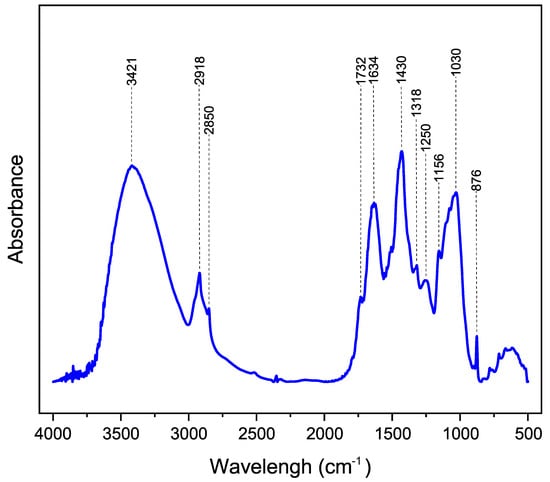
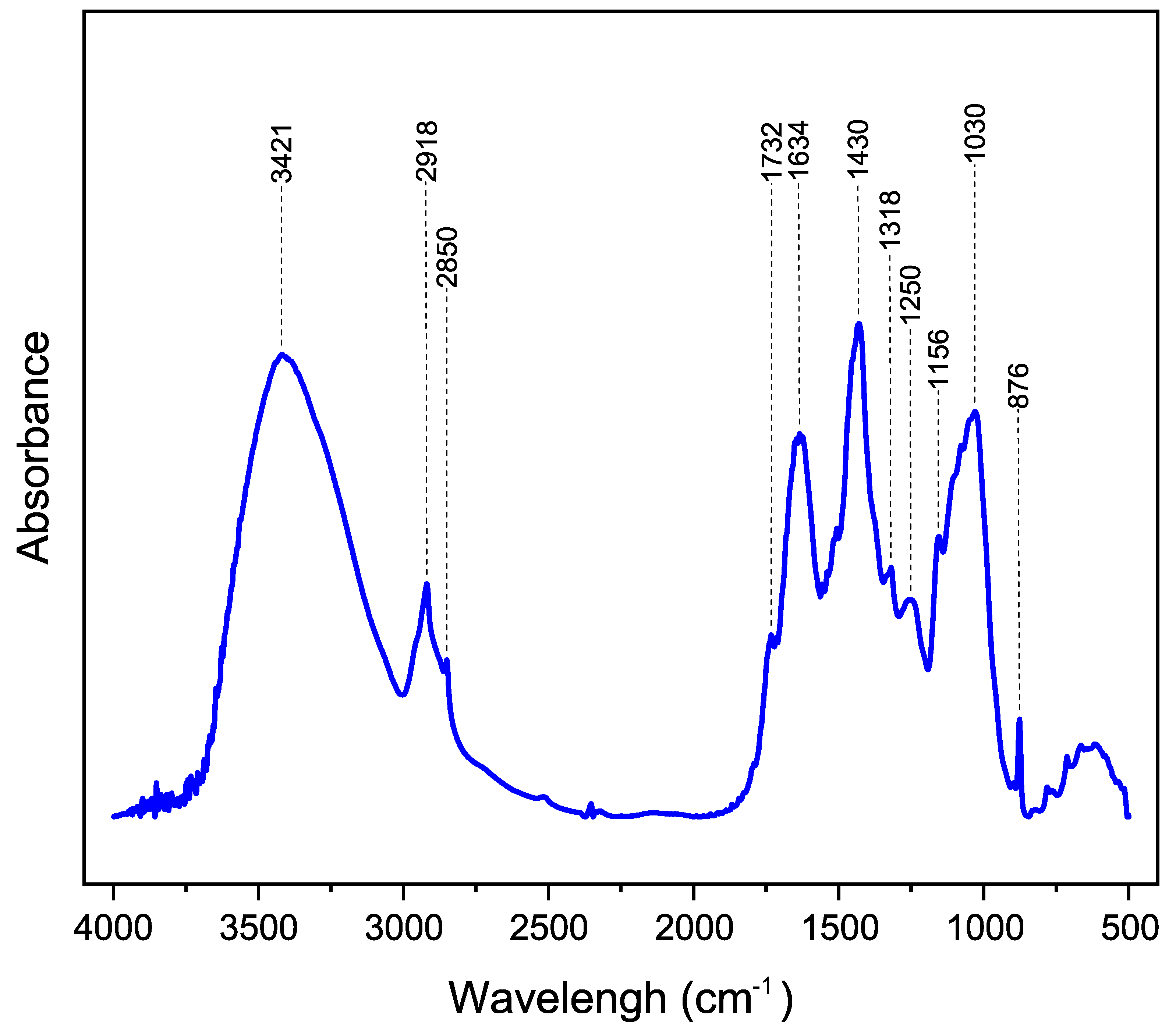
FTIR analysis was used to detect vibration of molecules present in the Ramon’s seed coat and to infer its structural composition. Figure 1 shows a broad, sharp peak at 3421 cm−1 in the spectrum, which indicates the stretching vibrations of O-H groups present interstitially in Ramon’s seed coat. The peaks at 2918 cm−1 originate from the methyl group, while those at 2850 cm−1 result from the asymmetrical stretching of CH3 methoxyl groups [35,36]. The low-intensity peak at 1732 cm-1 signifies the presence of acetyl groups in lignin and cellulose-based compounds, whereas the high-intensity peak at 1634 cm−1 suggests pectin. The region between 1400 and 1300 cm−1 corresponds to the cellulose fingerprint, which includes the bending of C-H and CH2 groups. The peak at 1250 cm−1 represents C-O-C stretching, while the region from 1150 to 1030 cm−1 corresponds to C-O stretching. The peak at 876 cm−1 represents aromatic C-H out-of-plane deformation [37,38].
Figure 1.
Fourier transform infrared spectroscopy (FTIR) of Brosimum alicastrum seed coat.
3.2. Effect of Pretreatment on Methane Production
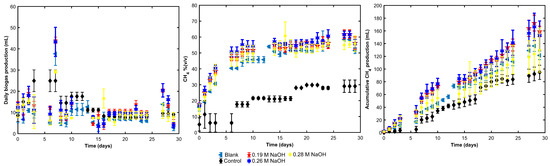
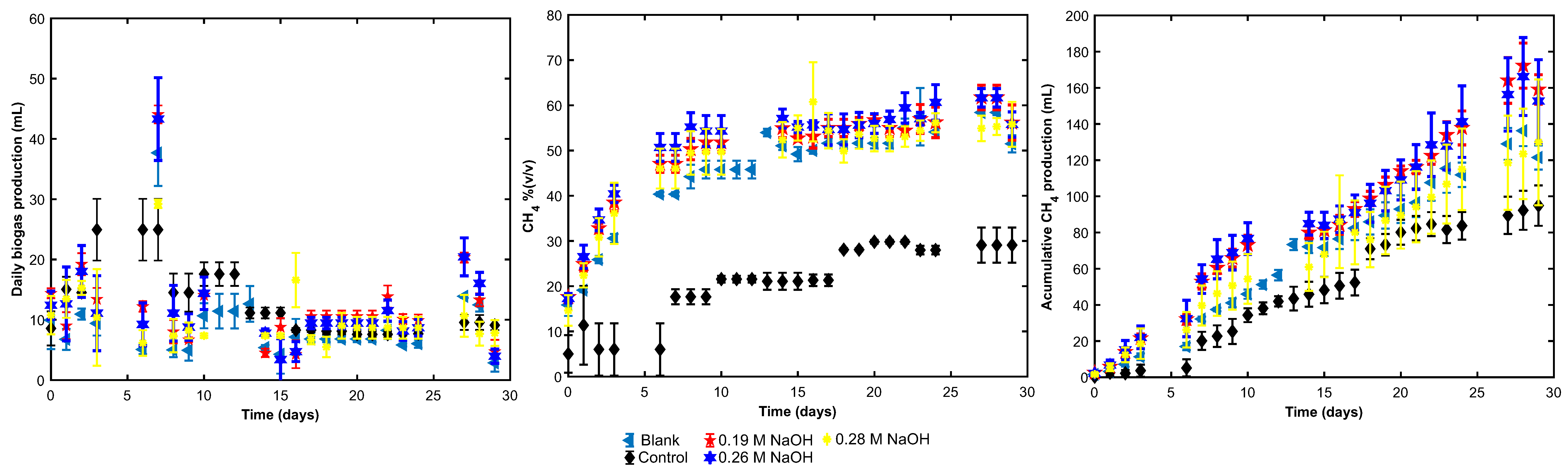
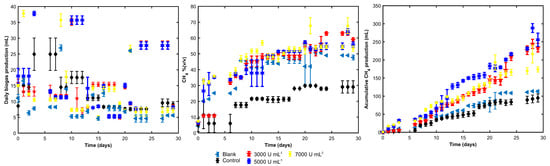
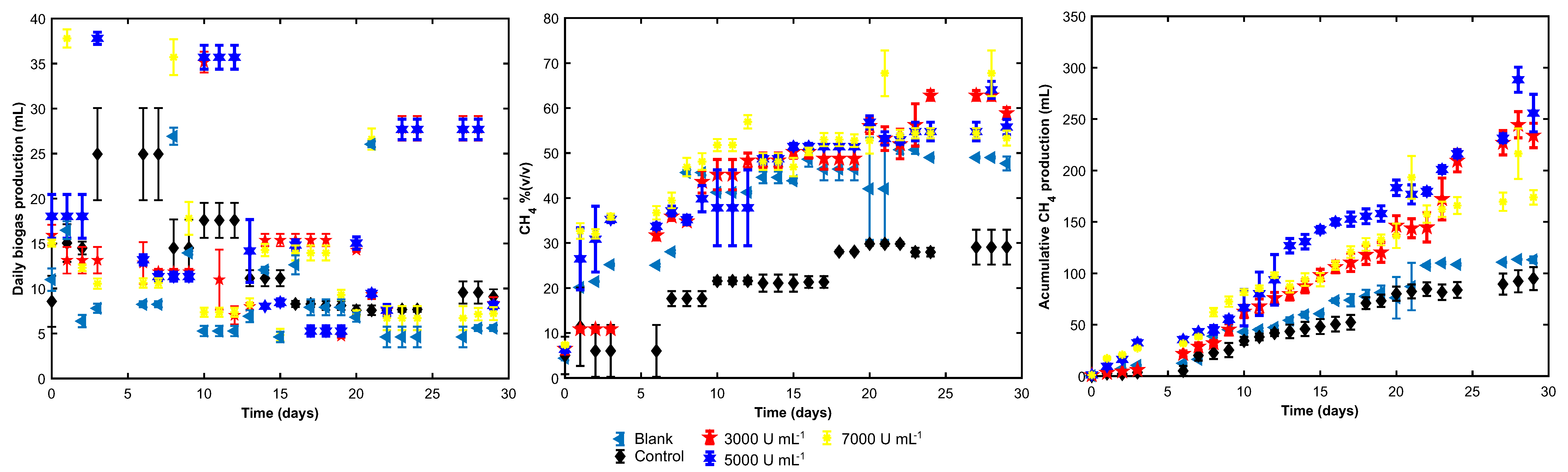
Methane production was carried out after the alkaline and enzymatic pretreatment stages (Figure 2 and Figure 3). Firstly, daily biogas production is highest when Ramon’s seed coat underwent NaOH and enzymatic pretreatment, compared to the control (untreated Ramon’s seed coat) and the blank (inoculum) during the biochemical methane potential assays. This suggests that the presence of untreated Ramon seed coat negatively affects anaerobic digestion (AD). These findings are consistent with previous studies demonstrating that lignin interferes with hydrolysis during AD through two main mechanisms: (i) forming a protective barrier that limits enzymatic access of microorganisms, and (ii) binding to enzymes both reversibly and irreversibly due to its inherent hydrophobicity [39,40,41]. Consequently, lignin limits the hydrolysis efficiency of the encapsulated holocellulose fraction. Thereby, decreasing the overall bioconversion efficiency of AD [40]. This trend is consistent with the findings reported by Sun et al. 2024 [39], who presented data indicating that higher lignin content in the substrate is associated with a significant reduction in methane potential. For instance, in wood samples with lignin contents ranging from 29% to 30%, the methane yield was reported between 188 and 224 mL CH4 per gram of volatile solids. This behavior is also observed for the CH4 percentage and cumulative CH4 production. These results indicate that NaOH and enzymatic pretreatment enhance the digestion of organic matter from Ramon’s seed coat. This enhancement can be explained by the fact that NaOH and enzymatic pretreatments increase the availability of reducing sugars in lignocellulosic biomass [12]. However, it can be observed that increasing the NaOH concentration during the seed coat pretreatment negatively affects CH4 production. Accordingly, the highest methane production was obtained at a NaOH concentration of 0.19 M. This inhibition is presumed to be associated with sodium levels; although sodium is essential for anaerobic digestion at low concentrations, levels above 0.25 M have been reported to significantly reduce methane yield, and this may even completely inhibit the anaerobic digestion process. This effect is likely due to increased osmotic pressure and the consequent dehydration of the microorganisms involved in anaerobic digestion [42].
Figure 2.
Effect of alkaline pretreatment with NaOH on daily, percentage, and cumulative CH4 production profiles from Brosimum alicastrum seed coat.
Figure 3.
Effect of enzymatic pretreatment with laccase on daily, percentage, and cumulative CH4 production profiles from Brosimum alicastrum seed coat.
With respect to methane content, alkaline pretreatment increased the methane concentration to an average of 60% across all treatments after 10 days, representing a 30% increase compared to the control. However, the achieved CH4 percentage with pretreated Ramon’s seed coat is lower than that reported by Battista et al. [43], which observed an 80% (v/v) CH4 percentage during the first 10 days of digestion using a mixture of coffee waste as a substrate subjected to alkaline pretreatment with 2 M NaOH. This difference in CH4 percentage can be attributed to the NaOH concentration, as this study used a stock solution of 1 M NaOH and higher NaOH concentration decrease the degree of polymerization and crystallinity of cellulose, break the structural links between lignin and carbohydrates, and remove partially lignin from the biomass [13,43,44]. On the other hand, the CH4 percentage obtained in this study is like that reported by Ağdağ et al. [45], where a 64% (v/v) CH4 percentage was achieved using municipal landfill leachate in an up-flow anaerobic sludge blanket.
Finally, it can be observed that the enzymatic pretreatment of Ramon seed coat enhanced methane production, with the highest yield achieved at a laccase dosage of 3000 U/mL. This effect is attributed to the enzyme’s ability to depolymerize or restructure the lignin network through the formation of phenoxy radicals generated by the oxidation of hydroxyl groups in phenolic compounds present in lignin. Additionally, it is important to note that the use of an enzymatic extract may involve the presence of other enzymes, such as peroxidases [46], which could further contribute to improved delignification and, consequently, increased methane yield. Moreover, the treatments at 3000 and 5000 U/mL showed no significant difference, and the treatment at 7000 U/mL resulted in decreased methane production. This behavior is consistent with the findings reported by Mlaik et al. [41], who indicated that enzyme overloading may induce inhibition of its stretching conformation, ultimately leading to enzyme inactivation. In this context, the fact that optimal results were achieved at a lower enzyme concentration represents an economic advantage, due to the high cost of enzymes remains a significant limitation for their application at an industrial scale [44]. In this work, the maximum production of methane was 319 mL after 24 days of digestion at 3000 U/mL. This result represents a 56.25% increase in cumulative CH4 production, with the value achieved in this study surpassing the 100 mL CH4 reported by Silva et al. [10], who utilized cellulase from Aspergillus japonicus on passion fruit peel (Passiflora edulis).
The experimental results of specific methane yield (SMY) for the different pretreatment methods are presented in Table 2. These values were calculated as averages based on the cumulative methane production profiles described previously. The influence of pretreatment type on anaerobic digestion performance is clearly evident in all cases. In particular, the highest SMY was achieved with enzymatic pretreatment at a laccase dosage of 3000 U mL−1. Under this condition, the SMY increased by 66.28% compared to the control, demonstrating the effectiveness of laccase in enhancing the hydrolysis of Ramon’s seed coat. This improvement can be attributed to the enzymatic modification of lignin structures, which increases the accessibility of cellulose and hemicellulose to microbial degradation [35]. However, it is important to highlight that increasing the enzymatic concentration above 3000 U mL−1 resulted in a significant decrease in the SMY for into enzymatic pretreatment. This behavior may be attributed to the accumulation of volatile fatty acids (VFAs) resulting from the rapid release of glucose during enzymatic hydrolysis and its subsequent conversion by acidogenic bacteria, which decreases the pH of the medium and thereby inhibits methanogenic activity [47,48]. In contrast, alkaline pretreatments did not result in significant differences in SMY.
Table 2.
Comparison of specific CH4 yield between the different pretreatments.
The SMY values obtained through alkaline pretreatment in this study are consistent with those reported by Buitrón et al. [15], who achieved methane yields ranging from 220 to 260 mL CH4/gVS for wheat straw and agave bagasse subjected to hydrothermal pretreatment. However, the enzymatic pretreatment evaluated in the present work resulted in higher methane yields, highlighting its potential as a more effective strategy for lignocellulosic biomass conversion. Similarly, Pellera et al. [8] reported SMY values of 190.2, 247.5, and 172.3 mL CH4/gVS for winery waste, cotton gin waste, and olive pomace pretreated with 0.5 M H2O2, respectively, which are also lower than those achieved in this study using enzymatic treatment. In addition, Atelge et al. [49] reported a SMY of 261 mL CH4/gVS from soybean straw, sunflower stalks, and corn biomass subjected to thermal pretreatment at temperatures ranging from 121 to 175 °C for 30–90 min.
Overall, these findings demonstrate that enzymatic pretreatment significantly enhances methane production compared to conventional chemical methods. The SMY values obtained are comparable to those reported for low-lignin biomass (1.23–2.98%), where methane yields between 360.5 and 438.9 mL CH4/gVS have been documented [39]. This suggests that the enzymatic approach effectively reduces the recalcitrance of lignocellulosic materials, improving substrate biodegradability and making it a promising alternative for optimizing anaerobic digestion processes.
3.3. Kinetic Modelling of Cumulative Methane Production
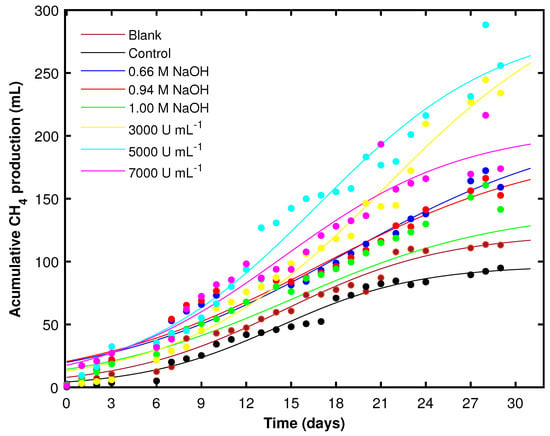
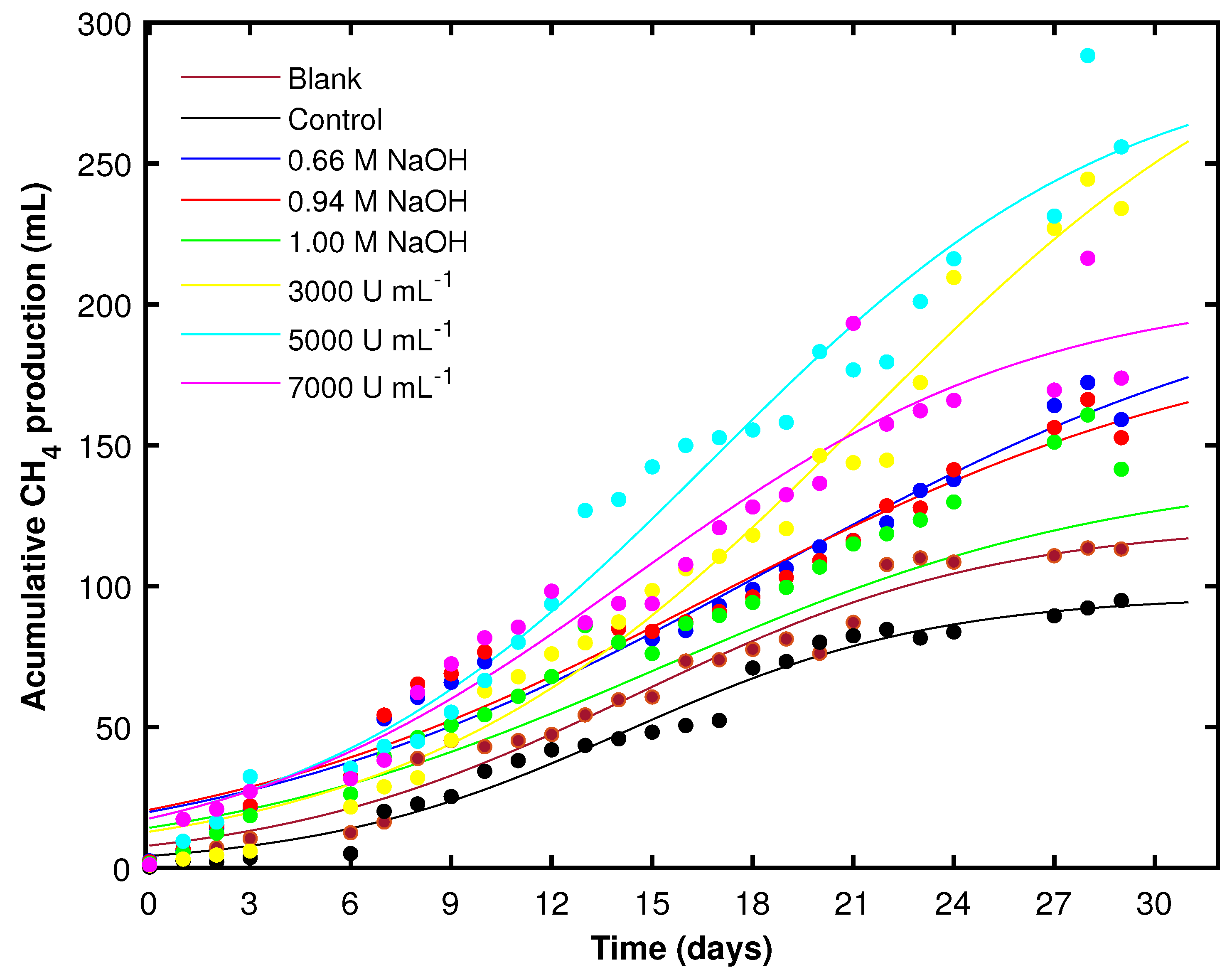
The kinetic analysis of cumulative CH4 production provides valuable insight into the effectiveness of the different pretreatments applied to Ramon’s seed coat. By applying the logistic model described in Section 2.4, clear differences in CH4 production rates were observed depending on the type and intensity of pretreatment. The experimental data (see Supplementary Material) and fitted curves presented in Figure 4 show that enzymatic pretreatment significantly enhances methane production kinetics. In particular, the treatment with 5000 U mL−1 of laccase exhibited the highest CH4 production rate, indicating improved substrate biodegradability and more efficient microbial conversion. In contrast, alkaline pretreatment at 0.19 M NaOH resulted in a comparatively lower CH4 production rate, suggesting limited effectiveness at this con-centration. Although increasing the NaOH concentration to 0.26 M and 0.28 M improved methane production rates, these values remained below those achieved with enzymatic pretreatment. This trend may be associated with the formation of inhibitory compounds or structural alterations that limit microbial accessibility [46]. Overall, the results highlight the superiority of enzymatic hydrolysis in enhancing digestion kinetics, while also demonstrating that alkaline pretreatment requires careful methodology to balance substrate solubilization and potential inhibitory effects.
Figure 4.
Kinetic modelling of the cumulative CH4 production from Brosimum alicastrum seed coat; • experimental values; - logistic model.
The kinetic parameters obtained from fitting the cumulative CH4 production data to the logistic model are summarized in Table 3. The results indicate that enzymatic pretreatments achieved higher methane production rates (Pr = 0.15–0.16 day−1) compared to alkaline pretreatments (0.12–0.14 day−1), suggesting a more favorable enhancement of substrate biodegradability. In contrast, the control and blank conditions exhibited the highest Pr values (0.22 and 0.18 day−1, respectively), indicating faster initial methane formation in the absence of pretreatment. This behavior may be explained by the generation of inhibitory compounds during both alkaline and enzymatic pretreatments. In particular, phenolic compounds derived from lignin disruption are known to temporarily inhibit microbial activity, especially methanogens, thereby reducing the apparent methane production rate [50]. Despite this initial inhibition, pretreatments ultimately improved overall methane yields, highlighting a trade-off between reaction rate and substrate accessibility. The Pr values obtained in this study are consistent with those reported by Pellera et al. [8], who applied a first-order ex-ponential model to evaluate CH4 production kinetics from various agroindustrial wastes. Their reported values include 0.154 day−1 for winery waste, 0.119 day−1 for cotton gin waste, 0.148 day−1 for olive pomace, and 0.330 day−1 for juice industry waste under alkaline pretreatment. These comparisons support the validity of the kinetic parameters obtained in this work and confirm that the observed trends fall within expected ranges for lignocellulosic substrates.
Table 3.
Estimation of the kinetic coefficients for the accumulate CH4 production from Brosimum alicastrum seed coat.
On the other hand, the highest Pmax values were obtained for enzymatic pretreatments at 3000 U mL−1 (319.10 mL) and 5000 U mL−1 (289.47 mL), followed by alkaline pretreatment at 0.19 M NaOH (212.09 mL). These results are consistent with the CH4 production trends observed in Figure 4, where enzymatic hydrolysis clearly promotes the greatest cumulative methane production. The enhanced performance of enzymatic pretreatment can be attributed to its ability to selectively modify lignin structures, thereby improving the accessibility of fermentable carbohydrates for microbial degradation. In contrast, the blank (122.50 mL) and control (96.70 mL) conditions yielded the lowest CH4 production, highlighting the critical role of pretreatment in overcoming the recalcitrance of lignocellulosic biomass and enhancing overall digestion efficiency. Furthermore, the relatively high Pmax values achieved with enzymatic treatments indicate a more complete conversion of organic matter, which is essential for maximizing energy recovery in anaerobic digestion systems. Although alkaline pretreatment improved methane production compared to the control, its performance remained lower than that of enzymatic hydrolysis, possibly due to the formation of inhibitory by-products or incomplete delignification [51]. The logistic model applied to describe the kinetics of cumulative CH4 production showed strong agreement with the experimental data, with coefficients of determination (R2 ≥ 0.95) for all treatments. This high level of correlation demonstrates the model’s capability to accurately represent methane production behavior under different pretreatment conditions. Additionally, the low Root Mean Square Error (RMSE) values indicate minimal deviation between predicted and observed data, confirming the robustness of the model. Overall, these findings validate the reliability of the logistic model as an effective tool for analyzing and predicting methane production kinetics in anaerobic digestion processes.
4. Conclusions
This study demonstrates that enzymatic pretreatment improves the hydrolysis stage of Ramon’s seed coat, promoting higher cumulative CH4 production and leading to an increased specific CH4 yield. This enhancement is likely associated with the breakdown of structural carbohydrates, which facilitates substrate availability for microbial conversion during anaerobic digestion. However, a further increase in enzymatic activity resulted in a decrease in specific CH4 yield, suggesting that excessive pretreatment may generate inhibitory by-products or cause substrate imbalances.
Conversely, kinetic analysis revealed that the CH4 formation rate was highest in the untreated control, indicating that both alkaline and enzymatic pretreatments may contribute to the release of inhibitory phenolic compounds derived from lignin. These compounds can temporarily hinder microbial activity, particularly affecting methanogenic populations and slowing down methane production rates despite higher overall yields.
Furthermore, the kinetic modelling applied in this study successfully described the cumulative CH4 production from pretreated Ramon’s seed coat. The model provided a reliable representation of the digestion process under different pretreatment conditions, highlighting its usefulness as a predictive tool for evaluating process performance and optimizing operational strategies in anaerobic digestion systems.
Supplementary Materials
The following supporting information can be downloaded at: https://www.mdpi.com/article/10.3390/fermentation12060280/s1, Table S1. ALLNaOH, Table S2. Blank, Table S3. ALLEnz, Table S4. Testa.
Author Contributions
G.R.-C.: Software, Conceptualization, and Writing—Original Draft. E.E.-G.: Conceptualization, Methodology, and Writing—Original Draft. J.A.V.-B.: Methodology. J.M.B.-L.: Methodology. T.T.-T.: Methodology. L.A.-G.: Supervision. R.T.-T.: Supervision. All authors have read and agreed to the published version of the manuscript.
Funding
This research received no external funding.
Institutional Review Board Statement
Not applicable.
Informed Consent Statement
Not applicable.
Data Availability Statement
The original contributions presented in this study are included in the article and Supplementary Material. Further inquiries can be directed to the corresponding author.
Acknowledgments
During the preparation of this manuscript/study, the author(s) used ChatGPT-5.5 for the purposes of grammar correction and stylistic improvement of the manuscript. The authors have reviewed and edited the output and take full responsibility for the content of this publication.
Conflicts of Interest
The authors declare no conflicts of interest.
References
- International Energy Agency. Biofuels. 2024. Available online: https://www.iea.org/reports/biofuels (accessed on 12 December 2025).
- Baharudin, L. Progress and future direction in turquoise hydrogen production by methane pyrolysis technologies: An overview of solid catalyst, plasma, plasma–catalyst hybrid, and molten media catalyst systems. Fuel 2025, 401, 135837. [Google Scholar] [CrossRef] [Scilit]
- Abdulmoez, M.; Othman, A.; Linjawi, M.; Al-Qutub, A. Solar Fuels Via Methane Valorization: Thermochemical Pathways, Unified Metrics, and Techno-Economic Perspectives. Energy Environ. Mater. 2026, e70331. [Google Scholar] [CrossRef] [Scilit]
- Greses, S.; Tomás-Pejó, E.; Gónzalez-Fernández, C. Agroindustrial waste as a resource for volatile fatty acids production via anaerobic fermentation. Bioresour. Technol. 2020, 297, 122486. [Google Scholar] [CrossRef] [Scilit] [PubMed]
- Rodriguez-Verde, I.; Regueiro, L.; Carballa, M.; Hospido, A.; Lema, J.M. Assessing anaerobic co-digestion of pig manure with agroindustrial wastes: The link between environmental impacts and operational parameters. Sci. Total Environ. 2014, 497, 475–483. [Google Scholar] [CrossRef] [Scilit] [PubMed]
- Pellera, F.M.; Gidarakos, E. Chemical pretreatment of lignocellulosic agroindustrial waste for methane production. Waste Manag. 2018, 71, 689–703. [Google Scholar] [CrossRef] [Scilit]
- Ward, A.J.; Hobbs, P.J.; Holliman, P.J.; Jones, D.L. Optimisation of the anaerobic digestion of agricultural resources. Bioresour. Technol. 2008, 99, 7928–7940. [Google Scholar] [CrossRef] [Scilit]
- Pellera, F.M.; Gidarakos, E. Anaerobic digestion of solid agroindustrial waste in semi-continuous mode: Evaluation of mono-digestion and co-digestion systems. Waste Manag. 2017, 68, 103–119. [Google Scholar] [CrossRef] [Scilit]
- Karki, R.; Chuenchart, W.; Surendra, K.; Shrestha, S.; Raskin, L.; Sung, S.; Hashimoto, A.; Khanal, S.K. Anaerobic co-digestion: Current status and perspectives. Bioresour. Technol. 2021, 330, 125001. [Google Scholar] [CrossRef] [Scilit]
- Silva, A.; Santos, L.; Valença, R.; Porto, T.; Sobrinho, M.D.M.; Gomes, G.; Jucá, J.; Santos, A. Cellulase production to obtain biogas from passion fruit (Passiflora edulis) peel waste hydrolysate. J. Environ. Chem. Eng. 2019, 7, 103510. [Google Scholar] [CrossRef] [Scilit]
- Rosero-Chasoy, G.; Rodríguez-Jasso, R.M.; Aguilar, C.N.; Buitrón, G.; Chairez, I.; Ruiz, H.A. Hydrothermal kinetic modeling for microalgae biomass under subcritical condition cultivated in a close bubble tubular photobioreactor. Fuel 2023, 334, 126585. [Google Scholar] [CrossRef] [Scilit]
- Valdez-Vazquez, I.; Alatriste-Mondragón, F.; Arreola-Vargas, J.; Buitrón, G.; Carrillo-Reyes, J.; León-Becerril, E.; Mendez-Acosta, H.O.; Ortíz, I.; Weber, B. A comparison of biological, enzymatic, chemical and hydrothermal pretreatments for producing biomethane from Agave bagasse. Ind. Crops Prod. 2020, 145, 112160. [Google Scholar] [CrossRef] [Scilit]
- Julio-Altamiranda, Y.T.; Mercado-Pacheco, J.D.; Sánchez-Tuirán, E.L.; González-Delgado, Á.D.; Ojeda, K.A. Evaluation of mechanical-green solvent pretreatment of oil palm wastes for reducing sugars production in North-Colombia. Sustain. Chem. Pharm. 2020, 16, 100256. [Google Scholar] [CrossRef] [Scilit]
- Jain, S.; Jain, S.; Wolf, I.T.; Lee, J.; Tong, Y.W. A comprehensive review on operating parameters and different pretreatment methodologies for anaerobic digestion of municipal solid waste. Renew. Sustain. Energy Rev. 2015, 52, 142–154. [Google Scholar] [CrossRef] [Scilit]
- Buitrón, G.; Hernández-Juárez, A.; Hernández-Ramírez, M.D.; Sánchez, A. Biochemical methane potential from lignocellulosic wastes hydrothermally pretreated. Ind. Crops Prod. 2019, 139, 111555. [Google Scholar] [CrossRef] [Scilit]
- White, D.; Hood, C. Vegetation patterns and environmental gradients in tropical dry forests of the northern Yucatan Peninsula. J. Veg. Sci. 2004, 15, 151–160. [Google Scholar] [CrossRef]
- Lopez-Mata, L. Genecological differentiation in provenances of Brosimum alicastrum—A tree of moist tropical forests. For. Ecol. Manag. 1987, 21, 197–208. [Google Scholar] [CrossRef] [Scilit]
- Olguin-Maciel, E.; Larqué-Saavedra, A.; Pérez-Brito, D.; Barahona-Pérez, L.F.; Alzate-Gaviria, L.; Toledano-Thompson, T.; Lappe-Oliveras, P.E.; Huchin-Poot, E.G.; Tapia-Tussell, R. Brosimum alicastrum as a novel starch source for bioethanol production. Energies 2017, 10, 1574. [Google Scholar] [CrossRef] [Scilit]
- López, I.; Passeggi, M.; Borzacconi, L. Validation of a simple kinetic modelling approach for agro-industrial waste anaerobic digesters. Biochem. Eng. J. 2015, 262, 509–516. [Google Scholar] [CrossRef] [Scilit]
- Morais, N.W.S.; Coelho, M.M.H.; e Silva, A.d.S.; Pereira, E.L.; Leitão, R.C.; Dos Santos, A.B. Kinetic modeling of anaerobic carboxylic acid production from swine wastewater. Bioresour. Technol. 2020, 297, 122520. [Google Scholar] [CrossRef] [Scilit]
- Yahya, M.; Herrmann, C.; Ismaili, S.; Jost, C.; Truppel, I.; Ghorbal, A. Kinetic studies for hydrogen and methane co-production from food wastes using multiple models. Biomass Bioenergy 2022, 161, 106449. [Google Scholar] [CrossRef] [Scilit]
- Nasar, N.; Pizzagalli, G.; Coulon, F.; Bajón-Fernández, Y. Enzymes targeting distinct hydrolysis blind-spots of thermal and biological pre-treatments significantly uplift biogas production. Bioresour. Technol. 2025, 426, 132353. [Google Scholar] [CrossRef] [Scilit]
- Wang, J.; Wan, W. Kinetic models for fermentative hydrogen production: A review. Int. J. Hydrogen Energy 2009, 34, 3313–3323. [Google Scholar] [CrossRef] [Scilit]
- Rosero-Chasoy, G.; Pabon, O.V.; Valencia-Hernández, L.J.; Cock, L.S. Kinetic analysis of lactic acid fermentation by using an extended logistic model. Process Biochem. 2024, 144, 1–5. [Google Scholar] [CrossRef] [Scilit]
- Poggi-Varaldo, H.M.; Alzate-Gaviria, L.M.; Pérez-Hernández, A.; Nevarez-Morillón, V.G.; Rinderknecht-Seijas, N. A side-by-side comparison of two systems of sequencing coupled reactors for anaerobic digestion of the organic fraction of municipal solid waste. Waste Manag. Res. 2005, 23, 270–280. [Google Scholar] [CrossRef] [Scilit] [PubMed]
- Valero, D.; Montes, J.A.; Rico, J.L.; Rico, C. Influence of headspace pressure on methane production in Biochemical Methane Potential (BMP) tests. Waste Manag. 2016, 48, 193–198. [Google Scholar] [CrossRef] [Scilit]
- Tapia-Tussell, R.; Avila-Arias, J.; Domínguez Maldonado, J.; Valero, D.; Olguin-Maciel, E.; Pérez-Brito, D.; Alzate-Gaviria, L. Biological pretreatment of mexican caribbean macroalgae consortiums using Bm-2 strain (Trametes hirsuta) and its enzymatic broth to improve biomethane potential. Energies 2018, 11, 494. [Google Scholar] [CrossRef] [Scilit]
- Tapia-Tussell, R.; Pérez-Brito, D.; Rojas-Herrera, R.; Cortes-Velazquez, A.; Rivera-Muñoz, G.; Solis-Pereira, S. New laccase-producing fungi isolates with biotechnological potential in dye decolorization. Afr. J. Biot. 2011, 10, 10134–10142. [Google Scholar] [CrossRef] [Scilit]
- Chikani-Cabrera, K.D.; Fernandes, P.M.B.; Tapia-Tussell, R.; Parra-Ortiz, D.L.; Hernández-Zárate, G.; Valdez-Ojeda, R.; Alzate-Gaviria, L. Improvement in methane production from pelagic sargassum using combined pretreatments. Life 2022, 12, 1214. [Google Scholar] [CrossRef] [Scilit]
- Valero, D.; Rico, C.; Canto-Canché, B.; Domínguez-Maldonado, J.A.; Tapia-Tussell, R.; Cortes-Velazquez, A.; Alzate-Gaviria, L. Enhancing biochemical methane potential and enrichment of specific electroactive communities from nixtamalization wastewater using granular activated carbon as a conductive material. Energies 2018, 11, 2101. [Google Scholar] [CrossRef] [Scilit]
- Azcorra-May, K.J.; Olguin-Maciel, E.; Leal-Bautista, R.M.; Canche-Escamilla, G.; Alzate-Gaviria, L.; Toledano-Thompson, T.; Tapia-Tussell, R. Sargassum delignification: A first step to mitigate the socio-economic and environmental impacts in the Caribbean through its sustainable exploitation. Biomass Convers. Biorefinery 2023, 15, 1057–1068. [Google Scholar] [CrossRef] [Scilit]
- Sluiter, A.; Hames, B.; Ruiz, R.; Scarlata, C.; Sluiter, J.; Templeton, D. Determination of ash in biomass laboratory analytical procedure. In National Renewable Energy Laboratory Analytical Procedure; National Renewable Energy Laboratory: Golden, CO, USA, 2005; Volume 19. [Google Scholar]
- Brown, D.; Shi, J.; Li, Y. Comparison of solid-state to liquid anaerobic digestion of lignocellulosic feedstocks for biogas production. Bioresour. Technol. 2012, 124, 379–386. [Google Scholar] [CrossRef] [Scilit] [PubMed]
- Canto-Pinto, J.; Pat-Moreno, N.; Moo-Huchin, V.; Pérez-Pacheco, E.; Chay-Canul, A.; Estrada-León, R.; Sauri-Duch, E.; Ríos-Soberanis, C. Comparison of proximate composition, phytochemical contents, antioxidant capacity and polyphenols in Brosimum alicastrum leaf, fruit and seed. J. Anim. Plan. Sci. 2024, 34, 875–885. [Google Scholar] [CrossRef] [Scilit]
- Chable-Villacis, R.; Olguin-Maciel, E.; Toledano-Thompson, T.; Alzate-Gaviria, L.; Ruiz, H.A.; Tapia-Tussell, R. Enzymatic hydrolysis assisted with ligninocellulolytic enzymes from Trametes hirsuta produced by pineapple leaf waste bioconversion in solid-state fermentation. Biomass Convers. Biorefinery 2023, 13, 9095–9106. [Google Scholar] [CrossRef] [Scilit]
- Pech-Cohuo, S.C.; Martín-López, H.; Uribe-Calderón, J.; González-Canché, N.G.; Salgado-Tránsito, I.; May-Pat, A.; Cuevas-Bernardino, J.C.; Ayora-Talavera, T.; Cervantes-Uc, J.M.; Pacheco, N. Physicochemical, mechanical, and structural properties of bio-active films based on biological-chemical chitosan, a novel ramon (Brosimum alicastrum) starch, and quercetin. Polymers 2022, 14, 1346. [Google Scholar] [CrossRef] [Scilit] [PubMed]
- Olguin-Maciel, E.; Larqué-Saavedra, A.; Lappe-Oliveras, P.E.; Barahona-Pérez, L.F.; Alzate-Gaviria, L.; Chablé-Villacis, R.; Domínguez-Maldonado, J.; Pacheco-Catalán, D.; Ruíz, H.A.; Tapia-Tussell, R. Consolidated bioprocess for bioethanol production from raw flour of brosimum alicastrum seeds using the native strain of trametes hirsuta bm-2. Microorganisms 2019, 7, 483. [Google Scholar] [CrossRef] [Scilit] [PubMed]
- Halib, N.; Amin, M.; Ahmad, I. Physicochemical properties and characterization of nata de coco from local food industries as a source of cellulose. Sains Malays. 2012, 41, 205–211. [Google Scholar]
- Sun, Z.; Liu, Q.; Li, Y.; Mazarji, M.; Feng, L.; Pan, J. Deciphering the impact of lignin on anaerobic digestion: Focus on inhibition mechanisms and methods for alleviating inhibition. ACS Omega 2024, 9, 44033–44041. [Google Scholar] [CrossRef] [Scilit]
- Li, P.; Liu, D.; Pei, Z.; Zhao, L.; Shi, F.; Yao, Z.; Li, W.; Sun, Y.; Wang, S.; Yu, Q.; et al. Evaluation of lignin inhibition in anaerobic digestion from the perspective of reducing the hydrolysis rate of holocellulose. Bioresour. Technol. 2021, 333, 125204. [Google Scholar] [CrossRef] [Scilit]
- Mlaik, N.; Khoufi, S.; Hamza, M.; Masmoudi, M.A.; Sayadi, S. Enzymatic pre-hydrolysis of organic fraction of municipal solid waste to enhance anaerobic digestion. Biomass Bioenergy 2019, 127, 105286. [Google Scholar] [CrossRef] [Scilit]
- Hierholtzer, A.; Akunna, J.C. Modelling sodium inhibition on the anaerobic digestion process. Water Sci. Technol. 2012, 66, 1565–1573. [Google Scholar] [CrossRef] [Scilit]
- Battista, F.; Fino, D.; Mancini, G. Optimization of biogas production from coffee production waste. Bioresour. Technol. 2016, 200, 884–890. [Google Scholar] [CrossRef] [Scilit]
- Di Mario, J.; Montegiove, N.; Gambelli, A.M.; Brienza, M.; Zadra, C.; Gigliotti, G. Waste Biomass Pretreatments for Biogas Yield Optimization and for the Extraction of Valuable High-Added-Value Products: Possible Combinations of the Two Processes toward a Biorefinery Purpose. Biomass 2024, 4, 865–885. [Google Scholar] [CrossRef] [Scilit]
- Ağdağ, O.N.; Sponza, D.T. Co-digestion of industrial sludge with municipal solid wastes in anaerobic simulated landfilling reactors. Process Biochem. 2005, 40, 1871–1879. [Google Scholar] [CrossRef] [Scilit]
- González-Muñoz, M.E.; Chikani-Cabrera, K.D.; España-Gamboa, E.I.; Machado Bueno-Fernandes, P.; Tapia-Tussell, R.; Alzate-Gaviria, L. Synergistic effect of high hydrostatic pressure, hydrogen peroxide, and a Trametes hirsuta BM-2 enzymatic extract on polyphenol release from Sargassum spp. Rev. Mex. Ing. Chim. 2026, 25, IA26665. [Google Scholar] [CrossRef] [Scilit]
- Anacleto, T.M.; Kozlowsky-Suzuki, B.; Björn, A.; Yekta, S.S.; Masuda, L.S.M.; de Oliveira, V.P.; Enrich-Prast, A. Methane yield response to pretreatment is dependent on substrate chemical composition: A meta-analysis on anaerobic digestion systems. Sci. Rep. 2024, 14, 1240. [Google Scholar] [CrossRef] [Scilit] [PubMed]
- Li, Y.; Chen, Y.; Wu, J. Enhancement of methane production in anaerobic digestion process: A review. Appl. Energy 2019, 240, 120–137. [Google Scholar] [CrossRef] [Scilit]
- Atelge, M.; Atabani, A.; Banu, J.R.; Krisa, D.; Kaya, M.; Eskicioglu, C.; Kumar, G.; Lee, C.; Yildiz, Y.; Unalan, S.; et al. A critical review of pretreatment technologies to enhance anaerobic digestion and energy recovery. Fuel 2020, 270, 117494. [Google Scholar] [CrossRef] [Scilit]
- Talreja, N.C.; Pandit, J.; Kalamdhad, A.S. Synergistic enhancement of biomethane production through anaerobic co-digestion of sugarcane bagasse and napier grass: Effects of substrate ratio, inoculum loading, and kinetic behaviour. Biomass Bioenergy 2026, 211, 109187. [Google Scholar] [CrossRef] [Scilit]
- Liu, X.; Zicari, S.M.; Liu, G.; Li, Y.; Zhang, R. Pretreatment of wheat straw with potassium hydroxide for increasing enzymatic and microbial degradability. Bioresour. Technol. 2015, 185, 150–157. [Google Scholar] [CrossRef] [Scilit]

Disclaimer/Publisher’s Note: The statements, opinions and data contained in all publications are solely those of the individual author(s) and contributor(s) and not of MDPI and/or the editor(s). MDPI and/or the editor(s) disclaim responsibility for any injury to people or property resulting from any ideas, methods, instructions or products referred to in the content. |
© 2026 by the authors. Licensee MDPI, Basel, Switzerland. This article is an open access article distributed under the terms and conditions of the Creative Commons Attribution (CC BY) license.