


Abstract
The growing demand for clean-label plant-based cheese alternatives underscores the need for products with desirable properties. A key technological challenge is replicating the firmness of traditional cheese without synthetic additives. This study explores lactic acid bacteria (LAB) fermentation as a natural texturizing method for clean-label plant-based cheeses. We investigated the link between LAB metabolic traits and the firmness of three substrates: cashew, soybean, and sunflower seed. A strong correlation (r ≈ −0.88) was found between final pH and firmness in cashew paste, where strains achieving a pH of ~4.0–4.5 (near the protein isoelectric point) produced the firmest gels (up to 3.35 N). Lactiplantibacillus plantarum 729/23 and Lacticaseibacillus helveticus NK-1 were most effective. Soybean paste firmness increased moderately (to 1.93 N), while sunflower seed paste showed no significant improvement (≤1.14 N) despite active acidification, indicating substrate-specific limitations. This study, supported by a comprehensive analysis of the literature on firmness measurement in plant-based cheeses, demonstrates the potential of targeted selection of natural starter cultures to create clean-label products with minimal ingredients.
1. Introduction
A growing body of research highlights the critical scientific and practical interest in plant-based cheese alternatives, driven by their environmental benefits and the rising demand for clean-label, health-oriented products [1,2,3,4].
According to the comprehensive study by Poore and Nemecek [5], which encompassed data from 38,700 farms across 119 countries and 40 food products accounting for 90% of global caloric and protein intake, animal-based foods—while providing only 37% of global protein and 18% of calories—are responsible for 83% of all agricultural land use, 58% of food-related greenhouse gas emissions, and the majority of impacts on eutrophication and acidification. A shift to a vegan diet, according to the authors’ estimates, could potentially reduce land use by 76%, lower food-related greenhouse gas emissions by 49% (in CO2-equivalents per year), decrease freshwater use by 19%, cut waterway pollution from eutrophication by 56%, and reduce environmental acidification by 50%.
Traditional cheese production significantly contributes to greenhouse gas emissions, land degradation, and excessive water consumption. The production of raw milk alone accounts for 79–95% of the cheese’s global warming potential, mainly due to methane emissions, manure management, and feed production [6,7]. Cheese manufacturing further intensifies environmental burdens, requiring up to 5000 L of water per kilogram of product and often lacking efficient wastewater treatment systems [8,9]. Thus, despite its high nutritional value and health benefits, cheese remains one of the most resource-intensive and environmentally taxing animal-derived food products. This underscores the need to develop plant-based alternatives capable of delivering comparable sensory and technological properties while dramatically reducing ecological impact.
While plant-based cheeses offer reduced ecological impact and suit populations with dietary restrictions, their textural properties often fall short of consumer expectations, presenting significant technological challenges for formulation and process design [1,10,11,12].
A major bottleneck in the development of plant-based cheeses is the ability to mimic the firmness, meltability, and sensory profile of dairy cheese, given the fundamentally different protein and carbohydrate matrices of plant substrates [1,11,12,13,14,15,16]. Traditional texturizers and stabilizers can improve these properties but undermine the “clean label” appeal for many consumers [1]. Recent research has focused on the potential for lactic acid bacteria (LAB) and other fermentation-active strains to serve as natural structuring agents, leveraging their ability to synthesize exopolysaccharides (EPSs), drive acidification, and modulate substrate rheology, thereby enhancing texture and reducing reliance on additives [3,17].
The global market for plant-based cheese is growing, yet products often rely on additives to compensate for poor texture, conflicting with clean-label demand [18,19]. Fermentation with lactic acid bacteria is a promising, natural alternative. However, industrial application is hindered by the lack of systematic data linking specific microbial traits to textural outcomes across different plant substrates [3,9]. Traditional starter cultures used in cheese production have been selected and refined over long periods of time, whereas the plant-based cheese industry is still in its early stages. Given the distinct compositional differences between plant biomass and dairy milk, there is no guarantee that cultures proven effective in traditional cheesemaking will perform optimally in plant-based matrices. This highlights the need to develop targeted screening methods for identifying strains compatible with each specific type of plant substrate. The novelty of this study lies in its direct, comparative approach: we correlate key metabolic activities of five LAB strains with the firmness they generate in three distinct, commercially relevant substrates (cashew, soy, sunflower). This provides a rational framework for selecting starters based on substrate composition, moving beyond empirical testing for cleaner-label product development.
Several studies have demonstrated that inoculation with selected bacterial combinations can improve both texture and flavor in plant-based cheese matrices, especially when exopolysaccharide-producing LAB are employed [2,13,17]. EPS improves rheological properties, increasing yield and texture similarity to dairy cheese by creating a more continuous protein matrix [2,17,20,21]. Acidification by bacterial metabolism is central for reaching the isoelectric point and facilitating curd formation. This step is critical not only for dairy, but also for protein-rich plant bases [3,22]. A third key parameter is amylolytic activity, relevant particularly in legume and starch-rich systems. Starch hydrolysis increases the amount of fermentable sugars, which enhances acid production but may lower viscosity if not controlled [23,24]. While the significance of proteolytic activity has been well documented in dairy cheese maturation, its role in plant-based systems remains less clear. Proteolysis can release bioactive peptides and modulate texture but, in the context of plant matrices, excessive proteolysis might lead to softer, less cohesive textures [23,25,26]. Evidence suggests that managing the balance between hydrolysis and structure maintenance is critical for optimal texture in plant-based cheeses [23].
Despite these advances, many current studies are hampered by a diversity of plant substrates (nuts, legumes, oilseeds) and the need for tailored microbial solutions for each matrix [3,10]. There is also a lack of systematic exploration linking microbial metabolic activity to firmness of plant-based cheeses. The goal of this study is to elucidate the relationship between the firmness properties of plant-based cheeses and the key metabolic traits of bacterial strains used as starters, including acidification, viscosity, proteolytic and amylolytic activities. By systematically comparing these parameters using three distinct plant-protein substrates—cashew (nut), soy (legume), and sunflower (oilseed)—this study seeks to identify optimal microbial strategies for structuring clean-label, functional, plant-based cheeses with superior mechanical qualities and minimal additive use.
2. Materials and Methods
2.1. Bacterial Strains
Five lactic acid bacterial strains were used in this study. Three strains Lactobacillus helveticus NK-1, Lactobacillus helveticus AC-V and Lactiplantibacillus plantarum 729/23 were obtained from the Collection of Microorganisms and Bacteriophages, All-Russian Research Institute of Butter- and Cheesemaking (VNIIMS, Uglich, Russia), and one strain Lactiplantibacillus plantarum B-5466 was acquired from the All-Russian Collection of Industrial Microorganisms (VKPM, Moscow, Russia). In addition, one strain Leuconostoc mesenteroides H32-02 Ksu was isolated in our laboratory from naturally fermented milk obtained in the Novosibirsk region and identified by 16S rRNA gene sequencing.
All strains were maintained as frozen stocks at –80 °C in MRS broth supplemented with 20% (v/v) glycerol. Prior to experiments, cultures were subcultured twice in MRS broth at 30 °C under anaerobic conditions and standardized to approximately 109 CFU/mL for inoculation of the substrates.
The most probable number (MPN) of microorganisms in plant substrates was determined [27]. The initial sample (paste from cashews, soy or sunflower seeds) was homogenized in sterile LB in a ratio of 1:10, successive tenfold dilutions were prepared (10−1–10−9), and 1 mL of each dilution was added to 3 parallel tubes with LB nutrient medium. After incubation at 30 °C for 3 days, the number of positively grown tubes was recorded for each dilution, forming a code combination, and the most probable number of viable microorganisms in 1 g (mL) of the sample was calculated using the NPVH tables with confidence limits.
2.2. Preparation of Fermented Plant Substrateы and Mechanical Property Analysis
2.2.1. Preparation of Fermented Plant Substrates for Mechanical Property Analysis and Estimation of Gas Formation Activity
Dried cashew kernels, hulled sunflower seeds, and soybeans were soaked in an excess of water for 12 h. The residual water was then decanted, and the hydrated seeds were blended to a homogeneous paste consistency. Individual portions of the paste were aseptically inoculated with bacterial suspensions. The bacterial suspensions were pre-cultured in MRS broth to an optical density OD600 = 1.5 and added to wet substrate at a concentration of 1% (w/w). The mixtures were thoroughly homogenized, and the initial pH of the substrates was measured. The inoculated paste was subsequently transferred into sterile syringes with 20 mm internal diameter and incubated at 30 °C for 24 h. The pH of the final fermented product was also determined using pH meter (Milwaukee MW102-FOOD PRO+, Milwaukee Instruments, Inc., Rocky Mount, NC, USA). All experiments were carried out in triplicate. As a control, non-sterile mass of the corresponding plant substrate without the addition of lactic acid bacteria culture was used.
Gas formation was evaluated by determining the increase in fermented substrate volume within a syringe. The cultures were classified as gas-forming if volume expansion exceeded 10%.
2.2.2. Analysis of the Mechanical Properties of Fermented Plant Substrates
The mechanical properties of the samples were analyzed using a compression test performed on an RSA-G2 mechanical analyzer (TA Instruments – Waters LLC, New Castle, DE, USA) [13]. Each sample was cut into a cylindrical shape (20 mm in height and 20 mm in diameter) and compressed by 5 mm at a constant speed of 1 mm/s using 25 mm diameter parallel plates. The force required to achieve 5 mm compression was recorded, representing the mechanical parameter used for comparison between different samples. The mean value from three replicate measurements per sample was recorded. Firmness was defined as the peak force recorded during this single compression cycle, corresponding to the first-bite force typically reported in standard TPA protocols.
2.3. Milk Fermentation and Final pH Determination
The acidifying activity of lactic acid bacteria (LAB) strains was assessed in ultra-pasteurized milk with an initial pH of 6.70. Bacterial cultures were inoculated into sterile 50 mL plastic tubes (Accumax Lab Devices Pvt. Ltd., Gandhinagar, India) at a concentration of 109 CFU/mL, representing a 1% (v/v) inoculum. The inoculated samples were incubated statically at 37 °C for 24 h. After fermentation, the final pH of the fermented milk was measured at room temperature (23 ± 2 °C) using a calibrated digital pH meter with a glass electrode, following the procedure outlined in the Russian State Standard GOST R 53359-2009 [28].
2.4. Determination of Dynamic Viscosity of Fermented Milk
Viscosity was measured on an AND SV-10 vibrational viscometer (A&D Company, Limited, Tokyo, Japan) at 23 ± 2 °C. Samples were homogenized through 3–5 gentle inversions before transferring a minimum of 40.00 cm3 into the measurement vessel, avoiding air bubbles. With the probe immersed to the specified depth, measurements were taken over 60 s until stabilization.
2.5. Determination of Proteolytic Activity
Proteolytic activity was evaluated by measuring zones of protein hydrolysis using a modified milk agar assay. The MRS agar medium was supplemented with 5% (w/v) of skimmed milk powder (fat content < 0.5%) and sterilized by autoclaving at 115 °C for 10 min to prevent protein denaturation. Wells were aseptically created in the solidified agar using the reverse end of sterile pipette tips, and a 100 µL aliquot of the bacterial culture (OD600 = 0.80 ± 0.05) was dispensed into each well.
The plates were incubated at 37 °C for 24 h. Proteolytic activity was indicated by the formation of clear zones around the bacterial colonies resulting from casein hydrolysis. The diameter of the zones was measured, with three replicate measurements taken per sample. The hydrolysis zone width was calculated using the following formula:
where HP is the casein hydrolysis zone width, D is the total diameter of the clear zone, and D0 is the well diameter.
HP = (D − D0)/2
The results are expressed as the mean diameter of the proteolytic zones ± standard deviation.
2.6. Determination of Amylolytic Activity
Amylolytic activity of the bacterial cultures was assessed by measuring the zones of starch hydrolysis [29,30]. An agarized MRS medium supplemented with 2 g/L of soluble starch was prepared and sterilized by autoclaving at 121 °C for 15 min. Wells were aseptically punched into the solidified agar using the reverse end of sterile pipette tips. A 100 µL aliquot of the bacterial culture (OD600 = 0.80 ± 0.05) was dispensed into each well. The plates were incubated at 37 °C for 24 h under aerobic conditions.
Following incubation, the agar surface was flooded with Lugol’s solution (1% I2 in 2% KI, w/v) for 2 min to visualize starch hydrolysis. Amylolytic activity was indicated by the formation of clear zones around the bacterial growth against a dark blue background. The width of the hydrolysis zone was calculated using the following formula:
where HA is the hydrolysis zone width, D is the total diameter of the clear zone, and D0 is the well diameter.
HA = (D − D0)/2
The mean value from three independent measurements was recorded.
2.7. Correlation Analysis
To assess the potential relationship between final pH values and gel firmness on different plant-based substrates, a correlation analysis was performed. For the calculations, mean values obtained for each microbial strain were used. The Pearson correlation coefficient (r) was calculated according to the standard formula as follows:
where xi represents pH values and yi the corresponding firmness values.
All calculations were carried out in Python 3.11 using the NumPy and Pandas libraries. Scatter plots with linear regression trend lines were generated for visualization of the observed relationships (library matplotlib).
Given the limited number of observations (one mean value per strain), the correlation analysis was considered descriptive and was used to illustrate general trends rather than to provide strict statistical inference.
2.8. Statistical Analysis
Statistical data analysis was performed using GraphPad Prism version 8.4 (GraphPad Software, Boston, MA, USA). To evaluate the significance of differences between the control group and experimental samples, a one-way analysis of variance (ANOVA) was employed, followed by Dunnett’s post hoc multiple comparisons test, which is specifically designed for comparing all groups against a single control. Differences were considered statistically significant at a threshold of p < 0.05. The results are presented as the mean value ± confidence interval (or ±standard deviation), and on the graphs, statistical significance is denoted by symbols (* p < 0.05, ** p < 0.01, *** p < 0.001, **** p < 0.0001).
3. Results
To evaluate the potential of three plant-based substrates for the production of cheese-like products through fermentation with different bacterial strains and to assess the influence of strain-specific properties on curd firmness, a series of analyses was performed. The summarized results are presented in Table 1.
Table 1.
The functional profiles of the bacterial strains and characteristics of the resulting fermented plant-based gels. “+” indicates visible gas formation during fermentation; “–” indicates no visible gas formation.
3.1. Analysis of the Mechanical Properties and Gas Formation of Fermented Plant Substrates
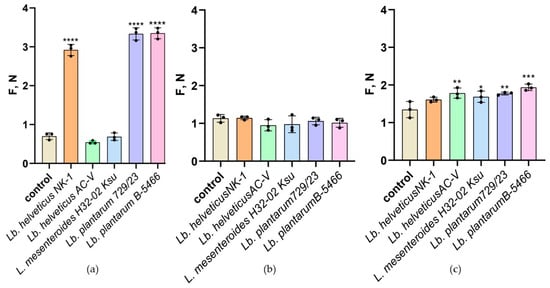
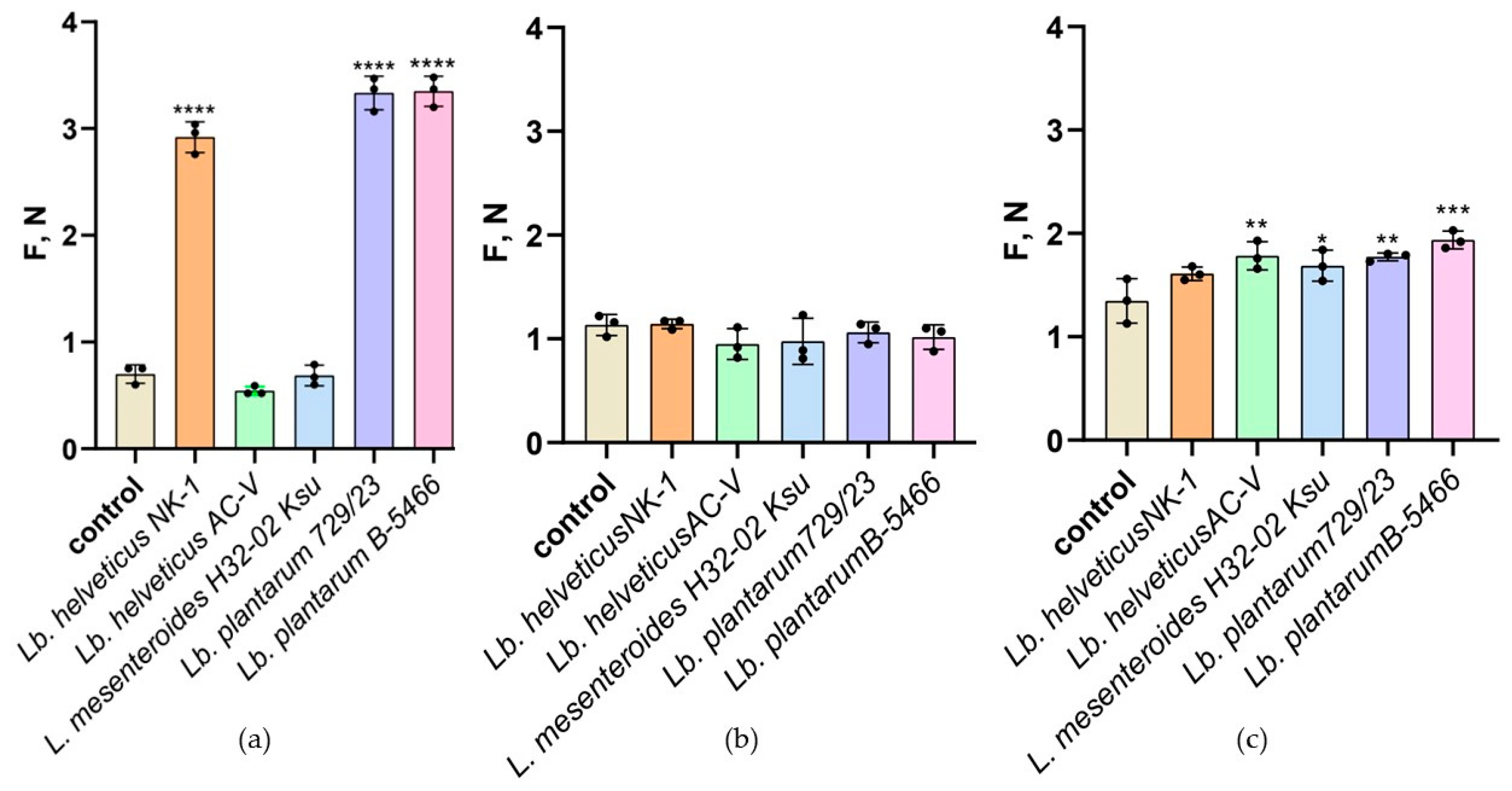
The evaluation of the rheological properties of fermented cashew paste revealed statistically significant differences in firmness depending on the bacterial strain used (Figure 1). Firmness was assessed by compression force, expressed in Newtons (N). The results demonstrate a clear separation of the tested strains into two groups according to their ability to modify the structural characteristics of the product.
Figure 1.
Comparative evaluation of the firmness of fermented cashew paste (a), sunflower seed paste (b), and soy paste (c) obtained using different strains of lactic acid bacteria. Data are presented as mean ± SD. * p < 0.05, ** p < 0.01, *** p < 0.001, and **** p < 0.0001 by Dunnett’s post hoc test for significant one-way ANOVA data.
In fermented cashew paste (a), the highest firmness values were observed in samples inoculated with Lb. plantarum B-5466 (3.35 ± 0.141 N, p < 0.0001), Lb. plantarum 729/23 (3.33 ± 0.158 N, p < 0.0001), and Lb. helveticus NK-1 (2.92 ± 0.144 N, p < 0.0001). These values were significantly greater than those of the control group (0.7 ± 0.086 N), underscoring the pronounced capacity of these strains to foster a dense protein matrix. In contrast, Lb. helveticus AC-V (0.54 ± 0.04 N, p = 0.3916) and L. mesenteroides H32-02 Ksu (0.68 ± 0.096 N, p = 0.9998) exhibited no substantial hardening effect, with firmness levels statistically indistinguishable from the control.
These findings affirm that the selection of starter strain constitutes a pivotal factor in dictating the textural attributes of fermented cashew paste. Notably, Lb. plantarum B-5466 and Lb. plantarum 729/23 emerge as the most promising candidates for the deliberate engineering of products with tailored rheological profiles.
The evaluation of the rheological properties of fermented sunflower seed paste (b) showed that none of the tested strains resulted in a significant increase in firmness compared to the control sample (1.13 ± 0.102 N).
In contrast, Lb. plantarum B-5466 (1.01 ± 0.119 N, p = 0.7352), L. mesenteroides H32-02 Ksu (0.97 ± 0.223 N, p = 0.5015), Lb. plantarum 729/23 (1.06 ± 0.1 N, p = 0.9482), and Lb. helveticus AC-V (0.95 ± 0.147 N, p = 0.3657) exhibited a tendency toward reduced firmness compared with the control group. The results obtained with Lb. helveticus NK-1 (1.14 ± 0.046 N, p = 0.9999) were closest to the control. However, as evident from the data, the variability among replicates was considerable, and confidence intervals overlapped broadly. This indicates the absence of statistically significant differences among most of the tested samples.
Thus, unlike the pronounced effects observed in cashew paste, fermentation with the same strains did not lead to any significant modification of the structural characteristics of sunflower seed paste under the conditions of this experiment.
The evaluation of the rheological properties of fermented soybean paste (c) revealed a statistically significant influence of microbial strains on the firmness characteristics of the product. As shown by the results, tested strains significantly increased the firmness of soybean paste compared to the control (1.34 ± 0.215 N).
The most pronounced strengthening effect was observed for strains Lb. helveticus AC-V (1.78 ± 0.136 N, p = 0.0057), Lb. plantarum B-5466 (1.93 ± 0.86 N, p = 0.0005), and Lb. plantarum 729/23 (1.77 ± 0.037 N, p = 0.0067). A significant, albeit less marked, increase in firmness was also recorded for L. mesenteroides H32-02 Ksu (1.68 ± 0.15 N, p = 0.0287). Conversely, the firmness value for the strain Lb. helveticus NK-1 (1.61 ± 0.065 N, p = 0.1015) did not exhibit a statistically significant difference from the control.
Thus, it was established that fermentation with lactic acid bacteria is an effective approach for modifying the structural characteristics of soybean paste.
Visible gas formation was observed in the majority of samples during fermentation, as indicated by partial biomass extrusion from cultivation molds. However, this effect was not universal: gas release was not detected in several cashew-based samples, specifically those fermented with Lb. helveticus NK-1, Lb. plantarum 729/23, and Lb. plantarum B-5466. Notably, these same samples, those in which no visible gas release was observed, exhibited the highest firmness values among all tested combinations (2.92 ± 0.144 to 3.35 ± 0.141 N), whereas samples that showed gas extrusion demonstrated considerably lower firmness (0.54 ± 0.04 to 1.93 ± 0.86 N). This indicates that gas formation during fermentation is associated with a looser and less structured matrix.
Although gas formation was assessed using a semi-quantitative criterion (more than 10% biomass displacement from the syringe mold), this approach allowed for consistent classification of samples into two distinct groups: with or without visible gas release. Importantly, samples categorized as “non-gassy” did not exhibit any noticeable extrusion, not even below the threshold, indicating a true absence of visible gas formation.
3.2. Acidifying Ability of Strains During Fermentation of Plant Substrates
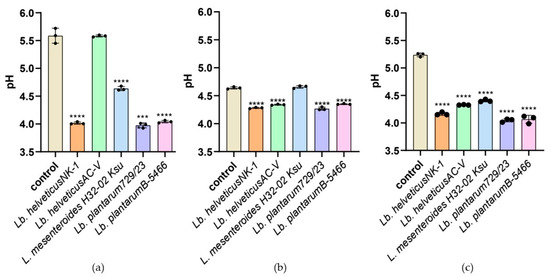
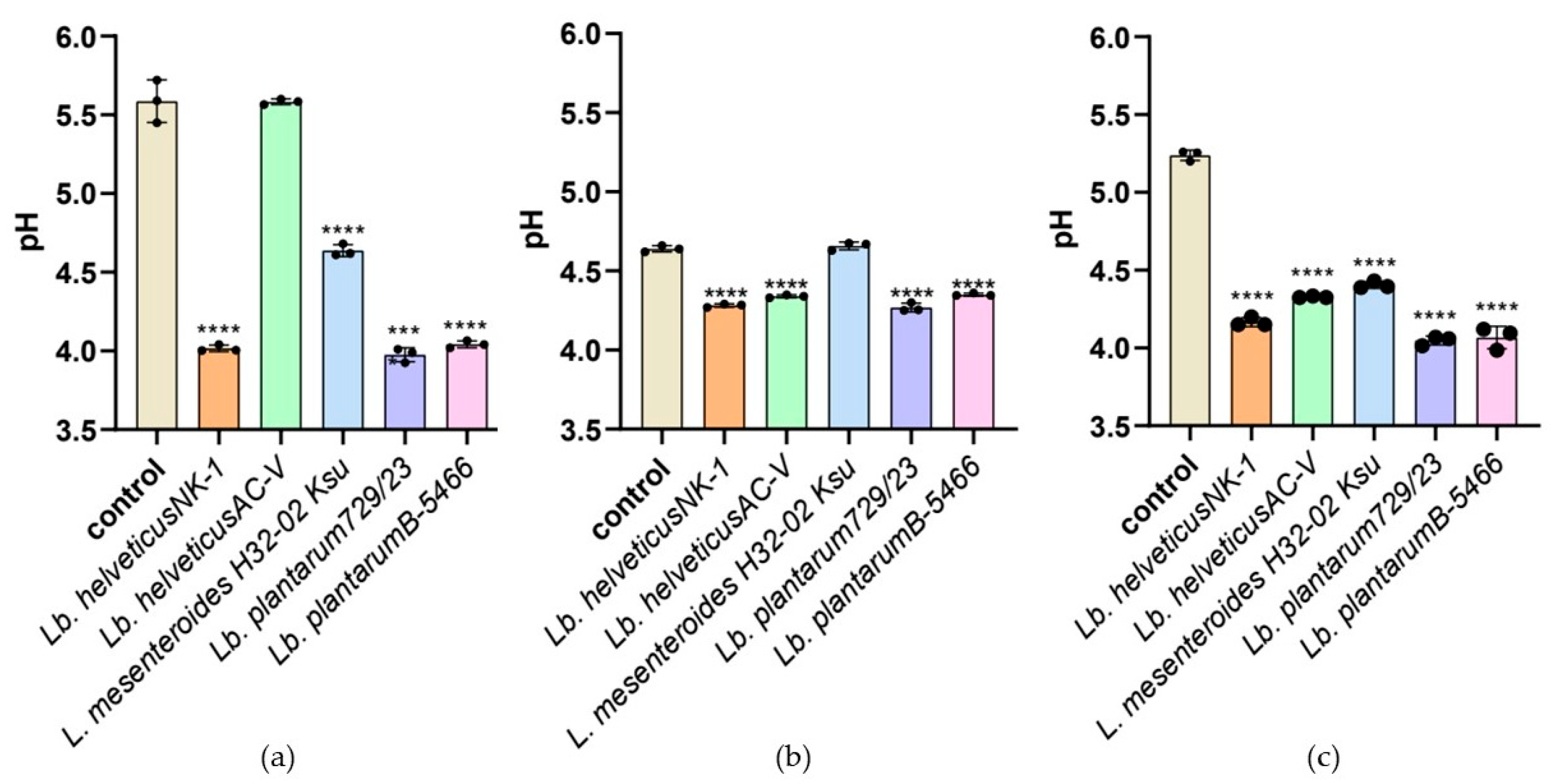
In addition to rheological characteristics, changes in acidity (pH) during fermentation of cashew paste with different microbial strains were investigated (Figure 2).
Figure 2.
The effect of fermentation by different microbial strains on the final pH value of cashew (a), sunflower (b), and soybean plant pastes (c). Data are presented as the mean ± SD. *** p < 0.001, **** p < 0.0001 by Dunnett’s post hoc test for significant one-way ANOVA data.
Analysis of the final pH values during fermentation of cashew paste (a) with various microbial strains revealed substantial acidification of the substrate compared to the control sample (pH 5.59 ± 0.14).
The obtained data allowed for the investigated strains to be clearly divided into two groups according to their acidifying capacity on this substrate.
The first group, which demonstrated the most pronounced acidification, included Lb. helveticus NK-1, Lb. plantarum 729/23, and Lb. plantarum B-5466. The final pH values in these samples were 4.02 ± 0.02 (p < 0.0001), 3.98 ± 0.04 (p < 0.0001), and 4.04 ± 0.02 (p < 0.0001), respectively.
The second group, represented by Lb. helveticus AC-V and L. mesenteroides H32-02 Ksu, was characterized by much weaker acidification. The final pH for Lb. helveticus AC-V was 5.58 ± 0.02 (p > 0.9999), which was nearly identical to the initial level, whereas L. mesenteroides H32-02 Ksu reached 4.64 ± 0.04 (p < 0.0001).
Thus, it was established that Lb. helveticus NK-1, Lb. plantarum 729/23, and Lb. plantarum B-5466 exhibit high fermentative activity toward cashew paste, as reflected in the substantial decrease in pH, while Lb. helveticus AC-V and L. mesenteroides H32-02 Ksu displayed a low acidification capacity under the tested conditions.
For sunflower seed paste (b), changes in pH during fermentation were investigated in parallel with the assessment of rheological characteristics. Analysis of the data revealed statistically significant acidification of the substrate in experimental samples compared to the control (pH 4.64 ± 0.02).
The strongest acidification capacity was observed for Lb. plantarum 729/23 and Lb. helveticus NK-1, with final pH values of 4.27 ± 0.03 (p < 0.0001) and 4.28 ± 0.01 (p < 0.0001), respectively. Slightly less pronounced, but still statistically significant, acidification was detected in samples fermented with Lb. plantarum B-5466 (4.35 ± 0.01, p < 0.0001) and Lb. helveticus AC-V (4.34 ± 0.01, p < 0.0001). Conversely, the final pH value for the sample fermented with L. mesenteroides H32-02 Ksu (4.66 ± 0.03, p = 0.6369) showed no statistically significant difference from the control.
In soybean paste, changes in acidity (pH) during fermentation were also investigated (c). The results demonstrated statistically significant acidification in all experimental samples compared to the control (pH 5.24 ± 0.03).
Analysis of the final pH values revealed a clear differentiation of the tested strains according to their acidification capacity in the soybean substrate. The most pronounced effect was observed for Lb. plantarum 729/23, which reached a pH of 4.05 ± 0.03 (p < 0.0001). Lb. plantarum B-5466 (4.07 ± 0.07, p < 0.0001) and Lb. helveticus NK-1 (4.17 ± 0.03, p < 0.0001) also demonstrated strong acidification activity. Moderate acidification capacity was recorded for Lb. helveticus AC-V and L. mesenteroides H32-02 Ksu, with final pH values of 4.33 ± 0.01 (p < 0.0001) and 4.41 ± 0.02 (p < 0.0001), respectively.
3.3. Analysis of Pearson Correlation Coefficients
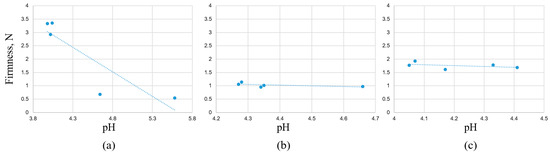
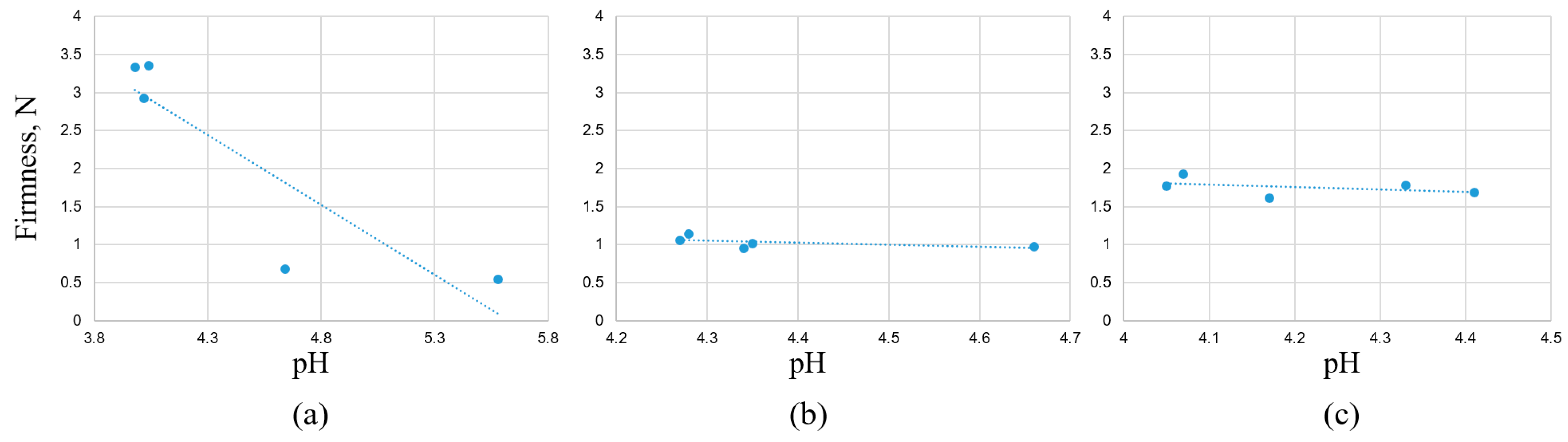
In the analysis of the relationship between final pH and the strength of fermented samples across different substrates, a general trend was observed: lower pH values were associated with higher gel strength. This effect was most pronounced in the cashew matrix, with a strong negative correlation (r ≈ –0.88), while soy and sunflower seed substrates showed weaker associations (r ≈ –0.43 and –0.55, respectively).
It should be noted that the correlation analysis has inherent limitations, as each strain was represented by a single averaged value, and the dataset is therefore discrete and small in size. These results should thus be interpreted cautiously. Nonetheless, the observed trend aligns with established concepts regarding the role of acidity in protein gelation and supports the hypothesis that pH reduction represents a critical determinant of the textural properties of plant-based substrates.
3.4. Total Microbial Load of Raw Plant-Based Substrates
The MPN in the studied plant substrates varied in the range from 2.5 × 10² to 3.1 × 10⁴ CFU/g depending on substrate. In the cashew paste, the MPN was 2.5 × 10² CFU/g, indicating a low initial level of microbial contamination. In the sunflower seed paste, this value was an order of magnitude higher, at 2.5 × 10³ CFU/g, while the soybean paste had the highest level of contamination (3.1 × 10⁴ CFU/g).
3.5. Milk Fermentation and Final pH
Fermentation of ultra-pasteurized milk with the tested LAB strains for 24 h at 37 °C resulted in a substantial decrease in pH.
The initial pH of milk (6.70) decreased to a range of 3.48–4.82 depending on the strain used, corresponding to pH changes (ΔpH) of 1.88 to 3.22 units. The highest acidifying activity was demonstrated by Lb. helveticus NK-1 (final pH 3.48; ΔpH 3.22) and Lb. helveticus AC-V (final pH 3.57; ΔpH 3.13). L. mesenteroides H32-02 Ksu showed intermediate activity (final pH 3.86; ΔpH 2.84), whereas the Lactiplantibacillus strains exhibited more moderate acidification: Lb. plantarum 729/23 (ΔpH 2.09) and Lb. plantarum B-5466 (ΔpH 1.88).
3.6. Dynamic Viscosity of Fermented Milk
The dynamic viscosity of fermented milk varied widely from 33.4 to 107.0 mPa·s, demonstrating substantial strain-specific differences in structuring capacity.
The highest viscosity was achieved by Lb. plantarum 729/23 (107.0 mPa·s), followed by Lb. helveticus NK-1 (102.0 mPa·s). Moderate viscosity values were observed for Lb. plantarum B-5466 (84.0 mPa·s), whereas Lb. helveticus AC-V (37.1 mPa·s) and Leuconostoc mesenteroides H32-02 Ksu (33.4 mPa·s) produced samples with the lowest viscosity.
Analysis of the relationship between acidification and viscosity revealed no direct correlation between these parameters. Strains exhibiting strong acidification (ΔpH > 2.5) showed varying abilities to induce textural changes, with only Lb. helveticus NK-1 combining intensive acidification with high product viscosity.
3.7. Proteolytic and Amylolytic Activities of the Strains
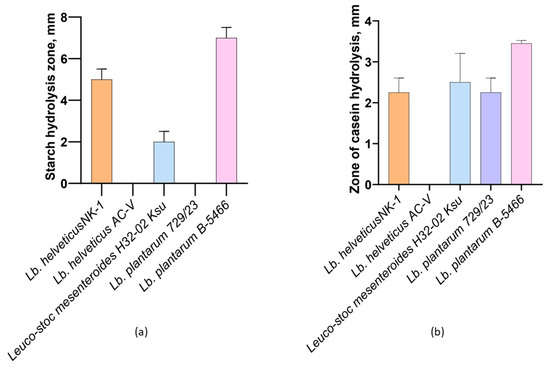
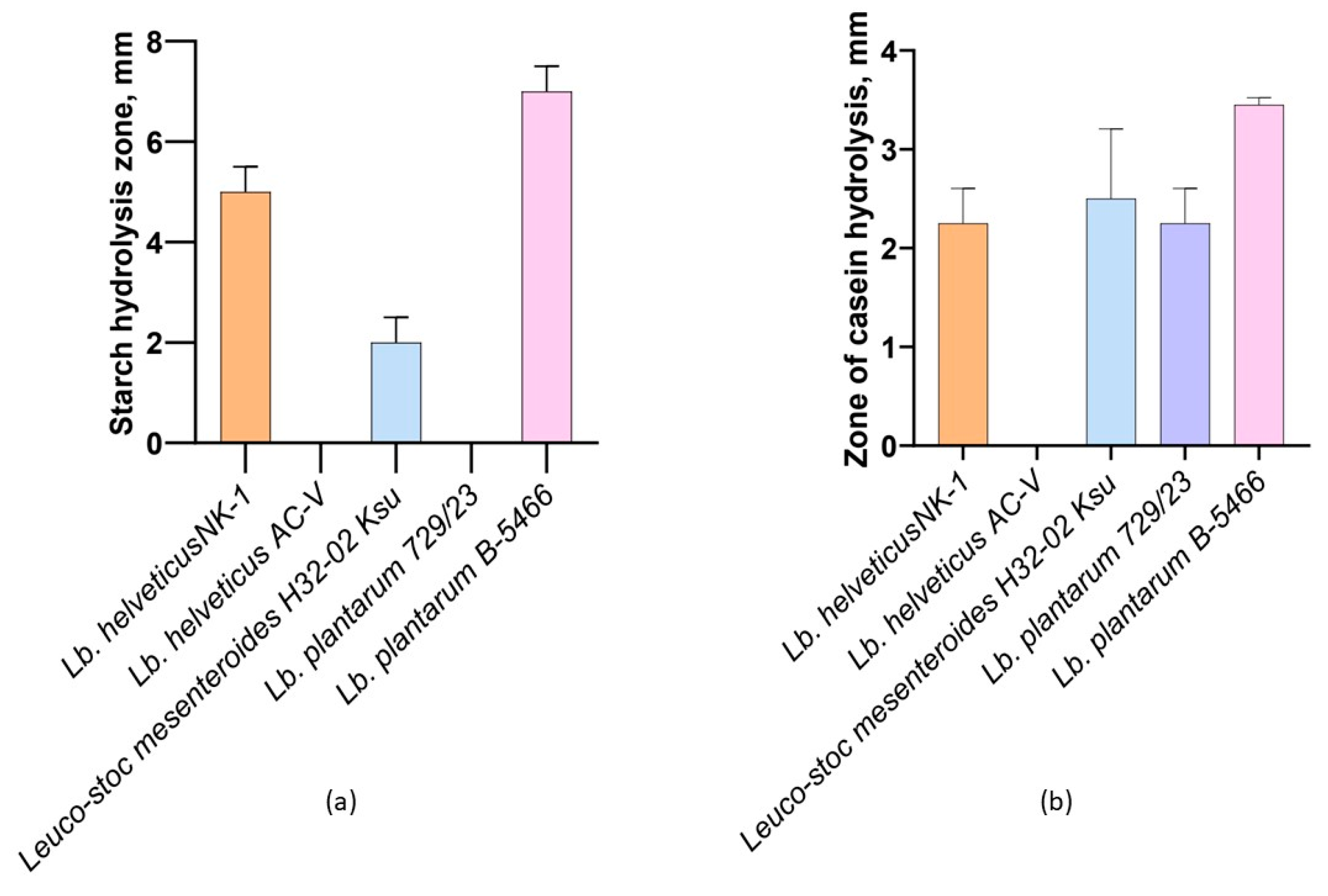
Screening for extracellular enzymatic activities revealed substantial differences in functional profiles among the tested strains (Figure 3). Proteolytic activity was detected in four out of five strains, with clearing zone diameters ranging from 2.25 to 3.50 mm.
Figure 3.
Widths of the enlightenment zones when assessing amylolytic (a) and proteolytic activities (b).
The highest proteolytic activity was demonstrated by Lb. plantarum B-5466 (3.50 ± 0 mm), followed by L. mesenteroides H32-02 Ksu (2.50 ± 0.50 mm), Lb. helveticus NK-1, and Lb. plantarum 729/23 (both 2.25 ± 0.25 mm). Lb. helveticus AC-V exhibited no proteolytic activity under the experimental conditions.
Amylolytic activity was detected in three out of the five tested strains.
The highest starch-hydrolyzing capacity was demonstrated by Lb. plantarum B-5466, with an average clearing zone of 7.0 ± 0.33 mm, followed by Lb. helveticus NK-1 with a hydrolysis zone of 5.00 ± 0.33 mm. Moderate amylolytic activity was observed in L. mesenteroides H32-02 Ksu (2.00 ± 0.33 mm). Lb. helveticus AC-V and Lb. plantarum 729/23 showed no detectable amylolytic activity under the tested conditions.
4. Discussion
The obtained results demonstrate a clear relationship between the acidifying capacity of the strains and the rheological properties of the fermented cashew paste (Figure 4). The highest firmness values were recorded for strains that provided the most significant pH reduction (Lb. plantarum 729/23, Lb. plantarum B-5466, and Lb. helveticus NK-1). The Pearson correlation coefficient, calculated with the corresponding assumptions, was −0.88. This suggests that the key mechanism of texture formation in this case is the acid-induced denaturation of cashew proteins, leading to the formation of a dense coagulated network. An exception was the strain Lb. helveticus AC-V, which, despite moderate acidification, did not induce gel strengthening. Therefore, the development of cashew-based products with a defined dense texture requires strains possessing high and consistent acidifying activity.
Figure 4.
The dependence of the firmness of the gel obtained through fermentation of vegetable mass on the final pH: cashew (a), sunflower (b), and soybean plant pastes (c).
Fermentation of the sunflower seed paste revealed a fundamentally different pattern compared to cashew. Despite statistically significant acidification by all tested strains, none resulted in a substantial increase in gel strength compared to the control. This substrate-specific limitation can be attributed to several intrinsic factors of sunflower seeds. Firstly, the inability of sunflower protein to form a strong gel under the conditions of our fermentation protocol can be attributed to its poor intrinsic gelling properties, which are critically dependent on high temperature denaturation. As comprehensively reviewed by González-Pérez and Vereijken, gel formation by globular proteins like helianthinin, the main sunflower storage protein, is a complex process requiring denaturation, aggregation, and network formation, with denaturation typically achieved by heating [31]. Sunflower protein isolates are known for their weak gelling capacity, forming irregular, foamy structures with low mechanical strength even in concentrated dispersions. A direct comparison highlights this limitation: a 10% (w/v) sunflower protein isolate dispersion forms a very weak gel with a storage modulus (G′) of only about 500 Pa after heating and cooling, whereas a similar soy glycinin dispersion achieves a G′ above 5000 Pa under identical conditions [31,32]. A key reason is that the denaturation temperature of sunflower protein isolate is approximately 100 °C, meaning that significant denaturation does not occur below this threshold [33]. Notably, some studies report that gelation may not occur even when heating to 110 °C [34]. This explains the observed lack of firmness increase despite active acidification in our experiment. The pH shift alone was insufficient to overcome the innate poor gelling functionality of non-thermally denatured sunflower proteins. Secondly, the major storage proteins in sunflower, helianthinin and 2S albumins, exhibit isoelectric points in a relatively broad and alkaline range (pI ~5.0–8.8), which is notably higher than the pH achieved during lactic fermentation (4.27–4.66) [31,35]. Thirdly, sunflower seeds contain significant amounts of phenolic compounds, primarily chlorogenic acid, which can constitute 1–4% of the kernel weight [36]. Polyphenols are known to reduce the gel strength of sunflower seed protein isolates [37]. Therefore, for modifying the texture of sunflower pastes, a strategy based solely on biological acidification is insufficient and necessitates the search for additional technological approaches (e.g., protein isolation, use of texture-modifying enzymes, or blending with other plant proteins) or strains with alternative modes of action.
The results of soybean paste fermentation confirmed the efficacy of biological acidification for modifying its rheological properties, yet revealed a more complex dependency. All strains significantly increased the paste’s firmness, with the most pronounced effect demonstrated by Lb. plantarum B-5466 and Lb. helveticus AC-V. However, a direct correlation with the pH level was not absolute: the strain Lb. plantarum 729/23, which showed the greatest pH reduction, did not form the firmest texture. This indicates that in the case of soy protein, alongside acid denaturation, other factors also contribute significantly to texture formation.
Lactic fermentation reduces substrate pH to approach protein isoelectric points (pI), facilitating protein precipitation and enhancing substrate firmness. Cashew proteins exhibit pI values at pH 3.0 and 5.0 [38,39], with optimal precipitation at pH 4.0–4.5 [39]. Soybean proteins demonstrate optimal isoelectric precipitation at pH 4.5, with acid precipitation at this pH resulting in distinct effects on protein composition and functional properties compared to precipitation at pH 3.5 or 5.5 [40]. Sunflower seed proteins display pI ranges from pH 4.1 to 5.6, varying by protein fraction [41]. Lactic acid bacteria used in our study effectively target these critical pH ranges, with the majority of strains achieving pH values below 4.5 necessary for protein coagulation. This pH reduction enables formation of protein networks that enhance firmness while maintaining functional properties in fermented plant-based products.
Texture profile analysis (TPA) is a standard method used to characterize the mechanical behavior of food gels by simulating the action of chewing. It typically provides multiple parameters, including firmness, cohesiveness, springiness, gumminess, and chewiness, which together describe the texture and mouthfeel of the product. In the present study, we focused exclusively on the firmness parameter, defined as the peak force during the first compression cycle, as a primary indicator of gel strength.
This decision was based on the exploratory nature of the current work, which aimed to identify promising combinations of plant-based substrates and LAB strains capable of forming dense, self-supporting gels suitable for further development as plant-based cheese analogs. At this screening stage, firmness alone was sufficient to differentiate between successful and unsuccessful fermentations. In subsequent stages, once optimal substrate–strain pairs are selected, full TPA profiling will be performed to evaluate additional textural properties relevant to sensory quality and product acceptability.
To account for the potential influence of structural heterogeneity introduced by gas formation, we adapted our firmness assessment protocol. Prior to measurement, the fermented material was gently extruded from the syringe mold to allow for gas release and permit collection of a cohesive portion of the matrix. From this portion, a representative sample was excised for texture analysis. While this approach enabled standardized sampling across replicates, we acknowledge that gas-induced porosity and fragmentation could introduce some variability, and firmness values obtained from such samples should be considered indicative rather than absolute.
It is important to emphasize, however, that gas-forming samples were not considered viable candidates for further development as plant-based cheese products. Gas production in these cases was likely the result of native microbiota activity not sufficiently suppressed by the added LAB strains. Given the importance of structural uniformity and visual quality in cheese analogs, strains that failed to prevent excessive gas formation were categorically excluded from consideration at this stage. Accordingly, although we reported firmness values for such samples, the primary reason for their exclusion was gas production itself. Texture measurements in this context primarily served to reinforce the functional inadequacy of these fermentations, highlighting the lack of gel formation in addition to their structural instability.
Comprehensive sensory evaluation, including the assessment of texture, mouthfeel, and flavor acceptability, will be addressed in the next stage of formulation development, where selected strains will be evaluated under refined processing conditions.
Direct comparison of published data, however, is complicated by considerable methodological heterogeneity. Tests have been conducted at different temperatures, on samples of varying dimensions, and using a wide range of deformation rates and compression levels (20–80% of the original sample height) [12,42,43]. Moreover, even within the same research groups, distinct protocols have been applied in separate publications [13,44]. As a result, reported values are not always directly comparable and must be interpreted with caution.
Nevertheless, ranges can be delineated from the literature. For dairy cheeses, firmness values span from 4–5.8 N in soft varieties such as Camembert and Mozzarella to ~69 N in Emmental and 74.9–126.8 N in Cheddar [12,43]. Plant-based analogs exhibit an even broader spectrum, ranging from 4.4–5.7 N in cashew- and soy-based products (tofu) to ~90 N in formulations incorporating refined coconut oil and starch [43]. Cheddar-type analogs have been reported with values of 56.7–101.9 N [12], high-protein cheeses based on fava bean protein with 16.1–76.4 N [12], and soy–starch formulations with 89.8–116.6 N [45]. Collectively, these data show that plant-based products range from very soft matrices to textures approaching those of semi-hard dairy cheeses.
In contrast, the values obtained in the present study were markedly lower, ranging from 0.54 to 3.35 N. These values are an order of magnitude below those reported for most plant-based analogs. The discrepancy is likely attributable to differences in formulation and processing. Whereas the majority of studies describe multi-component formulations containing starch, hydrocolloids, and vegetable fats prepared without microbial fermentation, our approach employed raw substrates fermented by lactic acid bacteria. The absence of structuring additives and the reliance on microbial activity alone may account for the lower gel firmness observed.
The work most comparable in methodology is that of Masiá et al. (2023) [13], in which pea protein isolate gels fermented with different bacterial blends exhibited firmness values of 3.5–7 N. In our study, the maximum firmness, achieved with cashew fermentation, was 3.33–3.35 N. Differences can be attributed to the composition of the substrate (pea protein isolate supplemented with sunflower oil, glucose, and sucrose in Masiá’s study), the bacterial consortia employed, and longer ripening of the analogs.
It is well established that the firmness of various cheeses, both dairy-based and plant-based, increases during the maturation process [46,47,48].
For instance, studies by Łopusiewcz et al. demonstrated that the firmness of a plant-based Camembert alternative made from lupin seeds increased from ∼2.02 N to ∼15.8 N after 7 days of ripening [49], while a similar product made from flaxseed increased from ∼2.1 N to ∼3.66 or ∼5.37 N, depending on the fungal component used [50].
Accordingly, the firmness values we obtained for cashew-based samples were comparable to the initial values observed in lupin- or flaxseed-based Camembert alternatives without additional structuring ingredients, suggesting potential for further improvement during the ripening stage of the final product.
In our study, we focused exclusively on the initial 24 h incubation phase, as the goal of this study was to elucidate the relationship between the firmness properties of plant-based cheeses and the key metabolic traits of bacterial strains used as starters, including acidification, viscosity, and proteolytic and amylolytic activities.
Closer examination of individual substrates highlights the decisive influence of raw material composition and processing parameters on gel firmness.
For cashew, our results (3.33–3.35 N) were lower than those reported by Campos et al. (2024), who observed 6.0–9.7 N in cashew-based analogs compressed to 20% of sample height [42]. The higher values may be explained by the inclusion of red seaweed, differences in microbial cultures, and alternative fermentation conditions (temperature and duration), all of which can promote a denser structure. Our cashew-based gels, in contrast, represent a softer variant, which is consistent with a formulation lacking external stabilizers.
A similar trend was observed for soy. In the classic study of Yang & Taranto (1982) [51], mozzarella-type analogs prepared from soy protein isolate with gelatin and other additives exhibited firmness values of 6.8–12.8 N, whereas our soy-based gels yielded only 1.61–1.93 N. The absence of texturizing agents and the higher moisture content of our samples likely account for this difference. The negative correlation between water content and firmness is well established for both dairy and plant-based cheeses [42,52] and the higher hydration of the soy substrate in our experiments is expected to have markedly reduced firmness.
For sunflower seeds, virtually no data on cheese-like products are available. However, it is well known that polyunsaturated lipid content negatively correlates with the firmness of both cheese analogs and other food matrices [42]. This relationship has also been demonstrated in dough systems, where sunflower oil produced the softest textures [53]. Our results for fermented sunflower seeds (0.95–1.14 N) are consistent with these expectations, supporting the interpretation that the low firmness of sunflower-based products is determined by their lipid composition.
Overall, the comparative analysis suggests that the low firmness of our samples results from both the absence of starch-based stabilizers and the intrinsic properties of the raw substrates: cashew and soy are characterized by high water content and the presence of unsaturated fats, whereas sunflower additionally contains elevated levels of polyunsaturated lipids, which hinder the formation of a dense protein matrix.
Cashew showed particularly encouraging performance in our experiments. Even without any additional structuring agents, and immediately after fermentation, the simple combination of cashew paste and bacterial cultures reached firmness values of ~3.3 N. This demonstrates that a clean-label substrate can already develop measurable firmness within a short time frame. Considering that previous studies reported values of 6–10 N only after supplementing the matrix with hydrocolloids or subjecting it to extended ripening, our results indicate substantial potential for further improvement. With appropriate strain selection and/or a short maturation period, cashew-based products potentially could achieve textural properties comparable to soft dairy cheeses while retaining a minimal-ingredient formulation.
In traditional cheese and dairy production, mild pasteurization is commonly applied to ensure the suitability of milk for coagulation and to reduce the microbial load of the raw material. Studies on the production of plant-based dairy alternatives also often employ pasteurization or autoclaving, although this is mostly the case for products made from protein isolates and involving emulsification steps [54,55,56,57]. Dense plant-based pastes derived from nuts, seeds, or legumes—as opposed to liquid plant “milks” or emulsified protein systems—are difficult to pasteurize or sterilize evenly under laboratory conditions without substantially altering their structure and nutritional properties. Moreover, methods ensuring complete sterility (e.g., autoclaving) are generally unsuitable for industrial applications due to high energy consumption and potential deterioration of product quality. This is particularly relevant in the context of “clean-label” product development, where minimal processing and the absence of artificial additives are prioritized.
In studies using homemade nut pastes as the starting material, hot water blanching is commonly applied after soaking [42,58]. According to the Fermented Foods Guideline (Plant-based Cheese) [59], blanching nuts in boiling water (≥90 °C for 2 min) is considered sufficient to achieve a 5-log reduction in Salmonella prior to soaking, blending, and fermentation.
It is well established that plant raw materials are often contaminated with spore-forming bacteria such as Bacillus spp. and Clostridium spp., which are resistant to mild thermal treatments [60] and may germinate during storage, leading to uncontrolled fermentation and product spoilage.
Lactic acid bacteria are widely used as biopreservation agents that inhibit the growth of undesirable microbiota. The addition of LAB strains such as Latilactobacillus sakei, Lacticaseibacillus casei, Lactiplantibacillus plantarum, and Leuconostoc mesenteroides—all of which possess QPS (Qualified Presumption of Safety) status [61]—has been shown to inhibit pathogens including Listeria monocytogenes, Salmonella sp., and E. coli O157:H7, as well as spoilage organisms such as Pseudomonas sp. and Enterobacteriaceae [62]. Incorporating LAB into plant-based products enables the suppression of undesirable microbiota through substrate competition and production of antimicrobial metabolites. Recent studies have demonstrated the effectiveness of LAB in extending the shelf life and enhancing the microbiological safety of meat analogs [63,64,65,66].
In strictly controlled laboratory experiments, substrate sterilization is often standard practice for isolating the effects of the inoculated strains. However, the aim of our study was to simulate conditions that closely resemble real-world industrial fermentation of plant substrates, where complete sterilization is economically and technologically impractical. This approach allows for an evaluation of strain performance in a competitive environment that includes natural microbiota, which is more representative of actual production settings. To account for the possible influence of native microbiota on the fermentation process, we included parallel control samples without LAB inoculation, incubated under identical conditions (i.e., the same temperature and time). This setup was designed to assess whether inoculation performs better than spontaneous fermentation in terms of acidity and texture development.
The results of acidity and texture measurements in the control samples were analyzed and compared to those of the inoculated variants (Figure 4). We observed that in the absence of the added strains, acidification and gel formation occurred to a much lesser extent or were not observed at all. Specifically, the strength of control samples was 0.7 ± 0.086 N (cashew, pH = 5.59 ± 0.14), 1.13 ± 0.102 N (sunflower, pH = 4.64 ± 0.02), and 1.34 ± 0.215 N (soy, pH = 5.24 ± 0.03). The limited texturization and weak or absent acidification in the control samples confirm that the observed gel structure and pH reduction in the tested substrates were primarily due to the metabolic activity of the inoculated LAB, not the native microbiota. These findings support the dominant role of the added cultures in shaping the final properties of the product. Therefore, the use of non-sterile but controlled substrates combined with parallel controls allowed us to reliably assess the contribution of inoculated LAB strains while maintaining the relevance of the experiments for potential industrial application.
We also evaluated the total microbial load of the initial plant pastes. The total microbial number of LAB inoculated into the substrates was ~1 × 10⁷ CFU/g, which exceeded the native microbiota levels by 3–5 orders of magnitude. Of course, when developing the final product—a cashew-based cheese analog—it will be essential to monitor the presence of both pathogenic and spoilage spore-forming microorganisms in the raw material and final product, and to select an appropriate treatment method for the nut base. We propose that mild thermal processing combined with LAB fermentation could eliminate the need for additional preservatives to control undesirable microbiota, which is especially important for clean-label formulations.
One of the goals of this study was to assess whether conventional technological characteristics of lactic acid bacteria, routinely used in dairy fermentation, could be repurposed to predict their functional performance in plant-based substrates. Such an approach is highly relevant for the development of clean-label plant-based cheese alternatives, where rapid and cost-effective screening of large LAB strain libraries is often necessary.
To this end, we evaluated the strains using two complementary strategies: (1) fermentation performance in milk, a well-established model matrix for assessing acidification and viscosity development, and (2) enzymatic activity on agar-based model systems (proteolysis and amylolysis), commonly used to characterize LAB functional potential in standardized conditions.
Fermentation of milk allowed us to measure final pH and dynamic viscosity—two parameters directly associated with acidifying ability and texture-forming potential in dairy contexts. Our results showed that the final pH in milk did not strongly correlate with acidification or structural outcomes in cashew-based matrices. For instance, Lb. plantarum 729/23 and B-5466 displayed relatively mild acidification in milk but achieved the lowest pH values and highest firmness in cashew paste. Conversely, Lb. helveticus NK-1, which showed the most pronounced acidification in milk (pH 3.48), also performed well in cashew, suggesting that pH in milk alone may not be a reliable predictor of performance across diverse plant substrates.
In contrast, milk viscosity demonstrated a clearer relationship with cashew matrix structuring. The two strains with the highest viscosity in fermented milk—Lb. plantarum 729/23 and Lb. helveticus NK-1—were also the ones that produced the firmest cashew gels (over 3 N). Strains with low milk viscosities, such as L. mesenteroides H32-02 Ksu and Lb. helveticus AC-V, failed to generate significant gelation in cashew. This suggests that milk viscosity may serve as a practical screening criterion for selecting strains with texture-forming potential in nut-based substrates.
To further explore functional differentiation, we also assessed the enzymatic activity profiles of the strains using agar-based model systems. While we acknowledge the limitations of these assays—their inability to replicate the complex macromolecular environment of real food matrices—the goal was not to draw direct mechanistic conclusions, but to test whether enzymatic capacity assessed under standardized conditions could reflect substrate-specific performance.
Strikingly, all three strains that demonstrated proteolytic activity on milk agar (Lb. plantarum 729/23, Lb. plantarum B-5466, and Lb. helveticus NK-1) were also the only ones to successfully structure the cashew matrix into firm gels. This consistency suggests that proteolytic potential, even when measured in simplified conditions, may be a relevant marker for predicting structuring behavior in nut-based substrates. No such relationship was observed for amylolytic activity, indicating that starch degradation capacity did not influence textural outcomes in the tested matrices.
Together, these findings suggest that traditional dairy-based screening parameters—particularly milk viscosity and proteolytic activity—may offer preliminary predictive value when selecting LAB strains for plant-based cheese applications. While the correlations were identified within a limited strain panel, they offer a foundation for future high-throughput studies. Such studies could validate the utility of these markers and streamline the selection of promising strains for fermentation trials in complex plant matrices.
Ultimately, integrating predictive screening tools with targeted plant–substrate evaluations may help reduce the reliance on full factorial fermentation trials and accelerate the development of high-quality, clean-label plant-based dairy alternatives.
5. Conclusions
In the evaluation of the mechanical properties of fermented plant substrates, significant strain-dependent modulation of firmness was observed. Cashew paste fermented with Lactiplantibacillus plantarum 729/23 and Lacticaseibacillus helveticus B-5466 and NK-1 strains exhibited markedly higher firmness (2.92–3.35 N) than the control (0.70 ± 0.09 N), indicating robust protein network formation, whereas Lacticaseibacillus helveticus AC-V (0.54 ± 0.04 N) and Leuconostoc mesenteroides H32-02 Ksu (0.68 ± 0.10 N) showed no strengthening effect. Sunflower seed paste displayed no significant firmness enhancement across all strains, with values comparable to control (1.13 ± 0.10 N) and with wide confidence intervals. Conversely, soybean paste firmness moderately increased for all strains (1.77–1.93 N) versus control (1.34 ± 0.22 N). These results underscore the critical influence of strain selection on the texturizing capacity of fermented plant substrates.
This study demonstrates that the formation of a firm plant-based curd can be achieved using only cashew paste and starter cultures, without the need for stabilizers or structuring additives. Within just 24 h of fermentation, firmness values comparable to soft cheese analogs were obtained, highlighting the potential of this approach for the development of clean-label products. These findings open opportunities for further optimization: the selection of strains with high texturing capacity, the incorporation of additional natural ingredients, and variations in processing and ripening conditions could further enhance firmness and improve sensory characteristics. The results also indicate that a similar strategy may be applicable to soybean substrates, provided that moisture content is carefully controlled.
Sunflower seeds did not form a dense curd; microbial fermentation nevertheless occurred, as evidenced by pH reduction by all tested strains. This observation suggests that combining different plant substrates may help balance the nutritional composition and confer textural properties closer to those of traditional dairy cheeses.
It is important to emphasize that the approach presented here relies specifically on microbial fermentation. In contrast to most current plant-based cheese analogs, which are typically blends of starch, fats, and hydrocolloids, the product obtained in this study is formed through the natural activity of microorganisms. This makes it closer to the classical principles of cheesemaking and opens new avenues for the development of fermented plant-based products.
Future work should focus on (1) optimizing sterilization conditions, fermentation parameters (time, temperature, inoculum size) and post-fermentation ripening for each successful substrate–strain pair; and (2) investigating blends of plant substrates (e.g., cashew with soy) to improve nutritional balance and texture.
Key challenges for industrial implementation include (1) Scalability and cost-effectiveness: transitioning from laboratory-scale fermentation in syringes to large vats while maintaining texture and preventing phase separation; (2) Process control: developing reliable biomarkers (e.g., specific pH endpoints, metabolite profiles, gas formation) for process monitoring to guarantee product consistency; (3) Regulatory and consumer perception: navigating food safety regulations for novel microbial starters and clearly communicating the benefits of “fermented” versus “formulated” plant-based cheese to consumers.
Addressing these challenges through further research and industry collaboration is essential to harness the full potential of LAB fermentation for the next generation of sustainable, clean-label, and sensorily appealing plant-based cheeses.
Author Contributions
Conceptualization and methodology, Z.N.; software, I.D.; investigation, V.N., A.S. (Anna Shiker), A.V., E.P. and I.D.; resources, O.K.; data curation, A.S. (Anna Shiker); writing—original draft preparation, V.N. and A.S. (Anna Shiker); writing—review and editing, Z.N.; project administration, A.S. (Alexey Sazonov). All authors have read and agreed to the published version of the manuscript.
Funding
This review was supported by the grant of the state program of the «Sirius» Federal Territory «Scientific and technological development of the «Sirius» Federal Territory» (Agreement No. 18-03 date 10 September 2024).
Institutional Review Board Statement
Not applicable.
Informed Consent Statement
Not applicable.
Data Availability Statement
The original contributions presented in this study are included in the article. Further inquiries can be directed to the corresponding author.
Acknowledgments
The authors would like to thank N.P. Sorokina from the VNIIMS (Uglich) for providing the bacterial strains.
Conflicts of Interest
The authors declare no conflicts of interest.
Abbreviations
The following abbreviations are used in this manuscript:
| LAB | Lactic acid bacteria |
| EPS | Exopolysaccharides |
| TPA | Texture profile analysis |
References
- Tekin, A.; Hayaloglu, A.A. Overcoming the flavour and textural/rheological problems of plant-based cheese alternatives: Challenges and solution strategies. Future Foods 2024, 11, 100531. [Google Scholar] [CrossRef] [Scilit]
- Huang, W.; Yang, S.; Wätjen, A.P.; Gumulya, Y.; Fernández-Pacheco, P.; Marcellin, E.; Prakash, S.; Bang-Berthelsen, C.H.; Turner, M.S. Isolation of an exopolysaccharide-producing Weissella confusa strain from lettuce and exploring its application as a texture modifying adjunct culture in a soy milk alternative. Int. J. Food Microbiol. 2025, 428, 110992. [Google Scholar] [CrossRef] [Scilit] [PubMed]
- Harper, A.R.; Dobson, R.C.J.; Morris, V.K.; Moggré, G.J. Fermentation of plant-based dairy alternatives by lactic acid bacteria. Microb. Biotechnol. 2022, 15, 1404–1421. [Google Scholar] [CrossRef] [Scilit]
- Pointke, M.; Ohlau, M.; Risius, A.; Pawelzik, E. Plant-Based Only: Investigating Consumers’ Sensory Perception, Motivation, and Knowledge of Different Plant-Based Alternative Products on the Market. Foods 2022, 11, 2339. [Google Scholar] [CrossRef] [Scilit]
- Poore, J.; Nemecek, T. Reducing food’s environmental impacts through producers and consumers. Science 2018, 360, 987–992. [Google Scholar] [CrossRef] [Scilit]
- González-García, S.; Castanheira, E.; Dias, A.; Arroja, L. Environmental performance of a Portuguese mature cheese making dairy mill. J. Clean. Prod. 2013, 41, 66–73. [Google Scholar] [CrossRef] [Scilit]
- Kim, D.; Thoma, G.; Nutter, D.; Milani, F.; Ulrich, R.; Norris, G. Life cycle assessment of cheese and whey production in the USA. Int. J. Life Cycle Assess. 2013, 18, 1019–1035. [Google Scholar] [CrossRef] [Scilit]
- Aguirre-Villegas, H.; Milani, F.; Kraatz, S.; Reinemann, D. Life Cycle Impact Assessment and Allocation Methods Development for Cheese and Whey Processing. Trans. ASABE 2012, 55, 613–627. [Google Scholar] [CrossRef] [Scilit]
- Berlin, J. Environmental life cycle assessment (LCA) of Swedish semi-hard cheese. Int. Dairy J. 2002, 12, 939–953. [Google Scholar] [CrossRef] [Scilit]
- Rune, C.; Clausen, M.; Giacalone, D. Sensory evaluation of plant-based cheese: A systematic review with a focus on texture and mouthfeel. Crit. Rev. Food Sci. Nutr. 2025, 66, 754–779. [Google Scholar] [CrossRef] [Scilit]
- Drake, S.L.; Yates, M. Development of a flavor lexicon for processed and imitation cheeses. J. Sens. Stud. 2010, 25, 720–739. [Google Scholar] [CrossRef] [Scilit]
- Dobson, S.; Marangoni, A.G. Methodology and development of a high-protein plant-based cheese alternative. Curr. Res. Food Sci. 2023, 7, 100632. [Google Scholar] [CrossRef] [Scilit]
- Masiá, C.; Fernández-Varela, R.; Jensen, P.E.; Rahimi Yazdi, S. The impact of different bacterial blends on texture and flavour development in plant-based cheese. Future Foods 2023, 8, 100250. [Google Scholar] [CrossRef] [Scilit]
- Bachmann, H.-P. Cheese analogues: A review. Int. Dairy J. 2001, 11, 505–515. [Google Scholar] [CrossRef] [Scilit]
- Ali, F.; O’Mahony, J.A.; O’Sullivan, M.G.; Kerry, J.P. Comparative Analysis of Composition, Texture, and Sensory Attributes of Commercial Forms of Plant-Based Cheese Analogue Products Available on the Irish Market. Foods 2025, 14, 2701. [Google Scholar] [CrossRef] [Scilit]
- Hutchings, S.; Alfante, R.; Jacob, N.; Loveday, S.M. Dairy versus non-dairy cheese texture: Sensory and instrumental contrasts. J. Texture Stud. 2024, 55, e12863. [Google Scholar] [CrossRef] [Scilit]
- Jurášková, D.; Ribeiro, S.C.; Silva, C.C.G. Exopolysaccharides Produced by Lactic Acid Bacteria: From Biosynthesis to Health-Promoting Properties. Foods 2022, 11, 156. [Google Scholar] [CrossRef] [Scilit] [PubMed]
- Grasso, N.; Roos, Y.H.; Crowley, S.V.; Arendt, E.K.; O’Mahony, J.A. Composition and physicochemical properties of commercial plant-based block-style products as alternatives to cheese. Future Foods 2021, 4, 100048. [Google Scholar] [CrossRef] [Scilit]
- Pointke, M.; Pawelzik, E. Plant-Based Alternative Products: Are They Healthy Alternatives? Micro- and Macronutrients and Nutritional Scoring. Nutrients 2022, 14, 601. [Google Scholar] [CrossRef] [Scilit] [PubMed]
- Mende, S.; Rohm, H.; Jaros, D. Influence of exopolysaccharides on the structure, texture, stability and sensory properties of yoghurt and related products. Int. Dairy J. 2016, 52, 57–71. [Google Scholar] [CrossRef] [Scilit]
- Liang, S.; Wang, X.; Li, C.; Liu, L. Biological Activity of Lactic Acid Bacteria Exopolysaccharides and Their Applications in the Food and Pharmaceutical Industries. Foods 2024, 13, 1621. [Google Scholar] [CrossRef] [Scilit]
- Khalesi, M.; Glenn-Davi, K.; Mohammadi, N.; FitzGerald, R.J. Key Factors Influencing Gelation in Plant vs. Animal Proteins: A Comparative Mini-Review. Gels 2024, 10, 575. [Google Scholar] [CrossRef] [Scilit]
- Araghi, F.E.; Nodushan, R.M.; Jafarpour, A.; Moslehishad, M. Optimizing the effect of plant protease on different properties of analog cheese containing functional corn leachate. Food Sci. Nutr. 2023, 11, 2719–2732. [Google Scholar] [CrossRef] [Scilit]
- Mwangi, A.S. Exploring lactic acid bacteria fermentation parameters to produce legume based cheese alternatives. Investigating probiotic potential, nutrient quality, aroma development and in-vitro protein digestibility. In Faculty of Food Science and Nutrition; University of Iceland: Reykjavík, Iceland, 2024; p. 85. [Google Scholar]
- Shafique, B.; Murtaza, M.A.; Hafiz, I.; Ameer, K.; Basharat, D.; Mohamed Ahmed, I. Proteolysis and therapeutic potential of bioactive peptides derived from Cheddar cheese. J. Food Sci. Nutr. 2023, 11, 4948–4963. [Google Scholar] [CrossRef] [Scilit]
- Wang, Z.; Tang, H.; Zhao, C.; Li, B. Study on the contribution of Lactobacillus helveticus with different proteolytic activities to fermented soy cheese. Innov. Food Sci. Emerg. Technol. 2025, 104, 104141. [Google Scholar] [CrossRef] [Scilit]
- Williams, M.G.; Busta, F.F. Total viable counts|most probable number (MPN). Encycl. Food Microbiol. 1999, 3, 2166–2168. [Google Scholar] [CrossRef] [Scilit]
- GOST R 53359-2009; Milk and Milk Products. Method for Determination of pH. Standartinform: Moscow, Russia, 2009.
- Alhazmi, L.S.; Alshehri, W.A. Purification and Biochemical Characterization of α-Amylase from Newly Isolated Bacillus cereus Strain and its Application as an Additive in Breadmaking. Pol. J. Microbiol. 2025, 74, 48–59. [Google Scholar] [CrossRef] [Scilit]
- Olivier, S.A.; Bull, M.K.; Bowman, J.P.; Ross, T.; Chapman, B. Long-read, multi-amplicon sequencing to explore genetic diversity associated with starch degrading phenotypes in amylolytic Lactobacillaceae. Front. Microbiol. 2025, 16, 1548052. [Google Scholar] [CrossRef] [Scilit] [PubMed]
- González-Pérez, S.; Vereijken, J.M. Sunflower proteins: Overview of their physicochemical, structural and functional properties. J. Sci. Food Agric. 2007, 87, 2173–2191. [Google Scholar] [CrossRef] [Scilit]
- Lakemond, C.; Jongh, H.; Paques, M.; Vliet, T.; Gruppen, H.; Voragen, A. Gelation of soy glycinin; influence of pH and ionic strength on network structure in relation to protein conformation. Food Hydrocoll. 2003, 17, 365–377. [Google Scholar] [CrossRef] [Scilit]
- González-Pérez, S.; Merck, K.B.; Vereijken, J.M.; van Koningsveld, G.A.; Gruppen, H.; Voragen, A.G. Isolation and characterization of undenatured chlorogenic acid free sunflower (Helianthus annuus) proteins. J. Agric. Food Chem. 2002, 50, 1713–1719. [Google Scholar] [CrossRef] [Scilit]
- Sánchez, A.C.; Burgos, J. Thermal Gelation of Trypsin Hydrolysates of Sunflower Proteins: Effect of pH, Protein Concentration, and Hydrolysis Degree. J. Agric. Food Chem. 1996, 44, 3773–3777. [Google Scholar] [CrossRef] [Scilit]
- Pickardt, C.; Neidhart, S.; Griesbach, C.; Dube, M.; Knauf, U.; Kammerer, D.R.; Carle, R. Optimisation of mild-acidic protein extraction from defatted sunflower (Helianthus annuus L.) meal. Food Hydrocoll. 2009, 23, 1966–1973. [Google Scholar] [CrossRef] [Scilit]
- Weisz, G.M.; Schneider, L.; Schweiggert, U.; Kammerer, D.R.; Carle, R. Sustainable sunflower processing—I. Development of a process for the adsorptive decolorization of sunflower [Helianthus annuus L.] protein extracts. Innov. Food Sci. Emerg. Technol. 2010, 11, 733–741. [Google Scholar] [CrossRef] [Scilit]
- Malik, M.A.; Saini, C.S. Polyphenol removal from sunflower seed and kernel: Effect on functional and rheological properties of protein isolates. Food Hydrocoll. 2017, 63, 705–715. [Google Scholar] [CrossRef] [Scilit]
- Neto, V.Q.; Narain, N.; Silva, J.B.; Bora, P.S. Functional properties of raw and heat processed cashew nut (Anacardium occidentale, L.) kernel protein isolates. Mol. Nutr. Food Res. 2001, 45, 258–262. [Google Scholar] [CrossRef] [Scilit]
- Ogunwolu, S.O.; Henshaw, F.O.; Mock, H.-P.; Santros, A.; Awonorin, S.O. Functional properties of protein concentrates and isolates produced from cashew (Anacardium occidentale L.) nut. Food Chem. 2009, 115, 852–858. [Google Scholar] [CrossRef] [Scilit]
- Verfaillie, D.; Janssen, F.; Van Royen, G.; Wouters, A.G.B. A systematic study of the impact of the isoelectric precipitation process on the physical properties and protein composition of soy protein isolates. Food Res. Int. 2023, 163, 112177. [Google Scholar] [CrossRef] [Scilit] [PubMed]
- Malik, M.A.; Saini, C.S. Heat treatment of sunflower protein isolates near isoelectric point: Effect on rheological and structural properties. Food Chem. 2019, 276, 554–561. [Google Scholar] [CrossRef] [Scilit] [PubMed]
- Campos, B.M.; Moreira-Leite, B.; Salgado, A.; Ramalho, E.; Marmelo, I.; Malfeito-Ferreira, M.; Sousa, P.; Diniz, M.S.; Mata, P. Fermented Cashew Nut Cheese Alternative Supplemented with Chondrus crispus and Porphyra sp. Appl. Sci. 2024, 14, 11082. [Google Scholar] [CrossRef] [Scilit]
- Braitmaier, H.; Wahl, A.-L.; Hinrichs, J.; Atamer, Z. Can plant-based cheese alternatives be characterized by methods for dairy cheese? Extending dairy cheese methods to characterize plant-based cheese alternatives. Int. Dairy J. 2024, 159, 106056. [Google Scholar] [CrossRef] [Scilit]
- Masiá, C.; Ong, L.; Logan, A.; Stockmann, R.; Gambetta, J.; Jensen, P.E.; Rahimi Yazdi, S.; Gras, S. Enhancing the textural and rheological properties of fermentation-induced pea protein emulsion gels with transglutaminase. Soft Matter 2024, 20, 133–143. [Google Scholar] [CrossRef] [Scilit]
- Oupathumpanont, O.; Thippayajan, S.; Pannarat, N.; Chaisingkan, P.; Wisansakkul, S. Formulation and evaluation of texture nutritional and sensory properties of plant-based cheese alternatives. Appl. Food Res. 2025, 5, 100877. [Google Scholar] [CrossRef] [Scilit]
- D’Incecco, P.; Limbo, S.; Hogenboom, J.; Rosi, V.; Gobbi, S.; Pellegrino, L. Impact of Extending Hard-Cheese Ripening: A Multiparameter Characterization of Parmigiano Reggiano Cheese Ripened up to 50 Months. Foods 2020, 9, 268. [Google Scholar] [CrossRef] [Scilit]
- Eroglu, A.; Toker, O.S.; Dogan, M. Changes in the texture, physicochemical properties and volatile compound profiles of fresh Kashar cheese (<90 days) during ripening. Int. J. Dairy Technol. 2016, 69, 243–253. [Google Scholar] [CrossRef] [Scilit]
- Irudayaraj, J.; Chen, M.; McMahon, D. Texture development in Cheddar cheese during ripening. Can. Agric. Eng. 1999, 41, 253–258. [Google Scholar]
- Łopusiewcz, Ł.; Śmietana, N.; Lichwiarska, E.; Mazurkiewicz-Zapałowicz, K.; Gefrom, A.; Drozłowska, E. The Biotransformation of Lupine Seeds by Lactic Acid Bacteria and Penicillium camemberti into a Plant-Based Camembert Alternative, and Its Physicochemical Changes during 7 Weeks of Ripening. Fermentation 2022, 8, 447. [Google Scholar] [CrossRef] [Scilit]
- Łopusiewicz, Ł.; Drozłowska, E.; Tarnowiecka-Kuca, A.; Bartkowiak, A.; Mazurkiewicz-Zapałowicz, K.; Salachna, P. Biotransformation of Flaxseed Oil Cake into Bioactive Camembert-Analogue Using Lactic Acid Bacteria, Penicillium camemberti and Geotrichum candidum. Microorganisms 2020, 8, 1266. [Google Scholar] [CrossRef] [Scilit]
- Yang, C.S.T.; Taranto, M.V. Morphological and Textural Comparisons of Soybean Mozzarella Cheese Analogs Prepared with Different Hydrocolloids. Food Struct. 1982, 1, 11. [Google Scholar]
- Lepesioti, S.; Zoidou, E.; Lioliou, D.; Moschopoulou, E.; Moatsou, G. Quark-Type Cheese: Effect of Fat Content, Homogenization, and Heat Treatment of Cheese Milk. Foods 2021, 10, 184. [Google Scholar] [CrossRef] [Scilit] [PubMed]
- Devi, A.; Khatkar, B. Physicochemical, rheological and functional properties of fats and oils in relation to cookie quality: A review. J. Food Sci. Technol. 2016, 53, 3633–3641. [Google Scholar] [CrossRef] [Scilit]
- Masiá, C.; Jensen, P.E.; Petersen, I.L.; Buldo, P. Design of a Functional Pea Protein Matrix for Fermented Plant-Based Cheese. Foods 2022, 11, 178. [Google Scholar] [CrossRef] [Scilit]
- Lassen, M.; Bruenig, R.; Czaja, T.P.; Amin, A.; Ørskov, K.E.; Hannibal, T.; Christensen, L.B.; Jensen, P.E.; Gouseti, O. Composite starch/fermented protein emulsion gels for plant-based cheese applications. LWT 2024, 212, 116863. [Google Scholar] [CrossRef] [Scilit]
- Mefleh, M.; Pasqualone, A.; Caponio, F.; De Angelis, D.; Natrella, G.; Summo, C.; Faccia, M. Spreadable plant-based cheese analogue with dry-fractioned pea protein and inulin–olive oil emulsion-filled gel. J. Sci. Food Agric. 2022, 102, 5478–5487. [Google Scholar] [CrossRef] [Scilit] [PubMed]
- Engels, W.; Siu, J.; van Schalkwijk, S.; Wesselink, W.; Jacobs, S.; Bachmann, H. Metabolic Conversions by Lactic Acid Bacteria during Plant Protein Fermentations. Foods 2022, 11, 1005. [Google Scholar] [CrossRef] [Scilit] [PubMed]
- Fabiszewska, A.; Wierzchowska, K.; Dębkowska, I.; Śliczniak, W.; Ziółkowska, M.; Jasińska, K.; Kobus, J.; Nowak, D.; Zieniuk, B. Plant-Based Alternatives to Mold-Ripened Cheeses as an Innovation among Dairy Analogues. Foods 2024, 13, 2305. [Google Scholar] [CrossRef] [Scilit]
- McIntyre, L. Section 3.7 Plant-Based Cheese Made from Nuts. In Safety of Fermented Foods. Assessing Risks in Fermented Food Processing Practices and Advice on How to Mitigate Them; McIntyre, L., the Fermented Foods Working Group, Eds.; Environmental Health Services, BC Centre for Disease Control, December 2024. Available online: https://www.gov.mb.ca/agriculture/food-safety/education-resources/pubs/fermented-veg.pdf (accessed on 8 February 2026).
- Kyrylenko, A.; Eijlander, R.T.; Alliney, G.; de Bos, E.L.-v.; Wells-Bennik, M.H.J. Levels and types of microbial contaminants in different plant-based ingredients used in dairy alternatives. Int. J. Food Microbiol. 2023, 407, 110392. [Google Scholar] [CrossRef] [Scilit] [PubMed]
- Hazards, E.P.o.B.; Allende, A.; Alvarez-Ordóñez, A.; Bortolaia, V.; Bover-Cid, S.; De Cesare, A.; Dohmen, W.; Guillier, L.; Jacxsens, L.; Nauta, M.; et al. Update of the list of qualified presumption of safety (QPS) recommended microbiological agents intentionally added to food or feed as notified to EFSA 21: Suitability of taxonomic units notified to EFSA until September 2024. EFSA J. 2025, 23, e9169. [Google Scholar] [CrossRef] [Scilit]
- Barcenilla, C.; Ducic, M.; López, M.; Prieto, M.; Álvarez-Ordóñez, A. Application of lactic acid bacteria for the biopreservation of meat products: A systematic review. Meat Sci. 2022, 183, 108661. [Google Scholar] [CrossRef] [Scilit]
- Ou, M.; Lou, J.; Lao, L.; Guo, Y.; Pan, D.; Yang, H.; Wu, Z. Plant-based meat analogue of soy proteins by the multi-strain solid-state mixing fermentation. Food Chem. 2023, 414, 135671. [Google Scholar] [CrossRef] [Scilit]
- Gungor, G.; Akpinar, A.; Yerlikaya, O. Production of plant-based fermented beverages using probiotic starter cultures and Propionibacterium spp. Food Biosci. 2024, 59, 103840. [Google Scholar] [CrossRef] [Scilit]
- Erem, E.; Kilic-Akyilmaz, M. The role of fermentation with lactic acid bacteria in quality and health effects of plant-based dairy analogues. Compr. Rev. Food Sci. Food Saf. 2024, 23, e13402. [Google Scholar] [CrossRef] [Scilit] [PubMed]
- Martín-Miguélez, J.M.; Castaño, C.; Delgado, J.; Olegario, L.S.; González-Mohino, A. Protective Effect of Lactic Acid Bacteria Isolated from Ripened Foods Against Listeria monocytogenes in Plant-Based Fermented Dry-Cured Sausages. Foods 2025, 14, 1491. [Google Scholar] [CrossRef] [Scilit] [PubMed]

Disclaimer/Publisher’s Note: The statements, opinions and data contained in all publications are solely those of the individual author(s) and contributor(s) and not of MDPI and/or the editor(s). MDPI and/or the editor(s) disclaim responsibility for any injury to people or property resulting from any ideas, methods, instructions or products referred to in the content. |
© 2026 by the authors. Licensee MDPI, Basel, Switzerland. This article is an open access article distributed under the terms and conditions of the Creative Commons Attribution (CC BY) license.