


Abstract
Mushroom mycelium is gaining attention as a sustainable protein source because it can be produced reliably through submerged fermentation and has a low environmental impact. In this study, we investigated the physicochemical and sensory characteristics of plant-based (PB) patties formulated with Lentinula edodes mycelium (LM) and pork backfat at respective levels of 15/0, 10/5, 5/10, and 0/15% (w/w, wet basis), based on the total formulation weight, and compared them with pork patties. Proximate composition analysis showed that the PB patty treatments had lower fat content (0–10.68%) than the control (p < 0.05). The water-holding capacity of the treatment groups was approximately 1.8 times that of the control (p < 0.05). The treatment groups exhibited generally lower texture profile values compared to the control. Electronic nose analysis showed that higher LM inclusion was generally associated with greater peak intensities for tentatively assigned volatile compounds, including ethanol, dimethyl sulfide, ethyl acetate, 3-methylbutanal, and hexanal. Electronic tongue analysis results showed that sourness and umami increased as the LM content increased. Sensory evaluation revealed no significant differences in overall acceptability among the treatments (p > 0.05). These results suggest the feasibility of developing low-fat plant-based patty formulations using LM.
1. Introduction
Protein is an essential nutrient required for bodily growth and development, metabolic regulation, the production of digestive enzymes, and the formation of hormones [1]. The global population is projected to reach 11.2 billion by 2100, and food demand is expected to rise sharply as a result. However, environmental issues such as increased greenhouse gas emissions and climate change resulting from population growth are destabilizing the sustainable supply of animal-based protein [2]. Consequently, plant-based protein is gaining attention as a means to ensure food security through mass production while reducing environmental impact, thereby supporting a sustainable protein supply [3]. Recently, plant-based meat alternatives that mimic the texture, taste, appearance, and sensory characteristics of animal-based meat have been developed. These products are rich in protein, vitamins, and minerals and offer health benefits due to their high dietary fiber content and low saturated fat levels [4]. The global plant-based meat market was valued at approximately USD 6.1 billion in 2022 in terms of revenue, and its compound annual growth rate was projected to be 17.1% from 2023 to 2032 [5]. In line with this growth trend, fast-food chains such as Lotteria have launched plant-based burgers like the “Miracle Burger” and “Sweet Earth Awesome Burger,” while Burger King has introduced the “Plant Whopper,” joining the wellness trend [6].
Plant-based patties have traditionally been made using legume proteins and wheat gluten, but reports indicate that consumer acceptance is low due to their sensory characteristics, which differ from those of conventional meat [7,8]. Consequently, mushrooms and mushroom mycelium, which can replicate the texture and flavor of conventional meat, have recently garnered attention as ingredients for plant-based meat alternatives [9]. In particular, mushroom mycelium is considered a viable protein source for mass production because it is easier to cultivate than fruiting bodies [10]. The mycelium of shiitake mushroom (Lentinula edodes) can be produced within 10 days through liquid submerged fermentation [11], whereas studies on fruiting body cultivation reported that fruiting was induced after 100–120 days of incubation [12]. Furthermore, mycelium can be produced in a small space under controlled conditions, allowing stable production with limited effects of climate [10,13]. In addition, because mycelium can be cultivated using agricultural byproducts as substrate components, it is considered a highly sustainable protein resource in terms of both economic efficiency and resource recycling [13]. Meanwhile, as the importance of nutritional management that considers both fat intake and fat type has been emphasized, reduced-fat products have been developed. However, reducing the fat content of meat products can impair flavor and texture, so achieving desirable sensory properties while reducing fat remains an important challenge [14]. In plant-based meat alternatives as well, fat plays an important role in regulating sensory properties such as flavor, texture, juiciness, and appearance. However, plant-based oils, which are generally liquid at room temperature, differ from animal fats, which are solid, in their physical and melting properties. These differences can lead to differences in the sensory properties of the resulting products, such as juiciness, texture, and smoothness [15].
Therefore, in this study, to minimize the effect of fat type, the same pork fat as in the control was used in the plant-protein-based patties. In addition, plant-based patties were prepared with different ratios of LM to fat, and their physicochemical, textural, and sensory properties were compared with those of pork patties to evaluate the applicability of low-fat formulations using mycelium.
2. Materials and Methods
2.1. Lentinula edodes Mycelium (LM) Produced by Submerged Fermentation
The LM used in this study was cultured and supplied by Ohsooup Co. Ltd. (Gangneung, Republic of Korea). The LM was obtained as follows. The stipe of an L. edodes fruiting body purchased from a mushroom retailer was aseptically cut open on a clean bench, and approximately 2 mm pieces of inner tissue with minimal exposure to the external environment were excised. The isolated tissue was inoculated onto potato dextrose agar (PDA) and incubated at 25 °C for 10–15 days until the mycelium covered more than 80% of the Petri dish area. The cultured mycelium was then stored at 4 °C and used as the inoculum source. For taxonomic identification of the cultured mycelium, 18S rRNA gene sequencing was performed using the primers NS1 (5′-GTAGTCATATGCTTGTCTC-3′) and NS24 (5′-TCCGCAGGTTCACCTACGGA-3′). Sequencing was outsourced to Macrogen (Seoul, Republic of Korea), and the resulting sequence showed 99.94% identity with the reference sequence of L. edodes (GenBank accession no. KM015456.1).
After species identification, the mycelium grown on PDA was finely minced with a surgical blade and homogenized using a high-speed homogenizer at 12,000 rpm for 30 s to prepare a suspension-type inoculum. The inoculum was inoculated into 150 mL of potato dextrose broth (PDB) and cultured in a shaking incubator. The resulting seed culture was then inoculated at 1.0% (v/v) into 7000 mL of liquid medium and cultured in a 10 L fermentation tank at 25 °C with an aeration rate of 0.15 vvm for 10 days. The PDB medium was prepared with 0.5% (w/v) yeast extract, 2.0% (w/v) glucose, 0.05% (w/v) MgSO4·7H2O, 0.05% (w/v) KH2PO4·12H2O, and 0.05% (w/v) silicone-based antifoaming agent (LS-303). After cultivation, the mycelium was harvested by vacuum filtration using filter paper with a pore size of ≤10 μm and washed three times with distilled water to remove residual medium components before use in the experiments.
2.2. Preparation of Pork Patties and PB Patties Formulated with Mycelium and Fat
The composition of the patties is shown in Table 1. For the pork patties, pork hind legs (24 h post-slaughter; Jeong-Dam, Suwon, Republic of Korea) were used as the raw meat. Raw meat and pork backfat were ground using a grinder (PA-82, Mainca, Barcelona, Spain) equipped with a 3 mm plate. The ground raw meat and backfat were then mixed with ice, nitrite pickling salt, and sugar to prepare pork patties. To prepare LM (Ohsooup Co. Ltd., Gangneung, Republic of Korea) for use in the experiment, it was centrifuged for 10 min (7496× g, 4 °C) using a centrifuge (Supra R22, Hanil, Daejeon, Republic of Korea) to reduce moisture. Preliminary analysis of the LM used in this study showed moisture, protein, fat, and ash contents of 81.00%, 5.10%, 0.10%, and 2.78%, respectively, and a pH of 4.98. The PB patty treatment group was supplemented with plant-based meat alternative (PBMA) at the same concentration (70%). The PBMA was prepared using isolated soy protein (ESfood, Gunpo, Republic of Korea; protein and moisture content: 90.92%, 6.30%; pH 6.30), wheat gluten (shinkwang food, Gimhae, Republic of Korea), and corn starch (OTOKI, Seoul, Republic of Korea). The three powders were mixed at a weight ratio of 37.5:50:12.5, and water was added at twice the total weight of the powder mixture to prepare the PBMA dough. Subsequently, the LM content was gradually reduced to 15%, 10%, 5%, and 0%, while the pork backfat content was increased to 0%, 5%, 10%, and 15%, and the mixtures were blended with ice, nitrite pickling salt, and sugar. The mixture was then weighed into 120 g portions and formed into patties of uniform size (90 mm in length × 90 mm in width). The formed patties were cooked in a chamber (10.10ESI/S, Alto-Shaam, Menomonee Falls, WI, USA) in steam mode at 75 °C for 40 min, with the core temperature set to 70 °C. They were then cooked in convection mode at 135 °C for 5 min and cooled at room temperature for 30 min. The cooled patties were vacuum-packed, stored in a refrigerator at 4 °C, and used in the experiment.
Table 1.
Formulation of pork patties and PB patties with mycelium and fat.
2.3. Proximate Composition
The proximate composition of pork patties and PB patties was determined according to AOAC methods [16], with reference to McClements et al. [17]. Moisture content was measured by the atmospheric drying method per AOAC 950.46, and crude protein content was determined by the Kjeldahl method per AOAC 928.08. In addition, crude fat content was analyzed by the Soxhlet method per AOAC 960.39, and crude ash content was measured by the direct incineration method per AOAC 920.153. Crude protein content was calculated by multiplying the measured total nitrogen content by a nitrogen-to-protein conversion factor. A factor of 6.25 was applied to the pork patties, and a factor of 5.4 was applied to the PBMA patties, taking into account wheat gluten, the main protein ingredient [18]. Proximate composition was measured in five replicates for the control and each treatment.
2.4. pH
To 3 g of pork patties and PB patties, 12 g of distilled water was added, and the mixture was homogenized for 1 min at 6451× g using an ultra turrax (HMZ-20DN, Pooglim Tech, Seongnam, Republic of Korea). The pH was measured using a pH meter (S220, Mettler-Toledo, Schwerzenbach, Switzerland) after three-point calibration with standard buffer solutions of pH 4.01, 7.00, and 10.00. pH was measured in four replicates for the control and each treatment.
2.5. Color
A colorimeter (CR-10, Minolta, Japan) was used to measure the lightness (CIE L*), redness (CIE a*), and yellowness (CIE b*) of cross-sections of pork patties and PB patties. A white standard plate served as the reference material, with CIE L* set to +97.83, CIE a* to −0.43, and CIE b* to +1.98. Color was measured in five replicates for the control and each treatment.
2.6. Cooking Yield
Cooking yield was determined by weighing the pork and PB patties before cooking and after cooling at room temperature for 30 min following cooking. The heating conditions were the same as those used for patty preparation, and measurements were made in five replicates for the control and each treatment. Cooking yield was calculated using the following equation.
2.7. Water-Holding Capacity (WHC)
The water-holding capacity (WHC) of pork patties and PB patties was determined using the filter paper press method, with reference to the method of Kang and Kim [19], and measured in six replicates for the control and each treatment. A 0.3 g sample was weighed and placed on a filter paper (Whatman No. 1, GE Healthcare, Chicago, IL, USA), then compressed between two plexiglass plates for 3 min. The filter paper was then dried in a desiccator for 24 h, and the area was measured using a planimeter (MT-10S, MT Precision, Tokyo, Japan). WHC was calculated using the following equation.
2.8. Texture Profile Analysis (TPA)
The cooked pork patties and PB patties were cooled at room temperature for 30 min and then cut into 10 × 10 × 10 mm cubes. Texture profile analysis (TPA) was then performed at room temperature using a texture analyzer (TA 1, Lloyd, Largo, FL, USA), with ten replicates for the control and each treatment. A 100 mm cylinder probe was mounted, and measurements were taken under the following conditions: pre-test speed 2.0 mm/s, post-test speed 5.0 mm/s, maximum load 2 kg, head speed 2.0 mm/s, distance 8.0 mm, and force 5 g. Through these measurements, hardness (kgf), springiness, cohesiveness, chewiness (kgf), and gumminess (kgf) were calculated. The TPA parameters were selected with reference to the evaluation parameters for ground beef patties presented in the research guidelines of the American Meat Science Association [20].
2.9. Electronic Nose (e-nose)
Pork patties and PB patties were weighed into vials in 2 g portions and analyzed using an e-nose (HERACLES-2-E-NOSE, Alpha MOS, Toulouse, France) equipped with two columns: MXT-5 (Restek, Bellefonte, PA, USA) and MXT-1701 (Restek). The measurement conditions were set as follows: heating temperature of 80 °C, acquisition time of 110 s, injection volume of 2.5 mL, injection speed of 125 μL/s, injector temperature of 200 °C, and detector temperature of 250 °C, and measurements were made in five replicates for the control and each treatment. The data were analyzed using AlphaSoft (Alpha MOS, Toulouse, France), and principal component analysis (PCA) was performed to compare the volatile compound patterns among the samples. The peak areas of the predicted volatile compounds were also compared.
2.10. Electronic Tongue (e-tongue)
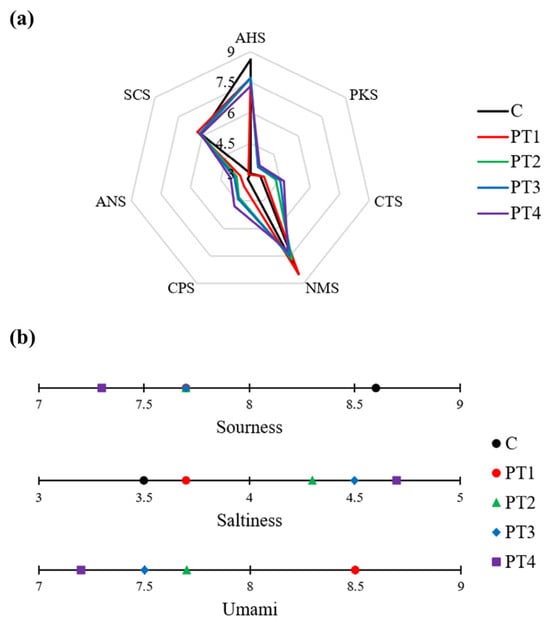
Pork patties and PB patties were mixed with distilled water in a 1:5 ratio and homogenized for 1 min at 6451× g using an ultra turrax (HMZ-20DN, Pooglim Tech). The mixture was then centrifuged at 6991× g for 10 min at 4 °C using a centrifuge (Supra R22, Hanil, Daejeon, Republic of Korea) to extract the supernatant. The supernatant was then diluted 1000-fold with distilled water and analyzed using an e-tongue system (Astree 5, Alpha MOS, Toulouse, France), with five replicates for the control and each treatment. The signal intensities of the taste components indicated by each sensor were verified using CTS (saltiness), NMS (umami), and AHS (sourness) sensors, as well as PKS and ANS (standard sensors) and SCS and CPS (auxiliary sensors).
2.11. Sensory Evaluation
The sensory evaluation was conducted with the approval of the Institutional Review Board at Kongju National University (Authority No: KNU_IRB_2024-124, 7 April 2025). Fifteen students from Kongju National University were recruited as panelists, and prior to evaluation, they were trained on the characteristics of the samples, the evaluation attributes, and how to use the scale. Heat-treated pork patties and PB patties were evaluated for color, texture, flavor, off-flavor, juiciness, and overall acceptability using a 9-point scale. Panelists were instructed to assign higher scores for more favorably evaluated color, firmer texture, and more palatable flavor. For off-flavor, higher scores indicated less noticeable unpleasant tastes or odors. For juiciness, higher scores indicated greater perceived moisture during chewing. Overall acceptability was evaluated by considering all attributes together, with higher scores indicating a more favorable overall evaluation of the product. This sensory evaluation was conducted as an exploratory assessment with a small panel of university students, and its results have limited generalizability to the preferences of general consumers.
2.12. Statistical Analysis
All experiments were repeated at least four times, and the results were analyzed. The mean and standard deviation of the results were calculated using the statistical analysis software SAS (version 9.4 for Windows, SAS Institute Inc., Cary, NC, USA). Subsequently, a one-way analysis of variance (ANOVA) was performed on the experimental results, and significant differences (p < 0.05) were verified using Duncan’s multiple range test.
3. Results and Discussion
3.1. Proximate Composition
The results of the proximate composition of pork patties and PB patties are presented in Table 2. Moisture content was significantly higher in PT1 than in all other groups, and protein content was significantly lower in all treatment groups than in the control (p < 0.05). Fat content was significantly higher in the control than in all treatment groups (p < 0.05). Among the treatment groups, fat content significantly increased with increasing backfat content (p < 0.05). Ash content was significantly higher in the control, PT1, and PT2 than in PT4 (p < 0.05). The LM used in this study contained approximately 81.0% moisture, 5.1% protein, 0.1% fat, and 2.8% ash. The composition of these raw materials influences the proximate composition of the final product [21]. Using the equation reported by Ozalp Unal et al. [22], the moisture contribution from LM was calculated on a mass balance basis to be 12.15%, 8.10%, 4.05%, and 0% in PT1, PT2, PT3, and PT4, respectively. However, these values represent the theoretical amount of moisture supplied by LM alone and do not directly reflect the moisture content of the final product. The final moisture content of food is influenced not only by the initial moisture content of the raw materials but also by their water-holding capacity and moisture loss during cooking [23]. Therefore, the differences in moisture content among the treatment groups in this study may be attributed to the combined effects of moisture supplied by LM, WHC associated with the LM-to-fat ratio, and cooking loss.
Table 2.
Proximate composition of pork patties and PB patties with mycelium and fat.
Fat content increased significantly as LM inclusion decreased and fat inclusion increased. The fat content of LM was 0.1%, whereas that of pork backfat is approximately 75–80% [24]. Therefore, the observed increase in fat content may be attributed to the increased inclusion of pork backfat, which has a higher fat content than LM. This trend is consistent with the findings of Peña-Saldarriaga et al. [25]. Meanwhile, although a small amount of fat is present in LM, no fat was detected in PT1. This may be attributed to the limitations of the Soxhlet extraction method, which quantifies lipid content based on the weight of the extraction residue [17].
The ash content of PB patties tended to decrease as LM inclusion decreased and backfat inclusion increased. Fat consists primarily of organic compounds, predominantly triglycerides [26], whereas LM has been reported to contain minerals such as calcium, potassium, and iron [27]. The ash content of the LM used in this study was 2.8%. Since ash content reflects the inorganic matter content of food [28], this decreasing trend may be associated with the formulation, in which the proportion of backfat, with its relatively low inorganic matter content, increased while the proportion of LM decreased. Singh et al. [29] reported that the composition of raw materials affects the general composition of the final product, a finding consistent with the results of this study.
Meanwhile, all treatment groups showed protein contents approximately 3 percentage points lower than that of the control. The protein content of meat alternatives has been reported to depend more strongly on the overall formulation than on the type of protein ingredient [30]. In this study, the addition of water at twice the powder weight during PBMA preparation may have contributed to the dilution of protein in the products. These results showed a tendency consistent with the findings of Hernandez et al. [31], who compared the protein content of commercially available plant-based meat alternative products and meat patties.
3.2. pH
The pH results for the pork patties and PB patties are presented in Table 3. The pH was significantly lower in the control and significantly higher in PT4 (p < 0.05). Among the treatment groups, pH tended to increase as LM content decreased, and the difference between PT1 and PT4 was 0.07 pH units. The pH of pork 24 h post-slaughter ranges from 5.66 to 5.69 [32], and the pH of the isolated soy protein and wheat gluten used in PBMA production has been reported as 7.94 and 6.49, respectively [21]. In addition, LM contains organic acids such as vanillic acid and syringic acid and is therefore weakly acidic, with a pH of approximately 5.08 [21,33]. The pH of the LM measured in this study was likewise 4.98, indicating weak acidity. Generally, the pH of food is influenced by the inherent pH characteristics of the raw materials and the addition ratio [34]. Consequently, the use of PBMA, which exhibits a higher pH than the meat-based control, led to a general increase in pH across the treatment groups. Furthermore, within the treatment groups, the pH gradually increased as the inclusion level of slightly acidic LM decreased. These findings aligned with the trend reported by Kang et al. [35], who observed a progressive increase in pH as chicken breast was incrementally substituted with soy protein and wheat gluten-based gels in sausage production.
Table 3.
pH and color of pork patties and PB patties with mycelium and fat.
3.3. Color
The color results for the pork patties and PB patties are presented in Table 3. Lightness (L*) was significantly higher in the control (p < 0.05). Among the treatment groups, lightness increased significantly as the LM content decreased and the backfat content increased (p < 0.05). Redness (a*) was significantly higher in the control than in all treatment groups, whereas yellowness (b*) was significantly lower in the control (p < 0.05). Among the treatment groups, PT4 showed significantly higher yellowness (p < 0.05). Fat in meat products is known to increase light reflectance and thereby raise lightness [36]. Therefore, the control with the highest fat content showed significantly higher lightness, and within the treatment groups, lightness also increased as the fat content increased. Meat contains myoglobin, which is responsible for its red color [36]. Meanwhile, the isolated soy protein and wheat gluten contained in PBMA have yellowness values of 18.03 and 19.20, respectively [21]. Thus, the high redness of the pork-based control is presumed to result from myoglobin, and the high yellowness of the treatment groups from the yellowness of the PBMA ingredients. Kamani et al. [37] reported that replacing meat with isolated soy protein in sausage production decreased lightness and increased yellowness, which is similar to the present findings.
3.4. Cooking Yield and WHC
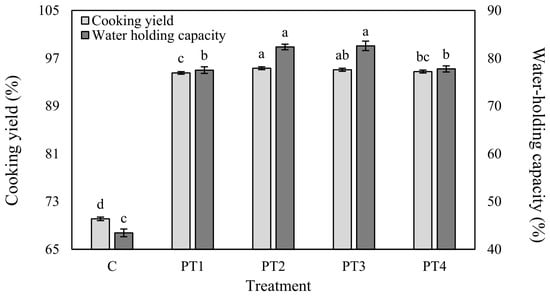
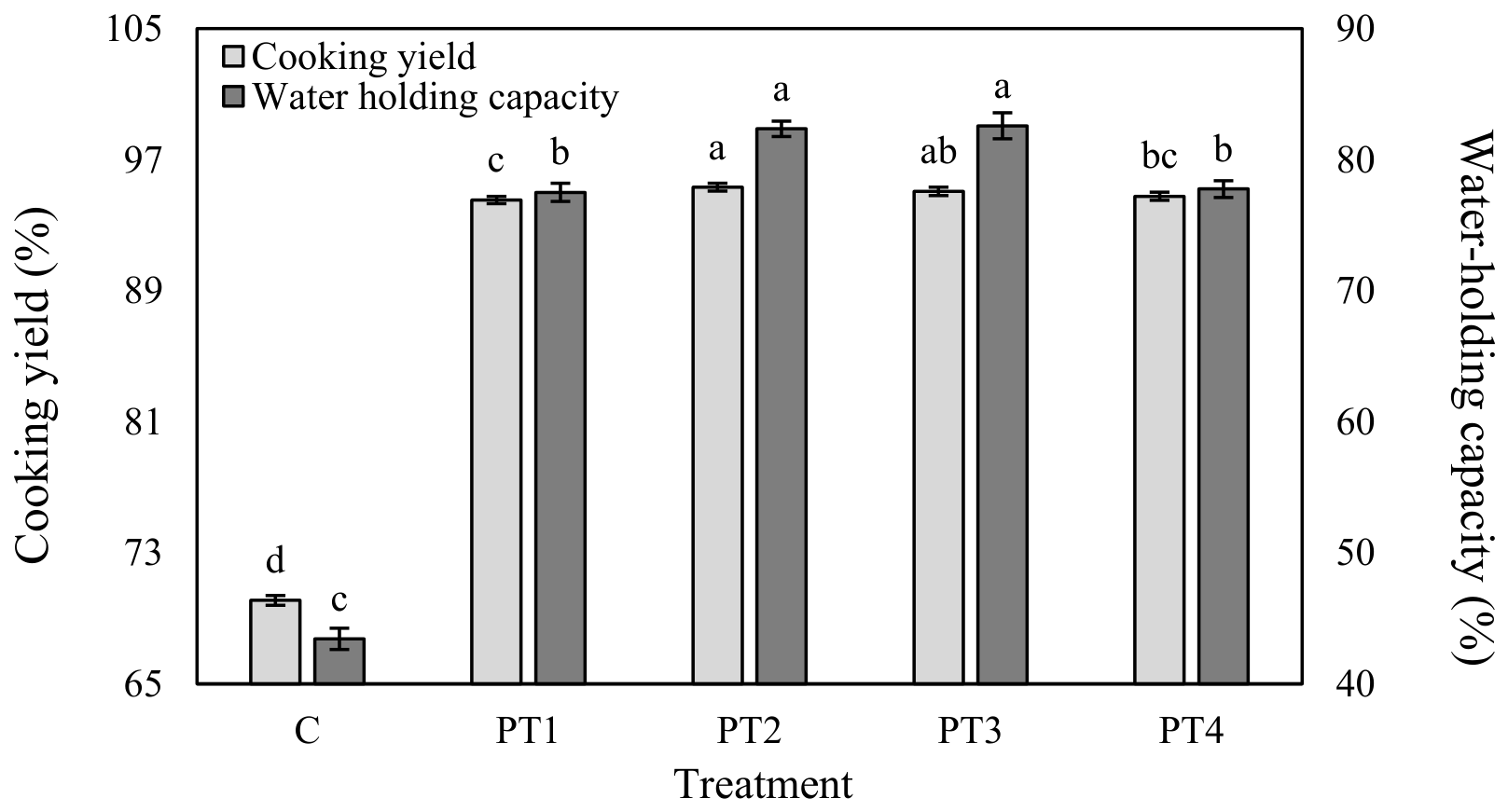
The cooking yield and WHC results for the pork patties and PB patties are shown in Figure 1. The control showed significantly lower values for both cooking yield and WHC compared to the treatment groups (p < 0.05). Among the treatment groups, cooking yield was significantly higher in PT2 and PT3 than in PT1 (p < 0.05). The cooking yield of PT4 was significantly lower than that of PT2 (p < 0.05) but did not differ significantly from those of PT1 and PT3 (p > 0.05). WHC was significantly higher in PT2 and PT3 (p < 0.05), whereas PT1 and PT4 did not differ significantly (p > 0.05). LM contains polysaccharides such as β-glucan [38], and these polysaccharides can effectively entrap water and oil through their porous structure [39]. Together with proteins, these polysaccharides form a composite network through various interactions, including hydrogen bonds, disulfide bonds, and hydrophobic and electrostatic interactions. This structure immobilizes water within the matrix, and the hydrophilic functional groups of the polysaccharides improve WHC [40,41]. In addition, the polysaccharide–protein network reduces moisture loss and protein denaturation during heating, thereby contributing to a higher cooking yield [40]. Meanwhile, isolated soy protein is generally hydrophilic, but it becomes amphiphilic as its internal hydrophobic regions are exposed during heating. The protein then acts as a surfactant at the fat surface, which improves emulsion stability and effectively traps water within the emulsion matrix [42]. Therefore, PT2 and PT3, to which both mycelium and fat were added, are presumed to have shown high cooking yield and WHC owing to improved emulsion stability and the formation of a protein–polysaccharide network. These results are similar to those reported by Kamani et al. [37] and Lee et al. [42].
Figure 1.
Cooking yield and water-holding capacity of pork patties and PB patties with mycelium and fat. All mean values are shown on the bar, and the standard deviation (SD) values are shown in the error bars. Means within the same color group but labeled with different letters (a–d) are significantly different (p < 0.05). C: Control, PT1: LM 15% and fat 0%, PT2: LM 10% and fat 5%, PT3: LM 5% and fat 10%, PT4: LM 0% and fat 15%.
3.5. Texture Profile Analysis (TPA)
The TPA results for pork patties and PB patties are presented in Table 4. Hardness was significantly higher in the control (p < 0.05), and among the treatment groups, hardness increased as LM content decreased. Springiness was lowest in PT4, and gumminess and chewiness were significantly higher in the control than in all treatment groups (p < 0.05). Cohesiveness was high in the control, PT1, and PT2, and tended to decrease from PT3 onward. In general, increasing protein content leads to the formation of a firm matrix structure, which increases hardness [42]. In addition, the type of protein and the structural characteristics of the matrix also affect hardness. In meat patties, thermal denaturation of myofibrillar proteins and the formation of a rigid network increase resistance to compression, which can contribute to higher hardness [36]. Furthermore, a study comparing the internal structures of beef patties and soy-based plant-based patties found that beef patties had a dense fibrous structure, whereas plant-based patties had a porous structure [43]. Therefore, the high hardness of the control in this study may be related to its relatively high protein content, together with structural differences in the matrix between pork patties and PBMA patties. However, because the microstructure was not directly analyzed in this study, the interpretation of the matrix structure’s contribution is limited.
Table 4.
Texture profile analysis of pork patties and PB patties with mycelium and fat.
Meanwhile, the high moisture content of mushrooms and the water-retention properties of dietary fiber may contribute to a softer texture in meat products [34]. In this study as well, formulations with lower LM content and higher fat content among the treatment groups tended to show lower moisture content and higher hardness. This tendency may be related to differences in moisture content accompanying the changes in formulation. Hardness acts as a key parameter constituting gumminess and chewiness [44]. Therefore, the significantly higher gumminess and chewiness of the control are presumed to reflect its significantly higher hardness. The results for hardness, gumminess, and chewiness between the pork patties and PB patties showed a tendency similar to that of Kamani et al. [37], who analyzed the TPA of plant-protein sausages and chicken sausages.
In addition, the formation of a protein–polysaccharide network has been reported to increase internal bonding strength and thereby improve cohesiveness [40]. Solid fat generally deforms irreversibly and shows plastic behavior when the applied stress exceeds the yield stress [45]. Accordingly, as solid fat content increases, irreversible deformation of the fat crystal network under compression during TPA reduces structural recovery, which can lower springiness and cohesiveness [46]. Considering these characteristics, the low springiness and cohesiveness of PT4, which contained no mycelium and had the highest fat content among the treatment groups, are presumed to result from this effect. These results are similar to those of Xue et al. [47], who reported that fat addition decreased springiness and cohesiveness in a TPA comparison of fat-free and fat-added sausages. Overall, although the PB patties in this study showed textural characteristics different from those of the pork patties, the findings are expected to serve as baseline data for designing low-fat PB patty formulations using LM and for controlling their textural properties.
3.6. e-Nose
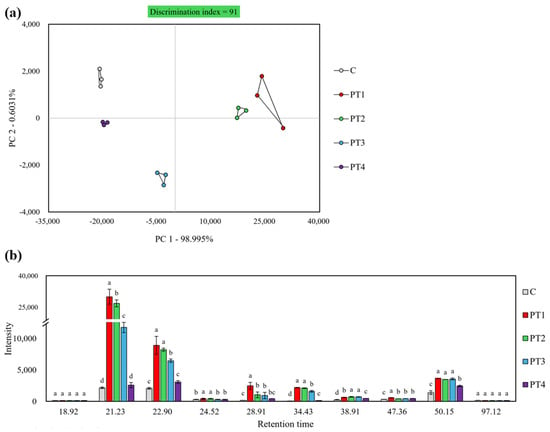
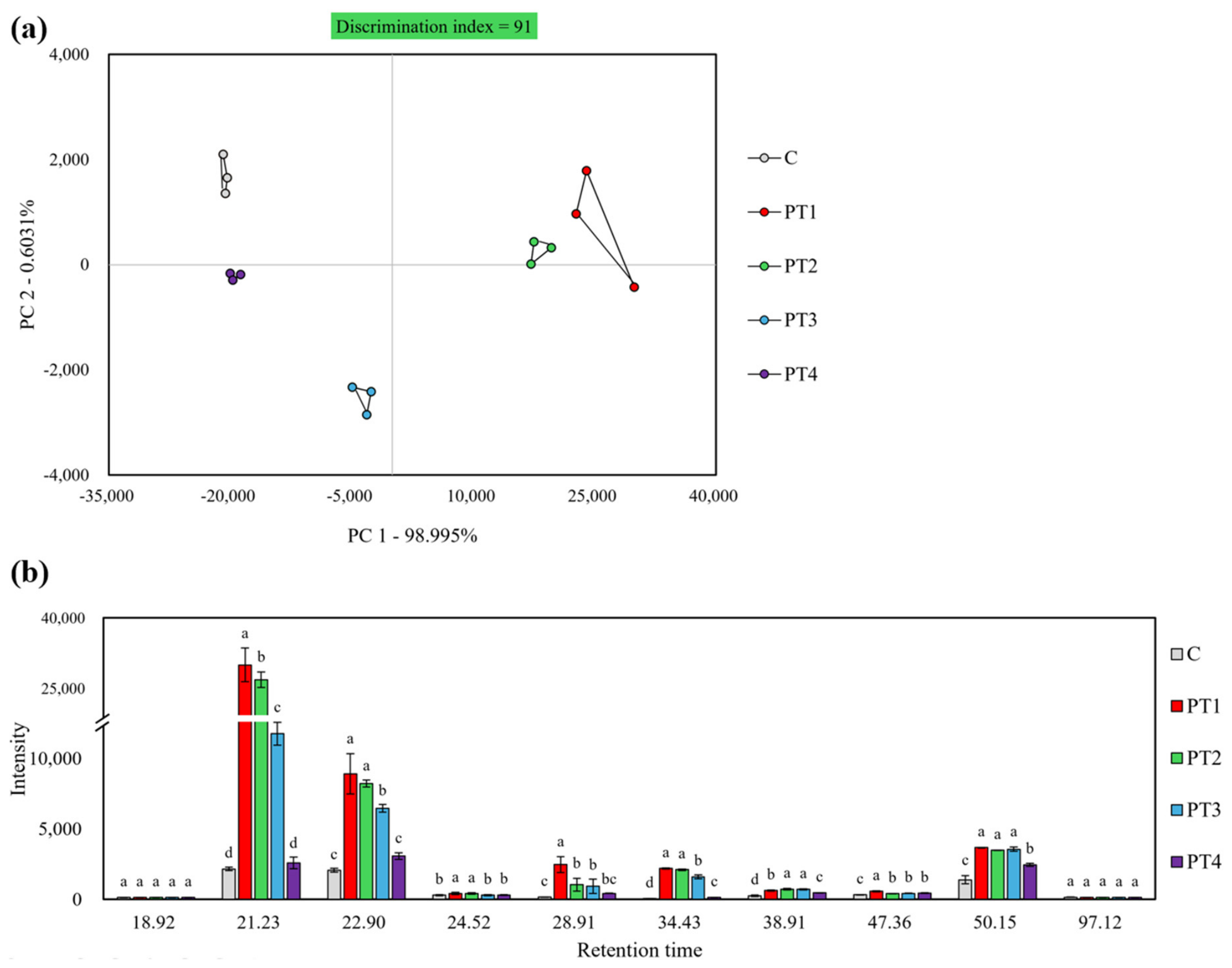
The e-nose results for pork patties and PB patties are shown in Figure 2. Figure 2a presents the principal component analysis (PCA) score plot to compare the overall volatile profiles of the patties, whereas Figure 2b compares individual peak intensities to identify the volatile signals associated with differences among formulations. The discrimination index was 91, indicating that the flavor characteristics of the samples were clearly distinguishable. Along PC1, which explained most of the variance, samples shifted toward the negative direction as the LM content decreased and the backfat content increased. PT4 was located close to the control on PC1 but was separated from it on PC2, showing a different volatile compound pattern. However, because PC2 explained only about 0.6% of the total variance, it is difficult to interpret this as evidence that the control and PT4 have clearly distinct volatile profiles. Therefore, the PCA results were interpreted mainly on the basis of the trend observed along PC1, and differences in volatile compounds among the samples are presented in Figure 2b.
Figure 2.
e-nose analysis of pork patties and PB patties with mycelium and fat: (a) Principal component analysis (PCA) score plot of the samples; (b) Peak areas of predicted volatile compounds. C: Control, PT1: LM 15% and fat 0%, PT2: LM 10% and fat 5%, PT3: LM 5% and fat 10%, PT4: LM 0% and fat 15%. Retention time (RT) 18.92: Methanethiol; 21.23: Ethanol; 22.90: Dimethyl sulfide; 24.52: Carbon disulfide; 28.91: Ethyl acetate; 34.43: 3-Methylbutanal; 38.91: Pentanal; 47.36: (E)-2-Pentenal; 50.15: Hexanal; 97.12: bis(2-methyl-3-furanyl)disulfide.
The results of the intensity analysis of volatile components based on retention time (RT) are as follows. The compounds corresponding to each RT were tentatively assigned based on Kovats retention index library matching using the e-nose software. In most RT ranges (21.23, 22.90, 28.91, 34.43, 50.15), the intensity of volatile components in the treatment groups (PT1, PT2, PT3) was significantly higher than that in the control group (p < 0.05). The peaks at RTs of 21.23, 22.90, 28.91, 34.43, and 50.15 were tentatively assigned to ethanol, dimethyl sulfide, ethyl acetate, 3-methylbutanal, and hexanal, respectively. In particular, PT1 exhibited the highest intensity in the RT 21.23 and 22.90 regions, while the intensity showed a significant decreasing trend in the order of PT2 and PT3. PT4 exhibited lower intensity than PT1, PT2, and PT3 or an intensity similar to the control group in most RT regions, showing a volatile compound profile distinct from the other treatment groups. Ethanol at RT 21.23 is produced during the breakdown of sugars and exhibits an ‘alcohol’ odor [48]. Dimethyl sulfide at RT 22.90 is a sulfur compound generated by the oxidation of methanethiol and is known to cause ‘pungent odor’, ‘spicy taste’, and ‘unpleasant taste’ in food [49]. Ethyl acetate at RT 28.91 belongs to ester compounds that generally exhibit a sweet ‘fruity aroma’ and has a low odor threshold, thus exerting a significant influence on the overall flavor of food [50]. 3-Methylbutanal at RT 34.43 is an aldehyde compound produced by lipid oxidation or amino acid Strecker degradation and possesses a low odor threshold. This compound exhibits ‘caramel’, ‘grassy’ aroma, and ‘sweet taste’, and is closely associated with the formation of the characteristic flavor of L. edodes [51,52]. Furthermore, hexanal detected at RT 50.15 is an aldehyde compound commonly found in edible mushrooms and exhibits a ‘grassy’ aroma [53,54]. Therefore, the e-nose results suggest that differences in the LM-to-backfat ratio are associated with differences in the volatile profiles of the PB patties. However, these compounds were not confirmed by GC–MS; therefore, interpretations based on their tentative assignments should be made with caution.
3.7. e-Tongue
The e-tongue analysis results of pork patties and PB patties are presented in Figure 3. Figure 3a shows the overall response patterns of the seven sensors, and Figure 3b compares sourness, saltiness, and umami, for which sensor responses were converted into taste intensity scores. In the case of sourness, the control showed the highest value of 8.6, while PT1, PT2, and PT3 recorded a value of 7.7, and PT4 showed the lowest value of 7.3. On the other hand, saltiness was lowest in the control at 3.5 and showed an increasing trend of 3.7 for PT1, 4.3 for PT2, 4.3 for PT3, and 4.7 for PT4. In the case of umami, the control and PT1 showed the highest value of 8.5, followed by a gradual decreasing trend of 7.7 for PT2, 7.5 for PT3, and 7.2 for PT4. Sourness in foods is related to pH, with lower pH resulting in higher sourness [55]. In this study, the control showed the lowest pH and the highest sourness score, whereas PT4 showed the highest pH and the lowest sourness score. These results suggest that the difference in sourness scores between the control and PT4 may be related to the difference in pH. This result is similar to that of Go et al. [56], who reported that sourness increased with decreasing pH in pork ham. Meanwhile, although PT1, PT2, and PT3 differed in pH, their sourness scores measured by the e-tongue were all identical at 7.7. The perceived intensity of sourness has generally been reported to be affected not only by pH but also by acid concentration and anion type [57]. In this study as well, differences in pH did not lead to differences in the e-tongue sourness scores, so caution is needed when interpreting sourness scores on the basis of pH alone. However, because the types and concentrations of organic acids were not analyzed in this study, further verification is needed to clarify the relationship between these factors and the sourness response of the e-tongue.
Figure 3.
e-tongue analysis of pork patties and PB patties with mycelium and fat: (a) Radar chart of electronic tongue sensor responses; (b) Taste intensity scores for sourness, saltiness, and umami. C: Control, PT1: LM 15% and fat 0%, PT2: LM 10% and fat 5%, PT3: LM 5% and fat 10%, PT4: LM 0% and fat 15%.
In emulsion-based foods, as fat content increases, the water-soluble components NaCl and KCl become dissolved in a relatively smaller amount of water. As a result, the salt concentration in the aqueous phase increases, which may enhance saltiness intensity [58]. Therefore, the increase in saltiness scores observed with increasing fat content in the treatment groups is presumed to be related to the relative increase in salt concentration in the aqueous phase resulting from the decrease in moisture content. Meat and LM contain nucleotides involved in umami—namely 5′-adenosine monophosphate, 5′-guanosine monophosphate, and 5′-inosine monophosphate—as well as the amino acid glutamic acid [59,60]. Therefore, umami scores tended to decrease as LM inclusion decreased and backfat inclusion increased. This trend is similar to the results of a previous study, which showed that the umami of sausages increased as the content of LM increased [21]. For electronic tongue response results to be perceived sensorially, an intensity difference of at least 2 sensor units is required [55]. However, in this study, no differences of 2 sensor units or more were observed for sourness, saltiness, or umami. Accordingly, the electronic tongue results may not be clearly perceived in actual sensory evaluation. Nevertheless, because electronic tongue analysis can be used to compare the response patterns of taste-related sensors among samples, the results of this study have value as supplementary data for comparing the response characteristics according to the mycelium-to-fat ratio.
3.8. Sensory Evaluation
The results of the sensory evaluation of pork patties and PB patties are presented in Table 5. Regarding the color, PT1, PT2, and PT4 showed significantly lower values than the control, while texture was significantly lower in PT1, PT3, and PT4 compared to the control (p < 0.05). Flavor and off-flavor scores were significantly higher in the control (p < 0.05), and juiciness was significantly higher in PT1, PT2, and PT3 than in the control (p < 0.05). Overall acceptability was also significantly higher in the control (p < 0.05), and no significant differences were observed among the treatment groups in any sensory attribute (p > 0.05). Juiciness refers to the sensation of moisture perceived during mastication after food intake [61]. In general, the WHC of meat products is highly correlated with the juiciness perceived during mastication [62]. Therefore, the treatment groups with high WHC are presumed to have shown generally high juiciness. Song et al. [63] reported that juiciness scores increased in sensory evaluation along with improved WHC in ham products, which is similar to the present findings. Overall, in the sensory evaluation, all attributes except juiciness were rated lower in the treatment groups than in the control. This is presumed to be because patties based on LM and plant protein differ from meat patties in flavor and texture characteristics.
Table 5.
Sensory evaluation of pork patties and PB patties with mycelium and fat.
4. Conclusions
In this study, the quality characteristics of PB patties prepared with different LM and fat contents were compared with those of pork patties to evaluate the applicability of low-fat formulations using mycelium. The PB patties had lower fat content and higher cooking yield and water-holding capacity than the pork patties. In particular, PT1, to which LM was added without backfat, did not differ significantly in overall acceptability from PT4, to which backfat was added without LM. This indicates that, under the present experimental conditions, fat reduction using LM did not lead to a significant decrease in overall acceptability, suggesting the feasibility of developing low-fat plant-based patties using mycelium. However, the texture and overall acceptability scores of the PB patties were generally lower than those of the pork patties, so improvements in formulation and processing conditions are needed to reduce these sensory differences. In addition, because LM and backfat contents were adjusted simultaneously in this study, the independent effects of each ingredient cannot be distinguished, and future experiments in which the two ingredients are adjusted independently are needed to evaluate them. Furthermore, formulation studies using plant-based fats and alternatives to soy and wheat are needed to evaluate the feasibility of fully plant-based patties and their suitability for consumers with food allergies.
Author Contributions
Conceptualization, Y.-N.O. and H.-Y.K.; methodology, H.-Y.K.; software, Y.-N.O. and H.-Y.K.; validation, Y.-N.O.; formal analysis, Y.-N.O.; investigation, H.-Y.K.; resources, H.-Y.K.; data curation, Y.-N.O.; writing—original draft preparation, Y.-N.O.; writing—review and editing, Y.-N.O. and H.-Y.K.; visualization, Y.-N.O.; supervision, H.-Y.K.; project administration, H.-Y.K.; funding acquisition, H.-Y.K. All authors have read and agreed to the published version of the manuscript.
Funding
This work was supported by Korea Institute of Planning and Evaluation for Technology in Food, Agriculture and Forestry (IPET) through High Value-added Food Technology Development Program, funded by Ministry of Agriculture, Food and Rural Affairs (MAFRA)(RS-2024-00403612). This research was supported by Glocal University 30 project at Kongju National University in 2026.
Institutional Review Board Statement
The study was conducted in accordance with the Declaration of Helsinki and the sensory evaluation was approved by the Ethics Committee of Kongju National University (Authority no: KNU_IRB_2024-124, 7 April 2025).
Informed Consent Statement
Informed consent was obtained from all subjects involved in the study.
Data Availability Statement
The original contributions presented in this study are included in the article. Further inquiries can be directed to the corresponding author.
Conflicts of Interest
The authors declare no conflicts of interest. The funders had no role in the design of the study; in the collection, analyses, or interpretation of data; in the writing of the manuscript; or in the decision to publish the results.
Abbreviations
The following abbreviations are used in this manuscript:
| LM | Lentinula edodes mycelium |
| PBMA | plant-based meat alternative |
References
- Miassi, Y.E.; Dossa, K.F. Forecasting animal protein supply in Asia and Europe in light of climate change, population growth, and land pressure. Trop. Plants 2023, 2, 22. [Google Scholar] [CrossRef] [Scilit]
- Nirmal, N.; Anyimadu, C.F.; Khanashyam, A.C.; Bekhit, A.E.D.A.; Dhar, B.K. Alternative protein—Sources: Addressing global food security and environmental sustainability. Sustain. Dev. 2025, 33, 3958–3969. [Google Scholar] [CrossRef] [Scilit]
- Hussain, M.A.; Li, L.; Kalu, A.; Wu, X.; Naumovski, N. Sustainable food security and nutritional challenges. Sustainability 2025, 17, 874. [Google Scholar] [CrossRef] [Scilit]
- Rahaman, A.; Ahsan, S.; Kumari, A.; Khaliq, A.; Mehmood, T.; Chughtai, M.F.J.; Farooq, M.A.; Khalifa, I.; Wali, M.; Zeng, X.A. Application of Plant-Based Proteins in the Development of Fish and Meat Analogue Products. J. Texture Stud. 2025, 56, e70025. [Google Scholar] [CrossRef] [Scilit]
- Begho, T.; Zhu, Y. Where are we now with meat alternatives? Global insights and strategic lessons for UK’s net-zero goals through agri-food system transition. Clean. Food Syst. 2025, 1, 100001. [Google Scholar] [CrossRef] [Scilit]
- Chang, J.B. Consumer Preferences for Conventional Meat and Meat Alternatives. Food Sci. Anim. Resour. 2025, 45, 1191–1203. [Google Scholar] [CrossRef] [Scilit]
- Lee, J.; Song, H.; Seo, K.H.; Lee, H.G.; Kim, H.; Choi, M.J. Physicochemical and sensory properties of plant-based meat patties using oil-in-water emulsion. Food Biosci. 2023, 56, 103084. [Google Scholar] [CrossRef] [Scilit]
- Lee, D.Y.; Venter, C.; Choi, Y.; Park, J.M.; Han, D.; Kim, J.S.; Park, J.W.; Namkung, S.; Mariano, E., Jr.; Lee, J.; et al. Market Status of Meat Analogs and Their Impact on Livestock Industries. Food Sci. Anim. Resour. 2024, 44, 1213. [Google Scholar] [CrossRef] [Scilit]
- Zhang, Z.; Zang, M.; Chen, J.; Zhang, K.; Wang, S.; Li, D.; Li, X.; Liu, M.; Pan, X. Effect of the mycelium of oyster mushrooms on the physical and flavor properties of a plant-based beef analogue. LWT 2024, 198, 116029. [Google Scholar] [CrossRef] [Scilit]
- Maseko, K.H.; Regnier, T.; Bartels, P.; Meiring, B. Mushroom mycelia as sustainable alternative proteins for the production of hybrid cell-cultured meat: A review. J. Food Sci. 2025, 90, e70060. [Google Scholar] [CrossRef] [Scilit]
- Choi, H.; Gwon, H.G.; Kim, D.; Kim, M.; You, S.; Jo, Y.J. Structural characterization and rheological analysis of Lentinus edodes mycelium (mycoprotein)–hydrocolloid composites for food formulation. Future Foods 2025, 11, 100568. [Google Scholar] [CrossRef] [Scilit]
- Kim, M.J.; Jeong, Y.; Park, M.J.; Jang, Y.; Ka, K.H. Effects of Blue Light on Fruiting Body Production and Ergothioneine Content During Sawdust Cultivation of Shiitake (Lentinula edodes). Mycobiology 2024, 52, 439–445. [Google Scholar] [CrossRef] [Scilit]
- Scholtmeijer, K.; van den Broek, L.A.; Fischer, A.R.; van Peer, A. Potential protein production from lignocellulosic materials using edible mushroom-forming fungi. J. Agric. Food Chem. 2023, 71, 4450–4457. [Google Scholar] [CrossRef] [Scilit]
- Zhu, X.; Tu, Y.; Zhao, Y.; Wu, N.; Yao, Y.; Chen, S.; Wei, T.; Mao, J.; Hu, X.; Wang, S.; et al. Emulsion gel-based fat replacers in meat products: Structured design, processing stability, oral lubricity/flavor perception, and digestive characteristics. Food Chem. 2025, 495, 146589. [Google Scholar] [CrossRef] [Scilit]
- Chen, Q.; Chen, Z.; Zhang, J.; Wang, Q.; Wang, Y. Application of lipids and their potential replacers in plant-based meat analogs. Trends Food Sci. Technol. 2023, 138, 645–654. [Google Scholar] [CrossRef] [Scilit]
- AOAC. Official Methods of Analysis of AOAC International, 20th ed.; AOAC International: Rockville, MD, USA, 2016. [Google Scholar]
- McClements, D.J.; Weiss, J.; Kinchla, A.J.; Nolden, A.A.; Grossmann, L. Methods for testing the quality attributes of plant-based foods: Meat- and processed-meat analogs. Foods 2021, 10, 260. [Google Scholar] [CrossRef] [Scilit]
- Oh, S.; Choi, Y.M.; Yoon, H.; Lee, S.; Yoo, E.; Hyun, D.Y.; Shin, M.J.; Lee, M.C.; Chae, B. Statistical analysis of protein content in wheat germplasm based on near-infrared reflectance spectroscopy. KJCS 2019, 64, 353–365. [Google Scholar]
- Kang, K.M.; Kim, H.Y. Effects of electron beam irradiation on the storage stability and quality characteristics of chicken and duck meat. Foods 2025, 14, 3867. [Google Scholar] [CrossRef] [Scilit]
- Miller, R.K.; Papadopoulos, L.S.; Schilling, M.W.; Wheeler, T.L.; Gray, R.A.; Dikeman, M.E.; Claus, J.R.; Owens, C.M.; King, D.; Belk, K.E.; et al. American Meat Science Association Research Guidelines for Cookery, Sensory Evaluation, and Instrumental Texture Measurements of Meat. Meat Muscle Biol. 2026, 10, 1–104. [Google Scholar] [CrossRef] [Scilit]
- Oh, Y.N.; Kim, H.Y. Characterization of plant-based sausage quality using Shiitake mushroom mycelia and soybean and wheat proteins. Food Sci. Anim. Resour. 2025, 45, 1514–1531. [Google Scholar] [CrossRef] [Scilit]
- Ozalp Unal, D.; Pehlivan, A.; Kaya Kartal, Y.; Ozer, A.; Kulen, S. Comparative Effects of White and Black Garlic on the Technological, Nutritional, and Sensory Properties of White and Whole Wheat Bread. Cereal Chem. 2026, 103, 587–610. [Google Scholar] [CrossRef] [Scilit]
- Zhang, Y.; Mtiulishvili, L.; Sala, G.; Scholten, E.; Stieger, M. Juiciness of plant-based meat analogues is driven by serum release rather than serum composition and viscosity. Food Hydrocoll. 2025, 172, 111950. [Google Scholar] [CrossRef] [Scilit]
- Gandemer, G. Lipids in muscles and adipose tissues, changes during processing and sensory properties of meat products. Meat Sci. 2002, 62, 309–321. [Google Scholar] [CrossRef] [Scilit]
- Peña-Saldarriaga, L.M.; Pérez-Alvarez, J.A.; Fernández-López, J. Quality properties of chicken emulsion-type sausages formulated with chicken fatty byproducts. Foods 2020, 9, 507. [Google Scholar] [CrossRef] [Scilit]
- Matthewman, M.C.; Nadkarni, A. Macronutrients, minerals, vitamins and energy. Anaesth. Intensive Care Med. 2026, 27, 116–121. [Google Scholar] [CrossRef] [Scilit]
- Muszyńska, B.; Kała, K.; Włodarczyk, A.; Krakowska, A.; Ostachowicz, B.; Gdula-Argasińska, J.; Suchocki, P. Lentinula edodes as a Source of Bioelements Released into Artificial Digestive Juices and Potential Anti-inflammatory Material. Biol. Trace Elem. Res. 2020, 194, 603–613. [Google Scholar] [CrossRef] [Scilit]
- Kim, H.S.; Kang, Y.J.; Lee, J.A.; Kim, H.Y. Quality Characteristics of Pork Emulsion-type Sausage Added with Water Dropwort Powder. Resour. Sci. Res. 2019, 1, 96–103. [Google Scholar] [CrossRef] [Scilit]
- Singh, R.; Sá, A.G.A.; Sharma, S.; Nadimi, M.; Paliwal, J.; House, J.D.; Koksel, F. Effects of feed moisture content on the physical and nutritional quality attributes of sunflower meal-based high-moisture meat analogues. Food Bioprocess Technol. 2024, 17, 1897–1913. [Google Scholar] [CrossRef] [Scilit]
- Godschalk-Broers, L.; Sala, G.; Scholten, E. Meat analogues: Relating structure to texture and sensory perception. Foods 2022, 11, 2227. [Google Scholar] [CrossRef] [Scilit]
- Hernandez, M.S.; Coyle, K.; Siebecker, M.G.; Woerner, D.R.; Brooks, J.C.; Legako, J.F. Nutritional profiling of plant-based meat alternatives and ground beef. J. Food Sci. 2024, 89, 9230–9242. [Google Scholar] [CrossRef] [Scilit]
- Kim, G.H.; Chin, K.B. Effects of different freezing temperatures of pork sausage batter on the quality characteristics of reduced-salt sausages using pre-rigor muscle. Anim. Biosci. 2022, 35, 1270. [Google Scholar] [CrossRef] [Scilit]
- Kajiyama, S.; Nagatake, T.; Ishikawa, S.; Hosomi, K.; Shimada, Y.; Matsui, Y.; Kunisawa, J. Lentinula edodes mycelium extract regulates the function of antigen-presenting cells to activate immune cells and prevent tumor-induced deterioration of immune function. BMC Complement. Med. Ther. 2023, 23, 281. [Google Scholar] [CrossRef] [Scilit]
- Boylu, M.; Hitka, G.; Kenesei, G. Sausage quality during storage under the partial substitution of meat with fermented oyster mushrooms. Foods 2024, 13, 2115. [Google Scholar] [CrossRef] [Scilit]
- Kang, K.M.; Lee, S.H.; Kim, H.Y. Effects of using soybean protein emulsion as a meat substitute for chicken breast on physicochemical properties of Vienna sausage. Food Sci. Anim. Resour. 2022, 42, 73–83. [Google Scholar] [CrossRef] [Scilit]
- Bakhsh, A.; Lee, S.J.; Lee, E.Y.; Hwang, Y.H.; Joo, S.T. Evaluation of rheological and sensory characteristics of plant-based meat analogs compared to beef and pork. Food Sci. Anim. Resour. 2021, 41, 983–996. [Google Scholar] [CrossRef] [Scilit]
- Kamani, M.H.; Meera, M.S.; Bhaskar, N.; Modi, V.K. Partial and total replacement of meat by plant-based proteins in chicken sausage: Evaluation of mechanical, physico-chemical, and sensory characteristics. J. Food Sci. Technol. 2019, 56, 2660–2669. [Google Scholar] [CrossRef] [Scilit]
- Bak, W.C.; Park, J.H.; Park, Y.A.; Ka, K.H. Determination of glucan contents in the fruiting bodies and mycelia of Lentinula edodes cultivars. Mycobiology 2014, 42, 301–304. [Google Scholar] [CrossRef] [Scilit]
- Zhao, X.; Zhang, Y.; Wang, X.; Yao, L.; Qu, Y.; Zhao, F.; Yun, J. Structure, physicochemical properties, and hypolipidemic activity of soluble dietary fiber obtained from button mushroom (Agaricus bisporus). Food Chem. X 2025, 29, 102657. [Google Scholar] [CrossRef] [Scilit]
- Gao, W.; Wang, Z.; Zhao, Z.; Deng, Y.; Wang, J.; Zhou, P.; Li, P.; Zhang, Y.; Zhang, M.; Liu, G. The Influence of Polysaccharides on the Textural Properties and Water Retention Capacity of Animal–Plant Dual-Protein Gels. Gels 2025, 12, 40. [Google Scholar] [CrossRef] [Scilit]
- Guo, Y.; Ma, C.; Xu, Y.; Du, L.; Yang, X. Food gels based on polysaccharide and protein: Preparation, formation mechanisms, and delivery of bioactive substances. Gels 2024, 10, 735. [Google Scholar] [CrossRef] [Scilit]
- Lee, M.; Ha, D.G.; Lee, H.G.; Lee, J.; Choi, M.J. Plant-based protein emulsions with soy protein isolate and gluten improve freeze-thaw stability and shelf life of pork meatballs. Meat Sci. 2025, 219, 109680. [Google Scholar] [CrossRef] [Scilit]
- Wiesman, Z.; Azachi, M.H.; Oshether, T. TD-NMR Structural Profiling of Meat and Plant-Based Meat Analog Burgers. J. Food Sci. 2025, 90, e70376. [Google Scholar] [CrossRef] [Scilit]
- Linares-García, J.A.; Ramos-Ramírez, E.G.; Salazar-Montoya, J.A. Viscoelastic properties and textural characterization of high methoxyl pectin from hawthorn (Crataegus pubescens) in a gelling system. Int. J. Food Sci. Technol. 2015, 50, 1484–1493. [Google Scholar] [CrossRef] [Scilit]
- Macias-Rodriguez, B.A.; Ewoldt, R.H.; Marangoni, A.G. Nonlinear viscoelasticity of fat crystal networks. Rheol. Acta 2018, 57, 251–266. [Google Scholar] [CrossRef] [Scilit]
- Dreher, J.; König, M.; Herrmann, K.; Terjung, N.; Gibis, M.; Weiss, J. Varying the amount of solid fat in animal fat mimetics for plant-based salami analogues influences texture, appearance and sensory characteristics. LWT 2021, 143, 111140. [Google Scholar] [CrossRef] [Scilit]
- Xue, S.; Park, J.Y.; Tuell, J.R.; Maskal, J.M.; Johnson, J.S.; Dinh, T.; Kim, Y.H.B. In utero heat stress has minimal impacts on processed pork products: A comparative study. Foods 2022, 11, 1222. [Google Scholar] [CrossRef] [Scilit]
- Jeong, C.H.; Lee, S.H.; Kim, H.Y. Microbiological composition and sensory characterization analysis of fermented sausage using strains isolated from Korean fermented foods. Food Sci. Anim. Resour. 2022, 42, 928–941. [Google Scholar] [CrossRef] [Scilit]
- Marcinkowska, M.A.; Jeleń, H.H. Role of sulfur compounds in vegetable and mushroom aroma. Molecules 2022, 27, 6116. [Google Scholar] [CrossRef] [Scilit]
- Xie, L.; Guo, S.; Rao, H.; Lan, B.; Zheng, B.; Zhang, N. Characterization of volatile flavor compounds and aroma active components in button mushroom (Agaricus bisporus) across various cooking methods. Foods 2024, 13, 685. [Google Scholar] [CrossRef] [Scilit]
- Chen, L.; Yang, T.; Liu, R.; Xu, Q.; Ge, Q.; Wu, M.; Yu, H. Sensory and neural responses to flavor compound 3-Methylbutanal in dry fermented sausages: Enhancing perceived overall aroma. Food Chem. X 2025, 29, 102769. [Google Scholar] [CrossRef] [Scilit]
- Hu, D.; Wang, Y.; Kong, F.; Wang, D.; Hu, C.; Yang, X.; Chen, X.; Chen, W.; Feng, Z. Analysis of Volatile Aroma Components in Different Parts of Shiitake Mushroom (Lentinus edodes) Treated with Ultraviolet C Light-Emitting Diodes Based on Gas Chromatography–Ion Mobility Spectroscopy. Molecules 2024, 29, 1872. [Google Scholar] [CrossRef] [Scilit]
- Barroetaveña, C.; González, G.C.; Tejedor-Calvo, E.; Toledo, C.; Pildain, M.B. Sensory characteristics and volatile organic compound profile of wild edible mushrooms from Patagonia, Argentina. Foods 2024, 13, 3447. [Google Scholar] [CrossRef] [Scilit]
- Zhu, R.; Wen, Y.; Wu, W.; Zhang, L.; Salman Farid, M.; Shan, S.; Wen, J.; Farag, M.A.; Zhang, Y.; Zhao, C. The flavors of edible mushrooms: A comprehensive review of volatile organic compounds and their analytical methods. Crit. Rev. Food Sci. Nutr. 2024, 64, 5568–5582. [Google Scholar] [CrossRef] [Scilit]
- Choi, J.H.; Kim, Y.J.; Hwang, J.M.; Choi, H.Y. Effect of Orostachys japonica (Maxim.) A. Berge on antioxidant activities, physicochemical properties, and sensory characteristics of pancakes using electronic nose and tongue analyses. Food Sci. Biotechnol. 2026, 35, 1445–1457. [Google Scholar] [CrossRef] [Scilit]
- Go, H.Y.; Park, S.Y.; Kim, H.Y. Analysis of cured pork loin ham quality using wet-aging and a pulsed electric field system. Food Sci. Biotechnol. 2023, 32, 1373–1382. [Google Scholar] [CrossRef] [Scilit]
- Sowalsky, R.A.; Noble, A.C. Comparison of the effects of concentration, pH and anion species on astringency and sourness of organic acids. Chem. Senses 1998, 23, 343–349. [Google Scholar] [CrossRef] [Scilit]
- Torrico, D.D.; Prinyawiwatkul, W. Psychophysical effects of increasing oil concentrations on saltiness and bitterness perception of oil-in-water emulsions. J. Food Sci. 2015, 80, S1885–S1892. [Google Scholar] [CrossRef] [Scilit]
- Wang, W.K.; Zhu, Y.; Tang, Y.; Lu, N.; Song, J.L.; Yuan, W.D.; Jia, Y. Non-volatile taste components of different cultivated mushrooms at mycelia, primordium, and fruit body cultivation stages. Int. J. Food Prop. 2016, 19, 1938–1948. [Google Scholar] [CrossRef] [Scilit]
- You, Z.; Bai, Y.; Bo, D.; Feng, Y.; Shen, J.; Wang, Y.; Li, J.; Bai, Y. A review of taste-active compounds in meat: Identification, influencing factors, and taste transduction mechanism. J. Food Sci. 2024, 89, 8128–8155. [Google Scholar] [CrossRef] [Scilit]
- Xu, S.; Falsafi, S.R. Juiciness of meat, meat products, and meat analogues: Definition, evaluation methods, and influencing factors. Food Rev. Int. 2024, 40, 2344–2377. [Google Scholar] [CrossRef] [Scilit]
- Tan, F.J.; Li, D.C.; Kaewkot, C.; Wu, H.D.; Świąder, K.; Yu, H.C.; Chen, C.F.; Chumngoen, W. Application of principal component analysis with instrumental analysis and sensory evaluation for assessment of chicken breast meat juiciness. Br. Poult. Sci. 2022, 63, 164–170. [Google Scholar] [CrossRef] [Scilit]
- Song, D.H.; Yang, N.E.; Seomoon, K.M.; Jang, I.S.; Chin, K.B.; Kim, H.W. Sous-vide cooking as a practical strategy to improve quality attributes and shelf stability of reduced-salt chicken breast ham. Poult. Sci. 2023, 102, 102444. [Google Scholar] [CrossRef] [Scilit]

Disclaimer/Publisher’s Note: The statements, opinions and data contained in all publications are solely those of the individual author(s) and contributor(s) and not of MDPI and/or the editor(s). MDPI and/or the editor(s) disclaim responsibility for any injury to people or property resulting from any ideas, methods, instructions or products referred to in the content. |
© 2026 by the authors. Licensee MDPI, Basel, Switzerland. This article is an open access article distributed under the terms and conditions of the Creative Commons Attribution (CC BY) license.