You are currently viewing a new version of our website. To view the old version click .

Gels, Volume 11, Issue 5

May 2025 - 72 articles

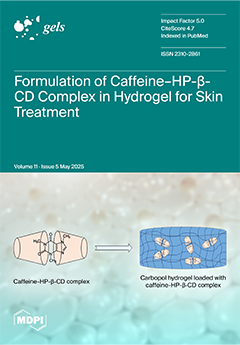
Cover Story: The permeation and penetration of caffeine through the skin is limited due to its hydrophilicity and the lipophilic properties of stratum corneum. The preparation of the complex between caffeine and hydroxypropyl-β-cyclodextrin could be considered an appropriate strategy to overcome this issue. The complexation of caffeine increased its scavenging activity against ABTS radical, and a tendency for improved protective effects in an in vitro model of H2O2-induced oxidative stress in L929 fibroblasts was observed. Further, the complex was incorporated into a carbopol hydrogel, which showed enhanced spreadability and penetration in comparison with the empty gel. View this paper

  • Issues are regarded as officially published after their release is announced to the table of contents alert mailing list .
  • You may sign up for email alerts to receive table of contents of newly released issues.
  • PDF is the official format for papers published in both, html and pdf forms. To view the papers in pdf format, click on the "PDF Full-text" link, and use the free Adobe Reader to open them.

Articles (72)

  • Article
  • Open Access
1,082 Views
20 Pages

Investigating the Interactions of Peptide Nucleic Acids with Multicomponent Peptide Hydrogels for the Advancement of Healthcare Technologies

  • Sabrina Giordano,
  • Monica Terracciano,
  • Enrico Gallo,
  • Carlo Diaferia,
  • Andrea Patrizia Falanga,
  • Antonella Accardo,
  • Monica Franzese,
  • Marco Salvatore,
  • Gennaro Piccialli and
  • Nicola Borbone
  • + 1 author

17 May 2025

This study reports the development of peptide-based hydrogels for the encapsulation and controlled release of peptide nucleic acids in drug delivery applications. Ultrashort aromatic peptides, such as Fmoc-FF, self-assemble into biocompatible hydroge...

  • Article
  • Open Access
1 Citations
1,123 Views
20 Pages

The Hypoglycemic Activity of Gracilaria lemaneiformis Polysaccharide Gels Based on IR/IRS-2/PI3k/Akt/Glut4 and Glycometabolism Signaling Pathways in HepG2 Cells

  • Xiaoshan Long,
  • Shucheng Liu,
  • Xianqing Yang,
  • Yongqiang Zhao,
  • Shaoling Yang,
  • Ya Wei,
  • Chuang Pan,
  • Shengjun Chen,
  • Peihong Jiang and
  • Bo Qi
  • + 1 author

15 May 2025

The aim of this study was to investigate the hypoglycemic activity and mechanism of G. lemaneiformis polysaccharide gels (GLP and GLP-HV) based on IR/IRS-2/PI3k/Akt/Glut4 and glycometabolism signaling pathways in HepG2 cells. After H2O2-Vc degradatio...

  • Article
  • Open Access
2 Citations
2,659 Views
22 Pages

A Novel Green In Situ Amine-Functionalized Aerogel UiO-66-NH2/TOCNF for the Removal of Azo Anionic Dyes

  • Rabia Amen,
  • Islam Elsayed,
  • Yunsang Kim,
  • Gregory T. Schueneman,
  • Emad M. El-Giar and
  • El Barbary Hassan

15 May 2025

UiO-66-NH2 is a metal–organic framework (MOF) with open metal sites, making it a promising candidate for adsorption and catalysis. However, the powdery texture of MOFs and the use of toxic solvents during synthesis limit their application. A no...

  • Article
  • Open Access
1,999 Views
25 Pages

Development of Liposome-Based Hydrogel Patches Incorporating Essential Oils of African Plants and Deep Eutectic Solvents

  • Wanhang Jiang,
  • Sara Toufouki,
  • Subhan Mahmood,
  • Ali Ahmad,
  • Alula Yohannes,
  • Yang Xiang and
  • Shun Yao

15 May 2025

A nanoliposome-integrated polymeric hydrogel was developed for the controlled release of essential oils (Argania spinosa, Passiflora edulis). A deep eutectic solvent (DES) composed of betaine and phytic acid enhanced the solubility and stability of e...

  • Article
  • Open Access
1 Citations
1,621 Views
22 Pages

Utilization of Cassava Starch–Glycerol Gel as a Sustainable Material to Decrease Metal Ion Surface Contamination

  • Rezky Anggakusuma,
  • Gemilang Lara Utama,
  • Dadan Sumiarsa,
  • Permata Apriliani Dewi Muslimah and
  • Ali Asgar

14 May 2025

Many studies have examined the ability of polymer-based gels or hydrogels to serve various purposes, particularly as absorbents. Several studies have reported that polyvinyl alcohol (PVA), with specific compositions and additives, is an absorbent and...

  • Review
  • Open Access
3 Citations
2,492 Views
33 Pages

Mechanical Properties of Cement-Based Gel Composites Reinforced by Plant Fiber: A Review

  • Peng Zhang,
  • Xiao Zhang,
  • Jinjun Guo,
  • Yuanxun Zheng and
  • Zhen Gao

14 May 2025

Plant fibers (PFs) have been increasingly employed in cement-based gel composites (CCs) on account of their excellent mechanical properties, toughness and sustainability. Researchers have engaged in a lot of studies on plant fiber-reinforced cement-b...

  • Review
  • Open Access
2 Citations
2,863 Views
24 Pages

Advances in Carbon-Based Aerogels for CO2 Capture: Fundamental Design Strategies and Technological Progress

  • Shakila Parveen Asrafali,
  • Thirukumaran Periyasamy and
  • Gazi A. K. M. Rafiqul Bari

14 May 2025

Carbon-based aerogels have garnered significant attention for CO2 capture owing to their low-cost precursors, tunable structures, and high porosity. Their performance in CO2 adsorption is intricately linked to their microstructural and textural featu...

  • Review
  • Open Access
1 Citations
1,946 Views
19 Pages

14 May 2025

Aerogels have garnered significant attention from the scientific community due to their extraordinary properties, including low density, high porosity, low thermal conductivity, and large surface area. These properties make them interesting candidate...

  • Review
  • Open Access
8 Citations
2,941 Views
26 Pages

13 May 2025

This review explores the enhanced transdermal therapy of several skin disorders with the application of carriers comprising phospholipid vesicular gel systems. Topical drug delivery has several advantages compared to other administration methods, inc...

of 8

Get Alerted

Add your email address to receive forthcoming issues of this journal.

XFacebookLinkedIn
Gels - ISSN 2310-2861