

You are currently viewing a new version of our website. To view the old version click .

Journal of Fungi, Volume 8, Issue 4

April 2022 - 93 articles

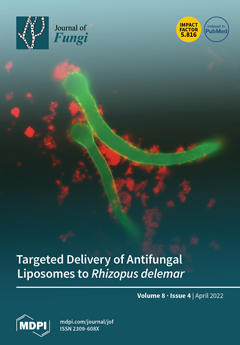
Cover Story: Mucormycosis is a life-threatening disease caused by Mucoromycota species such as Rhizopus delemar. Mucormycosis is most effectively treated with amphotericin B (AmB) and particularly with AmB-loaded liposomes (AmB-LLs). However, even after treatment, there is still a 50% mortality rate. We used the pathogen receptor Dectin-1 to target AmB-LLs to R. delemar. DEC1-AmB-LLs bound with great efficiency to exopolysaccharide matrices associated with sporangiospores, germlings, and mature hyphae. DEC1-AmB-LLs delivering sub-micromolar concentrations of AmB were an order of magnitude more efficient at inhibiting or killing R. delemar than AmB-LLs. The cover image shows rhodamine B-tagged DEC1-AmB-LLs (red) that are bound to calcofluor white-stained R. delemar germlings (green). View this paper
  • Issues are regarded as officially published after their release is announced to the table of contents alert mailing list .
  • You may sign up for email alerts to receive table of contents of newly released issues.
  • PDF is the official format for papers published in both, html and pdf forms. To view the papers in pdf format, click on the "PDF Full-text" link, and use the free Adobe Reader to open them.

Articles (93)

  • Review
  • Open Access
30 Citations
5,522 Views
22 Pages

12 April 2022

Concerns about fossil fuel depletion and the environmental effects of greenhouse gas emissions have led to widespread fermentation-based production of bioethanol from corn starch or sugarcane. However, competition for arable land with food production...

  • Article
  • Open Access
5 Citations
2,913 Views
13 Pages

Unveiling a Novel Role of Cdc42 in Pyruvate Metabolism Pathway to Mediate Insecticidal Activity of Beauveria bassiana

  • Yi Guan,
  • Donghuang Wang,
  • Xiaofeng Lin,
  • Xin Li,
  • Chao Lv,
  • Dingyi Wang and
  • Longbin Zhang

12 April 2022

The small GTPase Cdc42 acts as a molecular switch essential for cell cycles and polar growth in model yeast, but has not been explored in Beaurveria bassiana, an insect-pathogenic fungus serving as a main source of fungal formulations against arthrop...

  • Article
  • Open Access
20 Citations
4,598 Views
20 Pages

Faster Cryptococcus Melanization Increases Virulence in Experimental and Human Cryptococcosis

  • Herdson Renney de Sousa,
  • Getúlio Pereira de Oliveira,
  • Stefânia de Oliveira Frazão,
  • Kaio César de Melo Gorgonha,
  • Camila Pereira Rosa,
  • Emãnuella Melgaço Garcez,
  • Joaquim Lucas,
  • Amabel Fernandes Correia,
  • Waleriano Ferreira de Freitas and
  • Higor Matos Borges
  • + 11 authors

12 April 2022

Cryptococcus spp. are human pathogens that cause 181,000 deaths per year. In this work, we systematically investigated the virulence attributes of Cryptococcus spp. clinical isolates and correlated them with patient data to better understand cryptoco...

  • Article
  • Open Access
2,788 Views
13 Pages

12 April 2022

Psoroglaena humidosilvae Lee is described as a new lichen species from a wetland forest in South Korea. The new species is distinct from P. stigonemoides (Orange) Henssen by little projections locally present on the thallus; smaller, paler, and globo...

  • Article
  • Open Access
6 Citations
3,064 Views
14 Pages

A Kinesin Vdkin2 Required for Vacuole Formation, Mycelium Growth, and Penetration Structure Formation of Verticillium dahliae

  • Xing Yang,
  • Cuimei Guo,
  • Chi Chen,
  • Zhijuan Hu,
  • Xinyao Zheng,
  • Shan Xu,
  • Xingyong Yang and
  • Chengjian Xie

12 April 2022

The soil-borne vascular fungus Verticillium dahliae infects hundreds of dicotyledonous plants, causing severe wilt diseases. During the initial colonization, V. dahliae develops a penetration peg to enable infection of cotton roots. In some phytopath...

  • Review
  • Open Access
42 Citations
5,481 Views
9 Pages

Prevalence of COVID-19-Associated Pulmonary Aspergillosis: Critical Review and Conclusions

  • Matthias Egger,
  • Linda Bussini,
  • Martin Hoenigl and
  • Michele Bartoletti

12 April 2022

First reports of cases and case series of COVID-19-associated pulmonary aspergillosis (CAPA) emerged during the first months of the pandemic. Prevalence rates varied widely due to the fact that CAPA was, and still remains, challenging to diagnose in...

  • Article
  • Open Access
10 Citations
3,929 Views
18 Pages

12 April 2022

Fungi in the Entomophthorales order can cause insect disease and epizootics in nature, contributing to biological pest control in agriculture and forestry. Most Entomophthorales have narrow host ranges, limited to the arthropod family level; however,...

  • Article
  • Open Access
46 Citations
3,717 Views
14 Pages

11 April 2022

A major citrus postharvest pathogen, Penicillium italicum (P. italicum), causes substantial economic losses in citrus. In this study, a citral nanoemulsion containing polymethoxylated flavonoids (PMFs), the antimicrobial compounds from citrus, w...

  • Article
  • Open Access
11 Citations
3,877 Views
13 Pages

Invasive Fusariosis in Pediatric Hematology/Oncology and Stem Cell Transplant Patients: A Report from the Israeli Society of Pediatric Hematology-Oncology

  • Marganit Benish,
  • Sarah Elitzur,
  • Nira Arad-Cohen,
  • Assaf Arie Barg,
  • Miriam Ben-Harosh,
  • Bella Bielorai,
  • Salvador Fischer,
  • Gil Gilad,
  • Itzhak Levy and
  • Hila Rosenfeld-Keidar
  • + 5 authors

11 April 2022

Invasive Fusarium species infections in immunocompromised patients occur predominantly in those with hematological malignancies. Survival rates of 20–40% were reported in adults, but data in children are limited. Our retrospective, nationwide m...

  • Article
  • Open Access
10 Citations
3,903 Views
19 Pages

Systemic Infection by Non-albicans Candida Species Affects the Development of a Murine Model of Multiple Sclerosis

  • Thais Fernanda de Campos Fraga-Silva,
  • Natália Munhoz-Alves,
  • Luiza Ayumi Nishiyama Mimura,
  • Larissa Ragozo Cardoso de Oliveira,
  • Lívia Mara Alves Figueiredo-Godoi,
  • Maíra Terra Garcia,
  • Evelyn Silva Oliveira,
  • Larissa Lumi Watanabe Ishikawa,
  • Sofia Fernanda Gonçalves Zorzella-Pezavento and
  • Vânia Luiza Deperon Bonato
  • + 3 authors

10 April 2022

Candidiasis may affect the central nervous system (CNS), and although Candida albicans is predominant, non-albicans Candida species can also be associated with CNS infections. Some studies have suggested that Candida infections could increase the odd...

of 10

Get Alerted

Add your email address to receive forthcoming issues of this journal.

XFacebookLinkedIn
J. Fungi - ISSN 2309-608X