You are currently viewing a new version of our website. To view the old version click .

Journal of Fungi, Volume 7, Issue 12

December 2021 - 106 articles

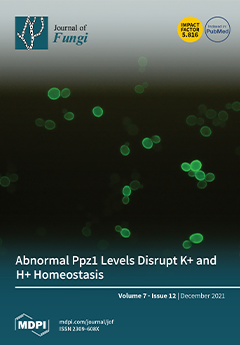
Cover Story: Phosphatase Ppz1 is the most toxic protein when overexpressed in Saccharomyces cerevisiae cells, but the reasons for its toxicity were not clear. Our results show that its overexpression results in a rapid decrease in K+ content and cytosolic pH and altered ability to acidify the medium. These phenomena, as well as the growth defect, are counteracted by the deletion of the plasma membrane Na+, K+/H+ antiporter Nha1. We experimentally prove that high levels of Ppz1 overactivate Nha1, leading to an excessive entry of H+ and efflux of K+, which is detrimental for growth. View this paper.
  • Issues are regarded as officially published after their release is announced to the table of contents alert mailing list .
  • You may sign up for email alerts to receive table of contents of newly released issues.
  • PDF is the official format for papers published in both, html and pdf forms. To view the papers in pdf format, click on the "PDF Full-text" link, and use the free Adobe Reader to open them.

Articles (106)

  • Article
  • Open Access
8 Citations
3,626 Views
10 Pages

18 December 2021

Invasive aspergillosis (IA) is a severe mycosis caused by Aspergillus species. The infection mainly affects immunocompromised patients with a significant clinical burden. This study aimed to determine the clinical and epidemiological characteristics...

  • Case Report
  • Open Access
16 Citations
4,237 Views
15 Pages

Malignant Keratitis Caused by a Highly-Resistant Strain of Fusarium Tonkinense from the Fusarium Solani Complex

  • Jens Schrecker,
  • Berthold Seitz,
  • Tim Berger,
  • Loay Daas,
  • Wolfgang Behrens-Baumann,
  • Claudia Auw-Hädrich,
  • Sabine Schütt,
  • Sabine Kerl,
  • Sascha Rentner-Andres and
  • Herbert Hof

18 December 2021

Fusarium spp. are moulds ubiquitously distributed in nature and only occasionally pathogenic for humans. Species of the Fusarium solani complex are the predominant keratitis-inducing pathogens, because they are endowed with proper virulence factors....

  • Article
  • Open Access
14 Citations
4,109 Views
16 Pages

Biochemical Profile by GC–MS of Fungal Biomass Produced from the Ascospores of Tirmania nivea as a Natural Renewable Resource

  • Jamal M. Khaled,
  • Naiyf S. Alharbi,
  • Ramzi A. Mothana,
  • Shine Kadaikunnan and
  • Ahmed S. Alobaidi

17 December 2021

The edible fruiting bodies of desert truffles are seasonally collected and consumed in many regions of the world. Although they are very expensive, they are bought and sold as a result of considerable scientific reports confirming their health and nu...

  • Article
  • Open Access
15 Citations
4,253 Views
15 Pages

Vacuolar Protein-Sorting Receptor MoVps13 Regulates Conidiation and Pathogenicity in Rice Blast Fungus Magnaporthe oryzae

  • Xueming Zhu,
  • Lin Li,
  • Jiaoyu Wang,
  • Lili Zhao,
  • Huanbin Shi,
  • Jiandong Bao,
  • Zhenzhu Su,
  • Xiaohong Liu and
  • Fucheng Lin

17 December 2021

Magnaporthe oryzae (synonym Pyricularia oryzae) is a filamentous fungal pathogen that causes major yield losses in cultivated rice worldwide. However, the mechanisms of infection of M. oryzae are not well characterized. The VPS13 proteins play vital...

  • Article
  • Open Access
26 Citations
5,084 Views
21 Pages

17 December 2021

Asproinocybe and Tricholosporum are not well known, and their placement at the family level remains undetermined. In this study, we conducted molecular phylogenetic analyses based on nuc rDNA internal transcribed spacer region (ITS) and nuc 28S rDNA...

  • Article
  • Open Access
11 Citations
6,180 Views
18 Pages

17 December 2021

Microbial natural products have had phenomenal success in drug discovery and development yet form distinct classes based on the origin of their native producer. Methods that enable metabolic engineers to combine the most useful features of the differ...

  • Article
  • Open Access
41 Citations
5,707 Views
21 Pages

Why Is the Correct Selection of Trichoderma Strains Important? The Case of Wheat Endophytic Strains of T. harzianum and T. simmonsii

  • Alberto Pedrero-Méndez,
  • H. Camilo Insuasti,
  • Theodora Neagu,
  • María Illescas,
  • M. Belén Rubio,
  • Enrique Monte and
  • Rosa Hermosa

17 December 2021

The search for endophytic fungi in the roots of healthy wheat plants from a non-irrigation field trial allowed us to select 4 out of a total of 54 cultivable isolates belonging to the genus Trichoderma, identified as T. harzianum T136 and T139, T. si...

  • Article
  • Open Access
12 Citations
4,786 Views
18 Pages

Phylogenetic Relationships, Speciation, and Origin of Armillaria in the Northern Hemisphere: A Lesson Based on rRNA and Elongation Factor 1-Alpha

  • Junmin Liang,
  • Lorenzo Pecoraro,
  • Lei Cai,
  • Zhilin Yuan,
  • Peng Zhao,
  • Clement K. M. Tsui and
  • Zhifeng Zhang

17 December 2021

Armillaria species have a global distribution and play various roles in the natural ecosystems, e.g., pathogens, decomposers, and mycorrhizal associates. However, their taxonomic boundaries, speciation processes, and origin are poorly understood. Her...

  • Case Report
  • Open Access
1 Citations
3,152 Views
6 Pages

First Report of an Invasive Infection by Cephalotrichum gorgonifer in a Neutropenic Patient with Hematological Malignancy under Chemotherapy

  • Ana Álvarez-Uría,
  • Pilar Escribano,
  • Verónica Parra-Blanco,
  • José Francisco Cano-Lira,
  • Alberto Miguel Stchigel,
  • Gillen Oarbeascoa,
  • Patricia Muñoz and
  • Jesús Guinea

17 December 2021

The etiological agents of infrequent invasive fungal infections (IFI) are difficult to identify on the species level using classic morphological examination. We describe the first case of an IFI caused by Cephalotrichum gorgonifer in a neutropenic pa...

  • Article
  • Open Access
6 Citations
4,388 Views
19 Pages

Multilocus Phylogeography of the Tuber mesentericum Complex Unearths Three Highly Divergent Cryptic Species

  • Marco Leonardi,
  • Daniele Salvi,
  • Mirco Iotti,
  • Gian Luigi Rana,
  • Aurelia Paz-Conde and
  • Giovanni Pacioni

17 December 2021

Tuber mesentericum is an edible European black truffle, apparently easy to recognize, but showing a high degree of genetic variability. In this study, we performed an integrative taxonomic assessment of the T. mesentericum complex, combining a multil...

of 11

Get Alerted

Add your email address to receive forthcoming issues of this journal.

XFacebookLinkedIn
J. Fungi - ISSN 2309-608X