


The authors wish to make the following corrections to this paper [1].
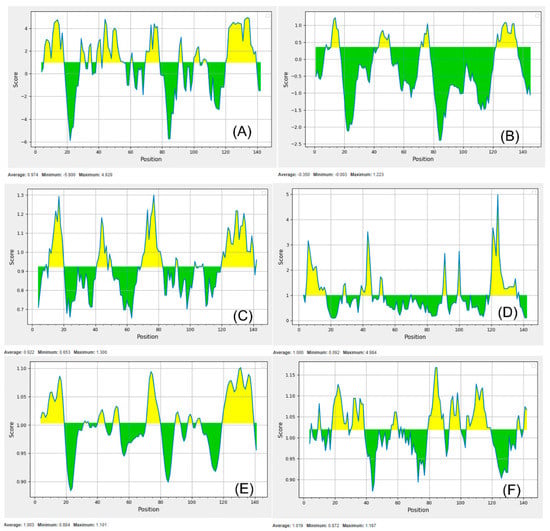
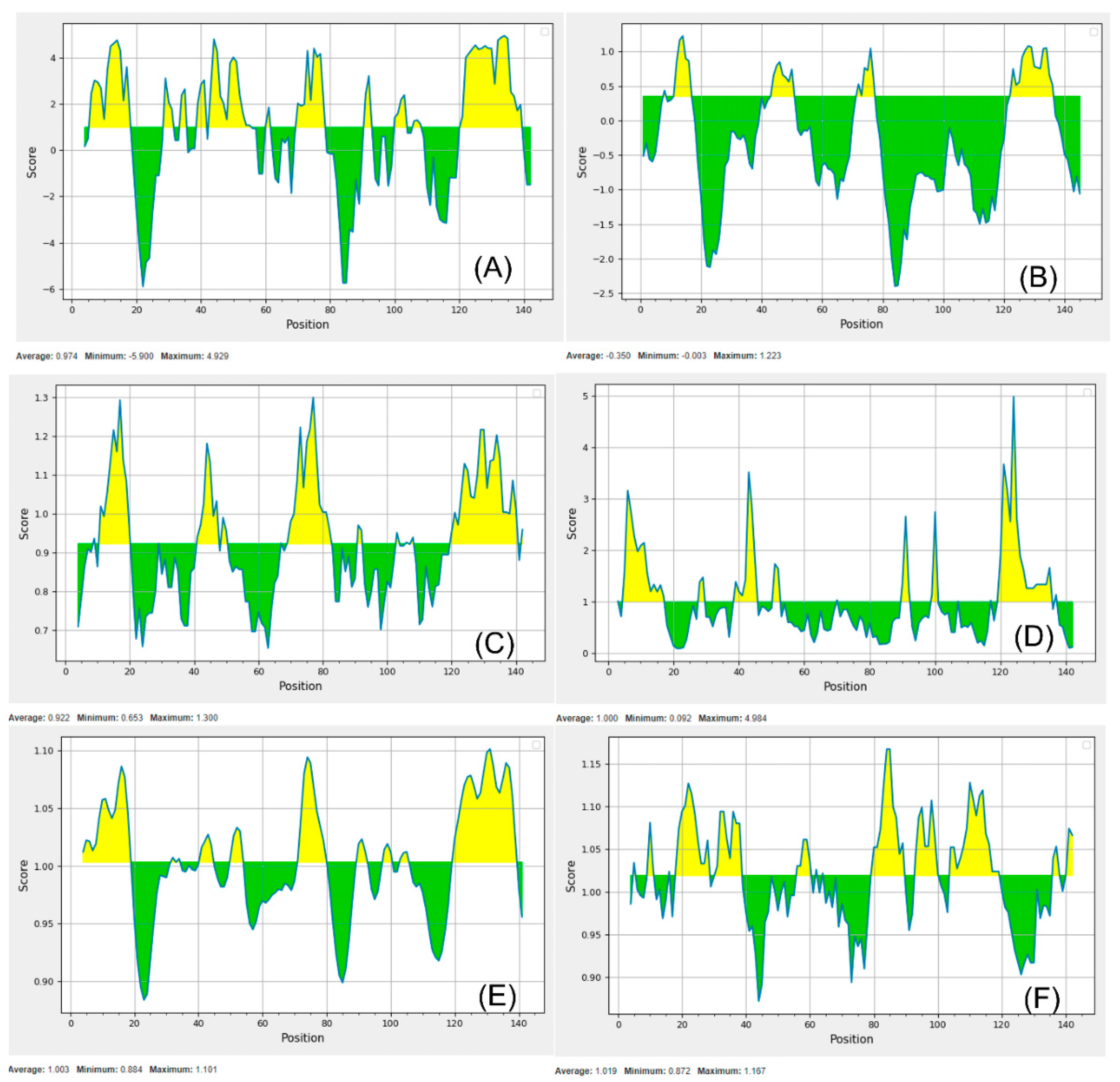
Figure 4.
B-cell epitope in the FLiS protein based on Parker hydrophilicity prediction (A). Bepipred linear epitope (B). Chou and Fasman β-turn prediction (C). Emini surface accessibility prediction (D). Karplus and Schulz flexibility prediction (E). Kolaskar and Tongaonkar antigenicity (F). The x axis and y axis represent the sequence position and corresponding antigenic properties score, respectively. The threshold level was set as a default parameter of the server. The regions shown in yellow color above the threshold value were predicted as the B-cell epitope.
The authors would like to apologize for any inconvenience caused to the readers by these changes.
References
- Ali, A.; Ahmad, S.; Wadood, A.; Rehman, A.U.; Zahid, H.; Qayash Khan, M.; Nawab, J.; Rahman, Z.U.; Alouffi, A.S. Modeling Novel Putative Drugs and Vaccine Candidates against Tick-Borne Pathogens: A Subtractive Proteomics Approach. Vet. Sci. 2020, 7, 129. [Google Scholar]
Publisher’s Note: MDPI stays neutral with regard to jurisdictional claims in published maps and institutional affiliations. |
© 2020 by the authors. Licensee MDPI, Basel, Switzerland. This article is an open access article distributed under the terms and conditions of the Creative Commons Attribution (CC BY) license (http://creativecommons.org/licenses/by/4.0/).