


Highlights
- Lipid-rich matrices contribute to improving texture and sensory acceptance;
- Mixing different plant sources can be effective for improving nutritional and technological characteristics;
- Fermentation and germination demonstrated promising effects on the final quality of milk substitutes;
- Advances have been made in the development of fermented milk substitutes, especially in terms of stability and quality.
Abstract
Interest in plant-based milk is rapidly growing worldwide. However, several challenges remain, such as low consumer acceptance, difficulty in matching cow milk’s nutritional profile, and poor stability. Since various groups benefit from consuming plant-based options, addressing these challenges is crucial. This study aimed to analyze plant sources used in plant-based milk, evaluating their chemical, technological, and sensory characteristics, as well as processing methods and emerging trends. A literature search was conducted for studies published in English over the last ten years in Embase, Scopus, Lilacs, Fsta, Pubmed, and Google Scholar, selecting those best fitting the inclusion criteria. Legumes, cereals, pseudo-cereals, nuts, fruits, and seeds have been used as plant matrices, each contributing distinct attributes to the plant-based milk. Thus, using plant proteins —i.e., mixing different plant-based foods into a single formulation has proven effective in overcoming certain limitations. Additionally, germination and fermentation have improved the stability, nutritional quality, and sensory properties of plant-based milk, reinforcing their potential for future advancements in this field.
1. Introduction
Cow milk is widely consumed worldwide due to cultural factors, its sensory quality, and its nutritional profile, which is rich in essential amino acids, lipids, calcium, riboflavin, and vitamin B12, all of which contribute to a healthy diet [1]. However, new trends and dietary patterns focused on health, sustainability, and lifestyle have driven the development of milk alternatives [2]. In this context, plant-based milk has emerged as a promising substitute, meeting a wide range of nutritional needs and personal preferences [3].
The growth of the plant-based market is driven by factors such as the high prevalence of lactose intolerance (65–70% globally) [4], cow milk protein allergy (3% of population), [5] and the rise in veganism and flexitarianism. Besides, the dairy sector is expanding globally, generating high gas emissions with significant environmental impacts [6].
Plant-based milk is obtained through the processing of different plant foods, such as cereals [7], pseudo-cereals [8], legumes [9], nuts [10], seeds [11], and fruits [12]. These foods, after being reduced to smaller particles, are homogenized with water to obtain a water-based extract. In addition, factors such as the type of raw material and their processing, the addition of more ingredients, and the type and duration of storage can alter the final presentation of the product [13]. Since each plant has a distinct nutritional profile, some studies have focused on combining different plant sources to develop more balanced plant-based milks, both nutritionally and sensorially [14].
In this context, non-dairy milks stand out as alternatives that offer lower ecological impact while providing nutritious and inclusive products. Generally, plant-based milks show lower greenhouse gas emissions, reduced land use, and lower overall water consumption compared with dairy milk [15]. Plant-based milks are consistently considered to be more eco-friendly options than dairy milk across most environmental indicators [16].
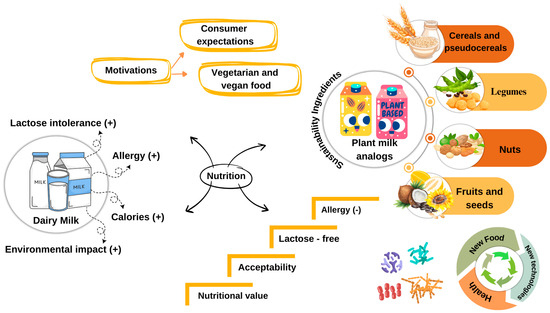
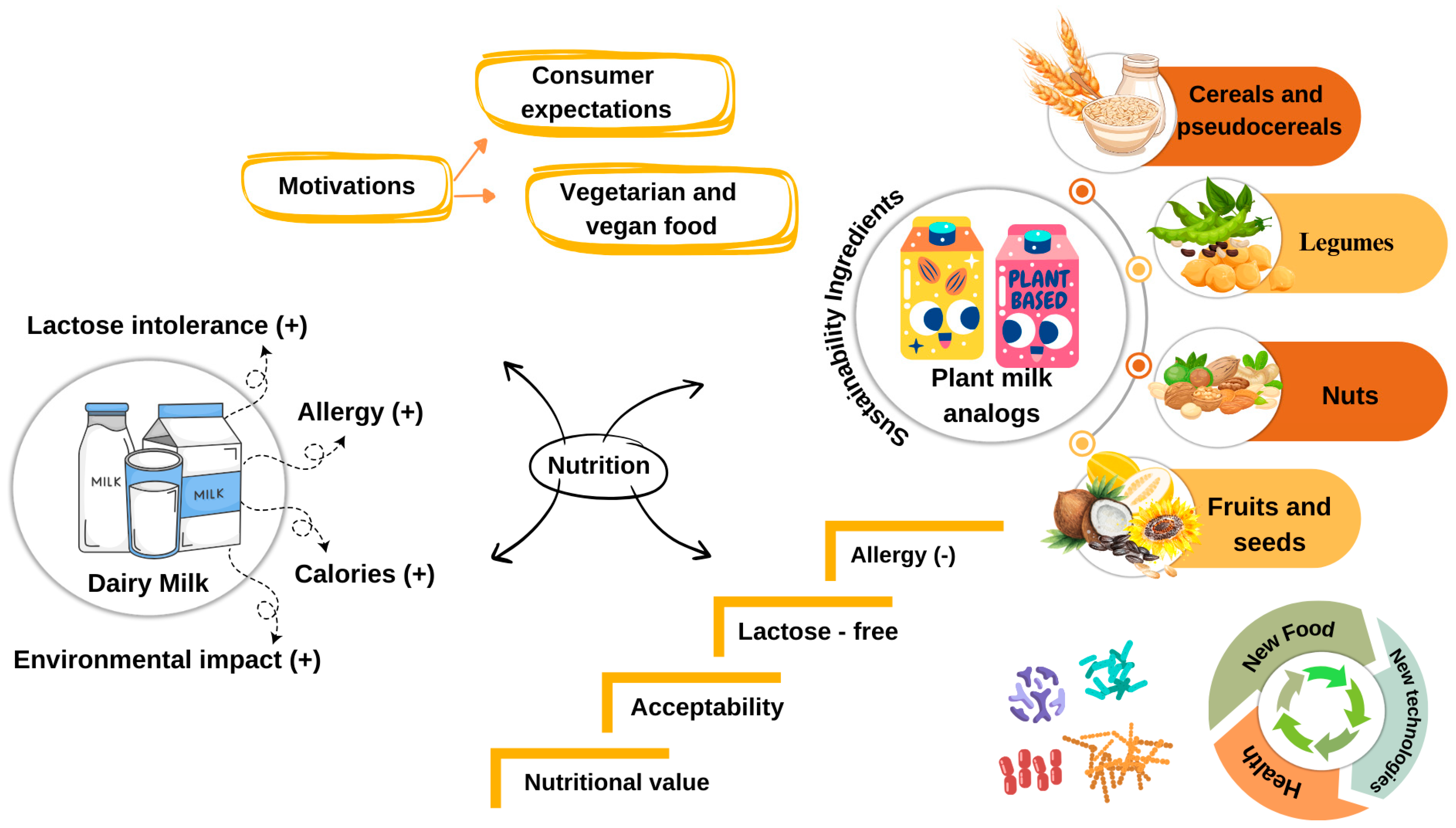
The main motivations driving the consumption of plant-based milk include nutritional factors, dietary restrictions (such as lactose intolerance and allergies), environmental concerns, and the search for sustainable alternatives, showing the growing preference for plant-based milk analogs, obtained from cereals, pseudo-cereals, legumes, nuts, fruits, and seeds (Figure 1).
Figure 1.
Motivations for the consumption of plant-based milk and their characteristics as milk analogs. Source: Prepared by the authors (2025). Designed using Canva Pty Ltd. (Sydney, Australia). Canva Pro Software Canva (2025).
Another growing trend is the production of fermented milk substitutes, which expands the potential for innovation in this market. The use of probiotics and microorganisms in plant-based milk leads to what are known as symbiotic products, which have shown remarkable nutritional, technological, and sensory properties, making them a viable alternative to cow milk analogs. For example, the fermentation of plant-based milk can improve the aroma and flavor of products, which consequently increases consumer acceptance. In addition, they have been shown to reduce antinutritional factors, increase the bioavailability of macro- and micronutrients, and, when mixing different fermentation cultures, the results are even more positive [17].
Given all these aspects, the objective of the present research is to identify in the literature current options, new approaches, the plant matrices used in the development of plant-based milk and fermented milk substitutes, and their influence on the chemical, technological, and sensory characteristics of the products.
2. Methodology
This is an integrative review with a systematic search, which was conducted in the Embase, Lilacs, Fsta, Scopus, and Pubmed databases, as well as Google Scholar. All included studies had to meet the following inclusion criteria: be written in English, be original research articles, be published between 2018 and 2025 and focused on plant-based milk development, and have assessed chemical, technological, and/or sensory properties. The exclusion criteria were as follows: (1) websites, editorials, theses, dissertations, studies involving animals, duplicated studies, patents, letters to the editor, conference abstracts, case reports, papers unavailable in full text, as well as articles not published during the chosen period; (2) review studies that did not evaluate plant-based milk or fermented milk substitutes; (3) studies published in languages other than English; (4) studies that developed plant-based milk for consuming, but did not analyze its chemical, technological, and/or sensory properties; and (5) studies lacking a clear methodology, which limits reproducibility.
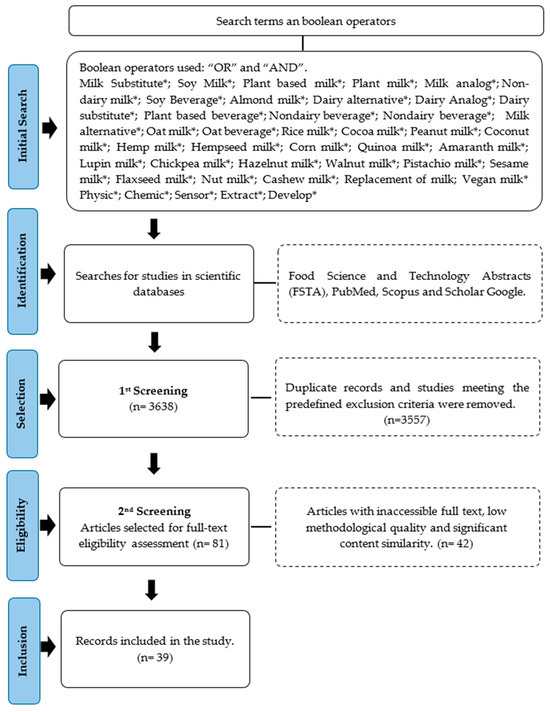
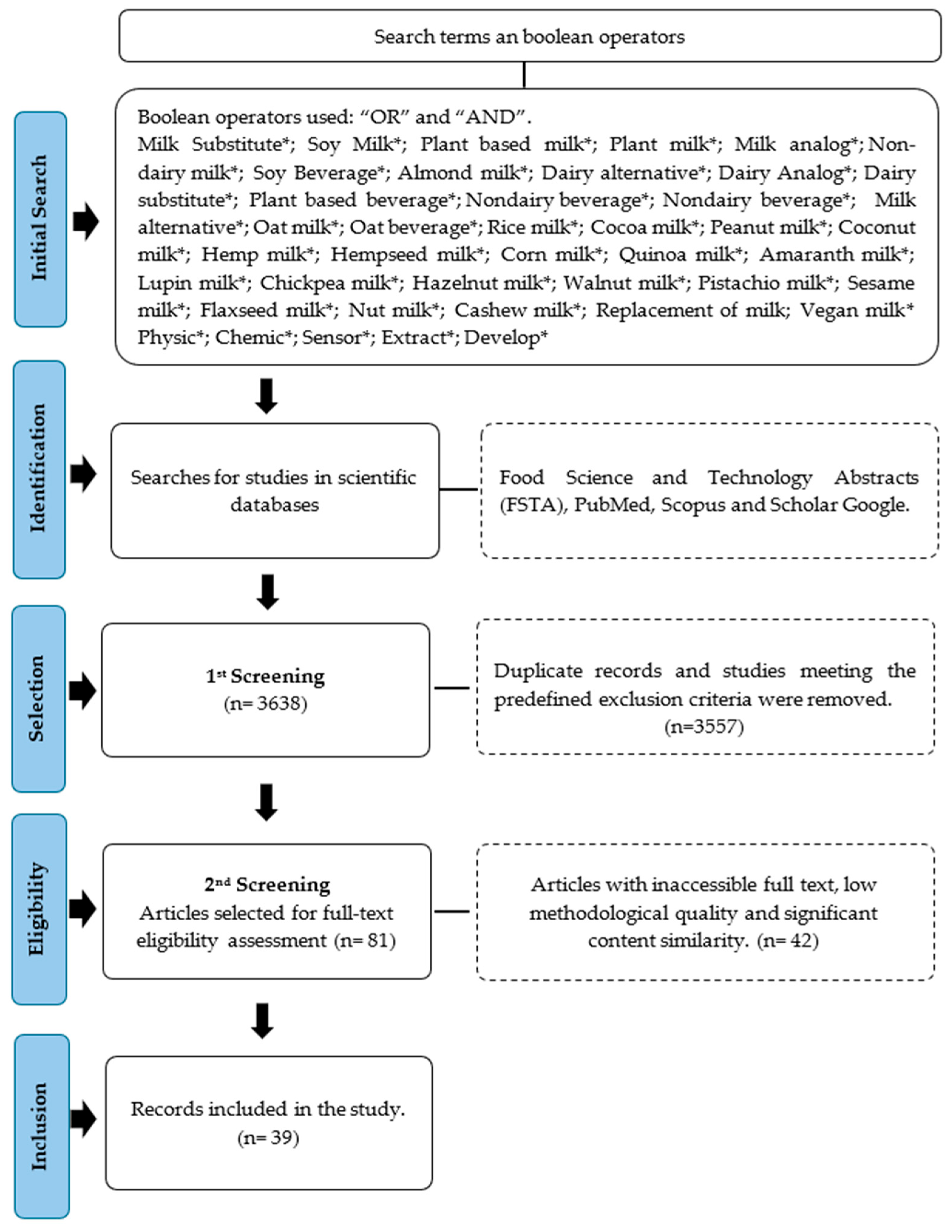
The descriptors were established based on the structured vocabulary DeCS/MeSH and combined using Boolean operators “AND” and “OR.” The selection of studies occurred in four stages (Figure 2). In the identification phase, keywords were used to search for relevant studies in databases, and the titles were analyzed. The selected records were organized in Zotero 6.0.36, and duplicates were excluded by the software. In this stage, the abstracts of the studies were assessed, and those meeting the exclusion criteria were removed.
Figure 2.
Flowchart of the study selection process. Source: Prepared by the authors (2025).
In the eligibility phase, full texts were evaluated, and those unavailable or outside of the review scope were excluded. Finally, thirty-nine studies were included.
3. Results and Discussion
A total of 39 studies were included. Of these, 30.8% (n = 12) focused on legumes, 10.3% (n = 4) on cereals and pseudo-cereals, 15.4% (n = 6) on seeds and nuts, 2.6% (n = 1) on fruits, 20.5% (n = 8) on association of plant matrices in plant-based milk, and 28.2% (n = 11) on fermented milk substitutes.
In relation to the analysis performed, 43.6% of the studies (n = 17) carried out technological, chemical, (Table 1) and sensory evaluation on the products (Table 2), 35.9% (n = 14) performed two of these analyses, and 20.5% (n = 8) carried out only one of them. In some cases, a single study investigated more than one plant matrix.
3.1. Legumes
Legumes, originating from the Fabaceae or Leguminosae family, are rich in proteins, complex carbohydrates, essential amino acids, vitamins, and minerals [18].
Several factors influence the physicochemical and sensory characteristics of legume-based milk. Among them are the type of chosen cultivar, the size, and the nutritional composition of the grains. Jin et al. [19] highlighted that plant-based milk derived from larger seeds tend to have a higher percentage of cotyledons, which significantly contribute to the nutritional profile of the product by increasing its total soluble solids (TSSs).
Tang et al. [9] found a more promising cultivar, resulting in a more stable plant-based milk. The authors attributed its stability to the higher protein content of the grain, which enhances solubility and emulsification, and to its high amylose content, which promotes viscosity and stability in plant-based milk [20,21].
Beyond these factors, the processing method also affects the physicochemical properties of plant-based milk, as noted by Joshi et al. [22], who tested different processing methods on mung bean milk and found that each had a distinct impact.
Table 1 summarizes the studies conducted with different plant matrices, showing that the interaction between the selected species, the intrinsic composition of the grains, and the processing approaches results in plant-based products with distinguished technological and chemical profiles. The analysis highlights relevant trends, such as improved stability, including parameters such as solubility, viscosity, and reduced phase separation, attributed to specific treatments and the structural characteristics of each raw material.
The data presented in Table 1 provides an overview of how different technological variables influence the functionality of legume plant-based products. These data provided the bases for further discussion on strategies capable of optimizing their nutritional and sensory values. The evidence presented reinforces that methods such as germination, which are recurrent among the compiled studies, play a relevant role in improving the quality of plant-based milk.
Table 1.
Ingredients, technological parameters, and chemical value indicators of plant-based milk.
Germination is known to enhance the nutritional composition of foods due to its high enzymatic activity [41]. Ianchyk and Atanasova [31] reported improved nutritional outcomes using this processing method, while Winarsi et al. [26] concluded that a longer germination time (12 h) led to a significant improvement in the nutritional profile of cowpea milk, whereas a shorter germination period (8 h) resulted in the least nutritious sample.
Germination is also known for improving sensory acceptance, roasting increased viscosity, while blanching improved the luminosity of peanut milk, as reported by Sakthi et al. [29]. Tuncel et al. [23] examined the characteristics in chickpea-, faba bean-, and cowpea-based milk, demonstrating that processing conditions significantly affected physicochemical behavior. Viscosity, for example, was influenced not only by starch characteristics but also by the pre-treatments employed: blanching, blanching in conjunction with dehulling, and soaking markedly diminished viscosity, primarily attributable to starch gelatinization during blanching and the dissolution of solids into soaking water. The authors attributed chickpea milk’s consistently higher viscosity compared to faba bean and cowpea analogs to its higher starch content.
In general, legume-based milk exhibited high levels of carbohydrates, protein, and minerals, but low lipid and fiber contents. Furthermore, a healthier lipid profile was observed in these milk substitutes, with the presence of unsaturated fats [27,31]. Sensorially, the products received successful scores, though overall acceptability was moderate, and the beany flavor remained present. The beany flavor can be minimized through some thermal and chemical processing strategies, such as high-temperature vacuum treatment, which removes most of the volatile compounds responsible for the unwanted flavor, such as short-chain fatty acids, sterols, and sulfur compounds. The Cornell method with hot grinding can be performed, in which the grain is crushed with boiling water or steam to form a paste heated to 80 °C, maintained for 10 min to inactivate lipoxygenase. There is also the Illinois pre-scalding method, in which pre-soaked grains are blanched in boiling water. In addition to these heat treatments, alkaline immersion and the use of defatted flour, isolates, and protein concentrates have also been used [42].
3.2. Cereals and Pseudo-Cereals
Cereals belong to the Poaceae family and are widely consumed worldwide, while pseudo-cereals are dicotyledonous that differ from cereals in function, structure, and chemical composition. Generally, they have a considerable energy value per serving, containing 50–80% of carbohydrates, 7–12% protein, 2–6% fat, 10–25% of fibers, and a varied profile of vitamins, minerals, and antioxidants. Moreover, being naturally gluten-free, they are safe for celiac consumers, making them valuable ingredients in gluten-free products and an active area of research in food science [43].
Color is a key attribute for improving sensory acceptance in plant-based milk, and it should resemble milk’s high luminosity as closely as possible. Sangkam et al. [33] evaluated the effect of blanching at 70 °C and 80 °C, varying pressure and time in corn milk, and concluded that different pressures did not affect the color of the samples, whereas heat significantly altered the luminosity of the corn milk.
Silva et al. [7] also applied heat in their study through pasteurization and sterilization. The authors demonstrated that sterilization resulted in a solid texture, making it unsuitable for plant-based milk. This finding is valuable to the literature, as it excludes this processing method from those that can be used to improve the characteristics of milk substitutes.
It is important to compare plant matrices within the same food group to determine which are most or least promising for this market. Ben Jemaa [8] evaluated oat and quinoa milk and found that oat milk was superior in chemical, technological, and sensory analyses, as it exhibited a lighter color, a nutrient profile similar to cow milk, and better sensory acceptance.
Bendezu-Ccanto et al. [32] also analyzed quinoa milk, using germinated white, red, and black quinoa. Again, quinoa presented challenges as a plant-based milk matrix, exhibiting phase separation, precipitation, and lumps, undesirable characteristics for plant-based milk. Even though germination increased the nutritional value of the samples, there was a loss of antioxidants in the final product, attributed to the thermal pasteurization (80 °C for 20 min) treatment applied during quinoa milk processing.
Findings regarding cereal- and pseudo-cereal-based milk aim to identify methods of improving the stability and characteristics of the final product as well as to determine the most suitable plant matrix for producing a milk analog with high nutritional and sensory qualities. Although technological challenges remain, the nutritional outcomes are encouraging, with the goal of achieving consumer sensory acceptance.
3.3. Nuts, Seeds, and Fruit
Nuts and seeds belong to different botanical families; however, they are closely related due to their high caloric density and rich nutritional composition, including MUFAs, PUFAs, essential fatty acids, high protein content, and important vitamins [44,45].
Coconut, derived from Cocos nucifera L., has diverse dietary, medicinal, and cosmetic applications. The different parts of the fruit vary widely in nutritional composition but generally contain a moderate amount of proteins and fibers and are rich in fat, which places coconut closer to the nut and seed group [46,47].
Mertdinç et al. [34] observed that pistachios from Antep, Turkey, were nutritionally and sensorially superior, while those from Siirt, Turkey, excelled in color. This highlights how variety influences the technological, chemical, and sensory properties of plant-based milk, beyond just the plant matrix itself.
Analyzing purchase intention for a new food is essential to understanding its compatibility with market demand. Lima et al. [10] evaluated cashew-based milk and found that most panelists would be willing to buy the product. In general, nuts are well accepted, making this food group a promising choice for developing plant-based milk.
From a nutritional perspective, nuts have shown great potential for plant-based milk production. For example, almond milk had a protein content comparable to cow milk [27] and contained higher amounts of carbohydrates, fiber, and calcium [8]. Hemp was also analyzed and exhibited a nutritional similarity to cow milk but encountered technological difficulties [8,11].
Coconut is known for imparting appealing sensory notes to food products, mainly due to its volatile compounds [48]. Coconut milk differs from cow milk in nutritional profile, as it has a high fat content as well as a high caloric value [12] and a lower protein content than expected for a milk analog. However, due to its valuable mineral and vitamin profile and generally high sensory acceptability, incorporating coconut into mixed plant-based milk formulations may help mitigate its limitations as a milk substitute, by combining diverse chemical compositions in a single product.
3.4. Association of Plant Matrices in Plant-Based Milk Production
Combining different food groups in plant-based milk has proven to be a promising practice in the plant-based milk market [49,50]. Blending diverse plant sources allows for a nutritional profile more similar to cow milk, as well as greater sensory acceptance. Besides selecting the plant matrix, other factors must be considered to achieve better plant-based milk formulation, such as the processing method applied, the proportion of each ingredient used, and the addition of flavor-enhancing ingredients.
For instance, coconut [37] and almonds [40] contributed to higher energy values in plant-based milk due to their high fat content, while ingredients such as melon seeds [13], chickpeas [35], and soy [39] increased the protein content in plant-based milk blends. Additionally, coconut improved the luminosity of the product, while oats, when used in the right proportion, enhanced the sensory scores of plant-based milks [49].
The plant matrices’ diversity and the technological findings observed in the studies indicate that the performance of plant-based milk directly depends on the interaction between the botanical matrix, processing conditions, and their resulting physicochemical properties. Legumes such as chickpeas, red beans, and mung beans showed strong sensitivity to thermal treatments, germination, and disintegration processes, with significant impacts on viscosity, yield, and stability, as reported by Tuncel et al. [23], Tang et al. [9], and Joshi et al. [22].
Lipid-rich matrices such as coconut, pistachio, walnut, and almond have shown a greater influence on creaminess, shine, solid content, and fat composition, as described by Mertdinç et al. [34], Tulashie et al. [12], and Kundu et al. [40]. Pseudo-cereals and sprouted cereals, such as quinoa and rice, stood out for the increase in antioxidants, carbohydrates, and phenolic compounds, especially under specific thermal conditions, according to Silva et al. [7] and Bendezu-Ccanto et al. [32]. Moreover, protein combinations and multicomponent mixtures revealed that the proportion between ingredients is relevant for characteristics such as color, stability, and macronutrient content, as observed by Oduro et al. [13] and Lopes et al. [36].
These results make it evident that each matrix responds uniquely to technological interventions, creating products with widely distinct chemical and functional profiles. Given this complexity, understanding how these transformations are reflected in consumer acceptance also becomes important, a topic further explored in the results and discussions on the sensory application of the plant extracts presented in Table 2.
When analyzing the studies presented in Table 2, it is observed that the sensory acceptance of plant-based milk strongly depends on both the raw materials used and the processing techniques adopted. Tuncel et al. [23] demonstrated that combined thermal treatments, such as blanching and peeling, considerably improve the consistency and appearance of legume milks, while Meghrabi et al. [24] indicated that white bean milk, despite its attractive appearance, exhibited a grainy texture and lower creaminess compared to commercial soy milk.
Among the red beans, Tang et al. [9] identified the JZY-2 cultivar as the most stable and sensorially accepted, reinforcing the importance of genetic variety. Processes such as germination and aromatic seasoning were also decisive. Joshi et al. [22] demonstrated that the combination of germination and cardamom elevated all attributes of mung bean milk, while Ladokun et al. [25] highlighted the predominance of a sweet flavor and mild aroma in cowpea milk. In soy-based milk, Jin et al. [32] found that grains with lower protein and higher lipid contents produce better-rated products, while Bendezu-Ccanto et al. [32] demonstrated that mixtures of quinoa of different colors can directly impact acceptance, regardless of antioxidant content.
Other matrices, such as almond, pistachio, and cashew nut, also showed a strong influence of the lipid profile and varietal composition on consumer acceptance, as demonstrated by Ben Jemaa [8], Mertdinç et al. [34], and Lima et al. [10]. Additional evidence shows that technological processes, such as the use of cooking water in chickpea milk [36] or optimized combinations of coconut, peanut, and tiger nut [13], can enhance desirable attributes such as consistency, appearance, and flavor. This rich sensory landscape is the perfect place to start looking into how fermentation can change the taste and usefulness of plant-based drinks even more.
Table 2.
Sensory evaluation indicators of plant-based milk.
3.5. Fermented Milk Substitutes
The genera Streptococcus and Lactobacillus, recognized for their ability to survive and thrive in adverse conditions, are the most commonly used in the fermentation of plant-based substitutes. In the case of Lactobacillus spp., species such as L. casei, L. helveticus, L. fermentum, L. reuteri, L. acidophilus, L. rhamnosus, and L. johnsonii have been frequently applied as probiotic cultures in soy-based options, providing various health benefits associated with their consumption [51,52,53]. Table 3 presents the findings of non-dairy products produced through fermentation.
Table 3.
Ingredients, treatments, and main findings on microbiological information, chemical value indicators, and sensory quality of fermented milk substitutes.
The preparation of fermented milk substitutes can be conducted with a variety of raw materials, such as cereals, legumes, fruits, nuts, and vegetables [51]. Among the ingredients used are hazelnut [52]; lentil [53,57]; barley (Hordeum vulgare L.) [51]; cashew nut [61]; ragi (Eleusine coracana) [51]; pea [30]; moth bean (Vigna aconitifolia) [51]; lupin (Lupinus angustifolius L.) [60]; soy [51,56]; almond [51]; coconut [51]; red bean (Phaseolus vulgaris L.) [59]; green mung bean (Vigna radiata L.) [59]; and buckwheat [57].
Table 3 shows data from studies that highlighted advances in the development of fermented milk substitutes, emphasizing stability and quality, such as the whiteness index in cashew nut milk and the pseudoplastic behavior of hazelnut milk. Chemically, there were reductions in antinutrients and preservation of microbiological and protein composition. Bean- and soy-based options exhibited high protein levels, comparable to or exceeding those of traditional products.
In the sensory analyses, coconut and sprouted almond milk were well accepted, and strains such as L. delbrueckii and L. paracasei stood out in texture and flavor in soy milk. However, hazelnut milk showed lower acceptance.
4. Final Considerations
Plant-based milk has been emerging as an exciting milk analog, offering a wide range of chemical and sensory properties. The present study revealed that legumes, cereals, pseudo-cereals, nuts, fruits, and seeds have distinct potential to be added in plant-based milk; therefore, combining different plant sources is an effective strategy to optimize their nutritional and technological characteristics. Furthermore, the comparative analysis of these foods and their respective processing methods demonstrated that each plant matrix presents specific strengths and limitations, which realistically differentiates their technological, chemical, and sensory potentials.
Additionally, processing methods such as germination and fermentation have shown a positive impact on the final quality of milk substitutes, enhancing stability and sensory acceptance. Further research is needed to address the potential challenges of these techniques, but the future of plant-based milk aligns with microorganisms and mixed plant proteins.
Based on the main findings, it can be inferred that fermented plant-based products have good technological, chemical, and sensory potential as well, but improvements in stability and taste are necessary for greater consumer acceptance.
Among some challenges are the standardization of technological characteristics and the mitigation of undesirable flavors caused by antinutrients in plant matrices. Stabilizers, colorings, and flavorings are being used to minimize these effects, yielding promising results.
A limitation of this study is that some included authors did not conduct all the analyses of interest: chemical, technological, sensory, and, for fermented milk substitutes, microbiological. Moreover, restricting the inclusion criteria to studies published in English may have been a methodological limitation. However, this paper offers substantial information about the current plant-based milk scenario, highlighting emerging trends in this rapidly growing market.
Author Contributions
R.G.H.L.: conceptualization, methodology, software, formal analysis, investigation, resources, writing—original draft preparation, and visualization. Z.d.C.d.M.: formal analysis, investigation, resources, data curation, writing—original draft preparation, and visualization. A.K.F.d.S.: formal analysis and investigation. V.R.d.O.: conceptualization, methodology, validation, investigation, data curation, and supervision. All authors have read and agreed to the published version of the manuscript.
Funding
This research received no external funding.
Institutional Review Board Statement
Not applicable.
Informed Consent Statement
Not applicable.
Data Availability Statement
No new data was created or analyzed in this study. Data sharing is not applicable to this article.
Acknowledgments
This work was (partially) supported by Programa Iberoamericano de Ciencia y Tecnología para el Desarrollo (CYTED) (through Red AlProSos 125RT0165).
Conflicts of Interest
The authors declare no conflicts of interest.
References
- Karoui, R.; Bouaicha, I. A review on nutritional quality of animal and plant-based milk alternatives: A focus on protein. Front. Nutr. 2024, 11, 1378556. [Google Scholar] [CrossRef] [Scilit]
- Loveday, S.M. Food proteins: Technological, nutritional, and sustainability attributes of traditional and emerging proteins. Annu. Rev. Food Sci. Technol. 2019, 10, 311–339. [Google Scholar] [CrossRef] [Scilit]
- McClements, D.J.; Grossmann, L. The science of plant-based foods: Constructing next-generation meat, fish, milk, and egg analogs. Compr. Rev. Food Sci. Food Saf. 2021, 20, 4049–4100. [Google Scholar] [CrossRef] [Scilit]
- Bayless, T.M.; Brown, E.; Paige, D.M. Lactase non-persistence and lactose intolerance. Curr. Gastroenterol. Rep. 2017, 19, 23. [Google Scholar] [CrossRef] [Scilit]
- Flom, J.D.; Sicherer, S.H. Epidemiology of cow’s milk allergy. Nutrients 2019, 11, 1051. [Google Scholar] [CrossRef] [Scilit]
- Food and Agriculture Organization of the United Nations (FAO); Global Dairy Platform (GDP). Climate Change and the Global Dairy Cattle Sector: The Role of the Dairy Sector in a Low-Carbon Future; FAO: Rome, Italy; GDP: Rome, Italy, 2019; Available online: https://www.fao.org/3/ca2929en/ca2929en.pdf (accessed on 26 March 2025).
- Silva, L.R.; Velasco, J.I.; Fakhouri, F.M. Use of rice on the development of plant-based milk with antioxidant properties: From raw material to residue. LWT 2023, 173, 114271. [Google Scholar] [CrossRef] [Scilit]
- Ben Jemaa, M. Plant-based milk alternative: Nutritional profiling, physical characterization and sensorial assessment. Curr. Perspect. Med. Aromat. Plants 2021, 4, 60–70. [Google Scholar] [CrossRef] [Scilit]
- Tang, J.; Cui, L.; Zhang, S.; Wang, L.; Hou, D.; Zhou, S. A novel plant-based milk alternative made from red kidney bean (Phaseolus vulgaris L.): Effects of cultivars on its stability and sensory properties. Food Biosci. 2023, 56, 103362. [Google Scholar] [CrossRef] [Scilit]
- Lima, J.R.; Bruno, L.M.; Wurlitzer, N.J.; Sousa, P.H.M.; Holanda, S.A.M. Cashew nut-based beverage: Development, characteristics and stability during refrigerated storage. Food Sci. Technol. 2021, 41 (Suppl. S1), 60–64. [Google Scholar] [CrossRef] [Scilit]
- Wang, Q.; Jiang, J.; Xiong, Y.L. High pressure homogenization combined with pH shift treatment: A process to produce physically and oxidatively stable hemp milk. Food Res. Int. 2018, 106, 487–494. [Google Scholar] [CrossRef] [Scilit]
- Tulashie, S.K.; Amenakpor, J.; Atisey, S.; Odai, R.; Akpari, E.E.A. Production of coconut milk: A sustainable alternative plant-based milk. Case Stud. Chem. Environ. Eng. 2022, 6, 100206. [Google Scholar] [CrossRef] [Scilit]
- Silva, A.R.; Silva, M.M.; Ribeiro, B.D. Health issues and technological aspects of plant-based alterna-tive milk. Food Res. Int. 2020, 131, 108972. [Google Scholar] [CrossRef] [Scilit] [PubMed]
- Oduro, A.F.; Saalia, F.K.; Adjei, M.Y.B. Sensory acceptability and proximate composition of 3-blend plant-based dairy alternatives. Foods 2021, 10, 482. [Google Scholar] [CrossRef] [Scilit] [PubMed]
- Berardy, A.J.; Rubín-García, M.; Sabaté, J. A scoping review of the environmental impacts and nutrient composition of plant-based milks. Adv. Nutr. 2022, 13, 2559–2572. [Google Scholar] [CrossRef] [Scilit]
- Geburt, K.; Albrecht, E.H.; Pointke, M.; Pawelzik, E.; Gerken, M.; Traulsen, I. A comparative analysis of plant-based milk alternatives part 2: Environmental impacts. Sustainability 2022, 14, 8424. [Google Scholar] [CrossRef] [Scilit]
- Tangyu, M.; Muller, J.; Bolten, C.J.; Wittmann, C. Fermentation of plant-based milk alternatives for improved flavour and nutritional value. Appl. Microbiol. Biotechnol. 2019, 103, 9263–9275. [Google Scholar] [CrossRef] [Scilit]
- Martín-Cabrejas, M.Á. (Ed.) Legumes: Nutritional Quality, Processing and Potential Health Benefits; Royal Society of Chemistry: Cambridge, UK, 2019; Volume 8. [Google Scholar]
- Jin, X.; Chen, C.; Guo, S.; Zhang, H. Analysis on physicochemical and sensory qualities of soymilk prepared by various cultivars: Application of fuzzy logic technique. J. Food Sci. 2020, 85, 1635–1641. [Google Scholar] [CrossRef] [Scilit]
- Obadi, M.; Qi, Y.; Xu, B. High-amylose maize starch: Structure, properties, modifications and industrial applications. Carbohydr. Polym. 2023, 299, 120185. [Google Scholar] [CrossRef] [Scilit] [PubMed]
- Krstonošić, V.S.; Kalić, M.D.; Dapčević-Hadnađev, T.R.; Lončarević, I.S.; Hadnađev, M.S. Physico-chemical characterization of protein stabilized oil-in-water emulsions. Colloids Surf. A Physicochem. Eng. Asp. 2020, 602, 125045. [Google Scholar] [CrossRef] [Scilit]
- Joshi, S.; Bathla, S.; Singh, A.; Sharma, M.; Inbaraj, B.S.; Sridhar, K. Development of mung bean (Vigna radiata L.)-based next-generation vegan milk: Processing, nutritional composition and quality attributes. Int. J. Food Sci. Technol. 2023, 58, 785–794. [Google Scholar] [CrossRef] [Scilit]
- Tuncel, N.Y.; Andaç, A.E.; Kaya, H.P.; Korkmaz, F.; Tuncel, N.B. The effect of different pre-treatments on unformulated pulse-based milk analogs: Physicochemical properties and consumer acceptance. J. Food Sci. Technol. 2024, 61, 268–278. [Google Scholar] [CrossRef] [Scilit]
- Meghrabi, S.; Yamani, M.; Taylor, G. Physicochemical and sensory characteristics of a new milk substitute from dry white kidney bean. Food Sci. Technol. 2023, 11, 218–225. [Google Scholar] [CrossRef] [Scilit]
- Ladokun, O.; Deniran, I.A.; Akinola, S. Development of milk analog from cowpea. SSRN Electron. J. 2023, preprint. [Google Scholar] [CrossRef] [Scilit]
- Winarsi, H.; Erminawati; Ramadhan, G.R.; Gumelar, E.M.; Kencana, L.A.S. Cowpea sprouted milk rich in phenolic antiox-idants, vitamin C, protein, and dietary fiber as an antidiabetic drink. AIP Conf. Proc. 2023, 2586, 060017. [Google Scholar] [CrossRef] [Scilit]
- Comak Gocer, E.M.; Koptagel, E. Production of milks and kefir beverages from nuts and certain physicochemical analysis. Food Chem. 2023, 402, 134252. [Google Scholar] [CrossRef] [Scilit] [PubMed]
- Duarte, C.M.; Mota, J.; Assunção, R.; Martins, C.; Ribeiro, A.C.; Lima, A.; Raymundo, A.; Nunes, M.C.; Ferreira, R.B.; Sousa, I. New alternatives to milk from pulses: Chickpea and lupin beverages with improved digestibility and potential bioactivities for human health. Front. Nutr. 2022, 9, 852907. [Google Scholar] [CrossRef] [Scilit] [PubMed]
- Sakthi, T.S.; Meenakshi, V.; Kanchana, S. Impact of different processing methods on physico-chemical characteristics and antioxidant activity of peanut milk. Asian J. Dairy Food Res. 2022, 41, 283–287. [Google Scholar] [CrossRef] [Scilit]
- Veber, A.L.; Leonova, S.A.; Simakova, I.V.; Esmurzaeva, Z.B. The development of a beverage with a dispersion structure from pea grains of domestic selection. IOP Conf. Ser. Earth Environ. Sci. 2021, 624, 012127. [Google Scholar] [CrossRef] [Scilit]
- Ianchyk, M.; Atanasova, V. Effect of germinated lentil seeds edition on the nutritional value of the beverage. Ukr. J. Food Sci. 2020, 8, 241–250. [Google Scholar] [CrossRef] [Scilit]
- Bendezu-Ccanto, J.; Contreras-López, E.; Lozada-Urbano, M. Development and characterization of an optimized novel drink from three varieties of sprouted quinoa. Afr. J. Food Agric. Nutr. Dev. 2023, 23, 24091–24114. [Google Scholar] [CrossRef] [Scilit]
- Sangkam, J.; Apichartsrangkoon, A.; Baipong, S.; Sriwattana, S.; Tiampakdee, A.; Sintuya, P. Pre-blanching corn and pressurization effects on the physicochemical and microbiological qualities of corn milk. Food Biosci. 2019, 31, 100446. [Google Scholar] [CrossRef] [Scilit]
- Mertdinç, Z.; Aydar, E.F.; Kadı, İ.H.; Demircan, E.; Koca Çetinkaya, S.; Özçelik, B. A new plant-based milk alternative of Pistacia vera geographically indicated in Türkiye: Antioxidant activity, in vitro bio-accessibility, and sensory characteristics. Food Biosci. 2023, 53, 102731. [Google Scholar] [CrossRef] [Scilit]
- Rincon, L.; Botelho, R.B.A.; Alencar, E.R. Development of novel plant-based milk based on chickpea and coconut. LWT 2020, 128, 109479. [Google Scholar] [CrossRef] [Scilit]
- Lopes, M.; Pierrepont, C.; Duarte, C.M.; Filipe, A.; Medronho, B.; Sousa, I. Legume beverages from chickpea and lupin as new milk alternatives. Foods 2020, 9, 1458. [Google Scholar] [CrossRef] [Scilit] [PubMed]
- Sunny, J.D.; Kundu, P.; Mehla, R. Preparation and physicochemical evaluation of dairy-free alternative based on coconut and millet milk. Int. J. Pharm. Biol. Sci. 2019, 9, 565–572. [Google Scholar]
- Olagunju, A.I.; Oyewumi, D.M. Physicochemical properties and antioxidant activity of novel plant milk beverage developed from extracts of tiger nut, cashew nut and coconut. Appl. Trop. Agric. 2019, 24, 170–176. [Google Scholar]
- Bolarinwa, I.F.; Aruna, T.E.; Adejuyitan, J.A.; Akintayo, O.A.; Lawal, O.K. Development and quality evaluation of soy-walnut milk drinks. Int. Food Res. J. 2018, 25, 2033–2041. [Google Scholar]
- Kundu, P.; Dhankhar, J.; Sharma, A. Development of non-dairy milk alternative using soymilk and almond milk. Curr. Res. Nutr. Food Sci. J. 2018, 6, 203–210. [Google Scholar] [CrossRef] [Scilit]
- Gunathunga, C.; Senanayake, S.; Jayasinghe, M.A.; Brennan, C.S.; Truong, T.; Marapana, U.; Chandrapala, J. Germination effects on nutritional quality: A comprehensive review of selected cereals and pulses changes. J. Food Compos. Anal. 2024, 128, 106024. [Google Scholar] [CrossRef] [Scilit]
- Sethi, S.; Tyagi, S.K.; Anurag, R.K. Plant-based milk alternatives an emerging segment of functional beverages: A review. J. Food Sci. Technol. 2016, 53, 3408–3423. [Google Scholar] [CrossRef] [Scilit]
- Kaur, H.; Shams, R.; Dash, K.K.; Dar, A.H. A comprehensive review of pseudo-cereals: Nutritional profile, phytochemical constituents and potential health-promoting benefits. Appl. Food Res. 2023, 3, 100351. [Google Scholar] [CrossRef] [Scilit]
- Zhou, J.; Yan, F.; Bi, Y.; Li, J. Nuts: An overview on oxidation, affecting factors, inhibiting measures, and prospects. J. Food Compos. Anal. 2024, 107, 134. [Google Scholar] [CrossRef] [Scilit]
- Zhang, M.; Wang, O.; Cai, S.; Zhao, L.; Zhao, L. Composition, functional properties, health benefits and applications of oilseed proteins: A systematic review. Food Res. Int. 2023, 171, 113061. [Google Scholar] [CrossRef] [Scilit] [PubMed]
- Mat, K.; Abdul Kari, Z.; Rusli, N.D.; Che Harun, H.; Wei, L.S.; Rahman, M.M.; Mohd Khalid, H.N.; Mohd Ali Hanafiah, M.H.; Mohamad Sukri, S.A.; Raja Khalif, R.I.A.; et al. Coconut palm: Food, feed, and nutraceutical properties. Animals 2022, 12, 2107. [Google Scholar] [CrossRef] [Scilit]
- Nyayiru Kannaian, U.P.; Edwin, J.B.; Rajagopal, V.; Nannu Shankar, S.; Srinivasan, B. Phytochemical composition and antioxidant activity of coconut cotyledon. Heliyon 2020, 6, e03411. [Google Scholar] [CrossRef] [Scilit]
- Guo, H.; Lai, J.; Li, C.; Zhou, H.; Wang, C.; Ye, W.; Wang, S. Comparative metabolomics reveals key determinants in the flavor and nutritional value of coconut by HS-SPME/GC-MS and UHPLC-MS/MS. Metabolites 2022, 12, 691. [Google Scholar] [CrossRef] [Scilit]
- Kumar, A.; Kaur, A.; Tomer, V.; Rasane, P.; Gupta, K. Development of nutricereals and milk-based beverage: Process optimization and validation of improved nutritional properties. J. Food Process Eng. 2020, 43, e13025. [Google Scholar] [CrossRef] [Scilit]
- Lee, P.Y.; Leong, S.Y.; Oey, I. The role of protein blends in plant-based milk alternative: A review through the consumer lens. Trends Food Sci. Technol. 2024, 143, 104268. [Google Scholar] [CrossRef] [Scilit]
- Chavan, M.; Gat, Y.; Harmalkar, M.; Waghmare, R. Development of non-dairy fermented probiotic drink based on germinated and ungerminated cereals and legume. LWT 2018, 91, 339–344. [Google Scholar] [CrossRef] [Scilit]
- Ermiş, E.; Güneş, R.; Zent, İ.; Çağlar, M.Y.; Yilmaz, M.T. Characterization of hazelnut milk fermented by Lactobacillus delbrueckii subsp. bulgaricus and Streptococcus thermophilus. Gıda 2018, 43, 677–686. [Google Scholar] [CrossRef] [Scilit]
- Verni, M.; Demarinis, C.; Rizzello, C.G.; Baruzzi, F. Design and characterization of a novel fermented beverage from lentil grains. Foods 2020, 9, 893. [Google Scholar] [CrossRef] [Scilit]
- Scarpelin, C.; Cordes, C.L.S.; Kamimura, E.S.; Macedo, J.A.; Barbosa, P.P.M.; Macedo, G.A. New plant-based kefir fermented beverages as potential sources of GABA. J. Food Sci. Technol. 2025, 62, 264–272. [Google Scholar] [CrossRef] [Scilit]
- Gomes, A.S.; Costa, K.S.; Martins Salomão, B.C. Antagonism and survival of probiotics encapsulated in functional yogurt-like fermented vegetable beverage. SSRN Electron. J. 2024, preprint. [Google Scholar] [CrossRef] [Scilit]
- Huo, C.; Yang, X.; Li, L. Non-beany flavor soymilk fermented by lactic acid bacteria: Characterization, stability, antioxidant capacity and in vitro digestion. Food Chem. X 2023, 17, 100578. [Google Scholar] [CrossRef] [Scilit]
- Mousavi, M.; Gharekhani, M.; Alirezalu, K.; Roufegarinejad, L.; Azadmard-Damirchi, S. Production and characterization of nondairy gluten-free fermented beverage based on buckwheat and lentil. Food Sci. Nutr. 2023, 11, 2197–2210. [Google Scholar] [CrossRef] [Scilit] [PubMed]
- Cunha Júnior, P.C.; Oliveira, L.S.; Blanco, J.C.; Silva, M.T.C.; Gálvez, S.G.L.; Rosenthal, A.; Ferreira, E.H.R. Elaboration, characterization, and probiotic viability of synbiotic non-dairy drink based on coconut. Ciênc. Rural 2023, 53, e20210723. [Google Scholar] [CrossRef] [Scilit]
- Chaturvedi, S.; Chakraborty, S. Optimization of fermentation conditions of synbiotic legume-based beverages and study of their antimicrobial and proteolytic activity. J. Food Sci. 2022, 87, 5070–5088. [Google Scholar] [CrossRef] [Scilit] [PubMed]
- Laaksonen, O.; Kahala, M.; Marsol-Vall, A.; Blasco, L.; Järvenpää, E.; Rosenvald, S.; Virtanen, M.; Tarvainen, M.; Yang, B. Impact of lactic acid fermentation on sensory and chemical quality of dairy analogues prepared from lupine (Lupinus angustifolius L.) seeds. Food Chem. 2021, 346, 128852. [Google Scholar] [CrossRef] [Scilit]
- Bruno, L.M.; Lima, J.R.; Wurlitzer, N.J.; Rodrigues, T.C. Non-dairy cashew nut milk as a matrix to deliver probiotic bacteria. Food Sci. Technol. 2020, 40, 604–607. [Google Scholar] [CrossRef] [Scilit]

Disclaimer/Publisher’s Note: The statements, opinions and data contained in all publications are solely those of the individual author(s) and contributor(s) and not of MDPI and/or the editor(s). MDPI and/or the editor(s) disclaim responsibility for any injury to people or property resulting from any ideas, methods, instructions or products referred to in the content. |
© 2026 by the authors. Licensee MDPI, Basel, Switzerland. This article is an open access article distributed under the terms and conditions of the Creative Commons Attribution (CC BY) license.