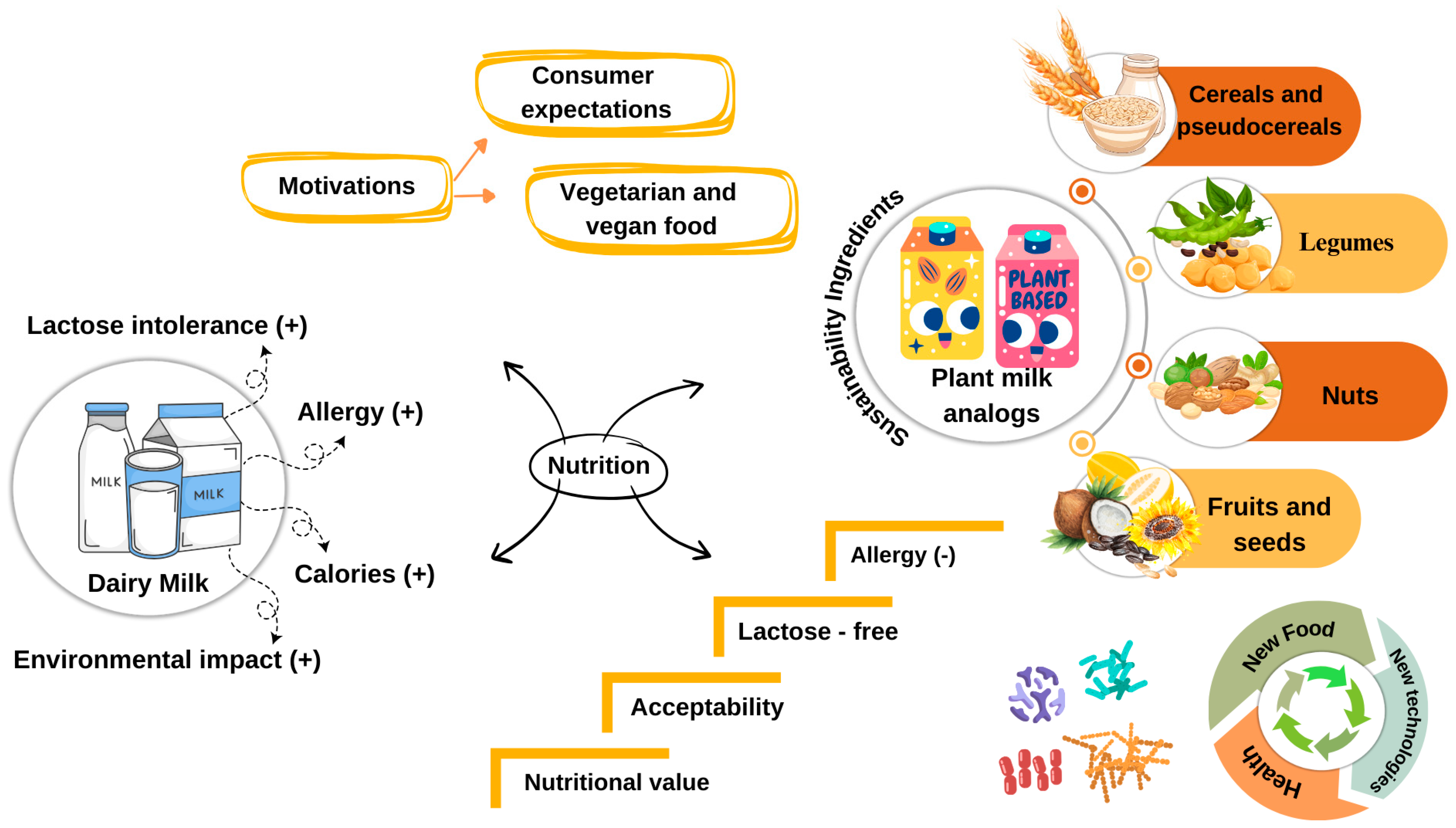
Current Scenario and New Approaches for the Chemical, Technological, and Sensory Qualities of Plant-Based Milk and Fermented Milk Substitutes

 , , and
Highlights
- Lipid-rich matrices contribute to improving texture and sensory acceptance;
- Mixing different plant sources can be effective for improving nutritional and technological characteristics;
- Fermentation and germination demonstrated promising effects on the final quality of milk substitutes;
- Advances have been made in the development of fermented milk substitutes, especially in terms of stability and quality.
Abstract
1. Introduction
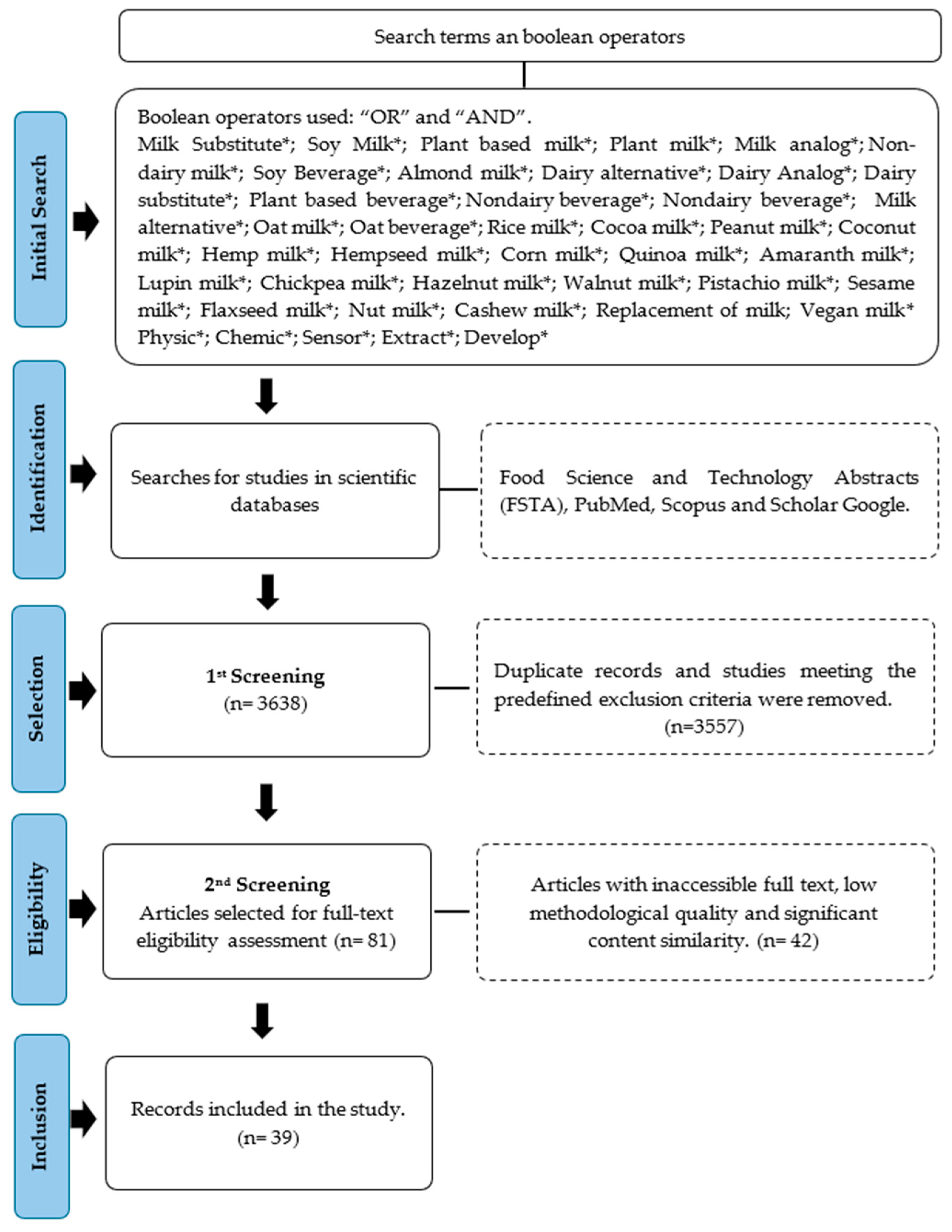
2. Methodology
3. Results and Discussion
3.1. Legumes

| Author/ Country | Plant Matrices | Formulation/ Processing | Main Technological Parameters | Chemical Value Indicators |
|---|---|---|---|---|
| LEGUMES | ||||
| Tuncel et al. [23] India | Chickpea (Cicer arietinum L.), cowpea (Vigna unguiculata L.), and faba bean (Vicia faba L.) seeds. | T1—Dry milling (control) T2—Soaking and wet milling T3—Blanching T4—Blanching and dehulling T5—Vacuum treatment T6—Germination | Extraction yield: 68–86%; lowest in T2; highest in T1 and T4. Viscosity: 1.75–3.69 cP; lowest in T2, T3, and T4; highest in chickpea-based milks. Color: higher luminosity and whiteness in T4; lowest whiteness in T2. pH: 5.9–6.9 (near-neutral). Titratable acidity: 0.05–0.13% (similar to cow milk). | pH: 5.9–6.9 (near-neutral). Titratable acidity: 0.05–0.13% (lactic acid). Viscosity: 1.75–3.69 cP. Extraction yield: 68–86%. Lipoxygenase activity: reduced in T1 and T6; increased in T2 and T4; inactivated by T3. |
| Meghrabi et al. [24] Jordan | White kidney beans (Phaseolus vulgaris L.). | Cleaning, removal of impurities, prolonged soaking (overnight) in boiled water, blanching for 20 min, grinding, adjusting water for desired total solids, adjusting pH (6.8–7.2) with HCl/NaOH, heating to 82–83 °C for 5 min, homogenization, cooling, and storage < 5 °C. | Final pH 6.65; titratable acidity 2.18 mg/g; total solids 12.20%; viscosity lower than that of soy milk (control). | The milk-based product from white kidney beans had 23.61% protein, 4.57% ash, 1.23% fat, 47.8% carbohydrates, 9.2% moisture, and 90.78% total solids. When compared with soymilk, it showed 12.19–8.06% total solids, 3.71–3.05% protein, 0.79–1.69% fat, 6.41–2.51% carbohydrate, 1.19–0.5% ash, 0.8–0.54% fiber, 87.78–92% moisture, pH of 6.64–6.87, acidity at 2.19–2.34%, and 47.4 kcal total energy. |
| Tang et al. [9] China | Red bean (Phaseolus vulgaris L.)—four cultivars: [Jizhangyun-2 (JZY-2), Pinjinyun-4 (PJY-4), Anbo (AB), and Yingguohong (YGH)]. | Flour (0.5 mm) + hot water (1:12, 95 °C), gelatinization at 90 °C for 10 min with amylase (0.1%), cooling (55 °C), enzymatic treatment (protease 0.0045%; glucosidase 0.4%; cellulase 0.1%; 1 h), filtration (200 mesh sieve), addition of rice bran oil (0.2%), dispersion + high-pressure homogenization, packaging and sterilization at 100 °C for 30 min, storage at 4 °C. | JZY-2 produced a product with better stability: lower centrifugal sedimentation rate (8.04% vs. 18.99–24.93%), smaller average particle diameter D3.2 (2.54 µm vs. 6.51–8.46 µm), higher zeta potential (−23.03 mV vs. −16.66 to −20.10 mV), lower instability index (0.13 vs. 0.41–0.54), and lower separation rate (4.44 vs. 5.55–12.76). It also showed higher viscosity and better particle distribution, while AB and YGH exhibited strong phase separation. | Red bean grains showed protein 24.02–29.13%, lipids 1.00–1.73%, ash 3.82–4.53%, total carbohydrates 56.59–60.50%, starch 40.39–47.46%, and amylose 32.39–36.97%, with higher levels of protein and starch in the JZY-2 cultivar. |
| Joshi et al. [22]. India | Mung bean (Vigna radiata L.). | Four methods: T1: soaking; T2: soaking and blanching; T3: germination; T4: germination and blanching. | T4 had the highest viscosity (4.43) and b* (1.76) values. T3 had the highest L* (48.61) values. | The germination method showed higher protein (4.39%), carbohydrates (5.52%), and energy (39.93 kcal). The fat content ranged from 0.02 to 0.06%, the ash content from 0.45 to 0.49%, and no fiber was detected. |
| Ladokun et al. [25] Nigeria | Cowpea, sugar, water, and cinnamon. | Cowpea grains were processed by soaking, dehulling, wet milling, sieving, and cooking. | Stable final product, suitable for consumption; simple and domestic processing. | Moisture content (85.24%), crude protein (12.47%), crude fat (9.33%), crude fiber (0.062%), and total ash (2.73%). |
| Winarsi et al. [26] Indonesia | Cowpea, water, and sugar. | Not specified | Not specified | Longer germination improved nutritional profile: phenolic content (4.67 mg GAE/g), vitamin C (75.8 mg/100 g), fiber (1.28%), and soluble proteins (33%). |
| Comak Gocer and Koptagel [27] Turkey | Peanut and water. | Not specified | Not specified | Low carbohydrate (0.28 g/100 mL), high fat (more unsaturated fatty acid, less saturated fatty acid), and higher energy than cow milk. |
| Duarte et al. [28]. Portugal | Lupin-based milk (LBM): sweet lupin and water. Chickpea-based milk (CBM): chickpea and water. | Not specified | Not specified | LBM had the highest protein (4.05%) and both matched cow milk protein levels. CBM had more starch (1.391 g/mL) and total carbohydrate (9.01 g/100 mL) than LBM (3.27 g/mL). Both were fat-free and rich in manganese (7.94 mg/100 mL–10.64 mg/100 mL). |
| Sakthi et al. [29] India | Peanut cultivars, water, and sugar. | Peanut milk samples were prepared by five different processing methods: T1: Fresh; T2: Blanching; T3: Soaking; T4: Roasting; T5: Germination. | T4 had the highest viscosity value (4.98–4.92) and T2 the highest L* (85.24) levels. | T4 had the highest antioxidant activity: 64% radical-scavenging activity (RSA). Total soluble solids (TSSs): 11–12. |
| Veber et al. [30] Russia | Different cultivars of pea and water. Oat milk. Soybean milk. Pea milk. | Hulling was determined using the hot water immersion method, followed by peeling and drying. Plant-based production: washing; germination at 21 °C for 13–15 h (humidity 40–90%); grinding to 1 mm; ratio 1:5 (grain/water); and extraction at 35–40 °C for 20–30 min. | Recommended higher essential amino acid content. Plant-based milk presented a homogeneous consistency (particles < 50 µm), a mild aroma, and a slight pea flavor. Technological composition depended on grain characteristics (size, husk, uniformity, protein and starch content). | Protein 2.8% (pea milk) vs. 2.0% (soy) and 1.0% (oat). fat 1.0%. total solids 10% (pea milk) vs. 8.8% (soy) and 8.7% (oat). Protein content of the pea cultivars between 20.2% and 24.85%; and starch between 37.83% and 39.11%. Pea cultivar “Chishminsky 229” was considered the main resource for plant-based milk production |
| Jin et al. [19] China | Soybean and distilled water. First class: 19 cultivars; Second class: 16 cultivars. | The process involves washing, soaking for 15 h at 4 °C, grinding (700 mL water/100 g grain) in a domestic blender for 2 min, filtering through cotton, heating to 95 °C for 5 min, and rapid cooling. | Soymilk from the second class showed higher viscosity (3.18–4.66). | High-protein, high-fat, large-grain soybeans enhance soymilk nutrition, while smaller grains reduce SS. Protein content: 3.18–4.17 g/100 mL; total solids content: 6.21–8.35 g/100 mL. |
| Ianchyk and Atanasova [31] Ukraine | Lentil seeds and water. T1: Ungerminated; T2: Germinated. | Not specified | T2: good protein digestibility (63.31%), high biological value, presence of B vitamins, minerals, monounsaturated fatty acids (MUFAs), and polyunsaturated fatty acids (PUFAs). T1 was less nutritious. | Not specified |
| CEREALS AND PSEUDO-CEREALS | ||||
| Silva et al. [7] Brazil | Rice (white; red; black) and distilled water. | T1: Unheated; T2: Sterilization; T3: Pasteurization. | T2—showed solid texture. T3—increased viscosity but caused darkening in black (L* = 28.11) and red (L* = 51.40) rice milk. Compared to commercial soy milk, black rice milk had the highest ΔE (52.42). | Black rice milk had the highest levels of phenolic compounds (122.05 mg GAE/100 g), antioxidant activity, and protein (1.75%). T3 increased carbohydrate content (4.43–10.92%) and total energy (24.21–56.04 kcal/100 g) but decreased lipid levels (0.15–0.72%). |
| Bendezu-Ccanto et al. [32] Peru | Sprouted quinoa: white (SWQ), red (SRQ), and black (SBQ). | Ten formulations using simplex lattice mixture design; plant-based milk processed by germination (48 h), grinding, filtration, mixing, homogenization, and pasteurization (80 °C/20 min). | Germination increased antioxidants: activity rose from 5.99–9.64 µM TE/mL (ungerminated) to 15.91–21.60 µM TE/mL in the germinated options. | T9: Best antioxidant capacity (21.60 µM TE/mL). The optimal drink (81.67% SBQ; 18.33% SWQ) contained 1.93 g/100 g of protein, 4.63 g/100 g of carbohydrates, and 0.59 g/100 g of fat. |
| Ben Jemaa [8] Tunisie | Oat and water. | Soaking for 12 h at 4 °C; grinding 1:5 (water: raw material) for 5 min; filtering with a plant-based milk bag; and refrigerated storage. | Oat and water. WI = 9.48; L* = 9.56; b* = 3.51. Quinoa and water. WI = 0.1; L* = 0.19; b* = 3.98. | Oat and water: Higher carbohydrate (23 g/100 g), protein (5 g/100 g), fiber (3 g/100 g), and calcium (360 mg/100 g) than milk. Notable antioxidant capacity (63.14%) and phenolic compounds (0.310 mg EAG/g DM). Quinoa and water: Higher fiber (1.5 g/100 g) and calcium (341 mg/100 g) than milk, but lower protein (1.5 g/100 g), fat (1.8 g/100 g), and carbohydrate (3.7 g/100 g). Strong antioxidant capacity (78.34%) and phenols value (0.836 mg EAG/g DM). |
| Sangkam et al. [33] Thailand | Super-sweet corn (Zea mays convar. Saccharata). | The separated seeds were blanched at 1:7 (w/v) with drinking water in a water bath for 10 min at either 70–72 °C (BC70) or 80–82 °C (BC80). | L* = 62–65. BC80 at 500 MPa/30 min had more corn starch gelatinization and increased viscosity (9.3) than BC70. | BC70 retained more volatile compounds from control than BC80, but some volatiles from BC80 were absent in control. |
| NUTS, OIL SEEDS AND FRUITS | ||||
| Mertdinç et al. [34] Turkey | Pistachio (Pistacia vera L.)—Antep and Siirt varieties. | Antep and Siirt pistachios crushed in a multifunction processor in a 1:6 ratio (pistachio/distilled water, 20 °C) for 1 min, filtered through cloth, and optionally stored at 4 °C for up to two weeks. | L: 56.62–59.22; WI: 55.58–57.38 for products made from Antep and Siirt pistachios, respectively. | Protein: 3.78–3.09%; Fat: 3.2–3.1% (oleic and linoleic acids, especially). TSS: 5–6.75%. Main phenolic compound: catechin (19.37–80.19). |
| Comak Gocer and Koptagel [27] Turkey | Cashew, hazelnut, peanut, walnut, and almond were used to make nut milk. | Soaking for 12 h; peeling; grinding with water 1:5 for 10 min; filtering with cloth; pasteurization at 90 °C for 5 min; kefir production with starter culture (0.015 g/L) incubated at 25 °C until pH 4.6; and storage for 30 days at 4 °C. | All the products had higher energy than cow milk due to the higher fat content. pH varied between 4.76–5.32 (milks) and increased during storage. | Protein: 0.8–3.0%. Fats: 2.0–8.0% (higher in walnut milk). Carbohydrates: 0.2–2.4%. Predominant fatty acids: oleic (hazelnut 61.5 mg/100 g), linoleic (walnut 46.9 mg/100 g), and α-linolenic, detected only in plant-based kefirs. Energy: 55–75 kcal/100 g, higher in hazelnut milk (73.7 kcal). |
| Tulashie et al. [12] Ghana | Coconut and deionized water. | Wet extraction: dehulling, testa removal, fragmentation, grinding at 55 °C, tissue filtration, re-extraction with hot water (3×), and pasteurization at 62.8 °C for 30–60 min. | FTIR revealed functional groups of proteins (Amide I), lipids (CH2 and C=O), and carbohydrates (O–H). Neutral pH (7.0)—uncommon for plant milks—improving stability and potential acceptance. Higher energy content (135.94 kcal/100 g) compared to cow milk. | Higher fat (14.12 g/100 g) and energy (135.94 kcal/100 g) than milk. Vitamin C (18.59 mg/100 g) and antioxidants (412.5–437.5 mg vitamin C EQ/L) similar to fruit juices. Low sugar (0.7 g/100 g), less protein (2.22 g/100 g), and comparable calcium (92.5 mg/100 g) to milk. Total phenols: 295.83–312.5 mg GAE/L. |
| Lima et al. [10] Brazil | Cashew, water, and sugar. | A ranking test was initially performed to verify the preference among three formulations with different kernel to water proportions (1:8, 1:10, and 1:12 by weight). | pH was 6.49 | Total solids 11.49%, ashes: 0.26%, proteins: 1.83%, lipids 3.97% and total carbohydrates: 5.43% |
| Ben Jemaa et al. [8] Tunisie | Almond Hemp. | Almond (made from nuts) and water. hemp (made from grains) and water. 200 gr of each vegetable material were rinsed and mixed for 5 min in a mixer with mineral water in a 1:5 ratio. | Withening Index (WI) Almond: WI = 21.46; L* = 21.54. Hemp: WI = 34.97; L* = 34.99. pH: Almond: 6.72 Hemp: 6.90 | Almond: Higher carbohydrate (6 g/100 g), fibers (1 g/100 g) and calcium (225 mg/100 g) content than milk, but lower proteins (2 g/100 g) and lipids (2.7 g/100 g). Hemp: Higher carbohydrate, lipids (7 g/100 g), total phenolic compounds (0.605 mg EAG/g DM), and calcium (375 mg/100 g) content than milk, with similar protein (3 g/100 g) and fiber (0 g/100 g) values. |
| Wang et al. [11] China/ United States | Hemp and water. T1: High-pressure homogeniza tion (HPH); T2: pH shift + HPH. | Not specified | T1: smaller particle diameter; less interface formation and oil–protein interaction than T2. Higher viscosity than untreated samples. T2: larger particle diameter; strong interface formation, intense oil–protein interaction, and higher viscosity than T1. | Not specified |
| ASSOCIATION OF PLANT MATRICES IN PLANT-BASED MILK | ||||
| Oduro et al. [14] Ghana | Melon seeds + bromelain, roasted peanuts, coconut, tiger nut, xanthan gum, KH2PO4, K2HPO4, cane sugar, and water. | Not specified | High L* values: 75.91–85.54. Coconut increased L*, while tiger nut decreased it. a*: 0.52–1.87; b*: 12.74–15.36. | Melon raised protein (3.51%), while coconut lowered it (1.65%). Coconut increased fat (4.09–6.54%), peanut reduced ash (0.25–0.51%), and tiger nut elevated carbohydrates (4.28–7.26%). |
| Rincon et al. [35] Brazil | Chickpea, coconut, water, and vanilla extract (VE). Different proportions. | Different proportions; thermal processing and homogenization | Coconut increased L* values (62.13–73.94) but decreased C* values (26.35–18.31). All h* values exceeded 84. Coconut (>40%) caused phase separation. | Chickpea raised protein (1.54 g/100 g–2.1 g/100 g), while coconut increased fat (1.08 g/100 g–3.43 g/100 g). Potassium (167.8–231.6 mg/100 g) was high, sodium (1.6–5.58 mg/100 g) low, and calcium (138.78–110.53 mg/100 g) similar to milk. |
| Lopes et al. [36] Portugal/ Sweden | Sweet lupin, chickpea, and water. | T1: cooked seeds without husks + cooking water; T2: germination with dehulling + fresh water; T3: whole seeds, colloidal milling + replaced cooking water. | T1: Higher initial viscosity and less shear-thinning behavior than T2. | T1 showed higher protein (1.8%) than T2 (1.6%). T3: carbohydrates (5.36 g/100 mL); starch (0.20 g/100 mL); and glucose (0.28 g/100 mL). |
| Sunny et al. [37] India | Millet, coconut, and water | Mixtures in different proportions T0–cow milk; T01–100%; T02–100%; T1–60% millet and 40% coconut; T2–50% millet and 50% coconut. | The emulsifying agent in coconut milk provided more stability for the product. | The 50% millet + 50% coconut formulation had the best nutrient profile. Millet increased moisture (80.13–84.24%) and ash (0.86–1.10%) but decreased protein (1.06–1.43%). Coconut increased fat (7.73–11.46%), calcium (13.2 mg/100 mL–16.42 mg/100 g), and iron (0.27 mg/100 g–0.39 mg/100 g), as well as total solids (15.76–20.13%), which were higher than milk. |
| Olagunju and Oyewumi [38] Nigeria | Tiger nut (Cyperus esculentus), cashew nut (Anacardium occidentale), and coconut (Cocos nucifera). | Variable proportions among the three extracts. TCCo1 (1:1:1) TCCo2 (3:2:1) TCCo3 (1:3:2) TCCo4 (2:1:3) | The formulation with the highest proportion of tiger nut (TCCo2) showed higher soluble solids (21.6 °Brix) and better antioxidant capacity. TCCo4 (more coconut) exhibited better appearance and visual stability. | Physicochemical values: pH: 4.53–4.63 (acidic range). Titratable acidity: 0.38–0.44% lactic acid. °Brix: 12.00–21.60. Proximate composition: Moisture: 70.13–72.97%. Fat: 5.15–10.96%. Ash: 1.63–2.98%. Crude fiber: 0.13–0.33%. Protein: 8.64–12.60%. Carbohydrates: 3.39–9.93%. |
| Bolarinwa et al. [39] Nigeria | Walnut, soybean, sugar, and distilled water. Malted and un-malted soy–walnut milk in different proportions. | Mixtures with malted and un-malted soybeans in different proportions. | Malting reduced total solids and increased pH and minerals. Mixtures with a higher proportion of nuts showed better texture and viscosity, as well as less sedimentation. | Maltation reduced total solids but increased pH, ash, and minerals. Total titratable acidity (TTA) matched milk (0.25–0.42%). Soybean raised protein (2.87–1.96%). Carbohydrates: 2.18–6.89%. Fats: 3.08–5.09%; no fiber. 70% walnut + 30% un-malted soymilk had higher protein and minerals. |
| Kundu et al. [40] India | Almond, soy, 0.5% NaHCO3, and water. | Mixtures of almond/soy 40:60, 50:50, 60:40 | The use of NaHCO3 improved extraction, reduced acidity, and diminished the “beany flavor” of soybeans. A higher proportion of almond increased viscosity, shine, and emulsion stability. | Almond reduced moisture and protein (S3: 2.43%; S1: 2.93%) and increased fat (S1: 5.65%; S3: 7.1%). All samples had higher ash contents (1.06–2.36%) than milk. |
3.2. Cereals and Pseudo-Cereals
3.3. Nuts, Seeds, and Fruit
3.4. Association of Plant Matrices in Plant-Based Milk Production
| Author/ Country | Plant Matrices/Evaluated Formulations | Sensory Test/Attributes Evaluated | Formulation Characteristics | Most Accepted Formulation | Main Findings |
|---|---|---|---|---|---|
| Tuncel et al. [23] India | Chickpea-based milk (CHBM), faba bean milk (FBM), and cowpea-based milk (CPBM) processed under six treatments (T1–T6: dry milling, soaking/wet milling, blanching, blanching + dehulling, vacuum, and germination). | 9-point hedonic scale. Attributes: appearance, flavor, consistency, and overall acceptance (OA). | CHBM showed the highest appearance scores (3.82–6.41) in all treatments. T4 had the highest consistency score (5.24–5.89). T6 had the lowest flavor score (2.29–3.60) and overall acceptance (3.06–4.09). | T4 (blanching + dehulling) | Germination (T6) decreased flavor and overall acceptance (OA); appearance was consistently better in CHBM. |
| Meghrabi et al. [24] Jordan | Plant-based milk is produced from white kidney beans (Phaseolus vulgaris L.), and compared with commercial soy milk (control). | 9-point hedonic scale, with 41 assessors. Attributes: appearance, viscosity, flavor, aroma, and overall acceptance. | White bean milk scored lower in flavor and viscosity compared to soy milk. Appearance was moderately accepted. The product exhibited a more granular texture due to the higher fiber content and lower fat content. | Soy milk (control) was the most accepted. | White bean milk was rated lower than the control, mainly for its less appealing taste and reduced creaminess. Its higher solids (12.2% vs. 8%) resulted in a grainier texture; the authors recommend process changes and flavoring to boost acceptance. |
| Tang et al. [9] China | Red bean (Phaseolus vulgaris L.). Four cultivars: Jizhangyun-2 (JZY-2), Pinjinyun-4 (PJY-4), Anbo (AB), and Yingguohong (YGH)—“milk” substitutes or red kidney bean milk (RKBM). | 9-point hedonic scale with 15 trained judges. Attributes: appearance, texture, flavor, odor, and overall acceptance. | Plant-based milk from the JZY-2 cultivar showed better appearance scores (lighter, slightly pink, without visible sediment), texture (less grainy, viscous, and smoother), and overall acceptance. | JZY-2 (Jizhangyun-2). | RKBM was the most sensorially accepted, combining better physical stability (without visible separation) with better texture and taste; AB and YGH showed a darker color and greater phase separation, which reduced appearance and overall acceptance. |
| Joshi et al. [22] India | Mung bean, water, sugar, and cardamom: T1: soaking; T2: soaking and blanching; T3: germination; T4: germination and blanching. | 9-point hedonic scale. Attributes: color, mouthfeel, flavor, taste, and overall acceptance. | T4 with and without cardamom was superior. Color (8.50); Appearance; (8.50); Mouthfeel (8.25); Taste (8.40); Flavor (8.30); and Overall Acceptance (8.30). | Germination and blanching | Cardamom improved all the scores. Germination reduced off-flavors and improved the sensory profile. |
| Ladokun et al. [25] Nigeria | Cowpea, sugar, water, and cinnamon. | Frequency of preference. Consumer acceptability for sweet or beany taste; aroma in terms of strong beany flavor; mild beany flavor; or neutral. | The acceptability for sweet taste was 80%, while bean flavor was 20%, and the aroma was described as a strong bean aroma (10%), mild beany flavor (70%), and neutral (20%). | Cowpea milk (single formulation) | Good overall acceptance, with a predominant sweet flavor and mild beany aroma. |
| Jin et al. [19] China | Soybean and distilled water. First class: 19 cultivars; Second class: 16 cultivars. | Sensory evaluation using fuzzy logic; 10 trained assessors. Attributes: flavor, odor, appearance, and mouthfeel. | Soymilk from lower-protein, higher-fat seeds had better sensory scores. Flavor: 65.83–40.00; Appearance: 65.83–40.00; Odor: 64.17–46.00; Mouthfeel: 62.50–46.25; Overall acceptance: 56.24–45.43. | Dongsheng-4 (ya = 56.24) | Soymilk made with grains of lower protein and higher fat contents had superior sensory acceptance. |
| Bendezu-Ccanto et al. [32] Peru | Sprouted quinoa: white (SWQ), red (SRQ), black (SBQ) T1—Dry milling (Control); T2—Soaking and wet milling; T3—Blanching; T4—Blanching and dehulling; T5—Vacuum treatment; T6—Germination. | 3-point verbal hedonic scale (“I dislike”, “neutral”, “I like”); 60 judges. Attributes not mentioned. | Significant differences between treatments (p < 0.05). Highest acceptance: T5 (50% SWQ: 50% SBQ) with an average of 3.0 (“like”). Lower acceptance: T4 (SWQ: SRQ 50:50) average 2.0 (“indifferent”). | T5 (SWQ: SBQ = 50%: 50%) | The optimal formulation according to the model did not match the most accepted one. Optimal = 81.67% SBQ + 18.33% SWQ (greater antioxidant); however, sensorially, T5 was superior. The sedimentation phase can be reduced with the use of hydrocolloids. |
| Ben Jemaa [8] Tunisie | Almond, oat, hemp, and quinoa milks. | 5-point hedonic scale. Attributes: Color, flavor, and odor. | Almond milk had higher acceptance in color (3.76) and flavor (3.86). Oat had the worst color (3.02). Quinoa had a better odor (3.86) but a worse taste (2.47). Hemp had moderate ratings (2.62–3.68). | Almond milk | Oat and hemp showed lower sensory acceptance and quinoa had a good odor but a less accepted taste. |
| Mertdinç et al. [34] Turkey | Plant-based pistachio milk from the Antep (APM) and Siirt (SPM) varieties. | With 11 trained panelists; scale of 1 to 10. Attributes: sweetness, bitterness, oily sensation, flavor, odor, appearance, and texture. | SPM was described as greasier, while APM felt lighter. Pistachio flavor was strong in both (ratings: 8.0–8.2). Color scored lower than cow milk or soymilk: 6.5 for APM, 5.6 for SPM. Overall acceptance was about 7.0 for APM, 5.6 for SPM. | APM (Antep pistachio milk) | The strong pistachio flavor was seen as positive. Authors suggest using pistachio milk in combination with other plant-based milks and adding ingredients such as cocoa or vanilla to further enhance flavor, aroma, and color. |
| Lima et al. [10] Brazil | The cashew nut milk is prepared using cashew nuts, water, and sugar in a 1:10 ratio, with 3% sugar content, no roasting was involved and subjected to thermal treatment at 140 °C for 4 s. | Ranking test, paired preference, just about right (JAR), and acceptance (9-point hedonic scale). | Average final acceptance: 6.5 (between “I slightly liked” and “I moderately liked”). 75% of the ratings were within the positive range. Ideal sweetness: 3%. White color, low perception of particles (2.5), and good homogeneity. There was no preference between roasted and unroasted nuts. | 1:10 + 3% sugar; no roast. | Slight darkening over time, but acceptance remained between 6.9 and 7.3. Products are considered sensorially accepted and stable. |
| Oduro et al. [13] Ghana | Plant-based dairy alternatives formulated from coconut milk, peanut milk, tiger nut milk, and melon seed milk. Evaluated formulations (3-blends): A, E, H, N, P, R:
| Mapping (RPM) with 90 consumers; acceptance test with a 9-point hedonic scale using Balanced Incomplete Block Design (BIBD) (19 consumers). Attributes: appearance, flavor, mouthfeel, consistency, aftertaste, and overall liking. | Coconut and peanut increased overall acceptance (7.22–7.44), while over 50% tiger nut and high melon reduced it (2.77–4.11). Acceptance: E = (6.2–6.5); P = (6.0–6.4); and H = lower acceptance (4.5–5.0). | hedonic test: E = (C25%, P37.5%, T37.5%) and P = (C50%, P25%, T25%). | Coconut and peanut improved consistency; melon and tiger nut did not. |
| Rincon et al. [35] Brazil | Chickpea, coconut, and water. Chickpea, coconut, water, and vanilla extract (VE). Different proportions. | 1st stage: 128 consumers, 9-point hedonic scale. Attributes: overall, color, odor, taste, and texture. 2nd stage: 28 regular consumers, 4 formulations (90:10; 70:30; both with/without 0.3% vanilla). | 1st stage: 100% chickpea extract (CPE) showed low acceptance (4.4 overall). The 50:50 mixture performed the best (5.6 overall), although no formulation reached ≥70% acceptance. 2nd stage: Among the consumers, 70:30 + vanilla achieved an overall score of 6.4 and was the only formulation to reach ≥70% acceptance, including 71% for flavor. | 50% CPE: 50% coconut extract (CNE) (1st stage, highest score among general consumers). 70% CPE: 30% CNE + 0.3% VE (vanilla) (2nd stage, the only one to achieve acceptance ≥ 70%). | Increase in CNE improves color, odor, taste, and overall acceptance. 100% CPE received the worst sensory acceptance. 50:50, 60:40, and 70:30 mixtures showed better sensory balance. Vanilla improved odor and taste, especially in 90:10 and 70:30. Acceptance ≥ 70% only for 70:30 + vanilla (habitual consumers). |
| Lopes et al. [36] Portugal/ Sweden | Pulses options from chickpea, lupin, and chickpea–lupin blends (50:50). Different processing procedures were tested: soaking, cooking, milling, sieving, germination (sprouts), dehulling, and processing with cooking water vs. fresh water. Includes Procedure A (sprouts) and Procedure B (seeds). | 29 consumers, hedonic scale 1–5. Attributes: color, appearance, flavor, aroma, consistency, and overall acceptance; evaluation up to 6 days of storage. | Comparing lupin- and chickpea-based milk, the best color and appearance results were evidenced in both lupin-based milks. On the other hand, the best flavor was attributed to the chickpea milk produced with new water and the best appreciation for taste and consistency was obtained for chickpea-based milk produced with cooking water. | Sensory results show that chickpea milk with cooking water has the best taste. | Blends scored higher (≈3) in appearance, flavor, and consistency than chickpea or lupin milk alone. |
| Sunny et al. [37] India | Plant-based drinks of millet milk, coconut milk, and blends. T1 = 60% millet + 40% coconut T2 = 50% millet + 50% coconut T3 = 40% millet + 60% coconut Cow milk (T0) as control; T01 (100% millet), T02 (100% coconut). | 9-point hedonic scale, n = 10 semi-trained panelists. Attributes: color, flavor, mouthfeel, and overall acceptance (OA). | Color: 7.32–8.35; flavor: 7.42–8.14; mouthfeel: 7.54–8.37; and OA: 7.34–8.21. The presence of coconut reduced the astringency of the millet, improving creaminess and masking bitter notes. The increase in coconut intensified the shine of the emulsion. | Samples were well accepted, but cow milk was preferred. T2 (50% millet: 50% coconut) had the best combination between palatability and reduction of astringent taste. | The astringency of the millet was masked by the fat and creaminess of the coconut milk. T2 was the best blend sensorially (except for pure coconut milk). T01 (pure millet) was the least accepted. The addition of coconut significantly improves the sensory acceptance of millet products. |
| Olagunju and Oyewumi [38] Nigeria | Four milk substitutes formulated from tiger nut milk, cashew, and coconut, in different proportions: TCCo1 (1:1:1) TCCo2 (1:2:3) TCCo3 (2:3:1) TCCo4 (3:1:2) | 20 panelists, hedonic scale 1–9. Attributes: taste, appearance, flavor (aroma + flavor), mouthfeel, consistency, and overall acceptance. | Samples had high OA (highest: 6.47). 3 tiger nut: 1 cashew: 2 coconut formulations similar to milk in appearance (6.53), consistency (6.27), and OA (6.27), with a higher taste score (6.73). | TCCo4 (3:1:2), highest global acceptance (6.47) and best flavor (6.67). | The formulation with the highest proportion of coconut + tiger nut (TCCo4) showed the best overall sensory performance. Milk substitutes with higher cashew content were rated worse. TCCo1 (1:1:1) showed good sensory balance, with better flavor, but did not surpass TCCo4 in acceptance. |
| Kumar et al. [49] India | Functional milk developed from finger millet and oats, in proportions from 90:10 to 50:50 for initial formulation. Optimized final product: malt-drink (finger millet/oat = 60:40) combined with double-skimmed milk (40:60–60:40). | 9-point hedonic scale. Direct comparison with sweetened cow milk. Attributes: appearance; consistency; flavor; and overall acceptability. | Oat improved acceptance, enhancing color, consistency, and reducing millet bitterness. The 60:40 association was the best, while 50% oat lowered scores. | Optimized formulation based on 60:40 malt/drink (millet:oat) combined with double-skimmed milk. | The combination of finger millet + oats did not compromise sensory acceptance, remaining close to cow milk. The optimized formulation presented an adequate balance between flavor, texture, and sweetness, justifying the high acceptance. |
| Bolarinwa et al. [39] Nigeria | Walnut, soybean, sugar, and distilled water. Malted and un-malted soy–walnut milk in different proportions. 10% non-malted soy: 90% walnut 30% malted soy: 70% walnut. | 9-point hedonic scale. Attributes: taste, appearance, flavor, texture, and overall acceptance (OA). | Maltation decreased sensory acceptance. 90% walnut; 10% un-malted soybean had the highest OA: 7.43–4.81. | Results of the sensory attributes indicated that soy–walnut milk produced from 10% un-malted and 30% malted soymilk substitution were most preferred to consumers. | Higher proportions of soy reduced sensory acceptance. |
| Kundu et al. [40] India | Blends of almond milk and soy milk in different proportions: T0 = cow milk (control) T01 = 100% soy T02 = 100% almond T1 = 40% almond/60% soy T2 = 50%: 50% T3 = 60%: 40% | 9-point Hedonic scale; 10 semi-trained judges. Attributes: color, mouthfeel, taste, flavor, and overall acceptability. | T3 had the highest scores of color: 8.34; flavor: 8.14; mouthfeel: 8.36; and OA: 8.20, followed by T2. All samples were accepted (OA: >8.0). | T02 (100% almond), best overall sensory performance. T3 (60:40 almond/soy), best overall acceptance among the blends. | The addition of almond significantly improved color, flavor, mouthfeel, and overall acceptance. Blends with a higher proportion of almond (T02, T3, and T2) were consistently superior. T01 had the worst sensory performance. The overall acceptance followed the trend: T02 > T3 > T2 > T0 > T1 > T01. |
3.5. Fermented Milk Substitutes
4. Final Considerations
Author Contributions
Funding
Institutional Review Board Statement
Informed Consent Statement
Data Availability Statement
Acknowledgments
Conflicts of Interest
References
- Karoui, R.; Bouaicha, I. A review on nutritional quality of animal and plant-based milk alternatives: A focus on protein. Front. Nutr. 2024, 11, 1378556. [Google Scholar] [CrossRef] [Scilit]
- Loveday, S.M. Food proteins: Technological, nutritional, and sustainability attributes of traditional and emerging proteins. Annu. Rev. Food Sci. Technol. 2019, 10, 311–339. [Google Scholar] [CrossRef] [Scilit]
- McClements, D.J.; Grossmann, L. The science of plant-based foods: Constructing next-generation meat, fish, milk, and egg analogs. Compr. Rev. Food Sci. Food Saf. 2021, 20, 4049–4100. [Google Scholar] [CrossRef] [Scilit]
- Bayless, T.M.; Brown, E.; Paige, D.M. Lactase non-persistence and lactose intolerance. Curr. Gastroenterol. Rep. 2017, 19, 23. [Google Scholar] [CrossRef] [Scilit]
- Flom, J.D.; Sicherer, S.H. Epidemiology of cow’s milk allergy. Nutrients 2019, 11, 1051. [Google Scholar] [CrossRef] [Scilit]
- Food and Agriculture Organization of the United Nations (FAO); Global Dairy Platform (GDP). Climate Change and the Global Dairy Cattle Sector: The Role of the Dairy Sector in a Low-Carbon Future; FAO: Rome, Italy; GDP: Rome, Italy, 2019; Available online: https://www.fao.org/3/ca2929en/ca2929en.pdf (accessed on 26 March 2025).
- Silva, L.R.; Velasco, J.I.; Fakhouri, F.M. Use of rice on the development of plant-based milk with antioxidant properties: From raw material to residue. LWT 2023, 173, 114271. [Google Scholar] [CrossRef] [Scilit]
- Ben Jemaa, M. Plant-based milk alternative: Nutritional profiling, physical characterization and sensorial assessment. Curr. Perspect. Med. Aromat. Plants 2021, 4, 60–70. [Google Scholar] [CrossRef] [Scilit]
- Tang, J.; Cui, L.; Zhang, S.; Wang, L.; Hou, D.; Zhou, S. A novel plant-based milk alternative made from red kidney bean (Phaseolus vulgaris L.): Effects of cultivars on its stability and sensory properties. Food Biosci. 2023, 56, 103362. [Google Scholar] [CrossRef] [Scilit]
- Lima, J.R.; Bruno, L.M.; Wurlitzer, N.J.; Sousa, P.H.M.; Holanda, S.A.M. Cashew nut-based beverage: Development, characteristics and stability during refrigerated storage. Food Sci. Technol. 2021, 41 (Suppl. S1), 60–64. [Google Scholar] [CrossRef] [Scilit]
- Wang, Q.; Jiang, J.; Xiong, Y.L. High pressure homogenization combined with pH shift treatment: A process to produce physically and oxidatively stable hemp milk. Food Res. Int. 2018, 106, 487–494. [Google Scholar] [CrossRef] [Scilit]
- Tulashie, S.K.; Amenakpor, J.; Atisey, S.; Odai, R.; Akpari, E.E.A. Production of coconut milk: A sustainable alternative plant-based milk. Case Stud. Chem. Environ. Eng. 2022, 6, 100206. [Google Scholar] [CrossRef] [Scilit]
- Silva, A.R.; Silva, M.M.; Ribeiro, B.D. Health issues and technological aspects of plant-based alterna-tive milk. Food Res. Int. 2020, 131, 108972. [Google Scholar] [CrossRef] [Scilit] [PubMed]
- Oduro, A.F.; Saalia, F.K.; Adjei, M.Y.B. Sensory acceptability and proximate composition of 3-blend plant-based dairy alternatives. Foods 2021, 10, 482. [Google Scholar] [CrossRef] [Scilit] [PubMed]
- Berardy, A.J.; Rubín-García, M.; Sabaté, J. A scoping review of the environmental impacts and nutrient composition of plant-based milks. Adv. Nutr. 2022, 13, 2559–2572. [Google Scholar] [CrossRef] [Scilit]
- Geburt, K.; Albrecht, E.H.; Pointke, M.; Pawelzik, E.; Gerken, M.; Traulsen, I. A comparative analysis of plant-based milk alternatives part 2: Environmental impacts. Sustainability 2022, 14, 8424. [Google Scholar] [CrossRef] [Scilit]
- Tangyu, M.; Muller, J.; Bolten, C.J.; Wittmann, C. Fermentation of plant-based milk alternatives for improved flavour and nutritional value. Appl. Microbiol. Biotechnol. 2019, 103, 9263–9275. [Google Scholar] [CrossRef] [Scilit]
- Martín-Cabrejas, M.Á. (Ed.) Legumes: Nutritional Quality, Processing and Potential Health Benefits; Royal Society of Chemistry: Cambridge, UK, 2019; Volume 8. [Google Scholar]
- Jin, X.; Chen, C.; Guo, S.; Zhang, H. Analysis on physicochemical and sensory qualities of soymilk prepared by various cultivars: Application of fuzzy logic technique. J. Food Sci. 2020, 85, 1635–1641. [Google Scholar] [CrossRef] [Scilit]
- Obadi, M.; Qi, Y.; Xu, B. High-amylose maize starch: Structure, properties, modifications and industrial applications. Carbohydr. Polym. 2023, 299, 120185. [Google Scholar] [CrossRef] [Scilit] [PubMed]
- Krstonošić, V.S.; Kalić, M.D.; Dapčević-Hadnađev, T.R.; Lončarević, I.S.; Hadnađev, M.S. Physico-chemical characterization of protein stabilized oil-in-water emulsions. Colloids Surf. A Physicochem. Eng. Asp. 2020, 602, 125045. [Google Scholar] [CrossRef] [Scilit]
- Joshi, S.; Bathla, S.; Singh, A.; Sharma, M.; Inbaraj, B.S.; Sridhar, K. Development of mung bean (Vigna radiata L.)-based next-generation vegan milk: Processing, nutritional composition and quality attributes. Int. J. Food Sci. Technol. 2023, 58, 785–794. [Google Scholar] [CrossRef] [Scilit]
- Tuncel, N.Y.; Andaç, A.E.; Kaya, H.P.; Korkmaz, F.; Tuncel, N.B. The effect of different pre-treatments on unformulated pulse-based milk analogs: Physicochemical properties and consumer acceptance. J. Food Sci. Technol. 2024, 61, 268–278. [Google Scholar] [CrossRef] [Scilit]
- Meghrabi, S.; Yamani, M.; Taylor, G. Physicochemical and sensory characteristics of a new milk substitute from dry white kidney bean. Food Sci. Technol. 2023, 11, 218–225. [Google Scholar] [CrossRef] [Scilit]
- Ladokun, O.; Deniran, I.A.; Akinola, S. Development of milk analog from cowpea. SSRN Electron. J. 2023, preprint. [Google Scholar] [CrossRef] [Scilit]
- Winarsi, H.; Erminawati; Ramadhan, G.R.; Gumelar, E.M.; Kencana, L.A.S. Cowpea sprouted milk rich in phenolic antiox-idants, vitamin C, protein, and dietary fiber as an antidiabetic drink. AIP Conf. Proc. 2023, 2586, 060017. [Google Scholar] [CrossRef] [Scilit]
- Comak Gocer, E.M.; Koptagel, E. Production of milks and kefir beverages from nuts and certain physicochemical analysis. Food Chem. 2023, 402, 134252. [Google Scholar] [CrossRef] [Scilit] [PubMed]
- Duarte, C.M.; Mota, J.; Assunção, R.; Martins, C.; Ribeiro, A.C.; Lima, A.; Raymundo, A.; Nunes, M.C.; Ferreira, R.B.; Sousa, I. New alternatives to milk from pulses: Chickpea and lupin beverages with improved digestibility and potential bioactivities for human health. Front. Nutr. 2022, 9, 852907. [Google Scholar] [CrossRef] [Scilit] [PubMed]
- Sakthi, T.S.; Meenakshi, V.; Kanchana, S. Impact of different processing methods on physico-chemical characteristics and antioxidant activity of peanut milk. Asian J. Dairy Food Res. 2022, 41, 283–287. [Google Scholar] [CrossRef] [Scilit]
- Veber, A.L.; Leonova, S.A.; Simakova, I.V.; Esmurzaeva, Z.B. The development of a beverage with a dispersion structure from pea grains of domestic selection. IOP Conf. Ser. Earth Environ. Sci. 2021, 624, 012127. [Google Scholar] [CrossRef] [Scilit]
- Ianchyk, M.; Atanasova, V. Effect of germinated lentil seeds edition on the nutritional value of the beverage. Ukr. J. Food Sci. 2020, 8, 241–250. [Google Scholar] [CrossRef] [Scilit]
- Bendezu-Ccanto, J.; Contreras-López, E.; Lozada-Urbano, M. Development and characterization of an optimized novel drink from three varieties of sprouted quinoa. Afr. J. Food Agric. Nutr. Dev. 2023, 23, 24091–24114. [Google Scholar] [CrossRef] [Scilit]
- Sangkam, J.; Apichartsrangkoon, A.; Baipong, S.; Sriwattana, S.; Tiampakdee, A.; Sintuya, P. Pre-blanching corn and pressurization effects on the physicochemical and microbiological qualities of corn milk. Food Biosci. 2019, 31, 100446. [Google Scholar] [CrossRef] [Scilit]
- Mertdinç, Z.; Aydar, E.F.; Kadı, İ.H.; Demircan, E.; Koca Çetinkaya, S.; Özçelik, B. A new plant-based milk alternative of Pistacia vera geographically indicated in Türkiye: Antioxidant activity, in vitro bio-accessibility, and sensory characteristics. Food Biosci. 2023, 53, 102731. [Google Scholar] [CrossRef] [Scilit]
- Rincon, L.; Botelho, R.B.A.; Alencar, E.R. Development of novel plant-based milk based on chickpea and coconut. LWT 2020, 128, 109479. [Google Scholar] [CrossRef] [Scilit]
- Lopes, M.; Pierrepont, C.; Duarte, C.M.; Filipe, A.; Medronho, B.; Sousa, I. Legume beverages from chickpea and lupin as new milk alternatives. Foods 2020, 9, 1458. [Google Scholar] [CrossRef] [Scilit] [PubMed]
- Sunny, J.D.; Kundu, P.; Mehla, R. Preparation and physicochemical evaluation of dairy-free alternative based on coconut and millet milk. Int. J. Pharm. Biol. Sci. 2019, 9, 565–572. [Google Scholar]
- Olagunju, A.I.; Oyewumi, D.M. Physicochemical properties and antioxidant activity of novel plant milk beverage developed from extracts of tiger nut, cashew nut and coconut. Appl. Trop. Agric. 2019, 24, 170–176. [Google Scholar]
- Bolarinwa, I.F.; Aruna, T.E.; Adejuyitan, J.A.; Akintayo, O.A.; Lawal, O.K. Development and quality evaluation of soy-walnut milk drinks. Int. Food Res. J. 2018, 25, 2033–2041. [Google Scholar]
- Kundu, P.; Dhankhar, J.; Sharma, A. Development of non-dairy milk alternative using soymilk and almond milk. Curr. Res. Nutr. Food Sci. J. 2018, 6, 203–210. [Google Scholar] [CrossRef] [Scilit]
- Gunathunga, C.; Senanayake, S.; Jayasinghe, M.A.; Brennan, C.S.; Truong, T.; Marapana, U.; Chandrapala, J. Germination effects on nutritional quality: A comprehensive review of selected cereals and pulses changes. J. Food Compos. Anal. 2024, 128, 106024. [Google Scholar] [CrossRef] [Scilit]
- Sethi, S.; Tyagi, S.K.; Anurag, R.K. Plant-based milk alternatives an emerging segment of functional beverages: A review. J. Food Sci. Technol. 2016, 53, 3408–3423. [Google Scholar] [CrossRef] [Scilit]
- Kaur, H.; Shams, R.; Dash, K.K.; Dar, A.H. A comprehensive review of pseudo-cereals: Nutritional profile, phytochemical constituents and potential health-promoting benefits. Appl. Food Res. 2023, 3, 100351. [Google Scholar] [CrossRef] [Scilit]
- Zhou, J.; Yan, F.; Bi, Y.; Li, J. Nuts: An overview on oxidation, affecting factors, inhibiting measures, and prospects. J. Food Compos. Anal. 2024, 107, 134. [Google Scholar] [CrossRef] [Scilit]
- Zhang, M.; Wang, O.; Cai, S.; Zhao, L.; Zhao, L. Composition, functional properties, health benefits and applications of oilseed proteins: A systematic review. Food Res. Int. 2023, 171, 113061. [Google Scholar] [CrossRef] [Scilit] [PubMed]
- Mat, K.; Abdul Kari, Z.; Rusli, N.D.; Che Harun, H.; Wei, L.S.; Rahman, M.M.; Mohd Khalid, H.N.; Mohd Ali Hanafiah, M.H.; Mohamad Sukri, S.A.; Raja Khalif, R.I.A.; et al. Coconut palm: Food, feed, and nutraceutical properties. Animals 2022, 12, 2107. [Google Scholar] [CrossRef] [Scilit]
- Nyayiru Kannaian, U.P.; Edwin, J.B.; Rajagopal, V.; Nannu Shankar, S.; Srinivasan, B. Phytochemical composition and antioxidant activity of coconut cotyledon. Heliyon 2020, 6, e03411. [Google Scholar] [CrossRef] [Scilit]
- Guo, H.; Lai, J.; Li, C.; Zhou, H.; Wang, C.; Ye, W.; Wang, S. Comparative metabolomics reveals key determinants in the flavor and nutritional value of coconut by HS-SPME/GC-MS and UHPLC-MS/MS. Metabolites 2022, 12, 691. [Google Scholar] [CrossRef] [Scilit]
- Kumar, A.; Kaur, A.; Tomer, V.; Rasane, P.; Gupta, K. Development of nutricereals and milk-based beverage: Process optimization and validation of improved nutritional properties. J. Food Process Eng. 2020, 43, e13025. [Google Scholar] [CrossRef] [Scilit]
- Lee, P.Y.; Leong, S.Y.; Oey, I. The role of protein blends in plant-based milk alternative: A review through the consumer lens. Trends Food Sci. Technol. 2024, 143, 104268. [Google Scholar] [CrossRef] [Scilit]
- Chavan, M.; Gat, Y.; Harmalkar, M.; Waghmare, R. Development of non-dairy fermented probiotic drink based on germinated and ungerminated cereals and legume. LWT 2018, 91, 339–344. [Google Scholar] [CrossRef] [Scilit]
- Ermiş, E.; Güneş, R.; Zent, İ.; Çağlar, M.Y.; Yilmaz, M.T. Characterization of hazelnut milk fermented by Lactobacillus delbrueckii subsp. bulgaricus and Streptococcus thermophilus. Gıda 2018, 43, 677–686. [Google Scholar] [CrossRef] [Scilit]
- Verni, M.; Demarinis, C.; Rizzello, C.G.; Baruzzi, F. Design and characterization of a novel fermented beverage from lentil grains. Foods 2020, 9, 893. [Google Scholar] [CrossRef] [Scilit]
- Scarpelin, C.; Cordes, C.L.S.; Kamimura, E.S.; Macedo, J.A.; Barbosa, P.P.M.; Macedo, G.A. New plant-based kefir fermented beverages as potential sources of GABA. J. Food Sci. Technol. 2025, 62, 264–272. [Google Scholar] [CrossRef] [Scilit]
- Gomes, A.S.; Costa, K.S.; Martins Salomão, B.C. Antagonism and survival of probiotics encapsulated in functional yogurt-like fermented vegetable beverage. SSRN Electron. J. 2024, preprint. [Google Scholar] [CrossRef] [Scilit]
- Huo, C.; Yang, X.; Li, L. Non-beany flavor soymilk fermented by lactic acid bacteria: Characterization, stability, antioxidant capacity and in vitro digestion. Food Chem. X 2023, 17, 100578. [Google Scholar] [CrossRef] [Scilit]
- Mousavi, M.; Gharekhani, M.; Alirezalu, K.; Roufegarinejad, L.; Azadmard-Damirchi, S. Production and characterization of nondairy gluten-free fermented beverage based on buckwheat and lentil. Food Sci. Nutr. 2023, 11, 2197–2210. [Google Scholar] [CrossRef] [Scilit] [PubMed]
- Cunha Júnior, P.C.; Oliveira, L.S.; Blanco, J.C.; Silva, M.T.C.; Gálvez, S.G.L.; Rosenthal, A.; Ferreira, E.H.R. Elaboration, characterization, and probiotic viability of synbiotic non-dairy drink based on coconut. Ciênc. Rural 2023, 53, e20210723. [Google Scholar] [CrossRef] [Scilit]
- Chaturvedi, S.; Chakraborty, S. Optimization of fermentation conditions of synbiotic legume-based beverages and study of their antimicrobial and proteolytic activity. J. Food Sci. 2022, 87, 5070–5088. [Google Scholar] [CrossRef] [Scilit] [PubMed]
- Laaksonen, O.; Kahala, M.; Marsol-Vall, A.; Blasco, L.; Järvenpää, E.; Rosenvald, S.; Virtanen, M.; Tarvainen, M.; Yang, B. Impact of lactic acid fermentation on sensory and chemical quality of dairy analogues prepared from lupine (Lupinus angustifolius L.) seeds. Food Chem. 2021, 346, 128852. [Google Scholar] [CrossRef] [Scilit]
- Bruno, L.M.; Lima, J.R.; Wurlitzer, N.J.; Rodrigues, T.C. Non-dairy cashew nut milk as a matrix to deliver probiotic bacteria. Food Sci. Technol. 2020, 40, 604–607. [Google Scholar] [CrossRef] [Scilit]


| Author/Year and Country | Ingredients/Treatments/ Probiotics | Overall Microbiological Information | Chemical Value Indicators | Sensory Quality |
|---|---|---|---|---|
| Scarpelin et al. [54] India | Peanut extract, water kefir, xanthan gum (WSP-WK). WSP-WK + inulin. Brazil nut extract, water kefir, xanthan gum (WSBN-WK). WSBN-WK + inulin. | Microbial count (log CFU/mL) after 24 h fermentation— Lactobacilli: 7.09 (WSP-WK)–8.13 (WSBN-WK). Yeasts (4.46–6.28), Lactococci (8.85–9.10), and total aerobic mesophilic bacteria (8.47–8.80) showed no significant differences. | Protein: 0.86% (WSBN-WK)–1.46% (WSP-WK). Lipids: 3.97% (WSBN-WK)–4.74% (WSP-WK). Carbohydrates: 0.20% (WSP-WK)–1.41% (WSBN-WK). Inulin decreased pH and rase TSS. | - |
| Gomes et al. [55] Brazil | Red rice and water. Fermented product with free probiotic strains (FBF). Fermented milk substitute encapsulated (in 2% alginate) with probiotic strains (FBE). Bifidobacterium animalis ssp. Lactis and Lactobacillus acidophilus. | FBF: Significant loss of probiotic viability (52% in 15 days, >75% by day 40). FBE: Encapsulation maintained probiotic levels (>7 log CFU/mL). | Low fat (0.4 g/100 g). High protein (4.3 g/100 g). Total carbs: 11.51 g/100 g. Bioactive compounds reduced after fermentation, but antioxidant and antimicrobial potential retained. | - |
| Huo et al. [56] China | Soy, water, and 0.3% NaHCO3. Lactobacillus acidophilus and delbrueckii, Lacticaseibacillus plantarum, paracasei, rhamnosus, and paracasei, Leuconostoc mesenteroides, Lactococcus lactis and Streptococcus thermophilus. | S. thermophilus-S had the smallest average particle size, indicating good stability (as well as L. paracasei-S and L. plantarum-S), while L. acidophilus-S had the largest average particle size, indicating low stability. | TSS did not vary significantly between microorganisms (≈10 g/100 mL). Fat content: 0.77 g/100 mL (L. plantarum)–1.46 g/100 mL (S. thermophilus). L. delbrueckii had the highest average protein content (23.01 mg/mL) and L. acidophilus the lowest (9.14 mg/mL). | Appearance: 8.75 (L. lactis)–9.12 (L. rhamnosus) (>0.05). L. delbrueckii (26.00) and L. paracasei (25.75) received the highest texture scores. L.mesenteroides-S tasted the worst (31.25). |
| Mousavi et al. [57] Iran | Lentils, buckwheat, and water. Buckwheat milk (BM), lentil milk (LM), and buckwheat–lentil milk (BLM). L. plantarum (ATCC 14917) and B. bifidum (ATCC 29521). | The ideal conditions for the formulation of plant-based fermented milk were buckwheat—51.96%, lentil—48.04%, and the lactic acid bacterium B. bifidum. | Ash content (% d.w)—Before fermentation: LM 0.11%; BM 3.4%. After fermentation (L. plantarum and B. bifidum with 5% high fructose corn syrup): LM 2.0 ± 0.1; BM 3.8 ± 0.2. | 9-point hedonic scale. Probiotic plant-based products can change due to interactions between probiotics and the food matrices, since the metabolic compounds produced can modify the texture, flavor, aroma, and color of the product. Average panel score was 4.8. |
| Cunha Júnior et al. [58] Brazil | Dried coconut (pulp), hot water, fructooligosaccharides, pectin, and demerara sugar. Lactobacillus casei. | The fermented plant-based milk remained stable for 28 days stored at 4 °C, without the development of quality indicator microorganisms. | Moisture, lipids, proteins, total carbohydrates, fibers, and ashes differed significantly (p < 0.05) after fermentation. Ash content decreased by 41% after 12 h of fermentation (0.39–0.23%). | - |
| Chaturvedi and Chakraborty [59] India | Red kidney beans and water (RKB). Green mung beans and water (GMB). Lactobacillus casei. | Fermentation in RKB reduced phytic acid, tannin, and saponin by approximately 71%, 42%, and 72%, respectively. Probiotic content decreased by 71%. | RKB: moisture: 85.6%. Fat: 2.4%. pH: 6.35. Acidity: 0.2025%. GMB: moisture: 89.5%. Fat: 0.01%. pH: 4.3. | Overall acceptability of fermented milk substitutes ranged from 6.51 to 6.72 for RKB and from 6.49 to 6.79 for GMB. |
| Laaksonen et al. [60] Finland | Lupin (liquid fraction) and 4% w/v barley starch. Lactic acid bacteria starters: Lactobacillus, Leuconostoc, Streptococcus, and Bifidobacterium. | All samples reached bacterial counts above 1 × 10⁸ CFU/g, with low levels of Enterobacteriaceae (<10 CFU/g) and yeasts/molds (<100 CFU/g), ensuring good microbiological quality. | Liquid fraction presented citric and malic acids before fermentation, which increased lactic acid and reduced sucrose. | 9-point hedonic scale: color and appearance were considered more pleasant than odor or taste. Samples were classified as ‘unpleasant’ or ‘neither unpleasant nor pleasant’ (<6.0). |
| Verni et al. [53] Italy | Lentil grains and distilled water. L. acidophilus ATCC 4356, L. fermentum DSM 20052, L. gasseri ITEM 13541, L. helveticus ATCC 15009, L. johnsonii NCC533, L. paracasei DSM 20312, and L. rhamnosus ATCC 53103. | Evaluation of thermal treatments: heating at 90 °C (5 and 10 min) and 110 °C (5 min) resulted in colonies (~3 log CFU/mL), while heating at 110 °C for 10 min eliminated Bacillus cereus, with no growth after 24 h at 37 °C. | Traces of lactic and acetic acids were detected before fermentation. Afterwards, levels reached 6.21–9.68 mM and 0.77–1.25 mM, respectively. | - |
| Bruno et al. [61] Brazil | Cashew nut. Bifidobacterium animalis; Lactobacillus acidophilus; and Lactobacillus plantarum Lyofast. | Microbial counts after 30 days remained below 3 MPN mL−1 for total and fecal coliforms, 102 CFU mL−1 for Staphylococcus aureus, yeasts, and molds, with no Salmonella in 25 mL. | pH (6.45–5.65) and a* (−0.95–−0.36) decreased, while whiteness index increased (79.37–81.30) during storage. L*: 81.66–83.95; b*: 9.39–9.95. | 9-point hedonic scale: sensory analysis scored 6.92 (I liked it moderately). 5-point hedonic scale: purchase intention scored 3.73 (Probably I would buy). |
| Chavan et al. [51] India | Soy and water. Almond and water. Coconut and water. All samples were formulated with a blend of barley, millet, and butterfly pea + sugar and cardamom. T1 (ungerminated), T2 (germinated). Lactobacillus acidophilus. | T2 at higher concentrations had greater probiotic counts (8.1–11.07 log CFU/mL). | Fermentation increased acidity (0.1–3.5%), polyphenols (1.94–4.77 mM GAE), and antioxidant activity (0.60–9.71% PSC). | Flavor of coconut milk (T2) scored 8.9 and aroma 8.2, while T1 received 7.9. Consistency of almond milk: 7.7 (T2) and 7.4 (T1). |
| Ermiş et al. [52] Turkey | Hazelnut, distilled water, and 1.5% w/w glycose. Lactobacillus delbrueckii subsp. strains Bulgaricus and Streptococcus thermophilus. | Hazelnut milk showed non-Newtonian pseudoplastic flow behavior and a structure more elastic than viscous. | Total titratable acidity: 1.25 g of lactic acid/100 mL. pH: 4.95. Serum separation: 28%. Protein content: 2.60%. Fat: 7.03%. Ash: 0.66%. | Acidity and mouthfeel scores resembled ayran (type of yogurt), but hazelnut milk was less aromatic, thinner, and had a less typical yogurt odor. General acceptability was slightly lower. |
Disclaimer/Publisher’s Note: The statements, opinions and data contained in all publications are solely those of the individual author(s) and contributor(s) and not of MDPI and/or the editor(s). MDPI and/or the editor(s) disclaim responsibility for any injury to people or property resulting from any ideas, methods, instructions or products referred to in the content. |
© 2026 by the authors. Licensee MDPI, Basel, Switzerland. This article is an open access article distributed under the terms and conditions of the Creative Commons Attribution (CC BY) license.
Share and Cite
Lima, R.G.H.; Mercês, Z.d.C.d.; Souza, A.K.F.d.; Oliveira, V.R.d. Current Scenario and New Approaches for the Chemical, Technological, and Sensory Qualities of Plant-Based Milk and Fermented Milk Substitutes. Beverages 2026, 12, 6. https://doi.org/10.3390/beverages12010006
Lima RGH, Mercês ZdCd, Souza AKFd, Oliveira VRd. Current Scenario and New Approaches for the Chemical, Technological, and Sensory Qualities of Plant-Based Milk and Fermented Milk Substitutes. Beverages. 2026; 12(1):6. https://doi.org/10.3390/beverages12010006
Chicago/Turabian StyleLima, Rafaela Giuliana Hermelino, Ziane da Conceição das Mercês, Ana Karolina Fortunato de Souza, and Viviani Ruffo de Oliveira. 2026. "Current Scenario and New Approaches for the Chemical, Technological, and Sensory Qualities of Plant-Based Milk and Fermented Milk Substitutes" Beverages 12, no. 1: 6. https://doi.org/10.3390/beverages12010006
APA StyleLima, R. G. H., Mercês, Z. d. C. d., Souza, A. K. F. d., & Oliveira, V. R. d. (2026). Current Scenario and New Approaches for the Chemical, Technological, and Sensory Qualities of Plant-Based Milk and Fermented Milk Substitutes. Beverages, 12(1), 6. https://doi.org/10.3390/beverages12010006