1. Introduction
Kombucha is a probiotic drink easily prepared by the infusion or extraction of “Camellia sinensis”, followed by the fermentation of sugars. The fermentation is carried out using a symbiotic culture of bacteria and yeast, called symbiotic culture of bacteria and yeast (SCOBY), and this stage usually takes 7 to 14 days. Its production is not yet a well-established process, and parameters such as the tea concentration, infusion temperature, SCOBY type and fermentation time have not yet been standardized [
1,
2,
3,
4,
5].
Kombucha is already a commercial beverage with increasing popularity due to its benefits to human health. Most of the reports emphasize its antioxidant capacity, due to its high concentrations of polyphenols, and other benefits, due to the presence of vitamins and minerals [
4,
5,
6,
7,
8,
9,
10].
Experimental factors are essential for the quality of kombucha. The temperature must be controlled at 28 ± 2 °C and the pH between 2.5 and 4.2, since these parameters influence its metabolic profile and its antioxidant activity. The fermentation time is directly associated with an increase in the acidity of the beverage; the concentrations of ethanol, organic acids, polyphenols and bioactive compounds; and the sensory characteristics desired for the final product [
4,
5,
6,
7]. Carbonation and the amount of dissolved oxygen influence the activity of aerobic acetic acid bacteria, responsible for the conversion of monosaccharides and ethanol into organic acids. The yeasts are responsible for the production of ethanol, conferring alcoholic characteristics that may interfere with the antioxidant capacity of the beverage, while the acetic bacteria contribute to the development of the acidic flavor [
1].
Several methods have been used to evaluate the total antioxidant capacity in fruits, vegetables, beverages and other foodstuffs [
7,
8,
9,
10,
11,
12,
13]. Usually, spectrophotometric methods such as Ferric Reducing Antioxidant Power (FRAP) and Folin–Ciocalteu (FC) assays are used [
10,
11].
Antioxidant activity has been measured by means of the electrochemical index (EI), which considers thermodynamic, kinetic and quantitative parameters from DP voltametric assays. The voltammetric techniques cyclic voltammetry (CV), differential pulse voltammetry (DPV) and square wave voltammetry (SWV) have been used to evaluate the redox profile of electroactive molecules, including those present in natural products and foods [
12,
13].
Concerning the evaluation of natural products, foods and beverages, the spectrophotometric methods are usually hampered by chromogenic interfering agents. Electroanalysis allows the tentative identification of antioxidants [
12,
13].
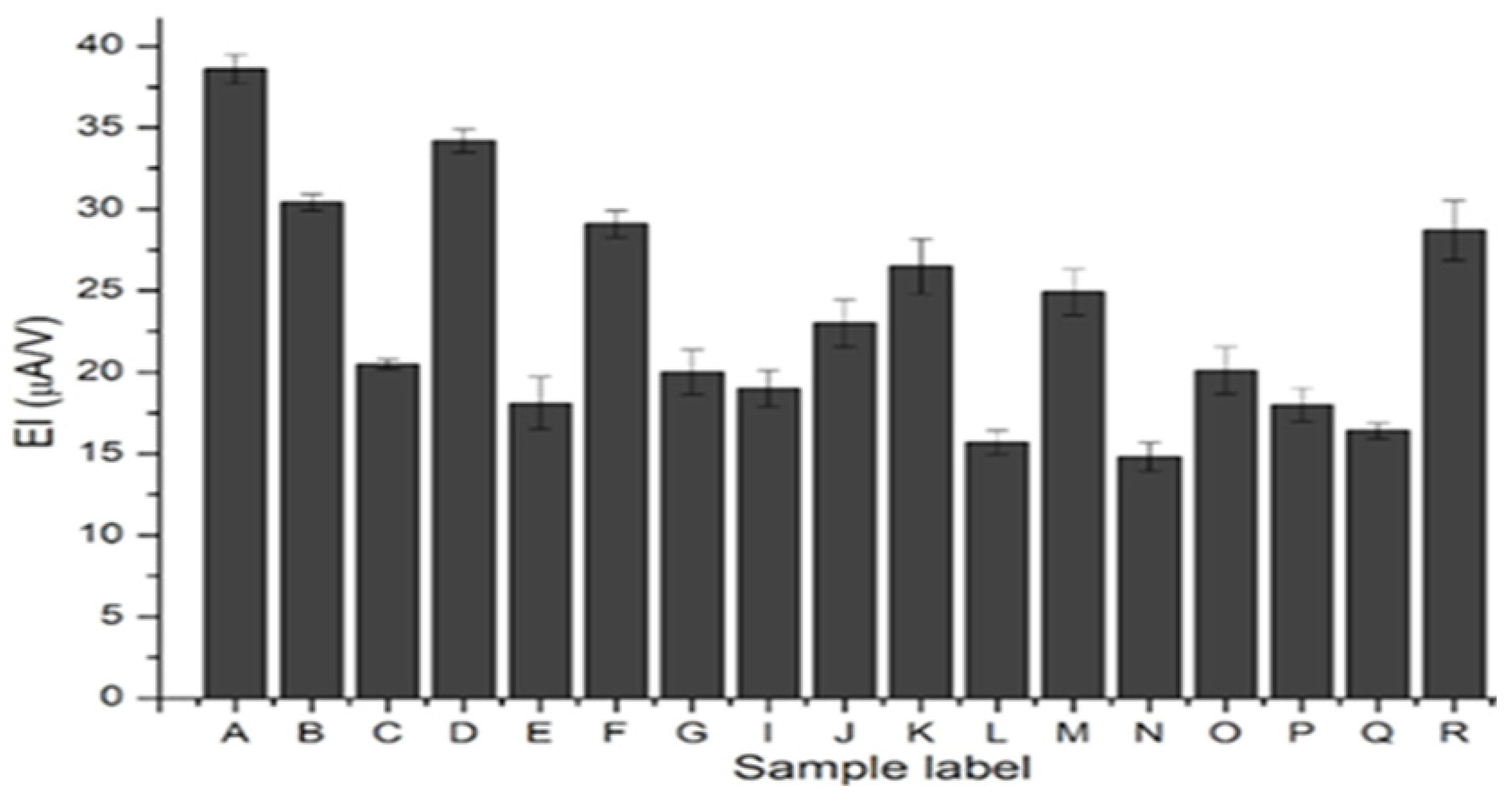
The aim of this study was to characterize and compare the voltammetric behavior of kombuchas, to establish their electrochemical profiles and antioxidant activities. Thus, 18 kombucha samples were used, either commercial or prepared in the laboratory from different symbiotic cultures acquired from different countries, and analyzed by DPV and SWV, on a carbon paste electrode (CPE). This work established and compared the electrochemical behavior of 18 kombuchas. In addition, the EI values determined for the samples were used to establish their antioxidant activities. The EI values were also compared here with the spectrophotometric data of FRAP and FC.
2. Materials and Methods
2.1. Chemicals and Reagents
The commercial kombuchas, all flavored, were acquired from local stores in Goiânia and Anápolis, Goiás, Brazil (
Table 1, samples A to F). Kombuchas prepared in the laboratory used SCOBYs from different countries (
Table 1, samples G to S). The SCOBYs related to the samples were acquired from Tao kombuchas
®, Porto Alegre, RS, Brazil (A–F) and Naturall
® probiotics, Shah Alam, Selangor, Malasia, (G–S). P and R kombucha samples were prepared following secondary fermentations in the presence of hibiscus and coffee, respectively.
The sodium acetate trihydrate, acetone, glacial acetic acid, hydrochloric acid, methanol, ferric chloride hexahydrate, ferrous sulfate heptahydrate, 2,4,6-tris(2-pyridyl)-s-triazine (TPTZ), gallic acid, sodium carbonate ≥ 99.0% purity, ethyl alcohol (HPLC grade), Folin–Ciocalteu (FC) reagent, graphite powder and mineral oil for carbon paste were sourced from Sigma-Aldrich, St. Louis, MO, USA. All solutions were prepared using analytical grade reagents and deionized water (conductivity 0.1 µS cm−1) (Millipore S.A., Molsheim, France). All solutions were prepared at a concentration of 100 µM from dilution of stock solutions (1 mM).
2.2. Preparation of Kombucha
The preparation of kombucha was based on the methodology proposed by Greenwalt et al. [
1]. In brief, the green tea leaves were infused with hot water containing 20% sucrose and free of carbon dioxide. The resulting tea was cooled to room temperature, transferred to a sterile, gauze-covered container and finally fermented with SCOBY for 14 days. To reduce the risk of contamination by pathogenic and spoilage microorganisms, sanitary measures were adopted; thus, the previously fermented culture broth was acidified and kept in an oven at room temperature. After four to seven days, a new SCOBY film was formed, and the resulting drink was filtered to remove the suspended microorganisms [
1,
6,
10].
For secondary fermentation and flavor addition, SCOBYs were added for 5 days to the culture broth previously fermented with C. sinensis and 20% (v/v) of the aqueous extract of the flavoring fruit or spice.
The main features of the resulting samples are presented in
Table 1.
2.3. Antioxidant Activity Determinations
The spectrophotometric determination of antioxidant activity was carried out in triplicate by two traditional methods [
11,
12], namely Folin–Ciocalteu (FC) expressed in mg L
−1 of gallic acid equivalents (GAE) of sample, and the Ferric Reducing Antioxidant Power (FRAP) expressed in mg L
−1 of ferrous sulfate.
From the fresh kombucha aliquot, at least three different dilutions were prepared in triplicate in test tubes. The Folin–Ciocalteu (FC) spectrophotometric method was used to determine total phenolic compounds in kombucha. Each aliquot of 50 µL of the kombucha sample at a concentration of 1% was placed in a test tube containing 1 mL of distilled water and 250 µL of the FC reagent [
11]. After 5 min, 750 µL of a 20% Na
2CO
3 solution and 2950 µL of distilled water were added. The mixture was incubated in the absence of light for 60 min; afterwards, the absorbance was measured in a spectrophotometer at 765 nm, using the blank solution as a reference. The quantification of phenolic compounds in kombucha samples was carried out in triplicate, and the average result was reported. The results were expressed in gallic acid equivalents in µg mL
−1, from a calibration curve obtained under the same conditions for sample analysis. The percentage of the remaining radicals after 5 min of reaction between the sample and FC
• was calculated using the following Equation (1):
where AbsC and AbsS are the absorbance of the control (FC
• solution) and of the sample, respectively.
The FRAP assay procedure is based on the Fe
3+ reduction to Fe
2+. The FRAP reagent, prepared at the beginning of the analysis, consisted of a mixture of 2,4,6-Tripyridyl-s-Triazine (TPTZ) (10 mmol L
−1), HCl (40 mmol L
−1), FeCl
3 (20 mmol L
−1) and sodium acetate–acetic acid buffer solution (pH 3.6) in the following proportion, 1:1:1:10, respectively. An amount of 100 µL aliquots of the kombucha sample were injected into 1.8 mL FRAP reagent and left in a water bath at 37 °C for 10 min. Then, absorbance was measured at 593 nm. FeSO
4·7H
2O aqueous solutions (500, 1000, 1500 and 2000 µM) were used in the calibration curve, and the results were expressed as µg Fe II equivalents per mL of the kombucha sample [
12].
A calibration curve for ferrous sulfate was plotted at concentrations of 500, 1000, 1500 and 2000 µM. The evaluation (595 nm) was performed after 30 min of mixing, and the FRAP reagent was used as a blank to calibrate the spectrophotometer. Ferrous sulfate concentrations (mM) were placed on the X axis and the respective absorbances on the Y axis in a spreadsheet, where the linear regression equation was calculated. The absorbance was calculated for 1000 mM of ferrous sulfate, according to Equation (1).
Absorption spectra were recorded using an Agilent 8453 UV-Vis spectrophotometer with a photodiode array detector and UV-Visible ChemStation software G1115AA (Agilent Technologies, Inc., Santa Clara, CA, USA).
2.4. Voltammetric Assays
Electrochemical assays were carried out with an Autolab III® potentiostat/galvanostat (Santa Clara, CA, USA) integrated with NOVA 2.1 software (Metrohm, Herisau, Switzerland). Measurements were made in a single-compartment 5 mL electrochemical cell with a 3-electrode system, consisting of a carbon paste electrode (CPE), an Ag/AgCl/KClsat electrode and a platinum wire (purchased from Lab Solutions, São Paulo, Brazil), representing the working, reference and auxiliary electrode, respectively. The experimental conditions for differential pulse voltammetry (DPV) were pulse amplitude of 50 mV, pulse width of 0.5 s and scan rate of 10 mV s−1. DP voltammograms were baseline corrected using a step window of 5.00 mV.
The experimental conditions for square wave voltammetry (SWV) were a pulse amplitude of 50 mV with a frequency of 50 Hz and a potential rise of 2 mV, corresponding to a scan rate of 100 mV s−1. The experimental conditions for cyclic voltammetry (CV) were a scanning range of 0.0 to 1.0 V and a scan rate of 100 mV s−1.
All experiments were carried out in triplicate, at room temperature, and the main electrolyte used was 0.1 M phosphate-buffer solution (PBS), pH = 7.0.
Electrochemical Index
The sum of the ratios
Ipa/
Epa for all peaks observed in DPV was used to obtain the
EI values.
For the identified anodic peaks, the respective currents (
Ipa) and potentials (
Epa) were associated with the electrooxidation of phenolic compounds (antioxidants). The
Ipa is directly related to the concentration and electron transfer kinetics of the identified electrooxidation reaction.
Epa, in turn, expresses the thermodynamic reducing character of the antioxidant [
13,
14,
15,
16,
17,
18,
19,
20].
2.5. Statistical Analysis
Analysis of variance (ANOVA) and Tukey’s test were used to identify significant differences between the analytical data sets obtained from the analyzed samples. The analysis was conducted using Origin 8.0 software, an application for analysis, statistical processing and graphical visualization of experimental data. The ANOVA test allowed us to verify the existence of statistically significant variations between the group means, assuming homogeneity of variances and normality of the data.
Subsequently, Tukey’s multiple comparison test was applied as a post hoc method to identify which pairs of samples presented significant differences. The use of these statistical tests provides greater robustness to the analysis of the experimental results, ensuring the validity of the conclusions based on rigorous quantitative criteria. The ANOVA and Tukey tests evaluated significant differences in the analytical data between samples. For each assay (FC, FRAP and EI), we ranked the 18 samples (A–R) within that assay only, using the raw assay values. Because rank is a relative measure, no scaling or normalization was applied; ranking is invariant to any monotonic transformation of the data. We assumed that higher values indicate better antioxidant performance in all four assays (as is standard for these readouts).
Thus, within each assay, we sorted samples in descending order and assigned integer positions starting at 1 (best), 2, 3, …, 18 (worst). Ties were handled with average (mid) ranks. If k samples tie and would occupy rank positions p through p + k − 1, each of those samples receives the average of those positions. As an example, if three samples tie for ranks 2, 3 and 4, each obtains (2 + 4)/2 = 3. These 18 samples (A–R) were analyzed using four assays related to antioxidant activity: FC, FRAP and EI. Because each assay is reported in different units and scales, comparisons between samples were made within each assay to avoid biased interpretations due to scale differences. To this end, we assigned ranks per assay, ordering the values in descending order (highest value = best antioxidant performance in that assay). A “rank average” was used in the event of ties. Thus, in the “Ranks (1 = best by method)” table, rank 1 indicates the best sample for that specific method. To summarize overall performance, a composite rank was also calculated per sample, defined as the arithmetic mean of the four ranks (one for each assay). The lower the composite rank, the better the overall performance, considering simultaneously phenolic/related content (FC), reducing power (FRAP), and EI.
This summary appears in the table “Composite ranking (average of ranks).” We quantified the association among four antioxidant readouts, FC, FRAP and EI, using two complementary measures: Pearson’s product–moment correlation and Spearman’s rank correlation. Pearson’s correlation assesses linear relationships between raw values, assuming interval-scale comparability; Spearman’s correlation assesses monotonic relationships by correlating ranks, making it more robust to outliers and nonlinear but monotonic trends. Because correlation coefficients are invariant to linear rescaling (e.g., min–max or z-score), all analyses were performed directly on the raw assay values; scaling was not required for correlation estimation. For reporting and visualization, we built two 3 × 3 correlation matrices—one for Pearson’s and one for Spearman’s—using only the short variable names (FC, FRAP, EI).
We quantified the association among four antioxidant variables, that is, FC, FRAP and EI, using two complementary measures: Pearson’s product–moment correlation and Spearman’s rank correlation. Pearson’s correlation assesses linear relationships between raw values, assuming interval-scale comparability; Spearman’s correlation assesses monotonic relationships by correlating ranks, making it more robust to outliers and nonlinear but monotonic trends.
4. Discussion
Camellia sinensis tea, as well as its kombucha products, is a rich source of polyphenolic antioxidants, such as catechins and gallic acid [
1,
2,
3,
4,
5,
6]. Therefore, the redox profile and the determination of antioxidant capacity are undeniable quality parameters for this functional foodstuff.
In this study, the electrochemical profile of 18 kombucha samples (A to R), commercially acquired or made in the laboratory (
Table 1), was evaluated.
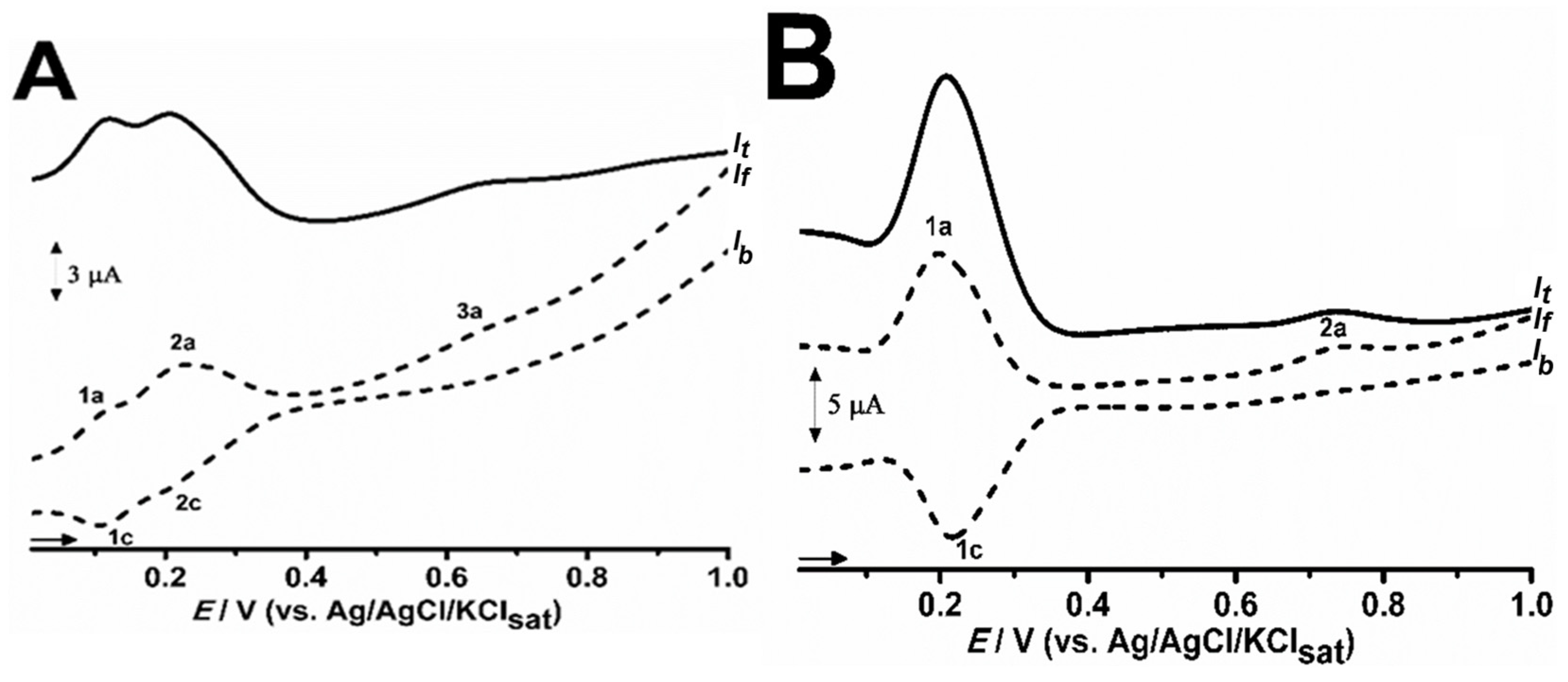
The electrochemical behavior of kombucha samples was investigated using DPV and SWV to verify the reducing power and reversibility of electroactive species identified. These data are closely related to pro-oxidant and antioxidant behavior, and were used to estimate
EI values. The
EI values were subsequently compared with classical spectrometric assays for antioxidant evaluation [
13,
14,
15,
16,
17,
18,
19,
20].
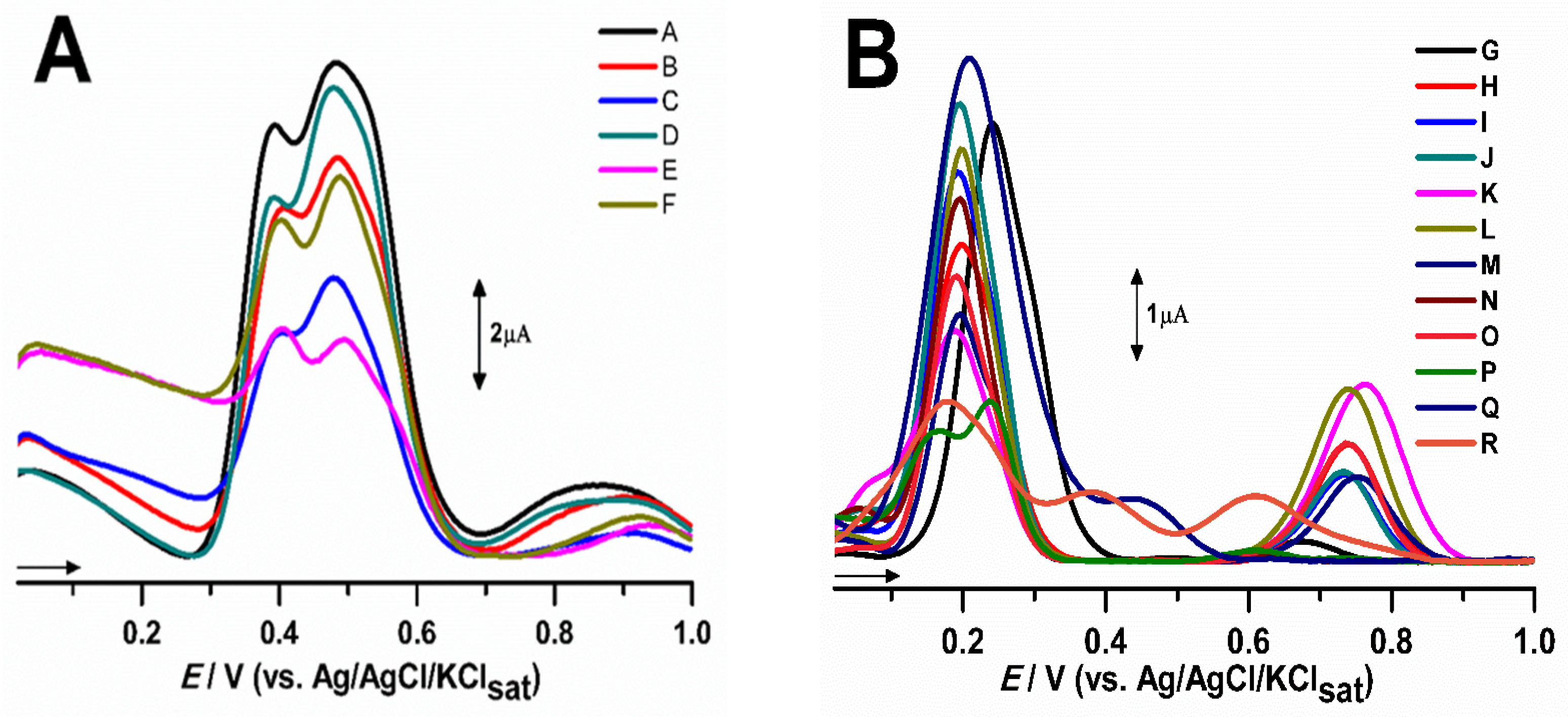
The results presented in
Figure 1 and
Figure 2 showed two main patterns, which can be explained by the flexibility of production protocols [
3,
4,
5,
6,
7,
8,
9,
10].
Thus, many production procedures, i.e., SCOBY source, flavoring additives and operational parameters, such as pH and temperature control, can exert a relevant impact on redox profile. For instance, higher pH can lead to low redox stability, as well as to the development of unwanted microorganisms [
2,
3,
5,
6,
7,
8,
9,
10]. Yet, the use of additives such as fruits, coffee and other natural sources of polyphenols will increase the antioxidant power of this functional probiotic beverage. Furthermore, enzymes, including glucosidase, pectinase, xylanase, cellulase and glucanase, produced during fermentation degrade the oligomeric and polymeric polyphenolic compounds in tea into smaller polyphenols, such as catechin and gallic acid, thereby increasing the total phenol and flavonoid content in the kombucha samples [
4,
5,
6,
7,
8,
9].
Although catechin and its derivatives are the main kombucha antioxidants, many other electroactive compounds can be found, i.e., ascorbic and phenolic acids [
1,
2,
3,
4,
5,
6,
7,
8,
9], thus impacting the DPV profile. In fact, the samples herein evaluated have exhibited two patterns, one with three anodic peaks, with the first at
Ep1a c.a. 0.35 V, the second at
Ep2a c.a. 0.50 V, and the third at
Ep3a c.a. 0.80 V (
Figure 1A); and the other with two anodic peaks, with the first at
Ep1a c.a. 0.2 V and the second at
Ep2a c.a. 0.75 V (
Figure 1B).
The anodic peaks between 0.20 and 0.40 V are typical for catechin and other “catechol-like flavonoids” (
Figure 1), yet the anodic peaks at
Epa ≥ 0.6 V are consistent with the presence of resorcinol- and monophenol-like moieties [
13,
14,
15,
16,
17,
18,
19,
20].
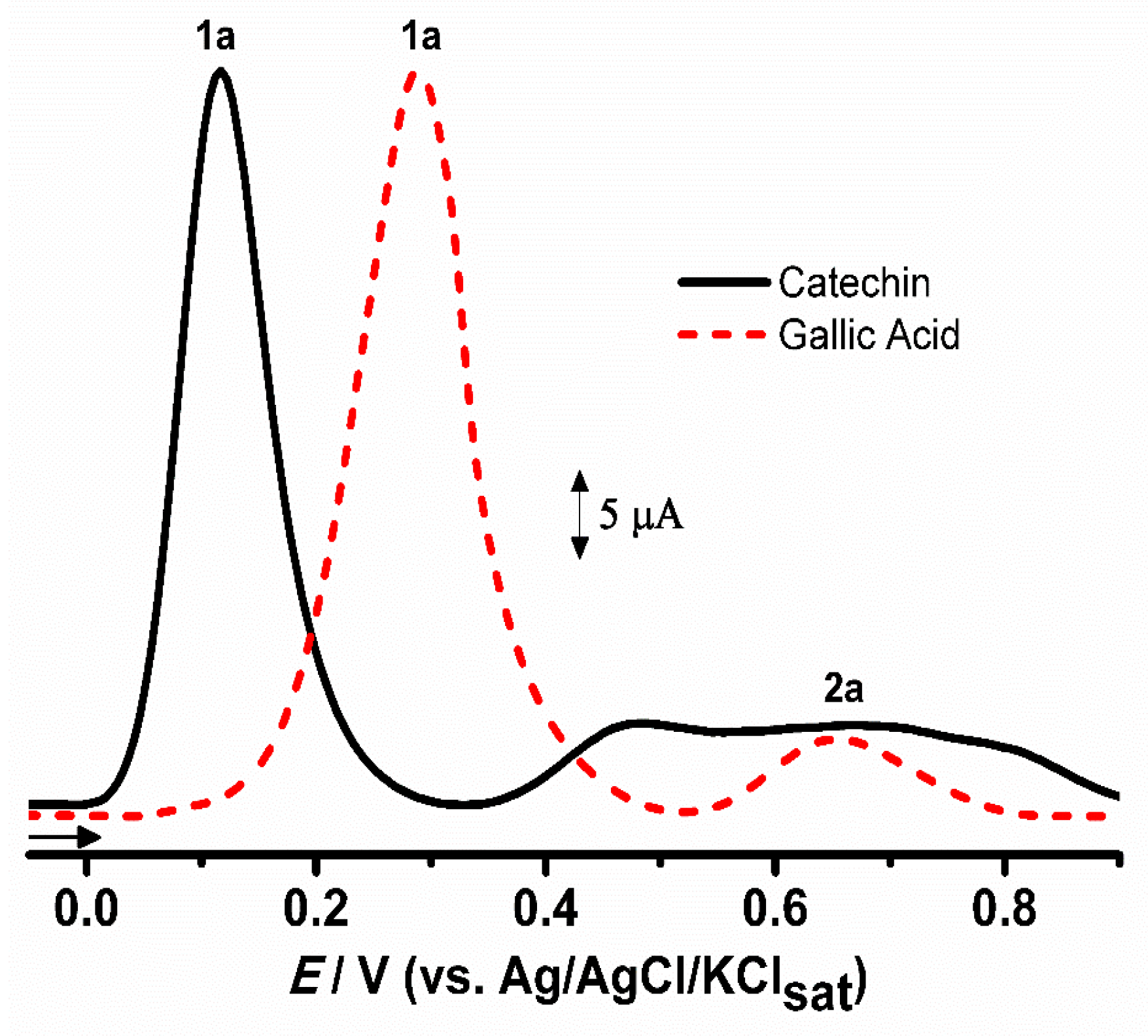
The oxidation of catechin occurs first reversibly, at the electron-donating 3′,4′-dihydroxyl groups of catechol, at very low positive potentials (
Figure 1,
Figure 2 and
Figure 3). In turn, the hydroxyl groups of the resorcinol moiety are oxidized at more positive potentials and from an irreversible anodic process (
Figure 1 and
Figure 3) [
14,
15,
16,
19,
20].
Nevertheless, the anodic peaks between 0.2 and 0.3 V are typical for any catechol and gallic acid-like polyphenols,
Figure 3, yet the anodic peaks at
Epa ≥ 0.6 V are consistent with the presence of resorcinol and monophenol-like moieties.
Moreover, the oxidation of polyphenols may precede electron transfer via the formation of a phenoxyl radical (semiquinone) intermediate. Semiquinone is unstable and decays via dimerization or polycondensation reactions [
13,
14,
15,
16,
17,
18,
19,
20], with other present electroactive and non-electroactive compounds, thus leading to split and shoulder DPV peaks (
Figure 1). Polysaccharides can also exert an indirect effect on diffusional processes by changing the medium viscosity and through binding properties [
5,
6,
7,
8,
9,
10,
13,
14,
15,
16,
17,
18,
19,
20].
It is worth noting that the P and K samples produced in the lab used a SCOBY modified with hibiscus and honey, two potential sources of polyphenols, as shown in
Table 1 and
Figure 1B. Furthermore, bioactive compounds such as epicatechin, catechin, caffeic acid and chlorogenic acid are produced or released during the metabolism of microorganisms involved in fermentation, affecting the antioxidant and redox profile [
3,
4,
5,
6,
7,
8,
9,
10].
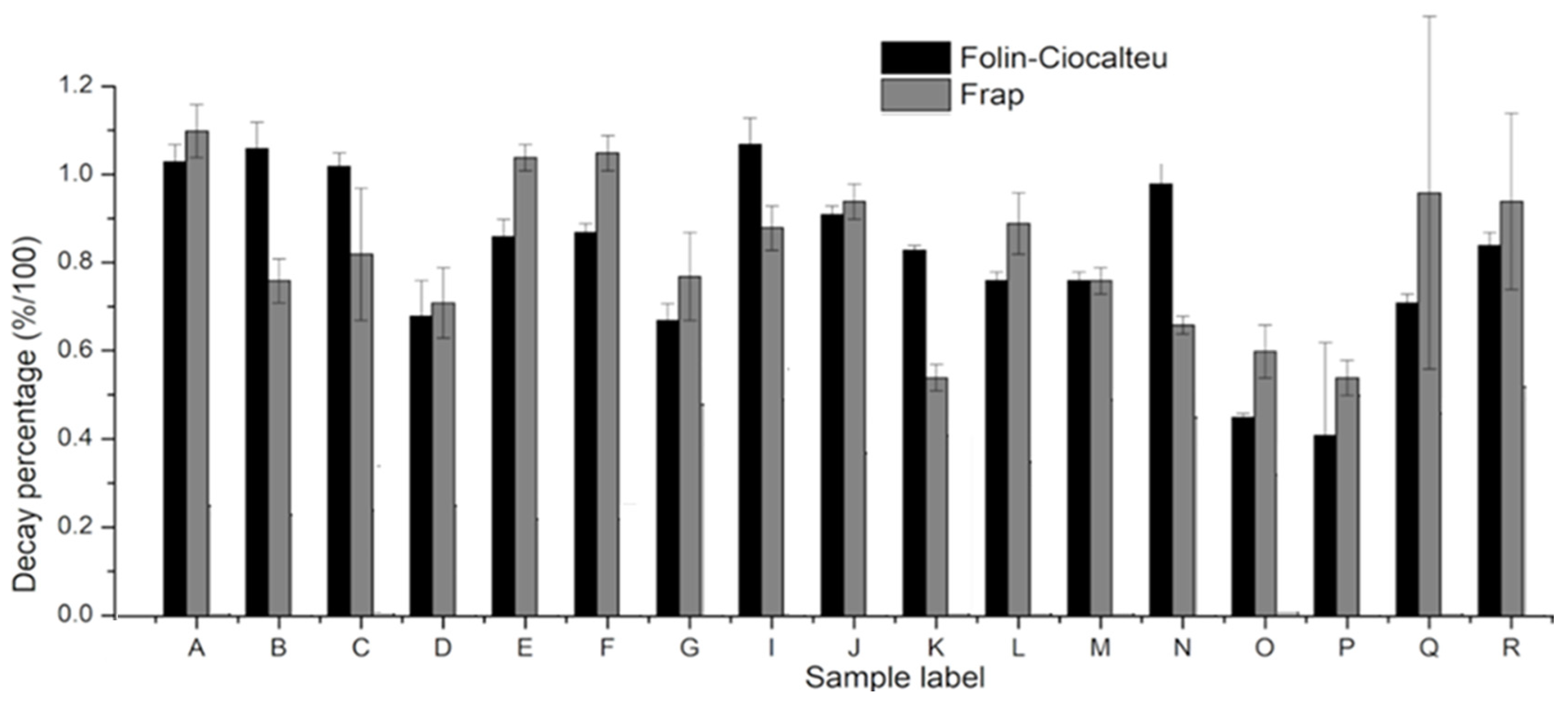
When comparing the spectrophotometric assays performed on the kombucha samples, the FC method data indicated the same trend as those of FRAP, with a slightly more significant difference only in samples K and N. However, especially for samples A-F, there are large differences with the other assays, FC and FRAP, as shown in
Table 2.
The data indicated that all samples presented significant antioxidant activities, since the EI values were high. Samples A, B, D and F presented an EI above 30 µA V−1, while the others presented values above 15 µA V−1. However, unlike the FC, FRAP and DPPH tests, the antioxidant activity is related to the presence and high concentration of phenolics, since the other components of the samples are not electroactive on CPE, such as sucrose, glucose, fructose, acetic acid, gluconic acid and glucuronic acid and ethanol, or are in low concentrations, such as vitamins and minerals. The results also indicated a CV of 29.56% for the EI values. This value is expected considering the variety and complexity of kombucha samples.
Moreover, some divergence between the three methods is scientifically plausible, since FRAP and FC are related to the reducing capacity of the samples on Fe
3 and Mo
6+ chemical reduction, respectively. Yet,
EI reflects the general electrochemical properties of the sample. In general, electron transfer in transition-metal states is faster than in phenolic compounds, which involve simultaneous hydrogen transfer [
13,
14,
15,
16,
17,
18,
19,
20].
However, overall, all methods indicated that these kombucha samples all presented antioxidant properties, regardless of the method used. Furthermore, these results indicated the advantages of the voltammetric EI method, since it is simpler and faster.
Previous studies have used comparisons of the antioxidant activity of foods from
EI and traditional methods such as FC, FRAP and DPPH, in wines [
13] and walnut kernel extracts [
16]; however,
EI has not been used for kombucha samples.
Statistical evaluation of EI, FRAP and FC using ANOVA and Tukey’s test indicated no significant differences among the methods (p > 0.05). The difference between the spectrophotometric assays and the electroanalytical EI parameter was expected due to the presence of chromogenic interfering substances in natural samples, which decreased the overall correlation. The other groups were similar on average. Additionally, an ANOVA test was performed with the normalized data, in which all data averages had no significant difference (pH0 = 0.31795). Thus, the findings from each antioxidant capacity variable seem to be in agreement.
Besides the well-established use of
EI values for antioxidant evaluation, voltammetric methods can provide complete electrochemical characterization of molecules and food samples, revealing information on redox stability, redox reversibility and pro-oxidant/antioxidant character, and allowing tentative identification of electroactive species [
13,
14,
15,
16,
17,
18,
19,
20].



 ,
,