


You are currently viewing a new version of our website. To view the old version click .

Bioengineering, Volume 8, Issue 10

October 2021 - 17 articles

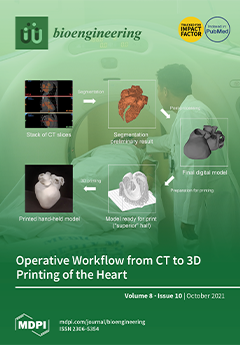
Cover Story: The generation of a good-quality digital anatomical model of the heart is a complex task. Its 3D representation, however, has the potential to provide detailed spatial information concerning the heart’s structure, also offering new opportunities if combined with additive manufacturing. In this work, we illustrate the difficulties that may be encountered in the workflow from a stack of computed tomography (CT) to the handheld printed heart model, which also considers real wall thickness variability. Stereolithography printing technology is exploited, and the accuracy of the result evaluated. View this paper
  • Issues are regarded as officially published after their release is announced to the table of contents alert mailing list .
  • You may sign up for email alerts to receive table of contents of newly released issues.
  • PDF is the official format for papers published in both, html and pdf forms. To view the papers in pdf format, click on the "PDF Full-text" link, and use the free Adobe Reader to open them.

Articles (17)

  • Review
  • Open Access
61 Citations
6,330 Views
19 Pages

Metal Oxide Nanoparticles and Nanotubes: Ultrasmall Nanostructures to Engineer Antibacterial and Improved Dental Adhesives and Composites

  • Abdulrahman A. Balhaddad,
  • Isadora M. Garcia,
  • Lamia Mokeem,
  • Rashed Alsahafi,
  • Fabrício Mezzomo Collares and
  • Mary Anne Sampaio de Melo

Advances in nanotechnology have unlocked exclusive and relevant capabilities that are being applied to develop new dental restorative materials. Metal oxide nanoparticles and nanotubes perform functions relevant to a range of dental purposes beyond t...

  • Review
  • Open Access
41 Citations
6,472 Views
21 Pages

Translational Application of 3D Bioprinting for Cartilage Tissue Engineering

  • Sophie McGivern,
  • Halima Boutouil,
  • Ghayadah Al-Kharusi,
  • Suzanne Little,
  • Nicholas J. Dunne and
  • Tanya J. Levingstone

Cartilage is an avascular tissue with extremely limited self-regeneration capabilities. At present, there are no existing treatments that effectively stop the deterioration of cartilage or reverse its effects; current treatments merely relieve its sy...

  • Article
  • Open Access
12 Citations
2,895 Views
15 Pages

Viscoelastic Characterization of Parasagittal Bridging Veins and Implications for Traumatic Brain Injury: A Pilot Study

  • Silvia García-Vilana,
  • David Sánchez-Molina,
  • Jordi Llumà,
  • Ignasi Galtés,
  • Juan Velázquez-Ameijide,
  • M. Carmen Rebollo-Soria and
  • Carlos Arregui-Dalmases

Many previous studies on the mechanical properties of Parasagittal Bridging Veins (PSBVs) found that strain rate had a significant effect on some mechanical properties, but did not extensively study the viscoelastic effects, which are difficult to de...

  • Article
  • Open Access
16 Citations
5,743 Views
14 Pages

Hemodynamic Investigation of the Effectiveness of a Two Overlapping Flow Diverter Configuration for Cerebral Aneurysm Treatment

  • Yuya Uchiyama,
  • Soichiro Fujimura,
  • Hiroyuki Takao,
  • Takashi Suzuki,
  • Motoharu Hayakawa,
  • Toshihiro Ishibashi,
  • Kostadin Karagiozov,
  • Koji Fukudome,
  • Yuichi Murayama and
  • Makoto Yamamoto

Flow diverters (FDs) are widely employed as endovascular treatment devices for large or wide-neck cerebral aneurysms. Occasionally, overlapped FDs are deployed to enhance the flow diversion effect. In this study, we investigated the hemodynamics of o...

  • Article
  • Open Access
2 Citations
3,470 Views
13 Pages

The enzyme alkaline phosphatase (ALP) is gaining interest because it exerts bioactive properties and may be a potentially important therapeutic agent for many disorders and diseases. Microalgae are considered an important novel source for the product...

  • Article
  • Open Access
29 Citations
4,447 Views
13 Pages

Biotechnological Conversion of Grape Pomace to Poly(3-hydroxybutyrate) by Moderately Thermophilic Bacterium Tepidimonas taiwanensis

  • Xenie Kourilova,
  • Iva Pernicova,
  • Michaela Vidlakova,
  • Roman Krejcirik,
  • Katerina Mrazova,
  • Kamila Hrubanova,
  • Vladislav Krzyzanek,
  • Jana Nebesarova and
  • Stanislav Obruca

Polyhydroxyalkanoates (PHA) are microbial polyesters that have recently come to the forefront of interest due to their biodegradability and production from renewable sources. A potential increase in competitiveness of PHA production process comes wit...

  • Article
  • Open Access
4 Citations
3,203 Views
17 Pages

Echogenic Advantages of Ferrogels Filled with Magnetic Sub-Microparticles

  • Olga A. Dinislamova,
  • Antonina V. Bugayova,
  • Tatyana F. Shklyar,
  • Alexander P. Safronov and
  • Felix A. Blyakhman

Ultrasonic imaging of ferrogels (FGs) filled with magnetic nanoparticles does not reflect the inner structure of FGs due to the small size of particles. To determine whether larger particle size would improve the acoustic properties of FGs, biocompat...

  • Review
  • Open Access
10 Citations
6,345 Views
31 Pages

Bioengineering of Extracellular Vesicles: Exosome-Based Next-Generation Therapeutic Strategy in Cancer

  • Priyanka Saha,
  • Suchisnigdha Datta,
  • Sukanya Ghosh,
  • Anurima Samanta,
  • Paramita Ghosh and
  • Dona Sinha

Extracellular nano vesicles and exosomes hold compelling evidence in intercellular communication. Exosomal intracellular signal transduction is mediated by the transfer of cargo proteins, lipids, micro (mi)RNAs, long noncoding (lnc)RNAs, small interf...

  • Article
  • Open Access
25 Citations
4,719 Views
13 Pages

Extracting Features from Poincaré Plots to Distinguish Congestive Heart Failure Patients According to NYHA Classes

  • Giovanni D’Addio,
  • Leandro Donisi,
  • Giuseppe Cesarelli,
  • Federica Amitrano,
  • Armando Coccia,
  • Maria Teresa La Rovere and
  • Carlo Ricciardi

Heart-rate variability has proved a valid tool in prognosis definition of patients with congestive heart failure (CHF). Previous research has documented Poincaré plot analysis as a valuable approach to study heart-rate variability performance among d...

  • Article
  • Open Access
3 Citations
3,950 Views
14 Pages

Due to their osteoconductive properties, allogenic bone screws made of human cortical bone have advantages regarding rehabilitation compared to other materials such as stainless steel or titanium. Since conventional screw drives like hexagonal or hex...

of 2

Get Alerted

Add your email address to receive forthcoming issues of this journal.

XFacebookLinkedIn
Bioengineering - ISSN 2306-5354