


Abstract
Caffeine has been recognized as an emerging pollutant in aquatic ecosystems due to its persistence. This study evaluated the techno-economic viability of caffeine removal using thermally modified bentonite (Na–Bent–400) as an adsorbent. Caffeine removal was simulated under two operational schemes: Scenario 1 (S1: Adsorption–Disposal), where Na–Bent–400 is discarded following saturation, and Scenario 2 (S2: Regeneration–Reuse–Disposal), which integrates adsorbent regeneration to enable the reuse of Na–Bent–400 in a second adsorption before final disposal. Using the optimized model for caffeine removal (95.97% removal efficiency in batch operation: 2.26 g/L Na–Bent–400, 30 mg/L caffeine, and pH 8), the process was scaled up through process simulation in Aspen Plus (V14) for a treatment flow rate of 8 L/s (252,288 m3/year). Capital expenditure (CapEx) was estimated at USD 331,004 without adsorbent regeneration (S1) and USD 486,725 with regeneration (S2), showing a 47% increase due to auxiliary equipment and operational complexity; however, integrating adsorbent regeneration minimizes long-term operational expenditures by reducing raw material requirements and wastewater treatment costs. Estimated water treatment costs based on operational expenditures (OpEx) are USD 1.38/m3 for S1 and USD 0.74/m3 for S2. A sensitivity study found that caffeine concentrations above 30 mg/L have little effect on treatment costs. By evaluating these scenarios, this study demonstrates the preliminary techno-economic viability of thermally modified bentonite for treating caffeine-contaminated agroindustry effluents.
1. Introduction
Caffeine, although not a naturally occurring contaminant in water, enters water bodies through various human activities, including the consumption of caffeinated food and beverages, coffee processing, and other industrial activities [1]. Additionally, caffeine is an ingredient in numerous prescription medications; following ingestion, 1–10% of the caffeine is excreted unmetabolized in urine [2,3]. Hence, it is considered a reliable indicator of anthropogenic contamination and a source-specific tracer for domestic wastewater in surface waters [1,3,4].
Caffeine concentrations vary depending on aquatic environments, reported values for rivers and lakes (0.05–33.2 µg/L) [5,6,7], groundwater (0.01–0.68 µg/L [5,8,9], drinking water (0.50–35 µg/L) [5,8,10], estuaries, seas and oceans (0.00033–8.23 µg/L) [5,11], and wastewater (0.02–86,000 µg/L [5,12,13] typically fall within the microgram-per-liter range (µg/L). However, the highest concentrations of caffeine have been reported in raw municipal wastewater, reaching 3,594,000 ng/L in Singapore [14], 1,214,375 ng/L in South Africa [15], 150,413 ng/L in England [16], 130,000 ng/L in the United States of America [17], and 9310 ng/L in Brazil [18]. The high caffeine concentrations in raw wastewater are likely due to increased consumption of caffeine-containing beverages, such as coffee, tea, chocolate, and energizing drinks [3,19]. In Colombia and other Central American coffee-producing countries, coffee cherries are predominantly processed using the wet method, which requires substantial volumes of water during the depulping and mucilage removal stages and consequently generates large amounts of wastewater [20]. Remarkably, wastewater from the fermentation stage in batch coffee processing at a pilot facility in Guatemala exhibited a caffeine concentration of 388.6 mg/L [21]. Similarly, a coffee-and-milk wastewater mixture supplied by Tokyo Gas Co., Ltd. (Tokyo, Japan) reported concentrations of 470 ± 100 mg/L [22]. In countries with major coffee agroindustries, such as Colombia, Brazil, and Vietnam, effluents containing caffeine concentrations of 38.85 ± 10.40 mg/L have been documented [23].
The effects of caffeine on various aquatic microorganisms (bacteria, microalgae, macrophytes, and larvae) were studied to assess ecological risk. Caffeine was shown to have toxic effects on Aliivibrio fischeri (EC50 = 998.5 mg/L), Raphidocelis subcapitata (EC50 = 60.1 mg/L), Lemna minor (EC50 = 649.2 mg/L), and Chironomus riparius (LC50 = 644.5 mg/L; EC50 = 81.62 mg/L for fresh biomass), disrupting physiological and metabolic functions. The estimated hazardous concentration affecting 5% (HC5) of tested species was 4.42 mg/L [5].
The primary sources of caffeine in aquatic environments include excretory residues from caffeine consumption, improper disposal of pharmaceuticals, coffee-processing wastewater, decaffeination plant discharge, and hospital effluents [11,24]. Although caffeine is not strictly regulated in many countries, its presence in bodies of water has generated increasing environmental and health concerns [7,11]. Once released into the environment, caffeine exhibits notable stability, with half-lives ranging from 100 to 240 days under variable environmental conditions [3,25]. Conventional municipal wastewater treatment plants (WWTPs) do not efficiently eliminate pharmaceuticals and personal care products (PPCPs) like caffeine [26,27,28], underscoring the need for targeted tertiary treatment technologies. Recent studies highlight that standard WWTPs achieve variable caffeine removal efficiencies depending on the treatment stage; primary treatment is generally ineffective, whereas secondary biological processes like activated sludge can reach 98–99% removal [29].
Various technologies have been explored in relation to caffeine abatement in aqueous media, including advanced oxidation processes (photocatalysis and electrochemical oxidation) [30], biodegradation by activated sludge [31], membrane filtration [32], and adsorption [33,34]. Among these, adsorption stands out as a highly efficient and cost-effective approach [34], particularly when utilizing low-cost sorbents such as agroindustrial waste-derived materials [2,28] and natural minerals, such as clays [35]. Adsorption offers distinct operational advantages, including operational simplicity, low energy demand, high efficiency at low pollutant concentrations, and the potential for adsorbent regeneration [33,34,36,37].
Green adsorbents have emerged as a promising class of sustainable materials for water and wastewater treatment. These materials are typically derived from agricultural residues, biomass, industrial by-products, or naturally occurring minerals, and their application is closely linked to circular economy principles [38,39]. For instance, natural zeolites such as clinoptilolite exhibit high ion-exchange capacity and structural stability, making them effective for removing heavy metals and nutrients from contaminated waters [40]. Similarly, waste-derived adsorbents, including biochar and activated carbons produced from agricultural residues, have demonstrated competitive adsorption capacities for dyes, phenols, and pharmaceuticals at low cost [41]. Recent advances also emphasize modifying green adsorbents through chemical pretreatment, grafting functional groups, or incorporating metal oxides to enhance selectivity, thereby broadening their applicability to emerging pollutants [42]. Overall, while green adsorbents may not always match the maximum capacities of advanced synthetic sorbents, their economic viability, regeneration potential, and environmental compatibility make them strategic materials for sustainable water remediation [39,41].
Adsorption studies have reported caffeine removal efficiencies high using Elaeis guineensis activated carbon (13.5 mg/g) [43], wood-activated carbon ( = 29.2 mg/g) [26], thermally modified bentonite ( = 80.3 mg/g) [44], and calcined Cu-Al layered double hydroxide ( = 152.99 mg/g). Comparative values of maximum adsorption capacities for a wide range of adsorbents are available in the literature, providing useful benchmarks for evaluating performance [35,45,46]. These findings confirm that adsorption is a promising technology for removing caffeine from water, providing an effective means to enhance water quality while contributing to the protection of aquatic ecosystems. These findings confirm that adsorption is a promising technology for treating caffeine-bearing effluents, thereby enhancing water quality and protecting receiving aquatic ecosystems.
Techno-economic evaluations (TEAs) of adsorption-based water treatment remain limited [47,48,49,50,51,52,53]. Most studies focus on determining the adsorptive capacity of specific materials, emphasizing removal efficiency, equilibrium, and kinetic studies [54], typically in batch systems and, less frequently, in fixed-bed columns. The cost analysis of water treatment (measured in USD/m3) is influenced by several factors, including the flow rate of wastewater to be processed (in L/day or m3/year), the concentration of the adsorbate (pollutant), the removal efficiency, and the equipment costs. Likewise, the unit cost of an adsorbent depends on its natural abundance, raw material processing requirements, thermal/chemical modification conditions, reusability across cycles, and final disposal pathways [54].
Although several investigations have optimized batch caffeine adsorption on various materials, such as wood activated carbon [26], Elaeis guineensis [43], and Sargassum (sp.) [55], wood sawdust [56], calcined Cu–Al layered double hydroxide [57], and calcined bentonite [44], evaluating variables such as pH, adsorbent mass/dose, contact time, and initial caffeine concentration using a response surface methodology (RSM) [26,43,44,55,57], there remains a critical knowledge gap regarding the industrial scaling, mass/energy balances, and techno-economic feasibility of these processes. To the best of our knowledge, no comprehensive techno-economic assessment (TEA) for caffeine removal from industrial or municipal effluents using modified clay adsorbents has been reported to date.
This study presents a TEA of caffeine removal using thermally modified bentonite (Na–Bent–400) based on optimized experimental data. As a pioneering effort towards the scalable application of adsorption technology for aquatic caffeine remediation, this work evaluates two operational schemes: Scenario 1 (S1: Adsorption–Disposal), where the saturated adsorbent is discarded after a single use, and Scenario 2 (S2: Regeneration–Reuse–Disposal), which incorporates a regeneration step to enable a second adsorption before final disposal. The TEA provides critical estimates of operational expenditures (OpEx), energy requirements, and the unit cost per volume of treated water, key indicators for evaluating process feasibility from environmental and process engineering perspectives.
2. Materials and Methods
2.1. Adsorbent Material and Reagents
The raw bentonite clay (Na–Bent) used for the adsorbent synthesis was obtained from Gea Minerales SAS (Armero-Guayabal, Colombia), which commercially exploits a mine in Armero-Guayabal (Colombia, South America), with an estimated reserve of 1.2 million tons [58]. The commercial cost of raw bentonite is USD 400/ton, including transport from the mine to different locations in Colombia. The Na–Bent was thermally treated at 400 °C to yield Na-Bent–400.
In a prior investigation, the thermal modification of bentonite was comprehensively characterized by X-ray fluorescence (XRF), X-ray diffraction (XRD), thermal analysis, and N2 adsorption–desorption, which demonstrated changes in the material’s physicochemical properties [44]. At 400 °C, dehydration and partial dehydroxylation reduced the basal spacing (from 15.4 Å to ~10 Å) and the specific surface area (from 83.1 to 66.7 m2/g), as confirmed by XRD and specific surface area analyses. FTIR spectra confirmed a reduction in the intensity of –OH stretching bands associated with interlayer water, together with changes in the Si–O and Al–OH stretching and deformation vibrations. Although micropore volume decreased, mesoporosity was preserved, facilitating molecular diffusion. Furthermore, the increase in the zero-charge point from 7.6 to 8.8 enhanced electrostatic and hydrogen-bonding interactions with caffeine molecules.
The adsorbate used for adsorption tests was anhydrous caffeine (99%, LobaChemie Pvt. Ltd., Mumbai, India). The pH adjustment of caffeine solutions for adsorption (pH = 8) and desorption (pH = 12) was performed using industrial-grade sodium hydroxide (NaOH, solid flakes, >98%, USD 550/ton).
2.2. Experimental Design for Caffeine Adsorption–Optimization Model
Batch adsorption experiments were previously carried out using Na–Bent–400 under constant conditions (pH = 8.0, stirring speed = 400 rpm, contact time = 120 min). Caffeine removal percentage was modeled as a function of adsorbent mass (, mg) and initial caffeine concentration (, mg/L) using a central composite design (CCD) within response surface methodology (RSM). Under optimal experimental conditions (111.8 mg Na–Bent–400 per 50 mL solution, 21.8 mg/L initial caffeine, desirability = 1.0), a maximum removal efficiency of 96.54% was achieved [44]. The second-order polynomial model predicting caffeine removal percentage (%) on Na–Bent–400 is expressed in Equation (1):
This empirical model was used to set operational target efficiencies and mass balance parameters for process simulation.
2.3. Process Flow Diagram Description
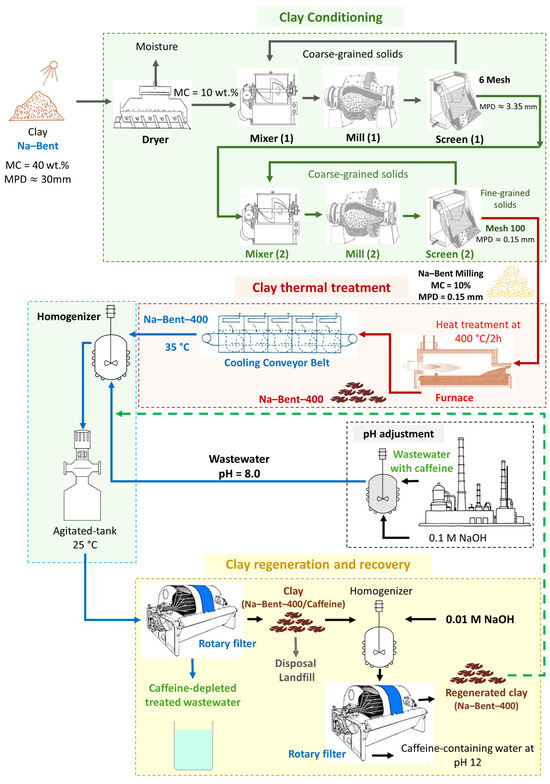
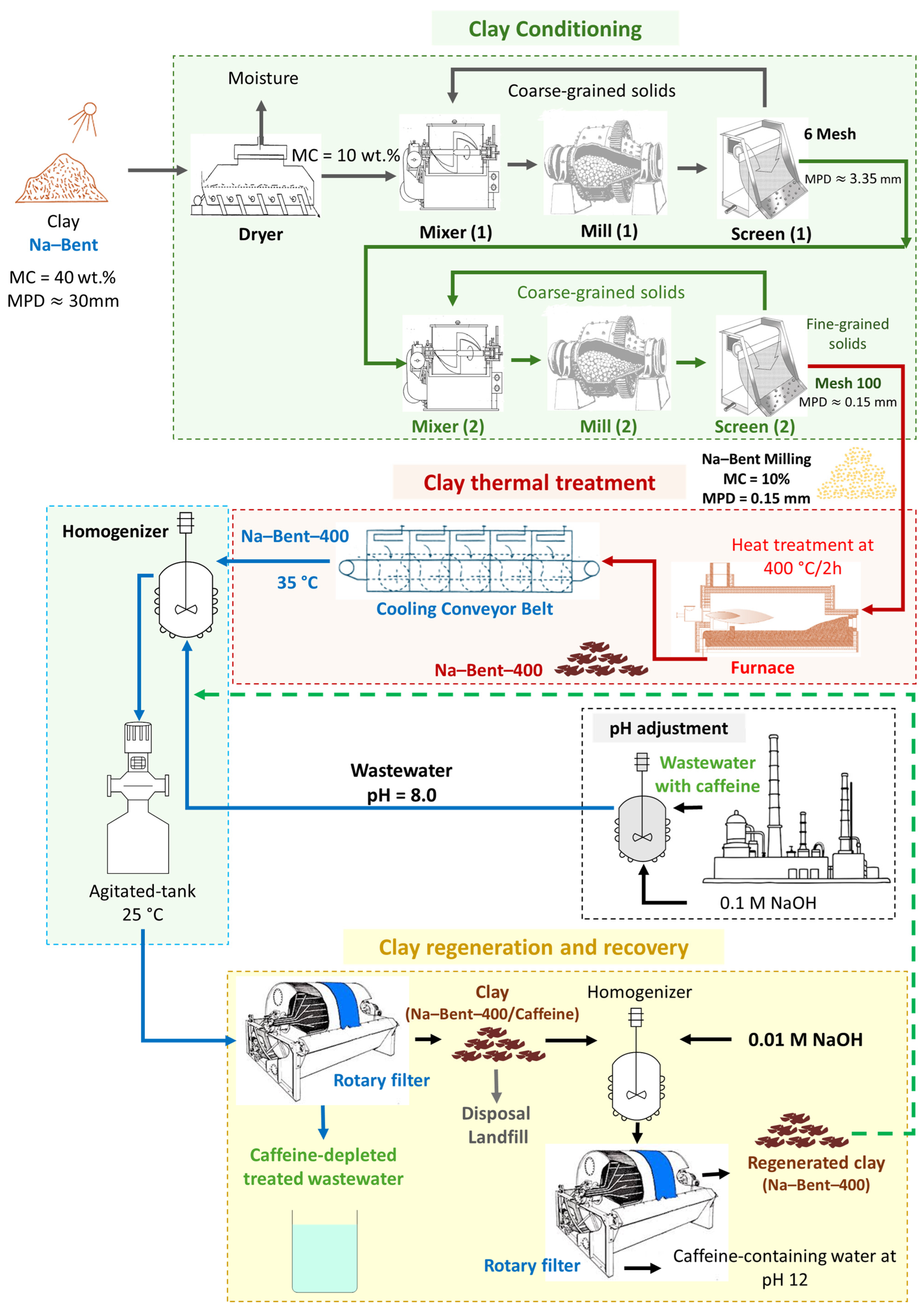
The industrial process flow diagram for caffeine adsorption from wastewater is illustrated in Figure 1. The baseline processing capacity was fixed at 8 L/s (252,288 m3/year) of wastewater with an influent caffeine concentration of 30 mg/L, representative of wet coffee-processing effluents and agroindustrial discharges [21,22,23]. The flow rate of 8 L/s corresponds to the average discharge rate of a regional coffee decaffeination plant in Manizales (Colombia) and reflects typical water consumption in wet coffee processing [59]. The complete plant design comprises four main stages: (1) clay conditioning, (2) clay thermal treatment, (3) caffeine adsorption, and (4) adsorbent regeneration and recovery.
Figure 1.
Process flow diagram of thermally modified bentonite production and caffeine adsorption.
2.3.1. Clay Conditioning
Raw bentonite (Na–Bent) delivered from the mine contains approximately 40 wt% moisture (wet basis) with a mean particle size (MPS) of 30 mm. Initial moisture reduction was achieved through passive solar drying, followed by continuous convective drying in a rotary drum dryer to reach 10 wt% moisture using warm dry air. Dried clay was then subjected to multi-stage crushing and mechanical screening to reduce the MPS from 30 mm to 0.15 mm (100 mesh).
2.3.2. Clay Thermal Treatment
Bentonite was subjected to thermal treatment at 400 °C in a furnace, a temperature at which partial dehydroxylation of the clay occurs, favoring the formation of the silanol (≡Si–OH) and aluminol (≡Al–OH) groups [44]. At this temperature, the layered structure of montmorillonite remains largely preserved, while defect sites are generated at the edges and basal planes. These structural modifications favor the formation of H–bonds between the caffeine molecule and the silanol and aluminol groups of the adsorbent. Yamamoto et al. (2019) studied the interaction of caffeine with montmorillonite and found that more than 80% of the ≡Si–OH groups of the clay were involved in caffeine adsorption [60]. Furthermore, it was suggested that the N atom of the imidazole ring interacted with the Si–OH of montmorillonite and the O atoms of siloxane [60].
The bentonite residence time in the klin was set to 2 h based on previous experiments. Finally, the thermally treated bentonite was cooled using a cooling conveyor belt and a series of fans. The outlet temperature of the treated bentonite was set to 35 °C. The thermally modified bentonite was named Na–Bent–400.
2.3.3. Caffeine Adsorption Using Thermally Treated Bentonite
Caffeine adsorption is performed after Na–Bent–400 production. The adsorption process starts by mixing the wastewater, previously conditioned to pH 8, with a specific amount of calcined clay in an agitated tank. The Na–Bent–400 dosage was set based on the optimal conditions reported by Quintero-Jaramillo et al. (2024) [44]. For this, a dose of 2.26 g/L of thermally treated bentonite was used. Furthermore, the adsorption process was carried out at 25 °C and pH 8.0, maintaining an agitation speed that guaranteed a transitional flow regime similar to that obtained under laboratory conditions for a 100 mL cylindrical beaker (Reynolds number = 1875). The volume of the adsorption tank was directly calculated from the volumetric flow rate (8 L/s = 28.8 m3/h) and the residence time (2 h), resulting in a stirred tank volume of 57.6 m3. The scale-up of the agitation system from the 100 mL bench-scale reactor to the 57.6 m3 industrial vessel preserved geometric similarity by evaluating constant power input (P) per unit volume (V) (P/V = constant), constant tip speed, and equal Reynolds number to determine the full-scale rotational speed [61]. Maintaining a constant P/V was chosen as the operational basis to ensure consistent energy dissipation, adjusting the impeller speed to account for the enlarged geometry. This criterion shifts the hydrodynamic profile from a transitional regime at the laboratory scale to a turbulent flow regime industrially, ensuring effective mass transfer and uniform solids suspension.
The volume and power required to process the wastewater flow rate were determined based on the residence time and adsorption kinetics [44], using the design equations for typical slurry adsorption processes [62]. After this adsorption process, a filter is used to separate the solid phase (i.e., Na–Bent–400 with adsorbed caffeine) from the liquid phase. A rotary drum filter was selected for this operation. On the other hand, the adsorbent material can be regenerated and used again in the adsorption process.
Although the adsorption stage effectively removes caffeine from the aqueous solution, regenerating Na–Bent–400 produces an alkaline effluent containing residual caffeine. This stream requires additional treatment before discharge to avoid secondary pollutants, an aspect not considered in this study. First, pH neutralization is necessary to comply with environmental standards. Subsequently, wetlands represent a low-cost and sustainable solution for removing caffeine at concentrations suitable for industrial-scale applications. Recent studies confirmed that vertical flow wetlands and full-scale ornamental wetlands achieve >95–99% caffeine removal under real operating conditions [29,63]. These phytoremediation systems offer both environmental protection and socio-economic benefits in rural and urban contexts.
2.3.4. Thermally Treated Bentonite Regeneration and Reuse
The solid phase obtained after the filtration step (i.e., Na–Bent–400 saturated with caffeine) was mixed with a 0.01 M NaOH solution in a stirred tank to desorb caffeine molecules from the Na–Bent–400 material. The regeneration process was carried out at room temperature and pH 12 for 2 h [44]. Subsequently, the slurry was sent to a rotary drum filter to separate the regenerated clay from the liquid fraction containing caffeine. The regenerated Na–Bent–400 was then used in a second adsorption step.
2.4. Simulation Procedure
The sodium bentonite clay (Na–Bent) used for the adsorbent synthesis was acquired from Gea Minerales SAS, which commercially exploits a mine in Armero-Guayabal (Colombia, South America), with an estimated reserve of 1.2 million tons [58]. The cost of the raw bentonite is USD 400/ton, including transportation from the mine to different locations in Colombia. The Na–Bent was heat-treated at 400 °C to produce Na–Bent–400. The detailed characterization of this material has been conducted using several techniques, including X-ray fluorescence, X-ray diffraction, thermal analysis, and N2 physisorption at 77 K. The caffeine adsorption, thermal treatment of bentonite, and clay regeneration processes were simulated using Aspen Plus (V14) (Aspen Technology, Inc., Bedford, MA, USA). A wastewater flow of 8 L/s was considered based on wastewater disposal in the industrial sector. The following assumptions were considered in the simulation procedure:
- The wastewater is only composed of water and caffeine;
- Na–Bent–400 is a stable material in aqueous solution;
- The adsorbent dosage was fixed at 2.26 g/L for both Scenario 1 and Scenario 2.
- The adsorption capacity of Na–Bent–400 depends primarily on the availability of active sites after material regeneration. Experimental results indicated that caffeine removal efficiency decreased from 95.97% during initial use (S1) to 85.34% in the second adsorption (a single regeneration and reuse step, S2) [44]. The maximum adsorption capacity of caffeine of Na–Bent–400 was 80.3 mg/g and decreased to 71.4 mg/L after regeneration.
- For an initial concentration of 30 mg/L, this decrease corresponds to residual caffeine concentrations in the effluent increasing from 1.20 mg/L in the first adsorption to 4.40 mg/L in the second. While the first adsorption achieves a concentration below the reported hazardous concentration threshold affecting 5% of aquatic species (4.42 mg/L), the residual level in the second adsorption using regenerated Na–Bent–400 (4.40 mg/L) approaches this threshold. Furthermore, although these effluent concentrations remain well below acute toxicity benchmarks such as the EC50 for the microalga Raphidocelis subcapitata (60.1 mg/L) [5], comparison with acute toxicity data alone is insufficient to confirm environmental discharge suitability. Consequently, the adsorbent reuse scheme (S2) is evaluated as an efficient primary bulk-removal process, recognizing that polishing steps (e.g., constructed wetlands) may be required for continuous discharge. Based on these operational performance limits, the simulation in S2 was restricted to two adsorption steps for Na–Bent–400.
- The process operates in a continuous mode in a steady state.
For the simulation, caffeine was added as a conventional compound with the chemical formula C8H10N4O2. The thermally modified bentonite material (Na–Bent–400) was created as a solid component, as it is not available in the software database. The chemical formula of bentonite (Na–Bent–400) was assumed to be Al2Si4O12H2, and the thermodynamic properties for non-conventional solids reported by the National Renewable Energy Laboratory (NREL) were manually introduced [64]. Scalar properties of caffeine, such as molecular weight, critical temperature, critical pressure, critical volume, liquid molar volume, and acentric factor, were defined. Moreover, temperature-dependent properties such as vapor pressure (PLXANT), heat of vaporization (DHVLWT), ideal gas heat capacity (CPIG), and solid heat capacity (CPSPO) were also incorporated into the simulation software. On the other hand, the Non-Random Two-Liquids (NRTL) model was used to describe the liquid phase throughout the process, since caffeine solubility in water deviates from ideality due to the presence of two amide groups, two amine groups, and three methyl groups in its structure. The binary interaction parameters of the NRTL model (i.e., , , ) were entered into the software using the equations reported by Dabir et al. (2018) [65]. The vapor phase was assumed to be ideal, since no high temperatures or pressures are required throughout the process.
The milling process is one of the most critical stages in bentonite treatment, as the power input is high to reduce particle size. Then, the Bond work index (BWI) of Na–Bent–400 was set as 6.5 kWh/ton. Furthermore, the milling equipment’s energy efficiency was set to 85%. The adsorption process was considered as a continuous slurry process. Then, an RStoic was used to estimate caffeine removal, using the experimental data reported by Quintero-Jaramillo et al. (2024) [44] as input. RStoic was used to model the adsorption process by assuming that caffeine and thermally modified bentonite form a “caffeine–bentonite complex”. This complex was introduced as a solid material in Aspen Plus (V14) using the hypothetical chemical formula (Al2Si4C8N4H12O14). The characteristics of this new complex allow for determining the material balances since the amount of caffeine removed from the inlet wastewater must remain adsorbed in the bentonite. Thus, the mass balances can be solved. The hypothetical reaction was introduced: “Caffeine + Bentonite → Caffeine–Bentonite complex”. The stoichiometry of this reaction was 1:1 to satisfy the mass balances. Finally, the “conversion” in this model was estimated based on the remaining caffeine in the wastewater outflow after the adsorption process. Other processes were simulated without any specific assumption. A summary of the most essential equipment used in Aspen Plus (V14) is presented in Table 1.
Table 1.
Summary of unit operations, process conditions, and Aspen Plus models used to simulate caffeine adsorption, thermally treated bentonite production, and adsorbent regeneration.
2.5. Economic Assessment
2.5.1. Capital and Operational Expenditures
The economic assessment was conducted to determine the capital expenditures (CapEx) and operational expenditures (OpEx) for caffeine removal from wastewater. Specifically, two scenarios are compared: Scenario 1—without Na–Bent–400 regeneration; and Scenario 2—with Na–Bent–400 regeneration. The mass and energy balances obtained after the simulation were used as input data for the economic evaluation. The CapEx estimate was prepared using equipment sizing from Aspen Process Economic Analyzer (APEA, V14) at the specified scale (i.e., wastewater flow of 8 L/s). The caffeine adsorption process was considered a brownfield process, as wastewater treatment is mandatory in all industries before discharge into water bodies. Therefore, the total direct cost (TDC) and total indirect cost (TIC) were estimated [61]. The TDC was estimated based solely on equipment and instrumentation costs, since the other costs, such as civil work, piping, and firefighting, should be included in the wastewater production process (i.e., an existing processing facility already has these elements installed for the rest of the process). Instead, the TIC was calculated considering items such as basic engineering, detailed engineering, and contingency [66].
The fixed capital investment (FCI) was estimated as the sum of the TDC and TIC. Finally, CapEx was calculated as the sum of FCI and working capital (15% of FCI) [67]. The equipment cost was elucidated based on the equipment sizing and mapping in the APEA software. However, the equipment cost must be adjusted, as the economic evaluation is based on 2022 as the base year in the APEA software. Therefore, the chemical engineering plant cost index (CEPCI) was used to update the equipment cost to 2025 (see Equation (2)). Finally, the CapEx estimates are classified as Class V based on the categories provided by the American Association of Cost Engineers (AAEC), as the results have a rough order of magnitude (ROM) with a wide accuracy range, typically from −50% to +50%.
The OpEx was estimated based on raw materials, utilities, maintenance, labor, and depreciation costs. The cost of the raw bentonite was USD 400/ton, including transportation from the mine to different locations in Colombia. Chemical reagents, such as NaOH, were quoted in the open literature. Indeed, the solid NaOH price was set at USD 550/ton. The electricity cost was set at USD 0.26/kWh, while the process water cost was USD 1.78/m3 [68]. Finally, the spent adsorbent in both S1 and S2 was classified as non-hazardous waste suitable for conventional landfill disposal. The total disposal fee, which encompasses transportation and tipping costs, was established at USD 16.33/ton based on the national average for solid waste management in Colombia.
Regarding the maintenance costs, this item was estimated as 6% of the CapEx. Labor force and cost were calculated based on the number of operators and supervisors required in each stage of the caffeine adsorption process. Operators’ and supervisors’ wages were set at USD 2.15/h and USD 3.76/h, respectively, based on Colombia’s minimum wage [68]. The number of employees required in both scenarios was determined based on the Alkhayat and Gerrard correlation (Equation (3)).
where NOL is the number of operators per shift, Ps is the number of processing steps involving solids handling, and Nnp is the number of non-particulate processing steps excluding vessels, fans, and pumps [69].
Finally, depreciation was calculated based on a project lifetime of 35 years, continuous operation for 8760 working hours (i.e., 365 operating days), and a 10% salvage value at the end of the project. The project lifetime was set based on a typical heuristic of wastewater plant designs.
2.5.2. Wastewater Treatment Cost and Net Present Cost (NPC)
No investment indicators were estimated since the caffeine removal process does not generate economic value. Indeed, the wastewater treatment process involves only outcomes (i.e., expenses) for purchasing the required equipment (i.e., CapEx) and reagents (e.g., bentonite), as the project only provides a service to an existing enterprise [70]. However, the wastewater treatment cost and net present cost were estimated. The first indicator (i.e., wastewater treatment cost) was calculated as the ratio of OpEx to the total volumetric flow of wastewater treated (i.e., 8 L/s). Additionally, the NPC was used as a metric to account for all future project expenses over its lifetime. In other words, this indicator allows for determining the alternative with the lowest total service cost. The NPC is estimated using the net present value equation, excluding the revenues from the cash flow calculation. The NPC was calculated using Equations (4)–(6).
where is the initial total capital expenditure (equivalent to CapEx) and corresponds to the cash flow in year n. Because the wastewater treatment plant does not generate revenue over its operational lifetime, nor does it recover the initial investment (no cash inflows are considered), is equivalent to the annual operational expenditures (OpEx). N is the end of the project lifetime (i.e., 35 years), r is the real discount rate used to convert future cash flows to present value, i is the nominal discount rate, and d is the expected inflation rate. In the present study, the nominal interest rate (i) was set at 9.25% in line with the Colombian government’s monetary policy. Furthermore, the expected inflation rate (d) was set at 5.11% [71,72].
2.5.3. Sensitivity Analysis
A sensitivity analysis was carried out to evaluate the influence of the initial caffeine concentration on the unit wastewater treatment cost (USD/kg of caffeine removed) at a fixed wastewater volumetric flow rate of 8 L/s, considering scenario 1, where the adsorbent is not regenerated or reused. The initial caffeine concentration was varied across a range representative of coffee-processing and agroindustry effluents (5 to 60 mg/L). Mass balances and operational costs (OpEx) were recalculated for each concentration to assess the financial responsiveness and economic stability of the adsorption process under fluctuating pollutant loads.
3. Results and Discussion
The caffeine adsorption process was analyzed with respect to economic and environmental outcomes. The optimal process configuration is elucidated through a direct comparison of the proposed scenarios.
3.1. Economic Assessment
3.1.1. CapEx and OpEx
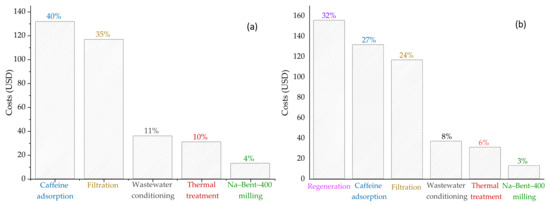
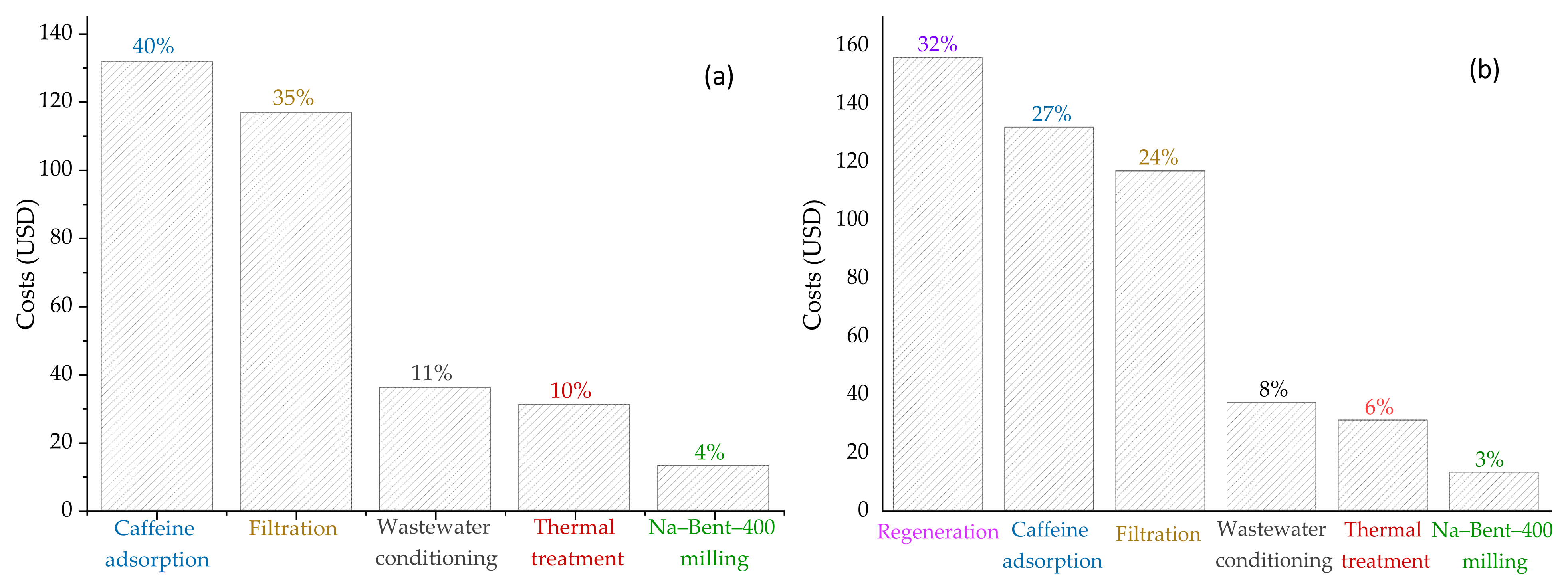
The CapEx of Scenario 1 (i.e., process without Na–Bent–400 regeneration) was USD 331,004, while the CapEx for Scenario 2 (i.e., process with Na–Bent–400 regeneration) was USD 486,725. The total capital investment in Scenario 2 was 47% higher than in Scenario 1, due to the adsorbent regeneration step. This stage involves an additional tank for chemical regeneration and a rotary drum filter to recover solid Bent–Na-400. Therefore, the regeneration cost of the adsorbent is one of the most important factors to consider when implementing the adsorption process in a wastewater treatment plant. For instance, Momina and Ahmad (2023) reported high costs associated with regenerating several adsorbents, including clay materials, activated carbon, and zeolites [73]. Thus, the regeneration process must be carefully considered when designing a process. In this case, the regeneration process reduces the economic feasibility of the caffeine adsorption process, since low-cost Na–Bent–400 is used. This statement has also been presented as a conclusion in the study by Momina et al. (2018) [74]. The disclosed values for each stage and their contribution to the total capital investment for the processes are presented in Table 2 and Figure 2.
Table 2.
CapEx per process stage in the caffeine adsorption from wastewater.
Figure 2.
Capital cost distribution per stage in the caffeine adsorption process from wastewater. (a) Scenario 1 (Adsorption–Disposal); (b) Scenario 2 (Regeneration–Reuse–Disposal).
The cost distribution in Scenario 1 shows that the highest costs are attributed to the caffeine adsorption process (40%) and filtration (35%). Both stages account for 70% of the process’s total capital investment (see Table 2). The equipment sizing explains this result, since the total wastewater is fed to the agitated tank for the adsorption process. Then, all the outlet stream from the slurry adsorption is sent to a filtration unit. Other costs associated with clay milling and conditioning are low, given the amount of Na–Bent–400 used.
On the other hand, the cost distribution in Scenario 2 allows us to explain the effect of the regeneration process on global investment. Indeed, the regeneration process accounts for 32% of the total capital investment (see Table 2). Filtration and slurry adsorption have higher initial investment costs than the other stages. The high cost of the regeneration process is attributed to adsorbent recovery and conditioning. Conditioning the thermally treated clay requires a large-volume stirred tank to remove adsorbed caffeine using an alkaline solution, with a 2-h residence time.
The scientific literature has published studies on caffeine adsorption mainly at the batch level, focusing on the parameters that affect the process, equilibrium, and kinetics. Nevertheless, most studies focus solely on analyzing lab-scale data, omitting a preliminary TEA. Then, only a limited number of plant-scale investment studies have been reported. For instance, Oliveira et al. (2019) reported high caffeine adsorption onto bentonite; however, no full-scale cost estimation was provided [75]. Likewise, in the review by Quintero-Jaramillo et al. (2021), the adsorption of caffeine onto various low-cost adsorbents, including bentonite, was highlighted as a viable treatment strategy [35]. However, the economic implications of adsorbent regeneration were noted as underexplored and typically cost-intensive [35].
A significant increase in capital investment is expected due to additional unit operations required for adsorbent regeneration. Indeed, Na–Bent–400 regeneration not only involves desorption with an alkaline solution but also requires additional infrastructure, labor, and energy inputs. These parameters affect capital and operating costs, as more depreciation, utilities, and supplies are needed. The order of magnitude of the base capital investment (Scenario 1 without adsorbent regeneration) can be compared with other literature data on the techno-economic assessment of small-scale wastewater treatment plants. For instance, Rodríguez-Miranda et al. (2015) reported a regional cost analysis of 51 municipal wastewater treatment plants in Colombia [76]. These authors exposed a non-linear cost relationship between plant capacity and capital investment. Specifically, wastewater treatment plants with low flow rates presented the highest CapEx. In this way, the results from the conceptually designed system can serve as an appropriate baseline for selecting the best process configuration.
A CapEx value of USD 300,000–USD 500,000 for a wastewater treatment plant for caffeine-polluted wastewater is low compared with the total capital investment for a whole process to produce soluble coffee or treat coffee residues to produce several value-added products. This statement is supported because soluble coffee facilities must include a wastewater treatment plant to reduce the organic load before disposal. Moreover, upgrading coffee residues (especially spent coffee grounds-SCG) to produce value-added products and energy vectors generates wastewater contaminated with caffeine. For instance, Karmee (2018) detailed a biorefinery scheme using SCG as raw material [77]. Lipids were extracted and transesterified into biodiesel (≈80–83% yield), while the exhaust biomass was hydrolyzed and fermented to bioethanol, or converted to bio-oil and biochar via pyrolysis [77]. This biorefinery system does not analyze wastewater production. Indeed, most biorefinery or process designs ignore the impact of wastewater treatment costs. Nevertheless, this step is essential to the TEA, as it increases capital costs and the product’s selling price. Several authors have supported this statement, as wastewater treatment plants account for 10–21% of a biorefinery’s total capital investment (CapEx) [78,79,80].
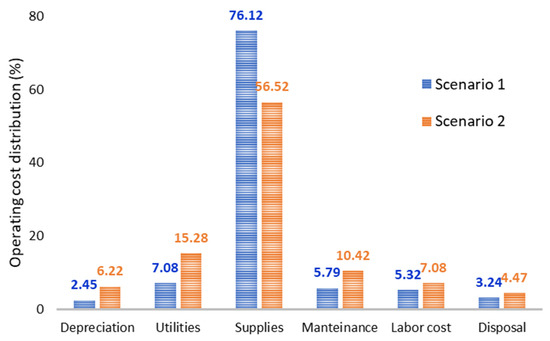
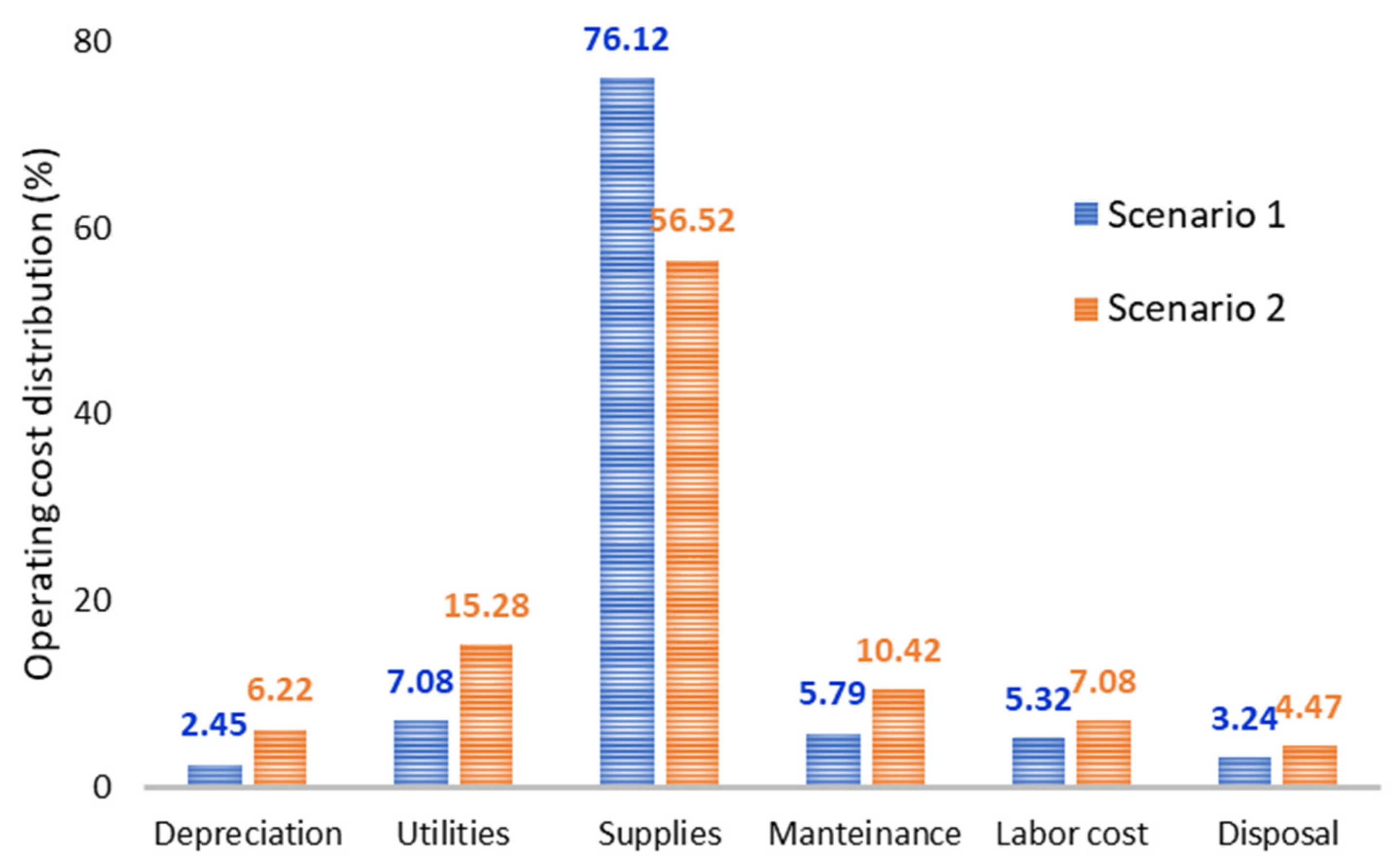
The OpEx of Scenario 1 was USD 347,385/year, while Scenario 2 was USD 186,520/year. The difference in the results is attributed to the operational savings derived from the regeneration process. Other items related to depreciation, labor, maintenance, and utilities were higher in Scenario 2 (Figure 3).
Figure 3.
Operating cost distribution per item and scenario. Scenario 1 (Adsorption–Disposal); Scenario 2 (Regeneration–Reuse–Disposal).
Therefore, the effect of adsorbent regeneration on the operating cost of a wastewater facility is evidenced. The share of OpEx was attributed to the chemicals required to treat the wastewater (75–80%), while maintenance, labor, and utilities accounted for less than 10% in both of the highest scenarios. This trend is similar to the OpEx shares reported by Cicekalan et al. (2023) for several municipal wastewater treatment processes [81]. The chemical shares had the highest cost (13–25%), while the other items, such as utilities, maintenance, and labor, had similar share values [81]. These results are not directly comparable because the processes and wastewater to be treated differ. However, the cost of chemicals has been identified as one of the most critical factors affecting wastewater treatment costs in a facility [82,83]. Patel et al. (2025) reported wastewater treatment using citric acid-modified chitosan as an adsorbent, in which the cost of chitosan accounted for 43–46% of the total cost [82]. Therefore, several strategies, such as adsorbent regeneration, are welcome to minimize reagent costs. Even renewable raw materials, such as biosorbents and minerals, should be used to reduce the environmental impact [84].
3.1.2. Wastewater Treatment Cost and Net Present Cost (NPC)
The wastewater treatment cost for the proposed scale (i.e., 8 L/s equivalent to 252,288 m3/year) was USD 1.38/m3 and USD 0.74/m3 for S1 and S2, respectively. The reduction in unit treatment cost when incorporating adsorbent regeneration is attributed to the capital recovery of the regeneration equipment, a decreased replacement frequency of Na–Bent–400, and lower overall operational expenses per volume of treated water. This trend directly mirrors the OpEx behavior, as Scenario 2 exhibited the lowest operating costs. The results are difficult to compare with other literature reports due to the authors’ limited knowledge; no published peer-reviewed studies have reported an economic assessment of caffeine removal using clay-based adsorbents. However, these results can be compared with those of other studies using other technologies to treat coffee industry wastewater. For example, Dobrosz-Gómez et al. (2024) reported a unit operating cost of USD 6.26/m3 applying electrocoagulation as an alternative for treating wastewater from the coffee industry [85]. Thus, the results reported are comparable to the values obtained in this work, despite the different treatment approach. Furthermore, the obtained unit cost is similar to other literature reports, with values ranging from USD 1/m3 to USD 4/m3 reported in the open literature in the same context (i.e., wastewater treatment from the coffee industry) [86]. In this way, the caffeine adsorption process seems to be an interesting alternative to treat wastewater since the adsorption process is a mature technology (i.e., technological readiness level—TRL-9) and clays are suitable adsorbents for this purpose.
In a comparative context, the costs obtained in this study are consistent with values reported in the literature on techno-economic assessments of wastewater treatment, particularly those addressing the removal of emerging contaminants from urban effluents. For example, Pryce et al. (2022) evaluated the life-cycle cost (LCC) of low-cost graphene-based adsorbent technologies, reporting a unit cost of USD 1.73/m3 of treated effluent [87]. Their work also provided a comprehensive comparison of unit costs for several adsorbent technologies, with the reported values falling within the range calculated in the present study. In addition, other process configurations—such as nanocomposites integrated with biological systems—have been proposed as viable alternatives for pollutant removal, with unit costs ranging between USD 2.55/m3 and USD 3.60/m3 [88]. Nevertheless, proper characteristics of each technology assessed must be considered when a deeper comparison is desired. Even so, similarity in unit treatment cost supports a feasible comparison at initial design stages (i.e., conceptual design) as a strategy to identify technologies with the potential to progress to other design stages (e.g., detailed design).
Wastewater treatment unit cost is related to the capital and operational expenses incurred during a specific period. Therefore, this metric indicates the current cost associated with the process. However, the caffeine adsorption process was conceptually designed. Then, a more feasible metric should be estimated that accounts for the total cost of the project over its entire life-cycle, by discounting all future costs to their present-day value.
The NPC of the wastewater treatment plant using Na–Bent–400 was estimated at USD 6.84 million for S1 and USD 3.96 million for S2. Implementing an adsorbent regeneration stage reduced the NPC by USD 2.88 million. Therefore, adsorbent regeneration can be a suitable alternative despite the high initial capital investment.
The difference in NPC is attributed to the reduction in the annual operating expenditures (OpEx). This reduction has a great impact on the total project life-cycle costs. The high initial capital investment of the regeneration unit reduces the adsorbent use and consumption throughout the project lifetime, more than compensating for this additional investment. Consequently, future process improvements must be addressed to decrease operating costs since these costs represent more than 90% of the NPC. The results elucidated the potential application of regeneration units in adsorption-based processes because long-term economic benefits can be obtained through lower life-cycle costs.
The results obtained in this study diverge from those reported by Ighalo et al. (2022), who observed an increase in the life cycle cost (LCC) of adsorption-based wastewater treatment and identified adsorbent regeneration and replacement as the primary LCC drivers [84]. This discrepancy is largely attributable to differences in the underlying adsorption capacity and the number of regeneration cycles evaluated. Specifically, the present work considered a single regeneration/reuse cycle, in which the adsorption efficiency of Na–Bent–400 declined from 95.97% to 85.34%. This operational condition significantly reduced fresh adsorbent consumption, thereby offsetting the CapEx and OpEx associated with the regeneration unit and ultimately yielding a lower NPC.
The presented results indicate that Na–Bent–400 regeneration is a promising strategy for reducing the life-cycle cost of adsorption-based wastewater treatment by decreasing fresh adsorbent consumption. However, the economic viability of regeneration is highly dependent on maintaining sufficient adsorption performance after regeneration and achieving an appropriate balance between regeneration costs and the savings obtained from reduced adsorbent replacement.
3.1.3. Sensitivity Analysis
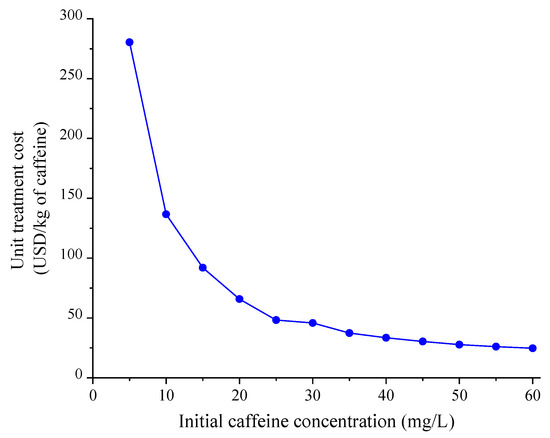
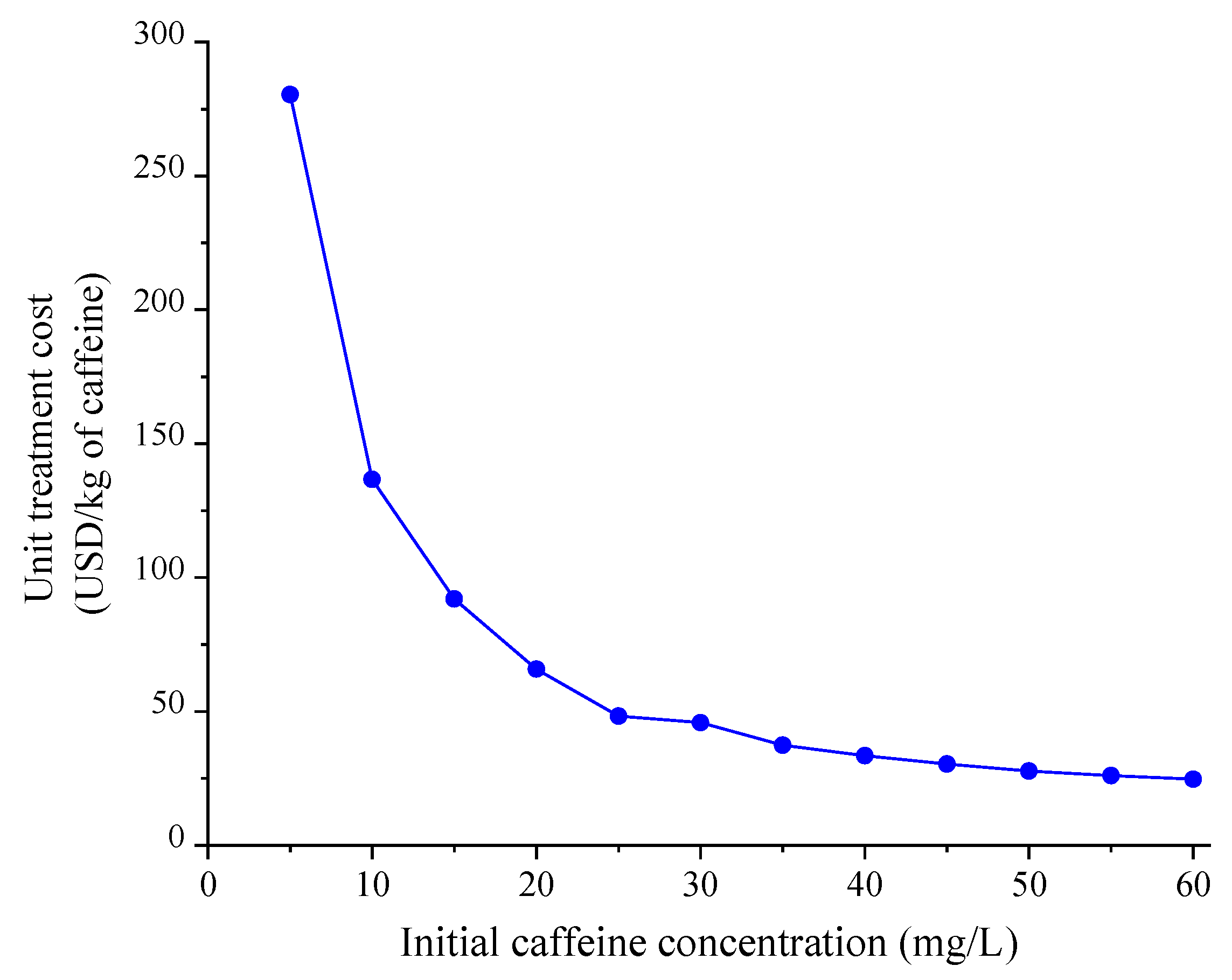
The influence of the caffeine concentration in the influent of the proposed wastewater treatment plant without regeneration (Scenario 1) is presented in Figure 4. A higher caffeine concentration in the wastewater stream reduces the treatment cost when an adsorption-based system is used. The unit cost definition can explain this behavior. Firstly, higher caffeine concentrations promote mass transfer from the bulk phase (i.e., liquid phase) to the solid phase. The adsorbent can remove as much caffeine as there are active sites present. Then, the process ends faster. This statement has been demonstrated by several authors who varied the initial pollutant concentration and adsorbent loading [89,90]. The unit treatment cost per mass of pollutant (USD/kg of caffeine) decreases when caffeine concentration increases based on the definition of the unit cost. The unit cost was estimated as the ratio between the annual operating cost (almost constant) and the mass of caffeine treated. If only the influent caffeine concentration increases while all other variables (i.e., adsorbent dosage, adsorbent cost, maintenance, energy, and labor) remain constant, the unit treatment cost decreases until the adsorbent reaches saturation. Then, the treatment cost per unit of caffeine decreases since the adsorbent dosage is constant. Finally, the adsorption driving force is higher, leading to faster adsorption (less adsorbent residence time).
Figure 4.
Variation in the unit treatment cost of caffeine disposal as a function of the initial caffeine concentration for a wastewater flow rate of 8 L/s.
A comparison of these trends was explicated in the open literature for different pollutants in wastewater. For instance, Ighalo et al. (2022) stated that adsorption cost metrics decrease when the adsorbent use per unit mass of adsorbate is minimized [84]. Then, for higher pollutant loadings, fewer grams of adsorbent (and fewer cycles) are needed per kg pollutant removed [84]. Moreover, Almeida-Naranjo et al. (2023) reported the same trend when analyzing an adsorption system for emerging pollutants removal [91]. Indeed, these authors concluded that high pollutant concentrations enable efficient adsorbent use, lower regeneration costs, lower energy consumption, and lower treatment costs per unit volume [91]. Finally, Diaz-Vargas et al. (2023) reported the same behavior when removing cocaine and derivatives from polluted wastewater using a biological disk reactor [92]. This behavior is not unique to adsorption systems.
4. Conclusions
Process simulation at an industrial scale (8 L/s, 252,288 m3/year) demonstrates the preliminary feasibility of using thermally modified bentonite (Na–Bent–400) for caffeine removal. Integrating adsorbent regeneration/reuse (Scenario 2, S2) requires auxiliary units, such as an alkaline desorption tank (homogenizer) and a rotary drum filter, increasing CapEx by 47% (USD 486,725) relative to single-use disposal (Scenario 1, S1, USD 331,004). However, regeneration significantly lowers long-term operational costs by reducing fresh adsorbent requirements and waste disposal quantities.
Adsorbent regeneration decreases the unit wastewater treatment cost from USD 1.38/m3 (S1) to USD 0.74/m3 (S2) based on operational expenses. Over a 35-year operational lifespan, S2 achieves an NPC of USD 3.96 million, generating USD 2.88 million in cumulative savings compared to S1(USD 6.84 million). These results confirm that operational savings in raw materials and waste management offset the initial capital penalty, making regeneration the superior financial strategy.
Sensitivity analysis across influent caffeine levels (5 to 60 mg/L) shows that unit removal costs decrease as concentration rises, stabilizing above 30 mg/L. Higher concentrations enhance liquid-to-solid mass transfer and active-site utilization, distributing fixed operational and capital costs over a larger mass of removed caffeine. Consequently, the Na–Bent–400 system demonstrates high financial stability under variable pollutant loads typical of coffee-processing effluents.
Despite its economic benefits, Na–Bent–400 exhibits a removal efficiency decay from 95.97% to 85.34% after a single regeneration/reuse (S2). This raises the effluent caffeine concentration to 4.40 mg/L, approaching the hazardous threshold (4.42 mg/L) reported for various aquatic microorganisms. Furthermore, the alkaline desorbed stream (pH 12) requires neutralization and secondary polishing (e.g., constructed wetlands) before discharge. Future research must assess multi-cycle regeneration, fixed-bed adsorption dynamics, and performance in complex wastewater matrices.
Author Contributions
Conceptualization, J.A.Q.-J., I.F.M.-Q., J.C.S.-T., J.I.C.-M., C.A.C.A. and N.R.S.-G.; Methodology, J.A.Q.-J., I.F.M.-Q. and J.C.S.-T.; Software, I.F.M.-Q. and J.C.S.-T.; Formal analysis, J.A.Q.-J., I.F.M.-Q., J.C.S.-T., C.A.C.A. and N.R.S.-G.; Investigation, J.A.Q.-J., J.C.S.-T., J.I.C.-M. and N.R.S.-G.; Resources, J.A.Q.-J., J.I.C.-M. and N.R.S.-G.; Data curation, J.A.Q.-J. and J.C.S.-T.; Writing—original draft preparation, J.A.Q.-J., I.F.M.-Q., J.C.S.-T., C.A.C.A. and N.R.S.-G.; Writing—review and editing, I.F.M.-Q., J.C.S.-T. and N.R.S.-G.; Supervision, C.A.C.A. and N.R.S.-G.; Project administration, J.I.C.-M. and N.R.S.-G.; Funding acquisition, J.A.Q.-J., J.I.C.-M. and N.R.S.-G. All authors have read and agreed to the published version of the manuscript.
Funding
This study was partially funded by the Universidad Nacional de Colombia Sede Manizales (DIMA, Hermes project code 50752) and the Ministerio de Ciencia, Tecnología e Innovación-MinCiencias-through the “Convocatoria de Doctorados Nacionales 2017, No. 785.
Data Availability Statement
The original contributions presented in this study are included in the article. Further inquiries can be directed to the corresponding author.
Acknowledgments
The authors thank the Universidad Nacional de Colombia Sede Manizales for the experimental support for this research. They also thank the Ministerio de Ciencia, Tecnología e Innovación-MinCiencias-through the “Convocatoria de Estancias Posdoctorales Orientadas por Misiones, No. 934” and the “Fondo Nacional de Financiamiento para la Ciencia, la Tecnología y la Innovación Francisco José de Caldas–FFJC, Acuerdo Especial de Cooperación No. 266 de 2023”. This work was supported by the research project “Aprovechamiento y Valorización Sostenible de Residuos Sólidos Orgánicos y su Posible Aplicación en Biorrefinerías y Tecnologías de Residuos a Energía en el Departamento de Sucre” (BPIN Code 2020000100189)”.
Conflicts of Interest
The authors declare no conflict of interest.
Abbreviations
The following abbreviations are used in this manuscript:
| Non-randomness parameter in the NRTL model | |
| AAEC | American Association of Cost Engineers |
| APEA | Aspen process economic analyzer |
| BWI | Bond work index |
| CapEx | Capital expenditure |
| CCD | Central composite design |
| CEPCI | Chemical engineering plant cost index |
| CFn | Cash flow in the year n |
| CPIG | Ideal gas heat capacity |
| CPSPO | Solid heat capacity |
| d | Expected inflation rate |
| DHVLWT | Heat of vaporization |
| EC50 | Half maximal effective concentration |
| FCI | Fixed capital investment |
| HC5 | Hazardous concentration for 5% of species |
| i | Nominal discount rate |
| LCC | Life-cycle cost |
| MPS | Mean particle size |
| N | Project lifetime |
| Na–Bent | Sodium bentonite clay |
| Na–Bent–400 | Thermally modified bentonite at 400 °C |
| Nnp | Number of non-particulate processing steps |
| NOL | Number of operators per shift |
| NPC | Net present cost (NPC) |
| NREL | National Renewable Energy Laboratory |
| NRTL | Non-Random Two-Liquids |
| OpEx | Operational expenditures |
| P | Power input |
| PLXANT | Vapor pressure constants |
| PPCPs | Pharmaceuticals and personal care products |
| Ps | Number of processing steps involving solids handling |
| Equilibrium adsorption capacity | |
| r | Real discount rate |
| ROM | Rough order of magnitude |
| RSM | Response surface methodology |
| RStoic | Stoichiometric reactor in the Aspen Plus simulator |
| SCG | Spent coffee grounds |
| S1 | Scenario 1: Adsorption–Disposal |
| S2 | Scenario 2: Regeneration–Reuse–Disposal |
| Interaction parameter 1 in the NRTL model Characterizes the energy interaction of component 1 relative to component 2 | |
| Interaction parameter 2 in the NRTL model Characterizes the energy interaction of component 2 relative to component 1 | |
| TDC | Total direct cost |
| TEA | Techno-economic assessment |
| TIC | Total indirect cost |
| TRL | Technological readiness level |
| USD | United States dollar |
| V | Tank volume |
| WWTPs | Wastewater treatment plants |
| Adsorbent mass | |
| Caffeine concentration |
References
- Tawfik, N.A.I.; El-Bakary, Z.A.; Abd El-Wakeil, K.F. Determination of caffeine in treated wastewater discharged in the Nile River with emphasis on the effect of zinc and physicochemical factors. Environ. Sci. Pollut. Res. 2024, 31, 28124–28138. [Google Scholar] [CrossRef] [Scilit] [PubMed]
- Beltrame, K.K.; Cazetta, A.L.; de Souza, P.S.C.; Spessato, L.; Silva, T.L.; Almeida, V.C. Adsorption of caffeine on mesoporous activated carbon fibers prepared from pineapple plant leaves. Ecotoxicol. Environ. Saf. 2018, 147, 64–71. [Google Scholar] [CrossRef] [Scilit] [PubMed]
- Li, S.; He, B.; Wang, J.; Liu, J.; Hu, X. Risks of caffeine residues in the environment: Necessity for a targeted ecopharmacovigilance program. Chemosphere 2020, 243, 125343. [Google Scholar] [CrossRef] [Scilit] [PubMed]
- Buerge, I.J.; Poiger, T.; Müller, M.D.; Buser, H.-R. Caffeine, an anthropogenic marker for wastewater contamination of surface waters. Environ. Sci. Technol. 2003, 37, 691–700. [Google Scholar] [CrossRef] [Scilit] [PubMed]
- Rodrigues, S.; Alves, R.S.; Antunes, S.C. Impact of caffeine on aquatic ecosystems: Assessing trophic-level biological responses. J. Xenobiot. 2025, 15, 86. [Google Scholar] [CrossRef] [Scilit] [PubMed]
- de Jesus Gaffney, V.; Almeida, C.M.M.; Rodrigues, A.; Ferreira, E.; Benoliel, M.J.; Cardoso, V.V. Occurrence of pharmaceuticals in a water supply system and related human health risk assessment. Water Res. 2015, 72, 199–208. [Google Scholar] [CrossRef] [Scilit] [PubMed]
- Adeleye, A.S.; Xue, J.; Zhao, Y.; Taylor, A.A.; Zenobio, J.E.; Sun, Y.; Han, Z.; Salawu, O.A.; Zhu, Y. Abundance, fate, and effects of pharmaceuticals and personal care products in aquatic environments. J. Hazard. Mater. 2022, 424, 127284. [Google Scholar] [CrossRef] [Scilit] [PubMed]
- Li, S.; Wen, J.; He, B.; Wang, J.; Hu, X.; Liu, J. Occurrence of caffeine in the freshwater environment: Implications for ecopharmacovigilance. Environ. Pollut. 2020, 263, 114371. [Google Scholar] [CrossRef] [Scilit] [PubMed]
- Sharma, V.K.; Sharma, A.; Verma, K.K.; Gaur, P.K.; Kaushik, R.; Abdali, B. A comprehensive review on pharmacological potentials of caffeine. J. Appl. Pharm. Sci. Res. 2023, 6, 16–26. [Google Scholar] [CrossRef] [Scilit]
- dos Santos, J.A.; Quadra, G.R.; Almeida, R.M.; Soranço, L.; Lobo, H.; Rocha, V.N.; Bialetzki, A.; Reis, J.L.; Roland, F.; Barros, N. Sublethal effects of environmental concentrations of caffeine on a neotropical freshwater fish. Ecotoxicology 2022, 31, 161–167. [Google Scholar] [CrossRef] [Scilit] [PubMed]
- Vieira, L.R.; Soares, A.M.V.M.; Freitas, R. Caffeine as a contaminant of concern: A review on concentrations and impacts in marine coastal systems. Chemosphere 2022, 286, 131675. [Google Scholar] [CrossRef] [Scilit] [PubMed]
- Oliveira, T.S.; Murphy, M.; Mendola, N.; Wong, V.; Carlson, D.; Waring, L. Characterization of pharmaceuticals and personal care products in hospital effluent and waste water influent/effluent by direct-injection LC-MS-MS. Sci. Total Environ. 2015, 518–519, 459–478. [Google Scholar] [CrossRef] [Scilit] [PubMed]
- Nödler, K.; Tsakiri, M.; Aloupi, M.; Gatidou, G.; Stasinakis, A.S.; Licha, T. Evaluation of polar organic micropollutants as indicators for wastewater-related coastal water quality impairment. Environ. Pollut. 2016, 211, 282–290. [Google Scholar] [CrossRef] [Scilit] [PubMed]
- Tran, N.H.; Li, J.; Hu, J.; Ong, S.L. Occurrence and suitability of pharmaceuticals and personal care products as molecular markers for raw wastewater contamination in surface water and groundwater. Environ. Sci. Pollut. Res. 2014, 21, 4727–4740. [Google Scholar] [CrossRef] [Scilit] [PubMed]
- Archer, E.; Petrie, B.; Kasprzyk-Hordern, B.; Wolfaardt, G.M. The fate of pharmaceuticals and personal care products (PPCPs), endocrine disrupting contaminants (EDCs), metabolites and illicit drugs in a WWTW and environmental waters. Chemosphere 2017, 174, 437–446. [Google Scholar] [CrossRef] [Scilit] [PubMed]
- Baker, D.R.; Kasprzyk-Hordern, B. Spatial and temporal occurrence of pharmaceuticals and illicit drugs in the aqueous environment and during wastewater treatment: New developments. Sci. Total Environ. 2013, 454–455, 442–456. [Google Scholar] [CrossRef] [Scilit] [PubMed]
- Blair, B.D.; Crago, J.P.; Hedman, C.J.; Treguer, R.J.F.; Magruder, C.; Royer, L.S.; Klaper, R.D. Evaluation of a model for the removal of pharmaceuticals, personal care products, and hormones from wastewater. Sci. Total Environ. 2013, 444, 515–521. [Google Scholar] [CrossRef] [Scilit] [PubMed]
- Froehner, S.; Piccioni, W.; Machado, K.S.; Aisse, M.M. Removal capacity of caffeine, hormones, and bisphenol by aerobic and anaerobic sewage treatment. Water Air Soil Pollut. 2011, 216, 463–471. [Google Scholar] [CrossRef] [Scilit]
- Kleywegt, S.; Payne, M.; Ng, F.; Fletcher, T. Environmental loadings of active pharmaceutical ingredients from manufacturing facilities in Canada. Sci. Total Environ. 2019, 646, 257–264. [Google Scholar] [CrossRef] [Scilit] [PubMed]
- Montes, C.A.; Ortiz, N.V.; Arias, C.A.; Chaparro, T.R. Vertical flow wetlands as the core for the sustainable treatment of coffee wastewater in small communities in Colombia: Preliminary results of the treatment of coffee wastewater in rural areas by vertical flow wetlands. Water Sci. Technol. 2023, 88, 1974–1981. [Google Scholar] [CrossRef] [Scilit] [PubMed]
- Figueroa Campos, G.A.; Sagu, S.T.; Saravia Celis, P.; Rawel, H.M. Comparison of batch and continuous wet-processing of coffee: Changes in the main compounds in beans, by-products and wastewater. Foods 2020, 9, 1135. [Google Scholar] [CrossRef] [Scilit] [PubMed]
- Chen, R.; Jiang, H.; Li, Y.-Y. Caffeine degradation by methanogenesis: Efficiency in anaerobic membrane bioreactor and analysis of kinetic behavior. Chem. Eng. J. 2018, 334, 444–452. [Google Scholar] [CrossRef] [Scilit]
- Monzón-Reyes, B.L.; López Méndez, M.C.; Vera-Puerto, I.; Sandoval-Herazo, M.; Sandoval Herazo, L.C. Full-scale ornamental constructed wetlands for caffeine removal from rural wastewater and coffee-processing effluents. Renew. Energy Biomass Sustain. 2026, 8, 54–62. [Google Scholar] [CrossRef] [Scilit]
- Wongphoom, T.; Saleepochn, T.; Noophan, P.L.; Li, C.-W. Effects of caffeine and COD from coffee wastewater on anaerobic ammonium oxidation (Anammox) activities. Water 2022, 14, 2238. [Google Scholar] [CrossRef] [Scilit]
- Hillebrand, O.; Nödler, K.; Licha, T.; Sauter, M.; Geyer, T. Caffeine as an indicator for the quantification of untreated wastewater in karst systems. Water Res. 2012, 46, 395–402. [Google Scholar] [CrossRef] [Scilit] [PubMed]
- Danish, M.; Birnbach, J.; Mohamad Ibrahim, M.N.; Hashim, R.; Majeed, S.; Tay, G.S.; Sapawe, N. Optimization study of caffeine adsorption onto large surface area wood activated carbon through central composite design approach. Environ. Nanotechnol. Monit. Manag. 2021, 16, 100594. [Google Scholar] [CrossRef] [Scilit]
- Mompelat, S.; Le Bot, B.; Thomas, O. Occurrence and fate of pharmaceutical products and by-products, from resource to drinking water. Environ. Int. 2009, 35, 803–814. [Google Scholar] [CrossRef] [Scilit] [PubMed]
- Essam, A.; Eldek, S.I.; Shehata, N. Management of caffeine in wastewater using MOF and perovskite materials: Optimization, kinetics, and adsorption isotherm modelling. J. Environ. Health Sci. Eng. 2024, 22, 345–360. [Google Scholar] [CrossRef] [Scilit] [PubMed]
- Yang, Y.; Wan, Y.; Chen, H.; Li, Y.; Muñoz-Carpena, R.; Zheng, Y.; Huang, J.; Zhang, Y.; Gao, B. Caffeine removal in wastewater: A comprehensive review of current treatment plants and small-scale innovations. Environ. Technol. Rev. 2025, 14, 594–612. [Google Scholar] [CrossRef] [Scilit] [PubMed]
- Wang, C.; Moore, N.; Bircher, K.; Andrews, S.; Hofmann, R. Full-scale comparison of UV/H2O2 and UV/Cl2 advanced oxidation: The degradation of micropollutant surrogates and the formation of disinfection byproducts. Water Res. 2019, 161, 448–458. [Google Scholar] [CrossRef] [Scilit] [PubMed]
- Nivala, J.; Kahl, S.; Boog, J.; van Afferden, M.; Reemtsma, T.; Müller, R.A. Dynamics of emerging organic contaminant removal in conventional and intensified subsurface flow treatment wetlands. Sci. Total Environ. 2019, 649, 1144–1156. [Google Scholar] [CrossRef] [Scilit] [PubMed]
- Huang, Z.; Gong, B.; Huang, C.-P.; Pan, S.-Y.; Wu, P.; Dang, Z.; Chiang, P.-C. Performance evaluation of integrated adsorption-nanofiltration system for emerging compounds removal: Exemplified by caffeine, diclofenac and octylphenol. J. Environ. Manag. 2019, 231, 121–128. [Google Scholar] [CrossRef] [Scilit] [PubMed]
- Rigueto, C.V.T.; Nazari, M.T.; De Souza, C.F.; Cadore, J.S.; Brião, V.B.; Piccin, J.S. Alternative techniques for caffeine removal from wastewater: An overview of opportunities and challenges. J. Water Process Eng. 2020, 35, 101231. [Google Scholar] [CrossRef] [Scilit]
- Bachmann, S.A.L.; Calvete, T.; Féris, L.A. Caffeine removal from aqueous media by adsorption: An overview of adsorbents evolution and the kinetic, equilibrium and thermodynamic studies. Sci. Total Environ. 2021, 767, 144229. [Google Scholar] [CrossRef] [Scilit] [PubMed]
- Quintero-Jaramillo, J.A.; Carrero-Mantilla, J.I.; Sanabria-González, N.R. A review of caffeine adsorption studies onto various types of adsorbents. Sci. World J. 2021, 2021, 9998924. [Google Scholar] [CrossRef] [Scilit] [PubMed]
- Danat, B.T.; Wuana, R.A.; Chahul, H.F.; Iorunga, M.S. Review of adsorption isotherms models. Appl. Water Sci. 2026, 16, 72. [Google Scholar] [CrossRef] [Scilit]
- Hussain, M.; Riaz, A.; Zeb, H.; Ali, A.; Mujahid, R.; Ahmad, F.; Zafar, M.S. Paving the path to water security: The role of advanced adsorbents in wastewater treatment. J. Water Process Eng. 2025, 71, 107333. [Google Scholar] [CrossRef] [Scilit]
- Recio-Colmenares, C.L.; Flores-Gómez, J.; Morales Rivera, J.P.; Palacios Hinestroza, H.; Sulbarán-Rangel, B. Green materials for water and wastewater treatment: Mechanisms and artificial intelligence. Processes 2025, 13, 566. [Google Scholar] [CrossRef] [Scilit]
- Liu, Y.; Biswas, B.; Hassan, M.; Naidu, R. Green adsorbents for environmental remediation: Synthesis methods, ecotoxicity, and reusability prospects. Processes 2024, 12, 1195. [Google Scholar] [CrossRef] [Scilit]
- Nykiel, M.; Furtos, G.; Oliwa, K.; Łach, M.; Korniejenko, K. Review of the application of zeolites as sorption materials in water treatment. Sustainability 2026, 18, 5045. [Google Scholar] [CrossRef] [Scilit]
- Kyzas, G.Z.; Kostoglou, M. Green adsorbents for wastewaters: A critical review. Materials 2014, 7, 333–364. [Google Scholar] [CrossRef] [Scilit] [PubMed]
- Dehghani, M.H.; Ahmadi, S.; Ghosh, S.; Othmani, A.; Osagie, C.; Meskini, M.; AlKafaas, S.S.; Malloum, A.; Khanday, W.A.; Jacob, A.O.; et al. Recent advances on sustainable adsorbents for the remediation of noxious pollutants from water and wastewater: A critical review. Arab. J. Chem. 2023, 16, 105303. [Google Scholar] [CrossRef] [Scilit]
- Melo, L.L.A.; Ide, A.H.; Duarte, J.L.S.; Zanta, C.L.P.S.; Oliveira, L.M.T.M.; Pimentel, W.R.O.; Meili, L. Caffeine removal using Elaeis guineensis activated carbon: Adsorption and RSM studies. Environ. Sci. Pollut. Res. 2020, 27, 27048–27060. [Google Scholar] [CrossRef] [Scilit] [PubMed]
- Quintero-Jaramillo, J.A.; Carrero, J.I.; Sanabria-González, N.R. Caffeine adsorption on a thermally modified bentonite: Adsorbent characterization, experimental design, equilibrium and kinetics. Colloids Interfaces 2024, 8, 26. [Google Scholar] [CrossRef] [Scilit]
- Almeida-Naranjo, C.E.; Aldás, M.B.; Cabrera, G.; Guerrero, V.H. Caffeine removal from synthetic wastewater using magnetic fruit peel composites: Material characterization, isotherm and kinetic studies. Environ. Chall. 2021, 5, 100343. [Google Scholar] [CrossRef] [Scilit]
- Latiza, R.J.P.; Mustafa, A.; Delos Reyes, K.; Nebres, K.L.; Rubi, R.V.C. Adsorbents derived from plant sources for caffeine removal: Current research and future outlook. Eng. Proc. 2024, 67, 15. [Google Scholar] [CrossRef] [Scilit]
- Bongosia, J.G.; Al-Gailani, A.; Kolosz, B.W.; Loy Chun Minh, A.; Lock, S.S.M.; Cheah, K.W.; Taylor, M.J. Scalable mesoporous biochars from bagasse waste for Cu (II) removal: Process optimisation, kinetics and techno-economic analysis. J. Environ. Manag. 2024, 370, 122558. [Google Scholar] [CrossRef] [Scilit] [PubMed]
- Patel, P.K.; Pandey, L.M.; Uppaluri, R.V.S. Conceptual techno-economic analysis of chitosan derivative resin and commercial sorbents for multi-heavy metal removal. Sep. Purif. Technol. 2025, 362, 131732. [Google Scholar] [CrossRef] [Scilit]
- Zhao, W.; Zhang, Z.; Xin, Y.; Xiao, R.; Gao, F.; Wu, H.; Wang, W.; Guan, Q.; Lu, K. Na2S-modified biochar for Hg(II) removal from wastewater: A techno-economic assessment. Fuel 2024, 356, 129641. [Google Scholar] [CrossRef] [Scilit]
- El-Shafie, A.S.; Rahman, E.; GadelHak, Y.; Mahmoud, R.; El-Azazy, M. Techno-economic assessment of waste mandarin biochar as a green adsorbent for binary dye wastewater effluents of methylene blue and basic fuchsin: Lab- and large-scale investigations. Spectrochim. Acta A Mol. Biomol. Spectrosc. 2024, 306, 123621. [Google Scholar] [CrossRef] [Scilit] [PubMed]
- Gonzales-Condori, E.G.; Bejar-Aramburu, D.G.; Gutierrez-Delgado, J.A.; Villanueva-Salas, J.A.; Gonzales-Condori, J.; Salazar-Pinto, B.M. Valorization of grape seed residues post-oil extraction as an adsorbent for hexavalent chromium in water. Kinetics, isotherms, thermodynamics, and techno-economic analysis. Energy Nexus 2025, 18, 100437. [Google Scholar] [CrossRef] [Scilit]
- Baaloudj, O.; Langerame, F.; Iunnissi, R.; Buttiglieri, G.; Buono, D.D.; Khadhar, S.; Scrano, L.; Trotta, V.; Brienza, M. Biochar-based downflow fixed-bed adsorption systems for water treatment: Process optimization, reusability, and techno-economic evaluation. Sep. Purif. Technol. 2025, 377, 134347. [Google Scholar] [CrossRef] [Scilit]
- Esmati, F.; Holliday, M.C.; Zein, S.H.; Jabbar, K.J.; Tan, S.H.; Putranto, A. Enhancing hexavalent chromium removal from textile effluent with low-cost adsorbent: Simulation and a techno-economic study. Int. J. Environ. Sci. Technol. 2025, 22, 6345–6364. [Google Scholar] [CrossRef] [Scilit]
- Younas, F.; Mustafa, A.; Farooqi, Z.U.R.; Wang, X.; Younas, S.; Mohy-Ud-Din, W.; Ashir Hameed, M.; Mohsin Abrar, M.; Maitlo, A.A.; Noreen, S.; et al. Current and emerging adsorbent technologies for wastewater treatment: Trends, limitations, and environmental implications. Water 2021, 13, 215. [Google Scholar] [CrossRef] [Scilit]
- Francoeur, M.; Yacou, C.; Jean-Marius, C.; Chérémond, Y.; Jauregui-Haza, U.; Gaspard, S. Optimization of the synthesis of activated carbon prepared from Sargassum (sp.) and its use for tetracycline, penicillin, caffeine and methylene blue adsorption from contaminated water. Environ. Technol. Innov. 2022, 28, 102940. [Google Scholar] [CrossRef] [Scilit]
- Rani, C.N. Feasibility study on the utilization of low-cost sawdust for adsorption of caffeine: Equilibrium, optimization, and response surface modeling. Desalin. Water Treat. 2022, 276, 271–281. [Google Scholar] [CrossRef] [Scilit]
- Taoufik, N.; Boumya, W.; Elmoubarki, R.; Elhalil, A.; Achak, M.; Abdennouri, M.; Barka, N. Experimental design, machine learning approaches for the optimization and modeling of caffeine adsorption. Mater. Today Chem. 2022, 23, 100732. [Google Scholar] [CrossRef] [Scilit]
- Macías-Quiroga, I.F.; Giraldo-Gómez, G.I.; Sanabria-González, N.R. Characterization of colombian clay and its potential use as adsorbent. Sci. World J. 2018, 2018, 5969178. [Google Scholar] [CrossRef] [Scilit] [PubMed]
- Pérez-Osorio, G.; Avelino-Flores, F.; Hernández-Lorenzo, B.; Gutiérrez-Arias, J.E.M.; Mendoza-Hernández, J.C.; Chavarin-Pineda, Y. Evaluation of the wastewater impact of coffee wet mill in Xicotepec, Mexico. Rev. UDCA Actual. Divulg. Cient. 2025, 28, e2717. [Google Scholar] [CrossRef] [Scilit]
- Yamamoto, K.; Shiono, T.; Matsui, Y.; Yoneda, M. Interaction of caffeine with montmorillonite. Part. Sci. Technol. 2019, 37, 325–332. [Google Scholar] [CrossRef] [Scilit]
- Towler, G.; Sinnott, R. Chemical Engineering Design: Principles, Practice and Economics of Plant and Process Design, 3rd ed.; Elsevier Ltd.: Cambridge, MA, USA, 2022. [Google Scholar]
- Tan, K.L.; Hameed, B.H. Insight into the adsorption kinetics models for the removal of contaminants from aqueous solutions. J. Taiwan Inst. Chem. Eng. 2017, 74, 25–48. [Google Scholar] [CrossRef] [Scilit]
- Monzón-Reyes, B.L.; Vera-Puerto, I.; Florez, V.V.; Méndez, M.C.L.; Month, A.E.Á.; Meléndez-Armenta, R.Á.; Herazo, L.C.S. Municipal and coffee wastewater treated by a full-scale Constructed Wetlands using ornamental plants under tropical climate. Ecol. Eng. 2026, 222, 107809. [Google Scholar] [CrossRef] [Scilit]
- Wooley, R.J.; Putsche, V. Development of an ASPEN PLUS Physical Property Database for Biofuels Components; Report MP-425-20685; National Renewable Energy Laboratory—NREL: Golden, CO, USA, 1996. [Google Scholar]
- Dabir, T.O.; Gaikar, V.G.; Jayaraman, S.; Mukherjee, S. Thermodynamic modeling studies of aqueous solubility of caffeine, gallic acid and their cocrystal in the temperature range of 303 K–363 K. Fluid Phase Equilib. 2018, 456, 65–76. [Google Scholar] [CrossRef] [Scilit]
- Rueda-Duran, C.-A.; Ortiz-Sanchez, M.; Cardona-Alzate, C.A. Detailed economic assessment of polylactic acid production by using glucose platform: Sugarcane bagasse, coffee cut stems, and plantain peels as possible raw materials. Biomass Convers. Biorefin. 2022, 12, 4419–4434. [Google Scholar] [CrossRef] [Scilit]
- Peters, M.S.; Timmerhaus, K.D.; West, R.E. Plant Design and Economics for Chemical Engineers, 5th ed.; McGraw-Hill Education: New York, NY, USA, 2003. [Google Scholar]
- Solarte-Toro, J.C.; Ortiz-Sanchez, M.; Cardona Alzate, C.A.; Gutiérrez, L.-F. Boosting Sacha Inchi valorization through the biorefinery concept in Colombia: Techno-economic assessment. Food Bioprod. Process. 2025, 153, 560–573. [Google Scholar] [CrossRef] [Scilit]
- Turton, R.; Shaeiwitz, J.A.; Bhattacharyya, D.; Whiting, W.B. Analysis, Synthesis, and Design of Chemical Processes, 5th ed.; Pearson Education: New York, NY, USA, 2018. [Google Scholar]
- Palmeros Parada, M.; Osseweijer, P.; Posada Duque, J.A. Sustainable biorefineries, an analysis of practices for incorporating sustainability in biorefinery design. Ind. Crops Prod. 2017, 106, 105–123. [Google Scholar] [CrossRef] [Scilit]
- Pryce, D.; Kapelan, Z.; Memon, F.A. Economic evaluation of a small wastewater treatment plant under different design and operation scenarios by life cycle costing. Dev. Eng. 2022, 7, 100103. [Google Scholar] [CrossRef] [Scilit]
- Trading Economics, Colombia Inflation Rate. Available online: https://tradingeconomics.com/colombia/inflation-cpi (accessed on 15 October 2025).
- Momina; Ahmad, K. Feasibility of the adsorption as a process for its large scale adoption across industries for the treatment of wastewater: Research gaps and economic assessment. J. Clean. Prod. 2023, 388, 136014. [Google Scholar] [CrossRef] [Scilit]
- Momina, A.; Shahadat, M.; Isamil, S. Regeneration performance of clay-based adsorbents for the removal of industrial dyes: A review. RSC Adv. 2018, 8, 24571–24587. [Google Scholar] [CrossRef] [Scilit] [PubMed]
- Oliveira, M.F.; da Silva, M.G.C.; Vieira, M.G.A. Equilibrium and kinetic studies of caffeine adsorption from aqueous solutions on thermally modified Verde-lodo bentonite. Appl. Clay Sci. 2019, 168, 366–373. [Google Scholar] [CrossRef] [Scilit]
- Rodríguez-Miranda, J.P.; García-Ubaque, C.A.; Penagos-Londoño, J.C. Analysis of the investment costs in municipal wastewater treatment plants in Cundinamarca. Dyna 2015, 82, 230–238. [Google Scholar] [CrossRef] [Scilit]
- Karmee, S.K. A spent coffee grounds based biorefinery for the production of biofuels, biopolymers, antioxidants and biocomposites. Waste Manag. 2018, 72, 240–254. [Google Scholar] [CrossRef] [Scilit] [PubMed]
- Tobin, T.; Gustafson, R.; Bura, R.; Gough, H.L. Integration of wastewater treatment into process design of lignocellulosic biorefineries for improved economic viability. Biotechnol. Biofuels 2020, 13, 24. [Google Scholar] [CrossRef] [Scilit] [PubMed]
- Thoppil, Y.; Zein, S.H. Techno-economic analysis and feasibility of industrial-scale biodiesel production from spent coffee grounds. J. Clean. Prod. 2021, 307, 127113. [Google Scholar] [CrossRef] [Scilit]
- Strieder, M.M.; Velásquez Piñas, J.A.; Ampese, L.C.; Costa, J.M.; Carneiro, T.F.; Rostagno, M.A. Coffee biorefinery: The main trends associated with recovering valuable compounds from solid coffee residues. J. Clean. Prod. 2023, 415, 137716. [Google Scholar] [CrossRef] [Scilit]
- Cicekalan, B.; Kosar, S.; Cingoz, S.; Eyit, N.; Ersahin, M.E.; Ozgun, H. Techno-economic and environmental assessment of different municipal wastewater treatment systems. J. Water Process Eng. 2023, 53, 103822. [Google Scholar] [CrossRef] [Scilit]
- Patel, P.K.; Pandey, L.M.; Uppaluri, R.V.S. Adsorption behavior and techno-economic analysis of citric acid-modified chitosan for heavy metal removal from wastewater. Chem. Eng. Sci. 2025, 315, 121868. [Google Scholar] [CrossRef] [Scilit]
- Molinos-Senante, M.; Hernández-Sancho, F.; Sala-Garrido, R. Economic feasibility study for wastewater treatment: A cost–benefit analysis. Sci. Total Environ. 2010, 408, 4396–4402. [Google Scholar] [CrossRef] [Scilit] [PubMed]
- Ighalo, J.O.; Omoarukhe, F.O.; Ojukwu, V.E.; Iwuozor, K.O.; Igwegbe, C.A. Cost of adsorbent preparation and usage in wastewater treatment: A review. Clean. Chem. Eng. 2022, 3, 100042. [Google Scholar] [CrossRef] [Scilit]
- Dobrosz-Gómez, I.; Ibarra-Taquez, H.N.; Gómez-García, M.-Á. Evaluation of the environmental and economic scope of an electrocoagulation process for the treatment of wastewater from the instant coffee industry. J. Solid State Electrochem. 2025, 29, 3441–3463. [Google Scholar] [CrossRef] [Scilit]
- Phan, H.Q.H.; Hoan, N.X.; Nguyen, N.H.; Duc, N.D.D.; Anh, N.T.N.; Que, N.T.; Thuy, N.T. Pre-treatment potential of electro-coagulation process using aluminum and titanium electrodes for instant coffee processing wastewater. Sustinere J. Environ. Sustain. 2019, 3, 170–185. [Google Scholar] [CrossRef] [Scilit]
- Pryce, D.; Alsharrah, F.; Khalil, A.M.E.; Kapelan, Z.; Memon, F.A. Comparative life-cycle cost analysis of alternative technologies for the removal of emerging contaminants from urban wastewater. Water 2022, 14, 1919. [Google Scholar] [CrossRef] [Scilit]
- Suhan, M.B.K.; Al-Mamun, M.R.; Farzana, N.; Aishee, S.M.; Islam, M.S.; Marwani, H.M.; Hasan, M.M.; Asiri, A.M.; Rahman, M.M.; Islam, A.; et al. Sustainable pollutant removal and wastewater remediation using TiO2-based nanocomposites: A critical review. Nano-Struct. Nano-Objects 2023, 36, 101050. [Google Scholar] [CrossRef] [Scilit]
- Inglezakis, V.J.; Balsamo, M.; Montagnaro, F. Liquid–solid mass transfer in adsorption systems—An overlooked resistance? Ind. Eng. Chem. Res. 2020, 59, 22007–22016. [Google Scholar] [CrossRef] [Scilit]
- Guiza, S.; Hajji, H.; Bagane, M. External mass transport process during the adsorption of fluoride from aqueous solution by activated clay. Comptes Rendus Chim. 2019, 22, 161–168. [Google Scholar] [CrossRef] [Scilit]
- Almeida-Naranjo, C.E.; Guerrero, V.H.; Villamar-Ayala, C.A. Emerging contaminants and their removal from aqueous media using conventional/non-conventional adsorbents: A glance at the relationship between materials, processes, and technologies. Water 2023, 15, 1626. [Google Scholar] [CrossRef] [Scilit]
- Díaz-Vargas, C.A.; Solarte-Toro, J.C.; Veloza, L.W.C.; Alzate, C.A.C.; Restrepo-Parra, E.; Higuita, J.C. Alternatives for cocaine disposal: An experimental, techno-economic, and environmental comparison between incineration and biological degradation. J. Clean. Prod. 2021, 296, 126462. [Google Scholar] [CrossRef] [Scilit]

Disclaimer/Publisher’s Note: The statements, opinions and data contained in all publications are solely those of the individual author(s) and contributor(s) and not of MDPI and/or the editor(s). MDPI and/or the editor(s) disclaim responsibility for any injury to people or property resulting from any ideas, methods, instructions or products referred to in the content. |
© 2026 by the authors. Licensee MDPI, Basel, Switzerland. This article is an open access article distributed under the terms and conditions of the Creative Commons Attribution (CC BY) license.