


Next Issue
Volume 10, February
Previous Issue
Volume 9, December


ChemEngineering, Volume 10, Issue 1 (January 2026) – 16 articles
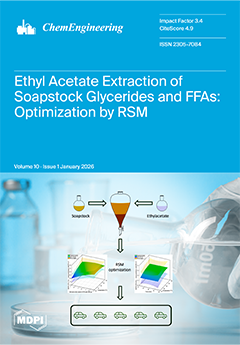
Cover Story (view full-size image): The production of vegetable oils generates soapstock (SS), a by-product rich in fatty acids suitable for biodiesel fuel production but contaminated with water, phosphatides (PL) and insoluble particles. This study examines the selective extraction of mono-, di- and triglycerides, as well as free fatty acids, from an aqueous solution of rapeseed SS using green solvents. Ethyl acetate demonstrated the best selectivity, separating lipids from PL without purification with acetone. The RSM optimized the process by determining the optimal solvent-to-dry-matter-of-SS ratio of 5:1, a time of 10 minutes and a temperature of 22 °C. These conditions allowed to reach a high lipid content with a minimal amount of PL. This approach offers a sustainable and resource-efficient method for processing SS into high-quality raw materials for biodiesel fuel. View this paper
  • Issues are regarded as officially published after their release is announced to the table of contents alert mailing list.
  • You may sign up for e-mail alerts to receive table of contents of newly released issues.
  • PDF is the official format for papers published in both, html and pdf forms. To view the papers in pdf format, click on the "PDF Full-text" link, and use the free Adobe Reader to open them.
Order results
Result details
Select all
Export citation of selected articles as:
16 pages, 1740 KB  
Article
Optimization of Conditions for Ethyl Acetate Extraction of Mono-, Di-, Triglycerides and Free Fatty Acids from Soapstock Using Response Surface Methodology
by Svetlana Zhizhkun, Lauma Laipniece and Igors Astrausks
ChemEngineering 2026, 10(1), 16; https://doi.org/10.3390/chemengineering10010016 - 14 Jan 2026
Viewed by 450
Abstract
Soapstock (SS), a by-product of vegetable oil refining, is a promising source of a mixture of mono-, di-, triglycerides, and free fatty acids (MDTG-FFA), a valuable feedstock for biodiesel production. In this study, the selective extraction of MDTG-FFA from SS using green solvents [...] Read more.
Soapstock (SS), a by-product of vegetable oil refining, is a promising source of a mixture of mono-, di-, triglycerides, and free fatty acids (MDTG-FFA), a valuable feedstock for biodiesel production. In this study, the selective extraction of MDTG-FFA from SS using green solvents (ethyl acetate, ethyl formate, methyl acetate, isopropyl acetate, and isobutanol) was investigated. Ethyl acetate showed the highest efficiency, allowing the elimination of the phosphatide (PL) precipitation step with acetone. The process optimization was carried out by response surface methodology with central composite design. Statistical analysis confirmed the significance of the obtained models: F-values were 4.55 (p = 0.013) for MDTG-FFA and 9.62 (p = 0.00074) for PL. Regression analysis revealed a good fit of the experimental data with quadratic models for MDTG-FFA and PL, with coefficients of determination (R2) of 0.804 and 0.897, respectively. The optimum extraction parameters were a solvent-to-dry-matter-of-SS ratio 5:1, time 10.2 min, and initial extraction temperature 21.7 °C. Under these conditions, maximum MDTG-FFA yields of 12.6% and 13.4% were achieved for the two batches of SS, respectively, with minimum PL yields of 0.02% and 0.1%. The obtained MDTG-FFA extracts rich in free fatty acids represent a promising feedstock for biodiesel production. The proposed method provides a rational, resource-efficient, and environmentally preferable extraction of valuable components from SS. Full article
(This article belongs to the Topic Green and Sustainable Chemical Processes)
Show Figures

Figure 1

25 pages, 5522 KB  
Article
Green Synthesis of ZnO Nanoparticles: Effect of Synthesis Conditions on Their Size and Photocatalytic Activity
by Veronika Yu. Kolotygina, Arkadiy Yu. Zhilyakov, Maria A. Bukharinova, Ekaterina I. Khamzina and Natalia Yu. Stozhko
ChemEngineering 2026, 10(1), 15; https://doi.org/10.3390/chemengineering10010015 - 14 Jan 2026
Cited by 1 | Viewed by 724
Abstract
Green technologies are actively being used to produce nanosized zinc oxide, which is in demand for water purification processes to remove pollutants. Despite the success of the green synthesis of ZnO nanoparticles, no scientific approach exists for selecting plant extracts to produce nanoparticles [...] Read more.
Green technologies are actively being used to produce nanosized zinc oxide, which is in demand for water purification processes to remove pollutants. Despite the success of the green synthesis of ZnO nanoparticles, no scientific approach exists for selecting plant extracts to produce nanoparticles with the desired properties. This study shows that the antioxidant activity of the plant extracts used is a key parameter influencing the properties of the resulting ZnO nanoparticles. This conclusion is based on the results of nanoparticle synthesis with the use of various plant extracts. The antioxidant activity of the extracts increases in the following order: plum–gooseberry–black currant–strawberry–sea buckthorn. The synthesized ZnO nanoparticles were characterized by UV–visible spectroscopy, transmission electron microscopy, and energy-dispersive X-ray spectroscopy. The catalytic properties of ZnO nanoparticles were tested under the degradation of a synthetic methylene blue dye after exposure to UV light. We found that with an increase in the AOA of plant extracts, the size of the nanoparticles decreases, while their photocatalytic activity increases. The smallest (d = 13 nm), most uniform in size (polydispersity index 0.1), and most catalytically active ZnO nanoparticles with a small band gap (2.85 eV) were obtained using the sea buckthorn extract with the highest AOA, pH 10 of the reaction mixture and 0.1 M Zn(CH3COO)2∙2H2O as a precursor salt. ZnO nanoparticles synthesized in the sea buckthorn extract demonstrated the highest dye photodegradation efficiency (96.4%) compared with other nanoparticles. The established patterns demonstrate the “antioxidant activity–size–catalytic activity” triad can be considered as a practical guide for obtaining ZnO nanoparticles of a given size and with given properties for environmental remediation applications. Full article
Show Figures

Graphical abstract

15 pages, 2845 KB  
Article
One-Step CO2-Assisted Pyrolysis of Spent Coffee Grounds: A Simpler Route to Highly Porous Biochar Compared with Two-Step Pyrolysis–CO2 Activation
by Ancuţa Balla, Cristina Marcu, Maria Mihet, Irina Kacsó, Septimiu Tripon, Alexandru Turza and József-Zsolt Szücs-Balázs
ChemEngineering 2026, 10(1), 14; https://doi.org/10.3390/chemengineering10010014 - 14 Jan 2026
Viewed by 639
Abstract
Spent coffee grounds (SCG) are an abundant, carbon-rich residue that can be valorized through thermochemical conversion into biochar. Conventional CO2 activation is typically performed in a two-step process, which is time- and energy-consuming. This study aims to evaluate whether a one-step CO [...] Read more.
Spent coffee grounds (SCG) are an abundant, carbon-rich residue that can be valorized through thermochemical conversion into biochar. Conventional CO2 activation is typically performed in a two-step process, which is time- and energy-consuming. This study aims to evaluate whether a one-step CO2-assisted pyrolysis can produce biochar with comparable or enhanced structural and textural properties while simplifying the process. We compare a two-step pyrolysis process followed by CO2 activation with a one-step CO2-assisted route for producing biochar from SCG. CO2 treatment markedly increases surface area (from 9.8 m2∙g−1 to 550.6–671.0 m2∙g−1) and pore volume. FTIR and Boehm titration indicate depletion of oxygenated surface groups, while N2 adsorption–desorption analyses and SEM reveal a more uniform micro/mesoporous texture for the one-step sample. Although fixed carbon decreases due to gasification, the one-step route delivers superior textural properties in a single thermal stage, reducing energy demand. These results highlight one-step CO2-assisted pyrolysis as an efficient, scalable option for producing high-porosity biochar from coffee waste. Full article
Show Figures

Graphical abstract

15 pages, 1465 KB  
Article
Experimental Study of Hydrodynamics During Fluid Flow from a Nozzle in a Differential-Contact Centrifugal Extractor
by Sergey Ivanovich Ponikarov and Artem Sergeevich Ponikarov
ChemEngineering 2026, 10(1), 13; https://doi.org/10.3390/chemengineering10010013 - 12 Jan 2026
Viewed by 412
Abstract
Modern processes to produce rare-earth elements, strategic metals, and nuclear fuel reprocessing require highly efficient liquid–liquid extraction in systems characterized by high viscosity, elevated interfacial tension, and small density differences. Traditional gravity-driven extractors exhibit low performance under these conditions, whereas centrifugal extractors enable [...] Read more.
Modern processes to produce rare-earth elements, strategic metals, and nuclear fuel reprocessing require highly efficient liquid–liquid extraction in systems characterized by high viscosity, elevated interfacial tension, and small density differences. Traditional gravity-driven extractors exhibit low performance under these conditions, whereas centrifugal extractors enable rapid mass transfer and nearly complete phase separation. Differential-contact annular centrifugal contactors offer the highest flexibility and efficiency, but their optimization is limited by the lack of experimental data on the hydrodynamics of liquid flow through perforated nozzles in a rotating field. This limitation hinders the development of accurate computational fluid dynamics (CFD) models (e.g., ANSYS Fluent), reliable equipment scale-up, and the design of optimized contactor configurations. The present study addresses this gap by experimentally determining the flow velocity of liquids through nozzles of various geometries across a wide range of centrifugal accelerations. From these data, a universal power-law correlation was derived, linking the flow rate to rotor speed, nozzle geometry, and the physicochemical properties of the phases. The proposed correlation provides a robust experimental basis for numerical model validation, computational design, and optimization of next-generation differential-contact centrifugal extractors. Full article
Show Figures

Figure 1

17 pages, 612 KB  
Article
Drying Methods Applied to Ionic Gelation of Mangaba (Hancornia speciosa) Pulp Microcapsules
by Jordan Heiki Santos Uemura, João Renato de Jesus Junqueira, Ângela Christina Conte Theodoro, Jefferson Luiz Gomes Corrêa, Thaisa Carvalho Volpe Balbinoti and Juliana Rodrigues do Carmo
ChemEngineering 2026, 10(1), 12; https://doi.org/10.3390/chemengineering10010012 - 12 Jan 2026
Viewed by 523
Abstract
Brazil is one of the richest countries in biodiversity, with biomes that host countless native species of ecological and economic relevance. Among its native fruits, mangaba (Hancornia speciosa) stands out for its nutritional relevance. However, its industrial use remains limited by [...] Read more.
Brazil is one of the richest countries in biodiversity, with biomes that host countless native species of ecological and economic relevance. Among its native fruits, mangaba (Hancornia speciosa) stands out for its nutritional relevance. However, its industrial use remains limited by seasonality, perishability, and harvesting difficulties. This study evaluated the effects of different drying techniques—convective (CD), microwave (MWD), and infrared (IRD)—on the physical and chemical properties of mangaba pulp microcapsules obtained by ionic gelation, including drying kinetics. Drying time varied markedly among treatments, ranging from 25 (MWD) to 185 (IRD) min. In general, the Page modified model provided the best fit for drying kinetics. Physical analyses revealed that IRD produced microcapsules with higher wettability (43.33 s), lower hygroscopicity (203.01 g/100 g), and higher bulk (0.382 g/cm3) and particle density (1.339 g/cm3). CD resulted in greater dispersibility (248.45%) and porosity (0.732), whereas MWD showed the lowest water absorption index (1.78). Regarding bioactive compounds, IRD retained the highest ascorbic acid content, CD preserved more antioxidant activity, and MWD presented the highest total phenolic content. Overall, despite the different processes, mangaba microcapsules retained relevant levels of bioactive compounds, confirming the potential of ionic gelation combined with drying as an effective preservation strategy. Full article
Show Figures

Figure 1

17 pages, 4456 KB  
Article
Sustainable Adsorption of Rhodamine B and Heavy Metals Using Sewage Sludge-Derived Biochar
by Yerkanat N. Kanafin, Assylzhan Mukhametrakhimova, Rauza Turpanova and Stavros G. Poulopoulos
ChemEngineering 2026, 10(1), 11; https://doi.org/10.3390/chemengineering10010011 - 9 Jan 2026
Viewed by 453
Abstract
The sustainable management of sewage sludge remains a key environmental challenge for rapidly urbanizing regions such as Kazakhstan. This study explores the potential of sewage sludge-derived biochar as an efficient, low-cost adsorbent for removing Rhodamine B (RhB) dye and toxic metals from water. [...] Read more.
The sustainable management of sewage sludge remains a key environmental challenge for rapidly urbanizing regions such as Kazakhstan. This study explores the potential of sewage sludge-derived biochar as an efficient, low-cost adsorbent for removing Rhodamine B (RhB) dye and toxic metals from water. Sewage sludge was pyrolyzed at 700 °C (BC) and subsequently activated with hydrochloric acid (BCH) and sodium hydroxide (BCN) to improve its surface functionality and porosity. The morphology, surface area, porosity, and functional groups of the obtained biochars were characterized using SEM-EDS, BET, FTIR, and XRD analyses. Batch adsorption experiments demonstrated that the pseudo-second-order kinetic model (R2 = 0.99) best described the data, indicating chemisorption-controlled uptake. Experimental RhB adsorption capacity was 14.53 mg/g for BCH at RhB concentration of 75 mg/L after 120 min. Moreover, BCH exhibited enhanced metal adsorption capacities of 22.85 mg/g (Cu2+), 17.55 mg/g (Zn2+), 15.08 mg/g (Cd2+), 7.97 mg/g (Cr3+), and 3.68 mg/g (As3+). These results confirm that acid activation significantly improves adsorption efficiency compared with pristine biochar due to increased surface area and the introduction of oxygen-containing functional groups. Overall, sewage sludge-derived biochar shows strong potential as a sustainable adsorbent for dye and heavy metal removal. Full article
Show Figures

Figure 1

16 pages, 2943 KB  
Article
Carbon Filters Modified with Synthesized TiO2, Fe3O4 and CaO via Mechanical Milling for Methylene Blue Adsorption
by Fatima Pamela Lara-Castillo, Jorge Carlos Ríos-Hurtado, Sergio Enrique Flores-Villaseñor, Alejandro Pérez-Alvarado, Rumualdo Servin-Castañeda, Gloria I. Dávila-Pulido and Adrián A. González-Ibarra
ChemEngineering 2026, 10(1), 10; https://doi.org/10.3390/chemengineering10010010 - 8 Jan 2026
Viewed by 413
Abstract
Although carbon filters (CF) can exhibit limited adsorption/selectivity for certain emerging pollutants and operating conditions, incorporating carbon–metal-oxide composites provides a platform to study how surface chemistry, charge distribution and oxide dispersion influence adsorption behavior. This study investigates the incorporation of metal oxides (Fe [...] Read more.
Although carbon filters (CF) can exhibit limited adsorption/selectivity for certain emerging pollutants and operating conditions, incorporating carbon–metal-oxide composites provides a platform to study how surface chemistry, charge distribution and oxide dispersion influence adsorption behavior. This study investigates the incorporation of metal oxides (Fe3O4, TiO2 and CaO) into a commercial carbon filter via mechanical milling, focusing on fundamental changes in surface properties and methylene blue (MB) adsorption mechanisms. The synthesized oxides were characterized by X-ray diffraction and scanning electron microscopy, confirming crystalline structures with crystalline sizes between 11 and 23 nm. Composite filters with varying oxide contents (10–30 wt%) were evaluated for point of zero charge (PZC), surface charge distribution and methylene blue (MB) adsorption. The kinetic experiments were adjusted to pseudo-second order (PSO). Although the maximum adsorption capacity (2.75 mg·g−1 for CaO-modified filters) is lower than commercially activated carbons, this work clarifies how oxide type and dispersion control adsorption performance and interaction mechanisms. Langmuir and Freundlich models revealed monolayer adsorption with favorable dye-surface interactions. These models provide key insights into the role of oxide type and pH in the dye removal process. Full article
Show Figures

Figure 1

21 pages, 2489 KB  
Article
Assessment of the Yield and Bioactive Compounds of Jambu (Acmella oleracea) Flowers and Leaves Extracted with CO2, 1,1,1,2-Tetrafluoroethane (R-134a), and Propane
by Marcos Antônio Avibar Ruzza, Raquel Laina Barbosa dos Santos, Nikolas Ramos Bernardes, Carlos Toshiyuki Hiranobe, Dener da Silva Souza, Michael Jones da Silva, Erivaldo Antônio da Silva, Renivaldo José dos Santos and Leandro Ferreira-Pinto
ChemEngineering 2026, 10(1), 9; https://doi.org/10.3390/chemengineering10010009 - 7 Jan 2026
Viewed by 403
Abstract
This study compares the extraction of oils and bioactive compounds from Acmella oleracea using supercritical CO2, pressurized R-134a, and propane under systematically designed experimental conditions. Extraction yields ranged from 1.16–3.35% for CO2, 1.90–2.35% for R-134a, and 1.30–5.42% for propane. [...] Read more.
This study compares the extraction of oils and bioactive compounds from Acmella oleracea using supercritical CO2, pressurized R-134a, and propane under systematically designed experimental conditions. Extraction yields ranged from 1.16–3.35% for CO2, 1.90–2.35% for R-134a, and 1.30–5.42% for propane. Propane achieved the highest yields and the fastest plateau (~35 min), producing extracts dominated by unsaturated fatty acids (linoleic acid ≈ 85%). Supercritical CO2 generated the most diverse chemical profile, combining alkamides (spilanthol), triterpenoids (β-amyrone), and lipids, with a plateau at approximately 50 min, whereas R-134a selectively enriched β-amyrin acetate (~70%) with intermediate kinetics (~45 min). These yield values are typical for non-oilseed species, in which the low natural abundance of the target metabolites renders solvent selectivity more relevant than the total extract mass. Statistical modeling (R2 > 0.96) confirmed that pressure was the main driver of CO2 and propane extraction, whereas temperature dominated R-134a performance. The distinct selectivity patterns revealed by Gas chromatography–mass spectrometry (GC-MS) indicate that each solvent generates compositionally different extracts aligned with specific industrial applications in cosmetics, pharmaceuticals, and nutraceuticals. The unified comparison of these three fluids under a consistent experimental design provides practical insights for rational solvent selection: propane favors unsaturated lipids, CO2 preserves multifunctional compositions, and R-134a targets triterpenoid esters, supporting the economic feasibility of producing enriched, solvent-free plant extracts. Full article
Show Figures

Figure 1

12 pages, 8827 KB  
Article
Photocatalytic Enhancement of Metal Ion Release from Oxides in the Presence of Polystyrene: Environmental Implications in Marine Pollution
by Francesca Coccia, Lucia Tonucci, Andrea Mascitti, Rosa Sinisi, Carmela Leonessa, Michele Ciulla, Antonella Fontana, Stefano Di Giacomo and Nicola d’Alessandro
ChemEngineering 2026, 10(1), 8; https://doi.org/10.3390/chemengineering10010008 - 7 Jan 2026
Viewed by 369
Abstract
The coexistence of plastics and metal-based materials in aquatic systems introduces complex interfacial processes that influence pollutant speciation and mobility. This study investigates the role of polystyrene (PS) in promoting UV-induced dissolution of ZnO and Cu2O in aqueous media, revealing a [...] Read more.
The coexistence of plastics and metal-based materials in aquatic systems introduces complex interfacial processes that influence pollutant speciation and mobility. This study investigates the role of polystyrene (PS) in promoting UV-induced dissolution of ZnO and Cu2O in aqueous media, revealing a plastic-mediated pathway for metal ion mobilization. Post-use expanded PS fragments were co-dispersed with the oxides and irradiated at 254 nm for 24 h. Ion concentrations were quantified by ICP-MS, while PS morphology and chemistry were characterized by SEM, EDX, FTIR, Raman, and DSC. The presence of PS markedly enhanced metal release, bringing Zn2+ from 29.9 to 50.6 ppm and Cu2+ from 1.1 to 26.5 ppm under irradiation, compared to minimal dissolution in the dark. Spectroscopic analyses indicated negligible polymer degradation, suggesting that enhanced dissolution arises from interfacial photooxidation and associated redox/pH microgradients at the polymer–oxide boundary. These findings demonstrate that PS may serve as a catalytic interface that accelerates UV-driven dissolution of otherwise poorly soluble metal oxides. This mechanism expands current understanding of plastic–pollutant interactions and has implications for predicting metal bioavailability and designing strategies to mitigate pollutant release in sunlit marine and coastal environments. Full article
Show Figures

Figure 1

20 pages, 4080 KB  
Article
Integrated Preflash Drum Optimisation for Energy Efficiency and Profitability in Crude Distillation Units
by Sharif H. Zein, Chukwuchetam A. Akakuru, Khalaf J. Jabbar, Usama Ahmed and A. A. Jalil
ChemEngineering 2026, 10(1), 7; https://doi.org/10.3390/chemengineering10010007 - 7 Jan 2026
Viewed by 675
Abstract
Crude distillation units operate as the most energy-intensive refinery operations and generate substantial carbon dioxide emissions. This research models the crude distillation system through its three main components: the atmospheric distillation unit, the naphtha stabilisation unit, and the vacuum distillation unit. The simulation [...] Read more.
Crude distillation units operate as the most energy-intensive refinery operations and generate substantial carbon dioxide emissions. This research models the crude distillation system through its three main components: the atmospheric distillation unit, the naphtha stabilisation unit, and the vacuum distillation unit. The simulation platform Aspen HYSYS version 14.1 enabled optimisation of the preflash drum under product quality constraints, and the analysis included pinch analysis techniques and techno-economic evaluation. The optimisation results demonstrated an 8.95% reduction in atmospheric furnace duty, a 7.38% decrease in total hot utility consumption with the crude distillation system, and an increase in heat recovery capability from 35.57% to 42.71%. Although the preflash process alone decreases profitability because of increased steam demand, combining preflash operation with heat recovery measures maintains both energy conservation and favourable economic performance. The study shows that refinery optimisation requires treating the crude distillation system as a fully integrated process. This approach offers effective strategies to improve energy performance and reduce carbon dioxide emissions while sustaining economic viability. The work differs from previous studies by evaluating the entire distillation system as an integrated sequence and demonstrating how preflash optimisation affects overall energy demand, heat-recovery potential, and economic outcomes while maintaining product quality. Full article
Show Figures

Figure 1

21 pages, 4770 KB  
Article
Novel Phosphorylethanolamine-Modified ZIF-67 for Crystal Violet Dye Removal
by Mohamad A. S. Ebrahim, Sagheer A. Onaizi and Muhammad S. Vohra
ChemEngineering 2026, 10(1), 6; https://doi.org/10.3390/chemengineering10010006 - 5 Jan 2026
Viewed by 435
Abstract
The elimination of toxic and long-lasting dyes like crystal violet (CV) from wastewater continues to be a major environmental challenge. Considering this, in this study, a novel amine-modified adsorbent was synthesized by functionalizing ZIF-67 with phosphorylethanolamine (PEA@ZIF-67) nanocomposite to enhance dye removal efficiency. [...] Read more.
The elimination of toxic and long-lasting dyes like crystal violet (CV) from wastewater continues to be a major environmental challenge. Considering this, in this study, a novel amine-modified adsorbent was synthesized by functionalizing ZIF-67 with phosphorylethanolamine (PEA@ZIF-67) nanocomposite to enhance dye removal efficiency. Comprehensive characterization of PEA@ZIF-67 nanocomposite using FTIR, XRD, TGA, and BET techniques confirmed the successful incorporation of PEA into ZIF-67 without compromising the structural integrity of the ZIF-67. The BET specific surface area of PEA@ZIF-67 nanocomposite was noted to be 145.3 m2/g. Furthermore, the application of PEA@ZIF-67 nanocomposite for CV adsorption was investigated and optimized using the Response Surface Methodology (RSM) technique, with the adsorbent dosage, initial dye concentration, and temperature as the operational variables. Under optimized conditions, qmax was 4348 mg/g. Adsorption kinetic studies showed the Avrami model to best fit the respective CV adsorption results, suggesting a heterogeneous and time-dependent mechanism. On the other hand, the Redlich–Peterson adsorption isotherm, which signifies a hybrid adsorption behavior, was noted to be effective. The thermodynamic studies confirmed that the CV adsorption onto PEA@ZIF-67 is spontaneous, endothermic, and entropy-driven. The post-adsorption FTIR and XRD analyses indicated that the used PEA@ZIF-67 was stable, thus supporting its reuse capability. Full article
Show Figures

Graphical abstract

21 pages, 688 KB  
Article
Crude Blend Optimization for Enhanced Gasoline Yield: A Nigerian Refinery Case Study
by Sharif H. Zein, Azeez Ajayi, Khalaf J. Jabbar, Muhammad Faiq Abdullah, Usama Ahmed and A. A. Jalil
ChemEngineering 2026, 10(1), 5; https://doi.org/10.3390/chemengineering10010005 - 5 Jan 2026
Viewed by 735
Abstract
Refinery blending is a routine operation, yet small changes in crude mix can strongly affect product yield and fuel quality. In this work, Aspen HYSYS v12.1 was used to model and optimize the blending of four Nigerian crude oils—Antan, Usan, Bonga, and Forcados—processed [...] Read more.
Refinery blending is a routine operation, yet small changes in crude mix can strongly affect product yield and fuel quality. In this work, Aspen HYSYS v12.1 was used to model and optimize the blending of four Nigerian crude oils—Antan, Usan, Bonga, and Forcados—processed at about 150,000 barrels per day. The study examined how adjustments in blend ratio and feed temperature influence gasoline output and energy use in the distillation unit. The best result was obtained at a blend of Antan 10%, Usan 37.45%, Bonga 10%, and Forcados 42.55%, where gasoline yield increased by roughly 5.6% compared with the equal-blend case. Product properties remained within Nigerian fuel standards (RON ≈ 92, sulphur ≈ 0.038 wt%), showing that quality was not affected by the optimizations. Economic estimates also indicated higher annual revenue and a modest reduction in furnace heat duty, suggesting lower fuel consumption. Although the work was limited to steady-state simulation without plant-scale validation, it provides practical evidence that systematic crude blend optimizations can deliver measurable gains in yield and energy efficiency for refineries using mixed feedstocks. Full article
Show Figures

Graphical abstract

27 pages, 554 KB  
Article
Equilibrium Shape for 2D Asymmetric Cylindrical Droplet on Heterogeneous Surface
by Jaesung Lee
ChemEngineering 2026, 10(1), 4; https://doi.org/10.3390/chemengineering10010004 - 4 Jan 2026
Viewed by 336
Abstract
We present a theoretical and numerical framework for computing asymmetric two-dimensional droplet shapes on surfaces with a sharp wetting boundary separating regions of distinct contact angles. Through Lagrange multiplier analysis of the constrained Gibbs free energy functional, we derive a simplified spreading condition [...] Read more.
We present a theoretical and numerical framework for computing asymmetric two-dimensional droplet shapes on surfaces with a sharp wetting boundary separating regions of distinct contact angles. Through Lagrange multiplier analysis of the constrained Gibbs free energy functional, we derive a simplified spreading condition that relates the contact line position ratio to the ratio of spreading functions encoding unbalanced Young stress at each contact line, reducing to an explicit algebraic relation that eliminates iterative computation. Gravitational effects substantially modify droplet height and curvature distribution across Bond number regimes, yet the contact line position ratio remains invariant, confirming that horizontal partitioning depends exclusively on interfacial energy ratios rather than body forces. Hydrophilic surfaces exhibit intuitive spreading toward regions with better wettability, producing flattened asymmetric profiles, while hydrophobic surfaces display counterintuitive behavior where droplets preferentially occupy regions with poorer wettability, maintaining tall compact geometries. Mixed hydrophilic–hydrophobic boundaries violate equilibrium conditions and drive spontaneous droplet migration. We develop an efficient two-stage computational strategy decoupling shape computation from equilibrium position determination, reducing computational cost by orders of magnitude. These findings provide quantitative design criteria for controlled droplet positioning on patterned substrates, with implications for microfluidic devices and droplet-based technologies. Full article
Show Figures

Figure 1

19 pages, 3132 KB  
Review
Suspension Type TiO2 Photocatalysts for Water Treatment: Magnetic TiO2/SiO2/Fe3O4 Nanoparticles and Submillimeter TiO2-Polystyrene Beads
by Manabu Kiguchi and Nobuhiro Hanada
ChemEngineering 2026, 10(1), 3; https://doi.org/10.3390/chemengineering10010003 - 4 Jan 2026
Viewed by 723
Abstract
Photocatalytic degradation of organic molecules using TiO2 has attracted attention in wastewater treatment because it can decompose organic compounds that are difficult to decompose by other methods. Meanwhile, efficient photocatalytic water treatment is difficult because it is not easy to separate nano-sized [...] Read more.
Photocatalytic degradation of organic molecules using TiO2 has attracted attention in wastewater treatment because it can decompose organic compounds that are difficult to decompose by other methods. Meanwhile, efficient photocatalytic water treatment is difficult because it is not easy to separate nano-sized photocatalysts from water. In this review, we have described two approaches to solve the water separation challenge in the suspension type TiO2 photocatalysts, which are uniformly distributed in water: magnetic TiO2/SiO2/Fe3O4 nanoparticles and TiO2-polystyrene beads. The preparation, characterization, and photocatalytic performance of the two types of photocatalysts and their application are discussed. Finally, we compare two types of photocatalysts while focusing on the respective advantages and disadvantages of each, and the future direction of research. Full article
(This article belongs to the Special Issue Advances in Chemical Engineering and Wastewater Treatment)
Show Figures

Graphical abstract

20 pages, 574 KB  
Article
Bioactive and Phenolic Profiles in Pinus pinaster Bark: A Comparative Study of Microwave and Ultrasound Extraction Methods
by Diana Barros, José Ignacio Alonso-Esteban, Tiane C. Finimundy, Carla Pereira, Josiana A. Vaz, Ricardo Pereira-Pinto, Élia Fernandes, Preciosa Pires, Joana Santos, Lillian Barros and Manuela Vaz-Velho
ChemEngineering 2026, 10(1), 2; https://doi.org/10.3390/chemengineering10010002 - 22 Dec 2025
Viewed by 1199
Abstract
This study conducted a comprehensive comparison of two green extraction methods, microwave-assisted extraction (MAE) and ultrasound-assisted extraction (UAE), for recovering bioactive phenolic compounds from Pinus pinaster bark. The goal was to valorize timber industry waste and enhance the value of by-products through the [...] Read more.
This study conducted a comprehensive comparison of two green extraction methods, microwave-assisted extraction (MAE) and ultrasound-assisted extraction (UAE), for recovering bioactive phenolic compounds from Pinus pinaster bark. The goal was to valorize timber industry waste and enhance the value of by-products through the development of eco-friendly processes to extract phenolic compounds from Pinus pinaster Aiton subsp. atlantica in northwest Portugal. MAE achieved significantly higher extraction yields than UAE (11.13 vs. 3.47 g extract/100 g bark) and superior total phenolic content (833 vs. 514 mg GAE/g). MAE extracts also exhibited enhanced antioxidant activity in most assays tested (DPPH, ABTS, ORAC, and OxHLIA), while both extracts effectively inhibited lipid peroxidation (TBARS) and showed activity against Gram-positive bacteria. Phenolic profile analysis revealed that MAE recovered a substantially higher amount of total phenolic compounds (230.0 mg/g) compared to UAE (86.95 mg/g), with procyanidins identified as the predominant compounds. The greater recovery of this complex procyanidin mixture by MAE is strongly associated with the enhanced bioactivities observed. Overall, this study confirms MAE as a highly efficient and sustainable technology for transforming pine bark waste into valuable antioxidant and antimicrobial extracts with potential applications in the food and pharmaceutical industries. Full article
Show Figures

Figure 1

22 pages, 4365 KB  
Article
Integration of Machine Learning and Feature Analysis for the Optimization of Enhanced Oil Recovery and Carbon Sequestration in Oil Reservoirs
by Bukola Mepaiyeda, Michal Ezeh, Olaosebikan Olafadehan, Awwal Oladipupo, Opeyemi Adebayo and Etinosa Osaro
ChemEngineering 2026, 10(1), 1; https://doi.org/10.3390/chemengineering10010001 - 19 Dec 2025
Viewed by 523
Abstract
The dual imperative of mitigating carbon emissions and maximizing hydrocarbon recovery has amplified global interest in carbon capture, utilization, and storage (CCUS) technologies. These integrated processes hold significant promise for achieving net-zero targets while extending the productive life of mature oil reservoirs. However, [...] Read more.
The dual imperative of mitigating carbon emissions and maximizing hydrocarbon recovery has amplified global interest in carbon capture, utilization, and storage (CCUS) technologies. These integrated processes hold significant promise for achieving net-zero targets while extending the productive life of mature oil reservoirs. However, their effectiveness hinges on a nuanced understanding of the complex interactions between geological formations, reservoir characteristics, and injection strategies. In this study, a comprehensive machine learning-based framework is presented for estimating CO2 storage capacity and enhanced oil recovery (EOR) performance simultaneously in subsurface reservoirs. The methodology combines simulation-driven uncertainty quantification with supervised machine learning to develop predictive surrogate models. Simulation results were used to generate a diverse dataset of reservoir and operational parameters, which served as inputs for training and testing three machine learning models: Random Forest, Extreme Gradient Boosting (XGBoost), and Artificial Neural Networks (ANN). The models were trained to predict three key performance indicators (KPIs): cumulative oil production (bbl), oil recovery factor (%), and CO2 sequestration volume (SCF). All three models exhibited exceptional predictive accuracy, achieving coefficients of determination (R2) greater than 0.999 across both training and testing datasets for all KPIs. Specifically, the Random Forest and XGBoost models consistently outperformed the ANN model in terms of generalization, particularly for CO2 sequestration volume predictions. These results underscore the robustness and reliability of machine learning models for evaluating and forecasting the performance of CO2-EOR and sequestration strategies. To enhance model interpretability and support decision-making, SHapley Additive exPlanations (SHAP) analysis was applied. SHAP, grounded in cooperative game theory, offers a model-agnostic approach to feature attribution by assigning an importance value to each input parameter for a given prediction. The SHAP results provided transparent and quantifiable insights into how geological and operational features such as porosity, injection rate, water production rate, pressure, etc., affect key output metrics. Overall, this study demonstrates that integrating machine learning with domain-specific simulation data offers a scalable approach for optimizing CCUS operations. The insights derived from the predictive models and SHAP analysis can inform strategic planning, reduce operational uncertainty, and support more sustainable oilfield development practices. Full article
Show Figures

Figure 1

Previous Issue
Next Issue
Back to TopTop