This is an early access version, the complete PDF, HTML, and XML versions will be available soon.
Article

Green Synthesis of ZnO Nanoparticles: Effect of Synthesis Conditions on Their Size and Photocatalytic Activity


by
Veronika Yu. Kolotygina
1,
Arkadiy Yu. Zhilyakov
2,
Maria A. Bukharinova
1,
Ekaterina I. Khamzina
1 and
Natalia Yu. Stozhko
1,*
1
Department of Physics and Chemistry, Ural State University of Economics, 8 Marta St., 62, 620144 Yekaterinburg, Russia
2
Laboratory of Heat-Resistant and Corrosion-Resistant Alloys Based on Nickel and Iron, Ural Federal University, Mira St., 19, 620002 Yekaterinburg, Russia
*
Author to whom correspondence should be addressed.
ChemEngineering 2026, 10(1), 15; https://doi.org/10.3390/chemengineering10010015

Submission received: 11 November 2025 / Revised: 26 December 2025 / Accepted: 31 December 2025 / Published: 14 January 2026

Abstract

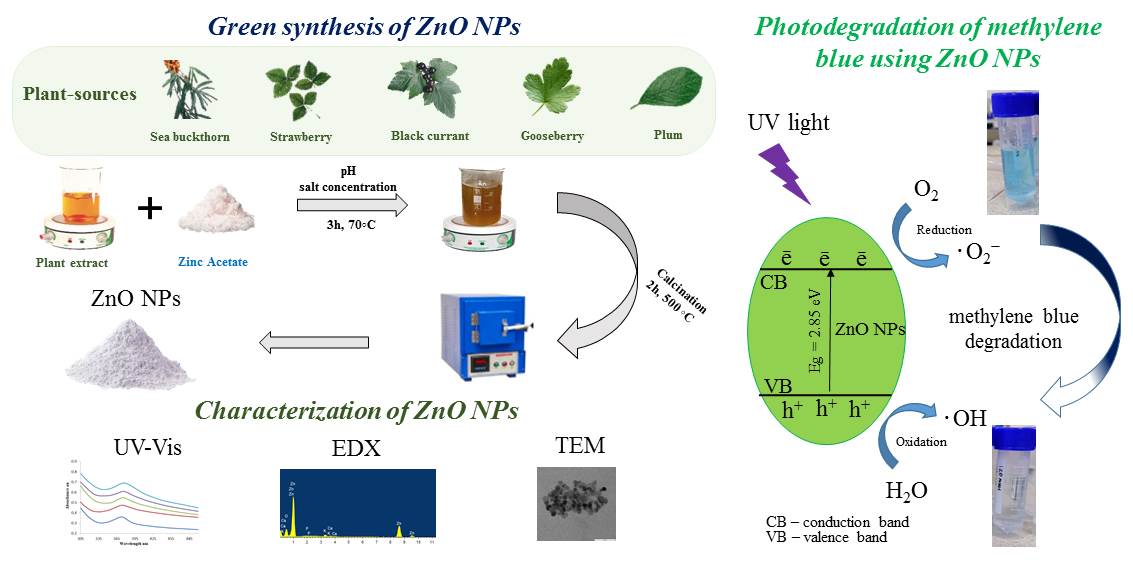
Green technologies are actively being used to produce nanosized zinc oxide, which is in demand for water purification processes to remove pollutants. Despite the success of the green synthesis of ZnO nanoparticles, no scientific approach exists for selecting plant extracts to produce nanoparticles with the desired properties. This study shows that the antioxidant activity of the plant extracts used is a key parameter influencing the properties of the resulting ZnO nanoparticles. This conclusion is based on the results of nanoparticle synthesis with the use of various plant extracts. The antioxidant activity of the extracts increases in the following order: plum–gooseberry–black currant–strawberry–sea buckthorn. The synthesized ZnO nanoparticles were characterized by UV–visible spectroscopy, transmission electron microscopy, and energy-dispersive X-ray spectroscopy. The catalytic properties of ZnO nanoparticles were tested under the degradation of a synthetic methylene blue dye after exposure to UV light. We found that with an increase in the AOA of plant extracts, the size of the nanoparticles decreases, while their photocatalytic activity increases. The smallest (d = 13 nm), most uniform in size (polydispersity index 0.1), and most catalytically active ZnO nanoparticles with a small band gap (2.85 eV) were obtained using the sea buckthorn extract with the highest AOA, pH 10 of the reaction mixture and 0.1 M Zn(СH3COO)2∙2H2O as a precursor salt. ZnO nanoparticles synthesized in the sea buckthorn extract demonstrated the highest dye photodegradation efficiency (96.4%) compared with other nanoparticles. The established patterns demonstrate the “antioxidant activity–size–catalytic activity” triad can be considered as a practical guide for obtaining ZnO nanoparticles of a given size and with given properties for environmental remediation applications.
Keywords: zinc oxide nanoparticles; green synthesis; phytosynthesis; antioxidant activity; plant extract; size effect; photodegradation; methylene blue; synthetic organic dye; nanocatalyst zinc oxide nanoparticles; green synthesis; phytosynthesis; antioxidant activity; plant extract; size effect; photodegradation; methylene blue; synthetic organic dye; nanocatalyst
Graphical Abstract