

You are currently viewing a new version of our website. To view the old version click .

Toxics, Volume 10, Issue 2

February 2022 - 58 articles

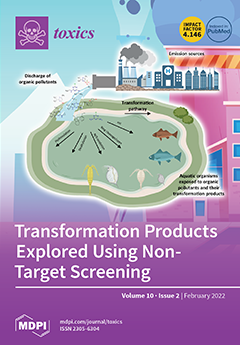
Cover Story: The occurrence of transformation products (TPs) of emerging pollutants has been of potential concern in aquatic environments. Nonetheless, it is unclear how TPs are formed and affect organisms in aquatic ecosystem. Thanking to recent advances in analytics and biotechnology, identification of TPs and their formation mechanisms can be explored by non-target screening (NTS) using high-resolution mass spectrometry (HRMS) and in vivo/vitro bioassay using model organisms. In this review, recent progress in TP research including their exposure and effect assessments is summarized. In particular, the review covers prospective research efforts on TP, such as identification of the products using NTS, and assessment of potential risk. View this paper
  • Issues are regarded as officially published after their release is announced to the table of contents alert mailing list .
  • You may sign up for email alerts to receive table of contents of newly released issues.
  • PDF is the official format for papers published in both, html and pdf forms. To view the papers in pdf format, click on the "PDF Full-text" link, and use the free Adobe Reader to open them.

Articles (58)

  • Review
  • Open Access
15 Citations
5,005 Views
21 Pages

22 January 2022

Since the rise and rapid development of nanoscale science and technology in the late 1980s, nanomaterials have been widely used in many areas including medicine, electronic products, crafts, textiles, and cosmetics, which have provided a lot of conve...

  • Article
  • Open Access
7 Citations
4,101 Views
15 Pages

Effects of Zinc Oxide Nanoparticles on Model Systems of the Intestinal Barrier

  • Anna Mittag,
  • Patricia Owesny,
  • Christian Hoera,
  • Alexander Kämpfe and
  • Michael Glei

21 January 2022

Zinc oxide nanoparticles (ZnO NP) are often used in the food sector, among others, because of their advantageous properties. As part of the human food chain, they are inevitably taken up orally. The debate on the toxicity of orally ingested ZnO NP co...

  • Article
  • Open Access
13 Citations
5,070 Views
15 Pages

Neuronal and Astrocytic Morphological Alterations Driven by Prolonged Exposure with Δ9-Tetrahydrocannabinol but Not Cannabidiol

  • Elisa Landucci,
  • Costanza Mazzantini,
  • Daniele Lana,
  • Maria Grazia Giovannini and
  • Domenico E. Pellegrini-Giampietro

21 January 2022

Cannabis derivatives are largely used in the general population for recreational and medical purposes, with the highest prevalence among adolescents, but chronic use and abuse has raised medical concerns. We investigated the prolonged effects of &Del...

  • Feature Paper
  • Article
  • Open Access
10 Citations
4,397 Views
13 Pages

Prioritizing the Effects of Emerging Contaminants on Estuarine Production under Global Warming Scenarios

  • Irene Martins,
  • Joana Soares,
  • Teresa Neuparth,
  • Aldo F. Barreiro,
  • Cândido Xavier,
  • Carlos Antunes and
  • Miguel M. Santos

20 January 2022

Due to non-linear interactions, the effects of contaminant mixtures on aquatic ecosystems are difficult to assess, especially under temperature rise that will likely exacerbate the complexity of the responses. Yet, under the current climatic crisis,...

  • Article
  • Open Access
7 Citations
4,158 Views
20 Pages

Transgenerational Effects of Prenatal Endocrine Disruption on Reproductive and Sociosexual Behaviors in Sprague Dawley Male and Female Rats

  • Bailey A. Kermath,
  • Lindsay M. Thompson,
  • Justin R. Jefferson,
  • Mary H. B. Ward and
  • Andrea C. Gore

20 January 2022

Endocrine-disrupting chemicals (EDCs) lead to endocrine and neurobehavioral changes, particularly due to developmental exposures during gestation and early life. Moreover, intergenerational and transgenerational phenotypic changes may be induced by g...

  • Communication
  • Open Access
13 Citations
5,532 Views
12 Pages

19 January 2022

Formation of DNA adducts is a key event for a genotoxic mode of action, and their presence is often used as a surrogate for mutation and increased cancer risk. Interest in DNA adducts are twofold: first, to demonstrate exposure, and second, to link D...

  • Feature Paper
  • Review
  • Open Access
378 Citations
53,974 Views
55 Pages

PFAS Molecules: A Major Concern for the Human Health and the Environment

  • Emiliano Panieri,
  • Katarina Baralic,
  • Danijela Djukic-Cosic,
  • Aleksandra Buha Djordjevic and
  • Luciano Saso

18 January 2022

Per- and polyfluoroalkyl substances (PFAS) are a group of over 4700 heterogeneous compounds with amphipathic properties and exceptional stability to chemical and thermal degradation. The unique properties of PFAS compounds has been exploited for almo...

  • Feature Paper
  • Article
  • Open Access
15 Citations
5,911 Views
20 Pages

Co-Exposure with an Invasive Seaweed Exudate Increases Toxicity of Polyamide Microplastics in the Marine Mussel Mytilus galloprovincialis

  • Filipa G. Rodrigues,
  • Hugo C. Vieira,
  • Diana Campos,
  • Sílvia F. S. Pires,
  • Andreia C. M. Rodrigues,
  • Ana L. P. Silva,
  • Amadeu M. V. M. Soares,
  • Jacinta M. M. Oliveira and
  • Maria D. Bordalo

18 January 2022

Plastic pollution and invasive species are recognised as pervasive threats to marine biodiversity. However, despite the extensive on-going research on microplastics’ effects in the biota, knowledge on their combination with additional stressors is st...

of 6

Get Alerted

Add your email address to receive forthcoming issues of this journal.

XFacebookLinkedIn
Toxics - ISSN 2305-6304