You are currently viewing a new version of our website. To view the old version click .

Toxics, Volume 10, Issue 2

February 2022 - 58 articles

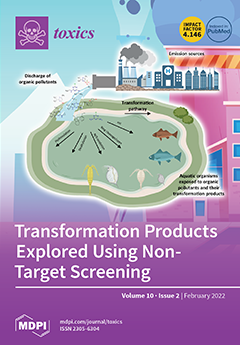
Cover Story: The occurrence of transformation products (TPs) of emerging pollutants has been of potential concern in aquatic environments. Nonetheless, it is unclear how TPs are formed and affect organisms in aquatic ecosystem. Thanking to recent advances in analytics and biotechnology, identification of TPs and their formation mechanisms can be explored by non-target screening (NTS) using high-resolution mass spectrometry (HRMS) and in vivo/vitro bioassay using model organisms. In this review, recent progress in TP research including their exposure and effect assessments is summarized. In particular, the review covers prospective research efforts on TP, such as identification of the products using NTS, and assessment of potential risk. View this paper
  • Issues are regarded as officially published after their release is announced to the table of contents alert mailing list .
  • You may sign up for email alerts to receive table of contents of newly released issues.
  • PDF is the official format for papers published in both, html and pdf forms. To view the papers in pdf format, click on the "PDF Full-text" link, and use the free Adobe Reader to open them.

Articles (58)

  • Article
  • Open Access
4 Citations
4,066 Views
13 Pages

Screening of a Novel Solvent for Optimum Extraction of Anionic Surfactants in Water

  • Jung-Hwan Yoon,
  • Yong Geon Shin,
  • Hyuck Soo Kim,
  • M. B. Kirkham and
  • Jae E. Yang

8 February 2022

Anionic surfactants (AS) are detrimental aquatic pollutants due to their well-characterized toxicity to aquatic organisms. The concentration of AS in aquatic environments is increasing because of their extensive use in many industries and households....

  • Article
  • Open Access
2 Citations
3,169 Views
11 Pages

Ex Vivo Model to Assess the Exposure of Patients to Plasticizers from Medical Devices during Pre-CAR-T Cells’ Apheresis

  • Raphaëlle Lautraite,
  • Lise Bernard,
  • Pascale Halle,
  • Philip Chennell,
  • Yoann Le Basle,
  • Justyna Kanold and
  • Valérie Sautou

8 February 2022

Background: The treatment of relapsed or refractory leukemia remains a major problem. Among the new therapeutic approaches, the use of modified T lymphocytes, called chimeric antigen receptor T cells (CAR-T cells), seems promising. The first step of...

  • Article
  • Open Access
1 Citations
2,675 Views
10 Pages

8 February 2022

Arsenic is a metalloid that is highly toxic to living organisms in the environment. In this study, toxicity caused by inorganic arsenate (As(V)) to terrestrial plants, such as barley Hordeum vulgare and wheat Triticum aestivum, was predicted using th...

  • Article
  • Open Access
11 Citations
3,471 Views
9 Pages

7 February 2022

Ciprofloxacin (CPX), a widely used antibiotic, was removed by synthesizing graphene oxide/calcium alginate–polyacrylamide (GO/Ca-Alg2–PAM) beads, a three-dimensional double-network complex. The synthesis of GO/Ca-Alg2–PAM beads was...

  • Article
  • Open Access
31 Citations
4,891 Views
14 Pages

7 February 2022

Microplastics have caused great concern in recent years. However, few studies have compared the toxicity of different sizes of microplastics in fishes, especially commercial fishes, which are more related to human health. In the present study, we rev...

  • Feature Paper
  • Article
  • Open Access
7 Citations
4,412 Views
20 Pages

Isolation of DiNP-Degrading Microbes from the Mouse Colon and the Influence DiNP Exposure Has on the Microbiota, Intestinal Integrity, and Immune Status of the Colon

  • Karen K. Chiu,
  • Shah Tauseef Bashir,
  • Ahmed M. Abdel-Hamid,
  • Lindsay V. Clark,
  • Mary J. Laws,
  • Isaac Cann,
  • Romana A. Nowak and
  • Jodi A. Flaws

6 February 2022

Di-isononyl phthalate (DiNP) is a plasticizer used to impart flexibility or stability in a variety of products including polyvinyl chloride, cable coatings, artificial leather, and footwear. Previous studies have examined the impact of DiNP on gut in...

  • Review
  • Open Access
23 Citations
10,147 Views
10 Pages

The Effects of E-Cigarette Aerosol on Oral Cavity Cells and Tissues: A Narrative Review

  • Paweł Szumilas,
  • Aleksandra Wilk,
  • Kamila Szumilas and
  • Beata Karakiewicz

6 February 2022

A wealth of research has comprehensively documented the harmful effects of traditional cigarette smoking and nicotine on human health. The lower rate of exposure to harmful chemicals and toxic substances offered by alternative electronic smoking devi...

  • Article
  • Open Access
12 Citations
5,054 Views
11 Pages

5 February 2022

With over a quarter of the world’s bats species facing extinction, there is a need for ecotoxicological studies to assess if acute and sublethal exposure to newer pesticides such as neonicotinoids and carbonates contribute to population decline...

  • Systematic Review
  • Open Access
10 Citations
3,099 Views
13 Pages

5 February 2022

In some occupational environments risk characterization is challenging or impossible to achieve due to the presence of multiple pollutants and contaminants. Thus, in vitro testing using the most relevant cell lines will provide information concerning...

  • Article
  • Open Access
56 Citations
5,620 Views
16 Pages

A Preliminary Assessment of Size-Fractionated Microplastics in Indoor Aerosol—Kuwait’s Baseline

  • Saif Uddin,
  • Scott W. Fowler,
  • Nazima Habibi,
  • Sufiya Sajid,
  • Sam Dupont and
  • Montaha Behbehani

4 February 2022

The omnipresence of microplastic (MP) in various environmental samples, including aerosols, has raised public health concerns; however, there is presently very limited information on MPs in indoor aerosol. This paper presents a unique dataset where s...

of 6

Get Alerted

Add your email address to receive forthcoming issues of this journal.

XFacebookLinkedIn
Toxics - ISSN 2305-6304