You are currently viewing a new version of our website. To view the old version click .

Toxics, Volume 10, Issue 2

February 2022 - 58 articles

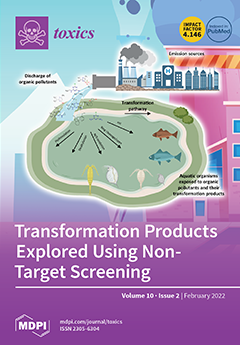
Cover Story: The occurrence of transformation products (TPs) of emerging pollutants has been of potential concern in aquatic environments. Nonetheless, it is unclear how TPs are formed and affect organisms in aquatic ecosystem. Thanking to recent advances in analytics and biotechnology, identification of TPs and their formation mechanisms can be explored by non-target screening (NTS) using high-resolution mass spectrometry (HRMS) and in vivo/vitro bioassay using model organisms. In this review, recent progress in TP research including their exposure and effect assessments is summarized. In particular, the review covers prospective research efforts on TP, such as identification of the products using NTS, and assessment of potential risk. View this paper
  • Issues are regarded as officially published after their release is announced to the table of contents alert mailing list .
  • You may sign up for email alerts to receive table of contents of newly released issues.
  • PDF is the official format for papers published in both, html and pdf forms. To view the papers in pdf format, click on the "PDF Full-text" link, and use the free Adobe Reader to open them.

Articles (58)

  • Article
  • Open Access
17 Citations
3,522 Views
11 Pages

Effect of Combined Soil Amendment on Immobilization of Bioavailable As and Pb in Paddy Soil

  • Young-Kyu Hong,
  • Jin-Wook Kim,
  • Sang-Phil Lee,
  • Jae-E. Yang and
  • Sung-Chul Kim

16 February 2022

Heavy metal pollution in soil can have detrimental effects on soil ecosystems and human health. In situ remediation techniques are widely used to reduce the bioavailable fractions of heavy metals in soil. The main objective of this study was to exami...

  • Review
  • Open Access
4 Citations
9,297 Views
24 Pages

16 February 2022

Lower urinary tract dysfunction (LUTD) is nearly ubiquitous in men of advancing age and exerts substantial physical, mental, social, and financial costs to society. While a large body of research is focused on the molecular, genetic, and epigenetic u...

  • Article
  • Open Access
4 Citations
3,516 Views
12 Pages

15 February 2022

E-cigarette, or vaping, product use–associated lung injury (EVALI) outbreak was linked to vitamin E acetate (VEA) used as a solvent for tetrahydrocannabinol (THC). Several studies were conducted to assess the products of VEA (and THC/VEA mixtur...

  • Feature Paper
  • Article
  • Open Access
24 Citations
4,354 Views
13 Pages

Uptake, Elimination and Effects of Cosmetic Microbeads on the Freshwater Gastropod Biomphalaria glabrata

  • Ying Wang,
  • Alice Baynes,
  • Kofi O. Renner,
  • Mingxing Zhang,
  • Mark D. Scrimshaw and
  • Edwin J. Routledge

14 February 2022

The presence of plastic cosmetic microbeads in the environment due to their extensive use in society and inevitable dispersal into wastewater is concerning. Therefore, it is vital to understand the processes of microplastic uptake and elimination by...

  • Article
  • Open Access
6 Citations
3,293 Views
13 Pages

Bisphenol A-Related Effects on Bone Morphology and Biomechanical Properties in an Animal Model

  • Tobias Prasse,
  • Ioannis Stratos,
  • Anja Niehoff,
  • Hildegard Christ,
  • Vincent Heck,
  • Carolin Meyer and
  • Thomas Mittlmeier

14 February 2022

Bisphenol A (BPA), which is contained in numerous plastic products, is known to act as an endocrine-disruptive, toxic, and carcinogenic chemical. This experimental series sought to determine the influence of BPA exposure on the femoral bone architect...

  • Feature Paper
  • Article
  • Open Access
12 Citations
3,649 Views
20 Pages

14 February 2022

The use of pesticides presents a risk to terrestrial and aquatic ecosystems. For this reason, the development of strategies to prevent and restore pollution is of the greatest interest, including the adsorption to organic matter. The aim of the prese...

  • Article
  • Open Access
11 Citations
3,949 Views
19 Pages

12 February 2022

Waste electrical and electronic equipment (WEEE) management in Port Harcourt, an oil-producing city in Nigeria, has become an environmental challenge for the location. WEEE recycling is predominantly managed by informal recyclers, who lack the skills...

  • Article
  • Open Access
11 Citations
3,082 Views
13 Pages

10 February 2022

Metal pharmaceutical residues often represent emerging toxic pollutants of the aquatic environment, as wastewater treatment plants do not sufficiently remove these compounds. Recently, vanadium (V) derivatives have been considered as potential therap...

  • Article
  • Open Access
4 Citations
3,124 Views
10 Pages

Toxicokinetics of Chromium in Enchytraeus crypticus (Oligochaeta)

  • Fátima C. F. Santos,
  • Rudo A. Verweij,
  • Cornelis A. M. van Gestel and
  • Mónica J. B. Amorim

9 February 2022

Chromium is naturally occurring, but emission from anthropogenic sources can lead to increased soil concentrations. Information on its toxicokinetics is essential in order to understand the time needed to reach toxicity and the mechanisms of uptake/e...

  • Article
  • Open Access
32 Citations
4,382 Views
10 Pages

Environmental Risk Assessment of Oxaliplatin Exposure on Early Life Stages of Zebrafish (Danio rerio)

  • Davide Di Paola,
  • Fabiano Capparucci,
  • Jessica Maria Abbate,
  • Marika Cordaro,
  • Rosalia Crupi,
  • Rosalba Siracusa,
  • Ramona D’Amico,
  • Roberta Fusco,
  • Tiziana Genovese and
  • Daniela Impellizzeri
  • + 4 authors

9 February 2022

Pharmaceuticals are actually identified as a threat to the ecosystem. Nowadays, the growing consumption of antineoplastic agents has been related to their continuous input in natural environments. These substances can interfere with physiological and...

of 6

Get Alerted

Add your email address to receive forthcoming issues of this journal.

XFacebookLinkedIn
Toxics - ISSN 2305-6304